Brows by G was established in 2015 as a brow bar and permanent makeup clinic by beauty artist Giovanna Minenna.
The beauty concept specializes in microblading, micropigmentation, shaping, tinting, waxing, and makeup services. The first salon opened at 1682 Grant Ave. at Lindsay St. in Winnipeg’s South River Heights area. Director and CFO Scott Russell notes that a second location will open at 160 Provencher Blvd. in Winnipeg shortly. He adds that growth is in the company’s plans with franchised studios and he is looking very closely at the Western Canada market, the Calgary, Edmonton, Saskatoon and Vancouver markets, for the next locations beginning with Calgary.
Image: Brows by G
“Our ideal space is a ground-level, salon-type space with large windows in the front,” he said. “As we would require procedure rooms as well as an open salon area, we would be looking for 1800 to 2200 square foot units. Location would be in a popular area for shops and salons with a fairly affluent population. Ease of parking is an important factor as our procedures can range from a short 20-minute appointment to 3-plus hours for more intensive micro pigmentation/ restoration appointments.”
Brows by G prefers to be near other health/wellness tenants as well as medical, dental, chiropractors, massage services, etc. In addition, being near specialty fashion and upscale home stores is preferred. The units are corporately owned and the unit is staffed by teams of trained specialists and technicians.
Last year, Brows by G associated with MC College Group Inc. to provide its Microblading Technician Training Program in the campuses in Western Canada.
Minimalist Japanese retailer MUJI has just announced that it will open a store in April of this year at CF Richmond Centre in suburban Vancouver. It will be the third store in the Vancouver Area for MUJI, and the eighth in Canada when it opens.
Japanese retailer UNIQLO also just announced that it will open this spring at CF Richmond Centre in an 8,010 square foot retail space, as per the floor plan above.
MUJI entered Vancouver for the first time last year when it unveiled a 7,770 square foot space to massive crowds in August of 2017 at Metropolis at Metrotown in Burnaby. An impressive 14,507 square foot store opened on Robson Street in Vancouver in December of 2017, making the store MUJI’s largest outside of Asia.
That downtown Toronto store, located at the Atrium, was MUJI’s first in Canada when it opened in November 2014. Its second Canadian location, spanning 5,225 square feet, opened at Mississauga’s Square One in November of 2015, followed by the October 2016 opening at Toronto’s Yorkdale Shopping Centre (6,375 square feet) and the Summer 2017 debut of a 6,000 square foot space at CF Markville, north of Toronto.
In an interview last year, MUJI’s Canadian President, Toru Akita, said that he expected MUJI to operate between 15 and 20 stores in Canada by the year 2020. Given its accelerated pace of openings, this goal would appear to be achievable.
Award-winning retail and real estate strategist Emily Salsbury-Deveaux has launched a new and unique micro-brand concept in North America’s largest shopping centre.
RAAS is a unique permanent pop up location that offers the opportunity to shop and support emerging brands from Canada. Many of the businesses are designers, curators, and unique food concepts.
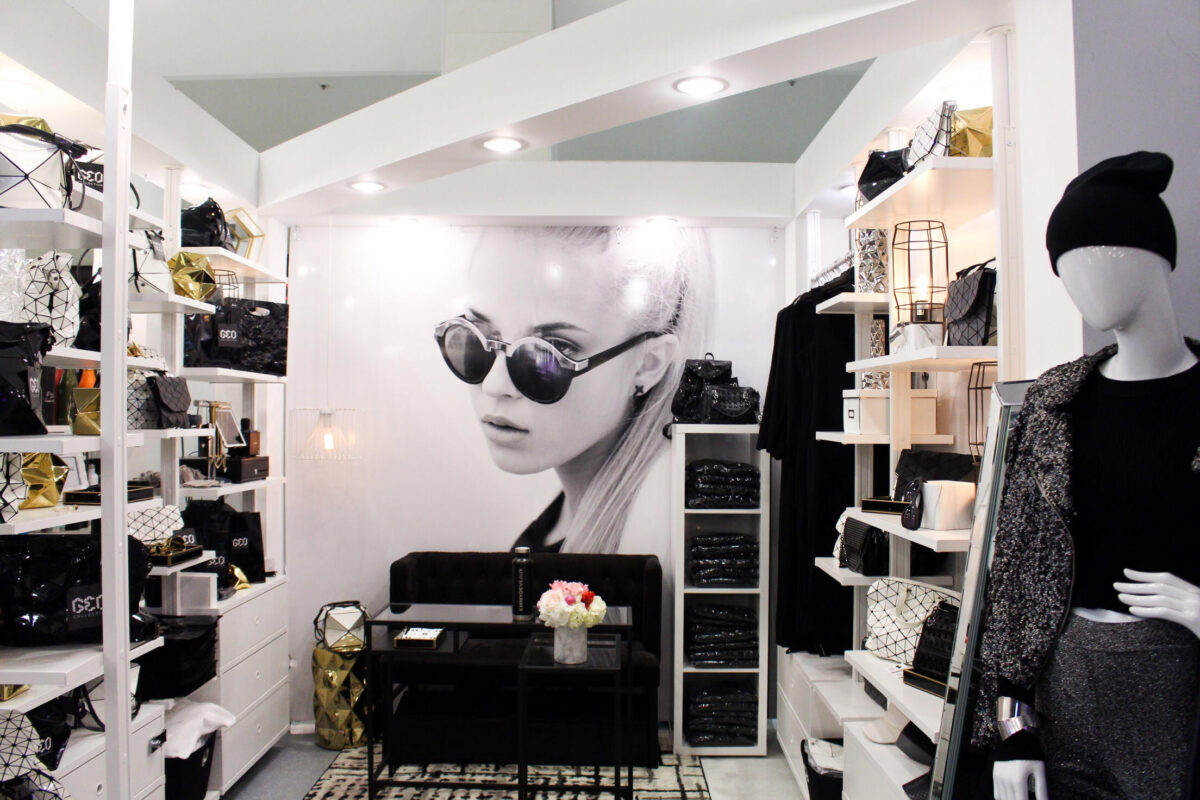
Salsbury-Deveaux is founder of EMMYDEVEAUX Industries Corp., which owns several different micro-brands including The Geo Collection, Obnoxious Youth, and five others that are in the pipeline. The new fashion label is called EMMYDEVEAUX.
“With the growing vacancy level in shopping centres, I saw it as an opportunity to look at incoming trends and make smaller brands out of it,” said Salsbury-Deveaux.
The Geo Collection is the first in her unique concept of retail. The idea is simple. Open up a store on a short-term lease. See how successful it is. And if it does well then it can potentially go into other vacancies in other malls.
“The whole idea is that they’re short-term trends that will come and go quite quickly but in the meantime they will fill vacancies and attract an audience that’s looking for those products, the collections are well curated and well branded,” said Salsbury-Deveaux, who has been working as a consultant in retail & real estate in Canada for 18 years.
“I believe that brick and mortar is thriving, enough that I’m putting my own money into opening stores. Retailers are still growing, just right now many are closing and that creates a more attractive narrative for the media. RAAS is an opportunity for companies like mine to be able to test the market and these micro-brands. To be able to open a short-term product line where I can test the success of it and then move it into other malls if it does well,” she said.
Image: EMMYDEVEAUX
Salsbury-Deveaux has developed a reputation for her unique strategy and her ability to increase profitability for her clients. Her work includes restructuring, revitalization, expansion, branding, market research, investment, acquisition, and culture/people.
She has worked as a consultant with major retailers around the world and has extensive shopping centre experience.
In 2013, she joined the School of Retailing at the University of Alberta’s School of Business as a consultant. She is currently the school’s Executive Director and is responsible for notable projects like RETAILWEEK and SOR|CG (School of Retailing Consulting Group) — the largest student consulting company in Canada. She is currently planning the upcoming retail conference at West Edmonton Mall on March 9th (website: tlc18.ca)
Salsbury-Deveaux saw RAAS as an opportunity where she could open up a store and sell products and also test her clothing line. She believes strongly in the vision for micro-retail created by Mark Ghermezian. “He has an impressive ability to attract the right community of businesses, meaning that we all help each other grow,” she said.
The Geo Collection focuses on the trend of minimalism, geometric accents, and gold tones. A three-month lease at RAAS was an ideal solution where a limited quantity of items were brought in for sale and over the course of the three months the store will transition to clothing. Longer leases are available for this creative initiative that is both in Mall of America and West Edmonton Mall.
Image: EMMYDEVEAUX
“We have the ability with my global team to bring in short-term brands very quickly,” said Salsbury-Deveaux. “This whole idea of bringing in a short-term brand that’s limited edition, limited quantity and after our three-month lease is up we could change the location into something else. We are just going to keep bringing in short-term brands. In my opinion, that’s how fast retail is going. Products need to turnover quicker to retain customer attention but fast fashion is a dangerous business if you want to do retail long-term.”
All of her other brands are currently in the online testing phase. “It is important that we are also testing the digital space. Emerging brands need to ensure they are able to service customers from every angle,” she said.
“In three months (The Geo Collection) will get changed over to another concept that we’re building. So we’re just going to keep building micro concepts and testing them online and if we think that one has the potential we’re going to open up a store with it,” said Salsbury-Deveaux.
West Edmonton Mall RAAS (PHOTO: WEST EDMONTON MALL)
“The reason RAAS is an important piece of this formula is that I’m able to open there, start building a customer base, build a brand, build the social media, make sales and be able to have sales data and feedback from customers . . . What we’re trying to do is figure out if we can test some of these brands that can potentially fill those vacant spaces for shopping centres while they look for permanent tenants.”
“It’s really important for me to try and find a solution because over the next couple of years, we are going to see significant closures. We’re going to lose a lot of retailers. So if we can build micro-trends based on what’s coming out of other parts of the world but not focused on long-term brands we’re able to capture audiences and to capture traffic for a short amount of time but then able to create that return visitor by changing over the brands constantly.”
“When you come to West Edmonton Mall on a Saturday and don’t have a hard time finding a parking spot….that is when I will start to worry about retail. So far every mall in this city is packed”
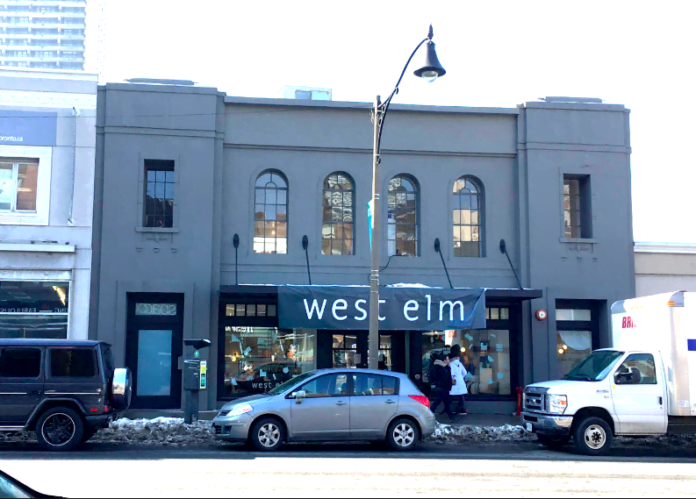
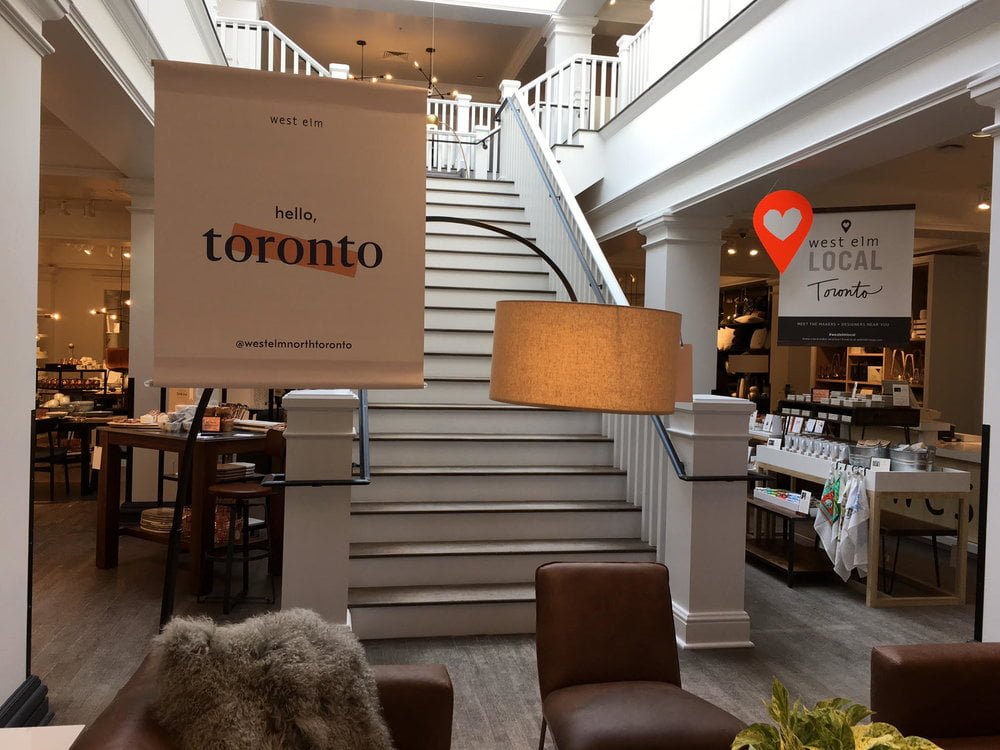
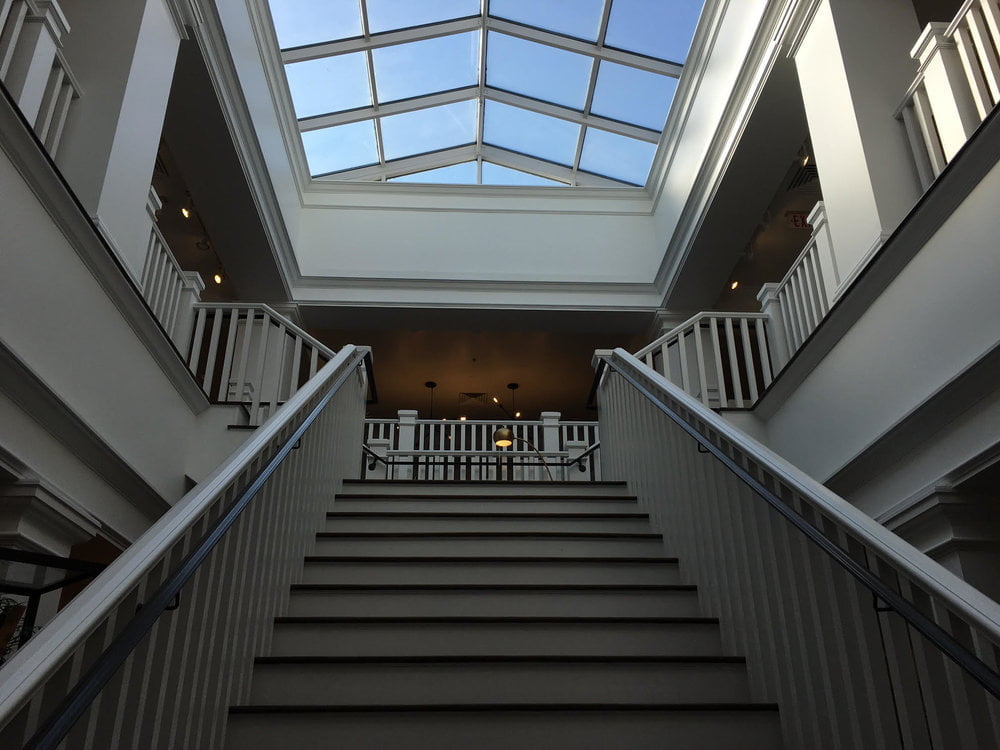
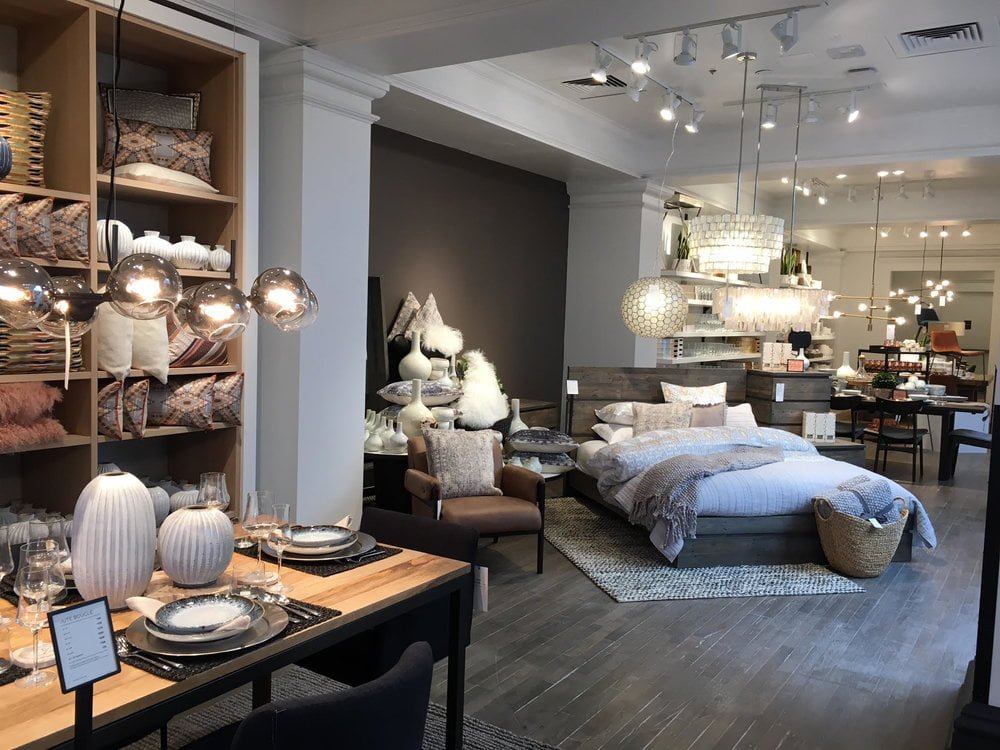
Popular upscale furniture and housewares retailer West Elm is expanding its Canadian footprint with a new location in Toronto that opens to the public on the morning of Thursday, February 15. The store is West Elm’s sixth in Canada, and second in Toronto, and includes several unique features not found in its other locations.
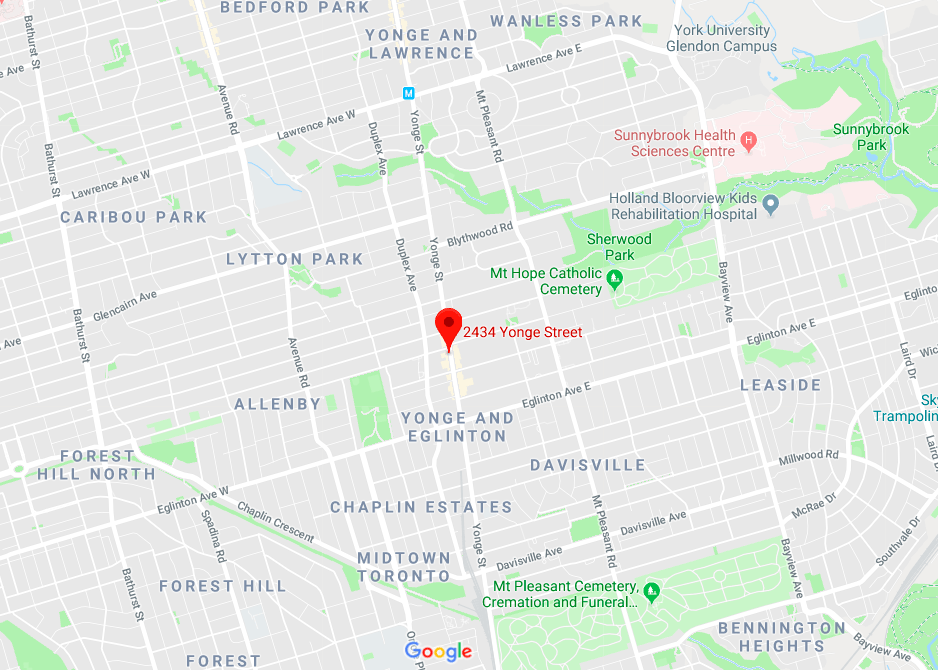
The two-level, 16,295 square foot store is located at 2434 Yonge Street, about two blocks north of the busy Yonge-Eglinton intersection. The area is seeing several new residential towers being built as thousands more people move into the rapidly changing area. Some of Canada’s wealthiest postal codes are located nearby, in neighbourhoods such as Forest Hill and Lawrence Park.
The store features a range of home furnishings from designers for every room in the home, and also offers Williams-Sonoma’s cross-brand design consultation program Design Crew, which pairs customers with experts who can provide design and installation services.
The store features a range of home furnishings from designers for every room in the home, and also offers Williams-Sonoma’s cross-brand design consultation program Design Crew, which pairs customers with experts who can provide design and installation services.
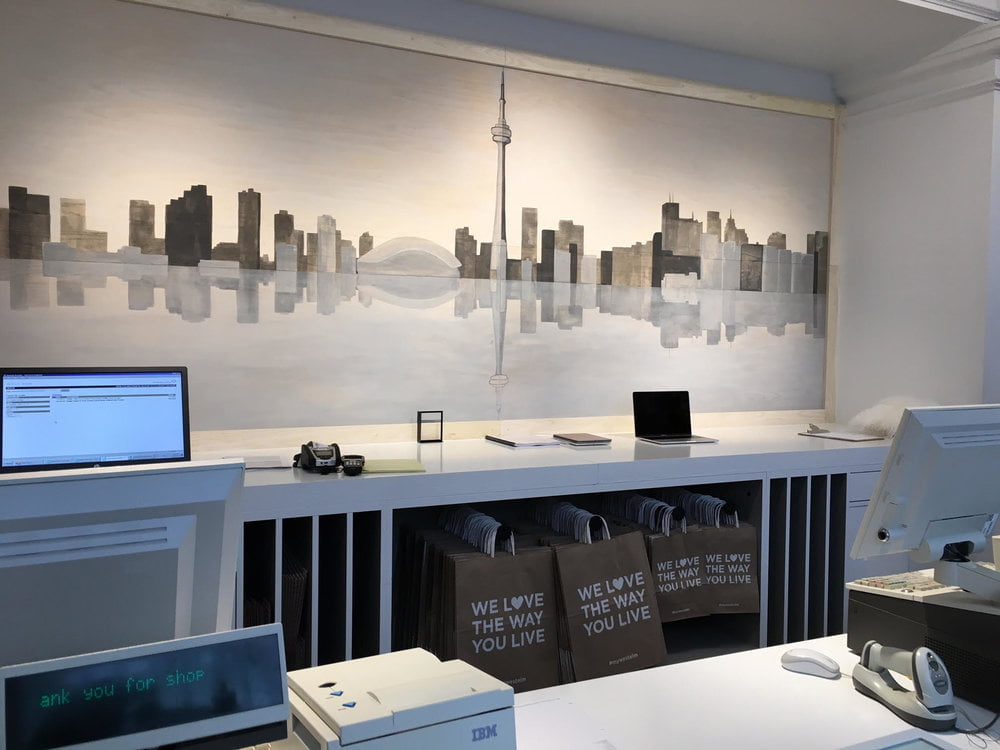
The new Toronto West Elm includes considerable ‘localization’ in terms of both its product offerings as well as interior design. The store supports seven Toronto-based makers and designers, offering customers an array of locally made products alongside the brand’s assortment of home furnishings and décor. The store’s main-floor cash-wrap area includes a hand-painted art panel of the Toronto skyline as seen from the water, including modern as well as historical buildings. A mirror image of the skyline sits beneath it in front of the cash-wrap, paying homage to Lake Ontario.
West Elm has partnered with American sleep brand Leesa, which now supplies mattresses and related products to West Elm’s Canadian stores. Leesa mattresses include a three-layer construction including memory foam — and the company donates one mattress to a non-profit for every 10 mattresses sold (West Elm also says that they’re very comfortable).
West Elm was founded by parent company Williams-Sonoma in New York City in 2002. It retails a variety of housewares, from large furniture pieces to small gift items. It currently operates more than 100 stores as well as e-commerce websites in the United States as well as in Australia, the United Kingdom and Canada— as well as unaffiliated franchisees that operate stores in the Middle East, Philippines and South Korea, and stores and e-commerce websites in Mexico.
In Canada, West Elm operates a large location in Toronto’s Shops at King Liberty, a store at 995 Rue Wellington in Montreal, and separate West Elm and West Elm Market locations on Vancouver’s tony South Granville strip. The Toronto store opened in October of 2008, Vancouver in September of 2012, and Montreal in June of 2013. Most recently, in the summer of 2015, West Elm opened at Calgary’s Mount Royal Village shopping centre.
Retail Innovation: Must-Attend Executive Development Program, Spring 2018
A new program at Saint Mary’s University in Halifax is designed to provide leaders with the skills, tools and insights to stay ahead of the curve in the rapidly, ever-changing retail landscape.
Instead of wondering what the future has in store, the program helps leaders proactively shape that future.
Dr. Ramesh Venkat is the director of the David Sobey Centre for Innovation in Retailing and Services and an Associate Professor of Marketing with the Sobey School of Business at Saint Mary’s University. In an interview, Dr. Venkat said the Retail Innovation, Strategy & Excellence program (RISE) is a response to the disruption happening in the retail environment. This disruption is driven by new technologies and business models, demographics, globalization, new ways of competing and new ways of taking product to market.
Retail Innovation: Must-Attend Executive Development Program, Spring 2018
He said retailers who are not able to respond to these disruptive forces are struggling. “Historically, retailers have been slow to react but that is changing,” said Venkat. “Retailers have to adapt and respond.”
“The program’s purpose is to have retailers prepare for this future – to help them become more creative and innovative so they can compete in this unprecedented environment.”
Venkat said the changing retail environment impacts all retailers no matter their size or what they’re selling. But for larger retailers, these changes are on a different scale.
“We take that into account. RISE is geared slightly towards medium to larger retailers, but it doesn’t preclude the participation of smaller companies,” he said.
“We expect participants will have some responsibility for innovation and change. It will be people who are focused on technology, focused on the customer experience, or on improving retail operations. There is opportunity for innovation within these areas. Anyone with the mandate or need to innovate and improve their business is a potential participant.”
Venkat said the program is unique — it doesn’t focus on day-to-day retail operations. It focuses on the big picture and strategic issues.
“It gets companies to think about the future . . . it’s an opportunity for executives to think about how they are going to prepare their organizations to compete effectively,” he said. “That’s what sets this program apart from other programs which tend to be more operationally-focused.”
The RISE program description says participants will gain knowledge, attitude and skills in a range of areas, which will enable them to plan for excellence in retail execution:
1. Understand the disruptive forces impacting the retail sector
2. Gain new perspectives into retail business models and innovation, and think about strategy through the lens of innovation
3. Demonstrate how to use data analytics to make evidence-based decisions, and improve retail operations and business performance
4. Learn frameworks and tools to build a customer-centric retail brand that incorporates digital strategies
5. Analyze strategic and operational retail challenges and formulate appropriate solutions
6. Develop greater personal awareness of leadership and decision-making style, and improve ability to work in, and lead teams
7. Identify and lead innovation and improvement opportunities
8. Develop both personal and company action plans focused on an innovation opportunity, which you can continue after the program
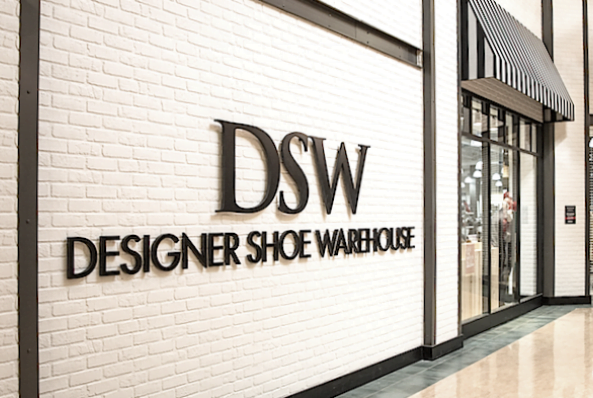
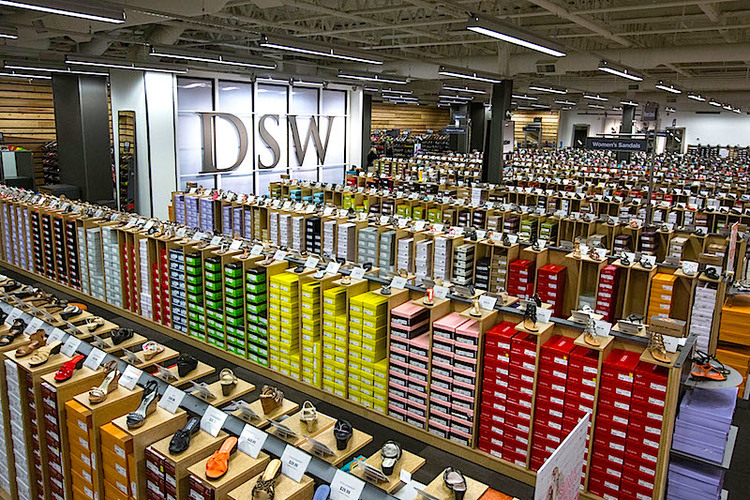
Popular off-price multi-brand American footwear retailer DSW Designer Shoe Warehouse has announced that it will be opening three stores in Canada this spring, bringing its Canadian store count to 27 units nationally. Of the three new locations, two stores will be located in Ontario, and one will be in suburban Edmonton — the Edmonton store will be in a centre that’s been somewhat secretive about its tenant mix until now.
All three stores will feature DSW Kids footwear and accessory departments, bringing the total number of stores with kids’ products to 17 in Canada. The new stores will also include about 1,500 square feet dedicated to women’s handbags, as DSW further grows its accessory business to compliment expansive off-price footwear offerings.
The two new Ontario locations will both open on March 1 of this year in suburban Toronto — one at Trinity Commons in Brampton, and another at RioCan Durham Centre. Both properties are owned and operated by RioCan REIT.
(Photo: DSW)
The Trinity Commons DSW store in Brampton will span about 25,000 square feet, according to lease plans provided by RioCan. DSW will join a 25,000 square foot Winners as well as a new 23,170 square foot Michaels store in a demised retail box that once housed a Target store — Target exited its Canadian operations entirely in the spring of 2015. Other anchors at Trinity Commons include the Home Depot, Canadian Tire, Metro and a Cineplex Silver City movie theatre, as well as several other anchors exceeding 20,000 square feet in the suburban big-box centre.
The Ajax store, located at RioCan Durham Centre, will measure about 20,000 square feet, according to a lease plan provided by RioCan. The store will be located between a Structube furniture store that will open soon, and a large PetSmart location. RioCan Durham Centre is also a significant big-box centre featuring large anchors such as Costco, Canadian Tire, Home Depot, Walmart, Canadian Tire and a Cineplex cinema, as well as several smaller anchors measuring 20,000 square feet or more.
[Premium Outlet Collection at Edmonton International Airport, opening May 2018. Rendering: Ivanhoé Cambridge]
The Edmonton DSW location will be at the highly anticipated Premium Outlet Collection — Edmonton International Airport, which opens to the public on May 2, 2018. DSW will occupy space ‘Anchor H’ according to plans, with the outlet centre having the address ‘1 Outlet Collection Way’.
The Premium Outlet Collection EIA has yet to release details on its other anchors and retailers, and is expected to make announcements closer to its official unveiling. A few retailers have confirmed that they will be opening at the centre, including Old Navy, Nike, Under Armour, ECCO and H&M, as well as at least two of TJX’s off-price brands. Nordstrom Rack and Saks OFF 5TH will not be opening at the outlet centre — Saks OFF 5TH has a store nearby at South Edmonton Common, and Nordstrom Rack will open (what will likely be its only Edmonton location) at South Edmonton Common in the fall of 2018.
When all three stores are open, DSW will have 27 store locations in Canada. DSW entered the Canadian market through a partial acquisition of Town Shoes Ltd, which operates banners Town Shoes, Shoe Warehouse and The Shoe Company. DSW’s first branded stores opened in the Toronto market in August of 2014, and DSW Inc. continues to have a 46.3% ownership in Town Shoes Limited.
(Image: DSW)
DSW has managed to open stores in many major markets in Canada — and even some smaller markets such as Victoria, Regina, Moncton and Halifax. The retailer has no stores in Quebec as of yet, however. The company’s expansion slowed in 2017 from its initially rapid expansion that began in 2014, though this spring 2018 announcement could be a sign that things are ramping up in terms of store openings. With the closure of Sears Canada, large-format retailers such as DSW now have more real estate options at more favourable lease rates, as landlords seek to repurpose vacated space.
In the United States, DSW boasts 511 store locations in 43 states with more than 12,000 employees. The company was founded in 1969 as Shonac Corporation (a shoe licensee for Value City) and its first standalone DSW store opened in Dublin, Ohio, in July of 1991. The company continues to expand domestically as well as internationally, including opening partner stores in the Middle East.
Craig Patterson, now based in Toronto, is the founder and Editor-in-Chief Retail Insider. He’s also a retail and real estate consultant, retail tour guide and public speaker.
The brand’s second Canadian storefront — the first to feature a cafe — is nearly triple the size of the first Canadian location that opened in the spring.
The Montreal-based fashion retailer, operating Dynamite and Garage banners, will restructure its operations for the digital age which has been accelerated by COVID-19.
A key goal of legalizing recreational cannabis is squeezing out illegal suppliers. But how competitive will legal cannabis retailing be against established black markets?
That’s a key question for federal and provincial politicians. Governments don’t like pot consumers funding organized crime.
To answer the question, consider the “four Ps” that marketers work with in every industry. Those are the product characteristics, price charged, place where sold and promotion activity. From this viewpoint, legal vendors have some potential advantages. But they face major challenges under current government plans.
Pricing challenges
Price is the competitive element politicians mention most. In Colorado, cheap legal cannabis means black markets control only 20 per cent of state sales. But in Washington state, where prices are higher, black markets capture 50 per cent.
In Canada, governments agree cannabis prices must be competitive. They’ve suggested $10 per gram, including excise and sales taxes.
Meanwhile, most provinces lack confirmed supplies, so they risk product shortages initially. Growers might prefer exporting their limited stocks to Germany’s higher-priced medical cannabis market.
Provincial governments could face awkward choices. If they price high to cover costs, they’ll be uncompetitive. If they price low to compete, taxpayers may end up subsidizing drug users.
Other pricing questions remain unanswered. Will all products share the same price? Or will prices differ by brand? Will each retailer set their own prices?
Retailers lack convenience
The places cannabis is sold also affect competitiveness. The western provinces will allow private-sector retailers. Ontario and its eastern counterparts are keeping retail in the public sector.
The public-sector plans lack convenience due to limited store numbers. That aids the black market.
For example, Ontario plans 150 outlets by 2020. That’s only one per 95,000 people, about as common as Walmart. It’s enough for planned shopping trips, but not for consumers who have unexpectedly run out.
By contrast, Ontario has 2,067 locations selling alcoholic beverages: One per 7,000 people. Those include liquor agency outlets, beer stores and wineries.
Private stores out West will likely be more numerous. But they’re banned from selling alcohol or tobacco. That specialization will restrict retailers’ revenue sources and the number of viable stores.
Provincial plans have barely mentioned on-site consumption. Countless bars and restaurants serve alcohol drinkers. Licensed cannabis “lounges” similarly could serve cannabis users, especially renters in non-smoking buildings and American tourists. Otherwise, those groups may stick with black markets.
Product advantages
Consumers can’t evaluate cannabis products without smoking them. The cannabidiol (CBD) and tetrahydrocannabinol (THC) concentrations vary greatly. Consumers also can’t detect contaminants like pesticides and mould.
Quality-assurance measures therefore could give legal cannabis products a competitive edge. Each province except Saskatchewan plans a single public-sector wholesaler. That centralization will facilitate large-scale testing.
Consider Ontario’s liquor agency. Its Quality Assurance Lab examined 28,000 beverages last year, rejecting 11 per cent.
Quality assurance, combined with recognizable brand names, would help products develop performance reputations. Some may offer a mild buzz, others a powerful high. Consumers could learn to rely on consistently performing brands, instead of unpredictable street weed.
Some critics even want plain packages, to discourage cannabis adoption. But that would make it harder for growers to establish reputations, neutralizing a key advantage over illicit products.
It would also reduce growers’ incentive to boost quality, especially if prices are fixed. As near generics, they’d instead try to lower production costs. Or perhaps hike THC numbers to stand out. Should we encourage cheaper, stronger pot?
The lack of edibles, like brownies and beverages, is a glaring gap. Ottawa won’t legalize those for another year. Unlawful suppliers keep market control until then.
Promotion limits
Federal rules also limit promotional activity. “Informational” ads are OK. But no evoking emotions, and no lifestyle depictions involving recreation or excitement.
Those clauses undermine legal cannabis’ competitiveness. Good ads evoke emotions. Lifestyle images explain complex products simply. And isn’t this law about “recreational” use? Growers consequently have proposed more flexible rules.
Because federal law prohibits self-service, sales staff will be important. Store ownership may matter here. Public-sector staff might be better at consumer education and harm reduction. Private-sector sellers may respond better to customer preferences and market trends.
Regarding in-store promotion, New Brunswick will display products under glass. Consumers will see packaging, read labels and visually compare products.
But Ontario wants things “similar to how tobacco is now sold.” That implies customers won’t see or touch products before purchase. It’ll be tough for consumers to develop preferences, and for growers to build reputations. That further weakens legal products’ competitiveness.
Prognosis is mixed
Overall, governments’ retailing prospects look mixed. Legal cannabis could stand out on product quality if growers earn reliable reputations. But edibles remain absent for now. Promotion could give legal cannabis another edge, if governments loosen up the rules.
Black markets will initially out-compete the provinces with convenient places. That will decrease over time, especially out West. But it won’t disappear without legalized lounges. Illegal vendors may always have some price advantage. Provinces can minimize that by forgoing profits.
Michael J. Armstrong is an Associate professor of operations research, Goodman School of Business, Brock University. He teaches courses on quality improvement, game theory, and operations management. He holds a PhD in management science from the University of British Columbia, an MBA from the University of Ottawa, and a BSc from the Royal Military College of Canada. Before his academic career, Armstrong was an aircraft maintenance manager. He holds several certifications from the American Society for Quality, including a six sigma black belt in quality improvement.
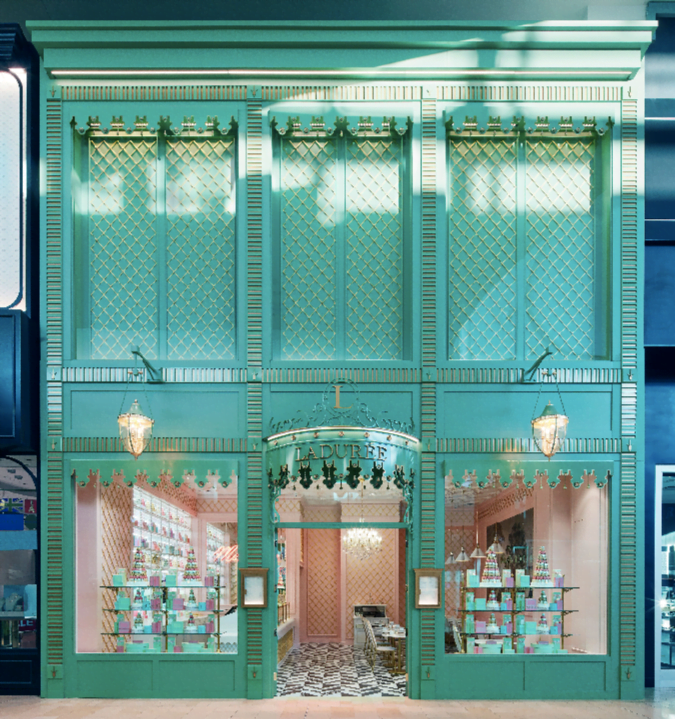
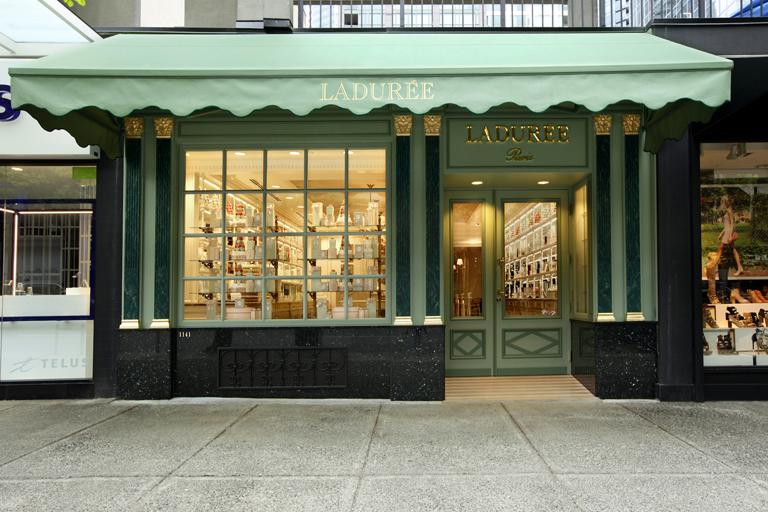
When French luxury bakery and sweets maker Ladurée opened its first Canadian location in Vancouver in the spring of 2016, there were lineups for weeks along Robson Street. That prompted a second Vancouver location to open inside of Holt Renfrew in the spring of 2017. In December of 2017, Toronto’s first Ladurée also saw lineups when it opened at Yorkdale Shopping Centre. To mark Ladurée’s entry into the Toronto market, Ladurée’s President David Holder visited the Yorkdale location last week along with Canadian licensee partner Olesya Krakhmalyova, store designer Claudia Ravnbo, and other attendees including dignitaries such as the Consul General of France in Toronto, Marc Trouyet.
Yorkdale’s Ladurée opened in DECEMBER of 2017.
It was David Holder’s first visit to Toronto, and we sat down with him to discuss Ladurée’s Canadian operations, including plans for the future. He says that we might expect to see more Ladurée locations in Canada, as well as a pastry bakery that will open in Vancouver this spring, followed by a Toronto bakery about a year later.
Vancouver was chosen for Ladurée’s first two Canadian locations, in part, because local licensee Olesya Krakhmalyova is a resident of Vancouver. With her knowledge of the city, and working in partnership with brokers Mario Negris and Martin Moriarty of CBRE in Vancouver, Ladurée selected popular Robson Street for its first store. Ladurée has “a new Canadian family,” Mr. Holder said, and the company is now on a journey to educate itself on the rest of the country in order to determine where other locations could open.
Robson Street location in Vancouver.
[Below: Videos of Ms. Krakhmalyova introducing Mr. Holder]
The Toronto market is large and the Yorkdale salon is rather small, spanning not even 1,200 square feet on one level. Mr. Holder said that the Yorkdale location is something of a ‘teaser’ to the Toronto market, and that the company could look to opening something a bit larger closer to, or in the downtown core. When Ladurée opened its first location in New York City, for example, it was only about 700 square feet — that was followed by a considerably larger Soho location measuring about 4,000 square feet.
Targeted locations could include the Bloor-Yorkville area, as well as something closer to the city’s thriving Financial District. Yorkville, he explained, features a European-like scale of low-rise commercial buildings with character — if Ladurée were to locate there, it might seek space with exterior patio seating for warmer weather. Yorkville is also known to be an affluent neighbourhood that is growing quickly, with luxury stores and condo towers being added with no end in sight.
If Ladurée were to locate in or near Toronto’s Financial District, it might take on a more ‘masculine’ look, according to Mr. Holder. Ladurée’s Yorkdale location includes liberal use of the colour pink, creating somewhat of a more feminine aesthetic. Mr. Holder pointed out that Ladurée is being open minded by opening locations that are unique, describing a future Mexico City location that will feature a restaurant, rooftop bar, and a 3-4 room boutique hotel.
Ladurée is also looking to expand its ‘Ladurée Picnic‘ grab-and-go concept, and Toronto’s Financial District could work for that as well, he said. Ladurée Picnic currently has one location in Paris, and London’s core will be next, he noted.
While finding street-level space in Toronto’s Financial District could be a challenge to Ladurée, it has options nearby. The charming St. Lawrence Market neighbourhood is located directly to the east, and the Entertainment District is to the west. The stretch of Queen Street West near the TTC Osgoode station could also be an option, given its proximity to the Financial District as well as to the Toronto International Film Festival, CTV Studios, art galleries, museums, sports facilities and other attractions.
As part of the endeavour to grow its Canadian operations, Mr. Holder said that the company might look to Montreal to open a Ladurée salon. This could be done through a local partner that knows the area — he explained that Ladurée will be calculated and careful with its expansion in Canada, and that it’s not in a rush to open too many locations at once. He also said that the company doesn’t necessarily have a goal as to the number of locations that it might open in Canada — much of it will be based on opportunity.
Ladurée is expanding its offerings in Canada, made possible by opening a dedicated bakery space in Vancouver to provide both of Ladurée’s Vancouver locations with fresh baked pastries. The bakery will be off-site and outside of the downtown core, where real estate is a bit less constricted, not to mention not as pricey. Expected to open this spring, the Vancouver ‘pastry laboratory’ kitchen includes a seasoned pastry chef who is moving to Vancouver specifically for the job. Mr. Holder explained that, as Ladurée’s operations expand further in Toronto, a bakery in the area would become necessary as well — that is, if a larger location with an on-site kitchen isn’t secured in the city’s core.
Designer Claudia Ravnbo discussed her vision for Toronto’s first Ladurée, which was the first in the world to reflect a new design aesthetic with an interior inspired by the colonial style of the 18th century. The pastel pink tea room is decorated with a white marble sales counter that is accentuated with gold lattice details and gold Lattice is also present on the walls of the salon. A Classic crystal chandelier contrasts with contemporary madeleine lights hanging from the ceilings, as well as the geometric marble tile flooring and velvet-accented furniture. The store’s soaring ceilings are dramatic with plaster ceiling treatments.
[Video: Ms. Ravnbo describes the Yorkdale location’s design, which is a first in the world for Ladurée]
Ladurée has a 500 square foot concession at Holt Renfrew in Vancouver, and it might not be the last in Canada, Mr. Holder noted. While there are no immediate plans for more Ladurée shop-in-stores, Mr. Holder said that he’s open to opportunities as they might present.
Mr. Holder said that the Toronto Ladurée is already a hit, and that the Vancouver locations are both strong performers. It speaks to the success of the brand in the eyes of consumers, which includes a diverse demographic — Mr. Holder explained how Ladurée is looking to not only cater to the refined tastes of an established clientele, but also to attract a new, younger consumer that desires fine food in a refined environment. Ultimately, Ladurée’s strategy is to cater to the tastes of local markets and as such, it will continue to educate itself on the Canadian market as it continues to expand.
The popular Dx3 conference is happening again next month in Toronto on March 7 and 8, and registration is now open. Dx3 has released an impressive roster of speakers from companies and brands including Amazon, Twitter, Google, Snapchat, Uber, Element AI, and others.
Dx3 is Canada’s largest digital marketing, retail and advertising conference, and the two-day event takes place at the Metro Toronto Convention Centre, conveniently located in the heart of the city.
“Dx3 is about innovation, but also inspiration. Nowhere else in Canada will you find such a diverse collection of experts exploring so many unique and creative ways to reach the modern shopper,” said Eric Mercer, Director of Content for Dx3. “And this is only the beginning – we’re excited to share more incredible programming announcements in the lead-up to March 7 and 8.”
More than 60 exhibitors and 50 speakers will be featured at Dx3 2018. Sessions at the conference range from large-scale keynotes by industry thought-leaders to intimate hands-on deep dives and workshops. Keynote speakers will include:
–Tamir Bar-Haim, Country Manager, Amazon, who will discuss how Amazon’s customer-centric focus has driven their tremendous growth – and the learnings and takeaways from their success.
–Jeff Miller, Global Head of Creative Strategy, Snapchat, who will open the second day of Dx3 with a dynamic presentation on the changing nature of “creative”. The medium matters, Mr. Miller will argue, and delivering a compelling message to consumers where they are is a powerful tool for the modern marketer.
–Theresa McLaughlin, EVP & Global CMO, TD Bank Group, will conclude the first day of Dx3 with a discussion that will explore how to maximize the impact of the marketing discipline within any organization, from attracting the right talent to growing and developing internal teams to seamlessly integrating marketing with other key business functions.
–Demystifying AI — This fireside chat will feature Chris Laver, Distinguished Data Scientist, Machine Learning and AI, RBC Royal Bank, and Katy Yam of Element AI and will explore the role – today and in the future – of AI in the worlds of marketing and retail.
Dx3 wil also include a panel discussion, ‘Twitter bootcamp’ and creative workshop as follows:
-Panel Discussion: Women in Tech – Lessons I’d Teach My Younger Self: On International Women’s Day (Thursday, March 8), four female tech leaders – April Dunford from Sprintly, Kristy Bates from Uber, Mandy Gilbert from Creative Niche and Meagan Tanner from Google – will engage in a dialogue on their experiences, successes and challenges in the industry.
-Twitter Bootcamp: How to Build Award-Winning Campaigns: Leanne Gibson, Twitter’s Interim Managing Director, will share a ‘playbook’ of techniques on how to build better campaigns and stronger promotion on Twitter.
Beyond the Banner Ad: A Creative Workshop – Josh Hudson, Creative Director at Amazon, will lead an innovative, hands-on seminar targeted at marketing and advertising agencies. He’ll explore the topics of Amazon Alexa, Twitch, and AR.
Three recent developments should insure Amazon’s continued place as Canada’s largest e-commerce retailer. The first involves the company opening its seventh facility during 2018. The new 600,000 sq. ft. warehouse will be just north of Calgary. Currently the company operates warehouses in Ontario and British Columbia. The retailer also announced in mid-November 2017 that both its Alexa service and Echo devices were available to Canadians and that it was expanding its Prime Now service.
During the first half of 2017 Amazon Canada’s best selling apparel categories were men’s bottoms, women’s intimates and women’s denim.
Canada’s E-commerce Growth In Q3 2017 Exceeds That For The U.S.
Canadian retail e-commerce sales increased (y/y) by 33.4% during the third quarter of 2017. For the same period U.S. retail e-commerce sales increased 15.4%. During the third quarter e-commerce accounted for 2.4% of total Canadian retail sales vs. 9.1% in the United States.
Canada’s E-commerce Sales Were Highly Concentrated During 2016
A study released by Boston Consulting in the third quarter of 2017 revealed that six Canadian retailers accounted for an estimated 60% of the country’s total e-commerce sales during 2016. There is no reason to belief that the collective e-commerce share of these retailers will not have increased during 2017.
Walmart.ca Update
In an attempt to jump start its e-commerce sales Walmart Canada in the second half of 2017:
Added 30 third-party sellers to its Marketplace. It planned to quadruple the products available on its site by the end of 2017. The third-party sellers offer products ranging from apparel to sporting goods. The retailer plans to invite third party sellers currently on Walmart’s U.S. marketplace to join its Canadian marketplace.
Cancelled the C$2.97 fee it previously charged customers that ordered online for pick up at a Walmart Canada’s dedicated “online only grocery pick up parking spots”. Currently Walmart stores in Ottawa, the greater Toronto area, Calgary, and Edmonton offer online pick up, along with seven locations in the Greater Montreal area.
Walmart Canada’s e-commerce initiatives during the second half of 2017 should position it to better compete during 2018 with the e-commerce efforts of Amazon, Canadian Tire, Loblaws, Best Buy and Home Depot.
Four Canadian Companies IPO’s Call Out E-commerce Growth As A Growth Objective
Over the past 12 months, four Canadian apparel companies have gone public. Three of them, Aritzia, Roots and LXRandCo are retailers, while the fourth, Canada Goose, is basically an apparel manufacturer. One of the key growth strategies detailed in each company’s prospectus was doubling their e-commerce sales over the next four years. In 2016, e-commerce accounted for between 11.4% and 12.8% of three of the company’s sales. The fourth, LXRandCo, a retailer of vintage purses, has less name recognition, so it is not surprising that e-commerce only accounted for 5% of its sales during 2016.
Don’t Forget About The E-commerce Return Process
While Nafta apparel retailers have continued to refine their e -commerce prices and delivery processes, less attention has been paid by these same retailers to their process of handling e-commerce returns. The NRF reported that in the U.S., 30% of items bought online end up being returned, compared to 9% of items bought in a store. Optora, an ecommerce software company, has forecasted that between Dec. 26 and Jan. 31, 2018, 45% of American’s will try to return a gift. To date, no consensus among retailers has developed as to the optimum procedure for handling online return purchases. However, an in-person return to a store costs a retailer half the amount ($3) of a return sent to a distribution centre ($6). In store returns also allow a retailer to return the product faster to its inventory. Lastly, 62% of consumers prefer the option of returning their online purchases to a store, while 33.6% expect a full refund as opposed to store credit.
Recognizing the importance for consumers of having a stress-free return process, Amazon has expanded operations for in-person returns, with a network of 2,000 U.S. locker locations, including 400 at its Whole Food stores. Walmart and Target have also set up return kiosks in their stores. Truly, according to Tobin Moore, CEO of Optero, “Returns have become a battleground among online retail”.
E-commerce Increases 114% For LXRandCo In Q3 2017
LXRandCo, a Montreal based retailer of vintage purses and accessories, reported that its net revenue increased by 82% during the quarter ending September 30, 2017. For the same quarter, the retailer’s e-commerce sales increased by 114% and accounted for 4.1% of its net revenue vs. 3.5% a year earlier. The retailer recently indicated its Q4 2017 ecommerce sales increased 85%.
E-commerce Growth Slows For Two Canadian Specialty Apparel Retailers
The good news for Canadian apparel specialty retailers, Reitmans (Canada) Ltd. and Le Chateau was that their ecommerce sales during Q3 2017 increased at a rate significantly greater than their comp store sales. The disappointing news was that the rate of increase for both retailers ecommerce sales slowed significantly from a year earlier. Specifically in Q3 2017 the e-commerce sales of Reitmans increased by 29.7% while Le Chateau’s increased by 14.0%. Both retailer’s e-commerce sales a year before increased by 40.1% and 55.1% respectively.
During December 2017, Reitmans e-commerce sales increased by 20.9% vs. 60% during December 2016.
Indochino Steps Up Store Expansion
Canadian headquartered Indochino, which as of the end of December 2017 operated 19 showrooms, plans to open up to 18 new locations during 2018. Currently the made-to-measurement retailer operates 8 stores in Canada and eleven in the United States. During 2017 the retailer doubled its sales for the second consecutive year. This publication is speculating Indochino will float an IPO during 2018.
Roots Targets 20% Of 2019 Sales From E-commerce
Canadian outdoor apparel/footwear retailer, Roots, has set a goal, according to its CEO Jim Gabel, of securing 20%-22% of its sales from e-commerce by 2019. In 2016 E-commerce accounted for 12.8% of Roots’ sales. All of the retailers iconic extended size fleece is available only online.
Carter’s Canada — E-commerce Once Again Saves The Quarter
Carter’s Canada and Children’s Place Canada during the third quarter of 2017 saw their sales negatively affected by Gymboree Canada’s liquidation. However, in the case specifically of Carter’s Canada, Gymboree had seemingly little effect on the retailer/wholesale’s e-commerce sales, which increased by almost 61% during the quarter.
A New “App” Assists Simons In Ramping Up Its E-commerce Efforts
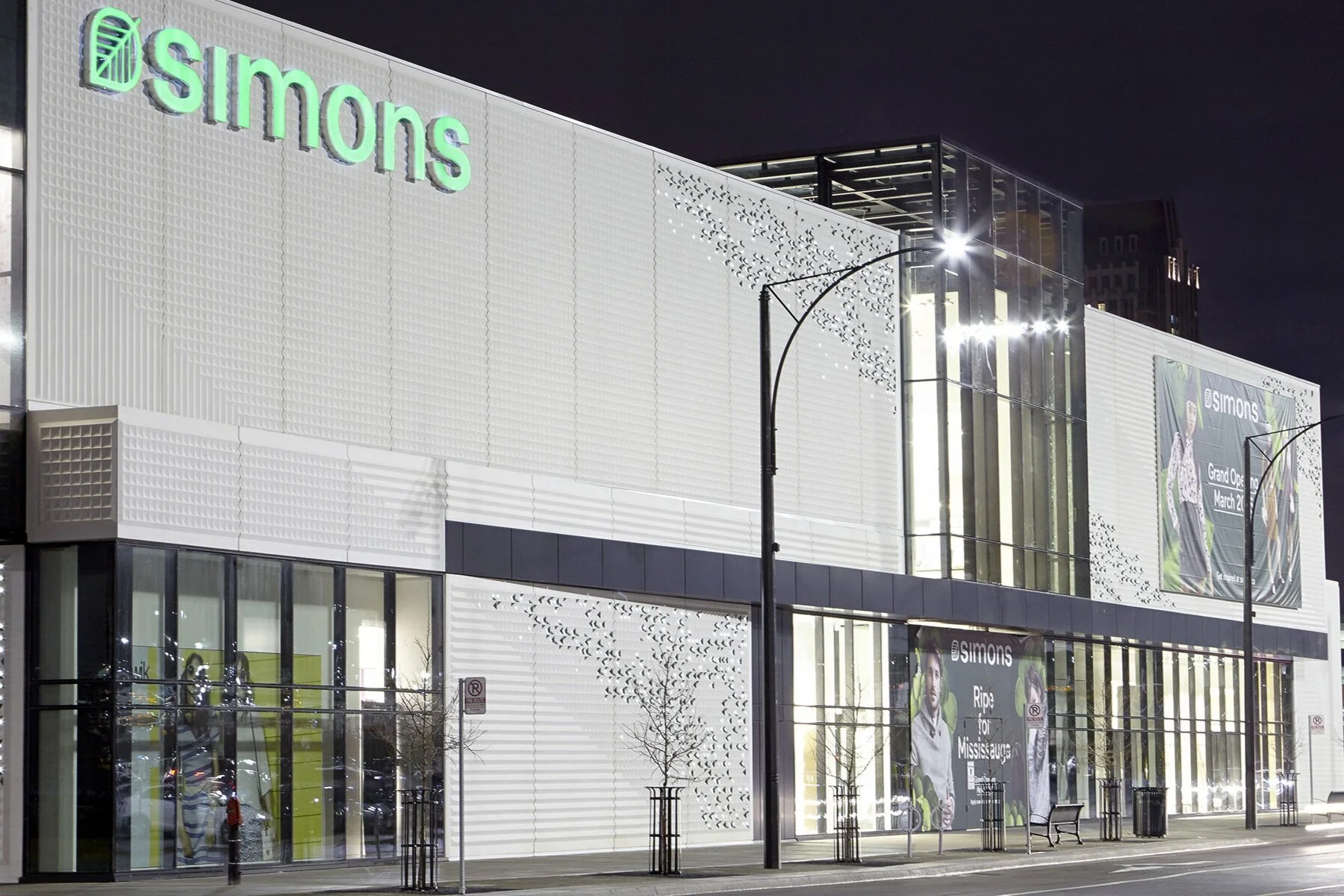
Quebec based Simons, with 15 stores across Canada, historically had an underdeveloped e-commerce business. Undoubtedly, this should rapidly change as the retailer in October 2017 introduced a new proprietary app. In addition to allowing a customer to shop and purchase online from the retailer, the app has two unique features. The first allows a user to snap a picture of an item and then search Simons’ inventory for a similar product. The second feature allows a Simons customer to have a truly omni-channel shopping experience, including determining/using their loyalty card’s point balance.
Industry watchers have indicated that early in 2018 Simons will begin construction of a highly automated distribution centre that will serve as a platform for its e-commerce business. In doing so, Simons will be emulating HBC, who in 2016 spent C$60 million to automate its Toronto e-commerce distribution centre.
This article has been excerpted from the current issue of Trendex’s NAFTA Apparel E-commerce Insights newsletter. For more information contact info@trendexna.com







![[Photo: DSW]](https://images.squarespace-cdn.com/content/v1/529fc0c0e4b088b079c3fb6d/1518566048227-1MOSL1VL02P7L6OM0HL1/ke17ZwdGBToddI8pDm48kAeBr0kHKQdd66zJiDasBntZw-zPPgdn4jUwVcJE1ZvWQUxwkmyExglNqGp0IvTJZamWLI2zvYWH8K3-s_4yszcp2ryTI0HqTOaaUohrI8PIMtjltb9syZbT0C3obJZTITKPnP2GZ5pjdFkJr9Duu9Y/download.png)

![[Premium Outlet Collection at Edmonton International Airport, opening May 2018. Rendering: Ivanhoé Cambridge]](https://images.squarespace-cdn.com/content/v1/529fc0c0e4b088b079c3fb6d/1518566204769-3RA5ZGGXP1953IUF2W0X/ke17ZwdGBToddI8pDm48kMND7jeswuafHVvShY_99gcUqsxRUqqbr1mOJYKfIPR7LoDQ9mXPOjoJoqy81S2I8N_N4V1vUb5AoIIIbLZhVYxCRW4BPu10St3TBAUQYVKchpefp9W4pNPIL6Jjfk5l04mRlM1-Bvry7juSXXVmpV7frbo4uXmeyQgEVTi6man6/Screen+Shot+2018-02-13+at+6.55.46+PM.png)





![Luxury Brand FENDI Opens 2 Boutiques in Montreal [Photos]](https://images.squarespace-cdn.com/content/v1/529fc0c0e4b088b079c3fb6d/1599662757364-IGKR2KN8OQQTC1EK8LOB/ke17ZwdGBToddI8pDm48kHH9S2ID7_bpupQnTdrPcoF7gQa3H78H3Y0txjaiv_0fDoOvxcdMmMKkDsyUqMSsMWxHk725yiiHCCLfrh8O1z4YTzHvnKhyp6Da-NYroOW3ZGjoBKy3azqku80C789l0nQwvinDXPV4EYh2MRzm-RRB5rUELEv7EY2n0AZOrEupxpSyqbqKSgmzcCPWV5WMiQ/IMG_7525.jpg)
![French Fashion Brand ‘ba&sh’ Opens Impressive Montreal Flagship Store [Photos]](https://images.squarespace-cdn.com/content/v1/529fc0c0e4b088b079c3fb6d/1599587845411-680MN62L6CF9D89L786P/ke17ZwdGBToddI8pDm48kHH9S2ID7_bpupQnTdrPcoF7gQa3H78H3Y0txjaiv_0fDoOvxcdMmMKkDsyUqMSsMWxHk725yiiHCCLfrh8O1z4YTzHvnKhyp6Da-NYroOW3ZGjoBKy3azqku80C789l0nQwvinDXPV4EYh2MRzm-RRB5rUELEv7EY2n0AZOrEupxpSyqbqKSgmzcCPWV5WMiQ/IMG_7351%2B%25281%2529.jpg)
![Away Luggage Expands into Canada with 1st Store [Photos]](https://images.squarespace-cdn.com/content/v1/529fc0c0e4b088b079c3fb6d/1599057644030-RLKEI9S58SZYX5DCYUZS/ke17ZwdGBToddI8pDm48kHH9S2ID7_bpupQnTdrPcoF7gQa3H78H3Y0txjaiv_0fDoOvxcdMmMKkDsyUqMSsMWxHk725yiiHCCLfrh8O1z4YTzHvnKhyp6Da-NYroOW3ZGjoBKy3azqku80C789l0nQwvinDXPV4EYh2MRzm-RRB5rUELEv7EY2n0AZOrEupxpSyqbqKSgmzcCPWV5WMiQ/IMG_6651.jpg)
![Samsung Expands Canadian Retail Operations with 1st Store in Quebec Market [Photos]](https://images.squarespace-cdn.com/content/v1/529fc0c0e4b088b079c3fb6d/1598282818108-MPQ6XU2BQOB6IM2T4TKG/ke17ZwdGBToddI8pDm48kFkrH-5tdugjw4EI8DIvnlFZw-zPPgdn4jUwVcJE1ZvWQUxwkmyExglNqGp0IvTJZamWLI2zvYWH8K3-s_4yszcp2ryTI0HqTOaaUohrI8PIE3gRuUo31qD9ipbhE5CC4vtWybflMTM2CDzsnOQ-lUYKMshLAGzx4R3EDFOm1kBS/Samsung_store_Montreal_facade.jpg)