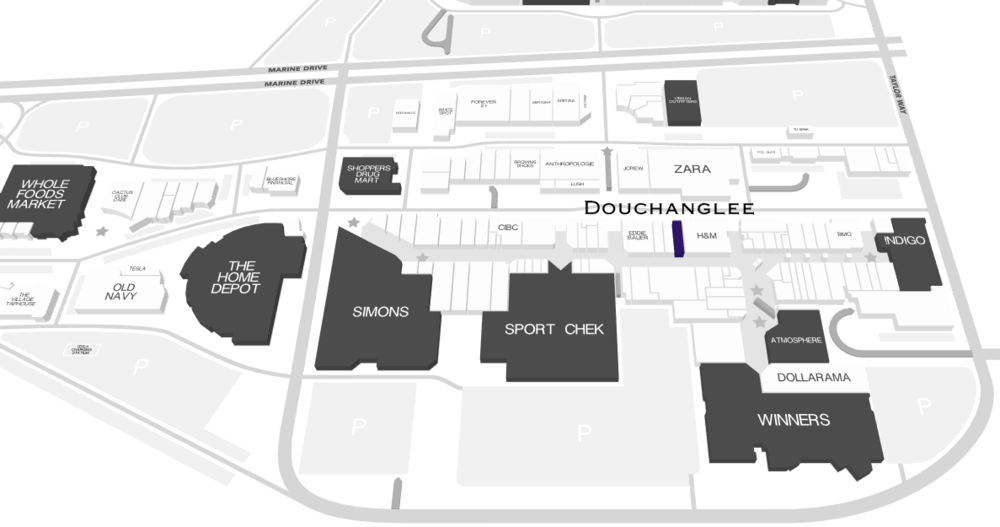
Taiwanese fashion brand DOUCHANGLEE will open its first Canadian location at West Vancouver’s Park Royal in March of this year. If all goes well, it could be the first of multiple Canadian stores.
DOUCHANGLEE currently operates several stores throughout Taiwan (5 boutiques, 9 department store ‘corners’ and 4 franchises), and will soon open in Paris, France. Canada is also part of the company’s international growth plan that is launching this year.
Canadian licensee Jack Wang explained how he wanted to bring DOUCHANGLEE to Canada after encouragement from his wife, who is a fan of the brand. He said that she found it challenging to find clothing from other brands in the Lower Mainland with a similar fit, quality and styling, prompting the entrepreneur to strike a deal with Taiwan’s DOUCHANGLEE to enter the Canadian market.
It helped that Mr. Wang and his family are friends with DOUCHANGLEE’s husband-wife design team, Dou Teng-huang and Zhang Li Yu-jing, who started the brand in 1995 (the name DOUCHANGLEE is a modified combination of their names). The designers graduated from the Department of Fashion Design at Taipei Shijiazhuang University in 1991 and during their studies, they won the first prize of the “4th ROC Fashion Design Newcomer Award” for Taiwan’s design industry. Plenty of other design awards followed.
DOUCHANGLEE designs women’s and men’s collections, and the Park Royal store will initially focus on womenswear. Prices are in the ‘contemporary’ price-point, along the same lines as Michael Kors and Kate Spade. The Park Royal store will span about 2,450 square feet on the ground level of Park Royal South, next to the recently relocated H&M.
The designers and models at a runway show.
Mr. Wang says that the Park Royal store could be the first of multiple locations for DOUCHANGLEE in Canada, though no other stores are currently in the works. The West Vancouver store will act as a test for future Canadian stores if the brand takes off, and he says he’s confident that locals will come to value the Taiwanese brand’s design and overall value proposition.
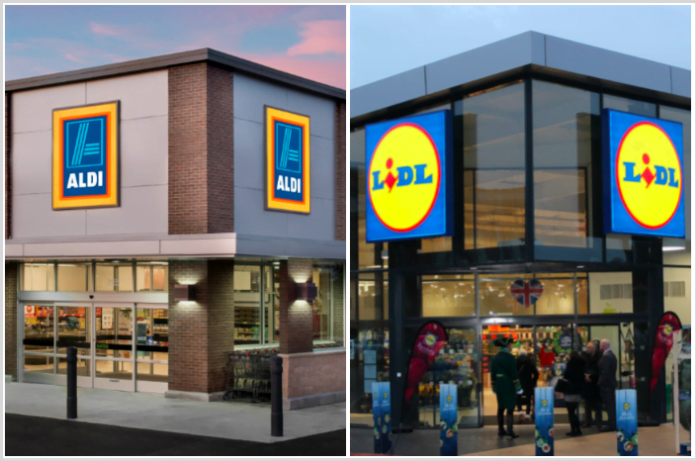
Amazon’s purchase of Whole Foods has stolen all the industry headlines over the past few months. The blockbuster deal has competitors, analysts and consultants making bold predictions on where, when and how consumers will buy their food in the years ahead. However, one grocery story in recent months that hasn’t gotten a lot of press is the arrival to the United States of German hard discounter Lidl.
In June, it opened 10 stores along the east coast, has plans for 80 stores by the middle of 2018, and is on its way to establishing more than 600 locations in the next few years. Another German hard discounter, Aldi, has been in the United States for several years, with 1,600 stores. It has plans in place to spend $1.6 billion to expand and remodel 1,300 stores as well as to open an additional 400 stores by the end of 2018.
So, what’s the big deal? What’s the threat? The answer is quite simple. Between 2003 and 2013, Lidl and Aldi have grown to 20,000 stores in Europe from 8,000. In Germany, the two have about 50 per cent market share. In the UK, they continue to experience double-digit same-store sales growth. It is amazing how fast these two discounters have grown in such a short period of time. Over the past 40 years, Lidl has gone from zero stores to 10,000 in 26 European markets, with $84 billion in sales.
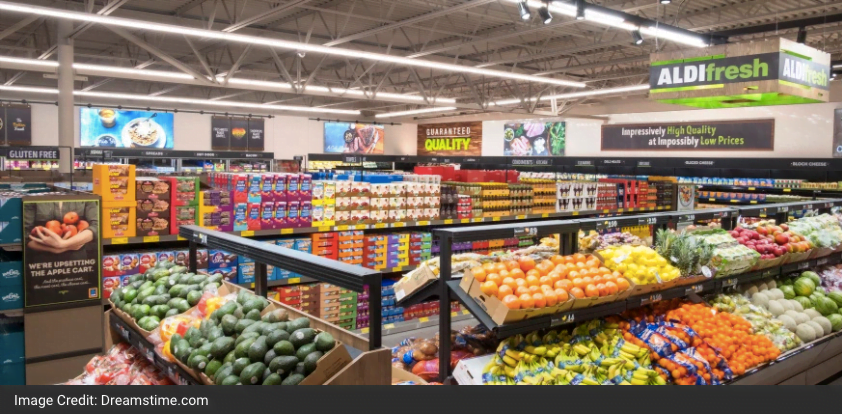
IMAGE CREDIT: DREAMSTIME.COM
What does this all mean for Canada?
There has been no formal announcement from either company that it will be launching in Canada in the near future. In fact, several years ago, Lidl did come to Canada and set up an office in Mississauga. The company was hiring staff and exploring real-estate sites for stores. Much to everyone’s surprise, Lidl suddenly decided to close its office, lay off staff and delay its launch. Perhaps the company saw that it would be more beneficial to launch first in the US, since the country is less consolidated, with larger urban centres and a much denser population.
Also, the US is underdeveloped in discount relative to Canada, which has 40 percent of its grocery sales already going through discount stores. A US launch also provides Lidl the opportunity to define, explore and develop its human resource requirements, system capabilities, product sourcing and supply chain capabilities for the North American market. It makes more sense to gain a foothold in the US and establish its base business needs before it expands into Canada, which has a much smaller market, a more diverse population, and a more challenging geography that serves only 36 million people.
I think it is inevitable that either Aldi or Lidl will enter Canada. Others have tried and failed. However, both these retailers have a proven track record of not only being successful in almost all markets they have entered, but they have also turned the competition on its head and have gained significant market share. Their strategies are simple, cost effective and easy for the consumer to understand and adopt.
Here are some of the components of their model that makes them such a success:
Limited assortment – fast movers only,
Focus on everyday products rather than niche items,
Right size store – 15-20,000 sq. ft. (about 30,000 sq. ft. in the US),
Cost efficient – labour-saving tactics such as displaying product in their shipping containers as opposed to hand packing,
Offer high-quality products at prices much cheaper than competitors (up to 50 per cent cheaper),
Everyday low prices – with enticing use of promotions,
High private-label penetration and SKU count,
Tailors each store to the ethnicity and demographics of the trading area it serves, and
High-quality prepared foods.
Food expenditures are one of the few ways consumers can control and influence the inflation in their household budget. This is why we have seen such a high degree of discount shopping, buying on promotion, ad matching, coupon usage and loyalty point redemptions amongst consumers. The trend toward discount and buying on deal isn’t abating. In fact, it continues to grow.
If someone were to ask me what the biggest threat to Canadian grocery retailers is, my answer would not be Amazon, but rather, the arrival of Aldi a Lidl in our markets. They have disrupted every market they have entered, and every grocery retailer should create a task force to examine the key elements of Lidl’s and Aldi’s programs that make them such a success. Incorporating some of their winning strategies into their own value propositions might not be a bad idea. In fact, it could make a lot of “cents”!
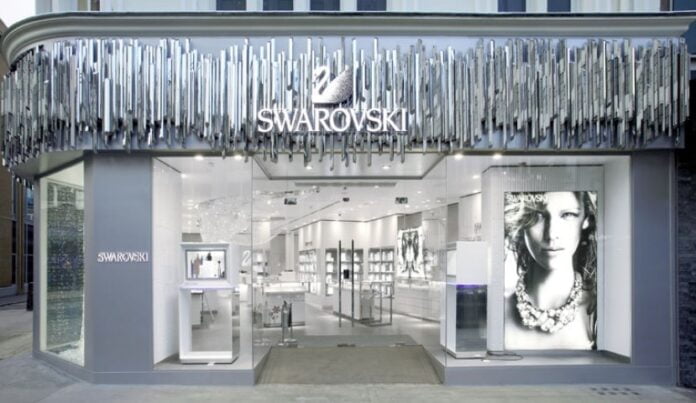
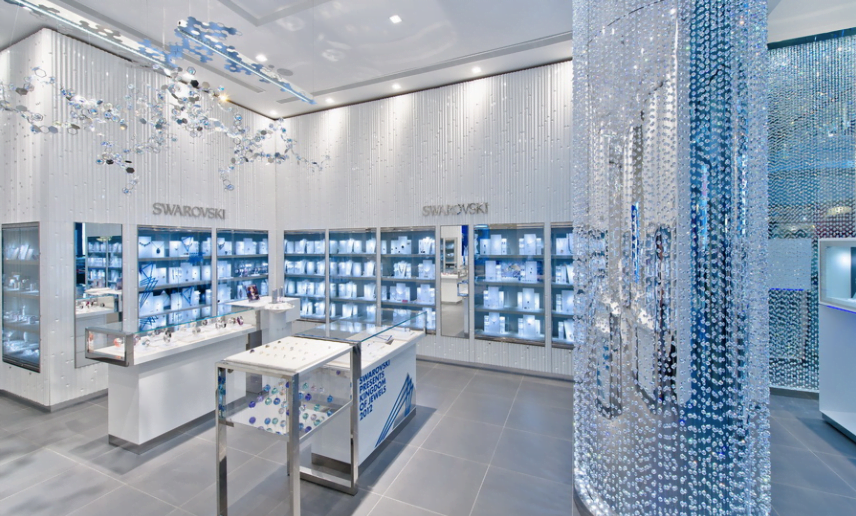
Well-known Austrian crystal jewellery/collectable/gift brand Swarovski plans to continue to open stores in Canada in 2018, as the company identifies markets for growth both for corporately-run as well as for franchised units.
In an interview, Swarovski’s CEO Robert Buchbauer explained how the brand is doing exceptionally well in Canada compared to other markets — Swarovski already has 47 corporately-owned stores in the country as well as five franchised locations. Canada is a sophisticated market with a European influence, valuing quality over price and Mr. Buchbauer said that the company continues to seek opportunities for new stores, with a focus on British Columbia and Quebec, as well as more stores for the Greater Toronto Area.
He noted that the Vancouver market is ripe for more Swarovski locations — the Lower Mainland is seeing strong sales numbers from its existing units, and the market continues to see growth in jewellery sales. CF Pacific Centre in Vancouver will see a new Swarovski store in 2019, he revealed.
Photo: SwarovskiPhoto: Swarovski
The Quebec market is a target for Swarovski as it continues to gain a foothold in the province and it most recently opened a unique pop-up space on Sainte-Catherine Street West in Montreal, and a store at CF Promenades St-Bruno will also open this year.
Recent new store openings for the brand include Oshawa and Oakville — brokerage Aurora Realty Consultants continues to handle Swarovski’s Canadian site negotiations under the direction of broker Manon Parisien.
Canada is something of a test market for Swarovski, and in a rather unique way. In late 2017, the company unveiled its first-ever Sparkle Pop Up at Square One in Mississauga. The tech-focused pop-up is a way for Swarovski to test out new ideas, products and concepts, with some successful elements expected to be rolled-out into store locations in Canada as well as globally. Customers can engage with augmented reality, for example, with digital screens showing the latest from the brand in an environment that encourages exploration.
(POP-UP AT SQUARE ONE IN MISSISSAUGA. PHOTO: TOM SANDLER PHOTOGRAPHY)
It was Square One’s market diversity that led to the brand partnering with the shopping centre for the Sparkle Pop Up. Square One is one of Canada’s largest and busiest malls, and Mississauga is known for its rapid population growth, which continues to diversify.
New Swarovski store locations in Canada will ideally be in the 800 square foot to 1,100 square foot range, according to the Aurora Realty Consultants website.
Swarovski was founded in Austria in 1895, and operates globally through its own stores as well as franchised locations and wholesale accounts. Its products include jewellery, figurines, home decor and various other collectable and gift items, with a focus on integrating cut-glass crystals into its designs.
Kelowna-based Compass Cannabis is joining forces with Starbuds, a leading cannabis retailer in the United States, to create a network of retail locations across Canada.
Dave Martyn, president of Compass Cannabis which was formed in March 2017, says the joint venture foresees up to 40 retail locations – and perhaps more – in Western Canada.
Compass Canada currently operates as a medical cannabis consultation company with eight locations in British Columbia and Alberta and another 10 expected to open in those two provinces by early 2018.
Martyn says the company plans to have a number of its clinics converted into retail cannabis dispensaries upon legalization of cannabis for recreational use within Canada.
“If you are a patient that’s looking to access the ACMPR (Access to Cannabis for Medical Purposes Regulations) program in Canada . . . we can provide both consultations with medical doctors as well as educational services to help you choose your provider,” says Martyn. “That business exists. That business is still growing at a very steady and healthy rate within Canada. But as we go into 2018, retail is also opening up a new avenue particularly Western Canada looks like it will be a very strong market for that business as well.”
Martyn says some of its medical locations will be converted to retail use. The company will continue with its medical program and is actually looking at an international expansion of that sector of its business.
“We will have existing medical that will remain in B.C. and Alberta and we do foresee continued growth on the medical side but the expansion to grow on the retail side I think is a little more sizeable compared to the medical market as we go into legalization and beyond,” he says.
Compass Cannabis and Starbuds plan to leverage the expertise of Starbuds, which has been operating in a mature recreational cannabis market for over four years, to become a leading distribution business within Canada’s cannabis industry.
“Really what they offer to the Canadian market that no one has is their expertise,” says Martyn. “They’ve been based in the first regulated market in North America which was in Colorado. They’ve been through legalization 1.0. They understand what does retail look like from all the important stakeholders from public safety and compliance all the way through to retail sales, services, education for customers. All the important facets. They are experts in that business. The Starbuds group is now across multiple states in the U.S. and continuing their expansion as legalized markets open up.
“Within Canada the challenge for a lot of the proposed retailers is they have a vision of what they believe will work but there’s no real world execution on those ideas. So for us we wanted to partner with a group that has been through legalization. They understand what real world operations look like. And they’ve delivered real results to the tune of tens of millions of dollars of sales in regulated legalized environments.”
COMPASS CANNABIS
Martyn says the initial target is that the company will grow to 40 retail locations in Canada and it believes it can expand beyond that number. The unknown right now is the number of permits that will be provided by the governments. Each province will regulate a certain amount. He says the company anticipates a mix of both franchises and corporately-owned locations.
“Ultimately we’re going to be choosy on our real estate. We want to be in quality retail locations. We don’t want to be a side street low profile site. We want to be in with quality retail partners and those sites aren’t necessarily easy to obtain or plentiful in some markets as well,” he says.
The medical side of the business is anticipated to grow to 10 to 12 locations.
Martyn says the company will be looking to expand beyond the B.C. and Alberta borders.
“Saskatchewan released regulations (recently) that do open that up. That is a province that we’re interested in. We have applied for a retail licence in Manitoba … But primarily we believe that the two best markets are going to be B.C. and Alberta and I certainly think in terms of positive, free market type regulation Alberta seems like it will be the leader in cannabis in terms of many sectors, not limited to retail and medical but also including licenced producers and things of that nature. Alberta has definitely set itself as the most positive framework from the business sense of expansion. Alberta is very well positioned today.”
COMPASS CANNABIS
Compass Cannabis has also entered into an agreement with the acclaimed architecture and design firm, McKinley Burkart, to provide design services for their retail locations.
Starbuds has 11 locations across Colorado and will expand to both Maryland and Massachusetts in 2018.
“This merger is representative of the future of the industry. As cannabis continues to become more widely accepted and legalized across the globe, Starbuds rises above the rest, expanding and evolving to meet the demands of the market. Starbuds’ expansion into Canada is just the beginning and we couldn’t ask for a better partner in the Canadian market,” says Brian Ruden, Starbuds’ founder and CEO.
When Michelle August opened her first SPINCO fitness studio in July 2014 in Kelowna, she had visions of eventually expanding to perhaps five locations.
But the entrepreneur has already surpassed her ambitions with nine locations to be in operation by the spring of this year.
“When I started this three years ago I wanted to have maybe five locations. I thought that would be the most amazing thing ever. So my goals have already really been exceeded,” says August, the founder of the company.
“With my new partner here in Toronto, our goals have gotten a lot bigger. We basically want to open five to 10 studios a year over the next five years and get up to somewhere around 25 to 50 studios just depending on the communities and the response we’re getting from all the cities. Basically the way that we’ve been growing is by finding the right partners in the right cities as well. That’s a huge thing for us too.”
After Kelowna, the company’s second location opened in Toronto in 2016 followed by Victoria the same year. In 2017, she opened a location in Halifax.
Image: SPINCO
Image: SPINCO
Image: SPINCO
This month, locations will spring up in Toronto, Ottawa and Vancouver. In February, a third Toronto location is planned to open and by the spring one as well in Oakville.
The first Toronto studio is at Yonge Street and Eglington Avenue. The second Toronto location, which opens January 19, is at Adelaide Street and Spadina Avenue. The third Toronto studio will be located in the Summerhill area on Yonge Street.
Each location is basically the same with customers set up with all the shower amenities and depending on the size of the city and the demand, August says, studios have between 35 to 55 bikes.
Image: SPINCO
“First and foremost the one thing that every single one of our riders if you walk in the door and ask them what their favourite thing about SPINCO is it’s probably the community that we’ve developed between our riders, our instructors, the owners, the managers, even the community around us which is partnering with local businesses in supporting the community. We’re always doing charity events,” says August.
She says another factor in the company’s success is the studio’s program as every instructor goes through a very extensive training process.
The popularity of the fitness industry continues to grow in Canada.
Image: SPINCO
Image: SPINCO
Image: SPINCO
Image: SPINCO
“Every time I turn around there’s a new fitness studio opening and there’s some coming from the States. There’s Canadian studios going to the States as well. I think it’s super cool. I think it’s definitely great for our community and everybody is always looking for something different as well,” says August.
“I can’t really see the spin industry going anywhere for a long time. It’s been one of the longest standing workouts for years and years. That and boxing really . . . Spin has been around for a decade. It’s pretty exciting and it’s really exciting to be a part of it in this stage and seeing the growth.”
SPINCO’s King/Spadina location will sell exclusive merchandise from brands such as, Champion, LILYBOD, Alo Yoga, RYU Apparel and S’well, and will take part in the studio’s nationwide, by-donation Monday night class that gives back to local charities across Canada.
“SPINCO offers structured, full-body spin classes designed to strengthen the body, energize the mind and feed the soul. Since 2014, the goal of each SPINCO class has been to work together as one team, one bike, moving in unison to the beat of the music to engage the butt, core and arms. Lead by dedicated & motivating instructors, that have undergone intensive in-house training, SPINCO’s workouts are made to inspire and uplift. No matter the fitness level, prepare to be motivated to achieve higher levels of personal well-being, physical strength and positive mental attitude,” says the company on its website.
The 17-store Marcil home improvement chain, with stores in Quebec, will soon be rebranded as part of Lowe’s acquisition of the RONA chain. Marcil stores will be converted to the RONA banner on February 26, as RONA is repositioned to encompass the company’s smaller and medium-sized stores.
Based in Boucherville, Quebec, Marcil was founded more than 40 years ago. It has stores in the greater Montreal area, which are each between about 5,000 square feet and 35,000 square feet. Marcil came under the control of RONA in 2005 when it acquired 51% of Marcil’s shares, followed by the 2014 buyout of the remaining shares.
American chain Lowe’s acquired Quebec’s RONA for C$3.2 billion in 2016, with a strategy. Small and mid-sized stores have kept the RONA branding, while bigger locations have been rebranded as large-format Lowe’s. The company’s smaller stores are also known as “proximity stores” averaging about 35,000 square feet, whereas its larger stores are each often 60,000 square feet.
“We are committed to RONA and the proximity building center model as one of Lowe’s Canada pillar of growth,” said Serge Éthier, Executive Vice-President of RONA Proximity. “RONA and Marcil operate in the same market segment, have complementary locations, and both serve a large client base of contractors and pros. It was therefore natural to combine the strengths of both banners. This decision will allow us to maximize our products and services offering to Marcil retail and professional customers, while simplifying our operations,” he added.
“We are committed to RONA and the proximity building center model as one of Lowe’s Canada pillar of growth,” said Serge Éthier, Executive Vice-President of RONA Proximity. “RONA and Marcil operate in the same market segment, have complementary locations, and both serve a large client base of contractors and pros. It was therefore natural to combine the strengths of both banners. This decision will allow us to maximize our products and services offering to Marcil retail and professional customers, while simplifying our operations,” he added.
The move is meant to solidify the RONA nameplate as being the top building centre chain in the country with small-to-medium locations. Starting February 26, shoppers at the former Marcil stores will have more to buy — its product selection will double as part of the name change, going from approximately 20 000 items to more than 40 000 products available in store and on rona.ca.
In addition, new product categories will be added to former Marcil stores, such as home appliances and a wide seasonal department, as well as from a transactional website that will not only let shoppers consult the product catalogue and verify store inventory, but also order online and collect their items in store or have them delivered by truck.
The RONA banner was founded in 1939 and now boasts a network of more than 430 stores, including both corporate stores as well as independent affiliates. Lowe’s is a Fortune 500 behemoth serving more than 17 million customers a week in the United States, Canada and Mexico, with its affiliated businesses seeing in excess of US $65 billion in sales in fiscal 2016 with more than 2,370 home improvement and hardware stores employing more than 290,000 people. Lowe’s Canada includes more than 600 corporate and independently run dealer stores under banners including Lowe’s, RONA, Réno-Dépôt, Marcil, Dick’s Lumber, and Ace Hardware, with more than 25,000 Canadian employees as well as an additional 5,000 employed by RONA’s independent affiliates.
(TORONTO QUEEN STREET WEST STOREFRONT. PHOTO: KOTN)
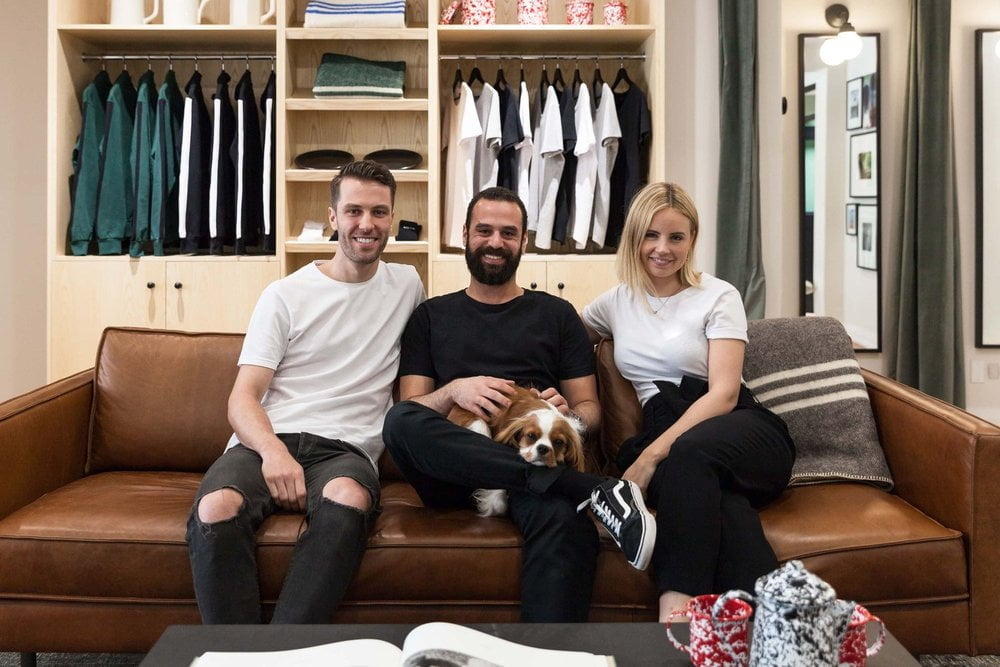
Unique Toronto retailer, Kotn, which sells high-quality everyday wear made from authentic Egyptian cotton, is looking at potential expansion across the country and into the United States as its concept gains popularity.
Rami Helali, one of the company’s co-founders, told Retail Insider “we’re currently looking in multiple other Canadian cities for more retail locations.”
The company opened its first bricks and mortar store at 754 Queen St W, Toronto in March 2017. The store is about 800 square feet.
“We are an online first business and since then what we’ve learned with that interaction with the customers and learning what the needs are and having that conversation and building that community is invaluable,” says Helali. “I think the future is in this omni-channel, multi-touch point kind of blurring the lines between analog and digital and that is kind of the direction we’re heading in.”
He says more than half of the company’s online sales are in the United States so that too is a market for potential future growth in bricks and mortar locations.
Kotn launched in Toronto in 2015 when founders Helali, Mackenzie Yeates and Benjamin Sehl noticed a gap in the marketplace – high-quality, well-fitting basics weren’t affordable for everyday wear.
Kotn set out to solve this problem, starting first with their Egyptian cotton T-shirt, which has the quality and cut of its designer counterpoints yet is affordable enough for consumers to pick up in multiples.
The brand partners directly with Egyptian cotton farmers in the Nile River Delta to keep costs low while helping to revive a struggling agriculture business.
“We run social audits on all of our manufacturing partners. We make sure everyone’s getting paid fair wages,” says Helali.
“For us, for the industry to really rebound in a sustainable way and to really have the impact we want on the ground which is long-term poverty alleviation and long-term education, we want to start with education. It’s an area with really high illiteracy rates especially within women and we believe the way forward for that region and the industry is to start there.”
Kotn is building schools in the region of Egypt where their cotton is grown to stop the illiteracy epidemic there. They opened their first school in 2017, providing education for 40 students. They have mandated that more than 50 per cent of the students are girls as the illiteracy rates are especially high for women in the region. Kotn funds the building of a school and its teachers.
For Black Friday/Cyber Monday, Kotn set a goal to completely fund their second school with sales – as a result they raised $56,330.52, enabling them to build their second school in the Nile Delta in 2018. Every single dollar will be invested into things like the school infrastructure, roads, instructor training, uniforms, books and supplies.
Kotn’s co-founders were named to Forbes 30 under 30 Class of 2018 in the retail and commerce category. The letters in the company name don’t stand for anything specifically but it’s the phonetic spelling of the Arabic word for cotton.
“We are an essentials company made out of authentic Egyptian cotton that is ethically sourced. For us, there was a gap or a need for well-made basics that didn’t cost an insane amount that were made well and when we say made well that means the quality is there and that the people along the way are treated well,” says Helali.
“We started literally with the white T and for the first year and a half we just had good T-shirts in three colours – black, white and grey. And we started online and that went well. We added some of these staples done well in multiple layers.”
The retailer says the authentic cotton, grown in the Nile Delta, is Egypt’s “white gold” – finer, softer, and more breathable than any other cotton.
“By working directly with cotton farming families in Egypt, we want to rebuild the industry from the inside. We make our own fabrics from raw cotton bought direct from farmers at guaranteed prices. Our model is like farm-to-table, but for your clothes,” says the company.
“Our cotton is then sent to our cut-and-sew factory outside Alexandria. The responsibly-run operation employs locals, securing their craft and their livelihood. By scrapping the middleman, we’ve ensured a fair wage for them, and an honest price for you.”
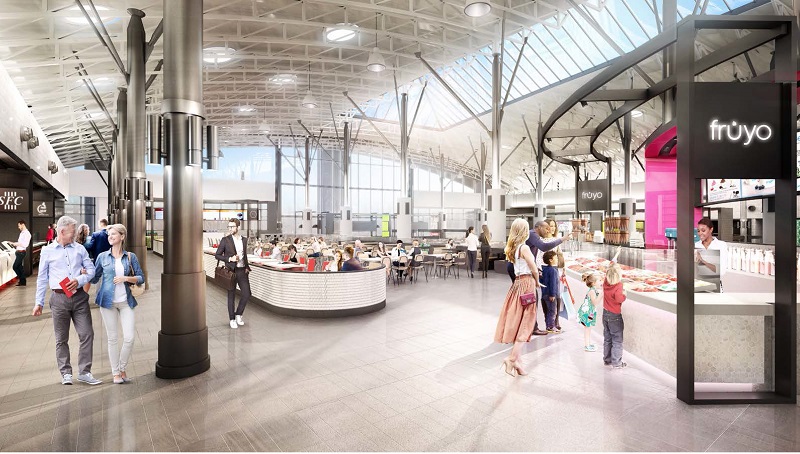
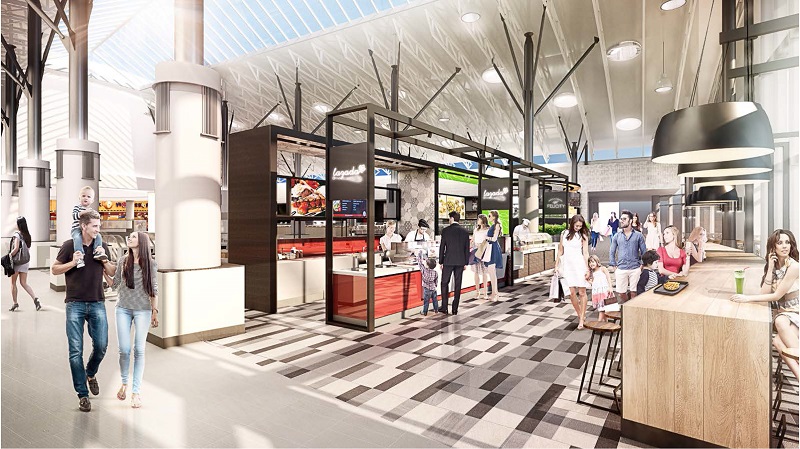
Cadillac Fairview is making a $17-million investment to revitalize the food court at CF Chinook Centre, saying the redevelopment will elevate the shopping experience for Calgary consumers by modernizing the area and transforming the space into a CF Dining Hall.
Paige O’Neill, general manager of the shopping centre which is one of Canada’s most productive, says the mall’s dining space is consistently one of country’s busiest and most productive food courts.
The new CF Dining Hall “will be open and inviting, with more communal spaces that better reflect the tastes of our shoppers and community,” she says.
CF Chinook Centre (RENDERING: GH+A DESIGN)
O’Neill says the food court will go from the current 19 establishments to 20 when the renovation is completed.
“We’re losing three or four of our existing clients to make room for more seating and we’re adding three or four new clients joining us,” she says. “The deals haven’t been signed yet so I can’t reveal who they are.”
Canadian design firm GH+A is designing the new space — the company has led renovations at several of the country’s leading malls.
The project is slated for completion over two phases to allow sections of the food court to remain in operation for the duration of the construction period. The first phase will start January 14 with the closure of the south half of the food court, with completion and opening scheduled for June. The second phase will start in June with the closure of the north side of the food court, with completion and opening scheduled for October.
The project will see the entire existing food court renovated, improving the aesthetics, design and capacity of the space. The renovation will include expanding and modernizing units, enhancing décor elements like tiling, upgrading furniture with communal tables and banquets, and the implementation of sorting stations to improve the overall experience for guests. The project will also include enhanced features including a revamp of the Centre’s existing outdoor patio. The 30,000 square feet of redeveloped space will feature 835 seats.
Because of the redevelopment, a children’s carousel which has operated in the food court for many years is no longer there.
“The food court is almost 18 years old and it’s definitely time for a refresh and a reno of that space to make sure we continue that great experience for our guests that come to Chinook,” says O’Neill.
CF Chinook Centre (RENDERING: GH+A DESIGN)
This redevelopment works with the newly-opened 61st Avenue S.W. pedestrian bridge over Macleod Trail that connects to Chinook Centre.
The Centre’s revamped dining space will have direct access to the new pedestrian bridge.
“With the catalyst of the pedestrian bridge, it’s probably going to become one of our number one entrances leading into the food court,” says O’Neill. “And we just renovated our food court washrooms. So it’s this sort of really nice timing. The renovation has been discussed and on the table for a number of years.
“With the food court being 18 years old, it’s just a great opportunity to re-invest and continue the re-investment in the Centre knowing that the Calgary economy and the Alberta economy will come back. We don’t have a problem with the food court because it’s still one of the highest-producing food courts in Canada but it’s definitely dated and we think this will be a great investment for not only the clients that remain in the food court and for the guests to come and experience a brand new area.”
The investment marks the latest major upgrade to the Centre’s food court since the last completed revitalization in 2000, says Cadillac Fairview.
“Dining is an essential aspect of the overall shopping centre experience and we are delighted to evolve the Centre’s food court into a signature CF Dining Hall where guests can enjoy culinary delights in a premium environment,” says Josh Thomson, Vice President, Development, Cadillac Fairview.
CF Chinook Centre (RENDERING: GH+A DESIGN)
Beside the food court revitalization, Cadillac Fairview is investing an additional $4.5 million to the south portion of the Centre this year with a major focus on new tiling and railings.
“They’re hiring. Their store is looking amazing inside. My understanding is that their restaurant will not make the opening date but will be open by early Spring,” says O’Neill. “We’re very excited to have them open in just over a month from now.
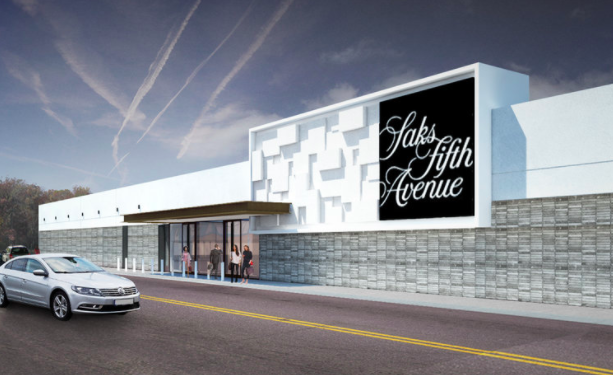
Saks Fifth Avenue store that will open at CF Chinook Centre on February 22 (courtesy of Craig Nealy/Stantec)Saks Fifth Avenue store that will open at CF Chinook Centre on February 22 (courtesy of Craig Nealy/Stantec)
“It will be a huge complement to Nordstrom, to Hudson’s Bay, to bringing in more clients into the Centre for overall shopping but it definitely helps I would say elevate the experience and elevate the shopping opportunities for people in Calgary.”
O’Neill says Chinook Centre has no other news right now on new retailers other than Saks Fifth Avenue coming to the mall.
“But I think with the opening of Saks, with the developments that are happening within the Centre and just within the city of Calgary, it’s definitely a place that we hope retailers will want to join us,” she says.
The retail industry as a whole is in a state of transition, and 2018 will prove to be an interesting year. Sears Canada is about to close all of its stores, releasing millions of square feet of space to fill. Off-price retailing is about to see unprecedented competition as Nordstrom Rack enters the market this spring. Legal marijuana retail stores will become a thing in Canada for the first time, the future of NAFTA is in question under the Trump administration, and Amazon continues to make moves that could see it further gain market share. We’ll be busily reporting on much of this, as we predict 2018 will be a dynamic year with plenty of highs and lows for the industry.
In our 2017 forecast, which we published almost 12 months ago to the day, we predicted that 2017 would be a “slow year for retail expansion” in Canada. We were wrong. More than 50 international brands entered Canada by opening stores or concessions in 2017, which could very well be record-breaking. Brands continue to work with brokers to seek real estate for new locations, and retailers that have already entered Canada are now in the process of seeking to open multiple locations in new markets.
While this all sounds exciting, it also represents unprecedented competition that could see more homegrown retailers struggle and ultimately shutter. Survival of the fittest has never been more relevant than today for retailers operating in Canada, and things are changing quickly — consumer tastes are changing, the cost of living is skyrocketing in some markets, technology and e-commerce continue to take hold, and those who do not adapt risk dying. There will no doubt be more store closures in Canada in 2018, after some unfortunate bankruptcies that took place last year.
Image: Miniso
International Brands Continue to Expand in Canada
As mentioned, more than 50 international brands entered Canada last year by opening stores, and there has been a momentum over the past several years where at least 20 new retailers a year have entered the country. Many of the brands that opened their first Canadian stores in 2017 will now seek to open more locations in various markets in 2018.
A few expansions have already been confirmed. Perhaps the most aggressive is value-priced Chinese variety retailer MINISO, which now indicates that it plans to open about 100 stores in Canada this year, with a goal to have about 500 stores by the year 2021. It’s an ambitious goal, and the company might even achieve it — the company is already a hit with a segment of the population that is buying everything from kitschy plush toys to home goods, at remarkably low prices and often of reasonably decent quality upon inspection.
Pricey streetwear brand Off-White, is an example of an already expanding retailer, and it will open its second Canadian store at the end of this month in a laneway in downtown Vancouver, after opening its first store last year in Toronto’s Yorkville neighbourhood. Aussie eyewear retailer Bailey Nelson has just expanded into the Vancouver and Toronto markets, and is expected to keep that momentum as it moves across the country. Another eyewear retailer, SEE Eyewear, is looking to Montreal and Vancouver after opening its first Canadian store in Toronto. DXL Men’s Apparel entered the Ontario market last year, with a national rollout planned. Woolrich’s President says that he anticipates a Montreal location opening in 2018 (followed by Vancouver a year later) and candy retailer Sugarfina, which opened in suburban Vancouver in late 2017, is expected to soon announce its first Toronto location.
An interesting trend is brands opening their own stores, which has been increasingly common over the past several years. Montreal-based outerwear brand Moose Knuckles opened its first store at Toronto’s Yorkdale Shopping Centre in the winter of 2017 for example, with Canada Goose opening its first store across the hall about a year before. We’ll likely see more of this in 2018 as brands seek to go ‘direct-to-consumer’, with some finding that they can see greater profits by “cutting out the middleman”, ie multi-brand retailers.
NORDSTROM RACK’S THIRD CANADIAN STORE WILL OPEN THIS SPRING AT 1 BLOOR ST. E. IN TORONTO. (PHOTO: FIRST GULF/FIRST CAPITAL REALTY)
Oversaturation of Off-Price Retail?
Over the past several years now, there’s been a rapid expansion of off-price retailers in Canada, making some question if we’ll see a saturation point. TJX Companies Inc., which operates Winners, Marshalls and HomeSense stores in Canada, plans to continue expanding into Canada in 2018 with an anticipated seven new Winners stores, eight HomeSense stores, and an additional 15 or so Marshalls stores, eventually resulting in more than 100 locations in Canada for each banner. Hudson’s Bay Company’s off-price division Saks OFF 5TH entered Canada in March of 2016 and already operates 16 stores here, and intends to operate 25 locations by the end of this year. Nordstrom’s off-price division Nordstrom Rack will open its first Canadian location at Vaughan Mills near Toronto on March 22 of this year, with a goal of eventually operating between 10 and 15 stores in Canada, depending on opportunities.
It remains to be seen how the off-price segment does in Canada with all of the competition, though many existing stores appear to be quite busy. One challenge in 2018 could be sourcing designer product for some of these stores, however, as some brands are seeking to tighten their distribution and limit off-price selling in order to elevate their brand image in the eyes of the consumer. For those off-price retailers that rely on such third party suppliers, particularly TJX, this could pose a problem in the future if they continue to expand and seek merchandise to fill their stores.
FreshCo (Image: JACKMAN REINVENTS)
Grocery Wars Ongoing
The grocery industry is a tricky one — there’s a lot of competition primarily from a few key players, and margins are often tight. With e-commerce on the rise and some cities seeing more people moving downtown, the face of grocery retail is changing. Sobeys recently announced that it will be expanding its value-priced FreshCo banner into Western Canada for the first time, and smaller entrants such as Farm Boy, Organic Garage, Nations Fresh Foods and Seafood City continue to make inroads.
Click-and-collect groceries is becoming more popular than ever in some markets, and some consumers are getting their groceries delivered — something that could become more common now that Amazon owns Whole Foods, which could lead to more industry disruption. With Sears closing all of its Canadian stores this year, we may see some grocery stores relocate into demised former Sears spaces.
E-commerce Gains, but it’s Expensive
We’ll no doubt continue to see e-commerce grow as a percentage of overall retail sales, though it still remains well below 10% of all Canadian retail purchases. If you think about it, e-commerce is somewhat inefficient — it costs money to ship a product directly to someone’s home, and things become even more complicated if the consumer wishes to return the product. Despite this, consumers continue to demand online shopping options and leading retailers are addressing this by improving their online experience.
Some formerly pure-play e-commerce brands have gone on to open physical retail stores with considerable success, supporting the notion that a hybrid or ‘omni-channel’ model is desirable. As the world is increasingly online, though, we might begin seeing this as a ‘single channel’ with a combination of physical and online retail being optimal, if not necessary in order to be successful.
Marijuana Stores (Legal Ones)
If all goes as planned, on July 1 of this year, you’ll be able to buy weed legally in a local store near where you live, as is the plan generally in various provinces. There appears to be anxiety out there as provinces decide how marijuana retail will be carried out (some provinces will operate government-run stores while others will allow for some private enterprise) and we’re hearing from some design firms that are seeking to make the retail experience exceptional.
With less than six months until the legalization date, it remains to be seen how many legal retail spaces will be open by then, where they will be located, and how distribution will be coordinated. In hindsight, legalization may have been announced in haste without proper distribution plans in place, and now there’s a rush to try to get things sorted by the legalization deadline.
(ROBSON STREET IN VANCOUVER ON JANUARY 2, 2018. PHOTO: LEE RIVETT FOR RETAIL INSIDER)
Neighbourhood Nodes:
A few of Canada’s key street front retail areas are expected to see new retailers this year, and there are a handful of locations that are seeing most of the activity.
In Vancouver, the city’s Robson Street strip will continue to see new retailers enter the market, adding to a few recent and highly anticipated additions. MUJI opened its largest store outside of Asia on Robson Street in the fall, a few doors down from Canada’s first Ladurée retail space. Several retail spaces remain empty for the short term — some will be replaced with new tenants, and at least one strip will end up being demolished for a new commercial development (details to follow). Forever 21 will close its Robson Street location in the middle of the month, and rumours are swirling that Indigo could replace it as a sublease with the company’s updated ‘cultural department store’ concept. Regardless if the rumour is true, Indigo is in the process of a significant expansion that will see new stores, as well as replacement locations as it rolls out the new concept and does away with the ‘Chapters’ nameplate.
Adjacent to Robson Street is Vancouver’s Alberni Street ‘Luxury Zone’, which will continue to see strong activity into 2018. UK-based luxury footwear retailer Jimmy Choo will move into a 1,500 square foot retail space alongside recently unveiled locations for the likes of Van Cleef & Arpels and Hublot, and jeweller Montecristo will move into a retail space recently vacated by the Italian Kitchen restaurant (which has relocated). An announcement will be made for the retail space currently occupied by multi-brand womenswear retailer Bluebird, which will be relocating up the street, and the momentum will continue into 2019 with new stores for Cartier and Hermes on Burrard Street, as well as other openings that will be discussed on Retail Insider throughout the year.
Further up Bloor Street West towards Avenue Road, more luxury boutiques will be opening in 2018. We’ve already reported on Dior’s plans to open a massive two level retail space at The Colonnade at 131 Bloor Street West, only steps away from a relocated William Ashley store that will be unveiled early this year. We’ll be doing a feature on Toronto’s Bloor Street West this winter as part of our ‘street tours’ series, which is ongoing.
Toronto’s Queen Street West, which represents a diverse range of retailers along its stretch between University Avenue and Ossington Avenue and a bit beyond, will continue to see some new retailers. More mainstream brands tend to locate along the stretch between University Avenue and Spadina Avenue, and we’ll be discussing two new retailers on the strip this month in articles. The stretch of ‘West Queen West’, towards Trinity Bellwoods Park is considered to be a “cool” area and over the past two years, several significant international retailers have opened their first Canadian stores along the strip. It will be interesting to see where this goes because some are already saying that nearby Dundas Street West could come into its own as the next ‘hot’ address as Queen Street West continues to gentrify and possibly become ‘mainstream’ itself.
Montreal’s Sainte-Catherine St. W. will look different by the year 2020.
Montreal’s Sainte Catherine Street West is about to ‘go under the knife’ as it were, with plans that include reconstructing the public realm with new sidewalks and landscaping. The project, which begins construction this week, will take several years and some retailers are concerned that disruptions could lead to lost business. Regardless of the street construction, big things are planned for the street. Saks Fifth Avenue has said that it will be opening a 250,000 square foot flagship at the back end of the Hudson’s Bay building downtown, and the flagship Birks jewellery store is being renovated and modified for the inclusion of a boutique hotel. In the middle of the strip, downtown Montreal’s La Maison Simons store will be seeing a renovation, and several blocks to the west, the new ‘Holt Renfrew Ogilvy’ will become Canada’s largest location in the Holt Renfrew chain with about 250,000 square feet of space (the nearby smaller Holt’s on Sherbrooke Street West will close with the merger).
Montreal has several other terrific pockets of local retailers, and one area to take notice of is the stretch of Sherbrooke Street West in the city’s Westmount area. Zadig & Voltaire just opened its first Montreal-based store on the stretch, and several interesting and upscale retailers are located in the immediate area. Zadig & Voltaire’s moving into the area could signal something bigger.
Canada’s Top Malls Remain Strong
Canada’s top malls continue to thrive, with Toronto’s Yorkdale Shopping Centre taking the top spot again in Retail Council of Canada’s 2017 Canadian Shopping Centre Study. With sales of $1,653 per square foot, Yorkdale rivals some of the top malls on the continent, not to mention globally. The study notes that there are numerous malls with annual sales exceeding $1,000 per square foot, and the study also discussed some of the trends that it is seeing amongst the most successful malls.
Some of those trends will see prominence in 2018, particularly the idea that considerably more space will be devoted to food-and-beverage offerings in Canada’s malls. We’re already seeing a rush of full-sized restaurants opening in malls (it’s still hard to get a table at the recently opened Cheesecake Factory at Yorkdale), and the next trend in malls will be food halls, not unlike those being seen in some malls south of the border, as well as overseas. ‘Food courts’ continue to be renovated in the country’s top malls — that is, if they haven’t already done so. The past five years has seen billions of dollars of investment into Canada’s top shopping centre properties, and that investment is expected to continue at some centres into 2018.
(PHOTO VIA OXFORD PROPERTIES GROUP)
Other additions to malls include entertainment options — in 2018, several of the country’s leading malls will see new VIP Cineplex cinemas open on site and as well, The Rec Room will be opening in several malls this year. It’s all part of an effort to turn malls into community gathering places where people will come, spend some time, and spend some money.
We’ll be reporting on a few mall expansions in Canada this year, as some landlords continue to see value in investing in their properties not only to enhance the consumer experience, but to also add space. And it’s not just retail space — in more expensive cities such as Vancouver and Toronto, we’re seeing some mall landlords looking to intensify sites by adding residential and office towers on-site. A mix of uses could see malls truly become the ‘community centres’ which in many respects was the vision of architect Victor Gruen, who is credited as having invented the modern mall.
On May 2 of this year, as well, a new mall will open just outside of Edmonton at the entrance to Edmonton International Airport. Premium Outlet Collection at Edmonton International Airport, which is a partnership with Ivanhoé Cambridge and Simon Property Group, will see about 428,000 square feet of leasable space. Tenants will be announced shortly (they toured some locals through the site last week, on a condition that they sign non-disclosure agreements).
(RENDERING OF THE CF CHINOOK CENTRE SAKS FIFTH AVENUE STORE, OPENING FEBRUARY 22, 2018. CRAIG NEALY/STANTEC)
Luxury Retail Continues to Flourish
The luxury segment continues to see gains in Canada, with new mono-brand store openings as well as activity with multi-brand luxury retailers, including large-format stores such as Holt Renfrew and Saks Fifth Avenue.
Luxury retail in Canada is contained primarily in the Toronto and Vancouver markets, with dozens of standalone luxury brand stores in both cities. Toronto’s Bloor-Yorkville area continues to see new luxury store openings, with several planned for 2018. Downtown Vancouver, as well, continues to see activity as luxury brands seek to open stores and as discussed in the past, one of Vancouver’s biggest challenges is finding the right space for the luxury brands that want to be in the city.
Montreal is also seeing increased luxury retail with the expansion of its Ogilvy store to become a luxury ‘Holt Renfrew Ogilvy’ flagship, which will include the installation of shop-in-store concessions for some of the world’s top luxury brands (some of which are currently up the street at the current 1300 Sherbrooke St. W. Holt’s). As well, it remains to be seen when Saks Fifth Avenue provides an update on its proposed Montreal flagship store, which would include an 80,000 square foot ‘Quebec-themed’ food hall.
Sears Canada Closure to Flood Market with Real Estate, and Job Losses
Sears Canada is in the process of closing its Canadian stores, and about 15 million square feet of real estate will be coming onto the market. The demise of Sears Canada has been a long time coming, unfortunately, though a silver lining is that landlords have had time to figure out what to do to replace their existing Sears stores. We’re already hearing from some landlords that they’ll be repurposing their Sears spaces by splitting them up for multiple tenants, or even demolishing them for redevelopment. From a real estate standpoint, 2018 will be an interesting year as we report on what landlords are doing with their Sears spaces — some of the country’s top malls have a Sears store as an anchor, and landlords are already telling us that they’ll be executing their plans this year to deal with the spaces.
One tragic aspect of Sears Canada’s demise is the thousands of job losses, and we wish everyone luck in getting things sorted.
More Bankruptcies/Store Closures:
Several retailers doing business in Canada went bankrupt in 2017, resulting in some store closures — we saw the likes of American Apparel, BCBG, Bebe, Express and a few others close Canadian operations. This year could be challenging to a few other retailers, both homegrown as well as international companies operating here.
While it might be too soon to speculate on which retailers may close stores and possibly exit the market, we take note that American fashion brand J. Crew, which has been struggling financially, has closed two Greater Toronto Area stores since August. A location at CF Markville in Markham closed in the summer, followed by more recently at CF Fairview Mall in Toronto (Edmonton’s only full-priced store also closed in late 2016). Some are questioning what, if anything, will happen next.
In summary, we expect 2018 to be an interesting year for Canadian retailing and despite the challenges and competition, we encourage everyone to try to remain positive. We’ll be reporting on the Canadian retail industry throughout the year and will provide updates on what’s happening both with our exclusive content, as well as our curated Canadian Retail News From Around The Web.
Cleveland, Ohio-based paint retailer Sherwin-Williams continues to open stores in Canada, and the province of Quebec will be a particularly important target for the retailer this year, according to brokerage Think Retail.
Sherwin-Williams’ growth in Canada is about 10% annually, prompting it to further seek locations. In Quebec, the company is looking to open two or three stores in 2018, and then between five and six in 2019. According to Think Retail, ideal storefronts are between 2,800 square feet and 4,000 square feet along high streets and in open air centres in several target markets.
Sherwin-Williams has more than 225 stores in Canada with 48 in British Columbia, 28 in Alberta, seven in Saskatchewan, nine in Manitoba, 88 in Ontario, 37 in Quebec, four in New Brunswick, two in Newfoundland, six in Nova Scotia and one in PEI.
Over the past three years, Sherwin Williams has opened 48 new stores in Canada.
Sherwin-Williams was founded in Cleveland in 1866, and it celebrated its 150th birthday last year. The company is technically a year older than Canada, and has a unique Canadian connection – Sherwin-Williams opened a manufacturing plant in Montreal in 1894, and its second CEO was Canadian. Sherwin-Williams is now the largest producer of paint in the world and its products are sold through a wide network of distributors including home centres, independent retailers, mass merchandisers, and through more than 4,200 company-operated paint stores. The company boasts annual revenue in excess of US $15 billion.