Grocery shopping is getting faster and easier across the country with the expansion of the unique services being offered by Toronto-based Penguin Pick-Up – a network of 76 free, convenient pick-up locations for online purchases.
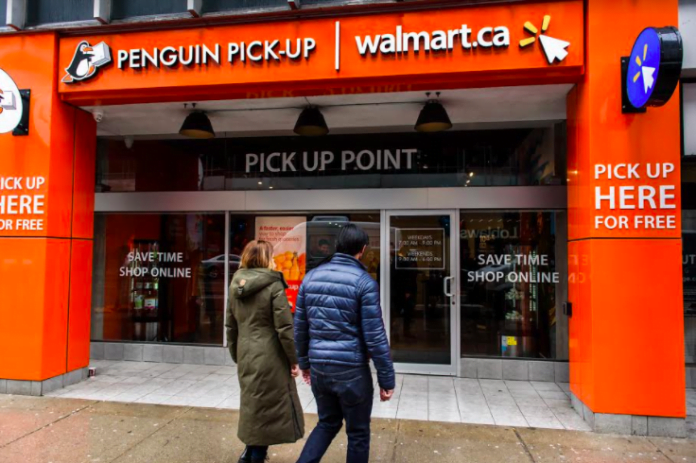
Just recently the company announced the grand opening of two new Penguin Pick-Up/Walmart locations at Yonge and Eglinton and Queen’s Quay.
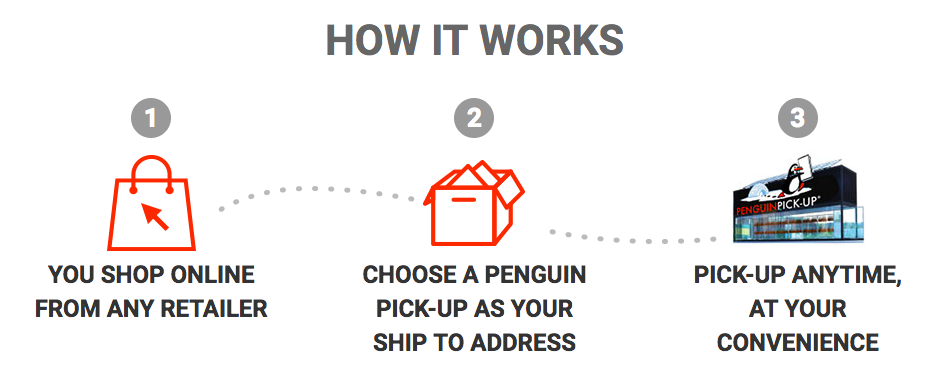
“Penguin Pick-Up is a network of locations which you can ship your online orders to on your behalf and at the same time the retailers can use our network to distribute online orders,” said Nielsen.
SCREEN SHOT FROM THE WALMART CANADA/PENGUIN PICK-UP WEBSITE
“The benefit for retailers is that they save a lot of money shipping many orders to one location instead of many orders to many locations. The benefit for you as a consumer is that you don’t need to worry about being home when delivery takes place. We’re trying to take the cost aspect out of the last mile. So we call it the other solution for the last mile. But we’re also taking all the frustrations away from the last mile.”
In Toronto, customers, with just a few clicks, can place their grocery order online at walmart.ca/grocery, select a convenient time and location and enjoy free pickup.
“The new co-branded Penguin Pick-Up/Walmart locations allow us to better serve more Toronto households, especially those that don’t have a Walmart Supercentre nearby,” said Daryl Porter, Vice President of omni-channel operations and online grocery at Walmart Canada, in a statement. “We continue to invest in services to make every day easier for busy Canadians and that includes offering greater flexibility and convenience to shop for groceries.
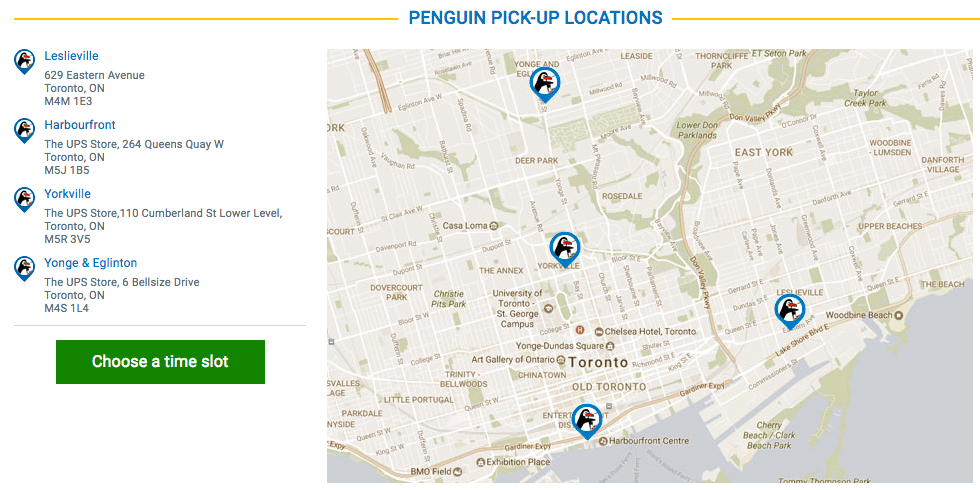
SCREEN SHOT FROM THE WALMART CANADA/PENGUIN PICK-UP WEBSITE
“Right now, this format is still new for us. The Pick-Up locations are an important part of our urban/city strategy and they could definitely work in other markets. However, we don’t have anything to announce at this time.”
Penguin Pick-Up has 37 locations in the Greater Toronto Area. The company’s physical locations are branded with signage. Customers can ship anything to Penguin Pick-Up from any online retailer in the world.
Nielsen said the company’s growth has been at “a pretty good pace” since its inception. When asked how many locations he foresees eventually, he replied: “Hundreds.”
“But we really want to follow where retailers and consumers are having the biggest challenges to meet,” he said. “Over time, we found that in particular urban areas, and in particular in areas where there’s high density . . . that’s where the biggest challenge comes in to the last mile. It’s not our only focus but that’s where we see that we are solving an immediate problem for retailers and consumers.”
Nielsen said the Penguin Pick-Up locations are equipped with freezers and coolers to store food. The locations, which are open 7 a.m. to 9 p.m. on weekdays and 10 a.m. to 6 p.m. on weekends, can store fresh and frozen food as well as hard goods such as electronics and apparel.
Since its launch in 2014, Penguin Pick-Up has received packages from over 5,000 retailers in 11 countries.
The company also operates Penguin Fresh which sells farm fresh food – a farmers’ market online. Consumers can choose food from local suppliers and farmers.
Recently, Metro Supply Chain Group Inc. (Metro) announced that it had finalized an agreement with Penguin Pick-Up to add that company’s convenient online purchase pick-up locations to its expanding direct-to-consumer delivery choices.
“Regardless of which provider actually fulfills the last mile to the consumer, it’s the retailer who takes the reputation hit for any inconvenience that can arise during that part of the transaction,” said Metro’s Head of Ecommerce Development, Tony Jasinski, in a statement. “From ‘sorry we missed you’ slips through stolen packages, the process is fraught with variables. Offering options like Penguin Pick-Up that replace the potential for human error with a consistent, predictable last mile experience helps our retailers go from online shopping cart to repeat customer that much faster.”
Now the fun begins for the retail and real estate industry across the country.
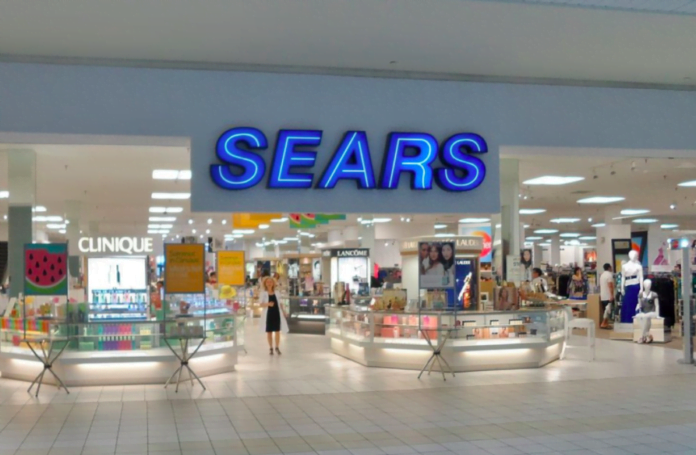
With the closure of all Sears Canada stores as of Sunday, a vast wasteland of empty space is now open in shopping centres across the country and in standalone structures.
But for the retail sector, like in life, when one door closes, a window of opportunity opens. And that’s how the industry is looking at the closure of what was a formerly iconic retail brand across Canada.
Peter Morris, CEO of Greenstead Consulting Group based in Victoria, said at one point in time Sears had 190 stores (of varying sizes) and well over 15,000 employees. The last store closures will result in millions of square feet becoming available on the market.
“There’s a tremendous opportunity depending upon where the space is located on one end of the scale,” said Morris. “The other end of the scale there’s going to be long-term pain in certain locations and for certain communities.”
Morris said he knows of some Sears locations where they were paying 50 cents per square foot because they were very old leases. But landlords of those spaces are now in a prime position to be able to re-purpose that space.
“Keep it retail. Make it service. Make it institutional such as libraries. And get an uplift on the rent and actually re-position the property,” said Morris. “A lot of people considered Sears to be an anchor and that was very, very true while Sears was in its heyday but frankly Sears stopped drawing traffic many years ago as witnessed by its demise. Those well-located Sears stores will be very quickly re-purposed.”
But there are also many former Sears stores that were standalone buildings. Morris said those are also ripe for redevelopment opportunities into mixed-use or condo use by either being torn down or re-purposed from the inside out.
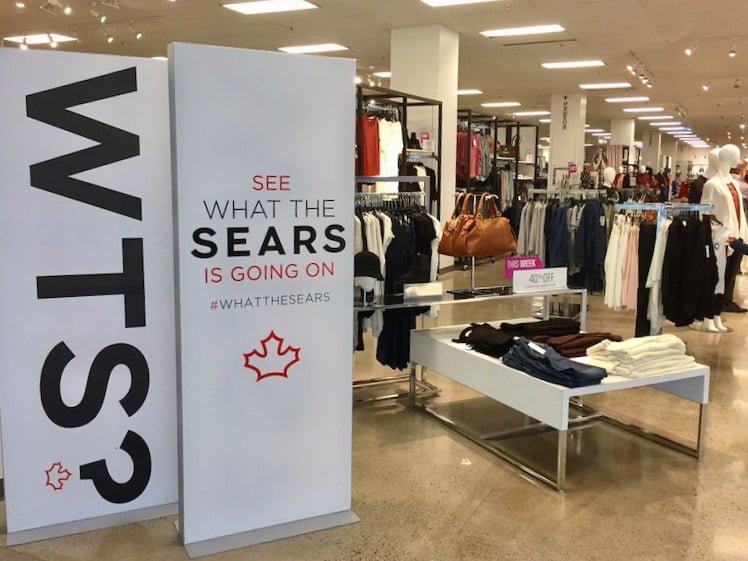
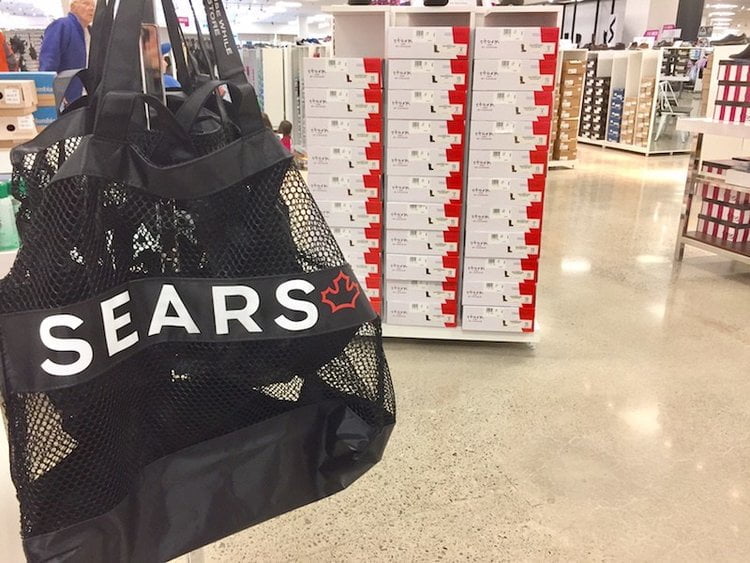
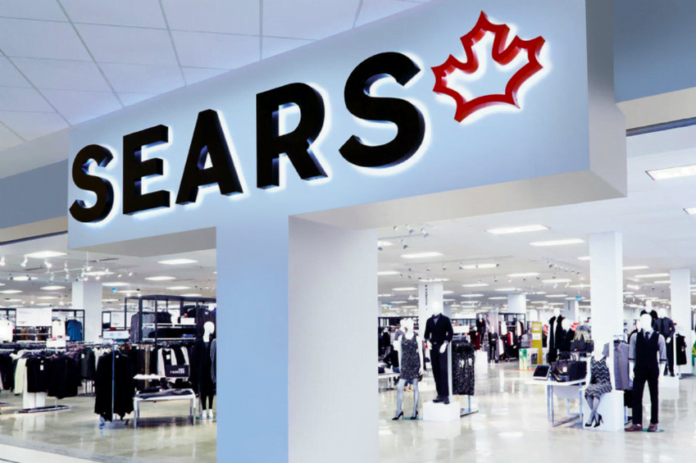
AT THE RENOVATED ‘WTS’ SEARS CONCEPT LOCATION AT PROMENADE MALL IN THORNHILL, ON. PHOTO: CHRISTINA AVILA FOR STYLE DEMOCRACY
“The ones that are going to be hurt however is unfortunately where Sears was strongest at the end of its life,” explained Morris. “That is in rural communities. Because in rural communities Sears was the general store of old. We saw the demise of department stores coming back in the 1970s, 1980s with the rise of the specialty store chains. Prior that, department stores ruled the roost and it was specialty stores, mom and pop, independent stores, that you found downtown and on main street. The department stores had the branding, the advertising power and the purchasing power to fill their stores with a selection.”
“But once those specialty stores came along we started to see sales in department stores peter out. After that came the big box stores – the Best Buys of the world and stores like that – and that started to cause the demise of a lot of specialty stores too. Where Sears did well in rural markets was because the specialty stores couldn’t operate efficiently in those markets. They were too small to meet the needs that they had for their bottom line for their investors . . . And the big box stores obviously can’t operate in a small rural catchment area for the same reason because they need to get those economies of scale.”
So it’s going to be hard to backfill those former Sears spaces in smaller communities.
“It’s a tale of two geographies. Urban versus rural,” said Morris.
AT THE RENOVATED ‘WTS’ SEARS CONCEPT LOCATION AT PROMENADE MALL IN THORNHILL, ON. PHOTO: CHRISTINA AVILA FOR STYLE DEMOCRACY
“It’s a little early. There’s going to be a lot of planning. It’s safe to say there aren’t any 150,000-square-foot users to take up so many stores. They’re going to have to re-demise that space. But shopping centres themselves are going through a transition. If Sears was in a prominent shopping centre, they have no problems chopping that space up into smaller spaces, commanding very high dollar value and the owners of those properties are going to be very, very satisfied.”
Secondary properties, though, will have to be more creative with that space, he said, and generally in shopping centres a revolution is taking place anyway with more food, more entertainment and more uses that were primarily in the past standalone locations such as gyms and offices.
“So anything that requires physical interaction which is what we’re now seeing in shopping centres,” said Morris.
Michael Kehoe, an Alberta-based retail specialist with Fairfield Commercial Real Estate Inc., in Calgary, said the departure of the Sears department stores may trigger co-tenancy provisions in major tenant leases across the country.
“A co-tenancy provision in a lease may be granted to an anchor or significant shopping centre tenant whereby should an important tenant leave the shopping centre the tenant with the co-tenancy provision in their lease may be entitled to close or have a reduced rent should the anchor or significant tenant space not be re-leased/replaced within a specific time period and in a certain manner such as replaced with retail use,” said Kehoe.
“The uncertainty caused by an anchor store closure can be amplified when the other major tenants in a shopping centre may have an opportunity to depart or reduce their rent thereby further weakening the image and appeal of the property.
It is essential that shopping centre landlords re-lease or redevelop vacant department store space is a timely and effective manner.”
Morris said co-tenancy is not in every lease and it’s not widespread but it is definitely a concept that is negotiated in by some strong tenants.
“It is a protective measure that strong tenants put into their leases,” said Morris.
“The problem for some landlords will be, and they’re evaluating this now I am sure, a cascading effect whereby you have a tenant that can leave because the anchor has left and they exercise that option to leave and then another tenant has their co-tenancy tied to the tenant that’s about to leave because Sears left and another tenant has their co-tenancy based upon the total amount of space occupied in the property and now that’s been triggered and they leave. And then there’s another co-tenancy and it just goes on and on. It becomes a self-fulfilling prophecy.”
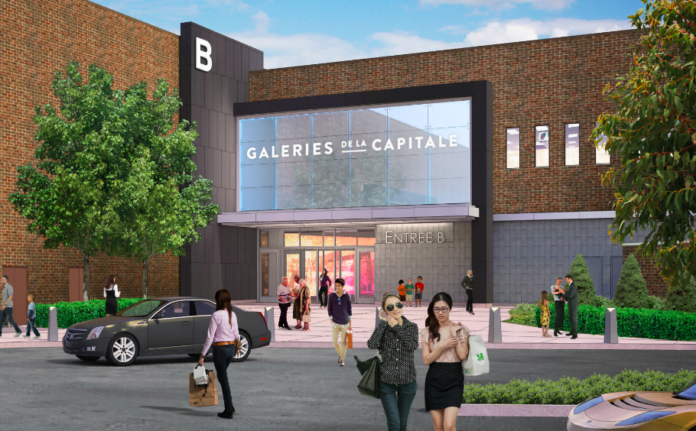
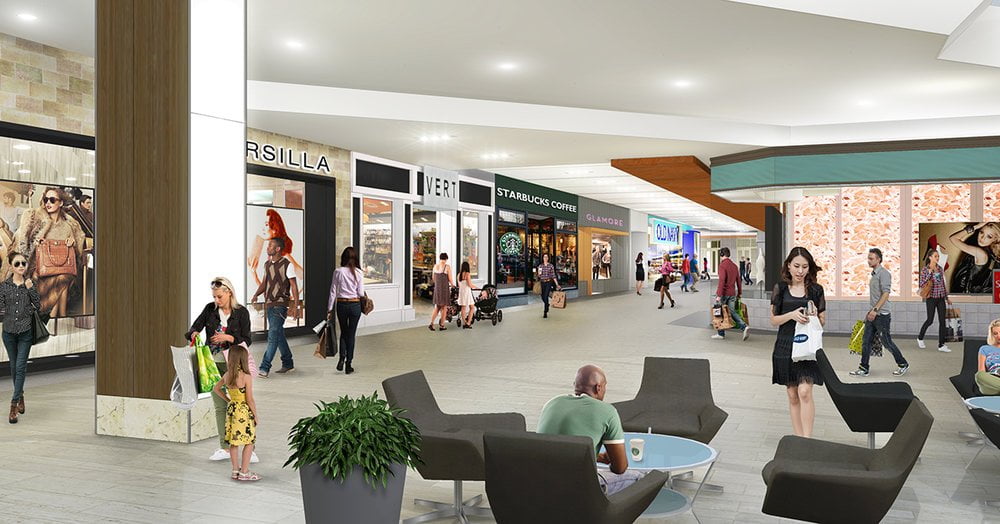
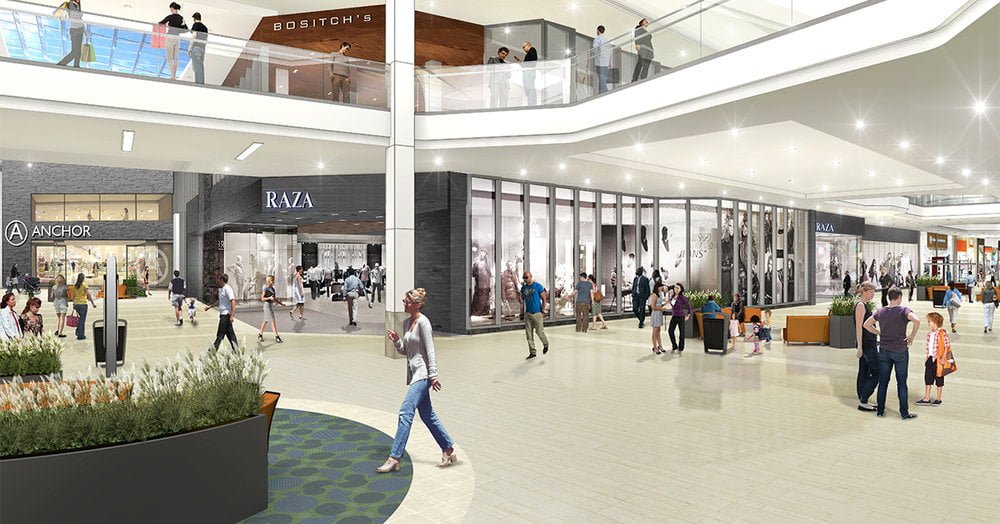
Les Galeries de la Capitale (Image: Oxford Properties)
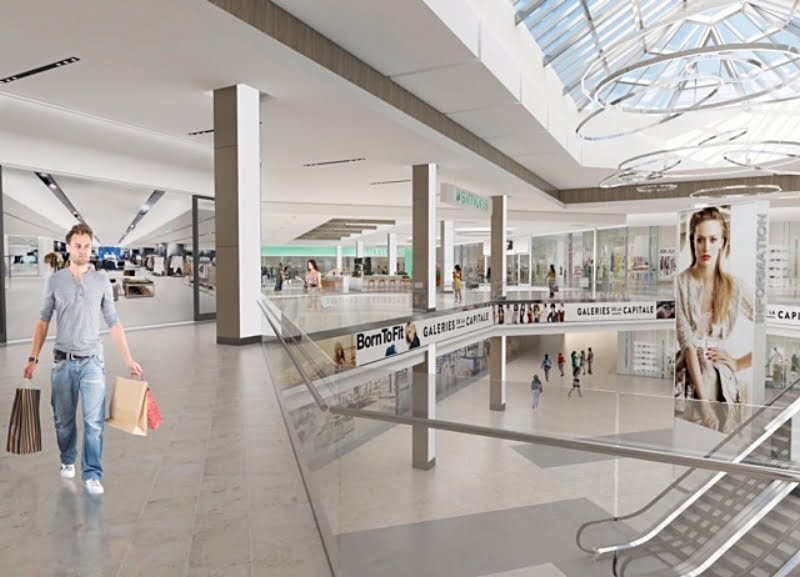
Renovations to Quebec City’s Les Galeries de la Capitale shopping centre have been ongoing for the past couple of years. The centre saw a 7.75% increase in traffic in 2017 as it added new stores and others were renovated. This year will be an important one, as well — renovations to the mall’s common areas will be completed, its Méga Parc amusement park will reopen, and La Maison Simons unveil its first net-zero department store.
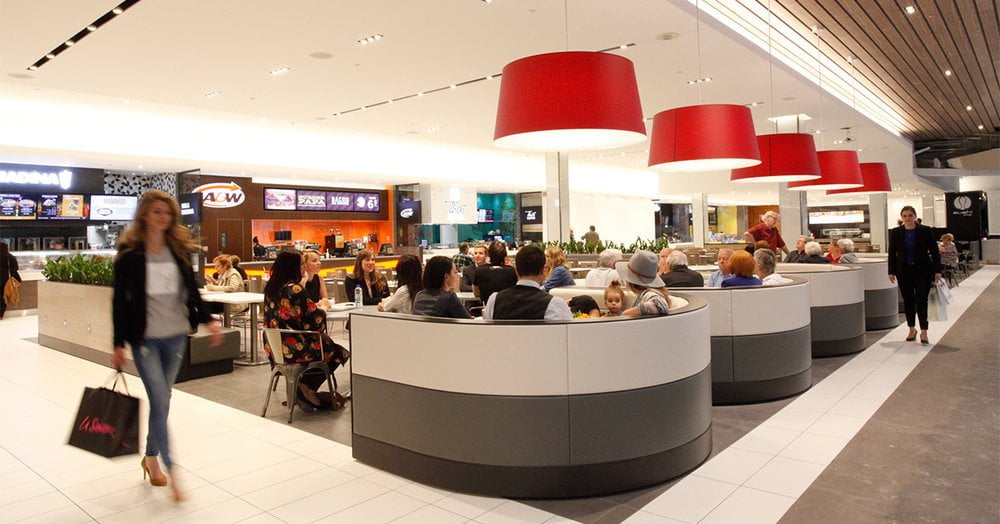
It’s all part of a plan for landlord Oxford Properties to attract more shoppers to the centre, explained the mall’s General Manager Stephan Landry. It’s already been a success — the centre’s renovated food court (called ‘Espace Gourmet’) is now one of the most productive in the country, and new stores are being added as retail space is reconfigured.
The modernization strategy commenced about three years ago, with more than $200 million in investments having been announced for the centre’s retail and entertainment components.
Les Galeries de la Capitale (Image: Oxford Properties)
Last year was an important one for Les Galeries de la Capitale. Twelve tenants renovated their stores at the centre, including a full renovation to its 163,000 square foot Hudson’s Bay anchor — Mr. Landry says that it is now the most attractive looking Hudson’s Bay store in the company. As well, 13 new stores opened at the mall last year, including Sephora, Urban Planet, Bijouterie Monaco, Clarks, Rinascimento, Soft Moc, MEC, BonLook and L’Occitane en Provence, among others. As well, Telus opened its first “Connected Experience store” in the province at Les Galeries de la Capitale last year.
Expanded food and beverage offerings at the centre include the newly opened restaurant-pub Le Balthazar — known for its expansive selection of beer, it’s the first location in Quebec City for the Montreal-based chain. Oxford Properties is dedicating more space to food and beverage establishments than ever before, recognizing that it helps attract visitors and retain them for longer.
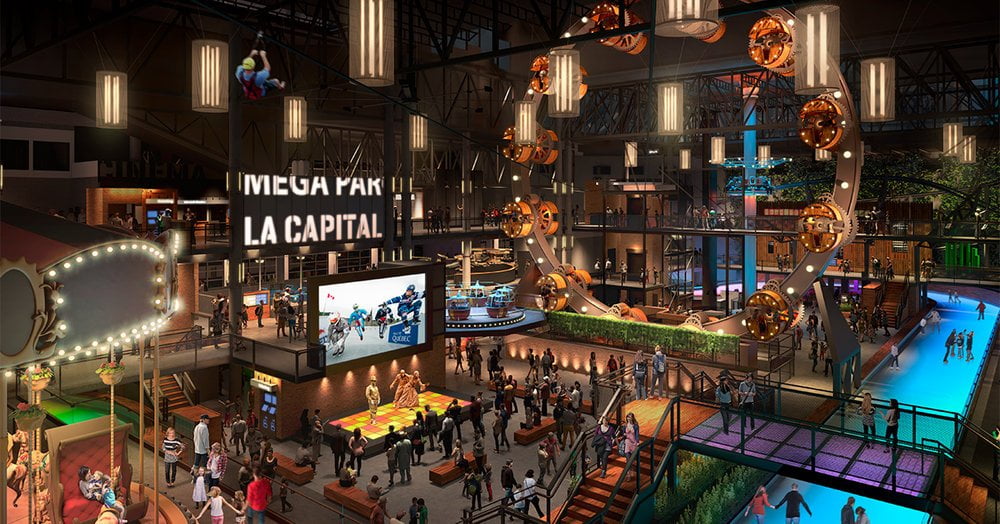
One of the mall’s most unique features, its Méga Parc amusement park, which closed temporarily in September as part of a $52 million overhaul that will see the 30-year old Méga Parc transformed into a Steampunk themed “entertainment zone inspired by the Industrial Era”. Construction is expected to be completed towards the end of this year and in the meantime, some of Méga Parc’s attractions can be found temporarily placed throughout the centre.
(THE MALL’S FOOD COURT, NAMED ‘ESPACE GOURMET’, SAW A RENOVATION IN 2015 THAT RESULTED IN ITS BECOMING ONE OF THE MOST PRODUCTIVE FOOD COURTS IN THE COUNTRY. PHOTO: OXFORD PROPERTIES) (THE MALL’S MÉGA PARC AMUSEMENT PARK WILL REOPEN TOWARDS THE END OF THIS YEAR, WITH A ‘STEAMPUNK’ THEME)
Further driving traffic to Les Galeries de la Capitale is its popular IMAX theatre, which is the largest in Canada, and the only one in the area.
Les Galeries de la Capitale will continue to see construction into 2018 and beyond, necessitated partly because of the relocation of one anchor, as well as the closure of another. La Maison Simons is relocating its 45,000 square foot store to a new $50 million, 80,000 square foot space that will open in March of this year. The replacement store will be the first in the company to be zero-carbon, in a space vacated by Target in 2015. The remainder of the former Target space will be occupied by nine smaller retailers, with one of them confirmed to be a 2,200 square foot Jean-Paul Fortin shoe store, expected to open in April.
The mall’s former Sears space, which was vacated this month (along with the rest of Sears Canada’s stores) will also need to be repurposed. Plans have yet to be revealed for the 185,000 square feet that Sears occupied in the centre.
Les Galeries de la Capitale (Image: Oxford Properties)
Les Galeries de la Capitale (Image: Oxford Properties)
(LA MAISON SIMONS WILL OPEN ITS FIRST NET-NEUTRAL STORE AT LES GALERIES DE LA CAPITALE IN MARCH OF THIS YEAR. RENDERING: LEMAYMICHAUD)
An impressive 14 new stores are confirmed to be opening in the centre over the next several months. Coffee retailer Nespresso will open in the mall in February of this year, and footwear brand Sketchers will open its first store in the Quebec City region in March. Michael Kors will open a store in May, and beauty brand MAC Cosmetics is confirmed to be opening a store there in September.
As well, Quebec City’s first location for the Montreal-based Mahée fragrance/fashion brand will be unveiled in August of this year. This will be only the second standalone Mahée location — its other location is at Oxford Properties’ Quartier DIX30 project in suburban Montreal (a downtown Montreal Mahée location, which opened in early 2016, closed several months ago, and currently houses a Swarovski pop-up store).
We’ll update this article as things progress at Quebec’s largest shopping centre. With more than 10 million annual visitors, the 1.5 million square foot mall with 280 stores is a regional leader, and could grab even more market share as visitor numbers and spending continues to grow.
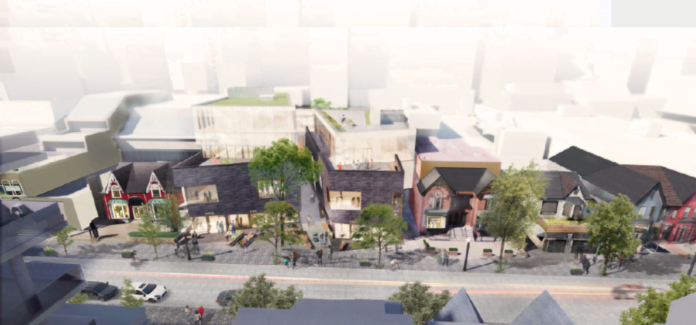
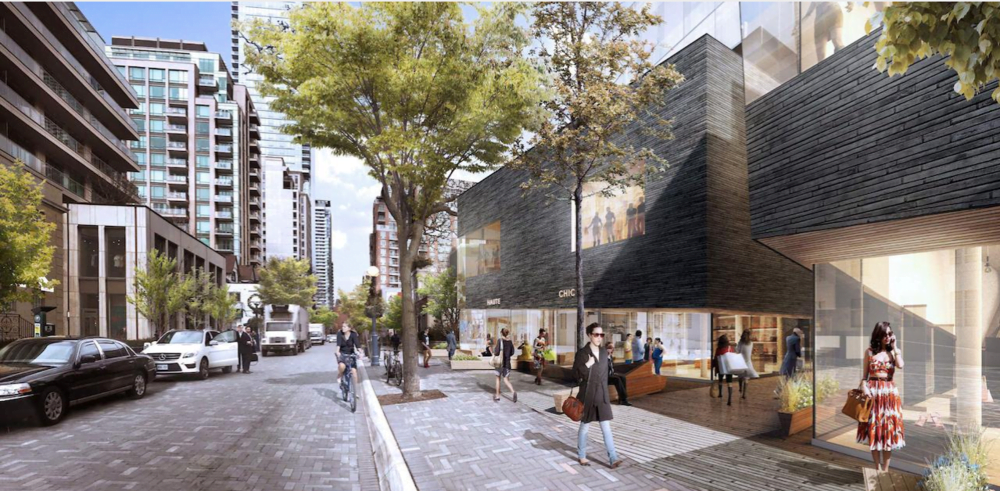
A new commercial development is part of a plan to expand pedestrian laneway access in Toronto’s Yorkville area, while also adding new luxury retailers and restaurants to the mix. With an anticipated 2020 occupancy date, the new multi-level 101 Yorkville Avenue project will be unlike anything in Toronto to date, and will solidify Yorkville Avenue as one of the country’s most prestigious retail addresses.
Last week, Urban Toronto first reported on the newly released renderings and after reading their article, we wanted to go into further detail on what’s planned for 101 Yorkville Avenue, with some further details from the developer. Many people are curious about what the 101 Yorkville Avenue redevelopment will look like — the property spans about 120 feet of street-front, and is part of the transformation of Yorkville Avenue into a luxury retail address.
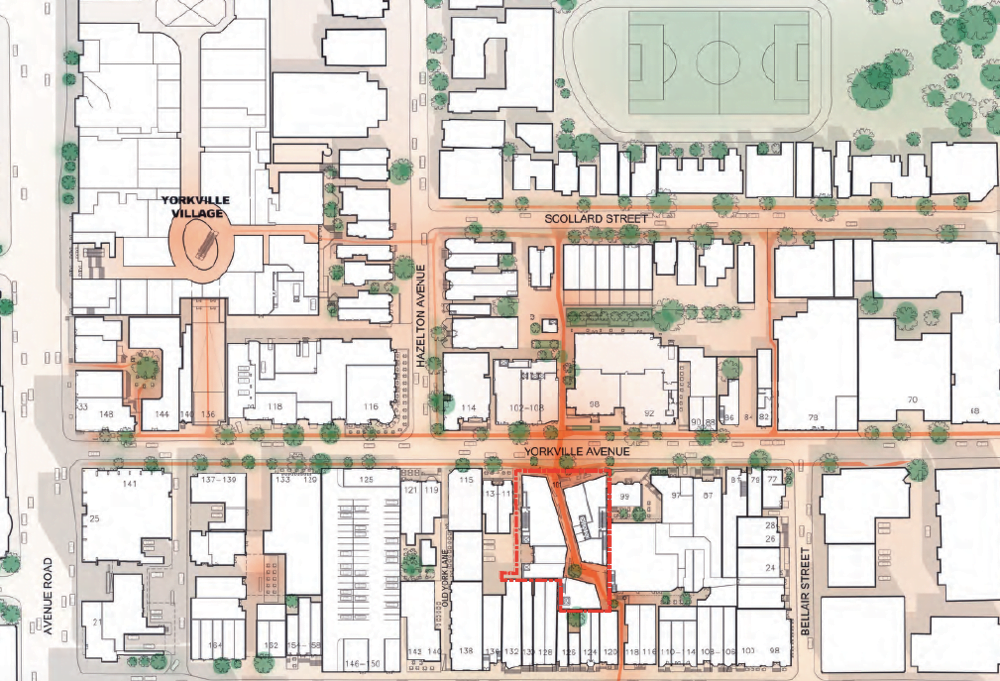
(MAP OF YORKVILLE, INDICATING THE PROJECT’S NEIGHBOURHOOD CONNECTIVITY)
First Capital Realty has been acquiring buildings in the area for several years, and a milestone was reached in November when Chanel opened a magnificent 8,550 square foot flagship at First Capital Realty’s overhauled 98 Yorkville Avenue (across from 101 Yorkville). Other First Capital Realty developments nearby include the 102-108 Yorkville Avenue project that will be completed towards the end of this year, housing flagships for luxury brands Jimmy Choo and Brunello Cucinelli, as well as an upper-level space for Toronto-based Her Majesty’s Pleasure. First Capital Realty also owns other real estate in the area (including the former Hazelton Lanes which has been rebranded ‘Yorkville Village’), and is marketing two properties nearby — a vacant lot at 82-84 Yorkville Avenue that can be custom-built for a tenant, as well as the middle street-level space between Jimmy Choo and Brunello Cucinelli that will be perfect for a leading luxury retailer.
The existing 101 Yorkville Avenue property includes a multi-level, 45,000 square foot circa 1977 brick structure housing several retailers and offices. The current building is dated, featuring a half-floor up/down design that, while common in the area, is considered to be less-than-optimal for international brands seeking street level exposure.
Demolition of the current 101 Yorkville Avenue property is anticipated for the spring of 2019, with a new 48,500 square foot commercial property (with an additional 6,300 square feet of outdoor space) expected to be finished towards the middle of 2020. Current tenant Over the Rainbow Jeans has already secured a replacement location at the Manulife Centre at 55 Bloor Street West, which is seeing an overhaul that will include Canada’s first Eataly.
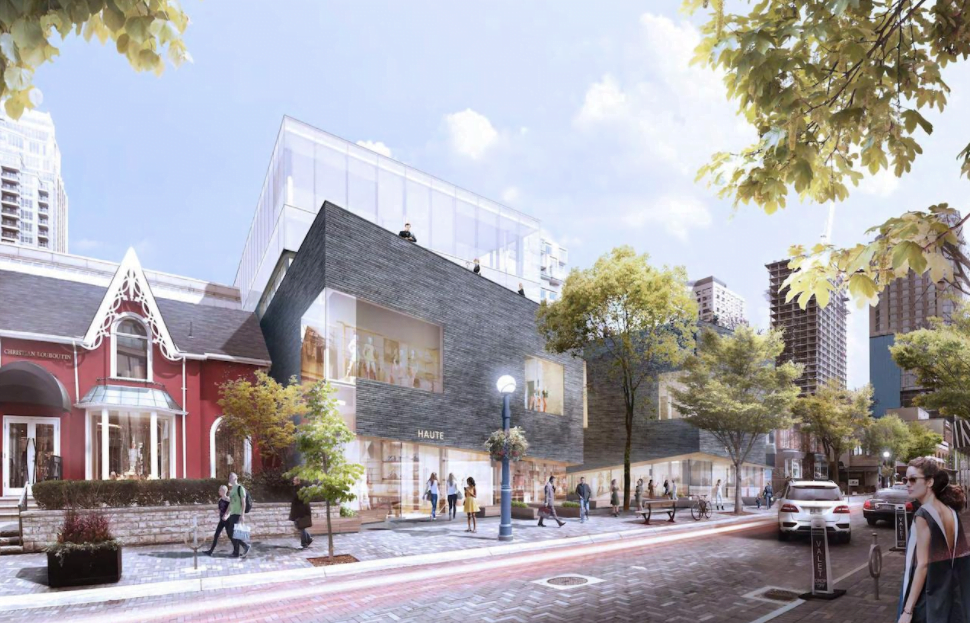
(LOOKING SOUTHWEST ON YORKVILLE AVENUE, WITH THE CHRISTIAN LOUBOUTIN BOUTIQUE IN THE RED BUILDING TO THE LEFT)
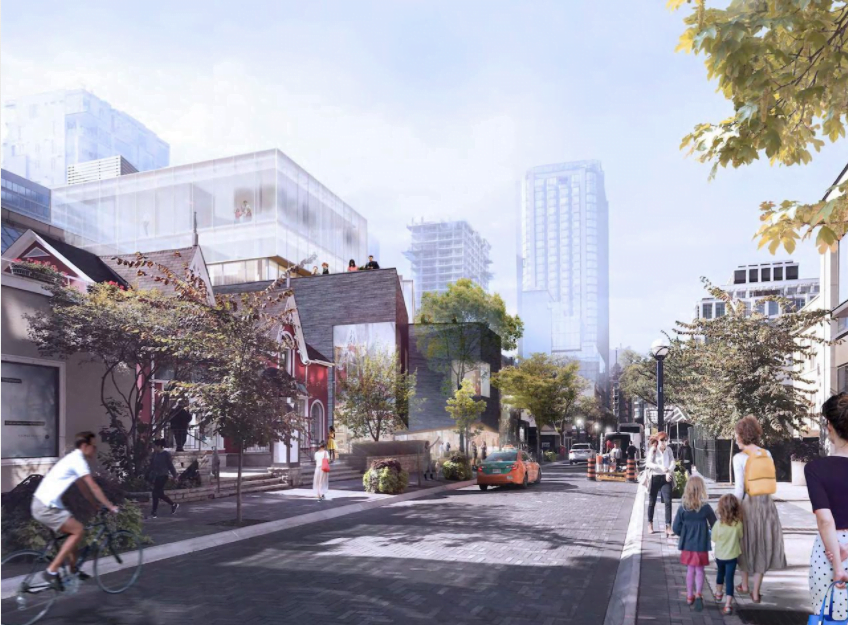
(LOOKING WEST ALONG YORKVILLE AVENUE)
(LOOKING EAST ALONG YORKVILLE AVENUE PAST 101 YORKVILLE AVENUE AT THE RIGHT)
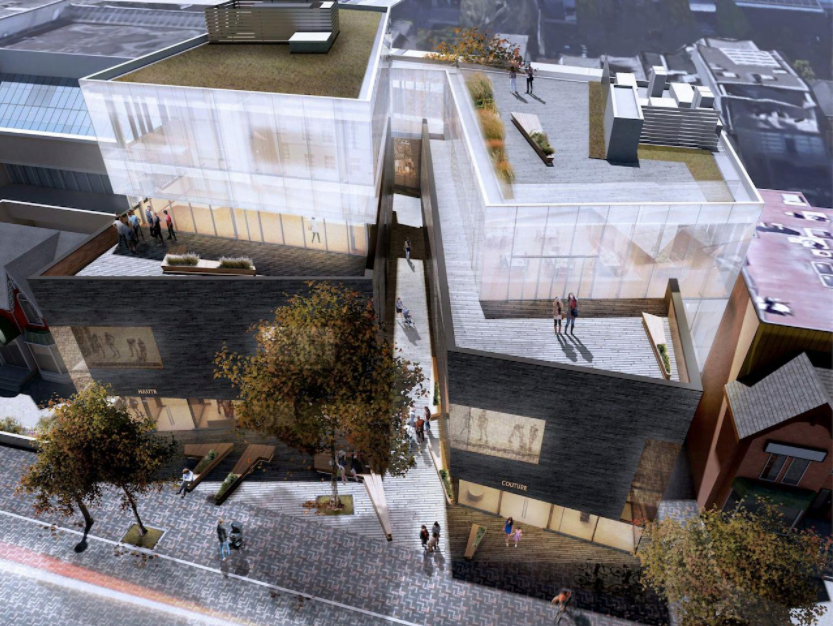
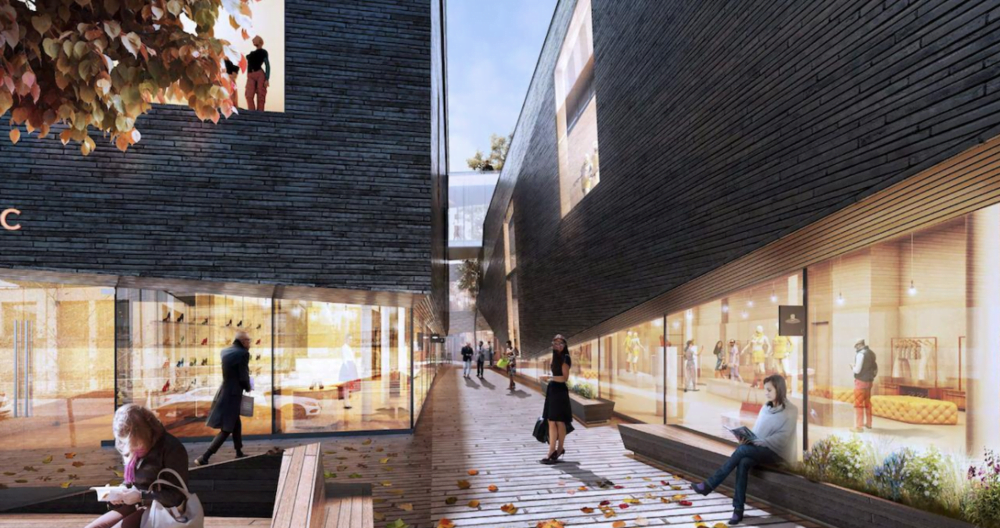
The overall design of “The Mews” will include three buildings separated by pedestrian walkways, including a south-end courtyard that leads to a connecting laneway that leads towards Cumberland Street. The new buildings’ design includes flexibility — plans show three levels of retail with seven units (some being two-level), though there’s ample opportunity to customize and modify these for individual retail tenants.
The building’s exterior is proposed to be clad in slate, which is the material commonly used on the roofs of historical Victorian homes in the neighbourhood. The historic slate shingles take on a new form as masonry bricks (brickwork is also common historically in the neighbourhood) on the solid façade.
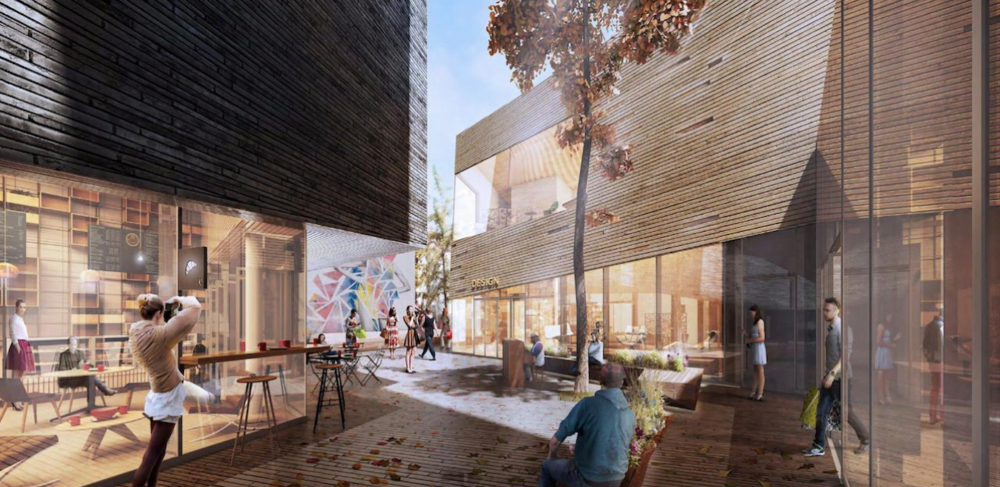
The east component of the complex, adjacent to Christian Louboutin at 99 Yorkville Avenue, will feature four levels of commercial space. The lower two levels will be dedicated to retail (there’s flexibility in their configuration) and the third and fourth levels may be used by food and beverage or other uses, with a third floor terrace and a glazed bridge connecting the east building to the west building (the west building will have three levels). A central pedestrian mews at ground level, which will be a privately-owned public space (PoPs), can be animated for events and will otherwise be designed to be attractive and welcoming with seating and plants. Being privately-owned, city permits for use (such as for patios or events) won’t be required in the same way as a purely public gathering space.
(A CLOSER LOOK AT THE MEWS)
(A CENTRAL COURTYARD AT THE HEART OF ‘THE MEWS’ WILL BE ANIMATED WITH VARIOUS USES THROUGHOUT THE YEAR)
(ANOTHER LOOK AT ‘THE MEWS’, FACING TOWARDS YORKVILLE AVENUE)
The complex’s design will create, in effect, ‘four corners’ for the Yorkville Avenue retail spaces — this will enhance desirability by creating exceptional visibility for each retail unit. First Capital Realty is targeting luxury brands for the three spaces in the floorplans that front directly onto Yorkville Avenue, with the possibility of including second-level as well as basement space for those units. Some of the world’s leading luxury brands have been seeking space in Toronto’s Bloor-Yorkville area, and this project will no doubt be of interest to retailers seeking customizable space within close proximity to other luxury brands in the heart of one of the world’s wealthiest high-density residential neighbourhoods.
Spaces in the interior corridor at 101 Yorkville could house a variety of retail uses such as fashion or food and beverage, with commercial units facing onto the privately-owned public space. The third and fourth floor spaces might be utilized for restaurants, and some retailers may also seek some of the space — luxury brands are increasingly seeking-out spaces that include private outdoor areas for their guests, be it a private client meeting or for larger events.
“Working closely with our design, construction, and development teams and in collaboration with our consultants, we have put together a project in Yorkville Mews that exemplifies everything we have learned about the neighborhood, the luxury-minded consumer, and the evolving desires of retail brands and restaurants,” said Eric Sherman, Senior Real Estate Manager at First Capital Realty who handles leasing in the area. “The Mews is an outdoor pedestrian walkway and courtyard that acts as a mid-block connection between Yorkville Ave and Cumberland but ties into a larger network that effectively connects Bloor Street all the way to Scollard Street.”
1 of 4
Mr. Sherman went on to say, “This not only plays into the unique character of Yorkville that has historically been defined by its quaint network of laneways, but also allows for the integration of an increased number of corner/end-cap retail spaces, more substantial storefront exposure, and an abundance of outdoor terrace space on multiple levels primed for flagship restaurant, café, and retail brands alike. Yorkville Mews allows for discovery and exclusivity but also prominence and animation – it solidifies Yorkville Ave as the most prestigious luxury address in the country.”
As Mr. Sherman described above, “The Mews” at 101 Yorkville Avenue will also act as a connection point that will be part of a pedestrian network extending from Bloor Street West all the way north to Scollard Street — an example of a retail landlord contributing positively to city building. First Capital Realty researched the history of Yorkville and determined that the historical relevance of the neighbourhood’s mid-block connections warranted a design that would include what is expected to be a significantly used pedestrian access, facilitated in part with the construction of 101 Yorkville Avenue.
It’s an exciting time for Toronto’s Bloor-Yorkville area, as billions of dollars are being spent on developments that will add a considerable amount of new retail to the area, as well as thousands more over the next several years. The new 101 Yorkville Avenue project will act as an anchor and connection point for the neighbourhood, which is in the process of securing its place as one of world’s leading luxury retail addresses. We’ll follow its progress ahead of its anticipated 2020 completion, and will also continue to report on other developments in the area.
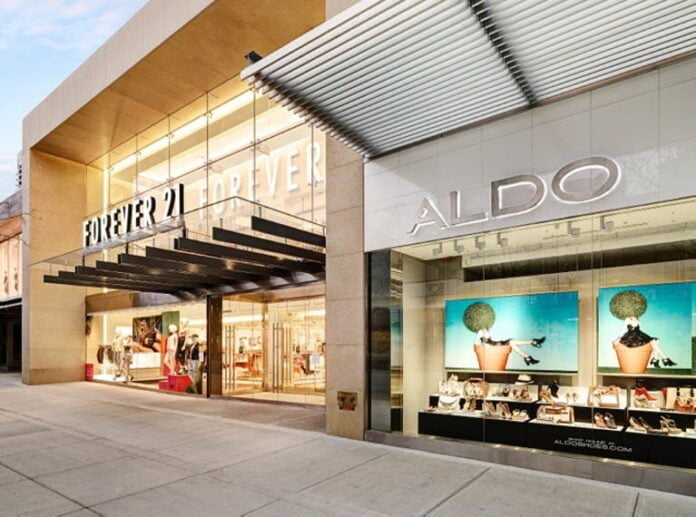
Today’s photo of the day is of the Forever 21 store at 1033 Robson Street in downtown Vancouver, which closed on Monday, January 15. Indigo Books & Music has announced that it has subleased Forever 21’s two-level 29,000 square foot space and will open a store there in the fall of 2018.
Indigo’s Robson Street store will reflect the retailer’s updated ‘culture department store’ concept that it launched at Toronto’s CF Sherway Gardens in the spring of 2016 (see photos below). Indigo has opened several of these new stores since then, and the retailer is in the process of aggressively securing new retail spaces, including replacement locations in existing markets, for its updated store format. With Sears Canada’s recent demise, Indigo has accelerated its plans to secure locations for updated stores.
(Photos below are of Indigo’s ‘cultural department store’ at CF Sherway Gardens in Toronto, via Burdifilek)
“Indigo, which also operates the Chapters brand, has had a long and valued relationship with book lovers in downtown Vancouver,” said Heather Reisman, Indigo CEO. “When we made the decision to leave our well-loved Robson street Chapters store, we promised our customers that as soon as we could, we would be back. We are so very excited to reconnect with this community who are among the best and most passionate readers in the country.”
According to a press release, “The new store will have a warm and inviting aesthetic inspired by the city. Customers will explore the best book selection, exclusive Indigo-designed lifestyle products and an outstanding IndigoKids department combining books, STEM (science, technology, engineering and math) products and the best in creative play. The store will also have a full cafe and community space for special events.”
Forever 21 opened at 1033 Robson Street in November of 2012.
Robson Street is in a state of transition and good things are on the way. This month we’ll be profiling Vancouver’s Robson Street with some updates from the BIA as well as brokers doing deals in the area.
The two most important developments for Canadian apparel retailing to date this decade has been the:
1. Invasion of foreign apparel retailers, and 2. The death of Sears Canada.
Readers are undoubtedly fed up with reading about Sears Canada’s demise (FYI, I am also similarly tired of writing about it). Nevertheless, I feel compelled to offer a eulogy for the company.
Sears Canada was a retailer that over the long-term earned the respect and affection of many Canadian households. It was viewed as a good corporate citizen whose products and services could be trusted by Canada’s middle class. As such, it is with a note of sadness that its passing is acknowledged.
The death of Sears Canada was not a foregone certainty…
Yes, department stores are struggling worldwide, yet in many cases it’s because they operated too many outlets,
Yes, many apparel retailers positioned in the middle of the market are struggling, yet many including Marks and La Maison Simons are not,
Yes, Sears Canada was late to ramp up its e-commerce business, yet e-commerce today counts for only 2%-4% of most Canadian retailer’s sales.
The two reasons for Sears Canada’s death were the greed/short sightedness of its principal shareholder and the seemingly incompetence of a series of Sears Canada’s CEO’s.
For over ten years, Eddie Lambert and his hedge fund were the primary stockholders of Sears Canada. In that position, Mr. Lambert was able to “call the shots” as when a number of Sears Canada’s primary locations were sold. Instead of Sears Canada reinvesting the sale proceeds back in the company, the monies were paid out in special stockholder dividends, totally in excess of C$1 billion. In addition, quarterly dividends, which should have been cut in light of the company’s deteriorating position, were maintained at unsustainable levels.
Without a doubt, Sears Canada’s former CEO Mark Cohen, who was fired in 2004 by Mr. Lambert over “strategic differences,” recently spoke the truth when he said, “Lampert has no strategy to make the company (i.e. Sears Canada) profitable…Sears is like an ATM machine for Lampert, he has his hands on it. Eddie Lambert is either dishonest, delusional and disingenuous, or some combination of the three.” To that, this I say, “Amen!”
Mark Cohen’s departure was followed in quick succession by six CEOs. Each one suffered from three shortcomings. The first involved their inability, with the exception of Calvin McDonald, to articulate where they saw Sears Canada being positioned in an ever changing retail market. The second and third reasons were interrelated as the CEO’s were not given either the needed funds or the authority to make the changes required to make Sears Canada competitive.
Finally we come to Sears Canada’s last CEO, Branden Stranzl, who in his infinite wisdom, hid from the Sears Board the hiring of his wife as Chief Marketing Advisor. However, in retrospect that decision should not have come as a surprise, given his “quixotic” reputation among Sears Canada’s management team. While the “ship” was increasingly taking on water, Mr. Stranzl squandered the retailer’s remaining time and re-sources on at least four highly questionable initiatives, in-cluding:
Designing a new corporate logo,
Creating a Sears pop-up shop in Toronto’s trendy Queen Street area,
Eliminating three of the country’s best known private label apparel brands, and
Making plans to compete with both Loblaws and Walmart by selling groceries.
It’s no wonder that while the retailer was almost comatose, Sears Canada’s last CEO lacked the gravitas to put together a deal that would have saved the company.
This eulogy concludes with my offering Sears Canada’s employees, pensioners, suppliers, shareholders and loyal customers its condolences, as this retailers passing was without a doubt preventable.
Final note re: the Canadian business press and Sears Canada:
In retrospect, one other group that must be called out for either negligence or complacency when it came to Sears Canada’s demise, is the country’s business press, who dutifully regurgitated Sears’ quarterly earning press releases with only minimal any in-depth analysis or commentary. The same journalists conducted fawning interviews with the never ending parade of new Sears CEOs without either asking tough questions during the interview or coming back later to find out why the glowing initial plans described by each new CEO never came to fruition. It’s obvious that Canada’s business press, with a few exceptions (e.g. Hollie’s Shaw’s first class article regarding Brandon Stranzl’s wife) were reluctant to question why Sears CEO’s kept “moving the goalposts.”
Randy Harris is president and owner of Trendex North America, Inc., one of North America’s largest marketing research and consulting firms specializing in the Canadian and Mexican apparel markets. As owner of this Toledo, Ohio based company; his area of specialization is the NAFTA apparel market. Follow Trendex North America, Inc. on Twitter at @Trendexnainfo
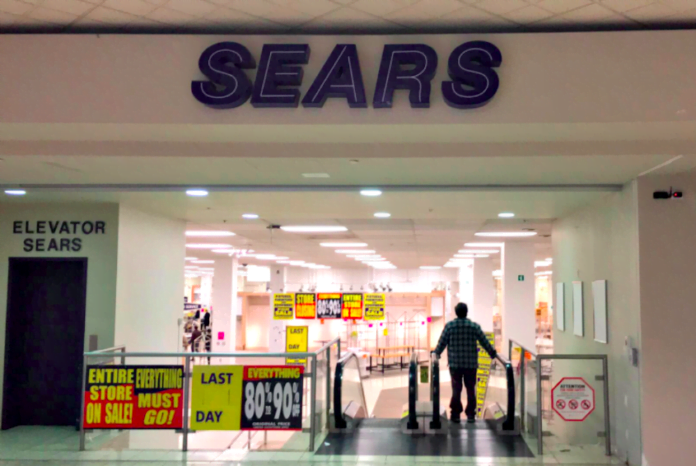
Today’s photos are of the Sears store at North Vancouver’s Capilano Mall, which was one of only a few Sears stores remaining in Canada when it closed on Sunday, January 14. Most of Sears Canada’s stores shuttered a week ago or more.
Sears Canada began in 1952 as Simpsons-Sears, which was as a joint venture between the Canadian Simpsons department store chain and the U.S. Sears chain, which also operated a mail order business. The joint venture was dismantled after the Hudson’s Bay Company bought Simpsons in 1978, resulting in Sears dropping the Simpsons name. Until recently, Sears Canada operated stores coast-to-coast ranging from large department stores to smaller pick-up and service centres.
This week, we’ll be reporting on Sears Canada’s demise, including interviewing experts to discuss its real estate and job losses — Sears will no doubt be an ongoing story as landlords repurpose store real estate, and retail workers seek positions elsewhere. In the meantime, there are several interesting articles on Sears Canada in the news, including the following:
A picture is worth a thousand words, as they say, so we’ll generally be brief with our new ‘photo of the day’ series that we’re launching this week. Several exceptional publications already do this (including one of our favourites, Urban Toronto) and we’re now also doing this as a way to build further engagement on our site as well as across our social media channels. Photos were taken by Lee Rivett, who lives in West Vancouver. And while we may typically only include one photo in a ‘photo of the day’ post, Mr. Rivett provided several photos and also created the video of the Capilano Mall Sears store that can be viewed directly below.
Mr. Rivett noted that in the photos above, taken Sunday January 14, discounts were advertised at 80-90% off. On Saturday, signage indicated sales generally 70-80% off, with some more photos below.
If you have a photo you’d like featured, feel free to tag us on Instagram @Retail_Insider_Canada or email directly to Retail Insider’s Editor-in-Chief, Craig Patterson, at: craig@retail-insider.com.
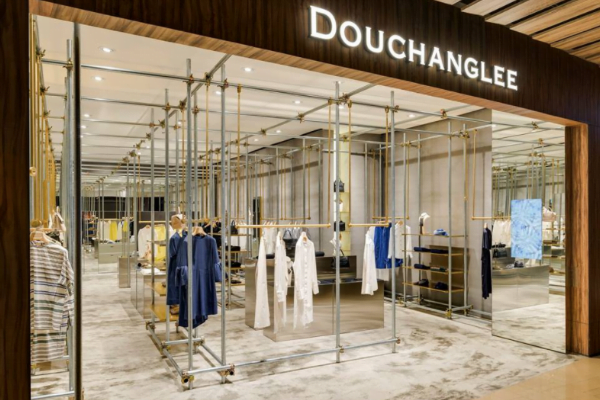
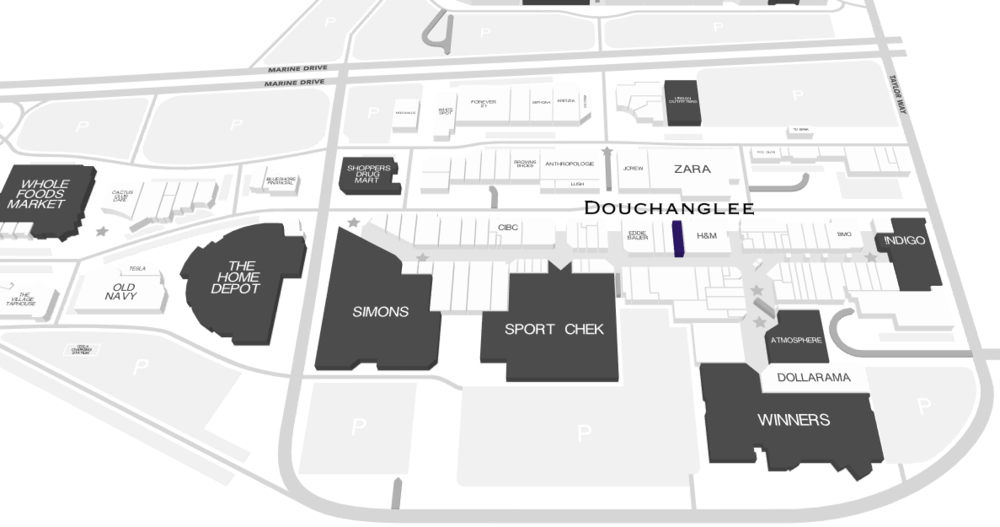
Taiwanese fashion brand DOUCHANGLEE will open its first Canadian location at West Vancouver’s Park Royal in March of this year. If all goes well, it could be the first of multiple Canadian stores.
DOUCHANGLEE currently operates several stores throughout Taiwan (5 boutiques, 9 department store ‘corners’ and 4 franchises), and will soon open in Paris, France. Canada is also part of the company’s international growth plan that is launching this year.
Canadian licensee Jack Wang explained how he wanted to bring DOUCHANGLEE to Canada after encouragement from his wife, who is a fan of the brand. He said that she found it challenging to find clothing from other brands in the Lower Mainland with a similar fit, quality and styling, prompting the entrepreneur to strike a deal with Taiwan’s DOUCHANGLEE to enter the Canadian market.
It helped that Mr. Wang and his family are friends with DOUCHANGLEE’s husband-wife design team, Dou Teng-huang and Zhang Li Yu-jing, who started the brand in 1995 (the name DOUCHANGLEE is a modified combination of their names). The designers graduated from the Department of Fashion Design at Taipei Shijiazhuang University in 1991 and during their studies, they won the first prize of the “4th ROC Fashion Design Newcomer Award” for Taiwan’s design industry. Plenty of other design awards followed.
DOUCHANGLEE designs women’s and men’s collections, and the Park Royal store will initially focus on womenswear. Prices are in the ‘contemporary’ price-point, along the same lines as Michael Kors and Kate Spade. The Park Royal store will span about 2,450 square feet on the ground level of Park Royal South, next to the recently relocated H&M.
The designers and models at a runway show.
Mr. Wang says that the Park Royal store could be the first of multiple locations for DOUCHANGLEE in Canada, though no other stores are currently in the works. The West Vancouver store will act as a test for future Canadian stores if the brand takes off, and he says he’s confident that locals will come to value the Taiwanese brand’s design and overall value proposition.
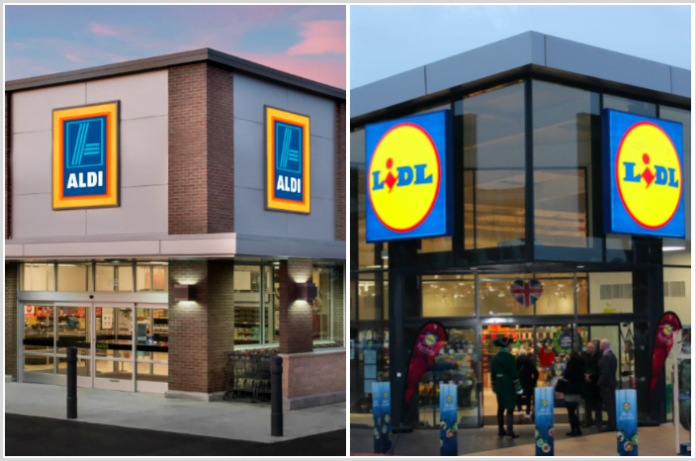
Amazon’s purchase of Whole Foods has stolen all the industry headlines over the past few months. The blockbuster deal has competitors, analysts and consultants making bold predictions on where, when and how consumers will buy their food in the years ahead. However, one grocery story in recent months that hasn’t gotten a lot of press is the arrival to the United States of German hard discounter Lidl.
In June, it opened 10 stores along the east coast, has plans for 80 stores by the middle of 2018, and is on its way to establishing more than 600 locations in the next few years. Another German hard discounter, Aldi, has been in the United States for several years, with 1,600 stores. It has plans in place to spend $1.6 billion to expand and remodel 1,300 stores as well as to open an additional 400 stores by the end of 2018.
So, what’s the big deal? What’s the threat? The answer is quite simple. Between 2003 and 2013, Lidl and Aldi have grown to 20,000 stores in Europe from 8,000. In Germany, the two have about 50 per cent market share. In the UK, they continue to experience double-digit same-store sales growth. It is amazing how fast these two discounters have grown in such a short period of time. Over the past 40 years, Lidl has gone from zero stores to 10,000 in 26 European markets, with $84 billion in sales.
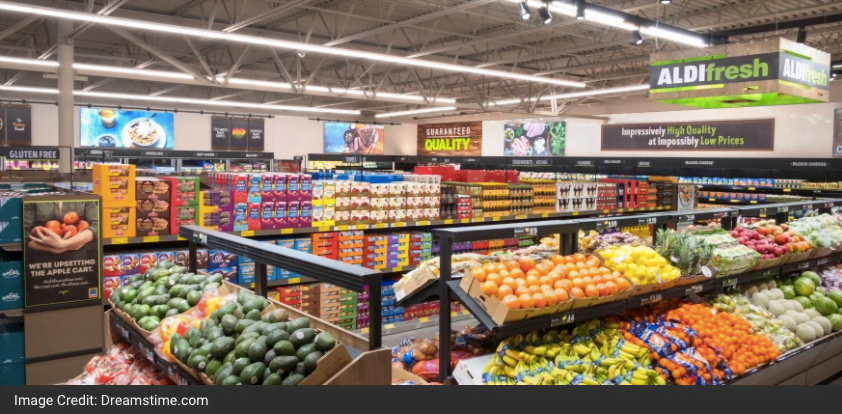
IMAGE CREDIT: DREAMSTIME.COM
What does this all mean for Canada?
There has been no formal announcement from either company that it will be launching in Canada in the near future. In fact, several years ago, Lidl did come to Canada and set up an office in Mississauga. The company was hiring staff and exploring real-estate sites for stores. Much to everyone’s surprise, Lidl suddenly decided to close its office, lay off staff and delay its launch. Perhaps the company saw that it would be more beneficial to launch first in the US, since the country is less consolidated, with larger urban centres and a much denser population.
Also, the US is underdeveloped in discount relative to Canada, which has 40 percent of its grocery sales already going through discount stores. A US launch also provides Lidl the opportunity to define, explore and develop its human resource requirements, system capabilities, product sourcing and supply chain capabilities for the North American market. It makes more sense to gain a foothold in the US and establish its base business needs before it expands into Canada, which has a much smaller market, a more diverse population, and a more challenging geography that serves only 36 million people.
I think it is inevitable that either Aldi or Lidl will enter Canada. Others have tried and failed. However, both these retailers have a proven track record of not only being successful in almost all markets they have entered, but they have also turned the competition on its head and have gained significant market share. Their strategies are simple, cost effective and easy for the consumer to understand and adopt.
Here are some of the components of their model that makes them such a success:
Limited assortment – fast movers only,
Focus on everyday products rather than niche items,
Right size store – 15-20,000 sq. ft. (about 30,000 sq. ft. in the US),
Cost efficient – labour-saving tactics such as displaying product in their shipping containers as opposed to hand packing,
Offer high-quality products at prices much cheaper than competitors (up to 50 per cent cheaper),
Everyday low prices – with enticing use of promotions,
High private-label penetration and SKU count,
Tailors each store to the ethnicity and demographics of the trading area it serves, and
High-quality prepared foods.
Food expenditures are one of the few ways consumers can control and influence the inflation in their household budget. This is why we have seen such a high degree of discount shopping, buying on promotion, ad matching, coupon usage and loyalty point redemptions amongst consumers. The trend toward discount and buying on deal isn’t abating. In fact, it continues to grow.
If someone were to ask me what the biggest threat to Canadian grocery retailers is, my answer would not be Amazon, but rather, the arrival of Aldi a Lidl in our markets. They have disrupted every market they have entered, and every grocery retailer should create a task force to examine the key elements of Lidl’s and Aldi’s programs that make them such a success. Incorporating some of their winning strategies into their own value propositions might not be a bad idea. In fact, it could make a lot of “cents”!
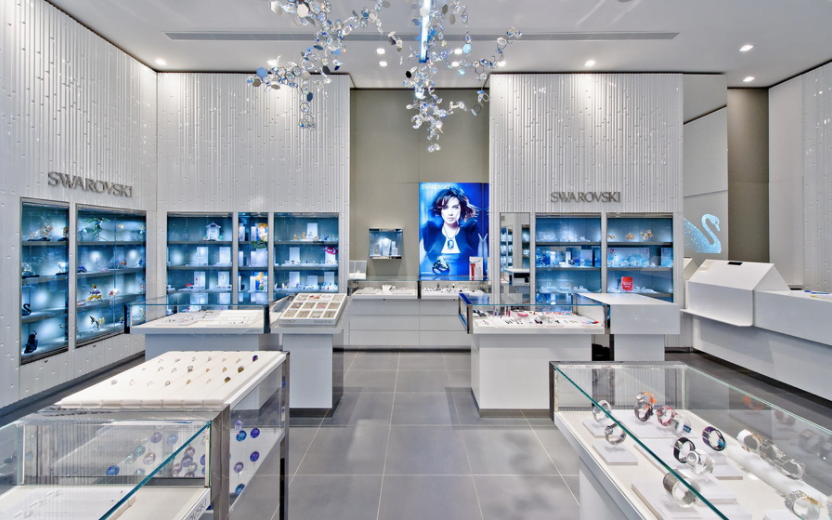
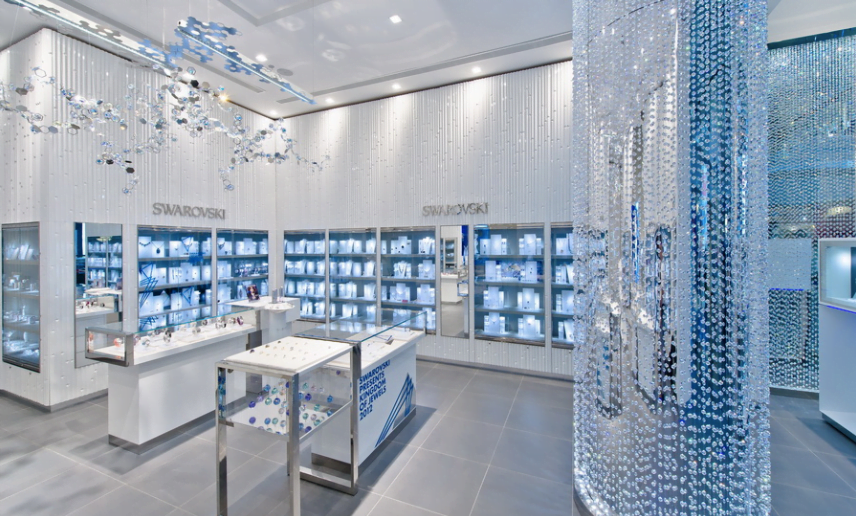
Well-known Austrian crystal jewellery/collectable/gift brand Swarovski plans to continue to open stores in Canada in 2018, as the company identifies markets for growth both for corporately-run as well as for franchised units.
In an interview, Swarovski’s CEO Robert Buchbauer explained how the brand is doing exceptionally well in Canada compared to other markets — Swarovski already has 47 corporately-owned stores in the country as well as five franchised locations. Canada is a sophisticated market with a European influence, valuing quality over price and Mr. Buchbauer said that the company continues to seek opportunities for new stores, with a focus on British Columbia and Quebec, as well as more stores for the Greater Toronto Area.
He noted that the Vancouver market is ripe for more Swarovski locations — the Lower Mainland is seeing strong sales numbers from its existing units, and the market continues to see growth in jewellery sales. CF Pacific Centre in Vancouver will see a new Swarovski store in 2019, he revealed.
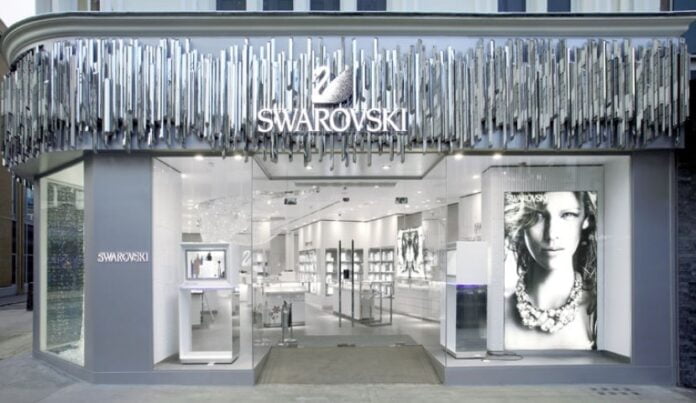
Photo: SwarovskiPhoto: Swarovski
The Quebec market is a target for Swarovski as it continues to gain a foothold in the province and it most recently opened a unique pop-up space on Sainte-Catherine Street West in Montreal, and a store at CF Promenades St-Bruno will also open this year.
Recent new store openings for the brand include Oshawa and Oakville — brokerage Aurora Realty Consultants continues to handle Swarovski’s Canadian site negotiations under the direction of broker Manon Parisien.
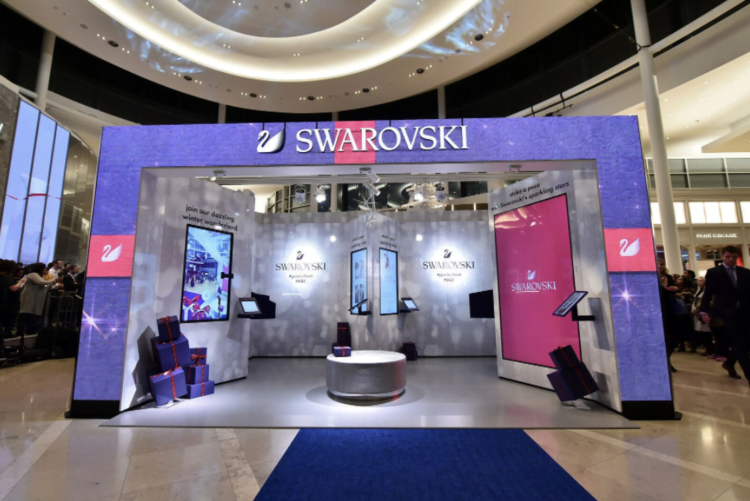
Canada is something of a test market for Swarovski, and in a rather unique way. In late 2017, the company unveiled its first-ever Sparkle Pop Up at Square One in Mississauga. The tech-focused pop-up is a way for Swarovski to test out new ideas, products and concepts, with some successful elements expected to be rolled-out into store locations in Canada as well as globally. Customers can engage with augmented reality, for example, with digital screens showing the latest from the brand in an environment that encourages exploration.
(POP-UP AT SQUARE ONE IN MISSISSAUGA. PHOTO: TOM SANDLER PHOTOGRAPHY)
It was Square One’s market diversity that led to the brand partnering with the shopping centre for the Sparkle Pop Up. Square One is one of Canada’s largest and busiest malls, and Mississauga is known for its rapid population growth, which continues to diversify.
New Swarovski store locations in Canada will ideally be in the 800 square foot to 1,100 square foot range, according to the Aurora Realty Consultants website.
Swarovski was founded in Austria in 1895, and operates globally through its own stores as well as franchised locations and wholesale accounts. Its products include jewellery, figurines, home decor and various other collectable and gift items, with a focus on integrating cut-glass crystals into its designs.