Non-seasonally adjusted prices for food purchased from restaurants were up 7.8% in February compared with February 2025. Unadjusted prices for alcoholic beverages served in licensed establishments increased 6.8% over the same period. These increases were particularly large in the year-over-year Consumer Price Index due to the GST/HST break from December 14, 2024, to February 15, 2025, which lowered the price of food and some alcoholic beverages paid by consumers at restaurants, said the federal agency.
In February, the largest increase in sales came from full-service restaurants (+1.4%), followed by limited-service eating places (+1.0%). After a month of strong growth, special food services (-5.7%) posted a large decline. Sales at drinking places (-0.1%) decreased slightly, it said.
Sales increased in eight provinces in February, with the largest increase in dollar terms coming from Ontario (+1.2%). Nova Scotia (+2.5%) posted the largest increase in percentage terms. In contrast, sales in Alberta (-0.8%) and Quebec (-0.4%) declined, added Statistics Canada.
This collaboration signifies adidas’ commitment to fostering grassroots sport and empowering the next generation of Canadian athletes, said the retailer.
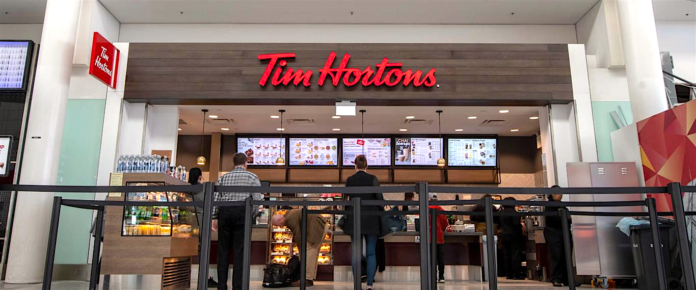
Through this partnership, adidas said it continues to champion the joy of sport at every level, from community fields to professional stadiums. The Timbits Soccer program has provided millions of kids with the opportunity to learn a new sport, including more than 250,000 youth every year. This long-term commitment highlights adidas’ dedication to youth sports across the country and investment in future generations.
Starting with the upcoming May season kick-off, the new adidas Timbits Soccer jerseys will be distributed to boys and girls aged three to seven, fostering a sense of team spirit and belonging, it said.
Kelly Graham
“We are incredibly proud to partner with Tim Hortons for the Timbits Soccer program, cementing our commitment to youth sport in Canada.” said Kelly Graham, Head of Marketing, adidas Canada. “As a global leader in sport, we believe in inspiring a lifelong love for sport and community from an early age, and this partnership is a great reflection of that belief.”
Hope Bagozzi
“Tim Hortons supports more than 250,000 youth through Timbits Soccer every season and we’re incredibly proud of the legacy of the program and how Tims restaurant owners across the country champion young people in their communities to get active, learn a new sport and make new friends. We’re thrilled to welcome adidas to the Timbits Soccer team with our new Timbits Soccer jersey partnership and create even more memorable moments for young players,” said Hope Bagozzi, Chief Marketing Officer for Tim Hortons.
To further amplify the partnership, a TV campaign featuring Canadian soccer star and adidas athlete Jonathan David will be airing in the weeks ahead, said adidas.
Rendering of Simons’ future store at CF Pacific Centre in downtown Vancouver, scheduled to open in Fall 2027 (Granville Street entrance). (CNW Group/La Maison Simons)
The location will mark Simons’ 20th store nationwide and its second in British Columbia – a milestone that builds on a period of strong growth, with Simons exceeding expectations and reaching more than $830 million in sales in 2025, said the retailer.
Located in part of downtown Vancouver’s former Nordstrom, Simons said the new store will complement its existing Park Royal location and enhance access for customers across the region, creating more opportunities to discover the uniquely Canadian Simons experience. CF Pacific Centre is among the highest-traffic retail destinations in Western Canada and is widely recognized as a leading location for flagship retail, it added.
The project represents an investment of more than $55 million and will contribute to the local economy, including the creation of approximately 150 new jobs. With this addition, Simons will employ more than 4,000 people across Canada.
The expansion reflects sustained demand in British Columbia, where the Park Royal store has delivered consistent, high double-digit growth since opening, including more than 30 per cent year-over-year growth in 2025. This momentum is further supported by strong digital engagement, with e-commerce accounting for approximately 35 per cent of Simons’ sales in the province.
Bernard Leblanc in the new CF Toronto Eaton Centre La Maison Simons store
“Vancouver is one of Canada’s most dynamic and inspiring retail markets, and we’re pleased to expand our presence here,” said Bernard Leblanc, President and CEO of Simons. “Our growth is guided by our customers and a desire to create spaces that reflect the communities we serve. The strong response in Western Canada has reinforced our commitment to the region, and we look forward to bringing a distinctive Simons experience to the downtown core – one that blends fashion, art and design while building meaningful connections with Vancouver’s diverse communities.”
Simons said the new CF Pacific Centre store will span approximately 92,000 square feet across three floors, representing a significant investment in downtown Vancouver. Designed by McKinley Studios, with architecture by LemayMichaud, the space will reflect Simons’ distinctive approach to retail, blending fashion, art, and architecture to create an immersive and thoughtfully crafted environment.
“Inspired by Vancouver’s architectural legacy, the concept references Brutalism and 1960s aesthetics, expressed through a balance of raw materials, sculptural forms, and warm, modern accents to shape a space that feels both monumental and sensorial – encouraging movement and curiosity throughout. Each Simons store is uniquely conceived, with a creative, people-first approach that shapes environments thoughtfully integrated into local communities, extending beyond the traditional shopping experience,” added the retailer.
In an interview with Retail Insider, Leblanc said it’s important to be in the heart of one of Canada’s most dynamic cities, both culturally and economically.
“We’ve been waiting for the right opportunity for us in downtown Vancouver for some time, and now it’s really exciting to be here to talk about it more and to be able to announce this publicly,” he said, adding the store is in part of old vacated Nordstrom space.
Main floor escalator well in La Maison Simons at CF Toronto Eaton Centre, September 18, 2025. Photo: Craig Patterson
“We opened the other store in Park Royal in West Vancouver in 2015, so it was 10 years last year already. In fact, since opening, it’s been a very successful store for us. We’ve been enjoying double-digit growth since it opened, and actually we did 30% year over year last year in Park Royal. Whether it be in our physical location in West Van, as well as the results that we have digitally, we’re seeing a very strong response to the Simons brand here in the Vancouver market and in BC in general. We feel that this is going to be a very good store for us in the heart of downtown Vancouver.
“(The Park Royal store is) amongst the top performers, and you would expect that from a market like Vancouver, just having the one store here. We feel that this second store will really build proximity with our client base and ensure that we can bring our authentic Simons customer service to life right in the heart of downtown Vancouver.”
Leblanc said the retailer’s strategy has always been more thoughtful and prudent in expansion plans, and that philosophy remains.
“We’re really focused on the very best markets or the most densely populated markets in the country, and the very best malls as well—really looking at a top-tier mall strategy. Now that we’ve opened our two flagships in Toronto last year and are now announcing this one in the heart of downtown Vancouver, we’re quite pleased with our footprint right now across the country. There aren’t any specific targets that we’ve identified. Our objective has never been to be the biggest; it’s really about being the best in the eyes of our clients, and that’s what we’ll stay focused on going forward,” he said.
Founded in 1840, Simons continues to grow through a measured and intentional approach. Over the past seven years, Simons said it has invested more than $350 million in the Canadian retail landscape, including the development of a state-of-the-art automated fulfillment centre, and continued enhancements to its digital and in-store experience.
Rendering of Simons’ future store at CF Pacific Centre in downtown Vancouver, scheduled to open in Fall 2027 (Georgia Street entrance). (CNW Group/La Maison Simons)
“This sustained investment has contributed to Simons’ recent performance, including a mid-20 per cent increase in annual sales in 2025. Same-store sales grew in the mid-teen per cent range across Canada from 2024 to 2025, with growth reaching the mid-twenties per cent range in newer markets. Recent openings in 2025 at Yorkdale Shopping Centre and CF Toronto Eaton Centre have exceeded traffic and sales expectations, while solid results for earlier openings in Pointe-Claire and Halifax further demonstrate continued demand for Simons’ fashion and home decor offering across the country. This continued expansion into new markets, supported by strong customer response, is contributing to Simons’ growing national presence – with the new Vancouver store marking the next step in that journey, as Simons continues to shape retail experiences that resonate with communities across Canada,” it said.
Sal Iacono
“We are incredibly proud to support Simons’ continued growth across Canada with their first flagship store in downtown Vancouver at CF Pacific Centre,” commented Sal Iacono, President & CEO, Cadillac Fairview. “The new store directly reflects our shared commitment to creating unparalleled retail destinations, and we look forward to the excitement Simons will bring to this landmark location.”
The current 19 Simons store locations: 10 in Quebec, including the company’s head office in Quebec City; three in Alberta; one in British Columbia; one in Nova Scotia; and four in Ontario.
Alice + Olivia storefront at Yorkville Village in Toronto. Photo: Craig Patterson
New York-based fashion brand Alice + Olivia is set to enter the Canadian market with its first standalone store, choosing Toronto’s Yorkville district for its debut as part of a broader global expansion strategy.
The Alice + Olivia Canada store will be located at Yorkville Village, where it will occupy a space of approximately 2,400 square feet previously home to Jean Paul Fortin. The Alice + Olivia store will open this Thursday, introducing the brand’s bold, fashion-forward aesthetic to the Canadian market via boutique partner TNT The New Trend.
The move reflects the Alice + Olivia’s targeted retail approach, which focuses on high-income urban neighbourhoods and established luxury shopping districts rather than large-scale rollout strategies.
Inside the new Alice + Olivia boutique at Yorkville Village in Toronto. Photo: Craig Patterson
A Strategic Entry into a High-Value Market
Founded in 2002 and led by CEO and Creative Director Stacey Bendet, Alice + Olivia has built a global following through its vibrant collections, distinctive prints, and tailored silhouettes. The brand operates a carefully curated boutique network across key U.S. markets, with a particularly strong presence in New York as well as in affluent coastal and resort destinations such as California and Florida. Internationally, the company has expanded aggressively in Asia through a mix of standalone stores and shop-in-shop locations within major luxury malls, allowing it to scale while maintaining brand control.
Rather than pursuing broad market saturation, Alice + Olivia has focused on clustering stores in high-income urban neighbourhoods and lifestyle-driven retail environments. This approach allows the brand to reinforce visibility within key markets while targeting consumers seeking expressive, fashion-forward apparel.
Alice + Olivia FW 2026 runway show, image: Alice + Olivia
The decision to enter Canada through Yorkville aligns closely with that strategy, positioning the brand within one of North America’s most established luxury corridors and in proximity to a concentrated base of affluent consumers.
In terms of pricing, Alice + Olivia sits within the contemporary luxury segment, with dresses typically ranging from approximately $550 to $950, and eveningwear and embellished pieces reaching well above $1,500. This positioning places the brand between premium fashion and traditional luxury, aligning with the spending power and fashion expectations of Yorkville’s core customer base.
Inside the new Alice + Olivia boutique at Yorkville Village in Toronto. Photo: Craig Patterson
Yorkville Village Continues to Evolve
The arrival of the Alice + Olivia Canada store comes as Yorkville Village continues to refine its tenant mix under the ownership of First Capital REIT.
The approximately 232,000-square-foot property has undergone significant repositioning over the past decade, transitioning from a traditional enclosed mall into a lifestyle-oriented destination that blends fashion, wellness, and daily-needs retail. Anchors such as Whole Foods Market and Equinox contribute to consistent foot traffic, while a growing number of experiential tenants reflect evolving consumer expectations.
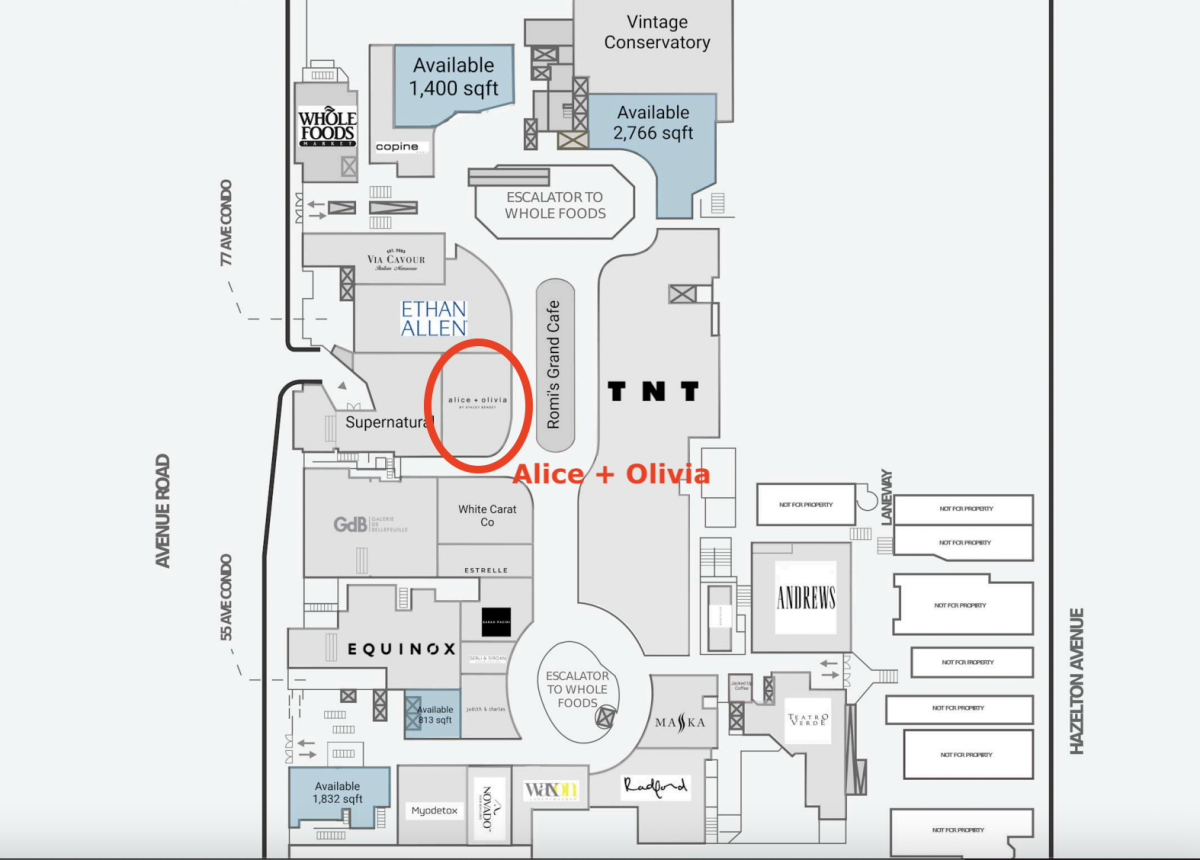
Recent leasing activity points to an ongoing shift toward curated concepts and distinctive retail experiences. The Alice + Olivia store replaces a legacy footwear tenant, while across the corridor, Romi’s Bakery is preparing to open in a space previously occupied by a restaurant concept. Recent openings include Ethan Allan furniture, White Carat Diamonds, and Supernatural. Last year, Alice + Olivia’s partner retailer TNT The New Trend unveiled a more than 17,000 square foot single level store in Yorkville Village.
Yorkville Village floor plan, via First Capital REIT
Yorkville Reinforces Its Role as Canada’s Luxury Gateway
The opening of the Alice + Olivia Canada store also reflects broader momentum within Toronto’s Yorkville neighbourhood, which continues to attract international brands seeking entry into the Canadian market.
The recent arrival of Frette nearby further underscores the area’s appeal, particularly among premium and luxury retailers looking to establish a presence in a high-profile, high-income environment.
Yorkville’s combination of luxury retail, upscale residential density, and strong tourism appeal has positioned it as a consistent first choice for brands entering Canada. As a result, the district continues to see steady investment and leasing activity, reinforcing its status as one of the country’s premier luxury retail nodes.
Whimsical fabric dressing rooms — Inside the new Alice + Olivia boutique at Yorkville Village in Toronto. Photo: Craig Patterson
Continued Momentum for International Retail Expansion
Alice + Olivia’s Canadian debut adds to a growing list of international brands establishing a foothold in Toronto. For retailers operating in the contemporary luxury segment, Yorkville offers a unique combination of visibility, brand alignment, and access to a targeted customer base.
As consumer demand for differentiated retail experiences continues, and as Toronto’s global profile evolves, further international entries into the market are expected.
Alice + Olivia storefront at Yorkville Village in Toronto. Photo: Craig Patterson Partner retailer TNT The New Trend recently unveiled a 17,000 sq ft multi-brand store at Yorkville Village in Toronto. Photo: Craig Patterson
The latest Canadian Food Sentiment Index, Vol. 2, No. 2 (Spring 2026) bi-annual report, produced by Dalhousie University’s Agri-Food Analytics Lab, reveals a Canadian consumer who is still under pressure—but adapting.
While inflation fears are easing, affordability remains the dominant force shaping decisions, behaviours, and trust in the food system, said Dr. Sylvain Charlebois, Senior Director of the Lab, who authored the report with Dr. Stacey Taylor, Dr. Armagan Ozbilge, and Dr. Hamed Aghakhani.
Charlebois said the Index tracks how Canadians perceive and experience key food-related issues over time. Drawing on insights from approximately 3,000 respondents, the Index provides a consistent and data-driven view of evolving consumer sentiment on food affordability, expenditures, behaviours, and trust.
Charlebois outlined a few highlights from this edition:
Food remains the top household concern, with over 80% of Canadians identifying it as the expense that has increased the most.
While inflation is still widely felt, perceptions are shifting toward more moderate increases, with many now expecting food inflation in the 5%–7% range over the next year.
Grocery spending continues to rise, with households reporting spending about $23 more per month on food compared to a year ago.
Financial vulnerability persists, as 34% of Canadians report drawing from savings or borrowing to afford food.
Affordability dominates food values, far outweighing nutrition, taste, or sustainability considerations.
Dietary habits are gradually shifting, with the share of Canadians identifying as strictly omnivorous declining, while more flexible approaches such as flexitarian diets are gaining traction—likely reflecting both rising meat prices and increased health awareness.
Protein choices are becoming more strategic, with consumers balancing cost and perceived health benefits, contributing to a slow diversification of diets rather than a full transition away from animal proteins.
The Health Canada front-of-package nutrition symbol is having a clear impact, with over 60% of Canadians indicating they are less likely to purchase a product displaying the label—suggesting the policy is influencing behaviour primarily as a deterrent.
Dr. Sylvain Charlebois
“Overall, the data suggests that while some pressures may be stabilizing, affordability continues to define how Canadians interact with the food system—shaping not only what they buy, but how they think about nutrition, value, and risk,” said Charlebois.
There is overwhelming support among Canadians for eliminating retail taxes on food, with about two-thirds (66.7% in Spring 2026) strongly agreeing with the idea. When combined with those who somewhat agree (21.0%), nearly 88% of respondents are in favour. Neutral responses remain limited, while opposition is minimal, with fewer than 5% expressing any level of disagreement. Overall, the data suggests a broad and consistent consensus in favour of removing food-related retail taxes, explained the report.
The report said the Spring 2026 results show strong support across all provinces for eliminating retail taxes on food, though levels vary regionally and have shifted slightly over time.
“Canadians continue to feel pressure on their food budgets, but Spring 2026 data suggests a slight shift from anxiety to adaptation. While affordability remains the dominant food value, consumers appear to be moderating their expectations for inflation through versatile strategies, from using food-rescue apps and seeking discounts to adjusting dietary choices and spending habits. Still, with one-third of Canadians dipping into their savings or borrowing money to purchase food, affordability appears to remain front and centre,” said Özbilge.
“Affordability far outranking nutrition shows that Canadians are under significant financial stress to provide healthy meals for their families, which is concerning. The drop in an omnivorous diet in favour of adaptable diets such as the flexitarian gives insight on how Canadians are managing their food budgets in difficult times,” said Taylor, Agri-Food Analytics Lab Research Fellow.
“Affordability continues to define the Canadian food economy, but policy tools like front-of-package labelling are accelerating change at the shelf. Consumers are making faster, more decisive choices, and that will force the industry to adapt—either through reformulation or repositioning,” added Charlebois.
Atlantic Canada continues to lead, with particularly high support in Newfoundland and Labrador and Prince Edward Island. The Middle of the country – Saskatchewan, Manitoba and Ontario – also show strong backing, while Quebec remains the least supportive, though still with a majority in favour and nearly catching up with the other provinces’ support, said the report.
“Compared to Spring 2025, some provinces—notably Prince Edward Island, New Brunswick, and Quebec—have recorded notable increases, while others, such as Saskatchewan and Nova Scotia, have seen slight declines. Alberta, for its part, experienced a more pronounced drop, with support falling from 71.1% to 63.2%. Overall, support remains widespread and robust across the country.”
ali Shot80 photo
The report also noted that trust in food institutions remains relatively stable, with modest shifts between Fall 2024 and Spring 2026.
“Health Canada now ranks highest (3.89), slightly ahead of Canadian farmers (3.86), who previously held the top position. Regulatory bodies such as the Canadian Food Inspection Agency and Agriculture and Agri-Food Canada continue to score strongly, reflecting sustained confidence in public institutions,” it said.
“Since Fall 2025, the largest gains in trust are observed for the Canadian Food Inspection Agency and Agriculture and Agri-Food Canada, followed by Health Canada, indicating a strengthening of confidence in government oversight. In contrast, major grocers remain the least trusted group despite a slight improvement, while independent grocers and food manufacturers sit in the mid-range.
“Overall, trust levels are broadly steady, with public institutions maintaining an edge over private-sector actors.”
Taking place across Calgary (April 28), Vancouver (April 30), Montreal (May 19), Toronto (May 22) and Ottawa in June, the roadshow series will convene business leaders, government representatives, and industry stakeholders to explore how Canadian companies can expand into the Chinese market and leverage global trade opportunities.
Established in 2018 and jointly hosted by China’s Ministry of Commerce and the Shanghai Municipal People’s Government, CIIE has become a key gateway for international businesses seeking entry and growth in China.
The 2026 edition will be held from November 5–10 in Shanghai.
With Bank of China the sole Strategic Partner of CIIE, Bank of China (Canada) has been leading the initiative of CIIE Roadshows for the 9th year in Canada.
“As global trade dynamics continue to evolve, Canadian businesses are increasingly looking for trusted pathways to access international markets,” said Dr. Deng Jun, President and CEO of Bank of China (Canada) and President of Canada-China Chamber of Commerce.“Through this national roadshow, we aim to provide practical insights, strategic connections, and on-the-ground support to help Canadian companies successfully enter and grow with China.”
The Bank said participation from Canadian businesses at CIIE has seen strong and consistent growth, rising from approximately 50 companies in 2022 to more than 120 in 2025, with further increases expected this year. Companies such as Arcwell, Dr. Bee, and Avalon Dairy have returned across multiple editions, underscoring the long-term value of the platform for Canadian Exporters.
It said the roadshow will spotlight real-world examples of Canadian companies already operating in China, offering tangible insights into market entry and long-term growth. These perspectives will be complemented by sector-specific insights, with a focus on key Canadian industries including agri-food, agriculture, consumer goods, retail, medical equipment and healthcare products.
Through the CIIE roadshow series, BOCC and CCCC continue to facilitate Canada–China trade, supporting Canadian exporters with tailored financial solutions, trade expertise, and access to global networks. The initiative is further supported by key partners including Canada China Business Council, Saskatchewan Trade & Export Partnership, Investissement Québec, and a broader network of business associations, added the Bank.
“Our role extends beyond financial services,” said Deng. “We are committed to building the ecosystem that enables Canadian businesses to compete and succeed globally – connecting them with the right partners, platforms, and opportunities.”
Designed as a cohesive annual national program, the roadshow series will build awareness across markets. Each stop will highlight region-specific industries and business opportunities, ensuring relevance for local stakeholders while contributing to a broader national bilateral trade conversation between the countries, noted the Bank.
Adults are now one of the fastest-growing segments in the LEGO market — helping push the company past $9 billion annually.
What’s getting less attention is the booming secondary market for parts, where serious builders are spending just as much, if not more.
Jenn Just has been inside that ecosystem for 27 years.
She runs The Brick Chick, an independent parts and custom design business serving adult collectors across the U.S. and Canada, and has watched the shift from “toy hobby” to serious collector economy in real time.
Just, based on Gabriola Island in B.C., said the Brick Chick was born in about 1999.
“It started off as “The LEGO Lady” until I got a cease and desist from Lego and was told I couldn’t use that name. So I framed that, it’s on the wall, and I moved on to The Brick Chick,” she explained.
“I consider myself a bit of a niche brand. I want to be a cult brand. I would like to be a cult leader. I want to give the people what they want and things that LEGO can’t or won’t do. A lot of that has to do with identity. If you are LGBTQ, like I am, queer folks like to have their little flags and so on in their LEGO builds.
Jenn Just
“I like to take big things in real life and shrink them down to little tiny things that minifigures can hold and represent what we actually have going on. So, a lot of flags. People want a Canadian flag, they want to be proud, they want to have their Tim Hortons cup and their “Tim Bricks,” and the different things that I do to disguise real brands and make them into funny little parody items.
“I’m a maker, kind of addicted to making things. I have a three-floor farmhouse full of equipment I’ve been gathering over the years. I make whatever appeals to me, and a lot of times that’s in the Lego niche because that’s where things were born.
“But I’ve expanded into fandom. People who like Lego also like things like Star Wars and Star Trek, a lot of science fiction, Dungeons & Dragons, all of that. So I try to appeal to every audience that I can.”
Just’s background is in the fashion industry. The first business she started was at age 19, knitting sweaters for a kitchen or farmer’s market. She later went to Sheridan College and got a fashion degree that she never intended to use, but she took that information and ran with it.
“Nowadays, I have a sub-brand called Salty Stitch Witch, where I do all my bags, patches, and different identity symbols. I have two multi-needle embroidery machines that I use to produce what I call “propaganda”,” she said.
“I also do 3D printing—I have a small farm—so I make home décor items and things that appeal to Lego fans. A lot of that involves taking small things Lego makes and expanding them into bigger versions, which is funny because it’s the opposite of what I do with the miniatures.”
Just said her work has a broad appeal, predominantly adult fans. Fans really like the nostalgic aspect. In this economy, people are willing to buy things that appeal to their inner child and remind them of happy times. When wallets get tight, she listens to her customers and gives them what they want.
“I’ve decided to scale this business. It’s been a small business until now, but it’s growing rapidly now that I can spread my wings. I have lots of ideas—I’m never short of ideas. I’m a neurodiverse person, so I tend to go in many directions at once.
“Many LEGO fans are also neurodiverse, so that works in my favor. I have great expansion plans. Making is a big part of my daily activities—I love creating things. I’m also opening up more on social media to show people exactly what I do and how to do it themselves. I don’t like gatekeeping—I think sharing knowledge is important.”
Canadian appliance retailer Coast Appliances has entered creditor protection under the Companies’ Creditors Arrangement Act (CCAA), marking a dramatic collapse following mounting financial pressures, operational disruptions, and the sudden resignation of its entire leadership team.
On April 17, 2026, the Supreme Court of British Columbia granted an initial order placing Coast Appliances under CCAA protection after an application led by the Bank of Montreal, acting on behalf of a lending syndicate. At the time of filing, the company carried approximately $69 million in debt and operated 17 showrooms and nine distribution centres across Western Canada and Ontario.
The Coast Appliances CCAA filing comes just days after a critical breakdown in governance. On April 15, the company’s full board of directors and Chief Executive Officer resigned, leaving the business without formal leadership immediately prior to the court process. The timing suggests a significant disconnect between management and lenders as the company approached insolvency.
Governance Breakdown Preceded Court Filing
The abrupt leadership exit is a defining element of the Coast Appliances CCAA filing and signals a deeper structural failure within the organization. In many insolvency situations, management remains in place to guide restructuring efforts. In this case, the complete departure of leadership just 48 hours before the filing points to a loss of confidence and control at the highest levels.
Lenders, led by the Bank of Montreal, stepped in to initiate proceedings, effectively taking control of the restructuring process. PricewaterhouseCoopers has been appointed as the court monitor and will oversee operations during the CCAA process.
Photo: Coast Appliances
Failed Turnaround and Mounting Financial Pressure
Coast Appliances had previously attempted to stabilize its business through significant private equity investment. By fall 2024, TriWest Capital Partners and related investors had injected approximately $60 million into the company in an effort to support a turnaround. However, those efforts ultimately failed as market conditions deteriorated and operational challenges intensified.
The company also failed to meet minimum equity thresholds earlier in 2026, which further constrained its ability to access financing and continue operations. A targeted sale process conducted prior to the filing attracted only one offer, which lenders deemed non-viable.
Housing Slowdown and Consumer Pullback Hit Core Business
The Coast Appliances CCAA filing reflects broader pressures impacting big-ticket retail categories in Canada. A significant portion of the company’s revenue was tied to residential construction and housing activity. As interest rates remained elevated, both single-family and multi-unit housing developments slowed, reducing demand from builder clients.
At the same time, inflation and higher living costs weighed on consumer spending. Demand for large household purchases such as appliances declined, creating a dual impact on both wholesale and retail channels.
These macroeconomic factors, combined with supply chain challenges and import cost pressures, contributed to a sustained erosion of the company’s financial position.
Operational Disruptions and Cyber Incident Added Pressure
Operational challenges further destabilized the business in the days leading up to the filing. A reported cybersecurity incident in mid-April disrupted internal systems, affecting inventory tracking and order management during a critical period.
The timing of this disruption, occurring just before the leadership resignation, suggests it may have accelerated the company’s move toward creditor protection.
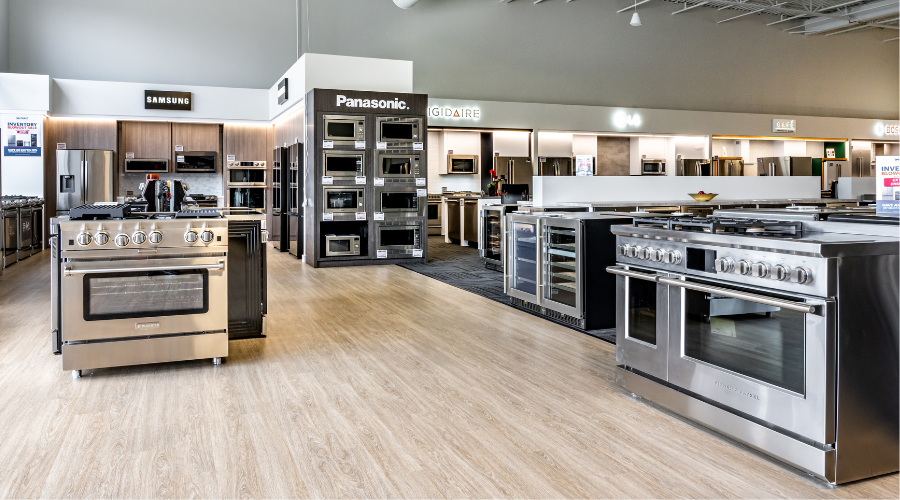
Coast Appliances store in Mississauga. Photo: Coast Appliances
Customer Deposits Raise Concerns
The Coast Appliances CCAA filing has also raised concerns among customers who placed deposits on undelivered products. Court materials indicate that the company held approximately $15.5 million in customer deposits at the time of filing, while only a fraction of that amount remained in available cash.
Under CCAA proceedings, customers with deposits are typically treated as unsecured creditors. This places them behind secured lenders in the priority of repayment and introduces uncertainty around whether those orders will be fulfilled or funds recovered.
Reports of delayed or missed deliveries, along with inventory held in warehouses, have already emerged in certain markets.
Investigation and Legal Pressures Compounded Challenges
Adding to the company’s challenges, Coast Appliances was facing an investigation by the Competition Bureau of Canada related to its marketing practices. The investigation focused on pricing and promotional claims, and a potential adverse outcome could have resulted in financial penalties.
This additional layer of legal exposure likely reduced the company’s attractiveness to potential buyers and further limited restructuring options.
While the CCAA process is typically used to facilitate restructuring, early indications suggest Coast Appliances is moving toward a wind-down of operations. The court-appointed monitor has engaged a third-party firm to begin store closing and asset sale processes, signaling a shift toward liquidation rather than recovery.
This development underscores the severity of the company’s financial position and the limited likelihood of a going-concern solution.
Broader Implications for Canadian Retail
The Coast Appliances CCAA filing highlights the vulnerability of retailers operating in categories closely tied to housing and discretionary consumer spending. It also underscores the risks associated with rapid shifts in economic conditions, particularly when combined with operational disruptions and governance challenges.
For the broader retail sector, the situation serves as a reminder of the importance of financial discipline, supply chain resilience, and strong governance structures in navigating periods of economic uncertainty.
As the process unfolds, stakeholders including customers, suppliers, and investors will be closely watching the outcome, particularly as asset sales and creditor recoveries begin to take shape.
Retail Insider’s newest articles are listed below, along with Canadian Retail News From Around the Web. Highlights include Aritzia’s launch of a large flagship at CF Toronto Eaton Centre and Woodbine Mall’s CCAA filing signaling a shift toward redevelopment. Yorkdale Shopping Centre’s 2025 sales per square foot performance remains a standout benchmark. These stories and others illustrate how Canadian retail real estate adapts to shifting consumer behaviour and changing market dynamics.
DoorDash has significantly expanded its grocery offering in Canada through a major partnership with Empire Company Limited, bringing more than 1,000 stores onto its platform across all 10 provinces.
The agreement marks one of the largest grocery expansions for DoorDash in Canada to date and reflects accelerating demand for on-demand delivery of everyday essentials. With the addition of Empire’s banners, the platform now features a broad mix of national and regional grocery options, including Sobeys, Safeway, IGA, FreshCo, Farm Boy, and Longo’s.
The partnership integrates multiple grocery and convenience banners into the DoorDash marketplace, significantly increasing both product assortment and geographic reach. Consumers can now access an average of nearly 10,000 items per store, including fresh produce, pantry staples, household goods, and pharmacy items.
Orders are fulfilled on demand, with delivery times averaging under 60 minutes in Canada’s largest urban markets. The expanded offering is designed to support both full grocery shops and smaller, immediate-need purchases.
Mike Goldblatt, Vice President of Enterprise Business Development and Partnerships at DoorDash, said the partnership responds to growing consumer demand for convenience.
“We’re proud to help give some time back through on-demand grocery delivery, whether it’s a full weekly shop or just for tonight’s dinner,” he said.
Image: Sobeys Orangeville
Empire Extends Digital Reach Through Third-Party Platform
For Empire Company Limited, the partnership represents a strategic move to expand digital access to its banners without relying solely on proprietary e-commerce infrastructure.
Mohit Grover, Senior Vice President of eCommerce at Empire, said the collaboration allows the company to better meet evolving consumer expectations.
“We’re providing customers with flexible, on-demand access to quality and value in more ways than ever before, while complementing our in-store experience,” he said.
Empire, one of Canada’s largest grocery operators, owns or operates more than 1,500 stores nationally across multiple banners, including Sobeys and Safeway.
Image: Sobeys Orangeville
Grocery Emerges as Key Growth Driver for DoorDash
The expansion comes as grocery continues to gain traction on the DoorDash platform. Approximately 25 percent of monthly active users in Canada engaged with grocery, convenience, alcohol, and retail categories as of late 2025, underscoring shifting consumer behaviour toward multi-category ordering.
With Empire now onboard, DoorDash partners with four of the five largest grocery companies in Canada, further positioning the platform as a significant player in the country’s evolving grocery e-commerce landscape.
Competitive Landscape Intensifies in Grocery Delivery
DoorDash’s expanded partnership with Empire comes as competition intensifies in Canada’s online grocery and last-mile delivery space, where multiple models continue to evolve.
Third-party platforms including Uber Eats and Instacart have already established grocery offerings in Canada, partnering with a range of retailers to facilitate on-demand delivery. Instacart has built a strong presence with grocery chains and independent operators, positioning itself as a dedicated grocery marketplace, while Uber Eats has expanded beyond restaurants to include convenience and retail categories.
At the same time, Canadian grocers have experimented with owned e-commerce infrastructure. Empire’s Voilà service, developed in partnership with Ocado, represents a more vertically integrated model focused on centralized fulfilment and scheduled delivery.
Image: DoorDash
Strategic Shift Away from Centralized Fulfilment
The partnership also follows a broader restructuring of Empire’s e-commerce strategy, including the recent decision to wind down its Ocado-powered customer fulfilment centre in the Calgary area, along with related Alberta operations.
The facilities did not meet financial expectations, reflecting a slower-than-anticipated pace of online grocery adoption in Western Canada. As a result, Empire is increasingly shifting toward third-party delivery partnerships to serve customers in those markets.
This reflects a broader industry shift away from capital-intensive, centralized fulfilment infrastructure toward more flexible, store-based and platform-driven distribution models.
Positioning for the Future of On-Demand Retail
The partnership highlights a broader shift in Canadian retail, where third-party platforms are increasingly playing a central role in distribution. Rather than building standalone logistics networks, retailers are leveraging established marketplaces to extend reach, improve speed, and meet consumer expectations for convenience.
As competition intensifies in grocery e-commerce, the collaboration between DoorDash and Empire signals a continued blurring of lines between food delivery, retail, and logistics platforms, with implications for how Canadians shop for everyday essentials.