Johny Srouji, an Israeli executive, is the newly appointed Chief Hardware Officer at Apple. He will lead the Hardware Engineering division, taking over from John Ternus. This change comes at a time when Apple continues to push the envelope in hardware innovation.
Srouji previously served as the senior vice president of Hardware Technologies and has been with Apple since 2008. His history at the company includes spearheading the development of the A4 chip, marking Apple’s first foray into designing its own systems-on-a-chip. His leadership has been pivotal in propelling the company’s silicon strategy and fostering a team renowned for its groundbreaking work.
Apple CEO Tim Cook praised Srouji, stating, “Johny is one of the most talented people I have ever had the privilege to work with.” Cook highlighted Srouji’s key role in delivering innovations that have transformed Apple’s product line.
New Leadership Dynamics
With John Ternus’s transition to CEO, Srouji’s appointment as Chief Hardware Officer marks a significant reshuffling of leadership at Apple. Ternus expressed confidence in Srouji’s abilities, stating, “I look forward to continuing to work closely with him in our new roles.” This collaborative approach is seen as essential as Apple aims to navigate an increasingly competitive technology landscape.
Background and Achievements
Before joining Apple, Srouji held senior roles at Intel and IBM, focusing on processor development and design. His academic foundation includes both bachelor’s and master’s degrees in Computer Science from Technion, Israel’s Institute of Technology. His team is credited with advancements in crucial areas such as custom chips, batteries, cameras, and cellular modems, integral to Apple’s diverse product offerings.
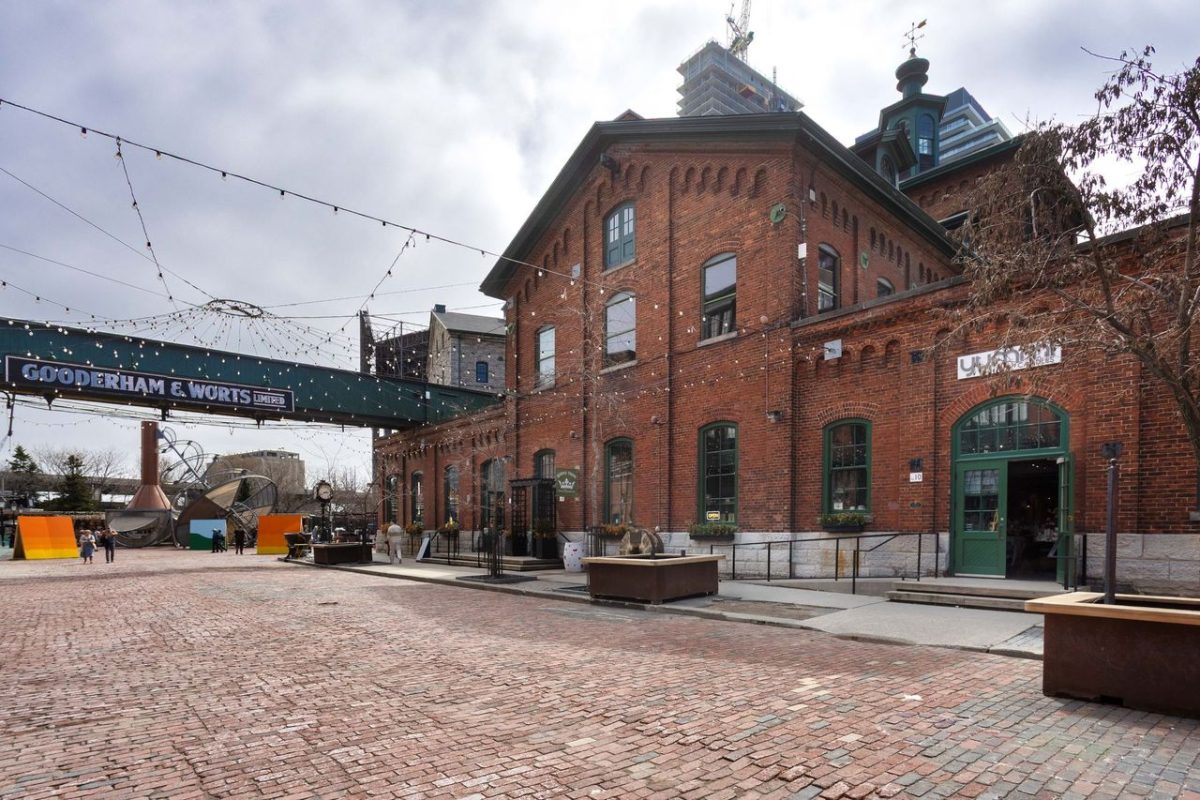
The Cooperage Marketplace in The Distillery Historic District.
The Distillery Historic District is expanding its retail offering with the opening of The Cooperage Marketplace, a new 4,305-square-foot shopping destination bringing together seven independent, founder-operated Canadian businesses under one roof.
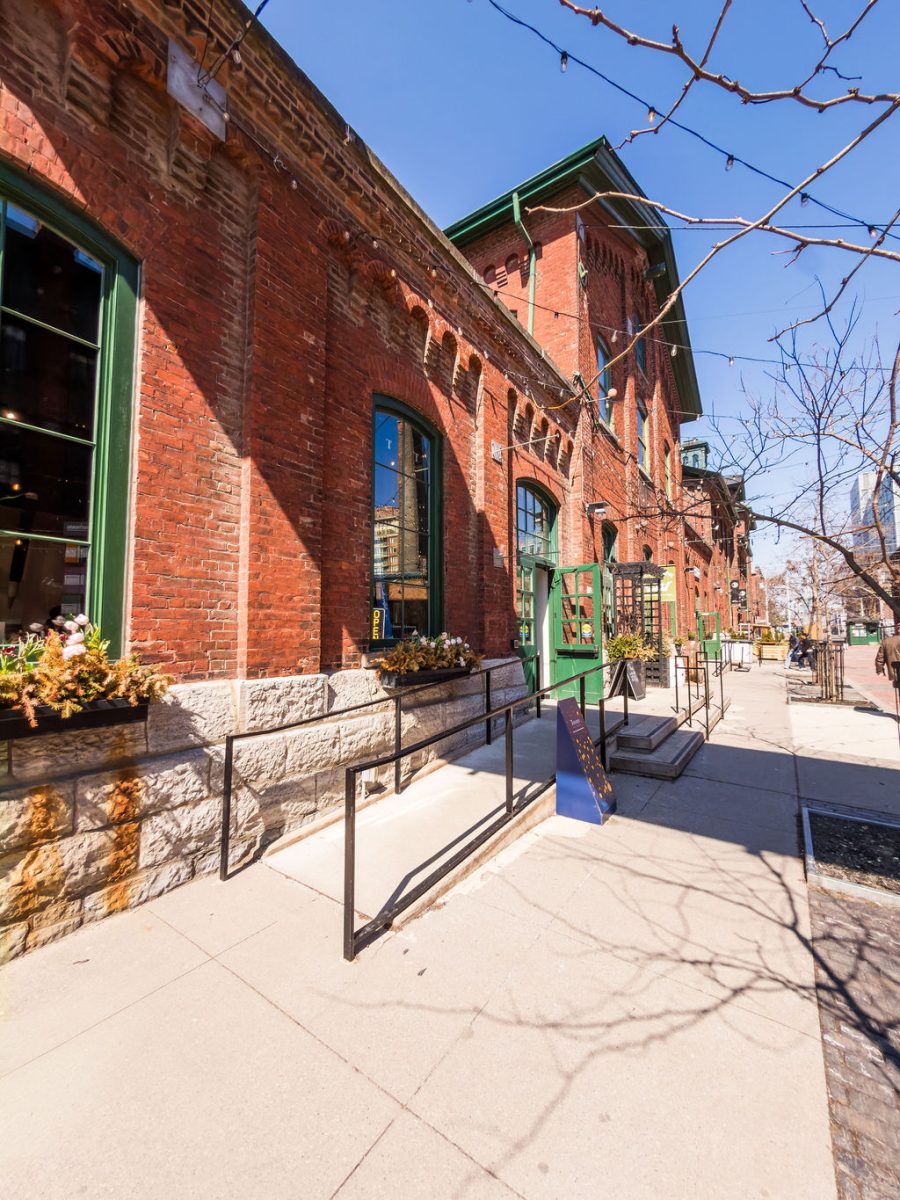
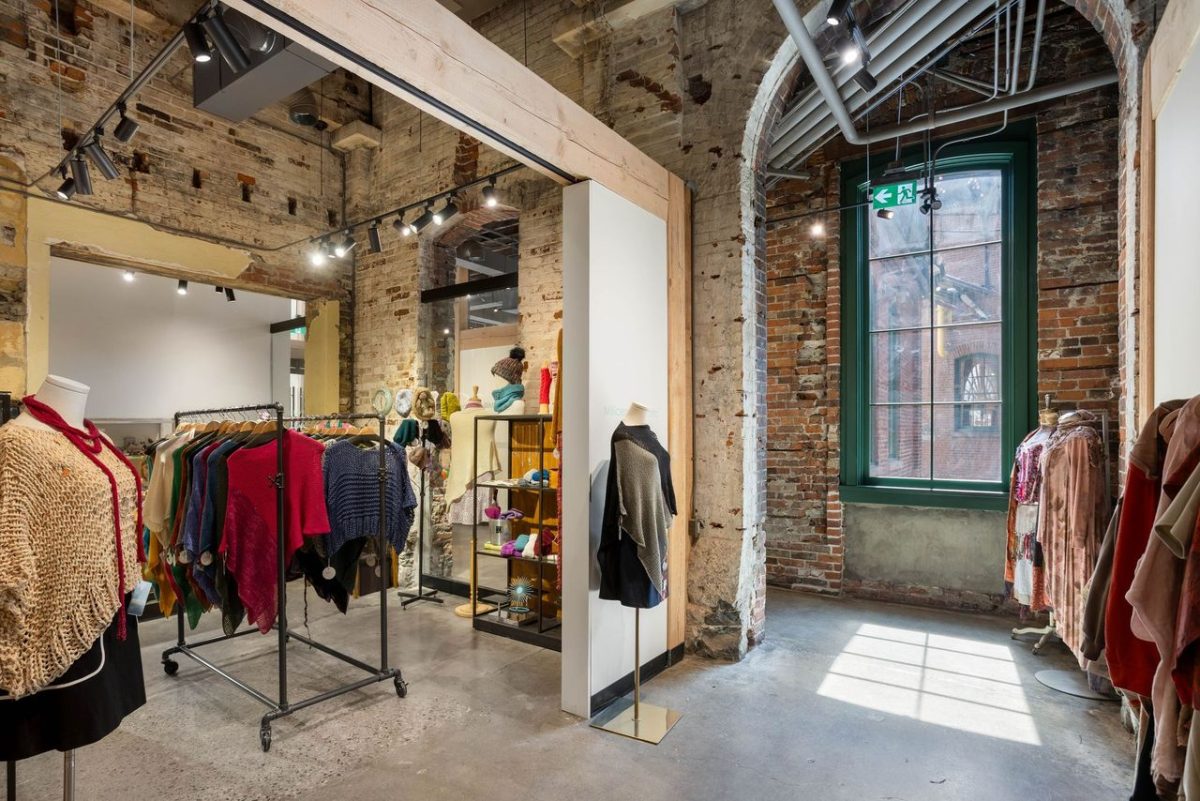
The Cooperage Marketplace is in one of the site’s most historic buildings, from the 1860s. Once used for making, storing and repairing whisky barrels, a “cooperage”, the name ties the marketplace directly to the building’s original heritage.
The Marketplace has a mix of new-to-The Distillery brands along with three existing tenants expanding into larger footprints ranging from 115 to 1,030 square feet, offering fashion and accessories, jewellery, gourmet food and specialty retail.
“The opening of The Cooperage Marketplace marks a new approach to retail here at The Distillery District,” said John Berman, co-owner of The Distillery Historic District.
Jamie Goad (l) and John Berman co-owners of The Distillery Historic District. Photo by Mario Toneguzzi
“It creates an accessible opportunity for artisans, makers and boutique retailers to have a physical space within a premier destination, while giving visitors a new way to experience the site. You can wander through a historic building, discover different brands, and connect directly with the people and stories behind them.
“With the success we’ve had with our smaller footprint retail spaces – and now with the opening of The Cooperage Marketplace – we’re already planning to expand this concept into other Distillery District locations giving more brands this opportunity.”
Berman said that officials are already planning to expand this concept into other Distillery District locations. If brands want to get in touch with him about leasing opportunities, they can contact: jb@thedistillerydistrict.com
A Historic Building, Reimagined
The Marketplace reflects a thoughtful approach to adaptive architecture and design, led by Jamie Goad, architect and co-owner of The Distillery Historic District.
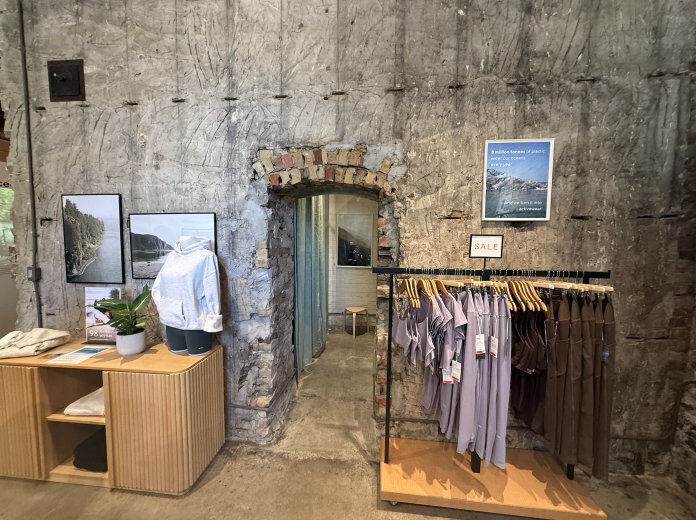
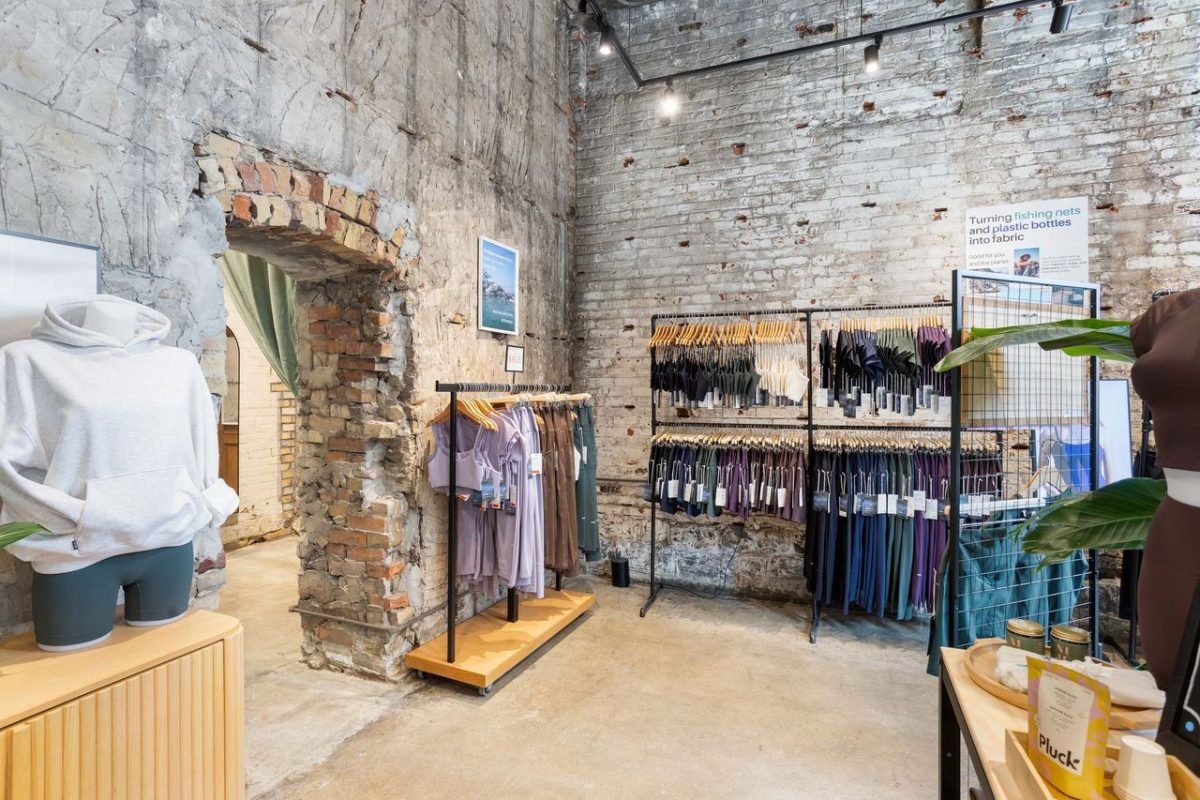
Goad said the renovation for the space took three months to complete, and a conscious decision was made throughout the process to preserve the architectural archeology of the building. Masonry with rough, irregular edges and chipped surfaces was left intentionally unrefined allowing the building’s history to be expressed.
In some areas, exposed brick reveals layers of original plaster dating back to 1863, uncovered during this most recent renovation, alongside original timber beams on the ceiling (some showing signs of charring from a past fire), while ductwork added in 1983 reflects a later phase of the building’s evolution. The renovation also leaves a gap between the original ceiling and the new, wood-framed retail units, keeping historical elements visible throughout, he said.
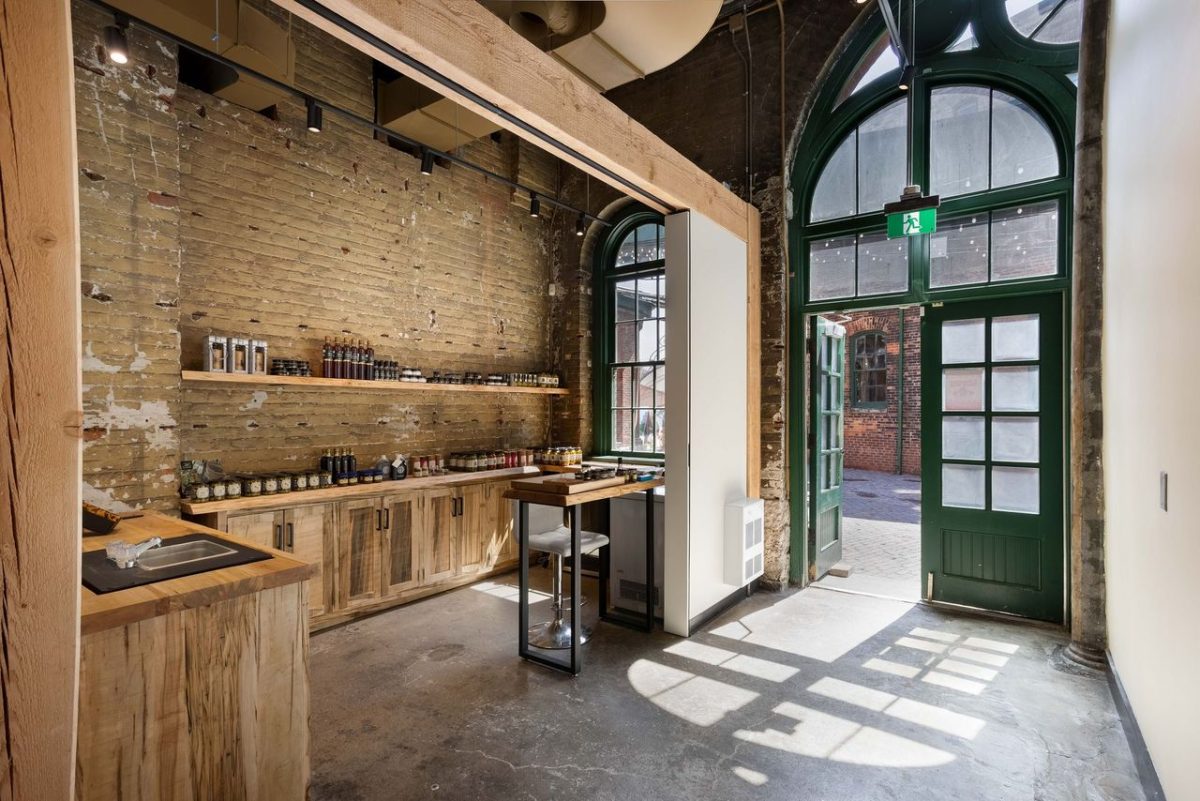
New, nine-foot-tall windows – fabricated by Mennonite craftspeople near Kitchener, Ontario – were designed as replicas of the original windows, based on archival photographs and installed with approval from Heritage Toronto, flooding the space with natural light, added Goad.
The Cooperage Marketplace in The Distillery Historic District. Photo by Mario Toneguzzi
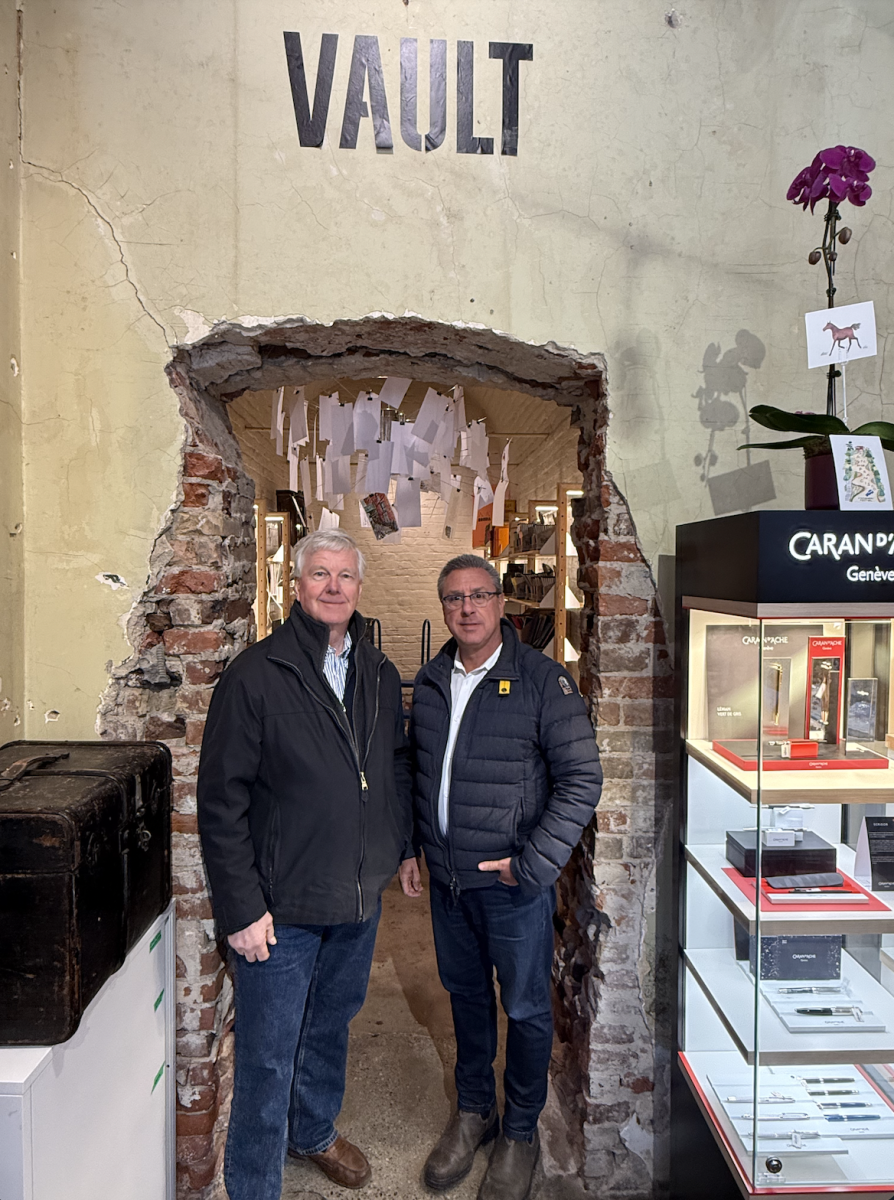
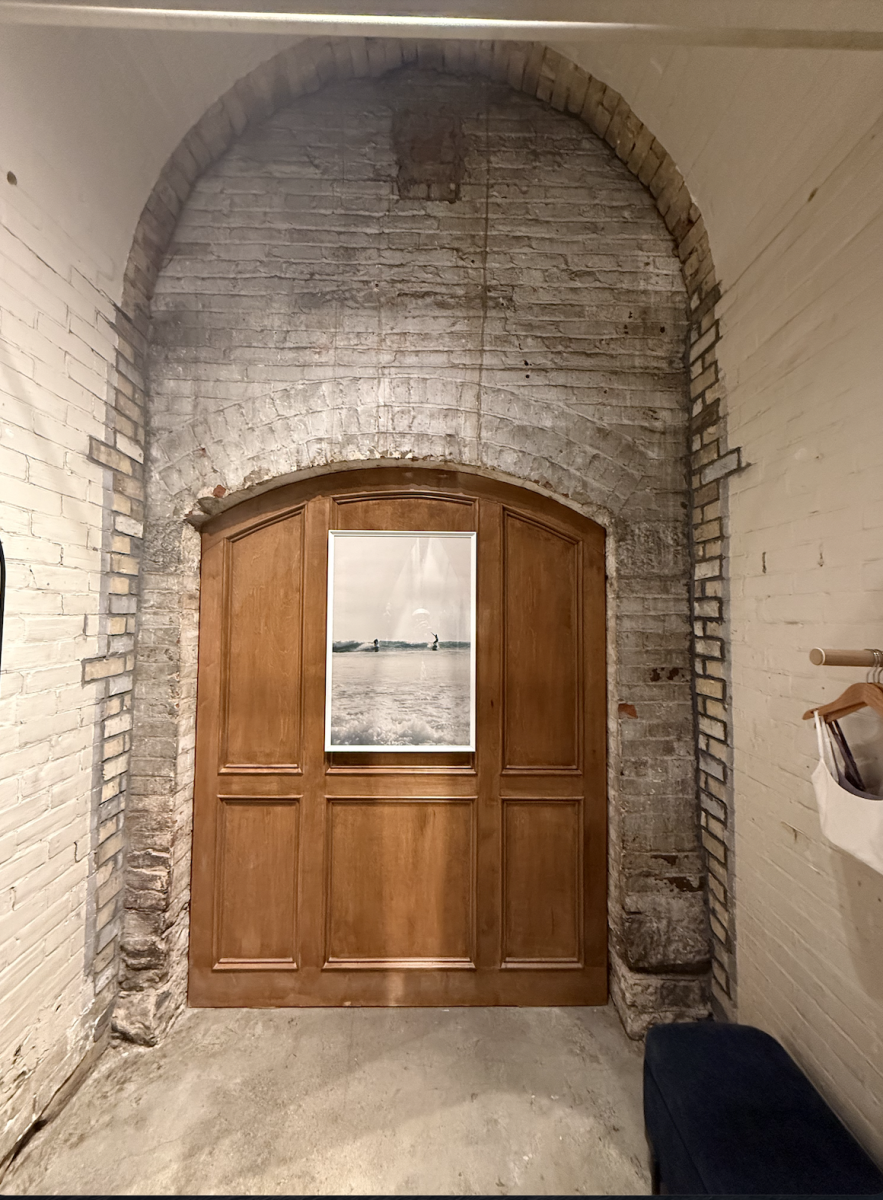
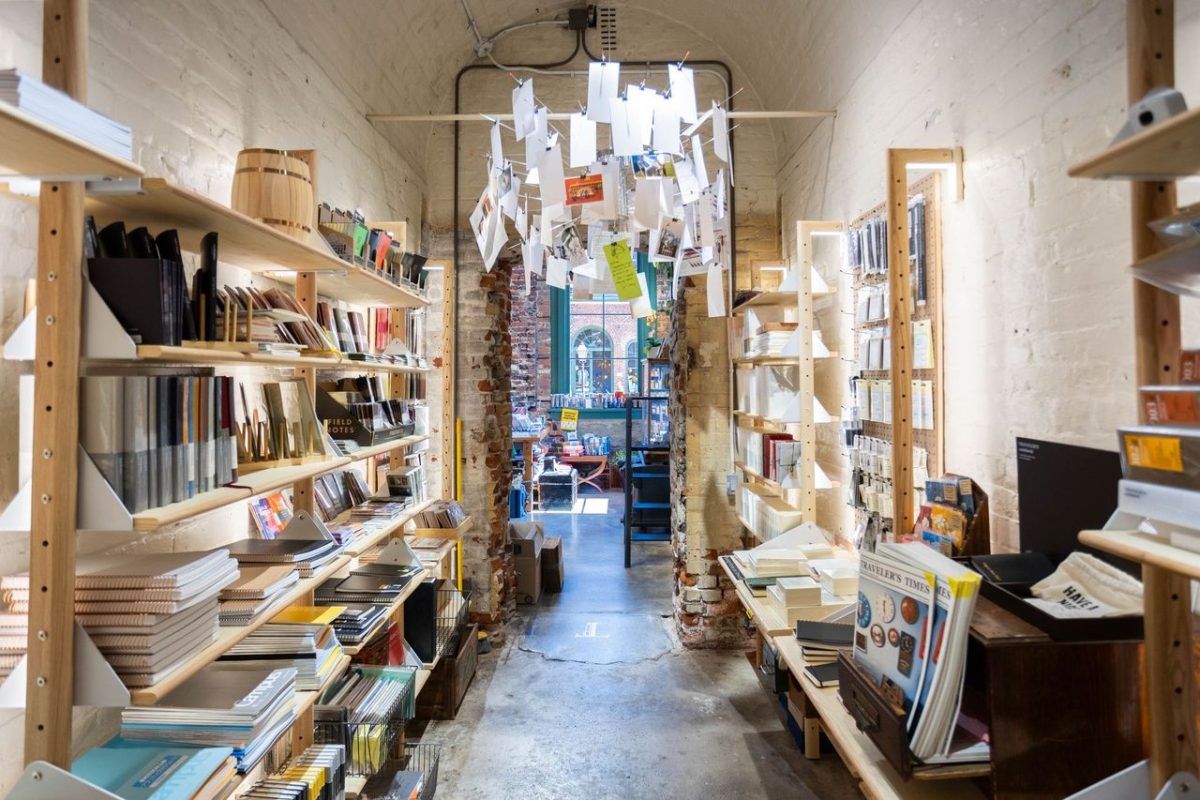
Three historic vaults uncovered during renovations have been preserved and integrated into the retail units. Defined by their barrel-vaulted ceilings and rough-edged openings, where vault doors once were, these spaces reflect the building’s industrial past and add a unique historical element to the marketplace, he said.
“This is the same approach we took when we first opened The Distillery District in 2003,” said Goad. “As an architect, the focus has always been on working with what’s already there — not trying to make it perfect but allowing the building’s history to remain intact. Then we layer in contrasting modern elements like glass storefronts so the marketplace can function today without losing what makes it so special.”.
The Marketplace has two entrances – at 6 Trinity Street and 52 Gristmill Lane. The space can also be accessed from the adjacent Yummi Candles shop. Both entrances are marked by grand double-doored archways with original architectural detailing above, while exterior signage featuring a cooper and barrel is mounted adjacent, referencing the building’s historic use.
On the rooftop, the embellished hexagonal wood-and-glass cupola, originally used to vent distilling fumes, remains a defining feature of the Cooperage building.
The Cooperage Marketplace in The Distillery Historic District. Photo by Mario Toneguzzi
The Cooperage Marketplace Businesses
(*existing tenants)
Toronto Pen Shoppe* – specialty retailer offering a sophisticated selection of fountain pens, inks, and notebooks from quality brands around the world
Orso Activewear* – sustainably produced athletic and loungewear brand that repurposes fishing nets and plastic bottles
Millicent Vee Knits* – handcrafted knitwear accessory brand specializing in legwarmers, hats, shawls and ponchos celebrating nearly 20 years at The Distillery District
KINDSUNDAY– specializing in everyday stainless steel jewellery, layering pieces and customizable charm designs, ideal for gifting
Lilith’s Garden – hand-dyed, upcycled clothing and accessories and vintage jewelry salvaged and re-assembled to create contemporary wearable pieces.
Love, Calista – handcrafted gifts, jewellery and accessories centred around personalization and custom engraving
Kovacic Truffles – gourmet food brand offering Serbian and Croatian white and black truffles, caviar, specialty olives, and a signature black truffle maple syrup, paired with tasting experiences.
The District welcomes nearly two million visitors worldwide each year. Founded in 1832 by the iconic Gooderham & Worts distilling company and now designated a National Historic Site of Canada, the site is an inspired blend of the largest collection of Victorian industrial architecture in North America and stunning 21st-century design. Walking its cobblestone, pedestrian-only streets you’ll find 90+ one-of-a-kind shops, restaurants and patios, galleries and theatres, immersive experiences, specialty coffee shops and artisanal chocolatiers. The Distillery District hosts many events, live music and festivals throughout the year, most notably The Distillery Winter Village.
“When we first bought The Distillery in 2001 all the the buildings were really as they were when they were originally built. They were never updated except for a couple of them,” said Berman.
The Cooperage Marketplace in The Distillery Historic District. Photo by Mario Toneguzzi
He said the building now occupied by the Marketplace was renovated before but very poorly and had taken away from the character of the space. Berman said the current owners tore everything out.
“It almost gave it an archaeological feel because the space is gorgeous. All the spaces are gorgeous. This one in particular had a real different feel to it,” said Berman as the raw brick and the vaults were exposed in the most recent round of renovations.
“The space has an amazing feel to it.”
Berman said the Marketplace is a unique approach to retail that has not been done there before with a “real focus on creators, artisans” and quality retail.
The Cooperage Marketplace in The Distillery Historic District. The Cooperage Marketplace in The Distillery Historic District. The Cooperage Marketplace in The Distillery Historic District. Photo by Mario ToneguzziThe Cooperage Marketplace in The Distillery Historic District. Photo by Mario ToneguzziThe Cooperage Marketplace in The Distillery Historic District. Photo by Mario ToneguzziThe Cooperage Marketplace in The Distillery Historic District. Photo by Mario ToneguzziThe Cooperage Marketplace in The Distillery Historic District.The Cooperage Marketplace in The Distillery Historic District.The Cooperage Marketplace in The Distillery Historic District.The Cooperage Marketplace in The Distillery Historic District.The Cooperage Marketplace in The Distillery Historic District.The Cooperage Marketplace in The Distillery Historic District.
As millions of visitors and billions of dollars arrive in Toronto each year, leaders across Toronto’s visitor economy have united behind an ambitious plan to elevate the city’s tourism competitiveness.
Marking National Tourism Week, Destination Toronto has launched theToronto Destination Master Plan: what it describes as “a bold, city-building roadmap” that sets a shares course for the future of Toronto’s visitor economy, developed jointly with a broad coalition of industry and community leaders.
Destination Toronto said tourism has proven to be one of Canada’s most resilient export sectors, particularly in Toronto with its broad global connectivity. Following a record-breaking year in 2025, with 28 million visitors generating over $9 billion in spending at businesses all throughout the city, Toronto is attracting more visitors than ever before, even in the face of geopolitical and economic headwinds. Toronto’s foundations are strong and the opportunities ahead are significant.
“However, cities across North America are investing decisively in infrastructure, public realm enhancements and signature attractions that elevate their international profiles and capture market share. Toronto’s Destination Master Plan is an opportunity to increase the city’s global competitiveness and to build on the city’s momentum through a coordinated, long-term strategy,” it noted.
Andrew Weir
“This plan is a roadmap to elevate Toronto’s competitiveness as one of the most exciting and appealing urban destinations for leisure travel and major meetings and events, supporting thousands of businesses and tens of thousands of jobs all throughout our city,” said Andrew Weir, President and CEO of Destination Toronto. “Because it was built collectively, with input from hundreds of businesses in and around the visitor economy, it reflects a city-wide view not only of the opportunity but of the path to seize that opportunity.”
The organization said the Plan was developed through extensive research within Toronto and among comparative cities, stakeholder engagement, and community consultation from more than 400 organizations and overseen by a Steering Committee of senior leaders from across sectors.
It outlined five interconnected tracks, including 29 strategies and more than 100 concrete actions, form a comprehensive framework for implementation to enhance the visitor experience, add new demand drivers and elevate Toronto’s global appeal to attract visitors and visitor spending to the city:
Ensure the city is welcoming, safe, and inspiring
Seamlessly connect people to and within Toronto and the broader region
Increase Toronto’s competitiveness for major events
Develop new attractors and demand drivers
Unite partners and resources to advance destination stewardship
Harrison Haines photo
“We are starting from a position of strength and a destination that millions of people choose to visit and meet in every year,” said Weir. “This plan calls on our community to double down on our most compelling attractors and districts so they are even stronger experiences, while also building a pipeline of new and next. It addresses key gaps in the visitor experience from transportation to safety to street-level vibrancy, and also identifies transformational opportunities like a new convention centre, a pedestrian street, and signature events that drive year-round appeal.”
As of this week, many small Canadian exporters may be eligible for rebates of some U.S. tariffs under a new system put in place by the U.S. government following the recent Supreme Court decision, says the Canadian Federation of Independent Business (CFIB).
Canadian businesses that served as the “Importer of Record” and paid U.S. tariffs on non-CUSMA compliant goods under the International Emergency Economic Powers Act (IEEPA) between February 4, 2025, and February 24, 2026, may now be eligible for refunds, said the national organization.
Approximately one-third of small Canadian exporters faced tariffs on goods that did not qualify for the CUSMA exemption. One quarter (26%) of these firms were the Importer of Record and should qualify for these rebates. Unfortunately, other small Canadian exporters lowered their prices for or cost-shared with their U.S. customers in order to keep the business affected by the tariff and will not be eligible for this relief, explained the CFIB.
Dan Kelly
“While it’s good news that some Canadian exporters may get over a year’s worth of tariff revenue back, it’s not an easy system to navigate. Canadian firms will need a U.S. customs account, a U.S. bank account, and may have to work with their customs brokers to get a refund,” said Dan Kelly, CFIB president.
“In addition, these rebates will not help those businesses affected by sectoral tariffs, including steel and aluminum, cars, softwood lumber or furniture. Sectoral tariffs are, sadly, still in place and are having a deep impact on many Canadian small firms. This mess is a reminder that Canada-U.S. trade is not just a big business issue and progress on a renewed CUSMA agreement can’t come soon enough.”
CFIB is providing guidance to small businesses on this process on its website. The CFIB is Canada’s largest association of small and medium-sized businesses with 103,000 members across every industry and region.
An artist's rendering of the vendor village on George Street at Ottawa's Byward Market. Image: Byward Market
Ottawa’s ByWard Market is set to introduce a curated outdoor retail concept this spring, with activity beside the former Hudson’s Bay Company flagship building on Rideau Street. Vendors will be set up along the George Street side of the former Hudson’s Bay store. The multi-level flagship closed on June 1, 2025 following the company’s bankruptcy and nationwide shutdown.
Renderings show vendors positioned along George Street, directly adjacent to the vacant building that is connected to CF Rideau Centre. Painted sidewalks and public realm enhancements are also planned, creating a more inviting pedestrian environment in what has been a highly visible but underutilized stretch of the Market.
Curated Vendor Mix Supports Local Businesses
According to the ByWard Market District Authority, the vendor village will launch in mid-May and feature a curated selection of local vendors offering giftware, gourmet foods, artisan crafts, and florals. The initiative reflects a more intentional strategy around how space is programmed and managed within the district.
“The initiative reflects an intentional approach to how it manages and animate the public realm in the ByWard Market. Through curated vending, thoughtful placement, and a focus on quality and diversity, the market is enhancing the visitor experience while supporting economic resilience for local businesses.”
This curated approach also considers how visitors move through the district. Vendors are grouped in specific zones to encourage exploration and ensure that increased activity benefits surrounding streets and retailers.
Byward Market revitalization plan. Photo by The Planning Partnership
Strategic Placement to Drive Foot Traffic
The ByWard Market vendor village will extend beyond George Street to include York Street, particularly along the north side between William and Dalhousie streets. Vendors will be positioned to “activate spaces” while avoiding placement directly in front of the Heritage Hall building, preserving key sightlines and access points.
A “grocer-focused zone” will also highlight fresh market-style offerings near existing food retailers, including areas around Irving Rivers and floral vendors located outside Moulin de Provence. This approach is intended to complement established businesses rather than compete with them.
The vendor village aligns with the forthcoming ACE, arts, culture and entertainment district, which is expected to launch in July. Together, these initiatives form part of a broader effort to reposition the ByWard Market as a more dynamic, experience-driven destination.
As of spring 2026, the district is navigating a transition that balances nearly two centuries of history with a reported $200 million revitalization plan. The closure of the Hudson’s Bay building has created both a challenge and an opportunity, with the surrounding public realm now being leveraged to reintroduce activity and engagement.
The ByWard Market vendor village also plays a role in preparing the area for Ottawa’s 200th anniversary in 2026 and the Market’s bicentennial in 2027.
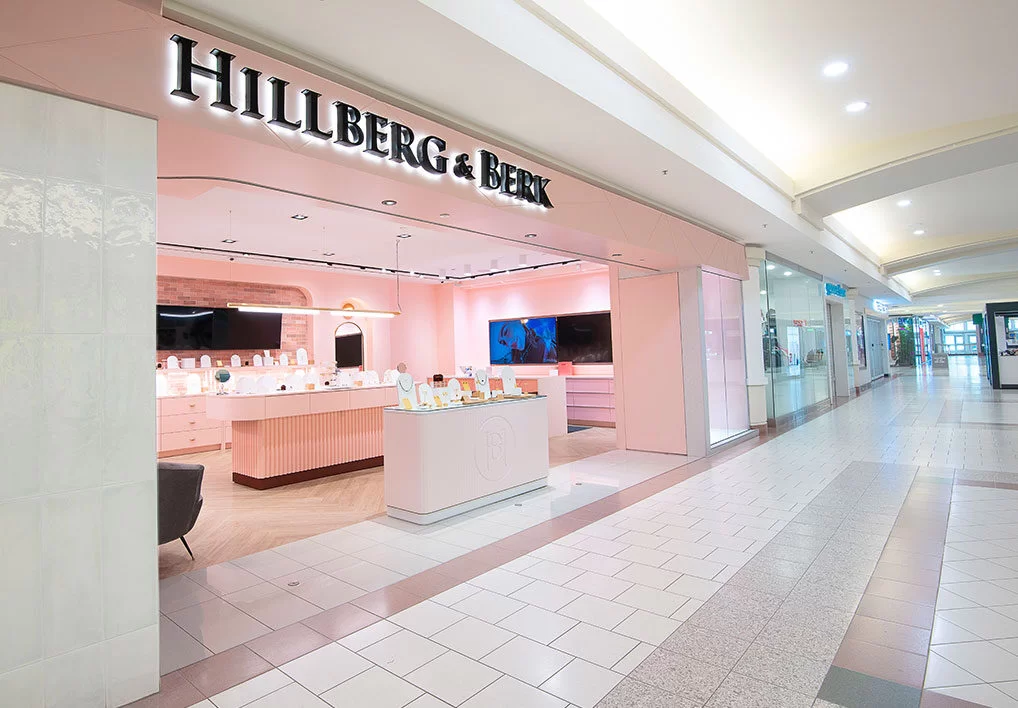
Hillberg & Berk at Willowbrook Centre in Langley BC. Photo: Hillberg & Berk
Canadian jewellery brand Hillberg & Berk is accelerating its national growth strategy, with a newly opened location at Willowbrook Shopping Centre in Langley, British Columbia marking its 17th store and underscoring a broader plan to reach 30 locations by 2027. The expansion is focused heavily on Ontario and British Columbia, positioning the company to strengthen its presence in key population centres while building a coast-to-coast retail network.
The Langley store represents the latest milestone in what the company describes as a “new wave” of openings that began in late 2024. The location also reflects Hillberg & Berk’s continued investment in physical retail as a platform for brand storytelling, community engagement, and customer experience.
Hillberg & Berk Willowbrook grand opening, April 2026. Photo: Victoria Ufimzeff
Hillberg & Berk’s expansion in Canada has gained traction through a series of recent and upcoming openings concentrated in both suburban and regional shopping centres. The company opened at Upper Canada Mall in Newmarket in late 2024, followed by a location at Lime Ridge Centre in Hamilton in November 2025. The Langley store adds a Western Canadian presence as the brand continues to scale nationally.
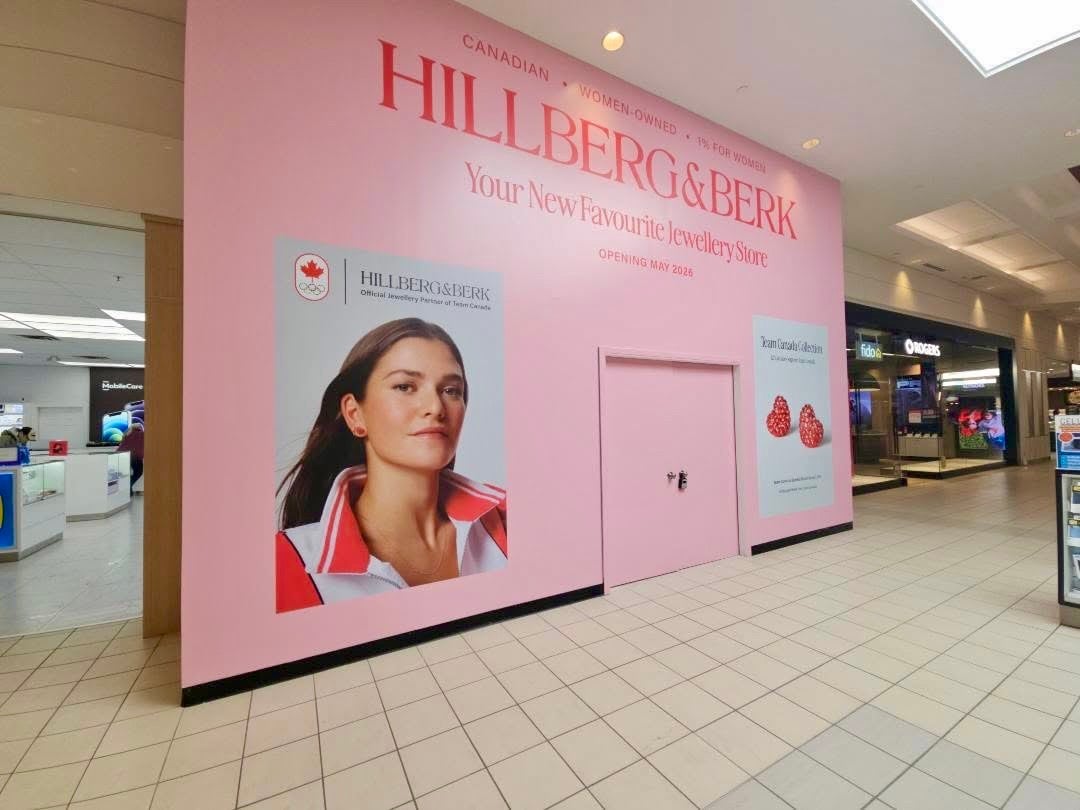
Additional locations are planned for 2026, including Sherwood Park Mall in Alberta, as well as several Greater Toronto Area sites such as Scarborough Town Centre, Hillcrest Mall in Richmond Hill, and Oshawa Centre. This clustering strategy in Ontario, particularly in the GTA, suggests a deliberate effort to build brand density in high-growth suburban markets while leveraging established retail corridors.
The approach aligns with broader shifts in Canadian retail, where brands are increasingly targeting well-performing mid-market malls that continue to benefit from strong local traffic and evolving tenant mixes.
Construction signage at Sherwood Park Mall in Sherwood Park, Alberta. Photo: Christa Patterson
Evolving Store Design Focuses on Experience and Dwell Time
As Hillberg & Berk expands its footprint, it is also refining its in-store experience to reflect changing consumer expectations. Founder Rachel Mielke has indicated that newer locations will incorporate “Sparkle Zones,” dedicated merchandising areas that highlight the brand’s signature Sparkle Ball™ collection.
Rachel Mielke
In addition, stores are being designed with hospitality-inspired seating areas intended to increase dwell time and encourage multi-generational shopping. This experiential approach reflects a growing emphasis across the retail sector on creating environments that invite customers to spend more time in-store, engage with products, and connect with the brand on a deeper level.
The integration of experiential elements into jewellery retail also signals a shift away from traditional transactional formats toward more immersive and socially oriented shopping experiences.
Purpose-Driven Growth Anchors Brand Strategy
A defining element of the Hillberg & Berk expansion in Canada is the integration of purpose-driven initiatives into its retail strategy. The Langley store opening included a local community component, with 5 percent of first-month sales supporting the Ishtar Women’s Resource Society, which provides housing, counselling, and education for individuals impacted by domestic violence.
Hillberg & Berk Willowbrook grand opening, April 2026. Photo: Victoria Ufimzeff
This localized approach complements the company’s broader “1% for Women” commitment, which allocates at least 1 percent of annual revenue to organizations that support women. Hillberg & Berk also funds grassroots programs such as Girls Forward and Play for More, which aim to address participation gaps in girls’ sports through access to equipment and leadership development.
Rather than treating corporate social responsibility as a separate initiative, the company has embedded these efforts into its core business model, aligning brand growth with measurable social impact.
Renovated Hillberg & Berk store at Southgate Centre in Edmonton. Photo: North Elm Construction
National Visibility Through Sports Partnerships
Hillberg & Berk has also expanded its reach through high-profile partnerships in women’s sports and Olympic programming. In June 2025, the company was named the Official Jewellery Partner of Team Canada, a four-year agreement that spans the Milano Cortina 2026 and Los Angeles 2028 Olympic Games.
As part of this partnership, the brand serves as the presenting partner of the Canadian Olympic Team Ring Program, designing commemorative rings for athletes. It has also introduced a Team Canada Sparkle Heart collection, with proceeds supporting athlete development.
Beyond the Olympics, Hillberg & Berk is involved with professional women’s leagues including the Professional Women’s Hockey League and the Northern Super League. These collaborations often include limited-edition products, with a portion of sales reinvested into league growth and athlete support.
The strategy positions the brand within a broader cultural conversation around women’s sports, while also building national visibility through partnerships that extend beyond traditional retail marketing.
10k Maple Leaf Studs. Image: Hillberg & Berk
From Kitchen Table to National Retail Expansion
Hillberg & Berk’s growth trajectory reflects a broader narrative of Canadian entrepreneurship. Founded in 2007 by Rachel Mielke at her kitchen table in Saskatchewan, the company has evolved into a nationally recognized brand with international reach. Milestones along the way have included an appearance on Dragon’s Den, commissions for Queen Elizabeth II, and its role as an official partner of Team Canada.
As the company continues its expansion, Hillberg & Berk is leveraging both physical retail and strategic partnerships to build a brand that blends commerce, experience, and purpose. With a clear path toward 30 stores and a growing presence in key Canadian markets, the next phase of growth will likely further define its position within the country’s competitive jewellery landscape.
The company said it is advancing a focused strategic reset centred on simplifying operations, enhancing its product offering, and reinforcing a disciplined cost structure to support sustainable, profitable growth.
“Second quarter results reflect the impact of a temporary Canadian Food Inspection Agency (CFIA) license suspension and a softer demand environment, which affected net sales and margins during the period. As a result, our net sales were $23 million, gross profit was $7 million, with gross margin of 30.6%, net loss was $7 million, with adjusted EBITDA margin of negative 4.4% and adjusted free cash flow was negative $2.0 million, with cash and marketable securities of $9 million,” it explained.
“Second quarter results reflect the impact of a temporary disruption and softer demand. More importantly, CFIA clarified what needed to change—and we are acting on it decisively,” said Selim Bassoul, Chairman and CEO. “We have simplified our cost structure, reduced complexity, and refocused the business on its core economics. At the same time, we are improving our product with better quality, larger portions and greater convenience to align with what customers value most.
“Our priorities are straightforward: protect margins, generate cash, and deploy capital with discipline. As we execute, we are focused on strengthening the business while evaluating a range of financial alternatives to enhance long-term value.
“Also, for fiscal year 2026, both the President, Najib Maalouf, and I have made the deliberate decision to forgo our base salaries. Our employment agreements remain unchanged, but we believe that in this phase of the Company’s transformation, accountability needs to start at the top. This is not a signal that we expect others to do the same. Our priority is to build a stronger, more resilient company — one that creates longterm opportunities for our teams, delivers for our customers, and earns the trust of our shareholders.”
Goodfood is a leading meal solutions brand in Canada, delivering fresh ingredients and ready-to-eat trays that make it easy for customers from across Canada to enjoy delicious meals at home every day. The company’s main production facility and administrative offices are based in Montreal with additional locations in the provinces of Ontario and Alberta.
“Our co-operative has been operating without a permanent CEO since former CEO Ken Keelor left on or around October 2024. From an email dated October 17, 2024 from Calgary Co-op former Board Chair Brad Krizan, it was stated: Effective immediately, Lisa Swartzman has been appointed interim CEO for Calgary Co-op … until a new CEO is in place, which we expect will occur within the next year,” said the proposal submitted by member Trent Cherak.
Lisa Swartzman
“Lisa Swartzman concluded her term as interim CEO around mid-November 2025, at which time Calgary Co-op appeared to quietly appoint current Board Chair Ken White to the additional role of “Executive Chair”. Ken appears to continue to assume the duties of both roles.”
“At the time of Calgary Co-op’s 2026 AGM, it has been more than 18 months since our cooperative has been without an apparent permanent CEO, and limited transparency and communication on this matter has been provided to Member-Owners. Calgary Co-op may now be falling behind in the grocery and food and beverage sector.”
Ken Keelor
The proposal is asking the Calgary Co-op Board to provide a written statement to all member-owners (via mail, email, or other direct letter to all member owners) acknowledging this matter, identify why a permanent CEO has not yet been found since Ken Keelor’s departure, and outline a plan and reasonable timeline for hiring a new CEO.
On its website, it said: “Due to overwhelming interest in our 2026 AGM, we have reached the venue’s room capacity and as a result, must restrict the meeting to voting-eligible members only. A member is eligible to vote at the Calgary Co-op Annual Meeting if they have purchased a one-dollar Calgary Co-op membership in the fiscal year ended November 1, 2025. Thank you for your understanding.”
As of Tuesday April 21, the grocery chain has not publicly released its annual 2025 report or annual 2025 financial results.
Total sales for the year ended November 2, 2024 were $1.48 billion. Total sales for the year ending on October 28, 2023, amounted to $1.303 billion, compared to $1.284 billion in 2022.
In the 2024 fiscal year, the company’s net loss was $10.043 million compared to net earnings of 16.7 million in 2023 and $38.67 million in 2022.
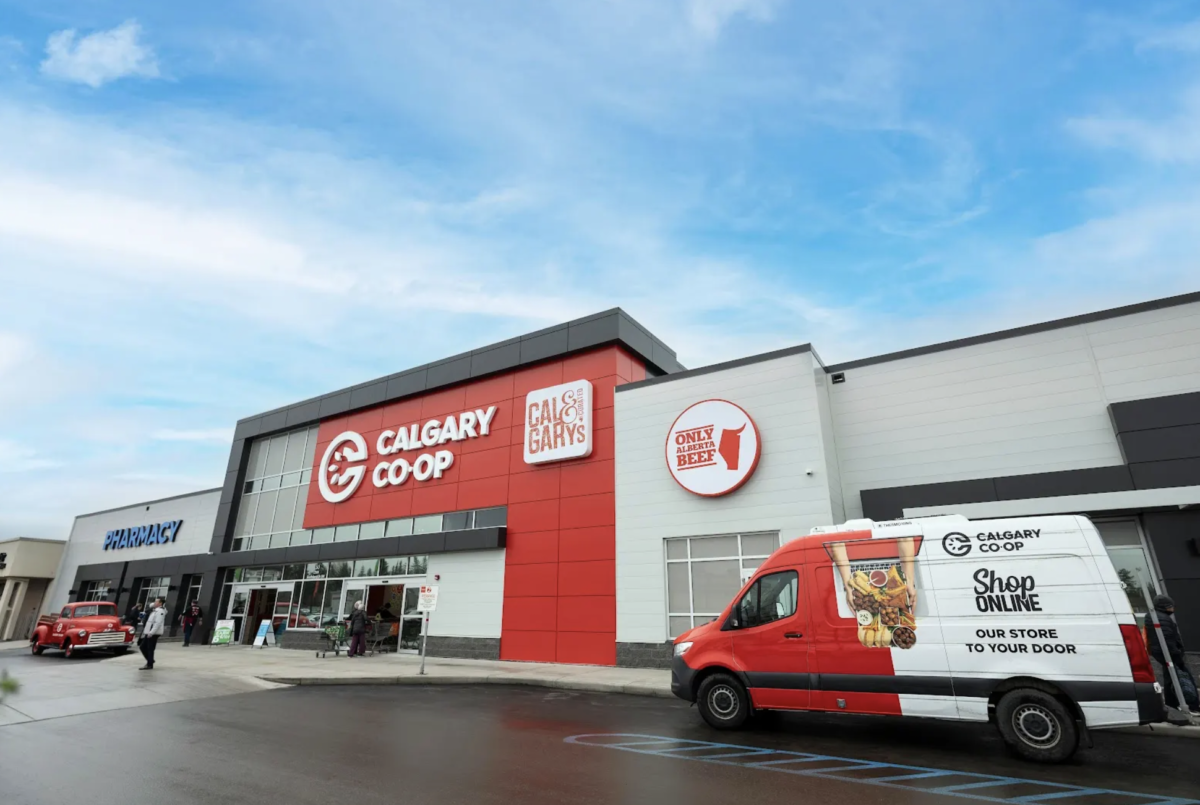
Calgary Co-op Oakridge. Source: Calgary Co-op
In an email statement, Co-op said: “With space being a consideration and to ensure ALL members who are eligible to vote (meaning they bought a membership at any point in fiscal 2025 or earlier) can attend, we need to limit the meeting to voting-eligible members only. New members who purchased their membership after November 1, 2025, will gladly be welcomed at next year’s AGM.
“While we have previously limited attendance to voting-eligible members only, we have not had to do so for a few years. The Carriage House Inn, where we are hosting this year’s AGM, currently holds double the number of members who attended our last AGM. We are sincerely pleased with the membership registration and interest this year.
“As for your question regarding our Annual Report and Financials, as is typical, these will be posted on our website directly before our AGM and will be provided to voting-eligible members in their AGM kits.”
Ken White
Another proposal submitted by member Siyang Feng regards the closure of the company’s Hampton’s store on March 28.
“The Location has been serving Hamptons and Edgemont community for over 20 years. Many residents rely on this location for pharmacy service and convenient groceries. In addition, there’re some high products and local brands, such as “Founders and Farmers” that shoppers can’t get similar substitute products from the second nearest store, which is the Superstore,” its said.
“Moreover, this creates extra challenges for a lot of seniors who don’t drive to access for groceries and their regular medications. Whereas: I’ve asked the Hamptons Homeowners Association, they said that Coop owns this property. As a member-owned cooperation, I think serving the community’s needs is equally important as making profit.”
The proposal is asking that Calgary Co-op consider bringing a similar service provider (groceries/pharmacy) to the Hamptons location with the potential for the property to be divided into several units for lease provided that groceries and pharmacy essentials will be available to the nearby neighbourhoods.”
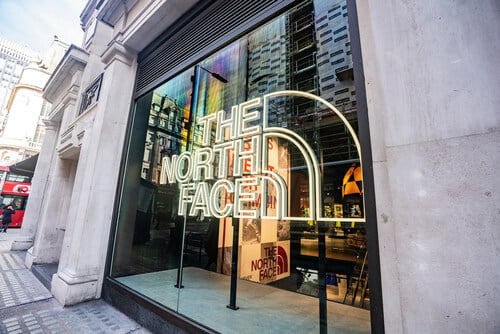
Nedap, a leader in item-level inventory visibility, is partnering with VF Corporation, a global leader in apparel, footwear and equipment whose portfolio of iconic active and outdoor lifestyle brands includes The North Face, Vans and Timberland.
As part of the collaboration, VF Corporation will deploy the Nedap Inventory Engine across its brand portfolio and 1,500+ stores, creating a stronger foundation for end-to-end inventory visibility and more seamless, data-driven retail operations, according to a news release.
The deployment starts in Q2-2026 with The North Face and will expand to additional VF brands over time. With brands rooted in performance, elevated design and innovation, VF serves consumers worldwide across outdoor, active and workwear lifestyles, it said.
The partnership supports VF’s ambition to create a single view of stock, built on a single, trusted view on inventory across its operations. With the Nedap Inventory Engine, VF aims to enhance stock accuracy, improve product availability and strengthen omnichannel performance across all regions. In addition to the store rollout, VF has expanded the initiative into its distribution channels, enhancing visibility and supporting efforts to address grey-market activities and strengthen brand protection, explained the brand.
Carsten Trenz
“Our consumers expect the same level of product availability and service whether they shop online, in-store or through any of our brand touchpoints,” said Carsten Trenz, VP of Digital at VF Corporation. “Unified visibility across our operations allows us to deliver that consistency and build long term customer loyalty.”
Hope Waldron
Hope Waldron, VP of Supply Chain Strategy, VF Corporation, added: “Extending our RFID program beyond stores to include distribution centers and vendor partners at the source gives us greater transparency across our entire supply chain. That visibility improves our ability to ensure product availability, strengthen brand protection, and deliver a more consistent consumer experience.”
VF said it selected Nedap following a successful pilot using an alternative solution, after which the company reassessed its long-term requirements for scalability, architecture and global support. Nedap was chosen based on:
The most robust, innovative and future-proof platform architecture
A proven track record of guiding and advising organizations through complex rollouts at scale
A user community that drives continuous improvement and shared innovation across leading retailers
Hilbert Dijkstra
“In today’s retail landscape, unified commerce only works when brands can rely on one consistent source of truth for their inventory,” said Hilbert Dijkstra, Managing Director Retail at Nedap. “VF’s decision to invest in end-to-end visibility reflects a clear vision for the future: the ability to serve consumers seamlessly across any channel. Through ongoing innovation of our platform, we help VF operate with confidence, agility and precision.”
Nedap empowers retailers to turn inventory movement into real-time insight and real-world results. Nedap has a workforce of over 1,000 employees and operates on a global scale. The company was founded in 1929 and has been listed on Euronext Amsterdam since 1947. Its headquarters is located in Groenlo, the Netherlands.
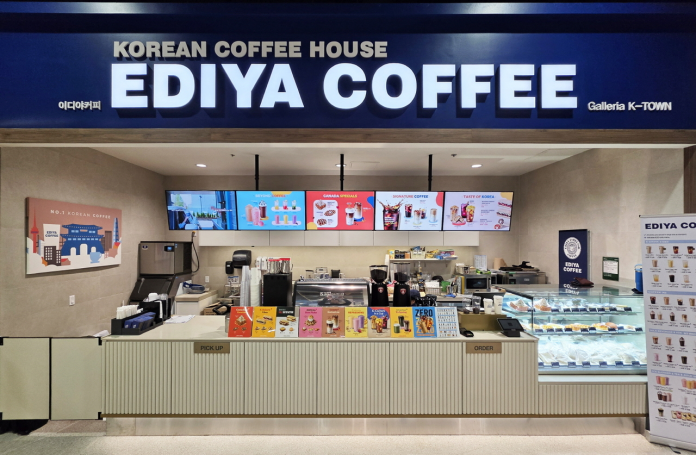
Ediya Coffee at Galleria Supermarket in Thornhill, Ontario. Photo: Ediya Coffee
South Korean coffee chain Ediya Coffee has entered the Canadian market with the opening of its first location inside Galleria Supermarket in Thornhill, a prominent Korean commercial hub within the Greater Toronto Area. The launch marks an important step in the company’s broader global growth strategy as it looks to establish a presence in North America.
The company said it selected Canada due to rising global interest in Korean food culture and strong domestic coffee consumption. Toronto was identified as a strategic entry point given its sizable Korean population and diverse consumer base, allowing Ediya to leverage both brand familiarity and growing curiosity around Korean-style beverages and desserts.
The Thornhill location experienced steady foot traffic from its opening last month, with long lines forming as customers sought to experience the brand’s offerings. While Korean consumers represented a core audience, the store also attracted a broader demographic of local customers interested in Korean-inspired drinks and food items.
The menu features a mix of signature Korean beverages and localized offerings tailored to Canadian tastes. Core items include “A-mang-chu” iced tea with mango, strawberry latte, dalgona latte, and sikhye, a traditional Korean sweet rice drink. Canada-specific products such as the Maple Nut Cream Latte and Signature Half & Half Latte reflect an effort to align with local flavour preferences.
Food offerings combine Korean-style desserts, including honey caramel bread and dalgona ice cream waffles, with savoury items such as burritos and sandwiches incorporating flavours like buldak and bulgogi. This hybrid menu approach positions the brand within both the specialty beverage and quick-service food categories.
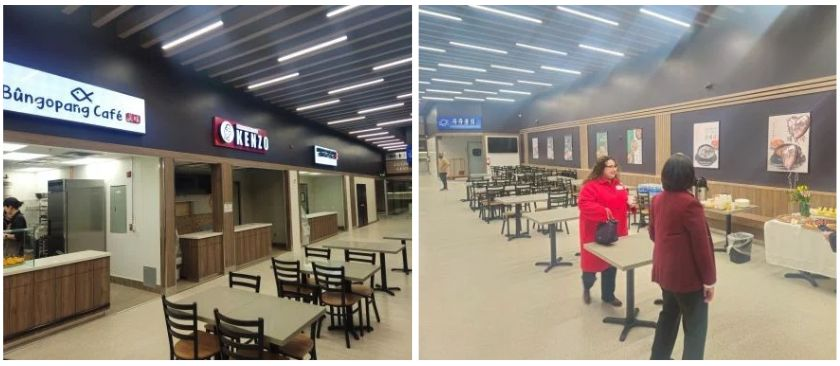
Galleria Supermarket K Town Branch Food Court
A Strategic “Glocal” Approach to Expansion
Ediya’s Canadian entry reflects a deliberate “glocal” strategy, blending globally recognized Korean menu items with locally adapted products. This approach is designed to differentiate the brand in a competitive coffee landscape dominated by established players such as Tim Hortons and Starbucks.
The company has positioned itself slightly below premium independent cafés in pricing while maintaining a distinct aesthetic and product mix. In contrast to its value-oriented positioning in South Korea, Ediya is entering Canada as a specialty concept, allowing for higher price points and margin potential.
Ediya’s move into Canada comes at a time when the company is navigating increasing competition in its home market. While it remains South Korea’s largest coffee franchise by store count, with more than 3,000 locations, its traditional mid-market positioning has been challenged by ultra-low-cost competitors.
In response, the company has been evolving its brand through premium product development and character-driven marketing initiatives. A recent collaboration with the Rilakkuma intellectual property reportedly drove a 42 percent increase in daily sales, highlighting a shift toward experience-driven and fandom-based consumption.
Data-Driven Operations and Expansion Pipeline
The Thornhill store also serves as a testing ground for Ediya’s operational and technological capabilities. The company has integrated a generative AI chatbot system into its Canadian operations, which manages a significant portion of customer inquiries while collecting real-time feedback to inform menu adjustments and customer experience improvements.
Ediya plans to use insights from this initial location to guide further expansion, with a target of opening up to three stores in Canada by the end of 2026. At the same time, the company is preparing for entry into Southeast Asia, including a planned move into Laos through a master franchise agreement.