In partnership with The Sobey Foundation and Canada’s Children’s Hospital Foundations (CCHF), the initiative is in its sixth year, continuing to fund and raise awareness for early intervention and crisis prevention programs through local children’s hospital foundations.
Since launching in 2020, the initiative has helped children’s hospitals across Canada treat and assess more than 220,000 children and youth – equivalent to approximately 120 children and youth per day. It has helped Canada’s 13 children’s hospitals cumulatively add and enhance close to 100 treatment spaces, train more than 17,000 mental health professionals and care providers, perform over 98,000 assessments and treat over 128,000 children and youth.
Photo: Empire
Empire Family of Brands, The Sobey Foundation, and CCHF have raised and donated more than $21 million in funds and in-kind support. 100% of funds raised go directly to local early intervention programs, helping expand access to mental health support for families in communities across the country.
From September 18–October 5, Empire Family of Brands, The Sobey Foundation, and CCHF continued their nationwide fundraising campaign to support early intervention and prevention programs for children and youth.
Renee Hopfner
Renée Hopfner, Head of Corporate Citizenship at Empire Company Limited, said the company launched the Family of Support: Child and Youth Mental Health initiative with Canada’s Children’s Hospital Foundations (CCHF) in 2020 to help more kids and families access local mental health support.
“The vision was always early help, close to home. Five years in, that vision continues to support 13 children’s hospitals with local programs focused on early intervention and crisis prevention. Since 2020, the initiative has helped Canada’s 13 children’s hospitals cumulatively add and enhance close to 100 treatment spaces, train more than 17,000 mental health professionals and care providers, perform over 98,000 assessments and treat over 128,000 children and youth,” she said.
“This five-year milestone reflects sustained investment and partnership, supporting programs that meet urgent needs and lay the groundwork for long-term change. As the need grows, so does the impact of Family of Support.”
Hopfner said one theme across Family of Support–funded programs is a holistic approach to early mental health intervention, one that goes beyond clinical treatment to support the overall well-being of children and youth.
“For example, in Calgary, Alberta, Family of Support is helping open access to child and youth mental health care at The Summit: Marian and Jim Sinneave Centre for Youth Resilience. Thanks to community support through the Alberta Children’s Hospital Foundation, hundreds of children and teens receiving care at The Summit benefit from specialized programming, including music, art, recreation, and horticultural therapy, that supports them on their mental health journey,” she said.
“Moreover, in Hamilton, Ontario, Family of Support is helping expand access to care at McMaster Children’s Hospital through Substance Use Supports for Pediatrics. McMaster Children’s Hospital is integrating youth substance use counsellors and peer support workers, in partnership with community providers to deliver integrated care, enhance community connections, and improve patient outcomes and safety by simultaneouslyaddressing mental health and substance use challenges.
“These are just two examples of how Family of Support is helping more children and youth access critical mental health programs early, but there are many more. Each program, across 13 children’s hospitals in Canada supported through Family of Support, has a regional focus, addressing urgent needs within the communities they serve.”
Photo: Empire
Hopfner said Empire partners with Canada’s Children’s Hospital Foundations (CCHF), which coordinates across 13 children’s hospital foundations, so funds stay local and align with each hospital’s priorities.
“Children’s hospitals are on the front lines of mental health care and understand the needs of their communities. Every dollar donated supports local programs directly. Children’s hospitals share how programs are
making an impact through assessments, patients served, care providers trained, and treatment spaces. This model blends national scale with local accountability, ensuring communities see tangible benefits where they live.”
At Empire Family of Brands, banners mobilize the local communities they serve. Customers were able to donate at checkout in participating stores across Canada, with campaign details promoted in store and online.
“We reinforce checkout giving with in-store and digital signage that connects customers to local hospital programs and FamilyofSupport.ca. Additionally, our banners also promote the campaign on social media, with amplification from children’s hospital foundation partners in each region.”
“Demand is rising, so our long-term focus is to support children’s hospitals in delivering early intervention and crisis prevention programs. Funding will continue to help Canada’s 13 children’s hospitals invest in assessments, treatment spaces, training, and research, using models of care that work in both clinical and community settings,” she added.
“Over the past five years, Empire Company Limited, The Sobey Foundation, andCanada’s Children’s Hospital Foundations (CCHF) have raised and donated $21.7 million in funds and in-kind support to local children’s hospital foundations. Looking ahead, we remain committed to ensuring families can access mental health support through their local children’s hospitals, translating national resources into solutions shaped by each community’s needs.”
Retail Insider is streamlining its Canadian retail news from around the web to include a handful of top news stories that can be viewed quickly during the day. Here are the top stories from the past 48 hours.
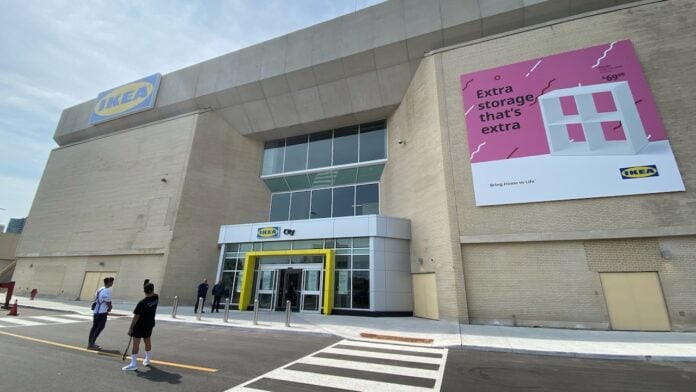
Scarborough Town Centre IKEA (Image: Craig Patterson)
IKEA Canada has announced that it will close its urban-format store at Scarborough Town Centre (STC) in early 2026, less than three years after opening the location. The decision marks a significant adjustment to the company’s evolving urban retail strategy as it continues to respond to shifting consumer shopping behaviours, particularly the growing preference for online purchasing.
The IKEA Scarborough Town Centre closure represents the end of a short-lived chapter for the global retailer’s city-centre store experiment in Toronto’s east end. The location, which opened in August 2023, spans approximately 80,000 square feet and was designed to cater to the needs of urban residents through a smaller, more accessible store format.
Scarborough Town Centre was the second urban-format IKEA to open in Canada, following the company’s downtown Toronto location at Yonge and Gerrard, which launched in May 2022 and remains in operation. The Scarborough store was envisioned as a model for compact city retailing by offering convenience, local accessibility, and an omnichannel shopping experience that integrated in-store browsing with digital tools.
However, IKEA Canada said in a statement that the store’s performance had fallen short of expectations. “This decision has not been taken lightly,” said Selwyn Crittendon, CEO and Chief Sustainability Officer, IKEA Canada. “We are constantly renewing and improving our business in order to remain relevant in an ever-changing retail world and to secure our future as a leading omnichannel retailer for generations to come.”
Scarborough Town Centre IKEA (Image: Craig Patterson)
Changing Consumer Habits and Omnichannel Growth
Crittendon pointed to the rapid evolution of consumer behaviour as a major factor behind the closure. Over the past several years, IKEA Canada has seen dramatic growth in online shopping, with 162.6 million visitors to IKEA.ca in the past year, compared to 33.8 million in-store visitors across the country.
The Scarborough store’s limited floor space restricted the number of products it could display and stock, which may have influenced its underperformance. Unlike IKEA’s traditional warehouse-style stores, which average more than 300,000 square feet, the STC location carried only about 2,500 products available for immediate purchase. Larger furniture items had to be ordered online or through delivery and pickup options, which may not have met all customer expectations, and a full-sized warehouse store is located a few kilometres away.
The Scarborough store’s digital-forward model, which included planning hubs, home delivery services, and click-and-collect features, aligned with IKEA’s long-term omnichannel vision. However, the company acknowledged that the balance between physical and digital retail continues to evolve and that the lessons from the IKEA Scarborough Town Centre closure will guide future decisions.
Scarborough Town Centre IKEA (Image: Craig Patterson)
Impact on Employees and the Local Community
The Scarborough Town Centre location currently employs 130 workers. IKEA Canada emphasized that supporting its staff during this transition remains a top priority. “Even as we respond to market needs, we are committed to putting our people first and leading with our culture and values through this transition,” said Crittendon.
The company added that efforts will be made to minimize the impact of the closure by offering assistance and potential redeployment opportunities where possible.
Despite the closure, IKEA reaffirmed its commitment to the Scarborough community. Customers in the region will continue to have access to products and services through IKEA’s North York full-size store and various digital and physical touchpoints, including IKEA.ca, home delivery, click-and-collect services, and its network of plan-and-order points across the Greater Toronto Area.
Scarborough Town Centre’s Changing Retail Landscape
The closure also reflects broader shifts at Scarborough Town Centre, one of Toronto’s largest and most significant shopping malls. Managed by Oxford Properties, the 1.3 million-square-foot complex has faced a series of major tenant departures over the past two years.
In mid-2025, Hudson’s Bay Company closed its store at the mall, part of a nationwide wind-down following the department store’s liquidation process. Around the same time, French sporting goods retailer Decathlon shuttered its STC location, one of five closures in the Greater Toronto Area, as part of a strategic restructuring.
The exit of IKEA, a globally recognized brand, will leave another major vacancy at the property. For Oxford Properties, the mall’s owner, the challenge now lies in reimagining the large-format retail spaces once occupied by legacy anchors and large international brands.
Scarborough Town Centre IKEA (Image: Craig Patterson)
Inside the Scarborough Town Centre IKEA
When it opened in August 2023, the IKEA STC store was celebrated as a milestone for accessible urban retailing. The grand opening attracted thousands of visitors, complete with community festivities and remarks from local officials.
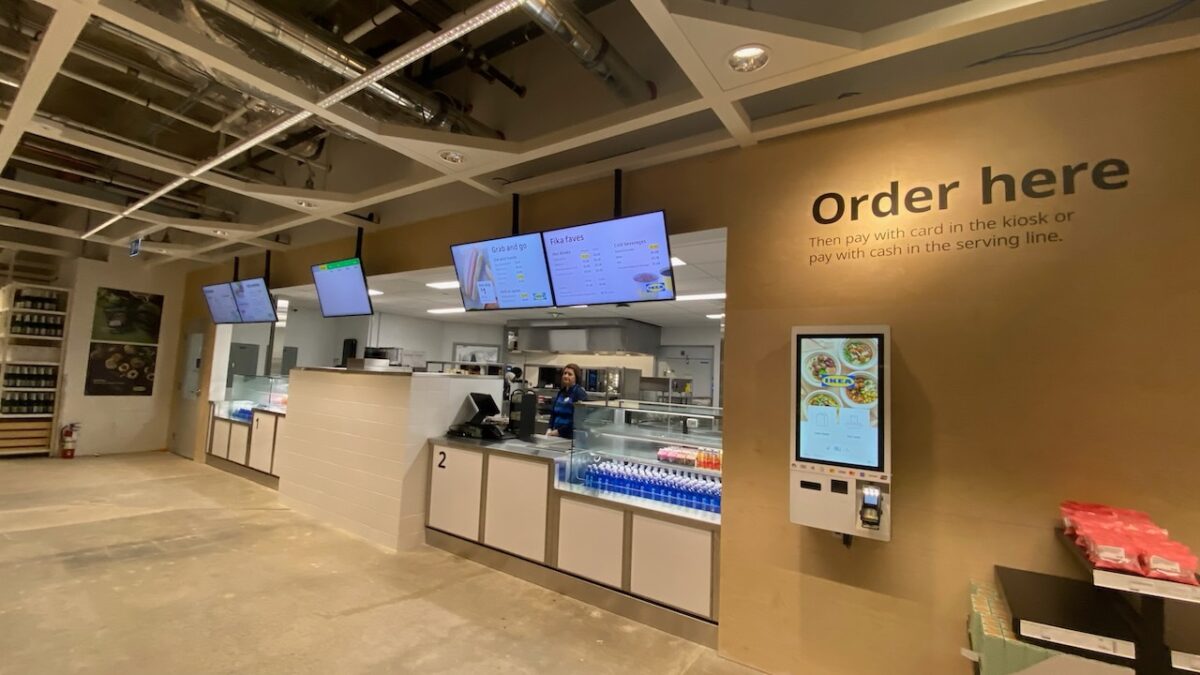
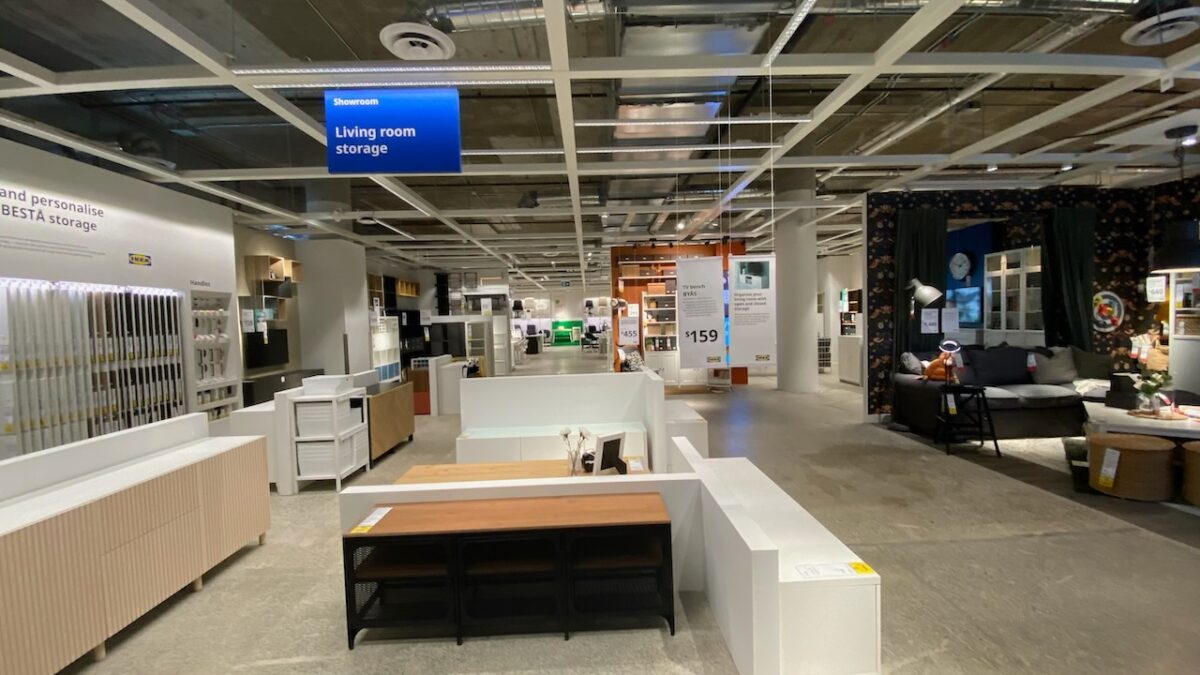
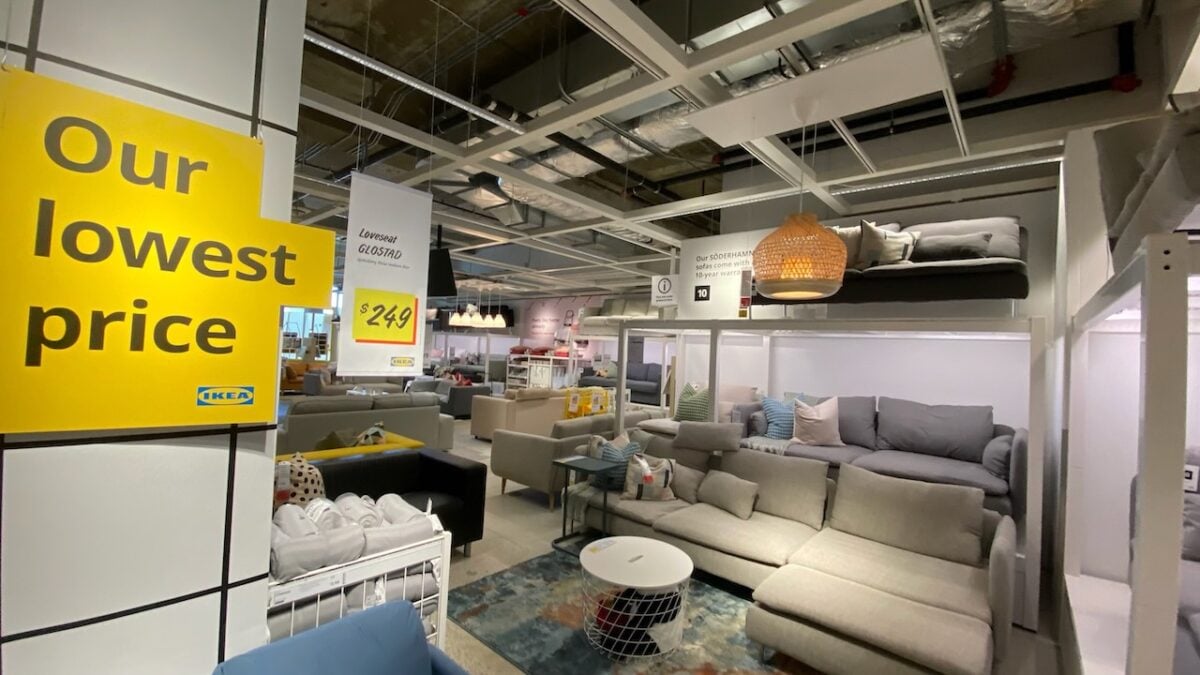
Designed specifically for smaller-space living, the 80,000-square-foot store included both mall and exterior entrances, two checkout areas, and an assortment of more than 2,500 take-home products. Customers could view larger furniture pieces and order them for home delivery or pickup. The store also featured a Swedish Deli offering signature dishes such as meatballs, veggie dogs, and frozen yogurt, further enhancing the in-store experience.
The store’s design and amenities reflected IKEA’s focus on sustainability, with eco-friendly packaging, renewable energy initiatives, and services that encouraged waste reduction. Despite these efforts, traffic levels and conversion rates failed to meet internal projections.
IKEA Downtown Toronto – AURA (Image: Dustin Fuhs)
Downtown Toronto Location Remains Operational
While the Scarborough Town Centre location prepares to close, IKEA’s downtown Toronto store at Yonge and Gerrard continues to perform strongly. Opened in May 2022, it marked the first urban-format IKEA store in Canada.
The downtown location, housed in the Aura tower, spans about 66,000 square feet over two levels. It has proven popular with downtown residents and students seeking affordable and space-efficient furnishings. The store operates on a cashless model, with self-checkout kiosks and mobile payment options, and integrates digital tools that streamline the urban shopping experience.
Its sustained success suggests that urban-format stores can work in certain markets, particularly those with high foot traffic, dense populations, and easy access to public transit. IKEA’s leadership has not indicated any plans to scale back operations at this location.
IKEA Canada’s Broader Retail Footprint
With the IKEA Scarborough Town Centre closure, IKEA Canada will continue to operate 15 locations nationwide. The retailer’s portfolio includes full-sized stores in major urban and suburban markets.
In recent years, IKEA has expanded its digital infrastructure and logistics network, introducing planning studios, pickup points, and enhanced delivery services to improve accessibility. These efforts align with the company’s commitment to sustainability, affordability, and convenience for Canadian consumers.
The company continues to adapt its physical footprint to the realities of e-commerce. Many of IKEA’s most successful markets now operate through a hybrid model that blends physical stores with an expanding network of online tools and delivery solutions.
I listened to the Nike Inc. (NYSE: NKE) Q1 Fiscal 2026 earnings call on September 30th after the bell. The call was hosted by Elliot Hill (President & CEO) and Matthew Friend (EVP & CFO). Nike is in the middle of a turnaround and although it has made some progress there is a lot of work to be done to return to glory.
Bruce Winder
GAAP Financials (all in $ USD)
Overall, for Q1/Fiscal 26, Nike revenue was $ 11.7 billion, up +1% vs. last year. Nike Wholesale was $ 6.8 billion, up + 7%. Nike Direct revenue was $ 4.5 billion, down -4%, which includes Nike Digital, which was down -12% & Nike Stores, which was down – 1%. Revenues for Converse were $366 million, down – 27%.
Gross margin rate for the quarter was 42.2%, down – 320 bps vs. Q1/ Fiscal 2025. This was a result of increased wholesale discounts, higher discounts at Nike factory stores, higher product costs (including new higher tariffs) & channel mix headwinds.
SG&A was $ 4 billion, or 34.3 % of revenue, down -1% for the quarter or down 60 bps to last year as a percentage of revenue. This was due to lower brand marketing expense. Operating overhead was flat to last year.
Operating income for the quarter was $ .927 billion, or 7.9% of revenue. This was down from $ 1.2 billion last year which was 10.4 % of revenue.
Nike’s effective tax rate for the quarter was 21.1%, up from 19.6% last year. This was due to a benefit from stock based compensation in Q1/Fiscal 2025.
Net income for the quarter was $ .7 billion or 6.2% of revenue, down -31% to Q1/Fiscal 2025. Last year net income was 9.1% of revenue.
EPS was .49 cents per share, down – 30% from last year.
Cash & cash equivalents were $ 7 billion, down -17%. Inventory was $ 8.1 billion, down -2% to last year. Cash generated from operations in the quarter was $ 222 million, down – 44% from $ 394 million last year.
Nike returned $ 714 million to shareholders in Q1, made up of $ 591 million in dividends, up + 6% to last year and share buybacks of $ 123 million.
Let’s look at how key Nike geography’s performed in the 1st quarter.
North America
Q1 revenue up +4%, Nike Wholesale up +11%, Nike Direct down -3%, Nike Digital down -10%, Nike Stores flat to LY, EBIT down -7%.
Nike indicated this region is “furthest ahead” on its transformation. The running, training & basketball businesses are all up double digits vs. last year. Sportswear also grew in the quarter but work still remains in that business. The Wholesale division returned to growth but was in part a result of higher liquidation volume to value channels. Nike feels it is reaching new customer segments. Inventory is down in units but up in dollars due to tariffs. The company says it’s closeout mix is approaching normalized levels.
Europe, Middle East & Africa (EMEA)
Q1 revenue up +1%, Nike Wholesale up 4%, Nike Direct down – 6%, Nike Digital down -13%, Nike Stores up +1%, EBIT down -7%.
Nike indicated that this region has a largely clean marketplace and that they have built momentum with sports & wholesale partners. The digital business is close to being exclusively full-price but issues remain in site traffic & demand. The running business enjoyed double digit growth in Q1, while the football & footwear businesses had low single digit growth. Sportswear declined low single digits. Nike selectively leveraged discounts to lower inventory in the region, which was down mid single digits by the end of the quarter.
Greater China
Q1 revenue down -10%, Nike Wholesale down -9%, Nike Direct down – 12%, Nike Digital down -27%, Nike Stores down – 4%, EBIT down -25%.
Nike indicated that low store traffic and poor in-season sell through are headwinds. Running is the bright spot growing high single digits. The market responds well to innovation. The region is highly promotional and relies heavily on local platforms that require discounts for events like 11/11 a.k.a. Singles Day. Inventory in the market is down about -11% to last year and the closeout mix is elevated. Nike’s priority for China is to increase seasonal sell through by refreshing store concepts around sport, creating greater brand distinction & merchandising, and lowering the mix of aged inventory at partners.
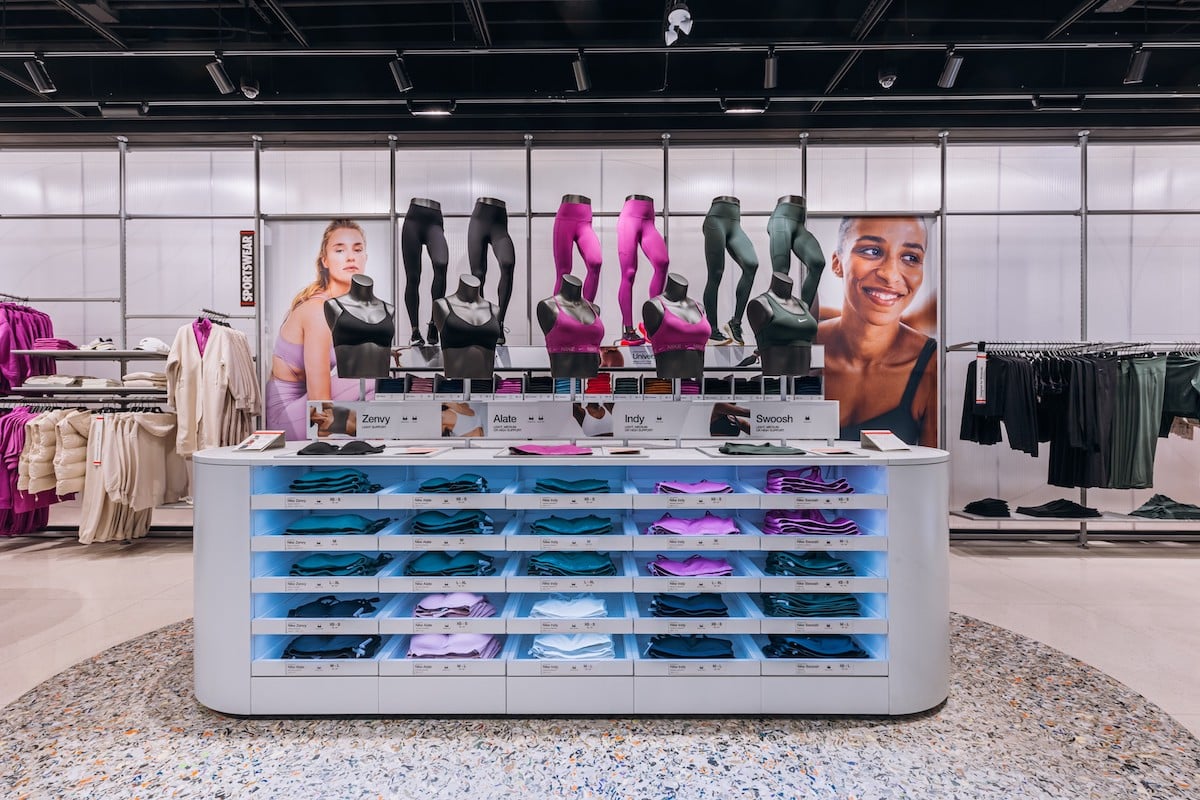
Bras and leggings at the Nike Bloor flagship in Toronto. Image: Nike
Asia Pacific & Latin America (APLA)
Q1 revenue up +1%, Nike Wholesale up + 6%, Nike Direct down -6%, Nike Digital down -8%, Nike Stores down -5%, EBIT down – 13%.
The region had mixed results as there are pockets of elevated inventory levels & much promotional activity. The market enjoyed double digit growth in running and high single digit growth in training. Sportswear declined low single digit. Inventory grew high single digit vs. last year. Nike plans on tightening buys and lowering inventory in some countries.
Management Commentary
Hill discussed the companies “win now” actions which include changes to Nike’s culture, product, brand marketing, marketplace & ground game.
So far, Nike has seen results across it’s top priorities including: it’s running business, the North America region and it’s relationship and growth of it’s wholesale business. According to Nike, consumers are responding.
Hill also mentioned that the company has onboarded about 8,000 employees to it’s new “sports offense” way of working. This includes organizing the company around it’s 3 main brands: Nike, Jordan & Converse. The company is migrating to smaller cross-functional teams who will be divided by brand & sport but also by country & type of account/channel of distribution. This is a change to Nike’s previous organization that was structured by men’s, women’s & children’s products. Nike’s long term vision is to use it’s sport offense approach to succeed beyond the traditional sports that the company competes.
The idea is that these more focused groups of product developers and brand marketers will obtain sharper consumer insights that enable them to connect with athletes in a more meaningful way to produce a “better coordinated attack”. More nimble, the athlete and the sport will become the center of attention again.
Hill acknowledged that there is still work to be done with: the sportswear business, the Greater China region & the Nike Direct channel.
The CEO used the Nike House of Innovation flagship in New York as an example (I have visited this store and it is quite incredible). The store creates a unique retail experience by sport. A recent refresh has led to double digit revenue growth for this location. The idea is for Nike to create more of a specific point of view in retail. This clarity “works in smaller formats too”. Another example is the recent refresh of the Austin store that focusses on running & training and has seen a significant sales increase as a result.
Nike mentioned how they used the US Open to style several athletes during high profile moments at the tournament. Hill says “sports & the worlds greatest moments will always be Nike’s runway”.
Hill discussed how one of Nike’s advantages and differentiators is that it focusses on so many channels (wholesale, direct) across so many price points for so many athletes in so many geographies.
Running
The CEO discussed how the Nike running business was the first division to embrace the new way of working. Research indicated that runners want 3 things: 1) big cushioning 2) stability or 3) an everyday shoe that returns energy. Therefore Nike redesigned the “Vomero”, “Structure” & “Pegasus” models based on these insights while integrating other Nike technologies such as: Nike Air, Flyknit, ZoomX & Reactx. Hill indicated that Nike plans to introduce one new style each season. The idea is to create a “relentless flow of innovation”. Early results show the running business is up + 20% in this quarter.
The opportunity for Nike is to apply this formula to: global football, basketball & training sports.
Global Football
Nike is gearing up for the 2026 World Cup and has targeted a younger consumer with 3 unique silos at 3 different price points. The company has relaunched the “Phantom 6” with strong sell through thus far. In Q3 Nike will launch it’s new “Tempo” & new “Mercurial” cleats after that. The team used the “scary good” campaign to help build awareness and results on some of the new products.
ACG
Nike also invested resources in it’s All Conditions Gear (ACG) business with a new breathable platform called “Radical AirFlow” and a new ACG super shoe with “ultra fly”. The company also launched a new ACG elite race team as well.
NikeSKIMS Partnership
Hill discussed Nike’s partnership with SKIMS and how this tie-up brings a new customer into the Nike ecosystem. The partnership has created performance training product with a very different look. The company recently debuted 58 silhouettes and early results are very strong.
Sportswear Transformation
This business continues to decline and Hill acknowledged that there is a lot of work to be done. It is a major priority at Nike to be fixed. The Nike Air Force 1 business is “stabilizing” and the Nike Air Jordan 1 inventory levels are “returning to health”. The Nike Dunk line is being aggressively managed down in all regions of the world. The Chuck Taylor line is in the early stages of a “global market reset”. The Converse brand has new leadership to get that brand back to profitable growth.
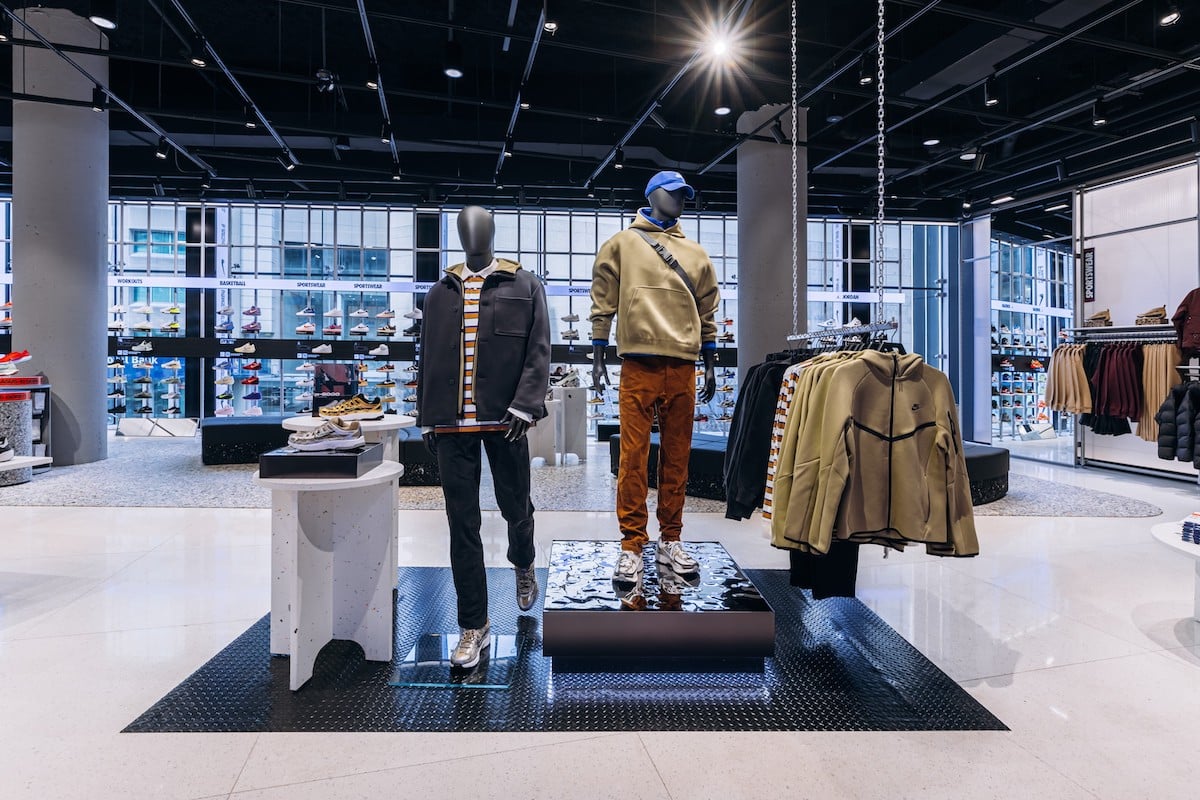
Men’s at the Nike Bloor flagship in Toronto. Image: Nike
North America
The Nike North America division took a number of positive steps to get the business back to profitable growth. The team worked hard to get product access to more premium locations. About 1,300 running spaces were reset at numerous retailers including Dick’s & Nordstrom in the quarter.
Hill indicated that Nike is pleased with the Nike brand store on Amazon and that it is performing better than anticipated.
There is still much work to do in the North American region as Nike strives to elevate & integrate the marketplace. Specifically as it relates to digital & physical channels and wholesale & Nike Direct. Nike would like to use work completed in North America as a blueprint for all other geographies.
For continued North America growth, Nike will focus on “win now” actions:
Focusing on the athlete
Marketing through emotional storytelling
Great product
Driving an integrated marketplace
Activate ground game
Greater China
There are “structural challenges” that Nike is facing in Greater China as it’s business was down -10% in Q1/Fiscal 26. Seasonal sell through was lower than expected which created large markdowns in order to keep the marketplace clean of excess inventory.
Nike remains committed to China as the country is passionate about several sports including basketball, football, running & training.
The plan for China is to lead with innovation & have sponsored athletes visit. This increases demand (this is the Nike formula for all regions). For Nike, sport is the pathway to winning in China.
Globally
Nike Digital is still “trying to find solid ground”. Although organic growth has slowed, the division is “pulling back” on promotions. Nike is trying to find the right assortment and marketing mix to bring consumers back to the Nike Digital “ecosystem”.
Nike has a presence in almost 190 countries and Hill warned that not all sports, channels & countries will recover on the same timeline. Nike’s recovery is not linear.
Hill is “realistic” that Nike is turning itself around at a time of fragile consumer confidence, evolving tariff dynamics and a Nike team that is “still settling” into it’s sport offense mentality. Nike realizes it has a lot “more to prove” and remains “hyper focused” on the athlete.
Tariffs
On the previous earnings call, Nike signaled that it was facing an annual tariff impact of $ 1 billion. Based on recent developments, this number has grown to $ 1.5 billion. Therefore, Nike forecasts that tariffs will negatively impact gross margin rate for fiscal 2026 by -120 bps, worse from the previous estimate of -75 bps 90 days ago.
Nike outlined a number of initiatives that are underway to try and mitigate some of this margin erosion.
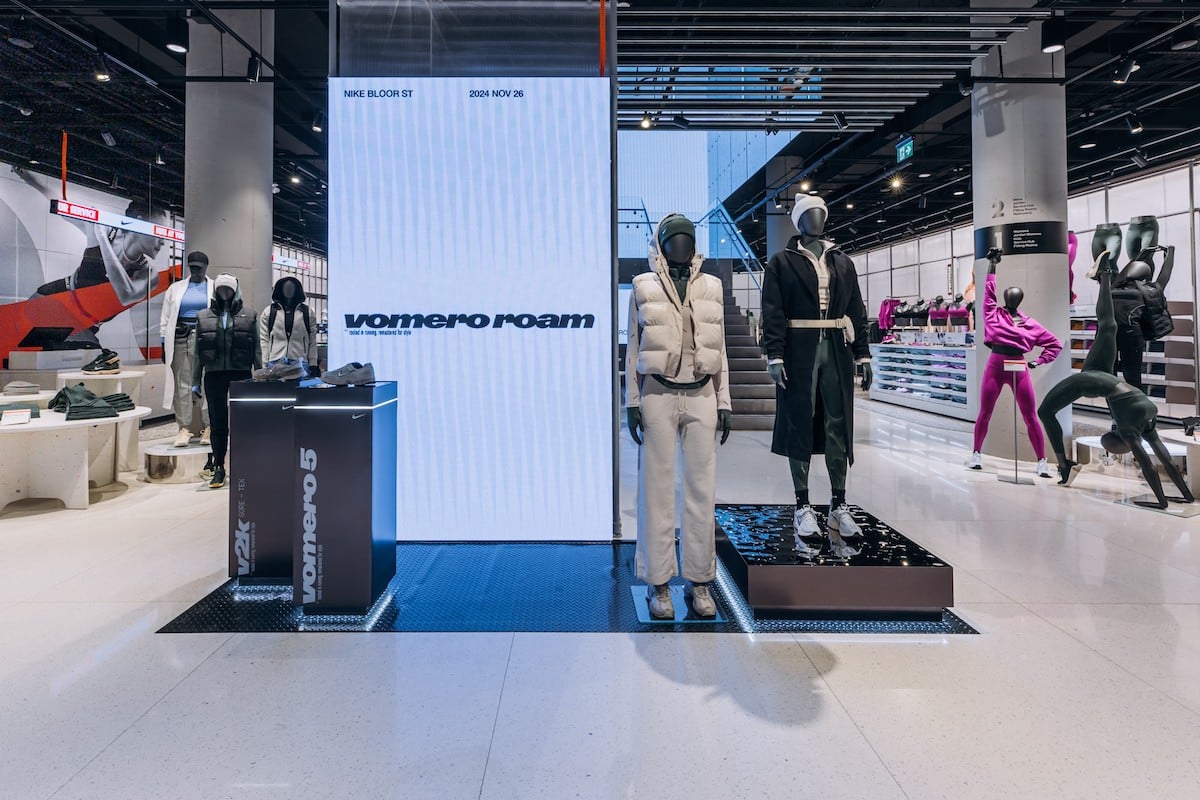
Innovative Zone at the Nike Bloor flagship in Toronto. Image: Nike
Management Guidance
Q2/Fiscal 2026
The CFO indicated that Nike is anticipating revenue to grow by a low single digit percentage in Q2. He indicated that Nike Digital will face greater headwinds in Q2 than Q1. Gross margin rate is guided to be down between -300bps to -375bps in the quarter (this includes net headwinds to gross margin rate of – 175bps due to increased tariff impact). SG&A will grow by a high single digit percentage, which includes growth of operational overhead by a low single digit percentage. Nike’s tax rate for Q2 is anticipated to be in the low 20% range, due to changes in earnings mix.
Balance of Full Year – Fiscal 2026
Nike anticipates it will continue sales momentum with wholesale partners (returning to modest growth rates) as the companies spring order book is up over 2025. Growth will be led by sports. One of the priorities for fiscal 2026 is to fix Nike Digital and make it into a full-price business. Nike Direct will not be able to return to growth for fiscal 2026. North America will lead Nike’s recovery. Both Greater China & the Converse turnaround will require more time as well. There will be a modest headwind to revenue in both the Nike wholesale and Nike Direct businesses. Foreign exchange rates will be a tailwind to reported revenue overall. This will offer minimal benefit to margin rate however, as Nike is hedged. SG & A will grow low single digits as investments in demand creation are spent. Progress will not be linear for fiscal 2026.
As it relates to fiscal 2026 margin rate pressure, Nike discussed 3 drivers: 1) sell through, product mix, channel mix headwinds 2) transitory impacts from “win now” actions & 3) newly implemented tariffs.
Nike is planning to exit the first half of fiscal 2026 with a “healthy” marketplace. In the 2nd half, gross margin rate may be better as less is spent on discounts.
Analysts asked Nike if they will return to double digit profitability over time and management thinks this is achievable.
Nike indicated that the path back to double digit operating margins lies with organic growth. Nike aspires to have a greater full price mix which will help. Organic growth will drive operating leverage on SG&A and operating overheads.
Stock Dynamics
At the end of day September 30th, Nike stock was trading at $ 69.83 on the NYSE. Earnings were released after the bell and the stock opened October 1st at $ 73.03, up + 4.6%. The stock jumped further to $ 76.50 to open October 2nd but has since cooled to $ 71.74 at the time of writing (October 6th at 1:30 pm EST). Over the last year, Nike stock has dropped by – 12.7% & is down -43.3 % over the last 5 years.
My Commentary
Nike is a great brand and has shown signs of making progress on it’s transformation & recovery but much work remains. Although North America has shown positive signs in wholesale, overall global profits are down considerably and I wonder if the company needs to cut operational overhead further as more investment may be needed in product development and marketing. Emerging tariffs have hit Nike hard and must be mitigated to preserve gross margins. You can see the brand’s performance sinking in key markets like China & it’s Nike Direct business is not performing. I like Hill’s approach to turning around the company through it’s win now & sport offense methodology but time will of course tell how successful these efforts are given the new ultra competitive landscape and frugal consumer.
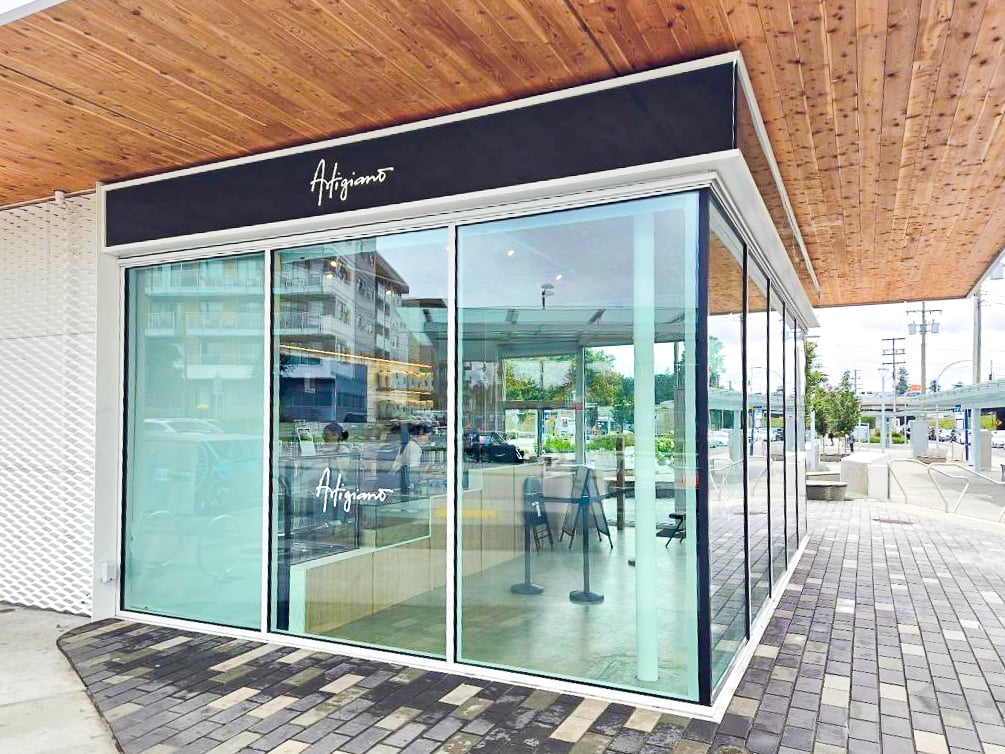
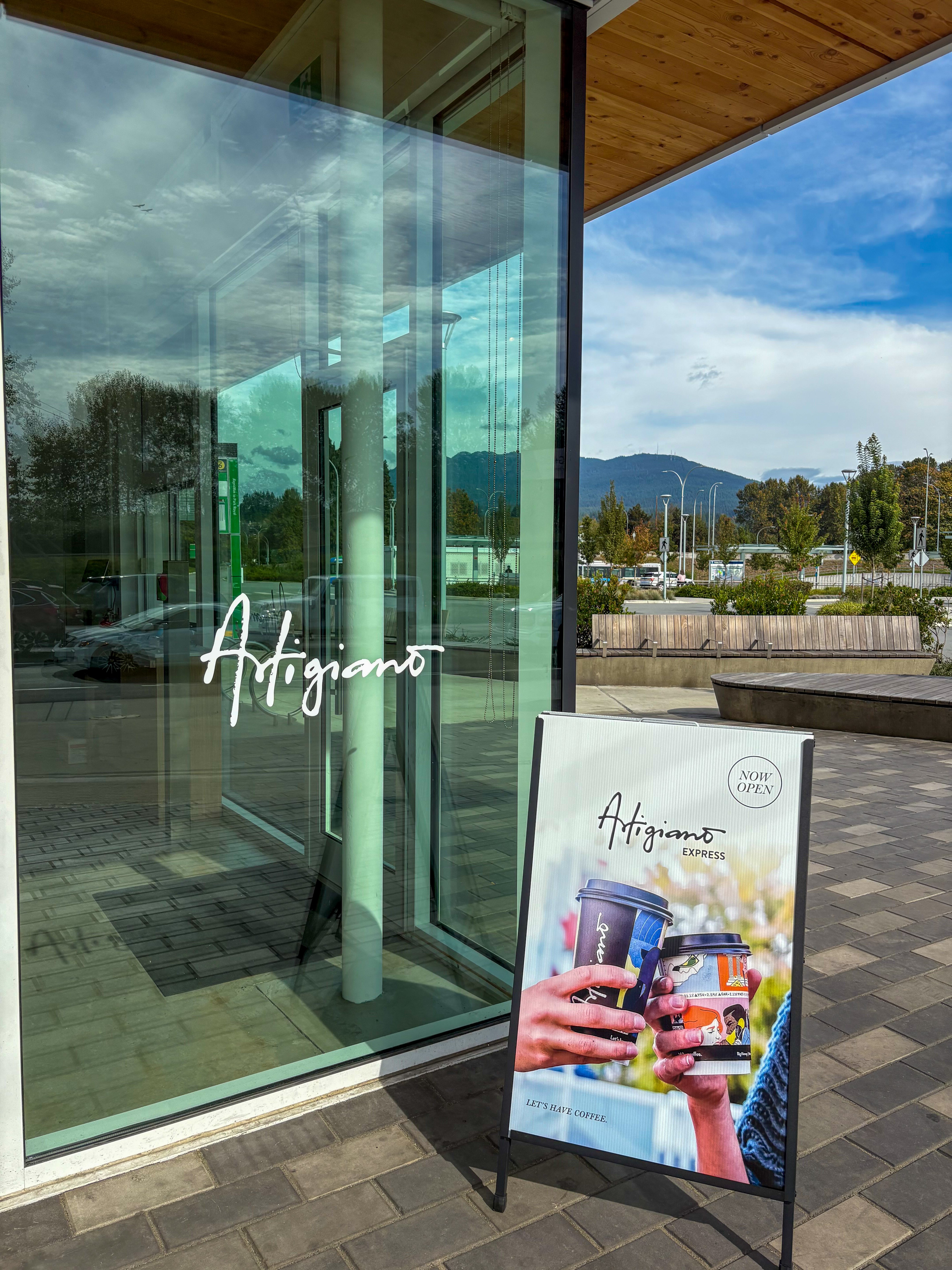
Vancouver cafe brand, Artigiano, has opened its first express location at Phibbs Exchange (1602 Main St, North Vancouver) in North Vancouver.
“Perfectly positioned in one of TransLink’s busiest transit hubs, this new Artigiano Express Cafe is designed for life on the move, offering commuters and travelers a quick, high-quality coffee and food experience before or after their bus ride,” explained the brand.
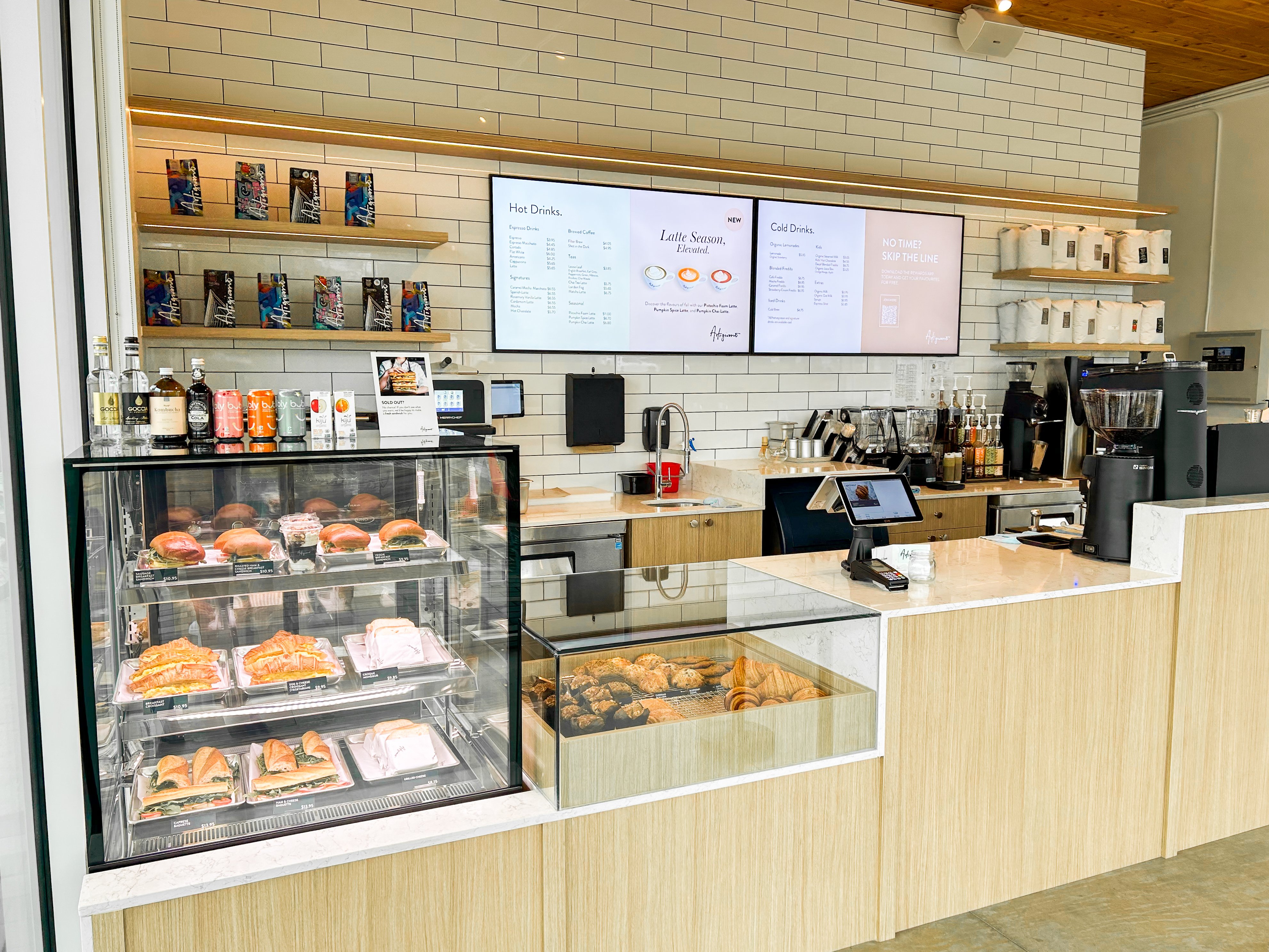
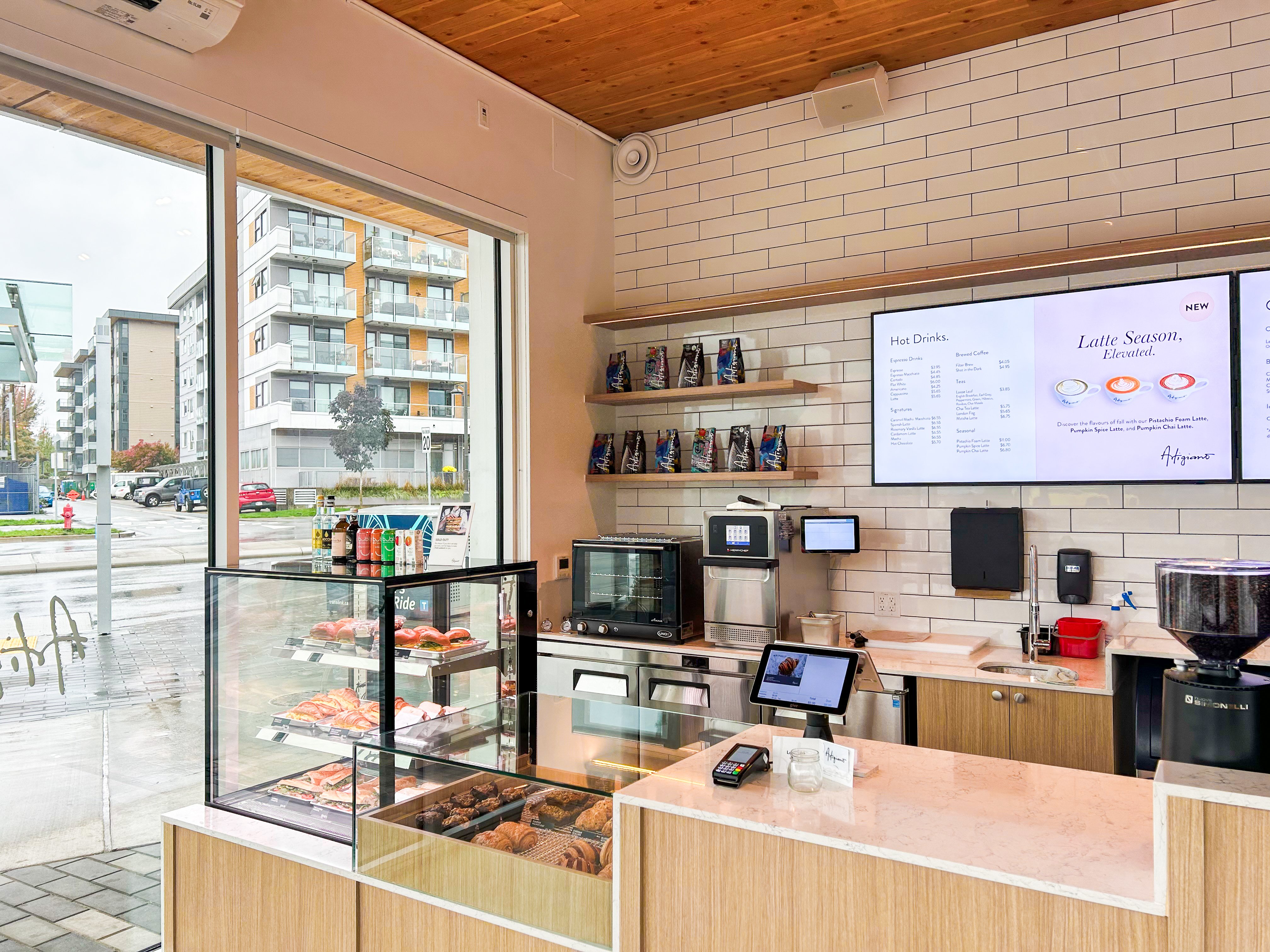
“With a streamlined menu built for speed and convenience, guests can expect Artigiano’s signature espresso beverages, fresh pastries, and handcrafted sandwiches – ready to grab, go, and enjoy. Despite its smaller footprint, the Phibbs Exchange location delivers the same dedication to quality that has defined Artigiano for over 25 years: expertly crafted drinks, fresh organic-forward, non-GMO and locally sourced ingredients, and friendly service.”
Dean Shillington
“This express concept is all about meeting our guests where they are – literally,” said Dean Shillington, President & Owner of Artigiano. “Phibbs Exchange is a bustling commuter hub, and we’re excited to offer a quick, elevated coffee and food experience for people on the go, without compromising the Artigiano quality they know and love.”
The Phibbs Exchange locations features a modern, efficient design with service tailored to peak commuter hours. Whether you’re grabbing a cappuccino before work, picking up a sandwich for your bus ride, or treating yourself to a pastry on the way home, this express cafe makes it easy to enjoy premium coffeehouse quality, fast, said the company.
“Adding to the convenience, Artigiano’s mobile app allows customers to pre-order and skip the line, making it even easier for busy commuters to enjoy their favorite beverages and snacks on the go. With just a few taps, customers can order ahead, pay seamlessly, and pick up their order when they arrive, making this express cafe experience even more efficient and tailored to modern lifestyles.”
Photo: Artigiano
Artigiano said the opening of this location underscores its ongoing growth and adaptability, bringing its European cafe-inspired approach to new formats that fit seamlessly into the daily rhythms of the community. Phibbs Exchange is Artigiano’s 22nd location.
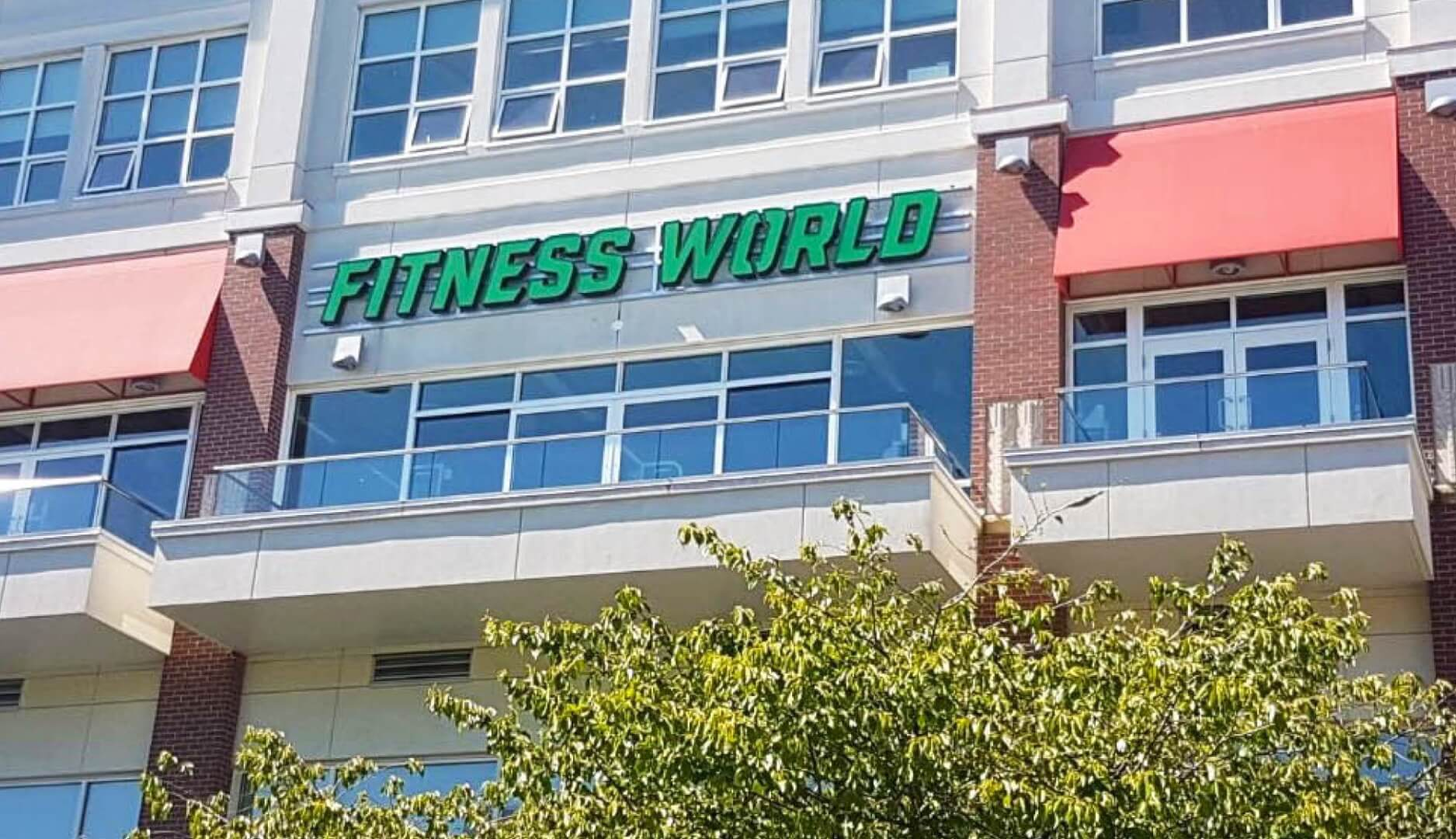
After rebuilding Fitness World from the brink of bankruptcy into one of British Columbia’s largest fitness chains, President and CEO Chris Smith is preparing for the next stage of growth: a nationwide Fitness World franchise expansion. The company, which currently operates 17 locations across the province with more than 90,000 members, is introducing a hybrid growth model that combines both franchised and corporate-owned clubs.
For Smith, who has worked in the fitness industry for nearly three decades, the franchise model represents what he calls the company’s “most significant growth frontier.” His vision balances scaling a proven concept while remaining true to Fitness World’s inclusive and community-driven mission.
Chris Smith
“We intend to offer the ability to become a franchisee while also still growing corporate stores,” Smith said. “We don’t plan on stopping corporate growth. We plan to continue with a balance of both, particularly at this stage of our incubation as a business.”
Fitness World’s current trajectory is a stark contrast to its situation just five years ago. The company was previously known as Steve Nash Fitness World and Sports Clubs, operating under a mid-tier pricing model before filing for bankruptcy during the pandemic.
Smith purchased the business out of insolvency and “right-sized” its operations to 15 clubs before gradually expanding to 17. An 18th location is now in development in British Columbia.
“It’s been an exciting time, certainly not a journey without difficulties or challenges,” Smith said. “But I think we’ve found a way. We definitely have something unique enough that it creates separation and a strong value proposition for our members.”
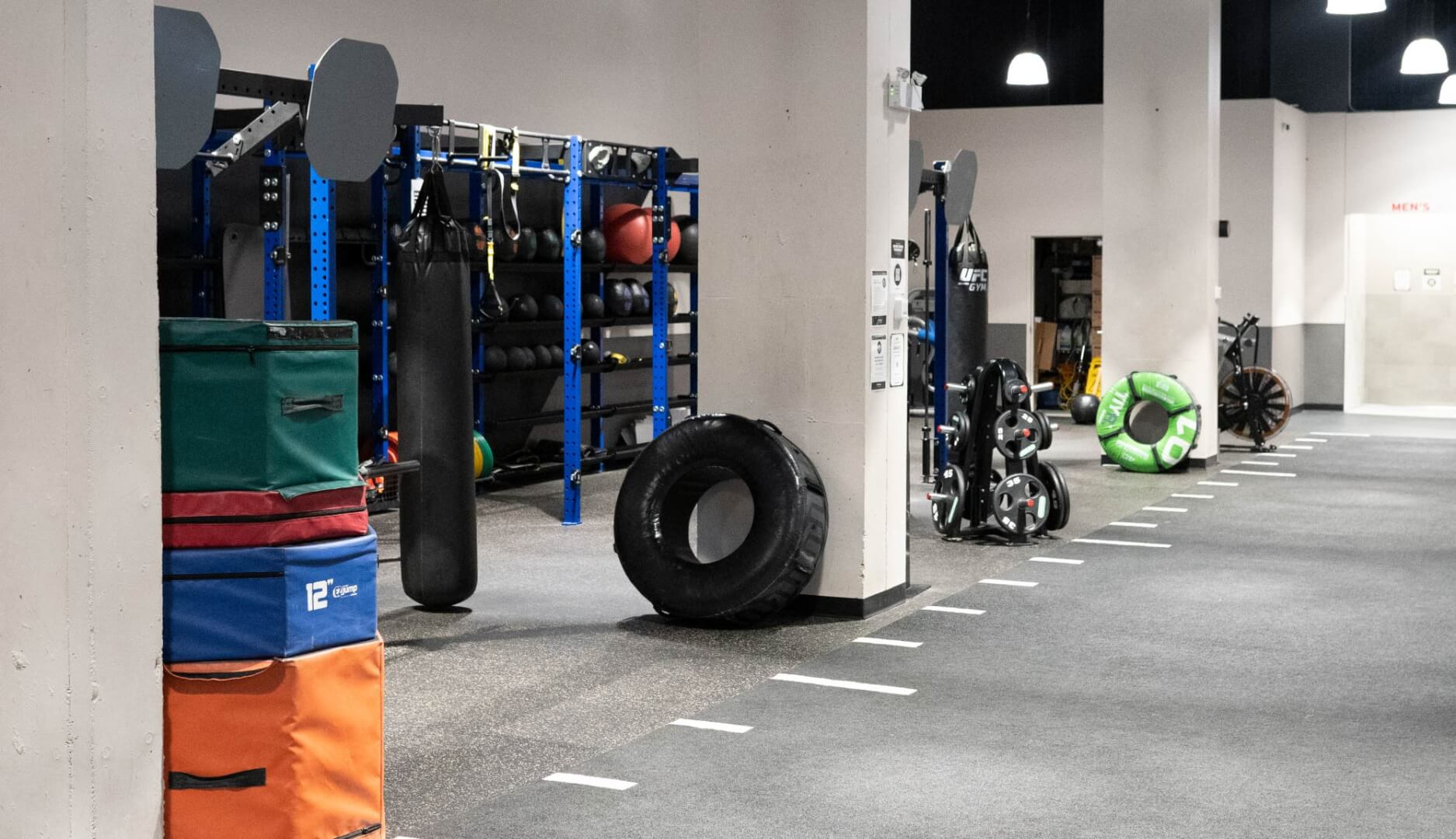
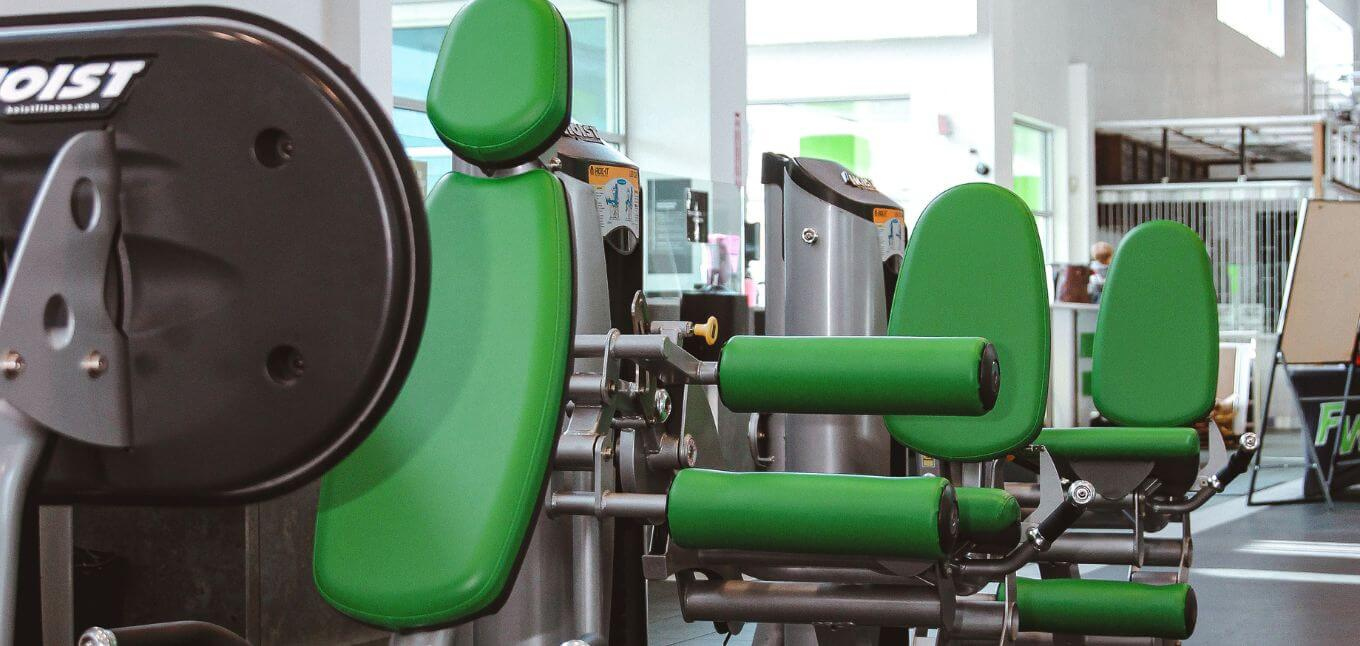
Since 2020, the company has invested close to $10 million into revitalizing its facilities, upgrading equipment, and refreshing interiors. According to Smith, nearly everything about the gyms has been transformed except the walls themselves. The changes have resonated with members, with Fitness World boasting some of the highest Google review scores in its markets.
Franchise Opportunities Across Canada and Beyond
The Fitness World franchise expansion is designed to tap into a growing fitness industry that is currently valued at $5.8 billion in Canada and growing at more than six percent annually.
Corporate growth is being focused in Ontario and Alberta, while the franchise model will allow operators to launch new clubs in both Canada and the United States. Smith confirmed that early discussions are underway in Toronto, Calgary, Edmonton, and markets across the West Coast.
“We don’t want to grow too fast, but we want to grow as sustainably as possible,” Smith said. “Our model has proven adaptable across urban and suburban markets, and we’re confident that we can replicate our success in new regions.”
The company is targeting both seasoned operators and first-time entrepreneurs, with initial franchise investments ranging from $1 million to $1.6 million. The goal is to establish a national presence while maintaining consistent standards and accessibility.
Photo: Fitness World
A Flexible Model for Different Communities
One of Fitness World’s defining features is its flexibility in adapting to the needs of local communities. The company typically operates facilities of 20,000 to 25,000 square feet, serving as anchor tenants in commercial retail centres. However, Smith said the model can adjust in size where larger footprints are not available.
“We flex our model into the communities,” Smith explained. “For example, some suburban clubs offer child-minding services because families need that support, while our urban locations may not require it. In some communities, we also offer women’s-only workout areas, whether for cultural or personal reasons. It’s about meeting members where they’re at.”
This approach has helped Fitness World serve diverse demographics, from young professionals in Vancouver to families in suburban areas. Amenities include strength and cardio equipment, hydro massage, nutritional services, group fitness classes, and recovery options such as red-light therapy and massage chairs.
Smith emphasized the importance of keeping membership prices accessible, avoiding the exclusivity of high-end gyms while offering a more robust experience than ultra-low-cost competitors. “We are very affordable,” he said. “We don’t want to be high-end because one of our core values is inclusivity. You can’t really be inclusive if your price point excludes people.”
Integrating Fitness and Healthcare
A key industry shift Smith highlighted is the growing intersection between fitness and healthcare. The rise of GLP-1 weight loss drugs has prompted greater dialogue between medical professionals and fitness operators.
“Our industry has always talked about how great it would be to tap into the medical community,” Smith said. “The introduction of these weight-loss drugs has created synergy that we’ve never seen before. It’s changing the way everyone approaches health and wellness.”
While Smith cautioned about regulatory differences between Canada and the United States, he said the integration of medical and fitness approaches could fundamentally reshape the sector. “It will end up in a better spot,” he noted. “But there are risks along the way.”
Photo: Fitness World
Younger Generations Driving Demand
Another positive development for Fitness World is the increased health focus of younger generations. Smith said Gen Z and Millennials are demonstrating stronger engagement in fitness compared to previous cohorts.
“The younger generation is prioritizing their health and wellness in a way that’s refreshing,” Smith said. “It could have a significant impact on the future of the industry.”
Statistics from the Fitness Industry Council of Canada, where Smith serves on the board, show that every $1 invested in wellness initiatives saves $4 in healthcare costs. “Imagine if we could double the number of Canadians living healthier lifestyles,” Smith added. “It would not only improve quality of life but also free up resources for other critical social programs.”
A Community-Centred Approach
Fitness World has sought to differentiate itself through community engagement. Initiatives have included free fitness programs for seniors, partnerships with youth organizations, and wellness programs for vulnerable populations such as those experiencing homelessness.
In 2025, the chain became the official fitness partner of RUNVAN, further cementing its role as a supporter of local health and wellness initiatives.
“We want to be more than just gyms,” Smith said. “We want to create a movement that makes health accessible for everyone, regardless of age, income, or background.”
Photo: Fitness World
Technology and Marketing Innovations
Behind the scenes, Fitness World has modernized its operations with new technology partnerships. In 2024, the company partnered with ABC Fitness to implement advanced member management platforms, digital engagement tools, and data-driven personalization. The result has been stronger online sales, which now represent a third of the company’s revenue.
“We’ve nearly tripled monthly sales since 2020 through digital marketing and online sales channels,” Smith noted. “Technology has been a critical part of our turnaround and growth.”
Looking Ahead: Expansion and Real Estate Strategy
The next stage of the Fitness World franchise expansion will hinge on securing the right real estate opportunities. Smith confirmed he will be meeting with brokers at the ICSC conference in Toronto, scouting potential sites.
“I’ll be looking at available real estate and making some strategic decisions in the coming months,” he said. “It’s easier said than done, but we’re committed to finding the right locations for long-term success.”
While a soft launch of the franchise program is planned for Canada in 2025, the company is preparing for a “hard launch” at major trade shows in Las Vegas later in the year, including the International Franchise Expo.
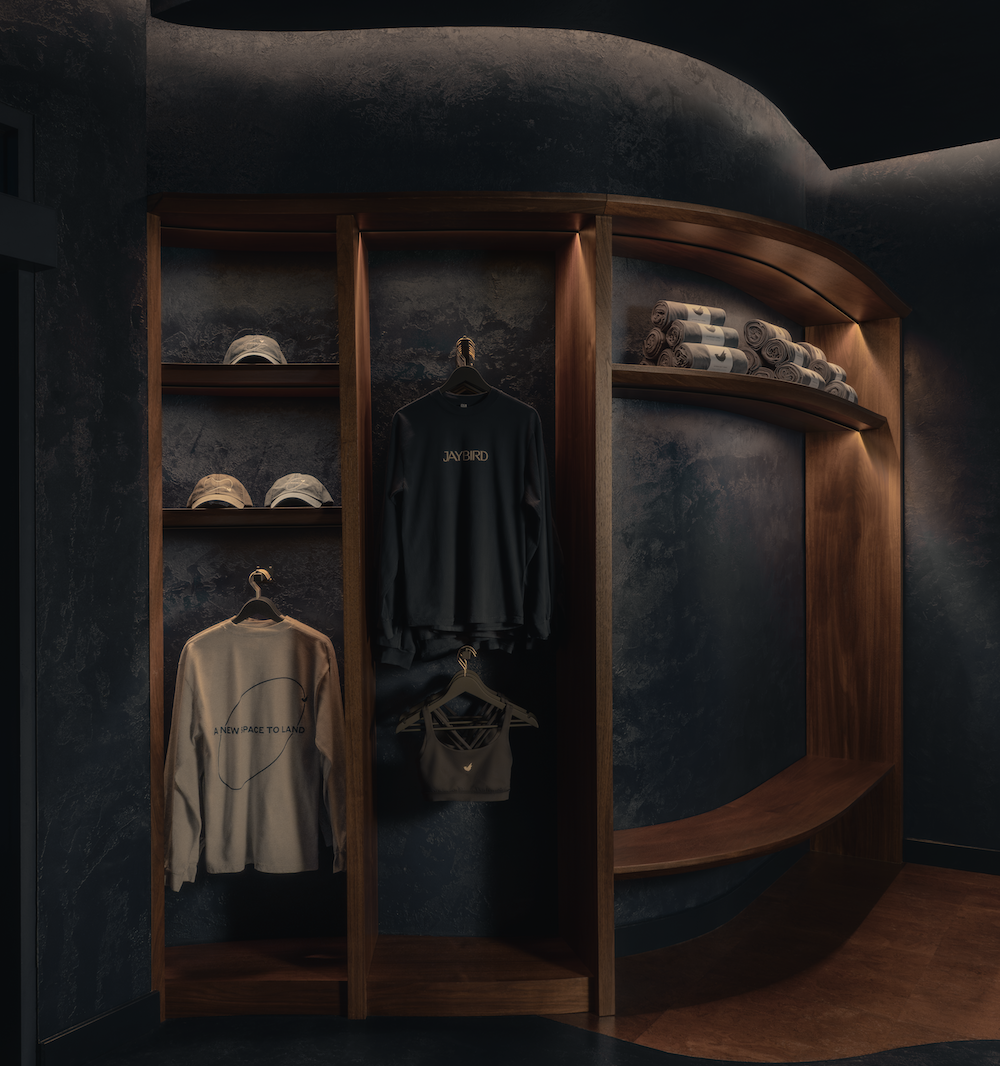
New Jaybird studio on Kingsway in Vancouver. Photo: Conrad Brown
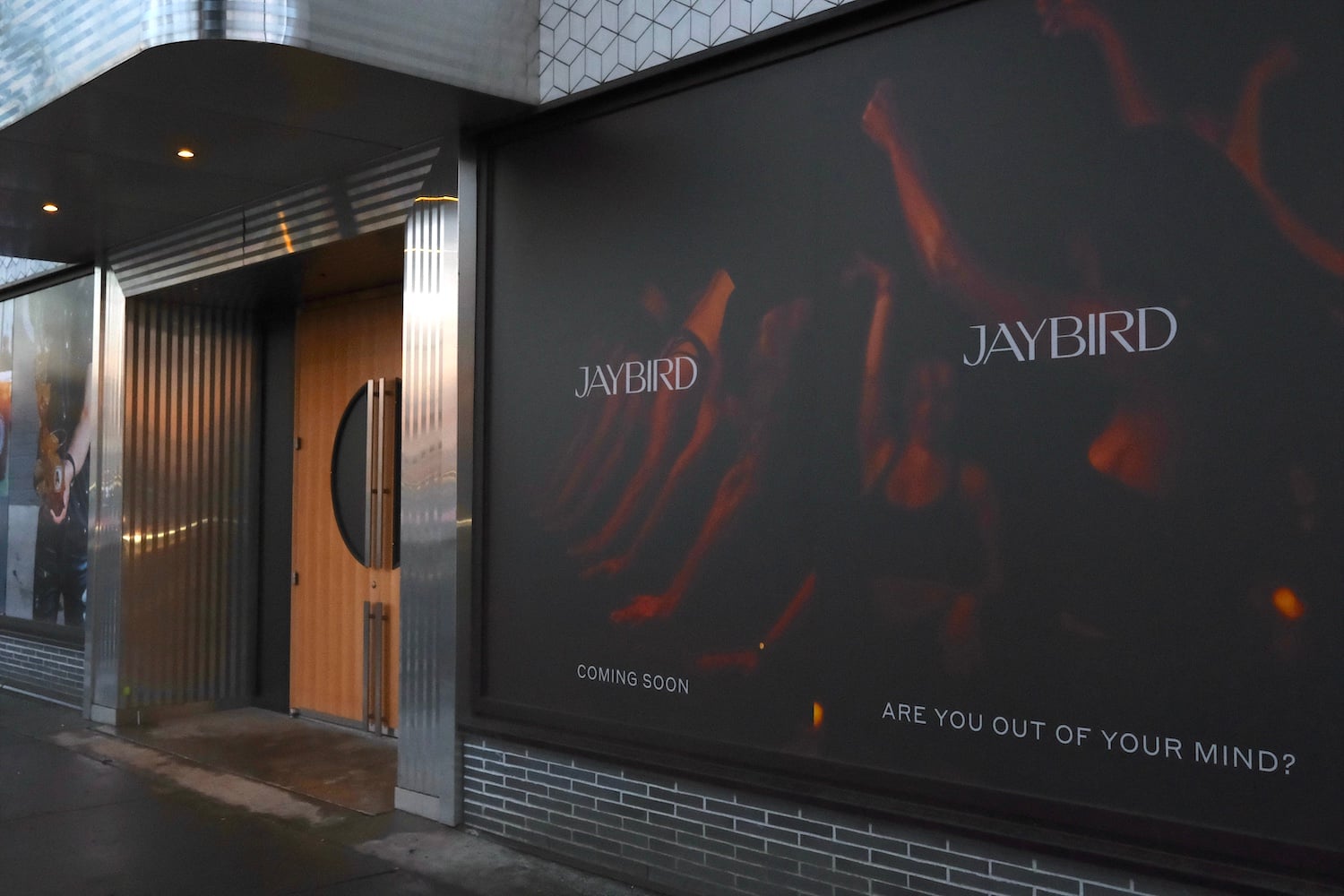
Canadian-founded Jaybird Studio is continuing its ambitious growth strategy, recently opening a second location in Vancouver’s Kingsway neighbourhood while laying the groundwork for further expansion in Toronto and New York City. The contemporary movement brand, which blends Pilates, yoga, and mindfulness in a sensory-rich environment, is positioning itself as a leader in the evolving wellness and fitness market.
Founded in 2019 by Ariel Swan and Barbie Bent, Jaybird Studio has built a reputation for its distinctive approach to movement and mindfulness. Its spaces are intentionally designed to be immersive, removing distractions such as mirrors and phones to encourage participants to focus inward. With candlelit rooms, curated playlists, and infrared heat, the concept is as much about mental restoration as it is about physical strength.
Ariel Swan
“We really believe in Jaybird,” said Swan in an interview with Retail Insider. “Where we are seeing the fitness world going is towards more mindfulness. Jaybird lives at the intersection between mindfulness and movement, and it gives you that time out from the busyness of your life to turn your attention inward.”
Expanding in Vancouver: Yaletown to Kingsway
The Kingsway opening marks a milestone for Jaybird Studio in Vancouver, where the company began with its flagship Yaletown location in 2019. That studio, Swan explained, was “our baby,” surviving through the challenges of COVID-19 and building a loyal base of clients who craved more space and more class offerings.
The new 6,000-square-foot Kingsway studio, which opened in June, represents Jaybird’s first dual-concept location in the city, featuring both mat-based and Reformer Pilates. Swan described the opportunity as “a dream come true,” noting that the Art Deco building fit perfectly with their vision for an elevated, community-driven space.
“When this building came up, it was exactly what we wanted,” she said. “It’s such a cool building and the neighbourhood is vibrant, with places like Osteria Savio Volpe and Analog Coffee nearby. People are so excited to have something new in that area.”
The Kingsway studio underscores Jaybird’s strategy of selecting neighbourhoods on the rise. “We’re really interested in density,” Swan explained. “Kingsway is a great example. We see it as an area that is growing, with high-rises going up and a lot of people moving there. We want to be at the forefront of that growth.”
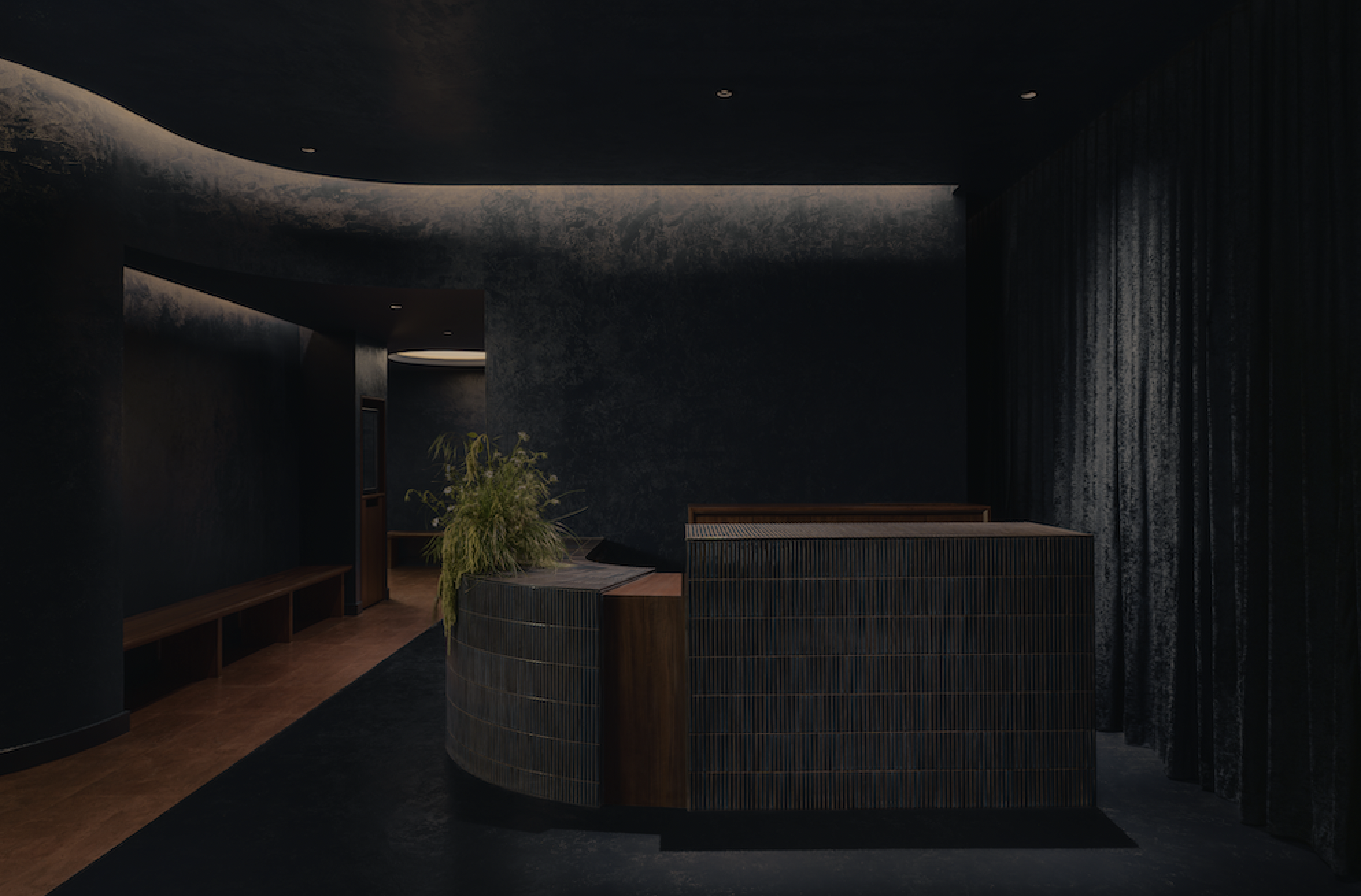
Jaybird Studio, Kingsway Vancouver. Photo: Conrad Brown
Toronto growth: Queen West and Yorkville
Toronto has become a crucial market for Jaybird Studio. The brand took what Swan called its “biggest risk” by opening on Queen West shortly after the pandemic. The studio’s sensory-driven model required specific infrastructure and sound isolation, which narrowed the pool of viable real estate.
“Our realtor calls them unicorn locations,” Swan noted. “We need an infrared heated room, we play music loud, and we can’t have neighbours right next to us. When you find these spaces, you kind of just have to jump.”
The risk paid off, with Jaybird establishing a strong Toronto following and later expanding to Yorkville. The Yorkville site, which opened on the lower level of 110 Bloor Street W. in December 2023, furthered the company’s design ethos, offering a dual-concept layout with both mat and Reformer Pilates. Looking ahead, Jaybird is planning a midtown Toronto location in Lawrence Park, expected to open in 2026.
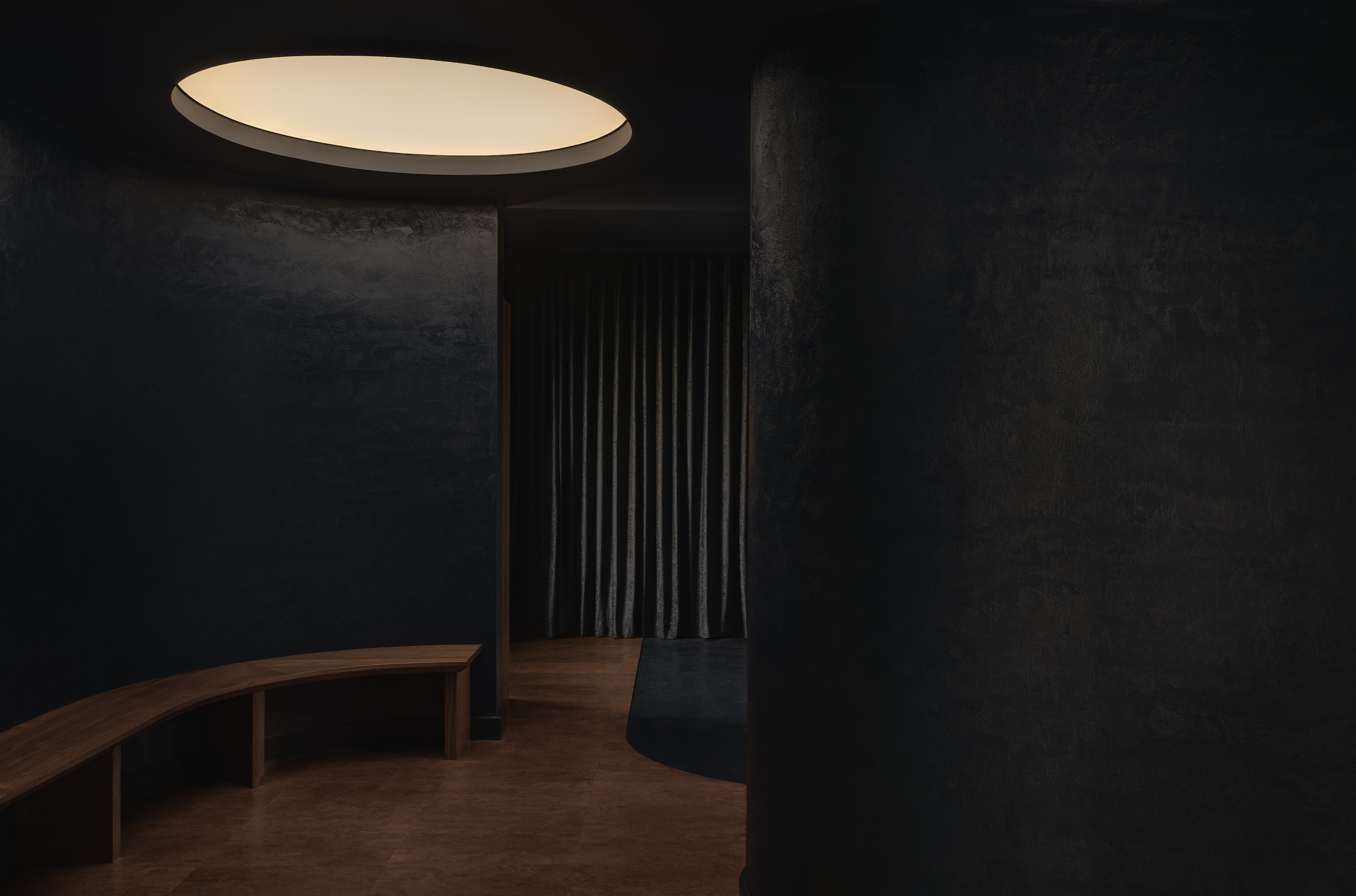
Jaybird Studio, Kingsway Vancouver. Photo: Conrad Brown
Looking beyond Canada: New York City
Perhaps the most significant step for Jaybird Studio is its planned expansion to the United States, with a first New York City location targeted for 2026 in the Flatiron district. Swan and Bent envision three to five studios in Manhattan as part of their long-term strategy.
“What we found is it’s a lot easier to have more locations in one city,” Swan explained. “When we only had one in Vancouver and one in Toronto, it was actually harder to manage. The more locations you can have in a denser area, the easier it is to operate.”
She added that the model also supports employee growth. “It’s amazing for staff. You can offer teachers and managers more opportunities when you’re concentrated in one city. That’s why New York is so exciting for us. It’s busy, it’s vibrant, and it needs these kinds of time-out spaces.”
Jaybird Studio, Kingsway Vancouver. Photo: Conrad Brown
The Jaybird philosophy: mindfulness through design
A core part of Jaybird’s identity lies in its design-forward approach. The studios are carefully curated to create a sense of immersion and separation from daily life. For its first Vancouver location, Jaybird partnered with local design firm St. Marie Studio, while its Toronto and Kingsway studios were created in collaboration with Futurestudio, a Toronto-based firm.
“We wanted to create spaces that didn’t feel like just another fitness studio,” said Swan. “Everything is very immersive. We went for a monochromatic look with strong colour stories, and when you walk in, you feel transported. Beauty in a space can ground you and energize you at the same time.”
The choice to remove mirrors is particularly important to the Jaybird experience. By stripping away visual comparison, participants are encouraged to focus inward, responding to their bodies rather than external appearance.
Swan describes Jaybird as a place that allows for “time out from the busyness of your life.” She added: “The room is dark, it’s candlelit, there are no distractions, no phones, no mirrors. You really have this time to come back to your breath and your body.”
Jaybird Studio, Kingsway Vancouver. Photo: Conrad Brown
Navigating demographics and community needs
While some fitness studios focus on narrow demographic groups, Jaybird has cultivated a broad base of clients. “Because we offer so many different styles of classes, we’re open to a wider demographic,” said Swan.
Reformer Pilates tends to attract a younger audience, often in their twenties and thirties, while mat classes appeal to a slightly older group. Sound baths, breath work, and stretching classes extend Jaybird’s reach to older demographics, including clients in their sixties and seventies.
“My mom is our biggest fan,” Swan shared. “She comes three times a week for stretching, and it’s completely changed her life. Her back doesn’t hurt anymore. It shows how Jaybird can meet people where they are, no matter their age.”
This breadth reflects the company’s philosophy of inclusivity. “We really want Jaybird to be that place where mindfulness feels accessible,” Swan said. “Even two minutes of relaxation and breathing can change the trajectory of your day.”
Expansion challenges and opportunities in a changing retail landscape
Jaybird’s expansion comes at a time when fitness and wellness are evolving. Inflation, real estate pressures, and shifting urban dynamics present challenges. Yet, Swan remains optimistic about the role Jaybird can play in communities.
“We’re grateful people continue to show up for themselves,” she said. “To build new communities and have people come in and say, ‘This is changing my life’ makes all the hard work worthwhile.”
Urban density, shifting zoning policies, and revitalized neighbourhoods all factor into the brand’s site selection process. Vancouver’s Kingsway, Toronto’s Lawrence Park, and New York’s Flatiron each illustrate how Jaybird is targeting growth corridors where its model of mindful fitness can thrive.
The brand’s growth trajectory is deliberate, balancing opportunity with operational feasibility. Rather than scattering single studios across multiple cities, Jaybird focuses on building clusters of locations within dense urban cores. This approach not only makes management easier but also reinforces brand awareness.
“Having multiple studios in one city allows us to strengthen community and provide continuity for clients,” Swan explained. “It’s about building something sustainable.”
Urban Barn at Queen & Spadina (Image: Dustin Fuhs)
Urban Barn, the 100% Canadian-owned and operated furniture and décor retailer with 54 stores nationwide, has launched the 2025 edition of its annual charitable initiative, Blanket the Country.
Since 2012, the program has provided over 70,000 blankets and nearly $90,000 in financial support to charities across Canada. This year, Blanket the Country has been reimagined to deliver even greater local impact by directly pairing each Urban Barn store with a non-profit organization in its community. From food banks and shelters to counselling, essential services and more, Urban Barn’s partnership with 37 different local non-profit organizations ensures support reaches neighbours where it’s needed most, said the retailer.
Through to October 31, customers can make a suggested $5 donation at checkout, in-store or online. Urban Barn will match every contribution, doubling the impact and ensuring support stays close to home. Donors will receive a thank-you offer of 20% off regularly priced décor with a minimum $100 purchase (valid November 1–23). While October is Urban Barn’s month of giving, the campaign continues year-round with customers invited to contribute $2 or more from November 1, 2025 through September 30, 2026, explained the retailer.
“Blanket the Country is fundamentally about compassion in action,” said Linda Letts, President of Urban Barn. “By supporting the efforts of our non-profit partners and keeping donations rooted in local communities, every act of generosity helps provide immediate and meaningful support. Together with our customers through the “Blanket the Country” initiative, we’re helping to ensure that those facing hardship have access to the assistance they need while feeling seen, valued and cared for.”
And the need is urgent. Today in Canada, 1 in 7 people experience food insecurity and shelters are operating near or at capacity.
Jacqueline Dupuis
“Youth leaving government care are far more likely to experience homelessness, which is why stable housing is so critical,” said Jacqueline Dupuis, Executive Director,Aunt Leah’s Properties. “With the support of Urban Barn and its customers, young people will be able to access safe, secure homes that provide a foundation upon which to build lasting stability. Every contribution helps ensure that youth and families have an opportunity to thrive.”
Urban Barn curates furniture and décor designed for “real life.” Founded in Vancouver in 1990, the 100% Canadian-owned company now operates 54 stores from coast to coast.
“At a time when affordability is top of mind for Canadians, the campaign aims to reinforce Walmart Canada’s commitment to helping Canadians save money and live better with low prices on thousands of products in-store and online, every day – not just during sales moments. At Walmart, customers don’t have to wait for a sale – Everyday Low Prices (EDLP) mean customers can count on low prices every day,” said the retailer.
Walmart recently revealed that with everyday low prices a Canadian family of four can save, on average, more than $450 per year when they do their weekly shop at Walmart as compared to any other major grocery store. This is the equivalent of more than two weeks of groceries, it noted.
Social & creators: National Meta and TikTok ads (EN/FR) deliver video and image assets highlighting affordability. Walmart Canada also partnered with comedian Debra DiGiovanni on a five-part “Guess the Basket Price” series to bring humour and cultural relevance to the value message.
Sports integration: Blue Jays lower third spots (was live until Sept. 28) highlighted Walmart’s promise: “This is not a sale. It’s everyday low prices.”
Digital & content: Dynamic catalogue ads, Walmart.ca and app banners, and a BuzzFeed partnership (Tasty videos, BuzzCut shorts, shoppable units, and takeovers) keep Walmart’s value promise front and centre online.
Customer touchpoints: CRM pushes including emails and notifications, national flyers, and in-store signage (EN/FR) reinforce Walmart’s everyday savings.
Local amplification: Through My Local Social, store associates share authentic, community-driven EDLP content across Meta and TikTok.
Radio: EDLP spots (EN/FR) extend campaign reach across broadcast and streaming audio.
To bring this campaign to life, Walmart Canada said it partnered with Cossette for overall “This is not a sale” creative across TV, Social, and OLV. Apex PR supported the “In the Streets EDLP Challenge” activation with comedian Debra DiGiovanni.
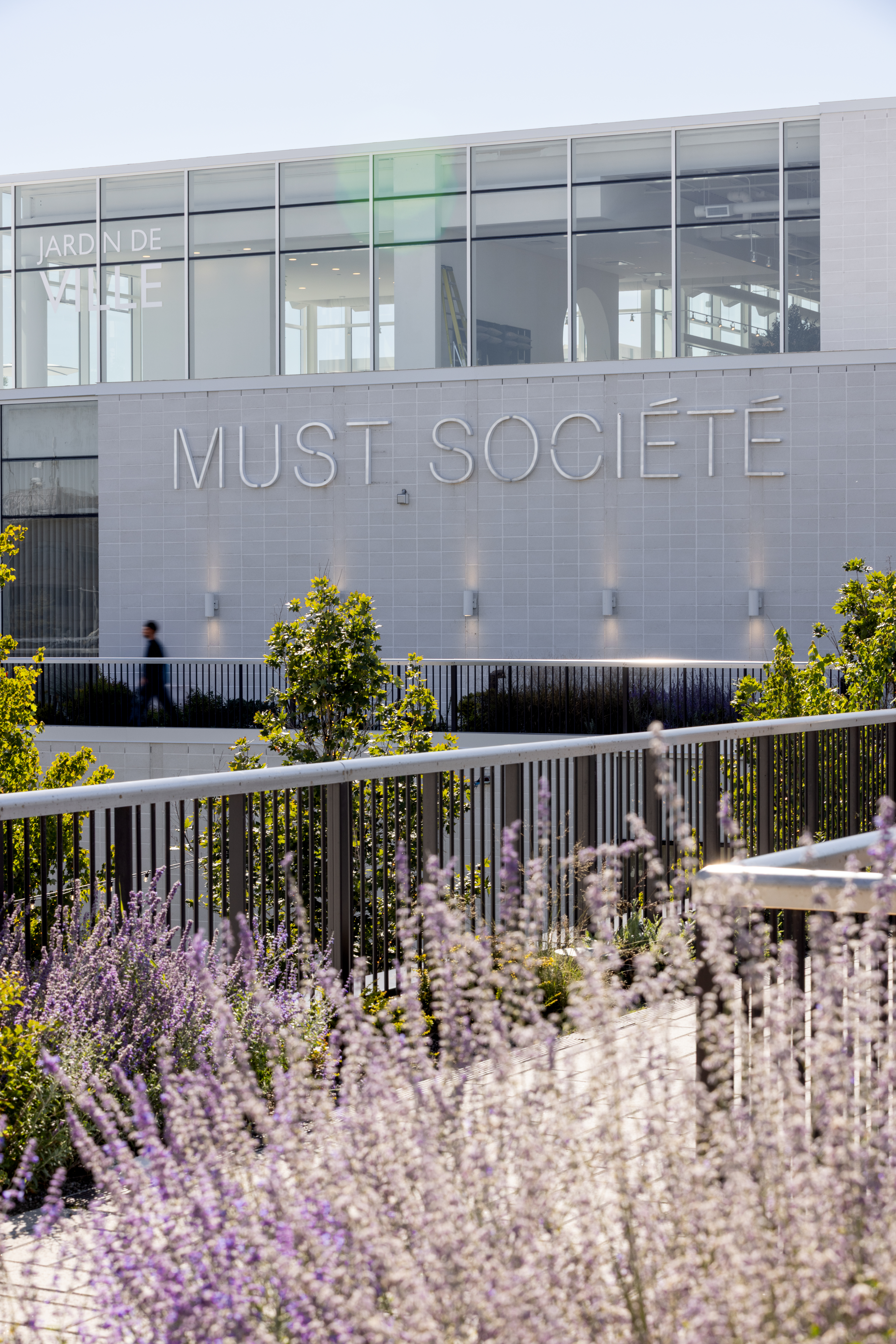
Groupe Must Société (formerly known as Groupe Home Société) has announced a major rebranding initiative: its Home Société stores, originally branded as a grouping of furniture brands Maison Corbeil, MUST, Jardin de Ville and La Galerie du Meuble, will now be named MUST SOCIÉTÉ.
This strategic change unifies the company’s physical retail presence under its most recognized and fastest-growing brand, aligning the in-store experience with the successful consolidated e-commerce platform, mustsociete.com, launched earlier this year. The name change will immediately affect nine stores, including locations in Toronto, Mississauga, Ottawa, Montreal, and Laval, said the retailer.
Walid Laraaba
“This rebranding is a pivotal step in our growth strategy,” said Walid Laaraba, President of Groupe Must Société. “The goal is to unify our brands under one banner to clarify our customer positioning and significantly strengthen awareness of our store concept. By consolidating under MUST SOCIÉTÉ, we are creating a more cohesive and powerful identity that resonates with our clients and streamlines their shopping experience, both online and in-store.”
The company said the decision to rebrand under the MUST SOCIÉTÉ name was a natural evolution for the company. The launch of mustsociete.com in 2025, which brought all five of the group’s banners into a single online marketplace, was met with overwhelmingly positive customer adoption and crystallized the move towards a unified identity.
Photo: Groupe Must Société
“A key benefit for customers is the enhanced product offering. All MUST SOCIÉTÉ locations will now feature premium and iconic European and Canadian brands, many of which were previously exclusive to select stores like Maison Corbeil. This creates a true one-stop-shop destination from medium to high-end home furnishings including Four Hands, Kartell, Ligne Roset and more,” it said.
This rebranding, said the retailer, is part of a larger strategic investment in growth and customer experience. The company’s future plans include:
New Consolidated Head Office: In October 2025, Groupe Must Société will officially inaugurate its first-ever consolidated head office in Laval.
New Outlet Concept: The current Mirabel store and warehouse will be transformed into a MUST SOCIÉTÉ outlet, offering products from all the group’s brands.
The transition will be visible with new signage rolling out across Toronto and Montreal locations in early October. The full rebranding of all designated stores is expected to be complete by early 2026, it added.
Photo: Groupe Must Société
Groupe Must Société is a leader in mid to high-end interior and exterior furnishings with16 existing stores across Quebec and Ontario. The company’s portfolio includesMaison Corbeil, MUST, Jardin de Ville, Prune Les Fleurs, and La Galerie du Meuble. Group Home Société is committed to offering a seamless blend of style, quality, and functionality.