A national survey commissioned by HelloFresh suggests that home-cooked meals made with fresh ingredients can play a role in improving mood and energy during the winter months.
The research, conducted by The Harris Poll Canada, found that 66 per cent of Canadians say eating more home-cooked meals with fresh ingredients significantly improves mood and energy. It also found that 60 per cent say they experience the winter blues, pointing to what the company describes as a demand for practical, everyday approaches to wellness during winter.
Research points to food and mood connection
The findings form the basis of HelloFresh’s Blue Monday activities and broader messaging around food and well-being. The company says the research shows that small, consistent choices around meals can be more realistic for many people than major lifestyle changes during winter.
According to the survey, 35 per cent of Canadians say they skip or delay a meal at least once a week because they cannot face cooking or deciding what to eat. The research describes this pattern as “Fridge Fatigue,” linking low energy, decision overload, and poorly stocked or disorganized fridges to reduced motivation to cook.
HelloFresh says the findings underscore the importance of accessible meal solutions that reduce decision-making and preparation effort, particularly during periods when energy levels are low.
Photo: HelloFresh
Blue Monday pop-up planned at Union Station
To mark Blue Monday, HelloFresh plans to host a walk-through pop-up installation at Toronto’s Union Station. The event is scheduled for Jan. 19, 2026, from 4 p.m. to 8 p.m. EST.
The installation will be centred on what the company calls a “Feel-Good Fridge,” intended to highlight the idea that keeping a fridge stocked with ready-to-cook meals made from specific ingredients can help support mood and energy. The pop-up is designed as a commuter-facing activation during the evening rush.
Attendees will be offered a free HelloFresh meal kit to take home. The kits will feature chef-designed meals described as simple and comforting, built around fresh ingredients. Dishes include a fattoush-inspired salad with vegetables, salmon with gremolata butter served with broccoli, and a Moroccan-style chicken bowl designed to be prepared in about 15 minutes.
Company frames meal kits as practical support
HelloFresh says its approach is based on the idea that food is one of the most immediate and practical tools available to people during winter, particularly when motivation is low.
“Food is one of the most practical ways to support yourself in winter because it’s something you can do today, even when motivation is low,” said James Griesser, head recipe developer at HelloFresh. “Fresh ingredients, simple routines, and meals built around foods like omega-3-rich fish, leafy greens, and lean proteins can help support mood and energy. Using a meal kit can also take some of the thinking out of dinner, which makes it easier to follow through when you’re tired.”
The company says meal kits with pre-portioned ingredients and step-by-step recipe cards are intended to reduce barriers associated with planning and decision-making, which the survey suggests can contribute to skipped meals during winter.
Photo: HelloFresh
Wellness goals shape consumer intentions
The survey also examined Canadians’ intentions around food and well-being. It found that 70 per cent of respondents say supporting mental or emotional well-being through better eating habits is a goal this year, with interest strongest among adults under 55.
HelloFresh says those findings indicate that many Canadians are looking to integrate food into broader self-care routines, particularly during winter evenings when energy and motivation may be lower.
The company positions its winter offerings as aligned with those stated goals, emphasizing meals that are designed to be quick to prepare while using fresh ingredients.
Company background
HelloFresh Canada was founded in February 2016. The company delivers meal kits with pre-portioned ingredients and recipe cards to customers across Canada. It offers several box options, including Quick and Easy, Family Friendly, and Veggie plans, and sources ingredients locally where possible.
The Blue Monday activation and survey findings are part of HelloFresh’s efforts to connect its meal kit service to seasonal consumer challenges identified in its research.
New data from ecommerce marketing company Omnisend shows that order returns in the post-Christmas week in Canada jump 39% above the average week. The surge isn’t evenly distributed: it’s concentrated in high-gifting categories where fit, specs, and personal preferences are easiest to miss.
Biggest Post-Christmas Return Spikes by Category
Biggest post-Christmas return spikes by category (vs. average week in 2025):
Marty Bauer, ecommerce expert at Omnisend, said: “Gifting clothes is always a gamble. Even when shoppers know someone well, fit, cut, and comfort are hard to predict, which naturally leads to exchanges after the holidays. “The same goes for beauty and fitness, where shade and skin compatibility matter just as much as brand loyalty to familiar, go-to makeup brands.”
“Pet products often come down to fit and preference (think harness sizing, dietary restrictions, age appropriateness, or duplicates), whereas games are usually returned due to duplicates or platform compatibility in the case of video games.”
Turning Returns Into a Customer Loyalty Opportunity
“Although returns can be logistically problematic for retailers, they can also present an opportunity to strengthen relationships with customers. Brands that make returns painless and steer shoppers toward exchanges can turn the busiest return week of the year into long-term loyalty.”
Apparel Remains the Highest-Risk Category
Bauer said apparel always has high return rates due to several factors, such as bracketing, improper sizing, in-style trends, and quality.
“While many of these things remain true year-round, the holidays add personal preference to the list. Apparel is a common gift, but too often recipients don’t like the item or suffer from one of the other issues, such as improper sizing,” he said.
Why Games Are Frequently Returned
“With games, we don’t really know 100%. It may be a combination of several things, the first being whether recipients actually want the game. It’s not uncommon for someone outside of the immediate household to purchase a game that does not align with the recipients’ interests. Second, video and board games are often duplicated, requiring recipients to return the item. Third, it may be a matter of receiving the wrong product. They may want controller X but receive controller Z instead.”
Value-Conscious Consumers Are Driving Higher Returns
Bauer said returns, especially post-holiday, are not a new phenomenon.
“The increase we see this year may have more to do with the fact that people are being more diligent about their wants and needs as they prepare for belt-tightening in the new year. Maybe in years past someone may have kept or regifted the unwanted sweater, but they are less willing to lose the value of that gift, instead choosing to return the item for something they want or need,” he said.
The Rising Cost of Returns for Retailers
“The added cost of original and return postage (especially for cross-border shipments), warehousing, logistics, and personnel all add up and affect the bottom line. Many items are not resellable once returned, meaning it can add even further costs to dispose of those products.”
Photo: Gustavo Fring
How Retailers Are Using Data and AI to Reduce Returns
Bauer said for years retailers have been using data or AI tools more effectively to reduce preventable returns in high-risk categories such as apparel and beauty and continue to improve upon their capabilities, recognizing returns will always be present.
“It’s a part of retail. The tools retailers are using include more accurate size charts, consistent measurement guidelines from their manufacturers, model descriptions in the product details, 3D product images, and virtual try-ons, to name a few,” he said.
“The goal with these features is to consistently reduce return rates, not eliminate them.”
Looking Ahead to the 2026 Holiday Season
Looking ahead to the 2026 holiday season, what practical steps should Canadian retailers take now to balance generous return policies with profitability and sustainability?
“One option is to offer a small discount in exchange for the consumer waiving their free return option. Another is to charge a slight restocking fee for returns, although this is increasingly turning off shoppers from stores, so tread carefully,” explained Bauer.
“Brands should also implement post-purchase emails to customers, not to sell products, but to earnestly ask how their order was. This provides an opportunity for customer service to head off potential issues before they result in returns. Of course, work on making product detail pages as accurate and helpful as possible. This is one area where AI can analyze return patterns based on factors such as sizing, which can inform the type of data to include on product pages.”
Toronto-founded beauty brand HBFace is positioning its business around a founder-led philosophy of “Resilient Beauty” on Blue Monday (January 19), linking its operations and brand identity to mental health awareness and daily self-care routines.
The company, founded by CEO Haley Bogaert, traces its origins to personal loss and grief, which it says shaped both its product focus and service model. HBFace describes its approach as prioritizing simplified beauty routines and expert brow services intended to support confidence and consistency for customers, particularly during difficult periods.
Founder-led origins shape brand strategy
HBFace says the brand was created after Haley lost both her mother and brother to mental health and addiction within a six-month period. Following those losses, she developed a daily makeup routine that she describes as a source of structure and stability rather than escapism.
The company states that this routine became the foundation of Resilient Beauty, a philosophy it defines as the belief that beauty does not need to be complex to be effective. HBFace reports that this philosophy guides its business decisions and service offerings.
According to the company, HBFace centres its operations on expert brow services, streamlined makeup and simplified routines. The brand says these offerings are designed to help clients feel confident and supported, with an emphasis on accessibility and ease of use.
HBFace describes its business as intentionally avoiding trend-driven complexity, instead focusing on consistency and practicality. The company says this approach reflects its view that resilience is built through repeatable, everyday practices.
Source: HBFace
Mental health alignment and growth
HBFace says it currently supports the Centre for Addiction and Mental Health (CAMH), aligning its brand mission with mental health awareness and care. The company describes this support as part of its broader commitment to integrating purpose into its business model.
The brand says it continues to grow while maintaining a focus on simplicity and accessibility. It characterizes its growth strategy as remaining grounded in its founding values rather than expanding into more complex or trend-focused offerings.
Timing tied to Blue Monday
The company frames beauty routines as grounding rituals and describes resilience as a daily practice rather than an abstract concept.
HBFace says its perspective is rooted in lived experience and founder leadership, rather than trends, and that this approach continues to inform how the business operates and communicates with its customers.
“Experiencing loss at a young age fundamentally changed the way I view beauty. When you lose people you love, you quickly realize that perfection is irrelevant. What matters is how something makes you feel. Beauty stopped being about transformation for me and became about grounding, routine, and self-connection,” said Bogaert.
“That perspective is woven into HBFace at every level. We do not chase extremes or unrealistic standards. Our services and products are designed to be consistent, approachable, and comforting. Internally, we operate with the same philosophy. We prioritize humanity, flexibility, and mental health for our team, because beauty should never come at the expense of well-being.”
Source: HBFace
Creating beauty that lasts emotionally and functionally
Bogaert said Resilient Beauty means creating things that support people on both good days and hard ones.
“It is beauty that holds you steady rather than asking you to perform. In practice, that means thoughtful formulations, neutral and wearable tones, and services that feel calm and intentional rather than rushed or overcomplicated,” she said.
“When we design a product or experience, we ask whether it will make someone feel more like themselves and whether it will simplify their day. If the answer is no, we do not move forward. Trends come and go, but emotional needs do not. Our goal is to create beauty that lasts emotionally and functionally.”
Making simplicity feel luxurious
Bogaert said simplicity was both a personal and strategic decision. During periods of grief and burnout, even small routines can feel overwhelming.
“I wanted HBFace to remove friction rather than add to it. A streamlined routine allows people to show up for themselves without pressure or excess,” she said.
“Our customers deeply resonate with this approach. They tell us they trust HBFace because we do not try to sell them everything, only what works. In a world of constant noise, simplicity feels luxurious. It builds trust, consistency, and long-term loyalty.”
Bogaert said its partnership with CAMH is not a marketing initiative. It is a responsibility.
“We ensure it remains meaningful by letting it influence how we operate, not just how we communicate. That includes how we train our teams, how we talk about mental health internally, and how we design customer experiences that feel safe and supportive,” she said.
“We are intentional about staying educated, listening, and evolving. Mental health is not a campaign. It is an ongoing commitment. If a partnership does not change behaviour, it does not matter.
Source: HBFace
“The beauty industry often treats mental health as an aesthetic rather than a reality. There is still too much emphasis on fixing how people look instead of supporting how they feel. Wellness is often framed as perfection, perfect skin, perfect routines, perfect habits, which can be isolating for people who are struggling.
“True wellness is flexible. It allows for low-energy days and imperfect routines. As an industry, we need to create more space for honesty, softness, and self-acceptance. Beauty should meet people where they are, not where they are told they should be.”
More than half of Canadian shoppers say they would trust artificial intelligence to complete purchases on their behalf, according to new research from payments company Adyen, pointing to a potential shift in how consumers interact with retailers and how transactions are executed.
Adyen’s 2026 Retail Report, found 51 per cent of Canadian consumers are open to allowing AI to manage the entire shopping process, including final checkout, once preferences such as budget and brand are set. Adoption of AI shopping tools among Canadian consumers has more than doubled over the past year, rising to 30 per cent from 11 per cent.
AI adoption accelerates among consumers
The report shows younger consumers continue to lead the use of AI in shopping. Forty-five per cent of Gen Z respondents and 44 per cent of Millennials reported using AI assistants when shopping. Adyen said a significant share of that usage is coming from first-time adopters, with 18 per cent of Gen Z and 16 per cent of Millennials trying AI-assisted shopping for the first time in the past 12 months.
Millennials emerged as the most receptive group to letting AI complete purchases, with 56 per cent indicating they are open to AI handling the full shopping journey. That willingness also extended across other age groups, including 54 per cent of Gen Z respondents, 49 per cent of Gen X and 35 per cent of Baby Boomers.
The findings suggest consumers are increasingly comfortable moving beyond AI as a discovery or recommendation tool and toward using it as a transaction channel.
Efficiency and discovery drive interest
Among Canadians already using AI assistants for shopping, respondents cited practical benefits as the primary drivers of adoption. Sixty-two per cent said AI saves them time, while 60 per cent said it helps them cut through what the report described as online noise. More than half of respondents, or 56 per cent, said they want retailers to use AI for proactive product recommendations.
The report frames this demand as an appetite for a more automated and curated shopping experience, with AI expected to move past basic suggestions and take on a more active role in completing transactions.
Sander Meijers
“We are entering a transformative era where AI moves beyond suggesting products to actually driving purchases,” said Sander Meijers, Canada country manager at Adyen. “This evolution has the potential to reshape how consumers interact with brands, making the buying journey more seamless and intuitive. Payments play a critical role as the enabler of this change, ensuring the process is secure, scalable, and frictionless. For retailers, embracing this shift isn’t just about upgrading technology – it’s about reimagining the entire customer experience to meet the expectations of a new, AI-driven era.”
Loyalty linked to convenience and values
Beyond AI adoption, the report examined factors influencing customer loyalty in Canada. Convenience emerged as a leading driver. Sixty per cent of shoppers said they would be more loyal to a retailer that allows them to buy online and return items in-store. The same proportion said loyalty would increase if they could purchase an out-of-stock item in-store and have it shipped directly to their home.
Brand values were also cited as a factor. Forty-six per cent of Canadian shoppers said they would be more loyal to retailers that demonstrate a strong social purpose or contribute to charitable causes. One-third of respondents said they like having the option to donate to a charitable cause during checkout.
Rewards programs also featured prominently. Sixty-seven per cent of shoppers said they are more likely to shop with brands that offer discounts through loyalty programs.
Retailers weigh opportunity against risk
On the merchant side, the report found retailers are actively assessing how far and how fast to deploy AI in the shopping and payment process. Forty-five per cent of Canadian retailers said they plan to expand their AI investments over the next year to enhance customer experience.
When asked specifically about AI completing purchases on behalf of consumers, 78 per cent of retailers said they are open to enabling the technology. Nearly four in 10, or 39 per cent, identified it as a top strategic priority, while 26 per cent said they plan to invest in it over the next 12 months.
At the same time, retailers cited caution around implementation. Data security was identified by 32 per cent as the most important factor in adopting AI-driven purchasing, while 34 per cent pointed to the need for effortless systems integration. Among retailers hesitant to adopt the technology, the leading concern was whether AI agents could securely handle payments, with 31 per cent citing risks related to fraud and chargebacks. Another 27 per cent said they were concerned about losing a direct relationship with customers.
Carlo Bruno
“While over a third of Canadian retailers are prioritizing this technology, many of those who are holding back fear losing that personal connection with the customer,” saidCarlo Bruno, vice-president of product at Adyen.“The way forward is to make sure AI is a powerful additive channel that offers shoppers a new way to transact, while ensuring the retailer remains in control of the customer relationship and data. The biggest hurdle isn’t the technology, it’s the relationship.”
Meijers said the real barrier today isn’t lack of interest, it’s trust, especially at the point of payment.
“When we talk about AI completing a transaction on someone’s behalf, that touches the most sensitive part of the shopping journey: personal data and money. Adyen’s 2026 Retail Report found that 41 per cent of Canadian consumers are concerned about payment data privacy and security if AI completes a purchase,” he said.
“In practical terms, retailers need time to build systems that reassure customers around data protection, fraud prevention and seamless dispute resolution, while also integrating AI into their commerce processes in a way that enhances rather than replaces consumer choice. That’s why adoption is strong in discovery and recommendations, yet slower when it comes to autonomous checkout. This isn’t about skepticism of AI, it’s about confidence in how it executes critical steps of the buy cycle.”
Photo – Adyen
When AI completes a transaction and something goes wrong, who is ultimately accountable—the retailer, the AI provider, or the payments platform?
“This is one of the most important questions as we move from AI assisting shoppers to AI actually completing purchases, and consumers are very clear about what they expect. Our research shows 43 per cent of Canadian shoppers want clarity on who is accountable if something goes wrong, and 42 per cent want guaranteed, no-hassle returns and refunds,” explained Meijers.
Accountability has to be shared
“The short answer is that accountability has to be shared, but clearly defined upfront. The retailer owns the customer relationship and remains responsible for the overall experience. Even if an AI agent is making decisions behind the scenes, the retailer is still the face of the transaction.
The AI provider is responsible for how the model behaves, and the payments platform must ensure transactions are secure and compliant.
“What makes this scalable is clear governance with agreed-upon rules for fraud prevention, disputes, refunds and customer communication. This is where initiatives like the Universal Commerce Protocol (UCP) come in. Developed by Google and endorsed by industry leaders including Adyen, UCP defines common language and building blocks for agentic commerce across discovery, checkout and post-purchase experiences. By standardizing how agents, retailers and payment providers interoperate, UCP enables secure, provable payments with clear lines of responsibility across the ecosystem.”
Retailers balancing enthusiasm with caution
Meijers said the willingness to explore a new technology and the readiness to invest in it are two very different things.
“Retailers are balancing enthusiasm with caution, ensuring their systems are secure, that AI integrates with their existing commerce stack and that the customer experience doesn’t suffer,” he said.
Source: Adyen
“Add to that the business reality that many retailers are prioritizing foundational capabilities first—unified commerce, secure checkout, loyalty data integration—before layering on more advanced AI purchasing. Once those pieces are in place, investment in AI-driven purchasing will follow more quickly.”
Meijers said price absolutely matters, but Adyen’s Retail Report data shows that value means more than just the lowest price.
“Canadian shoppers want AI to go beyond bargain-hunting, with 56 per cent wanting retailers to proactively recommend products, and 58 per cent wanting AI to help them discover unique brands and shopping experiences. That speaks to a desire for relevance and inspiration, not just discounts,” he noted.
“At the same time, 42 per cent prefer retailers who remember their preferences and deliver more tailored experiences, which is where AI can really help retailers protect margins. When recommendations are personal, contextual and aligned with a shopper’s tastes, retailers don’t have to rely solely on price competition to win the sale. The key is setting clear guardrails so AI optimizes for long-term customer value, brand positioning and margin health, not just short-term conversion.”
Safeguards need to be visible to consumers
Source: Adyen
What safeguards need to be visible to consumers to address concerns around loss of control and payment data security as AI-driven commerce scales?
“First, shoppers should have clear consent and preference controls and be able to easily adjust preferences at any time. Second, they should have real-time visibility into what the AI is doing on their behalf, whether it’s selecting products, applying discounts or preparing checkout. Third, there must be secure data handling with visible assurances like multi-factor authentication and proactive fraud monitoring that customers trust,” added Meijers.
“And finally, there has to be responsiveness if something goes off plan, giving customers instant ways to pause, review and resolve issues. When these safeguards are built into the experience, they don’t just protect customers, they build confidence and accelerate adoption.”
To better serve its customers in London, Ontario, Walmart Canada says a new Supercentre is expected to open in 2028 at Wonderland Road South and Wharncliffe Road South.
Walmart Canada said it will become an anchor tenant in this expanding commercial development serving southwest London and the surrounding region.
The approximately 140,000 square-foot London Southwest Walmart Supercentre will feature:
A full grocery department with fresh produce, bakery, fresh protein assortment (including chicken, beef, pork and seafood) and deli
A full general merchandise assortment, including home, electronics and apparel
A pharmacy
Plus, customers will be able to access Walmart Canada’s full online order pickup and delivery options for grocery and general merchandise!
Shawn Fujiki
“As part of our $6.5 billion investment in Canada announced last year, we’re excited to announce this new Supercentre, located in southwest London,” said Shawn Fujiki, Senior Director, Real Estate, Walmart Canada. “As the nearby community continues to grow, including several planned developments nearby, we’re proud to bring Walmart Canada’s assortment and everyday low prices to the community.”
“Welcoming Walmart to our development as an anchor tenant underscores the strength of the London market and the community value of well-located, large-format retail,” said Ali Soufan, President of York Developments. “We’re proud to collaborate with a high-caliber national retailer like Walmart to support the long-term growth potential of the Wonderland Gateway development.”
Situated at the intersection of two major arterial roadways, the site offers connectivity to Highways 401 and 402, public transit routes, and key population centres throughout the city, said the company.
In 2025, Walmart Canada said it announced a $6.5 billion investment over five years to expand its store and supply chain footprint. As part of this plan, in 2025 Walmart Canada opened new Supercentres in Port Credit and Oakville in Ontario and grand opened its Ambient Distribution Centre in Vaughan, ON. So far, five new Supercentres are slated to open over the next two years: Fort McMurray, AB, Sherbrooke, QC, Tsuut’ina Nation, AB, Hamilton, ON, and London, ON.
Walmart Canada operates 150 stores in Ontario, including four in London, and employs over 45,000 people in the province.
Retail Insider is streamlining its Canadian retail news from around the web to include a handful of top news stories that can be viewed quickly during the day. Here are the top stories from the past 48 hours.
As the new year unfolds, the Canadian retail landscape is defined by strategic moves, cautious optimism amid economic pressures, and innovative responses to evolving consumer behaviours. This week’s stories in Retail Insdider reveal a sector balancing expansion in key urban and regional markets with a sharp eye on cost management and digital transformation. From grand openings in heritage spaces to pioneering retail formats, the industry continues to refine its physical and technological footprints.
The themes emerging spotlight the ongoing shift toward experiential and hybrid retail, as exemplified by new store formats and concept launches like Booster Juice’s drive-thru model and Caulfeild Apparel’s multi-brand menswear concept HANK. Retailers and landlords alike must navigate the interplay between tight real estate markets, steady investment appetite, and the challenges posed by rising costs and shifting customer priorities. The importance of leadership and corporate affairs also surfaces, with fresh appointments signalling a strengthened focus on engagement and advocacy.
This period coincides with the excitement of the 2026 Winter Olympics in Milano Cortina, highlighting how national sporting events influence retail marketing and consumer connection, notably through Empire Company Limited’s campaign tied to Team Canada. As winter retail activity peaks, the industry is poised for a dynamic year that respects tradition while embracing technological and market innovations.
Retailer News
Apple’s unveiling of its new Sainte-Catherine Street location in Montreal marries heritage restoration with enhanced customer engagement in an important retail corridor. This anchor investment aligns with the brand’s strategy to optimize its urban retail presence rather than expand its footprint, underlining the critical role of flagship store evolution in a competitive market.
Meanwhile, Recipe Restaurant Group International propels Olive Garden’s nationwide growth ambitions with new openings in Ontario this summer, following its acquisition of Western Canadian outlets. This national expansion strategy signals confidence in broadening the chain’s market penetration and reflects broader trends toward regional diversification within Canadian dining real estate.
On the innovation front, Booster Juice’s launch of its first drive-thru location in Ontario epitomizes retail adaptation to consumer convenience preferences, embracing hybrid service models that meld speed with accessibility. Similarly, Caulfeild Apparel Group enters the menswear retail market with its new HANK multi-brand concept, strategically filling the void left by department store exits, and emphazising curated, experience-rich shopping environments below luxury specialist stores.
Retailer Financials / Trends / Reports
Calgary’s retail environment showcases resilience, with Barclay Street Real Estate noting the vacancy rate dropping to 3.4% despite substantial new inventory additions focused on smaller formats suited to community retailers. This reflects a shifting strategy towards mixed-use infrastructure and supports evolving consumer needs for neighbourhood retail rather than traditional department store dominance.
More broadly, Morguard’s commercial real estate outlook anticipates sustained tightness in retail property markets, underpinned by strong demand and stabilizing lending conditions, which likely buoy investment confidence amid a moderate economic growth climate. This environment encourages landlords and developers to prioritise quality retail spaces, complementing the steady growth demonstrated by retailers like Richelieu Hardware, which reported a 7.2% sales increase fueled by strategic acquisitions and brand portfolio expansion.
At the consumer level, the landscape remains challenging. The TD Bank survey revealing that 67% of Canadians plan to reduce spending in 2026 speaks to tightening household budgets, particularly among younger adults. Yet, there remains strong loyalty toward Canadian-made products, offering silver linings for domestic retailers committed to local sourcing. Retailers such as Groupe Dynamite are capitalizing on this momentum, reporting 30.8% comparable store sales growth in late 2025, signalling the benefits of omnichannel strategies and efficient store footprint management.
Retailer People News
Leadership developments illustrate the sector’s focus on strategic communication and growth. L’Oréal Canada’s appointment of Laurie Bouchard as chief corporate affairs and engagement officer demonstrates an increasingly vital role in navigating government relations and brand reputation amid a competitive Canadian market.
Similarly, Bubble Skincare’s push for deeper national presence through major retail partnerships with Walmart Canada and Shoppers Drug Mart reflects a retail growth strategy aligned with accessible, affordable skincare trends, enhancing brand reach without expanding traditional physical stores, as detailed in their market expansion plans. These moves resonate with current consumer demand for quality at accessible price points.
Further emphazising leadership continuity and expertise, Larry Leung’s reappointment as Chair of CXPA Canada highlights the growing integration of customer experience with emerging technologies like AI to enhance loyalty and in-store interaction. Meanwhile, key hires such as Cineplex Media’s Anton Vassiliev as Vice President of Media Operations indicate a focus on data-driven advertising strategies, essential for retail media growth in evolving commercial real estate environments.
Retailer Op-Eds
The sector’s evolving retail space dynamics are sharply analysed in CBRE’s piece on small retail innovations amid big-box closures. The mass shuttering of department stores like Hudson’s Bay has propelled landlords to explore adaptive reuse strategies, including pop-ups and mixed-use health and community hubs, signalling transformative opportunities in commercial real estate and tenant diversification.
In foodservice, McDonald’s Canada’s recent price freeze on its value menu has triggered a price war that pressures competitors and reverberates throughout supply chains, with implications for quick-service restaurants’ margins and broader retail real estate tied to the restaurant sector. This contest underscores the delicate balance between consumer affordability and supply chain sustainability.
Finally, in apparel, Chip Wilson’s board nominations for Lululemon expose deeper strategic challenges faced by this iconic brand, highlighting the need to reinvigorate innovation and customer engagement to sustain competitive positioning. This reflects ongoing governance and leadership challenges critical to retail investors and real estate stakeholders alike.
Editor’s Take
This week’s developments illustrate a retail sector that is both dynamic and cautious, carefully navigating the dual pressures of economic headwinds and evolving consumer expectations. Flagship investments like Apple’s Montreal store demonstrate continued confidence in high-touch urban retail, while innovative concept launches such as Booster Juice’s drive-thru location show adaptation to convenience-driven consumption.
Financially, robust retail property demand evidenced by declining vacancy rates in Calgary and positive sales momentum at Groupe Dynamite, detailed here, contrast with consumer spending caution conveyed in the TD survey. This juxtaposition underscores the importance of nimble, customer-centric strategies supported by strong leadership — exemplified by appointments at L’Oréal Canada and CXPA Canada — focused on engagement and digital innovation.
Ultimately, the sector’s future will be shaped by how well retailers and landlords leverage technology, embrace flexible retail formats, and respond to shifting demographics and economic realities. The collective insights from this week’s news provide a roadmap for navigating these transformative times with resilience and strategic foresight.
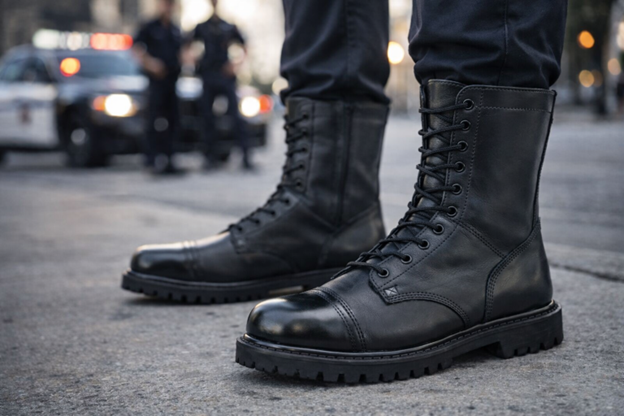
Choosing the right police boots directly impacts your safety, comfort, and performance during every shift. Your footwear affects how quickly you move, how long you can stay on your feet, and whether you end the day with sore joints or serious fatigue.
Police boots function as essential equipment, not just uniform items. The right pair supports your stability and mobility through long patrols, foot pursuits, and unpredictable situations.
This guide covers what matters most when selecting police shoes, trooper boots, and law enforcement boots for professional duty.
Match Footwear To Duty Environment
Your assignment determines what your boots need to handle. Patrol officers spend most of their shifts walking and standing on concrete. State troopers work along highways, with extended standing periods, exposure to vehicle traffic, and uneven road shoulders. Tactical and response units face rapid directional changes, rough terrain, and high-impact movement.
Prolonged standing and repetitive walking on hard surfaces increase your risk of foot, knee, hip, and lower back problems. Without proper cushioning and support, your police boots accelerate fatigue and raise injury risk. Consider the surfaces you walk on most, how long your shifts run, and how much sudden movement your role requires.
Prioritize Proper Fit and Ergonomic Support
Fit matters more than any other feature in police footwear. Poorly fitted boots cause blisters, nerve compression, joint strain, and reduced endurance. Your tactical boots should accommodate your foot width, arch height, and duty sock thickness without creating pressure points.
Lower extremity discomfort directly reduces your performance and increase injury rates during long shifts. Look for contoured footbeds, solid arch support, and shock-absorbing midsoles that maintain alignment and fight fatigue. Police shoes should allow your toes to spread naturally while keeping your heel locked in place. For officers dealing with plantar fasciitis, metatarsalgia, or chronic heel pain, consider integrating orthotic insoles for foot pain that are custom-molded to your arches. Purpose-built orthotics maintain neutral alignment, distribute pressure, and reduce shock on concrete, helping extend on-shift endurance while minimizing hotspots, numbness, and post-shift knee or back soreness. Internal foot movement creates friction and accelerates discomfort as your shift wears on.
Evaluate Materials And Construction
Material choice affects how long your boots last, how well they breathe, and how much they weigh. Full-grain leather provides excellent abrasion resistance and structure. Ballistic nylon improves airflow and cuts overall weight. Many modern police boots combine both to balance protection and comfort.
Construction method determines service life. Goodyear-welted police boots can be resoled, extending their usable lifespan significantly. Cemented construction weighs less but typically doesn’t last as long. If you’re logging serious miles on patrol, resoleable boots reduce long-term replacement costs.
Check Traction And Outsole Performance
Slip resistance keeps you safe during pursuits and rapid response situations. our police boots must grip on wet pavement, oil-exposed surfaces, and uneven ground. Rubber outsoles with multidirectional tread patterns improvetraction during sudden stops and quick direction changes.
Slips and falls remain a leading cause of workplace injury in law enforcement. Slip-resistant footwear significantly reduces these incidents. The outsole should balance grip with flexibility. Overly rigid soles reduce your responsiveness and excessively soft soles increase fatigue on hard surfaces.
Consider Ankle Support And Stability
State trooper boots and tactical law enforcement boots typically require increased ankle support. Higher shafts and structured collars help reduce lateral movement and lower sprain risk during pursuits or on uneven terrain. Structured ankle support improves your balance and reduces lower limb strain during physically demanding situations.
Effective stability extends beyond shaft height. Heel counters, midfoot shanks, and secure lacing systems all contribute to controlled movement without restricting mobility. Ankle padding should provide contact without pressure when you walk and run.
A well-engineered ankle system also improves proprioception, helping you maintain awareness of foot placement during rapid movement. This balance between support and flexibility maintains your speed, control, and injury prevention during extended shifts.
Manage Footwear Weight to Reduce Fatigue
Boot weight directly affects how quickly you tire. Heavier boots increaseenergy expenditure and accelerate fatigue during prolonged walking. Lighter footwear reduces stress on your joints and muscles over long shifts.
Lightweight police shoes work well for urban patrol or administrative duties. Trooper boots and tactical boots may need added protection, but should still use modern materials such as EVA midsoles to control overall weight. The goal is finding an efficient strength-to-weight ratio rather than maximum protection at any cost.
Address Weather And Climate Conditions
You work in all weather conditions, so your police boots need appropriate protection. Look for water resistance through treated leather, sealed seams, or waterproof membranes. Moisture control prevents blistering and skin breakdown during long shifts.
Cold climate agencies need insulated police boots to protect circulation and reduce cold-related injuries. Hot environments benefit from breathable linings and moisture-wicking materials.
Improper footwear for climate conditions increases the risk of skin conditions and circulation problems.
Ensure Safety Features And Compliance
Certain roles require additional protective features. Composite or steel toe caps provide impact resistance. Electrical hazard-rated outsoles protect against live current exposure.
Your footwear specifications should align with agency safety policies and applicable occupational standards to reduce injury risk and liability exposure.
Evaluate Durability And Lifecycle Cost
The purchase price doesn’t tell the whole story. Reinforced stitching, durable uppers, and high-quality outsoles extend service life. Tracking wear patterns helps identify failure points and improve future boot purchases.
Choosing the best police boots requires evaluating your duty environment, fit needs, materials, traction, support, and safety features. Your police shoes, trooper boots, and law enforcement boots must perform as occupational equipment under demanding conditions.
Agencies that apply systematic selection criteria and incorporate officer feedback improve comfort, reduce injury risk, and enhance operational readiness. Proper footwear selection supports both immediate performance and long-term health.
Carpet is staging an unexpected comeback in UK homes, with new analysis showing renewed consumer interest after years of decline in favor of luxury vinyl tile (LVT) and hard flooring options.
The shift comes as 21% of UK homeowners planning to spend on new flooring, with designers increasingly specifying rich colors, bold patterns, and high-pile textures that challenge the minimalist hard-floor aesthetic that has dominated for the past decade.
“We’re seeing a real swing back to carpet, particularly in bedrooms and family spaces,” says Ben Herbert, Director at online luxury carpet store Designer-Carpet.co.uk, who carried out the analysis . “People spent years living with hard floors, but they’re now realizing they’ve been missing out on the warmth underfoot, sound absorption, and that sense of comfort that only carpet provides.”
The Comfort Factor
Carpet retains 25% of the £3.5 billion UK flooring market despite intense competition from LVT, which now holds 35% share. But the quality of carpet sales is changing. Consumers are moving away from budget options toward premium wool and natural fiber carpets priced at £25+ per square metre.
Wool carpet sales proved particularly resilient, holding 49% of the carpet segment in 2023 and growing at 4.2% annually. The natural material’s renewable, biodegradable properties appeal to sustainability-conscious consumers, while its durability justifies higher upfront costs.
Wool carpet can last 20-25 years with proper care, according to Herbert. “When you compare that to LVT replacement cycles, the economics start to make sense, especially when you factor in the comfort benefits.”
Design Trends Towards Texture
Interior designers report that 2025 trends explicitly favor carpet’s tactile qualities. Dark greys remain the top-selling color, but earthy neutrals like beige surged 22% in 2024. Natural stone and cream tones are forecast as major trends, with designers using carpet to create “grounded and calming spaces” that contrast with the clinical feel of all-hard-floor homes.
Plush, high-pile carpets in warm shades are making particular gains, helping transform interiors into “havens of comfort and relaxation” according to industry trendspotters. The move aligns with broader interior design shifts toward maximalism and color-drenching techniques.
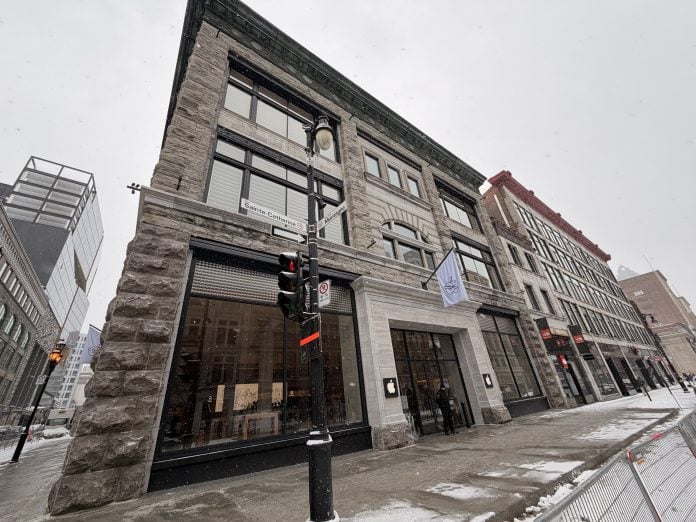
New Apple store at 1255 Ste-Catherine St. W. in Montreal. Photo: Maxime Frechette
Apple has officially opened a new retail store on Sainte-Catherine Street West in downtown Montreal, relocating from a previous space nearby. The reimagined Apple Sainte-Catherine store occupies the main floor of a restored heritage building at the prominent corner of Sainte-Catherine Street and Rue de la Montagne, reinforcing Apple’s long-term commitment to one of Canada’s most important urban retail corridors.
The new location replaces Apple’s previous Sainte-Catherine store, which first opened nearby in 2008. While the new store is not positioned as a flagship in the same sense as Apple’s highly experiential Vancouver location at CF Pacific Centre, it represents a major upgrade in scale, design, and customer experience. According to Apple, the new store more than doubles the size of its former downtown Montreal location and has been under construction since 2024, reflecting the complexity of renovating a heritage structure to meet Apple’s global retail standards.
The intersection of Sainte-Catherine Street West and Rue de la Montagne sits within Montreal’s Golden Square Mile, an area defined by high pedestrian traffic, luxury retail, hotels, and cultural destinations. The new store is located near Holt Renfrew Ogilvy and within walking distance of Sherbrooke Street West, reinforcing Apple’s position within Montreal’s most prestigious retail zone.
The original Apple Sainte-Catherine store served downtown Montreal for nearly two decades. By relocating to a larger, more prominent space, Apple maintains its visibility while significantly expanding its ability to support programming, technical services, and community engagement. This approach aligns with Apple’s broader Canadian retail strategy, which has increasingly favoured relocations and expansions of existing stores over aggressive network growth.
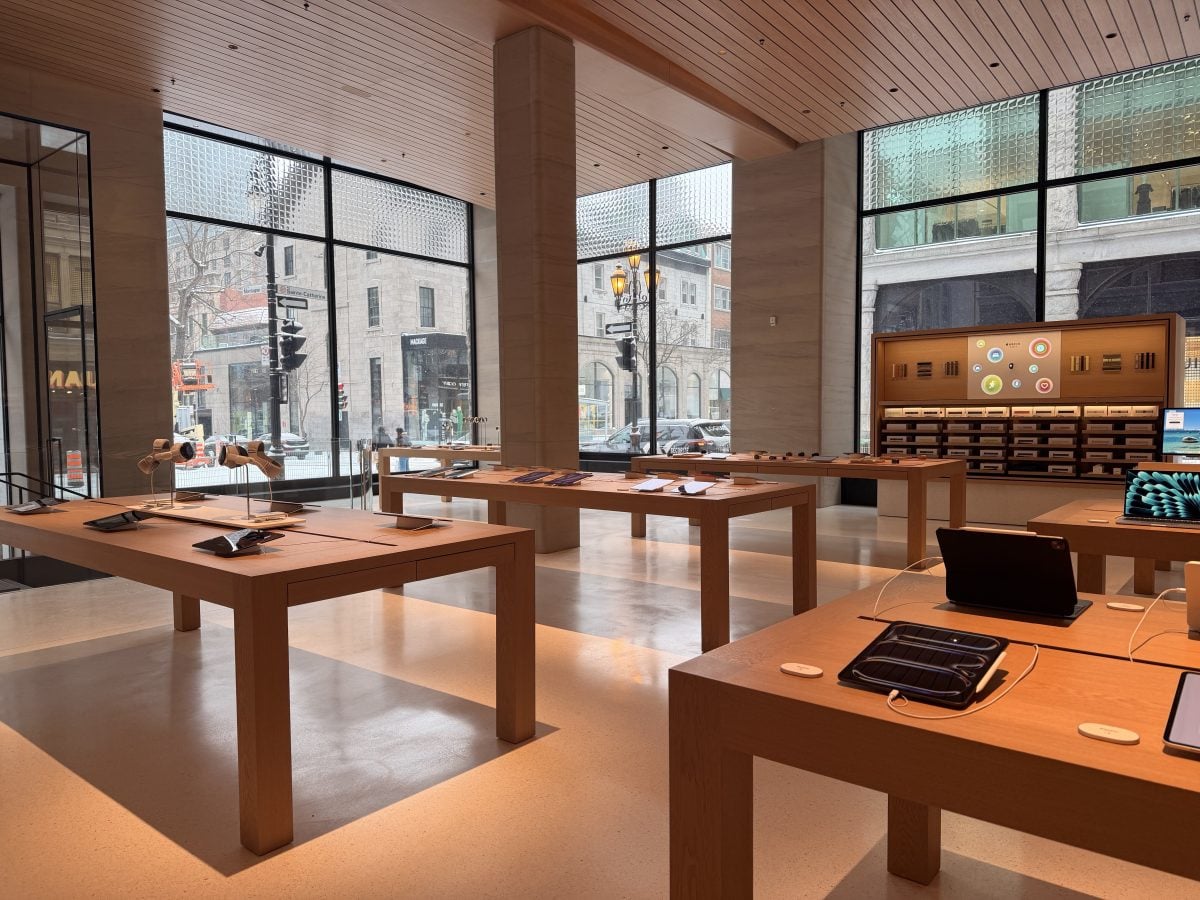
New Apple store at 1255 Ste-Catherine St. W. in Montreal. Photo: Maxime Frechette
Restoring a Historic Montreal Building
The new Apple Sainte-Catherine store occupies a heritage building that required an extensive and carefully managed restoration. Apple worked with Montreal-based construction firm SAJO, a specialist in complex retail and heritage projects, to execute the multi-year build-out. Construction began in 2024 and involved navigating the architectural constraints of a protected structure while delivering Apple’s contemporary retail standards.
The façade blends historic Saint-Marc stone sourced from Quebec with local granite, while skilled local copper artisans restored the building’s original cornice. The result is a storefront that respects the architectural legacy of downtown Montreal while presenting a modern retail presence on one of the city’s busiest commercial corners. The project highlights Apple’s approach in Canada, where global design standards are paired with local expertise to address site-specific heritage and urban challenges.
Inside, the store has been designed to create an inclusive and welcoming environment. Apple emphasized accessibility throughout the space, incorporating varied table heights, flexible seating options, and wider access routes for wheelchair users. These design choices reflect Apple’s ongoing efforts to ensure its retail spaces accommodate a broad range of customers and needs.
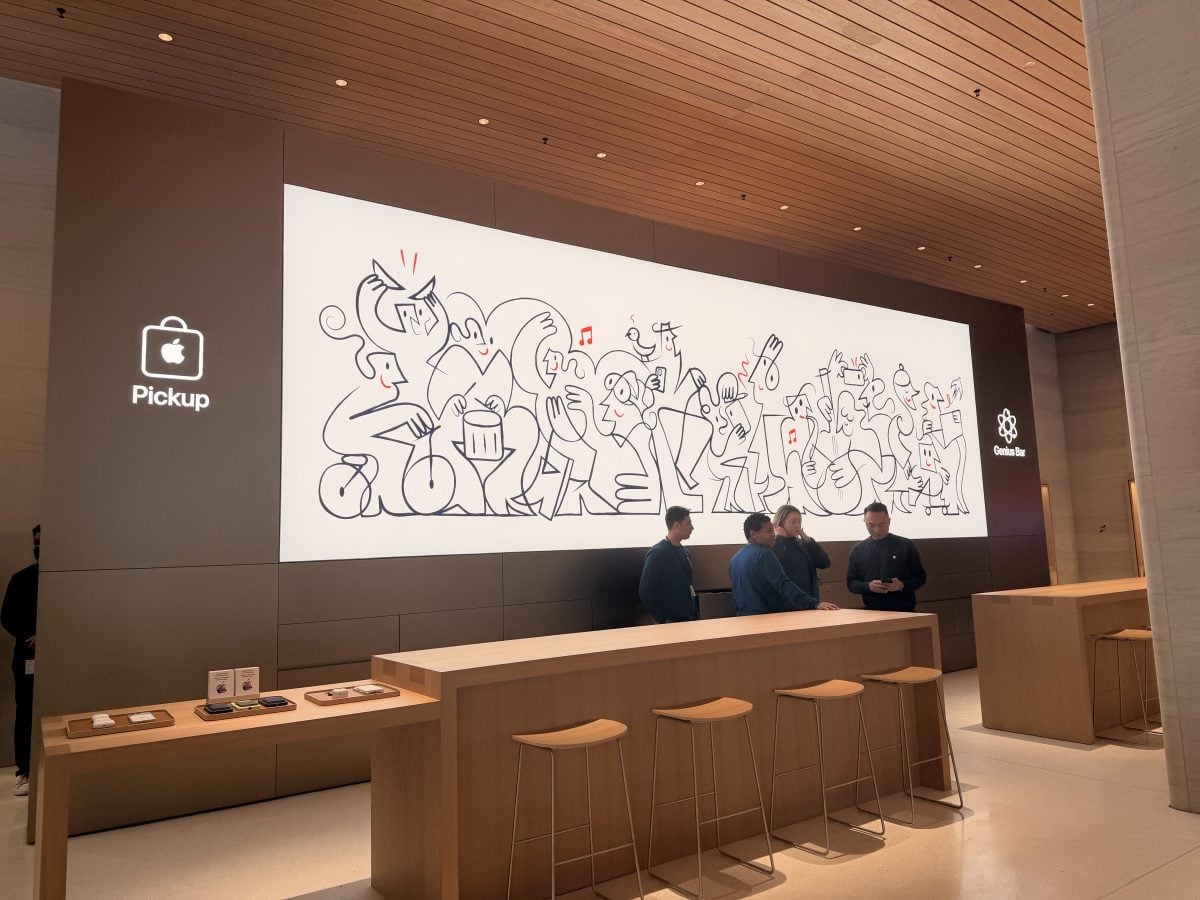
New Apple store at 1255 Ste-Catherine St. W. in Montreal. Photo: Maxime Frechette
Expanded Services and In-Store Experience
The larger footprint allows Apple to offer a full suite of in-store services in a more open and functional layout. Toward the back of the store, a dedicated Apple Pickup area enables customers to order products online and collect them in store at a scheduled time. The Genius Bar provides technical support from trained Apple Specialists, while customers can also access services such as personalized shopping sessions, flexible monthly financing, competitive trade-in values, and expert setup assistance.
The Apple Sainte-Catherine Montreal store also hosts free Today at Apple sessions, which focus on creativity, skills development, and accessibility. Customers can learn how to edit video, improve photography, or get started with Apple Intelligence on iPhone, iPad, and Mac. Additional sessions introduce users to assistive technologies, including VoiceOver features available on Apple devices.
New Apple store at 1255 Ste-Catherine St. W. in Montreal. Photo: Maxime Frechette
A Multilingual Team and Local Engagement
Apple stated that the nearly 200-person team at the new store collectively speaks dozens of languages, reflecting Montreal’s multicultural population. The company emphasized that its Specialists are trained to provide personalized guidance, whether customers are purchasing their first Apple device or integrating new products into an existing ecosystem.
“For nearly 20 years, we’ve been proud to be part of the downtown Montreal community, whose spirit of creativity and innovation continues to inspire us,” said Deirdre O’Brien, Apple’s senior vice president of Retail and People. “We’re incredibly excited to build on this longstanding relationship and create a destination where our customers can experience the very best of Apple, from our innovative products to the expert care and support of our amazing team.”
New Apple store at 1255 Ste-Catherine St. W. in Montreal. Photo: Maxime Frechette
Opening Celebrations Spotlight Local Creativity
To mark the opening, Apple collaborated with Montreal-based illustrator and designer Catherine Potvin, who led live art demonstrations on iPad during opening weekend. On Friday, January 16, and Saturday, January 17, customers visiting the store at select times were able to receive illustrations drawn directly onto Apple retail bags, reinforcing the company’s emphasis on creativity and local cultural engagement.
Apple also encouraged customers to explore Quebec-made content across film, television, music, books, podcasts, and apps, alongside a curated Apple Music Sainte-Catherine playlist. These initiatives reflect Apple’s ongoing effort to connect its retail environments to the communities they serve.
Apple has operated stores in Canada for 21 years and currently runs 28 locations nationwide, including five in Quebec. In recent years, the company’s Canadian retail strategy has focused on upgrading key locations in major urban markets rather than expanding store count. The relocation of the Apple Sainte-Catherine Montreal store follows similar investments, including the redevelopment of Apple Square One in Mississauga and the flagship transformation of Apple’s Vancouver CF Pacific Centre location.
New Apple store at 1255 Ste-Catherine St. W. in Montreal. Photo: Maxime FrechetteView from Chanel at Holt Renfrew Ogilvy (on de la Montagne) of the new Apple store at 1255 Ste-Catherine St. W. in Montreal. Photo: Maxime Frechette