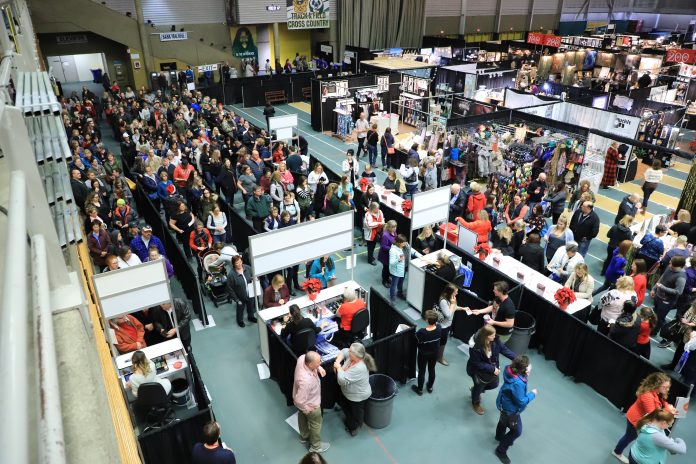
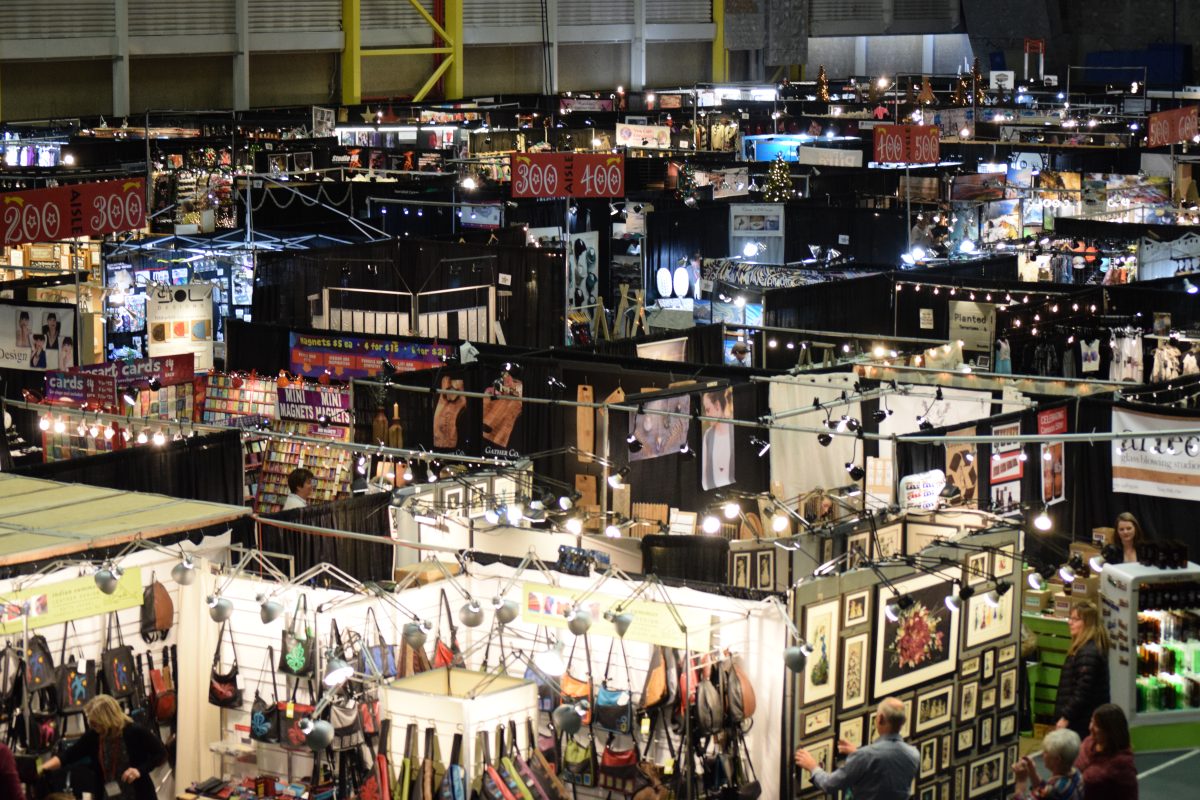
More than 225 artisans, makers and designers from across the country will set up shop at the U of A Butterdome from December 4–7 for Alberta’s largest holiday craft market. Celebrating 35 years, the Butterdome Craft Sale gives Edmontonians a one-of-a-kind chance to support local small businesses, celebrate diverse Canadian heritage and, in the time of tariffs and shipping delays, put their money where it counts.
Since 1990, the Butterdome Craft Sale has become Alberta’s premier holiday shopping event, allowing visitors to meet passionate creatives in person, hear their stories, and feel their works first-hand—all the while enjoying drinks and snacks, live music, and festive decor, say organizers.
Across the country, this year’s artisans have been selling more than ever, and the 2025 Butterdome Craft Sale spotlights a slew of products that speak to a growing Canadian pride: wild rose hip soap (Prairie Soap Shack); cork wall maps featuring NHL arenas (Wanderlust Creatures); maple garlic sauces and jellies (Voisin’s Maple Products); Lake Louise-inspired porcelain earrings (Heatgust); moose-patterned flannel baby bibs (Gracious Gifts); and maple leaf stained glass suncatchers (A Touch of Glass). It’s no surprise that the show’s Christmas trees will be topped with maple leaves in lieu of stars, they said.
Photo: Butterdome Craft Sale
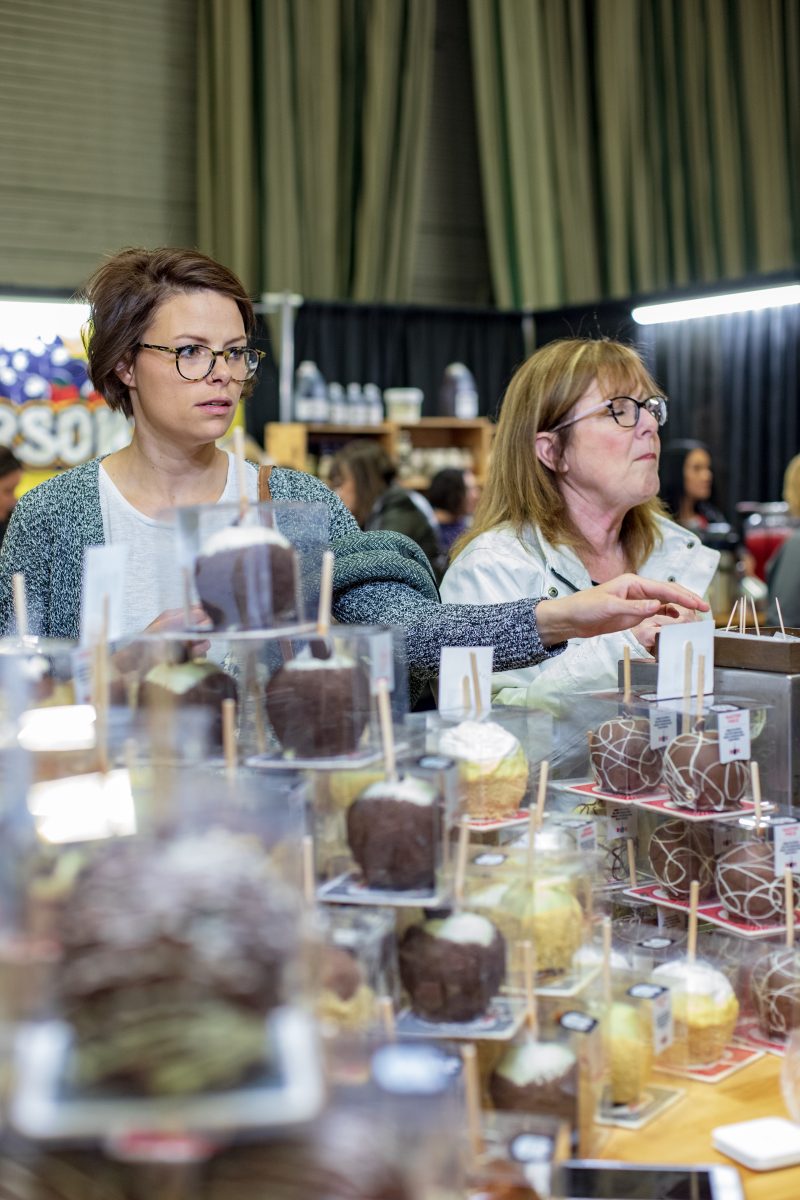
“Alongside other concessions and delicious artisan samples, this year’s Craft Sale will also host the CBC’s Make the Season Kind food truck from Dec 5 to 7, with acclaimed Edmonton chef Daniel Costa (Olia Ristorante, Bar Henry, Bar Bricco) curating a by-donation dish in support of Edmonton’s Food Bank and Food Banks Alberta. (Spoiler: The Zuppa di Ceci, or chickpea soup, cleverly incorporates key pantry items that food banks need this time of year.),” according to organizers.
“Since the tariffs conversation began, we’ve seen a clear surge in demand for locally made goods, both online and in-person at markets and events,” says Ray Ma of Honest Dumpings. “Our customers are more intentional than ever about buying Canadian. They want to know the story behind the food—who made it, where the ingredients came from, and how their purchase supports jobs in their own community.”
Photo: Butterdome Craft Sale
“Recently, I’ve noticed that customers value “Canadian-made” and “handmade” more than ever, seeing my work not just as functional mugs but as pottery that carries a Canadian story—a piece many customers say feels distinctly Canadian,” says potter Moon Kim of MoonK Studio. Her mugs, bowls and serving trays often reflect Canadian wildflowers, camping life, and mountains (Canmore’s “Three Sisters” are a fan favourite!) with clay and materials sourced from Canada and her native Korea.
Google's Senior VP of Engineering John Giannandrea speaks onstage
Apple is preparing for a major leadership transition in its artificial intelligence organization, announcing that John Giannandrea, the company’s senior vice president of Machine Learning and AI Strategy, will step down from his role and transition to an advisory position before retiring in the spring of 2026.
The company also said it has hired Amar Subramanya as vice president of AI, reporting to Apple’s software chief Craig Federighi, as Apple signals a tighter integration between AI development and its core software and product roadmap.
The move comes as Apple continues to push further into AI-enabled features under its Apple Intelligence banner, while attempting to strengthen internal execution on foundation models, product integration, and safety evaluation.
Amar Subramanya Joins Apple From Microsoft
Subramanya, described by Apple as a “renowned AI researcher,” most recently served as corporate vice president of AI at Microsoft, and previously spent 16 years at Google, where he was head of engineering for Gemini Assistant.
Apple said Subramanya will lead several of the company’s most critical AI areas, including:
Apple Foundation Models
Machine learning research
AI safety and evaluation
For Canadian business and technology decision-makers, the appointment stands out as a sign Apple is still actively recruiting top-tier AI leadership talent in a market defined by intense competition from Microsoft, Google, OpenAI, and Meta.
Apple Reassigns Portions of Giannandrea’s Organization
Alongside the leadership change, Apple said “the balance” of Giannandrea’s organization will shift under Sabih Khan and Eddy Cue, moving pieces of the AI group closer to parallel internal teams.
The restructuring indicates Apple is not only replacing leadership but also adjusting reporting lines to align AI work more tightly with areas like operations, product delivery, and services—suggesting a push to turn AI research into deployable features at scale.
Giannandrea’s group has included responsibilities such as:
Apple Foundation Models
Search and Knowledge
ML Research
AI Infrastructure
A Strategic Shift Under Craig Federighi’s Software Leadership
Apple CEO Tim Cook framed the changes as both a leadership transition and an acceleration of Apple’s long-term AI strategy, emphasizing Federighi’s growing role in shaping Apple’s AI execution.
“AI has long been central to Apple’s strategy,” Cook said, adding that Federighi has been instrumental in driving Apple’s AI efforts and is overseeing work to deliver a “more personalized Siri” next year.
For Apple, placing AI leadership under Federighi is a clear signal that the company’s AI ambitions are moving further into the mainstream of its software platform strategy, rather than remaining primarily a standalone research function.
What It Means for Canada’s Apple Ecosystem
For Canadian retailers, carriers, and enterprise IT buyers, Apple’s AI leadership changes matter less as a corporate reshuffle and more as a signal of product direction. As Apple expands AI features across iOS, macOS, and iPadOS, demand is expected to increasingly shift toward newer hardware capable of running AI-enabled experiences smoothly and securely.
Giannandrea’s retirement also marks the closing chapter of a leadership era that began with Apple’s 2018 effort to build a stronger AI and machine learning engine internally—at a time when voice assistants, on-device intelligence, and contextual computing were becoming core platform priorities.
With Subramanya joining, Federighi’s oversight expanding, and internal reporting lines being reorganized, Apple appears to be laying the foundation for its next phase in AI: one focused on foundation models, product integration, and trusted deployment at global scale.
Läderach at 110 Bloor Street West in Toronto. Note: at time of photo, Läderach was waiting for exterior signage to be installed, hence the temporary sign. Photo: Craig Patterson
Läderach’s newest Canadian boutique has opened its doors on Toronto’s luxury run, bringing fresh Swiss chocolate to street level on one of the country’s most important retail corridors. The Läderach Bloor Street store, located at 110 Bloor Street West, quietly began trading ahead of a grand opening on Thursday, November 27 that featured a ribbon cutting and a chocolate giveaway for the first 200 customers.
The debut marks Läderach’s first street-front location in Canada and the latest step in a broader North American expansion that now spans malls, airports and high streets. The premium chocolatier already has a presence in key Greater Toronto Area shopping centres and recently entered British Columbia, but Bloor-Yorkville adds a different type of visibility, with constant foot traffic from local residents, tourists and office workers.
“We are thrilled to expand our presence of fresh Swiss chocolate in Canada on historic Bloor Street,” said Warren Dunkelberger, President of Läderach North America. “This location represents an important step in our commitment to making our fresh, artisan Swiss chocolate more accessible across the country.”
Läderach at 110 Bloor Street West in Toronto. Photo: Craig Patterson
Läderach lands on Canada’s premier luxury corridor
The boutique at 110 Bloor sits in a narrow, street-facing space of just over 1,100 square feet between the Winners/HomeSense entrance and the Alexander Wang boutique. The building, owned by ProWinko and managed by Salthill Capital, has been attracting new tenants in recent times, including a large Saint Laurent flagship, Paris Baguette and Mandy’s Salads.
Leasing for the Läderach Bloor Street boutique was completed by Casdin Parr of Odyssey Retail Advisors and Jason Richter of Capricorn Retail Advisors, who represented the tenant. The property was co-listed by CBRE’s Urban Retail Team alongside Carmen Siegel of Cushman & Wakefield.
Canadian construction firm BUILD IT brought the space to life — BUILD IT works with various leading brands on store build-outs.
For Läderach, it is a deliberate move into a neighbourhood that already caters to luxury shoppers. Bloor-Yorkville is in the midst of another wave of investment, with new flagships underway and existing retail boxes being rethought for high-end uses. Tiffany & Co. is preparing a major new corner store nearby, while other global brands continue to reshape the street.
“This is definitely a statement for us,” said Jorge Chon, Regional Operations Manager for Läderach in Toronto, during an in-store interview. “We have been wanting a Bloor Street store for about four years. We needed the right space and the right neighbours, and this location gives us both. The demographics, the foot traffic and the character of the street make it a perfect fit.”
The shop joins an existing network of Läderach locations in the Toronto region, including CF Toronto Eaton Centre, Yorkdale Shopping Centre, York Mills Centre, Square One in Mississauga and CF Sherway Gardens. The company also recently opened at CF Richmond Centre near Vancouver, with more western Canadian locations on the way.
Läderach at 110 Bloor Street West in Toronto. Photo: Craig Patterson
A boutique built around fresh chocolate
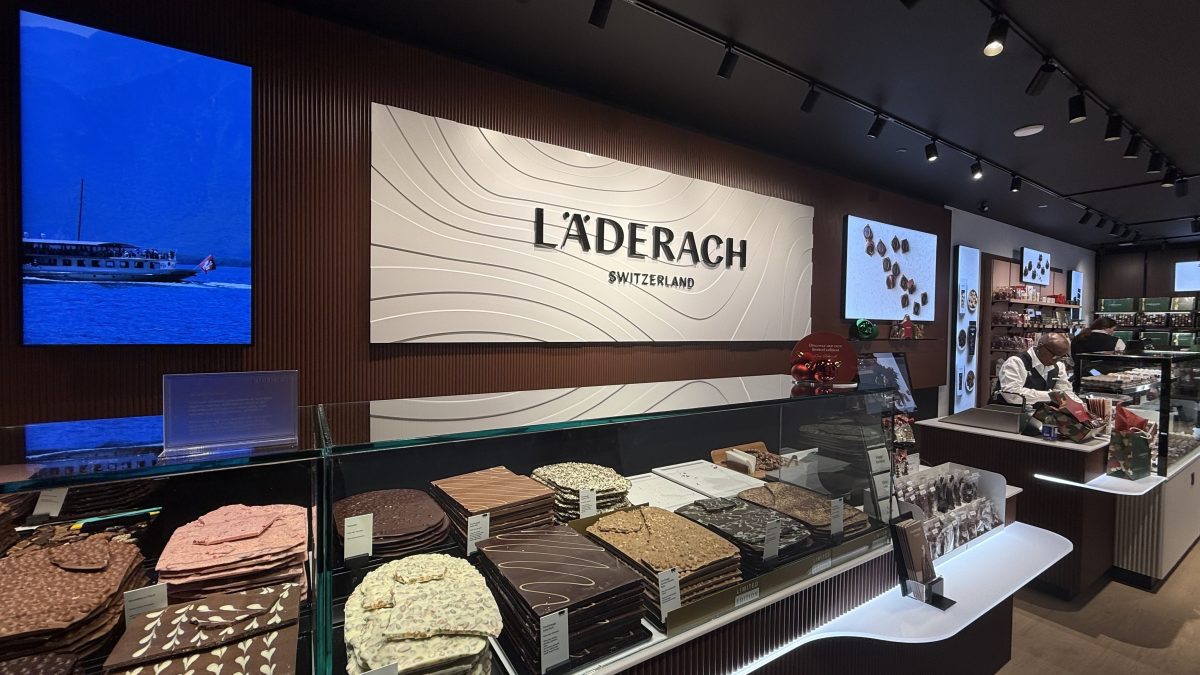
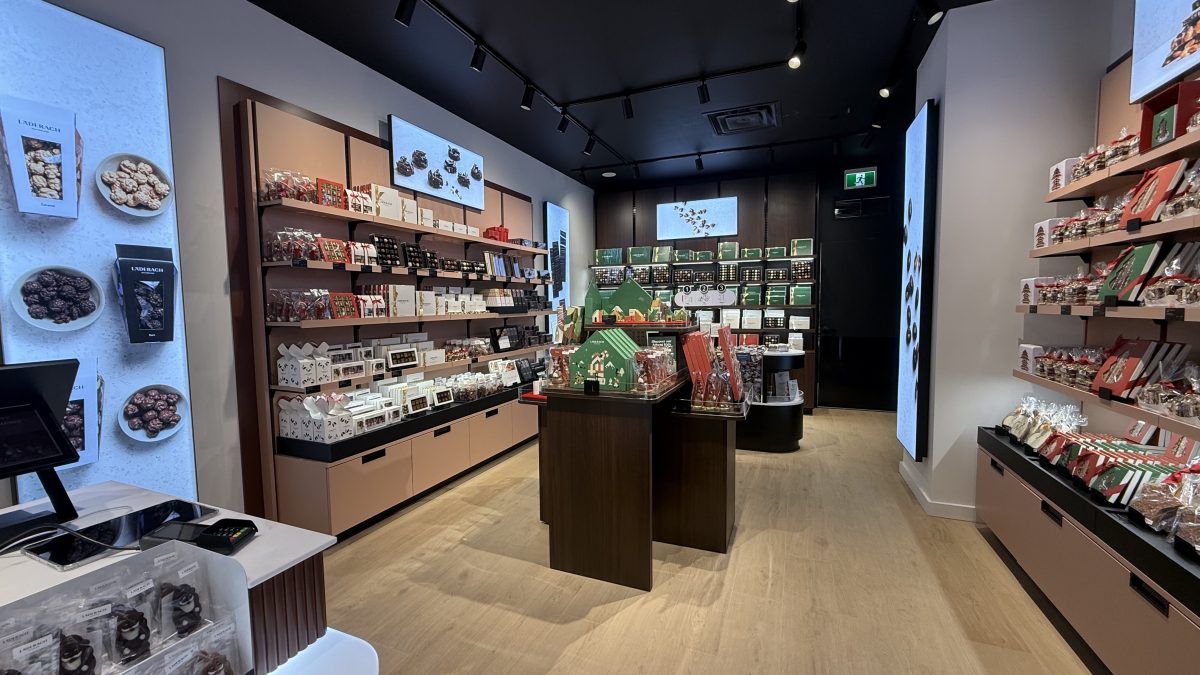
Inside, the design leans into chocolate as both product and inspiration. The walls and fixtures follow a palette of warm browns and neutrals, with subtle textures intended to evoke the look of poured and tempered chocolate. The layout is compact but carefully organized, reflecting a newer global store concept that Läderach has refined through test locations in Switzerland.
“We bring the elements from our 2.0 concept, but this is a more refined evolution,” said Chon. “We learned that we do not need gigantic stores to deliver the full experience. It is about flow, assortment and making sure customers feel close to the product from the moment they walk in.”
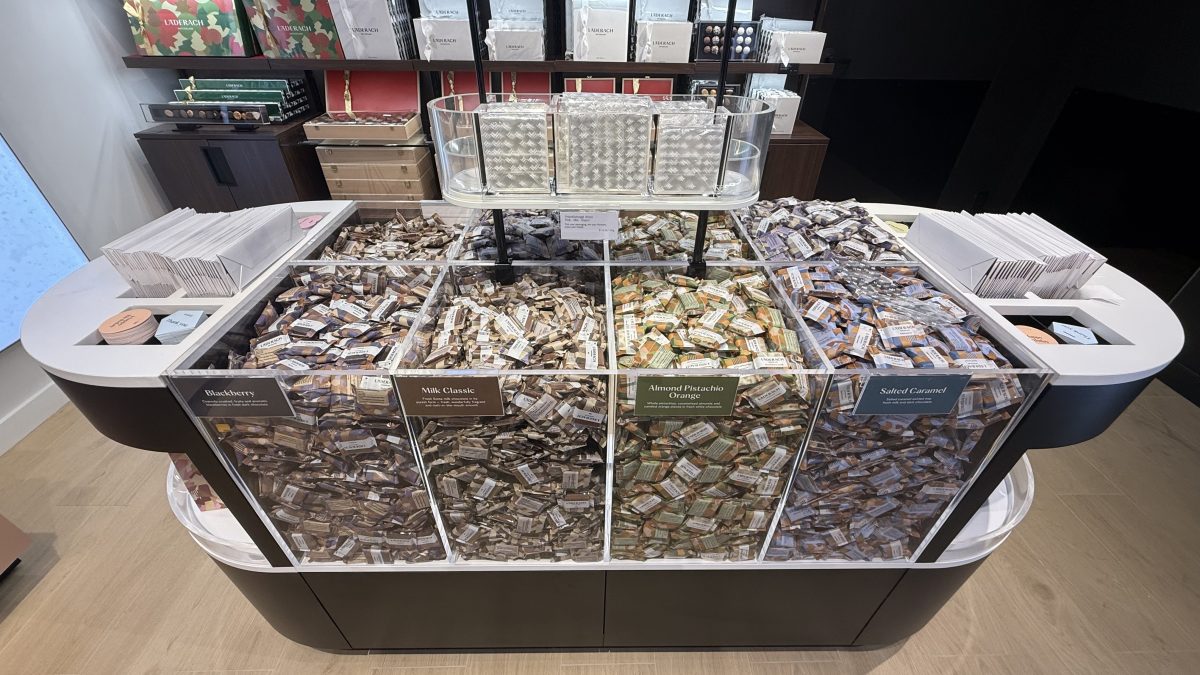
The centre of the boutique is dominated by the brand’s signature FrischSchoggi counter, where large slabs of chocolate are displayed in an almost sculptural way. Produced in Switzerland, the slabs are poured, mixed and finished by hand or with light mechanical assistance, then shipped to Canada by air on a weekly basis to maintain freshness.
“In our factory, the chocolate is pumped onto trays, mixed and spread, then quickly cooled and tempered,” Chon explained. “Everything is made in Switzerland and we bring it in weekly. Customers choose the flavours they want and we break off pieces by hand, sold by weight. It is like going to a cheese shop and asking for a hundred grams of your favourite cheese, but with chocolate.”
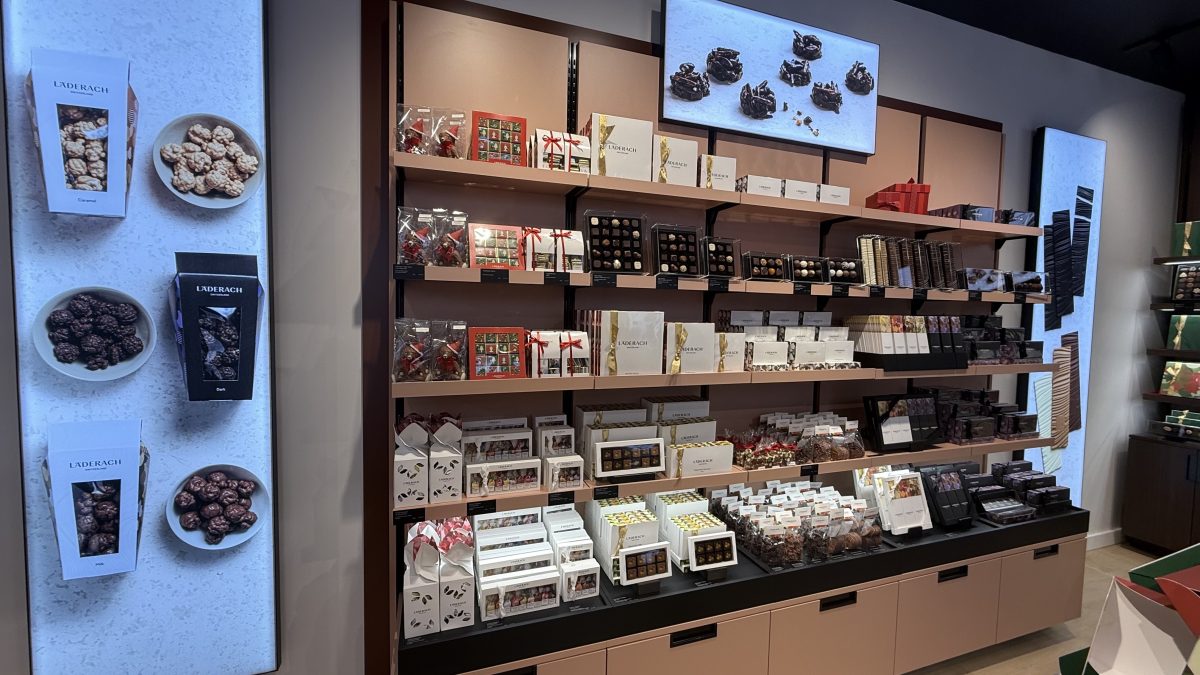
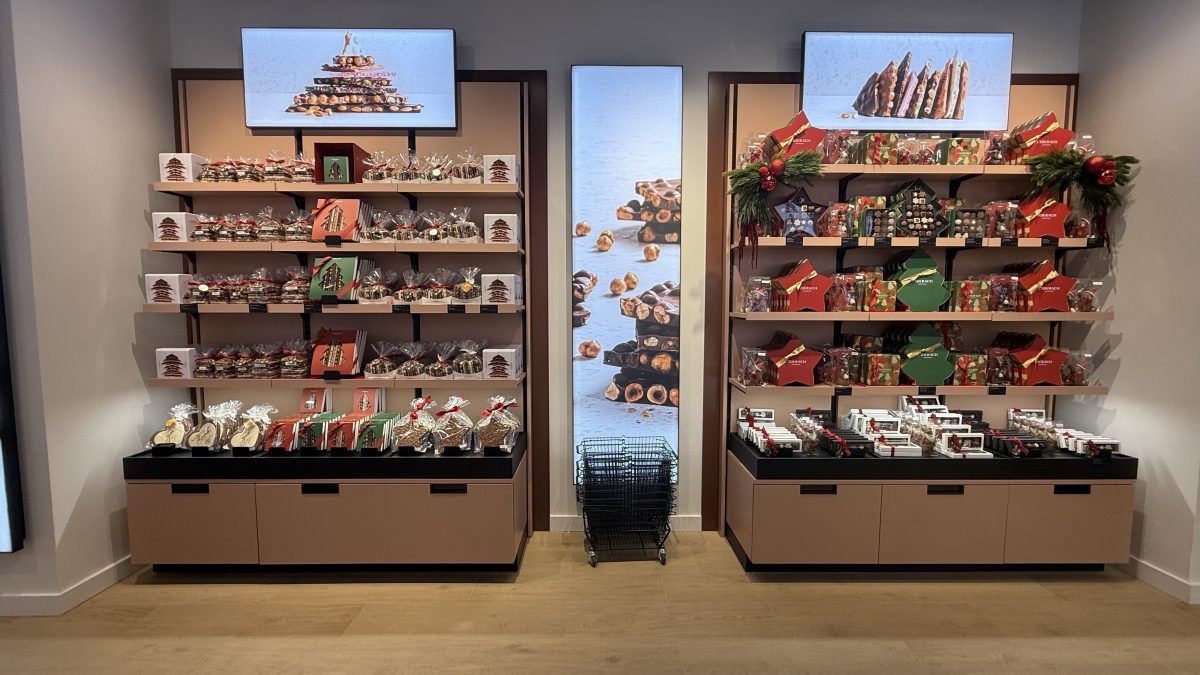
Alongside the FrischSchoggi display, the boutique carries a broad assortment of pralines, truffles, single-origin bars and seasonal gift items. A seasonal table at the front of the shop highlights limited-time collections that are geared to holidays and occasion-driven traffic on Bloor Street.
Läderach at 110 Bloor Street West in Toronto. Photo: Craig Patterson
Pistachio leads a growing flavor lineup
One of the surprise stories in Läderach’s Canadian growth has been the strong demand for pistachio, particularly in Toronto. The flavour has become a bestseller across several locations, including Eaton Centre and Yorkdale, and is expected to perform especially well in Bloor-Yorkville given the neighbourhood’s taste for specialty products.
“We brought the milk pistachio chocolate last December and people went crazy,” said Chon. “We thought it would be a trend that lasted a few weeks or maybe a month, but it has not stopped. That is why we introduced the dark pistachio version too. It is a little less sweet, but with the same filling, and people love it.”
Ingredient sourcing is a key part of the story Läderach tells in its boutiques. Pistachios come from Iran, hazelnuts from Piedmont in Italy, and almonds from California, with Swiss milk and tightly controlled production processes in the company’s home country.
“We try to source the best ingredients and we do not use preservatives,” Chon noted. “Everything is made fresh in Switzerland, brought in by air and sold quickly. That is what sets us apart and why we focus so much on freshness in every store.”
Läderach at 110 Bloor Street West in Toronto. Photo: Craig Patterson
Expansion strategy across Canada and beyond
The Läderach Bloor Street store is part of a broader expansion strategy that has seen the company build density in key markets before moving into new regions. In Canada, that has meant starting in Toronto and then extending westward.
Läderach entered the country in December 2019 with a flagship at CF Toronto Eaton Centre. The Yorkdale store followed in late January 2022, taking over a former Godiva space as part of a wider North American deal. York Mills Centre joined the network by early 2024, offering a convenient stop for commuters and residents in a high-income pocket of North York. Square One in Mississauga opened in summer 2024, followed by CF Sherway Gardens in August 2025.
On the West Coast, CF Richmond Centre became Läderach’s first British Columbia location in 2025. Chon confirmed that the company has already secured additional sites.
“We are going into CF Pacific Centre in Vancouver, which is very exciting for us,” he said. “We also have a planned store inside the McArthurGlen designer outlet by the airport in Richmond, and we are working on getting into well known centres. After that, we are exploring Calgary and Edmonton.”
Outlets are also on the radar, with locations such as Niagara, Vaughan Mills and Toronto Premium Outlets under consideration for future phases.
“First we focus on the main cities and the main shopping centres,” said Chon. “Then we can get creative about where else we can go. We do not have a fixed number in mind for how many stores Canada will eventually have. Time will tell. It is more important to grow in an organized way so we can support each store properly.”
Läderach at 110 Bloor Street West in Toronto. Photo: Craig Patterson
Events, partnerships and a neighbourhood role
Although the boutique is compact, it is designed to host events and private tastings. Läderach has already tested this format at other locations, including a recent event at CF Toronto Eaton Centre for a Swiss corporate group that paired wine with chocolate-based canapés.
“We had foie gras with chocolate, special creations from a catering company and wine pairings,” Chon said. “Then we did a chocolate experience in the store. Those events work very well and we see this Bloor Street location as perfect for that type of activity.”
The company is also looking to build relationships with the Bloor-Yorkville BIA and nearby businesses.
“We are exploring partnerships with the local BIA to understand what the plans are for the summer and the rest of the year,” he said. “The neighbourhood is very supportive. Our neighbours like Saint Laurent, Gucci and others have already expressed interest in doing VIP events or collaborations. That is how retail works. A strong mix of tenants helps everyone.”
The timing of the opening, just ahead of the holiday season, is another advantage. Bloor Street sees significant gifting traffic in November and December, with locals and visitors alike seeking premium products that can serve as host gifts, corporate presents or personal indulgences.
“Right in time for gifting season, the products fly off the shelves,” Chon said. “People love their chocolate and they want something special. This store gives them that, right in the middle of the luxury run.”
Läderach at 110 Bloor Street West in Toronto. Photo: Craig Patterson
A Swiss brand with global reach and local ambitions
Läderach remains a family-owned business, founded in 1962 in the Swiss canton of Glarus. The company oversees its value chain from the cocoa bean through production to the final product, with all manufacturing kept in Switzerland. That level of control, combined with a focus on freshness, has helped Läderach become the largest chocolate retailer in Switzerland and a prominent name globally.
Today, the brand operates more than 200 boutiques in over 20 countries and supports those physical locations with an expanding e-commerce platform. It also counts the reigning World Chocolate Master among its leadership, a credential that reinforces the company’s emphasis on craftsmanship and innovation.
In Canada, the Läderach Bloor Street store underlines the company’s intention to compete seriously in the premium chocolate segment. Positioned alongside leading international fashion and luxury brands, the boutique gives Läderach a high-profile stage from which to build deeper recognition among both local residents and visitors.
“This is a neighbourhood store and a flagship address at the same time,” said Chon. “We have local customers who live around the corner and come in for gifts or treats, and we have tourists who discover us while exploring Bloor Street. It is a powerful combination.”
Hillberg & Berk, the Regina-based jewellery brand known nationwide for its vibrant pieces and purpose-driven mission, is preparing for a milestone moment. On December 9, 2025, the company will release the Official Team Canada Jewellery Collection in partnership with the Canadian Olympic Committee. The launch arrives at a time of rising anticipation as athletes and fans look toward the Milano Cortina 2026 Olympic Winter Games, scheduled for February 6 to 22. For Hillberg & Berk, the debut represents both the evolution of a national partnership and the deepening of its long investment in women’s sport and community empowerment.
Hillberg & Berk announced its four-year partnership with the Canadian Olympic Committee in June 2025, a move that formalized years of organic connections between the brand and Canadian athletes. To mark the occasion, the company released the Team Canada Sparkle Hearts, a limited piece that quickly became a fan favourite. The earrings have already sold out three times, generating more than ten thousand dollars in proceeds in support of Team Canada.
Rachel Mielke
“As a brand passionate about community, we have always believed in the power of storytelling, and few stories are as inspiring as those told through sport,” said founder and CEO Rachel Mielke in the partnership announcement. She noted that athletes have worn Hillberg & Berk pieces on the world stage for years as symbols of confidence, strength, and unity. This alignment of values laid the groundwork for a deeper collaboration leading into the 2026 Olympic Games.
The Team Canada Jewellery Collection builds on that momentum, bringing the energy and symbolism of Olympic sport into homes across the country. The new line is designed to be both accessible and aspirational, appealing to dedicated fans and casual supporters who want to celebrate Team Canada in a meaningful way.
Details of the December 9 Launch
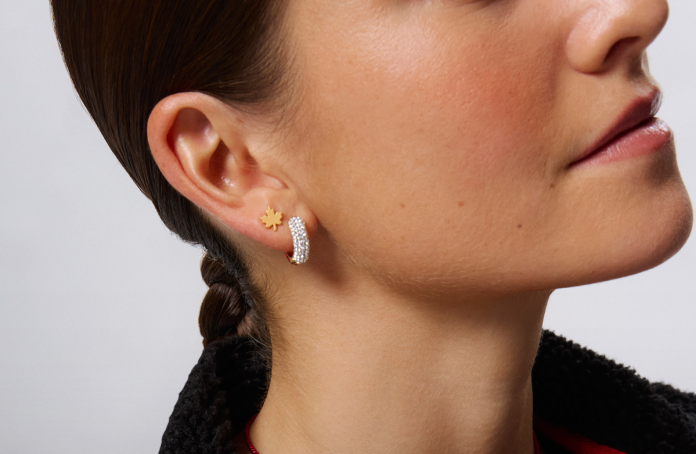
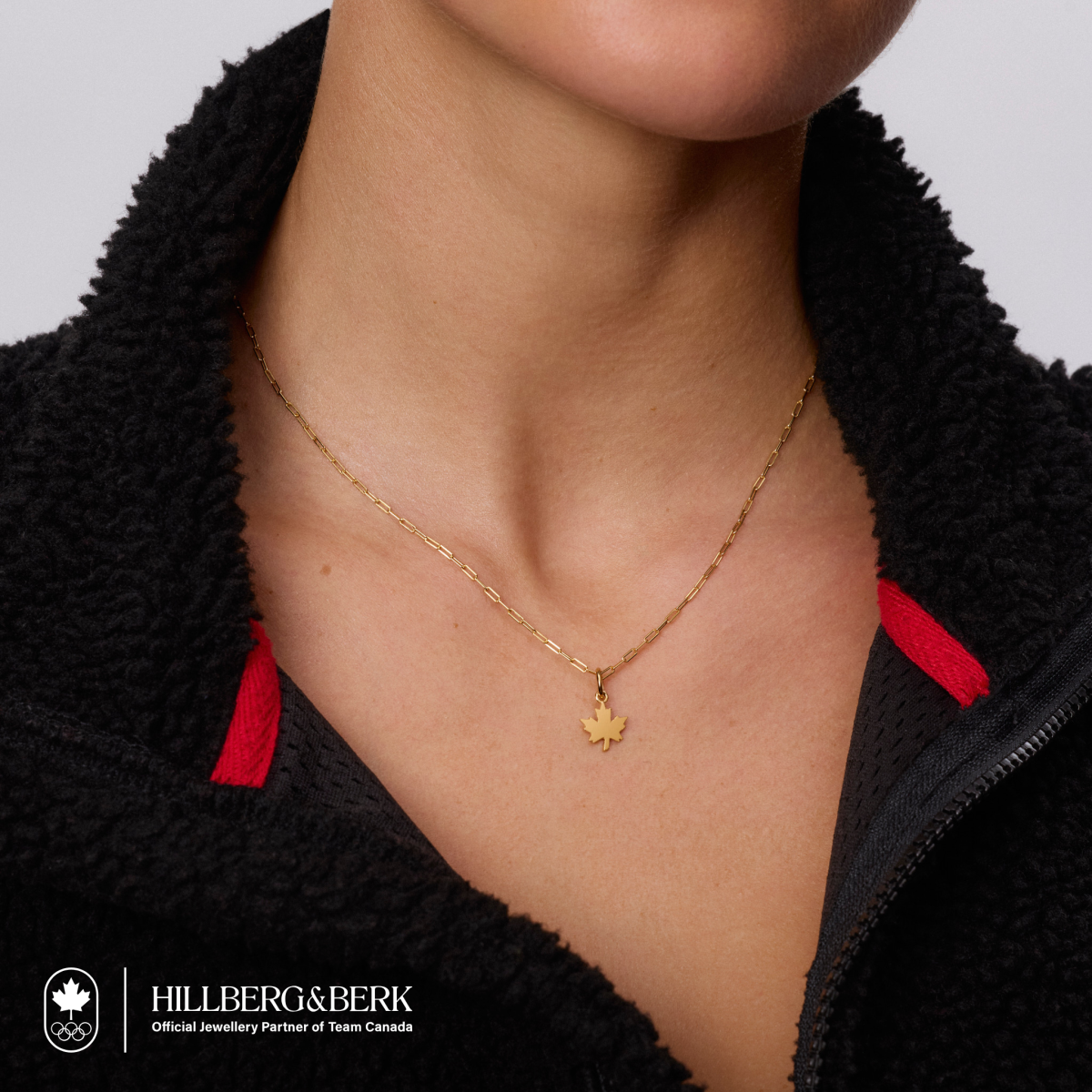
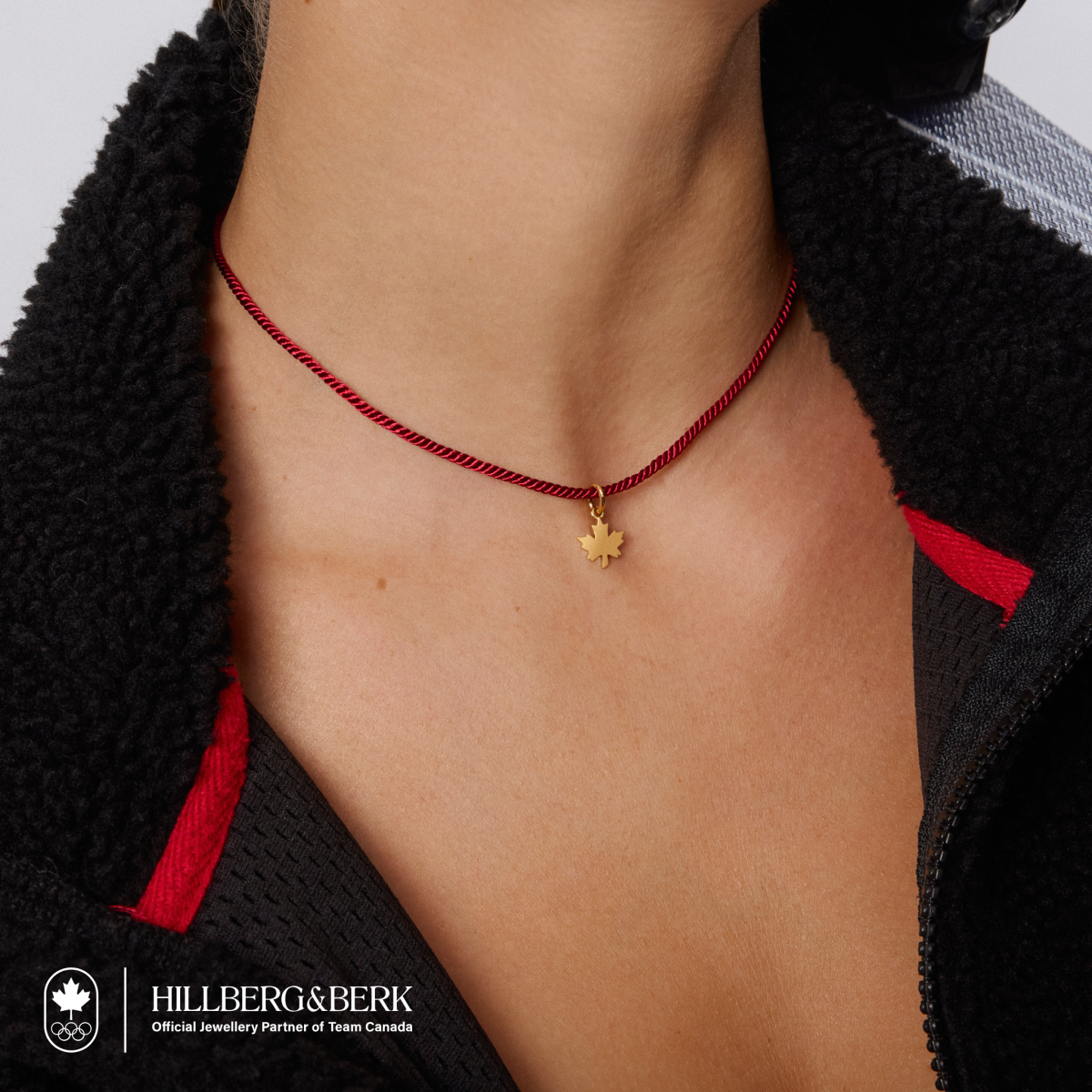
The full collection will be released on December 9, with early access beginning December 4 for BerkPerks loyalty members. Pieces include brooches, studs, hoops, charms, necklaces, and rings. The designs highlight familiar Canadian elements such as maple leaf motifs, rich reds, and Hillberg & Berk’s signature sparkle. Each item arrives in custom red velvet packaging that mirrors the brand’s luxury aesthetic and its attention to detail.
Twelve percent of all sales from the Team Canada Jewellery Collection will go directly to support Team Canada. That financial commitment forms a key part of the brand’s strategy as it positions itself more prominently within the national sports landscape. The funding will help the Canadian Olympic Committee deliver programs that foster athlete development and expand opportunities for young people to participate in sport.
Maple Leaf Charm Necklace. Image: Hillberg & Berk
The Face of the Campaign: Maïa Schwinghammer
To bring the new collection to life visually and narratively, Hillberg & Berk partnered with freestyle moguls skier Maïa Schwinghammer. Born in Saskatoon and now competing internationally, Schwinghammer represents the energy and ambition of a new generation of Canadian athletes moving confidently toward Milano Cortina 2026.
“Representing my country on the world stage has been my dream since I was a kid, and I feel incredibly lucky to be living it,” said Schwinghammer. “My favourite quote is, ‘What a blessing it is to be challenged in a pursuit of your own choosing.’ I live by that.”
The Team Canada Jewellery Collection is positioned as both a celebration of athletes like Schwinghammer and a way for fans to share in the Olympic journey. Each piece is designed to capture the spirit of dedication, pride, and personal expression that defines Team Canada. For the brand, featuring an athlete from the Prairies underscores its Canadian roots and the universality of its message.
10k Maple Leaf Studs. Image: Hillberg & Berk
A Strategic Commitment to Women’s Sport
The collection is part of a broader and increasingly visible sports strategy for Hillberg & Berk, one that places a significant emphasis on supporting women across all levels of sport. The company has built a portfolio of partnerships that spans elite Olympic athletes, professional leagues, and grassroots programs focused on increasing participation among girls.
Its four-year partnership with the Canadian Olympic Committee includes more than the Team Canada Jewellery Collection. As the Official Jewellery Partner of Team Canada through Milano Cortina 2026 and the Los Angeles 2028 Olympic Games, Hillberg & Berk will also produce custom commemorative rings for all athletes. In addition, the company has aligned with the Northern Super League as the Official Jewellery Partner of the first professional women’s soccer league playoffs and final. This relationship includes the creation of winning necklaces for players and limited edition fan pieces that provide financial support for league growth.
Hillberg & Berk’s expanding sports presence also includes work with the Professional Women’s Hockey League and a number of philanthropic initiatives. Programs such as Play for More and Girls Forward address the fact that many girls leave sport in adolescence due to limited access and lack of support. The brand designs capsule jewellery pieces that help fund organizations focused on skill building, leadership, and confidence for girls. At least one percent of the company’s annual sales supports women-related causes, with a portion directed specifically to girls’ and women’s sport.
Maple Leaf Corded Necklace. Image: Hillberg & Berk
Purpose at the Heart of the Brand
Hillberg & Berk was founded on a philosophy of empowerment, with a mission to help women express themselves with authenticity and purpose. This mission fits naturally with the narratives emerging from the Canadian sports community, especially as women’s sport receives more attention and investment both nationally and globally.
The company notes that many female athletes began wearing its jewellery independently, long before formal partnerships were established. For Hillberg & Berk, these early connections signaled an opportunity to support a segment of the sports world that continues to face funding and visibility gaps. By turning these relationships into formal partnerships, the brand not only acknowledges the role athletes played in its growth but also reinforces its commitment to elevating women’s sport.
The Team Canada Jewellery Collection is an extension of that philosophy. Through design, storytelling, and financial contribution, the collection transforms sponsorship into something tangible, allowing fans to carry a piece of the Olympic narrative with them. For Hillberg & Berk, the goal is to ensure that the jewellery becomes more than an accessory, functioning instead as a symbol of pride, inspiration, and shared national enthusiasm ahead of Milano Cortina 2026.
Looking Ahead to Milano Cortina 2026
As the countdown to Milano Cortina 2026 begins, Hillberg & Berk is preparing to play a visible role in the uniforms, wardrobes, and personal style of Canadian athletes. The brand expects its pieces to appear both in competition and in the broader presentation moments that accompany the Games.
The Team Canada Jewellery Collection is expected to resonate with consumers across the country during the holiday season and into the Olympic year. With themes of national pride and personal expression woven throughout the campaign, the launch serves as an early celebration of what many hope will be a strong showing for Team Canada in Italy.
The collection also reinforces the role retail partnerships play in amplifying sporting culture in Canada. Hillberg & Berk’s alignment with the Canadian Olympic Committee comes at a time when fans are increasingly interested in supporting organizations that reflect their values. With a clear mission and a purposeful approach to storytelling, the brand is positioning itself as both a retailer and a cultural contributor in a moment of heightened excitement for Canadian sport.
Toronto-based startup ShopReel AI is aiming to reshape how consumers shop online by transforming social video content into AI interactive, shoppable experiences. Co-founded by Lawrence Tung, the company merges artificial intelligence with social commerce to let users “shop what they watch” directly from videos on platforms like Instagram.
The concept emerged when social media video content became a dominant retail discovery channel. “We saw how quickly TikTok and Reels changed how people engaged with brands,” said Tung. “Yet, online shopping hadn’t caught up to that video-first world. We asked ourselves: why are we still shopping through static images and text when we consume everything else through video?”
Turning Social Media into a Storefront
At its core, ShopReel AI connects social engagement and commerce through video. Using advanced AI, the platform scans each frame of a video to identify and tag products automatically, turning social video content into a digital storefront. Consumers watching an Instagram Reel can tap directly on an item, such as a sweater, jacket, or accessory, within the same scene, and instantly view its product page.
“We call it contextual social commerce,” explained Tung. “People use social media not just for entertainment but also for inspiration. The challenge is that the shopping experience has been disconnected. You might see a product you love in a reel, click through, and then have to hunt around a website to find it. ShopReel AI bridges that gap.”
By linking directly from video to purchase, ShopReel AI provides what Tung describes as “continuity of experience.” The goal, he said, is to make shopping as seamless as doing what we love, watching videos — and for brands, that means higher engagement and conversion.
How the Technology Works
The company’s platform is built for simplicity. “Merchants don’t have to do any manual tagging,” Tung explained. “They simply upload the video and the associated product links. Our AI does the rest, recognizing products within the reels and connecting them back to the brand’s product page. It’s built to be intuitive and low-lift for teams that are often stretched thin.”
The experience for consumers is magical and mirrors how they already engage with video content on Instagram or TikTok, except now the link between discovery and purchase is instantaneous. “When someone clicks on any part of a product as seen in a reel they’re taken directly to the exact product page featured” said Tung. “No searching, no guesswork.”
Smarter Analytics for Brands
Beyond convenience, ShopReel AI provides merchants with a level of insight rarely possible in social commerce. Brands can now track engagement not just at the video level but frame by frame, understanding exactly how viewers interact with products.
“For the first time, brands can see how customers engage within a video,” Tung said. “They can identify which products attract the most attention, which moments drive clicks, and how that correlates with sales. Think of it like a dynamic heatmapin video.”
These analytics, he explained, go far beyond standard metrics like views or impressions. Instead, they provide “intelligent information in context”, helping brands refine their creative, optimize product placement, and better understand the connection between engagement and conversion.
Designed for Independent Retailers as Well as Major Brands
While ShopReel AI’s technology is robust enough for enterprise use, Tung emphasized that the platform was also built with smaller retailers in mind. “Independent merchants often face budget and resource constraints,” he said. “We wanted to create a tool that gives them access to the same kind of immersive commerce experience that big brands have.”
Using nothing more than a smartphone, merchants can create authentic shoppable reels that connect directly to their online store. “It’s about making high-impact content achievable and affordable,” said Tung. “We think this levels the playing field.”
The company’s early discussions with retailers reflect growing interest in that capability. ShopReel AI is currently in conversations with several brands about pilot campaigns and upcoming launches. “Our product is scalable and ready to go,” Tung confirmed. “We’re working closely with partners who see the potential to bring their content to life in new ways.”
Bridging Online and In-Store Experiences
While the platform is designed for digital channels, Tung believes there are compelling applications for physical retail as well. “We’re seeing a lot of interest in omnichannel storytelling,” he said. “Imagine a brand filming shoppable reels inside their own store. Pulling products off the rack and creating looks right from their physical space.”
That kind of content can strengthen familiarity and connection for customers who later visit in person. “When shoppers walk into the store and recognize the layout or products from what they saw online, it deepens the relationship,” Tung explained. “It brings the online and offline worlds together in a really natural way.”
The Role of Authenticity in an AI-Driven World
While the company embraces AI, Tung stressed that authenticity remains central to the experience. “There’s a lot of excitement about generative AI, but we believe shopping still needs to feel real,” he said. “When people make a purchase, they want to know exactly what they’re getting.”
For that reason, ShopReel AI focuses on enhancing real content rather than generating synthetic imagery. “We think the integration of AI into authentic, real-life video makes the most sense right now,” he added. “Customers want to see genuine products in context, not computer-generated versions. That builds trust.”
Tung acknowledged that some brands are experimenting with AI-generated advertising, citing recent examples like Coca-Cola’s AI holiday campaign, but he believes consumers will increasingly value the human element. “Authenticity is going to matter more than ever,” he said. “That’s where we see ShopReel AI standing out.”
A Proudly Canadian Innovation
Headquartered in Toronto, ShopReel AI is part of Canada’s growing community of technology innovators. The company is also affiliated with the Vector Institute, a government-funded organization that supports the adoption of artificial intelligence across industries.
“The Vector Institute has been instrumental in helping us connect with talent and build our team,” said Tung. “It’s a world-class ecosystem, and we’re proud to be part of it. There’s incredible innovation happening here in Toronto, and we want to contribute to that story.”
He hopes that more Canadian retailers will collaborate with local technology firms like ShopReel AI to accelerate digital transformation. “Canada has the talent and creativity to lead in retail technology,” Tung said. “We just need to keep building those bridges between the tech community and the retail sector.”
The Future of Social Commerce
As social media continues to influence purchasing decisions, platforms like ShopReel AI may represent the next evolution of e-commerce. With over 60 percent of social media users engaging with shopping-related content, Tung believes the timing is ideal for contextual commerce to take off.
“We’re just at the beginning,” he said. “Video is how people consume information today and increasingly, it’s how they shop. As we onboard retailers to our platform,our mission is to make that process as seamless and enjoyable as possible, both for consumers and for the brands that serve them.”
Looking ahead, ShopReel AI plans to expand its partnerships and roll out new features that integrate further with social networks and retail systems. “Our roadmap includes exploring generative tools that enhance video analytics,” Tung said. “But the foundation will always be authentic, intelligent, and human-driven shopping experiences.”
Retail and office spaces rely on routine, but that routine only works when the environment stays clean and organised. A spotless floor or tidy counter matters, especially as foot traffic quickly dulls surfaces, marks glass doors and wears down restrooms. It takes more than a quick wipe to keep everything looking ready for the day.
Many businesses underestimate how much of their brand presentation lives in the small things customers and employees notice immediately. Lighting matters, signage matters, but none of it lands properly in a space that feels neglected. Cleanliness sets the tone for everything that follows, from staff morale to customer confidence.
Why Cleaning Retail Spaces and Offices Makes Daily Operations Smoother
Retail and office environments have different rhythms, but both face consistent pressure. People move through them constantly. Packages come in, stock gets shifted, doors open and close and every surface ends up touched by someone. It adds up quickly, which is why many companies turn to office cleaning toronto to keep their workspaces under control.
A commercial team knows how to move through a space efficiently without disrupting operations. They work around foot traffic, early openings and late closings. They manage high-touch surfaces, waiting areas, shared workstations and restrooms with a level of detail that keeps everything feeling fresh well into the workday. When employees walk into a clean office each morning, it sets a quiet expectation of professionalism. In retail settings, it helps customers feel comfortable lingering, browsing and returning.
This consistency matters. A team trained for commercial environments approaches cleaning differently from general residential crews. They understand the patterns of busy spaces and the speed at which grime accumulates. Their work becomes part of the invisible infrastructure that keeps the business running without hiccups.
The Role of a Retail Cleaning Service in Customer Experience
A store’s appearance affects how people behave inside it. When aisles look tidy, shelves feel fresh and floors stay clear of debris, customers slow down. They pay more attention to displays. They pick up items they might otherwise walk past. A good retail cleaning service supports this kind of shopper behaviour by maintaining an atmosphere that feels intentional rather than chaotic.
Retail spaces have practical needs that go far beyond appearances. Changing rooms need constant attention, glass storefronts pick up streaks quickly and back rooms collect dust from stock movement. Spills in busy areas become safety concerns if ignored. A professional team handles these tasks so staff can focus on sales and service, while regular cleaning also keeps inventory presentable by preventing dust from settling on products or packaging.
Why Commercial Cleaning in Toronto Helps Businesses Stay Ahead
Running a business in a city as busy as Toronto means dealing with weather, foot traffic and long operating hours. Winter slush leads to muddy footprints in reception areas. Summer humidity leaves smudges and moisture stains. Delivery routes create dust trails. These challenges make commercial cleaning in Toronto a practical necessity rather than an optional upgrade.
Commercial cleaners use equipment that handles this volume. Industrial vacuums, floor scrubbers and specialised products cut through grime quickly and safely. They know how to maintain flooring materials found in modern offices and retail spaces, whether sealed concrete, laminate, hardwood or tile. Their work protects surfaces that would otherwise wear down faster under constant stress.
Why Clean Workspaces Support Employee Performance
A tidy workspace influences more than appearances. Employees focus better when their environment feels organised. Messy break rooms, overflowing bins or sticky desks send the wrong message. Clutter slows people down mentally and physically. A professionally cleaned office removes these small but meaningful irritations.
Air quality improves too. Dust in vents or on shelves affects people sitting in the same room for eight hours a day. Clean air and clean surfaces contribute to fewer sick days and a generally more comfortable atmosphere. In open-plan offices, where everything feels shared, having a consistent cleaning routine provides reassurance that the environment is being looked after properly.
Why Retail and Office Cleaning Should Be Part of Long-Term Planning
Businesses often budget for décor, advertising, renovations or new technology, but cleaning plans deserve equal attention. A neglected space ages quickly. Floors lose their shine, furniture wears down and dust settles into corners. Once that happens, even the best branding cannot hide it.
Scheduling regular professional cleaning is a long-term maintenance strategy. It protects the investment in furnishings, flooring and fixtures. It keeps the environment welcoming. And it creates a consistent experience for staff and customers alike.
A clean setting also supports compliance with workplace standards. Many industries require regular sanitation, especially in areas where food, health or large groups of people are involved. Professional cleaners help maintain those expectations in the background.
No matter how you look at it, a professional cleaning crew is not a liability, but an invaluable asset for you and your business.
Retail Insider is streamlining its Canadian retail news from around the web to include a handful of top news stories that can be viewed quickly during the day. Here are the top stories from the past 24 hours.
The numbers showed big growth in sales, AI-influenced sales as well as a surge in “Buy Now Pay Later”.
Black Friday Results | Key Findings for Canada:
Black Friday sales in Canada grew 6% YoY, reaching$865M USD
Average discountingrose to 28% (up from 27% last year)
$173M USD in Canadian Black Friday online sales were influenced by AI and digital agents
AI-search-referred traffic:
AI-search-referred-traffic increased 5xcompared to last year’s Black Friday
Conversion rates from AI search are4x higher than social, showing AI’s strength in product discovery
Social and Mobile:
Social traffic share was12%, down from 13% last year
Mobile traffic share decreased to 74% from75%
Mobile order share increased to 60%, up from 57% last year
Payment Shares:
Buy Now, Pay Later shares grew from 2.8%to 5.1% this year
Mobile Wallet Pay increased from16% to 18%this year
Both these channels are taking share from the traditional payment channels, Credit card/Debit Card, whose shares decreased from 80% last year to 75% this year
Caila Schwartz
Caila Schwartz, Director of Consumer Insights, SalesforceSpend Insights, said: “Canadian Black Friday sales were strong, growing 6% year-over-year to a total of $865 million, suggesting the consumer is certainly still spending, but that growth comes with a clear warning sign. Shoppers are relying heavily on flexible financing to afford those deep discounts. The use of ‘Buy Now, Pay Later’ plans surged dramatically, with its share of payments nearly doubling from 2.8% to 5.1% this year. This shows that while retailers successfully drove purchases with aggressive deals, the Canadian consumer’s holiday budget is clearly stretched, forcing them to lean into debt just to ease the cost of shopping.”
“AI took centre stage in Canada during Black Friday. Evolving from a helpful add-on to a critical value driver for retailers, with AI-search-referred traffic surging 5x year-over-year,” she added.
Online sales were strong on Thursday with sales up 10% YoY.
Order volumes were up 9% YoY, indicating strong demand.
Units per transaction alsoincreased 15% YoYwith consumers not only placing more orders, but also buying more items at checkout.
Discounts were strong heading into the Black Friday event, with Thursday discount rates averaging 30%, up 15% over last year.
Thanks to large discounts, the average selling price in Canada fell 12% YoY.
“The Canadian consumer is converting at rates we haven’t seen in years. By offering discounts up 15% over last year, retailers successfully dropped the average selling price by 12%. This focus on value is unlocking massive demand: not only are shoppers placing more orders, but they are buying 15% more units at checkout. The message is clear: great prices are the engine driving Canada’s strong start to Cyber Weekend,” said Schwartz.
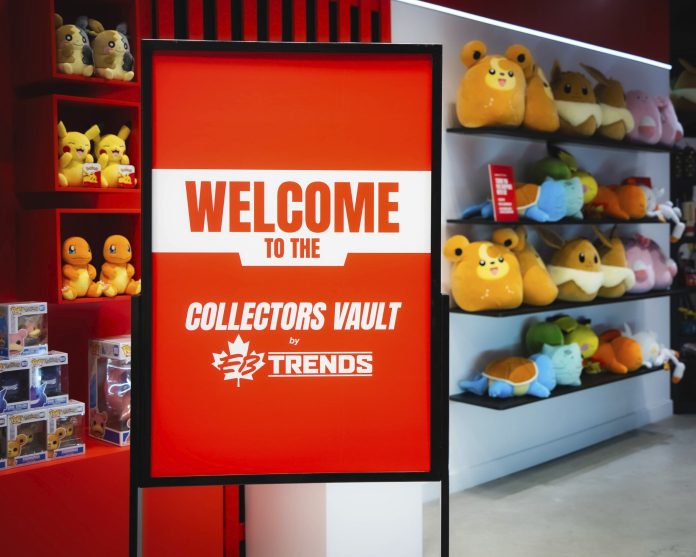
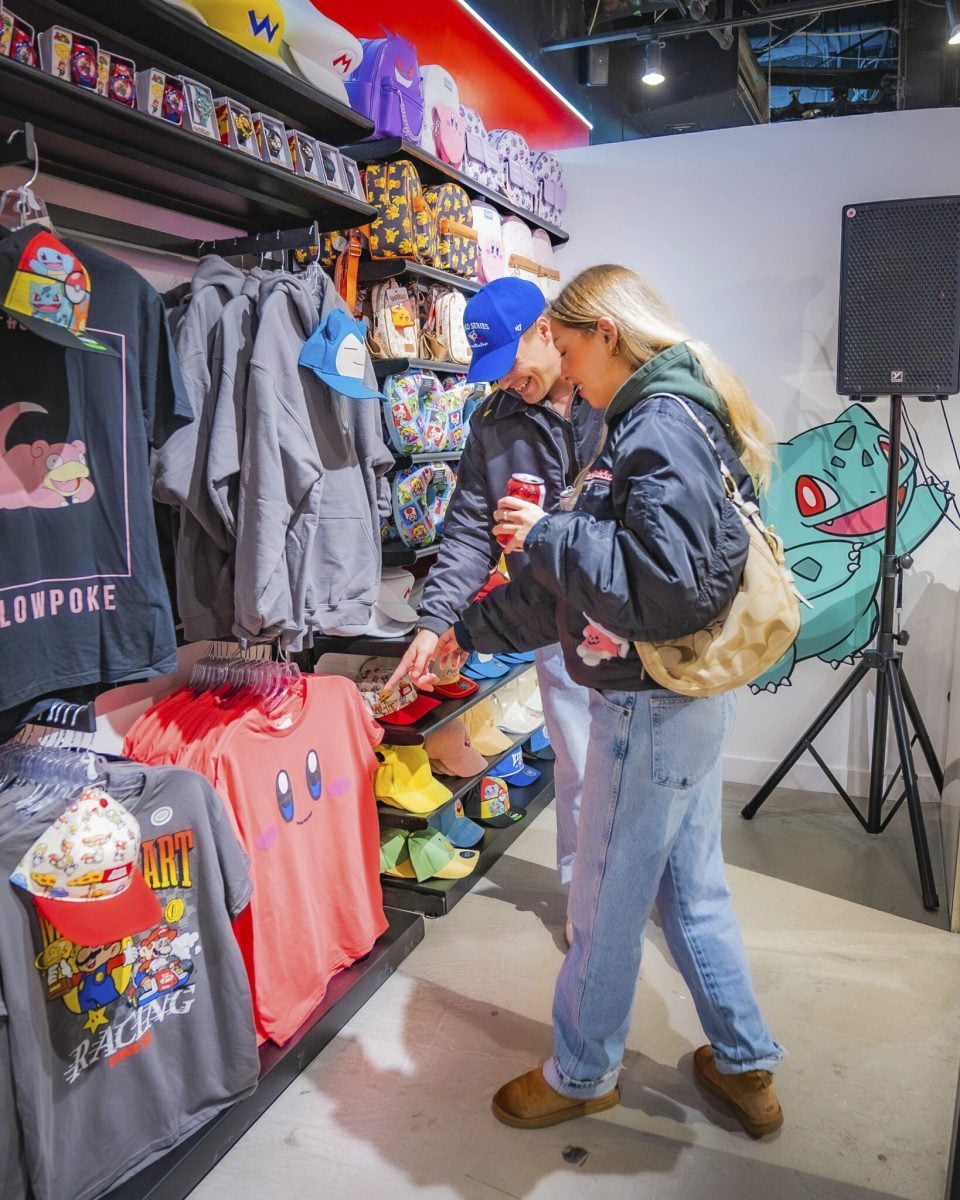
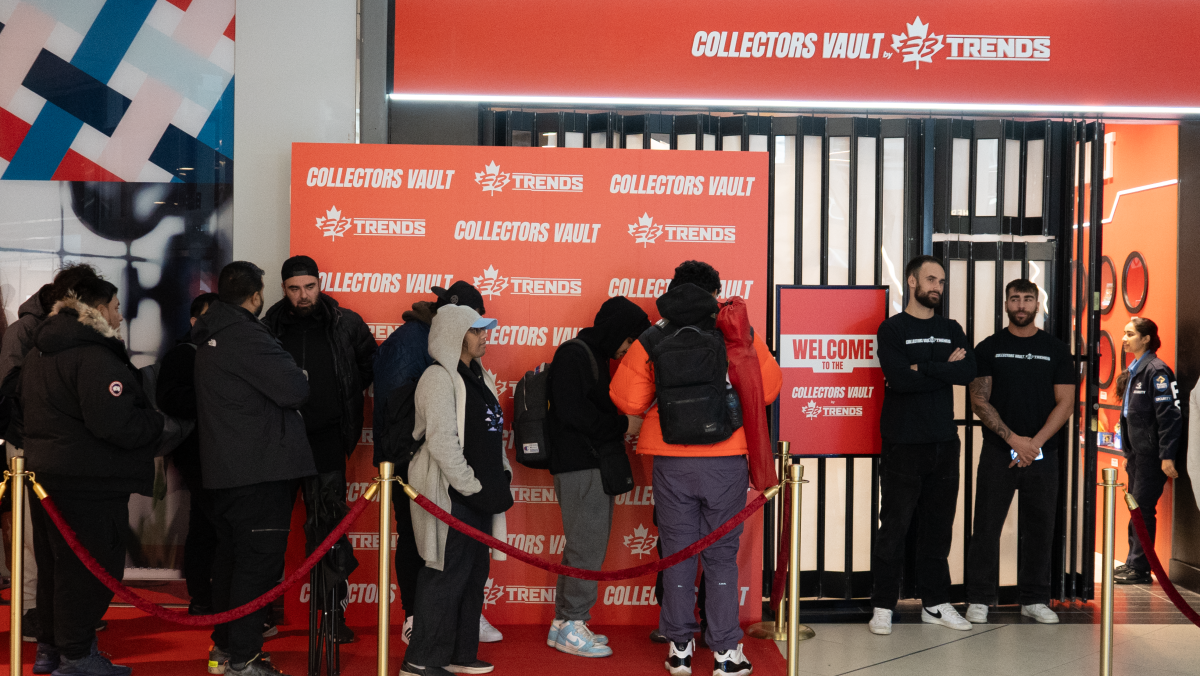
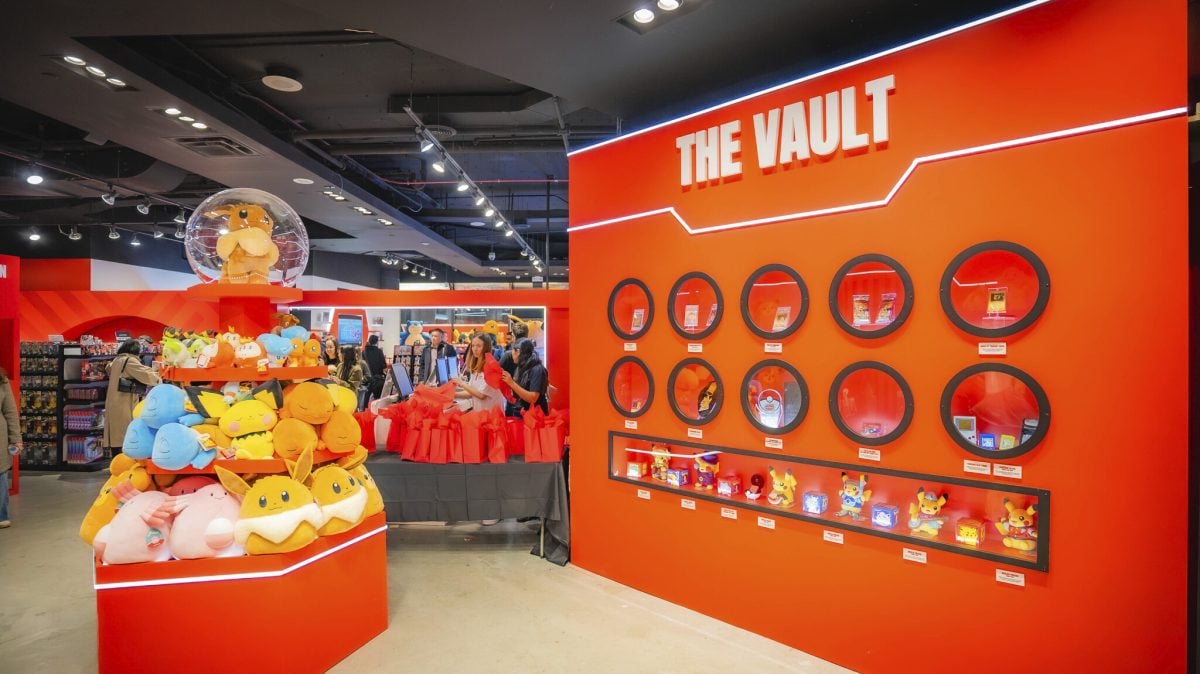
World champions, collectors, and cosplay heroes recently converged on Toronto for the VIP preview of the Collector’s Vault — an EB Trends pop-up at the CF Toronto Eaton Centre celebrating the creatures, cards, and culture that sparked a global obsession.
Toronto’s most passionate fans, including a six-year-old Pokémon prodigy and Canada’s nine-year-old Junior Champion were on site for a one-night-only sneak peek of the Collector’s Vault before it officially opened to the public on November 1.
The Vault, on Level 2 in the former Frank and Oak space, runs until January 15.
Inside people will find:
The Legendary Wall – a display of ultra-rare collectibles worthy of legend
Exclusive merch drops and collector must-haves available for a limited time
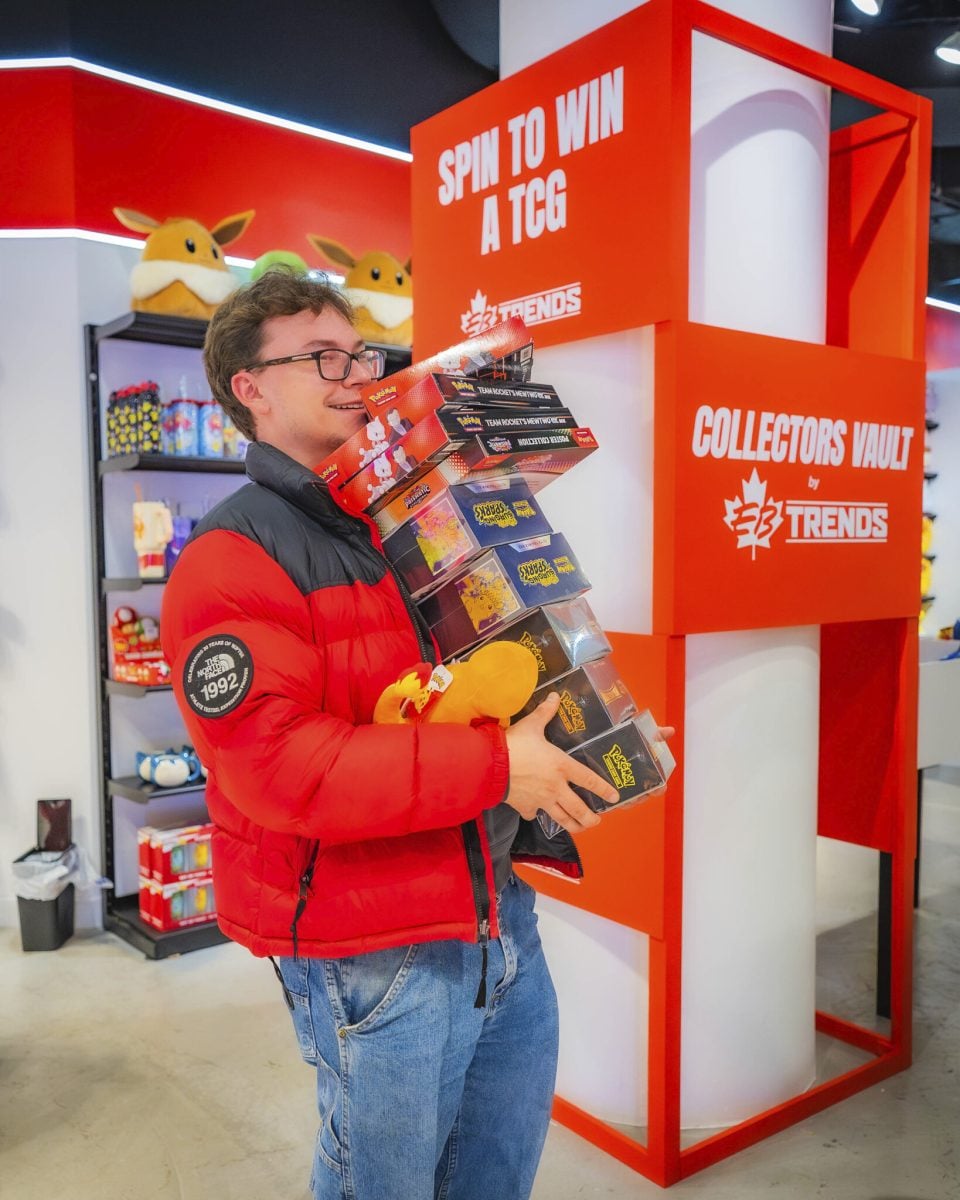
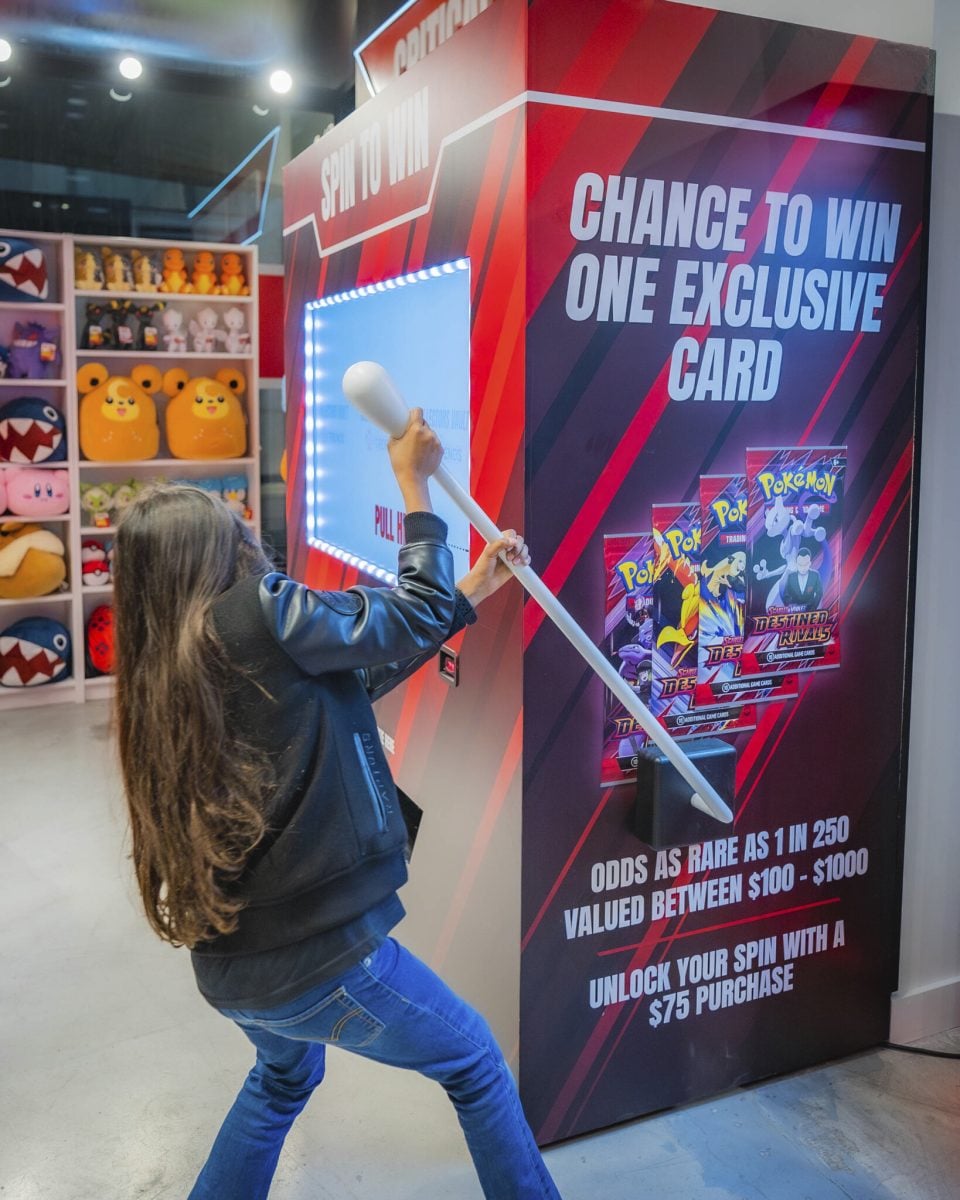
The Epic Pull Machine – with $5,000 worth of cards, including rare ones valued at $1,000
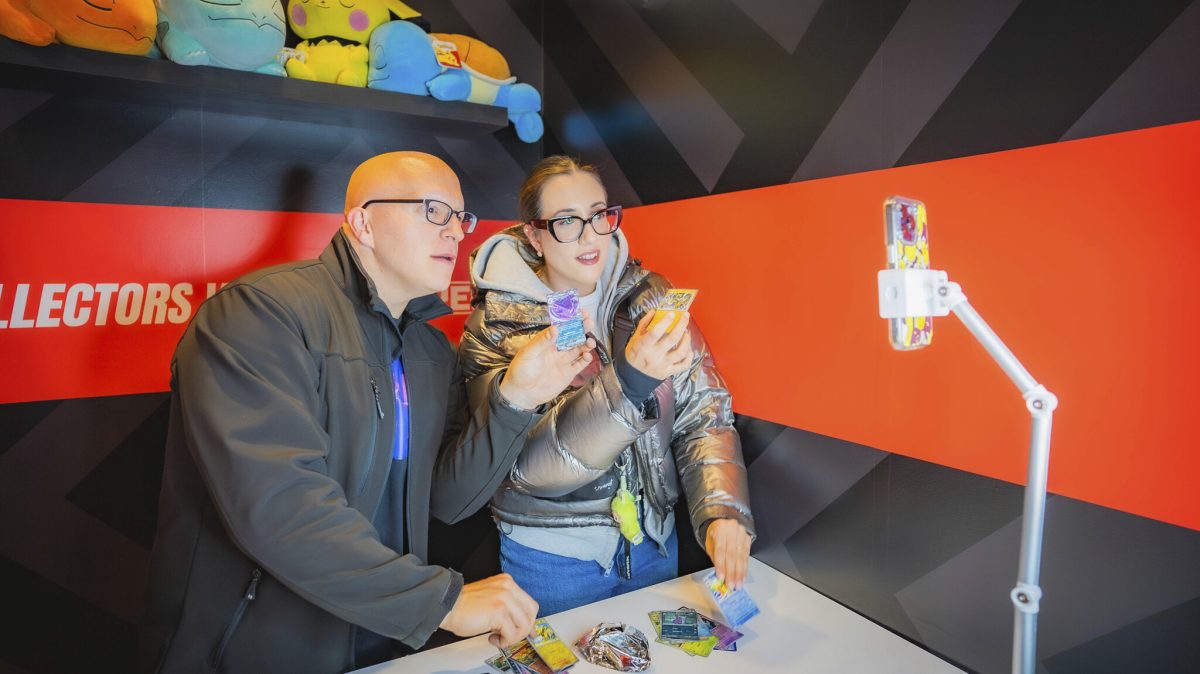
The Live Pack Break Zone – the place to rip, record, and stream your pulls for all to see
Live Pokémon characters – and cosplayers for eye-catching photo opps
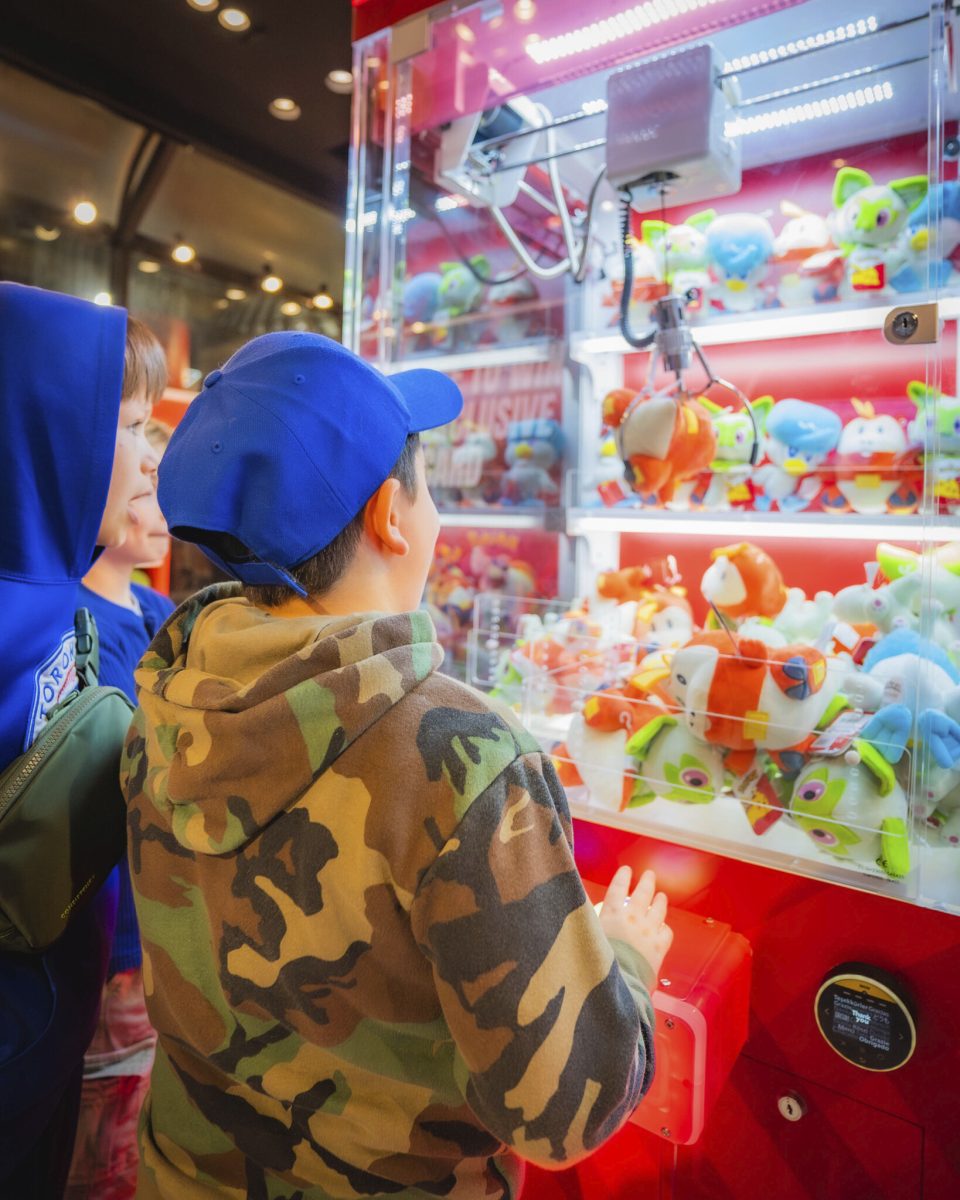
The Claw Machine – the ultimate plushie grab
Jim Tyo
Jim Tyo, President of EB Games Canada, said the Collectors Vault by EB Trends was inspired by a fundamental shift in how Canadians engage with gaming, pop culture, and collectible worlds.
“This store is a reflection of the evolution of fandom culture with design-led spaces they can explore, connect, and fully immerse themselves in with real-world experiences that are exciting and memorable,” he explained.
“This concept for the Collectors Vault was created from a shared ambition between EB Games and Vibrant Marketing to redefine what fan-focused retail can be. Vibrant Marketing brought deep expertise in immersive cultural experiences, and EB Games contributed decades of leadership in understanding what fans look for from specialty retail. Together, we saw an opportunity to build a flexible model that could spotlight whatever worlds or franchises are capturing the public’s imagination at any moment — which is exactly what the ‘Trends’ name represents.
“The Collectors Vault is the first expression of this approach, and the overwhelming response reinforces how powerful it is when you build a destination truly shaped by what fans are excited about.”
Tyo said the company is seeing a remarkable shift in how people approach collectibles.
“For some, these items hold deep personal nostalgia; for others, they represent long-term value and a growing cultural currency. Our goal is to serve both — to honour the emotional connection veteran fans have with these properties while creating an environment that feels exciting, accessible, and relevant for a new generation discovering them for the first time,” he said.
Photo: EB Trends
“The Collectors Vault reflects that balance. We’ve curated premium, high-demand products that serious collectors actively seek, while also designing experiences that invite younger fans into the world of collecting — from live pack-breaks to interactive installations and exclusive drops that spark discovery. Through the EB Trends model, we can continually adapt to the fandoms and cultural movements resonating most strongly, ensuring we’re meeting collectors where they are today and where they’re headed next.”
Tyo said what keeps the brand passionate is the same thing that keeps fans passionate: the sense of connection these worlds create.
“Collecting and competing have always been about more than the items themselves — they’re about the stories, the shared excitement, and the feeling of belonging to a community that spans generations. When you see fans trading tips in line, cheering during a pack-break, or celebrating a plushie grab from the giant claw, it’s a reminder of why this culture endures,” he noted.
Photo: EB Trends
“That energy is what motivates us to keep building spaces like the Collectors Vault. It’s a privilege to help create moments where creativity, competition, and community come together in ways that feel as fresh and inspiring today as they did decades ago. Seeing that passion continue — and grow — is what keeps us invested in delivering experiences worthy of the fans who make this culture what it is.”
Tyo said what younger players gain from Pokémon and the collecting culture goes far beyond the cards themselves.
“These worlds teach strategy, patience, and problem-solving — but just as importantly, they teach confidence. When kids trade, build decks, or hunt for a rare card, they’re learning how to make decisions, express themselves, and engage with others in a community that celebrates curiosity and creativity,” he noted.
Photo: EB Trends
“There’s also a social dimension that’s incredibly meaningful. Collecting introduces younger fans to shared traditions. It gives them a sense of belonging and connection that’s increasingly rare in a digital world whether that’s opening packs with friends, learning from older players, or celebrating small wins together. That’s why we’re building spaces like the Collectors Vault — places where those moments can happen in real life, where younger players can experience the thrill, the learning, and the community that have always been at the heart of fandom.”
Tyo said what makes Pokémon so special for families is that it creates a shared language across generations.
Photo: EB Trends
“Parents who grew up with the franchise are now introducing it to their kids, and that continuity builds a connection that feels both nostalgic and completely new at the same time,” he shared.
“Collecting or competing as a family deepens that bond. It encourages collaboration, friendly rivalry, and a sense of teamwork — and it gives everyone a role to play, regardless of age or experience level. Those shared experiences are what make this world so enduring. When families come into the Collectors Vault, you can see how these moments bring them closer, and that’s exactly the type of connection we want to support and celebrate.”
Rachelle Wintzen, founder of Chi Junky, Toronto’s first full-service, music-forward movement studio, launched her business in 2014, long before boutique wellness evolved into the premium category it is today.
Over the past 12 years, she’s built one of Toronto’s most enduring studio brands – and a model that has influenced some of the city’s biggest players.
Her approach to hyper-curated, white-glove movement experiences set a new standard in the industry, which ultimately led Sweat + Tonic to bring her on pre-launch to design their full-service model and movement programming.
“After almost 10 years living in New York and finding so much inspiration there with the level of customer service, creativity of brands, and offerings I used much of that to inspire Chi Junky. When I moved back to Toronto and spent two years studying the Toronto marketplace, I went to almost every single studio in the city. I studied the experience as a customer, what worked, what didn’t and how I could use what I experienced in NYC and Toronto to create Chi Junky,” explained Wintzen.
Rachelle Wintzen
“The problem I tried to solve in the marketplace stemmed from my own personal struggle (which is the same for many), which was the challenge of trying to get to a class, leaving the house for a long day ahead carrying your gym bag, work bag, yoga mat, water bottle and more. If you forgot your mat it was make or break if I got to the class or not or pay the rental fee for a less desirable rental mat. At the time I was also teaching in home private classes, a service that is a luxury experience and a barrier for most people. That is when the idea for Chi Junky came to me.
“Chi Junky started as a semi-private full service studio that had no more than four people in a class for that individual attention and luxury full service experience. I provided alkaline water, tea service, mats, props and towels all for $25 a person! I wanted to offer a premium experience but at the same competitive price of a standard class drop in fee, I felt strongly that money should not be the breaking point that prevents someone from getting to experience a luxury service. The goal was to make it as easy as possible to get to a class.”
Wintzen said it is hard to believe it has been 12 years, from the humble beginnings of a 150-square-foot room that fit four mats, being a one-woman-show to what the studio has become today – a team of 40 strong and 4,000-square-foot space.
“I never thought the studio would become what it has. I attribute the 12-year success to many things. For one, I never settle. I am constantly seeking ways to improve, innovate and raise the bar within Chi Junky. I am always seeking inspiration not just from within my own industry but a lot from my background which was high end hospitality. I worked in that industry in NYC for almost a decade and that taught me so much and are the principles that I use to drive Chi Junky to this day.
“12 years later you will still find me cleaning the mats, folding our blankets crisply, ensuring I know the names of our members, curating experiences that stem far beyond a typical class and always looking for ways to innovate. I have my hand on everything within the business almost to a fault. Many would say I need to delegate way more but I truly believe that the high level that Chi Junky operates is because I am invested heavily in the small day-to-day details. I also cannot take all the credit, my team is exceptional and they also care deeply about the studio. We love to care for people and while it is a movement studio, we are all in the business of hospitality and customer service first and foremost.”
Rachelle Wintzen
From day one the vision for Chi Junky was to create a space that felt like a home away from home, noted Wintzen.
“This concept remains the same today, all you have to do is show up and let us take care of the rest. I mean that literally. I never enjoyed schlepping everything I needed for a class all over the city. So I changed that and created the first full service studio. When you come to Chi Junky you just need to show up. There is alkaline water on tap with glasses available so you don’t need to bring that clunky water bottle, towels, mats and all the props you need for each class meticulously laid out for you.
“Each of our signature classes has its own prop – styled set up for you and the best part at the end of each class you just get to get up and leave everything there for us to clean up. This is intentional so you can stay in your post class zen state and not worry about cleaning a mat, putting props away and you can just get on with your day. You can even leave your towel on the floor and we will take care of that for you too. We aim to offer a full-service five-star experience from top to bottom.
“All of our props are premium with lululemon mats and plush props from b,halfmoon. Over the years I have found ways to keep improving the full service experience. We have a manual for how we fold every towel in the building from the restrooms to the sweat towels in the studio. The attention to detail and intention behind every small detail is what makes the Chi Junky experience what it is. Down to folding each blanket perfectly, the Chi Junky way, yes there is a Chi Junky blanket folding method too. Each prop is placed in a certain way to create a visually stunning room to walk into which immediately creates a sense of calm.”
Wintzen said she proudly opened and operated the Chi Junky studio at Sweat and Tonic with large success within its first location in 2019.
Photo: Chi Junky
“Since my departure, the Chi Junky full-service experience continues to live on at Sweat and Tonic within all locations. When I first started the concept of full-service in the industry 12 years ago this was unheard of, but now I see this becoming almost an expectation within the high-end boutique fitness space. Pre-pandemic we started to see more high end brands start to enter the marketplace however the pandemic heartbreakingly flatlined a lot of studios,” she said.
“We are now seeing a boom in the industry that we have never seen before. More and more premium fitness brands are opening multiple locations and what is really exciting is that for the first time these brands are entering the New York marketplace, which used to be the other way around. Toronto has significantly leveled up the experience and is exploding right now. There is a welcome trend right now of leaning more into wellness as a social outlet where people are looking to adopt a healthier lifestyle and spend their time socializing less and less over drinks and more in the wellness space.
“Places like Chi Junky become where you go to socialize in a healthy way and become the third space, the third most important place in your life you spend the most time, with home as number one, followed by work and then the third space, your wellness space.”
Photo: Chi Junky
As the boutique fitness space becomes more crowded, what advice would she give to founders trying to build a wellness brand with true staying power?
“Stay true to your intention, values and integrity. Lean into what your unique offering is and never settle. Once you find your concept that sticks, keep innovating and raising the bar within your own offering,” she said.
“Never stay too long in something comfortable, live in the discomfort of always striving to do better. Even if your space doesn’t have all the bells and whistles or deep pockets, get really resourceful, get scrappy (that is true entrepreneurship), and never compromise on exceptional customer service. Above all invest heavily in taking care of your community, they are what will give you staying power against all odds.”