Staples Canada announced Monday the return of its iconic That Was Easy campaign with the launch of a reimagined brand platform designed to help Canadians crush their to-do lists and get back to what matters most.
Celebrating the 20th anniversary of the original campaign and iconic EASY button, this new brand platform goes beyond a nostalgic symbol – it highlights how the brand has evolved over the past two decades, said the company.
Informed by shifting customer needs, this evolution spans Staples’ entire enterprise, across both B2C and B2B operations, and reaffirms its brand promise: to simplify the working and learning experience through curated products, seamless service, and expert support — making life easier for all Canadians, it said.
Rachel Huckle
“For 20 years, the EASY button has symbolized Staples’ commitment to simplifying the working and learning experience for our customers,” said Rachel Huckle, CEO, Staples Canada. “Today, we’re not just reviving a nostalgic part of our brand – we’re redefining EASY. This evolution represents our dedication to curating the right products, creating easy and enjoyable customer experiences, and leveraging our expertise to help Canadians efficiently tackle their to-do lists and get back to what matters most – living.
“We understand that our customers’ lives are busier than ever. Whether you’re a parent, educator, business owner, remote worker, or a student looking for the latest tech, Staples is committed to making your working and learning experience easier, more seamless, and more supportive than ever before.”
The new brand platform reflects how Staples is meeting today’s customers’ needs through:
Curated product selection: Thoughtfully selected offerings across key categories including tech, kids, travel, and services.
Enhanced customer experience: Seamless shopping experiences both in-store and online.
Expert guidance, EASY solutions: Staples associates are at the heart of the EASY experience; knowledgeable, friendly and ready with tailored solutions to help customers make confident decisions.
Human-centered approach: Relating to customers’ everyday challenges with authenticity.
Building confidence: Empowering customers to tackle their to-do lists efficiently.
“The campaign’s TV spot highlights the diverse needs of today’s consumers – from parents gearing up for back-to-school, to remote workers setting up home offices, to business owners streamlining operations – and demonstrates how Staples makes these experiences EASY,” said the retailer.
“At the heart of the creative campaign is the “Staples Family,” who will be featured in all campaign elements throughout the year. The authentic portrayal of everyday Canadians navigating their busy lives showcases how Staples helps them crush their to-do lists so they can get back to enjoying life’s most important moments.
“As part of its continued brand evolution, Staples has introduced a multitude of new products and services to support customers in managing their to-do lists to achieve their goals. These include the expansion of Staples Kids Learn and Play, a partnership to accept Amazon returns, a Print Connect platform to help simplify printing for businesses, and an Apple for Education program to help educational institutions access technology products.”
Heeding the call to address productivity challenges, three quarters of Canadian business leaders say their companies now invest as much as – if not more – than their U.S. and global competitors in technology, machinery, equipment and intellectual property, but American tariffs have put a stranglehold on revenue and are cutting off the funds earmarked for continued investment, according to a new survey by KPMG in Canada,
Most leaders (92 per cent) also acknowledged that they must be bolder and further ramp up their investments in technology and innovation to build a more resilient, prosperous economy. However, six in 10 (59 per cent) say the current economic environment prevents them from investing in the “kind of technologies” that would improve their company’s productivity, said KPMG.
Benjie Thomas
“These results reflect a more ambitious mindset within Canadian business, but they also acutely underscore the difficulties our economy faces right now,” said Benjie Thomas, Chief Executive Officer and Senior Partner, KPMG in Canada. “Tech investment requires a strong bottom line and nine in 10 business leaders say it is essential that governments ‘act with urgency’ and not fall ‘prey to complacency’ in driving tax reform, eliminating interprovincial trade barriers, improving access to capital, and building infrastructure that unites us and opens new markets.”
A 2024 KPMG International survey of global businesses found that large Canadian companies are also outspending their counterparts, but, like the new Canadian survey, many of these investments are still in the early stages and have yet to make up for the extended period when Canadian firms undercapitalized on technology, said the company.
“Canadian firms are at a critical junction in their efforts to modernize and boost productivity,” added Thomas. “The investments they have made in the last few years are making a difference with 75 per cent saying that their digitization efforts have generated the expected returns and benefits. A further three-quarters found their investments in artificial intelligence boosted their productivity by 10 per cent or more, with over a third saying these investments improved it by over 20 per cent.
“There is a big risk that these investments will be stranded if companies don’t have the capital to continue to invest.”
Key KPMG Survey Findings:
75 per cent of 250 Canadian business leaders say their company invests the same if not more than their U.S. and global competitors
92 per cent agree Canadian companies need to ramp up their investments in technologies or risk falling further behind the U.S.
88 per cent say Canadian companies need to be bolder, and not wait around for everyone else to adopt a certain technology
59 per cent say they can’t afford to invest in the kind of technologies that would improve their productivity given the current economic environment
90 per cent say governments “must act with urgency to ensure Canada remains competitive and prosperous,” adding “it’s essential that our governments don’t fall prey to complacency”
75 per cent say their digitization efforts have generated the expected returns and benefits
75 per cent say their investments in AI boosted their productivity by 10 per cent or more, with 37 per cent saying these investments improved it by over 20 per cent
Given ongoing trade uncertainty, three quarters (76 per cent) of respondents are bracing for the worst and taking steps to prepare for a Canadian recession, said KPMG.
To mitigate the effects of a potential downturn, business leaders laid out their top priorities for the Canadian government:
Remove interprovincial trade barriers and harmonize regulations and credentials (64 per cent)
Undertake a comprehensive tax review to improve competitiveness (58 per cent)
Streamline processes and expedite resource and major infrastructure projects (56 per cent)
“In Q1 2025, Happy Belly Food Group marked its 12th consecutive record quarter of growth and reported its first quarter of positive net income from operations-signaling a pivotal cornerstone in our evolution,” said said Sean Black, Chief Executive Officer.
Sean Black
“This achievement underscores our continued progress toward becoming Canada’s premier acquirer and scaler of emerging food brands, while delivering meaningful value to our shareholders. We doubled our system sales, driving a 101% increase versus the same quarter last year. We successfully added 8 restaurant locations in Q1 through our continued focus on organic growth and accretive acquisitions.”
Gary Fung
“I would like to personally congratulate all brand leaders, franchisees, team members and cross functional teams for an amazing start to fiscal 2025. The team continues to execute on our aggressive growth and strategic plans, which is leading to yet another positive step forward and significant growth during Q1 2025. System sales reached $11M (+101%), and total revenues of $4M (+95%) both doubled versus the same quarter last year,” said Gary Fung, Chief Financial Officer.
“Adjusted EBITDA increased 690%, while achieving positive cash flow before changes in non-cash working capital, and our first quarter positive net income from operations. Another key milestone achieved by Happy Belly Food Group.”
As at the end of Q1 2025, Happy Belly had 50 operating restaurants, up 32 or 178% versus the same quarter last year.
“I am very proud of the continued momentum that we have achieved in the business and with our financial results; we doubled our system sales and achieved the first quarter of positive net income from operations. These strong results are a testament to the team-oriented culture we have built at Happy Belly. Our management team and brand partners are working together to support our franchisees as we accelerate national expansion. With a clear focus on growth throughout 2025-2026, we believe our best chapters are still to come,” said Black.
Q1 2025 Financial Highlights
System wide sales across Quick Service Restaurants (QSR) totalled $10.76M in the first quarter of fiscal 2025, up 101% versus the same quarter last year (2024 – $5.36M). The increase is attributed to organic baseline restaurant growth, alongside increased restaurant count, which reached 50 operating restaurants at the end of Q1 2025, up 178% versus 18 in the prior year. Total restaurant count includes the one acquisition during Q1 2025 (Smile Tiger Coffee Roasters; closed January 27, 2025).
Total operating revenues, vendor rebates and interest income totalled $3.67M in fiscal 2024, up 95% versus the same quarter last year (2024 – $1.88M). Year-over-year growth was driven by continued sales growth in both the QSR and Consumer Product Goods (CPG) segments, multiple business acquisitions in the past twelve months, and new net restaurants (6 openings and 1 acquisition during Q1 2025).
Total product sales totalled $3.08M in the first quarter of 2025, up 101% versus the same quarter last year (2024 – $1.53M). In addition, royalties and franchise fee revenues reached $0.39M during the quarter, up 139% from the prior year (2024 – $0.16M), which was driven by an increase in royalties collected from 37 franchised restaurants in the system.
Adjusted EBITDA reached $0.23M or 6.4% in the first quarter of fiscal 2025, up 696% versus the same quarter last year (2024 – $0.03M or 1.5%). During the first quarter of fiscal 2025, net income from operations was net income positive $0.01M versus a loss of ($0.11M) in the prior year.
Net working capital remains healthy at $3.74M as of March 31, 2025 (2024 – $0.80M). Total cash and cash equivalents were $3.60M as of March 31, 2025. One non-brokered private placement was completed on January 9, 2025 for $0.50M. Furthermore, cash flows before non-cash working capital was positive $0.10M in Q1 2025 versus negative ($0.09M) in the same quarter last year.
Happy Belly continued to make accretive cash and equity investments during the first quarter of fiscal 2025 by acquiring Smile Tiger Coffee Roasters on January 27 (1 restaurant location in Kitchener Waterloo).
Happy Belly added eight new restaurants during Q1 2025. The Heal Lifestyle brand opened five new locations. Lettuce Love Cafe and Yolks Breakfast Inc. each opened 1 location. One location was through the acquisition of Smile Tiger Coffee Roasters.
Five individuals and two youths have been charged in relation to an organized retail crime operation that took place at CF Chinook Centre, reported the Calgary Police Service (CPS) recently.
After seeing a concerning rise in organized retail crime, CPS worked alongside the Retail Council of Canada, retail businesses and security teams to develop a coordinated response to protect stores, staff and shoppers, it said in a news release.
“In 2024, retail theft in Canada surpassed $9 billion, with organized groups increasingly targeting high-value goods for resale. The rise in theft has led to increased security costs, declining sales for retailers and growing concern among frontline retail workers,” it said.
“So far in 2025, the CPS has received approximately 400 service calls from retail stores. Of those 400 calls, 142 were related to theft and five were related to robbery. In addition, we have received 3,273 reports through the CPS online reporting system.
“Retail crime may seem like a victimless offence, but it has real consequences for our community,” said Inspector Travis Juska. “It affects business owners, employees and our city’s overall sense of safety.”
In response, CPS said it is working closely with retailers to:
Share intelligence on known offenders and theft patterns.
Encourage timely reporting of all incidents and introduce a direct reporting channel to police and security teams.
Promote crime prevention strategies and staff training.
Between Tuesday, May 13 to Thursday, May 15, officers from the Organized Retail Crime Team conducted targeted enforcement at retail stores in CF Chinook Centre, located at 6455 Macleod Trail S.W., to identify and apprehend individuals involved in retail theft, it said.
Retailers and local businesses are urged to invest in theft deterrence technologies and to report all retail thefts to the CPS to ensure a united front against organized retail crime through the following ways:
Revive Wellness Club at 2100 Bloor St. W. in Toronto. Image: Revive Wellness Club
Revive Wellness Club, a wellness brand originally founded in the United Kingdom, has officially opened its first Canadian location at 2100 Bloor Street West in Toronto’s High Park neighbourhood. The company’s expansion into Canada is spearheaded by Greg Aguilera, who owns 100% of the brand’s Canadian operations.
“This is just the beginning,” said Aguilera. “We plan to open up to 20 locations across Canada, with six corporately owned and the rest franchised. But we’re being selective—this is about doing it right, not just fast.”
Greg Aguilera
A New Kind of Wellness Hub
The Toronto location is more than a spa—it blends wellness, research, and community under one roof in just over 2,100 square feet. At its core is contrast therapy, the practice of alternating hot and cold exposure, delivered in a space designed to be calming and seamless.
“There are no corridors, barely any doors,” said Aguilera. “You flow from one space to another. We designed it to be an experience—not just a treatment.”
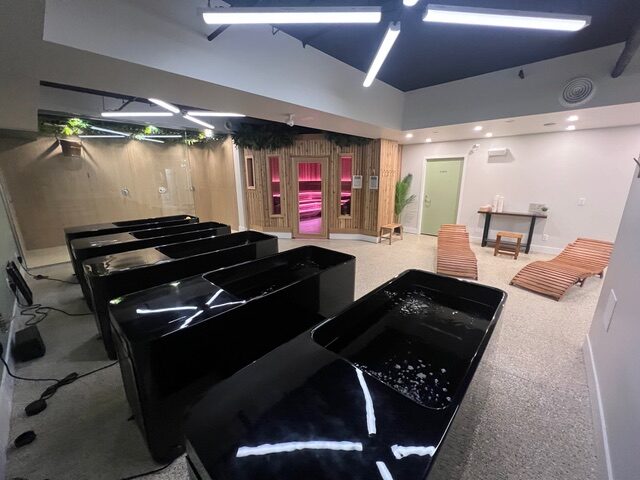
The facility includes a sauna, cold plunge pools, therapy spaces, and a coffee shop—a nod to both wellness and social connection. “We serve the best coffee around,” Aguilera said. “We partnered with Chaveta, a local coffee roaster at 994 Bathurst Street. Our team did six days of barista training. If we’re going to do something, we’re going to do it properly.”
Built from the Ground Up
The Toronto club was developed from scratch. “When we walked in, it was a construction site,” Aguilera said. “We’ve been here since it was a concrete floor. And already, we’re talking about what the first renovation would look like.”
While the space is compact, it’s designed for maximum impact. “This space packs a lot of punch,” he said. “And we’re already thinking—if the space next door becomes available, can we expand?”
A living wall, originally planned for the space, was put on hold due to its $100,000 price tag. “We’ve done the plumbing for it, so maybe down the road. But for now, we wanted to invest elsewhere,” said Aguilera.
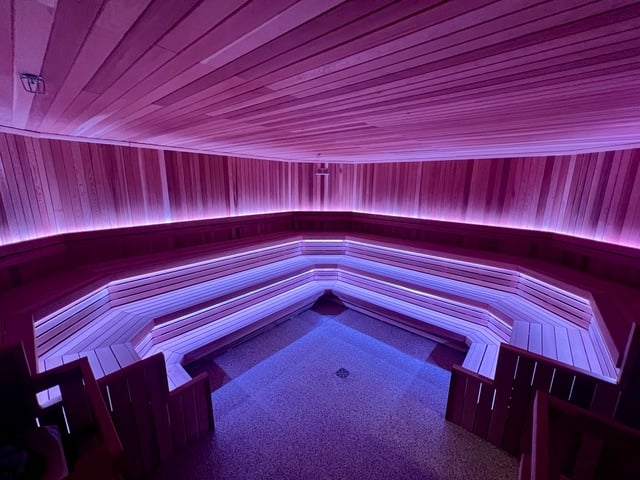
Sauna in the Revive Wellness Club at 2100 Bloor St. W. in Toronto. Image: Revive Wellness Club
Grounded in Science and Research
Revive isn’t just about wellness trends. The brand is partnering with the University of Toronto and OCAD University to foster academic research and creativity.
“We’re working with U of T’s kinesiology, physiotherapy, and chiropractic departments to host student researchers who will study the effects of contrast therapy,” said Christabel, a team member and project leader. “We want real-world data on how this affects both physical and mental recovery.”
A community art project with OCAD is also underway. A mural will adorn a blank wall in the club, reflecting the neighbourhood and Revive’s values.
Aguilera emphasized the importance of these partnerships. “We’re not just saying we’re backed by science—we’re contributing to it,” he said. “Contrast therapy has been around forever, but the research is still limited. We want to change that.”
Wellness for Everyday People
While contrast therapy is often associated with elite athletes, Aguilera says the real growth in the UK—and now in Canada—is among everyday people.
“We thought our main clients would be Olympians and pro athletes,” he said. “But it turns out, the biggest growth is in the everyday person. People with stressful jobs, parents, commuters, anyone looking for one hour to reset.”
Sessions last around 60 minutes and include multiple rounds of hot and cold exposure. “It’s long enough to feel the benefits without diminishing returns,” said Aguilera. “You get dopamine release in the sauna, then you reactivate that with the cold. It’s about balance.”
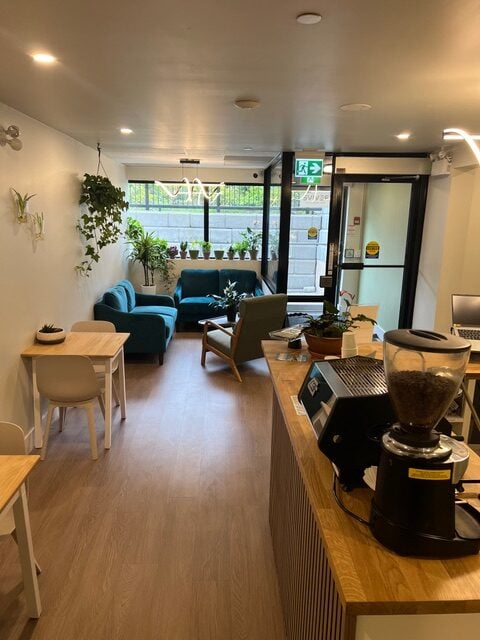
Waiting area, with coffee, at Revive Wellness Club at 2100 Bloor St. W. in Toronto. Image: Revive Wellness Club
A Space to Unwind and Belong
Beyond the science and saunas, Revive is deeply focused on building community. The club hosts support groups, therapy talks, and will soon launch a running club.
“We want to be a space where people can come have a coffee, work remotely, go for a walk, or do a session,” said Aguilera. “People talk to each other here. The energy shifts depending on who’s in the room.”
The club’s philosophy is simple: wellness should be accessible, consistent, and community-driven. “This isn’t a once-a-year spa day,” he said. “This is something you build into your life.”
Eyes on Expansion—Cautiously Optimistic
Revive Canada has ambitious plans to expand to 20 locations by 2027. The next targets include areas across the Greater Toronto Area, followed by the Golden Horseshoe. Aguilera noted that British Columbia and Nova Scotia are also in consideration, with Kelowna cited as a possible location.
“We want to be careful,” he said. “We’re not giving out franchises like candy. Franchisees need to be passionate. If you’re not invested emotionally, this isn’t the business for you.”
Aguilera added that all of the operational systems in place—from hiring to training to community engagement—are designed with scale in mind.
“We built this for growth. But controlled, intentional growth,” he said.
Revive Wellness Club at 2100 Bloor St. W. in Toronto. Image: Revive Wellness Club
Global Aspirations—and a Wellness Cave
While Canada is the priority, the long-term vision is international. Aguilera owns 33% of Revive UK, which has four locations including partnerships with British Olympians and sports teams.
He teased one particularly ambitious idea: “We want to build the first Revive in a cave in South America,” he said. “A real cave. And all Revive members globally would have access.”
Not Just Wellness—Longevity
Ultimately, Revive is about more than just treatments. It’s about giving people a space to heal, decompress, and invest in their long-term health.
“People are starting to see that wellness isn’t a luxury—it’s a necessity,” said Aguilera. “This isn’t eyebrow threading. This is your vascular system, your mental health, your body’s ability to cope with stress. It’s real.”
Revive Wellness Club is now open to the public at 2100 Bloor Street West in Toronto. The team encourages locals to stop in—for a session, a coffee, or just a chat.
“This is just the beginning,” said Aguilera. “Toronto is the first chapter of a much bigger story.”
American Express has announced the return of its Backing International Small Restaurants grant program in Canada to help small, independent restaurants grow and thrive.
The company said the program, in its fourth year in Canada, is designed to help small, independent businesses that support their communities – specifically those serving or operated by individuals facing economic hardship – to make meaningful upgrades, like enhancing digital capabilities, improving kitchen operations and reimagining their dining spaces.
Applications in Canada are open until June 30, 2025. Eligible, independent food establishments located in Toronto and Montreal areencouraged to apply.
Kerri-Ann Santaguida
“At American Express, we’re proud to continue backing small restaurants that play such a vital role in our local communities,” said Kerri-Ann Santaguida, Vice President and General Manager, Merchant Services, American Express Canada. “These restaurants are more than just places to dine — they are cultural and community anchors. This program is designed to invest in this important group of business owners so they are able to preserve what makes their restaurants so special.”
Since launching in 2022, the Backing International Small Restaurants initiative has supported more than 135 restaurants worldwide. Among last year’s Canadian recipients was Montréal’s Bocadillo, a family-run restaurant that used its grant to expand its role as a hub for the city’s music and dance community.
“The grant had allowed us to host more live music events, upgrade our sound system, and improve the dining experience for our guests, ultimately helping us strengthen our connection with our local community in Montreal,” said Laura Uzcategui, owner of Bocadillo.
This year, Backing International Small Restaurants is bigger than ever and is open to applicants in three new countries — France, New Zealand, and Spain — in addition to dining establishments in Australia, Canada, Japan, Mexico, and the U.K. The program is offering $1.45 million USD in funding to 100 restaurants so they can make critical improvements, like upgrading kitchen equipment and making improvements to their storefront, said American Express.
David Downey
“The IDA Foundation is excited to partner once again with American Express to launch the fourth year of the Backing International Small Restaurants program,” said David Downey, Executive Director, IDA Foundation. “To empower these vital community anchors to thrive, this initiative provides essential support to the independent restaurants that are the heart and soul of our downtowns.”
Amex Canada also has a grant and mentorship program run by DMZ at Toronto Metropolitan University. Funded by Amex Canada and administered by DMZ, 100 Canadian small businesses will be selected to each receive a $10,000 CAD grant and mentoring support.
Retail Insider is streamlining its Canadian retail news from around the web to include a handful of top news stories that can be viewed quickly during the day. Here are the top stories from the past 24 hours.
Business trips from Canada to Montana are becoming more and more common because this American state attracts entrepreneurs with its economic potential and strategic location personally. From new business opportunities to logistical challenges and legal risks, Canadian businessmen must be well-prepared.
We will provide a detailed guide to successful and safe business travel, with a focus on practical advice, risk prevention and how to protect your valuables when making a business trip with a flight case.
Why Montana is an increasingly attractive destination for Canadian businesses
Montana stands out as an attractive destination for Canadian entrepreneurs because of its dynamic business environment. The country is experiencing the development of new shopping centers and business zones, which allows easier access to retail and distribution. Montana’s tax environment, including the absence of a state sales tax, attracts companies looking to optimize costs.
The proximity of Canadian provinces such as Alberta and British Columbia further facilitates logistics operations, enabling faster transportation of goods and services across the border. This geographic advantage, combined with the growing demand for Canadian products, makes Montana an ideal location for business expansion.
For Canadian businesses, this country represents a gateway to the wider US market, with relatively low operating costs compared to other countries.
How to prepare a business trip from Canada to Montana – documentation, customs and logistics
Preparing for a business trip to Montana requires careful planning to avoid problems at the border. The first step is to check the documentation. Canadian entrepreneurs must have a valid passport, and in some cases a visa, depending on the length of stay and purpose of travel. For business activities such as meetings or trade shows, an ESTA authorization to enter the US is usually sufficient, but it is important to check the specific requirements of the US Embassy.
Customs regulations are a key part of preparation. If you are carrying product samples, promotional materials, or equipment, you must complete customs forms and prepare invoices proving the value of the goods.
Logistics includes the choice of reliable transportation. Most Canadian businessmen choose road transportation because of Montana’s proximity, but it’s important to check road conditions and weather conditions, especially in the winter. Accommodation reservations in cities such as Billings or Bozeman, which are Montana’s business centers, should be made in advance to ensure availability.
The most common reasons why Canadian traders choose to make business visits to Montana
Canadian entrepreneurs visit Montana for a number of reasons. Trade fairs and exhibitions, such as those in the field of agriculture or energy, attract companies that want to present their products or establish new partnerships. B2B meetings are another important reason, as they enable direct contact with local distributors and customers.
Retail expansion is also a significant motive. Many Canadian brands are exploring the possibility of opening stores or warehouses in Montana to take advantage of lower taxes and demand for quality products. In addition, the visits enable the evaluation of the competition, which is crucial for strategic planning.
Risks on America’s Roads: What Every Canadian Business Needs to Know About Traffic Safety
Driving in Montana can be challenging for Canadian drivers due to differences in traffic regulations and road conditions. Speed limits in Montana are often higher than in Canada, especially on highways, but the penalties for violations are severe. It is important to familiarize yourself with the local rules, such as the obligation to wear a seat belt and the ban on using mobile phones while driving.
Long stretches without gas stations or service stations are common in rural Montana, so it’s essential to plan your routes and make sure you have enough fuel. Winter storms can cause road closures, requiring you to check weather forecasts and use winter tires. Driving style in the US can be more aggressive, especially on busy stretches, so caution is key.
What to do if there is a car accident during a business trip to the USA
In the event of a traffic accident, the first thing is to ensure the safety of all participants. If possible, move the vehicle off the road and turn on all warning lights. Call 911 if there are injuries and contact the police to make an official report. Documenting the incident is key – photograph the scene of the accident, vehicle damage and any injuries.
Share basic information with other participants, including names, contact information, and insurance information, but avoid discussing guilt. Notify your company and insurance company as soon as possible, giving them all the relevant details. If the accident has serious consequences, consider consulting a Montana legal professional.
Hiring a car accident attorney may be necessary if the accident results in significant financial losses, injuries, or legal disputes. For Canadian citizens, finding a local Montana car accident attorney can be a challenge, but it’s important to seek out an expert with experience in traffic law. It is advisable to check online directories or contact local law associations.
Differences in the laws between Canada and Montana may affect the outcome of the case. For example, Montana uses a “fault” system for determining liability, which means that damages are awarded based on the degree of fault of each party. An attorney can help navigate these differences and protect your interests, especially if you are facing international legal implications.
Business and legal advice for loss prevention during business trips to the US
Loss prevention begins with adequate insurance. Check whether your business insurance covers overseas travel, including car accidents and medical expenses. Consider additional rental car insurance to reduce the risk of unexpected expenses.
Corporate responsibility is also significant. Make sure all employees are familiar with accident procedures and have access to emergency contacts. Personal protection includes carrying essentials such as a first aid kit, a spare phone, and cash for emergencies. Regular education about traffic regulations and safety practices can significantly reduce risks.
Conclusion
Business travel from Canada to Montana offers numerous opportunities for business growth and development but requires thorough preparation. Special attention should be paid to legal risks, such as traffic accidents, where cooperation with local lawyers can be crucial. With smart planning, proper insurance, and education, these trips can be safe and successful. Travel smart and achieve your business goals without unnecessary complications.
Retail sector marketing doesn’t stand still — it changes and evolves along with the advancement of new digital technologies and shifting customer behaviors. As customer expectations rise, marketers face growing pressure to deliver smarter, more engaging campaigns.
Keeping customers engaged can be very challenging, indeed, unless you constantly stay in the loop of the latest retail digital marketing trends and know how to leverage those in your marketing practices.
This article will bring you some of the hottest retail marketing trends, each with countless tips to help you stay one step ahead of the competition and create campaigns that truly convert.
1. Real-time marketing: creating instant connections with shoppers
The pace of changes in society, business, and, of course, marketing, gradually but steadily displaces any strategy that relies on slow and inefficient customer-servicing models and processes. In simple terms, staying competitive and not being real-time and instantly magical is not possible anymore.
Remember when campaigns took months to roll out? Cute era. Now your latest social feed is an F1 track, and you’re the pit crew. Real time marketing remains a tried and trusted method for boosting engagement during live events or viral moments online.
Keep agility on tap with this mini-playbook:
Track current and trending hashtags hourly.
Pre-design flexible templates.
Reply to comments like a human.
Prepare ready-to-deploy discount codes.
Employ always-on social listening tools.
Consider implementing a post-sales performance tracker.
Now, every pop-culture moment becomes a potential micro-campaign, whether folks are sporting limited-edition tees or handing out branded high-quality custom silicone wristbands that tie the moment back to your brand. Shoppers feel the adrenaline, share the post, and click “add to cart” before the highlight reel ends.
The so-called agile approach in marketing stipulates small steps, not being afraid to make mistakes and learn from them, and continuous improvements on an everyday basis will follow.
In digital marketing in retail industry, you cannot win if you don’t make mistakes. In this insane pace of business and social life, mistakes are simply inevitable. The most successful marketers are the ones who changed their attitude to small failures as a means to progress. Why don’t you follow their example?
Just remember: speed without relevance equals cringe. Speak when you can add wit, warmth, or a can’t-miss promo. Otherwise, wave as the trend zooms by — there’ll be another in ten minutes.
2. Voice search optimization for retail sites
Have you noticed how more often customers in retail rely on their voice when searching for goods and services? Everyone serious about search engine optimization (SEO) knows that voice search optimization is the new hot trend in digital marketing, and in SEO for retail websites in particular.
If typing is yesterday’s search, chatting with a device is today’s concierge service. Shoppers love the hands-free convenience: browsing while cooking, comparing prices while commuting, or checking stock without leaving the couch.
Voice queries sound like a conversation between friends. They’re longer, more polite, and often urgent. “Hey Siri, is there a 24-hour florist open tonight?” That urgency means the answer they hear first wins the sale.
Think of your website as an audio script. Headings become cues, meta tags the stage directions. If your site reads awkwardly out loud, rewrite until it flows.
Use conversational modifiers (“for kids,” “under $50”).
Optimize images with descriptive file names (voice uses them too).
Structure content chronologically to aid story-style answers.
Implement breadcrumb navigation for a clear hierarchy.
Monitor Google’s Search Console for rising voice-style queries.
Voice commerce is next. Set up quick-pay options linked to wallets like Apple Pay or Amazon Pay, so a user’s voice command can translate into a completed order and a tangible gain for your retail business.
Keep experimenting. Record yourself asking ten product questions; if your store never shows up, that’s your to-do list for the week. Dominating voice search means being the retailer that literally speaks to its customers.
3. Augmented reality for virtual try-ons
Relatively recently, the most curious of us read in futurologists’ books (like the ones written by Ray Kurzweil and Peter H. Diamandis) how the new technology — augmented and virtual reality — will change our shopping experiences in the future. This future they talked about is already here, and it’s a big part of the key trends in retail marketing.
Blink and the mall dressing room has moved into your living room. Point your camera, pick a product, and voilà — your reflection sports a new jacket or eyeliner shade. The line between browsing and buying just blurred in beautiful ways.
Consumers adore the “zero-commitment trial.” No more shipping four sizes and mailing three back. Instead, they spin around, zoom in, and decide instantly. Brands benefit too: lower return rates, higher average order value, and social buzz when shoppers share their augmented reality (AR) selfies.
The challenge? Making the customers’ shopping experience foolproof for every device, from budget Androids to flagship iPhones. Lighting, skin tones, and bandwidth vary wildly, but robust calibration keeps the illusion intact.
Try these five focus areas to nail your AR deployment:
Ensure one-tap access inside product pages.
Implement real-time size scaling for accurate fit.
Toggle views (front, side, 360°) at a swipe.
Add a snapshot option for social or wish lists.
Don’t forget about the call-to-action like “Add to cart now.”
Once your AR campaign goes live, promote it loudly. Use tutorials on Instagram Reels, QR codes in store windows, and email teasers to drive adoption. The first AR session is the gateway drug; after that, customers expect it everywhere.
Congratulations, you’ve contributed to making customers even more spoiled. That’s why it’s so important to keep iterating. For example, introduce seasonal filters, limited-edition skins, or gamified rewards for trying multiple items.
AR is still a novelty for many shoppers, so fresh content keeps them coming back for more digital dress-up — and more real-world purchases.
4. User-generated content
Which type of user reviews do you trust more when shopping, let’s say, on Amazon? We bet you start with the ones where users included photos of their purchased goods, or videos of usage, or the unpacking process.
Think back to the last gadget you bought. Did you trust the brand’s polished video or that grainy YouTube review where someone stress-tested it with duct tape? Odds are the latter will sway you. That’s the quiet strength of user-generated content (UGC).
Beyond persuasion, UGC fuels SEO. Those image alt tags, captions, and off-site shares widen your keyword net without lifting a finger. It’s crowdsourced optimization.
As you start investing in UGC strategies, don’t overlook the value of earning niche-relevant backlinks. Engaged users are more willing to share a link to your website or retail shop. For the same token, a mention on a specialized forum often delivers higher-intent visitors than broad social exposure.
Kick off your UGC-focused marketing campaign with these tactics:
Ship thank-you cards asking for a quick photo review.
Set up a “Wall of Fame” on your homepage.
Integrate referral links, so users earn perks when friends purchase.
Sponsor themed photo walks or demo days.
Track top contributors and surprise them with generous discounts.
Transparency is crucial. Modern-day users are smart and can sense and track your actions, just like you do to theirs. If you edit a user’s image, disclose it. That forthrightness preserves trust and encourages more submissions.
UGC also feeds product innovation. Spotting repeated complaints about a strap breaking triggers a redesign long before support tickets pile up. Listening to users through their content keeps your brand ahead of the competition and helps it stay away from possible reputation damage.
5. Data-driven retail marketing and lead generation tools
Given the pace at which the above-mentioned digital trends in retail develop and the sheer volume of marketing nuances involved, you may ask yourself if you can pull this off. An old-fashioned marketer of the 90s couldn’t, but someone armed with the latest lead generation tools can.
Retail digital marketing relies heavily on data. And where there is data, there are means to squeeze every drop of insight into revenue-driving actions. Retail’s secret sauce is no longer catchy slogans — it’s behavioral analytics predicting when Jessica will need new running shoes before her current pair retires.
At the heart of that prediction is lead scoring. Enterprise retail tech firms often rely on software like Breadcrumbs to score leads and convert more effectively, elevating quality over quantity so marketing dollars aren’t wasted on window shoppers.
Below, find a toolkit to jump-start your data-driven conquest:
Site personalization platforms, e.g., Optimizely, Dynamic Yield, Fresh Relevance.
Lead-scoring engines like Breadcrumbs, HubSpot Lead Scoring, or Marketo Engage (by Adobe).
Exit-intent survey tools like Qualaroo, Hotjar, or Website Feedback by SurveyMonkey.
Affiliate-management hubs (to track influencer performance), such as PartnerStack, Refersion, or Rakuten Advertising.
Predictive email platforms, e.g., Klaviyo, Iterable, ActiveCampaign, or the famous Mailchimp.
For retail teams shortlisting vendors, compare data coverage, enrichment accuracy, intent signals, and CRM integrations. This 2026 ai lead generation platform guide benchmarks leading tools and outlines selection criteria tailored to retail—helping you align AI scoring, automation, and compliance with higher lead-to-customer conversion.
Track two KPIs religiously: average order value and lead-to-customer ratio. When both return high values, your stack is aligned. If they stall, dive into your scoring model — maybe a once-hot attribute cooled off post-holiday season.
Finally, pair quantitative dashboards with qualitative interviews. Yes, these are time-consuming, but the efforts are totally worth it.
Data hints at what happens; customers tell you why. Merge those perspectives, and your marketing engine evolves from merely data-driven to insight-oriented.
Take this with you
Just before you go, take the gist of the five retail marketing trends from this article with you:
Real-time marketing
Real-time marketing keeps your brand relevant by meeting customers at the exact moment of engagement. It isn’t optional anymore — it’s a must if you want to grab shoppers’ attention and boost your conversions.
Voice search optimization
Voice search favors conversational phrasing, location clues, and quick access to information. If your retail site doesn’t answer voice queries clearly, it’s time for a content tune-up.
Augmented Reality (AR)
Shoppers want fun, realistic AR — and they expect it to work perfectly across devices. With AR, product discovery becomes visual, interactive, and more shareable than ever.
User-Generated Content (UGC)
Customers trust other customers — UGC turns shoppers into your most powerful marketers. As you start investing in UGC strategies, don’t overlook the value of earning niche-relevant backlinks.
Data-driven retail marketing and lead generation tools
Today’s retail success is built on actionable data, not gut feeling. Data tells you who to talk to, when, and what to say — your only job is to listen and act.
Our final recommendation is to constantly stay on your toes for what might be coming to the retail digital marketing mainstream tomorrow or the next month. When artificial intelligence is doubling its strength every two weeks or so, and quickly becoming implemented in marketing tools and technologies, nothing is impossible anymore.
In today’s fast-paced retail world, 73% of consumers say product presentation strongly influences their buying decisions. A merchandising app has become an essential tool for businesses trying to stay ahead of the competition and manage retail execution with precision. These apps help streamline visual merchandising, track compliance, and boost sales performance—all in one place. From small local chains to global brands, digital merchandising tools are now critical to success.
Let’s explore when your business truly needs a merchandising app and how to make that decision count.
Signs It’s Time to Invest in a Merchandising App
If you’re questioning whether now is the right time to invest in technology, there are a few clear signs that your business is ready. Below are the most common situations where a merchandising app can shift operations from chaos to control.
1. You’re Managing Multiple Retail Locations
Juggling displays, promotions, and stock across multiple stores can be overwhelming. A merchandising app gives your team a centralized platform to upload photos, track compliance, and communicate instantly. Instead of relying on manual checklists or scattered emails, everything is managed in one clean system.
More importantly, it ensures brand consistency. When your product displays look different in every location, it hurts the customer experience. A merchandising app standardizes execution and gives managers real-time visibility into what’s working and what’s not.
2. Store Audits Are Taking Too Long
If audits are eating up your time and producing inconsistent results, you’re overdue for a digital solution. Store audits are vital to understanding execution gaps—but only when done efficiently.
A merchandising app can cut audit time in half by automating checklists, enabling photo uploads, and offering GPS-stamped reports. Instead of spending hours compiling notes and photos after each visit, reps log everything in real time. This creates a faster feedback loop and reduces human error.
3. Your Field Team Isn’t Aligned
One of the biggest challenges in field operations is communication breakdown. Whether it’s unclear instructions, delayed updates, or outdated paperwork, poor communication slows execution and costs money.
A merchandising app solves this by giving everyone—managers, reps, and merchandisers—access to the same data. Tasks, guidelines, planograms, and reports live in a single mobile platform. No more searching through inboxes or WhatsApp groups for the latest plan. Alignment becomes automatic.
By the time your field team starts asking for better tools, it’s often a sign you should have invested in a merchandising app already.
4. Promotions Aren’t Being Executed Correctly
You spend time and money planning seasonal or promotional campaigns, but what happens when they don’t get implemented on the sales floor?
Without a merchandising app, it’s tough to verify what’s been set up. Store staff might forget to install signage or place displays in the wrong spot. These errors are invisible unless you’re physically in the store.
A merchandising app lets your team upload visual proof of execution. You can monitor every location, provide instant feedback, and make adjustments on the fly. Campaigns roll out on time, everywhere.
5. Inventory Issues Are Hurting Performance
If stores constantly run out of stock or display incorrect SKUs, your bottom line takes a hit. Without visibility into what’s actually on shelves, you’re flying blind.
Many merchandising apps integrate with inventory systems or allow field reps to scan barcodes and log stockouts. This lets managers act quickly, reallocating stock or reordering as needed. You get hard data instead of vague reports.
A merchandising app like LEAFIO.AI enhances inventory management by providing real-time data analytics, enabling retailers to optimize stock levels and reduce waste. It utilizes advanced algorithms to forecast demand accurately, ensuring that the right products are available at the right time. Additionally, the app streamlines the replenishment process, allowing retailers to maintain efficient inventory turnover and improve overall operational efficiency.
In this way, a merchandising app becomes more than a tool for visuals—it’s a vital link between the shelf and the supply chain.
6. Data is Stuck in Spreadsheets
You can’t optimize what you don’t measure. If your reporting still relies on Excel files or manual updates, you’re wasting time and missing insights.
Modern merchandising apps generate reports instantly. They track everything from task completion rates to compliance scores and shelf photos. You can filter by region, team, product, or store, making it easy to identify problems before they spiral.
And because everything is cloud-based, your data is always up to date and accessible from anywhere. That means faster decisions and smarter strategies.
7. You’re Expanding Into New Markets
New markets mean new teams, new stores, and new challenges. Maintaining consistency across unfamiliar territory can be tough.
A merchandising app gives you a playbook. New hires access the same standards and training materials as your veteran staff. Tasks are tracked automatically, ensuring that execution is on par from day one.
Instead of adding layers of bureaucracy, the right app simplifies onboarding and lets you move faster.
8. Brand Image Is a Priority
Brand image is built on what customers see in stores. Poor lighting, missing signage, or sloppy displays degrade trust and lower perceived value.
By using a merchandising app, you enforce your visual standards at scale. Every store gets the same guidelines, and every rep is accountable. You protect the brand you’ve worked hard to build.
This matters not just to customers, but to partners, investors, and vendors who expect professionalism and consistency.
9. You Need to Prove ROI
Whether you’re pitching to stakeholders or evaluating team performance, you need clear evidence of impact. That’s where a merchandising app shines.
With built-in analytics, you can connect merchandising quality to sales lift, campaign success, or audit pass rates. You don’t just tell the story—you show it with proof. And that makes your business case much stronger.
Conclusion
Businesses don’t just wake up needing a merchandising app—it becomes essential when execution, visibility, and consistency start slipping. Whether you’re managing growth, fixing field issues, or aiming to improve performance, a merchandising app offers control, clarity, and speed. It’s not a luxury. It’s a necessity when your business moves beyond what spreadsheets and emails can handle.