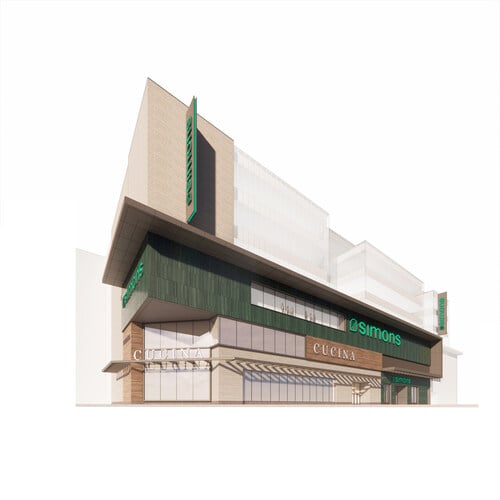
Simons, Canada’s oldest private, family-owned business, announced Thursday it is continuing to expand in Toronto with the opening of its highly anticipated CF Toronto Eaton Centre store on September 18 at 10 a.m. EST.
The second of two new locations opening in the city this year, the CF Toronto Eaton Centre store will span more than 112,000 square feet across three floors and feature labels exclusive to Simons as well as international designers, local brands, and pieces by our country’s artists that will be revealed at the opening. True to Simons’ uniquely Canadian approach, the structure will be inspired by natural elements, leveraging architecture by Lemay-Michaud Architecture and an interior design by Toronto-based Gensler Design, said the retailer.
Rendering of the Simons location at CF Toronto Eaton Centre, set to open to the public on September 18, 2025 at 10:00 a.m. EST. (CNW Group/Simons)
“At Simons, serving our customers has always been more than a responsibility—it’s a privilege rooted in care, creativity, and connection,” said Bernard Leblanc, President and CEO of Simons. “We’re thrilled to open our doors at CF Toronto Eaton Centre on September 18 and become part of the downtown Toronto community. This iconic location is the perfect place to share our passion for fashion, art, and design, and we look forward to building meaningful relationships with Torontonians through the exceptional service and sense of purpose that guides everything we do.”
As Simons’ 19th location across the country, the opening marks a major milestone in the brand’s continued national expansion, reaffirming its investment in the Greater Toronto Area and the future of Canadian retail, it said.
Simons was founded in 1840 by John Simons in Quebec City. Originally a dry goods store, the family company is known today for accessible and inspired fashion. Locations: 10 in Quebec, including the company’s head office in Quebec City; three in Alberta; one in British Columbia; one in Nova Scotia; and soon four in Ontario.
The RONA Foundation, which oversees the philanthropic activities of RONA inc., one of Canada’s leading home improvement retailers operating and servicing some 425 corporate and affiliated stores, has launched the Home Sweet Home campaign’s third edition.
From September 1 to October 12, 2025, the network will mobilize to collect donations in support of nearly 150 local non-profit organizations that provide help to victims of domestic violence, low-income families, and people with disabilities or mental health issues. The campaign will run in all corporate stores, as well as some distribution centres and several stores in its network of affiliated dealers, said the retailer.
The RONA network teams are ready and motivated for the start of the new edition of the Home Sweet Home campaign. (CNW Group/RONA inc.)
Josée Lafitte
“Our goal is to make a difference in the lives of the communities around us, and that’s what drives our daily activities at the RONA Foundation. What I love most about our Home Sweet Home campaign is that its impact is significant at a local level; indeed, the selected organizations we help are located in the same regions as our stores and distribution centres,” said Josée Lafitte, Director of the RONA Foundation.
The Foundation hopes to raise $500,000 during this campaign.
“Once again this year, everyone in our network is highly motivated to raise funds, especially since our store teams are the ones who decide which organization to support. At RONA and the RONA Foundation, we believe that every individual should have a suitable living environment that meets their needs. Each in their own way, the organizations we support contribute to improving the quality of life of vulnerable Canadians,” said Catherine Laporte, President of the RONA Foundation’s board of directors and Chief Digital and Marketing Officer at RONA.
Catherine Laporte
Customers will be invited to make a donation in support of their local cause. As for online shoppers, they will also get the opportunity to donate $2, $5 or $10 on rona.ca.
The Foundation is a charity established in 1998, whose mission is to help improve the quality of life of Canadians in need by revitalizing their living environments or making it easier to access housing. In particular, it aims to help victims of domestic violence and their children, low-income families, and people with disabilities or mental health issues.
RONA inc. is one of Canada’s leading home improvement retailers, headquartered in Boucherville, Québec. The network operates or services some 425 corporate and affiliated dealer stores under the RONA+, RONA, and Dick’s Lumber banners.
Dr. Phone Fix Canada Corporation announced Thursday positive financial results for the three and six months ended June 30. The company said it continues its growth momentum with revenue up 13% from 2024, gross margin sitting at 55%, compared to 51.9% in 2024, and Adjusted EBITDA up 506% from 2024. Dr. Phone Fix also announced that it has entered into a new national repair agreement with Likewize Corp. and an expanded strategic partnership with Assurant, Inc.
Piyush Sawhney
“Q2 showcased healthy top-line growth, margin strength and a return to positive Adjusted EBITDA, while we advanced national partnerships that expand our reach and credibility with insurers and OEM programs,” said Piyush Sawhney, Chief Executive Officer of Dr. Phone Fix.
“We’re focused on disciplined execution, growing same-store sales, scaling our certified pre-owned sector, leveraging partnerships with insurance companies and OEM’s to drive durable, profitable growth, and delivering consistent, reliable service that keeps customers in our ecosystem. For the second half of 2025, we expect gross margin to remain strong as procurement scale, CPO mix, and insurer/OEM program volumes increase. Combined with ongoing cost discipline, we also expect Adjusted EBITDA to improve in the second half of 2025.”
“Looking ahead, our growth playbook combines measured new store openings with a disciplined M&A strategy to accelerate scale. Our strategy is to target high-quality operators in markets where we lack coverage today, prioritizing cultural fit and strong unit economics. Post-acquisitions, we plan to drive additional value through centralized procurement, inventory and refurbishment capabilities, insurance and OEM program access, shared marketing, and our proven operating playbook. Taken together, we believe this approach will expand our footprint efficiently, deepen our national coverage, and enhance cash generation, at the unit level, over time.”
Founded in 2019, Dr. Phone Fix operates a nationwide network of 35 corporately owned cell phone and electronics repair stores across four Canadian provinces.
SUMMARY OF QUARTERLY RESULTS
The following table sets forth unaudited (2025) and audited (2024) financial information comparing the three and six-month periods ended June 2025 to the three and six-month periods ended June 2024.
Financial Results Summary (CAD)
Three Months Ended June 30, 2025 ($000)
Three Months Ended June 30, 2024 ($000)
Variance (%)
Six Months Ended June 30, 2025 ($000)
Six Months Ended June 30, 2024 ($000)
Variance (%)
Revenue
2,857
2,525
+13 %
5,054
4,712
+7 %
Gross Profit
1,570
1,310
+20 %
2,781
2,478
+12 %
Gross Margin
55.0 %
51.9 %
+3.1 %
55.0 %
52.6 %
+2.4 %
Operating Expenses (SG&A)
2,376
1,893
+26 %
4,130
3,722
+11 %
Adjusted EBITDA(1)
280
(69)
+506 %
282
(222)
+227 %
Cash & Equivalents
761
346
120 %
761
346
120 %
(1)
See “Non-GAAP Financial Measures” towards the end of this document.
In June 2025, Dr. Phone Fix entered into a national repair agreement with Likewize, enabling insured Canadians to access fast in-store repairs across our network, said the company.
“Likewize is a corporation founded in 1997 that operates in over 30 countries, that offers insurance, warranty, repair, trade-in, recycling, and tech support to telcos, banks, carriers and retailers on smartphones, tablets, laptops and connected devices in the home,” it said.
“In July 2025, Dr. Phone Fix expanded its strategic partnership with Assurant to accelerate certified pre-owned (CPO) device sales nationwide. This deeper integration strengthens Dr. Phone Fix’s supply chain, broadens product selection, speeds up inventory turnover, and positions Dr. Phone Fix to capture one of the fastest-growing segments of the device market.”
Payroll employment in retail trade decreased by 8,100 (-0.4%) in June, following a growth of 1,000 (+0.1%) in May and a decline of 1,400 (-0.1%) in April. From January to June, payroll employment in this sector recorded a general downward trend, with an overall decline of 23,800 (-1.2%), according to a report released Thursday by Statistics Canada.
The main contributors to the downward trend from January to June were general merchandise retailers (-7,800; -3.0%), food and beverage retailers (-7,400; -1.4%) and building material and garden equipment and supplies dealers (-4,500; -3.1%), said the federal agency.
Year over year, payroll employment in retail trade was down 26,900 (-1.3%) in June, added Statistics Canada.
Overall, the number of employees receiving pay and benefits from their employer—measured as “payroll employment” in the Survey of Employment, Payrolls and Hours—decreased by 32,900 (-0.2%) in June, following an increase of 18,500 (+0.1%) in May. On a year-over-year basis, payroll employment was up 41,000 (+0.2%) in June, explained Statistics Canada.
“In June, monthly payroll employment declines were recorded in 10 of the 20 sectors, including manufacturing (-8,400; -0.5%), retail trade (-8,100; -0.4%), construction (-5,200; -0.4%) and health care and social assistance (-3,700; -0.2%). These declines were partially offset by a gain in public administration (+3,800; +0.3%). The remaining nine sectors were little changed,” it said.
“Meanwhile, job vacancies in Canada edged up by 12,100 (+2.5%) to 492,000 in June, partially offsetting the cumulative decline recorded in May and April (-37,100; -7.2%). Year over year, job vacancies declined by 59,200 (-10.7%) in June.”
Year over year, job vacancies were down in 11 sectors in June. The largest declines were recorded in health care and social assistance (-22,400; -18.5%), transportation and warehousing (-8,000; -24.7%) and retail trade (-7,100; -13.5%). Finance and insurance (+3,800; +21.8%) was the only sector to record an increase, said the report.
Bobby’s Burgers by Bobby Flay is officially going international with an expansion into Canada, the brand has announced on LinkedIn.
“In a game-changing move, we’ve signed a 65-unit agreement with Falcon Capital Group to bring Bobby Flay’s signature handcrafted burgers, fries and shakes to the Canadian market,” it said.
“Here’s the sizzle: – A legendary chef, unparalleled culinary quality, and an entirely new audience of burger enthusiasts. – We’re partnering with industry powerhouse Falcon Capital Group, led by franchise executive Jim Gormleyand Audra Wosik, to elevate our growth to new heights. – Our expansion isn’t just about more locations — it’s about giving Canadian entrepreneurs a unique, exciting franchise opportunity.
Bobby Flay
“This is just the beginning! With our eyes on the future and more locations in the works, Bobby’s Burgers is ready to shake up the burger scene across Canada.
“Canada, you’re about to get a taste of the Unbeatable Burger Experience. Are you ready?’
In a LinkedIn post, Gormley said: “Our flagship Canadian restaurant will open in Toronto, proudly serving chef Bobby Flay’s signature handcrafted burgers, fries, and shakes.
“This launch is more than a restaurant opening it’s the beginning of a nationwide growth story. Our vision is to create exceptional guest experiences, offer world-class franchise opportunities to Canadian entrepreneurs, and introduce the Bobby Flay unbeatable burger experience that truly stands apart to Canada
“A big thank you to Bobby Flay, @Michael McGill, and the entire Bobby’s Burgers team for trusting us to lead this exciting expansion. The journey starts now and Canada you’re in for something special.”
Dollarama at Tsawwassen Mills in Delta, BC (December 2021). Photo: Lee Rivett.
Montreal-based Dollarama Inc. reported revenues ahead of expectations in its second quarter of fiscal 2026, but the results failed to excite investors. According to a new report from Stifel analyst Martin Landry, revenues reached $1.724 billion, up 10 percent year-over-year and above both Stifel’s forecast of $1.678 billion and consensus of $1.693 billion.
Comparable store sales in Canada rose 4.9 percent, outpacing management’s guidance of three to four percent. The growth was fuelled by a 3.9 percent increase in traffic and a 0.9 percent increase in basket size, a performance Landry described as “healthy” compared to industry trends.
Earnings Weighed by Higher Costs
While revenues outperformed, higher expenses and taxes dampened earnings. Dollarama posted adjusted earnings per share of $1.16, up 14 percent from a year earlier, but essentially in line with consensus and Stifel’s forecast of $1.17. Excluding one-time items, EPS was closer to $1.20.
Gross margin expanded to 45.5 percent, but rising selling, general and administrative (SG&A) expenses offset the gains. SG&A costs were $241 million, exceeding Stifel’s estimate of $224 million, with The Reject Shop acquisition and related transaction costs accounting for a portion of the increase. In addition, Dollarama’s effective tax rate climbed from 25 percent to 27 percent as the retailer became subject to global minimum taxes following the Australian acquisition.
Guidance Unchanged, Seasonal Sales Flat
Management left full-year fiscal 2026 guidance unchanged, but noted that comparable sales growth is now expected at the high end of the three to four percent range. Seasonal categories remained flat, a trend the company expects will continue, while margins are expected to narrow slightly in the second half of the year due to mix shifts and higher transportation costs.
International Growth Stories
Dollarama’s Latin American subsidiary, Dollar City, delivered a strong quarter. Net earnings rose 56 percent year-over-year, ahead of expectations, while sales advanced 16.4 percent, marking the strongest growth in three quarters. Store count increased by 15 percent, contributing to the momentum. Lower inbound shipping costs supported margins, although higher labour expenses offset some of the gains.
In Australia, Dollarama closed its acquisition of The Reject Shop in July for approximately C$209 million. The retailer operates 395 stores and generated A$866 million in sales in 2024. Dollarama plans to overhaul the chain by introducing a new pricing strategy, redesigning layouts, and enhancing merchandising to mirror the Canadian Dollarama experience. The company has set an ambitious target of expanding the network to 700 stores by 2034.
Dollarama at The Tenor in Toronto (Image: Dustin Fuhs)
Valuation and Market Reaction
Despite the earnings beat, Dollarama’s shares fell four percent on the day of the announcement. Stifel notes that shares trade at 36 times forward earnings, a near-record valuation roughly 10 turns above the 10-year average. “Incremental buyers could be on the sidelines awaiting a more meaningful contribution from the Australia and Mexico businesses,” Landry wrote.
Stifel reiterated its Hold rating and C$190 price target, using a blend of earnings, EBITDA, and discounted cash flow valuation methods.
Risks Ahead
Stifel highlighted several risks to the investment outlook, including further penetration of online retail, where Dollarama has only a limited presence, as well as global geopolitical and macroeconomic factors. The Russia–Ukraine conflict, currency fluctuations, and ongoing inflation could all impact costs, sourcing, and consumer demand. Rising interest rates were also flagged as a potential headwind for discretionary spending.
Canada’s Value Retail Giant
Dollarama remains Canada’s dominant value retailer, with more than 1,600 stores nationwide and an estimated market share of over 80 percent. The company has a reported brand awareness of 98 percent and appeals to a broad customer base across income groups. Approximately 25 to 30 percent of its product assortment is refreshed annually, ensuring profitability and consumer interest.
In addition to its Australian and Latin American holdings, Dollarama maintains a 60.1 percent stake in Dollar City, which now operates 532 stores across Colombia, El Salvador, Guatemala, and Peru, generating over US$1 billion in annual sales.
Outlook
Dollarama’s Q2FY26 results underline the strength of its domestic business but also reflect the growing complexity of its international operations. While investors appear cautious about near-term profitability given rising costs and taxes, the company’s international expansion, particularly in Australia and Latin America, could provide meaningful upside over the longer term.
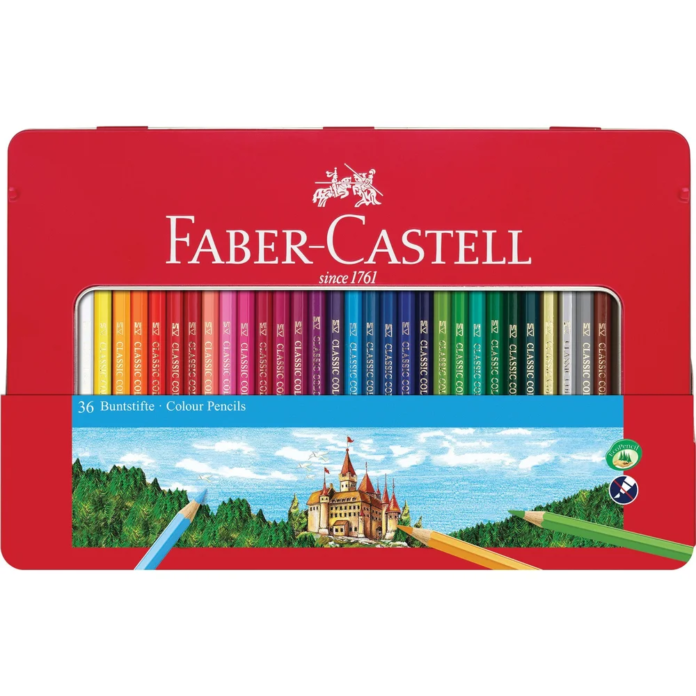
Faber-Castell, the German heritage brand known worldwide for its writing and creative products, is expanding its Canadian presence through a new distribution agreement. Genco International, the parent company of Kroeger Marketing, has signed a Canada-wide, non-exclusive deal to distribute select products from Faber-Castell’s consumer line, including its award-winning Creativity for Kids® arts and crafts kits.
The agreement, announced this week, will see Kroeger Marketing begin distribution in select retail channels in September 2025. A broader rollout is expected by January 2026. The partnership marks a significant step for Faber-Castell in opening additional avenues to reach Canadian parents, teachers, and retailers.
The deal comes ahead of two of the most critical shopping periods in the Canadian retail calendar: back-to-school and the winter holiday season. For Faber-Castell, the partnership ensures that its creative product lines will be more visible and accessible during these peak periods.
“This partnership with Faber-Castell strengthens our ability to deliver well-made, trusted creative products to Canadian retailers and consumers,” said Grant Chapman, Chief Operating Officer of Kroeger Marketing. “We’re focused on making it easier for families, educators, and retailers across the country to access fun and creative tools that support hands-on learning and creativity.”
By leveraging Kroeger Marketing’s distribution network, Faber-Castell expands Canadian distribution into channels where it has not traditionally had a strong presence. That strategy aligns with a broader push by the brand to position itself in high-demand retail environments.
Building on Market Expertise
Kroeger Marketing, with a legacy of more than five decades, specializes in wholesale distribution of toys, games, puzzles, arts and crafts, and Halloween products. Its expertise and deep retail relationships make it an attractive partner for Faber-Castell’s expansion in Canada.
“Genco and Kroeger Marketing bring strong relationships and proven experience in the Canadian market,” said Scott Flynn, Chief Executive Officer of Faber-Castell. “They will be an important additional partner in expanding our reach where we have not traditionally been present. Together with our broader network of partners, this relationship strengthens our ability to bring Faber-Castell’s award-winning product lines to even more Canadian families, educators, and retailers.”
Heritage Brand With a Global Footprint
Founded in 1761 in Stein, Germany, Faber-Castell has become synonymous with high-quality pencils, pens, and creative tools. The company, now in its ninth generation of family ownership, has inspired generations of artists, designers, and students. Historical figures ranging from Vincent van Gogh to Karl Lagerfeld have used Faber-Castell products, adding to its reputation for quality and creativity.
The company now operates 14 production sites in 10 countries and markets its products through 22 sales and distribution organizations worldwide. Its products are available in more than 120 countries, underscoring its global reach.
In addition to its traditional writing instruments, the company has made significant inroads in arts and crafts through Creativity for Kids®. Originally founded in 1976 by Phyllis Brody and Evelyn Greenwald, the brand was acquired by Faber-Castell and has since become a cornerstone of its consumer-facing line, particularly in North America.
A New Chapter for Canadian Retail
For Canadian retailers, the agreement offers expanded access to one of the most respected names in creative products. With the rise of at-home learning, crafts, and creative pastimes, the timing of this expansion may prove especially significant. Retailers are expected to benefit from increased product availability, while parents and teachers gain access to a broader range of trusted supplies.
The deal also reflects larger shifts in Canadian retail, where international heritage brands are turning to experienced local partners to strengthen distribution. By partnering with Kroeger Marketing, Faber-Castell expands Canadian distribution at a moment when consumers are seeking both quality and accessibility.
As rollout begins in September 2025, Canadian retailers will gradually integrate Faber-Castell’s lines into their shelves, with broader access by early 2026. The collaboration positions both companies to capitalize on seasonal demand while establishing a foundation for long-term growth in Canada’s creative product sector.
Since taking office, United States President Donald Trump has used tariffs to address perceived trade deficits with other countries. He claims that other countries have cheated and pillaged the U.S. via trade deficits.
In response, many political leaders have implemented retaliatory tariffs on American products, although Canadian Prime Minister Mark Carney recently lifted many of them in an apparent peace offering amid Canada-U.S. trade negotiations.
From June 25 to July 8, 2025, Kantar, a global research and consulting company, conducted a survey through its online panels of 1,500 respondents in Canada, France and the United Kingdom, respectively.
Strict quotas were used to ensure the survey respondents would match the census profile of the adult population in each of the three countries.
Surveying consumers
As a social scientist who examines citizen engagement in civic and political life, I designed the survey questions. Respondents answered yes or no to:
Due to Trump’s recent tariffs, have you boycotted: a) American products, including grocery items; b) American services, such as Facebook, Amazon, or TV streaming services; and c) Travel to the United States.
The graph below outlines the results. Compared to the U.K. and France, Canadians were far more likely to report boycotting American products, services and travel.
Percentage of respondents in the U.K., France and Canada who reported boycotting American products due to Trump tariffs. (Author provided)
Canadians, of course, have greater opportunities to boycott compared to other countries, given historically high levels of travel and international trade with the U.S. and Canada’s close proximity to the country. Statistics Canada reports that Canadian trips to the U.S. are down by 28.7 per cent from last year.
This case study of political consumerism reveals important distinctions compared to traditional boycotts.
Politically motivated boycotting is typically associated with those holding left-wing views.
In this case, both left-wing and right-wing people are participating in the boycott of American products. There are no ideological differences in participation in Canada and France. However, in the U.K., those on the right are more likely to boycott American products, services and travel than those on the left.
Existing research also shows well-educated people are more likely to boycott, particularly in Canada and France.
But in the Kantar survey, education did not impact participation in the boycott of American products, services and travel. All educational groups were motivated to participate.
Expressing discontent
Boycotting is a particularly attractive form of political behaviour in the case of international relations, because angry international citizens cannot simply contact Trump to express their discontent.
In fact, criticizing U.S. policies under Trump may result in being turned away at the American border by U.S. Customs and Border Protection.
Instead, consumers can express their discontent through the choices they make when grocery shopping, when making travel plans, and finally, in their choice to refrain from using American-owned social media like Facebook.
This situation is also unique because Trump actively encourages citizens to boycott companies with which he disagrees. Despite his own calls to boycott companies, Trump and American officials have called Canadians “nasty” for boycotting U.S. alcohol and travel in retaliation of American tariffs.
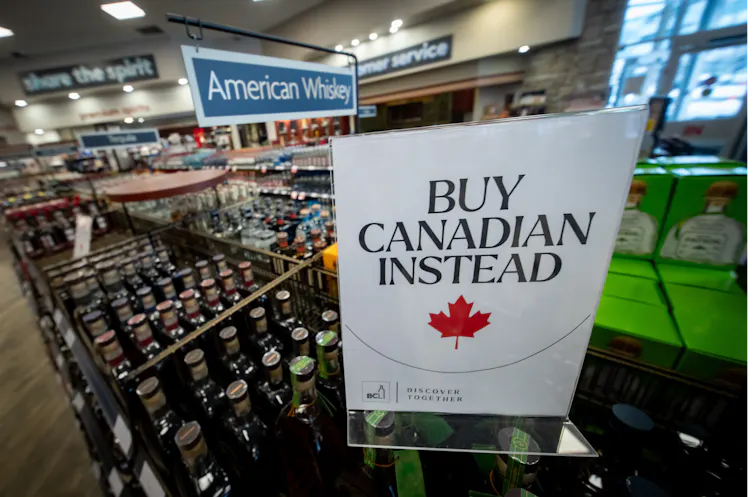
Shoppers have been caught up in the ‘buy Canadian’ fervour since U.S. President Donald Trump announced tariffs on all Canadian goods. THE CANADIAN PRESS/Ethan Cairns
Canadians may choose to follow the direction of their prime minister or they may view this as an opportunity to take more responsibility and continue to use their purchasing choices to influence trade relations.
In contrast, political leaders in France continue to criticize the European Union’s recent trade agreement with the U.S. In this case, French citizens may follow suit and continue to use their purchasing power to influence trade relations.
About the author: Shelley Boulianne is Professor in Communication Studies at Mount Royal University.
Salt Creek Capital has acquired Infinity RRGB Ventures, the sole Canadian franchisee and operator of Red Robin restaurants, securing the American chain’s presence in British Columbia. The deal, announced this week, places the San Francisco Bay Area private equity firm in control of all 11 Red Robin restaurants in Canada.
No financial terms were disclosed, but Infinity RRGB Ventures represents a significant foothold in the Canadian casual dining market, with over 1.6 million guests annually and a loyalty program exceeding 150,000 members.
Jamie Reeves, chief executive officer of Infinity, will remain in place to oversee daily operations. Salt Creek Capital executives said they view Reeves’ leadership as central to the franchisee’s continued success.
“The success of Infinity reflects the outstanding leadership of the entire management team,” said Tim Cripe, principal at Salt Creek, and Bobby Sheth, the firm’s senior managing director, in a joint statement. “We are thrilled to support the company in this next chapter of strategic growth and development under Jamie Reeves’ leadership.”
A U.S. Chain With a Limited Canadian Footprint
Red Robin Gourmet Burgers, based in Colorado, is best known for its gourmet burger menu, bottomless fries, and family-friendly atmosphere. With roughly 500 restaurants in North America, the chain’s presence in Canada is unusually narrow.
All Canadian Red Robin restaurants are in British Columbia, a market the brand has focused on since retreating from Alberta in 2019 during a corporate restructuring. There are no locations in other provinces.
Infinity RRGB Ventures, headquartered in Surrey, oversees restaurants in Vancouver, Victoria, Surrey, Langley, Burnaby, Abbotsford, Coquitlam, Kamloops, Kelowna, Maple Ridge, Prince George, and Vernon. The franchisee’s role is pivotal, bridging Red Robin Gourmet Burgers’ U.S. operations with Canadian consumers and shaping the brand’s visibility north of the border.
Image: Red Robin
Infinity RRGB Ventures: Local Roots, National Importance
Founded as Red Robin Canada’s exclusive franchisee, Infinity RRGB Ventures has grown into a significant regional operator. The company employs several hundred staff members across British Columbia and has positioned itself as one of the top three Red Robin franchisees across North America.
The acquisition by Salt Creek Capital marks a turning point. The firm specializes in supporting lower-middle-market businesses through ownership transitions, and its backing suggests Red Robin Canada could see operational refinements or renewed expansion efforts in the years ahead.
Infinity has already developed strong consumer loyalty. Its Red Robin Royalty program boasts more than 150,000 active members, making it one of the most robust restaurant loyalty platforms in Canada’s casual dining sector.
Salt Creek Capital’s Growing Appetite for Franchises
Salt Creek Capital, founded in 2009, has earned a reputation as an active investor in small and midsize businesses, often those in transition. With over 45 acquisitions completed across a range of industries, the firm is known for installing seasoned operators into leadership positions through its Executive Partnership Program.
While it invests across manufacturing, distribution, healthcare, and consumer services, Salt Creek has increasingly shown interest in franchise systems and food & beverage operations. Its acquisition of Infinity RRGB Ventures signals confidence in the long-term viability of the Red Robin brand in Canada, despite its limited footprint.
The deal also highlights the private equity firm’s ongoing strategy of focusing on companies generating between $5 million and $150 million in annual revenue.
Red Robin’s Place in Canadian Dining
For Canadian diners, Red Robin has long represented an American-style casual dining experience. Its focus on gourmet burgers, diverse menu offerings, and family-friendly service carved out a niche during its expansion into Canada in the 1980s.
But the brand has also faced challenges. Its Alberta retreat underscored the difficulties of sustaining operations in competitive provincial markets, especially as homegrown Canadian chains and international rivals gained momentum.
British Columbia has remained a stronghold, however. High-traffic urban and suburban locations in Vancouver and Victoria, along with outlets in smaller markets such as Kamloops and Prince George, continue to attract loyal patrons.
What the Acquisition Could Mean for the Future
The acquisition raises questions about Red Robin’s long-term Canadian strategy. With Salt Creek Capital acquiring Infinity RRGB Ventures, observers will be watching for signs of whether the new ownership will push for expansion beyond British Columbia or remain focused on strengthening existing operations.
Private equity ownership often brings new capital, operational discipline, and efficiency initiatives. For Infinity, that could mean investments in restaurant upgrades, digital platforms, or loyalty program enhancements. It could also spark consideration of re-entering provinces where the chain once operated.
At present, neither Salt Creek Capital nor Infinity RRGB Ventures has signaled concrete plans for additional Canadian openings.
Rendering of the 'Grapefruit' fountain, to be located in the expanded retail component of The James. Image: Tricon Residential
Toronto’s storied “Five Thieves” retail stretch along Yonge Street is about to evolve into something unprecedented, as developer Tricon Residential moves forward with a significant retail expansion behind the historic shops. Anchored by The James, a 23-storey luxury rental tower at 5 Scrivener Square, the project will introduce a curated retail experience, a striking public square, and a direct TTC connection, cementing the area as one of the most desirable urban destinations in Canada.
“We’ve designed a European-inspired retail mews integrated into a pedestrian-friendly square that will become a true gathering space for the community.” says Jeremy Hurwitz, Vice President of Retail at Tricon Residential.
Rendering of The James in Toronto, as seen from Scrivener Square. Image: Tricon Residential
A Vision Rooted in Heritage and Modern Design
The Scrivener Square area is no stranger to architectural significance. Its centerpiece, the former North Toronto railway station, was transformed into a spectacular LCBO flagship in 2003, preserving the station’s 140-foot clock tower and intricate stonework. This adaptive reuse project became a symbol of heritage integration in Toronto and set a precedent for future development in the area.
Tricon’s expansion builds on this tradition. The project, led by globally renowned Danish architects COBE, pairs contemporary design with the square’s historic character. The podium of The James features hand-laid brick, echoing the texture and scale of the original Shops of Summerhill, while the tower incorporates a striking lamella structure and modern glass elements.
“This isn’t just about creating retail space,” explains Hurwitz. “It’s about placemaking and curating a unique retail mix and public realm that draws people in and creates an amenity rich environment for our residents. Our landscape architect, Claude Cormier and Associates, envisioned a grapefruit water fountain as the centrepiece. It’s whimsical, beautiful, and unlike anything else in the city.”
Rendering of The James in Toronto, as seen from Scrivener Square. Image: Tricon Residential
Curated Retail and Dining Experience
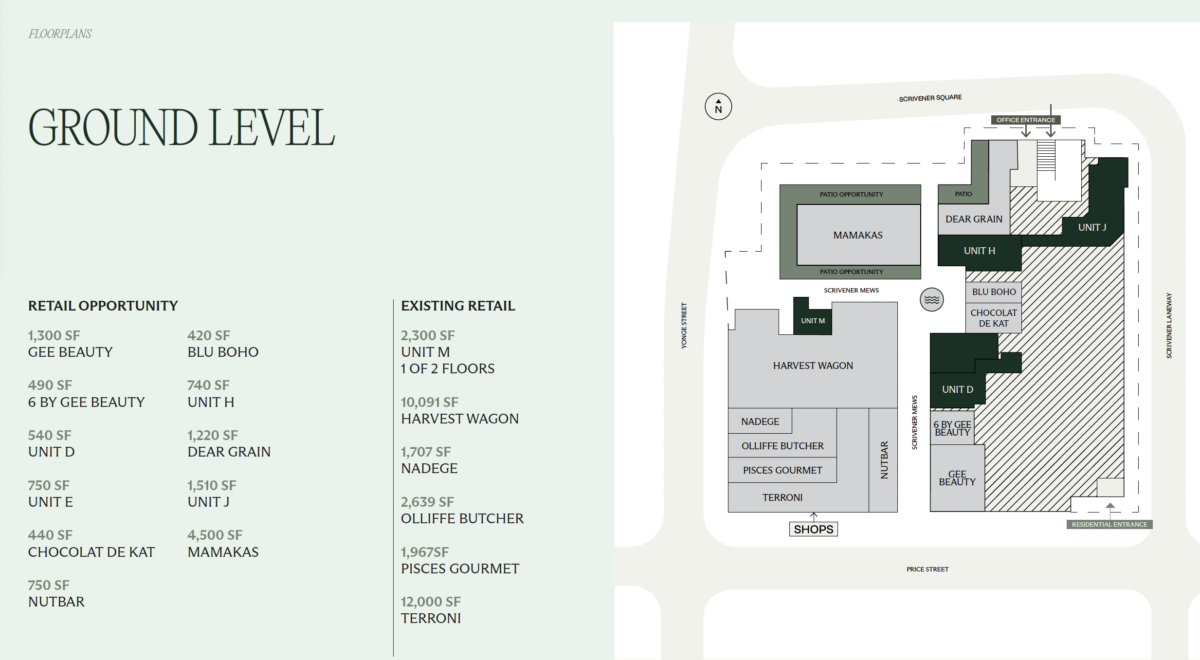
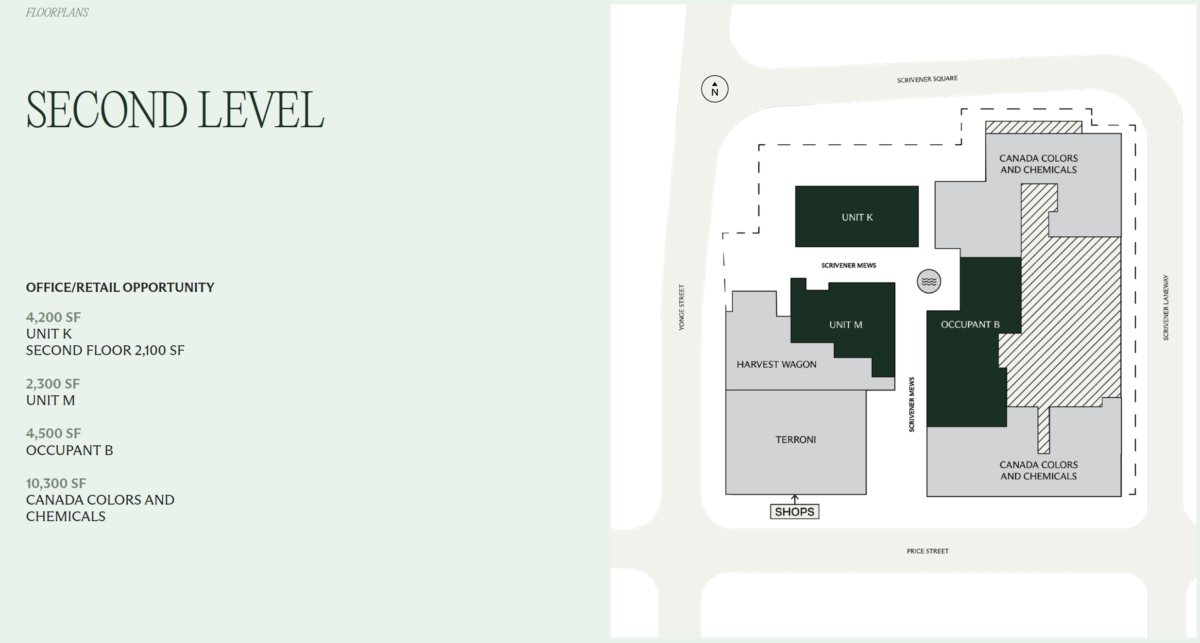
The retail component of The James extends and enhances the beloved Five Thieves block, home to iconic tenants like Harvest Wagon, Olliffe Butcher Shop, Pisces Gourmet, and Terroni. These staples have served the Rosedale and Summerhill communities for decades, and the new development aims to complement and not replace their charm.
The project introduces a pedestrian-focused laneway lined with boutique retailers, wellness studios, and culinary concepts. Confirmed tenants include Mamakas, Gee Beauty, 6 By Gee Beauty, Nutbar, Dear Grain Bakery, Chocolat de Kat, and Bluboho, with negotiations underway for additional premium offerings in fashion, lifestyle, upscale quick-service and wellness.
The centre of this retail expansion is an open-air courtyard, framed by boutique storefronts and anchored by the now-famous grapefruit fountain. Renderings reveal a vibrant piazza animated with café seating, lush landscaping, and seasonal programming.
Tricon has gone further by introducing patio zones, hand-laid brick pathways, and flexible event spaces to support seasonal markets and community activations. The design’s emphasis on permeability ensures that Scrivener Square remains both a local hub and a destination for visitors exploring the Yonge corridor.
TTC Integration: A Game-Changer for Connectivity
One of the most innovative aspects of the development is its integration with the Summerhill subway station. A new entrance will emerge directly within the retail component, connecting the underground transit network with the piazza above.
This addition positions Scrivener Square as a model of transit-oriented development, aligning with Toronto’s goals for sustainable urban growth.
Rosedale’s Demographic Advantage
The project’s location in Rosedale-Summerhill, one of Canada’s wealthiest enclaves, provides a built-in customer base for premium retail. Within a one-kilometre radius, the average household income exceeds $300,000, and over 63% of residents hold a bachelor’s degree or higher. These demographics, combined with a high projected population increase in the area, signal strong market potential.
Further bolstering demand are 17 residential developments under construction within 1.5 kilometres, adding approximately 3,800 units to the local housing stock, alongside an additional 39 projects in pre-construction.
Original ‘Five Thieves’ prior to construction of The James. Image: Woodcliffe
Retail Tenancy: Strengthening the Five Thieves Legacy
The Shops of Summerhill, colloquially known as the Five Thieves, have long been an anchor for specialty retail in Toronto. Names like Harvest Wagon and Pisces Gourmet are synonymous with quality, and the cluster attracts a loyal customer base.
The expanded tenant roster will include luxury food concepts, specialty retailers, and high-end wellness operators. Combined with the architectural ambition of the project, this approach positions Scrivener Square as a future benchmark for urban mixed-use design in Canada.
Construction of the retail spaces is progressing in tandem with The James residential tower. Retail units are scheduled for delivery in early 2026, with a grand opening planned for fall 2026. According to Hurwitz, leasing momentum is strong, with the project currently about 70% committed.
Rendering of The James in Toronto. Image: Tricon Residential
The James: Redefining Luxury Rental in Toronto
Above the retail component, The James introduces 127 light-filled private residences with sweeping panoramic views over the tree canopy of Toronto’s most celebrated neighbourhood.Designed for discerning downsizers, these residences average 1,600 square feet, with some spanning up to 4,000 square feet. Amenities include an outdoor infinity pool, saltwater lap pool, boutique fitness centre, spa facilities, and valet parking, all hallmarks of a five-star hotel.
Rental rates will reflect the exclusivity of the offering, making The James one of Toronto’s most premium rental properties upon completion.
A Decade in the Making
For Tricon Residential, the completion of Scrivener Square represents the culmination of a ten-year vision to create a mixed-use destination that celebrates heritage while embracing modern urban living. It also signals a broader trend in Toronto’s development landscape: the rise of experiential retail and placemaking as integral components of residential projects.
“From the architecture to the landscaping to the tenant mix, every detail has been curated with intention. We’re proud to deliver a project that enhances the neighbourhood and sets a new standard for mixed-use development in the city.”