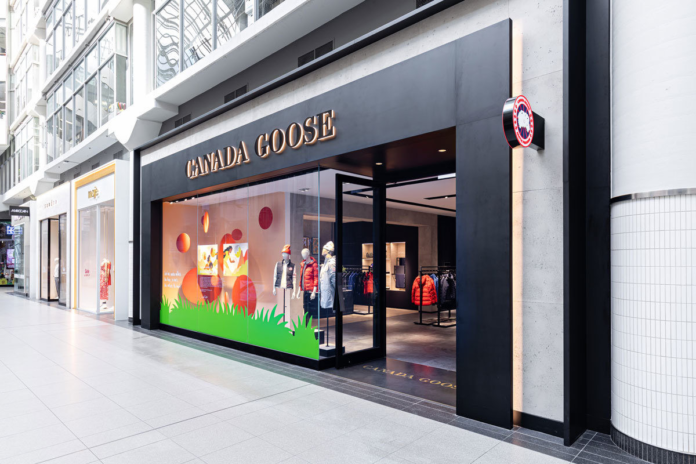
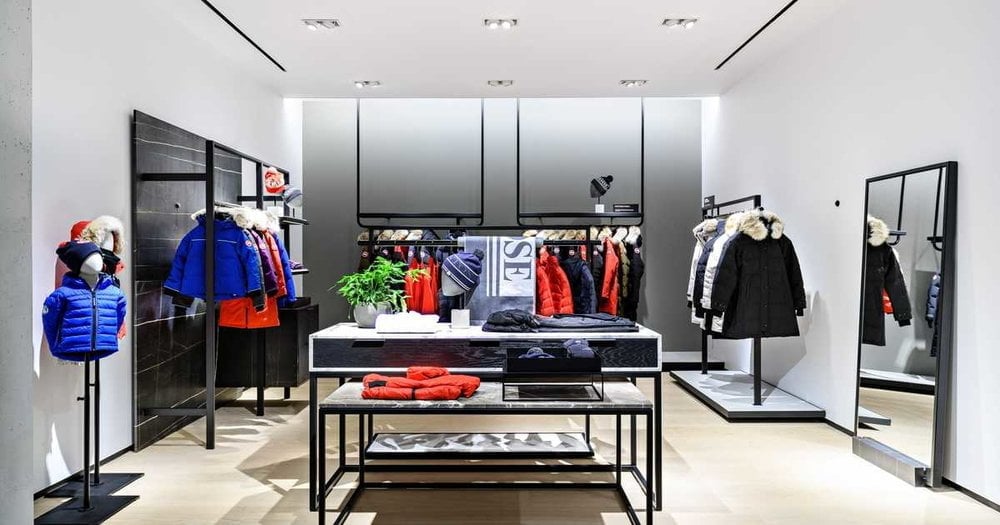
Canada Goose at CF Toronto Eaton Centre (Image: Benoy)
Canada Goose Holdings Inc., the Canadian luxury outerwear company best known for its parkas, is facing a potential ownership change that could reshape its future as a global fashion brand.
Bain Capital, which has controlled Canada Goose since 2013, has received bids to take the company private at a valuation of about US$1.4 billion, according to a CNBC report citing people familiar with the matter. The move comes less than a decade after Canada Goose’s high-profile public offering and at a moment when the company is balancing expansion with shifting consumer demand.
Bain Capital’s investment in 2013 set Canada Goose on a new course. The private equity firm financed an international expansion that transformed a Toronto-based maker of winter apparel into a household name across luxury markets worldwide. Canada Goose went public in 2017, but Bain retained control through multiple-voting shares.
As of March 2025, Bain held 60.5 percent of those securities, representing 55.5 percent of total voting power. The firm has now enlisted Goldman Sachs to advise on a potential sale, though no final decision has been made as additional bids are expected.
Prospective Buyers
Several global firms have expressed interest. CNBC reported that private equity companies Advent International and Boyu Capital have made verbal offers. Shanghai-based Bosideng International, a major apparel manufacturer, is also considering a bid. Another group of suitors reportedly includes Hong Kong-listed Anta Sports Products and private equity firm FountainVest Capital.
Canada Goose, Bain Capital, and Goldman Sachs have not commented publicly on the process, and interested parties have not confirmed details of their offers.
Investors reacted swiftly to the news. Shares of Canada Goose rose nearly 9 percent in premarket trading Wednesday, building on gains of about 21 percent so far this year. The company is currently valued at US$1.18 billion, according to LSEG data, but the prospective buyout values it at a higher premium.
Canada Goose at West Edmonton Mall. Photo: Canada Goose
Financial Performance
Canada Goose reported fiscal 2025 revenue of $1.35 billion, an increase of 1.1 percent from the previous year. Direct-to-consumer sales — a focus of its growth strategy — climbed 5.1 percent to $998.9 million. Gross profit rose 2.8 percent to $943.1 million, representing a margin of nearly 70 percent.
Net income attributable to shareholders improved to $94.8 million, or $0.97 per diluted share, up from $58.4 million the year before. However, in July the company posted a quarterly loss larger than expected, with costs tied to retail expansion and promotions weighing on results.
Expanding Global Footprint
Canada Goose has been steadily broadening its reach. As of August 2025, the company operates 76 permanent retail stores worldwide, up from 74 at the end of its fiscal year in March. Recent openings include new flagships in Paris and Milan, underscoring its ambitions in key luxury markets.
The brand has also sought to diversify its offerings. Beyond its iconic parkas, Canada Goose has introduced eyewear, rainwear, lighter-weight jackets, and seasonal apparel designed for warmer months. Under the creative direction of Haider Ackermann, the company launched the Snow Goose capsule collection, along with special releases such as a Lunar New Year line.
What Privatization Could Mean
If Bain Capital accepts one of the offers, Canada Goose would return to private ownership after eight years on public markets. A privatization could give the company more flexibility to make long-term strategic decisions outside the scrutiny of quarterly earnings reports.
Whether the company stays public or shifts back into private hands, the outcome will have significant implications for one of Canada’s most prominent fashion exports. The decision is likely to influence Canada Goose’s ability to manage costs, pursue international expansion, and maintain its position as a leading name in luxury outerwear.
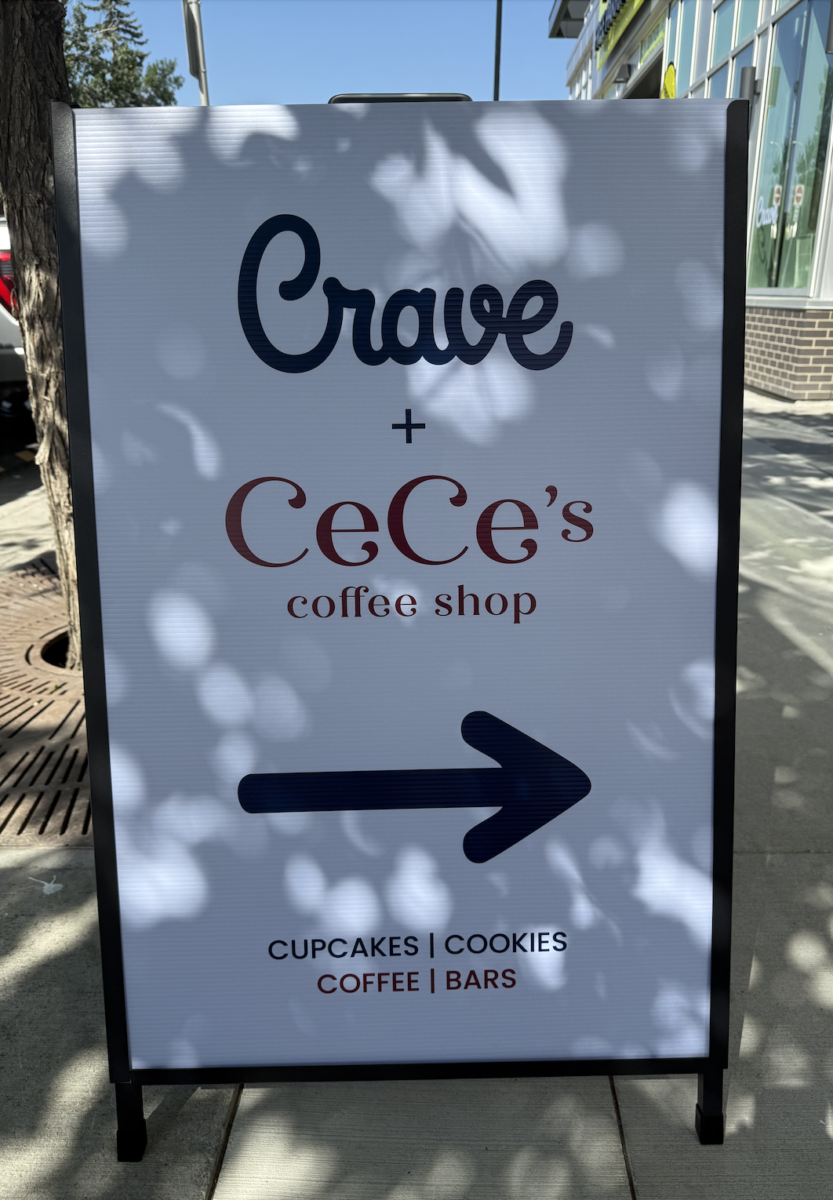
Crave Cupcakes, the iconic Calgary-based bakery known for its from-scratch cupcakes, cookies, and cakes, is expanding with a move from its original location in the Kensington neighbourhood to a new spot combining the bakery with a coffee shop called CeCe.
Co-founders Carolyne McIntyre Jackson and Jodi Willoughby, sisters who launched Crave in 2004, have expanded over the years beyond their original Kensington location. The company now boasts locations in Edmonton, Saskatoon, and a new bakery/cafe in Kelowna.
The brand recently opened its new location in the Hillhurst neighbourhood, just west of where it had been for years since its opening.
Co-founders Carolyne McIntyre Jackson (right)and Jodi Willoughby, sisters who launched Crave in 2004
At its grand opening this week, Jackson said the concept of a coffee shop with a bakery was launched in June in Kelowna.
“Kelowna is a little bit different with one full space but here it’s kind of two different spaces,” she said.
“This was a really good opportunity. It actually started with the Kelowna space. When we went to Kelowna we saw this beautiful space but it was big and we thought if we’re going to take this space we can’t just do cupcakes, we also need to do coffee. It started there. The Kensington block is getting a huge renovation. So we started looking in the area. It needed a renovation, you’re sales are going to be not maybe what they should be, hard to park. We then decided to move the location. This space was available and we thought we can do the coffee shop next door.”
Crave. Photo: Mario Toneguzzi
Jackson said the square footage at the new location is about 2,500 square feet combined with the two concepts.
Does she foresee the concept evolving into more locations?
“Maybe, we’ll see how it goes. I think it will be interesting because Kelowna is so different. Kelowna is one big space where this is two separate spaces. It’s going to be interesting to see how the two of them operate.”
Crave. Photo: Mario Toneguzzi
In addition to their physical expansions, Crave introduced a new Bake at Home line, available in over 150 grocery stores across Alberta and British Columbia. The line includes cake mixes, frozen buttercream, and pre-portioned cookie dough—all made with the same high-quality ingredients that Crave is known for.
Crave also launched its first-ever cookbook, “Crave: Cupcakes, Cakes, Cookies, and More from an Iconic Bakery.”
In Calgary there are four stores. Kelowna was the brand’s first new location in 12 years.
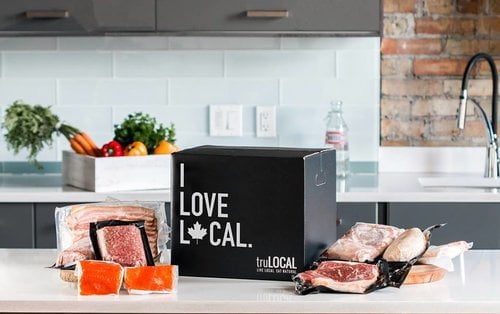
EMERGE is a Canadian e-commerce and retail portfolio of premium brands. Its subscription, marketplace, and retail businesses provide members with access to offerings across grocery and golf verticals. truLOCAL is the flagship Canadian meat and seafood subscription service, connecting local farmers with a health-conscious audience. Its golf vertical includes discounted tee-times/ experiences brand, UnderPar, and discounted golf apparel and equipment brands, JustGolfStuff and Tee 2 Green.
Q2 2025 Financial Highlights
For the second quarter of 2025, compared to the second quarter of 2024:
Revenue grew to $8.5M vs. $4.98M, an increase of 70% YoY, marking the 5th consecutive quarter of revenue growth. Both grocery and golf verticals achieved positive organic growth
Gross profit grew to $3.1M vs. $2.1M. Excluding $382K fair value of inventory adjustment in relation to T2G, a non-cash item, gross margin would be approximately 41.0% vs. 41.3%
Adj. EBITDA improved to $958K vs. ($40K), an increase of $1M YoY, marking the 2nd consecutive quarter of positive Adj. EBITDA and our strongest result since re-focusing EMERGE around Grocery and Golf verticals
Net Income from continuing operations improved to $201K vs. ($623K). Excluding $382K fair value of inventory adjustment in relation to T2G, a non-cash item, net income from continuing operations would be $583K
Cash flow from operations of $2M vs. ($0.2M) in Q2 2024
Cash position grew to $3.5M (June 30, 2025) vs. $2.7M (March 31, 2025) and $2.2M (June 30, 2024). Cash grew quarter-over-quarter, despite the $1.1M spent to close the T2G acquisition in early Q2
Ghassan Halazon
“Q2 was a break-through quarter for the Company. We drove exceptional revenue growth, profitability and cash flow generation,” said Ghassan Halazon, Founder and CEO, EMERGE.
“We closed the transformative acquisition of T2G, and subsequently super-charged that brand, historically a low growth business, to high double-digits in its first quarter under EMERGE, leveraging our digital ads playbook and cross-brand synergies with our golf portfolio.
“We also continued to drive positive organic growth at truLOCAL, a benefactor of the “Buy Canadian” consumer sentiment. Special thanks to our team, Board, and trusted partners on a standout quarter of operational execution and strategic precision. We plan to remain disciplined, focused and opportunistic in the quarters and years ahead.”
On April 4, EMERGE closed the acquisition of Tee 2 Green, a profitable, discount golf apparel and equipment business with a 38-year track record of retail operations, focused on the Canadian market. T2G achieved revenue of $6.4M, Adjusted EBITDA of $1M and net income of $700K in 2024 (unaudited).
EMERGE utilized the cash proceeds from the Carnivore Club asset sale, as well as the previously announced sale of the premium, dormant SHOP domains to Shopify towards closing the T2G acquisition.
T2G’s first quarter under EMERGE ownership, Q2 2025, delivered exceptional organic revenue growth and profitability, exceeding management’s expectations. The strong performance was fueled by EMERGE’s targeted digital advertising and cross-brand synergies within its golf vertical. Cash flow generated by T2G in its first quarter under EMERGE comfortably exceeded the $1.1M upfront cash payment made by EMERGE to complete the transaction, said the company.
Q3 2025 Outlook
For Q3 2025, EMERGE management is seeing continued operational momentum QTD, and expects to achieve another quarter of double-digit revenue growth, and positive Adjusted EBITDA, it said.
truLOCAL is expected to continue to be a benefactor of the “Buy Canadian” sentiment. Its discounted golf experiences and products vertical is expected to continue to gain from the weakening macro climate given the recession-friendly nature of the business model, it added.
Acquisition Pipeline
“Building off our early success acquiring and accelerating T2G, EMERGE is selectively advancing accretive acquisition opportunities, specifically in the grocery and golf verticals, where we have amassed deep expertise, bench strength, brand awareness and substantial customer databases. EMERGE’s focus is exclusively on profitable acquisition candidates with $750K-$2M in Adj. EBITDA, with a long-standing track record of revenue stability and cash flow generation,” it explained.
Top Priorities
The company said its top priorities in the near-term are to i) continue to drive organic revenue growth, ii) extract synergies to drive profitability, iii) explore accretive tuck-in acquisition opportunities in the grocery and golf verticals; and iv) opportunistically explore avenues to enhance cash flow and reduce interest expense.
Dollarama Inc. reported on Wednesday its financial results for the second quarter ended August 3, indicating continued sales growth.
Fiscal 2026 Second Quarter Results Highlights Compared to Fiscal 2025 Second Quarter
Sales increased by 10.3% to $1,723.8 million, compared to $1,563.4 million
Comparable store sales in Canada increased by 4.9%, over and above 4.7% growth in the corresponding period of the previous year, and 27 net new stores opened in Canada, compared to 14 net new stores
EBITDA increased by 12.2% to $588.5 million, representing an EBITDA margin of 34.1%, compared to 33.5%
Operating income increased by 14.3% to $483.5 million, representing an operating margin of 28.0%, compared to 27.0%
Net earnings increased by 12.4% to $321.5 million, resulting in a 13.7% increase in diluted net earnings per common share to $1.16, compared to $1.02
932,046 common shares repurchased for cancellation for $174.8 million
“The second quarter of fiscal 2026 marked a significant milestone in our international expansion, with entries into two new markets. We completed our acquisition of Australia’s largest discount retailer, and we celebrated the opening of Dollarcity’s first store in Mexico,” said Neil Rossy, President and CEO of Dollarama.
“Our complementary international platforms strengthen and diversify our long-term growth strategy, with our successful Canadian business serving as the foundation that fuels our broader ambitions. Strong Comparable store sales growth in Canada, both in the second quarter and year to date, highlights the strength of our business model, the relevance of our value proposition for Canadian consumers and the team’s impeccable execution.
Sales for the second quarter of fiscal 2026 increased by 10.3% to $1,723.8 million, compared to $1,563.4 million in the corresponding period of the prior fiscal year. This increase was driven by growth in the total number of stores over the past 12 months (from 1,583 on July 28, 2024 to 2,060 on August 3, 2025), including the contribution since the acquisition of TRS of 395 stores in Australia, which generated $25.7 million of sales for the Australian segment during the Post-Acquisition Period, and Comparable store sales growth in Canada, said Dollarama.
It said comparable store sales in Canada for the second quarter of fiscal 2026 increased by 4.9%, consisting of a 3.9% increase in the number of transactions and a 0.9% increase in average transaction size, over and above Comparable store sales growth in Canada of 4.7% for the second quarter of fiscal 2025. The increase was primarily driven by strong demand for consumables.
Founded in 1992 and headquartered in Montréal, Quebec, Canada, Dollarama is a leading Canadian value retailer with international reach with 2,718 conveniently located stores and over 41,000 people serving customers in seven countries on three continents. In Canada, Dollarama operates 1,665 stores with a presence in all 10 provinces and two territories. In Australia, Dollarama operates the country’s largest discount retail chain, The Reject Shop, with a national network of 395 stores. Dollarama is also the majority shareholder, through its equity-accounted investment, in Latin American value retailer Dollarcity which has 658 stores located in Colombia, El Salvador, Guatemala, Mexico and Peru.
Canada-US border crossing. Image: Maple Syrup from Canada
On August 29, the United States will close the door on a long-standing trade convenience: the de minimis exemption. For decades, this rule allowed small shipments valued at US $800 or less to cross the border duty-free, bypassing the cumbersome customs procedures that normally apply to imports.
For Canadian food producers—especially the small and mid-sized ones—the implications are significant. While the headlines have focused on tariffs on steel, cars, or lumber, this quieter policy change risks undermining a vibrant ecosystem of specialty and artisanal foods that have found eager consumers south of the border.
The Hidden Artery of Food Trade
The exemption was never about giant grain shipments or truckloads of beef. Those flows already move through established commercial channels, covered by USMCA rules that keep most tariffs at zero. Instead, the de minimis threshold acted as a hidden artery for small players: the Nova Scotia jam maker shipping gift boxes to Vermont, the B.C. chocolatier sending truffle assortments to Seattle, or the Ontario pet treat company tapping into the booming U.S. specialty market.
Specialty food stores have also benefited from this trade mechanism. Independent retailers in New York, Chicago, and Los Angeles often relied on small, frequent Canadian shipments to diversify their offerings. Now, they too face higher prices, longer waits, and more red tape, which could limit the range of Canadian products on their shelves.
Why Small Doesn’t Mean Insignificant
At first glance, the overall economic impact may look minor. Bulk food exports—Canada’s wheat, beef, canola oil, or pulses—will continue to flow unaffected. But focusing on aggregate trade numbers misses the point.
Estimates suggest that between $500 million and $1 billion worth of Canadian food exports to the U.S. move each year under the $800 threshold—everything from craft condiments and gourmet snacks to specialty beverages, frozen goods and shipments for trade shows and customer samples. This may be a fraction of Canada’s $40+ billion agri-food trade with the U.S., but for the companies involved, it often represents their entire U.S. market entry strategy.
Food economics isn’t just about tonnage; it’s about market access, competition, and consumer choice. When small firms lose their ability to compete, entire product categories shrink. American specialty retailers will see fewer Canadian craft brands on their shelves. And in Canada, entrepreneurs may think twice before scaling up if the first step into the U.S. market is suddenly cost-prohibitive.
Ottawa’s Blind Spot
One option Ottawa does have is to revisit its own de minimis threshold. Currently, goods entering Canada from the U.S. are duty-free only up to C$150—a fraction of the former U.S. level. Matching the American threshold would not only benefit Canadian consumers by lowering cross-border costs, it would also give Ottawa stronger footing to argue for reciprocity in Washington.
Instead of treating de minimis as a technical issue, Canadian policymakers should see it as a strategic lever: a way to protect small exporters, rebalance trade irritants, and keep cross-border commerce flowing for the businesses least able to absorb new costs.
A Tale of Two Trade Systems
The timing also exposes a paradox. On one hand, USMCA protects large-scale trade flows; on the other, Washington is dismantling a system that supported the very businesses USMCA was supposed to empower. For Canadian food exporters, the message is contradictory: scale up or stay home.
This policy shift also reveals how vulnerable small businesses are in a tariff war not of their making. While policymakers spar over billion-dollar industries, the fallout is felt most acutely by the companies shipping a few hundred dollars’ worth of goods at a time. It is the micro-entrepreneurs, not the multinationals, who risk being collateral damage.
The Bigger Picture
Trade policy often looks like a chess game of billion-dollar pieces. Yet the board is also populated by pawns—the small shipments, the craft producers, the specialty stores—that give life to Canada’s food economy. Dismissing their struggles as marginal ignores their role in shaping competition, culture, and innovation.
The end of the de minimis exemption is more than a technical rule change. It is a reminder that when protectionism rises, it is usually the smallest who pay the highest price. For Canadian food exporters and the retailers that depend on them, this fall may prove to be one of the toughest harvests in years—not in the fields, but at the border.
Retail Insider is streamlining its Canadian retail news from around the web to include a handful of top news stories that can be viewed quickly during the day. Here are the top stories from the past 48 hours.
Birks Group Inc., a leading designer of fine jewelry and an operator of luxury jewelry, timepieces and gifts retail stores in Canada, has announced that Jean-Christophe Bédos, the company’s President and CEO and Director, is stepping down from his role, effective August 29.
He will continue to support the company in an advisory capacity during the leadership transition. The decision comes as the company repositions itself for stability and long-term growth, it said.
Image: Jean-Christophe Bédos
Birks said an executive search for a new President and CEO will take place in due course. In the interim, Niccolò Rossi di Montelera, in addition to being the company’s Executive Chairman of the Board, was appointed as Interim CEO. Montelera was elected to the company’s Board of Directors in September 2010 and has served as Vice-Chairman of the company’s Board of Directors from June 2015 until being appointed Executive Chairman of the Board in January 2017.
Niccolò Rossi di Montelera
Davide Barberis Canonico, a member of the company’s Board of Directors, was appointed Interim President and Chief Operating Officer. With 12 years of service on the company’s Board of Directors, Canonico brings extensive leadership experience, having held CEO roles at several companies. He will assume day-to-day leadership responsibilities, explained Birks.
“On behalf of the entire Board, I would like to thank Jean-Christophe for his leadership and dedication during his 13 years with Birks Group. Under Jean-Christophe’s leadership, the Company developed the Birks product brand, developed partnerships with renowned global brands and was able to navigate through some difficult times, including the Covid-19 pandemic,” said Rossi di Montelera.
Davide Barberis Canonico
“We are grateful for Jean-Christophe’s dedication throughout his 13-year tenure. A leadership transition is an important step as we refocus the company’s priorities. I would also like to thank Jean-Christophe for deciding to stay on as an advisor. This continuity will help ensure a smooth transition and allow the company to move forward with confidence and clarity.”
Birks operates 17 stores under the Maison Birks brand in most major metropolitan markets in Canada, one retail location in Montreal under the Birks brand, one retail location in Montreal under the TimeVallée brand, one retail location in Calgary under the Brinkhaus brand, one retail location in Vancouver under the Graff brand, one retail location in Vancouver under the Patek Philippe brand, four retail locations in Laval, Ottawa and Toronto under the Breitling brand, four retail locations in Toronto under the European Boutique brand, one retail location in Toronto under the Omega brand and one retail location in Toronto under the Montblanc brand. Birks was founded in 1879 and has become Canada’s premier designer and retailer of fine jewelry, timepieces and gifts.
“It has been an honour to serve as President and CEO of Birks Group. I would like to thank the Rossi di Montelera family, as well as the Board of Directors and every employee of the Company for their trust and their support over the last 13 years,” said Bédos. “Leading Birks Group through both successes and challenges has been a deeply meaningful experience. I am proud of the team’s commitment and resilience and what the team has accomplished over the last 13 years, including during some challenging periods. I remain confident in the team’s ability to steer the Company toward a stronger future.” Mr. Bédos continued, “While Birks Group has faced important industry challenges and softer-than-expected performance in recent years, the Company remains committed to operational discipline, excellent client service and value creation for its shareholders. After careful reflection, I believe the time is right for a leadership transition and I look forward to continuing to support the Company in an advisory role as it enters a new phase.”
Canonico commented: “I am honoured and grateful to the Board of Directors for the opportunity to lead the Company. I would also like to thank Jean-Christophe for his dedication over the past 13 years. I look forward to working closely with our teams to drive improved performance through a disciplined focus on operational excellence and delivering exceptional value to our clients.”
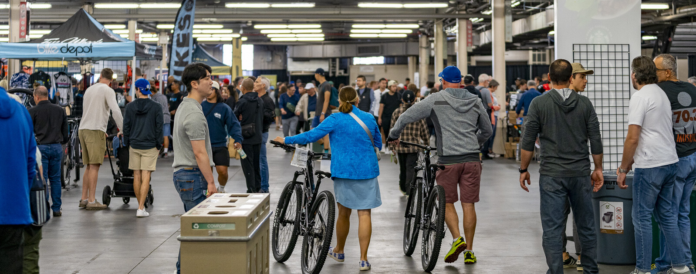
The Toronto Bicycle Show and E-Bike Expo, one of Canada’s largest consumer cycling events, is entering a new chapter after more than 36 years as a fixture for the biking community. Long organized as an end-of-season clearance showcase, the event will now be managed by StyleDemocracy, marking a significant evolution in both scope and ambition.
Renamed the Toronto Bike and Outdoor Sale, the event will broaden its focus to include not only bicycles and e-bikes but also golf, ski, and snowboard categories. The change signals a deliberate move to capture the growing momentum in multiple outdoor sports industries, while keeping cycling at the heart of the show.
The show began decades ago with a simple model: gather vendors across Southern Ontario to liquidate end-of-season bike inventory in one place. Consumers purchased tickets, vendors paid booth fees, and cyclists benefited from discounted products in a format reminiscent of the classic boat shows.
Over time, it grew into the Toronto Bicycle Show and E-Bike Expo, drawing thousands annually to the International Centre in Mississauga. The event became a signature date on the Canadian cycling calendar, featuring exhibitors, gear demonstrations, travel and tour operators, and, more recently, an expanded e-bike category reflecting surging consumer demand.
With the original organizers stepping back after decades at the helm, StyleDemocracy has stepped in to reimagine the show for today’s market.
StyleDemocracy Steps into Consumer Trade Shows
For StyleDemocracy, best known for its large-scale warehouse sales, the move into consumer trade shows marks a natural next step.
Oliver Berg, Vice President of StyleDemocracy, described the acquisition as both strategic and exciting.
Oliver Berg
“Our long-term objectives have not just been growth, but diversification, and the Bike Show allows us to do that as we are now entering the consumer trade show business,” said Berg. “Our growth as a business over the last three years has allowed us to build a backend operation that is geared to support a variety of solutions, not just warehouse sales.”
He added, “When the opportunity came our way to take over this show, it was very exciting for us because we felt we had everything in our toolbox to transition into this new business and to take this show and make it bigger and better for both vendors and consumers.”
Berg also emphasized the importance of working more closely with smaller operators: “Historically, our events have been large warehouse sales representing global brands, but this event is different. We will be working with a lot of local, independent retailers, which is very different, but very cool and exciting.”
Cycling and Golf Markets Surge
The timing of the relaunch reflects explosive growth across outdoor sports in North America.
In cycling, demand has been especially strong for e-bikes, which have seen sales climb by 269% since 2019, with more than two million units now sold annually. Market forecasts suggest the North American e-bike category will nearly double by 2029, surpassing $7.5 billion in value. E-bikes now drive more than 60% of all growth in bicycle sales, underscoring their role as a dominant force in the market.
Golf has experienced its own resurgence. In 2024, a record 47.2 million Americans took part in the game, whether on courses or through new entertainment formats such as simulators and driving ranges. That figure represents a 45% increase in participation since 2016. Juniors are embracing the sport at record levels, with more than 3.7 million under 18 playing on-course, a 48% increase since 2019. Meanwhile, millennial golfers are projected to spend nearly $4,600 per person on the sport this year, fueling demand for equipment, lessons, and travel.
By adding golf, ski, and snowboard categories, the Toronto Bike and Outdoor Show positions itself to meet consumer demand across multiple outdoor segments while retaining cycling as the anchor.
Marketing Innovation with 55 Rush
To help drive awareness and attendance, StyleDemocracy will once again work with 55 Rush, the marketing and events agency that has become a close partner. The relaunch will feature an extensive program of targeted marketing, prize giveaways, and consumer activations aimed at making the show more dynamic and exciting.
This partnership reflects StyleDemocracy’s approach to enhancing events through experiential engagement, designed to attract new audiences and build momentum beyond traditional sales-driven trade show models.
Vendor Recruitment Underway
Vendor participation remains central to the show’s success. StyleDemocracy is actively recruiting exhibitors across the expanded categories, and an event page hosted on StyleDemocracy’s website is now live, outlining details and opportunities. The page is currently more B2B-focused, serving as a resource for vendors interested in securing space at the event.
For participating brands and retailers, the relaunch provides a unique opportunity to reach thousands of active, sports-minded consumers in one location. For attendees, the appeal remains strong: access to a broad range of discounted gear, opportunities to interact with brands directly, and exposure to innovations across multiple outdoor categories.
Honouring the Legacy While Moving Forward
While the show is expanding its scope, Berg underscored that its cycling foundation remains intact. “This is about growth, but also about staying true to what made the show special in the first place,” he said. “Cycling remains at the heart of this event, and we are proud to build on that foundation.”
The Toronto Bike and Outdoor Show will maintain its legacy as a community gathering for cycling enthusiasts while evolving into a broader lifestyle showcase that reflects how Canadians are embracing outdoor recreation.
Facade of the soon-to-open Modern Ambition flagship in Winnipeg. Image supplied
Canadian fashion is entering a new chapter with the launch of Modern Ambition Winnipeg, the debut flagship store from Mondetta Clothing. Scheduled to open in late September at 223 Carlton Street in downtown Winnipeg’s True North Square, the boutique represents both a bold investment in homegrown design and a carefully crafted vision for the future of menswear.
Part of the Mondetta Clothing family, Modern Ambition seeks to carve out a unique space in Canadian fashion by merging luxury tailoring with performance-driven fabrics. The result is a men’s brand positioned to serve professionals who value both aesthetics and functionality in their wardrobes.
“Think of it as Brunello Cucinelli meets Nike,” explained Georgi Gvakharia, Vice President of Retail for Mondetta Clothing, during an interview with Retail Insider. “We are combining old-world craftsmanship and luxury with a modern twist that includes technical details designed for how people live and travel today.”
Georgi Gvakharia
An Intimate “Living Room” Experience
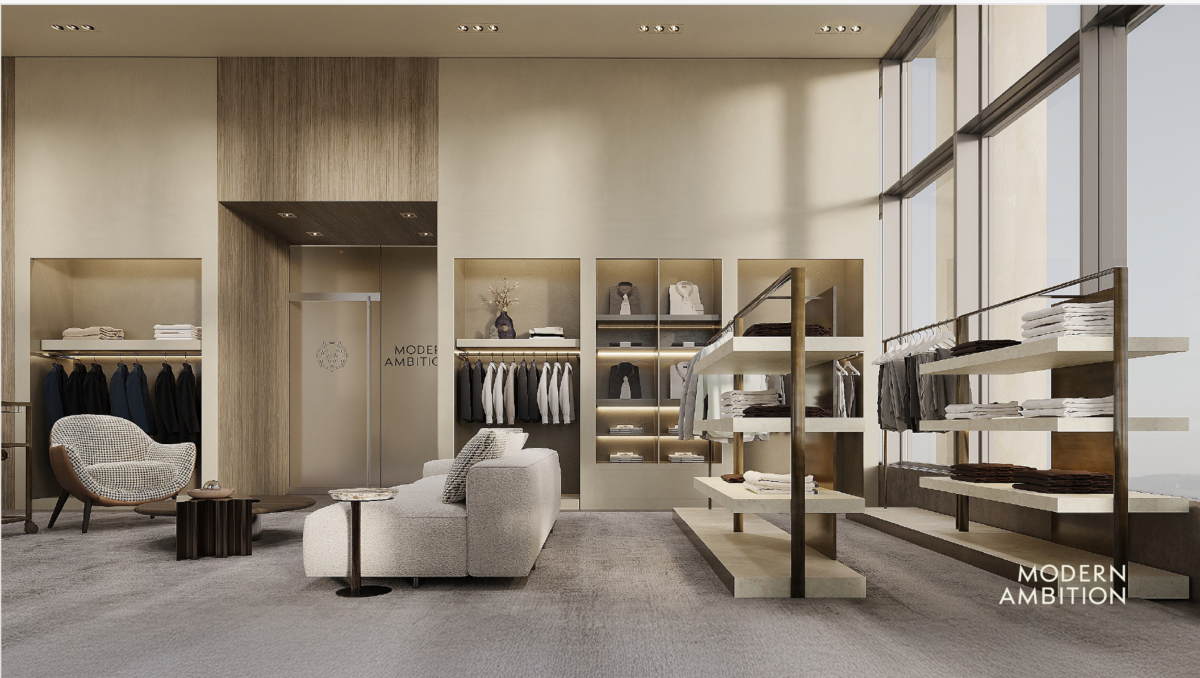
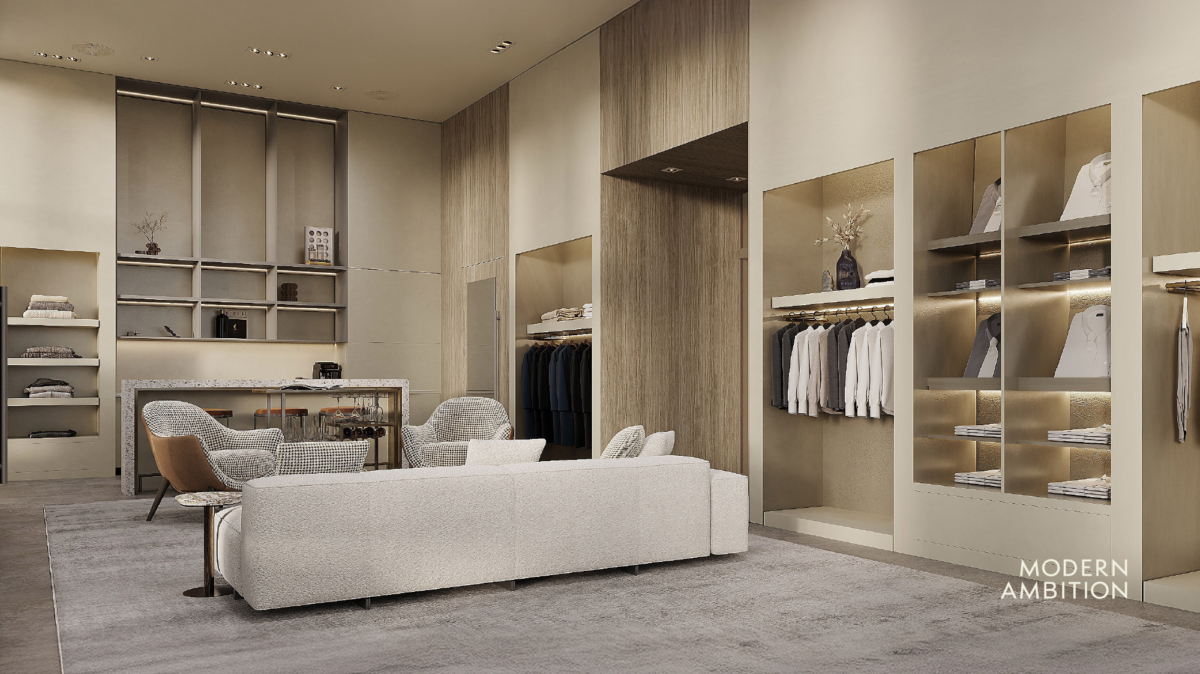
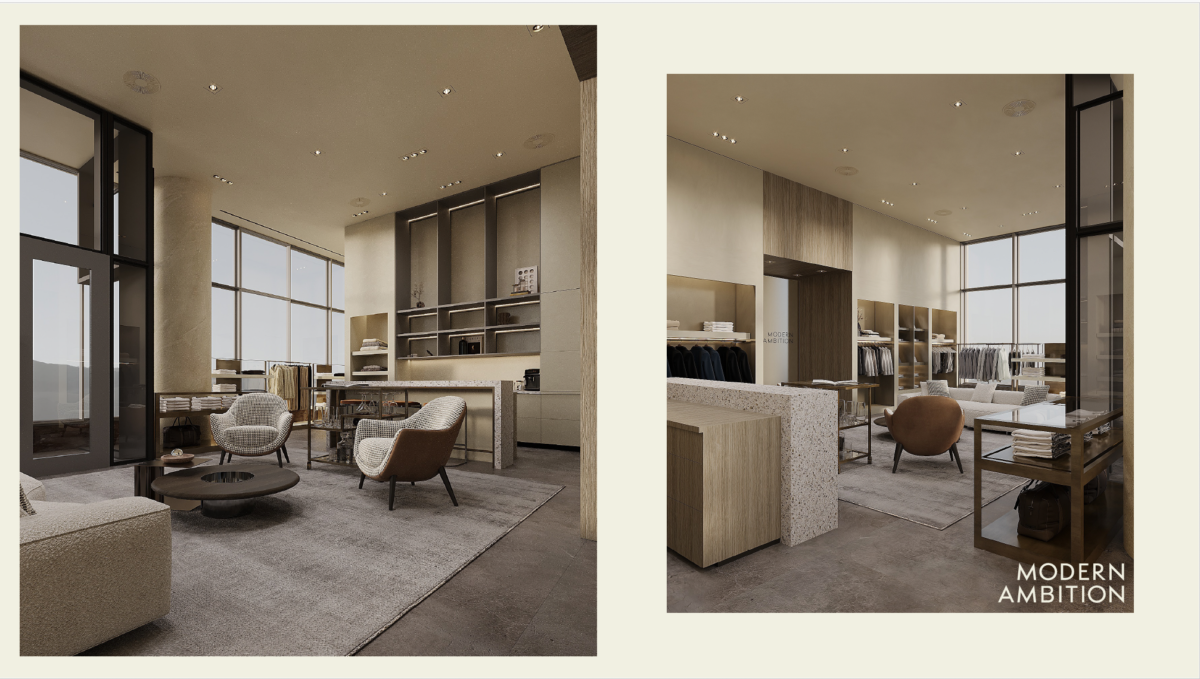
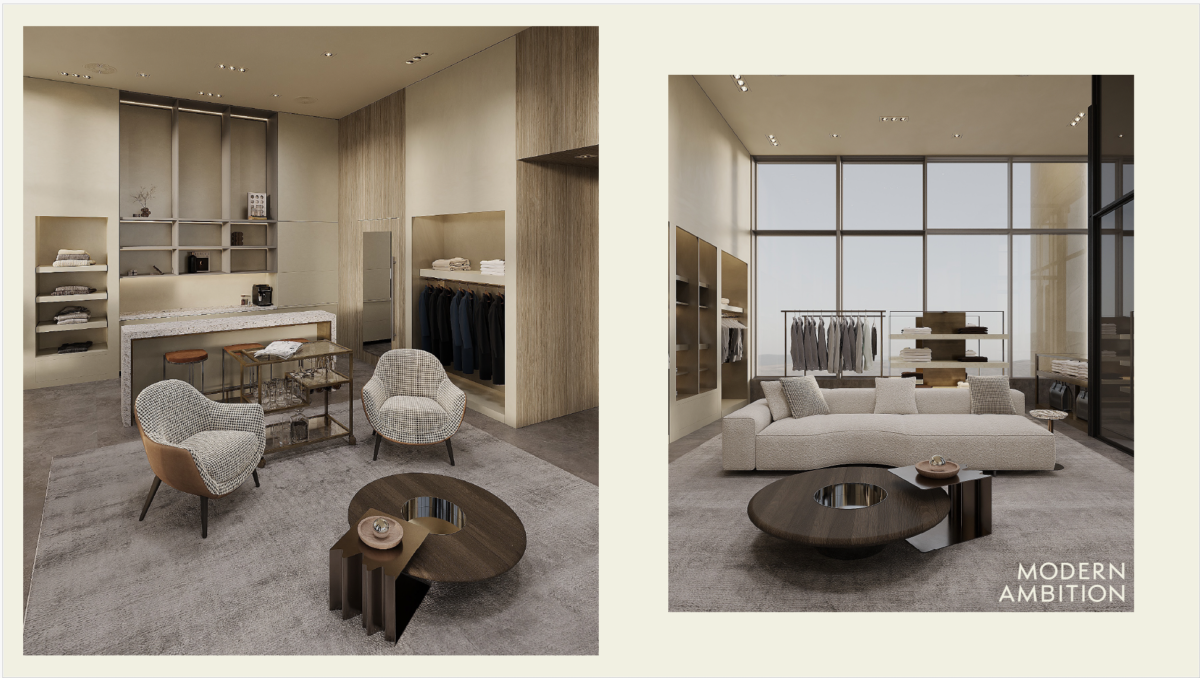
At just 1,200 square feet, the new boutique is smaller than many contemporary flagships, yet its scale is intentional. “We want to create a very intimate environment,” said Gvakharia. “Our CEO called it the ‘living room’ at Modern Ambition. Customers should feel like they are at home, relaxed, enjoying the space, and not in a commercial retail environment.”
To achieve this atmosphere, Mondetta is investing more than $1 million into the store’s design. The interior features muted tones of off-white and beige, with plush carpets and custom furniture that create a sense of understated luxury. A bar serving espresso and refreshments further enhances the experience, underscoring the brand’s emphasis on leisure and hospitality.
“We don’t want people to feel rushed or pressured,” Gvakharia noted. “This is about concierge service, one-on-one styling, on-the-spot tailoring, and a retail experience that feels personal.”
Rendering of the Modern Ambition flagship store in Winnipeg. Image: Modern Ambition
True North Square: Winnipeg’s Growing Cultural Hub
The decision to open the first Modern Ambition flagship in Winnipeg carries both strategic and symbolic weight. True North Square, located at Carlton and Graham Avenue, is a mixed-use development that has become a focal point for investment and revitalization in the city’s downtown.
“True North Square is becoming a hub,” Gvakharia said. “You’ve got the Winnipeg Jets’ offices there, SkipTheDishes’ headquarters, and new high-end developments like the Sutton Place Hotel coming. Restaurants and shops are growing around it, and we felt this would be a great location to introduce Modern Ambition Winnipeg.”
By choosing Winnipeg as the brand’s launchpad rather than a larger market like Toronto or Vancouver, Mondetta reinforces its commitment to its Manitoba roots. The company has been headquartered in Winnipeg since its founding in 1986, and Modern Ambition’s flagship further establishes the city as a player in Canada’s evolving fashion retail landscape.
Rendering of the Modern Ambition flagship store in Winnipeg. Image: Modern Ambition
A Fusion of Tailoring and Technical Innovation
Modern Ambition is positioned within the luxury space, yet with a price point more accessible than traditional European houses. Suits will range between $900 and $1,400, crafted from Italian fabrics but designed in Manitoba and manufactured primarily in Indonesia.
The garments integrate technical details such as wrinkle resistance, hidden zippered pockets, and stretch fabrics that allow for ease of movement and travel convenience. “You don’t need to iron these suits. They travel well, they move with you, and they are designed for a modern lifestyle,” explained Gvakharia.
The collection will include suits, outerwear, blazers, and select elevated casualwear. By combining fine materials with technical innovation, Modern Ambition aims to serve millennial and Gen Z consumers seeking quality, functionality, and style without the prohibitive prices of legacy luxury brands.
“There’s a gap in the market,” Gvakharia emphasized. “Not everyone can afford a $5,000 or $6,000 suit, but there is demand for a luxury experience and product at a more approachable level. That’s the customer we want to serve.”
Rendering of the Modern Ambition flagship store in Winnipeg. Image: Modern Ambition
Expansion Plans Across Canada
The Winnipeg flagship is just the beginning of a broader retail strategy. Mondetta plans to open 10 to 12 Modern Ambition stores across Canada over the next five years, with Toronto, Vancouver, Calgary, Edmonton, and Montreal identified as key markets.
At the same time, Mondetta is preparing to launch a separate retail concept under the broader company brand, focused on a younger demographic and a more accessible price point. That division, still in development, is being positioned as a modern, fashion-forward counterpart to Mondetta Originals and MPG (Mondetta Performance Gear).
“We have a roadmap for 24 to 25 stores within the next five years, across different divisions,” Gvakharia confirmed. “Modern Ambition will be the premium tier, while our other concept will be more commodity-driven, with a younger audience in mind.”
Beyond Bricks and Mortar: Omnichannel and Experiential Retail
Modern Ambition’s retail strategy extends beyond its physical stores. The brand is launching its online store simultaneously with the Winnipeg flagship, ensuring a full omnichannel presence from day one.
The company is also innovating with mobile and experiential retail. A luxury motorhome is being retrofitted as a travelling showroom, complete with high-end finishes and a curated collection. This mobile boutique will host trunk shows and brand activations across Canadian cities, allowing Modern Ambition to engage directly with customers outside major retail centres.
“We’re not just building stores,” Gvakharia explained. “We’re building touchpoints. The mobile showroom, the online store, even concepts like a Modern Ambition café in Winnipeg—these are ways to immerse customers in the brand and create lasting connections.”
Rendering of the Modern Ambition flagship store in Winnipeg. Image: Modern Ambition
Rooted in Mondetta’s Legacy
Modern Ambition represents the latest evolution for Mondetta Clothing, which will celebrate its 40th anniversary next year. Founded in Winnipeg in 1986, Mondetta first rose to prominence with its iconic flag sweatshirts, which became symbols of global unity. Over the years, the company has diversified into activewear (through MPG), heritage collections (Mondetta Originals), and now luxury menswear.
In 2021, Mondetta became a Certified B Corporation, committing itself to stringent environmental and social standards. Sustainability, ethical sourcing, and community engagement remain central to the company’s mission, reflected in its continued support for the Mondetta Charity Foundation, which funds schools in Africa and contributes to causes in Kenya and North America.
“Modern Ambition is part of that legacy,” said Gvakharia. “It’s about showing that a Canadian company can innovate in the luxury space while staying true to values of sustainability and community impact.”
A Canadian Brand With Global Aspirations
While the immediate focus is on establishing Modern Ambition in Canada, the long-term vision is international.
“We want to solidify the brand within Canada first,” Gvakharia said, “but once we have that foundation, global expansion will follow.”
The Winnipeg flagship is both a symbolic statement and a test case. Success here could lay the groundwork for Modern Ambition to compete on a larger stage, positioning Canadian menswear alongside international luxury players.
For Gvakharia, who previously worked with global luxury brands including Hugo Boss and Ralph Lauren, bringing that expertise to a Canadian label is deeply meaningful. “After many years in the luxury and premium market, it’s exciting to use that experience to help a Canadian brand evolve. We’re opening opportunities and creating jobs in Canada, and that’s something I’m very proud of.”
Global pressures are reshaping how Canadians shop — and the shift is showing up on their receipts. New survey data from Interac reveals that 78% of Canadians have redirected at least one monthly purchase from a big-box or international retailer to a local Canadian business since tariffs were first announced, with a quarter of Canadians shifting three to five purchases a month, and a fifth of Canadians pivoting six or more.
Interac Debit transaction data reflects the purchase pivot: for the first time in recent years, small and medium sized businesses (SMBs) consistently outpaced larger merchants in year-over-year volume growth between April-July 2025. During this period, SMBs saw an incremental 15 million Interac Debit transactions, compared with the same months in 2024, it said.
“Earlier this year, consumers told us they intended to shop more locally in light of tariffs — and they’ve followed through. While larger merchants have traditionally led in Interac Debit volume growth, small and medium businesses are now growing their volume at a faster rate,” said Debbie Gamble, Group Head, Chief Strategy & Marketing Officer, Interac. “Our summer data snapshot shows Canadians are using their spending power with great intention — responding to global pressures through where they shop, what they buy and how they choose to pay.”
The new Interac data reveals five standout ways Canadians are spending this summer:
Small restaurants win big. Following tariff announcements, restaurants saw the most dramatic change. Within the April-July 2025 time period, volume growth for SMB restaurants was twice as large as their chain counterparts. Convenience stores and tourism-related SMBs also saw a boost.
Little treats, big comfort. At a time of heightened global economic uncertainty, many Canadians are turning to small indulgences — especially food — for comfort and connection. Nearly two-thirds (64 per cent) say affordable treats help lift their mood, and 59 per cent say it feels even better when those purchases support local businesses. When asked to compare their spending this summer versus last:
42 per cent of Canadians are spending more on fresh produce from farmers’ markets
30 per cent are spending more on baked goods from local bakeries
21 per cent are spending more on premium jams, sauces and honeys
Essential luxuries. Interac also asked Canadians what non-essential purchases they would never cut from their budget – even when feeling financially squeezed.
More than a third (35 per cent) of Boomers and 27 per cent of Millennials say purchases toward their health and wellness is the category they are least likely to eliminate from their budgets.
Three in 10 (30 per cent) of Gen Z and 23 per cent of Gen X report that streaming services are their number one spending priority they would not discontinue.
A quarter of Gen Zs (26 per cent) would not forgo skincare or personal care products.
Made in Canada — or not made in the U.S. The preference for Canadian-made goods remains strong, with 70 per cent of Canadians checking product labels for Canadian origin before buying. If a Canadian option isn’t available, two-thirds (65 per cent) say they prioritize goods made outside the U.S.
Tap Canadian. Supporting local isn’t just about where Canadians shop — it’s also about how they pay. Four in 10 Canadians (42 per cent) were unaware that using Interac Debit can help small businesses save on transaction fees and keep more money in Canada. Choosing this 100 per cent Canadian payment method helps dollars stay local, can support small businesses in their growth and hire and reinvest in their communities. Nearly six in 10 Gen Zs (57 per cent) say knowing the benefits makes them more likely to pay with Interac Debit.