Advertisement
Advertisement
Home Blog Page 382

Canada’s Food Inflation Drops to Record Low Amid GST Holiday

Image: Canadian Food Business

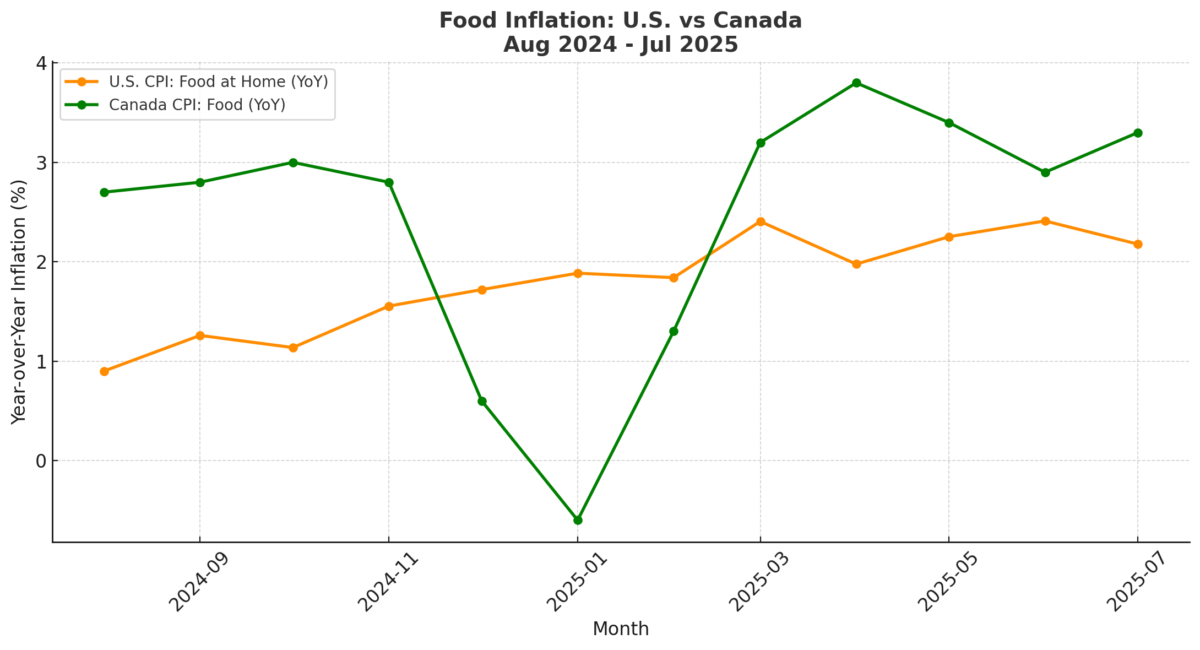
The latest food inflation data, released this week, was nothing short of startling. From November to December, Canada’s food inflation rate plummeted from 2.8% to 0.6% — an unprecedented monthly decline. This marks a historical record, surpassing the previous drop of 1.9% in March 2012. What makes December’s numbers even more surprising is that the food industry typically sees inflationary pressures peak during the winter months, especially in November, December, February, and March. For the busiest month of the year, a decline of -2.2% is highly unusual and largely attributed to the GST Holiday, which began on December 14.

The Impact of the GST Holiday on Inflation

The GST Holiday has, without question, delivered relief for consumers. However, it also highlights the complex relationship between tax policy and inflation metrics. According to Statistics Canada, the Consumer Price Index (CPI) reflects the final prices paid by consumers, including GST, PST, or HST, as well as environmental, liquor, and tobacco taxes where applicable. When taxes like GST are reduced, it directly impacts the CPI. This is exactly what we saw in December, and similar trends are expected in January and February.

The data from Statistics Canada reveals a strong correlation between lower food inflation rates at restaurants and the extent of tax relief provided during the GST Holiday. Provinces offering the most significant reductions, such as Nova Scotia, Newfoundland and Labrador, and Prince Edward Island—where GST was cut by 15%—experienced the steepest declines in restaurant inflation at -3.9%, -4.0%, and -3.0%, respectively. Ontario, with a tax reduction of 13%, also saw a notable drop at -3.0%. These numbers are remarkable.

Limited Impacts in Provinces with Lower GST Reductions

In contrast, provinces like Alberta, Saskatchewan, and Manitoba, where GST was only reduced by 5%, experienced negligible impacts. Alberta’s restaurant inflation decline was a mere -0.2%. This disparity underscores the direct influence of tax reductions on inflation data. However, it also exposes how these policies can artificially suppress inflation metrics, masking underlying cost dynamics. Base menu prices likely remained unchanged or subtly increased, even as tax-inclusive prices dropped. This “tax illusion” gives the impression of reduced costs without reflecting the actual market conditions.

Statistics Canada’s report is clear: Canadians paid less for food in December. Month-over-month inflation rates fell by -0.3% in retail and -4.5% in restaurants. But this does not mean food became genuinely cheaper. Quite the opposite. The GST Holiday’s impact has created a temporary distortion, masking the true cost trajectory of food and leaving room for “opportunity pricing.”

Business Pricing Strategies During the GST Holiday

Some grocers and restaurant operators may have leveraged the tax break to increase their base prices, confident that consumers would focus on lower final bills rather than subtle price hikes. This phenomenon highlights a key concern with temporary fiscal measures: they can obscure real price dynamics and inadvertently encourage strategic pricing adjustments that offset intended benefits.

What December’s data truly reflects is not a straightforward pass-through of tax relief but a complex interplay between reduced taxes and business pricing strategies. This serves as a cautionary tale about the unintended consequences of short-term fiscal policies. While the GST Holiday may have offered consumers some relief, it also underscores the risks of relying on temporary measures to address long-term affordability challenges in the food sector. Real solutions require structural, sustainable approaches that address both inflationary pressures and market dynamics comprehensively.

Spring Food Price Hikes Expected

Looking ahead, consumers should brace themselves for major price hikes in the spring and beyond, as predicted in our annual Canada’s Food Price Report 2025. These increases are expected to reflect ongoing inflationary pressures, supply chain challenges, and market adjustments following the expiration of temporary measures like the GST Holiday.

More from Dr. Sylvain Charlebois:

Nemesis Pavilion to open in February at new Surrey Pavilion in City Centre

Hospitality-driven speciality coffee company Nemesis is taking its pursuit of ‘coffee creating culture’ to the city of Surrey, with the highly anticipated opening of its fourth location. Debuting this February at the new Surrey Pavilion, in the heart of City Centre, Nemesis Pavilion will feature all the signature hallmarks of its brand — inviting space, dynamic music, excellent coffee, pastries, and elevated brunch, said the company in a news release.

Jess Reno
Jess Reno

“Surrey is one of the country’s fastest growing cities and City Centre is at the core of its growth — a community surrounded by families, campuses, sports facilities, parks, public art, and more,” said Jess Reno, who opened his first Nemesis in Vancouver’s Gastown in 2017. “Similar to our other locations, we wanted to place our next Nemesis in a neighbourhood where arts, culture, and education are celebrated. We’re beyond excited to open our doors at the Surrey Pavilion next month and work with Marcon to create this new cultural hub.

“We collaborated with the Marcon interior design team to create a space that is both thoughtful and refined. Inspired by modern architecture, the interior emphasizes subtle details — highlighting the warmth of wood, steel, and glass — while intentional use of light and sound creates a seamless harmony with our style of service and hospitality.

“By design, Nemesis Pavilion will be equipped with a full pastry kitchen. This will allow us to create fresh pastries throughout the day, including donuts, which will be exclusive to this new location initially.” 

The 2,600 square foot space will feature 50 seats, with an expansive patio expected to open during the warmer months. As with each Nemesis location, Nemesis Pavilion’s design is distinct and unique, said the brand.

“The service team, led by senior operations manager Albert Tang, includes operations manager Karl Broadway and director of coffee Nathaniel Fried. Guests will continue to enjoy directly-traded, thought-provoking coffees from Nemesis’s partners at origin — from drips to pour overs,” it said.

“The kitchen team features executive chef Mielye Mitchell and executive sous chef Lina Serrano — two talented individuals who have been leading the culinary program at Nemesis since the launch of their GNW location. While Nemesis Pavilion will serve a similar brunch and Dope Bakehouse menu as its sister locations, it will also introduce something new – donuts – focused on nostalgic flavours and re-interpreting the classics.”

Related Retail Insider stories:

Cognizant study shows consumers who embrace AI could drive $4.4 Trillion in spending over 5 years 

Photo by Andrea Piacquadio

Cognizant, in collaboration with Oxford Economics, has unveiled new insights into how artificial intelligence (AI) is set to revolutionize the consumer purchasing journey by 2030 and drive significant economic impact.

The study, New Minds, New Markets shows that as income and purchasing power increases among 18 to 44-year-old AI enthusiasts, this demographic will command an estimated $4.4 trillion of AI-influenced consumer spending in the U.S. by 2030. In the U.K., this spending projection is estimated at $690 billion, in Australia it’s at $669 billion, and in Germany it’s at $539 billion. 

The study also predicts that U.S. consumers who embrace AI could drive nearly half (46%) of spending by 2030. In Australia, this projection rises to 55% over the same period. In Germany it’s estimated at 46% and in the U.K., it’s at 39%.  

Ravi Kumar S.
Ravi Kumar S.

“As AI-influenced buying evolves, businesses must navigate mixed consumer attitudes towards AI,” said Ravi Kumar S. CEO of Cognizant. “Enterprises are balancing the demand for convenience with the need for control and trust. Understanding these attitudes is crucial for developing AI solutions that not only enhance convenience but build confidence in the full potential of how AI can reimagine the customer experience and unlock tremendous value.”  

Key findings from the study: 

  • Consumers are most comfortable using AI in the discovery phase of making a purchase decision (the Learn phase.) Across all consumer age groups, 47% cite they are comfortable using AI to help choose products and services. In this phase, AI-powered search tools, personalized recommendations and virtual assistants can be essential tools in the discovery and evaluation stages of consumer journeys. Technology companies are already building these capabilities into their consumer-facing toolsets, making it easier for consumers to use AI to gather information and shortlist options.  
  • During the decision-making phase (the Buy phase), consumers harbor more hesitation. In this phase, consumers share concerns around security and trust when it comes to using. The study showed 75% of consumers are unlikely to allow AI to automatically reorder or pay for high value items without their direct authorization. Additionally, only 16% of those who are 55 years and older are comfortable using AI during this phase (and only 33% are comfortable among the 18–44-year-old group.) 
  • Comfort levels begin to rebound in the post-sale engagement phase (the Use phase.) In this phase, consumers benefit from AI’s ability to help them tap into time savings and targeted services that add value to their after-purchase experience. Across all consumers, nearly a third (28%) said they are comfortable with AI reordering low-priced items. For example, smart HVAC systems could intelligently reorder air filters from the manufacturer directly, reducing the onus on consumers to identify the need for replacements themselves or reliance on local retailers to deliver supplies in a timely manner. 

Related Retail Insider stories:

New corporate headquarters and DC opens for The Brick in Edmonton

Photo courtesy of Leon's

Leon’s Furniture Limited has announced the opening of the brand-new corporate headquarters for The Brick along with a leading-edge Shared Services Distribution Centre that has a combined total footprint of 500,000 square feet in Edmonton.

This represents one of the more significant single property investments in the company’s 100-year history and sets a solid foundation for continued growth and improved service levels for the next generation. The building will also serve as the new head office for Trans Global Insurance. The combined facility will employ more than 400 Team Members in Edmonton, said the company in a news release.

“Our new shared services Distribution Centre represents another important milestone in our ongoing efforts to generate significant efficiencies throughout our network” said Mike Walsh, President and Chief Executive Officer of the LFL Group. “The new DC will enhance product availability and shipping times, throughout the Prairies and Territories.

“Our new Corporate Headquarters for both The Brick and Trans Global Insurance provides a modern and innovative space to promote excellence.”

Darci Walker
Darci Walker

“This new building marks a monumental step forward for The Brick as it demonstrates our commitment to growth. As we embark on this new chapter, we’re excited to create an inspiring environment that
supports our team’s dedication to delivering exceptional products and services to our valued customers.”
said Darci Walker, President of The Brick.

The combined facility was built under a 50/50 joint venture partnership with Qualico Properties, a
leading real estate developer and was built on 28 acres of purchased land in the NW quadrant of
Edmonton.

The Brick has been in business since 1971.

Leon’s Furniture Limited is the largest retailer of furniture, appliances, and electronics in Canada.
Its retail banners include Leon’s, The Brick, The Brick Mattress Store, and The Brick Outlet. The
addition of The Brick’s Midnorthern Appliance banner, alongside Leon’s Appliance Canada banner,
makes the company the country’s largest commercial retailer of appliances to builders, developers,
hotels, and property management companies. LFL has over 300 retail stores from coast to coast.

Related Retail Insider stories:
Sweat and Tonic Unveils New Concept Studio REFORMD (Renderings)

REFORMD Rendering by Ste Marie Studio (CNW Group/Sweat and Tonic)

 Sweat and Tonic, a Toronto boutique fitness and wellness destination, has announced the launch of REFORMD — what it calls a groundbreaking new brand and concept studio set to open in spring 2025.

Nestled within The Well and located just steps away from Sweat and Tonic’s second location that opened in December 2023, REFORMD is set to make history as the world’s highest-capacity Lagree method studio, said the company in a news release.

“This announcement comes less than a year after announcing plans to open their third location in Toronto’s prestigious Yorkville neighbourhood. Renowned for their state-of-the-art, immersive yoga, Pilates, HIIT and indoor cycling classes, and 360-degree wellness and recovery hub, Sweat and Tonic’s REFORMD will specialize in Lagree Method workout classes delivered by world-class Lagree-certified instructors, all carefully crafted and delivered through their signature high-energy experience and expert programming,” it said.

“We have the privilege of welcoming over 3,000 guests in attendance per day, in 475 classes weekly across our two locations and Tonic Spa, and we’re so grateful for the overwhelming support since opening our second location at The Well,” said David Ingram, Founder of Sweat and Tonic.

“Every day, we see first-hand what’s important to our guests – highest quality fitness classes, comprehensive wellness and recovery options, elevated amenities, connecting with a strong and dedicated community, and friction-free access to it all. With the demand we’ve seen since opening at The Well, there was an opportunity to further elevate our offerings and support our guests in their wellness journeys. REFORMD is the next exciting step in our mission to bring the best of boutique fitness and wellness to the community. Not only are we adding the Lagree Method – one of the best strength-building workouts in the world – to our offerings, we’re pushing the boundaries and elevating the guest experience above and beyond what you’ll find anywhere else in this city.”

REFORMD Rendering by Ste Marie Studio (CNW Group/Sweat and Tonic)

The company said its 6,000 square-foot location will be equipped with 30 Mega Pro Megaformer machines, featuring immersive custom-programmed chromatherapy lighting and AV, floor-to-ceiling mirrors, and an elevated instructor Megaformer platform providing a clear line of sight to optimize the workout experience. The space will also include a welcome lounge, education room with two Megaformer machines, a grab and go fridge and Tonic Bar ordering kiosks for pre- and post-class fuel, private changerooms and showers, as well as heated flooring throughout the changeroom and Megaformer studio.

“Lagree is not Pilates, and the Megaformer is not a reformer. Since its inception over 25 years ago, the Lagree Method stands in a category of its own and has continuously evolved, earning its reputation as one of the world’s most effective and transformative workouts,” it said.

“Founded on five components of physical fitness – endurance, cardiovascular fitness, body composition, flexibility, and strength – Lagree is a patented high-intensity, low-impact exercise method that tightens, tones, and deeply activates slow-twitch muscle fibers. The method integrates body-building principles and focuses on slow, controlled movements and progressive load to build strength. The Mega Pro is the 8th and the newest of the evolving Megaformer machine series, featuring a moving carriage and adaptive platform lift to activate muscles and allow for easier stabilization of joints to ensure less impact and inflammation in connective tissues during and post workout.”

REFORMD Rendering by Ste Marie Studio (CNW Group/Sweat and Tonic)

“Lagree Fitness has always pushed the limits of the fitness industry,” said Sebastien Lagree, inventor and Founder of Lagree Fitness. “With over 180 patents and 600 Lagree Method studios worldwide, evolution and innovation has always driven my vision for the brand. At our core, it’s always been our mission to help others reach new heights in their health and fitness, and we do that by pushing the industry out of their comfort zone. Knowing that Sweat and Tonic, a bold brand with innovation and technology at their forefront, is bringing the largest-capacity Lagree Studio in the world and continuing to raise the bar for the fitness and wellness industry in Toronto and beyond, is very energizing. Experimenting, pushing, and evolving – this is what the future of fitness is all about.”

Related Retail Insider stories:
Canadian Retail News From Around The Web For January 23, 2025

Canadian Retail News From Around The Web

News at a Glance

Retail Insider is streamlining its Canadian retail news from around the web to include a handful of top news stories that can be viewed quickly during the day. Here are the top stories from the past 48 hours.

Many Canadians are more than 15 minutes from a grocery store: Statistics Canada (Grocery Business)

Trudeau, premiers urging shoppers to buy Canadian (Grocery Business)

A U.S.-Canada tariff battle looms. These 10 things could get costlier (Global)

Trump’s tariff threats to China could hit Canadian wallets. Here’s why (Global)

Brit shop owner in Canada discovers locals ‘love’ sausage rolls and traditional Scottish dish (The Mirror)

Man charged in Walmart fire at Square One that caused over $10 million in damage (CTV)

Winnipeg retailer Swimming Matters closes doors after 26 years serving aquatic athletes (Winnipeg Free Press)

Bill 85: Quebec Retailers to Gain Flexibility with Extended Hours (RCC)

Manitoba Retail Crime Crackdown Gains Permanent Support (RCC)

‘What are we living in — a wild west?’: Pot shop owners left fuming by city’s lax rules (Toronto Star)

Flatbed truck smashes into Kelowna sports collectibles store during robbery (Global)

Vancouver sandwich store shutters, sushi shop starts service (VIA)

Thieves ‘more brazen,’ Brandon store manager says, but police think new initiative is showing results (CBC)

Primaris REIT Acquires Southgate and Oshawa Centres for $585M

Southgate Centre in Edmonton. Image: Mapquest

Toronto-based Primaris Real Estate Investment Trust (REIT) announced a $585 million transaction involving two prominent shopping centres. The deal is positioned as one of the largest retail real estate transactions of the year and marks a strategic expansion for Primaris REIT. The acquisitions include a 50% interest in Edmonton’s Southgate Centre and full ownership of Ontario’s Oshawa Centre.

The transaction, facilitated by advisors CBRE and TD Securities, is expected to close by January 31, 2025. Payment for the acquisitions will be a combination of $335 million in cash, $75 million in series A units of the REIT valued at $21.82 per unit, and $175 million in exchangeable preferred units in a newly created subsidiary partnership.

The assets were previously owned by Ivanhoé Cambridge, the real estate subsidiary of Caisse de dépôt et placement du Québec (CDPQ). Both malls are currently managed by JLL.

Southgate Centre: A Key Asset in Edmonton

Located in Edmonton’s Malmo Plains neighbourhood, Southgate Centre spans 846,000 square feet of retail space on 39 acres, with a site coverage of approximately 66%. The mall features a tenant mix that includes Hudson’s Bay, Winners, Safeway, Uniqlo, Apple, Sephora, and Lululemon, among other tenants.

Southgate Centre recently underwent a $93 million redevelopment of 260,000 square feet, repurposing the former Sears space. This project, completed in 2022, introduced a modernized retail offering and enhanced the mall’s overall appeal. According to Primaris, Southgate has a long-term occupancy rate of 87.5%, a weighted average lease term (WALT) of 5.9 years, and generated $300 million in total retail sales for the 12 months ending August 31, 2024.

Edmonton’s growing population, forecasted to increase by 28.2% over the next decade, further strengthens Southgate Centre’s market potential. The city’s diverse economy, anchored by energy, government, and education sectors, positions the mall as a key retail hub for the region.

Oshawa Centre: Eastern Ontario’s Retail Landmark

Situated 40 minutes east of downtown Toronto, Oshawa Centre is one of Ontario’s largest malls. The property encompasses 1,215,200 square feet of retail space on 79 acres, with a lower site coverage of 47%, offering ample opportunities for future development.

The tenant roster at Oshawa Centre includes Hudson’s Bay, Marshalls, H&M, Uniqlo, Zara, Aritzia, and Sephora, as well as the Regional Municipality of Durham as an office tenant. A major $230 million redevelopment in 2016 added 375,000 square feet, expanding the food court and introducing more retail space.

Despite its size and tenant mix, Oshawa Centre’s long-term occupancy rate currently stands at 73.8%, with a WALT of 3.8 years. The mall reported $242 million in sales for the 12 months ending August 31, 2024. The Oshawa area is experiencing strong demographic growth, with a projected 22% population increase over the next decade, making it an attractive investment for Primaris.

Oshawa Centre, photo: Norman Katz

Primaris REIT: Building a Dominant Portfolio

Primaris REIT, known as Canada’s only enclosed shopping centre-focused REIT, has been actively executing a growth strategy centered on acquiring leading malls in mid-sized Canadian markets. Since its spin-off from H&R REIT in 2021, Primaris has acquired over $2.4 billion in assets, including prominent properties from several of Canada’s largest pension funds.

With these latest acquisitions, Primaris’ portfolio now totals 15 million square feet, valued at approximately $4.6 billion. The REIT’s same-store sales productivity is set to increase from $684 per square foot as of September 30, 2024, to $736 per square foot on a pro forma basis. The addition of Southgate Centre and Oshawa Centre further solidifies Primaris’ position in the market and provides opportunities for income growth through leasing vacant space, converting tenants to net lease agreements, and optimizing former department store areas.

“This transaction highlights the strategic advantages of our vertically integrated management platform and robust balance sheet,” said Rags Davloor, Chief Financial Officer at Primaris. Patrick Sullivan, President and COO, added, “Southgate and Oshawa Centre align perfectly with our growth strategy, offering strong sales volumes and significant potential for value creation.”

Divestitures and Future Outlook

In addition to the acquisitions, Primaris announced the sale of Sherwood Park Mall in Alberta for $107 million and Edinburgh Market Place in Guelph, Ontario, for $31.5 million. These dispositions, part of a broader capital recycling strategy, allow the REIT to focus on high-performing assets in growing markets.

Primaris’ proactive approach to managing tenant risk was also addressed in light of Comark Group filing for creditor protection under Canada’s Companies’ Creditors Arrangement Act. Comark operates 36 stores in Primaris’ portfolio under the banners Bootlegger, Cleo, and Ricki’s. With most leases structured on a short-term basis, Primaris has been preparing to replace these tenants with stronger retail brands.

Positioning for Long-Term Growth

The acquisition of Southgate Centre and Oshawa Centre marks a pivotal step in Primaris’ strategy to dominate Canada’s enclosed shopping centre sector. By leveraging its scalable management platform and focusing on high-quality assets, the REIT is well-positioned to capitalize on evolving market opportunities.

“These acquisitions enhance our value proposition with retailers while providing significant growth opportunities for our unitholders,” said Alex Avery, Chief Executive Officer of Primaris. “We remain committed to maintaining industry-leading financial metrics and delivering consistent returns.”

More from Retail Insider:

Chick-fil-A’s growth in Canada continues with new expansion plans for British Columbia

Photo courtesy of Chick-fil-A

Chick-fil-A plans to expand its Canadian footprint to British Columbia with five to seven new restaurants expected to open in the province by 2030. 

The brand in a news release said its growth in British Columbia follows its successful expansion into the province of Alberta in 2024, where three new restaurants opened in Calgary and Edmonton last year.  

Jessica Sisk Roehle
Jessica Sisk Roehle


“We are excited about the opportunity to bring an authentic Chick-fil-A experience to guests in British Columbia, where local Chick-fil-A Owner-Operators will create hundreds of new jobs, and invest in their teams and local communities,” said Jessica Sisk Roehle, director of restaurant development in Canada for Chick-fil-A.

“The incredible reception Chick-fil-A received when we expanded into Alberta this past year really energized us as we planned our next steps in Canada. British Columbia has a number of vibrant, thriving communities across the province that makes it such a great place for us to grow.” 

The company said it plans to open its first restaurant in British Columbia by late 2027 or early 2028. 

Additionally, it said it plans to open a record eight restaurants across Ontario and Alberta in 2025, marking the most openings in Canada in any year since the first restaurant opened in 2019. It has opened 22 restaurants in Canada over the past five years. 

“As part of the expansion in British Columbia, the entrepreneurs who will be local Chick-fil-A Owner-Operators are expected to hire approximately 80-120 employees at each new location, joining thousands of Chick-fil-A restaurant Team Members who work at Chick-fil-A restaurants in Ontario and Alberta,” it said.

Since Owner-Operators began welcoming guests in Canada in 2019, the communities served by their restaurants have benefitted in a variety of ways, the company outlined: 

  • Every time a restaurant opens, US$25,000 is donated by the company to Second Harvest, one of Canada’s largest food rescue organizations, to support local non-profit organizations in the area to help reduce hunger and food waste. So far, the company has donated over US$500,000 to local Canadian organizations in celebration of Restaurant openings. That tradition will continue in British Columbia.  
  • Since the beginning of 2020, the brand has donated more than US$1.65 million to support Second Harvest’s food rescue programs that have helped provide 4.95 million meals worth of surplus food for people in need and supported the national expansion of Second Harvest’s food rescue initiatives to communities across Canada. 
  • Participating Chick-fil-A restaurants donate surplus food to local shelters, soup kitchens and charities through the Chick-fil-A Shared TableTM program, which has resulted in ingredients for over 133,000 meals being donated by Chick-fil-A restaurants in Canada, with the number growing each day.  
  • Canadian non-profits like Children’s Aid Foundation of CanadaEast York Meals on WheelsLiving Lakes CanadaSignal Hill Life Education SocietyToronto City MissionWindsor Family Home and Community Partnerships and Yonge Street Mission, have collectively received US$660,000 from the Chick-fil-A True Inspiration Awards, annual grants given to organizations that make an impact by Caring for People, Caring through Food, Caring for Our Communities and Caring for Our Planet – falling within Chick-fil-A corporate social responsibility pillars, which help guide overall giving efforts. 
  • Chick-fil-A has awarded nearly US$189,500 in scholarships since 2020 to 86 Team Members in Canada to support their goals of pursuing post-secondary education.  

Chick-fil-A, Inc. is the third largest quick-service restaurant in the United States, known for its freshly prepared food, signature hospitality and unique franchise model. More than 200,000 Team Members are employed by local Owner-Operators in more than 3,000 restaurants across the United States, Canada, and Puerto Rico. In 2023, the company shared plans to expand into Europe and Asia. The family-owned and privately held company was founded in 1967 by S. Truett Cathy.

Related Retail Insider stories:

RONA brings together its collaborators to launch 2025

Photo courtesy of RONA

RONA inc., one of Canada’s leading home improvement retailers operating or servicing some 425 corporate and affiliated stores, brought together this week more than 300 people representing nearly 180 vendors, as well as 330 RONA leaders for the Vendor Forum and Store Manager Meeting.

As the entire home improvement industry prepares for its biggest season, spring, these events are a unique opportunity for participants to learn about RONA’s priorities and strategies for the coming year and to engage with members of RONA’s Executive Leadership and Merchandising teams, said the company in a news release.

This year, seven vendors were awarded Vendor of the Year in their respective categories. RONA recognizes their commitment to helping deliver the very best to its customers, whether through the value and quality of their products, collaboration, and their ability to adapt, it said.

“Our vendors played an important role in RONA’s success in 2024. Through the support and collaboration of our key partners, RONA continues to offer better value and improved assortments for our PRO and DIY customers,” said Doug Young, Chief Merchandising Officer, RONA inc. “It’s important for us to recognize the remarkable work of vendors over the past year through our Vendor of the Year awards. Our award winners are valuable partners helping us to continuously improve and meet customers’ needs.”

Here are the winning vendors by category:

  • Lumber and building materials: Doman
  • Projects: Monoserra
  • Home: Stanley Black & Decker
  • Value: S Boudrias Horticulture
  • Assortment: Old Castle
  • Innovation: TNA Doors
  • Pro: Henkel

About 70 vendors will also take part in the RONA Product Experience at the Store Manager Meeting. Leaders of RONA+ and RONA stores eagerly await this important exhibition, where they’ll have the chance to meet vendors, discover new products, try them out, and learn more about their features, said the retailer.

J.P. Towner
J.P. Towner

“Continuous training of our in-store teams is very important to us, since it helps us provide our customers with even better service. Knowing our products and what makes them different is key to providing sound advice to our customers and becoming the benchmark for customer experience in the construction and home improvement industry. I’d like to extend my warmest thanks to the vendors who are exhibiting at this year’s Store Manager Meeting. Their presence is a great added value for our leaders in the field who are thrilled to explore the exciting new product innovations and strengthen the partnerships with our vendor community,” said J.P. Towner, President and Chief Executive Officer at RONA inc.

RONA inc. is one of Canada’s leading home improvement retailers headquartered in Boucherville, Quebec. The RONA inc. network operates or services some 425 corporate and affiliated dealer stores under the RONA+, RONA, and Dick’s Lumber banners. With a long and rich history, RONA inc. has supported Canadians in their home improvement and construction projects since 1939.

Related Retail Insider stories:

Amazon to Close Quebec Operations, Affecting 1,700 Employees

IMAGE: AMAZON PRIME

Amazon has announced plans to cease operations at seven facilities in Quebec over the next two months. The closures include one fulfillment center, two sorting centers, three delivery stations, and one AMXL (extra-large) delivery station co-located with a sorting center. This decision will impact approximately 1,700 regular employees and 250 temporary seasonal workers in the province. 

Transition to Third-Party Delivery Model

The company stated that it will revert to a third-party delivery model supported by local small businesses, a system previously in place until 2020. Amazon spokesperson Barbara Agrait emphasized that this move aims to maintain high-quality service and offer greater savings to customers in the long term. She clarified that the decision was not influenced by the unionization of 200 employees at Amazon’s DXT4 warehouse in Laval, Quebec, which occurred in May 2024. 

Employee Compensation and Support

Affected regular employees will receive severance packages, including up to 14 weeks of pay following the closure of the facilities, along with transitional benefits such as job placement resources. Temporary seasonal workers will be compensated until the conclusion of their contracts. Amazon has expressed its commitment to assisting employees during this transition period. 

Government Response

Quebec Employment Minister Kateri Champagne Jourdain acknowledged the company’s decision as a corporate reorganization and assured support for the displaced workers. She stated, “We’ll be there for the employees; that’s what we do in the employment ministry, help workers find other work.” The provincial government is actively engaging in discussions to address the situation and provide necessary assistance to the affected workforce. 

Potential Role of Intelcom

In light of Amazon’s shift to a third-party delivery model, Intelcom, an existing subcontractor for Amazon’s delivery and sorting services, may assume a more prominent role. Numerous job postings were recently listed on Intelcom’s website, indicating potential opportunities for the displaced Amazon employees. This development suggests a possible avenue for continued employment within the logistics and delivery sector in Quebec.

Background on Unionization at DXT4 Warehouse

In May 2024, the Administrative Labour Tribunal certified the unionization of approximately 200 employees at Amazon’s DXT4 warehouse in Laval, marking the first instance of an Amazon warehouse unionizing in Canada. The Confédération des syndicats nationaux (CSN) led the unionization efforts, citing concerns over work pace, health and safety measures, and wages. Despite Amazon’s plans to appeal the decision, the unionization was upheld, and the company was legally required to engage in collective bargaining with the newly formed union. 

More from Retail Insider: