Home Blog Page 597

How Shopper Behaviour is Changing in Canada in a Post-Inflation World [Op-Ed]

As inflation stabilizes, a new type of consumer has emerged, marked by value consciousness digital savviness, and a preference for experiences over material goods. THE CANADIAN PRESS/Cole Burston

After a long anticipated wait, the Bank of Canada has finally decided to cut interest rates by 25 basis points. The decision marks a departure from the series of interest rate hikes that were previously implemented to curb inflation.

The recent decrease appears to be signalling that inflation is finally starting to stabilize in Canada.

Over the past few years, Canadians have felt the strain of inflation. Many individuals turned to deal-chasing and savings as a way to build financial safeguards, giving rise to what we, as retail researchers, call the “new consumer.”

This “new consumer” phenomenon appears to be more than just a temporary response to economic hardships. It has since evolved into a more permanent behavioural shift, reflecting a broader transformation in consumer habits and preferences.

As inflation stabilizes and the economy adjusts to a new normal, businesses must adapt to meet the changing needs and preferences of this demographic.

Who is the ‘new consumer’?

The new consumer is marked by value consciousnessdigital savviness and a preference for experiences over material goods.

Despite the recent stabilization of consumer prices, the new consumer has retained habits formed during economic uncertainty, continuously seeking deals and discounts. CBC News segment about rising inflation putting pressure on Canadian consumers.

Youtube video

According to the latest Future Consumer Index report by consulting firm Ernst & Young Global Limited, U.S. consumers are increasingly prioritizing savings over brand loyalty.

The survey revealed that nearly half of participants would download a brand’s app to access loyalty promotions or exclusive deals, while 70 per cent were inclined to join loyalty programs for free shipping benefits.

Additionally, 45 per cent of respondents have used discount codes or vouchers during online shopping in the past six months. This trend highlights the significant shift towards cost-conscious consumer behaviour.

Consumers are also actively using digital platforms to compare prices and read reviews, making more informed purchasing decisions than ever before. This digital savviness allows them to navigate the online marketplace efficiently, ensuring they get the best value for their money.

Physical store experience is still key

Despite the emphasis on looking for deals and reviews online, the new consumer still values in-store experiences. According to the Ernst & Young survey, 59 per cent of consumers visit stores to see, touch and try items before buying, and 57 per cent prefer in-store shopping to avoid shipping hassles.

Additionally, human interaction is increasingly important during the post-purchase journey. Fifty-six per cent of U.S. consumers consider it crucial for product returns and refunds, and 55 per cent value it for discussing product questions or concerns.

There’s also a notable shift towards experiential spending. Consumers are now more inclined to invest in travel, dining and unique activities over accumulating material possessions. This trend reflects a desire for meaningful and memorable experiences that offer greater satisfaction than physical goods.

Understanding these characteristics is essential in the new age of retailing. The new consumer’s focus on value, informed by digital tools and a shift towards experiential spending, defines their behaviour in a post-inflation world.

This evolving consumer profile presents both challenges and opportunities for brands and retailers, shaping the future of the retail landscape.

A young woman crouched down beside a full shopping cart, looking at the label on a can in a grocery store aisle
Consumers nowadays are continuously seeking deals and discounts, despite consumer prices stabilizing. (Shutterstock)

How retailers can cope

In an era where digital commerce continues to grow, physical retail stores are being forced to reinvent themselves, moving away from transaction points to vibrant hubs of brand experience. For instance, fuelled by the COVID-19 pandemic, retail e-commerce sales increased 67.9 per cent in Canada from February 2020 to July 2022.

This shift underscores the evolving role of physical stores, which are becoming places where consumers can learn, experience and play. As retailers adapt to changing consumer expectations, the notion that a store must be more than a place to transact is becoming a fundamental aspect of retail strategy.

A prime example of this trend is the Nike store in Manhattan, which epitomizes the concept of the store as a medium rather than just a marketplace. Far from the traditional retail setup, this location serves as a “playground” centred around experience.

The store includes a basketball half-court with adjustable hoops and digital screens, an enclosed soccer trial area, a treadmill facing a jumbotron for simulated outdoor runs, a customization shoes bar, touchscreens throughout and dedicated coaches to assist customers testing new sneakers.

The transformation of stores into experience-rich environments reflects a broader trend in retail where the value of a physical location is measured not just by traditional sales per square foot, but by the ability to engage consumers in a more meaningful ways. Retailers who invest in making their stores true extensions of their brand are primed to set themselves apart in an increasingly competitive marketplace.

Lotalty first

To thrive in this new retail landscape, leveraging loyalty programs is essential for retailers. These programs can help bridge the gap between digital and physical retail experiences by offering personalized rewards and exclusive deals that drive both online and in-store traffic.

Retailers should focus on creating loyalty programs that not only reward purchases but also enhance the overall customer experience.

For instance, integrating mobile apps that provide real-time notifications on deals and events, offering exclusive in-store experiences for members and using data analytics to tailor rewards to individual consumer preferences can significantly enhance engagement and retention.

In essence, the future of retail lies in these dynamic, personalized and interactive spaces where shopping is only part of the appeal.


By Omar H. Fares Lecturer in the Ted Rogers School of Retail Management, Toronto Metropolitan University and Joseph Aversa, Assistant Professor, Retail Management, Toronto Metropolitan University

*

*

This article is republished from The Conversation under a Creative Commons license. Read the original article.

Tepperman’s Furniture Opens Massive Experiential Storefront in St. Catharines, Following Market Research [Interview]

Tepperman's St. Catharines (Image: Tepperman's)

Family-owned furniture retailer Tepperman’s, in business since 1925, has opened its seventh location with the latest in St. Catharines, Ontario.

Andrew Tepperman, grandson of the founder and current company president, said the goal of the new store is to create a fresh, inspirational look for the brand.

Andrew Tepperman

“We included features like selfie stations, waterfall, kids area with digital games imported from England, courtesy popcorn and coffee café, electric car charger, nature rest area with live plants, solar panels to reduce energy costs, 1928 working pickup truck similar to what our founder Nate would have used and we filled it with old appliances and furniture from that era,” said Tepperman.

“We didn’t originally have it on our radar. We had opened up in Ancaster about an hour away near Hamilton in 2019 and we noticed over the last couple of years that we’re drawing people from St. Catharines and Niagara Falls. So it was actually challenging logistically to deliver all the way out there. So we started to do demographic research. We used Environics and we found out that the demographics was very similar for our top performing markets like Windsor for instance. 

“So immediately we said we’ve got to start to dig into this place. There happened to be a large vacant site that was owned by Smart Centres. It was an old Home Outfitters and an old Designer Depot. The site had been sectioned off. We said we wanted to take the whole thing. It’s 66,000 square feet – 44,000 square feet is showroom and 19,000 square feet is warehousing.”

Tepperman’s St. Catharines (Image: Tepperman’s)

Tepperman said because this store is so far away from its main distribution centre in London the retailer needed a site with a larger warehouse capacity so it could deliver right from the store.

“We did a soft opening May 3 which was interesting because it’s really taken off,” he said. “It’s exceeding expectations. It’s a good market and I think it’s resonating because that market has not seen something new and fresh in a long time. 

“We have kids and you’re not supposed to say one of them’s the nicest or the best but this our best looking store. We put a lot into it. What was interesting was starting about five years ago we began renovating all of our stores and before we even looked at St. Catharines we developed this Tepperman’s 2.0 model and Ancaster would have been a 2.0 model. The last store was London but London was so big we said let’s develop a Tepperman’s 3.0 model, make it more interesting, more inspirational, more experiential. 

“We engaged our designer who is from New York and we said kind of surprise us. Come up with something new. So she developed this amazing new look for London but construction costs have gone up a lot. So we said we have to put London on hold with this new design but all of sudden we realized we have St. Catharines now coming on line. The timing was perfect. We pulled some of the best new ideas from the Tepperman’s 3.0 model and put it into St. Catharines.”

Don Gregor of Aurura Realty Consultants is the real estate representive for Tepperman’s.

Image: Tepperman’s
Tepperman’s St. Catharines (Image: Tepperman’s)

Tepperman said the retailer is not targeting anything right now for expansion.

“It’s kind of wait and see. We’re always looking. Any opportunity that comes by we look at but we don’t have like a specific target market today,” he said.

Tepperman’s started as a dream when Nate Tepperman began his peddling career selling door-to-door in Windsor, Ontario in 1925.

In a previous story with Retail Insider, Andrew Tepperman said his grandfather left Russia right after the Revolution in that country and came to Canada.

“I think he had a Grade Five education. English was not his first language. No money. I think he worked at odd jobs. We don’t know a lot and then in 1925 he started going door to door selling rugs and blankets,” said Tepperman.

“This is really interesting. He needed to differentiate what he was doing. So he would sell it on credit and every week he would go back and collect a nickel and what’s amazing fast forward to today we use that exact same model and we still do in-house credit where everyone else uses banks. We follow the exact same thing he did from 1925. So, when times get tough, we work very closely in a different way with our customers and that’s always been a differentiator for us.”

Image: Tepperman’s
Noah, Bill and Andrew Tepperman

Tepperman said his grandfather eventually got a bicycle so he didn’t have to walk door to door and then got a pickup truck and eventually opened his first brick and mortar store – all within the same area in Windsor.

“He never expanded. He went from 1925 to 1970 one store, one location in Windsor. And he unfortunately drowned in 1970 when he was 70 years old. He was on vacation in Florida. So my father Bill Tepperman was 36 at the time and was kind of thrust into the leadership position of the business and my father continued to build up on the legacy and then in 1983 he expanded to Chatham and then 1992 expanded to Sarnia and in 1997 expanded to London,” he said.

“In 2006, my father retired, and I took over as president and my brother took over as secretary-treasurer. We had four stores at the time, and we continued to grow the stores. We outgrew London so we closed the store that we had been in for 10 years and in 2008 we built a very large facility in London just down the street and today it’s our largest store. It’s 85,000 square feet of showroom and 150,000 square feet of distribution space. It’s pretty large. It’s joined together.”

Toronto’s ‘The Scene Medical Beauty Bar’ Expanding with Long Term Goal of Dozens of Locations Across Canada [Interview]

The Scene Medical Beauty Bar Leslieville (Image: Provided)

The Scene Medical Beauty Bar in Toronto is looking to bring more awareness to skincare and to decrease stigma for those who want treatments. The brand has expanded its services to include more wellness options and has the goal of opening 50-60 locations across Canada within the next ten years. 

“The brand was developed last year, bringing a new way of skincare and wellness to the industry and we are really trying to innovate it. With our first location opening in October of 2023 and our second location opening in December of 2023, we are still very much in our infantile stage, building and learning lessons along the way. We are very excited to be part of the Greater Toronto Area and beyond and our plan is to expand further out in the city of Toronto, out of the GTA, and eventually across Canada. We also have our eyes on a few international spots as well, so big plans over the next ten years,” says Samantha Foley, founder of The Scene Medical Beauty Bar. 

The Scene Medical Beauty Bar Leslieville (Image: Provided)
Samantha Foley

The two openings from last year include one in Leslieville and one in Forest Hill and they offer facial treatments, wellness IVs and shots, injectables, and minimally invasive InMode technology treatments. The brand also offers service stacking for consumers who want multiple services at the same time. 

“At our studios you will find open air concepts along with private treatment rooms. Our open air environment allows for you to still enjoy high quality, medical grade skin services, while also getting you in and out and back to your busy lifestyle. The open air beds are kind of like getting your hair done, having a tattoo, or even being at the dentist these days. We really wanted to remove some of those frills, some of that fluff that really ends up driving the price up for the consumer and create something that becomes more accessible.” 

Along with the open air concept, consumers can also request a private room for treatments.

Expansion Goals 

Currently, Foley says for the brand’s next location, they are looking at the West End as well as in the heart of downtown. 

“So we are looking in high traffic areas, where people work or where they live that way consumers are not crossing the city or worrying about parking or things like that. We are hoping for the fourth quarter of this year to open another location and another location in the second quarter of next year.” 

Outside of the GTA, Foley said she would like to expand outside of the city and will be looking at high populated cities such as Vancouver, Halifax, and Montreal. 

“The goal would be to open out first outside of Ontario location in 2026, so two years from now and that allows us to really built up our brand awareness in the GTA and potentially even with another out of town Ontario location, first being Ottawa, and then from there we would start to move out to Quebec or the Coast.” 

Foley says as looking for new locations, she is looking for street entrances as mall locations can be daunting for some consumers. As the brand does not need as much room as a traditional skincare space, Foley says the ideal size would be 1,200 square feet and needs space for both private rooms and the open air concept.

“While we understand that it can be convenient to be in populated areas, we do find that there is still a bit of a downside when it comes to our downtime from our procedures that can be a barrier for some people walking through a populated shopping mall, perhaps a treatment that leaves them looking like they have had work done. People still want the ability to exit and not necessarily be surrounded by people. 

Within the next few years, Foley says she is hopeful the brand will have eight locations in the GTA with the ultimate goal of having between 50-60 new locations within the next ten years. Outside of Canada, Foley says she wants to take the brand internationally: “For that, we are definitely looking beyond 2028. But again, we will be looking at highly populated cities in the US where we know that this type of service is quite popular.” 

Raising awareness 

The Scene Medical Beauty Bar Leslieville (Image: Provided)

To educate and destigmatize treatment services, Foley says they offer free consultations and also go out into the community.  

“Especially in this day and age with social media, you are getting so many mixed messages about skincare and the treatments. So we are trying to make sure that people are going to trusted sources to get information, as these products can actually be damaging if not used properly. People are also realizing that good skin comes from within, and we are able to provide support in that and educate people on how our services will help.” 

Foley says the brand’s ideal consumer is someone who takes their skin seriously, visits monthly, and wants to have the best care in the least amount of time with amazing products, technology, and educated staff members. 

“You always get that ‘oh, I don’t want to look fake’ or things like that and in the right hands, you are only going to have your natural beauty or natural skin enhanced – we are not trying to change anyone’s appearance, we are just trying to create true skin health because at the end of the day, skin is our largest organ and we know that taking care of it has benefits.” 

Anatomy of a Leader: Dan Kelly, President and CEO, Canadian Federation of Independent Business (CFIB)

Anatomy of a Leader: Dan Kelly, President and CEO, Canadian Federation of Independent Business (CFIB)

As President and CEO of the Canadian Federation of Independent Business, Dan Kelly often finds himself in the media spotlight commenting on all sorts of issues relating to the small business community in the country.

He’s probably done 5,000 to 10,000 media interviews over the course of his 30-year career with the CFIB. During the pandemic alone, he was averaging about 2,000 interviews a year. 

“I recall those early days, even though I was working from home, I was probably doing interviews, back to back interviews, almost the entire day just trying to explain to the public just how serious the pandemic restrictions were imposing costs on small business,” said Kelly. 

Image: Dan Kelly

But being in the spotlight can be challenging.

“You do have to develop a thick skin. And I will say when I started this job I sure didn’t have one. I took it all very, very seriously. One of the things that helps though is I take my job seriously but don’t take myself seriously,” he said. “So if anyone looks at my Twitter or X feed, they will see just loads and loads of attacks, sometimes on small business, sometimes on CFIB and occasionally on me.

“I don’t take myself seriously and I think that helps. During the pandemic, I had lots of criticism on both sides of the equation . . . I had just some vicious, vicious comments and those ones I’ve got to admit I try to tune out. Luckily, my son who is now 15, he laughs them off whenever I get a death threat or anything else. That does happen . . . I had a couple of death threats myself and those don’t feel good.”

Kelly was born in Winnipeg and lived in Manitoba for the first 30 years of his life. He has a Bachelor of Commerce degree from the University of Manitoba.

“I had always hoped that I would have a career in the foreign service at one point or work internationally. Right after university I went and lived in Japan for a year teaching English, but with a goal of trying to get some international experience and that’s proven to be useful as I’ve been used by the Government of Canada a few times to promote the free trade agreements that we have with various countries. So I’ve often given speeches now over the last several years especially around the Canada/EU agreement. I was a fairly regular speaker overseas to promote the benefits of that both to business in general and to small and medium sized companies specifically,” he said.

Image: Dan Kelly

During university Kelly was heavily involved in politics which was right around the time of the free trade debate. After writing a couple of papers about free trade, he became a believer in the importance of Canada/U.S. free trade. It was a hot debate in the late 1980s with two very distinct sides on that. He got involved in supporting the agreement and the federal election campaign with the free trade debate at the centre.

“So I started to get involved in politics not because of a big desire to get involved in politics but because of a particular issue I felt quite passionate about,” said Kelly. 

After that election campaign, he became involved in a provincial election.

“It was really at that stage that my political views on the importance of business and having a greater voice really began,” said Kelly. “Right after our provincial election I was just finishing up university I was offered a job to go and work for the Premier of Manitoba (Gary Filmon). I thought that was a pretty cool opportunity, one that I shouldn’t pass up.”

Kelly worked as a policy analyst/advisor for about three years in the Premier’s office. At that stage, he began to see the inner workings of government but also the importance of connecting to the business community. At that time he had some meetings with the CFIB while he was working within the Premier’s office.

Image: Dan Kelly / CFIB

That connection eventually led to a job with the CFIB, starting in a junior position as a policy analyst in the Winnipeg office. He has been with the CFIB for the past 30 years. In 2012, after a variety of roles and experiences with the organization, he became its President. Today, the organization has close to 100,000 members across the country. The organization has 400 staff which makes it one of the largest not for profit advocacy groups in Canada.

“One of the reasons we have so many long serving staff at the Federation is because it is one of those jobs where you can go home every day feeling super proud of what you do, that you’re making a contribution, not just to the well being of the organization to which you work but in the betterment of society. And I truly believe that if we can help small and medium size businesses individually and collectively, making it a little bit easier, a little less complicated or a little bit less expensive in some way, we are not just adding value to that business but we’re adding value for employees and for society more broadly,” explained Kelly.

“Supporting small businesses is such a noble goal . . . That’s really been my life’s work and it’s work that I feel super passionate about, just as passionately about today. We’ve made a lot of positive strides but there still is so much heavy lifting left to do to help support and protect small and medium size businesses across the country.

“This is not the job for the faint of heart. You have to bite your tongue pretty hard. You also have to speak your mind fairly plainly. One of the things I think CFIB does very well is it speaks to power very sincerely. We don’t try to be antagonistic. We try to go into every relationship with every political party, every politician with fresh eyes. But at the same time we will be sharply critical. We will call a spade a spade and go after a minister, go after a party if they’re doing stupid things. But on the same day we can then be there working with a government or a party to support them on files which they’re making good progress.”

Politics has been part of Kelly’s life for a very long time. He enjoys working with politicians of different political stripes, finding it intellectually stimulating. But one of the things he doesn’t like is when politicians are so locked into their perspective that they reject even a discussion with someone who may not see it the same way as them.

To relax, Kelly spends a lot of time with his son and watching baseball. He enjoys spending time with his family and traveling as well. Kelly has a fairly big property despite the fact that he lives in a densely populated city like Toronto.

“I spend a lot of time in my backyard, tending to my garden, doing all the landscaping and work myself and that is a good stress reliever. In my job right now, there are very few things that I can actually accomplish and put away in a day or two. Whereas you go to work in the yard and you can actually on Saturday afternoon make some headway and actually see some progress in real time. That doesn’t happen in the lobbying world so I do find it satisfying to scratch another itch.”

Nike Flagship to Open at CF Toronto Eaton Centre as Cadillac Fairview Fully Tenants Former Nordstrom Space 

Future La Maison Simons, Eataly and Nike at CF Toronto Eaton Centre. Image supplied

Cadillac Fairview announced that the former Nordstrom space at CF Toronto Eaton Centre in downtown Toronto has been fully leased, after Nordstrom exited the space (and the country) last year. Nike will open a flagship in part of the former Nordstrom space, joining La Maison Simons which was also announced as a tenant this morning, and Eataly which Retail Insider announced last week

The CF Toronto Eaton Centre Nike store will span 18,000 square feet over two floors, and will be located along a new interior corridor that will be created on the main level of the 213,000 square foot former Nordstrom store. Across the hall, Eataly and La Maison Simons will both have a presence with entrances. 

Nike will have some space on the second floor of the former Nordstrom, along with Eataly and Simons which according to Simons CEO Bernard Leblanc, will have a small presence on that level (Simons will occupy much of the 90,000 square foot third floor of the former Nordstrom store). 

Former north entrance to Nordstrom at CF Toronto Eaton Centre — a new hallway through the main level of Nordstrom will be part of a retail mix that will welcome Nike, La Maison Simons, and Eataly. Photo: Dustin Fuhs
Former south mall entrance to Nordstrom at CF Toronto Eaton Centre — Nike will have a presence to the left of a new hallway, with Eataly to be on the right. Photo: Dustin Fuhs

The flagship Nike store will replace a smaller location at CF Toronto Eaton Centre that opened several years ago on Level 1, which spans 5,370 square feet. Israel-based Fox Group, under its ‘Retailors’ division, is the licensee for Nike in Canada. Retail Insider announced in February of this year that Nike will also be opening a 17,000 two-level storefront at 1 Bloor Street East in downtown Toronto next year. 

As reported last week, Eataly’s location at CF Toronto Eaton Centre will open next year, and will occupy part of the former Nordstrom space in the mall. According to renderings, Eataly will have a presence at street level facing Yonge Street, as well as on the second level of the former Nordstrom. Eataly has not yet released details on the size of its CF Toronto Eaton Centre location though on Thursday morning, sources were saying it will be about 25,000 square feet — somewhat smaller than the 55,000 location at the Manulife Centre that opened in November of 2019.

“At Cadillac Fairview, nothing is more important than creating a world-class shopping experience for our guests and we’re thrilled to welcome these exciting  clients to our flagship shopping centre in the heart of downtown Toronto,” said Sal Iacono, CEO at Cadillac Fairview in a statement. 

Updated glass galleria at CF Toronto Eaton Centre. Photo: Dustin Fuhs
Exterior of the former Nordstrom at CF Toronto Eaton Centre. Photo: Dustin Fuhs

“Much like fashion trends, our shopping centre is constantly evolving to suit the needs of our shoppers and we’re proud to redefine the retail landscape in downtown Toronto with these exciting additions,” said Sheila Jennings, General Manager, CF Toronto Eaton Centre in a statement. 

Cadillac Fairview has invested more than $1.6 billion into CF Toronto Eaton Centre since 2010, including acquiring the massive Hudson’s Bay building and adjacent 401 Bay St. office tower in 2014 for $650 million. That paved the way for Saks Fifth Avenue to open within the Hudson’s Bay building in early 2016. 

Other notable investments by Cadillac Fairview in CF Toronto Eaton Centre included the redevelopment of 290 Yonge Street, and the revitalization of the centre’s galleria skylight roof. The south section of the roof was completed in the spring of 2023 and was updated with the latest materials and technologies to improve its long-term energy efficiency and sustainability. The second phase of the project includes roof enhancements above the North Court as well as improvements to elevators and the addition of three new staircases, expected to be completed in late 2024.

Former Nordstrom at CF Toronto Eaton Centre. Photo: Dustin Fuhs
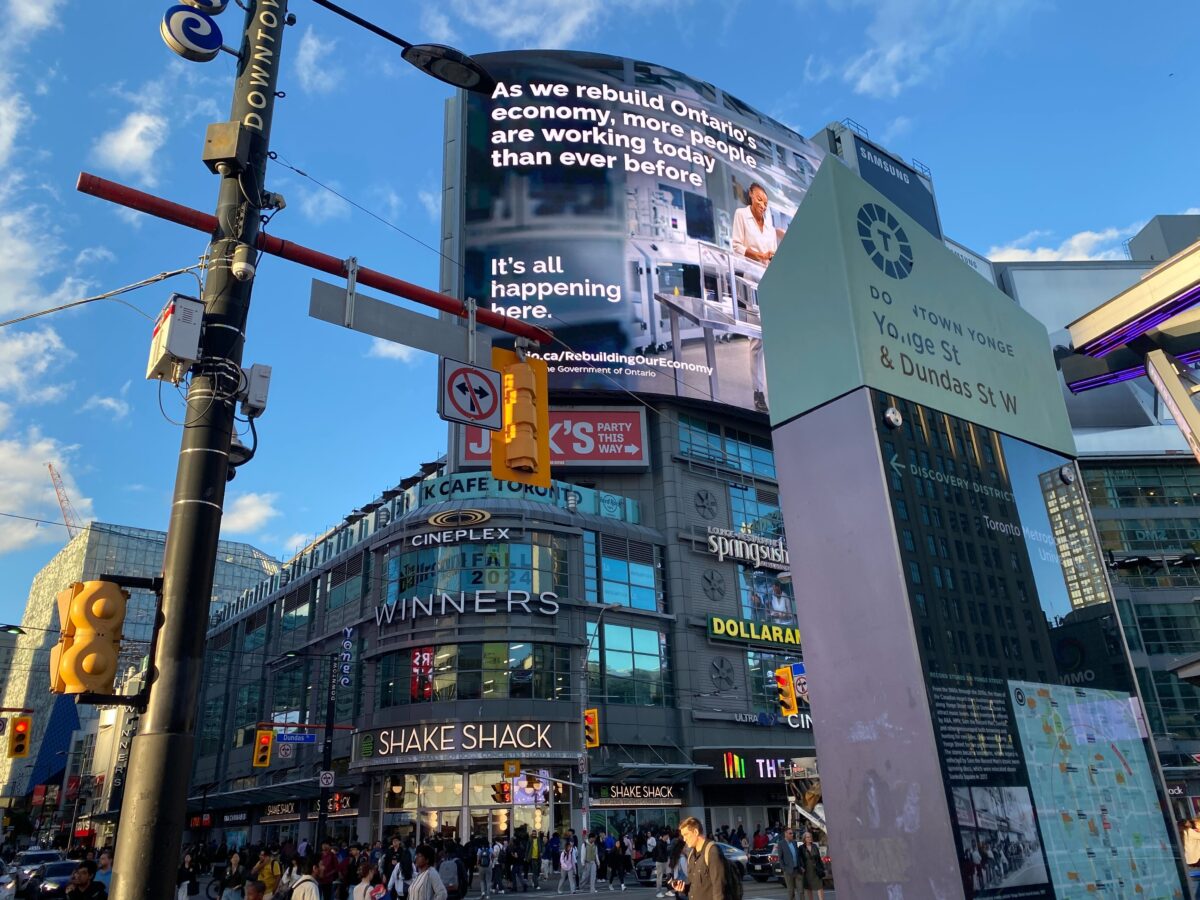
Photo taken from Dundas and Yonge streets south to CF Toronto Eaton Centre. Photo: Dustin Fuhs

Cadillac Fairview recently unveiled its Queen’s Cross Food Hall, a chef-driven culinary concept by Oliver & Bonacini. Located at the south end of the mall’s lower level, the 19,000 square foot space features 13 unique food stalls, two rotating pop-up stalls (Craig’s Cookies is currently one of them), a stylish bar and café, and seating for about 300 guests.

BMO bank will open a 21,000 square foot branch to the north of Simons in a retail space formerly occupied by a Samsung store — it will be part of BMO Place at 33 Dundas Street which features offices for the bank.

CF Toronto Eaton Centre ranked as the second-most productive shopping centre in terms of sales per square foot by ICSC’s 2023 Canadian mall study, which was reported recently in Retail Insider. The busy downtown Toronto shopping centre, with more than 50 million annual visitors, saw sales per square foot of $1,457 in 2023, being second only to Toronto’s Yorkdale Shopping Centre.  

La Maison Simons to Open Stores at CF Toronto Eaton Centre and Yorkdale in Former Nordstrom Spaces 

Rendering of the future Yorkdale La Maison Simons store in Toronto. Image supplied

Quebec City-based retailer La Maison Simons has announced that it will open two stores in Toronto in the fall of 2025. One will be downtown at the CF Toronto Eaton Centre and the other at the Yorkdale Shopping Centre. It’s part of a $75 million investment by Simons that will see the retailer further penetrate the Canadian market with a presence in the largest and wealthiest city in the country. 

Bernard Leblanc

Bernard Leblanc, CEO of Simons, said that the lease deals to open the two Toronto stores were “decades in the making”, and that the opportunity to finally open in those malls was made possible following Nordstrom’s exit from Canada. The large retail boxes with expansive floor plates became available following Nordstrom’s closure last year, providing landlords the opportunity to secure Simons and other retailers as a tenants.  

The CF Toronto Eaton Centre La Maison Simons store will span about 110,000 square feet over three levels, featuring local art and unique architectural designs by Lemay Michaud and Gensler Design. Leblanc said in an interview that the store’s access points will include a street entrance on Yonge Street as well as access from within a new corridor in the mall, which will run through the former 223,000 square foot Nordstrom store that once occupied the space. Simons will also occupy a small portion of the 63,800 square foot second floor of the Nordstrom space, with most of the remainder to be occupied by Eataly, which will measure about 25,000 square feet over two floors. Most of the 90,000 square foot third floor of the former Nordstrom will be occupied by Simons, as well as some new storage space for landlord Cadillac Fairview. 

A two level Nike flagship store spanning about 18,000 square feet will open in the remainder of the former Nordstrom space. SAJO is the design-build firm that will be responsible for the construction.

Rendering of the future La Maison Simons and Eataly at CF Toronto Eaton Centre. Image supplied

The Yorkdale La Maison Simons store will span about 118,000 square feet, and will also feature unique artwork and architectural designs by Lemay Michaud and Gensler. Simons will occupy the first two levels of the former Nordstrom store, which had expansive floor plates exceeding 60,000 square feet each. It’s not yet known what landlord Oxford Properties will do with the third level of the former Nordstrom space. Leblanc said that “sun” will be a central theme to the Yorkdale store, which makes sense — the purpose-built 188,000 square foot Nordstrom box features walls of glass including on its south-facing facade, which means the Yorkdale Simons store has the opportunity to be flooded by sunlight depending on its design. 

Leblanc said that the design of both stores is now in the works, with details to come — Simons stores feature unique and often whimsical interiors, such as dressing rooms that look like outhouses and deer heads with antlers covered in fabric. Each Simons store also features at least one key piece of large artwork, and Simons has yet to decide what will be installed in the two new Toronto stores. 

Both stores will offer the full range of Simons merchandise, which includes fashions for men and women, kid’s, home goods, footwear, bags, accessories and other items. About 70% of the product in Simons stores is private, made under various labels including the names of the departments in the stores. That includes Twik and La Contemporaine for women, and Le 31 and Djab for men. 

Edito by Simons (Image: Simons)

Both the CF Toronto Eaton Centre and Yorkdale Simons stores will also feature separate designer ‘Edito’ departments for women and men, which feature a range of pricey luxury brands that can be far more costly than Simons’ relatively affordable private labels. Brands in Simons’ Edito department include names such as Balmain, Chloé, DSquared2, Emporio Armani, Erdem, Helmut Lang, JW Anderson, Jacquemus, Marni, Moschino, Rick Owens, Vivienne Westwood, Yohji Yamamoto and others. The selection of brands at Edito departments in Simons varies store-to-store, and Leblanc said it’s not yet determined which brands will be carried in the CF Toronto Eaton Centre and Yorkdale Simons locations. 

The Toronto stores could become the top-selling locations for the company, with La Maison Simons estimating that sales at the two locations could be in the $100 million range combined — currently Simons’ total annual sales are in excess of $650 million, with two thirds of those (about $430 million) being in its 17 physical stores and the remainder being online. Currently the top-selling Simons stores in the chain are the Place Ste-Foy (Quebec City) and downtown Montreal flagships. 

Simons says it’s spending more than $75 million to build the new Toronto stores, which will create about 400 jobs. While the investment is significant, so is the expected return — with the sales projections of the two Toronto stores, physical retail sales are expected to rise to over half a billion dollars annually after they open next year. 

Simons Halifax Shopping Centre (Image: Nic Takushi / David Sobey Retailing Centre)

Toronto was specifically targeted, according to Leblanc, because it’s the second largest online market in Canada for Simons. The Toronto area was vastly under-served by La Maison Simons, with just one store at Square One in Mississauga. The Montreal market, which is smaller and less affluent than Toronto, is home to five productive Simons stores, he noted. The Square One store also saw a 3% increase in sales in its fiscal year — and while the store has helped somewhat to increase brand awareness for Simons in the GTA, its location was too remote for most who live in the region and frequent other malls. 

CF Toronto Eaton Centre is possibly the busiest shopping centre in the world, with over 50 million annual visitors and a location in the heart of busy downtown Toronto. The complex is located on subway and streetcar lines and is adjacent to sometimes chaotic Dundas Square, which was recently rebranded as Sankofa Square (a name that the majority of Torontonians seem to dislike). CF Toronto Eaton Centre recently ranked second in the 2023 Top 25 Malls by Sales Per Square Foot in Canada, with a productivity number of $1,457 per square foot for reporting retailers. The massive centre was originally anchored by an 800,000 square foot Eaton’s store, which operated there from 1977 until 1999, and then Sears Canada until Cadillac Fairview bought back the space in 2012 to convert into Nordstrom and office uses. 

Yorkdale isn’t nearly as busy as CF Toronto Eaton Centre, though it sees millions of visitors a year and boasted sales per square foot of $2,402 in 2023, according to the same ICSC study. The mall is a powerhouse of big-name and luxury brands, with the largest single clustering of standalone luxury stores in the country. Landlord Oxford Properties has invested heavily into the shopping centre, including recent updates to its food court and the construction of a luxury wing which involved relocating various retailers in the mall’s centre run. 

CF Toronto Eaton Centre (Image: Dustin Fuhs)

The Toronto Simons stores will be the 18th and 19th locations for the retailer. In March of 2024, La Maison Simons unveiled a store at the Halifax Shopping Centre in Halifax, which Leblanc noted brought the chain “truly coast-to-coast”. Over the past five years, Simons have invested hundreds of millions of dollars into its operations, including opening a store in the Montreal suburb of Pointe-Claire in May of 2022, and investment into an automated fulfilment centre in Quebec City. 

La Maison Simons was founded in 1840, and it wasn’t until 12 years ago that the retailer expanded outside of Quebec. In October of 2012, Simons opened at West Edmonton Mall, kicking off a national expansion for the retailer that saw it open stores in various major markets. That included Park Royal in West Vancouver (2015), Square One in Mississauga (2016), CF Rideau Centre in downtown Ottawa (2016), The CORE in downtown Calgary (2017), Londonderry Mall in Edmonton (2017), and most recently in Halifax. 

During that same expansion period, Simons expanded within Quebec with stores at Galeries d’Anjou in Montreal (2013), Promenades Gatineau near Ottawa (2015), Galeries de la Capitale in Quebec City (2018), and CF Fairview Pointe-Claire (2022). They joined existing stores in Quebec that include the company headquarters and retail space in Old Quebec, and stores in Ste-Foy, downtown Montreal, Sherbrooke, St-Bruno, and Laval. 

Simons Head Office in Quebec (Image: Simons)

Bernard Leblanc said that it was a privilege to work out of the Old Quebec offices, where Simons has had a store and offices since 1870. The Old Quebec Simons store is still popular and features unique architecture in a heritage space. 

Last year when Retail Insider first broke the news of Nordstrom’s exit from Canada, we also speculated that La Maison Simons could replace some of the retail space being vacated by the Seattle-based retailer. Leblanc said that this early speculation by us and others didn’t factor heavily into negotiations with Cadillac Fairview and Oxford Properties, both of which wanted Simons as tenants following Nordstrom’s Canadian exit. Simons had actually been speaking to both landlords years before, and had intended to open stores at both malls but at the time, deals did not materialize. 

That includes in 2015, when Simons’ then CEO Peter Simons told the Montreal Gazette that the retailer would open Toronto stores at Yorkdale and Scarborough Town Centre. Neither deal materialized at the time, with Simons instead opening stores in other markets. Several years ago Peter Simons told Retail Insider in an interview that CF Toronto Eaton Centre was specifically a target for a Simons store at some point, as well. 

Leblanc wouldn’t confirm rumours that La Maison Simons would open a downtown Vancouver store in part of the 230,000 square foot three-level Nordstrom building that was once home to an Eaton’s store. Sources had told Retail Insider that there was a possibility that La Maison Simons could take part of the former Nordstrom space at CF Pacific Centre, along with other retailers. We’ll follow up on this story when we learn more.  

Wild Fork Expands Canadian Presence with Third Location, Eyes Future Growth Nationwide [Interviews]

Wild Fork Ancaster, Ontario (Image: Wild Fork)

Innovative food company Wild Fork continues to expand its retail footprint in Canada with plans for significant growth in the future.

The brand is set to open its third location June 10 in Ancaster, Ontario. 

Elle Mejia-Pierce

Elle Mejia-Pierce, Real Estate Lead at Wild Fork, said the company has 44 stores in the United States with another 15 slated to open before the end of the year.

The brand launched in Canada as an online business servicing the Greater Toronto Area with same day delivery. The first retail store opened a year ago in Whitby, Ontario. The second store opened in Oakville, Ontario in November.

Wild Fork Ancaster, Ontario (Image: Wild Fork)

Mejia-Pierce said the sweet spot for stores is about 4,000 square feet. But the Oakville and Ancaster stores have significantly larger footprints with just under 7,000 square feet in each.

“Eventually we’re going to be expanding all across Canada. So the play after Ontario will be out West in B.C. and Alberta but that’s probably more a three to five year plan. Right now, I’m really concentrating on Ontario and in the GTA (Greater Toronto Area) market. So the two stores that we have slated opening up next year are both in London and in Newmarket,” she said.

Locations have been a challenge for the company.

“I like streetfront retail. I like streetfront corner retail. In Ontario, typically those pads have been reserved for banks and for restaurants. Finding the access that we need in terms of our shipping, being able to actually get our products into the stores, has been a challenge. New builds have worked favourably for us because we can build in those features where we need them,” said Mejia-Pierce. “But we like the corner streetfront retail. We prefer to be end caps if we are going to be not in a standalone building. 

“I try to stay away from inline although our Whitby store is inline and is doing quite well for us.”

Ali Baker, Principal and Vice President at commercial real estate firm Avison Young is handling Wild Fork’s Canadian real estate needs.

Wild Fork Ancaster, Ontario (Image: Wild Fork)

Mejia-Pierce said when the brand opened its retail store it had only about 450 SKUs but now the brand is north of 600 SKUs and working its way up towards 1,000.

“We’re very, very protein heavy. We’re a protein store. Everything is frozen. We have probably the largest depth of SKUs in protein that you’ll find in any retailer. We’re pretty democratic. Everything from your ground meats, your ground beef, and your more economical meat choices to your Wagyu steaks you can get in our stores. And a lot of the exotic meats as well. So we’ve got bison and we’ve got elk and we’ve got venison. We’ve got a really great seafood depth as well,” she said. 

“Then we have the ancillary items. Our frozen fruits and our desserts. Really trying to make it easier for the consumers to be able to plan a full meal when they come into our stores.”

Mejia-Pierce said the online business remains a strong part of the company.

“I have 26 prime markets that I want to make sure that we’re in within the next three years in Ontario before we start making the move out West. Just trying to position ourselves in communities where probably not hitting every major intersection but making sure we have enough of a presence in the GTA and in the surrounding markets so that we penetrate the markets so that the brand name becomes recognizable,” she said.

“We find once we get a customer through the door there they are our customer. It’s kind of a no-brainer. But there’s only so much marketing that you can do. The online space is such a noisy space that having that physical brick and mortar store to be a banner in these communities is what’s going to be the most important. 

“So I’d like to see us inching up towards 30 stores in the next three years . . . We’re really excited about the Ancaster opening. We are filling up our pipeline for 2025 and even going into 2026 with these new builds as well and really just trying to meet our customer where they are and give them their options for their online shopping, give them their options for their in-store shopping and making it a really great experience and a cost-effective experience.

“One of the things we’re trying to get across in the market is that we are not a premium brand. We’re a very democratic brand. So whether you’re shopping for your day to day items for your family and picking up your ground meats and your chicken breasts and you’re just regular staples every week or whether you’re planning an all-out dinner party and you want to go all out with Wagyu steaks and lobster and whatever else it is you want to pick up, we really do run the gamut in our stores. A lot of people look at us as a premium brand and we really are an everyday brand.”

STACKT Market Secures 10-Year Lease Extension in Toronto, Unveils Venture to Empower 11,000 Canadian Small Businesses [Interview]

Image: STACKT Market

STACKT, North America’s largest shipping container market established in 2019, has signed a new 10+-year lease extension with the City of Toronto for its site at Bathurst and Front and the concept is also launching its new STACKTˣ which is a venture to help accelerate small businesses across Canada.

Matt Rubinoff

“We are thrilled to continue our relationship with the City of Toronto,” said Matt Rubinoff, Founder and President of STACKT. “In Toronto, STACKT market began as a unique concept and has evolved into an impactful ecosystem where people and businesses can connect and grow. 

“We have created a community here in Toronto, and this lease extension proves our ongoing commitment to fostering opportunities for creativity and growth. We are excited about the extension and to bring this energy across Canada this year.”

Image: STACKT market

Rubinoff said the lease extension signals the commitment of continued support for Canadian businesses, innovative retail concepts and community-driven public spaces.

STACKT creates award-winning and innovative ecosystems that drive a new way of thinking. From large-scale public spaces to satellite pop-ups, STACKT designs concepts that provide inspiration, opportunity and connection. The community is made up of innovators, creators, collaborators, and consumers alike. STACKT’s award-winning Toronto flagship, STACKT market, animates 100,000 square feet with art, retail, events and public space. The dynamic space shifts alongside the brands and experiences within it. 

“(The lease extension) obviously shows the commitment and support from the City of Toronto and a big one for us as we can plan into the future now. It’s been typically shorter term leases that we’ve been doing in the past since its inception in 2019,” said Rubinoff.

“We support brands, small businesses, culture, innovation and everything through there. There’s several different components to the property. It’s the size of a city block in downtown Toronto at Front and Bathurst. 100,000 square feet. And there’s a mix of different uses throughout the site. There is a retail component to it. We work with everything from emerging businesses and small businesses in there, right through to the larger bigger brands that may come and do something innovative and test new concepts.

“We have event spaces that are on site. We have consistent programming, community programming that we’re doing through the site. And even have an industrial component with it as we’ve got a brewery on site.”

STACKT’s flagship location in Toronto has hosted over 3,000 businesses in Canada since its inception in 2019. Renowned brands such as Endy, Sonos, Makeway, Inkbox and Monos had their Canadian in-store debut at STACKT market. STACKT continues to foster the value when intersecting community and commerce, creating over 10,000 jobs, hosting over 1,800 events since inception and in turn driving over five million visitors to its Toronto flagship location.

Rubinoff said on average about 30 businesses are operating at the site.

“But part of the nature of STACKT and ever-revolving in what we do to help both small business and large business is there’s a lot of short-term leases we offer to these brands and because of that there’s quite a bit of turnover in there,” he said. 

Image: Stacktx

The new  STACKTˣ  concept will provide small businesses with resources and tools, community-driven partnerships and physical retail opportunities. 

STACKTˣ will open its first expansion location in Ottawa on June 13 in the Byward Market, followed by Vancouver and Calgary locations. These prime retail locations and digital resources will support over 11,000 small businesses across Canada in the first year and continue STACKT’s legacy as the leading incubator for small businesses nationwide.

The Vancouver and Calgary locations are set to open later in the summer. Those specific locations have not been announced yet.

“STACKTˣ is a platform built for small businesses and it’s so they can get more from opportunities, resources, access, things that they need so they can succeed both online and in person,” said Rubinoff. 

“With the 3,000 businesses we’ve hosted since inception, we witness some of the challenges that a lot of these small businesses are seeing from a lack of resources, access to capital, no historical data or limited opportunities that they have. So we looked at this and we said the path needs to change and we need to change that in order to get a different outcome on this piece.

“Our goal is to take the learnings of what we have for the past five years at the flagship and launch this dedicated platform for small businesses so that they can get more out of their business journey. It too just like the flagship will be ever-evolving and ever-changing so that it aligns with these realities of what the environments are around them, everything from the market, the economy, the industry, consumer preferences. A number of different things there. All of that will obviously need to come into play but we’re going to provide this opportunity for them.”

The digital component provides resources for business owners. There will also be workshops. There is also a physical component with space for one business at a time. 

“We’ve designed a very specific modular retail unit that we’re going to be placing in really high foot traffic, premium locations in these cities to provide obviously amazing exposure and awareness and foot traffic for these brands,” explained Rubinoff. “It’s a grant program. So it’s free of charge to all these businesses that want to participate and they get access to this unit with a whole bunch of other things that we layer in from a support side . . . They get an opportunity to go out and test physical retail which has been a key piece to this.”

STACKTˣ will be giving away over 48 grants within their new pop-up locations in Ottawa, Calgary and Vancouver each offering a one-month free lease. The STACKTˣ Storefront Grant is an opportunity for small businesses to test out a retail storefront, engage with new and existing customers and learn key insights that can be applied for future growth.