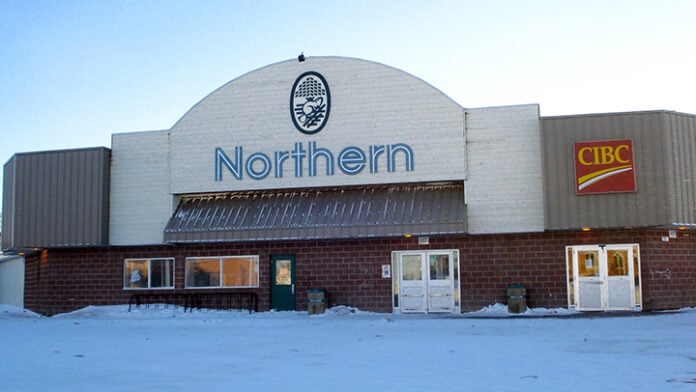
Northern Store in Moosonee. Photo: Northwest Company
The North West Company, a major retailer serving rural and urban communities across Canada and internationally, announced second-quarter results for the period ending July 31, 2024. The company, which operates 229 stores under various banners, reported a 4.6% increase in consolidated sales, reaching $646.5 million.
Given the strong numbers, North West’s Board of Directors declared a quarterly dividend of $0.40 per share. It’s a 2.6% increase from the previous quarter.
Dan McConnell, President and CEO of the North West Co., said, “We are very pleased with the results this quarter, delivering increases in adjusted EBITDA and adjusted net earnings compared to a strong second quarter last year.”
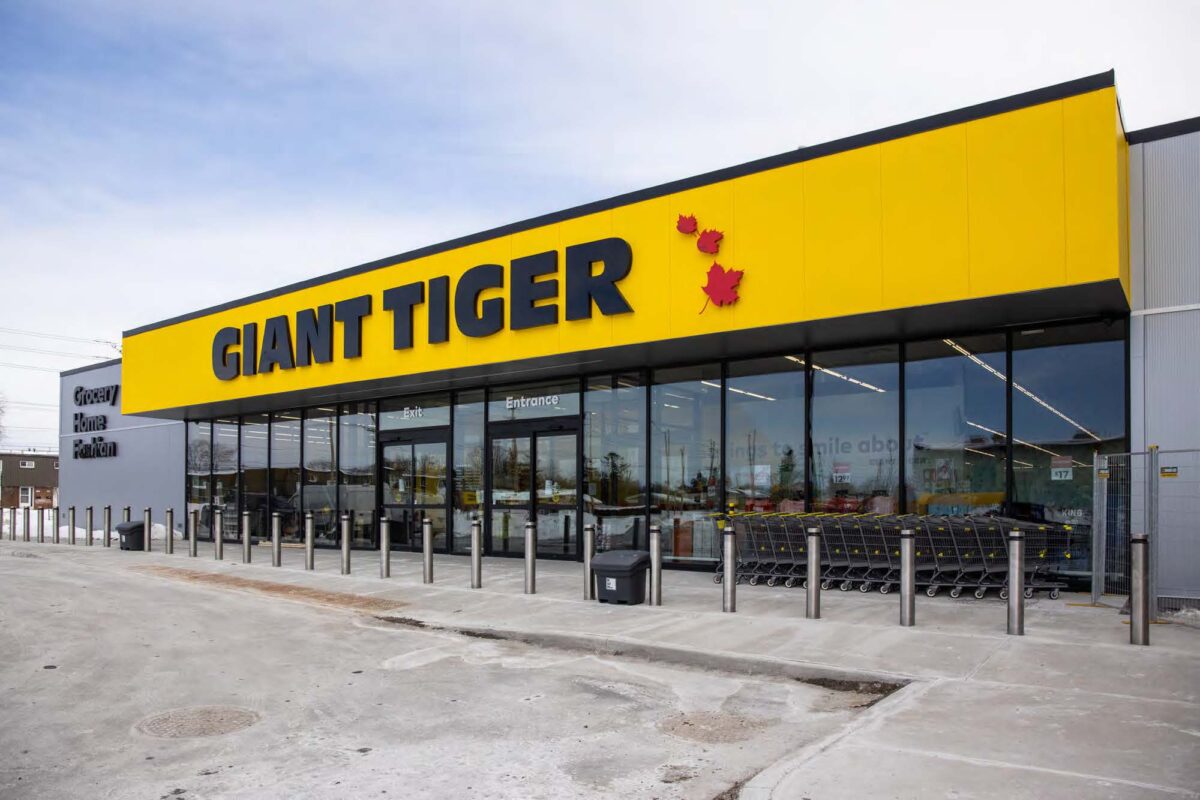
Giant Tiger Store (Image: Giant Tiger)
The company’s Canadian operations led the charge, with same-store sales increasing by 6.8%. This growth helped offset more modest gains in International Operations, which saw a 0.9% increase in same-store sales.
North West’s gross profit rose by 7.5% to $219.8 million, bolstered by sales gains and a 91 basis point improvement in gross profit rate. The company attributed this increase to changes in sales blend and a reduction in markdowns.
However, the retailer faced challenges in the form of increased expenses. Selling, operating, and administrative costs rose by 10.1% compared to the previous year, primarily due to inflationary pressures and higher wage costs.
Despite these headwinds, North West’s earnings before interest, income taxes, depreciation, and amortization (EBITDA) grew by 4.1% to $83.4 million. Adjusted EBITDA, which excludes certain non-comparable expenses, increased by 6.1% to $88.4 million.
The company’s net earnings saw a slight decrease of 3.0% to $36.9 million, partly due to the impact of new tax legislation. The Global Minimum Tax Act, enacted in Canada on June 20, 2024, resulted in a $1.0 million increase in income tax expense for the quarter.
Looking ahead, McConnell expressed optimism about the company’s direction. “We are building a strong foundation through our focus on operational excellence initiatives and the momentum in our Canadian business,” he noted.
The North West Company maintains a significant presence in Canada, with additional operations in Alaska, the South Pacific, and the Caribbean. The company’s diverse portfolio includes stores operating under banners such as Northern, NorthMart, Giant Tiger, Alaska Commercial Company, Cost-U-Less, and RiteWay Food Markets.
Jack Long at the opening of Long & McQuade in Belville, ON, in 2016. Photo: intelligencer.ca
Jack Long, founder of Canada’s largest music retail chain Long & McQuade, has passed away at the age of 95. The company announced his passing on September 4, 2024.
Long’s journey from professional trumpet player to retail magnate began in 1956. With a music degree from the University of Toronto, he opened a small instrument shop on Carlton Street in Toronto.
The business quickly expanded, with Long adding practice studios for music lessons. This decision led to a fateful partnership with drummer Jack McQuade, who rented space for drum lessons.
In 1957, the two musicians joined forces to open Long & McQuade Musical Instruments on Yonge Street. The partnership lasted until 1965 when McQuade sold his share to Long to focus on drumming.
Jack Long memorial. Image via Long & McQuaid
Long & McQuade’s expansion across Canada began in 1968. Today, the company boasts over 100 stores nationwide and an online presence launched in 2008. It employs more than 1,800 musicians and contracts about 1,000 music teachers.
The company’s impact on Canadian music has been significant. Notably, Rush‘s late drummer Neil Peart purchased his first drum kit – a chrome Slingerland set – from a Toronto Long & McQuade store.
Long’s contributions to Canada’s music industry were recognized in 2014 when he was appointed to the Order of Canada. He was honoured for his pioneering role in the country’s music retail sector and his commitment to musicians, customers, and employees.
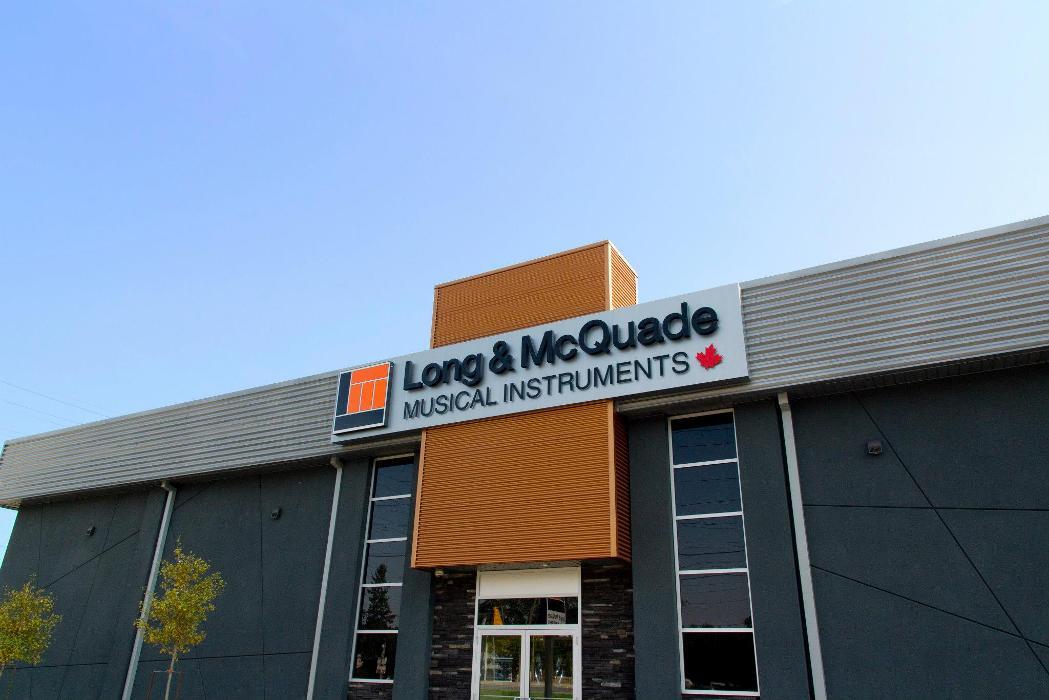
A Long & McQuade store. Photo: Long & McQuade
While the Long family continues to own the business entirely, Jack’s sons Steve and Jeff now manage daily operations. Jack remained involved as an advisor until his passing.
The Long family expressed pride in Jack’s legacy, stating, “Jack lived a long and happy life, surrounded by music and family until the very end. We will miss him every day.”
Long & McQuade’s website offers a wide range of services, including instrument sales, rentals, repairs, and music lessons. The company’s non-commissioned sales approach and performance warranty program have contributed to its enduring success in the Canadian music retail landscape.
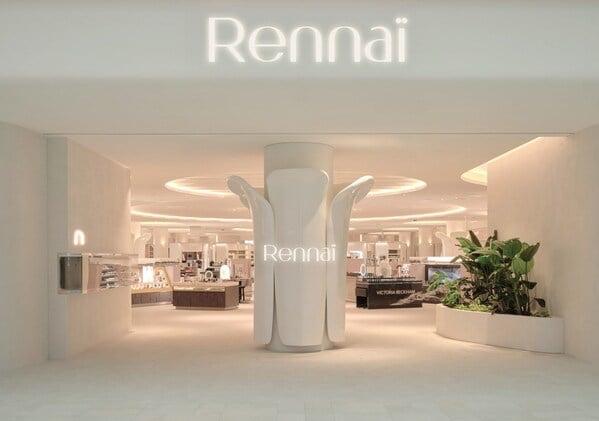
Rennaï, a new beauty and self-care retailer is now open at ROYALMOUNT in Montreal, Canada (CNW Group/Rennaï)
Multi-brand beauty and self-care retailer Rennaï has opened its first ever location at Royalmount in Montreal.
This launch marks the beginning of Rennaï’s ambitious North American expansion plan. The retailer aims to open several stores across the continent over the next five years.
Christopher Novak
Rennaï’s 36,000-square-foot Royalmount space, designed by renowned interior designer Ana Borrallo, offers a unique shopping experience. The store features a curated selection of local, national, and global beauty products in a breathtaking environment.
Christopher Novak, President and CCO of Rennaï, said,” Opening our first location in Canada with unique offerings in a state-of-the-art facility marks a pivotal moment in beauty and self-care evolution.”
The store is divided into five distinct “realms,” each catering to different aspects of self-care:
The Reimagine Realm focuses on makeup artistry.
The Refresh Realm is dedicated to fragrance exploration.
The Revitalize Realm offers supplements and personal care products.
The Rejuvenate Realm specializes in skincare and houses a medical aesthetic clinic.
The Retreat Realm provides a relaxation space and pampering services.
Rennaï currently showcases over 175 brands, with plans to introduce more exclusive and first-to-market concepts throughout the year. The company aims to set new industry standards by educating customers and helping them develop personalized beauty routines.
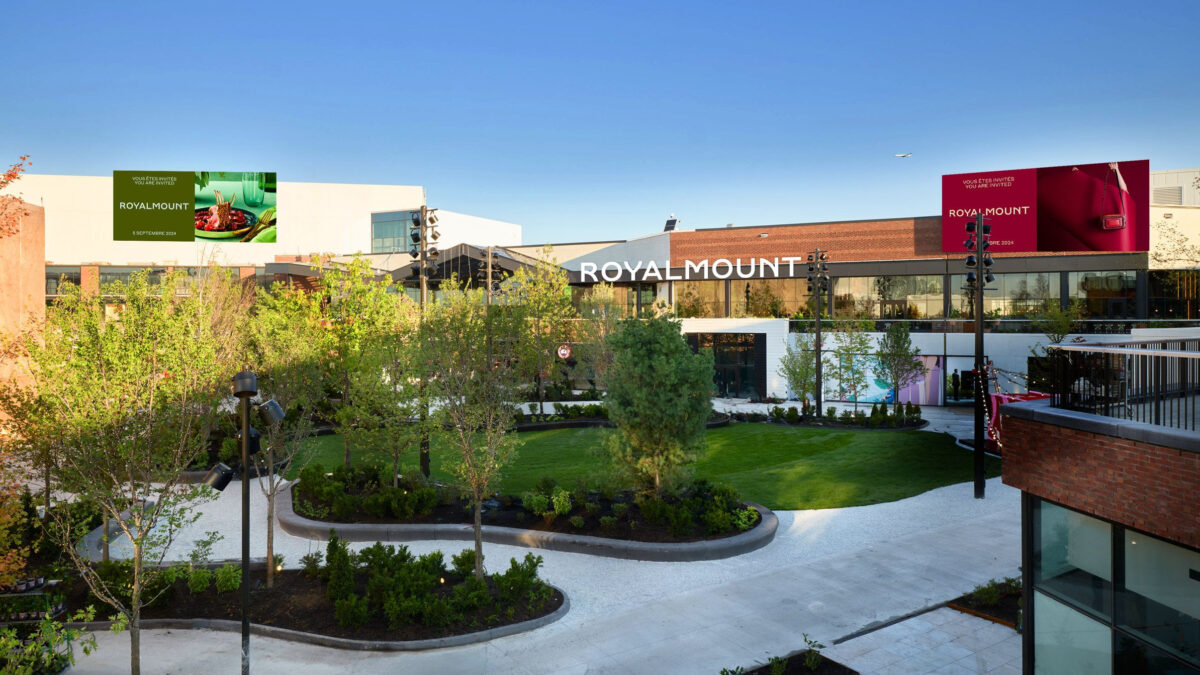
Royalmount in Montreal. Photo supplied by Carbonleo
Royalmount boasts an impressive array of 170 stores and 60 restaurants and cafes. Half of these retail concepts are new to the market, offering shoppers a fresh and diverse selection of brands and experiences. About 50 retailers opened on the September 5 opening day.
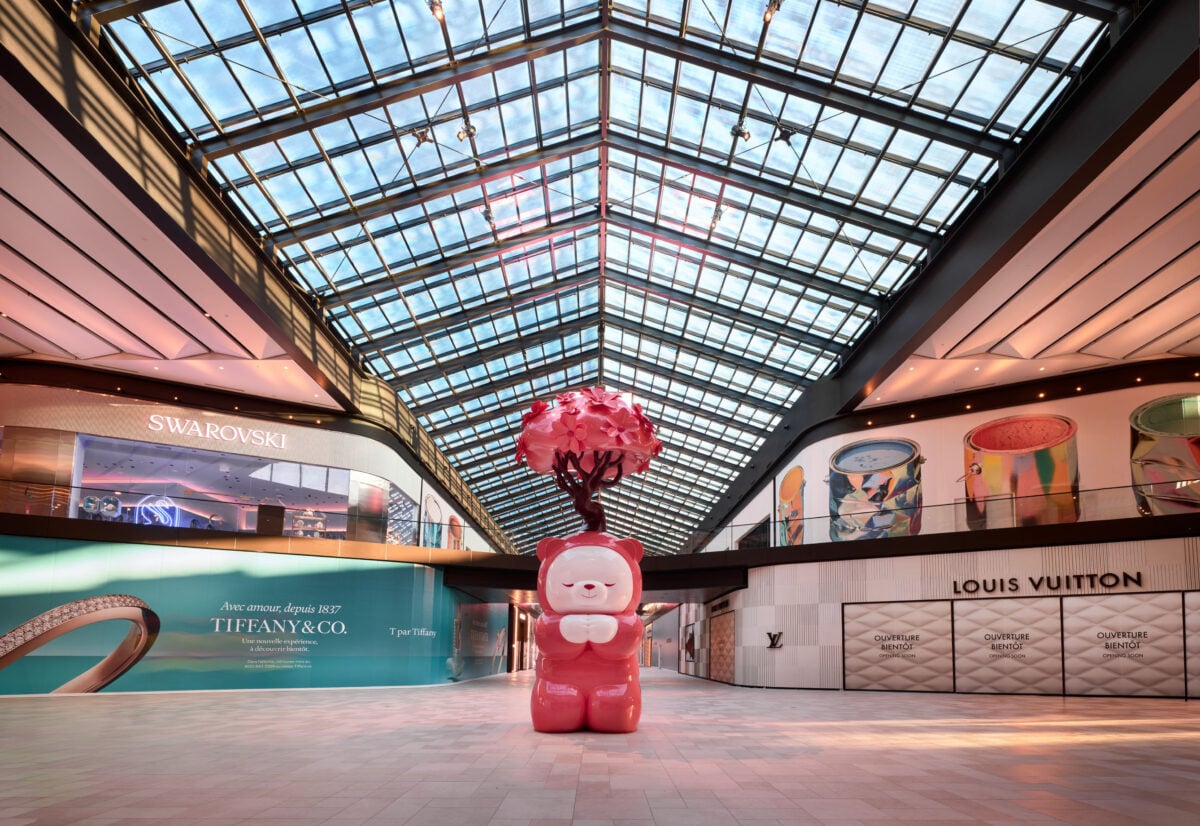
Notably, Royalmount houses the largest concentration of luxury stores in Quebec. The positioning establishes the complex as a destination for high-end shopping in the province.
Beyond retail, Royalmount embraces green spaces and art. The complex features a 77,000 square foot urban park, providing a natural oasis amidst the bustling shopping environment. Additionally, art enthusiasts can explore a public art trail showcasing over 60 installations from both local and international artists.
Royalmount in Montreal – Louis Vuitton and Tiffany & Co. will open in several months. Photo supplied by Carbonleo
Sustainability is at the forefront of Royalmount’s design and operations. Developed by real estate company Carbonleo, the complex is on track to become Canada’s largest LEED Gold retail project. This commitment to environmental responsibility sets a new standard for retail developments in the country.
One of Royalmount’s most innovative features is its climate-controlled enclosed skybridge. The $50 million structure directly connects the complex to Montreal’s metro and public transit system, encouraging eco-friendly transportation options for visitors.
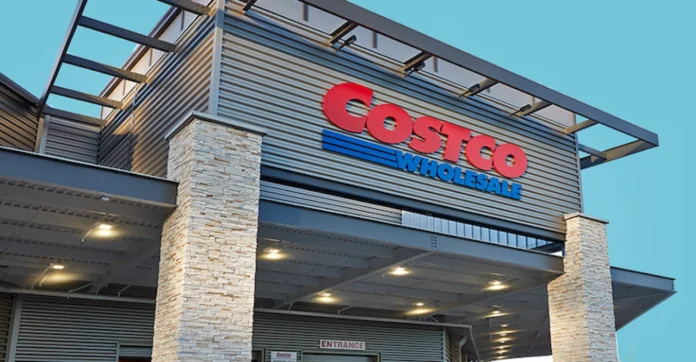
US-based membership-only big-box warehouse club Costco Wholesale has begun construction on its fourth store in Winnipeg. The new location will be at 4077 Portage Avenue near Assiniboia Downs on the western edge of the city.
The City of Winnipeg issued Costco a development permit in July for the construction of a 166,894-square-foot store. Work on the site, currently an open field, commenced several days ago.
The new Portage Avenue location will be part of the growing Westport mixed-use development, spanning over 15 acres. The project, approved by city councillors last year, includes plans for a one-story building and parking lot. Renderings from June 2023 also indicate the addition of a gas bar at the site.
4077 Portage Avenue in Winnipeg. Click image for interactive Google Map
The new store will join Winnipeg’s existing Costco locations on St. James Street, Regent Avenue West, and McGillivray Boulevard.
Costco has a significant economic footprint in Canada, where it serves over 10 million members and generates average annual sales of about CDN$25 billion.
Background on Costco
Costco’s journey began in 1976 when Sol Price introduced the first membership warehouse club, Price Club, in San Diego, California. Initially limited to business members, Price Club offered a wide range of supplies and wholesale items. Jim Sinegal, a key figure in Price Club’s success, later co-founded Costco Wholesale with Jeff Brotman in 1983, opening their first warehouse in Seattle, Washington.
The merger of Price Club and Costco Wholesale in 1993 created a powerhouse in the retail industry. The company today carefully selects about 4,000 stock keeping units (SKUs) per warehouse, significantly fewer than the 30,000 found in most supermarkets, allowing them to offer the best value to members.
As of August 2024, Costco operates 884 warehouses worldwide, with a significant presence in North America. The company has 611 locations in the United States and Puerto Rico, 108 in Canada, and 40 in Mexico. Its global footprint extends to countries such as Japan, the United Kingdom, Korea, Australia, Taiwan, China, Spain, France, Iceland, New Zealand, and Sweden.
Costco’s financial performance remains strong, with net sales reaching US$210.55 billion for the first 44 weeks of 2024. The company’s success has earned it the 11th spot on the Fortune 500 rankings of the largest United States corporations by total revenue.
Golfworld, a pioneering golf entertainment company, plans to open its first Golfworld Montreal Golf Complex in the winter of 2024-2025, followed by a Laval location in the summer-fall of 2025. The state-of-the-art facilities aim to replicate the golfing experience for visitors of all skill levels.
The ambitious project, backed by five shareholders, aims to establish up to 10 branches in Quebec’s major cities within five years. Each complex represents an investment of approximately $1.5 million and will create about 20 jobs.
Golfworld Montreal Golf Complex: A Comprehensive Golfing Hub
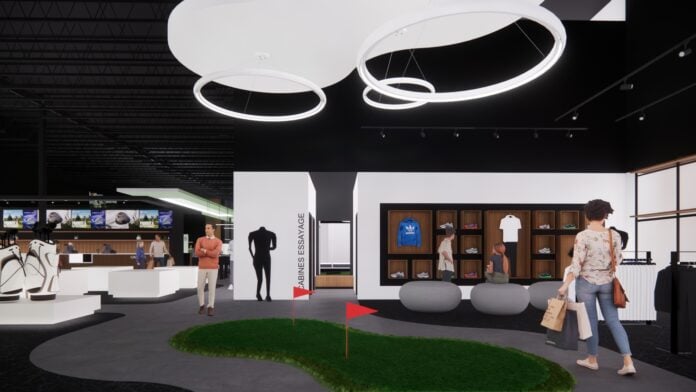
What sets Golfworld apart is its unique concept, unparalleled in Canada. Each complex will house a luxury urban mini-golf course, a zone with cutting-edge Prosim and Trackman simulators, a Duogolf performance workshop, and an indoor training center. The 6000 sq. ft. space will feature an immense practice green, an approach shot area, and an integrated sand trap for bunker practice.
Duogolf, a specialist in club fitting, will relocate its Laval store to join this venture. Led by industry experts Mario Laflamme and Martin Whelan, Duogolf will oversee all performance zones in Quebec’s supercenters.
The luxury mini-golf, inspired by Florida’s popStroke concepts, will be a highlight of each complex. Depending on the building’s layout, it may be located on the rooftop terrace, offering stunning city views, or annexed to the ground floor, providing an immersive experience year-round.
These 25,000 sq. ft. facilities will also include areas for professional golf lessons and a club repair and adjustment workshop. A specialized boutique will stock major industry brands for equipment, accessories, clothing, and footwear, with a strong emphasis on Quebec manufacturers.
The Golfworld Montreal Golf Complex and its counterparts will cater to a diverse clientele, from professional golfers to families and corporate events. The company’s rapid expansion plans include franchising the concept for growth within Quebec and beyond.
Canadian food processing and distribution company George Weston Limited announced it has successfully completed a private placement of $250 million in senior unsecured notes.
Terms and Conditions of the George Weston Unsecured Notes
The offering comprises $250 million aggregate principal amount of series 2029 notes. The notes bear an interest rate of 4.193% per annum and are set to mature on September 5, 2029. The issuance was conducted on a private placement basis, targeting qualified accredited investors.
George Weston has earmarked the net proceeds from the offering for general corporate purposes. The flexible approach allows the company to strengthen its financial position and potentially fund future growth initiatives.
Impact of George Weston Unsecured Notes on Company’s Financial Structure
The newly issued notes are unsecured and rank equally with all existing and future unsecured and unsubordinated indebtedness of the company. This parity ensures that the notes maintain a consistent risk profile with George Weston’s other financial obligations.
Notably, the notes have received favorable credit ratings from two prominent agencies. DBRS Limited has assigned a credit rating of “BBB” with a “Stable” trend, while Standard and Poor’s Rating Services has provided a credit rating of “BBB”. These ratings reflect the market’s confidence in George Weston’s financial stability and future prospects.
The successful placement of these notes was facilitated by a syndicate of agents led by BMO Capital Markets, CIBC Capital Markets, and RBC Capital Markets. Their involvement highlights the strong relationships George Weston maintains within the Canadian financial sector.
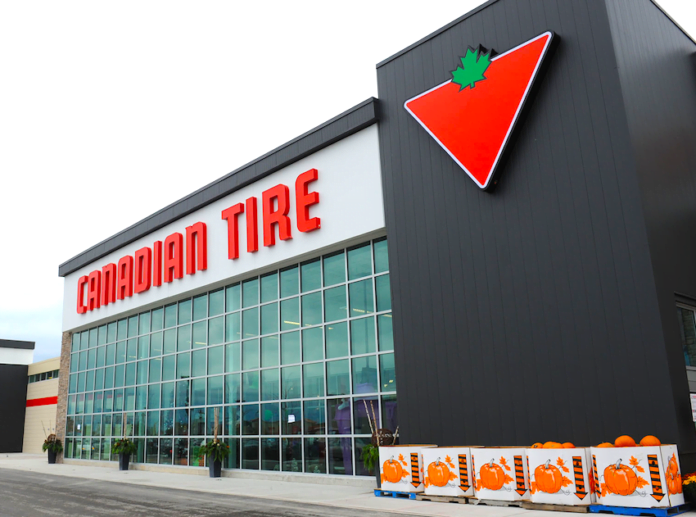
Canadian Tire Corporation, Limited, for the second consecutive year, has been recognized as one of the World’s Most Trustworthy Companies by Newsweek.
CTC was listed in the Retail category and ranked as the most trustworthy Canadian retailer, one of just two Canadian companies to make the list of 72 global brands.
Susan O’Brien
“Our inclusion on the list of the World’s Most Trustworthy Companies reinforces and fuels our Brand Purpose: ‘We Are Here to Make Life in Canada Better.’ Trust is earned over time and if nurtured and protected, becomes a company’s greatest asset,” said Susan O’Brien, Executive Vice President and Chief Brand & Customer Officer, Canadian Tire Corporation. “For over a century, we’ve built a deep emotional connection with Canadians by putting them at the centre of everything we do.
“This global recognition is a testament to our team members’ commitment to fostering trust through the products we sell for life in Canada, through the value we offer in our Triangle Rewards loyalty program, and through our passionate support of Jumpstart and the many investments we make in our communities from coast to coast. At CTC, we know trust is a privilege that must never be taken for granted.”
The World’s Most Trustworthy Companies 2024 were selected based on an independent survey of over 70,000 participants across 23 industries in 20 countries. Newsweek, in collaboration with Statista, evaluated companies according to three trust touchpoints: Investor Trust, Customer Trust, and Employee Trust. The study analyzed 230,000 evaluations, supplemented by a social listening analysis to gauge the sentiment of online mentions. Eligible companies included publicly traded organizations headquartered in the target countries with revenues exceeding $500 million USD.
Canadian Tire Corporation, Limited is a group of companies that includes a Retail segment, a Financial Services division and CT REIT. The retail business is led by Canadian Tire, which was founded in 1922 and provides Canadians with products for life in Canada across its Living, Playing, Fixing, Automotive and Seasonal & Gardening divisions. Party City, PartSource and Gas+ are key parts of the Canadian Tire network. The Retail segment also includes Mark’s, a leading source for casual and industrial wear; Pro Hockey Life, a hockey specialty store catering to elite players; and SportChek, Hockey Experts, Sports Experts and Atmosphere, which offer the best active wear brands.
There are more than 1,700 retail and gasoline outlets. CTC also owns and operates Helly Hansen, a leading technical outdoor brand based in Oslo, Norway.
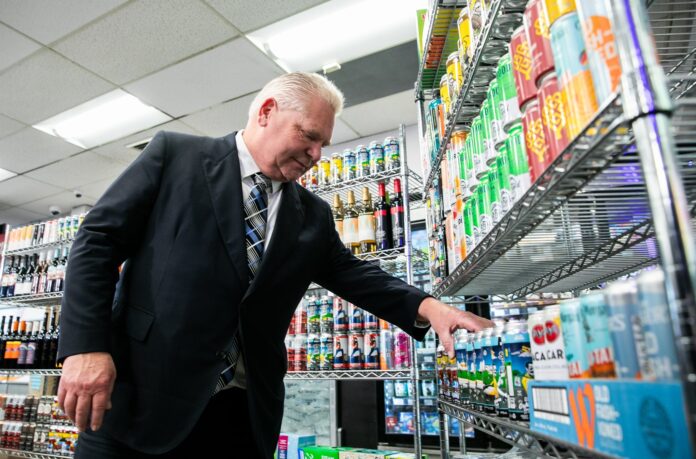
The Alcohol and Gaming Commission of Ontario has already granted 4,200 licenses to convenience stores. This means approximately 40% of these establishments can now offer alcoholic beverages to their customers.
While the move promises economic benefits, it also raises concerns among health organizations. The Centre for Addiction and Mental Health in Toronto has voiced apprehension about increased alcohol accessibility.
In response to these concerns, Ontario’s Finance Minister, Peter Bethlenfalvy, assured that the government takes social responsibility “extremely seriously.” The province plans to invest $10 million in public health efforts related to alcohol consumption as part of a broader mental health initiative.
The new regulations stipulate that convenience stores can sell alcohol from 7 a.m. to 11 p.m. To support local producers, 20% of beer, cider, and premixed cocktails on display must come from small Ontario producers. Similarly, 10% of wine displays must feature products from small Ontario wineries.
This policy change fulfills a 2018 campaign promise by Premier Doug Ford to bring beer and wine to corner stores. It required renegotiating a deal with The Beer Store, which will receive $225 million in taxpayer funds under the new agreement.
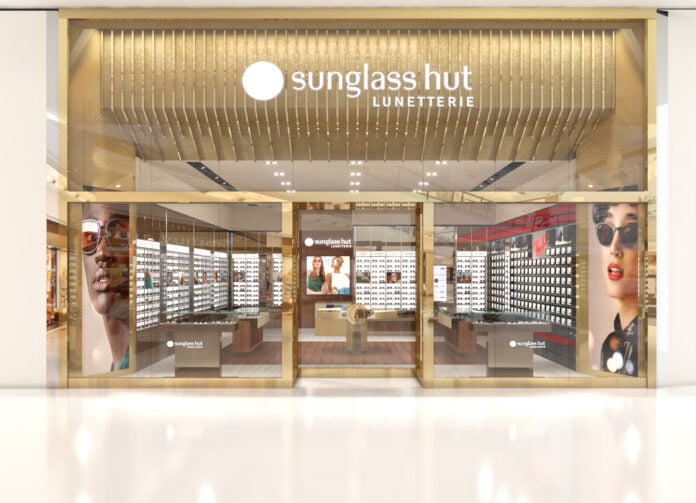
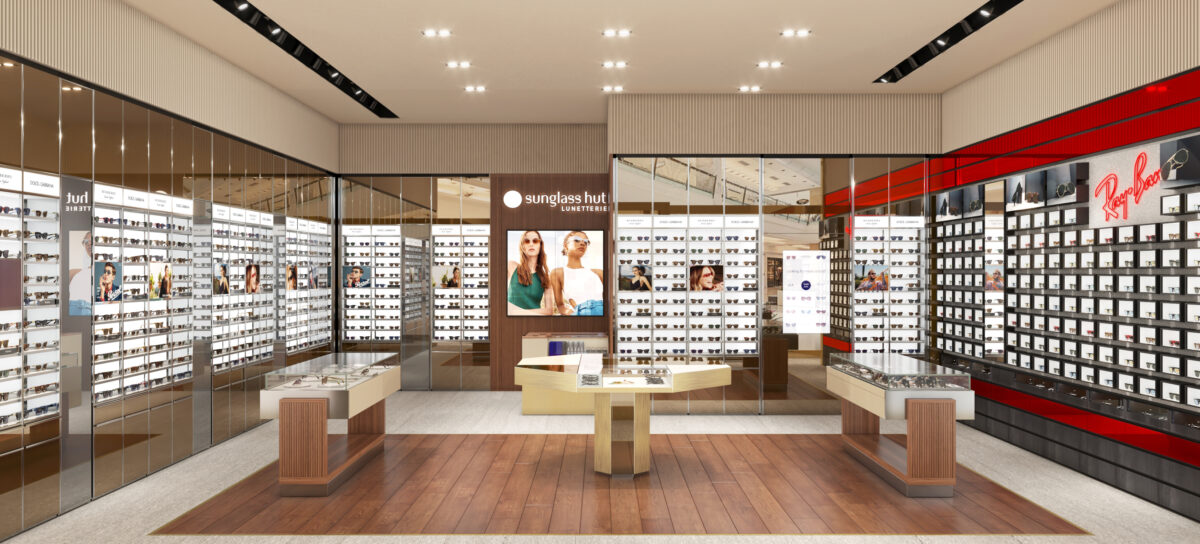
Sunglass Hut has launched its new boutique design at the new Royalmount shopping centre in Montreal.
The company said this is its first new boutique in the Quebec market in over five years and introduces the province to Sunglass Hut’s latest global design concept.
Photo courtesy of Sunglass Hut
“The new boutique boasts a sleek and modern design, positioning it as the top choice for luxury sun retail. With advanced technology like LED windows and Smart Shoppers—interactive screens built into the walls for seamless browsing and purchasing— and a broad range of premium and performance sunglasses, to our well-educated associates, our store offers shoppers a meaningful and personalized shopping experience,” said the company.
“Housing a wide range of frames from renowned luxury brands such as Burberry, Jimmy Choo, Miu Miu, Persol, Prada, Tiffany & Co., and others, the boutique is set to deliver the ultimate eyewear shopping experience. The store also features a special Ray-Ban Shop in Shop wall, offering a unique experience for eyewear enthusiasts.”
The store is 803 square feet.
Sunglass Hut was founded in 1971. It has more than 3,300 retail locations.
Stores can be found in fashionable shopping districts across the globe, from the Americas, Europe and the Middle East to Australia, South Africa, China, Southeast Asia and beyond, providing consumers with a fun, highly engaging shopping experience in-store and online.
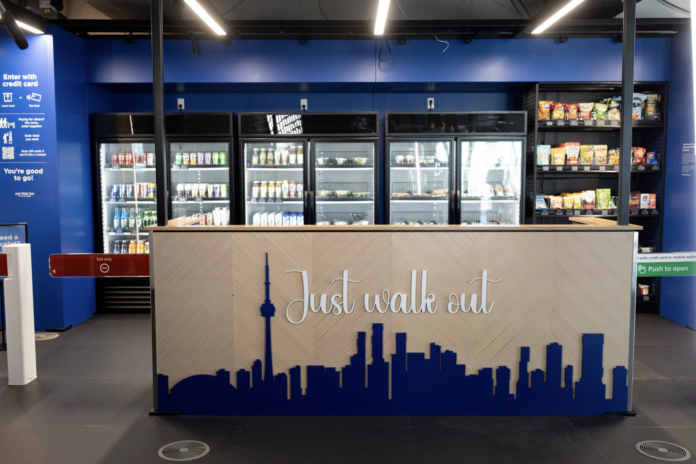
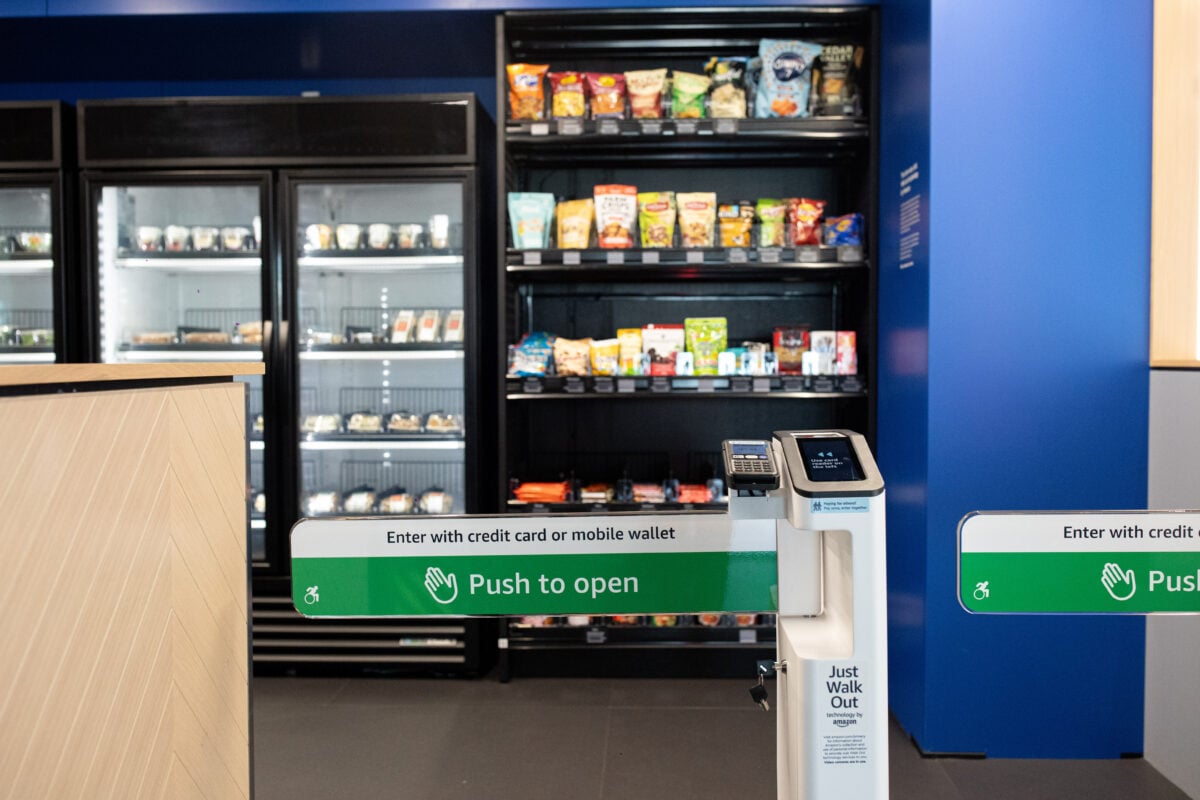
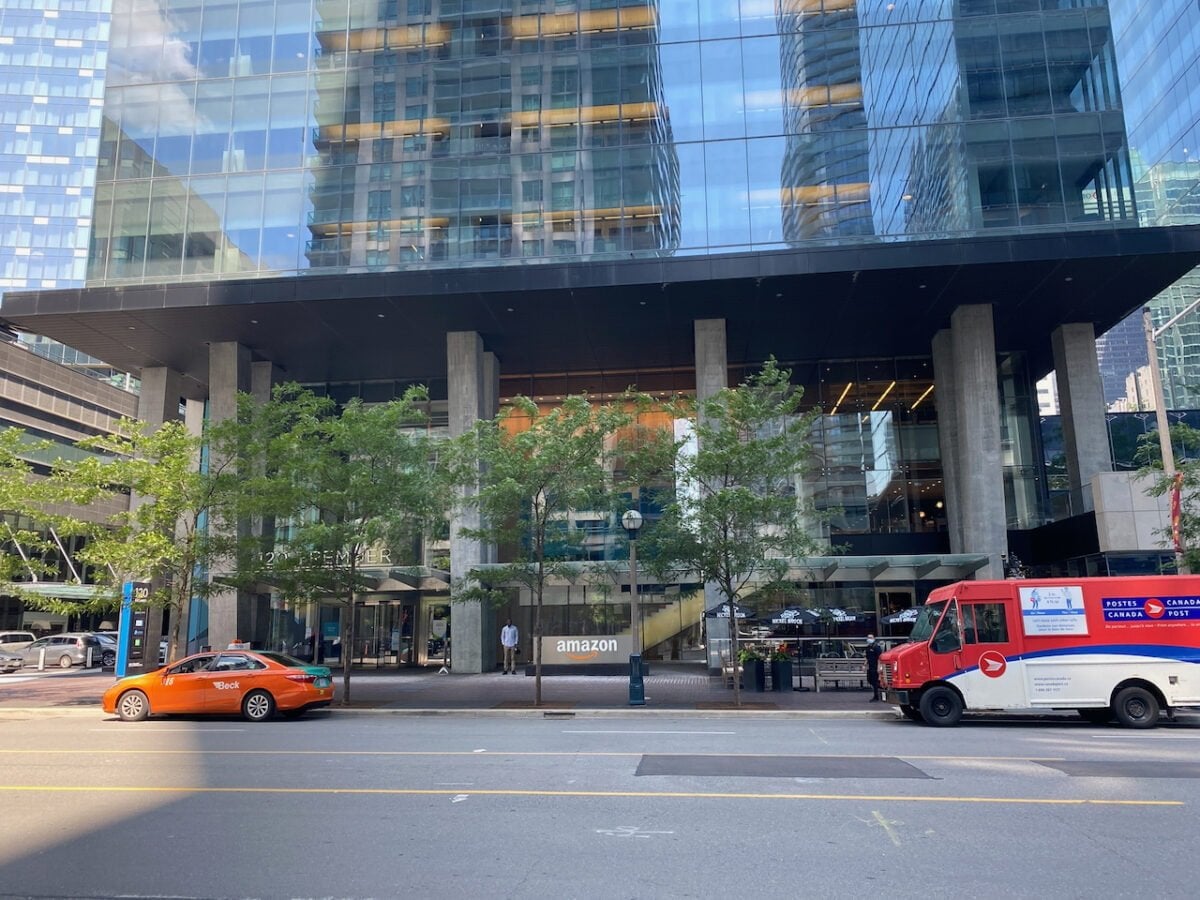
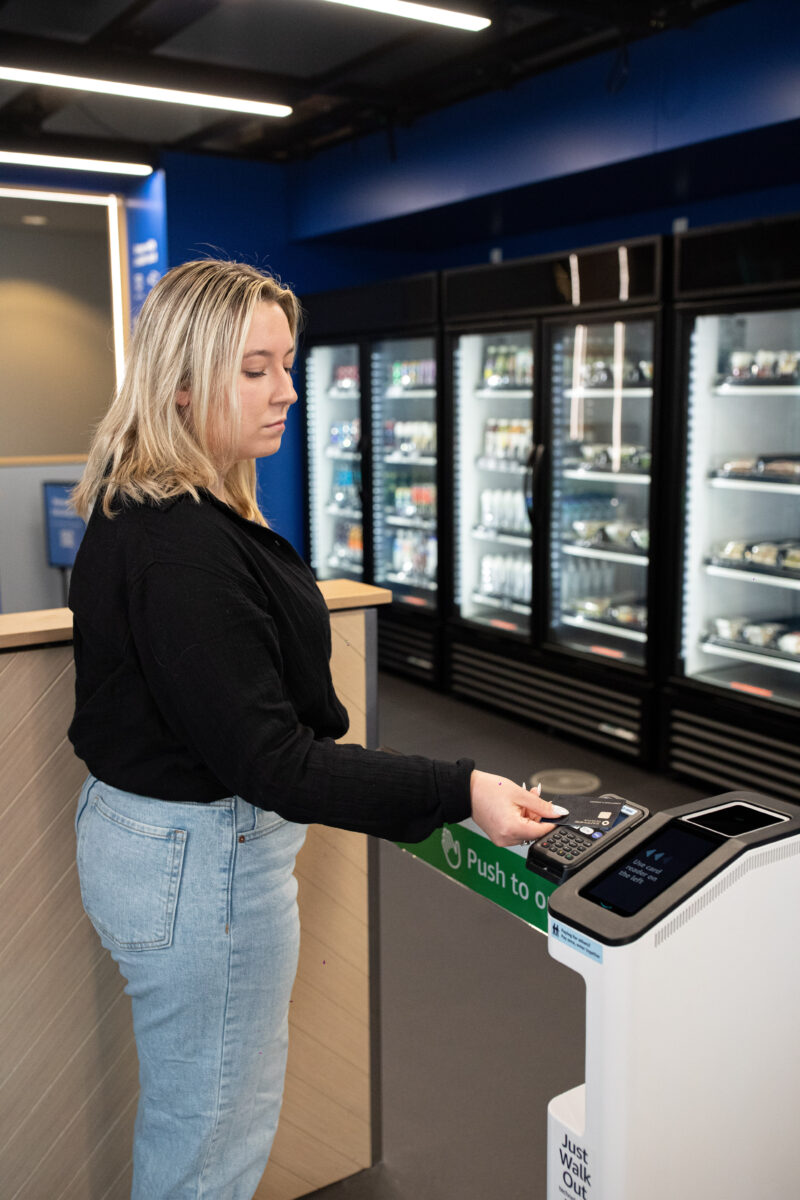
Amazon’s YYZ14 office at 120 Bremner Boulevard in Toronto has launched the first Just Walk Out technology store at an Amazon office in Canada, with a second location planned for the YYZ18 office at 18 York Street later this year.
The store at YYZ14 offers a variety of ‘grab and go’ food and beverages from brands including Greenhouse, Cove Gut Healthy Drinks, and Well.
Leveraging artificial intelligence (AI), including computer vision, machine learning, and generative AI, as well as sensor fusion, Just Walk Out technology enables shoppers to grab what they want and simply leave the store, said the company.
Photo courtesy of Amazon
To enter the store, Amazon employees use their credit card at the entry gate. Just Walk Out technology associates the shopper with their payment instrument, and detects the items taken from or returned to store shelves, creating a virtual shopping session. When employees have completed their visit, they simply leave the store, and their payment instrument will be charged for the items they took with them.
“Just Walk Out technology has been a game-changer for shoppers around the world, removing the part of the shopping experience they enjoy the least – standing in line to pay – and allowing them to get on with their day more quickly,” said Jon Jenkins, Vice President, Just Walk Out technology. “It’s exciting to bring this innovative technology to more of our employees, and we look forward to continuing to expand to new locations across Canada.”
Amazon Canada Office in Toronto on Bremner Street – Photo by Dustin Fuhs
Today, Just Walk Out technology is available in more than 180 third-party locations in the U.S., UK, Canada, and Australia, with new locations launching every week. In Canada, Just Walk Out technology stores can be found at Scotiabank Arena in Toronto, Scotiabank Saddledome in Calgary, and Toronto Pearson International Airport.
On Thursday, Amazon announced the latest developments at its Vancouver and Toronto Tech Hubs, introducing new features and office space for more than 8,500 corporate and technology employees.
A new 43,000 square foot atrium opened at The Post, the flagship office building at Amazon’s Vancouver Tech Hub, where more than 4,500 employees work across business teams including Amazon Web Services (AWS), Worldwide Amazon Stores and Devices.
Photo courtesy of Amazon
The company said the open-plan, light-filled atrium will provide new collaboration spaces for Amazon employees, including a café, event venue, break-out areas, and meeting rooms. Designed by B+H Architects, the atrium features 22-foot high ceilings and a nod to the building’s history as Vancouver’s Main Post Office, including an 18-foot mural resembling a pixelated postage stamp. Upon closer inspection, the mural features individual mailbox doors that date back to the building’s 1960s origin.
The Post has historical significance for Vancouver, and its original architecture was restored as part of an ambitious heritage redevelopment by property developer and manager QuadReal Property Group and MCM Architects. The Post’s building systems are on track to achieve LEED Gold Certification, and leverage waste heat recovery, passive solar shading, light shelves that reflect daylight into the interior and an energy-efficient building envelope. The adaptive reuse of the building’s existing central podium saved approximately 25,000 tonnes of carbon and diverted significant construction waste from local landfills.
Jesse Dougherty
“Our investment in The Post reflects Amazon’s continued commitment to our Vancouver Tech Hub,” said Jesse Dougherty, Amazon VP. “This new space will be an ideal location for our teams to gather and invent on behalf of customers. It’s incredibly rewarding to witness the impact of Amazon’s investments in downtown Vancouver, bringing thousands of employees to the city centre in a building that also offers retail and other amenities for the broader community to enjoy.”
Brenda Bailey
Amazon is the sole corporate tenant at The Post, with its 1.1 million square feet of office space that includes the new atrium connecting a 21-floor South Tower and 22-floor North Tower. Amazon completed its move-in to the South Tower earlier this year, while the North Tower is on track to open in 2026.
“Amazon has been a key member of B.C.’s strong tech sector, and their continued commitment in the Vancouver Tech Hub at The Post will provide jobs for people, and signal to other businesses that this is the place to anchor and grow,” said Brenda Bailey, Minister of Jobs, Economic Development and Innovation. “For years now, Vancouver has been the fastest growing tech hub in North America, and we’re driving new investment, creating new jobs and more opportunities to build an economy that works for everyone.”
At Amazon’s Toronto Tech Hub, where 3,500 employees work, Amazon plans to add three new floors at its YYZ18 office at 18 York Street in late 2024, adding 79,000 square feet of space.
To learn more about Amazon’s impact in Canada, click here.