

A note from the author: “According to Canada’s Food Price Report 2024, the recommended monthly expenditure for a healthy diet per individual is $339. Currently, the average monthly spending stands at $248. Until July 2021, Canadians were typically spending above the suggested budget for a nutritious diet. However, this is no longer the case. Now, we are facing increased risks as the carbon tax rises, without a clear understanding of its long-term effects on food prices.”
Canada appears to be a “trading-down” market, a trend that may persist for some time. Recent data from Statistics Canada on the food retail and service industries, as well as fresh GDP figures, paint a concerning picture, especially for those looking to attract more food companies or grocers to our country.
Our population grew by more than 3% last year, yet our GDP increased by less than 1%. While other industrialized economies, such as France and Germany, are experiencing worse economic headwinds, Canada’s economy is highly integrated with the world’s most robust economy at present. Despite our proximity to this economic superpower, the benefits of our geography seem to have stalled. The most alarming aspect of the January GDP numbers is that Canada’s hottest economic sector is currently the public service, while private investments have stalled, largely due to higher interest rates.
The gap in GDP per capita between Canada and the United States has widened by 106% since 2015, and this trend shows no signs of reversing. In other words, despite our growing population, Canada is becoming poorer, not richer.
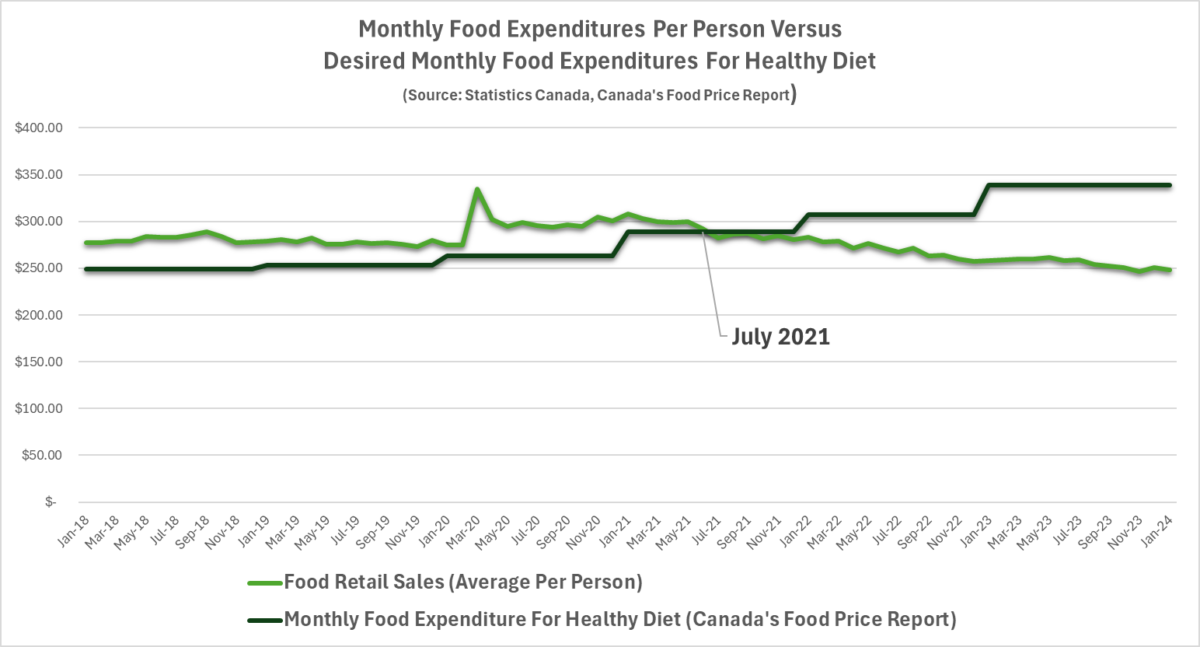
For those in the food business, this is certainly not good news. Statistics Canada’s reports on food and service sales confirm that consumers are dealing with less wealth while facing higher food and menu prices. As of January 2024, the average Canadian is spending $248 a month on food retail sales per capita, down from $258 in January 2023 and $282 in February 2017. These figures are all in real dollars, which makes the situation even worse. Based on Canada’s Food Price Report 2024, an individual’s monthly expenditure for a healthy diet should be $339. Again, the current average monthly spending is $248. Until July 2021, Canadians were spending more on average than the desired budget to support a healthy diet. Since then, it has clearly been a challenge (see graphic).
Canadians are either wasting less or finding alternative ways to source food outside conventional channels like grocery stores, such as dollar stores and non-traditional grocery discounters. Per capita food expenditures in our country have never been as low as they are now.
One might think that grocers are struggling with this situation, but they are readjusting their strategies and putting more pressure on suppliers with higher fees and lower prices. These are perfect conditions for a potential price war later this year, so don’t be surprised if it happens.
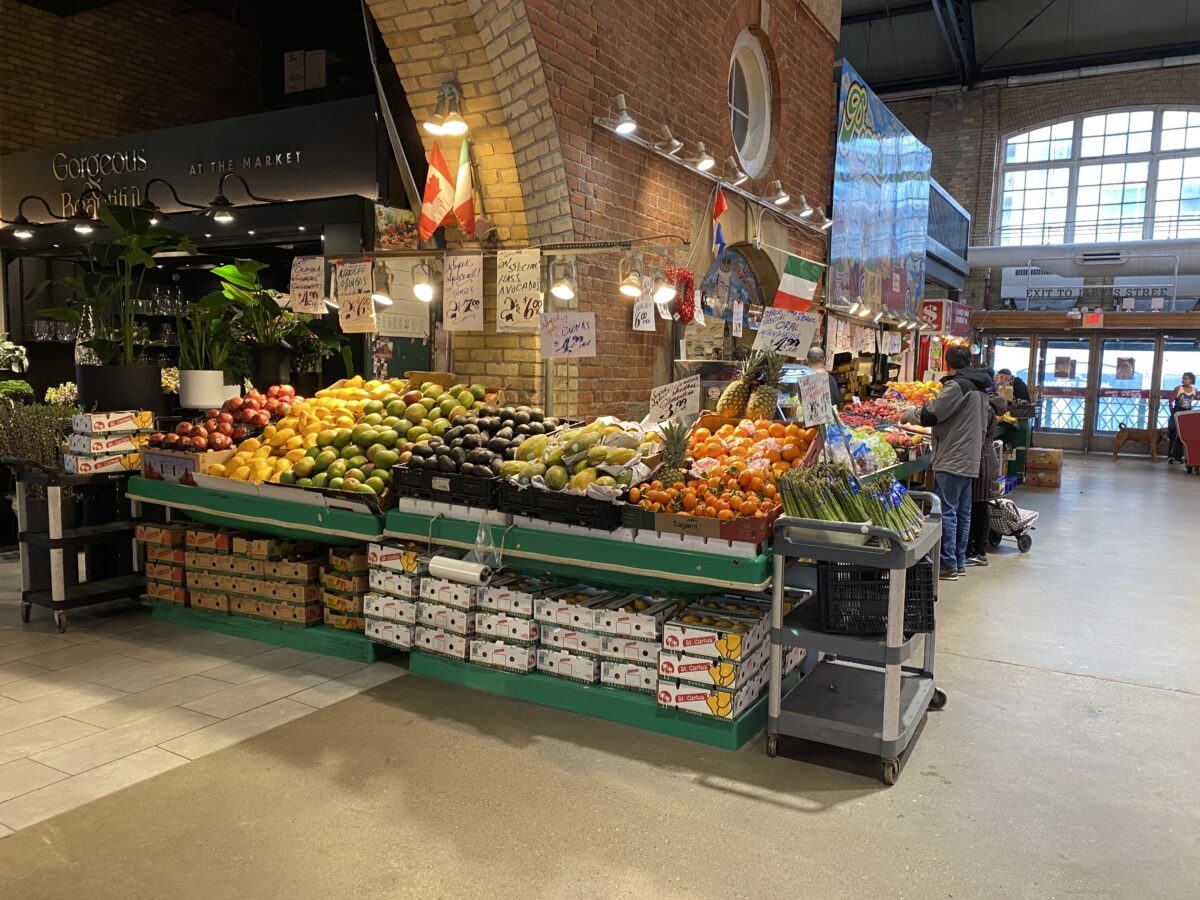
The data on food service provides a different perspective. On average, Canadians spent $169 at restaurants in January, which is about the same as last year and an increase from $149 in January 2018. However, these sums are in real dollars. The current retail/service split in Canada is that about 41% of all money spent on food is at restaurants, compared to a split closer to 54% in the United States, favoring food service. Considering the frugality of the market, it’s astonishing to see so much money being spent at restaurants, where you typically get less food for your money.
The days of uncertainty regarding the balance between working from home and working away from home are long gone. The food economy has, for all intents and purposes, normalized. Food inflation is causing Canadians to spend less at grocery stores, which may seem counterintuitive, but is what the data is telling us. Currently, about 18% of all retail dollars are devoted to food, compared to 21% in 2017. Simply put, the cost of living is a problem for many Canadian households, and trading down is much easier with food. People may be “ordering in” more often to avoid tips and overpriced beverages, for example.
All of this is based on our trust in Statistics Canada, which may not be all that strong. However, Statistics Canada is merely an indicator, and Canadians have no other way to know what is really going on out there other than reading reports from the federal agency.
Regardless of how we interpret the data, the numbers are simply not encouraging. This is what happens when our population grows, but not our collective economic wealth.
















I don’t see anything relating this to carbon tax. April Fools?
There are many ways to save money on food including growing some of your own, cooking more at home and changing the basic ingredients. Not all of us have the same caloric requirements. Did Statistics Canada include bakeries, specialty food stores and farmers markets or did they just count expenditures at conventional grocery stores? Has the proliferation of ready-to-eat meals, which you can pick up at small neighbourhood shops or order online affected the numbers? What about decreasing family size and changing demographics. Growing teenagers eat a lot. The rest of us maybe half that. I wouldn’t count on how much we spend on food as a measure of whether we’re well nourished.
It has already been found that the carbon tax has a minimal impact on inflation. Also, are there other food specialists in this country that could provide an opinion? One cannot get reliable information by always relying on the same pundits.
One can clearly see the bias in this article.
1- The reference of 2015 as a start point to determine the GAP with the US. Why not go to 2007?
2- Carbon tax reference. Provinces that are not part of the Federal Carbon Tax still have grocery inflation!
3- Where is the reference to Major grocery stores in Canada that have published record breaking profits?
It is not because of the number of people. In 1913 Canada let in 5% of its population and no one was homeless or too broke to buy food. There is an accelerating expansion of wealth inequality because our economic system caters to wealthy people. The people and the government of Canada are going broke because we own less and less assets that have been ‘privatized’ /sold to those with the vast wealth who hold our mortgages, who collect our rents on food and housing and make huge shareholder profits of the privatized land and utilities our governments sold them over the past decades for ‘efficiency’. This inequality is happening to the entire Western world. We can keep blaming other people and find ourselves living either in shanties and tents or in houses with high walls and vast security systems because of massive increase in crime, or we can imagine a better future with an economic system that serves everyone and not a couple thousand wealth people.