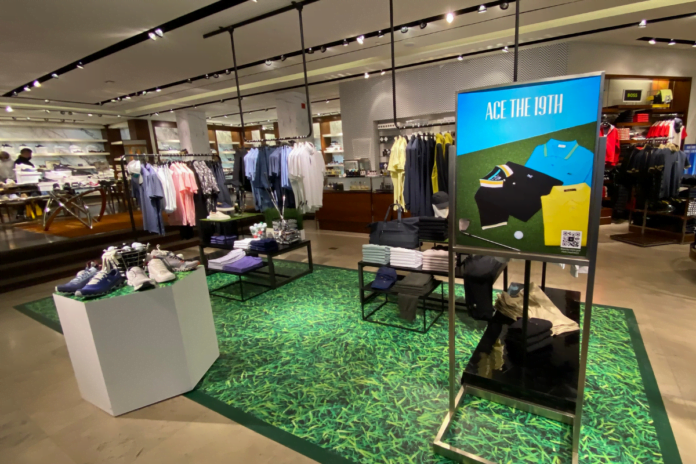
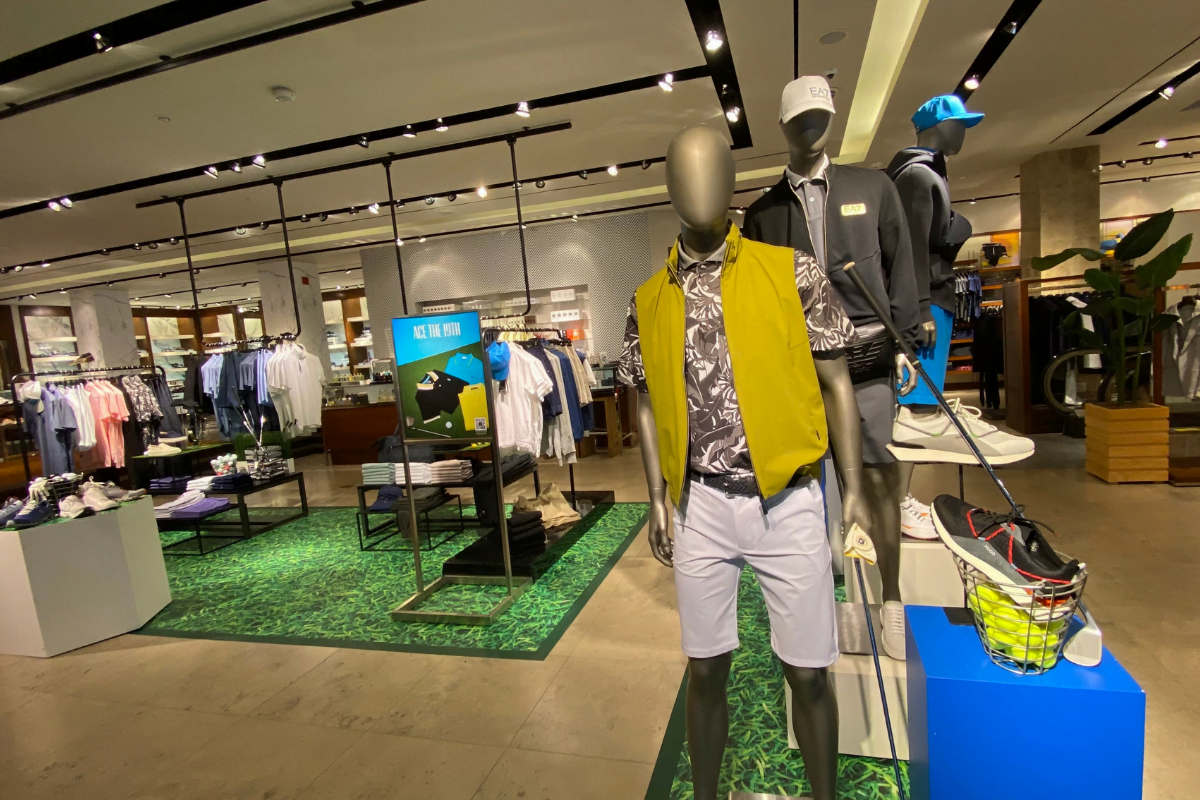
Harry Rosen at 82 Bloor Street (Image: Craig Patterson)
Harry Rosen, Canada’s leading luxury menswear retailer, is accelerating growth in its sportswear category with style-forward golf apparel and the launch of a marketing campaign which was tied into the recent Masters golf tournament.
“For over six decades, Harry Rosen has helped Canadian men look and feel their best in their personal and professional lives. Advising men on how to present a look of confidence on and around the golf course is the next step,” said Trinh Tham, Harry Rosen’s Chief Marketing Officer. “We’re thrilled it’s come to life with the irreverent spirit inherent to our brand. The campaign is vintage Harry Rosen cheek.
Trinh Tham
“We just teed off with the curation of golf attire for a style-forward customer who is always looking to define his look. The offering that we’ve put together is really based on this groundswell demand that we’ve been seeing and the growth and success of our sportswear assortment at Harry Rosen in-store and online.”
Tham said the curated golf collection will have a specific in-store presence at all the retailer’s locations.
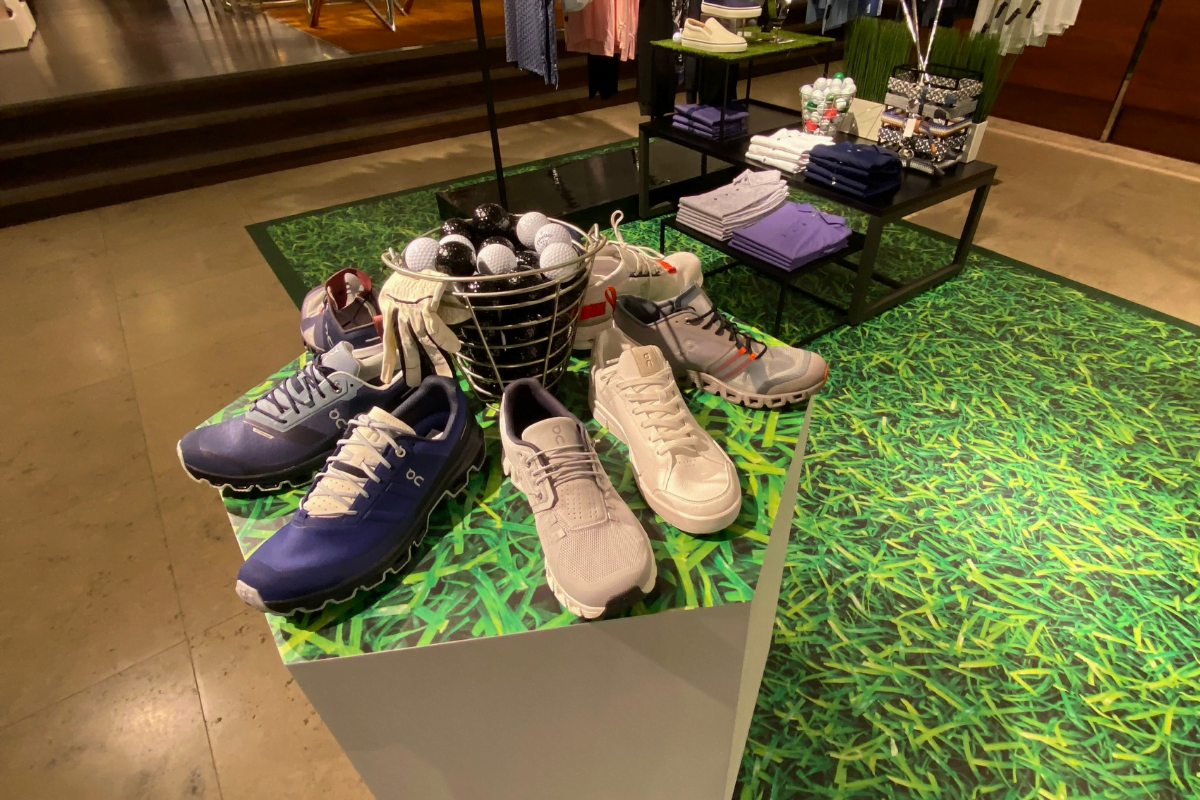
“In-store you’re going to see wonderfully curated displays of golf attire. We’ve been following the trends of our customer interests, always focused and honed in on what our customers are interested in,” she said.
Harry Rosen at First Canadian Place (Image: Dustin Fuhs)
“And we knew that membership at Canadian golf courses had increased exponentially. We heard that these memberships had soared about 113 per cent in 2020 compared to 2019. And we also saw that among Canadian golfers, 65 per cent of them were aged between 18 and 34 and this is a group of customers we’re very interested in introducing to the Harry Rosen brand and Harry Rosen ecosystem.
“In addition to our tailored suiting, eventwear, and formal workwear, our focus on sportswear has also responded to men’s growing needs and lifestyle and look choices as well as the extraordinary uptake on the sport of golf.”
TV spots aired during the recent live broadcast of the Masters Tournament, featuring all the trappings of a professional golf broadcast, including the gushing commentary — except the commentators were more interested in the player’s outfit selection than their shot selection.
“We hear far more about a player’s shirt game than their short game and the break in their pants than the break in their putt,” said the retailer.
Harry Rosen at 82 Bloor Street (Image: Craig Patterson)Harry Rosen at 82 Bloor Street (Image: Craig Patterson)
“Interest in golf surged during the pandemic, with tens of thousands of young men across Canada taking up the sport. But many still aren’t quite sure how to navigate fashion on the links. Thankfully, while there may be lots of places to get advice on your game, nobody knows golf style like Harry Rosen.”
Harry Rosen said it has curated a selection of products for the modern man and savvy golfer. Customers will find performance fabrics and stylish, streamlined looks from brands including Greyson, J Lindeberg, Brax Lab, RLS, KORS Michael Kors, Lacoste, and Psycho Bunny, it said.
“Harry Magazine, the retailer’s fashion publication, features Taylor Pendrith, the proudly Canadian pro golfer, as he brings his swing to this year’s PGA Tour in his rookie season. Pendrith is an ideal Harry Rosen role model, known to be loyal and authentic, with a hard-working ethic and sense of ease on the rounds. Golf colleagues and fans alike predict that it won’t be long before the affable Canadian rising star adds a PGA Tour title to his on-course accomplishments,” it said.
“The golf campaign was conceived by agency partner Zulu Alpha Kilo. It’s the latest installment in the brand’s “Set the Tone” platform, launched in 2020. The idea stems from Harry Rosen’s founding principle: to help men dress their best and feel their most confident in any situation.”
The campaign includes video, out-of-home, social, in-store collateral, and print in golf publications. Media buying was handled internally by Harry Rosen and with Horizon Media.
“Our thought is while we can’t help you with your technical golf game, we can certainly help you look the part in true Harry Rosen style where you get to personalize your look to reflect your individuality even on the golf course. That’s how we came up with this (six-week) campaign,” said Tham.
“With the campaign, we really wanted to surprise and delight our customers by entertaining them with the style commentators that were posing as real golf commentators. I had a lot of people text and ask me if those were real commentators in our spots.”
Harry Rosen, which was founded in 1954, has 17 stores across Canada.
Podcast [Interview] Graham Wong of LAUFT Discusses Expansion of Flexible Work Concept
Craig has a conversation with Graham Wong, founder and CEO of flexible workspace concept LAUFT, about its plans for the future which includes locations within shopping centres and even retailers.
The Interview Series podcast by Retail Insider Canada is available on Apple Podcasts, Stitcher, TuneIn, Google Play, or through our dedicated RSS feed for Overcast and other podcast players. Also check out our The Weekly podcast where Craig and Lee discuss popular content published on Retail Insider which is part of the The Retail Insider Podcast Network.
Drop us a line at Craig@Retail-Insider.com. You can also rate us in Apple Podcasts or recommend us in Overcast to help more people discover the show!
Background Music Credit: Hard Boiled Kevin MacLeod (incompetech.com). Licensed under Creative Commons: By Attribution 3.0 License. http://creativecommons.org/licenses/by/3.0/
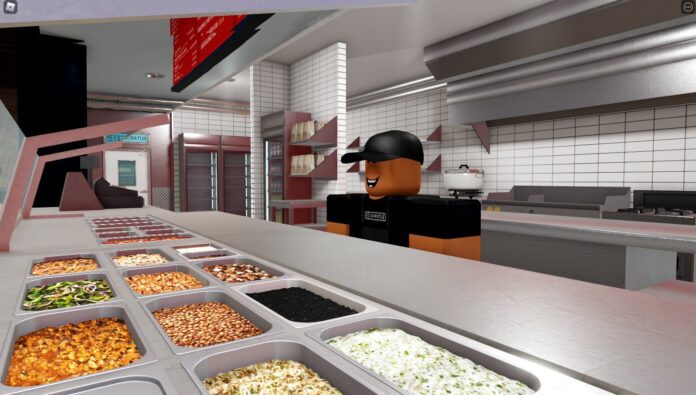
Chipotle Burrito Builder is a new simulation experience that will challenge Roblox players to roll burritos in the metaverse to earn Burrito Bucks, the brand's in-experience currency.
Some restaurants these days are looking for new ways to reengage with a market heavily affected by a two-year old pandemic. Restaurants have done a lot of juggling over the last two years: Redefining menus, thinking of new ways of connecting with customers, in other words, pivoting to a positive future. It’s been nothing short of impressive. One approach which is gaining some traction recently is to look at a new market, the metaverse. Yes, lots of hype about the metaverse, also known as augmented reality, and it is also providing new opportunities for the food service industry.
The metaverse is also another reason so many are talking about cryptocurrencies these days. Many see the two rely heavily on each other as they develop. For example, Crypto Baristas aims to bridge the gap between the physical and virtual worlds for coffee lovers. Not only does it bring coffee fans together in the metaverse, but the project is funding an actual coffee shop in New York City called Coffee Bros., which partners with coffee farmers from around the world. It’s all done with cryptocurrencies.
Few knew how the technology would escalate and scale in a way that it would change how we communicate. Not to mention, how the internet changed how we live. The metaverse is a virtual world that continues to exist and evolve even if you’re not around by way of some virtual reality devise. You can get in and out while the world carries on, with or without you. You can create, buy, and sell goods and yes, order and virtually eat food in a digital economy. You obviously can’t physically eat food in the metaverse, nevertheless, there are numerous other things you can do that you can’t do in the real world.
In the more idealistic concepts of the metaverse, it’s interoperable, allowing anyone to take virtual items like clothes or cars from one platform to another. You can make money, get credits to purchase things in the real world. Very fascinating.
Chipotle recently teamed up with Roblox to have users create meals that earn credits for real food. When they began inviting people to join their restaurant in the metaverse and collect credits for their next Chipotle order by receiving special codes, over 20,000 people were waiting to get in. McDonald’s announced recently that it intends to open new restaurants in the metaverse. Wendy’s and Hooters have also made announcements in the last few days. In Canada, Restaurants Canada launched a metaverse marketplace for its industry, a trend hunter partnership to revive the foodservice Industry. It will be launched in May. We are expecting other chains to follow suit over the next several months.
It is still unclear though how the metaverse will change our lives, or how restaurants can make money selling food virtually. It may be that it will come and go, like many other things in life.
However, the potential crossover between the real food world and a virtual one in the metaverse can help companies to look at the market differently. Think about how employees can be trained or allow chains to try new menu items. Experiences can be changed in a way they can’t right now. For example, the metaverse could offer consumers a chance to eat breakfast in Istanbul, lunch in Paris and dinner in Rio, on the same day. Or, on a more personal level, you could go to a family restaurant and be served by your own ancestors and experience the food they ate many years ago. Most of the industry R&D can occur in the metaverse. It may not be real food, but you are in fact dealing with avatars representing real people who will tell companies what they like and dislike. The metaverse can be limitless, but of course, how consumers would react to experiences can bring its load of unpredictability.
The metaverse is also another reason so many are talking about cryptocurrencies these days. Many see the two rely heavily on each other as they develop. For example, Crypto Baristas aims to bridge the gap between the physical and virtual worlds for coffee lovers. Not only does it bring coffee fans together in the metaverse, but the project is funding an actual coffee shop in New York City called Coffee Bros., which partners with coffee farmers from around the world. It’s all done with cryptocurrencies.
Most Canadians may not buy into this metaverse concept at all. Food is food, and you either order it from a restaurant or you cook your own. In other words, sticking to the basics. Let’s face it, wearing VR headsets can be a pain, making us look silly. Some may even experience motion sickness while wearing them. Nothing pleasant about that.
The online world is different than before the pandemic, especially in the food industry. There’s more business, more traffic, so converting some of that traffic into a virtual world is not as hard as two years ago. Joining the metaverse for a restaurant is not that expensive and the possibilities are interesting. If this helps our food service get back on its feet, all the power to them.
Retail Insider is streamlining its Canadian retail news from around the web to include a handful of top news stories that can be viewed quickly during the day. Here are the top stories from the past 24 hours.
Despite the numerous challenges that have restricted much of the retail industry over the course of the past two years, hampering merchants’ efforts and impeding progress, opportunities have also arisen for those in the position to take advantage of them. The digitization of the world around us, which has sparked a sharp rise in the consumer’s adoption of online channels to make purchases, has changed the way many within the industry are conducting their businesses. New processes and modes of product delivery and transfer are being developed in order to meet the growing expectations of an increasingly digital consumer. It’s a shifting retail environment that enables brands to get closer to those engaging with them. And, according to industry expert, Liza Amlani, it’s an environment that’s proving ideal for the development of direct-to-consumer (DTC) brand strategies.
“There are a few different factors that are driving brands to invest more into their DTC strategies,” she says. “Most notably, however, much of the work currently being done in this area is through the lens of getting closer to the consumer. A lot of brands are losing a lot of third-party data. It’s really changing the way brands think about product and the opportunities to leverage insights related to them in order to drive better decision-making. Capturing the right product insights goes a long way toward informing product creation, merchandising and marketing and promotion. As a result, a number of brands are attempting to own and leverage this data to close the feedback loop and build deeper relationships with their customers. It allows them to better understand what consumers want and develop the right product for them at the right time in the right channel. This really comes from direct insights from customers.”
Speed to market
It’s a shift in thinking among brands that’s been building momentum for some time, recognizes Amlani, but is one that she says has certainly been facilitated by impacts of the COVID-19 global pandemic and subsequent accelerated digitization of the retail industry. Brands like Canada Goose, Arc’teryx and others have benefitted tremendously from the growth of ecommerce and changing consumer purchasing preferences and behaviour. And, there are online marketplaces being introduced on a consistent basis which are meant to help consumers more easily find their favourite DTC brands. It’s changing the retail landscape considerably, suggests Amlani, who also points out the ability that it provides DTC brands in increasing their product cadence.
“Another force that’s prompting brands to develop or enhance their DTC strategies comes from their desire to accelerate their speed to market,” she asserts. “In order to do this, they need to be creating teams that really understand the customer and who are building the deeper relationships that are required. And, it’s not only important from a product and merchandising insights perspective. Some brands are beginning to use insights across multiple categories, helping to break down category silos, bringing everyone working for the brand onto the same page. Again, it’s all about getting closer to the customer in order to create and introduce the products they want as quickly and efficiently as possible.”
Digital transformation
Amlani goes on to explain that, in addition to helping brands gain control of their customer data and supporting them in increasing their speed to market, there are a number of other benefits that brands receive as a result of the development of an effective DTC strategy. Brands today, she says, are starting to assess whether or not they’re overly represented in the market. They’re also recognizing some of the wholesale nuances that a DTC strategy helps them avoid, like navigating the negative, devaluing impact adjacent brands might have on their product. One or a number of these factors are leading many brands to close or scale back some of their retail accounts, a move most noticeable by Nike’s decision to cutback some of the products that it makes available through Foot Locker. It’s been estimated that an astounding 70 per cent of the retailer’s sales in 2021 were directly generated through Nike product. Upon news of Nike’s decision, Foot Locker’s stock plummeted 30 per cent. Amlani says that it’s a trend that’s mounting, and one that she believes is leading many multi-brand retailers to increase their digital investment.
“This is really going to push a number of retailers to accelerate their digital transformations,” she asserts. “This is especially true for retailers with multiple banners that are buying the same product. The challenge inherent in that kind of structure is that when different teams are buying from the same product catalogue, they end up recreating things like item master and product knowledge, resulting in a lot of duplicated work that isn’t consistent across banners and channels. And so, brands like Nike and others who have been a little more forward in their thinking with respect to digital transformation are realizing that the retailers that they’re partnering with aren’t fast enough for them. As soon as Nike develop a product, it’s on their website, app and social platforms. For retailers who have not advanced their digital capabilities or updated their tech stack, there will remain a disconnect between them and their brand partners who are working in the cloud and with digital tools. It’s already leading some to reduce the amount of product they share with retail partners. And I believe it’s a trend that will continue for some time longer.”
Leveraging customer insights
Apple Store at Yorkdale Shopping Centre (Image: Craig Patterson)
It’s a situation that Amlani says will result in a number of multi-brand retailers being left behind if they don’t catch up to their brand partners and the fast-advancing digital curve. She suggests that in order to combat these challenges, some are simply increasing their merchandising strategy to encompass a wider breadth of brands that appeal to their customers and, in some cases, enhancing the representation of brands within their product assortment and mix that truly reflect the retailer’s community of shoppers. This approach, however, has its obvious limitations, only allowing teams to be as creative as the product that’s available to them. In order to really respond in the face of increasing DTC competition and success, Amlani says that multi-brand retailers will need to leverage their own internal innovation and ingenuity and understanding of their customers.
“Creating private label products is perhaps the most effective way for multi-brand retailers to compete in this evolving retail landscape,” she says. “But doing this requires a great deal of work and is an area that many retailers don’t even want to venture into. However, for those with the resources and creativity to be able to execute on this, private label represents a fantastic way for some to really start to take advantage and deepen their understanding of their customers. And, again, this is all about engaging with the consumer, developing meaningful relationships with them, listening to them, and closing the feedback loop in order to hone an awareness of the product they want. The direct insights that many have access to through their customer-base can be used to great effect, informing and driving important decisions around design and product development.”
Extended product life cycle
It could be suggested by some, perhaps in a bit of a knee-jerk kind of way, that the current state of the traditional retail model could be under threat as a result of shifting consumer behaviour and an ever-expanding digital retail ecosystem. Might it be the demise or diminishing of the distributor? Amlani doesn’t think so. Instead, she believes that the pressures being placed on multi-brand retailers by their DTC competitors is a natural evolution of the industry that will simply yield greater innovation. In fact, she adds that as a result of rising sentiment around corporate social responsibility, there may soon be a need for even more distributors in order to properly manage an extended product lifecycle.
“What we’re going to start seeing is a lot more activity in the off-price space,” she says. “And, we’re also going to see increased activity around product beyond its full-price journey. That’s where we’re going to see more distributors and their increased importance as they take excess product. As retailers and manufacturers continue to place greater emphasis and focus on reducing the waste they create and operating within a more responsible and sustainable retail model, it’s going to push everyone to think about the product and its journey differently, resulting in a longer product life cycle. It’s actually in the end going to drive closer, deeper collaboration between distributors and their brand partners.”
Investing in technology
In order for multi-brand retailers to achieve this, however, Amlani underscores the significance of their task ahead, highlighting the amount of work that’s required. It’s a situation that calls for resilience, self-assessment, forward-thinking strategy and a penchant to get as close to the customer as possible. After all, retail is about delivering the right product and creating delight for the consumer. And, according to Amlani, it’s a fact that goes a long way toward highlighting just how critical it is for organizations within the industry to focus more energy and invest further into the development of their digital initiatives in order to achieve their objectives.
“Going forward, it’s really important for multi-brand retailers to look at other brands within the industry and learn from them. Brands like Nike, Amazon and Walmart take risks around their investment in technology and the way they test and iterate with product, understanding that they have to consistently improve their speed to market. Those brands are obviously the benchmarks for this type of approach to retail. But there’s a lot that can be learned from watching the way they do things in order to satisfy their customers. To start down that path and realize the opportunities in front of them, retailers have got to ramp up their investment in technology and accelerate their digital transformation.”
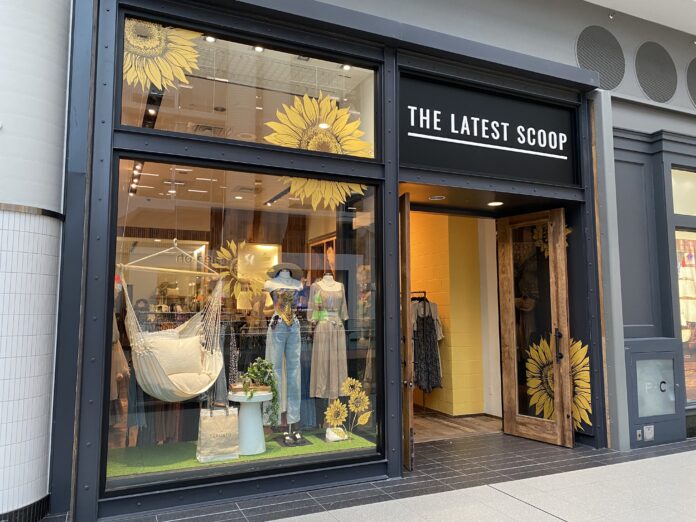
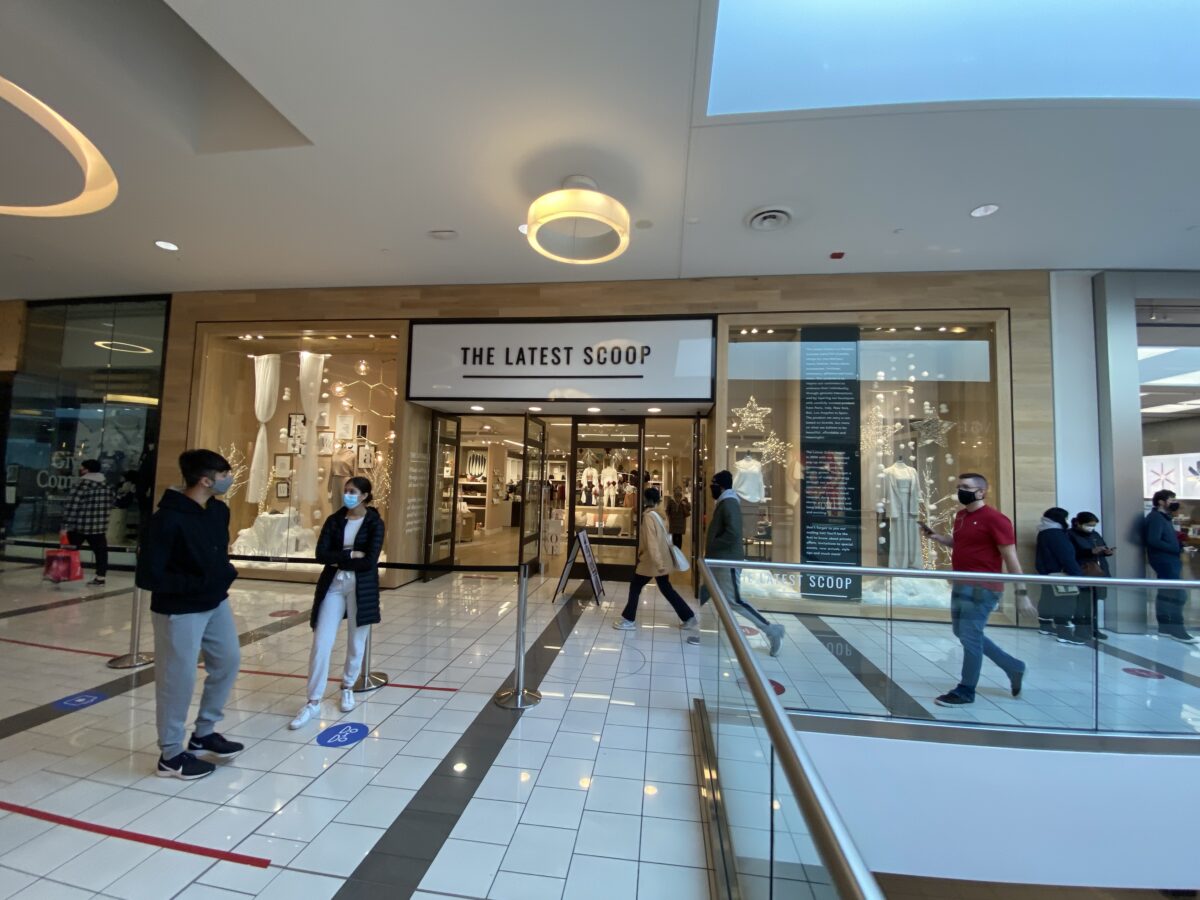
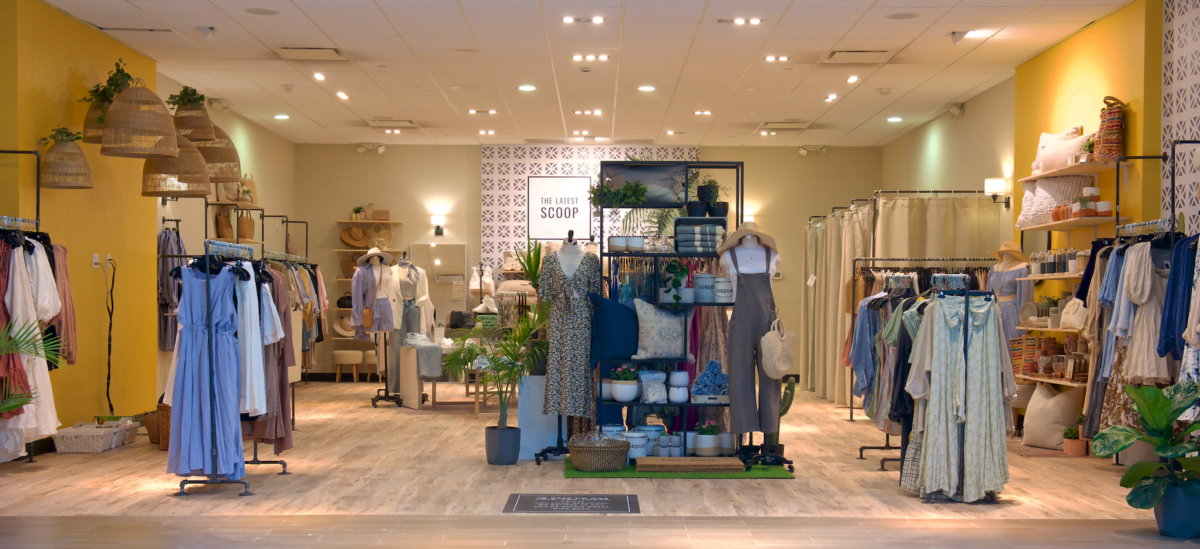
The Latest Scoop at CF Toronto Eaton Centre (Image: Dustin Fuhs)
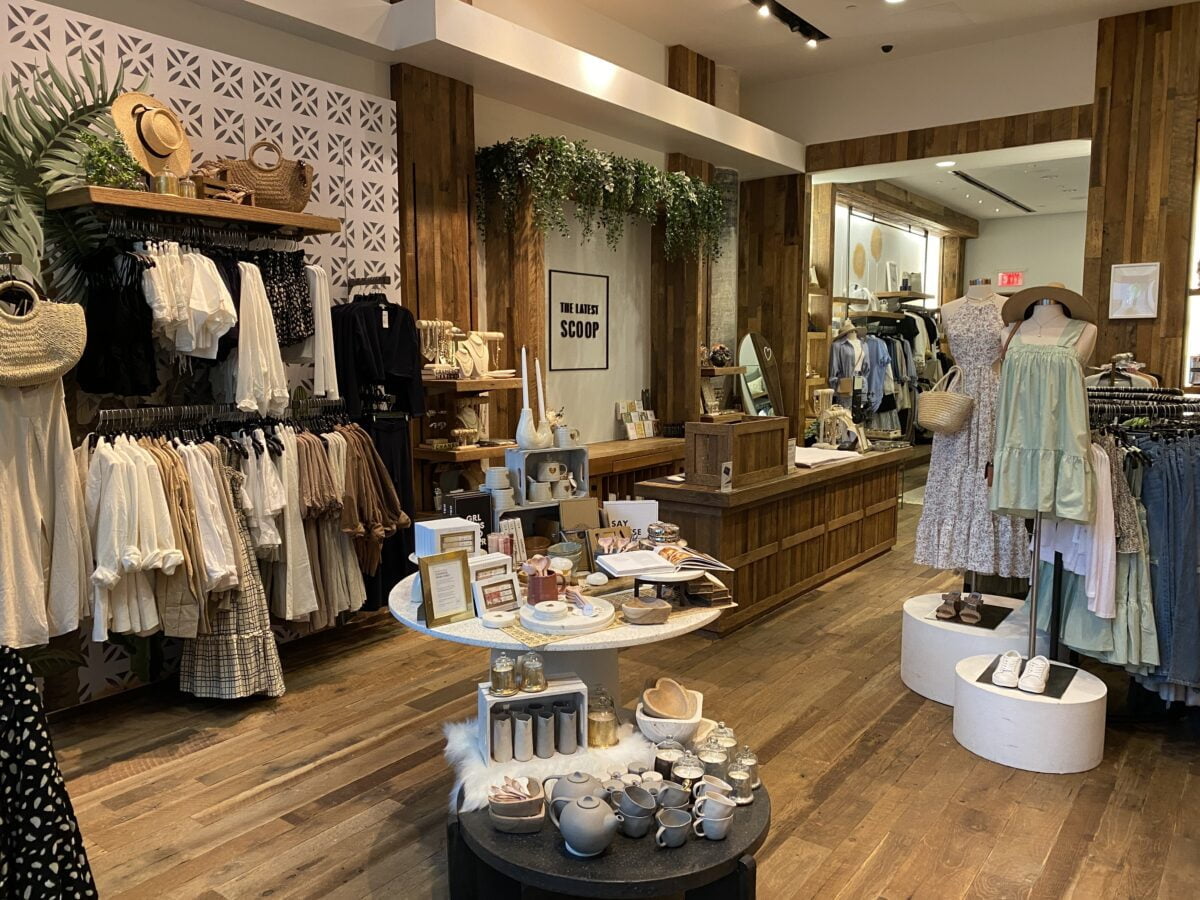
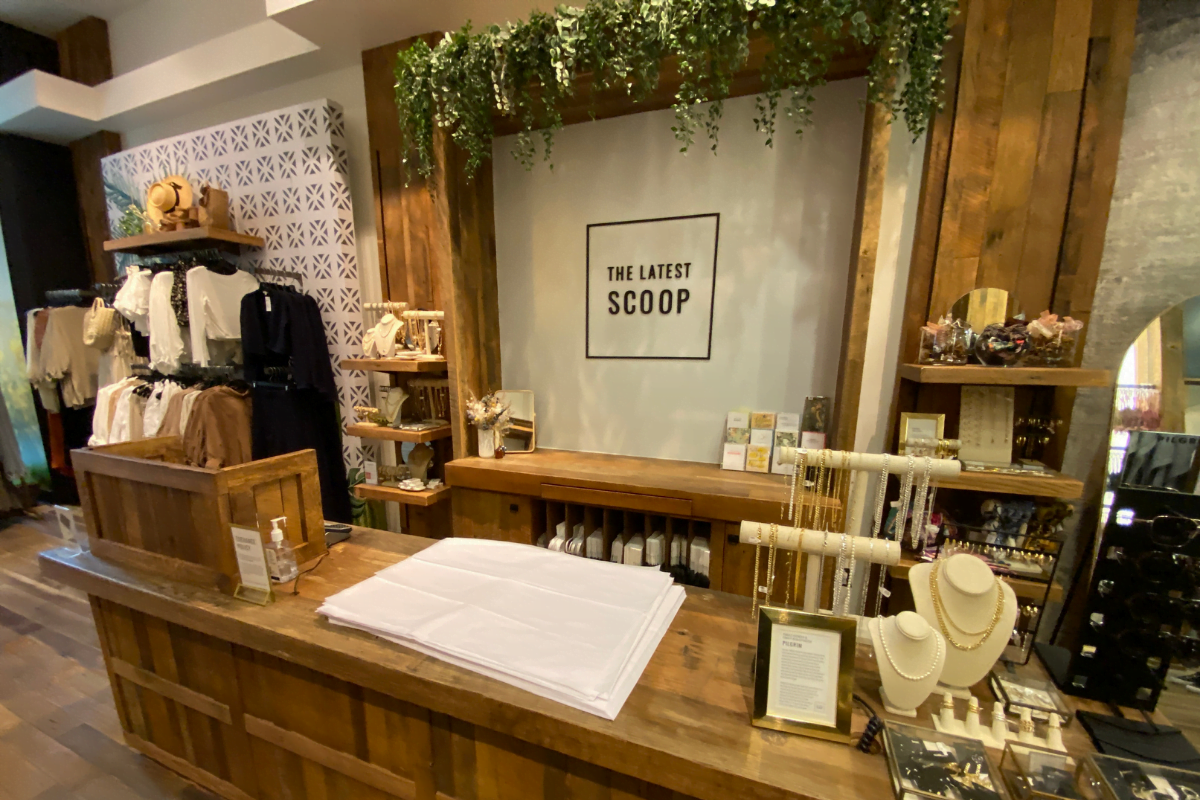
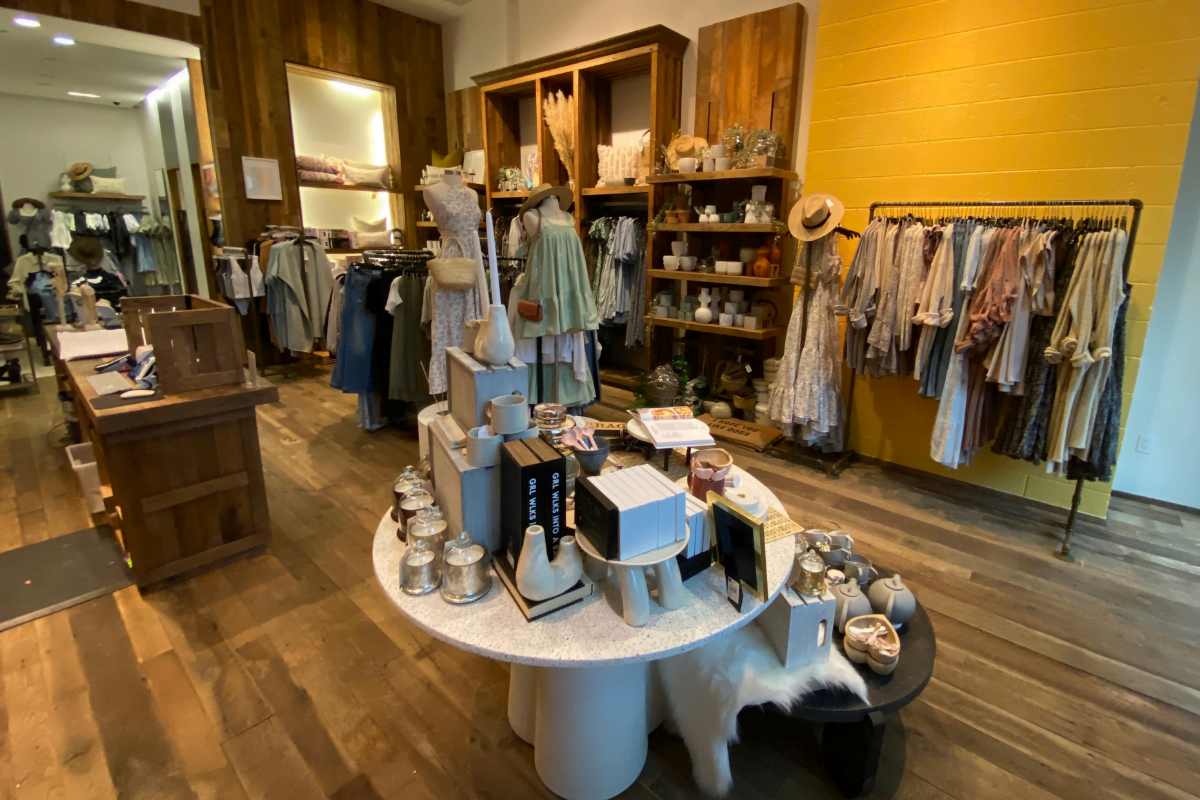
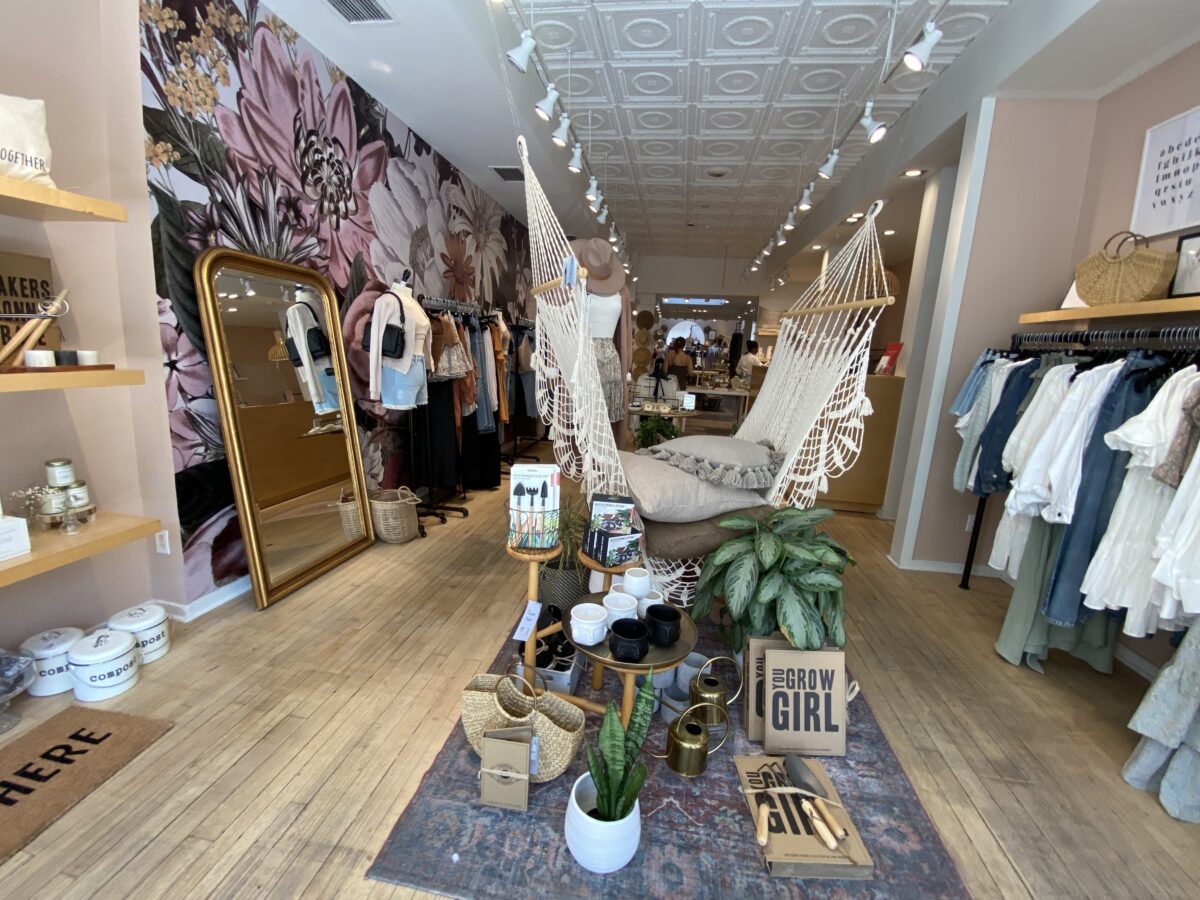
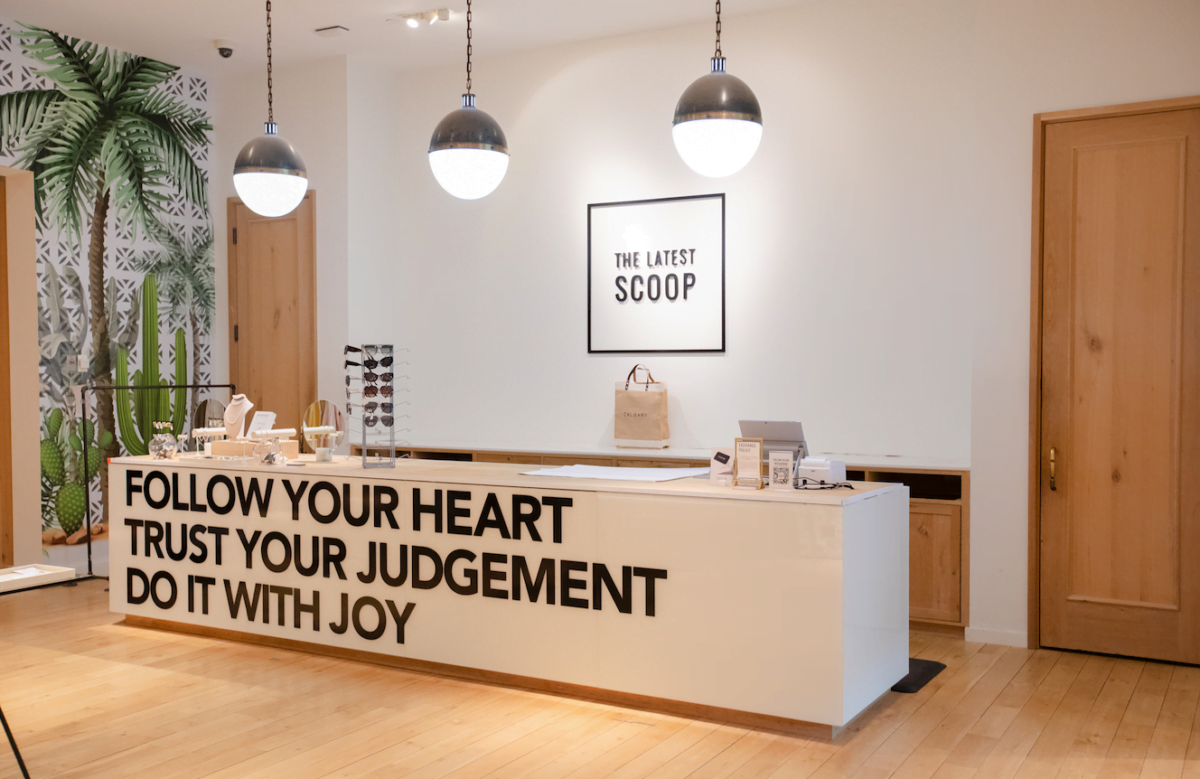
Here’s the latest scoop on The Latest Scoop – it is continuing to grow its retail brand across the country with its unique strategy of launching pop-up spaces in preparation for longer-term leases and buildouts in certain markets.
The lifestyle concept store, which offers a curated selection of pretty things for people and their homes such as fashion, home décor, accessories, furniture, stationery, giftware, was born in 2004 as a series of pop-up shops and The Latest Scoop has quickly evolved into nine permanent locations in in Vancouver, Victoria, Calgary and Toronto.
The company’s first location was in Dundarave in West Vancouver.
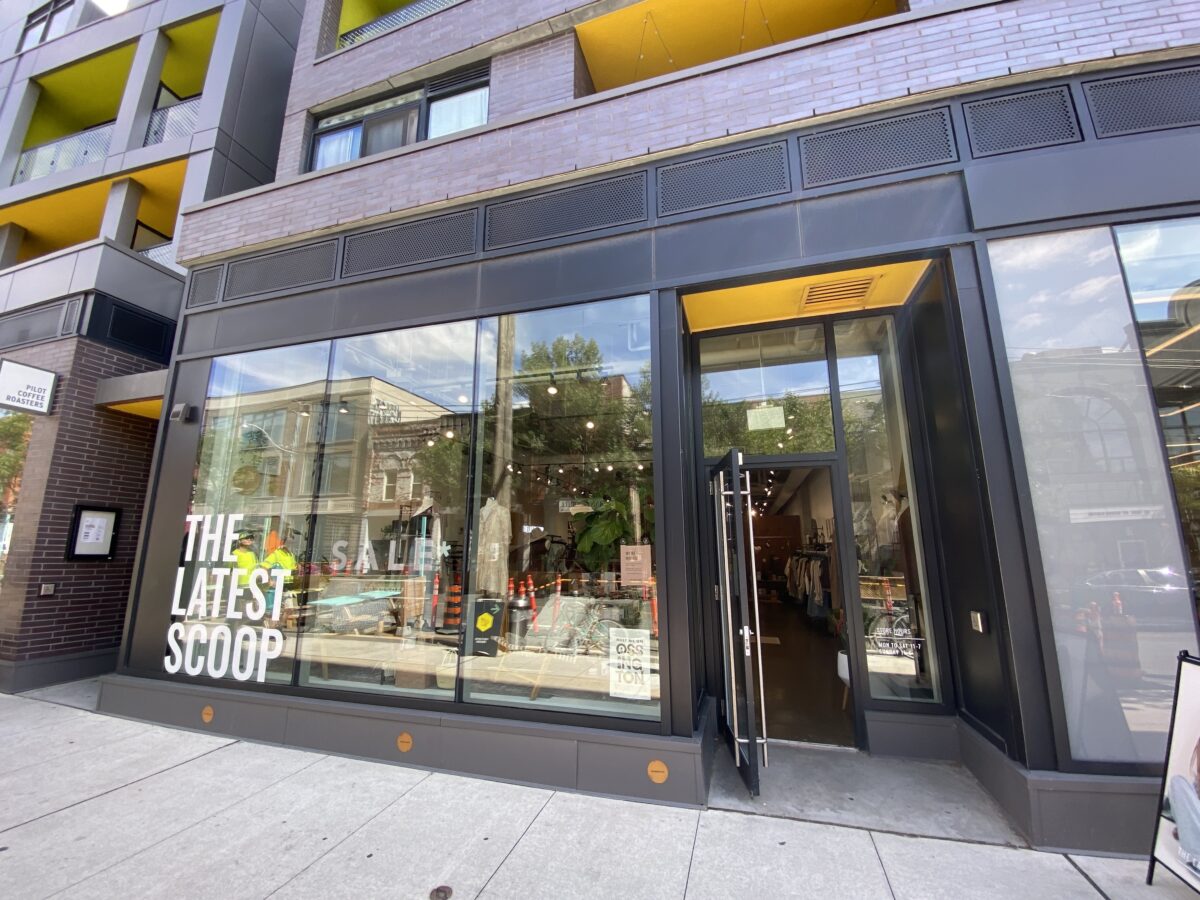
Image: The Latest Scoop on Ossington Ave (Photo by Dustin Fuhs)
Debbie Nichol
Deborah Nichol, Founder of the brand, said the retailer has a total of 12 locations currently. The most recent is in Woodgrove Centre in Nanaimo. Prior to that it opened in CF Market Mall in Calgary and CF Chinook Centre in Calgary. It has also opened in Mayfair Shopping Centre in Victoria. Guildford Town Centre in Surrey, BC, and the CF Toronto Eaton Centre were also opened since the pandemic began.
Nichol had been in retail for a number of years and retired many years ago to take care of her young son Adrien, who is now the brand’s CEO.
Adrien Nichol
“But I missed working. I had a really popular store in town and I just missed being out in the workplace and it was a very creative business that I enjoyed and even Adrien said to me I should go back to work and open up another store,” she said. “I guess he had it in his blood at an early age.
“I had the money to go shopping and not working I had the time to go shopping for once and I couldn’t find anything I wanted. Nothing was motivating me. When I go into a store, I want to feel something. I go shopping for emotion, for experience . . . That’s why people go to brick and mortar stores. And there was nothing. It was a time when all the designers were coming out with their own stores and they all looked the same – all gray, white, black, taupe, whatever it was, there was nothing new.
The Latest Scoop at CF Toronto Eaton Centre (Image: Dustin Fuhs)
The Latest Scoop at CF Toronto Eaton Centre (Image: Dustin Fuhs)
The Latest Scoop at CF Toronto Eaton Centre (Image: Dustin Fuhs)
“I started thinking what could I do that would fit into my lifestyle as a mom of a young child, and my husband travelled, my life was pretty busy, but not interrupt my lifestyle. So I thought a pop-up store. I would open whenever I wanted and carry whatever I wanted and open for short periods of time. This turned out to be a very successful strategy. It was definitely fun. I had no rules in my buying mix. If I felt like I wanted to carry a tennis racket, I’d carry it. Anything. There were no rules. Complete outside the box thinking, which is still our strategy today.
“We would sell out after two or three weeks basically.”
The brand started opening stores for longer periods of time because of customer demand. That demand continued and it led to some of its stores having permanent locations.
“What COVID has done is offered us the opportunity to get back to our roots, which is why we opened up Mayfair and Chinook and Toronto Eaton Centre in the various pop ups that were opening – to go back to our roots and have fun with the neighbourhoods that we’re in and develop and grow our ecommerce. We love ecommerce but we really love brick and mortar retail because we get to meet the customer, hear them and talk to them,” said Nichol.
The Latest Scoop at Guildford – Photo by Lee RivettImage: The Latest Scoop
“It gives us the opportunity to test market new neighbourhoods without committing to long-term leases. Should we wish to switch to long-term leases then that’s our choice at that point.”
According to the company’s website: “Our Purpose is to inspire our people and our customers to embrace their individuality through genuine interactions.
“We travel from Paris, Italy, New York, Bali, Los Angeles to Spain to uphold our standards of always having fresh new arrivals weekly, based not on brands, but on what we find to be beautiful, inspirational, and meaningful. While searching for fabulous pieces, we also bring back innovative design concepts to create beautiful stores, reset seasonally.
“When you’re here, we urge you to lose yourself in the sense of discovery. We want you to have fun, laugh, connect and most importantly, fall in love with your wardrobe and your home.”
Image: The Latest Scoop on Queen Street West in Toronto (Photo by Dustin Fuhs)Image: The Latest Scoop
Nichol said opening a new store is a big undertaking financially and it’s a big commitment. When you open a pop up, you get to test market to see if you’re accepted by the neighbourhood. If you’re in the right location. If the store is the right size.
“You get a chance to feel it out,” she said. “It’s like a test drive. If you buy a car you want to test drive it and that’s sort of what we do with retail locations. And to be honest, we go in with full integrity of becoming full-time stores within that community and we just want to make sure that the neighbourhood understands us and we’re a good fit.
“We’re already looking at other neighbourhoods in Canada, in other provinces. And we will continue down the path of temporary stores, pop-up stores, that we hope to convert to full-time. But we’ll also go into smaller communities like Nanaimo where we don’t know if it will lead into full-time at this particular time. It’s unknown territory to us but we feel confident that the cities that we’re choosing are chosen with purpose.
“As far as expanding the pop up we’ll be looking throughout the rest of Canada and also we’ll be going back into the United States. Before COVID, we had one temporary store in Pasadena, California and there’s a benefit to having stores in the US, because our buying team travels down to California every three or four weeks.”
College Park in Toronto, formerly Eaton's (Image: Dustin Fuhs)
Brand Finance Canada’s latest report indicates RBC is the country’s most valuable brand while Scotiabank is the nation’s strongest brand.
Brand Finance is the world’s leading brand valuation consultancy. It was set up in 1996 with the aim of bridging the gap between marketing and finance.
David Haigh
In its 2022 report, David Haigh, Chairman & CEO, Brand Finance, said the purpose of a strong brand is to attract customers, to build loyalty, to motivate staff.
“All true, but for a commercial brand at least, the first answer must always be ‘to make money’. Huge investments are made in the design, launch, and ongoing promotion of brands. Given their potential financial value, this makes sense. Unfortunately, most organizations fail to go beyond that, missing huge opportunities to effectively make use of what are often their most important assets. Monitoring of brand performance should be the next step, but is often sporadic,” he said.
“Where it does take place, it frequently lacks financial rigour and is heavily reliant on qualitative measures, poorly understood by non-marketers. As a result, marketing teams struggle to communicate the value of their work and boards then underestimate the significance of their brands to the business. Skeptical finance teams, unconvinced by what they perceive as marketing mumbo jumbo, may fail to agree on necessary investments. What marketing spend there is, can end up poorly directed as marketers are left to operate with insufficient financial guidance or accountability. The end result can be a slow but steady downward spiral of poor communication, wasted resources, and a negative impact on the bottom line.”
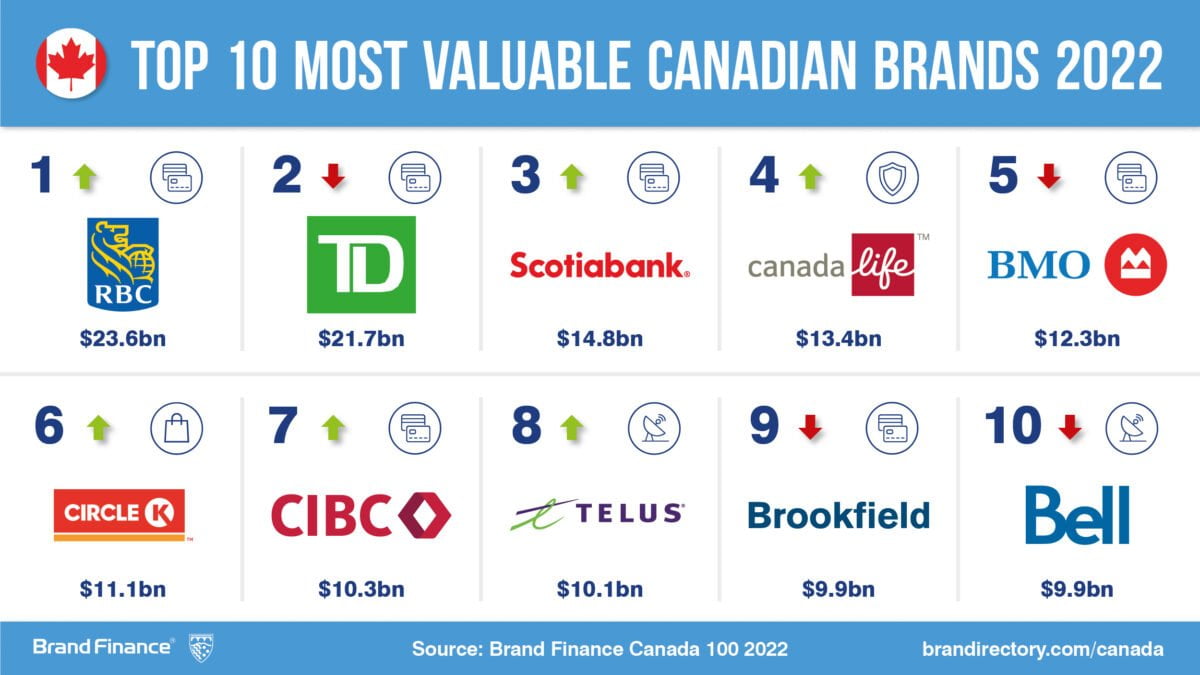
The most valuable Canadian brands of 2022 (Image: Brand Finance)
In its report, the Top 10 Most Valuable Brands in Canada were:
RBC
TD
Scotiabank
Canada Life
BMO
Circle K
CIBC
Telus
Brookfield
10.Bell
Charles Scarlett-Smith
“The top 10 has traditionally been dominated by the big banks and telcos. Incidentally, these are the kind of brands we would expect to see at the top of a ranking in a developing economy, rather than mature economy. Tech sector brands are still notably missing at the top of the table, but with the current trends in the sector, we will likely see Shopify and Constellation Software vying for the top 10 in the near future,” said Charles Scarlett-Smith, Director of Brand Finance Canada.
“The dominance of the banking system is really telling. The Canadian financial sector really punches above its weight. What’s been interesting though in the last couple of years is seeing how Circle K with its new brand strategy has really synthesized their brand messaging.”
Three years ago, Alimentation Couche-Tard began the mammoth project of rebranding their large global portfolio of brands under the Circle K global masterbrand. Circle K is now part of the fabric of the Canadian landscape, except for in Quebec, where the winking Owl and Couche-Tard nomenclature remains. Blue and red is gone now though in favour of red and orange; we are curious to see if Quebecers noticed, said the report.
The report said the list of most valuable brands reflects the Canadian economy generally: low-risk, conservative, and effective.
“These traits have historically been a safeguard against economic crises; however, the pandemic has put forward a unique set of challenges for Canadian brands. Brands have been required to constantly adapt to shifting pandemic response policies. This manifested as a blessing in disguise for some sectors, and a quagmire of cutbacks and logistics for others. The typically reliable Canada Top 100 has never been more dynamic,” said the report. “There is also some light at the end of the tunnel. From 2020 to 2021, the aggregate value of the Top 100 Canadian brands fell by one per cent. It was the first time that the brand economy decreased in value since we began our study. This year, we are happy to report that Canadian brands are back in the green, having grown in value by an average of 22 per cent. Canadian brands (for the most part) are bouncing back.”
RBC (brand value up 13 per cent to CA$23.5 billion) has regained the top spot as the most valuable brand in Canada after falling second to TD in 2020 (brand value up three per cent to $21.7 billion). RBC and Scotiabank are the only two banking brands that have seen double digit growth since 2020.
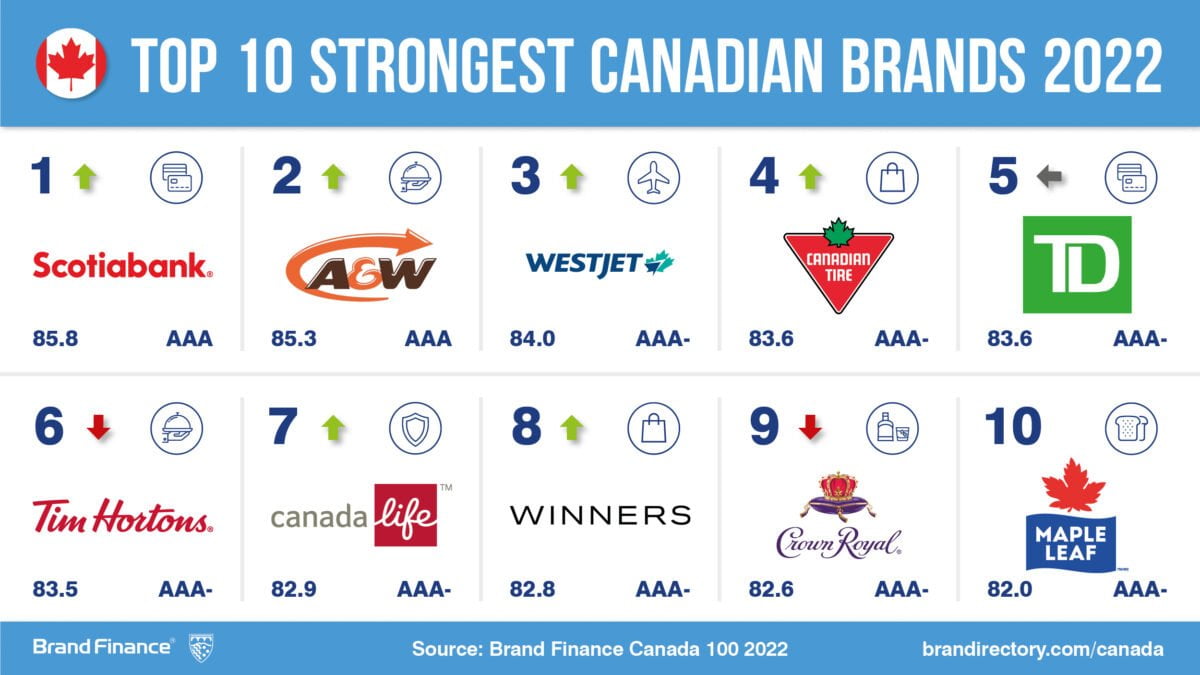
Scotiabank in Downtown Toronto (Image: Dustin Fuhs)The Top 10 Strongest Canadian brands of 2022 (Image: Brand Finance)
The Top 10 Strongest Canadian Brands were:
Scotiabank
A&W
WestJet
Canadian Tire
TD
Tim Hortons
Canada Life
Winners
Crown Royal
10.Maple Leaf
Scarlett-Smith said a brand’s strength is determined through a balanced scorecard exercise, where brands are benchmarked and indexed against their competitors on over 30 different brand strength related metrics. Metrics in the BSI range from the amount businesses invest in their brands, to stakeholder equity metrics (momentum, awareness, familiarity, recommendation etc…), to the price premium a brand can command compared to its peers.
“For the first time in three years, Crown Royal is not the strongest brand in the table. The strongest brand is Scotiabank with a Brand Strength Index (BSI) score of 85.8 out of 100 and a corresponding AAA rating. The strength of the Scotiabank brand has increased by an impressive 6.9 points since the start of the pandemic, the most of any banking brand in Canada. Scotiabank’s brand strength growth is largely down to increased recommendation and NPS (Net Promoter Score), where the bank vastly outperforms its competitors,” said the report.
“The recent announcement (by Canadian Tire) of a $3.4 billion investment strategy, with a focus on building out its ‘Owned Brands’ products and offerings, signals an exciting future for the retailer and its portfolio of sub brands.”
Retail Insider is streamlining its Canadian retail news from around the web to include a handful of top news stories that can be viewed quickly during the day. Here are the top stories from the past weekend.
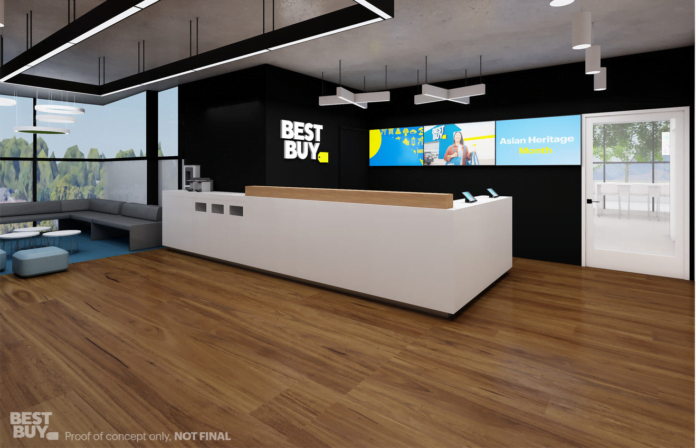
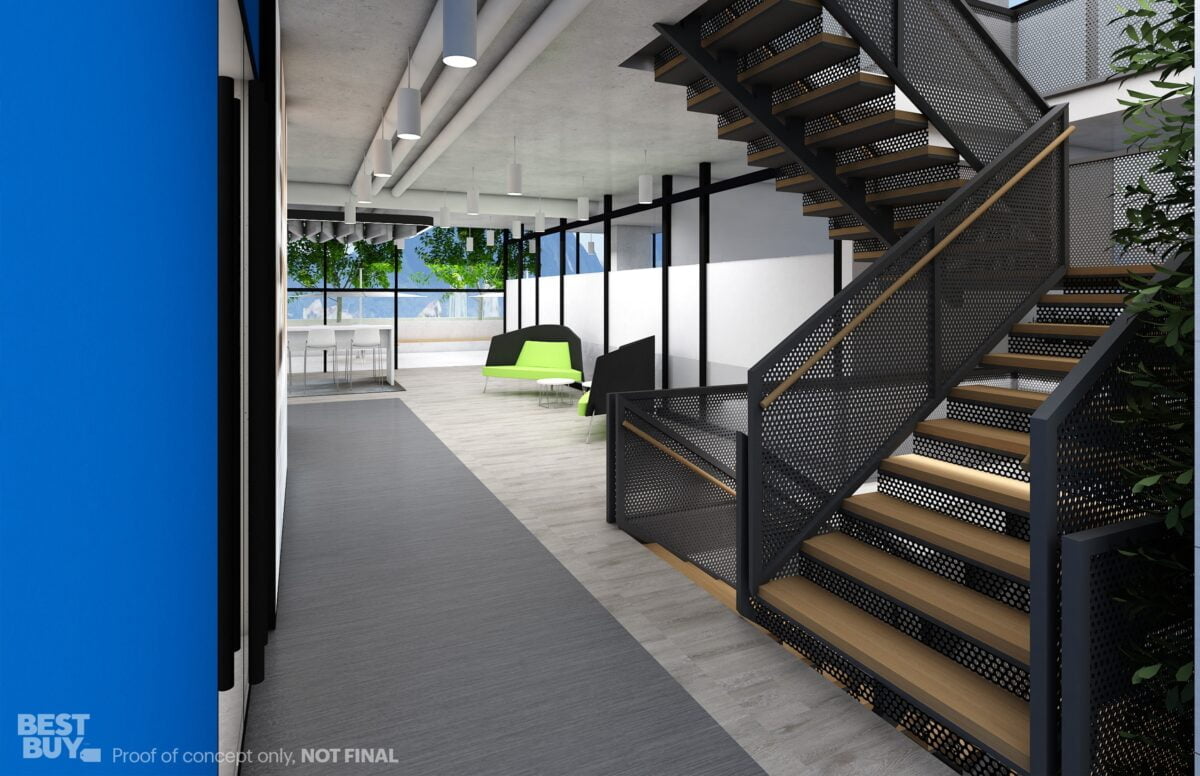
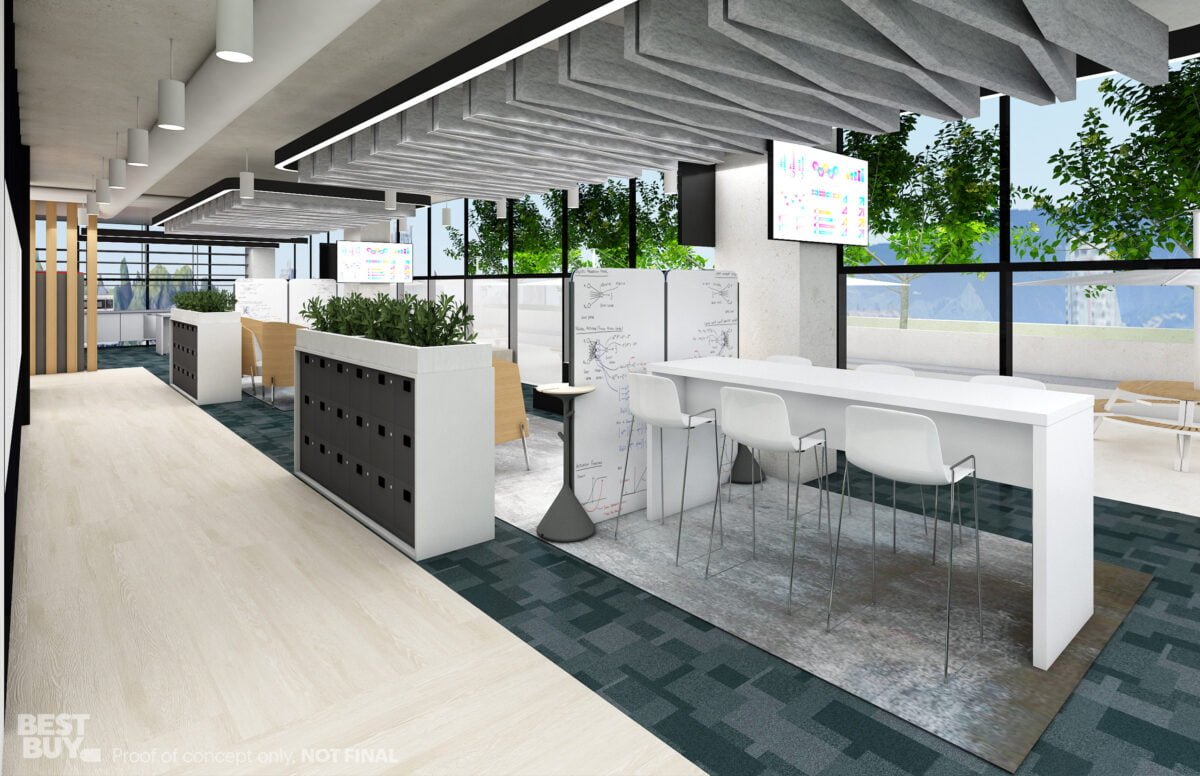
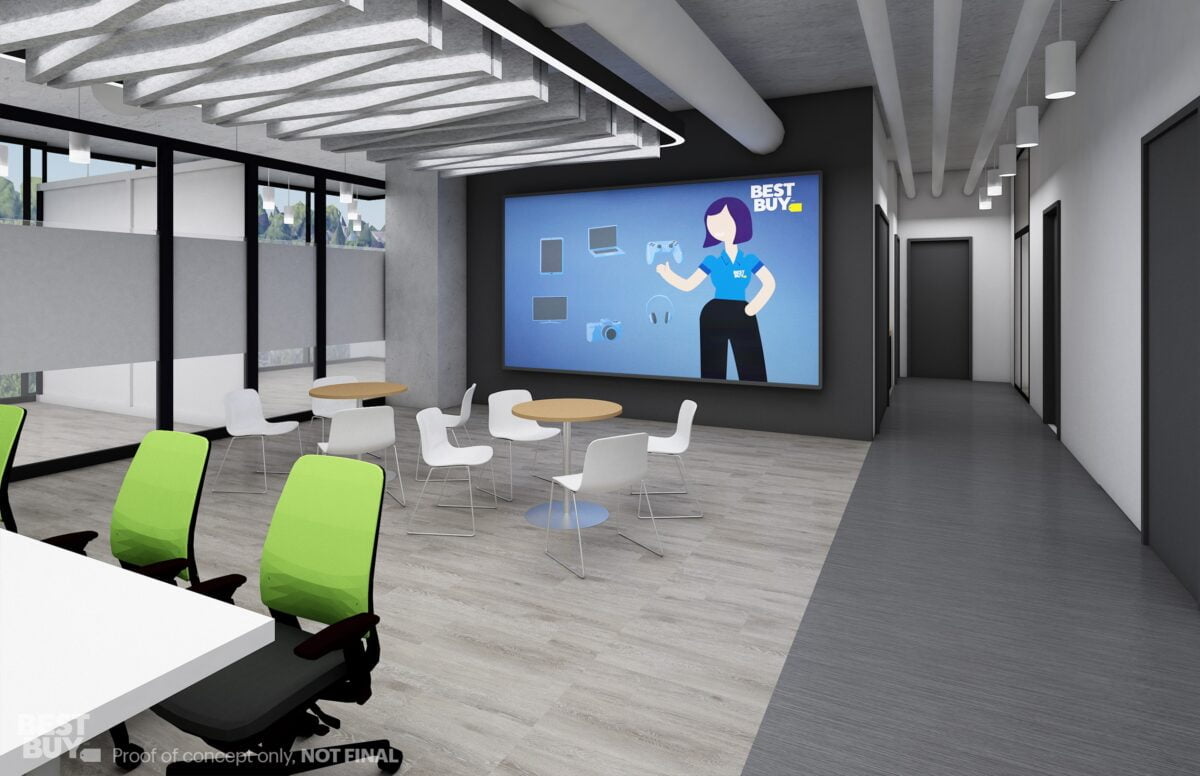
The company is targeting May when it will relocate from its current 140,000-square-foot head office space in Burnaby to a new 70,000-square-foot space in the Mount Pleasant area of Vancouver.
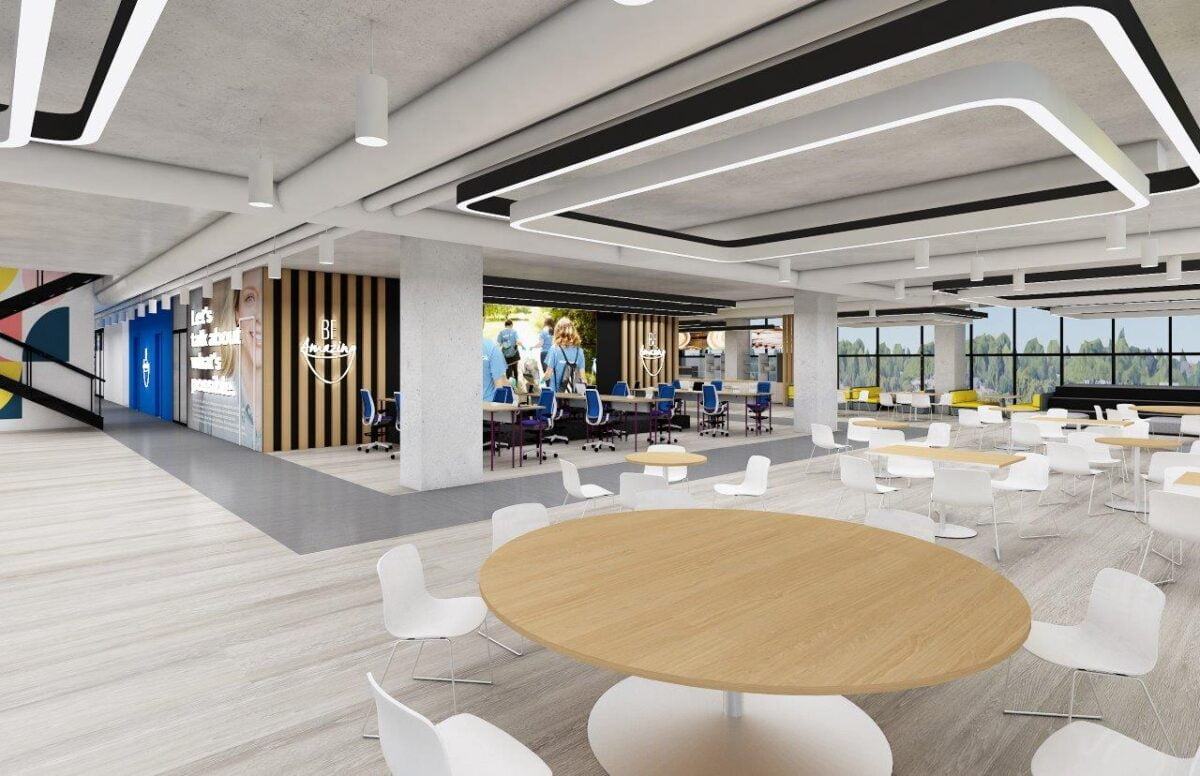
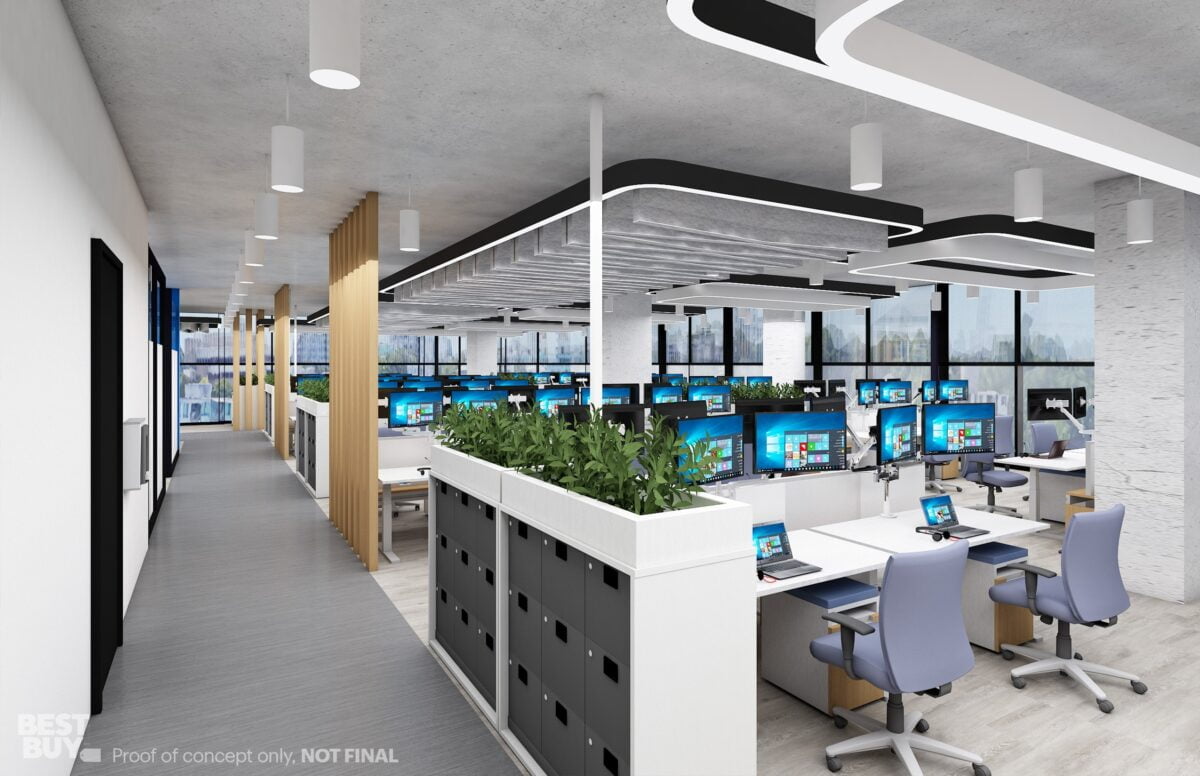
The new office space will be used for intentional connection, collaboration, to inspire cross-functional innovation and serve as a space for those who want/need the option to work in an office.
Best Buy Canada HQ (Rendering: Best Buy Canada)
Carol Graziani, Director of Diversity and Inclusion for Best Buy, who also wears a hat for employee experience and the corporate environment, said prior to the pandemic the retailer had about 1,200 people assigned to the corporate headquarters.
Carol Graziani
“Pre-pandemic we all worked on site all of the time. We all worked five days in the office. That was our structure. Before the pandemic we were moving to a semi-remote structure where we were going to do what we call work away and give people the opportunity to work remotely two days a week,” she said.
“We were going to launch that in April of 2020. Then the world changed and we went to 100 per cent corporate employees working remotely. So the fortunate piece was we already had the infrastructure and the technology in place to facilitate remote work two days a week and we just pivoted because when the lockdown happened we closed our office.
“We tried a couple of times to bring people back on site but the health mandates kept shifting so we really stayed almost fully remote for the entire two-year period.”
Best Buy Canada HQ (Rendering: Best Buy Canada)
Graziani said when the company designed the new office and looked to the future it did so with the intention of no longer requiring employees to be on site for a routine schedule. Only about 30 people have to be on site five days a week in the areas of shipping and receiving, IT services or security.
“But the vast majority of our employees are basically on site when they want to be here or when their leaders deem it’s an advantage to come together,” she said.
“This differs a little from what you hear about hybrid. In the hybrid model, companies say you have to be on site two to three days a week. We’re basically saying we’re not requiring you to come on site any number of days a week. It’s your choice. You can be flexible. And when leaders say you know what we want to have a town hall, we want to do some team building, then people will come. Really flexible.”
A survey of employees found that 96 per cent of respondents felt they were able to do their jobs as effectively if not more effectively working remotely than when they were in the office full time. Over 50 per cent said they only wanted to come to the office when specifically required, as opposed to on a regular basis or required number of days per week of month. An additional 25 per cent saw themselves coming to the office (post COVID) between one and five times a month.
Best Buy Canada HQ (Rendering: Best Buy Canada)
The top three reasons that employees would come to the office were: Events like large team sessions, strategy sessions or town halls; To connect with others (face to face /team building); and To work on a complex project that required face to face collaboration.
“We’re a technology company so we embrace technology quite readily and so learning how to use technology and being able to pivot into that environment, I think that’s kind of in our DNA. It’s what we do because we’re Best Buy,” said Graziani.
“We had been experimenting with different work models over the last five years. So for example an agile work process. Our employees are quite adaptive and I think our workforce also tends to be skewed to a younger demographic who are quite open to exploring new ways of working. I don’t know if that makes it easier for us or not but again because we are a technology-focused company, embracing new ways of doing things is kind of what we do.
“This gives people choice and I think choice and empowerment are really important to employees in today’s workforce.”
Kelly talks about the missed opportunity to help small businesses recover from the pandemic, the rising costs for doing business, concerns about government spending and tax increases, the Temporary Foreign Worker Program, the business tax rate, and credit card processing fees.
The Video Interview Series by Retail Insider is available on YouTube.
Connect with Mario Toneguzzi, a veteran of the media industry for more than 40 years and named in 2021 a Top Ten Business Journalist in the world and the only Canadian – to learn how you can tell your story, share your message and amplify it to a wide audience. He is Senior National Business Journalist with Retail Insider and owner of Mario Toneguzzi Communications Inc. and can be reached at mdtoneguzzi@gmail.com
Also check out the other series offered by Retail Insider, including The Weekly podcast and The Interview Series, which are both available on Apple Podcasts, Stitcher, TuneIn, Google Podcasts, or through our dedicated RSS feed for Simplecast and other podcast players.