Advertisement
Advertisement
Home Blog Page 889

Luxury Brand FENDI Opens 2 Boutiques in Montreal [Photos]

EXTERIOR OF NEW FENDI WOMEN’S BOUTIQUE IN HOLT RENFREW OGILVY. PHOTO: MAXIME FRECHETTE

Italian luxury fashion brand Fendi has opened two impressive boutique spaces at Holt Renfrew Ogilvy in Montreal. It’s part of an expansion for Fendi in Canada which has included several concession openings within Holt Renfrew stores.

FENDI’S ‘NEW CONCEPT’ WOMEN’S BOUTIQUE FEATURES LATEST STORE DESIGN

Last week, Fendi opened a ‘New Concept’ women’s boutique on the street level of Holt Renfrew Ogilvy at 1307 Ste-Catherine Street. The 672-square-foot boutique houses Fendi’s iconic bags, leather goods, and accessories in one area. An adjacent area in the concession house women’s ready-to-wear clothing and footwear.

The women’s boutique showcases the brand’s latest store design which includes a facade, columns, and diagonal flooring in Italian Arabescato Vagli marble which Fendi says was inspired by the architecture of Roman churches. Ivory-coloured leather shelves are suspended by tubular structures in champagne metal, while marmorino walls add further character to the space. A curved sofa in light blue velvet and a handmade carpet with a geometric pattern features nuances from green to lilac. Handmade 3D plaster wall accents feature a textured FF logo designed by the late Karl Lagerfeld who was the designer for Fendi from 1965 until his death last year. On Tuesday September 9, it was announced that British designer Kim Jones was hired by Fendi to replace Lagerfeld. Jones will design Fendi’s women’s couture collection, women’s ready-to-wear and furs.

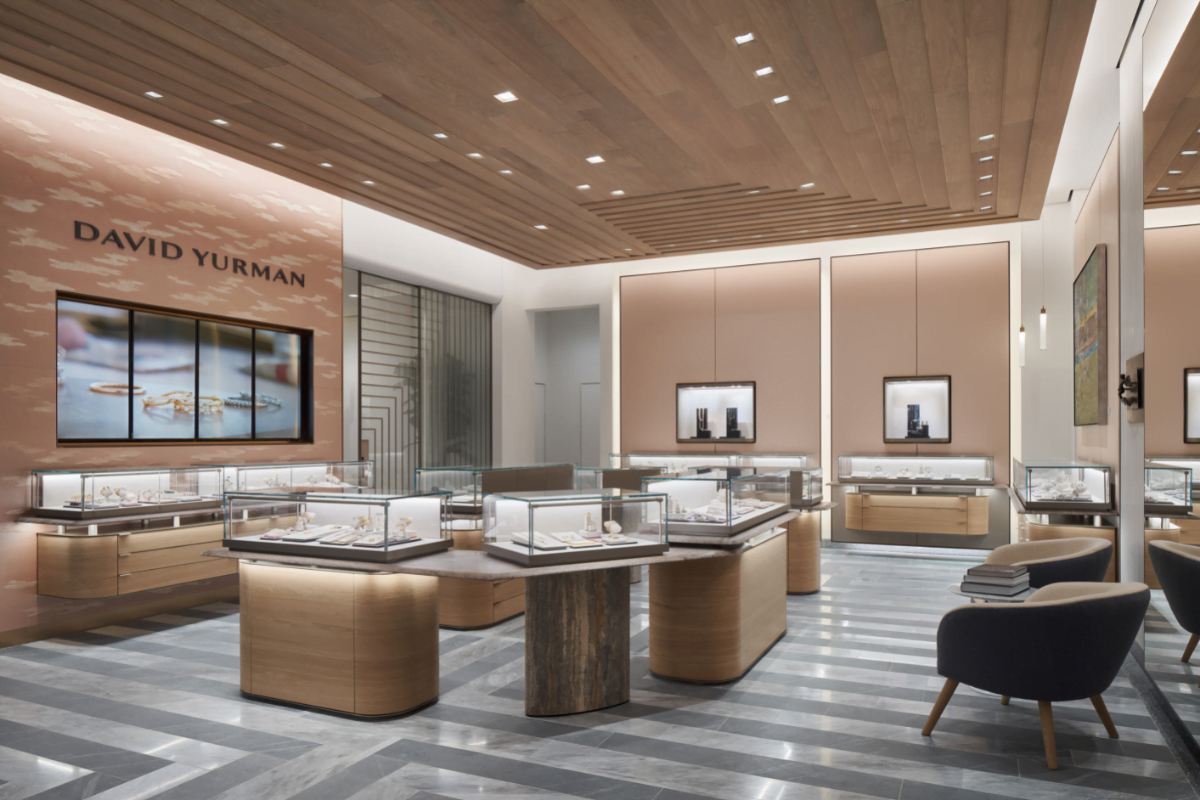
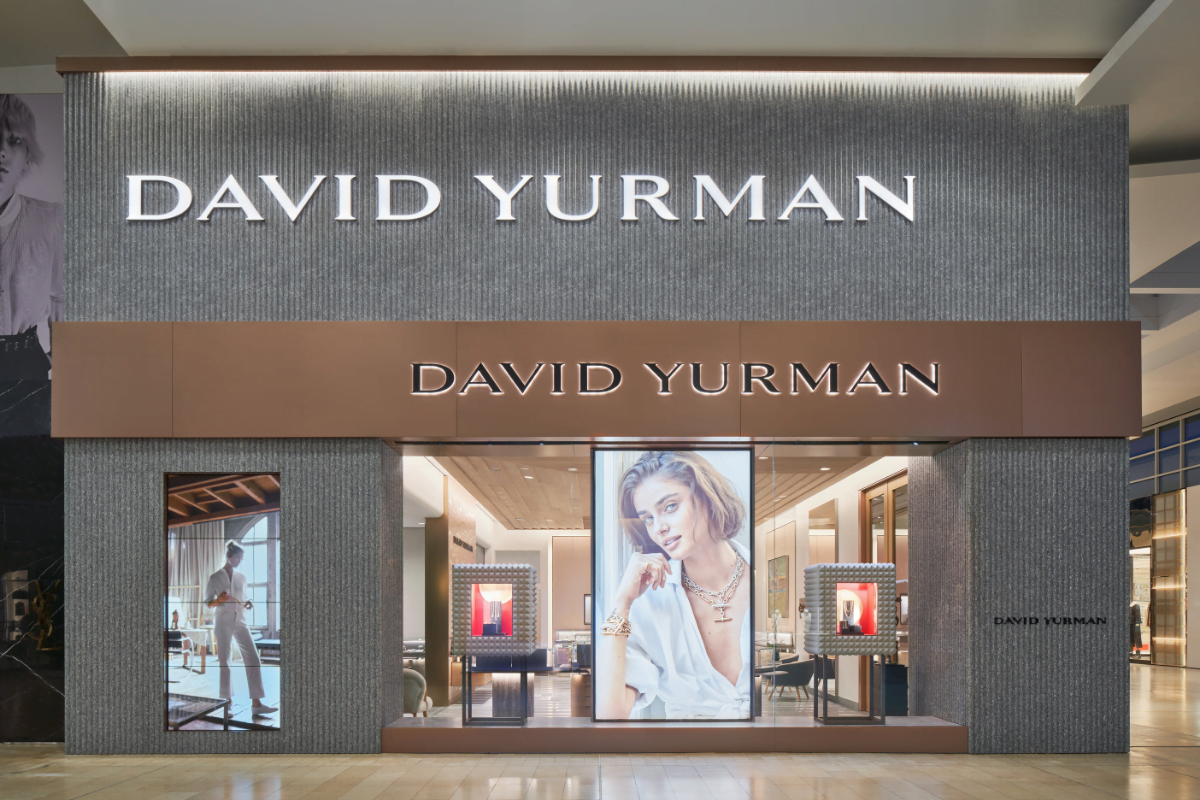
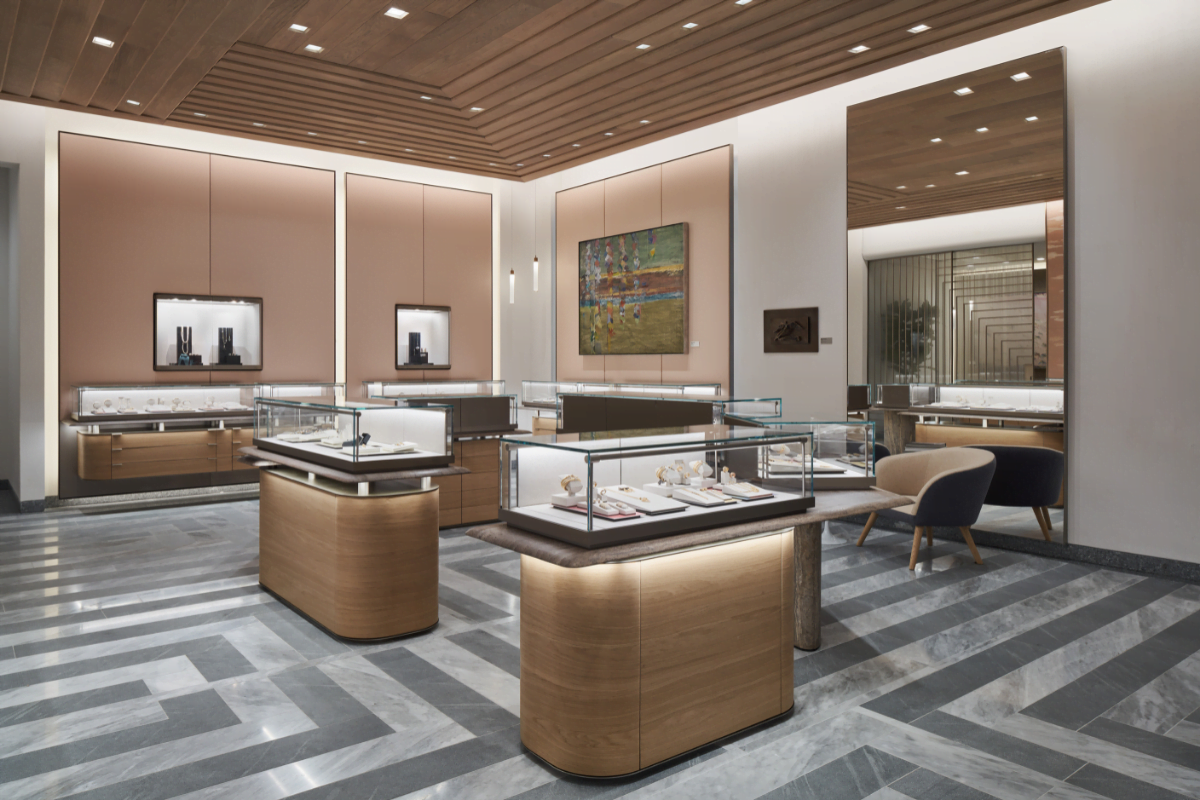
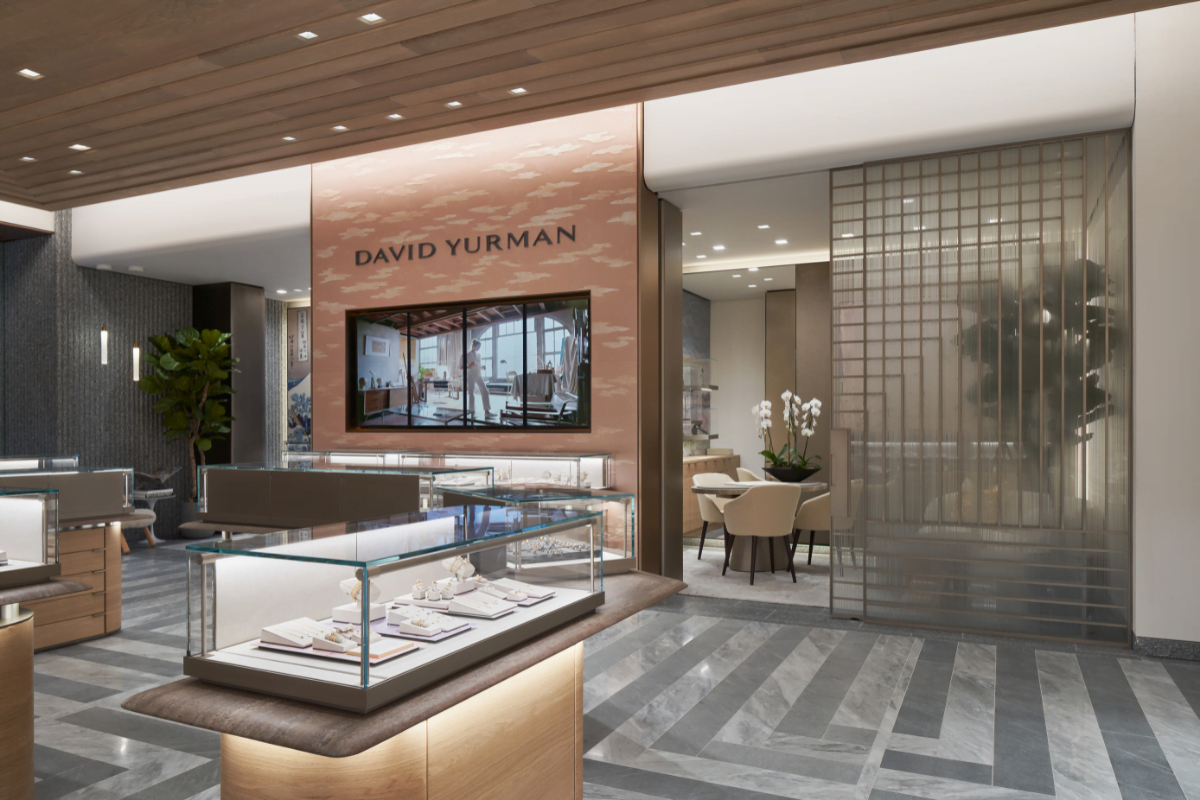
Fendi joins 10 other luxury brand concessions on the main level luxury hall at Holt Renfrew Ogilvy including Louis Vuitton, Hermes, Chanel, Dior, Tiffany & Co., Saint Laurent, Gucci, Prada, David Yurman, and Bottega Veneta. Fendi is the final piece of the puzzle for the luxurious new street level of Holt Renfrew Ogilvy which is unlike any other store in Canada. The historic Ogilvy department store building was expanded to about 250,000 square feet over six levels and is directly connected to the new Four Seasons Hotel and Private Residences, featuring the priciest hotel rooms and condominium residences in the city.

FENDI UNVEILED READY-TO-WEAR MEN’S BOUTIQUE IN HOLT RENFREW OGILVY

Last week, Fendi also unveiled a new 527-square-foot men’s concession on the fourth floor of Holt Renfrew Ogilvy. The boutique carries the full range of Fendi men’s ready-to-wear as well as leather goods and accessories. While the main floor women’s Fendi boutique was designed to be ‘feminine’, the new fourth floor men’s boutique is said to have been designed with masculine shades of green and camel. Textured silver FF walls create a backdrop for forest green lacquer and cork shelving which accents the boutique’s carpet which is of the same green shade.

The fourth floor men’s store at Holt Renfrew Ogilvy is home to 25 luxury brand concessions, branded wholesale areas, and an expansive footwear hall. We featured the new 40,000-square-foot men’s floor in Retail Insider when it opened in the spring of 2019 — it’s the largest men’s department in the Holt Renfrew chain by far.

In late 2018, Fendi opened its first Canadian concession at Holt Renfrew in Vancouver in a concession space on the third floor. An accessory boutique on the main floor as well as a men’s space on the lower level followed. In January of 2019, Fendi opened a 3,000-square-foot ‘world of’ boutique on the main floor of the Holt Renfrew flagship store at 50 Bloor Street West in Toronto, carrying Fendi’s full line of apparel, bags/accessories, and footwear for both women and men. In the fall of 2019, Fendi unveiled an impressive 1,900-square-foot women’s boutique housing ready-to-wear, bags/accessories and footwear, at the Holt Renfrew store in Toronto’s Yorkdale Shopping Centre. That Fendi boutique features entrances facing the mall as well as from within Holt Renfrew, and a separate men’s Fendi concession is located a few steps away in a 600-square-foot space.

For some historical background, Fendi once had a licensed standalone boutique space in Canada. In 1996, multi-brand retailer Collections International opened a Fendi bag and accessory boutique at 1005 Alberni Street in Vancouver (corner of Burrard Street). The boutique operated there until the early 2000s. The space was joined by adjacent spaces and is now occupied by a very impressive Tiffany & Co. flagship.

The Fendi brand has been available in Canada for decades as a wholesale account at Holt Renfrew. More recently, luxury brands have demanded that they be able to operate leased concession spaces within multi-brand stores. Taking a page from sister retailers Selfridges in the UK, Brown Thomas in Ireland, and De Bijenkorf in the Netherlands, Holt Renfrew revised its business model several years ago to become a house of luxury brand concessions with limited specialty retail operations. What has resulted is a situation where Holt Renfrew has a broader depth of certain luxury brands than competitors Saks Fifth Avenue and Nordstrom in Canada. That’s primarily because the brands carried at Holts are handling their own operations within the store.

Because Holt Renfrew carries Fendi’s entire apparel and bag/accessory categories, it’s less likely that Fendi will rush to open standalone stores where it has an operating presence in Toronto, Vancouver, and Montreal. That means landlords potentially miss out on opportunities in Bloor-Yorkville in Toronto, Alberni Street in Vancouver and on Rue de la Montagne in Montreal.

If Fendi is highly successful within its current Toronto, Montreal, and Vancouver concessions, it could look to eventually open standalone units in the luxury areas of those cities — a situation that could leave Holts exposed. Already, partner brand Louis Vuitton exited the downtown Calgary and Edmonton Holt Renfrew stores while opening standalone suburban stores at CF Chinook Centre and at West Edmonton Mall. It was a hit to the productivity of the Holt Renfrew building in Calgary, and was the primary contributing factor to the closing of the downtown Edmonton Holt Renfrew store in January.

Industry insiders say that Fendi could look to eventually open standalone stores at the overhauled Oakridge Centre in Vancouver as well as the Royalmount project under construction in Montreal. West Edmonton Mall is also said to be a contender.

What’s interesting is that luxury brands such as Fendi are saying that their Canadian sales are higher now than at this time last year. Certainly not all retailers in Canada can boast the same. People with money are staying in Canada and spending it here to treat themselves. Some very prominent Canadians are visiting and spending money in local destinations as opposed to other countries. What is resulting is a boom to some areas attracting visitors and locals spending big dollars.

The completion of Holt Renfrew Ogilvy in Montreal marks a milestone in what was intended to be a decade-long ‘superstore’ construction strategy for the Holt Renfrew chain. In 2007, Holt Renfrew relocated its Vancouver store into a much larger space at CF Pacific Centre which now spans more than 190,000 square feet. In 2009, Holt Renfrew relocated its Calgary store into a 150,000 square foot building once occupied by Eaton’s. In 2012, Holt Renfrew doubled the size of its Yorkdale store in Toronto which currently measures about 130,000 square feet. In 2016, Holt Renfrew opened a 140,000-square-foot store at Square One in Mississauga. While growing its fleet of stores, Holt Renfrew closed smaller units in Ottawa, Quebec City, Winnipeg, and Edmonton.

The 190,000-square-foot 50 Bloor Street West flagship Holt Renfrew store in Toronto is undergoing a renovation as well, which includes a soon-to-be-completed facade as well as three overhauled retail levels. We’ll be reporting on this within a couple of weeks when the facade and display windows are finished, and provide some details on the next steps in that store’s transformation.

French Fashion Brand ‘ba&sh’ Opens Impressive Montreal Flagship Store [Photos]

EXTERIOR OF NEW BA&SH STORE ON MONTREAL’S SHERBROOKE STREET. PHOTO: MAXIME FRECHETTE . PHOTO: MAXIME FRECHETTE

French women’s fashion brand ba&sh has opened its second standalone Canadian store in Montreal’s affluent Westmount area. The impressive two-level space is the first to feature an in-store cafe as well as a second level mezzanine intended for events.

NEW MONTREAL BA&SH LOCATION FIRST TO FEATURE IN-STORE CAFE

The Montreal ba&sh store is located at 4932 Sherbrooke Street in a 3,300-square-foot space. That includes a street level spanning about 2,300 square feet, as well as a 1,000-square-foot second level. The main level includes a cafe in a partnership with Montreal-based Pastel Rita — the decor in the ba&sh store was inspired by the St. Laurent Blv. Pastel Rita location. The mezzanine level is intended for special events and is otherwise not accessible to the public.

The stretch of Sherbrooke Street in Westmount where ba&sh is located is also home to upscale retailers such as WANT Apothecary, Zadig & Voltaire, L’Occitane, Aesop, Maska Mode, James Perse, Sarah Pacini, and others. Westmount is a wealthy enclave in the city of Montreal with about 20,000 residents. Annual household incomes and real estate prices are among the highest in Canada, with Westmount being home to many prominent millionaires and even several billionaires.

INTERIOR OF NEW BA&SH STORE ON MONTREAL’S SHERBROOKE STREET. PHOTO: MAXIME FRECHETTE

This spring, ba&sh opened its first Canadian store at the base of the Hazelton Hotel at 118 Yorkville Avenue in Toronto, spanning about 1,300 square feet on one level. Jeff Berkowitz of Aurora Realty Consultants represents ba&sh in Canada and negotiated both lease deals on behalf of the retailer.

CANADIAN BA&SH ECOMMERCE WEBSITE SET FOR 2020

As part of its Canadian direct-to-consumer expansion, a dedicated Canadian ba&sh e-commerce website will be launched later this year as well.

In the fall of 2019, ba&sh launched its Canadian wholesale expansion in a partnership with the Hudson’s Bay Company to open ba&sh shop-in-stores inside Hudson’s Bay locations in Toronto, Montreal, and Vancouver. Holt Renfrew also carries the ba&sh line at its stores in Canada. In Toronto, ba&sh opened a pop-up space at the Yorkville Village shopping centre in Toronto in a partnership with local retailer TNT and it remained open until the new 118 Yorkville Avenue store opened to the public for two days in March of this year (before shutting temporarily along with other retailers because of COVID-19).

The ba&sh brand was founded in Paris by two best friends, Barbara Boccara and Sharon Krief, in 2003. The name ‘ba&sh’ is a hybrid of their first names. The brand, described as being a hybrid of “rock and roll and bohemia” focuses on feminine clothing that is also comfortable. Collections include ready-to-wear, bags, accessories and footwear. The price-point is in the ‘contemporary’ range with dresses generally in the $400-$1,000 range, blouses costing in excess of $300, bags priced over $500, and shoes priced into the hundreds of dollars depending on style.

The brand’s international expansion was made possible in part by a significant investment by LVMH. In the United States, ba&sh opened a US headquarters about two years ago and the company currently operates more than a dozen stores in the country. Department stores in the US carrying ba&sh include Nordstrom, Bloomingdale’s and Neiman Marcus. ba&sh also has stores in countries globally as well as wholesale distribution in various multi-brand retailers.

More ba&sh stores are expected to open in Canada. Given the brand’s exposure in the Vancouver market through Hudson’s Bay and Holt Renfrew, British Columbia could be in line for at least one standalone ba&sh storefront.

AI-Powered Symptom Screening Technology to Help Fight Spread of COVID Virus in Canada

EXTERIOR OF PREDICTMEDIX COVID SCREENING ROOM. RENDERING: PREDICTMEDIX

Today’s shopping trip is not the same trip it was just six months ago. It doesn’t matter whether you’re talking about visiting the local grocery store, a shopping centre or your favourite independent bookstore, the general look and feel of the trip has changed. It’s become altered. Or, to borrow a buzzword most often used to describe sudden change within the industry, much about the physical retail experience has been disrupted. Only this time, the disruption has not come as the result of a new channel through which to sell product or the introduction of an alternate method of payment. And its impact, as evidenced by multiple store closures throughout the country, has been profound and could prove to linger longer than we’d all prefer.

The disruption this time around is, of course, that caused by the implications surrounding the COVID-19 global pandemic. The virus will forever be linked to the year 2020 and remembered for a lifetime by those unfortunate enough to have lived through it. It’s forced the shutdown of physical spaces the world over, prohibited the gathering of crowds, and has forced us all to live and interact with one another differently. No matter how you look at our current situation, the change we’ve all been subjected to has been immense. Despite all of this, however, as communities and businesses continue to open and adapt to a new normal, the need in people to enjoy tactile experiences, to satisfy their appetites as social creatures, persists. The only question for retailers going forward is: how safe and comfortable can they make their in-store experience for visitors? Not surprisingly, a good portion of the answer could lie in the promise of artificial intelligence technology.

EXTERIOR OF PREDICTMEDIX COVID SCREENING ROOM. RENDERING: PREDICTMEDIX

Securing a Safe and Comfortable Environment

A recent survey commissioned by CIEL Capital and conducted by Category 5 and Maru/Blue reveals that 70 percent of Canadians would feel much more or more comfortable if thermal cameras were used to screen for elevated temperatures in privately-owned spaces, such as retail stores and grocery stores, as an additional screening measure to help prevent the spread of COVID-19. And, according to Mary Barroll, Senior Vice President of communications at CIEL Capital, thermal imaging cameras may be just what the industry needs right now.

“Retailers everywhere continue to implement new measures in their stores to protect both their employees as well as patrons to their business,” she says. “Every business owner should place the safety and comfort of everyone involved at the top of their list of priorities and should be considering all available options to ensure that they can deliver on these things.”

CIEL Capital is a family-run, private equity firm dedicated to investing in and actively growing niche businesses. One of the businesses that it’s invested in is Category 5, a company traditionally known for its work producing some of the coolest print and install projects for some of Canada’s most iconic brands, but one that has during the COVID pandemic quickly grown to become a full-service manufacturer, integrator and installer of Health Canada-certified thermal cameras and COVID-19 personal protective equipment.

COVID-19 SCREENING ROOMS AT AIRPORT. RENDERING: PREDICTMEDIX

How the Technology Works

The cameras infrared technology, which has been in use for decades to help detect hot spots and fire hazards within buildings, has been adapted to read body temperature by layering in the capabilities of artificial intelligence. The cameras identify the human face, triangulating focus on the forehead to receive the temperature information, thereby eliminating any false positives that might be produced by a hot beverage being held in the hand of the individual being scanned. If an abnormal temperature is detected by the camera, an automatic notification can be sent to a designated receiver of this information.

Further, the cameras are capable of scanning up to 30 people at a time at a distance of 9 metres, providing information based on temperature scans in less than 2 seconds, with an accuracy within half of a degree Celsius. The technology is incredibly fast and efficient and can be customized by each business based on their space and individual needs. The cameras can even detect when someone is not wearing a mask. It’s allowed many businesses to continue operating during the pandemic, explains Barroll, helping to create a safe and comfortable environment for employees.

“Our clients really appreciate the technology because it’s helping their employees feel safe returning to their workplace,” she says. “The implementation of the cameras provides employees with the assurance that their employer is doing everything they can to ensure their health and safety.”

COVID-19 SCREENING ROOMS OUTSIDE SCHOOL. RENDERING: PREDICTMEDIX

Broader Applications Amid Greater Need

Body temperature-reading thermographic cameras were initially installed by Category 5 with client businesses that provide essential services, including food processing companies, manufacturers, and providers of transportation to satisfy the initial need in supporting infrastructure at the onset of the pandemic. However, Barroll recognizes a much broader application of the technology as the country continues to reopen the economy.

“Some of our clients are also dealing with the public,” she says. “We installed cameras at a high-end yoga spa where the expectations of its customers are extremely high. The business has been implementing every necessary protocol to ensure the safety of their patrons. But the installation of our thermographic cameras has provided that added security and peace of mind that the spa is taking extra steps to help prevent the spread of the COVID virus. The spa owner says her clients love it.”

According to Barroll, the response of Canadians to the COVID crisis has been unique, with most showing a willingness to abide by health authority decisions and recommendations, including the wearing of masks in public spaces, the use of hand sanitizer and the practice of physical distancing. And she applauds the attitude shown by most, suggesting that the adaptation exhibited by the average Canadian to embrace these health protocols, in combination with the grim reality that COVID-19 may be with us for some time longer, could lead to widespread adoption of thermographic camera technology.

“I think that most people are now realizing that what we’re all going through is not a response to a short-term crisis,” she asserts. “There is no immediate cure for this. It could be some time before a vaccine for COVID is developed and distributed. So, longer-term strategies are necessary. And because Canadians have displayed a willingness to follow the lead of health sciences on this issue, they may be ready to accept thermographic cameras as part of a new norm going forward.”

COVID-19 SCREENING BOOTHS AT SUBWAY STAION. RENDERING: PREDICTMEDIX

Scanning Beyond Temperature

Barroll’s sentiments are shared by Dr. Rahul Kushwah, co-founder and COO of PredictMedix – a Toronto-based artificial intelligence firm that has developed safe entry modules that are equipped to not only screen people for temperature, but for other COVID-related symptoms as well. It’s a differentiator that seems to set the company’s technology apart from other similar technologies being deployed in response to the pandemic, one that allows the company to provide an added layer of insights and detection to its user.

“The majority of other technologies focus on temperature,” he says. “Our technology has been designed to detect several symptoms that have an association with COVID-19, including changes in an individual’s breathing rate, the presence of pink-eye and coughing. An elevated temperature is not the only symptom.”

The company uses a combination of infrared, thermal, and visual spectrum imaging in concert with trained algorithms to detect the numerous symptoms in an individual. And its utilization of deep learning enables the technology to correlate an individual’s skin temperature with their core temperature, something that Kushwah points out as another noticeable gap in some of the other technologies being used on the market.

“With respect to scanning for temperature, when an individual steps into one of our modules, we’re focusing on several different parts of their face, not just one,” he says. “Our algorithms have been trained concerning the ways all of those points on the face correlate to core temperature, giving us a true indication as to whether or not someone is running a fever.”

COVID-19 SCREENING BOOTHS AT STADIUM. RENDERING: PREDICTMEDIX

Deep Learning and Advanced Algorithms

In August, PredictMedix, in partnership with Juiceworks Exhibits, deployed it's COVID-19 symptom mass screening technology at Flow Water (North America's first sustainably-sourced-and-packaged alkaline spring water company, located north of Toronto in Aurora) as well as a 24-hour retail pharmacy in Montreal. And Kushwah intimates at much more happening behind the scenes at the company, which could include potential deals and partnerships with some of the continent’s largest brands. As a result, he believes that the technology developed by PredictMedix is poised to benefit a wide range of people.

“This technology benefits employees of companies that have reopened, customers of the company, as well as anyone entering a space where it’s being used. At the end of the day, we have got to reopen and start to make a return to normal, or as close to normal as possible. We can’t remain in a near-shutdown state forever because we’re seeing what’s happening to economies on a global scale. But as we reopen, we’ve got to ensure that there isn’t another shutdown. To do that, you’ve got to create a safe environment. And how you do that is by ensuring that the people coming in are symptom-free.”

Stopping the Spread

With respect to the next steps or action required by a retailer or owner of a space where this technology is deployed and where an individual has been scanned and is exhibiting COVID symptoms, Kushwah says that the onus is then on the business. However, he makes recommendations, including advising the person to take a COVID test as well as denying them entry into the space.

PredictMedix’s modules have also been equipped with hardware that can be connected to the company’s proprietary technology to detect cannabis and alcohol impairment as well as mental illness. These are two areas where the company sees potentially huge gains with opportunities to benefit scores of people by elevating their standards of health and safety, opportunities Kushwah says the company is, in tandem with their efforts to create safe workplace environments during the COVID-19 pandemic, helping to “solve real world problems”.

Regardless of the application and use of PredictMedix’s technology, however, its safety modules join a host of other technologies being deployed across the country in a collective effort to fight the spread of COVID-19. And as consumers everywhere continue to accept the implementation of protocols and precautions as necessary measures to keep themselves and everyone else safe, the combined effort of companies leveraging the power of artificial intelligence could prove it to be the most powerful tool at our disposal, and one of the most effective means in helping societies everywhere reintegrate, kickstart economies and ensure the health and wellbeing of everyone.

The Rolling Stones First Flagship Store, ‘RS No. 9 Carnaby’ Opens Its Doors in London

It all started with Carnaby Street, the heartbeat of the West End of London’s music, fashion, cultural scene for over 60 years. GH+A Design was privileged to design RS No. 9 within the context of this famous street.

RS No. 9 is more than just a retail space, it is the ultimate fan experience. The store is designed to immerse the customer in all that is The Rolling Stones.  Customers can shop a curated assortment of products only available at this store, including unique brand collaborations, and limited-edition artwork. Throughout the store, there are moments to stop and take the perfect selfie at oversized “tongue” sculptures on both floors, or in front of your favorite lyrics in the Mirror Room on the lower level.  Before customers leave, they must stop at the customisation station to get a one-of-a-kind T-shirt printed while they wait.

RS No. 9 is located within a protected heritage building, so to respect the history of the façade, GH+A chose to ‘paint it black’ creating a sophisticated, understated edifice identified only by “tongue” bus stop sign, and subtle tone-on-tone lettering on the building.  Inside however, the store comes to life with a full height multimedia video wall inspired by The Rolling Stones latest No Filter Tour stage set. In the windows is an art installation of a soundwave representing the first verse of the iconic song “Paint It Black”. The black theme is continued throughout the store with a muted palette of black and dark grey tiles, wood and metal accented by pops of the iconic Rolling Stones red. Customers will get a glimpse of more excitement downstairs via the glass floor covered in classic song lyrics, and the fitting room on the ground floor gets shoppers up close with the full height album cover of Some Girls.

Once customers descend the iconic red stairs, the experience continues with a Sound Room where customers will be surrounded by red acoustic panels, and a Mirror Room where The Stones’ lyrics steal the show. The fitting room downstairs brings the classic Exile On Main Street album cover to life and offers another perfect photo-op. The age of the building made for a challengingly small footprint, and existing building conditions were leveraged to turn previously unusable space into key customer journey moments.

GH+A Design Studios was privileged to work with Bravado and their team to pack every inch of RS No. 9 with as much energy and soul as we could to be sure that fans who come from around the world will leave feeling a little closer the greatest rock & roll band of all time.

RS No. 9
RS No. 9 (PHOTO VIA GH+A DESIGN)

About GH+A design studios 

Our over three decades of experience has been built on successful relationships with clients and consultants on both sides of the lease line. We are a curious team of 70+ passionate, creative & strategic thinkers that re-position, re-invent & disrupt all retail including fashion, health + wellness, F&B, as well as shopping center development.

We curate and connect all touchpoints of consumer behaviors and shopping habits with brand identities and clients’ vision to transform spaces into inspiring and engaging environments with purpose and authenticity.

With offices located in Montreal (Quebec) and Detroit (Michigan), GH+A designs for an international market with a strong focus on customer experience and retail performance. For more information, please visit www.ghadesign.com.

About Bravado: Bravado lives at the crossroads of music and fashion. As a division of Universal Music Group, they are an industry leader in creating products that spark organic, emotional connections between fans and artists. They are the leading provider of consumer, lifestyle and brand management services around the world. With teams in 40 countries, Bravado creates a tailored approach for every project — from creating new spaces in the market to bringing an artist’s creative vision to life. Bravado is about building brands and legacies that live on, beyond the music. www.bravado.com 

Groupe Dynamite Files for and Obtains Creditor Protection Amid Pandemic Struggles

EXTERIOR OF DYNAMITE LOCATION. PHOTO: GROUPE DYNAMITE

On Tuesday, Montreal-based fashion company Groupe Dynamite filed for and obtained creditor protection to restructure its operations. The company operates stores in Canada as well as internationally under the Dynamite and Garage banners.

French language publication La Presse first reported Tuesday that Groupe Dynamite had filed for and obtained protection under the Companies’ Creditors Arrangement Act. A Chapter 15 filing will be sought in the United States Bankruptcy Court in due course.

It’s not yet clear how many stores will be closing as negotiations with landlords are said to be ongoing to determine which stores will remain open. Groupe Dynamite operates 400 stores under the Dynamite and Garage banners globally in eight countries. While Canada is the biggest market in terms of store count, Groupe Dynamite operates 82 Garage stores in the United States as well as three Dynamite locations. The company has franchised stores in the Middle East as well.

EXTERIOR OF GARAGE LOCATION. PHOTO: GROUPE DYNAMITE

According to its website, Groupe Dynamite has 5,200 employees and has operated since 1975. Montreal-based Andrew Lutfy owns Groupe Dynamite as well as development firm Carbonleo which built the Montreal Four Seasons Hotel and Private Residences and is also building the highly anticipated multi-billion dollar Royalmount project in Montreal which will include a large shopping centre component as well as residential and other uses — Royalmount is said to be at least six months behind schedule according to a broker familiar with the situation.

As of press time, information on debts owing by Groupe Dynamite were not made available. Online sales grew substantially during the pandemic at Groupe Dynamite while stores were closed. Moving forward, the company will continue to focus resources to its online channels.

At about 7:30pm on Tuesday, Groupe Dynamite issued an English language press release on the filing. Included is information and quotes.

The release states, “After record performance in 2019, Groupe Dynamite, Inc. was again exceeding expectations early in 2020, but COVID-19 caused an unexpected and unsustainable strain on the business. The ongoing pressures of store closures, social distancing measures, closed borders adding to lack of tourism and global economic uncertainty, which have no end in sight, have led the Montreal-based retailer and its Board of Directors, to face the reality of a new retail paradigm and proactively restructure their business model.”

Andrew Lutfy began working as a store clerk at Dynamite in 1982 and he quickly took over operations for the business where he was promoted to President of the entire organization in the mid-1980s. Mr. Lutfy became the sole shareholder in 2002.

In late 2019, Groupe Dynamite put in place a legal Board of Directors, and had recently hired a new President and CEO, Liz Edmiston, as part of a strategy to build the retail brands and digital capabilities to compete on a global scale. That was until the pandemic hit in mid-March. Prior to Ms. Edmiston’s hiring, Mr. Lutfy himself ran the business after Anna Martini exited the company in the winter of 2017.

“This pandemic has created a corporate tsunami” said Mr. Lutfy. “At the end of the day there are many things we control, but unfortunately not the impacts of this global pandemic. We’ve come to terms that the impacts of COVID-19 will be felt until such time as we can dance at weddings and crowd into office elevators, and have open borders without quarantine restrictions.”

“Our digital channels have experienced incredible growth over the past six months, but unfortunately not enough to offset empty city centres, and change of consumer needs as a result of work from home policies. However, in these uncertain times our strong brands make customers happy, and emotional connections matter.”

“The last six months have accelerated a digital revolution and we must rapidly course-correct our business model to reflect this important shift. Therefore, making this incredibly emotional and difficult decision at this time speaks to our deep responsibility towards all of our employees, customers, secured creditors and key stakeholders, and we are confident the outcome will result in a stronger business model that can thrive – even in a crisis.”

Mr. Lutfy said that the restructuring will have no impact on the 530 head office and warehouse employees, and minimal impact to Groupe Dynamite’s 3800 store employees who will be offered transfer or relocation options should their store close.  As well, the press release noted that there will be no negative impact on any of his other affiliated businesses or investments.

Groupe Dynamite is one of numerous Quebec-based retail chains to file for creditor protection since this spring. Last week, Montreal-based men’s fashion retailer Ernest filed for creditor protection, joining other Quebec brands including Reitmans, Aldo, Tristan, Laura Shoppes, Lole, Frank And Oak, SAIL/Sportium, David’s Tea, Stokes, Bestseller Canada, and others. A record-breaking number of Canadian retail chains have also filed for creditor protection since the spring, with thousands of store locations closing as a result.

Landlords are struggling to fill all of the vacant spaces left by retailers closing stores. Many of Canada’s retailers are in the process of restructuring in one way or another and the store closures will continue to increase. One industry expert told Retail Insider that we are likely to see another wave of bankruptcy filings as wage subsidies end. January 2021 will also be a particularly challenging time as retailers assess operations following the December holiday shopping season.

Uncertainties leading into the fall will have retailers and analysts on their toes. As students return to schools, many are expecting Canada to see a spike in COVID-19 cases in Canada. One doctor in British Columbia said that they expected a second shutdown to happen in that province as soon as October. Further uncertainties include an election in the United States in November.

On the bright side, some retailers in Canada are saying that sales are up over last year at this time. That includes luxury brands and jewellers. Canadians with money who otherwise may have traveled internationally are staying at home and treating themselves by purchasing coveted goods. Retailers in tourist destinations in Canada are also saying that sales are up as domestic travel reaches new heights amid international travel bans.

Numbers from Statistics Canada are showing that retail sales have bounced back in Canada since the March economic shutdown. That doesn’t take into account lost profits during the shutdowns as well as current profitability given increased costs of doing business at the moment. The next few months will be critical to the survival of retail in Canada as well as the foodservice and fitness industries.

Federal Government Extends CECRA Commercial Rent Relief for Small Businesses into September

SMALL COFFEE SHOP IN BUSINESS

The federal government announced Tuesday that the Canada Emergency Commercial Rent Assistance (CECRA) program for small businesses will be extended by one month to help eligible small businesses pay rent for September.

But the government said this will be the final extension of this program as it explores options to support small businesses as they face the ongoing challenges of the COVID-19 pandemic — including the challenges of fixed costs at a time when health concerns and precautions prevent many businesses from operating at full capacity.

It said all provinces and territories continue to participate in this initiative and collaborate with the federal government to provide rent support to those small businesses most in need. Current CECRA application deadlines will also be extended to accommodate this extension.

“Across Canada, small businesses are working hard to grapple with this crisis so they can serve their communities and provide jobs. Our government recognizes that while small businesses’ needs are evolving, many still require support to face the challenges of the COVID-19 pandemic. That is why we are extending the rent relief provided through CECRA by an additional month, to ensure that Canadian businesses hit hardest by COVID-19 get support when they need it most,” said Chrystia Freeland, Deputy Prime Minister and Minister of Finance, in a news release.

“As we work to safely reopen our economy, our government understands that things are still tough for our small business owners and that rent remains a major expense. That’s why we are extending the Canada Emergency Commercial Rent Assistance by one month to include September. We will continue to be there for our small business owners as we rebuild,” said Mary Ng, Minister of Small Business, Export Promotion and International Trade.

CECRA HAS FACED MUCH CRITICISM THROUGHOUT THE COVID-19 PANDEMIC

The much-maligned CECRA program has faced main criticisms that it relied on landlords to opt into the program and the threshold for loss of revenue for businesses to apply was too high — impacted small business tenants were businesses paying less than $50,000 per month in rent and who had temporarily ceased operations or had experienced at least a 70 percent drop in pre-COVID-19 revenues.

Dan Kelly

“While extending CECRA for September will be welcome news for the lucky few small firms whose landlords are participating, we desperately need significant changes to delivering support for rent and fixed costs. It is good news government is considering ‘options’,” said Dan Kelly, President and CEO of the Canadian Federation of Independent Business.

Laura Jones, Executive Vice-President of the CFIB, said the organization is disappointed that no fixes to the flaws in the program have been announced.

“Rent relief is critical to the future of many Canadian small businesses. The extension will help some businesses. However, many businesses have been shut out of participating in the program due to landlord lack of participation. The deep unfairness that has existed in the program since it was launched needs to be addressed as some businesses have been operating for six months without the rent relief they need and others have already made the tough decision to close,” she said.

“We are pleased the new finance minister continues to indicate she is aware there is a problem with the existing rent relief program and is continuing to listen to small business.

Diane J. Brisebois

Diane J. Brisebois, President and CEO of Retail Council of Canada, said the organization has been advocating strongly for amendments to the CECRA program for several months.

“Specifically, we’d like to see changes to the eligibility criteria as well as to the application process so that rent relief can be provided directly to tenants. Some retailers have benefited from the program, but ongoing store closures remain inevitable as many landlords across the country haven’t utilized the voluntary program. Rent relief remains a priority issue for RCC as SME retailers with severely reduced revenues continue to have difficulty in paying their rent,” she said.

EXPERT SAYS EXTENSION WILL MAKE SIGNIFICANT DIFFERENCE TO FOOD AND BEVERAGE INDUSTRY

David Lefebvre, Restaurants Canada Vice President, Federal and Quebec, said the CECRA extension “will make a significant difference for many restaurants”.

“Government is continuing to process applications as of now and will do so until the end of the month. The ministerial press release adds language to ask landlords to show goodwill and enter into deals,” he said.

“The Ministers also recognize the challenges of fixed costs at a time when health concerns and precautions prevent many businesses from operating at full capacity. We continue to advocate for a better rent support program, and hope the government considers a new and improved version of CECRA moving forward.”

Jon Shell, Managing Director & Partner of Social Capital Partners in Toronto, and co-founder of the Save Small Business grassroots coalition, said he is glad this is the last extension of CECRA.

“CECRA has been helpful for the minority of businesses that have qualified, but it’s long past time to look for a better solution to help businesses in sectors battered by having to shut down and pay their fixed costs,” he said. “So many have yet to receive any support at all, and certainly did not receive CECRA. I applaud the new Minister of Finance for recognizing the importance of fixed cost support, and investing the time and energy into an improved approach.”

Michael Kehoe, owner of Fairfield Commercial Real Estate in Calgary, said the one-month extension of the CECRA program for small business is welcome news in an uncertain economic landscape.

“As programs like this are likely to wind down in the near future and with increasing fears of a second wave of infections, I am concerned that the small business segment of the Canadian economy could be decimated by the end of the year. Some trade groups are predicting that 60 percent of Canadian restaurants could be at risk of closing this fall and Statistics Canada data supports this dire prediction,” he said.

“Governments and commercial space landlords need to work together with small business owners in the short term to avoid long-term damage, rampant unemployment, and irreparable harm to the small business sector and the communities they serve across our country. Small business is the heart and soul of Canada and when times are challenging all levels of government must find solutions to assist business owners until things normalize and that will occur over time. Further extensions to the CECRA program beyond today’s announcement are likely and necessary.”

CFIB SUGGESTS RELIEF BE SUPPLIED INDEPENDENT OF LANDLORD PARTICIPATION

The CFIB is recommending:

  • Relief be independent of landlord participation;

  • Relief continue through the fall;

  • Retroactively allowing business owners who met the 70 percent revenue loss criteria but whose landlords did not wish to participate to apply for the government portion of the assistance; and
  • Provinces extend commercial eviction protection until there is a better program in place for rent relief.

As of September 7, over 106,000 small business tenants have been supported through the program, representing 994,000 employees, for a total of over $1.32 billion in rent support, according to the government.

“The government is continuing to process thousands of applications worth hundreds of millions of additional dollars of support. Property owners are encouraged to continue to make use of CECRA for eligible tenants and to work to provide flexibility where possible to their tenants as they recover from the crisis. The federal government also continues to support the provincial banning of commercial evictions during the pandemic,” it said.

Gym Memberships and Attendance Plummet in Canada Amid COVID-19: Survey

Group of people doing fitness in a gym

Besides hospitality, the fitness sector has been one of the hardest hit industries during the COVID-19 pandemic as many people continue to be reluctant to visit their gyms and studios.

RUNREPEAT’S SURVEY SHOWED 60% OF CANADIANS HAVE CANCELLED GYM MEMBERSHIP

RunRepeat, a website that reviews running shoes, recently conducted a survey of 5,055 gym members, between August 1 and August 13, on their thoughts about returning to their gyms and what they plan to do.

Overall the survey found:

  • Only 30.98 percent of gym members have returned to their gym since lockdowns;

  • 60 percent have cancelled or are considering cancelling their memberships(19.59 percent cancelled, 40.11 percent considering);
  • Consumer confidence in gyms has decreased since March, with: 22.35 percent fewer members returning to their gyms than had expected to by now and 22.49 percent more respondents having already canceled or considering cancelling their memberships than expected to in March.

The survey found that in Canada 69.23 percent of gym members have not returned since opening while 30.77 percent have. In the U.S, 70.72 percent have returned and 29.28 percent have not. The world average was 69.01 percent returned and 30.98 percent not returned.

The survey produced some interesting numbers of how COVID is impacting gym memberships.

Canada had the highest percentage of members who are currently considering cancelling their gym memberships at 39.23 percent. The world average was 38.55 percent and for the U.S. it was 39 percent.

The percentage of people who have already cancelled their gym memberships was 21.15 percent in Canada, 20.51 percent world average, and 20.56 percent in the U.S.

The percentage of people keeping their gym memberships was 39.62 percent in Canada, 40.93 percent for the world average, and 40.44 percent for the U.S.

EXPERT SAYS LESS THAN 1/3 OF GYM MEMBERS HAVE RETURNED POST-COVID

Nick Rizzo, Fitness Research Director at RunRepeat, said that in Canada less than one third of gym members have returned to their gyms since they were given the go-ahead to reopen during the pandemic.

“That’s almost an indicator of consumer confidence. How confident they feel that they can go to the gym, get the value they want out of it and be okay with it. There has to be a value exchange,” said Rizzo. “They have to feel safe enough, comfortable enough, to go back. That’s an indicator.

“The other aspect of it is the financial one. What are they doing about their gym memberships and how do they feel about it? In Canada, 60.38 percent had already cancelled or were considering cancelling . . . There’s a massive looming potential for a mass exodus if things don’t start improving. We’re seeing the trend of people cancelling has been increasing 10 per cent since our last survey over four months ago. And if (COVID) cases continue to rise and we hit those winter months and the New Year when memberships are supposed to increase and that doesn’t happen and we start losing more memberships it’s going to be very difficult for a lot of gyms.”

People have gotten more accustomed to working out at home or outside since the pandemic began in mid March. The behaviour is becoming more entrenched in people’s habits and that is having and will continue to have a big impact on the fitness industry.

“This is the conversation I’m having with so many people right now — gym members and fitness professionals. This is the first time in who knows how long what is typically referred to as the primary form of exercise - fitness, the gym - was no longer an option during the lockdown. People were forced to go and try other potential solutions to fill that need,” said Rizzo.

“Now that many can go back, they’re choosing other options. And the longer that this goes on, the more likely people are going to develop habits that suit their lifestyle better or they get more out of or are more consistent with.

“We ran another study before and saw that people are actually exercising more during the lockdowns than before when things were open. Specifically the people who were exercising the most are the ones that used to go and exercise the least.”

Unique Automated Coffee Concept Launches Aggressive Canadian Expansion

EXTERIOR OF RC COFFEE KIOSK IN BLOOR-YORKVILLE SHOWCASING THE CAFE STOREFRONT ON THE LEFT AND THE ROBOT BARISTA ON THE RIGHT. PHOTO: RC COFFEE

RC Coffee is taking self-service technology to another level with its unattended, robotic coffee kiosks, set to roll out across Canada this year and into 2021. The company looks to change the perception of self-serve coffee through sophisticated technology that truly measures up to barista standards.

Claiming to provide the authentic espresso experience found in a premium cafe, RC Coffee’s automated barista is a modernized spin on North America’s raging take-out coffee culture. RC Coffee operates 24/7, seven days a week, delivering its menu of specialty coffees with precision by performing all the functions of a human barista mechanically.

RC COFFEE INTRODUCES TORONTO’S FIRST AUTOMATED BARISTA

In a post-COVID world, this contactless, unattended coffee kiosk couldn’t have come at a better time. The project — that has been in the works for more than three years — is making its grand debut during the unprecedented time of elbow bumps and face masks.

The first RC Coffee kiosk is located in a KingSett Capital property at 1235 Bay Street, in Toronto’s upscale Bloor-Yorkville neighbourhood. A partnership with Dark Horse Espresso — one of Toronto’s finest coffee roasters — this introductory kiosk promises premium quality coffee in a newly-branded “Coffee Automat” experience. Each carefully-crafted beverage is served according to Dark Horse’s high standards and can be customized with all natural ingredients including milks, sugars, and flavourings.

PHOTO OF ‘RETRO’ CAFE STOREFRONT AT NEW RC COFFEE LOCATION. PHOTO: RC COFFEE
COFFEE KIOSK IN ACTION. PHOTO: RC COFFEE
RC COFFEE AUTOMATED, CONTACTLESS KIOSK. PHOTO: RC COFFEE

The “Automat” concept itself is a cheeky retro design that lends itself to the optimism of traditional food and beverage vending technologies. In partnership with the design team at Mjolk, RC Coffee and Dark Horse Espresso have staged a cafe storefront and whimsical window display designed to inject a sense of mystery and playfulness into the coffee experience.

“From order submission, to the time the coffee meets the customer’s hand, we have transformed the coffee purchasing experience by introducing a new level of service and innovative technology,” said RC Coffee in its press release. 

Customers have the choice of ordering via the LCD interface, mobile friendly Touchless web interface, or  they can download the RC Coffee app (coming soon). RC’s vision is to enable customers to use its app to find their local coffee robot, schedule an exact pick-up time, and save favourites for ease of reorder. RC’s coffee robot will only begin making your beverage once you are within a certain radius.

Leveraging the power of Eversys Cameo – the world’s most advanced super-automatic espresso machine – RC Coffee has been meticulous in ensuring quality is not compromised for the sake of promptness. RC Coffee has extended the platform and added a touchscreen menu interface, contactless ordering plus payment versatility, and a robotic delivery system for a 24/7/365 fully autonomous cafe experience  The kiosk can perform all the functions of a real barista in a fraction of the time — grinding the coffee to perfection and performing a thorough clean between each beverage to eliminate cross-contamination. 

CUSTOMER WAITING AT RC COFFEE KIOSK. PHOTO: RC COFFEE
COFFEE BEING PREPARED IN EVERSYS CAMEO. PHOTO: RC COFFEE

CADILLAC FAIRVIEW INTERESTED IN RC COFFEE INITIATIVE WITH AGGRESSIVE EXPANSION PLAN IN THE WORKS

Now open, Bloor-Yorkville’s newest robot barista serves premium espresso beverages retailing at 20% less than its Starbucks equivalent. 

RC Coffee has an aggressive expansion plan that includes 100 locations within the next 12 months. Landlords such as Cadillac Fairview and Oxford Properties have shown keen interest in the pilot project — an incredibly promising sign for RC Coffee. Suzanne Cayley of Aurora Realty Consultants is representing RC in its concept expansion.

“Our aim was for our first location to tell a story in grand spectacular fashion, with department store style windows giving customers a peek into a fictional historical coffee setting. Our “mock cafe” storefront provides a playful fictional history for the Dark Horse Automat as a 1950-60s Toronto café. This concept holds a special place in the heart of Yorkville but is widely forgotten about for the rest of the city,” said Adam Lang, Marketing Manager at RC Coffee.

Whilst appropriate for our impatient and COVID-marred world, the RC Coffee kiosk does raise the question: is it necessary to obliterate yet another human interaction in the name of convenience?

“The world has recently changed dramatically, and the barista to customer interaction is somewhat risky despite people’s best efforts to maintain a safe environment. Furthermore, the days of lounging in the café comfortably as your home away from home are on hold indefinitely. RC Coffee is the ideal answer for a new reality. We recognize the importance of a pleasant experience when it comes to coffee, and we strive to make our storefronts engaging while safe. We’re noticing groups of friends coming to our Bay St kiosk, taking pictures, laughing, being amazed by the technology and enjoying their orders on-the-go. We’re providing a new frontier for the coffee experience, and hope to build a strong online community via social media.”

‘Nutrimeals’ Launches 1st Contactless Vending Machine in Canada

REDNERING OF NUTRIMEALS CONTACTLESS VENDING MACHINE. RENDERING: NUTRIMEALS

Calgary-based Nutrimeals has launched what it calls a first of its kind in Canada contactless vending machine that connects to people’s smartphones.

CALGARY-BASED NUTRIMEALS VENDING MACHINE IS CONTACTLESS AND CONVENIENT

Sam Hale, who is a co-owner of the company with Grace Clark, said the revolutionary automated vending kiosks are now offering a completely contactless pick up option for people during this COVID-19 pandemic.

“With a push from the global pandemic, these remotely placed kiosks are now able to display their inventories on your smartphone. The app has a unique reservation system where the user can purchase items and pick them up by scanning a bar-code. The only thing the customer touches are the items that they are purchasing,” said Hale.

“I believe that this will help with the public’s COVID concerns.”

Nutrimeals was started in the owners’ last year of university at the University of Lethbridge three years ago. Both Hale and Clark were studying finance. It started as an online ecommerce business that allowed people to order food for set durations. People would select a day that they wanted meals delivered to their homes.

Today, the company is operating both its vending machine model as well as their delivery model.

The two vending machines are currently located at 940 6th Ave S.W. and 1040 7th Ave S.W. in Calgary’s downtown.

“In addition to central locations, we are looking to expand throughout cities in health care facilities, post secondary institutions, condominiums, fitness facilities, and more,” said Hale.

There are usually three or four selections of different meals as well as some different beverages.

“We’re going to keep evolving our product line to incorporate not only our own proprietary products but also other local businesses as well,” said Hale.

“From the very beginning, Nutrimeals’ vision (has been) to create a space where healthy meals and convenience co-exist. We believe that consumers are often faced with the decision to choose between health focused food and fast food. We provide our customers with convenient, wholesome meals that are not compromised by time. Today, businesses are challenged with being able to offer unique amenities in their buildings. We believe that our automated kiosks are the future solution to the diminishing food retailers throughout major Canadian cities,” says the company on its website.

NUTRIMEALS DRAGON BOWL DINNER/LUNCH OPTION. PHOTO: NUTRIMEALS

“Meal production begins with the freshest ingredients and are hand prepared in our commercial kitchen. We transport the inventory in refrigerated vehicles to maintain ultimate freshness. Each kiosk is loaded with a wide variety of meals that are carefully thought out to cater to many different dietary preferences and pallets, including but not limited to: vegetarian, gluten free, Keto, etc. Our menu rotates frequently allowing our customers to enjoy a wide range of taste and textures.

“All of our meals have a shelf life of five days. However, if an item is not sold within three days it is removed from the kiosk and donated to the Leftovers Foundation. The Leftovers foundation redirects the unsold meals to:

  1. Reduce food waste & the associated greenhouse gasses

  2. Conserve resources by eliminating the need to process items that would traditionally be added to local waste management programs

  3. Promote food waste awareness.”

NUTRIMEALS PIVOTED ITS BUSINESS MODEL TO ADAPT TO COVID-19 PANDEMIC

The vending machines were launched in January pre-pandemic. When much of the foot traffic in the downtown slowed down because of the pandemic, the company created the app for people to order ahead of time and reserve their meals.

“Now we can actually push the product via our app to the consumer instead of just relying on foot traffic and tenants to that building. The nice thing about the app in this environment is that people are very conscious now about self serve and also contactless delivery methods,” said Hale.

“What’s cool about the app is when you order on your smartphone you don’t have to touch the vending machine anymore. You just scan the bar code the app creates for you once you pay and all you do is grab your product. It’s completely contactless and what I call COVID friendly.

“I think it’s a very scalable model. It’s not necessarily only for food. We’re starting here but we plan to do a lot of other industries using this technology because I feel there is a demand there. For numbers, it all depends on the demand that we see from customers or landlords. How it works right now is we rent the space in the buildings. However, we have been getting an influx of calls about the technology and the products that we offer from a lot of places like airports, hotels, universities, schools. And we plan to roll it across Canada as soon as we can.”

Q&A with Keith Hontz, CEO and President of Savantis, on Tech in the Retail Sector

KEITH HONTZ

By Linda Farha

Retail Insider sat down with Keith Hontz, CEO and President of Savantis, a leader in global IT staffing, a SAP Gold Partner with a full-service consulting practice, to discuss solutions for the retail industry that can be beneficial to all merchants, especially during these difficult times.

Retail Insider: Can you tell us a little bit about your career and what got you to where you are today?

Hontz: I’ve always had a great passion for technology and pursued my interest by completing a Bachelor of Science degree in Computer Science at James Madison University, and rounded out my education with an MBA from the University of Delaware. After graduating, I spent the first six years of my career at DuPont Information Systems, working as a project manager deploying sales and marketing systems. I then joined SAP America where I was engaged in several senior roles spanning from consulting, presales, product management, sales, sales management, industry leadership to developing and mentoring start-ups, and more. Over the course of my nearly 25-year tenure at SAP, I built strong relationships with customers and contributed to the company’s growth across multiple channels. In 2019, I pivoted my career by leveraging my enterprise experience to strategically increase revenues with mid-size tech companies. This began at SocketLabs, a leader in high-volume email infrastructure, where I was the CEO of the company, and, most recently, with Savantis as CEO and President.

RI: What does Savantis do and what are the company’s key benefits for the retail sector?

Hontz: At Savantis, we help companies improve their overall operational efficiency by providing IT staffing and delivering end-to-end solutions with SAP, the world-leading enterprise application software company in the world. Our key benefit for the retail sector is our ability to bridge the gaps for mid-sized retailers when it comes to planning, procuring, and supplying, as they are faced with the same challenges as national chains. With many decades of experience, our expert team at Savantis recognize retailers’ needs and can implement SAP Retail Solutions that help win over modern-day shoppers by providing a fully omnichannel experience to consumers. The wants and needs of modern-day retail consumers are ever changing – but their expectations for authentic, quality experiences only ever seem to increase. So, we strive to help retailers bridge the gaps and increase their customer experiences and ROI, through the improvement of overall operational efficiency.

RI: Since the start of COVID-19, has the way you support the retail industry resulted in other benefits?

Hontz: Our solutions have always helped streamline operations and as a result, improve the bottom line. We live in fluid times and now, more than ever, companies need to be efficient and nimble to pivot effectively. The retail industry is no exception and, in fact, is an example of a sector that shifted dramatically because of COVID. We are able to keep up with the new reality of the retail industry since we, ourselves, use the same operational processes to ensure that we can support our clients.

RI: What do you think the future of retail requires?

Hontz: The future of retail requires simplification. Reviewing operational processes and optimizing them can achieve this. Savantis comes in to play here with a number of solutions. Through IT staffing and innovative technology from SAP we can begin implementing comprehensive Customer Experience solutions to achieve simplification, optimizing retailers’ success.

RI: As you look forward, how do you think COVID-19 will impact consumer demands?

Hontz: A lot of it boils down to simple personalization. Retailers need to understand what drives consumers to buy and ensure that their experiences and interactions with your brand are extremely positive. The retail industry has already seen a major shift in consumer demand since the start of the pandemic, specifically value-driven buying habits. Many people are more budget conscious, which translates into price comparison and deeper research for the right deal, so it is critical to build trust as this equates to loyalty. Another key consideration is the buying environment and ensuring that it feels safe and welcoming.

RI: How can retailers learn to understand the changing demands of consumers and work towards ensuring that consumers feel comfortable in the new retail environment?

Hontz: It’s no surprise that massive retailers like Walmart have seen their e-commerce business grow enormously during the coronavirus pandemic, as millions of people have avoided venturing into stores. It is essential to remember that no two customers will have the same comfort level, so it is essential to provide an environment that can adapt accordingly. A way to achieve this is to implement an omnichannel experience. Using innovative technologies, retailers can create an environment that can change and adapt based on the consumer’s needs. This ensures that their customers are being served with the right information on a product, the best price, and additional benefits when engaging with them.

RI: What exactly is an omnichannel experience? And why is it something to think about when looking ahead for the retail industry?

Hontz: An omnichannel experience recognizes that a customer may begin looking in one particular channel, such as in store, but move into another, their mobile phone, as they progress through their purchasing decision. This multi-channel approach to sales aims to provide a seamless shopping experience for the customer through the integration of technology, personalized content and communications, and data. When effectively implemented, an omnichannel experience allows a retailer to use their knowledge of a consumer’s engagement with the brand and offers them a full-circle positive experience. It is imperative that the implementation of an omnichannel strategy is evaluated when looking ahead at the retail industry as it benefits both brands and their consumers. While consumers are rewarded with a seamless and integrated experience, retailers are able to foster and build authentic, long-term relationships with their consumers. It is these positive relationships between consumers and brands that keep consumers willing to spend money and remain loyal in the future.

RI: Do you have any advice for small businesses that are competing online with large-scale retailers?

Hontz: As a small business, you need to stand out. You must have a key beneficial aspect that sets you apart from the bigger guys. And while large-scale online businesses use technological advances to their advantage, so can you. For example, a smaller business can match the online experience that bigger retailers can provide while additionally providing a more personalized and digital in-store experience for consumers, that large-scale retailers simply cannot deliver.

RI: Do you have any concerns about the challenges that may arise from going digital?

Hontz: With digital challenges, come digital solutions. And with the best overall operational efficiency, which Savantis can help provide through IT staffing and end-to-end solutions with SAP, no digital challenge is ever too big to be met with a digital solution.

Global IT staffing, a SAP Gold Partner with a full-service consulting practice, and an Industry Solution Provider to discuss the company’s solutions for the retail industry and how they may be beneficial to all merchants, especially during these difficult times.

IT staffing and delivering end-to-end solutions with SAP, a world-leading business software.

RI: Can you tell us more about a digital solution you have recently implemented?

Hontz: One of our clients, Sports Basement, a San Francisco-based sporting goods store, was experiencing 60% of their customers showrooming (browsing products then buying online somewhere because they felt it was a better price). In order to drive in-store purchases and develop consumer trust, Savantis developed an in-store mobile app to give customers the ability to scan a product and make a real-time price comparison, providing them with a best-price buying confidence before completing their purchase.

RI: Do you have any final thoughts or piece of advice?

Hontz: Yes, retail has had a tough go lately and the implementation of digital technologies, such as SAP technologies and omnichannel experiences, in the retail industry may seem scary and is likely an unchartered territory for many, but it is key to remember that technology can offer a leg up, and a differentiator for your brand, especially when maximizing the overall operational efficiency of your company.