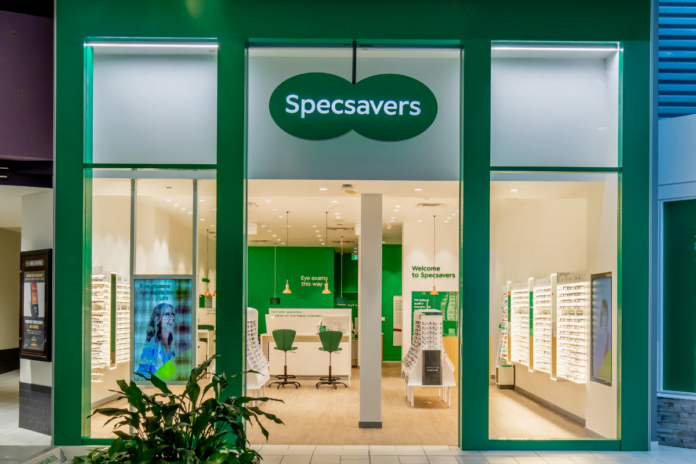
Specsavers Store Exterior Woodgrove Centre B.C. (Image: Specsavers Canada)
Specsavers, the world’s largest optometrist owned and led business, is investing $100 million to open 200 locations across Canada by 2024.
Bill Moir
The company said the funds will cover 100 per cent of start-up costs for independent Canadian optometrists and opticians to launch community-based clinics and stores while creating 2,000 jobs across the country.
“We are placing a significant investment behind our offer of an alternative model that enables Canadian optometrists to put patients’ needs first while owning a thriving business and gaining access to cutting-edge technology,” said Bill Moir, General Manager, Specsavers Canada.
“By way of example, when Specsavers entered the Australian market, the advanced technology used by our professional partners doubled the national rate of detection of glaucoma, and increased diagnosis of other health conditions.”
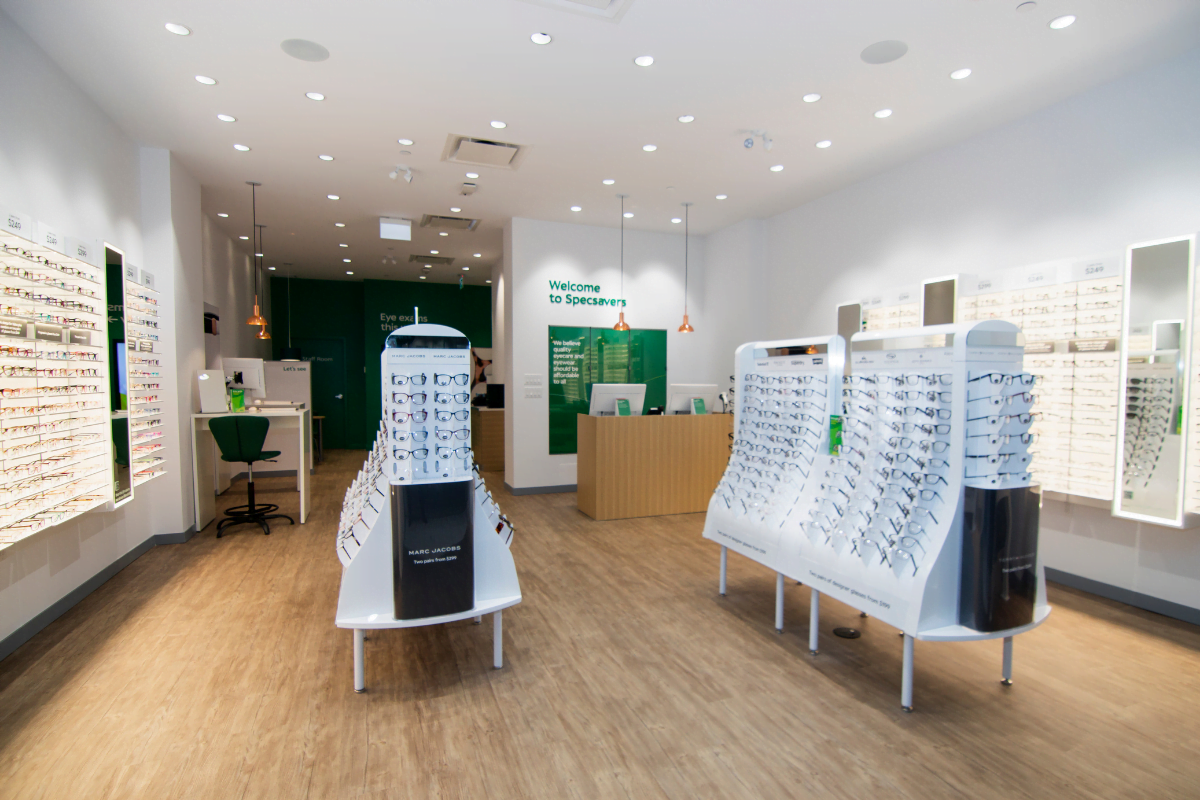
Specsavers Store, Coquitlam Centre, B.C. (Image: Specsavers Canada)
Founded in the U.K. nearly 40 years ago by optometrist husband and wife team Doug and Mary Perkins, there are now more than 2,300 Specsavers locations across 11 countries caring for 41 million patients and customers.
Specsavers currently has four stores in Canada – Kelowna, Nanaimo, Coquitlam and Chilliwack. The first two stores opened in Nanaimo and Coquitlam in November.
The company bought BC-based Image Optometry in March 2021 and will start to transition more of them to the Specsavers brand. Moir said 12 more will be opening by April.
“The aim is to become the market leader in the country by the end of 2024 and in order to do that we will need to have a strong base of 200 stores and we’ll need to be in all the major provinces,” said Moir.
He said Specsavers’ intent is to reverse the current trend of consolidation in the Canadian market where a small number of large players – owned by financial institutions, frame manufacturers, or large corporate parents – now own many of the once independently owned optical businesses and clinics in Canada. Through this new investment initiative, Canadian optometrists and opticians will have an accessible opportunity to own a Specsavers clinic and optical store with the cost of establishing each business, which averages $500,000, covered by Specsavers.
Trevor Thomas and David Bishop of JLL are working with Specsavers on the store rollout including negotiating store leases.
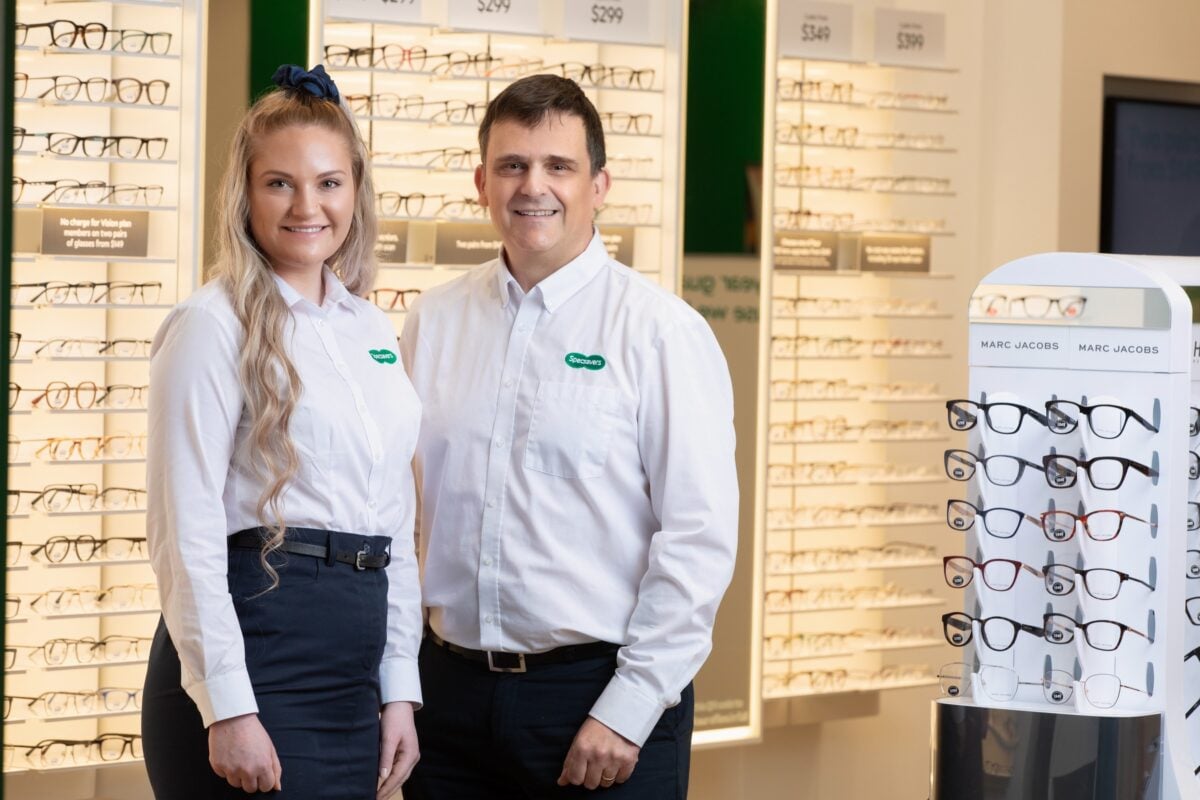
Dr. Scholfield on December 11, 2021 as he opens the doors to his independently owned clinic and Specsavers store with retail partner, Seija Gilks in Nanaimo, B.C. – one of 200 clinics and stores set to open across Canada by 2024. (CNW Group/Specsavers Canada)
Specsavers Store, Woodgrove Centre, B.C. (Image: Specsavers Canada)
“We’re ensuring that Canadian optometrists and opticians will be able to advance their careers through the best clinical equipment through professional development opportunities and also put in place a really comprehensive administrative and marketing and financial support for them to own their own business,” said Moir.
George Minakakis has spent over 20 years leading global brands in the Optical Industry.
George Minakakis
“Specsavers entry into Canada has been anticipated for years. Their brand has been wildly successful in many markets. They have also been able to take significant market share rather quickly. Australia being one of those markets. Their business and consumer model, marketing and pricing strategies are an attractive value proposition to consumers. And favourable to single location operators that may want to join the Specsavers team,” said George Minakakis, principal of Inception Retail Group Inc., advising Businesses and Private Equity in the Retail, Restaurant, and Healthcare sectors.
“If their Australian and UK markets are any indication of volumes you can expect these locations to potentially generate $350-$500 million in revenue. That’s a lot of sales that will be stripped away from existing operators large and small. Most optical chains have moved consumers to the upper tier of eyewear spending and consumers have felt that they are overpaying. Specsavers will change that paradigm for many. Their focus on eyecare is just as good as any independent optometrist and retail chain.
“Capturing market share in Canada will not be a walk in the park. Most major chains will respond. Their strategies will need to be as attractive and more than a simple offer and brand message to offset the powerful marketing Specsavers will unleash. In the final analysis we will quickly see who is prepared to compete with them. My advice to optical retail chains: raise the bar on your talent and bring experienced people to the table. I also expect a few retail chains to come up for sale because of this new entry in the Canadian marketplace.”
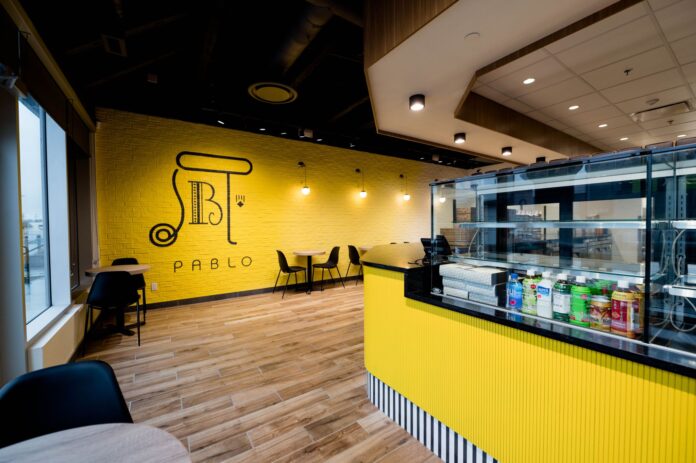
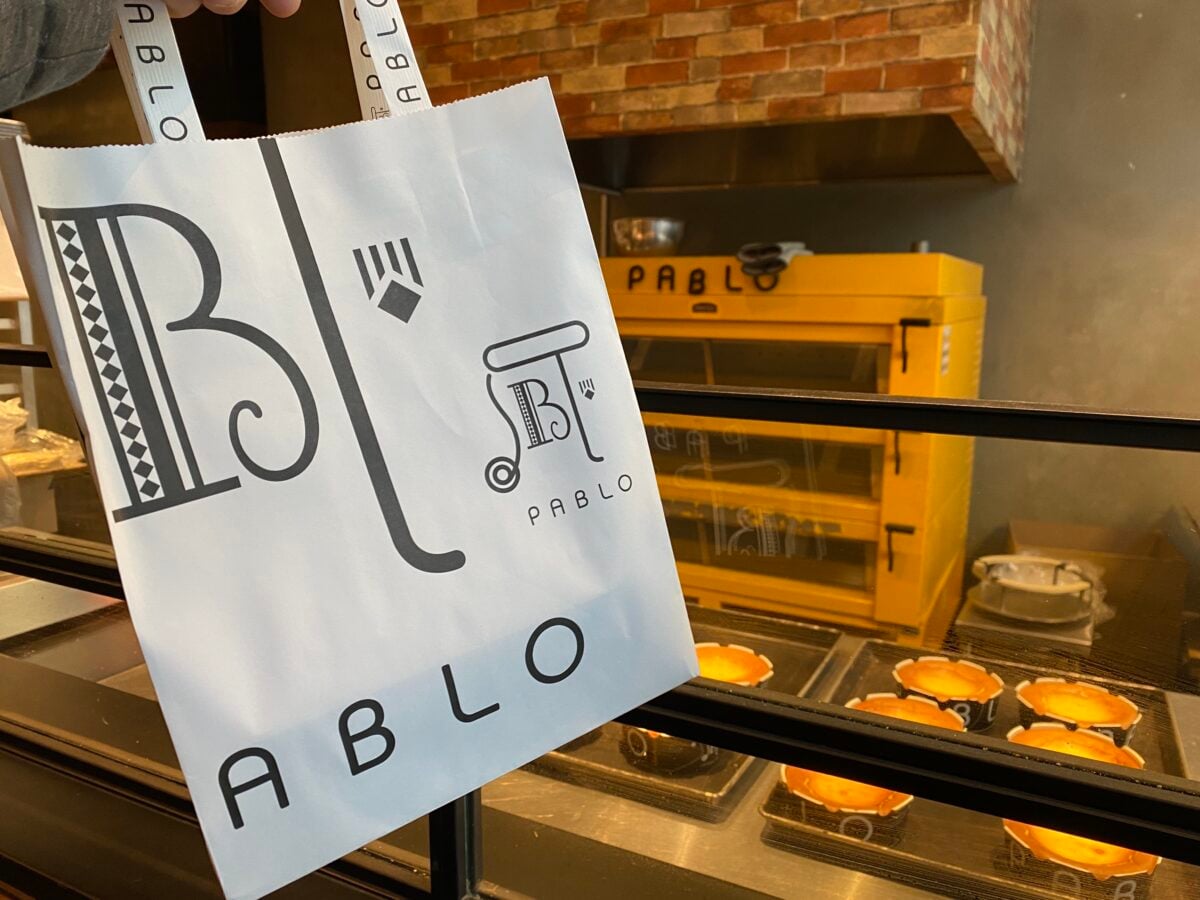
Pablo Cheese Tarts (Edmonton)
Construction: GH Construction
Photo: BB Collective
The unique Pablo Cheese Tart concept, featuring Japanese pastries, desserts and baked goods, continues to expand its footprint across Canada.
Hugo Lin, the company’s President, said Pablo Cheese Tart is planning to have a variety of options for the consumer.
“Mainly we make pastries. We originated in Japan in Osaka. The CEO actually started the company around 2010. What we sell basically is cheese tarts and anything related to cheese,” said Lin.
“The name actually comes from Pablo Picasso. The thing is that food can be a type of art as well. It’s not just about the taste but also the presentation. That’s why he uses the name.”
Image: Pablo Cheese Tart
Image: Pablo Cheese Tart
The company began in Canada in 2017 with a location on Dundas Street in downtown Toronto, which was recently announced to be closing as of January 22nd. Currently, the pastry shop has four locations in Toronto, Calgary, Edmonton and Hamilton.
The company is planning to open a new location in Markham in March followed by one in the Newmarket/Aurora area in July. It is currently confirming the location for that site. Pablo has a location secured in Vancouver with an opening in July this year. There is also a site in Saskatoon that will open by the end of this year.
Lin said the company is planning to expand its offering of products with more Japanese pastries, desserts and baked goods.
“In terms of future expansion, a US store was supposed to be opening last year before the pandemic started but after the pandemic everything had to be paused because of logistics and everything,” said Lin.
Pablo Cheese Tart on Dundas Street in Toronto (Image: Dustin Fuhs)
“But once the pandemic is over we want to resume the opening for the US side as soon as possible. In Canada, we are hoping to place a couple of more stores in Winnipeg and Montreal. We import some of our ingredients directly from Japan so after the pandemic started we’ve had a lot of logistics issues. So we want to make sure that all stores that we open would basically have no issues regarding the inventory or the ingredients. It will take time for us to make sure that we won’t have any problems.”
Lin said the concept resonates with consumers because it is different from the desserts or pastries that we traditionally have in Canada and North America.
“Our main goal, or focus, is to basically have a lighter texture of the dessert so you can actually eat more instead of feeling guilty and very full after eating the dessert. That’s why we tend to go with a lighter texture but still enjoy the dessert.”
An increasing number of retailers are using the visual discovery platform Pinterest to reach customers.
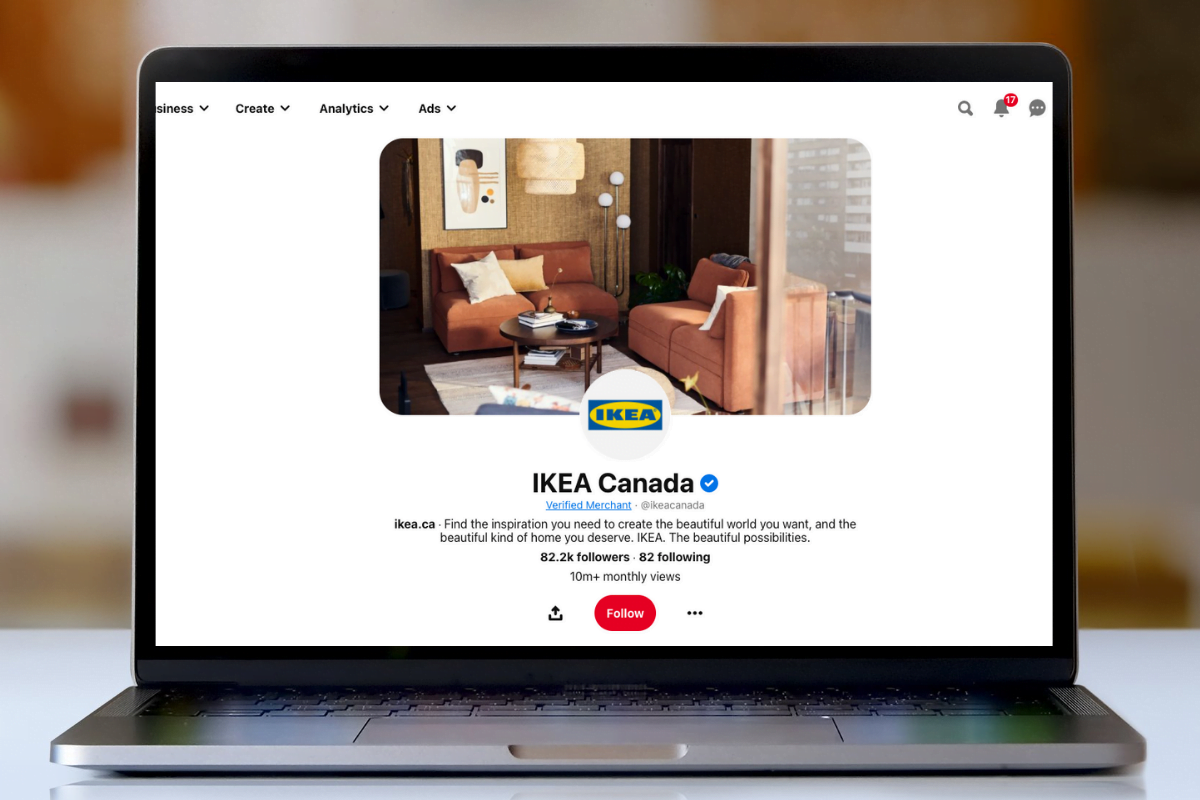
Brands such as IKEA and Indigo are tapping into the power of the platform’s reach with nearly 11 million monthly active users in Canada and 400 million globally.
Martin Svensson
“Pinterest is a visual inspiration platform,” said Martin Svensson, who is the head of retail partnerships at Pinterest. “With Pinterest you can discover useful and relevant things that inspire you to do things in real life.
“Things like where do I want to go on my next holiday? What should I cook for dinner tonight? All the way through to how do I plan for that kitchen remodel? All those things, all of those ideas, you can find on Pinterest. It’s really all about discovering things.”
Pinterest launched in 2010 and went public in 2019. The Canadian office opened in 2018 with the sales team and it has been growing ever since. In 2021, it had over 50 roles open across marketing, communications, engineering and sales and it is continuing to expand in 2022.
IKEA Canada on Pinterest.ca
Svensson said Pinterest is different from social platforms.
“It’s more of a visual discovery platform and we play very much in that search space where you come, you search and you can find content as well,” he said.
Svensson said Indigo is an interesting example of the type of work the retailer has done with Pinterest.
“In many ways they share our overall mission as well. Our mission is to inspire people to live a life they love where it’s Indigo’s mission to inspire reading and simplify their customer’s journey to a life with intention. So there’s a lot of synergies between our brands from that perspective,” said Svensson.
Indigo on Pinterest.ca
“And Indigo’s challenge was really to get away from the perception that they’re just a book destination or a gifting destination. That’s the way many consumers see them. So what they decided to do is really partner with us and focus on some of these key moments around the year where people spend a lot of time preparing or researching and planning.
“In their case, they wanted to really highlight the quality assortment of their home, wellness and kids products. We did an analysis together with them to understand if their consumers were actually users of Pinterest and there was a near match there. It was the most perfect match I’d ever seen.
“What we did with Indigo was really to highlight the trends and insights that they could lean into and really make sure that they harness the platform in the best possible way.”
For Indigo, that meant the retailer focused on moments in life such as Mother’s Day or back to school. Organically they upload Pins or content ahead of a moment to inspire Pinners with ideas which in turn encourages them to shop online or visit a store.
Indigo has also used Pinterest’s ‘Collections’ ad format that allows retailers to feature more than one product on the site.
Indigo on Pinterest.ca
“Our shopping format essentially means that for a retailer they can take their entire repository, or catalogue, or shopping feed, which will likely be the same feed that powers in-store availability across all of their SKUs and then upload that to Pinterest,” explained Svensson.
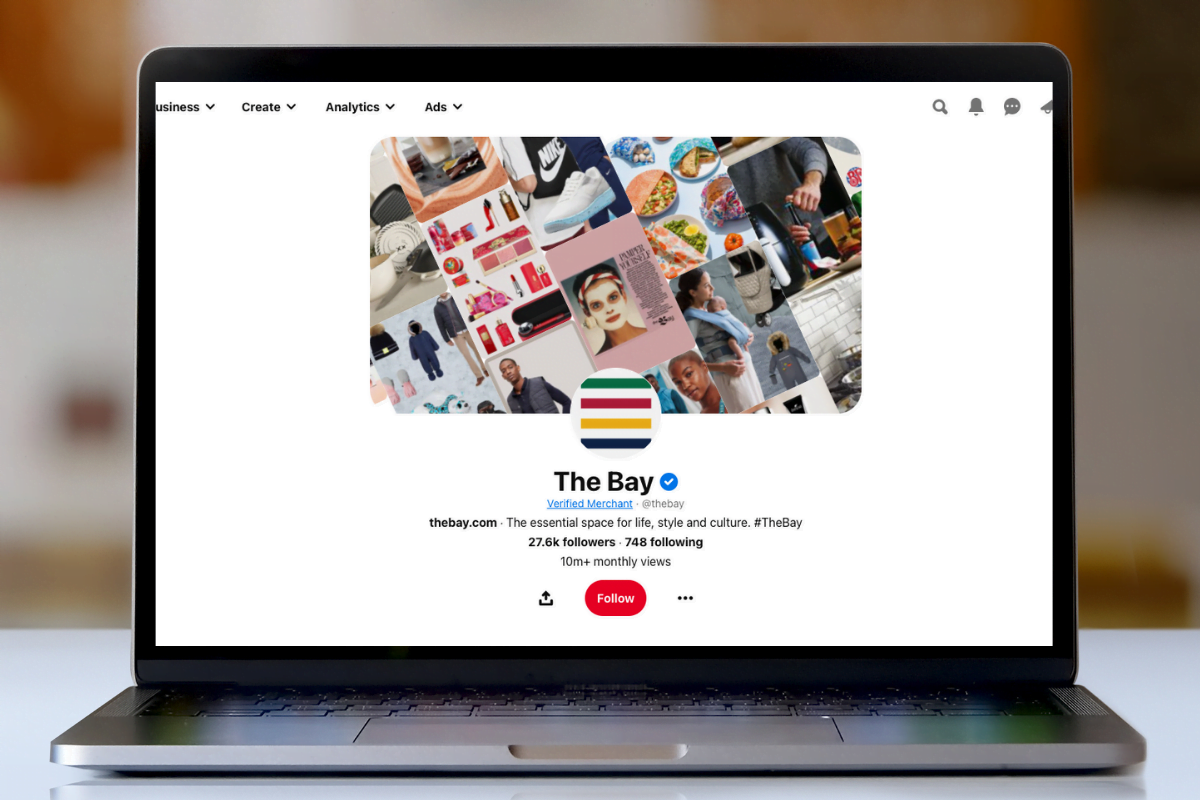
He said Pinterest’s retail team focuses on the top 27-28 omnichannel retailers in Canada and the vast majority of them use Pinterest on a regular basis such as Canadian Tire, Michaels, Lowe’s, RONA, The Bay, IKEA.
People use Pinterest throughout the shopping process to find new possibilities, refine their purchase criteria and most importantly, make decisions. Pinners are planners and are coming to the platform with intent. They are in a purchasing mindset so Pinners are open to businesses reaching them with ideas and ads. On Pinterest, businesses can reach Pinners early in their decision making process while they are actively considering what to buy and do next, but they are still trying to determine which products and services they want to try. In fact, 97 per cent of the top searches on Pinterest are unbranded—leaving a lot of room for brands to enter the conversation. This open-minded behaviour makes Pinterest especially effective for customer acquisition goals, added the platform.
Svensson said the Canadian sales team was launched at the end of 2018.
The Bay on Pinterest.ca
“The consumers were there. Not all retailers were yet there. But some of the more experimental ones, some of the ones that understood the power of Pinterest, they were already on the platform,” he said.
“And you had a lot of retailers who really understand the impact of the visual nature of Pinterest – the need to find a way to facilitate discovery and inspiration online. The Canadian buyers were there along with a number of clothing brands as well. We had lululemon. They were big proponents of Pinterest in those days and they still are all the way through to our friends in e-commerce like an Article which was one of the first furniture-related clients to really develop a presence on the platform as well.”
Svensson said Pinterest provides retailers with an opportunity to connect with consumers before they’ve made up their mind and picked the product and the category or the brand they want to pick.
“So if you’re in the business of doing customer acquisition, it really affords a wonderful opportunity for retailers to connect with prospective customers,” he said, adding that being able to connect with people at the right points in time allows a retailer to be part of their consideration list much sooner.
He said it’s very easy for retailers to get started on Pinterest. Creating a profile takes little time. The inclusion of shopping products is as simple as a retailer uploading its feed and Pinterest auto-creates Pins, or pieces of content, allowing the retailer to connect with consumers almost instantly.
Retail Insider is streamlining its Canadian retail news from around the web to include a handful of top news stories that can be viewed quickly during the day. Here are the top stories from the past 24 hours.
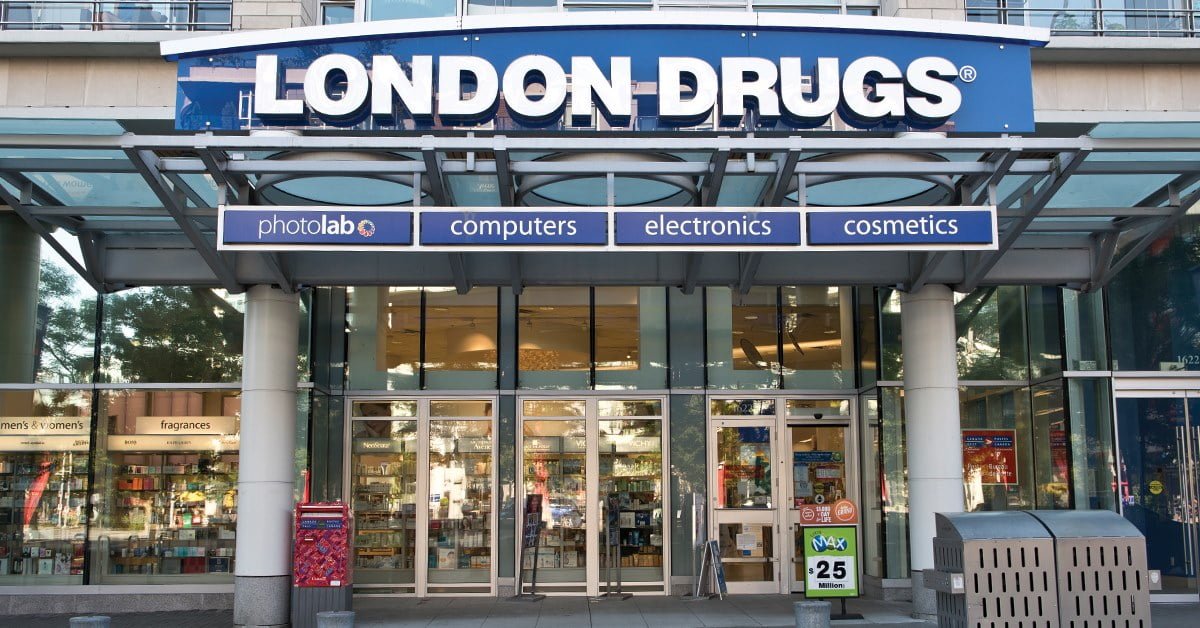
When it comes to homegrown Canadian retail success stories, you’re not going to find too many as endearing or inspiring as that of London Drugs. From its humble beginnings, opening a single store on Vancouver’s Main Street in 1945, to the brand’s status today as western Canada’s preeminent destination for pharmacy needs, electronics, appliances and more, the organization has witnessed just about every challenge and opportunity that the retail environment and evolving market conditions could present. Currently serving more than 35 major markets and an estimated 45 million customers a year throughout British Columbia, Alberta, Saskatchewan, and Manitoba, the brand and its offering contributes significantly to the health and wellbeing of the communities in which it operates. And, more than three quarters of a century after its founding, London Drugs continues to grow. It’s an incredible achievement for the iconic Canadian retailer, one that Clint Mahlman, the company’s President and Chief Operating Officer, says is rooted in its differentiated approach to retail.
“Part of what makes London Drugs so special is the fact that the company has spanned a number of different eras and customer needs,” he says. “And there are a few qualities about the brand that has allowed it to stand the test of time. We’ve always been unique in our offering. And, we’ve always developed strategies that are unique to our competition, focusing on our customers in everything that we’ve done. If you look back historically at London Drugs, whether it be the originator of the brand, Sam Bass, or his successors like Mark Nussbaum and Wynne Powell, the company has enjoyed the guidance of incredible leaders and true merchants who were not afraid to try things that were completely unique, different or off-the-wall. As a result, today we’re known as a uniquely eclectic, unconventional retailer that’s a little bit quirky. This approach has also let others throughout the organization understand that trying new things and failing often is a really positive sign that they’re pushing themselves. Supporting this philosophy has always been a culture of support, promoting innovation, creativity and continuous learning. And, perhaps most significant to the success that the brand has enjoyed over the years is the trust and integrity that it’s managed to build in its customers and employees, doing right by their needs and the experiences they seek.”
Serving to lead
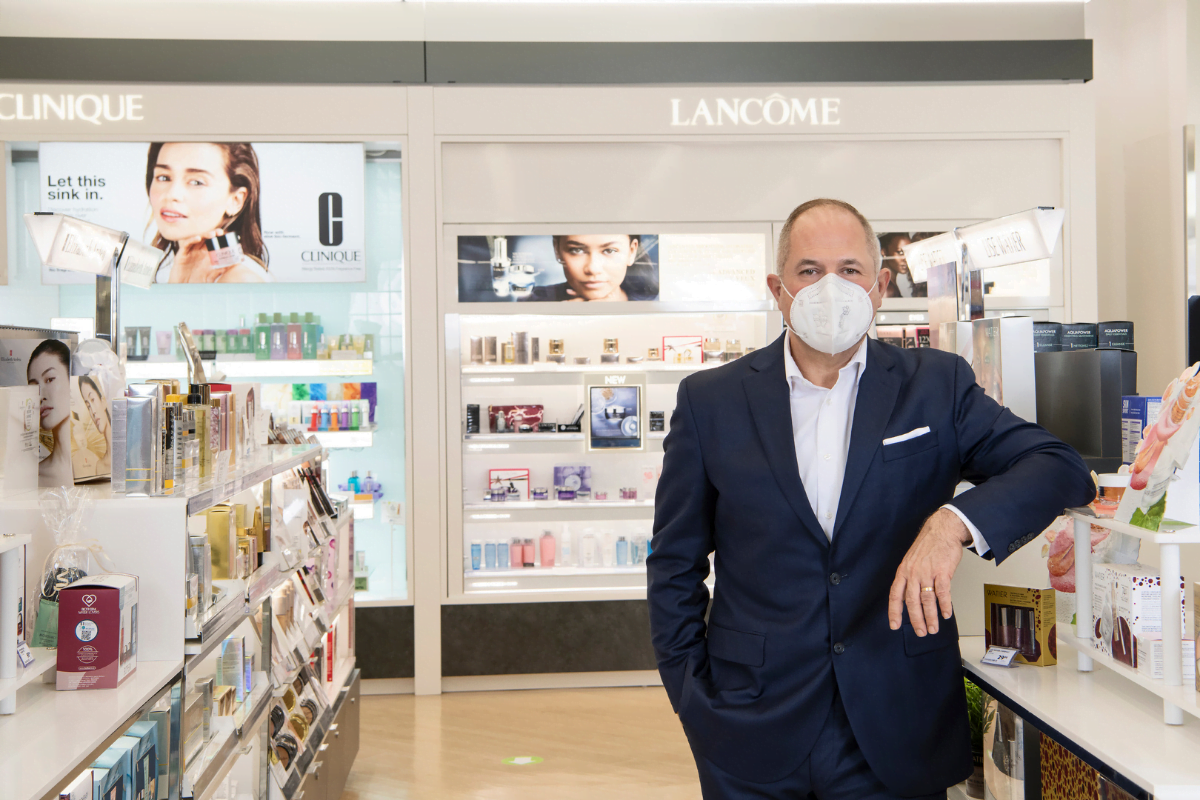
Clint Mahlman (Image: London Drugs)
Mahlman, who’s held leadership positions at London Drugs for an astounding 37 years, has been present for more than half of the company’s history, witnessing much of its growth and evolution. As a result, he possesses a deep and unmatched understanding of the brand’s values and approach to business and customer service. He appreciates the legacy that London Drugs has built over the years and is acutely aware of the role it continues to play. The profound recognition of the factors that have contributed most significantly to the company’s success and continued growth allows Mahlman to carry on its mission to remain differentiated and unique, leading with a style that seems very much influenced by his understanding of the brand and its customers.
“Leadership is about bringing out the very best in the people around you in order to help the organization do its very best work and live up to its potential,” he asserts. “I describe myself as more of a servant leader in the sense that I understand the needs of our owners, customers and staff and the importance of finding ways to help them fulfill those needs. During difficult times, much like those that we’ve experienced over the course of the past 20 months or so, leadership is also very much about stepping forward and being very bold and clear concerning the path and navigation through these challenges. When we were given the privilege in the early days of the pandemic to be designated as an essential retailer, we had to figure out a way to leverage the opportunity responsibly for the communities we serve and for our staff. There was so much fear and uncertainty, and people needed clarity and things to rally behind. This thinking was very much the catalyst behind our support of the community, small local businesses, and the creation of special hours for first responders and healthcare staff. Once this direction from a leadership perspective was set, our staff was really able to rally behind these initiatives, taking over with so many wonderful ways of helping the community and driving the organization forward.”
All perspectives count
With such an enduring tenure at London Drugs, it seems natural that Mahlman’s approach to business would be underpinned by a real sense of compassion and care. However, he cites his upbringing in Gibsons Landing on British Columbia’s Sunshine Coast and experiences working in forestry camps, commercial fishing boats, pulp mills and logging operations as extremely influential and educational with respect to connecting with people. They are experiences and lessons, Mahlman says, that made an indelible impression on him, providing him with knowledge that will stay with him forever.
“During my time working in some of my earlier jobs as a kid, I quickly learned that some of the brightest, most articulate, trustworthy and intelligent people that I’d ever meet were working in those jobs. Many of whom had never received a formal education. And many of them did not have an easy time growing up. Those experiences and connections taught me at a very young age, as did my parents, the importance of looking at the person and to never confuse intelligence and smarts with education, the colour or creed of the person, or the letters following someone’s name. To this day, I recognize the importance of listening to the people doing the work on our behalf on the front line. All perspectives count at the end of the day and this remains very important to the continued growth of the company.”
A culture of care
Image: London Drugs
Mahlman goes on to explain that there have obviously been an inordinate number of influences and inspirations that he could share concerning the experiences he’s enjoyed at London Drugs. He describes the people at the company as “special”, suggesting that exceptional qualities and characteristics have been present within the organization throughout its storied history, saying that it’s difficult to single out any one person or experience as singularly integral to his development as a person and professional. However, he recalls one meeting in particular that helped him realize almost immediately that he was working with the right company.
“I have had so many wonderful mentors and influences throughout my career at London Drugs,” he says. “But, one interview that I had with the legendary Tong Louie has really stood out for me. I was being interviewed for the human resources job with the company. It was my second interview with Mr. Louie. After the conversation, he looked me up and down with his famously unlit pipe to his mouth for what seemed like an eternity. And then he looked me in the eye and asked, ‘will you take care of my people?’. In that moment, I knew how important it was for Mr. Louie, as it’s also been for Brandt and his sons Greg and Stuart, to treat their employees with dignity and respect. It’s been a cornerstone to the way London Drugs has been run as an enterprise and incredibly influential for me concerning the way I lead and approach the business.”
Pandemic pivots
It’s a leadership style and approach that continues to serve Mahlman extremely well, helping to position the company for further growth and success. And, it’s also proven to be instrumental in helping to guide London Drugs through the challenges and adversity that were brought about by impacts of the COVID-19 global pandemic, allowing the brand to remain agile and to adapt to a changing retail environment. Mahlman points to the many pivots and shifts that were made by the company during the past 20 months or so as evidence of that agility and ability to adapt, adding, however, that its London Drugs’ unyielding penchant to innovate and experiment that had already shored up the brand’s offering in a way that secured its strength and resolve during these times of uncertainty and disruption.
“The situation around the pandemic drove trial by a large number of customers who may not have shopped with us in the past or may not have shopped with us online, testing our ability to be nimble and responsive to all of the significant challenges that were presented to the entire industry,” he says. “It forced us to find different suppliers and reassess how we actually retail in order to safely interact with customers and get them the product they need. In addition, something that’s really distinguished London Drugs from many of our competitors is our technology business. In the last few years, we’ve been focusing on the repairs and services side of our business. After the initial panic-buying phase of the pandemic had receded, our technology repair business went through the roof as people needed to stay connected. In fact, for a period of time, Apple told us that we were by volume the largest authorized Apple repair depot in North America. We were also very fortunate to develop our ecommerce business very early on and also introduced one of the first buy-online-pickup-in-store models of any chain in Canada, long before the pandemic. At the time of its introduction, our customers didn’t really see the value in it. But, as soon as restrictions and lockdowns were instituted across the country, it was obviously a service that became essential to meeting their needs. And we were ready with the experience and systems necessary to meet those needs instantly.”
Digitization of pharmacy
Image: London Drugs
In addition, Mahlman explains that because the company had also amassed invaluable experience using their store locations as fulfillment hubs, it was able to quickly and effectively meet the surge in demand of online orders that occurred at the onset of the pandemic and throughout. He also credits the attitude of the London Drugs store staff for much of the brand’s successes, praising their commitment to serving the company’s community of customers and continuing to innovate in order to find greater efficiencies and service enhancements. Mahlman says that the collective sentiment within the company to achieve continual improvements is critical in maintaining its forward momentum and addressing the challenges of an ever-changing retail environment.
“The massive digitization of retail and the world around us, the increased use of artificial intelligence and robotics and continued rise of ecommerce are big forces that are shaping retail and the future of London Drugs at the moment,” he explains. “And, with respect to ecommerce, an underestimated challenge faced by Canadian retailers is the amount of international ecommerce players selling to Canadians, without the same cost and infrastructure that companies in Canada need to operate within. Convincing government of the importance of creating a level playing field is very difficult. They don’t seem to understand how challenging it is for Canadian retailers, who often feel as though they’re playing the retail game with one arm tied behind their back. In addition, the digitization of healthcare and expanding scope of practice for pharmacists presents exciting potential for customer access to healthcare and is very influential to our strategy going forward. However, this side of the business needs to be developed with a clear understanding of privacy-related issues. In order to address these significant influences, we’ve recently developed two initiatives named Galileo and DaVinci with several linking projects that are responses to these forces and meant to ensure our competitiveness for another 75 years.”
Systems investment
Galileo and DaVinci represent the largest capital and systems investments in the company’s history, empowering it with a platform from which the brand can maintain the breakneck speed of retail digitization. It helps to position the company well to evolve with future advancements and innovations impacting the success and growth of players across the industry. However, as Mahlman points out, the most significant benefit that the investment will reap is the fact that it will allow London Drugs to further enhance the excellent experience that it already provides for its customers, leveraging state-of-the-art tools as we head into a new digital age of pharmacy and healthcare retail.
“There’s an intersection of three forces that will impact all business, particularly those that deal with personal health data, going forward,” he asserts. “There’s been a massive change in computational power through very sophisticated neural-based quantum computing which are generating an inordinate amount of data collected from a multitude of sources, fuelling massive artificial intelligence engines that can inform based on customer shopping data, or data related to personal health, presenting immense potential around their use. However, it’s all for nought if the new privacy laws that we’ve seen instituted across Europe, laws that will be introduced soon in Canada, are not fully thought through when implementing these systems. In order for companies to fulfill this wonderful potential for customers, they’ll need to ensure that customer data is robustly protected and secured so customers have confidence in the retail and healthcare industries. If executed properly, a more intuitive shopping experience and enhanced healthcare outcomes are possible to achieve, dramatically improving the customer experience.”
Further growth?
With respect to opportunities for London Drugs to achieve further growth, Mahlman’s approach is extremely pragmatic. He admits that the company has never felt that it’s needed a store location on every corner in the provinces it serves, adding that it doesn’t have any plans to announce any massive store buildouts. Instead, he says that it will continue to focus on developing unique services that fill a need and are local with respect to the need state of the customers in the surrounding area. He goes on to explain that the range of services that the company already provides allows it to add value to the retail shopping experience, engendering and strengthening trust among its customers.
“In highly regulated fields like pharmacy, convenience and trust are the things that customers look for,” he asserts. “You literally cannot, by law, differentiate yourself too much in your actual service offering. It’s similar within the insurance services business that we’re in, where it’s highly regulated and traditional retail offerings or incentives are not permitted. In those regulated businesses, establishing a degree of differentiation is difficult. But what permeates across all businesses is trust and reliability. So, those unique businesses that we operate provide us with an opportunity to support that differentiation. You might be able to get your prescription filled with a competitor. But there are very few that can repair your iPhone while you’re waiting, and help you connect your blood pressure and glucose monitor readings from pharmacy so that on your next doctor visit, he or she has all of the data that they need at their disposal. And, we also offer a wonderful post office experience. These types of services generate foot traffic to London Drugs, increases engagement with our valued customers and allows us to build relationships and trust with them.”
Continued progression
Clint Mahlman (Image: London Drugs)
Considering all of the innovations and unique service offering that the company has developed and introduced through the years, London Drugs serves as an excellent example of the positive outcomes that are often yielded from continuous experimentation and a willingness to listen to the customer. And, after more than 75 years of business, there doesn’t seem to be a chance that the company’s going to let up under Mahlman’s leadership. He says that it’s not in his or the brand’s character to do so, adding that it’s their collective commitment to forging ahead, consistently improving and maximizing the potential of the homegrown Canadian community pharmacy.
“Retail is such an interesting industry. Very few other industries have their customers in their workspace every day. A lot of other industries have long sales cycles and are involved in a product or service that marries them to their customers for long periods of time, regardless of their customer satisfaction rate. But retail is a theatre performance presenting tests every day. You’ve got to be on at all times or the customer will take their business elsewhere. That environment, though brutal, provides retailers with the type of immediate feedback that players in other industries crave and spend millions of dollars every year to obtain. It’s something that keeps us on the edge of performance every day. It’s what makes retail fun and exciting – that pursuit of excellence. And, at London Drugs, we’re all extremely fortunate to be able to rely on the support of our frontline people, as well as the significant and steadfast guidance of the Louie family ownership. We’ve always been very truly blessed to enjoy their support, allowing us to take a long-term approach to enhancing the business and the services that we provide for the London Drugs customer.”
After years of success following its inception in 1984, Montreal-based fashion brand Gorski has opened a new and its first flagship store in its hometown in the prestigious Westmount neighbourhood with plans to open more physical locations in the future.
The brand, established by Leonard Gorski and his wife Karin, designs, creates and distributes sustainable, natural fabrics focused on ethically-sourced luxury outerwear and accessories.
“Over the years we have built a significant business – most of it in the United States. We have presently over 30 shop-in-shops on the couture and designer floors of Nieman Marcus in the United States with a very substantial digital presence with Neiman Marcus also with Saks Fifth Avenue,” said Leonard Gorski.
Image: Gorski
The Nieman Marcus locations are on the same floor as such high profile brands as Chanel, Armani, Brunello Cucinelli.
“We are the only Canadian brand which has such a presence on the designer couture floor which is really reserved for what we call A-level brands – mostly European, a few American,” he said.
“Our headquarters have always been in Montreal even though my wife is American. My kids are American. We always felt as proud Canadians, proud Montrealers and we always made our styling design headquarters in Montreal even though 98 per cent of our business is outside of Canada.”
Gorski said the retailer has evolved from being simply an outerwear collection to today where it features a number of different collections which include apres-ski, cashmere and wool, shearling, fur, down-filled. The company began with a focus on the luxury fur fashion business which remains about 30 per cent of the overall business and a growing part of its business.
The retailer also carries cool weather accessories and home decor selections.
Image: Gorski
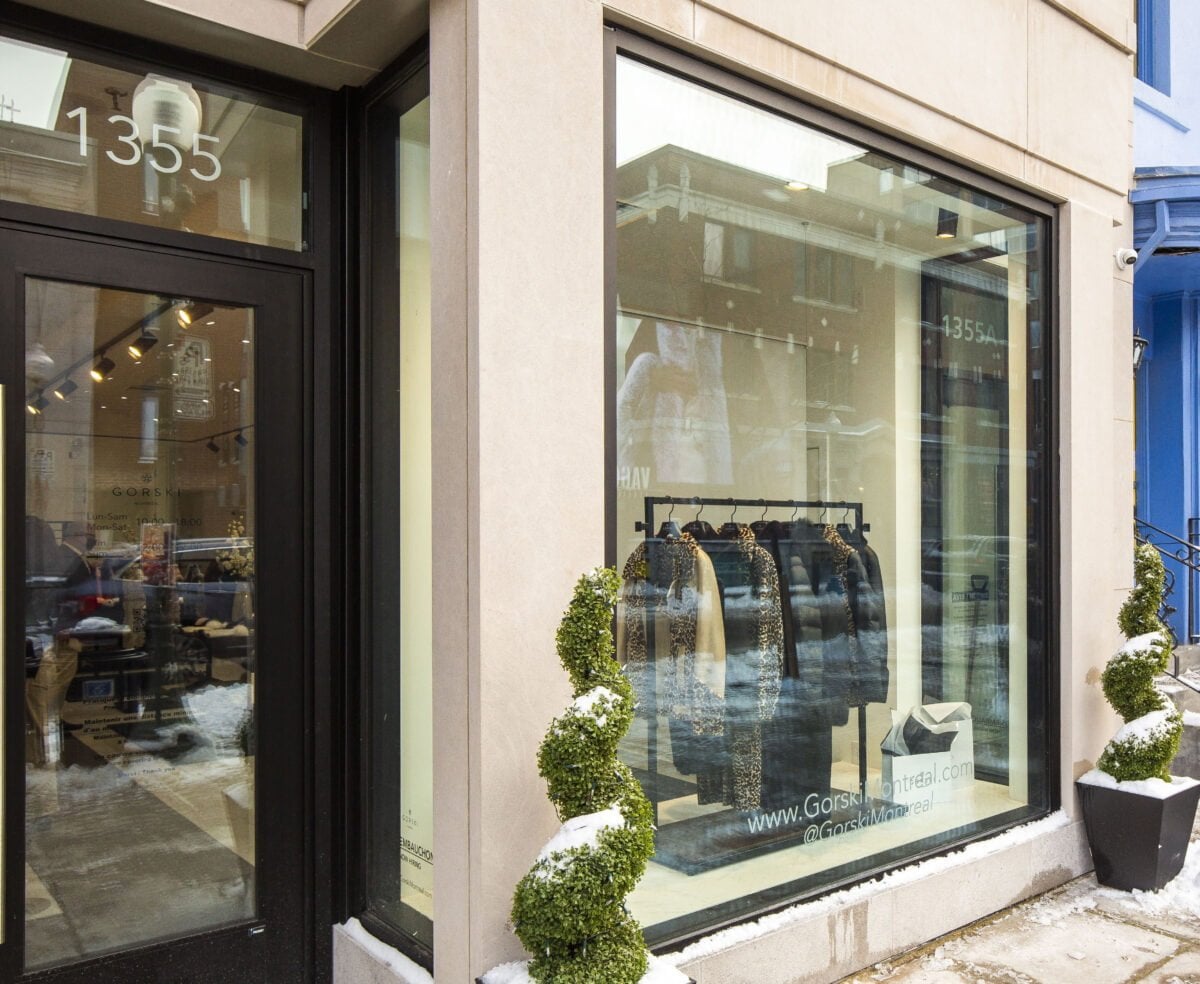
The first flagship store in Montreal was opened last fall on 1355 Greene Avenue.
“Retail is not dead. Actually retail is probably the most under focused. In other words, it’s an industry that probably is over-sold. So we decided to contribute to our community here. We decided to open our newer offices and headquarters on Greene Avenue, renovated an amazing building. After we started the revival, the revitalization, the street is coming back. We have an active merchants’ association which is being more active and more stores opening,” said Gorski.
“That’s our first store. With plans to expand to either purchase or merger and acquisition to Toronto, Vancouver in the next two to three years.”
The Montreal store and showroom is about 6,000 square feet.
Image: Gorski
“We see this as an evolution. We felt that we overlooked our own neighbourhood. We were extremely successful in the United States . . . So we always thought that somehow we wanted to look at our own neighbours . . . And we always thought that eventually we were going to open a flagship and when everybody thought that retail was dead forever we wanted to make a statement.”
With its presence in shop-in-shops the retailer is essentially in every important retail market in the United States. That concept is only with Nieman Marcus. But Gorski said the company also has a successful business relationship with Saks Fifth Avenue where it has produced for them certain collections.
Gorski is a strong supporter of the retail industry and optimistic of the future. Consumers like to have options today. The Gorski stores will be designed and built as part of the customer experience. They can shop in the stores or shop virtually.
“The old term was online or e-commerce. The future of retail is the physical stores with v-commerce. V for virtual commerce. In other words, consumers in two, four or five years are not going to go with the static side which has a SKU with five pictures. There will be much more enriched visibility for the store with a virtual experience. We would like to be among the first ones in the world to employ the elevated customer service in the store with an elevated virtual experience if they do not want to or can’t come to the store so they can shop us virtually,” said Gorski.
Gorski has been featured over the years in fashion magazines such as Vogue, Town & Country, Harper’s Bazaar, Vanity Fair and W, Neiman Marcus legendary Christmas Book.
Gorski collections are now available at the new flagship on Greene Avenue in Westmount, Montreal, or online at www.gorskimontreal.com – also the finest stores worldwide, including at Neiman Marcus stores across the United States, NeimanMarcus.com, BergdorfGoodman.com also a separate collection availed at Saks.com
Retail Insider is streamlining its Canadian retail news from around the web to include a handful of top news stories that can be viewed quickly during the day. Here are the top stories from the past 24 hours.
Alo Yoga Opening First International Location in Canada
This week Craig and Lee talk about Alo Yoga’s first international location outside of the United States. The flagship store will replace The Gap at Bloor and Bay Streets in Toronto.
The Weekly podcast by Retail Insider Canada is available on Apple Podcasts, Stitcher, TuneIn, Google Play, or through our dedicated RSS feed for Overcast and other podcast players. Also check out ourThe Interview Seriespodcast where Craig interviews guests from across the Canadian retail landscape as part of theThe Retail Insider Podcast Network.
Drop us a line at Craig@Retail-Insider.com. You can also rate us in Apple Podcasts or recommend us in Overcast to help more people discover the show!
Background Music Credit: Hard Boiled Kevin MacLeod (incompetech.com). Licensed under Creative Commons: By Attribution 3.0 License. http://creativecommons.org/licenses/by/3.0/
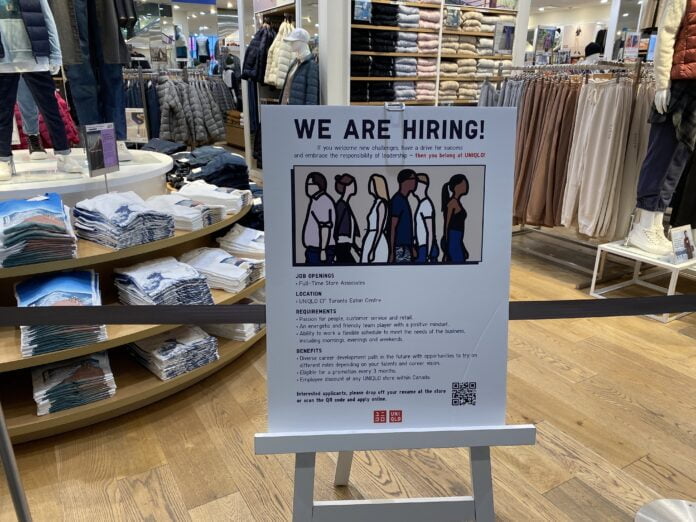
Uniqlo Hiring Sign at CF Toronto Eaton Centre - Photo by Dustin Fuhs
Staffing shortages will continue to persist, and likely worsen in the near future, straining retailers’ ability to generate revenue during the ongoing COVID-19 pandemic.
Suzanne Sears, President of Best Retail Careers International, said the retail industry was under-staffed going into the pandemic and unable to fill a significant amount of roles by 10 per cent.
Suzanne Sears
“COVID of course turned everything upside down. Currently, most retailers when they came out of wave number three were under-staffed between 20 and 25 per cent. It’s hard to say what the recent lockdowns have triggered but I anticipate the shortages or the vacancy rate will linger at 20 and maybe get as high as 30 per cent,” said Sears.
“There’s a direct measurable correlation between the amount of staff and sales revenue. Retailers have known this for hundreds of years. Each person on the floor is expected to generate X number of dollars. Reducing staff on the floor does not off-set it. It simply means you’ve lost some sales. Now I think retailers are feeling very confident that people will flip to e-commerce if that’s the case but the minute you flip to e-commerce you’re competing with everybody else. The leakage, the ability to jump to a different retailer, is pretty high.
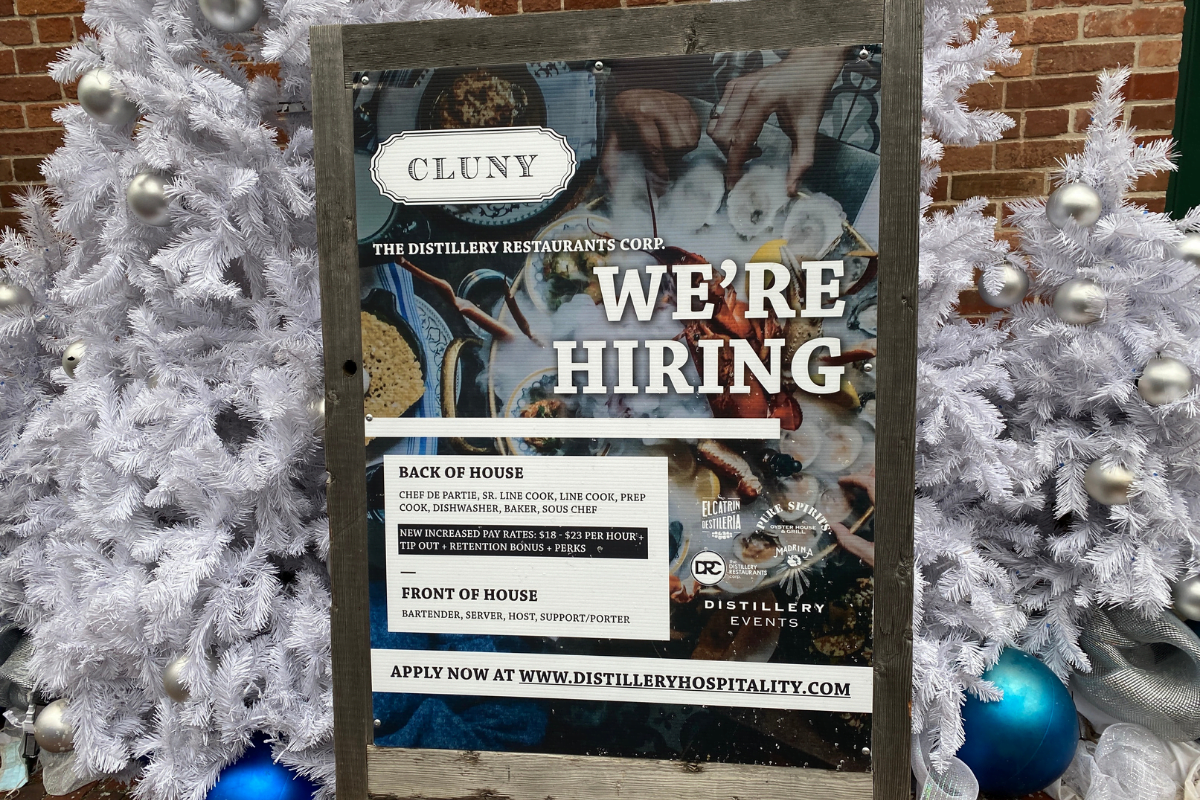
Cluny Hiring Sign in the Distillery District (Photo: Dustin Fuhs)
“So if you can capture a sale in a store that should always be your first choice . . . You’ve got to maintain a minimum store floor presence.”
She said many factors are driving that high vacancy rate in retail jobs.
The first, and most immediate one, is how the Omicron variant of the virus is affecting so many people because it is so infectious. It’s knocking retail staff out of commission and some of them are just sitting out the latest health crisis. They don’t want to risk getting the virus and they are waiting for the current situation to be resolved.
“If you’re working in front-line retail, you’re facing the public all the time. So there’s no end to your exposure and there’s no requirement that your co-workers be vaccinated. So it’s a high risk environment,” said Sears. “So this is why many are saying I think I’ll drop out for awhile.”
Another factor in the labour shortages is that people are re-thinking if retail is the right career for them on every level because it has a tremendous amount of volatility. Here today, gone tomorrow.
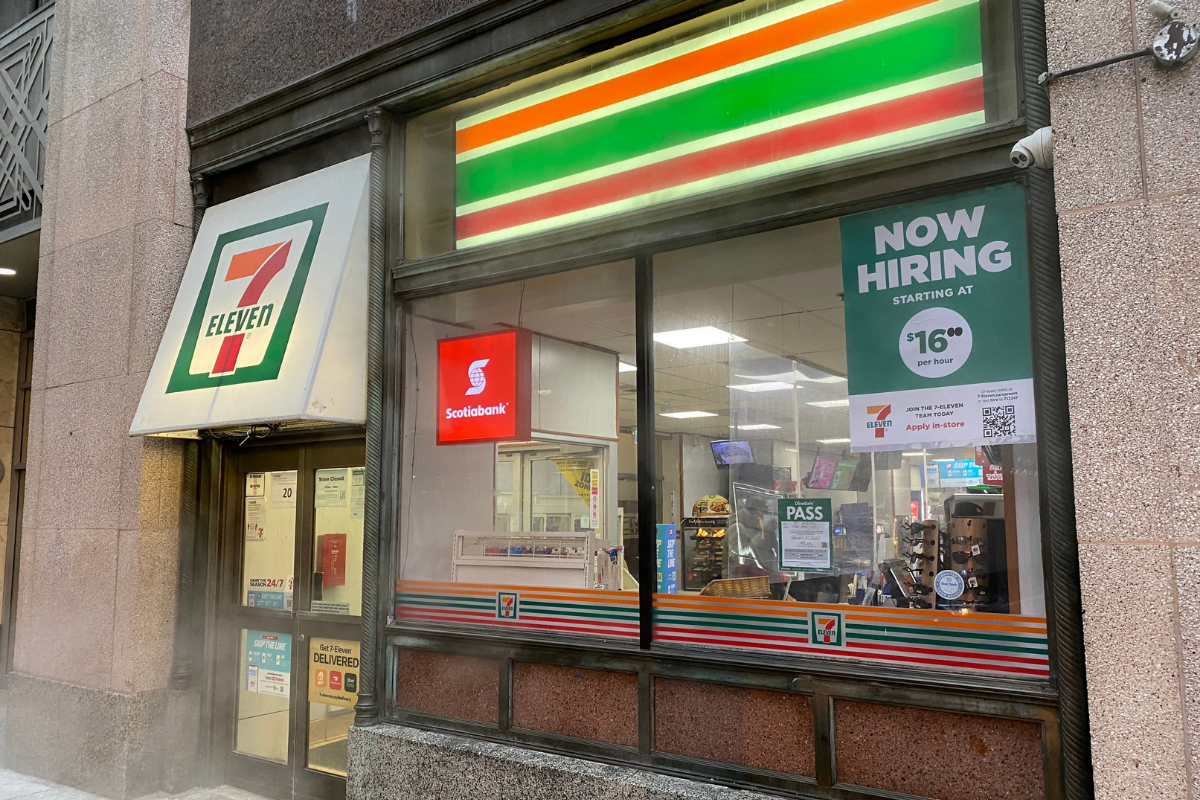
7-Eleven Hiring Sign on Bay Street (Photo: Dustin Fuhs)
“The employers can pretty much blame themselves for that one because a good number of them did not offer the support throughout the entire pandemic. If closures came, they simply laid people off. People didn’t hear again from them until they wanted them back. But people then wonder when they close again what happens to them?,” said Sears. “So a lot of people are re-evaluating whether retail is a viable career.”
She said wages in every other sector have increased dramatically and wages in retail are rising a bit but at a “creeping” rate.
“It becomes a risk-reward issue. Would I prefer to go and load boxes at Amazon for $20 an hour, work in the warehouse at Algoma Steel for $25 an hour or work in retail at $17 an hour – that’s pretty much what retailers have been tossing around lately. That’s sort of the average,” said Sears.
“The risk-reward component is iffy. There’s not enough benefits. There’s not enough sick pay. There’s not enough flex. Again, employers are going to have to take a solid look at these issues plus the hours aren’t usually guaranteed. If I’m hired for full-time, next week I might be working part-time and part-time in some cases has dropped down to four hours a week.”
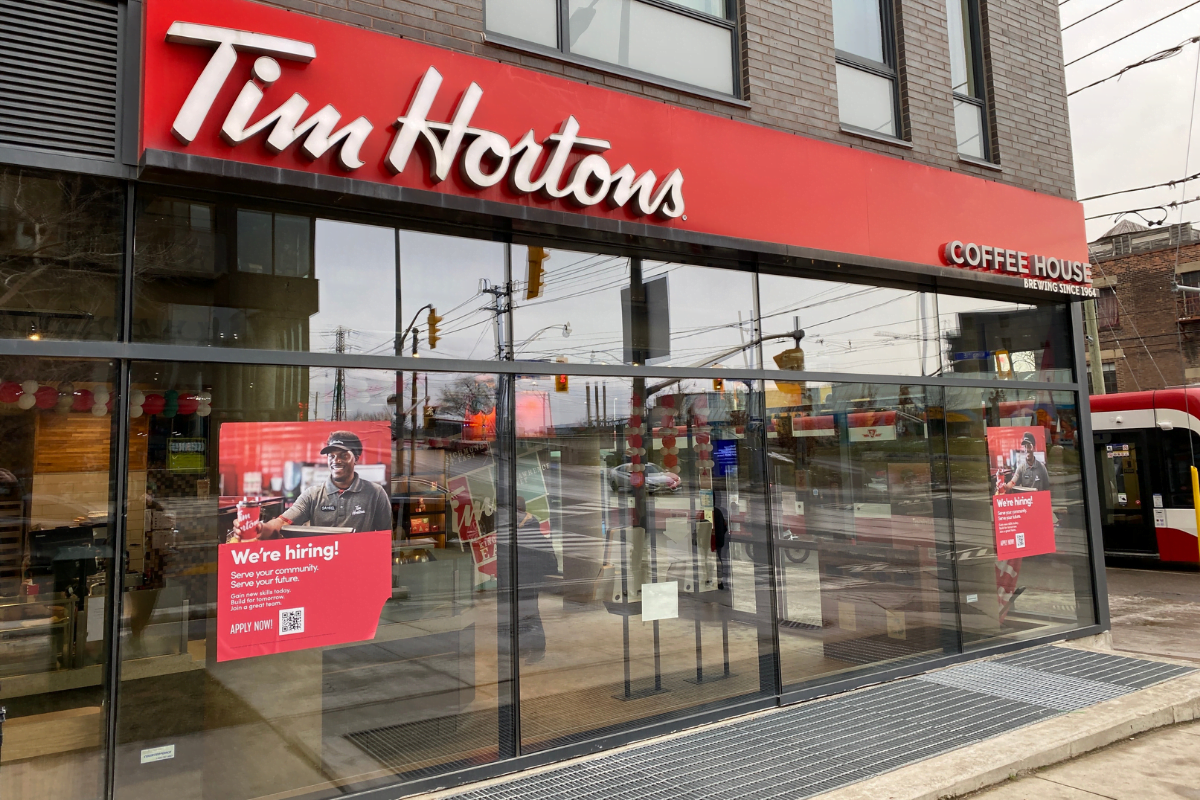
Tim Hortons Hiring Sign (Photo: Dustin Fuhs)
Another factor leading to labour shortages in the retail industry is retirements and people simply quitting their jobs.
“There’s a huge quit factor. In the United States, 20 million people quit their jobs in 2021. In Canada, we don’t know because we don’t really track it as much but if we cut the same percentages as being about 10 per cent of their population, it would mean approximately two million people quit their jobs,” said Sears. “So you ask yourself why would people do that during a pandemic? How bad are things that people would actually quit?
“But it is happening. The work/life balance has always been a problem in retail and retail has been slow to pick up the flexibility factor where people need far more time off or leaves of absences than ever before. And if they aren’t going to get them they simply quit.”
On top of everything, immigration to Canada has been really slow in the past two years.
“Because we don’t have population growth on our own, we look to a huge pool of immigrants coming into the country who often take retail jobs as their first jobs,” said Sears.
“I predict we could be looking at vacancy rates of 25 to 30 per cent midway in 2022.”
Canadian specialty pet retailer Ren’s Pets has announced a continuation of its rapid growth strategy into 2022, which will begin with five new Ontario stores.
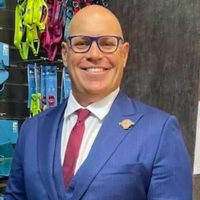
Scott Arsenault
The new locations include Orillia, Thunder Bay, Stouffville, Niagara Falls, and Newmarket, ranging from 5900 square feet to 8300 square feet. With these stores starting to open in April, it will bring the total store count for the Legault-owned pet retailer to 43.
“We’re so excited to keep growing the Ren’s Pets brand and adding new stores in amazing communities that are passionate about pets,” said Scott Arsenault, CEO at Ren’s Pets.
“We’ve had several years now of strong growth for our business, and we’re continuing that trend into 2022 with incredible new locations for our customers to visit.”
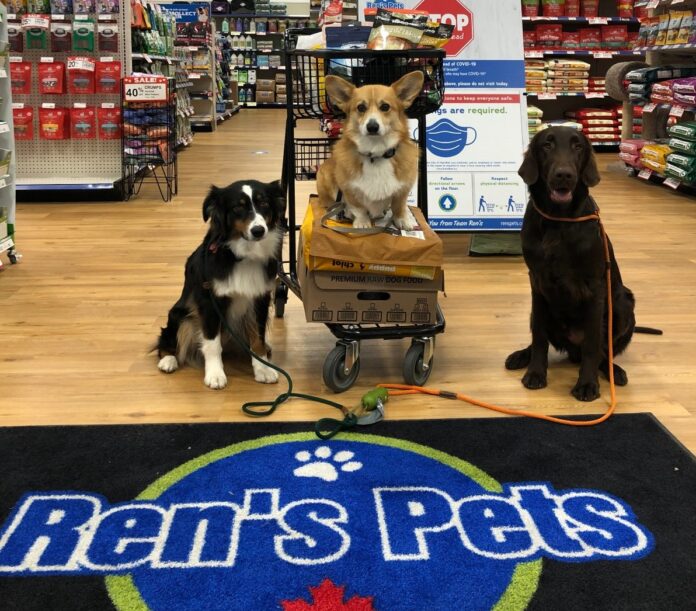
Ren’s Pets – Milton Grand Opening (Image: Ren’s Pets)
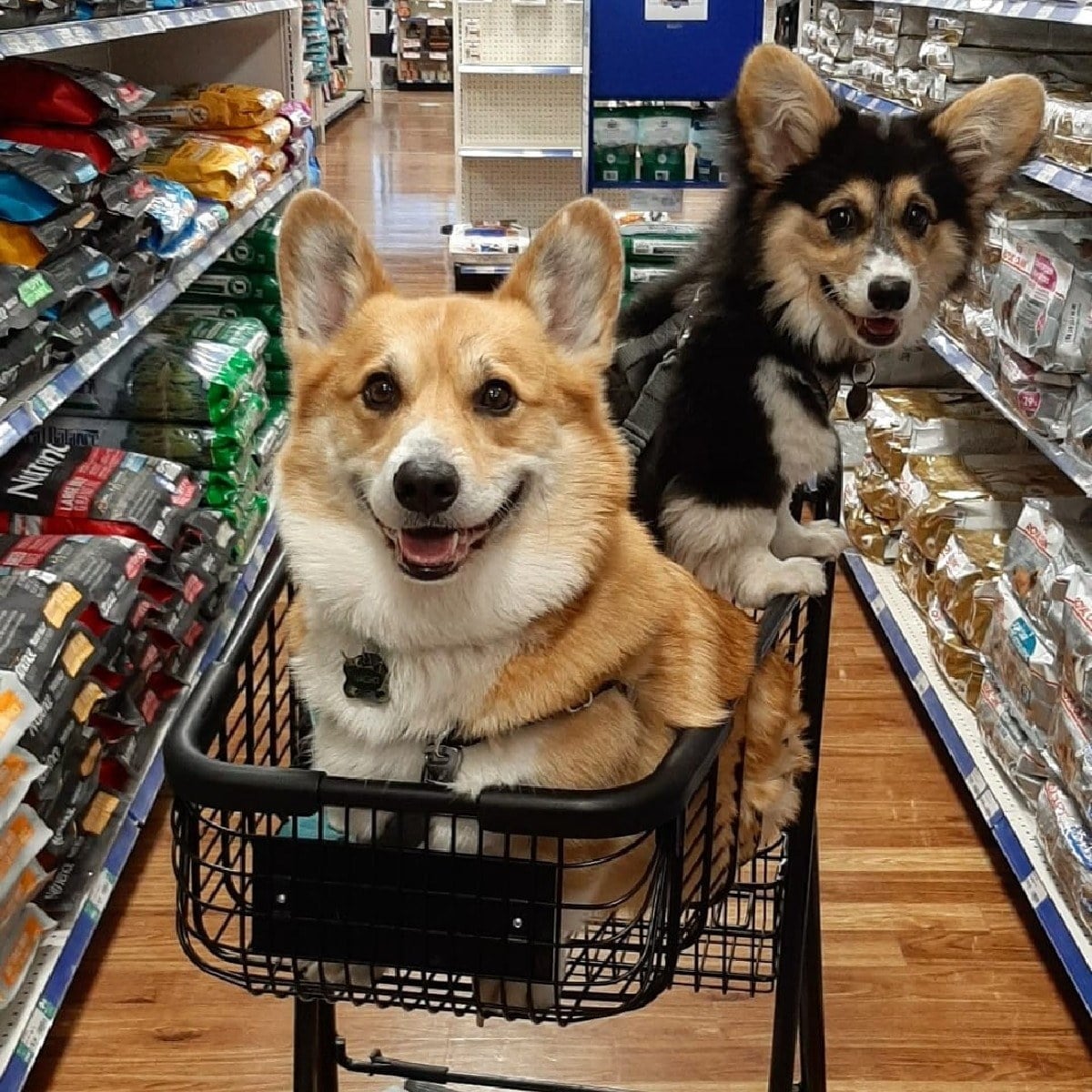
Image: Ren’s Pets
Image: Ren’s Pets
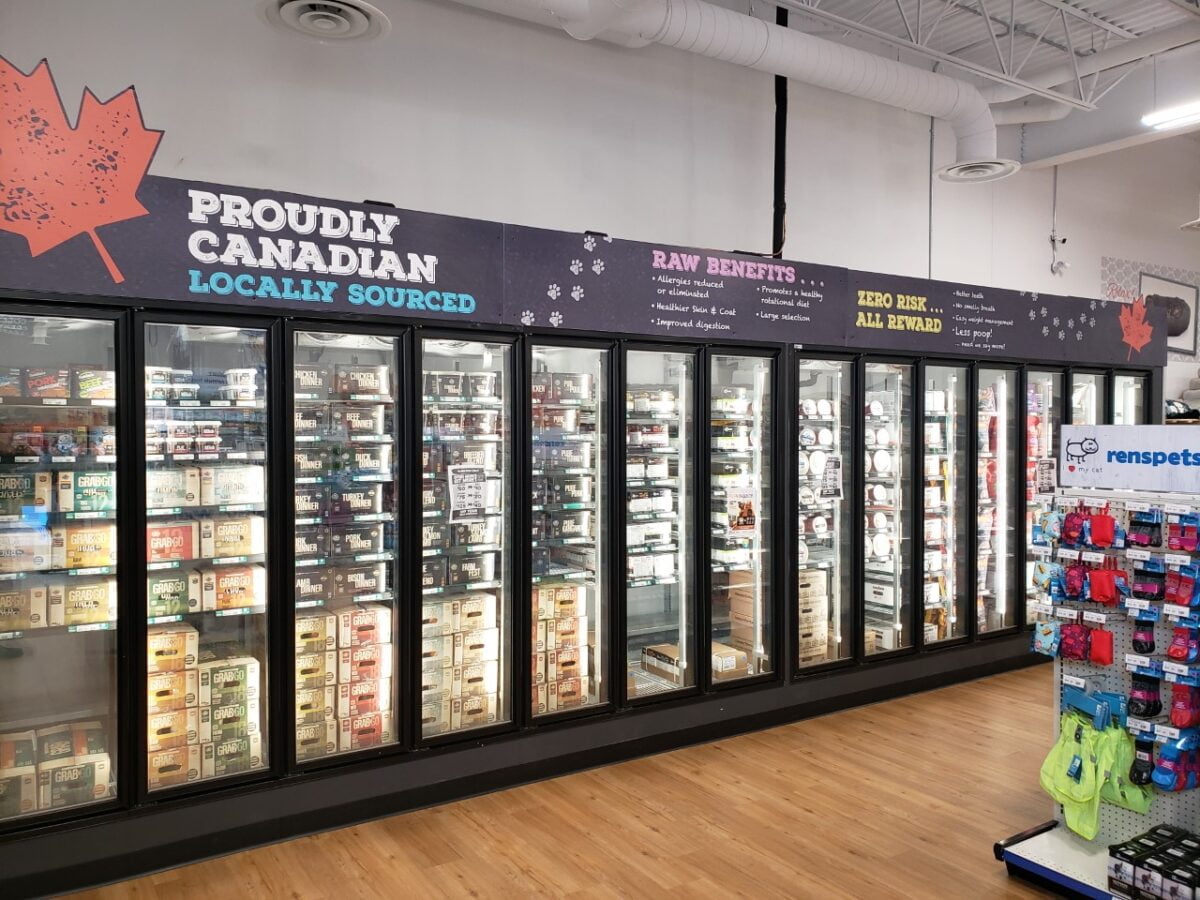
The 2022 additions to the chain will showcase more than 8,000 products over categories that range from dog & cat food, grooming, treats & toys, and 16 doors of 32-foot walk-in freezers for raw & frozen pet food.
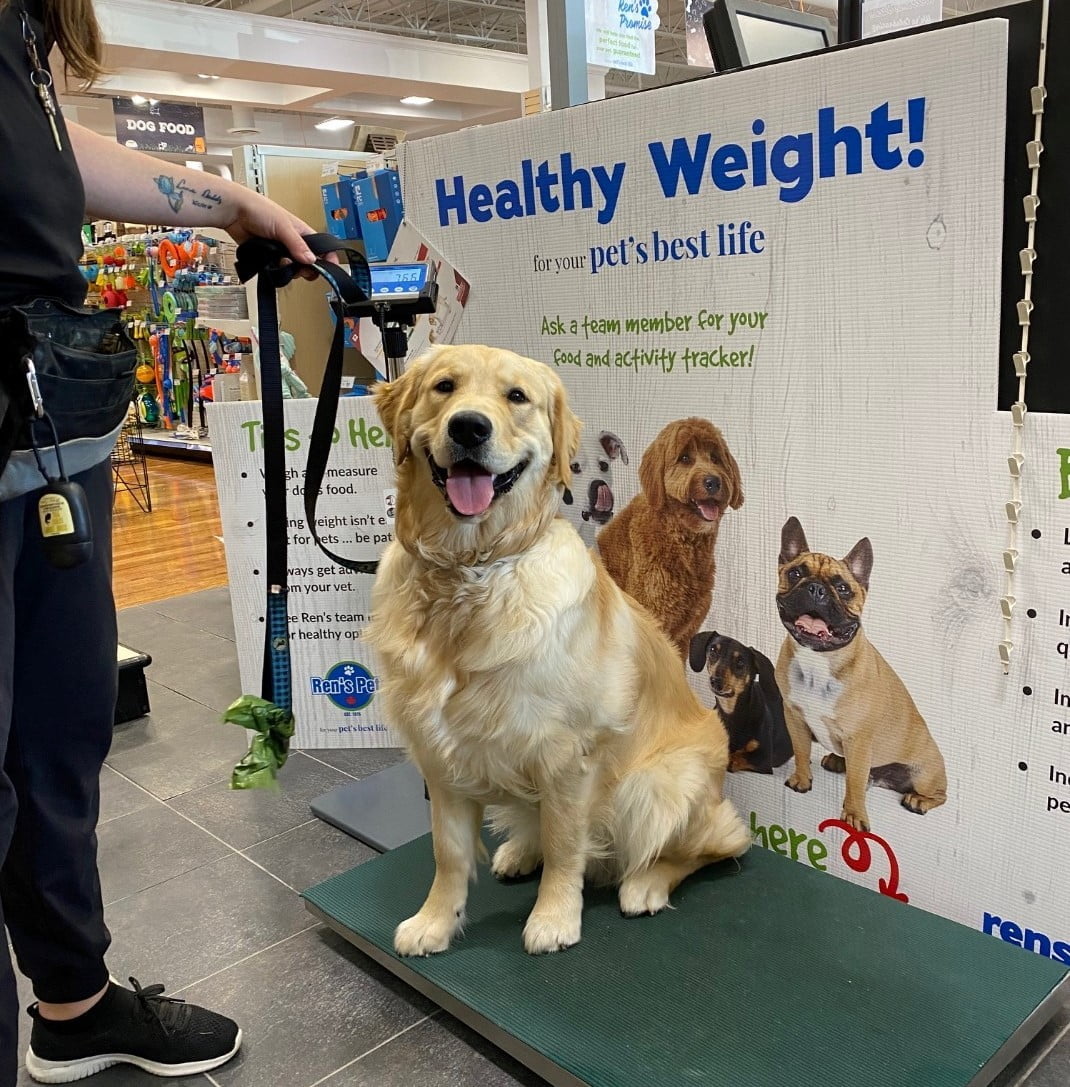
“We know there’s a demand for additional physical locations, based on the extensive research we do and the continued growth of pet,” continues Arsenault. “Pet parents are looking for a strong pet bricks and mortar offering, a place they can come in with their pets and truly be serviced along with doing things like weighing their pet, trying samples, asking for advice from our knowledgeable staff, having fittings for harnesses, collars or clothing, and socializing with other pet folks and their pups.”
Ren’s Pets have shifted their new store design to a community-based environment with add-on digital tools that retail brands are implementing to make up for a lack of foot traffic.
Image: Ren’s Pets
Larissa Wasyliw
“Ren’s has truly transformed into an omnichannel powerhouse,” shares Larissa Wasyliw, VP of Ecommerce & Marketing at Ren’s Pets. “We’ve seen our ecommerce business grow extraordinarily, but know our stores are just as important to our customers.”
The brand recently added same-day delivery through a partnership with DoorDash and upgrading loyalty rewards programs that incentivize for repeat business.
“There are already a lot of Ren’s Rewards members in our upcoming new markets of Orillia, Thunder Bay, Stouffville, Niagara Falls, and Newmarket that shop with us now in our current stores or on the website,” said Wasyliw. “We can’t wait to show these pet parents that Ren’s is here for your pet’s best life, providing premium food, treats, and toys in their own Ren’s stores in their communities.”
Founded in 1975, the Guelph-based Ren’s Pets was acquired by the Legault Group in August 2021 and has stores in Ontario and the Maritimes.