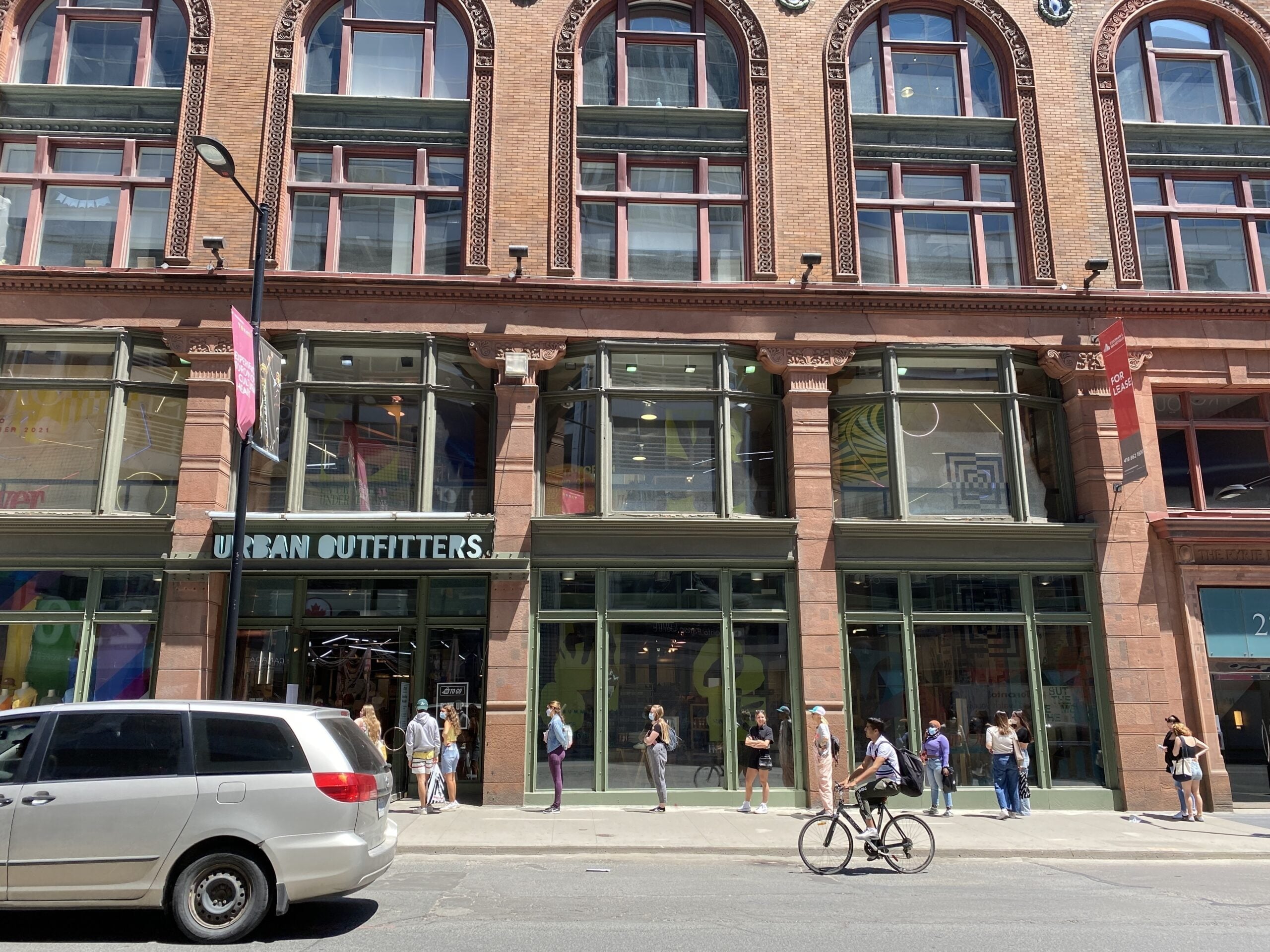
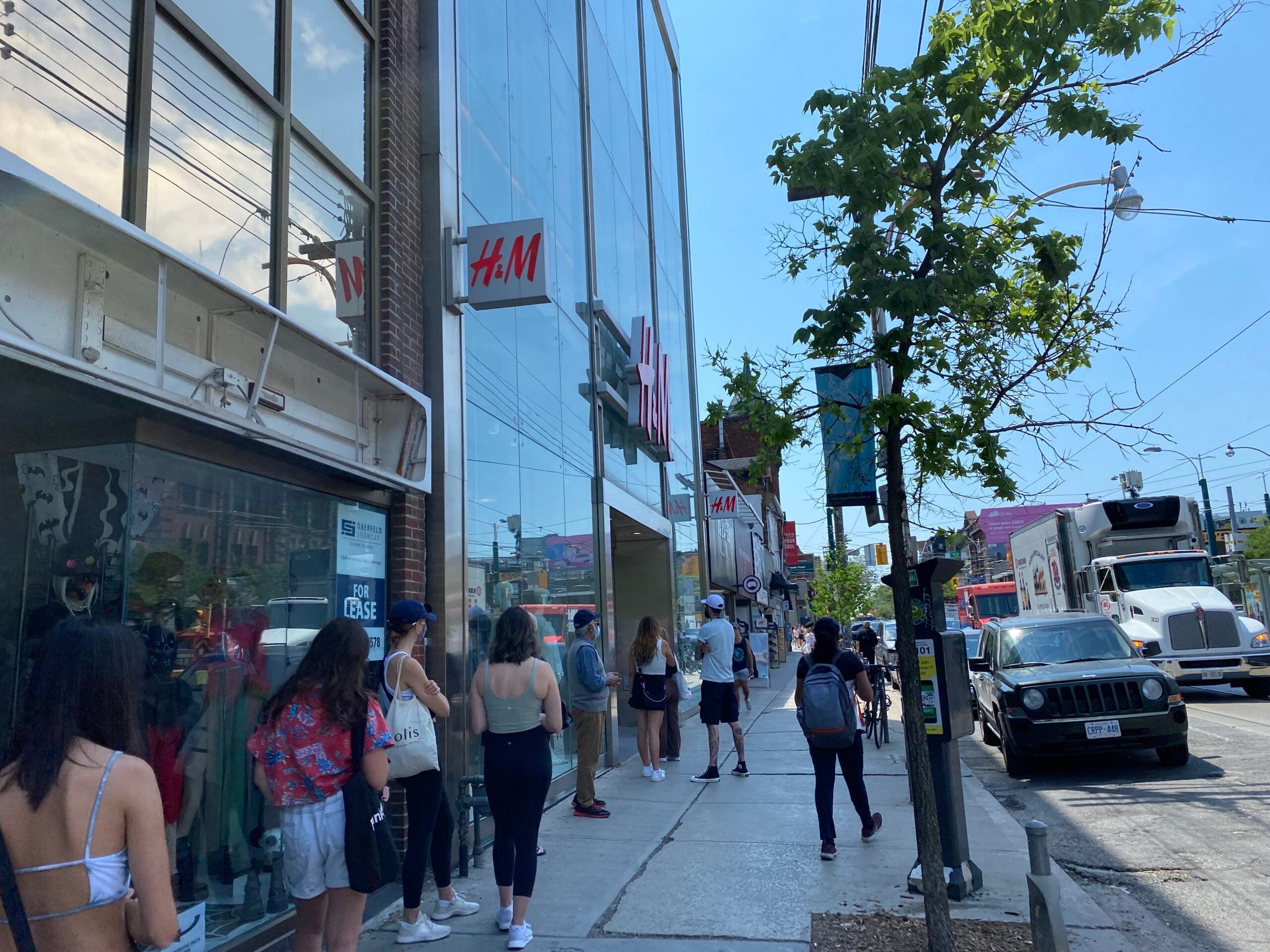
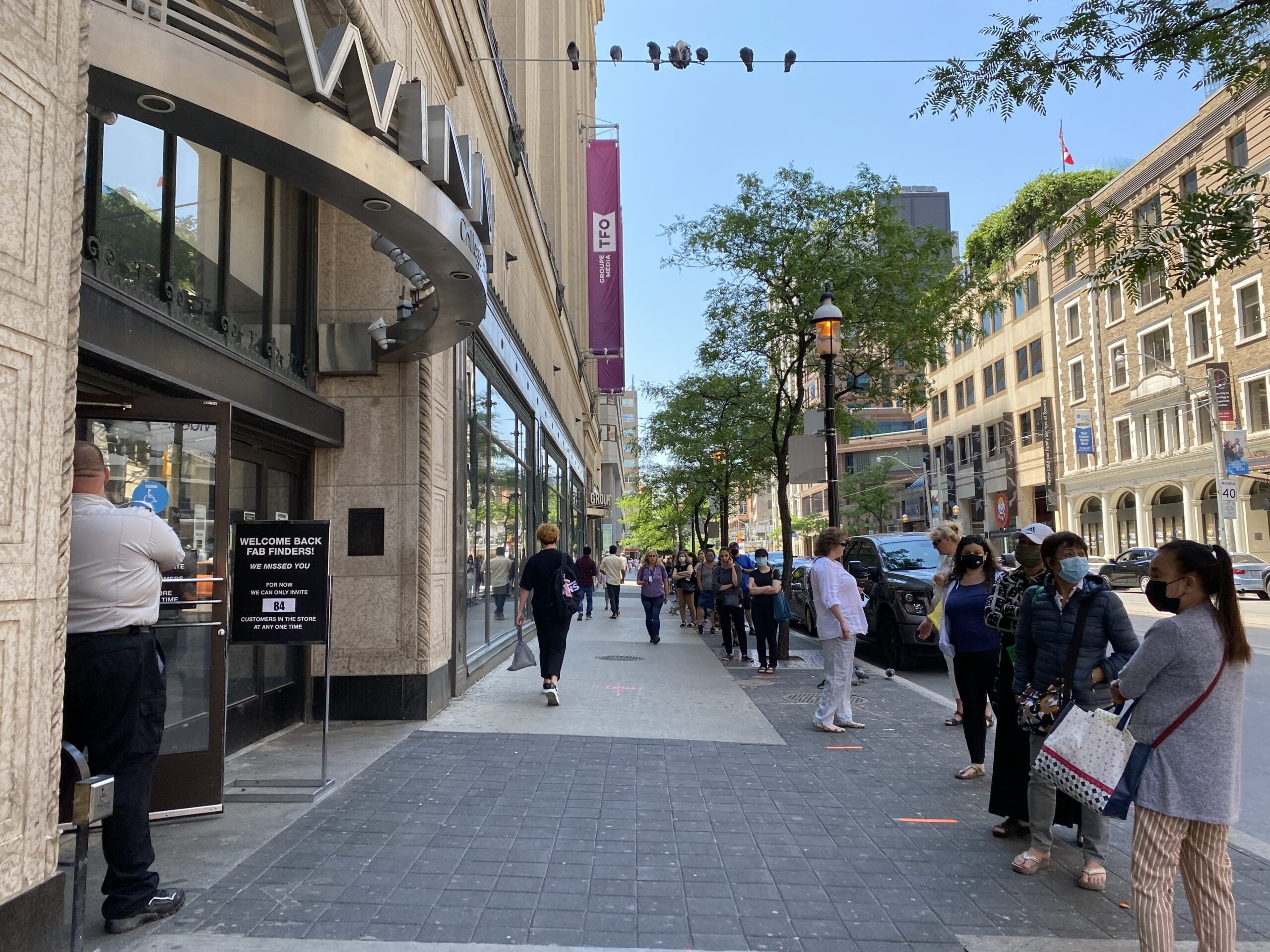
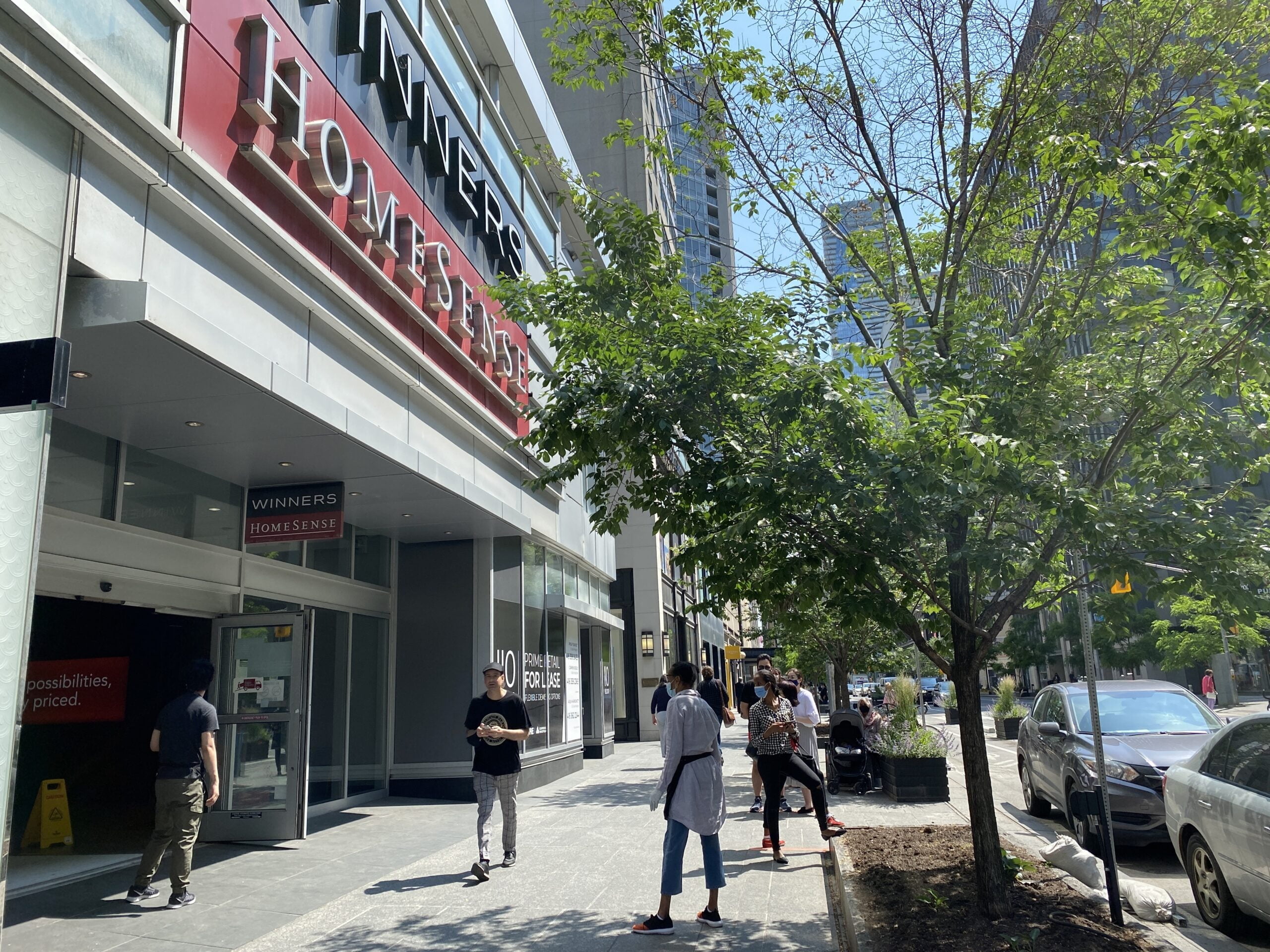
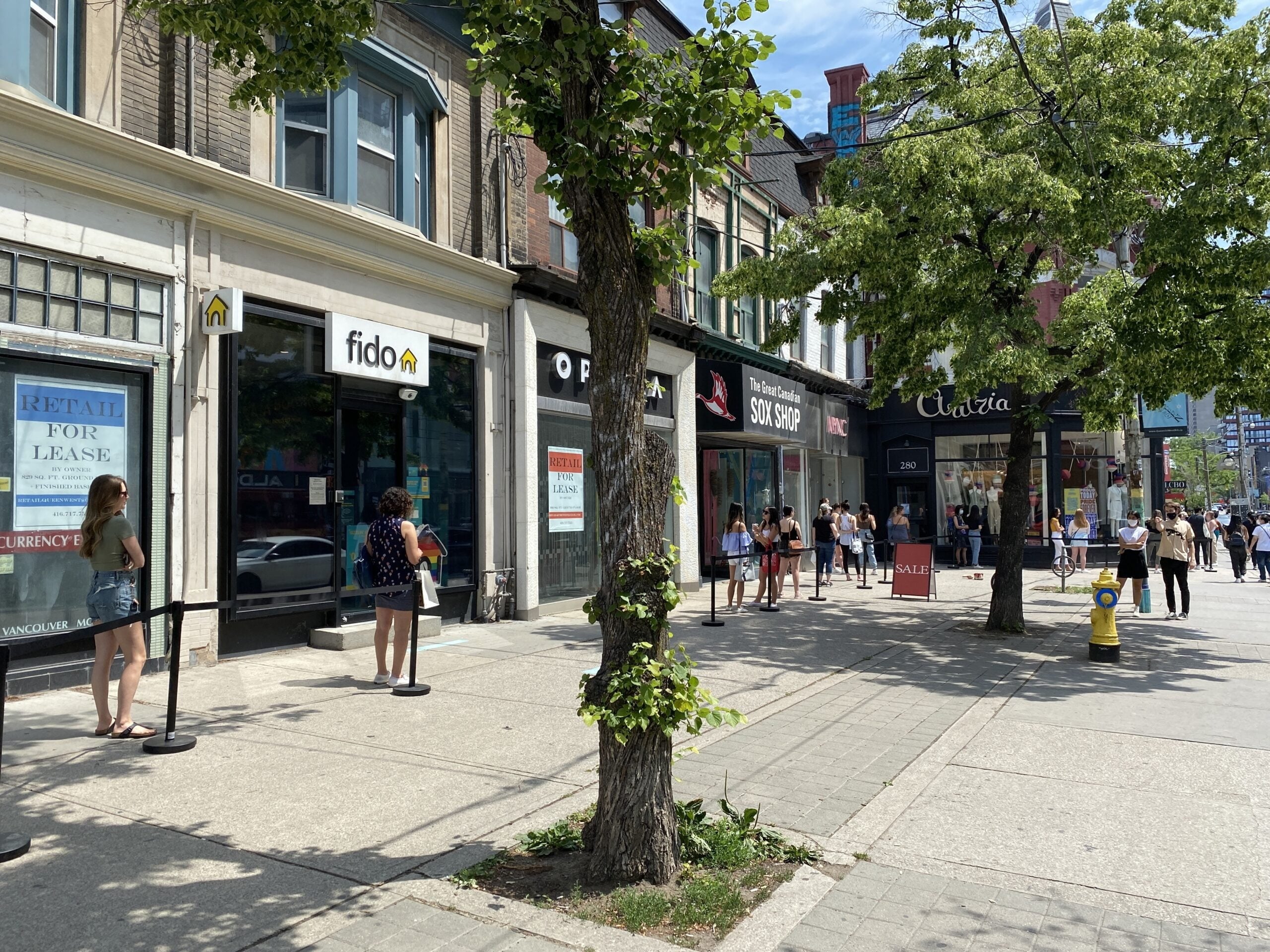
Ontario saw a partial reopening Friday, allowing retailers with street-facing stores to reopen as well as restaurant patios. Lineups at some Toronto retailers were hundreds of feet long with a mix of customers buying and returning products. Patios were hopping on the weekend throughout downtown Toronto on the weekend and sidewalks were crowded, although some rain put a damper on the activity on Sunday afternoon.
We observed lineups at every Winners, Marshalls and HomeSense store in downtown Toronto as well as at Nordstrom Rack at 1 Bloor E., H&M, Zara, Aritzia and various other retailers in the core. The lineups were a mix of shoppers and people returning items. The overall vibe, coupled with the sunny warm weather, was positive with people getting out into the city enjoying the sun, patios, and stores.
Photos from the Re-Opening of Retail in Toronto in June 2021
1 of 7
Nordstrom Rack at Yonge and Bloor - Photo by Dustin Fuhs
Nordstrom Rack at Yonge and Bloor
Urban Outfitters on Yonge - Photo by Dustin Fuhs
Urban Outfitters on Yonge
H&M Lineup on Queen West - Photo by Dustin Fuhs
H&M Lineup on Queen West
Zara on Queen West - Photo by Dustin Fuhs
Zara on Queen West
Winners at College Park - Photo by Dustin Fuhs
Winners Homesense on Bloor - Photo by Dustin Fuhs
Winners Homesense on Bloor
Aritzia on Queen Street - Photo by Dustin Fuhs
Aritzia on Queen Street
Nicolas Kalatzis of luxury multi-brand fashion retailer Nicolas in Yorkville said there’s a pent-up demand from consumers looking to “get back to a normal life” and that there’s an opportunity for a spending boom. In terms of menswear fashions, smart-casual is selling though because of the current work-from-home situation, many aren’t yet buying suits and sports jackets or pants for that matter.
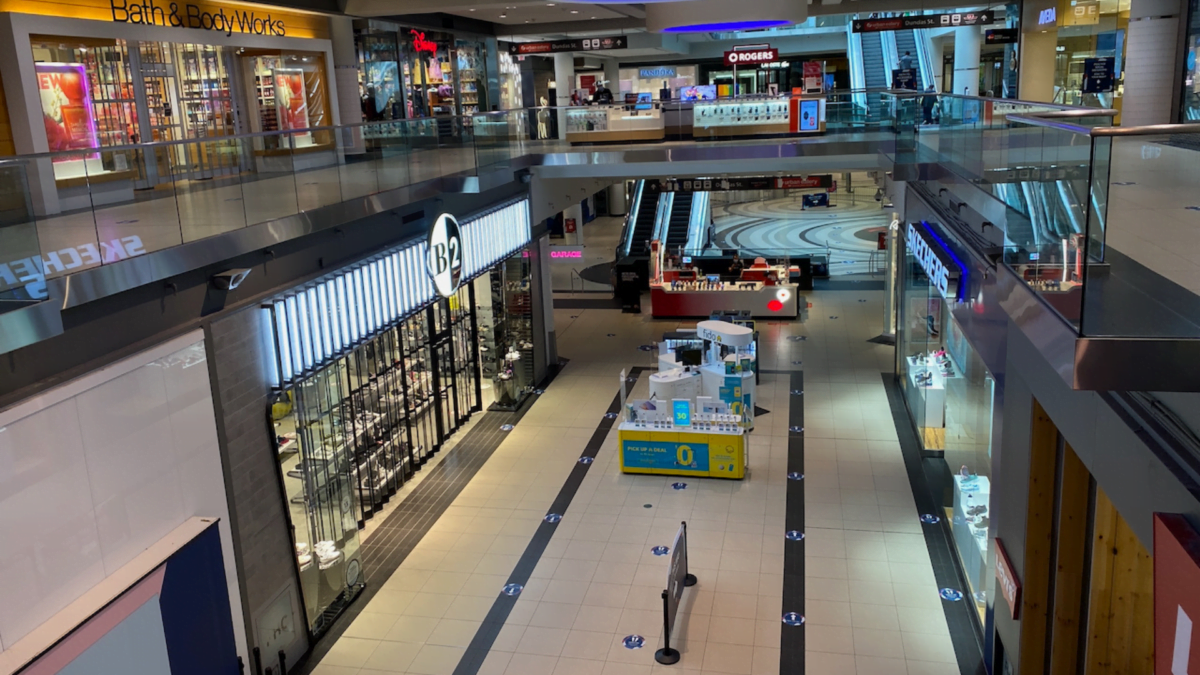
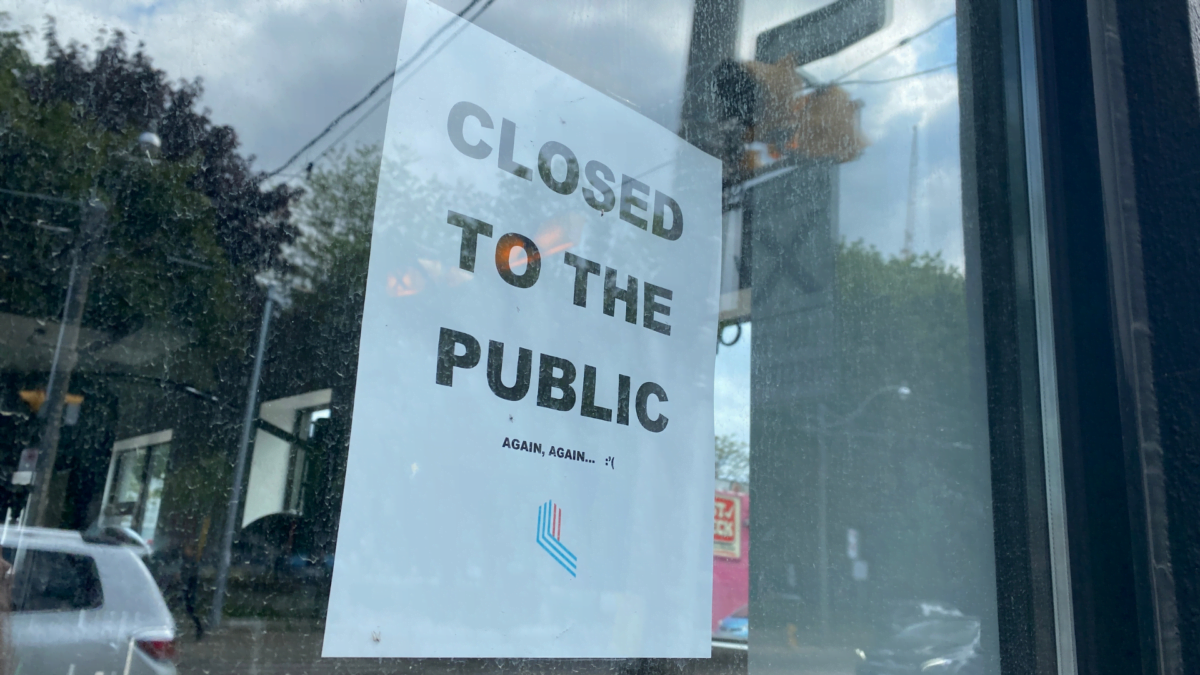
The Ontario lockdowns have been criticized by many including in an article we ran on Friday in Retail Insider. Aldo CEO David Bensadoun was also quoted in the Toronto Star last week saying, “If you had a bunch of really smart people sitting in a room trying to think up ways to kill retail, you couldn’t have done a better job than the Ford government.” Mall-based retailers lacking exterior entrances are still not permitted open and many are angry, as are other businesses including restaurants not able to open for indoor dining, beauty services, fitness and others.
There’s ongoing good news for brick-and-mortar retail despite rapid growth in digital. We’re aware of numerous lease deals that have either been executed or are in the negotiation phase for retailers, restaurants and other business categories. It’s great to see such optimism from businesses as we look to a less restricted “post-Covid” world. Many are hoping and praying that we don’t see further lockdowns moving forward which could be impacted by new variants.
One interesting development that was announced last Friday is a partnership with Hudson’s Bay and Forever 21. Hudson’s Bay will be carrying the Forever 21 line in several of its stores in a partnership with YM Inc. which relaunched the Forever 21 brand in Canada this spring with standalone stores as reported in Retail Insider. We reported that TopShop/TopMan was exiting Hudson’s Bay by this fall and Forever 21 could be seen as something of a replacement, though Forever 21 may not have such a grand presence within Hudson’s Bay stores at least initially. We’re told that at the Yorkdale Bay store, Forever 21 will occupy the second level of the former TopShop space but not the ground floor. Forever 21 will also have an expansive presence at the Square One Bay store in Mississauga and an expansion will continue. Forever 21 is also available on thebay.com.
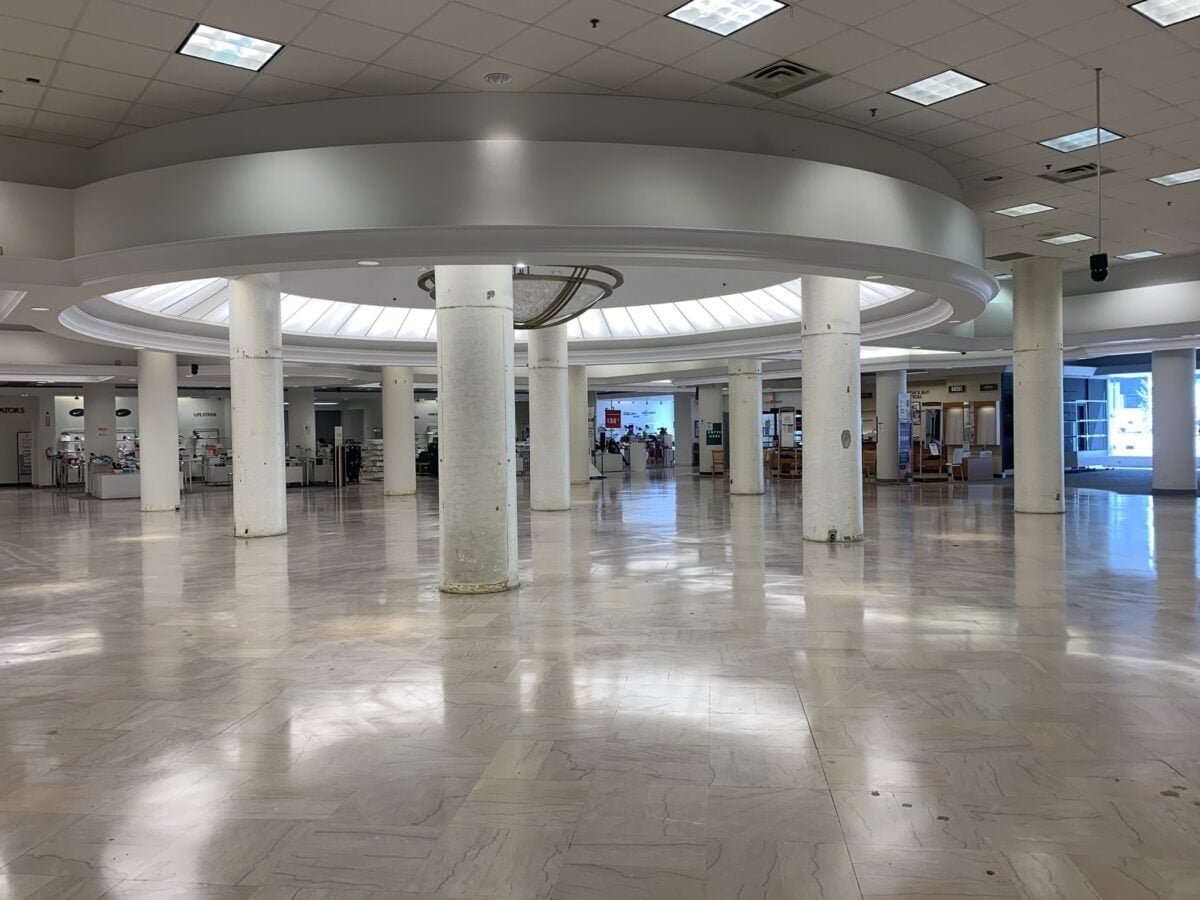
Main floor of the downtown Calgary Hudson’s Bay flagship store on June 13 2021. Image: “AL”
We reported this month that the downtown Calgary Hudson’s Bay flagship store would be downsized to three floors. An inside source in Calgary provided Retail Insider with an update. The north side of the street level of the store has been cleared out for a new women’s fashions department with the remainder of the floor to house cosmetics, fragrances and handbags (which once occupied the entire floor). The north half of the second floor will also house womenswear with the remainder of the floor for menswear – the entire second floor for years was dedicated solely to men’s fashions. The north half of the third floor, once all womenswear, will become a housewares floor. The fourth-floor currently housing women’s fashions, kids and toys will be shut down as will the furniture department on the fifth floor, and the basement level is said to be empty as well.
It appears that human-staffed check-outs in stores are on the way out for some retailers in Canada, and many consumers are unhappy. There have been a few news articles recently where Shoppers Drug Mart told shoppers that unless they’re using cash, the self-checkout is the only option. Now there’s a report that a Walmart store in Terrace BC will be the first in Canada to have all self-checkouts as a test. No doubt the trend will continue and unhappy consumers may vote with their dollars.
Retail Insider’s Craig Patterson will be hosting an event for Telus this Wednesday at 2pm Eastern/11am Pacific discussing smart security systems and how the technology is being integrated beyond security to include store operations and analytics. The Retail Insider podcast is also ramping things up with various guests with several segments to be released this week and next. Our most recent podcast features David Goldman of Vancouver-based menswear retailer Boys’Co which will be shutting down towards the end of this year, and it’s a great conversation.
The following is an overview of a few things we’re watching right now in terms of openings, happenings, closings, and other announcements.
Retail Openings and Happenings
1 of 4
Southcentre Mall - Photo by Brenden Klam
Southcentre Mall - Photo by Brenden Klam
Kingsway Eat n Seek - Photo by Brenden Klam
Kingsway Eat n Seek - Photo by Brenden Klam
French sporting goods behemoth Decathlon opened a permanent store location in Burlington Ontario over the weekend, replacing a temporary storefront that opened last year. The retailer has been profiled several times in Retail Insider and it is expected to open stores in major markets across Canada over the next several years. Brokerage Oberfeld Snowcap is negotiating the lease deals on behalf of the retailer.
The Biway $10 Store concept is expected to open at 95 Orfus Road in Toronto at some point, and its opening was delayed following the death of founder Mal Coven in October of 2020. Coven had plans to revive the brand with a new concept where all products (or a bundle of items) would be priced at $10. Details with his estate are being sorted out and we’ll report back when we have more information.
Vancouver-based fashion retailer Oak + Fort will be opening its largest store to date this summer at West Edmonton Mall in Edmonton. The 5,000 square foot Oak + Fort will be considerably larger than its second-largest location which spans about 3,000 square feet. We’ll be reporting back on more details about the store as well as a broader expansion for the brand that will see new Oak + Fort stores open in Canada as well as the United States where it already has several locations.
Oxford Properties-managed Southcentre Mall in Calgary and Kingsway Mall in Edmonton launched public art initiatives this month as part of a patio initiative called Eat & Seek with seating for 60 plus guests at Southcentre and 80 plus guests at Kingsway. The expansive outdoor art installations also act as self-serve patio spaces to support the local foodservice businesses at the malls by safely enjoying a takeaway meal outdoors. We reported this spring that shopping centres across Canada are opening outdoor patio spaces in parking lots (see photos above in the slideshow).
Montreal-based outerwear and fashion brand Moose Knuckles announced a significant investment from former CEO of Tapestry, Inc. (the company that owns Coach, Kate Spade and Stuart Weitzman) with Victor Luis appointed as Executive Chairman of Moose Knuckles. Luis is partnering with Moose Knuckles’ founders and Co-CEOs Noah Stern, Ayal Twik and their families, along with global investment firm Cathay Capital to be an investor in the company. Moose Knuckles has experienced significant double-digit year-over-year growth during the past five years under Luis’ guidance and it plans to broaden and accelerate its expansion. Moose Knuckles opened its first permanent store at Toronto’s Yorkdale Shopping Centre in 2017 and has since expanded to other storefronts in Canada and beyond, including several pop-ups that could be converted to permanent storefronts.
Calgary-based C & C Candle company has expanded its operations into a 30,000 square foot building in the city. It’s a positive move despite challenges with the pandemic. The brand says that it is continuing to grow its customer base across Canada and is bullish on the future. The new location recently opened with a grand opening scheduled for July as more stock comes in. The company has three different collections of candles, three different types of essential oils, bath bombs, bath salts and a whole range of supplies to make candles and is primarily an e-commerce retail operation.
Image: Endy Sofa
Toronto-based bed-in-a-box brand Endy, now owned by Sleep Country Canada after an acquisition in 2018, has launched its first product not intended for the bedroom. The new Endy Sofa is modular and can be configured as an armchair, love-seat, 3-seater, or L-shape sectional and there’s a matching ottoman. The sofas are made with high-density foam and durable synthetic linen fabric and comes with reversible cushions with tufted and non-tufted sides. Shipping is free and averages 3.2 days and there’s a 30 day risk-free trial as with the mattresses. It remains to be seen if Endy continues to develop its home furnishings business which could be a mild disruptor to the segment. It will also be interesting to watch if mattress-in-a-box competitors also try something similar.
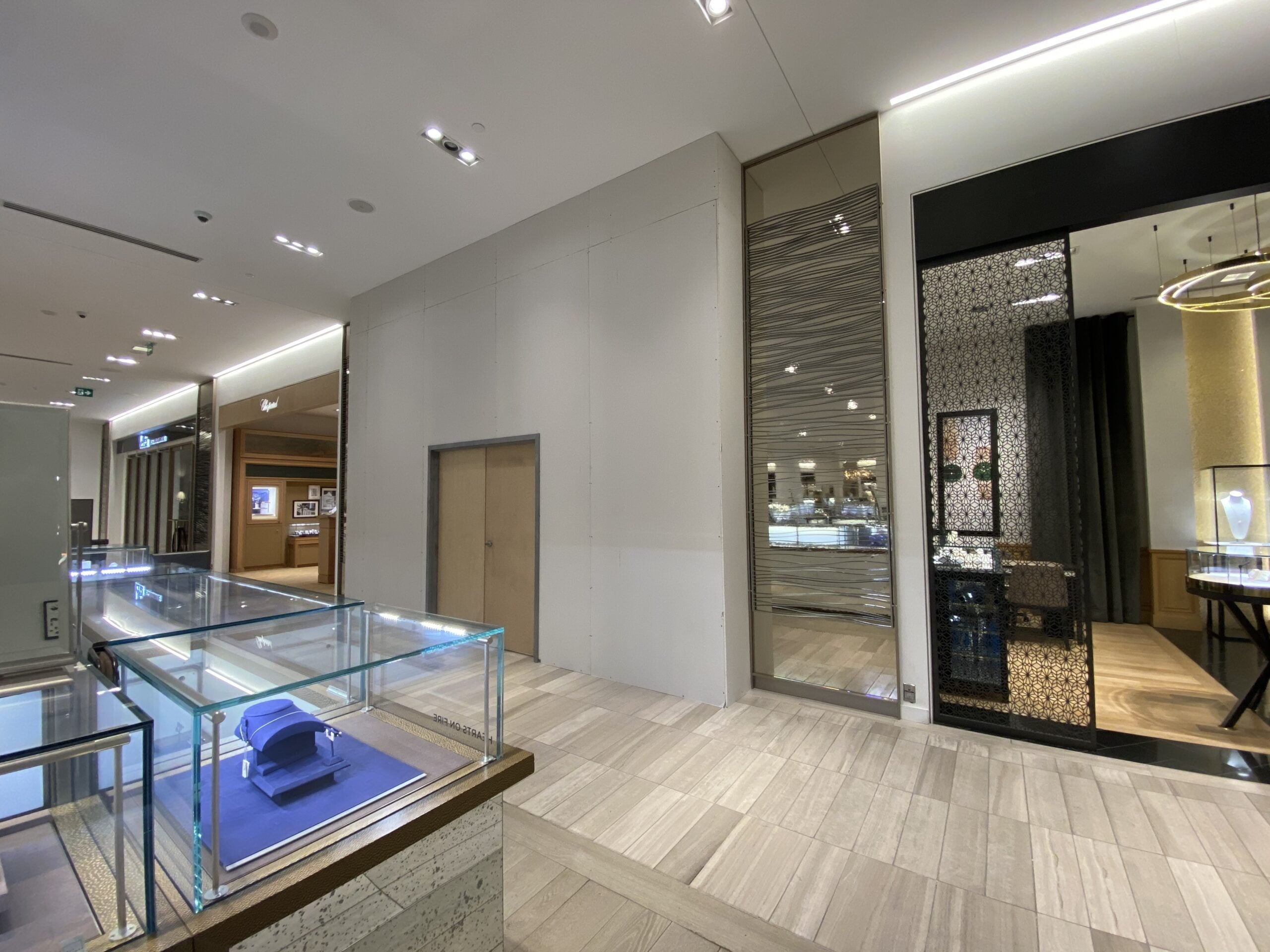
Former De Grisogono boutique at Saks Fifth Avenue in downtown Toronto - Photo by Craig Patterson
Former Georges Rech at 101 Yorkville - Photo by Craig Patterson
Georges Rech at 101 Yorkville
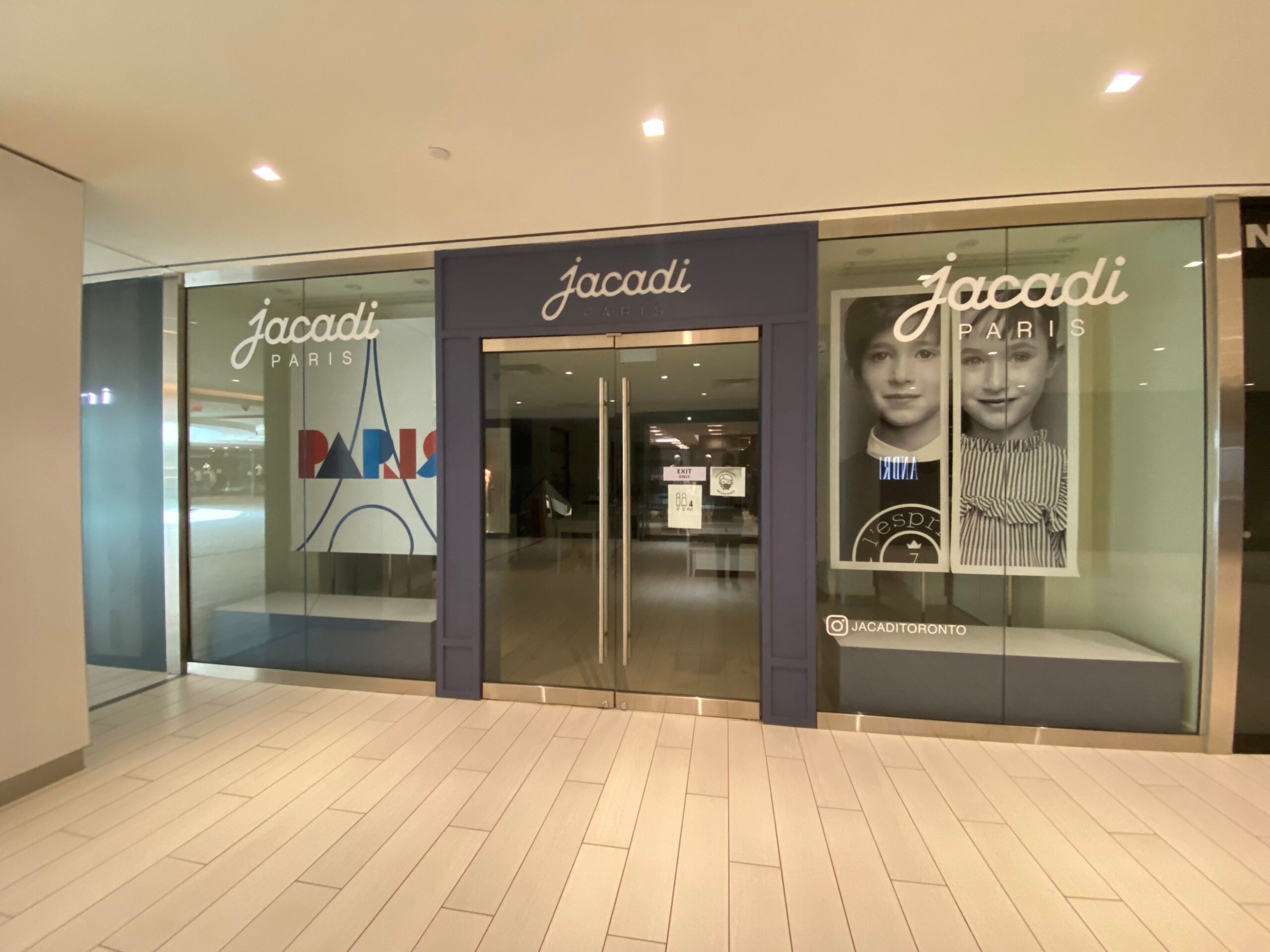
Former Jacadi at Yorkville Village - Photo by Craig Patterson
Several stores have shut in Canada and more could come. American jewelry brand Alex and Ani appears to have shut all of its Canadian stores and the brand filed for bankruptcy in the US last week after struggles. We’ll follow up with a more detailed article about this as the brand began to rapidly open stores after entering Canada in 2015.
Over the past two days we noted that in Toronto’s Yorkville area, two prominent stores have closed. At 101 Yorkville Avenue, upscale French women’s fashion brand Georges Rech shut its store which operated there for several years. Georges Rech has had a presence in Toronto for decades and this could be an end of an era unless a new location is found. A Montreal boutique at 1277 Greene Street in affluent Westmount is still operating for now.
Upscale French children’s brand Jacadi also shut its store at the Yorkville Village shopping centre in Toronto. The brand also has stores at Bayview Village in Toronto, Lakeshore Road E. in Oakville according to its website. A store in Vancouver’s Kerrisdale is closed and a store on Laurier Avenue in Montreal also shut a while ago, and we’ll follow up to see if the company has or will shut all stores in Canada.
The De Grisogono boutique at Saks Fifth Avenue in downtown Toronto has shut down with white hoarding replacing the storefront. The Italian luxury jeweller featured a $100,000 watch in the Toronto boutique when Saks opened in 2016. The jeweller filed for bankruptcy in 2020 amid controversy. Saks in Toronto also lost a Boucheron boutique last year (the line is now carried at Holt Renfrew) and the space is vacant, and we also noticed that Australian skincare brand Aesop has shut its Saks shop-in-stores in downtown Toronto and CF Sherway Gardens.
1 of 3
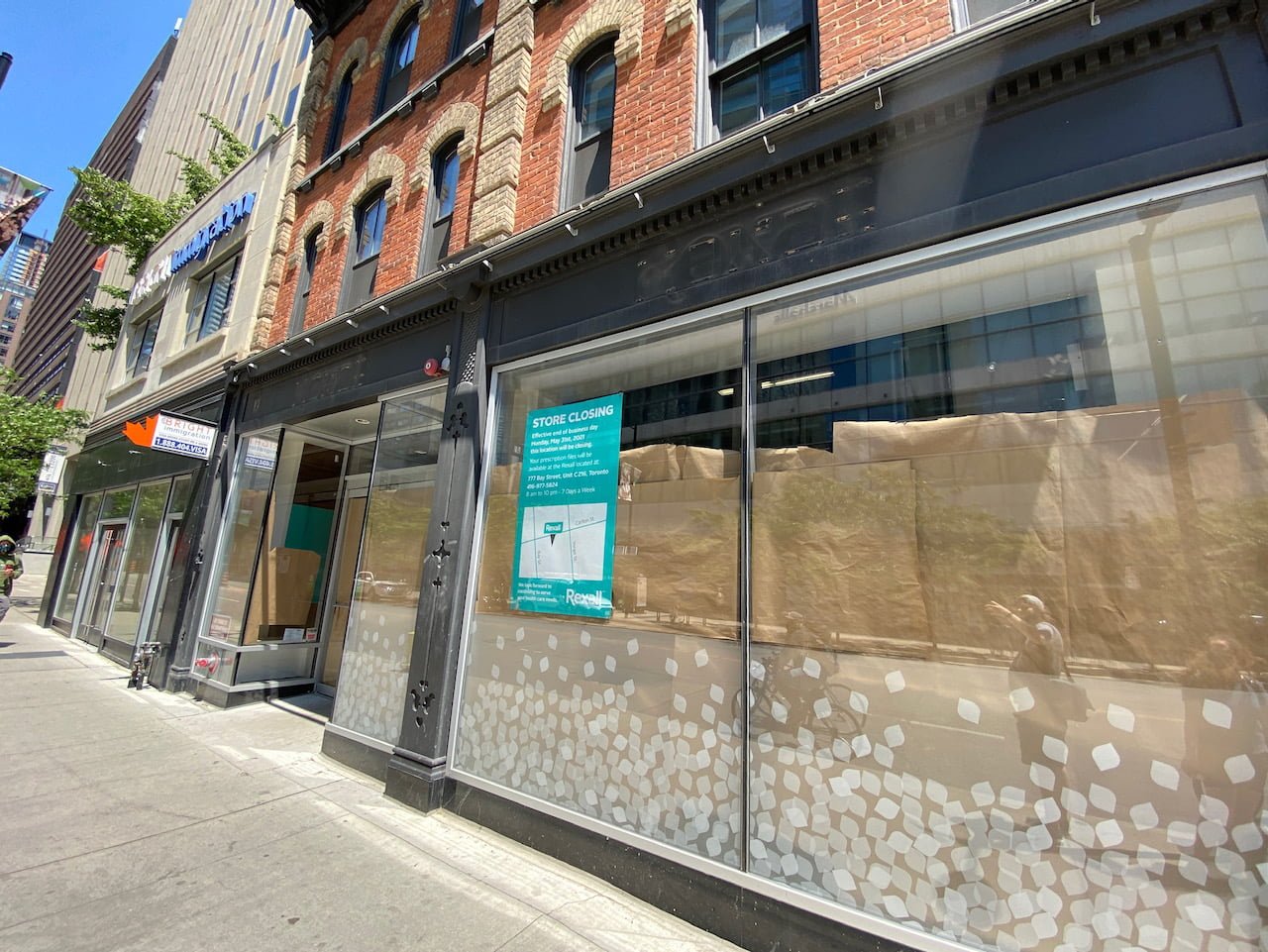
Closed Rexall at Yonge & Gerrard - Photo by Dustin Fuhs
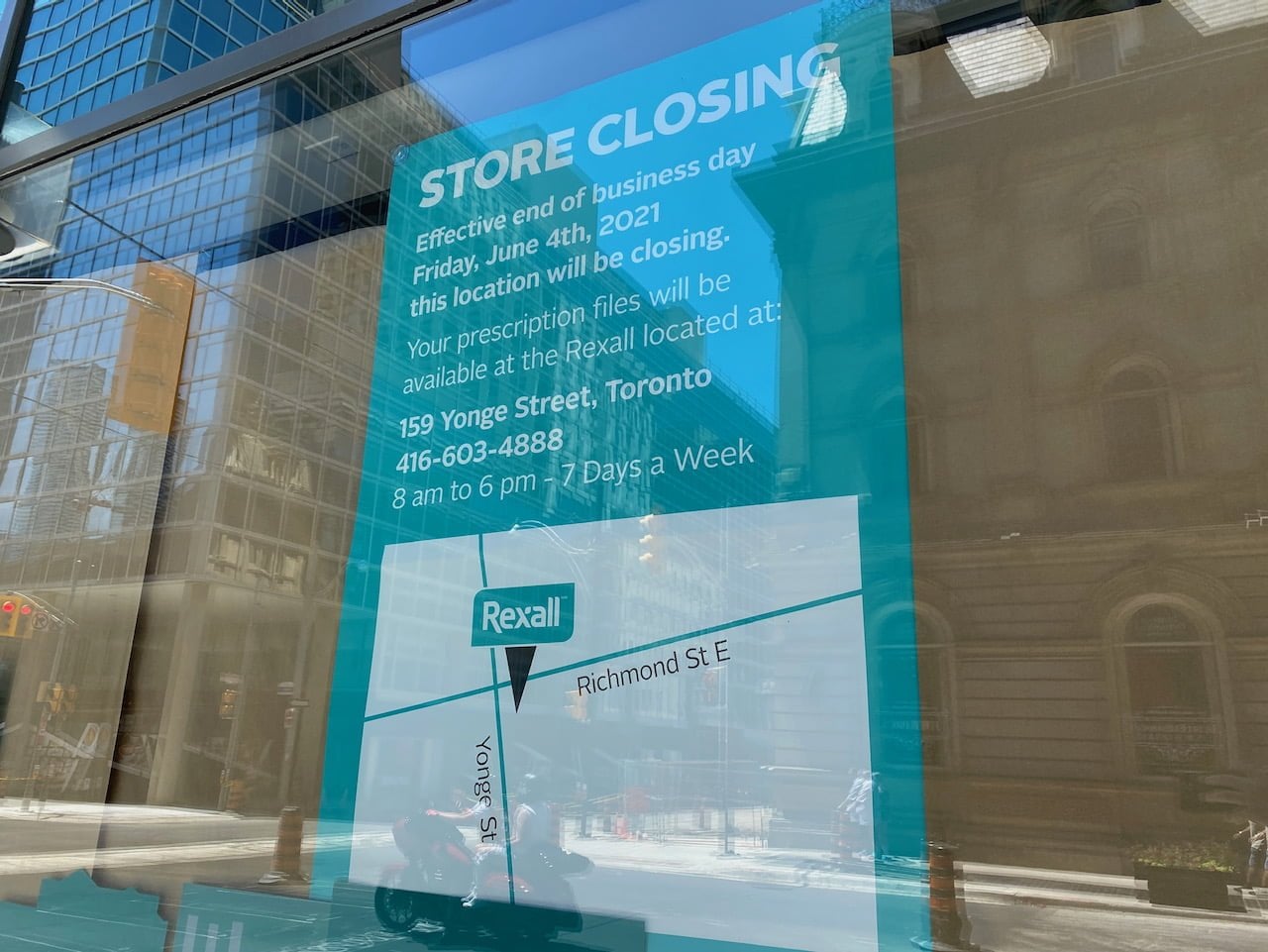
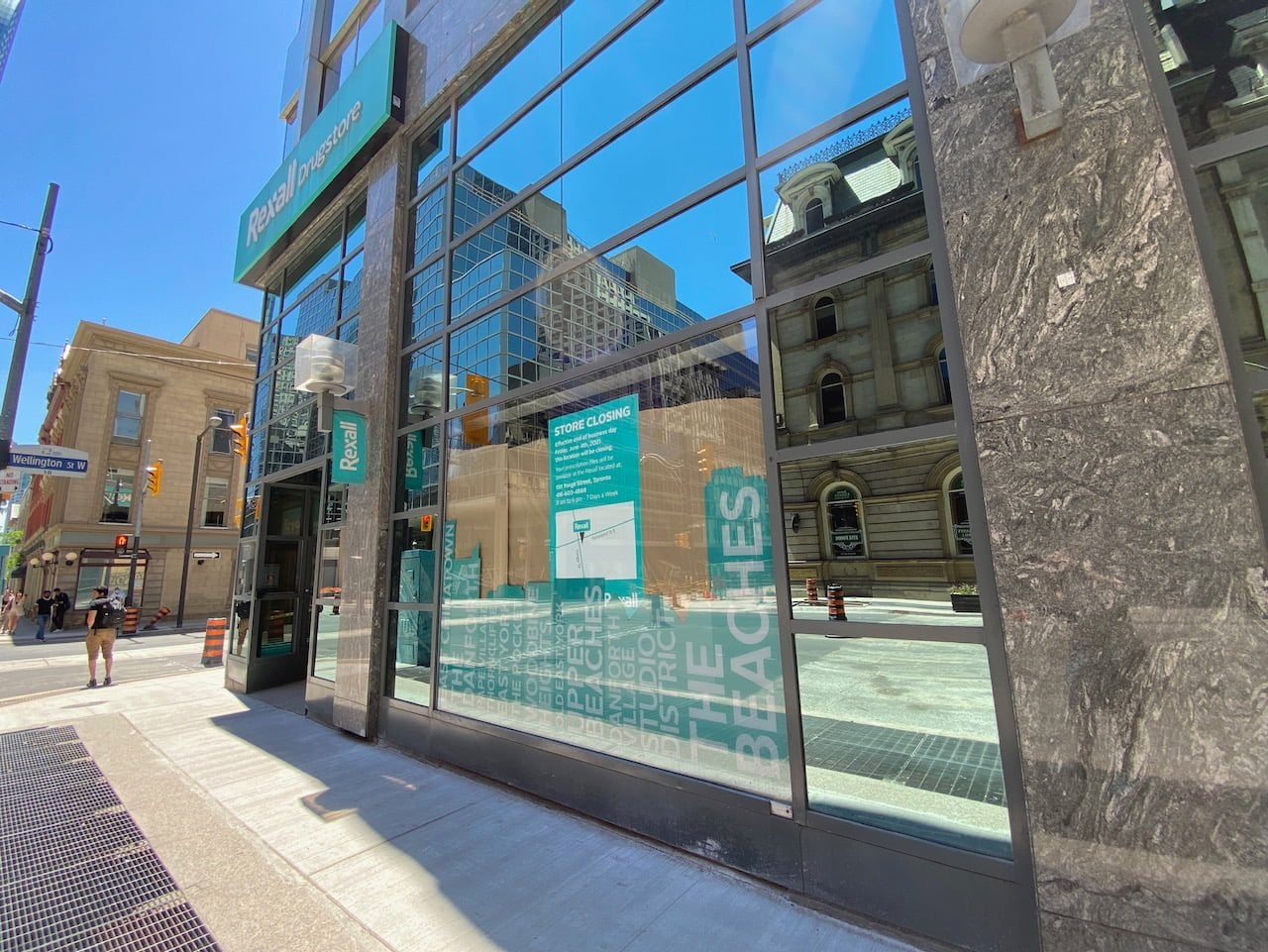
Closed Rexall at Yonge & Wellington - Photo by Dustin Fuhs
Closed Rexall at Yonge & Wellington - Photo by Dustin Fuhs
Two Rexall drug stores in downtown Toronto recently shut, including a location at 48 Yonge Street at the corner of Wellington Street as well as at 401 Yonge Street near Gerrard Street. This follows the recent announcement that the unique Rexall store on Bloor Street near Brunswick Avenue in the Annex will also be shutting – the store opened in a former ‘dive bar’ in the spring of 2017.
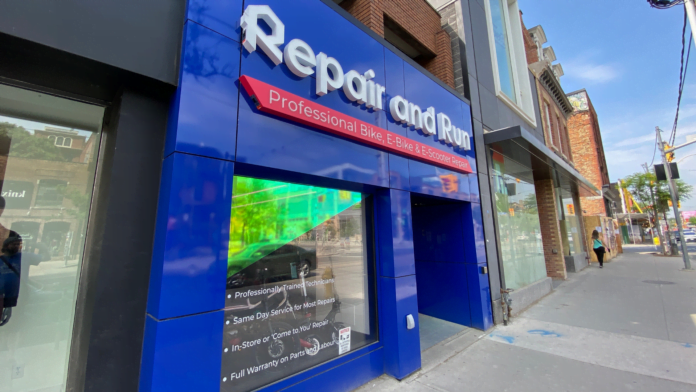
Repair and Run at 363 Queen West - Photo by Dustin Fuhs
Some of the people behind the founding and success of Mobile Klinik, the Canadian chain of smartphone and tablet repair shops, have launched a new business in downtown Toronto for bike, e-bike and scooter repairs.
Repair and Run, with its first location at 363 Queen Street West, has plans to eventually expand the concept to many more locations.
Youssef Botros, VP of Business Development, said the new company is trying to follow the same road map that Mobile Klinik used to become such a national success.
“Repair & Run was actually first started in France about five years ago. The mobile bicycle repair business since then has grown into a network of brick and mortar stores within France. The Canadian branch just started. It’s been in the works for a little while,” said Botros.
“Ken Campbell, my partner, approached me while I was at Mobile Klinik, and said ‘hey we really like the work that you did at Mobile Klinik and we were wondering if you wanted to join this company’. I’m an avid cyclist myself. It’s one of the things I enjoy most. Some people have yoga or the gym. This is my way to disconnect. I love to explore new places.”
Repair and Run on Queen Street – Photo by Dustin Fuhs
“It’s not really about how fast I’m going or my heart rate. It’s just being outside. Being active. Seeing new places.”
Botros spent six years with Mobile Klinik. As Mobile Klinik’s first employee, he comes to the new venture with a wealth of experience and knowledge in building a national retail repair brand and supported Mobile Klinik’s expansion through to its acquisition by TELUS, by leading the Training and Development and developing key relationships and programs that are still in operation today.
Ken Campbell
Campbell is an experienced executive and entrepreneur. He was a co-founder of Mobile Klinik. He served as founding CEO of WIND Mobile (now Freedom) and was CEO of telecom operators in North Africa and Europe.
“With the first store, we want to make sure we can prove the concept and survive through the off-season by maybe doing a couple of other things on top of bike repair,” said Botros. “But we’re planning to be here for a long time and opening up about 50 locations in the next five years.
“That’s not anything new to me. We’ve done 90 something or so in the last five years with Mobile Klinik.
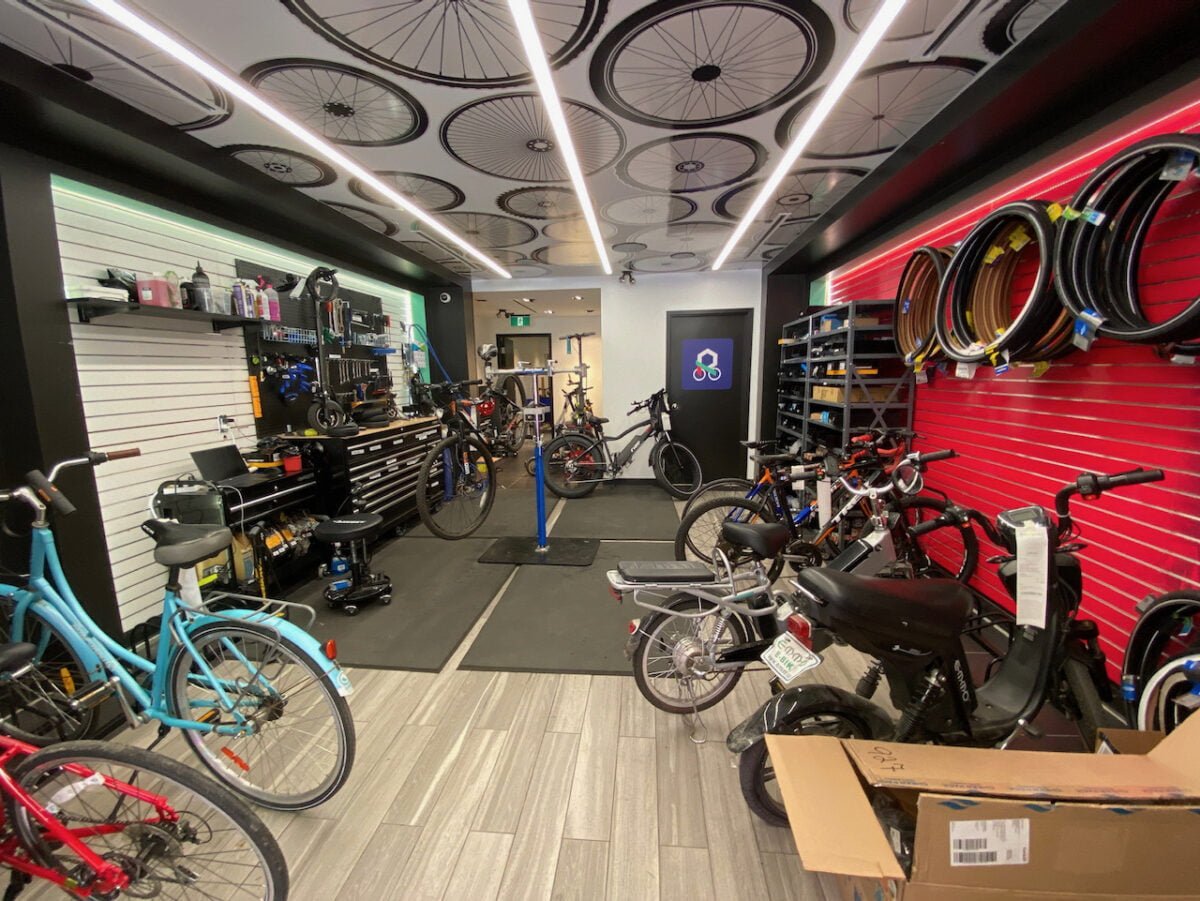
Repair and Run on Queen Street – Photo by Dustin Fuhs
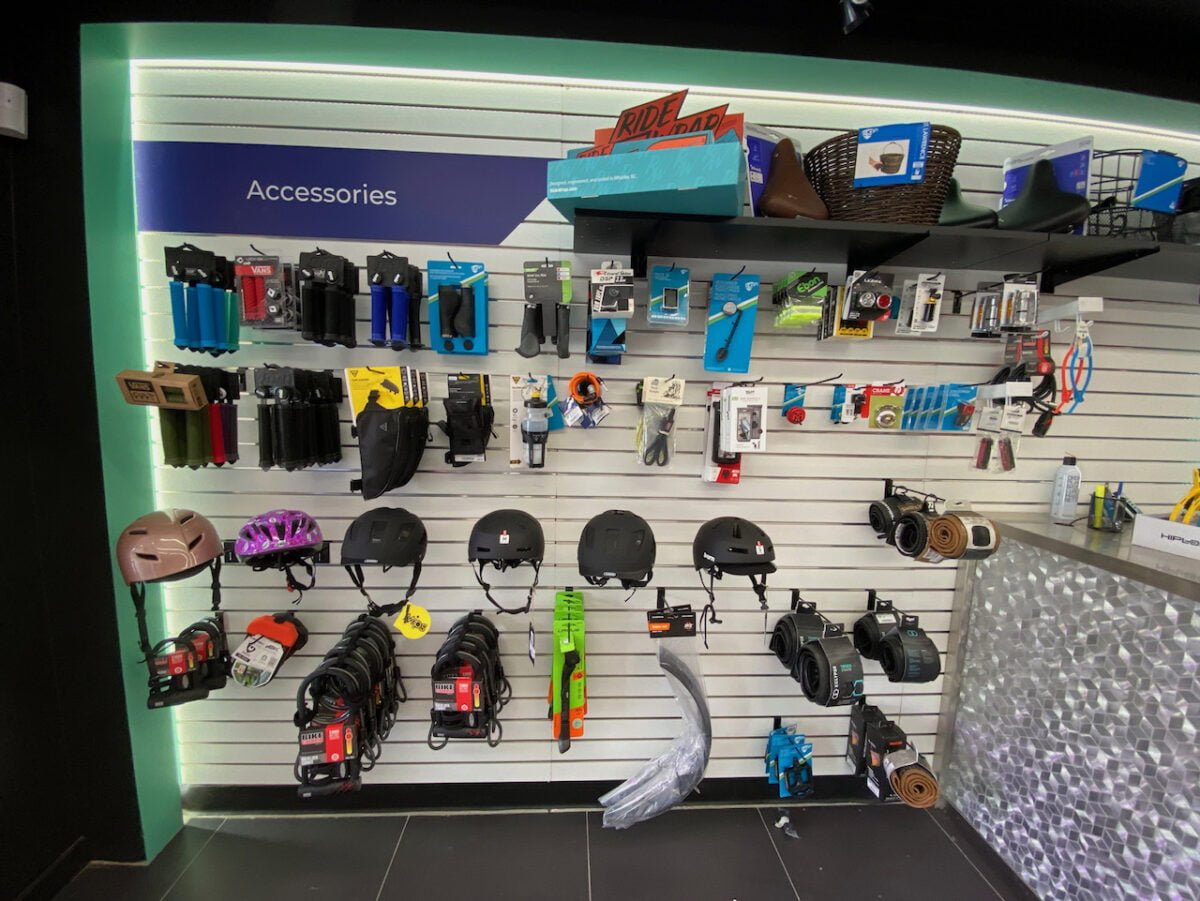
“At the very core, we are very repair focused. We do professional bike, e-bike and e-scooter repairs. We’re very aware of the e-mobility trend that is booming right now. Our business model is a little bit different than a lot of the bike shops you would probably see around. Rather than having 70 per cent of our sales dedicated to bike sales and things of that nature, we actually have the inverse repair business model. Most of our shop floor is dedicated to repairs. We’ve got repair stations set up. In this particular location, we actually have double the space because we have a basement where we’re going to be putting in more technician stations as well to be able to turn around bikes and e-bikes and e-scooters within a fairly good amount of time. Most of the repairs that we do are same-day or within 24 hours.”
Botros said some repairs may take a little bit longer depending on what parts are needed to be replaced.
He said the on-going pandemic has been a major driving factor in the growth in popularity for bikes, e-bikes and e-scooters.
“And fuelled by the fact that e-bikes are becoming so popular, people who are not generally into cycling are getting more interested in it. And even older people. People who may have knee problems or other health problems or feel like they can’t cycle on a regular bike so easily. E-bikes and e-scooters and all of the e-mobility type devices are making things so much easier for people, encouraging people to get out there and to start using it for commutes for example. We have a really big population that are food delivery couriers and almost all of them have e-bikes,” said Botros.
“It’s overwhelmingly positive feedback I would say from all of the people that have e-bikes. It makes them feel like a kid again and makes biking a lot more enjoyable.”
In Ontario, where the third wave was particularly devastating for working-class and racialized people, advocates pointed out that while many workers from these communities were disproportionately deemed “essential,” they were also the least likely to be able to access paid sick leave benefits.
As we hopefully near the end of the pandemic and collectively consider how to transform the workplace in ways that are safer, more equitable and humane, it’s important that the voices and experiences of essential workers are heard.
While media coverage has been crucial in fuelling public discussions about the workplace, our research shows that there’s a disconnect between the way media covered work issues during the pandemic and the stories workers felt were important for the public to understand.
Survey of workers
During the first wave of the pandemic, our research team conducted a survey of three groups of essential workers in Nova Scotia — long-term care workers, retail workers and teachers.
Our survey focused primarily on how working conditions had an impact on their health and well-being, but because essential workers were receiving more media attention, we also asked participants to reflect on how the media covered their occupations.
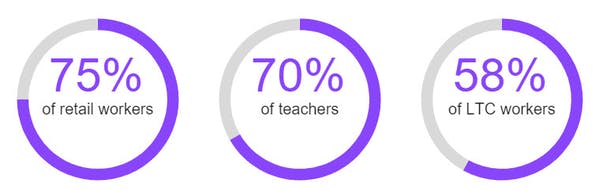
We asked survey participants if the media focused on the most important issues of their work, and 69 per cent of participants responded “no” versus 31 per cent who said “yes.” Broken down by group, retail workers were the most likely to say that the media was not covering the most important issues (75 per cent) followed by teachers (70 per cent) and long-term care workers (58 per cent).
Breakdown by sector of those who responded ‘No’ to the question: Did the media focus on the most important issue of your work? Author provided, Author provided
When asked to describe how they felt about media coverage of their work, some participants expressed gratitude. One long-term care worker told us:
“I think some of the coverage has been good and it has brought to light the ‘gaps’ in the system and how some of the most vulnerable people in society are treated and prioritized.”
However, about half of the open-ended responses stated that coverage was incomplete, one-sided or that the tone became more critical over time. For example, some long-term care workers felt that coverage focused disproportionately on residents, ignoring workers:
“They have focused on the impact to residents but have not talked about the tremendous work the staff did in LTC facilities in NS to keep everyone safe. The staff were viewed as the carriers [of COVID-19] and would be blamed publicly if an outbreak occurred.”
Retail workers, teachers
Retail workers noted that media coverage was largely silent on what some saw as unnecessary risks to their health. According to one participant:
“They show us as these lifesavers and glamourize us when in reality, we’re risking our health and safety so Karen can buy Doritos and ice cream at 10 p.m.”
Teachers noted that they were often portrayed as complaining, whining or lazy, especially when they expressed concerns about working conditions. As one teacher commented:
“It has been interesting to see praises sung as the extent of our jobs was discussed, and then to be referred to in a negative light as we look for clarification of safety measures for returning to school.”
Our participants’ frustrations with media coverage of their work during the first wave of the pandemic underscore the importance of intentionally including workers’ experiences in public dialogue about the economy and public policy.
After all, workers’ lived experiences are not interchangeable with broader questions about business and the labour market, nor can we understand workers’ experiences through a near exclusive focus on policy. Ignoring workers’ experiences leads to missed opportunities for understanding how policy and working conditions can improve.
While economists rejected that connection, worker-centred media coverage provided important insight into why workers were turning away from food services.
In post-pandemic Canada, media will also play a crucial role in shaping public understanding of labour conditions. If we’re committed to creating a future of work that is safe and equitable, workers themselves must be a central voice in the stories that media tell.
Special Edition 34: David Goldman on Boys'Co's Final Chapter
This week, Craig and David discuss the 75 year fashion legacy of family-owned Murray Goldman, including the 37 year run of iconic Vancouver-based menswear retailer Boys’Co which will shut down at the end of this year. Despite the sad news, it’s a positive conversation with a lot of history and gratitude.
The Weekly podcast by Retail Insider Canada is available on Apple Podcasts, Stitcher, TuneIn, Google Play, or through our dedicated RSS feed for Overcast and other podcast players.
Drop us a line at Craig@Retail-Insider.com. You can also rate us in Apple Podcasts or recommend us in Overcast to help more people discover the show!
Background Music Credit: Hard Boiled Kevin MacLeod (incompetech.com). Licensed under Creative Commons: By Attribution 3.0 License. http://creativecommons.org/licenses/by/3.0/
Toronto Eaton Centre Closed - Photo by Dustin Fuhs
While Ontario gears up for the first step of its reopening on Friday, many retailers and small business owners across the province are angered and frustrated that they are still left on the sidelines as a result of the COVID-19 pandemic.
“The level of anger and despair we’re hearing from business owners is alarming. They are watching their life’s work crumble due to the province’s inaction. The Ontario government needs to let more businesses reopen more quickly, so they can catch up to their counterparts in the rest of the country,” said Dan Kelly, President and CEO of the Canadian Federation of Independent Business.
Dan Kelly
“Ontario businesses are incredibly frustrated as they have had little or no opportunity to make sales, while the rest of the country is reopening much faster. At this rate, many provinces will be back to normal business operations before Ontarians can even get a haircut. We need to pick up the pace now, or many businesses won’t even make it to reopening.”
Gyms, hair salons, barbers, stores located in malls without a street-facing entrance and many others will remain closed in Ontario despite the launch of the province’s reopening plan on Friday.
According to the CFIB, only 44 per cent of small business owners in Ontario say they are currently fully open and 66 per cent say the province is too slow in reopening.
Essential Shopping only at CF Toronto Eaton Centre – Photo by Dustin Fuhs
“At Over the Rainbow, during all our open periods, health and safety was our number one priority. As a result, there were no reported cases coming from our retail environment. Despite our best efforts, Ontario continues to be the most locked down retail environment in all of North America since the beginning of this pandemic,” said Daniel Carman, Vice President of the company. “Small businesses know what they have to do to protect their customers and their staff. All we need are the proper protocols.
“Our government is not interested in doing the heavy lifting. They refuse to regulate, monitor and hold irresponsible retailers accountable for their actions. The government has instead rolled out blanket restrictions that are arbitrary and unfair to small businesses inside of shopping centres. We should be given an even playing field instead of having to remain closed for at least another 21 days. Why are small businesses in malls being punished because of one social media clip? The government needs to do better than this.
Daniel Carman
“Over the Rainbow has been in business serving our community for 46 years. It’s an insult that this government believes they can still treat responsible business owners like this by shutting us down on and off for the past 16 months. In all this time, we’ve searched everywhere for sound reasons and understanding for why small businesses must sacrifice. To this day, we’ve received no answers or explanations.”
In a public statement, the Retail Council of Canada implored the Ontario government to allow all retail to open at the same time – including those within malls.
“Ontario has endured the longest lockdown in the world. Our members have absorbed unbearable financial, emotional stress, job losses and business closures, all without improving health outcomes. There is no medical evidence to support the continued lockdown of businesses. In fact, the government’s own data shows that in-store COVID-19 transmissions are almost non-existent. Despite this, new job numbers released last week by Statistics Canada show that Ontario has now lost 85,500 retail jobs in Ontario since pre-pandemic levels – 32,300 of these are from May 2021 alone,” said the organization.
“Ontario’s health trends are encouraging and we are ahead of what was forecasted when Ontario’s three-step plan was introduced. Positivity rates are the lowest they’ve been in nine months, vaccination rates are high and hospital ICU numbers are steadily falling. And yet, too many of our retailers will remain in lockdown on June 11 when Ontario moves into Stage 1. Jurisdictions across all of North America , as well as around the world, have shown that stores can reopen safely and responsibly.
“We strongly encourage the Ontario government to let all retailers reopen on June 11 at reduced capacities, including those within malls. Retailers have had no choice but to swiftly rewrite their plans throughout the past year and we are now asking the government to do the same.”
Ryan Mallough
Ryan Mallough, Director of Provincial Affairs for Ontario for the CFIB, said it is certainly good to see that the province is finally getting the ball rolling on the reopening.
“It’s been a very long time here and certainly for restaurants with patios and retailers who have been shut down for a great length of time since April 8 provincewide, it is good news. And it’s good to see that we’re on the path of reopening,” he said.
“But on the flip side of it, it’s been immensely frustrating for all of the other businesses in particular hair salons, fitness studios, dance studios, gyms, who are not only still closed but remain closed for another three to six weeks depending on the sector while watching every other province, BC, Alberta, Saskatchewan, Quebec, get to reopen those sectors if not already over the next days as they head toward the second stage of their reopening.”
The CFIB is urging the Ontario government to:
Add hair salons, barbers and other personal care services to the reopening list for this Friday;
Add some capacity for gyms, fitness, and dance studios this weekend;
Add limited capacity this Friday for indoor dining as is in place in most provinces;
Immediately provide retailers in malls with no street-facing entrance with an option for in-person sales;
Shorten the three-week interval between further rounds of reopening and bring in a new, faster plan that is more in line with other provinces;
Immediately add a third round of Ontario Small Business Support Grant funding to help those facing ongoing restrictions as they reopen; and
Resurrect the PPE grant at a greater amount to help businesses with the potentially high cost of safe reopening.
Training Lane at 487 King Street E – Photo by Dustin Fuhs
Mallough said only 35 per cent of Ontario businesses are fully staffed (last in the country) and only 27 per cent of businesses are at normal revenue levels.
“The province is very much lagging (other provinces) and it is very much noticed by the small business community. When the Ontario government is making decisions, it’s kind of looking at Ontario as a silo. I can tell you Ontario business owners are very much looking at the rest of the country and are going ‘you can get a haircut in Alberta today, you’re going to have to wait another three weeks minimum to get one in Ontario’. Looking at the conversations at the federal level, it’s possible the (US) border will be open again before you can get a haircut in Ontario, which is kind of ridiculous,” added Mallough.
Details of Ontario’s reopening on Friday can be found here.
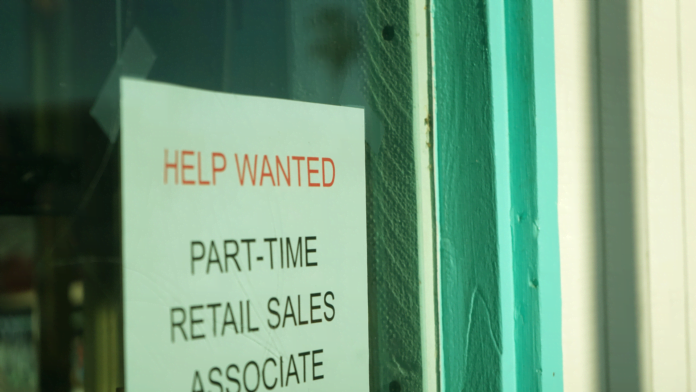
We’re almost there. Though the process has seemed slow and somewhat cumbersome, the rollout of COVID-19 vaccines is now well underway in every province and territory across Canada. Successful administering of its multiple types in numerous clinics throughout the country is allowing communities everywhere to move collectively and consistently toward our goal of reaching herd immunity. In conjunction with steadily decreasing cases reported, it means that we’re that much closer to a return to normalcy, or something like it, anyway. We’ll once again soon be able to gather, assemble and attend events; to enjoy interaction and engagement with our neighbours and communities at large. And, after such a turbulent and uncertain time, it also means that retailers will be able to start reopening their physical spaces to their customers, welcoming them back to the in-store environment that makes the industry so dynamic and exciting. However, according to Suzanne Sears, President of Luxury Careers Canada and retail staffing expert, it seems increasingly likely that their efforts to do so will be stunted in the midst of what she describes as a retail staffing crisis.
Suzanne Sears
“What retailers are going to be facing when they reopen their physical storefronts is the fact that at least 20 to 25 percent of the retail workforce is not going to come back in time to help create a great in-store environment and support the operation in general,” she says. “And, most importantly, they’re not going to return in time to save the fiscal year for most retailers. If you couldn’t sell much of anything between January and June, you’ve really got to hustle now to make up for those lost dollars. And you can’t do it if you don’t have people. I’m seeing it on a daily basis. Requests are coming in for staff from companies and locations that have never experienced a problem in this area before. In Montreal, for example, there are hundreds of vacancies within organizations. The idea of reopening and restarting is to generate income. And you can’t do that without people.”
Retail talent shortage
Recent Statistics Canada data highlights the issue, reporting that the Canadian economy lost 68,000 more jobs during the month of May, bringing the total of jobs lost since the start of the pandemic to 571,000. Given the fact that retail is by far the largest employment sector in the country, the impact of these lost jobs on the industry starts to become obvious for many. But what isn’t so evident to the casual observer, explains Sears, is the scale and magnitude of the impact, which she believes will show up primarily in a loss of sales and productivity for any retailer struggling with the challenge of filling roles within their organizations, which will be exacerbated by something of a multiplier effect.
“When you’re missing staff, you’re missing out on revenue equal to four-times their salary in the sales and products and services they deliver for the company,” she explains. “So, if you’re paying someone $50,000 a year and that position becomes vacant, you’re actually losing out on about $200,000 because of the vacancy. When you multiply that by dozens or hundreds of missing people, organizations will be losing money simply because of a shortage of talent. Some of that comes from lost sales because there isn’t anyone there to sell to the customer. Some of it comes from lost efficiencies in things like the supply chain. And some of it comes from overburdening existing staff who, because another position is unfilled, have to do two jobs at the same time, decreasing their efficiencies. Vacancies hurt organizations. And when the vacancies are this pronounced and widespread, they have the potential to hurt the entire industry.”
Multitude of factors
Sears is quick to point out the fact that vacancies had already been an issue for many retailers prior to the pandemic when fully ten percent of roles within organizations were unfilled. However, events of the past 16 months or so have resulted in a multitude of factors that are each contributing significantly toward the current talent shortage. Impacts of the pandemic have precipitated in many heightened concerns over safety, leading to an exodus from major urban centres and an unwillingness in those living outside of cities to commute for work. In addition, due to a halt on immigration to the country, the number of new Canadians, who fill a sizeable percentage of retail roles, both frontline and support, have decreased year-over-year, falling substantially short of Canada’s immigration targets. And students enrolled in post-secondary institutions have left their campuses, returning home and leaving the supporting part-time roles that they filled.
“All of these factors have combined to create a worrisome population gap for retail in many cities across the country,” she says. “The problem is most challenging in Montreal, Toronto, British Columbia and Manitoba. There just aren’t enough people willing to re-enter the workforce to fill the vacancies left by impacts of the pandemic. But, what’s perhaps even more troubling, posing potentially severe consequences, is the fact that women have been exiting the labour market at an alarming rate. Without full-time schooling and childcare services, many are unwilling or unable to return to work.”
Stability and security
Further Statistics Canada data indicates that more than 20,000 women exited the Canadian labour force between February and October 2020, representing the majority of jobs lost (55%) within the retail, accommodation and food services industries during that time period. Any of the factors lending to the crisis on their own would be cause for concern, says Sears, but cumulatively they are reflective of one of the greatest staffing challenges that Canadian retail has ever experienced. Add to the list some of the fundamental deficiencies within the offering of retail employment, and the challenge becomes even greater.
“The scope of benefits and incentives that retailers offer in order to attract people to the industry has got to improve,” she asserts. “Wages have got to increase and more paid sick leave, among other things, need to be afforded. But, more than anything, retailers need to offer a guaranteed number of hours to work. It’s the number one complaint among prospective employees – the fact that most within retail work a random schedule of hours that’s different every week. It leads to a perspective of retail as an unstable career and not something that’s desirable enough to be involved in. Providing consistency and security will be critical in retailers’ efforts to attract the right talent to their stores.”
Providing a healthy and safe environment
In addition to ensuring the financial stability that job seekers require, allowing them to meet their own budgets and pay for things like childcare, groceries, rent and other necessities, Sears believes that retailers must also provide the security of a safe and healthy environment to work within. Without having achieved vaccine herd immunity, many are not currently comfortable enough returning to the retail workplace. However, going forward, the retail staffing expert offers a way by which retailers can safeguard their physical locations and establish a safe setting.
“Retailers are going to need to demonstrate to prospective employees, in a tangible way, that showing up for work is not going to jeopardize their health or their lives,” she exclaims. “To do this, they’re going to need to implement significant measures in order to offset risk. As a result, employing a fully vaccinated staff is going to be crucial. It’s the issue that retailers are going to be confronted with tomorrow and into the foreseeable future. In order to do this, many will consider making ‘proof of vaccination’ as a term of employment within their organizations. I absolutely believe that this will gain traction within the industry very quickly and will become the way of the modern workforce. It’s really the only way by which retailers or any other business can ensure the health and safety of their employees and customers.”
Innovation and reinvention
As retailers in communities and cities across the country continue their preparations to reopen their operations to the public and reintroduce their offering, the need for many to fill the roles required to execute on their anticipated return is becoming increasingly dire. Sears recognizes the seriousness of the situation, describing the current staffing shortage as a pivotal moment in the near- and long-term future of retail in Canada. She adds that it could serve as a catalyst for real change within the industry, perhaps sparking a bit of much needed creativity in order to attract and retain the best of the best and ensure the continued growth and success of their businesses.
“Most of the jobs that have been lost during the pandemic are supporting part-time jobs. To start refilling these positions, retailers are going to need to invest into modernizing them with more flexible terms and conditions. They’re going to need to innovate and reinvent retail as a viable career again, offering clear paths to opportunity, success and promotion within the company that are easily documented and observable. As part of this, they’re going to need to offer training for their employees and teach them more, which almost always results in heightened engagement and productivity. There are a lot of changes that need to be made within the industry to meet the current challenges. The changes that are required need to come from leadership in order to empower human resources and the rest of the organization. And it needs to happen sooner rather than later, because they’re already fighting the battle from behind.”
For retail staffing support, contact Suzanne Sears, President, Best Retail Careers International Incorporated, by email: info@brcareers.com or phone: 289.795.6150, or visit https://brcareers.com/
This week, Craig and Lee talk about Craig’s analysis on The Hudson’s Bay Company’s potential redevelopment plans for its flagship locations in Canadian downtowns. Is it a good strategy or missed opportunity?
The Weekly podcast by Retail Insider Canada is available on Apple Podcasts, Stitcher, TuneIn, Google Play, or through our dedicated RSS feed for Overcast and other podcast players.
Drop us a line at Craig@Retail-Insider.com. You can also rate us in Apple Podcasts or recommend us in Overcast to help more people discover the show!
Background Music Credit: Hard Boiled Kevin MacLeod (incompetech.com). Licensed under Creative Commons: By Attribution 3.0 License. http://creativecommons.org/licenses/by/3.0/
The panel of experts will discuss how smart security systems and automation tools can help businesses drive value across the entire organization while arming HR, marketing and operations teams with valuable data insights that they need to navigate the tectonic shifts being seen over the course of the pandemic. You’ll learn how to:
Create ‘wow’ shopping experiences for your guests and embrace new trends such as curbside pickup
Proactively detect threats, minimize inventory loss and streamline business operations
Run more secure, efficient and profitable storefronts
As retailers reopen and gain capacity following lockdowns, theft and other security incidents are on the rise and need to be addressed. Technology now can also do much more. Join us next Wednesday for the free event by registering here.
*Retail Insider partnered with TELUS for this event. For more information, email: craig@retail-insider.com.