Advertisement
Home Blog Page 950

Canada’s Retail Supply Chain Network Strained and Warehouses Full Amid Increased E-Commerce

White semi truck on a highway. Photo: iStock

Canada’s retail supply chain network may be under strain right now due to the demand created by the COVID-19 pandemic, but for the most part, it has navigated through these turbulent and uncharted waters quite well according to one expert.

Marshall Toner, Managing Director and National Lead, Industrial – Canada for commercial real estate firm JLL, said that essential services are putting a strain on the Canadian supply chain system.

“If we look at any of our belongings at home, they are delivered by truck,” said Toner. “Keeping our drivers’ health and safety is paramount right now – otherwise the goods don’t move, even if they are available, especially when it comes to essential products.”

MARSHALL TONER

Toner emphasized that the supply chains have been doing an exceptional job at keeping grocers stocked up. He said that so far, there haven’t been apparent product shortages and that while some brands or high quantities may not be available at all times, customers are generally able to find what they are looking for.

Despite this, the outlook for non-essential products differs. Toner explained that products that are currently experiencing low or no demand may cause supply chain back-ups at multiple levels, and that suppliers may see shortages in warehouse space as manufacturers continue to ship out their stock.

Toner said, “We’re still fairly early in the outbreak to determine its impact on the supply chain network. There are no trends or historical data to compare the current situation to.”

“Usually we can base our predictions on events that have occurred in the past. In this case, there is no past event that I know of that we can use as precedent. Things change daily. People in charge of supply chain networks in Canada have done an admirable job of keeping supplies where they need to be, given the vast extremes of our country.”

Toner went on to clarify that early in the pandemic, there were some products that customers couldn’t find or were more challenging to get, but he hasn’t heard that complaint lately. “I think it’s a bit of a “wait-and-see” effect,” said Toner. “For every month this situation goes on, we’ll get a clearer idea on how our supply chain network is doing and where the strains are going to be – either at that given time, or into the future.”

Prior to the outbreak of COVID-19, the industrial real estate market across Canada was quite strong, particularly in Vancouver and Toronto, where vacancy rates were of about one percent or less. Montreal, Calgary, and Edmonton also all had pretty healthy markets.

Toner said that when Canada approaches some level of normalcy again following the pandemic, there will be a demand on the supply chain system because non-essential goods will begin to flow again.

What will companies learn through the current situation about their supply chain networks going forward?

“That’s really hard to pinpoint because I think every industry is likely looking to answer that question through a different lens,” said Toner. “In terms of essential service goods, I would say it could influence where we’re sourcing goods from or looking at having more than one supplier.”

When asked how the COVID-19 situation has affected buying patterns, he said, “We don’t know what the buying patterns are going to be like, I think it’s too early to tell. If we trend towards normalcy sooner than later, that will have an effect on how buying habits are either going to remain the same, alter, or totally change overtime. I don’t think anyone has the answer for that.”

Toner explained that companies with an e-commerce base that offer any kind of essential services are doing well now, and that their business has probably picked up. He suggested that they are probably going to see a change in the way their distribution or supply chain network works in order to meet the demand.

Toner said that overall, the supply chain network has done an excellent job of keeping the goods moving and available for consumers despite the challenges presented by the current COVID-19 crisis.

Looking forward, retail experts have suggested that many consumers have increasingly turned to online shopping, and perhaps have developed habits that will remain with them in the long term. This could impact the industrial real estate market of the future, with the availability of warehouse and distribution centre space becoming even more important.

JLL’s recent Q1 industrial research reports note that the Canadian Industrial market entered 2020 with sub three percent vacancy, double-digit rent growth, and a notable uptick in construction activity.

While the impact of the COVID-19 pandemic on the industrial market is still largely unknown, Toner says that JLL will continue to report on conditions as they evolve.

Canadian Apparel Brand DUER Pivots Business Model Amid COVID-19 Shutdowns

PHOTO: DUER

Since Vancouver-based apparel company DUER started in 2013, several crowdfunding Kickstarter programs have been created to finance the venture. That process – seeing where the demand was and then meeting it – allowed co-founder and president, Gary Lenett, to look at a more efficient, cost-effective way to get the customer what they wanted. It also gave him better insight into the amount of waste created by the apparel industry.

“Creating speculatory inventory, which everyone does, bringing it in (to stores) and then spending all this money on marketing, trying to sell it. It’s completely inefficient,” explains Lenett.

Especially when much of the unsold product is marked down at a deep discount to customers or outlet stores or ends up in the landfill.

So when DUER was forced, due to the COVID-19 crisis, to pivot, quickly and hard, Lenett and his team were ready with a new way of doing business.

DUER had just shipped most of its spring product to their wholesale network of retailers (approximately 1000 doors around the world). They had a solid business strategy and plans to expand. But, in mid-March, within a week they lost 70% of their business when two of three sales channels – wholesale and two retail locations of their own in Vancouver and Toronto – were forced to close.

E-commerce became the only source of revenue. And so they returned to their roots - and to their loyal customers - to help steer the ship.

Living Their Brand: How do You do More with Less?

“I went to our suppliers and said the world is changing, how are we going to respond?” describes Lenett.

They decided to change to a quick response model. They create and market a prototype of a product: new washes, new colours, or a completely new style. Customers order and then if enough of the design is purchased, Duer puts it into production and delivers the garment in 4 to 6 weeks.

DUER’s significant competitive advantage? Two of their four suppliers are also investors, (and one is a co-founder).

“I didn’t want just a supplier, I wanted people who were going to support and build a brand, long-term,” explains Lenett, a 30-year veteran of the apparel industry. “I’ve been in the business long enough and I know the only constant is change. I needed people who would be invested.”

And that’s why they were able to get traction on the new way of doing business so quickly. They’re turning the main mode of sales - from brick and mortar stores to online pre-sales - from concept to delivery in 8 weeks.

Keeping it Simple

DUER came out of Lenett’s personal ambition to make a pair of pants that are versatile and comfortable, no matter what activity you’re doing. But he’s also a self-described “fashion guy”, so he didn’t want his clothes to be too outdoorsy, either. They took streetwear and made a comfortable, technical product that is fashionable enough to go from day to evening events without losing its impact or stylishness.

“We have a “core basic program”, which is seasonless, so there is less waste,” he points out. “It’s sophisticated but we’re not slaves to fashion. We have three proprietary fabrics with different colours and washes.”

PHOTOS: DUER

“When our customers tell us (through our website, by taking out their credit card) that there is enough demand for a product, then we’ll put it into this core program.”

He believes customers will support this new paradigm in the apparel industry for several reasons: it will be less expensive (DUER plans to pass the savings from production efficiency onto their customers) and there is less waste. There will be a 4- to 6-week wait for customer delivery but its a small price to pay for more sustainable clothing.

Get Dressed. Get Real. Get on with it.

“It’s a bit of an anti-consumerist message, our brand statement. We’re just giving some really good, basic products you can wear throughout your day that are easy-care,” he says. “So you can focus on what’s important.”

While Lenett is hesitant to make predictions about the retail garment industry’s future, he does admit that the predominant view is that the pandemic will be catastrophic for independent clothing retailers.

“Our retail plan will be very aggressive, once the market opens up again,” Lenett predicts. “We have three new stores slated but there may be more. But that’s because of our business model where we have this direct supply chain.”

PHOTOS: DUER

Lenett describes DUER as a ‘Surprise and Delight’ brand which are found just off the prime shopping district. They create ‘denim playgrounds’ in each of their stores, with monkey bars and swings, so their stores are at least 800 square feet. Customers can try out the product and play around (to see how it fits and moves).

“We’re only going to open one location per city,” he says. “It’s more about projecting our brand than sales.”

His Advice for Other Retailers

“Chaos can reward the bold. Find new ways of doing things, there are a lot of options,” Lenett says. “I’ve been in this business a long time and I know we’ll get through this. The singular trait that you need in this industry, or any retail, is resiliency. If you have the resolve, you’ll be OK. It won’t be easy but you’ll be OK.”

And DUER seems to be doing more than OK. They’re currently exceeding their pre-COVID-19 E-commerce sales projections by 25 percent, with 20 percent of the original budget. Not bad for a small business that began with Kickstarter financing.

Preparations Begin the Reopening of Retail Stores in Canada: RCC

The Retail Council of Canada is working with an international consultancy group to develop a framework for the retail industry to prepare for the eventual reopening of stores across the country when the COVID-19 (coronavirus) crisis is finally over.

Diane Brisebois, President and CEO of the Retail Council of Canada, told Retail Insider the organization has engaged the Boston Consulting Group, a global management consulting firm, to assist in a recovery plan for the industry.

“We need to develop a Retail Recovery Playbook. We have set up special retailer task forces reflecting the different categories and sizes of retailers we represent across Canada that will work with RCC and the the Boston Consulting Group in the coming weeks and months,” said Brisebois.

“We are developing a framework, resources, and tools to assist retailers in preparing for the next stages of the recovery. We will also be reaching out to the different stakeholders who serve the retail community to better coordinate, collaborate, and harmonize approaches.”

“We are pro-actively reaching out to all levels of government to ensure that the recovery guidelines and regulations are as harmonized as possible and mirror the needs of the sector, their employees and customers and we are also looking at other countries such as Germany to integrate best practices into our plan.” 

Cadillac Fairview, a prominent landlord of some of the biggest malls in the country, said in a statement: “At Cadillac Fairview, we are committed to ensuring our employees, partners and communities stay safe and healthy as we plan our recovery.

“Like many in the industry, we are actively planning for reopening and what ‘open’ could look like. In addition, members of our team sit on various industry associations such as BOMA (Building Owners and Managers Association), who are sharing best practices based on early learnings from other countries.

CF TORONTO EATON CENTRE. PHOTO: CADILLAC FAIRVIEW

“Assessing this across our national portfolio, we don’t foresee this being a one size fits all approach and will of course, be acting in accordance with provincial and local public health guidelines. Our current plan is scenario based, with a focus on supporting our clients’ recovery and serving the communities where we operate. This includes partial openings, continued social distancing guidelines, and a phased return of the broader workforce, to name a few areas we are focused on.”

Brisebois said what happens next for the retail industry is critical and transformative. “It will be different. It will be challenging. It will require operational flexibility. It will also require different knowledge, different competencies, different standards and those are all important issues that retailers need to start addressing,” she said.

And they need to start putting these plans in place now.

“We’ve brought some of the smartest people around the virtual table in order to think about what we need to address and what we need to implement,,” said Brisebois.

Hand of woman holding paper bags enjoy with shopping in the mall.

“It’s not just store operation, store hours,  store design, staffing, supply chain or your ecommerce business. It’s also about  understanding how consumers will shop, what they will shop for, and how much they will be able to spend post COVID-19. 

“What are the new social norms? What does social distancing mean post COVID-19?  What will be expected of retailers and shopping malls during and after the recovery? There’s so much that needs to be thought through because this is something we’ve never really experienced and it’s something that is changing our world as we know it.”

The playbook will provide  guidance and resources for both small and larger retailers. RCC appreciates that an independent retailer with one or two locations may face different challenges and issues than regional or national chain.

“So we’re really going to dive deep to try to help all our retailers get back on their feet,” said Brisebois.

Downtown Vancouver Amid the COVID-19 Shutdown: Walking Tour [Photos]

DUNN’S TAILORS. PHOTO: LEE RIVETT

By Lee Rivett and Craig Patterson

Downtown Vancouver, which is usually busy during the day, is a virtual ghost town as people isolate at home amid the COVID-19 pandemic. The ‘non-essential’ retailers, restaurants and other businesses in the city have shut down for the most part, with some restaurants open for take-out while some are even selling grocery items.

Retail Insider’s Lee Rivett toured parts of Vancouver’s downtown core and took photos for this article. The following is a description of what was seen, including some details of what is to come — retail will see significant changes amid restructuring and bankruptcies as some stores will never reopen, while other new stores will be unveiled once the situation reaches normalcy or as some are calling it, the ‘new normal’.

The tour begins at the corner of Granville Street and Pender Street, where menswear retailer Dunn’s has announced that it will never reopen. Prior to COVID-19, sources had said that the retailer was struggling and was looking to close. The clearance is likely to continue in a few weeks when stores are permitted to open again, and bargain hunters looking for store fixtures may also want to have a look.

AVENUE ROAD (FURNITURE) AT 301 W PENDER STREET DURING COVID-19 PANDEMIC. PHOTO: LEE RIVETT

The Avenue Road furniture store at 301 W. Pender was featured in Retail Insider in 2018 when it opened. The store is a stone’s throw away from Victory Square park leading towards the Downtown Eastside and Gastown.

HOLT RENFREW AT GRANVILLE STREET AND DUNSMUIR STREET DURING COVID-19 PANDEMIC. PHOTO: LEE RIVETT

The 190,000-square-foot Holt Renfrew store at the northwest corner of Granville Street and Dunsmuir Street has closed temporarily, and the main floor is currently boarded up to prevent thefts. The Vancouver Holt Renfrew store was the chain’s top performer prior to its closure. Affluent Chinese shoppers were the store’s most lucrative demographic. Given that we don’t know when borders will be opened again for tourism, this Holt Renfrew store could take a further financial hit in the months to come. Below are more photos taken outside of the Holt Renfrew store at CF Pacific Centre.

REGULAR HOLT RENFREW CLADDING (CHANEL) WITH BOARDED WINDOWS TO THE RIGHT WHICH WERE PAINTED WHITE. PHOTO: LEE RIVETT
FEUILLE (NEXT TO BABOR BEAUTY SPA) ON HOWE STREET ACROSS FROM HOLT RENFREW DURING COVID-19 PANDEMIC. PHOTO: LEE RIVETT

Above: The upscale streetwear retailer Feuille has shut temporarily and its facade has been boarded up. The retailer carries merchandise that is sometimes priced into the thousands of dollars. Feuille also operates the impressive two-level Off-White store in Vancouver’s ‘Luxury Zone’ which was featured in Retail Insider when it opened in April of 2018.

MINISO ON GRANVILLE STREET DURING COVID-19 PANDEMIC. PHOTO: LEE RIVETT

The shuttered Miniso store on Granville Street has seen better days. Retail Insider has received several concerning emails from Miniso franchisees. It remains to be seen what the future of Miniso will be in Canada — when the retailer entered the country in 2017, it said that it planned to open 500 stores, possibly the most aggressive retail expansion in Canadian history. Many franchised locations have already closed permanently while corporately owned stores may reopen in a few weeks.

SWIMCO ON GRANVILLE STREET (IN HUDSON BUILDING) DURING COVID-19 PANDEMIC. PHOTO: LEE RIVETT

Calgary-based swimwear brand Swimco has boarded up its facade as it has shut temporarily. Last year Retail Insider featured owner Lori Bacon on a podcast.

CAFE CREPE ON GRANVILLE STREET DURING COVID-19 PANDEMIC. PHOTO: LEE RIVETT
ARITZIA ON GRANVILLE STREET (PART OF THE CF PACIFIC CENTRE) DURING COVID-19 PANDEMIC. PHOTO: LEE RIVETT

Above: the Artizia store at CF Pacific Centre has shut temporarily. CF Pacific Centre itself can be entered at certain times of the day, though only a handful of food retailers are operating within.

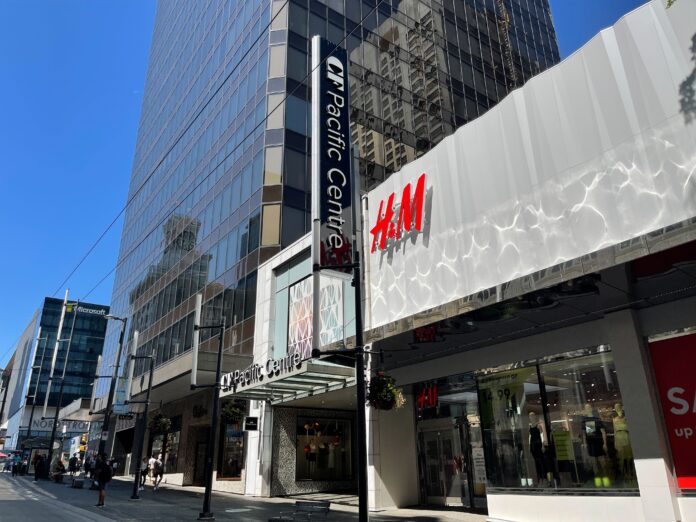
The H&M flagship store, above, expanded last year by adding a third level on the concourse level of CF Pacific Centre. At almost 40,000 square feet, the H&M store is the second-largest in Canada. Until 2007, Holt Renfrew occupied the space prior to moving up the street to its current and much larger location.

Above: Nordstrom’s Vancouver flagship store, which opened to much fanfare in September of 2015, has boarded up parts of its facade until it is permitted to reopen. Until recently, the Vancouver store was said to be the company’s top performer, though a new Nordstrom location in Manhattan is expected to surpass Vancouver’s numbers. Given the uncertainty around tourism in Vancouver, the city’s Nordstrom store could take a sales hit in the months to come and even beyond.

SEPHORA AND HARRY ROSEN OFF OF DUNSMUIR STREET AND HOWE STREET DURING COVID-19 PANDEMIC. PHOTO: LEE RIVETT

The photo above is looking south from the corner of Dunsmuir Street and Howe Street. The Sephora store at the corner, located within CF Pacific Centre, will be relocating to another space within the mall when construction is finished (and stores are permitted to reopen). Amachris Corporation is building out the Sephora space.

Luxury menswear retailer Harry Rosen, which operates a highly productive location above Sephora, was said to be seeing sales per square foot in the $2,000 range prior to the temporary shutdown. Menswear, generally, is expected to see a sales hit as some men may work from home more in the future.

HOTEL GEORGIA AND HAWKSWORTH RESTAURANT AND THE CF PACIFIC CENTRE ATRIUM FROM HOWE STREET AND GEORGIA STREET DURING COVID-19 PANDEMIC. PHOTO: LEE RIVETT

The photo above is looking towards the intersection of W. Georgia Street and Howe Street. The glass ‘igloo’ atrium at CF Pacific Centre will soon be demolished for what sources speculate will be a flagship Apple store. Below is a closer look at the soon-to-be-lost glass igloo.

EMPTY ART GALLERY PLAZA ON GEORGIA OVERLOOKING CF PACIFIC CENTRE’S NORDSTROM AND MICROSOFT DURING COVID-19 PANDEMIC. PHOTO: LEE RIVETT

The north plaza at the Vancouver Art Gallery is an important meeting place. It was deserted on a sunny Saturday afternoon, which is indeed unusual. CF Pacific Centre and Nordstrom can be seen behind it.

HUDSON’S BAY AT GEORGIA STREET AND SEYMOUR STREET NOT BOARDED UP DURING COVID-19 PANDEMIC. PHOTO: LEE RIVETT

Above and below: the 637,000-square-foot Hudson’s Bay store at the northeast corner of Granville Street and W. Georgia Street has been shuttered temporarily. The store was in line for further renovations at some point. Prior to the COVID-19 shutdown, we were going to report that for the first time, menswear had been introduced into luxury department ‘The Room’ on the store’s second level. Some had speculated that Saks Fifth Avenue could occupy part of the building as is the case in Toronto, and now some are questioning if Saks will even keep its Canadian stores operational particularly given low sales numbers at the CF Sherway Gardens store in Toronto as well as at the CF Chinook Centre location in Calgary.

SASSO MODA ON GEORGIA STREET (ACROSS FROM HUDSON’S BAY) DURING COVID-19 PANDEMIC. PHOTO: LEE RIVETT

Above: A shuttered fashion boutique at the northeast corner of W. Georgia Street and Seymour Street. Most of the block will eventually be demolished for a new development that insiders have said will be “spectacular” and “unlike anything in Canada” to date.

SASSO MODA COVID-19 SIGNAGE WITH BARE SHELVING WITHIN. PHOTO: LEE RIVETT
FOOT LOCKER ON ROBSON STREET AT HORNBY STREET DURING COVID-19 PANDEMIC. PHOTO: LEE RIVETT

Above: The tour takes a turn onto Robson Street, where artists have painted murals on some boarded up store facades. The Foot Locker store occupies a prominent location at the northwest corner of Robson Street and Hornby Street. The 800 block of Robson Street has been under construction to permanently close the street to vehicle traffic, which will shift vehicle movements in parts of the downtown core when construction is finished in the fall.

SALVATORE FERRAGAMO ON ROBSON STREET OFF HORNBY STREET DURING COVID-19 PANDEMIC. PHOTO: LEE RIVETT

Italian brand Salvatore Ferragamo is the last remaining luxury brand on Robson Street. The temporarily closed store was the first Ferragamo location in Canada when it opened in the late 1980’s. In the 1980’s as well, a ‘Les Musts de Cartier’ store was located on the 700 block of Robson Street and other upscale fashion brands located on the 1000 and 1100 blocks of Robson Street at a time when some referred to it as Robsonstrasse.

VICTORIA’S SECRET AT BURRARD STREET AND ROBSON STREET DURING COVID-19 PANDEMIC. PHOTO: LEE RIVETT

A massive Victoria’s Secret flagship store has temporarily closed at the northeast corner of Robson Street and Burrard Street. Some are questioning if the store will eventually close, and some are questioning the fate of the chain generally. Industry insiders speculate that Japanese retailer Uniqlo could eventually replace Victoria’s Secret at that corner.

LULULEMON STORE AT BURRARD STREET AND ROBSON STREET DURING COVID-19 PANDEMIC. PHOTO: LEE RIVETT

Lululemon’s flagship store at the southeast corner of Robson Street and Burrard Street has shut temporarily. The store will be expanding into an adjacent space on Robson Street that was until a few months ago occupied by Australian footwear retailer UGG. The UGG brand was in the process of shutting its remaining three Canadian stores prior to the pandemic closures. Below is another photo of the same Lululemon flagship store.

KIEHL’S SINCE 1851, ROCKY MOUNTAIN CHOCOLATE AND SUNGLASS HUT ON ROBSON STREET DURING COVID-19 PANDEMIC. PHOTO: LEE RIVETT

The photos in this section of this article were taken on the 1000 block of Robson Street. Many facades have been boarded over and artists have painted murals. Some are saying that some retailers on Robson Street may never reopen, which is also the case for many streets and malls across the country.

ALDO STORE ON ROBSON STREET DURING COVID-19 PANDEMIC. PHOTO: LEE RIVETT
INDIGO AND ALDO STORES ON ROBSON STREET DURING COVID-19 PANDEMIC. PHOTO: LEE RIVETT

Canadian retailer Indigo probably should have included artwork on its boarded up facade — graffiti has ensued and has otherwise been an issue in parts Vancouver for years. Indigo opened its Robson Street store in 2018 after remodelling a space formerly occupied by Forever 21. The Forever 21 brand exited Canada last year after its US parent company filed for bankruptcy.

SEPHORA STORE ON ROBSON STREET DURING COVID-19 PANDEMIC. PHOTO: LEE RIVETT

Above is the impressive two-level Sephora store on Robson Street’s 1100 block. The store opened to much fanfare in the fall of 2014. A construction site next to it will house at least one large retailer.

BANANA REPUBLIC AND ARITZIA AT INTERSECTION OF THURLOW STREET AND ROBSON STREET DURING COVID-19 PANDEMIC. PHOTO: LEE RIVETT

Retailers at the corner of Robson Street and Thurlow Street have closed, with boarded up storefronts featuring artwork at the three-level Banana Republic store as well as messaging at Artizia’s flagship store. Below are more photos of both stores.

BANANA REPUBLIC AT THURLOW STREET AND ROBSON STREET DURING COVID-19 PANDEMIC. PHOTO: LEE RIVETT
ARTIZIA AT THURLOW STREET AND ROBSON STREET DURING COVID-19 PANDEMIC. PHOTO: LEE RIVETT
MUJI ON ROBSON STREET DURING COVID-19 PANDEMIC. PHOTO: LEE RIVETT

Above and below are photos of the Muji store on the 1100 block of Robson Street. When it opened in December of 2017, it was the largest Muji store outside of Asia with more than 14,000 square feet of space. Last year an expanded 20,000-square-foot Muji store in downtown Toronto took that title.

LADUREE, STEVE MADDEN AND NELSON BAILEY ON ROBSON STREET DURING COVID-19 PANDEMIC. PHOTO: LEE RIVETT

The photo above shows vibrant artwork on the boarded up facade of the Steve Madden store on the 1100 block of Robson Street. Next to it is Ladurée which opened to long lineups in the spring of 2016. Below is a closeup photo of Ladurée, which is taking online orders on its recently revamped Canadian website.

LADUREE ON ROBSON STREET DURING COVID-19 PANDEMIC. PHOTO: LEE RIVETT
REIGNING CHAMPION AND EDDIE BAUER ON ROBSON STREET DURING COVID-19 PANDEMIC. PHOTO: LEE RIVETT

Above is a photo of the temporarily closed Reigning Champ and Eddie Bauer stores on the 1100 block of Robson Street. It remains to be seen if Reigning Champ reopens and if it does, for how long.

PAUL FRENCH BAKERY AND CAFE CONSTRUCTION SIGNAGE ON ROBSON STREET DURING COVID-19 PANDEMIC. PHOTO: LEE RIVETT

French bakery concept Paul was set to open its first Canadian storefront on the 1100 block of Robson Street in the near future. It is across the street from Ladurée, and both businesses are owned by the Holder Group.

UNCLE TETSU CONSTRUCTION SIGNAGE ON ROBSON STREET DURING COVID-19 PANDEMIC. PHOTO: LEE RIVETT

Downtown Vancouver’s first Uncle Tetsu Japanese cheesecake location will eventually open on the 1100 block of Robson Street. Its first location opened at Metropolis at Metrotown a couple of years ago.

CHOPARD BOUTIQUE ON W GEORGIA STREET ACROSS FROM FAIRMONT VANCOUVER DURING COVID-19 PANDEMIC. PHOTO: LEE RIVETT

The next leg of the tour includes Vancouver’s ‘Luxury Zone’ area, which spans the area between the Fairmont Hotel Vancouver to the East and the Shangri La and Trump hotels to the west. The Chopard store on the 900 block of West Georgia Street has been boarded up temporarily.

Below are several photos of shuttered retailers at the Fairmont Hotel Vancouver. Owned by Larco, the retail component of the hotel features five major luxury brands: Louis Vuitton, Dior, Omega, Gucci, and St. John Knits.

FAIRMONT VANCOUVER DURING COVID-19 PANDEMIC. PHOTO: LEE RIVETT
GUCCI BOUTIQUE AT FAIRMONT VANCOUVER DURING COVID-19 PANDEMIC. PHOTO: LEE RIVETT

Above: The Gucci store at the Fairmont Hotel Vancouver, featuring frontage both on W. Georgia Street as well as Hornby Street, is shut temporarily. The store is said to be moving to a new 8,000-square-foot space in the area in 2021.

DIOR BOUTIQUE COMPLETELY EMPTY FROM WITHIN FAIRMONT VANCOUVER DURING COVID-19 PANDEMIC. PHOTO: LEE RIVETT

Above and below: The 9,600-square-foot two-level Dior flagship is shut temporarily. The store was the largest Dior location in North America when it opened in the summer of 2015. In the fall of 2019, a 14,300-square-foot Dior flagship store opened at 131 Bloor Street West in Toronto and that store currently holds the title of the largest Dior location on the continent.

DIOR BOUTIQUE DOORS BOARDED AT FAIRMONT VANCOUVER DURING COVID-19 PANDEMIC. PHOTO: LEE RIVETT
LOUIS VUITTON BOUTIQUE DOORS NOT BOARDED AT FAIRMONT VANCOUVER DURING COVID-19 PANDEMIC. PHOTO: LEE RIVETT

Above and below: The 10,000-square-foot two-level Louis Vuitton flagship at the Fairmont Hotel Vancouver has shut temporarily, and merchandise has been removed from within. The store was the largest Vuitton ‘Maison’ in Canada when it expanded in 2011. A year later, Louis Vuitton opened an 18,000-square-foot, two-level Maison at 150 Bloor Street West in Toronto.

LOUIS VUITTON BOUTIQUE COMPLETELY EMPTY AT FAIRMONT VANCOUVER DURING COVID-19 PANDEMIC. PHOTO: LEE RIVETT
LOUIS VUITTON BOUTIQUE AT FAIRMONT VANCOUVER DURING COVID-19 PANDEMIC. PHOTO: LEE RIVETT

Above: Louis Vuitton’s Burrard Street facade — the brand has been at the Hotel Vancouver for nearly 20 years and was only about 4,000 square feet when it first opened.

HERMES AT BURRARD STREET AND GEORGIA STREET IS CLOSED BUT NOT BOARDED UP DURING COVID-19 PANDEMIC. PHOTO: LEE RIVETT

The photos above and below are of the impressive Hermes flagship store which opened in September of 2019. We featured the store, as well as the history of Hermes in Vancouver, in an expansive article last year. Hermes occupies nearly 6,000 square feet at the southwest corner of Burrard Street and W. Georgia Street within The Burrard Building, which also houses Tiffany & Co. (seen in the photos above) as well as Birks-operated Graff and Pakek Philippe boutiques, Rimowa, a Jimmy Choo boutique featured in this publication, and another jeweller which has not yet announced its new store facing onto Alberni Street.

HERMES GATES CLOSED TO PUBLIC DURING COVID-19 PANDEMIC AT BURRARD STREET AND GEORGIA STREET. PHOTO: LEE RIVETT
PAPYRUS (PREVIOUSLY CLOSED) AND COACH ON BURRARD STREET NEAR ROBSON STREET DURING COVID-19 PANDEMIC. PHOTO: LEE RIVETT

Above is the storied 755 Burrard Street building. A Coach store features an art-filled boarded up facade — in the 1990’s, a Chanel boutique occupied the wider space where Coach is while the smaller space to the right was once home to a franchised boutique for french luxury brand Celine. The Papyrus space at 755 Burrard Street had already been vacated by the tenant following its bankruptcy several months ago.

OLD HERMES LOCATION AND TIFFANY & CO AT ALBERNI STREET AT BURRARD STREET DURING COVID-19 PANDEMIC. PHOTO: LEE RIVETT

The photo above was taken from in front of the Louis Vuitton store, looking down the 1000 block of Alberni Street. To the right of this photo is a Tiffany & Co. flagship store occupying nearly 10,000 square feet of space over two levels. The corner retail space on the left of this photo was until recently occupied by Hermes prior to its relocating to its larger space at 717 Burrard Street. French jeweller Cartier will replace Hermes in the corner location of the 755 Burrard building.

OLD HERMES LOCATION WITH EMPTY DISPLAYS VISIBLE FROM WINDOWS DURING COVID-19 PANDEMIC. CARTIER WILL REPLACE IT. PHOTO: LEE RIVETT
OLD ITALIAN KITCHEN LOCATION, JIMMY CHOO AND RIMOWA ON ALBERNI STREET DURING COVID-19 PANDEMIC. PHOTO: LEE RIVETT

The photos above were taken on the 1000 block of Alberni Street, considered to be the heart of Vancouver’s ‘Luxury Zone’. Over the past seven years, luxury brands have opened boutiques in the area which has made it a destination.

JIMMY CHOO AND RIMOWA ON ALBERNI STREET DURING COVID-19 PANDEMIC. PHOTO: LEE RIVETT
SUKI’S, VACHERON CONSTANTIN AND MONTBLANC ON ALBERNI STREET DURING COVID-19 PANDEMIC. PHOTO: LEE RIVETT
VACHERON CONSTANTIN AND MONTBLANC ON ALBERNI STREET DURING COVID-19 PANDEMIC. PHOTO: LEE RIVETT

Above: French luxury conglomerate Richemont Group operates several luxury brands on the 1000 block of Alberni Street. Richemont’s other Canadian store clustering is located at the Yorkdale Shopping Centre in Toronto.

ALBERNI STREET NEAR BURRARD STREET DURING COVID-19 PANDEMIC. PHOTO: LEE RIVETT
BLACK + BLUE RESTAURANT AND KOBE RESTAURANT ON THE 1000 BLOCK OF ALBERNI STREET DURING COVID-19 PANDEMIC. PHOTO: LEE RIVETT
THIERRY RESTAURANT ON THE 1000 BLOCK OF ALBERNI STREET DURING COVID-19 PANDEMIC. PHOTO: LEE RIVETT
OLIVER PEOPLES ON ALBERNI STREET DURING COVID-19 PANDEMIC. PHOTO: LEE RIVETT

Upscale optical retailer Oliver Peoples opened one of its two Canadian stores last year on the 1000 block of Alberni Street in Vancouver. The little store is impressive inside, though it’s currently hidden behind the painted boarded up facade.

HUBLOT, DE BEERS AND TONY BURCH ON ALBERNI STREET DURING COVID-19 PANDEMIC. PHOTO: LEE RIVETT

Above is The Carlyle retail complex on the 1000 block of Alberni Street. A 2013 renovation saw substantial updates that included a marble facade as well as the addition of luxury brands. Those include watch brand Hublot, diamond brand De Beers, women’s fashion brand Tory Burch, Italian luxury brand Prada, French luxury brand Saint Laurent, Italian fashion brand Moncler, and in the laneway behind, an impressive Off-White store.

In years past, The Carlyle was an underwhelming complex housing a 7-Eleven convenience store as well as a Dollar Tree location which opened in 2012. In the late 1990’s, duty free retailer DFS Galleria opened a 25,000-square-foot store at The Carlyle, though it had to shutter as it never got the rights to sell duty free goods. A former duty free store up the street had won those rights and it operated for years before seeing a spectacular downfall in sales after a tour bus parking space was removed from in front of it.

BURBERRY ON THURLOW STREET AND ALBERNI STREET DURING COVID-19 PANDEMIC. PHOTO: LEE RIVETT

Above: Canada’s first standalone Burberry boutique opened more than a decade ago at the base of the Shangri La hotel at the corner of Alberni Street and Thurlow Street. Last year the store was doing well in terms of sales, though the Alberni Street area was already starting to see a sales decline amid a reduction in tourism as well as a crackdown on money leaving China.

THURLOW STREET AND ALBERNI STREET INTERSECTION DURING COVID-19 PANDEMIC. PRADA IS ON ONE CORNER TO THE LEFT, AND VERSACE ON THE CORNER TO THE RIGHT. PHOTO: LEE RIVETT
THURLOW STREET AND ALBERNI STREET INTERSECTION FACING EAST DURING COVID-19 PANDEMIC. PHOTO: LEE RIVETT
BRUNELLO CUCINELLI AND VERSACE ON THURLOW STREET NEAR ALBERNI STREET DURING COVID-19 PANDEMIC. PHOTO: LEE RIVETT

Brunello Cucinelli opened its first standalone Canadian store at 745 Thurlow Street in 2015, and Versace opened its second standalone store in Canada next to it the same year. Plywood was being placed over the facade of the Versace store on Saturday.

VERSACE ON THURLOW STREET NEAR ALBERNI STREET DURING COVID-19 PANDEMIC. PHOTO: LEE RIVETT
PRADA AT ALBERNI STREET AND THURLOW STREET DURING COVID-19 PANDEMIC. PHOTO: LEE RIVETT

Above is the 8,500-square-foot two-level Prada flagship which is located at the southeast corner of Alberni Street and Thurlow Street in The Carlyle — the space is very impressive. Below are photos of the shuttered Saint Laurent and Moncler boutiques at The Carlyle which both face onto Thurlow Street.

PRADA, SAINT LAURENT AND MONCLER ON THURLOW STREET NEAR ALBERNI STREET DURING COVID-19 PANDEMIC. PHOTO: LEE RIVETT
LEONE BOUTIQUE CLOSING SIGNAGE (ANNOUNCED PRIOR TO COVID-19 PANDEMIC). PHOTO: LEE RIVETT

The tour now takes a turn to the upscale part of West Hastings Street. The photo above is of the soon-to-permanently-close Leone store at the Sinclair Centre at 757 W. Hastings Street (corner of Howe Street). We reported earlier this year that the storied store would shutter permanently after opening its impressive space in 1987.

BIRKS ON GRANVILLE STREET DURING COVID-19 PANDEMIC. PHOTO: LEE RIVETT
THE POST ON GEORGIA STREET WITH CONSTRUCTION CONTINUING DURING COVID-19 PANDEMIC. PHOTO: LEE RIVETT

The final two photos, above and below, are of the construction site of ‘The Post’ on W. Georgia Street in downtown Vancouver. Landlord QuadReal is developing the massive building which will eventually include a Loblaw City Market grocery store as well as a food hall and other retailers. Post-pandemic, it is unclear how people will embrace crowded food halls in Canada and elsewhere.

THE POST ON GEORGIA STREET WITH CONSTRUCTION CONTINUING DURING COVID-19 PANDEMIC. PHOTO: LEE RIVETT

If you’ve made it to the end, thank you for reading our photo tour of downtown Vancouver. Feel free to comment below with any thoughts. What will downtown Vancouver look like when stores reopen again?

Why Canada isn’t Running Out of Food During the Coronavirus Pandemic

LONG LINES OF MASKED SHOPPERS WAIT TO SHOP FOR GROCERIES IN TORONTO ON APRIL 9, 2020. PHOTO: THE CANADIAN PRESS/FRANK GUNN

By Michael von Massow and Alfons Weersink

We are living through a period in which many jurisdictions have shut down virtually all non-essential commerce. People are working from home or have been temporarily laid off.

We have seen rushes on food and grocery items like toilet paper and hand sanitizer that have resulted in some short-term shortages in stores.

Some have questioned the resilience of our food system and whether we could run out of food. The easy answer is we are not running out of food. Our food system has proven to be robust and resilient and shortages are demand-based rather than supply-based.

We have cheap food. It doesn’t always feel like it, but Canadians spend among the lowest proportion of our income on food in the world. Canadians who don’t live in remote communities have an abundance of safe and affordable food. We also have an incredible diversity of food products available.

Stores are Restocking

Yes, we have seen some shortages on grocery store shelves. But we have seen stores restocking regularly, and the expectation is that the system will catch up.

The just-in-time process used in our food system, in fact, is not unique to food supply chains. It is based on producing and shipping product to meet expected demands. It depends on accurate forecasts and smooth delivery.

We have seen a significant surge in demand as people buy large quantities in anticipation of being at home for long periods of time. This was exacerbated by panic buying, when people saw shortages in the store or heard of shortages in news reports. Products are being quickly restocked, even though they’re often snapped up quickly.

We will see a return to some semblance of normality reasonably soon — at least with respect to food stocks in stores. This is supported by policies at stores that are limiting quantities that people can purchase.

Demand for things like hand sanitizer continue to be high. Demand for other food products will probably stabilize relatively quickly, even if people continue to hold extra stock at home. Grocery stores have seen an increase in demand for food as restaurants are closed, but that simply shifts demand from food service distribution to supermarket distribution, and isn’t leading to food supply shortages.

We are also seeing larger individual shopping orders as consumers minimize the number of times they have to go to the grocery store.

MILK PROCESSORS HAVE LOST A SIGNIFICANT CHUNK OF THEIR MARKET DURING THE PANDEMIC, LEAVING DAIRY FARMERS WITH NO ONE TO TAKE THEIR MILK AND FORCING SOME FARMERS TO DUMP IT. PHOTO: PAT SUTPHIN/TIMES-NEWS

Milk Dumping

While there have been some shortages at grocery stores, we’ve also seen reports of farmers dumping milk or plowing down crops.

This is caused by the requirement for adjustments in the food system. As demand has decreased in food services, it’s increased in retail. So why is milk being dumped and why are crops being mowed down?

It’s because raw product needs to be diverted to new processors and products, and other products need to be diverted to different processors. Some products require packaging changes. Professional bakers buy industrial-sized bags of flour, for example, but most retailers won’t normally carry that size.

These adjustments take time, and for perishable products like milk and produce, storage isn’t available. These adjustments are now under way and products are beginning to flow through supply chains more normally.

No Border Closures

Food supply chains have been protected from border closures this far, and that’s expected to continue. The most important border for Canada’s food supply chain, and that of the United States too, is the Canada-U.S. border. More than half of our food imports come from the U.S.

During the winter months, we import more. But fresh local produce is available to most Canadians in the warmer months.

Even if the border closed, we would still not go hungry. We would have less fresh produce, but we’d still have Canadian apples and root vegetables in storage. We would also have frozen products available.

Given the sales forecasts for these items, we probably wouldn’t begin to run short until the Canadian growing season had kicked in. But there would be bread, milk, meat, and cheese readily available. We might see a decrease in variety, but we wouldn’t run out of food. And there’s no indication that there’s any risk of the border closing in the short run.

WOMAN GROCERY SHOPS WHILE WEARING A MASK AMID COVID-19 PANDEMIC

Food Processing Could be Impacted

One area of concern is the processing sector. There are fewer processing plants than there are both farmers and retail stores.

If plants close, production stops. We have seen the temporary closure of a pork processor in Québec due to COVID-19 and a big beef plant in Alberta has temporarily closed.

The Québec plant is reopening and the Alberta plant has shut down to mitigate the risk of employees getting sick. While there is not yet a fixed date for the Cargill plant in Alberta to re-open, it is expected to be soon. These short-term closures can cause hardships, particularly for farmers, but shouldn’t significantly affect availability on grocery shelves.

While the Cargill represents almost 40 per cent of the beef processing capacity in Canada, our beef industry is highly integrated with the American industry with both livestock and beef products flowing in both directions.

Plant closures would cause losses for perishable products like milk or produce. But for meat producers, livestock can be diverted or held until processors reopen. This can cause significant losses for farmers. Prices go down with extra supply and if livestock has to be shipped further and costs go up if animals have to be held. But unless the number of closures increases dramatically and closures are enduring, we will continue to see food on grocery shelves.

Overall, our food system has bent but not broken in the face of unprecedented demand. We can remain confident that we will have food available as we work our way through the peaks of the pandemic.

This article was originally published in The Conversation. Read the original article here.

Mike von Massow is a faculty member in the Department of Food, Agricultural, and Resource Economics at the University of Guelph. His research focuses on consumer perception of and demand for food in both retail and food service contexts. He also studies value/supply chains that bring food to the market.

Alfons Weersink is a faculty member in the Department of Food, Agricultural, and Resource Economics at the University of Guelph. His research focuses on the impact of government policies and new technology on the agri-food sector.

Newly Announced Commercial Rent Assistance (CECRA) Program Insufficient According to Many Retailers & Businesses in Canada

Property Leasing Discussions

When Prime Minister Justin Trudeau announced last week the Canada Emergency Commercial Rent Assistance (CECRA), it was hailed by many as a saviour for many small businesses who are struggling to stay alive.

But days later after the program has been digested and analyzed, many are questioning and wondering how effective it will actually be as several issues have been raised about the program. And May 1 rent is closing in on thousands of beleaguered businesses across the country.

Basically, CECRA will provide forgivable loans to qualifying commercial property owners to cover 50 percent of three monthly rent payments that are payable by eligible small business tenants who are experiencing financial hardship during April, May, and June; the loans will be forgiven if the mortgaged property owner agrees to reduce the eligible small business tenants’ rent by at least 75 percent for the three corresponding months under a rent forgiveness agreement, which will include a term not to evict the tenant while the agreement is in place and the small business tenant would cover the remainder, up to 25 percent of the rent.

Impacted small business tenants are businesses paying less than $50,000 per month in rent and who have temporarily ceased operations or have experienced at least a 70 percent drop in pre-COVID-19 revenues.

Laura Jones, Executive Vice-President of the Canadian Federation of Independent Business, said the national organization has been hearing two big concerns from members.

“The first one is the question about whether their landlord will participate in the program,” said Jones. “And the second one is around the threshold being too high. You have to show a 70 percent revenue reduction. There are many businesses who are in pretty rough shape who have a 50 percent reduction or a 60 percent reduction and they’re not eligible for the program.

“But even for those who are eligible for the program, they’re worried that their landlord isn’t going to participate. It’s up to the landlord. There’s a lot of power right now with this program with the landlord and that’s probably the biggest concern we’re hearing.

“As May 1 looms there’s a big question mark as to what degree this is going to solve the problem. We know from our survey results that in theory business owners like the idea that everyone has a share in this and that the landlord and the tenant and government all help pay for the rent. In theory. But in practice there’s a lot of worry that this isn’t going to work.”

The other major initiative with the program is that it doesn’t apply to bigger companies and retailers who are paying $50,000 a month in rent.

Closed businesses for COVID-19 pandemic outbreak, closure sign on retail store window banner background. Government shutdown of restaurants, shopping stores, non essential services.

“There’s not a lot of clarity yet in terms of how that will work,” said Jones, adding that the average rent for small business owners in Canada is $10,000 per month. “Many will be covered but there are some that won’t be.”

Jon Shell, Managing Director & Partner of Social Capital Partners in Toronto, and co-founder of the grassroots coalition of small businesses across Canada called SaveSmallBusiness.ca, said the reluctance of the Canadian federal government and its provincial governments to institute a moratorium on commercial evictions is leaving hundreds of thousands of small business owners at the mercy of their landlords.

“In Canada, the decision on whether to impose a moratorium on commercial evictions has been left to the provinces, as this is within their jurisdiction. But only a couple of provinces have done this, leaving the vast majority of Canadian businesses exposed to being locked out of their premises if they can’t make rent,” said Shell in a LinkedIn post.

“At Save Small Business what we’re hearing from all over the country are stories of businesses being threatened with evictions and deals being signed for rent deferrals that are heavily weighted to the landlord. There are some cases of landlords actually reducing rent, but they are very few and very far between.”

In an interview with Retail Insider, Shell said the lack of moratoriums is the biggest problem with the program right now.

“Some landlords are saying this is a pretty good deal so let’s do this. But other landlords are saying I’ve got all the cards here. I don’t need to take any haircut. So I’m not going to. And we’ve certainly heard from tenants who have said that their landlords are refusing to even engage on this deal.

“The deal itself I think is pretty good. The issue is there’s no forcing mechanism.”

The Fitness Industry Council of Canada said it appreciates the Prime Minister’s announcement regarding the Canada Emergency Commercial Rent Assistance Program, but for the fitness industry, this only covers single clubs and studios and does not address the need for a solution for regional and national organizations who have rent more than $50,000 per month.

“The Fitness Industry Council of Canada has been working to push this legislation through by engaging in conversations with the government at various levels,” said Scott Wildeman, FIC President. “We appreciate this significant step in helping to support the thousands of fitness establishments that have been hit so hard during this crisis.”

As of 2019, there are nearly 6,800 clubs across the country, with more than six million members and this represents revenue of nearly $3 billion USD. All fitness facilities in Canada closed as of mid-March, with the majority having cancelled their monthly fees immediately.

The Council said landlords across the country are urged to support this federal initiative and provide flexibility to tenants who are facing these challenging times. Together, through this program, landlords and tenants will be able to assist thousands of fitness business establishments across Canada.

David Lefebvre, Restaurants Canada Vice President, Federal and Quebec, said while full details on the Canada Emergency Commercial Rent Assistance program have yet to be released, the organization is encouraged by what the federal and provincial governments have brought to the table so far.

“This program responds to one of the biggest concerns for restaurants right now, but we’ll need to see the full details to assess whether this program will make a meaningful difference. Restaurants Canada is now in the process of gathering feedback from members and will continue to work with government to address any gaps,” he said.

Landlords are also wondering about specifics of the program. How is rent defined? Base rent or does it also apply to common area maintenance and property taxes.

Also, it appears as if the government is only providing assistance to landlords who have a mortgage on their property.

When and How Consumers Will Shop Again after Stores in Canada Re-Open

By Antony Karabus and Farla Efros

With malls empty, stores shuttered, and consumers sequestered within the safety of their homes, we can’t help but wonder: How long will retail remain on hold to counter the spread of COVID-19 and what will the sector look like when it’s time to reopen?

The most difficult question might be: Which retailers will make a come-back and which will not survive?

Leveraging 30 years of experience advising retailers and having witnessed many ups and downs — though none as drastic as the COVID-19 situation — we offer the following predictions on the return of consumer demand and the changes we should anticipate. We suggest actions that retailers can take to mitigate the new normal in the near to mid term.

Digital generated devices on desktop, responsive online shop on screen.

COVID-19 has Accelerated the Momentum of the Shift of Sales from Stores to Digital

While the retail sector experienced a significant sales shift from brick and mortar to digital over the past 10-plus years, that relative rate of growth (still 10+ times above the brick and mortar sales growth) had actually been decelerating over the last three years as the digital channel began to mature. In 2019, brick and mortar sales still represented between 70 and 85 percent of total retail sales, depending on the sector. That reality confirms that most people still prefer to shop in-store where they can appreciate the touch, feel, and interaction of the store experience.

We believe the pandemic will accelerate digital’s growth trajectory, returning us back to the 30% + percent growth rate when digital channels first emerged as a meaningful factor in the retail sector. We will also see an accelerated shift from traditional hybrid brick and mortar/digital retailers to online-only merchants such as Amazon, as well as increased market share by retailers selling “essential” items such as Walmart and those operating in the grocery, drug, home improvement, dollar, and certain essential service-related retail sectors. Those shifts will put added pressure on chains selling “discretionary” items. Amazon’s stock price is now well over USD 2,300, reflecting its incredible 30% plus growth in 2020 versus the 20% it achieved in 2019

While we believe consumers will eventually return to brick and mortar stores selling discretionary items, they will do so at a slower rate until they feel more secure. Additionally, each province will govern the conditions of the return, which might slow down consumers even more if for example consumers are mandated to wear masks in malls The record rise in unemployment levels today is over four times the record high seen in 1982, which, together with the resultant threat of large-scale bankruptcies, is promoting tremendous economic uncertainty among consumers. We are hopeful that the large-scale, expanded unemployment benefits and wage subsidies by government will mitigate some of these insecurities.

Where a consumer lands on the spectrum will dictate the shape of the demand curve.

While some speculated in March that retailers will experience a V-shaped consumer demand curve, bouncing back to the way it was before, we see a different outcome. Consumer demand will be somewhere between a U and an L-shaped curve, as we predict the upward slope of the demand curve will be a lot shallower on the way back up than the decline was on its way down.

For each retailer, the upward slope of that curve will be totally dependent on the nature of the products they sell – and the relative feeling of economic insecurity of the socio-economic audience it serves.

Two main issues will affect the consumer demand curve: Where consumers lie along the wealth spectrum and the essential versus discretionary nature of items being purchased. For essentials, it’s a V-demand curve. For discretionary items, we expect a slow return, with the best case being a U-shaped demand curve and a longer period before the upward curve starts rising again.

In order to forecast what their year after re-opening will look like, every retailer must determine where their customers fall along the socio-economic spectrum. In the past, wealthy consumers shopped without hesitation thanks to substantial disposable income and overall feelings of wealth, feelings largely contingent on a booming stock and real estate market and large annual bonuses in a growing economy. But, with large stock market declines and the likely vanishing of bonuses for at least a year, even the more affluent consumers will be likely be more cautious. With retailers now cancelling orders, what will even be available ie the choices or styles to tempt consumers back to spending on non discretionary items.

So how will the current situation impact this demographic? We predict that consumers with higher net worth and disposable income will continue to shop for discretionary items. Still, they will likely reduce that spending until the stock market and other asset values rebound.

Due to financial instabilities, including sharply rising unemployment, the lower- to-mid income shopper will be too concerned with how they’ll pay their rent/mortgage to spend much on discretionary items. For the next while, their purchases will be focused on the essentials, with survival and stability the primary concern.

Being Proactive Will Help Retailers Mitigate the New Landscape

The impact of the pandemic will no doubt be detrimental for numerous retailers and will accelerate the need for restructuring or even creditor protection. Keep in mind, many retailers have only five to ten months of liquidity now. If they are going to survive long-term, it’s critical that retailers adopt important steps once consumers return. Only by being proactive will they be able to effectively tackle the many challenges they will undoubtedly face. Retailers selling fashion apparel will need to fortify their balance sheets to be able to withstand the shock of the sudden sharp decline in consumer demand. Many of these apparel chains will need to withdraw from numerous weaker locations (given the anticipated acceleration of the traffic declines in the weaker locations with anticipated greater consumer unemployment and financial insecurities) and to invest heavily in their digital and omni-channel capabilities to adapt to the acceleration in the shift to digital from stores.

For example, what retailers have in stock today are spring and summer goods. By the time consumers come back, however, we’ll be heading towards back to school/college and the fall season. Retailers will need to take a hard look at their inventory and determine which items are basics that can be packed away for next year and which items will need to be liquidated or disposed of for being seasonably inappropriate. The largest and strongest retailers will continue to grow and thrive, including leaders such as Walmart, Costco, Sobeys, Loblaw, Home Depot, Lowes, Lululemon, Aritzia, Couche-Tard, and Canadian Tire all having strong, well-established brands. Retailers like Indigo should thrive as well given their focus on books, and leisure/lifestyle (including books on baking, cooking, and other related topics) all critical categories when people are at home and school comes to an end and likely this summer will be the summer of “staycations”.

Of course, retailers will need to find ways to ease the feelings of nervousness by consumers who will be wary about shopping in large crowds and will need to feel safe in stores again.

HRC Retail Advisory recommends five key steps for retailers to safeguard their businesses

  1. Closely manage cash flow. Liquidity will be the most important determinant of a retailer’s ability to survive until this crisis is over, and to possibly even thrive long-term. Prioritize all payments carefully in relative importance to long-term sustainability. Develop robust rolling 13-week cash flow forecasts and minimize surprises for lenders, bankers and suppliers.

  2. Maintain regular communication with staff and outside stakeholders, including employees, lenders, suppliers, and landlords. As with every crisis, this one will end too. What’s essential today is to communicate in a way that supports future viability after the crisis is over.

  3. Carefully manage inventory risk. The closer your inventory comes to “consumer essentials” or “all-year-round basic products,” the lower your markdown and inventory risk. If much of what you sell is seasonal fashion or discretionary, there’s a greater likelihood of a significant margin risk. Develop the right disposition strategies and tactics to minimize the pain and to help generate cash flow to assist with liquidity. Determine what purchase orders to cancel from what suppliers by considering the relative importance of those suppliers to your future after the crisis

  4. Re-prioritize capital spending into essential initiatives to “keep the lights on,” initiatives that will drive future profitability and working capital and lastly others that are entirely discretionary without clear payback. The initiatives without strategic or financial payback will likely be deferred

  5. Strengthen e-commerce and related fulfilment capabilities. A robust e-commerce and omni-channel capability both now and after the coronavirus crisis ends, will position retailers well for the re-start of retail

The effects of COVID-19 will be long-lasting. We hope these recommendations will provide retailers with a clearer picture of what to expect and when after stores re-open. And, by taking these important steps, retailers will be able to pick up the pieces and move forward once the devastation is complete.

This article was modified from an article authored by Antony Karabus in WWD on April 10, 2020.

Farla Efros is President and Co-Founder of leading strategic retail consultancy HRC Advisory.

Antony Karabus is CEO and Co-Founder of leading strategic retail consultancy HRC Advisory.

How Much are Online Reviews Actually Worth?

By Keatext

Today, as more and more retail brands face a struggle for survival —shuttering their brick-and-mortar stores and losing revenue in the process—making the shift from in-store to online sales has never been so urgent and so necessary.

Even without calculating for the current pandemic upending retail on an unprecedented scale, double-digit growth YoY in the eCommerce share is set to represent 22% of USD 29 Trillion global sales by 2023—and 57% of global sales growth is expected to be driven by this increase in online purchasing. Almost overnight, brands have become reliant on online sales.

REVIEW DATA IS AVAILABLE — AND SO IS THE SOLUTION TO HIGHER SALES

Brands that stood out as the forerunners of online sales are rushing alongside late-adopters to embrace a new mode of online marketing and selling. What does that new mode look like? It’s going where consumers are and asking where people are shopping online, how they’re weighing their purchasing decisions, and why they’re buying. This new mode of marketing and selling taps into a wealth of online consumer review data that’s already out there—and growing.

Review data shows brands what consumers are saying in their own words, without lag time. Consumers’ sudden reliance on online shopping coupled with a decrease in people’s trust in advertising (83% don’t trust advertisements) means brands can’t afford to not be in control of their reviews and those reviews’ value to marketing.

Sophisticated AI customer feedback management solutions put review data front and centre as a marketing channel for community management and consumer insights. Those insights directly and accurately inform marketers so they can craft a customized e-commerce environment tailored to engagement, conversions and high sales.

Are retail brands ready for this transition today? The reviews are out there waiting for brands to make a move towards stronger, sales-driving connections with their customers. Equipped with the ability to analyze reviews through an AI solution, brands can leverage each and every customer review today.

WHERE DATA FITS INTO RETAIL INDUSTRY CHANGES

Customers are now being hit with more advertising, email blasts, pop-up deals, and other brand marketing in every facet of their online lives. With all that noise, it’s more difficult than ever for marketing to get their message through. And even then, is the customer listening?

The retail industry’s embrace of digital avenues and big data has led to more personalized and customizable marketing strategies that make use of, for example, real-time recommendations for customers as they online shop and human-like chatbots that support customers in decision-making and purchasing.

Yet even with these advances some things remain the same: people still buy on emotion and justify with logic. Emotional decision-making has its own, personal logic and richly diverse context. Today, marketers who understand this are tapping into new data-driven ways to emotionally connect with customers and implementing an unprecedented level of personalization in their marketing strategies.

INSIDE THE CUSTOMER FEEDBACK GOLDMINE

In reviews, customers don’t only talk about products, they talk about how these products fit into their lives. In essence, they talk about who they are—from simple likes and dislikes to lifestyle preferences.

Looked at individually and in targeted groupings, these reviews provide reasons for purchasing, repurchasing or dissatisfaction while also providing an even more valuable emotional, psychological context for other consumers and for marketers.

Feedback is not a goldmine of information for information’s sake; it’s a goldmine because customer reviews impact buying decisions. A goldmine because it describes habits, routines, lifestyles, and preferences. That form of feedback is the kind that makes a significant difference when converting customers and maintaining customer loyalty.

EVERY PIECE OF FEEDBACK IS A BUSINESS OPPORTUNITY

Customers regard brands and even their related companies as more than manufacturers or service providers: they form value-based and emotional relationships with them. Customer feedback has become an integral part of that relationship, with hundreds of thousands of customers sharing their thoughts in reviews on multiple public websites.

  • 91% of people regularly or occasionally read online reviews, while 84% of those people trust reviews as much as a personal recommendation.

  • 95% of consumers are influenced by online reviews for their purchase.

  • A +0.1 star rating can increase conversion rates by +25%.

  • A brand with excellent reviews can experience a +31% spend increase.

  • More than four negative reviews about a company, brand or product can decrease sales by 70%.

Considering the high impact of reviews on conversion rates, strategic marketing campaigns and advertising may be in vain without a comprehensive and accurate way to manage and leverage customer feedback.

WHY REVIEW DATA SHOULD LEAD MARKETING STRATEGIES TODAY

Customer reviews are as effective as word-of-mouth. People want to hear from each other about their lived experiences with products—and people trust each other more than they trust brands and their products.

These online reviews should be understood as peer-to-peer conversations and valued for the insight they can provide to marketers. So it’s no surprise that so many customers consult reviews before making a purchase. Reviews provide a form of peer-to-peer guidance. The information in reviews is perceived by consumers as less biased and more trustworthy than a brand’s advertising.

Currently, 83% of customers don’t trust advertising and most of those customers choose to pay attention to—and trust—other customers’ peer reviews online:

  • 94% of consumers trust social media influencers more than a friend for their purchase.

  • 74% of consumers rely on recommendations shared by influencers for their purchase.

  • 73% of consumers think written reviews are more important than star and number ratings.

On top of that, consumer conversion rates also increase when brands themselves engage with online reviews. A brand that responds to 32% of customer reviews may see 80% higher conversion rates than a similar sized brand replying to 10% of reviews.

ALL CONTEXTUAL REVIEW DATA CAN DRIVE CONVERSION RATES

Every review can represent a potential sale—it’s all about context. Even a negative review can be understood as a positive: when one person writes, “This face cream makes my oily skin even oilier!” a consumer who is looking for a product to moisturize their dry skin might just add the face cream to their online shopping cart.

Catching those nuances of contextual detail in reviews is where a feedback management solution makes all the difference to understanding customers and what makes them buy. AI feedback analysis speeds up and focuses this process in a situation such as today’s, where time is of the essence.

Beyond analyzing customers’ online reviews, a fast and effective AI customer feedback solution solves retail brands’ short-term needs for connecting with customers in a time of rapid change to the retail sector, with its channel shift from in-store sales to online purchasing. In the longer term, AI data analysis helps companies readily adapt to future changes in the retail sphere, letting a brand keep conversion rates up while other players try to weather the storm.

HOW PUBLIC, FREELY AVAILABLE REVIEW DATA CONNECTS BRANDS TO CUSTOMERS

The massive surge of digital data in the expanded online retail sector has resulted in a wealth of information about who’s buying, what brands are selling, and why. While the goldmine of customer feedback is out there, the sheer amount of it can seem overwhelming to even the most seasoned marketing strategist.

The volume of unsolicited feedback is a double-edged sword for brands: both a new opportunity to get to know and connect with customers and a challenge in managing customer expectations and ensuring that their requests and problems are satisfactorily addressed.

However, looked at through the lens of AI data management, that feedback is all opportunity. Sophisticated AI text-analytics provides insights to take advantage of opportunities and resolve challenges via a data-driven marketing strategy. Those thousands of reviews that once seemed inaccessible and overwhelming will launch brands towards greater engagement, increased sales and brand growth.

AI data analysis is a key business development tool for staying in immediate and lifelong touch with customers’ needs and behaviours. When applied to publicly available product reviews, data analysis opens the door for brands to tap into customer preferences and purchasing behaviour as they change with global news and trends.

MOVE INTO RETAIL’S FUTURE WITH AI ANALYSIS

Digital data has opened multiple windows into the complex arena of customer needs and behaviours. As a tool that can take a brand’s retail marketing strategy from being a response to industry trends to being a trendsetter, a comprehensive AI customer feedback solution stands out as the most advanced, future-oriented choice. With data-driven insights, brands can accurately and confidently strategize for higher sales and brand growth.

Ready to start really understanding your customer feedback?

Schedule a free demo here.

Retailers Among Canada’s Most Trusted Brands Amid COVID-19: Study

Walmart store exterior

The retail industry in Canada fares very well when it comes to gaining the trust of Canadian consumers during the current COVID-19 (coronavirus) pandemic.

A recent survey by Field Agent Canada indicated that Canadians like the hard efforts made by retailers to keep the food supply chain safe and plentiful and that is gaining favour with consumers.

Jeff Doucette, General Manager of Field Agent Canada, said the company asked 603 Canadians which three brands were gaining their trust during the current crisis.

Stocking up on disinfectants to prevent the spread of germs during virus outbreak

The following are the brands mentioned by Canadians:

  1. Lysol, 23.1 per cent;

  2. Costco, 15.1 per cent;

  3. McDonald’s, 11.6 per cent;

  4. Walmart, 10.9 per cent;

  5. Tim Hortons, 9.1 per cent;

  6. Superstore, 9.0 per cent;

  7. Loblaws, 8.5 per cent;

  8. President’s Choice, 6.8 per cent;

  9. Clorox, 5.6 per cent;

  10. Sobeys, 5.6 per cent;

  11. Amazon, 5.5 per cent;

  12. Purell, 5.0 per cent;

  13. Shoppers Drug Mart, 4.6 per cent; and

  14. Kirkland-Signature, 4.3 per cent.

“Once you got past Lysol, they were very retail and food service centric,” said Doucette. “Lysol I think just because people are cleaning the heck out of their homes, trying to keep this bug away. That’s the brand they’ve been turning to. The other CPG (consumer packaged goods) brand that is in the top 10 is Clorox. Both of those have that germ-killing heritage in their brand. People have just been turning to them as go-to products to help keep their homes clean.

“It was a bit of a surprise to me to be honest that there were so many retail brands integrated in there. Looking at the data, the things that stand out to me is one COSTCO is the second most mentioned brand in that study. When you think about COSTCO, we’ve seen the lineups outside the stores. We’ve seen the volumes there. But I think they’ve been really good at doing the social distancing and controlling the amount of items that people were stockpiling or trying to do that. It did surprise me that they were the highest mentioned retailer just given that they only have 100 stores across Canada and you have to have a membership to shop there. But definitely a brand that people have gained trust in over the past few weeks.”

Costco Wholesale store in south San Francisco bay area

Doucette said one of the things that retailers have been really good at - what’s been strong - is that they’ve kept the wheels on the food supply chain despite huge surges in volume.

“It’s really been amazing to see how the retailers - and the suppliers - but the retailers are the front lines of that, have really stepped up to manage a huge surge of volume as people stopped eating in restaurants and started eating all their meals at home,” said Doucette.

“That was one piece. The second piece was really the communication that we’ve seen. We’ve seen amazing corporate communications. I regularly get emails from Michael Medline (President and CEO of Empire Company which owns Sobeys) or Galen Weston (Executive Chairman of Loblaw Companies) just kind of keeping people up to date on what is happening.

McDonalds worker holding bag of fast food.

“And I think the third piece is they’ve taken customer safety and staff safety really serious and you’ve seen that evolve over time. It might be the pathways marked on the floor or it might be the screens that are put up in front of the cashiers. All of those things are adding up to really improve the brand image in the minds of Canadians. They’ve really stepped up.”

Doucette found it interesting that Amazon was not in the top 10 list.

“I’m not an e-commerce skeptic but I like to temper the idea of e-commerce. We know that e-commerce is up and people are ordering from Amazon and they are ordering groceries online from Walmart and Loblaws. But at the end of the day the retailers that had the highest levels of trust or gains in trust were bricks and mortar retailers with stores,” he said.

“Amazon is on the list. They’re number 11 out of 14. But they’re not number one. I always like to temper that shift of people’s train of thought that says everyone is starting to buy their groceries online and from Amazon. That’s not what’s playing out. This shows me at the end of the day that brick and mortar retail is still very important to Canadians and they are brands that they trust.”

Canadian Footwear Brand ‘Vessi’ Triples Sales Amid Goodwill Initiatives

PHOTO: VESSI FACEBOOK PAGE

A Vancouver-based footwear retailer has turned the concept of ‘doing good’ into a smart business practice as the company has three times its sales since embarking on the community goodwill initiative.

Vessi, a direct to consumer sneaker company, recently turned to its online community to ask how it could give back and then launched a series of initiatives for COVID-19 (coronavirus) relief.

Tony Yu, co-founder of the company who focuses on the marketing and business development and strategy side of the business, said giving back to the community is the right thing to do.

“The community is like what brought us up. If we can give back to our community, we’re effectively making our home even a better place,” said Yu. “It’s one of the core things from our founders’ perspective but we also feel kind of obligated to help be that voice of our customers. How can we give back?”


View this post on Instagram


Apply via our #linkinbio!⁠⠀ ⁠You know your community best. ⁠⠀ ⁠⠀ Over the past few weeks we’ve been blown away by the initiatives of our community in the fight against COVID-19. From creating a volunteer network of grocery deliveries, 3d printing PPE, to buying meals for our frontline healthcare workers, we realized that you know your community best. ⁠⠀ ⁠⠀ This is why we’ve set up the Vessi Community Fund – a fund to support our everyday heroes who are looking to make a difference through small acts of kindness within their community.⁠⠀ ⁠⠀ To kick start things off, we’re giving away $1,000/day to support 10 community projects daily. Everyone is welcome to apply, no project is too small – we’ve got your back.⁠⠀ ⁠⠀ Apply today and tag a friend – let’s create moments of happiness and #makewaves⁠ 🌊

A post shared by Vessi (@vessifootwear) on

“We shifted a lot of our existing marketing budget over to community relief efforts.”

The online retailer has given away 2,000 free sneakers to health-care workers, launched a ‘pay what you can’ model to donate 400,000 face masks, and created a Community Fund Program to give away $100,000 for initiatives launched in the community. It also started Vessi TV giving the community ways to stay healthy and cope with the coronavirus crisis.

Yu said the fund supports small community projects - everything from volunteers delivering groceries and medicine, to people making face masks and personal protective equipment.

“However we can use this fund to enable small pockets of happiness now that’s really the mandate,” he said.

Vessi was founded in 2017 but it launched publicly in September 2018.


View this post on Instagram


These past few weeks have been so enlightening while we've connected with our healthcare communities. We've learned so much about all the moving parts and the importance of the essential-services fighting COVID-19. Thank you for sharing your stories with us and binding our communities together!⁠⠀ ⁠⠀ Our mission to help during this pandemic is far from finished. We are bursting with ideas to keep us all connected, supported and uplifted during this hard time. ⁠Stay tuned and follow along for all of our next steps.⁠⠀ ⁠⠀ For the time being, our Choose What you Pay sale in support of fundraising PPE for Canadian and US healthcare workers is still on for a limited time! ⁠⠀ ⁠⠀ To the healthcare workers, thank you for including us on your journey! We're all in this together.⁠⠀ ⁠⠀ Have any questions or suggestions on how we can stay involved? Leave us a comment below to connect!⁠⠀ ⁠⠀ Vessi⁠⠀ ⁠⠀ 📸⁠⠀ 1. @ohlacherie⁠⠀ 2. @awesomemom2000tv⁠⠀ 3. @hwebber01⁠⠀ 4. @brooke.vdb⁠⠀ 5. Sarah and the Maple Ridge Urgent & Primary Care Team⁠⠀

A post shared by Vessi (@vessifootwear) on

COVID-19 definitely put a damper on the retailer’s expansion plans.

“We’ve had a really good experience with retail stores when we set up our pop up stores. So that was a pretty big disappointment. We were in the process of actually designing a proper retail front. We have our locations really set up like an experience centre. You can walk into the store, slip on a pair of shoes from our shoe bar and then walk through water inside the stores. We’ve built out this whole feature set,” said Yu.

But when that was put on hold the company began thinking creatively on how it could help the community and give back to the community.