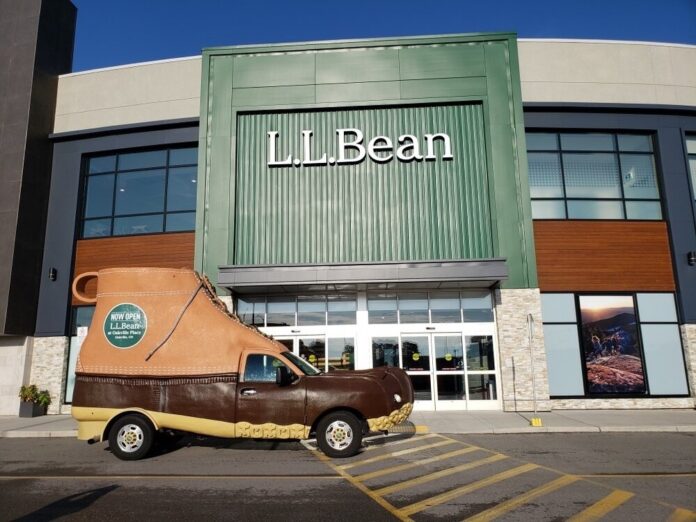
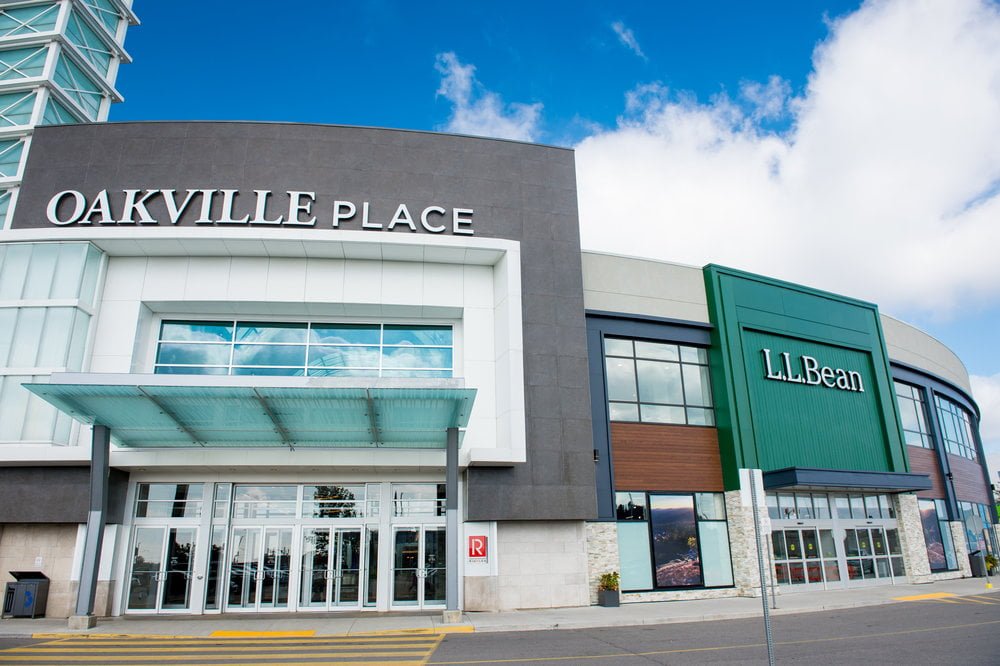
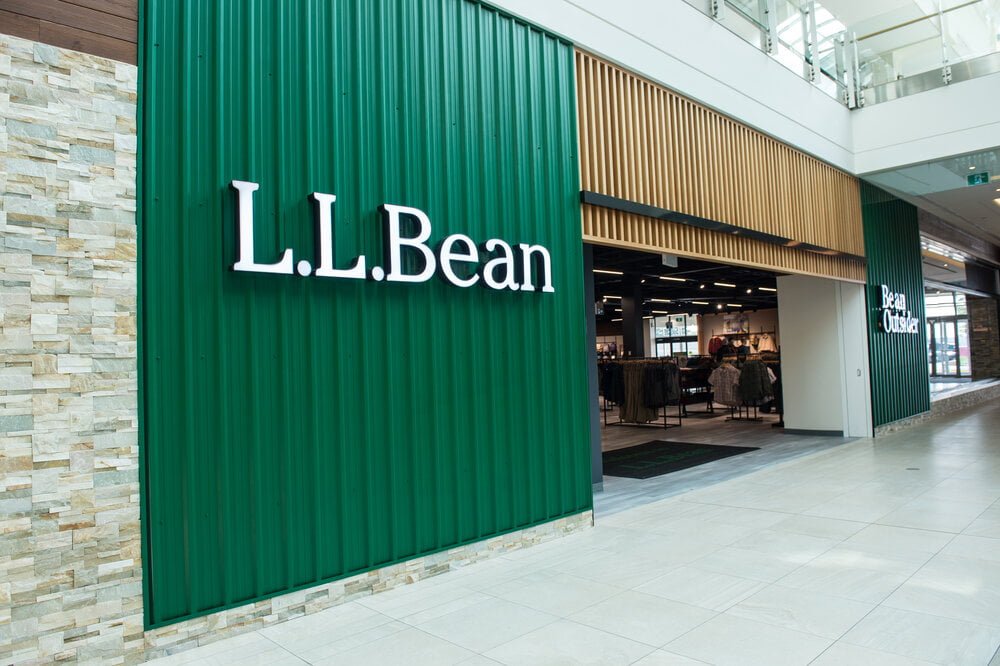
Exterior of Oakville L.L.Bean store. Photo: L.L.Bean
U.S.-based outdoor specialty retailer L.L.Bean has announced four more Canadian stores that will open in 2021 as the company ramps up its Canadian expansion into new markets. Each of the four stores will be firsts for the Victoria, Vancouver, Calgary, and Halifax markets and indicates confidence in brick-and-mortar retail in Canada.
Business grew by 100% in 2020 according to L.L.Bean in a statement, prompting the continued Canadian store expansion despite the pandemic. Toronto-based Jaytex Group has the exclusive license for L.L.Bean stores and wholesale distribution in Canada. Privately-owned Jaytex was founded in 1978 and features a portfolio of private label and lifestyle brands licensed in Canada.
“Despite the hurdles that the pandemic presented, in 2020 we successfully opened three new L.L.Bean retail locations in Ontario and saw strong overall performance in the Canadian market,” said Howie Kastner, President of Jaytex Group. “This continued success speaks to the inherent love of the outdoors and eagerness for new adventures that Canadian customers share with the brand. We look forward to continuing to explore opportunities across Canada and support this growing customer base.”
Exterior of L.L.Bean first Canadian store at Oakville Place. Photo: George Pimentel
Exterior of L.L.Bean first Canadian store at Oakville Place. Photo: George Pimentel
“While 2020 posed many challenges to our business, including the temporary closure of all retail stores, we are committed to increasing our brick-and-mortar presence in order to serve more communities,” said L.L.Bean President and CEO, Stephen Smith. “We know that a record number of people reconnected with the outdoors amidst the pandemic, some for the first time, and we see these new habits remaining firmly in place going forward.”
The four new Canadian stores will open over the course of three months, with the first this summer.
A store at Victoria’s Mayfair Mall will open in August and it will be located on the south side of the mall near a large Aritzia store. Mayfair is considered to be the leading enclosed shopping centre property in the Victoria area and is anchored by a Hudson’s Bay department store. Other large retailers include Toys R Us, Indigo, and Sport Chek. The centre spans more than 500,000 square feet on one level and has over 100 stores within.
In September, L.L.Bean will open its first Calgary store at the Deerfoot Meadows shopping complex. Deerfoot Meadows is a 320,000-square-foot hybrid outdoor outlet concept with 45 tenants anchored by Nordstorm Rack and Atmosphere. Adjacent retailers include Ikea and a Walmart Supercentre. Deerfoot Meadows is also within close proximity to CF Chinook Centre which is considered to be the leading enclosed shopping centre property in the region.
1 of 6
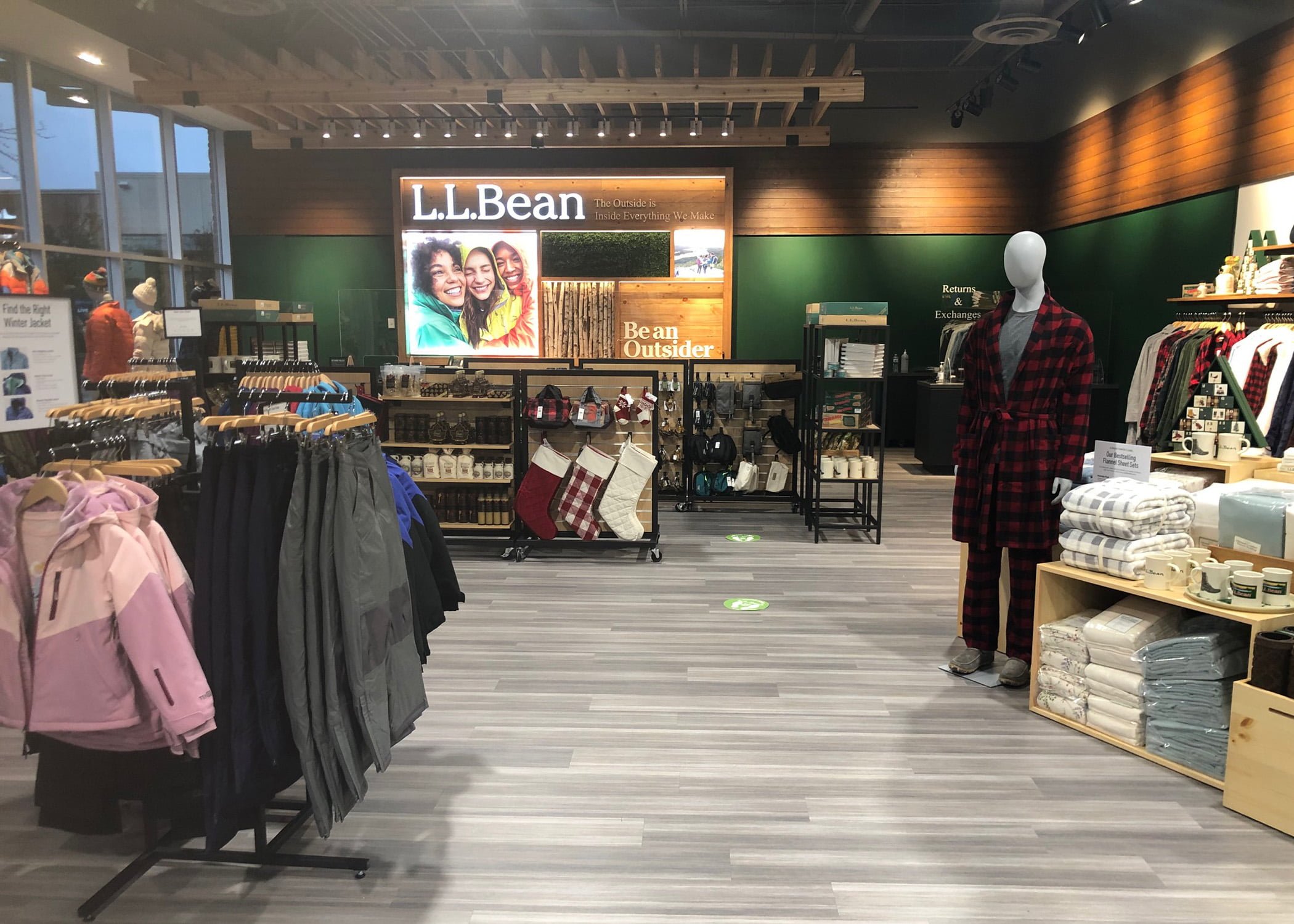
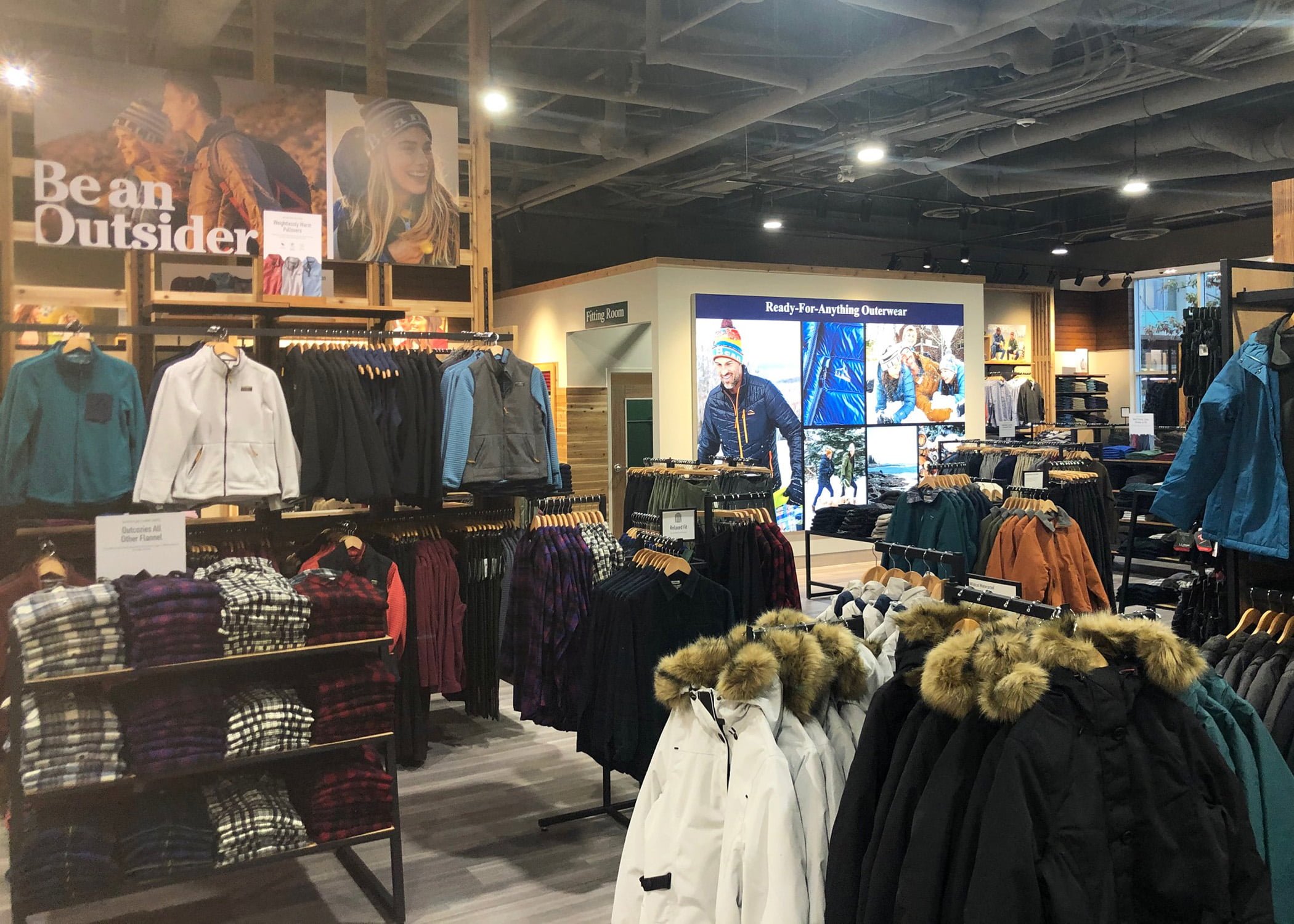
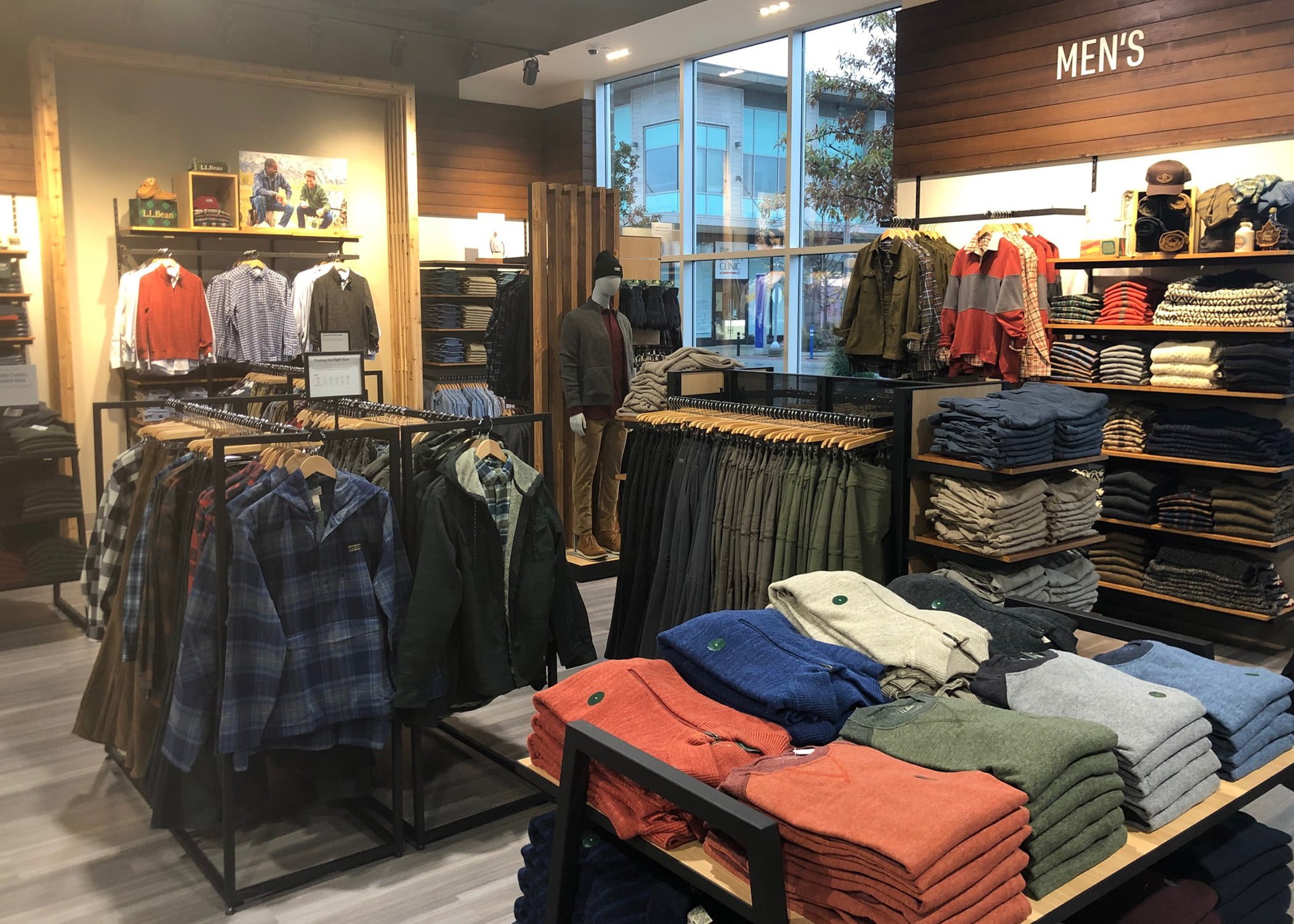
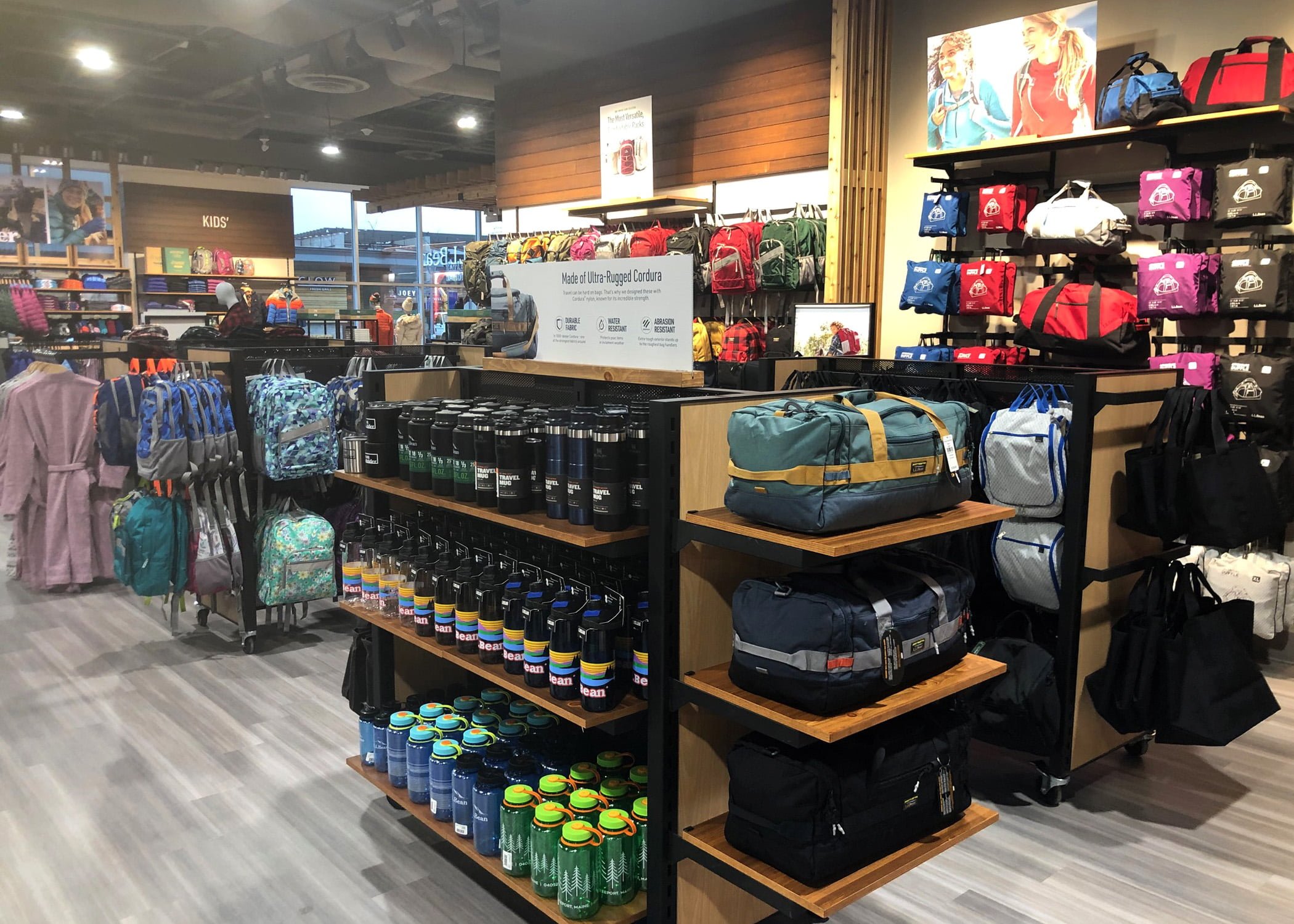
Interior of the new Don Mills L.L. Bean store. Photo: L.L. Bean
Interior of the new Don Mills L.L. Bean store. Photo: L.L. Bean
Interior of the new Don Mills L.L. Bean store. Photo: L.L. Bean
Interior of the new Don Mills L.L. Bean store. Photo: L.L. Bean
Interior of the new Don Mills L.L. Bean store. Photo: L.L. Bean
Interior of the new Don Mills L.L. Bean store. Photo: L.L. Bean
Also in September, and previously discussed in Retail Insider, L.L.Bean will open its first store in Nova Scotia at Dartmouth Crossing in the Halifax area. Dartmouth Crossing is a massive big-box centre boasting Atlantic Canada’s only Ikea store as well as retailers including a combined Cabela’s/Bass Pro, Costco, Walmart, Home Depot, Canadian Tire, Homesense, Cineplex, Kent Home Improvement, Playdium, and a recently-opened Marriott Courtyard Hotel. The 511-acre development contains over 1.8 million square feet of gross leasable area.
In October of this year, L.L.Bean will open its first store in the Vancouver area at The Amazing Brentwood in Burnaby. The L.L.Bean store will be located in the outdoor ‘Town Centre Plaza’ with a rounded facade facing it. The Amazing Brentwood is a combined indoor-outdoor mixed-use retail complex that was made possible by overhauling the existing Brentwood Town Centre mall property with the addition of new commercial space and residential buildings. New tenants at The Amazing Brentwood include Sporting Life and Nike and other tenants to open include H&M/H&M Home, Adidas, JAC by Jacqueline Conoir, Suitsupply, and The Rec Room.
Brokerage Oberfeld Snowcap represents L.L.Bean in Canada for its expansion under the direction of Andrew Laudenbach. L.L.Bean stores are typically in the 13,000-to-15,000-square-foot range, with some being larger or smaller. The retailer has said that it plans to eventually operate 20 stores in the Canadian market. By October of this year, L.L.Bean will have already opened eight stores in Canada.
Exterior of the new Don Mills L.L.Bean store. Photo: L.L.Bean
In partnership with Jaytex, L.L.Bean entered the Canadian market in 2018 with an e-commerce site as it developed wholesale partnerships with several prominent retailers including Hudson’s Bay, Sporting Life, and MEC. L.L.Bean’s first physical Canadian store opened in Oakville Place near Toronto in August of 2019. That was followed by stores in Barrie, Ontario at Georgian Mall (opened July 2020), Ottawa at the Ottawa Train Yards (opened August 2020), Vaughan Mills near Toronto (opened September 2020), and most recently, L.L.Bean’s first Toronto location opened at the CF Shops at Don Mills in October of 2020.
Each location features a unique store design and a curated assortment of footwear, apparel, and outdoor essentials informed by Canadian customer feedback.
Other major markets in Canada are also expected to see L.L.Bean stores including Edmonton, Winnipeg, and possibly the Montreal area depending on expansion plans. The southern Ontario market is expected to see more locations, given its population.
Family-run L.L.Bean was founded by Leon Leonwood Bean in 1911 when he developed the brand’s flagship product, the Maine Hunting Shoe, which combines rubber bottoms with leather uppers to ensure one’s feet remained dry while hunting. L.L.Bean was officially founded in 1912 and has been in business for nearly 110 years.
The company’s original Maine flagship complex has been open since 1917, spanning 220,000 square feet and is open 24 hours a day, 365 days a year. For the first time in its history and due to the pandemic, the flagship has been operating on reduced hours and will again be a 24-hour store as of next month. The motivation behind L.L.Bean’s always-on hours was to accommodate visiting sportsmen who would drive all night and wanted an early start the following day.
In addition to the Maine flagship, L.L.Bean operates 54 stores across 19 states in the United States. The retailer opened its first international location in Tokyo, Japan in 1992 and manages 25 stores and outlets in that market.
This week L.L.Bean also announced that it would be opening three more stores in the US this year in Salem, New Hampshire, Millbury, Massachusetts, and Amherst, New York.
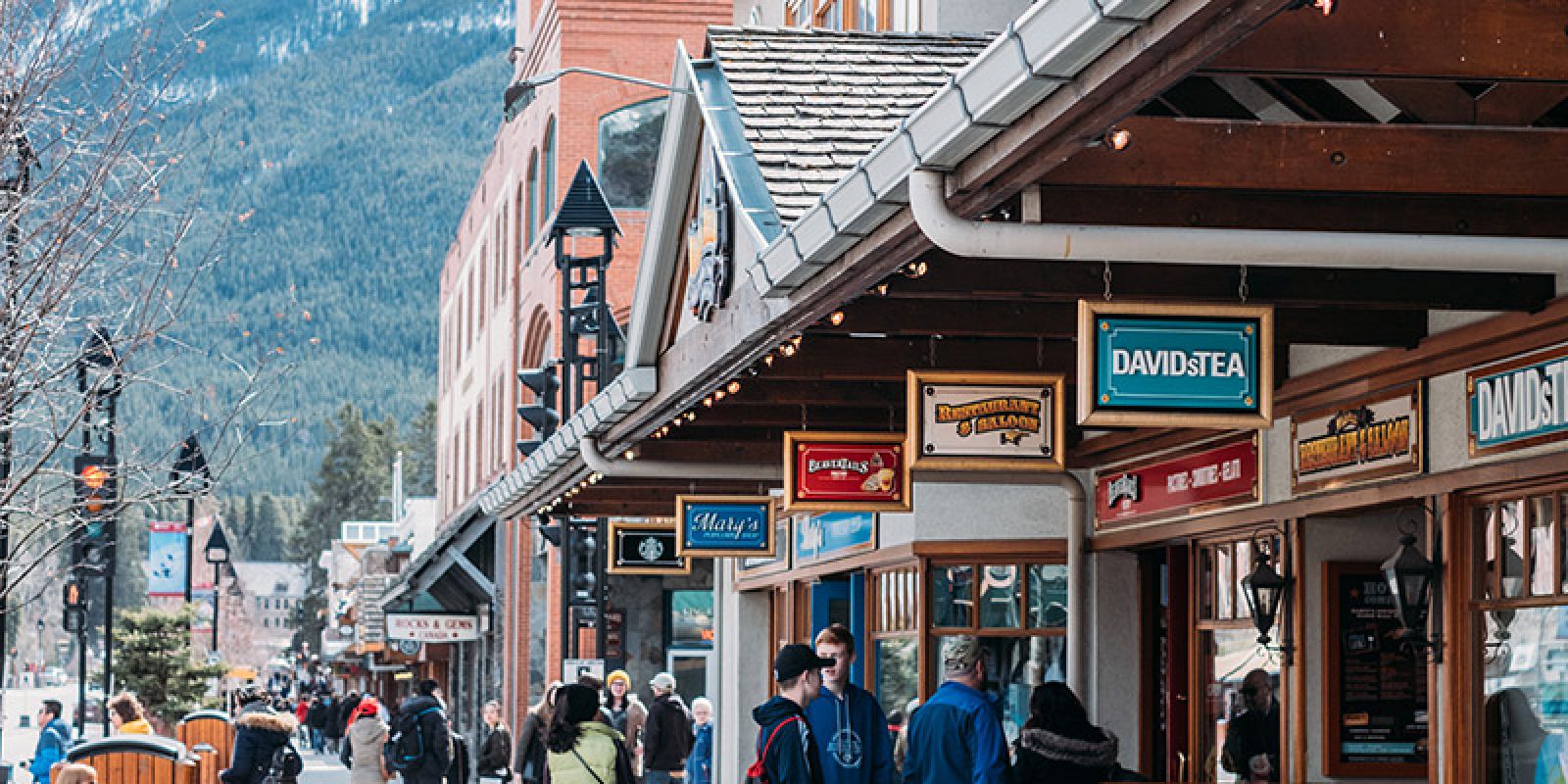
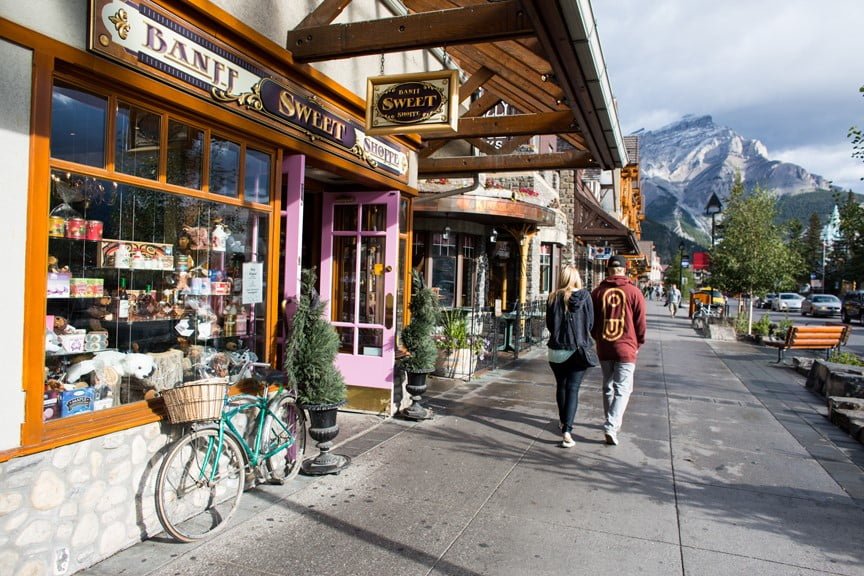
One of the hardest hit industries from the COVID-19 pandemic is the tourism sector and one area of Canada that has particularly felt that blow is Banff, Alberta, which relies heavily on visitors spending money in restaurants, hotels, retail stores, and other places of business.
“The Banff economy is 90 percent based on tourism and many stores and restaurants are just hanging on at this point as the pandemic drags on,” said Michael Kehoe, a retail specialist in the area and broker/owner of Fairfield Commercial Real Estate.
Michael Kehoe
“The ‘rubber-tire’ market made of visitors from Alberta and Saskatchewan may not be enough to save the 2021 summer season. The international visitors are what is needed along with conferences and events, like weddings, to drive a full recovery in the all-season resort markets and mountain towns like Banff.”
According to Banff & Lake Louise Tourism, tourism is the hardest hit sector of economic activities and the Banff area is unique in that its sole industry is tourism.
The current situation facing the tourism sector in Canada is the worst we have ever seen — more dire than the impact experienced after 9/11, SARS, and the 2008 economic crisis combined. One in 10 Canadian jobs is tied to tourism.
Banff and Lake Louise businesses are continuing to struggle — hotel occupancy rates in 2020 were down approximately 50 percent and revenue was down 60 percent. 2021 is also off to a slow start amidst restrictions with hotel occupancy down 63 percent.
Angela Anderson, spokesperson for Banff & Lake Louise Tourism, said the past year has definitely been the most challenging one probably ever.
Angela Anderson
“Tourism is the hardest hit sector in the economy. Our community in Banff and Lake Louise is really unique in that it’s sole industry is tourism. The town site was built to support visitation to the National Park. So everybody here works in tourism,” said Anderson.
“This situation is definitely the worst that we’ve ever seen. It’s more dire than what we experienced after 9/11, SARS, and the 2008 economic crash combined. It was a very, very intense year to go through.”
According to Banff & Lake Louise Tourism, in 2018, the Town of Banff generated $3.1 billion in spending in Alberta (this includes spending in Calgary as people arrive at the airport then head to Banff).
In a usual year, more than four million people come to Banff National Park and more than 80 percent visit the Town of Banff, where a majority of retail stores are located, as well as in Lake Louise.
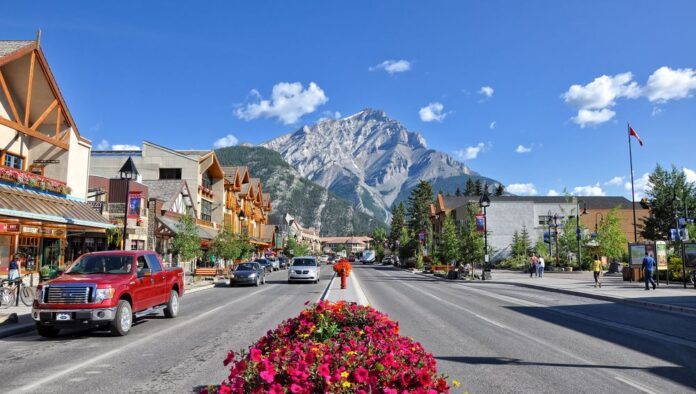
Downtown Banff storefronts. Photos: Banff.ca
1 of 2
Here is some accommodation data for Banff supplied by Travel Alberta for last year :
Average Daily Room Rate: $207 (compared to $269 in 2019, a drop of 22.8 percent);
Occupancy rate: 38 percent (compared to 70.4 percent in 2019, a drop of 46 percent);
Revenue per Available Room: $79 (compared to $189 in 2019, a drop of 58.4 percent);
Revenue: Room revenue decreased by $216.95 million to $119.9 million, a drop of 64.4 percent compared to 2019; and
Supply/demand: Room supply decreased by 14.5 percent, but room demand plummeted by 53.9 percent.
Whether it’s a restaurant, a hotel, or a retail shop, many businesses in the tourist area are hanging by a thread if they are still operating.
“We know that our member businesses are really struggling right now. One thing that we’re not really used to do but we’ve been focusing on with other partner organizations is just really asking the governments at all levels for supports for our region and for the tourism industry,” said Anderson. “Those supports are absolutely crucial and those are what are helping businesses survive right now.
“And it’s not enough. There’s definitely more needed and so we continue to ask for support for businesses. That said, there is some optimism going into this summer . . . and we will absolutely be relying on Canadians and regional visitation to help our businesses get through this summer.
“Pending what’s happening in the different provinces with restrictions and cases, that should be a priority. Getting those under control for the health safety of Canadians is definitely the priority, but hopefully, we’re still very hopeful, that that will come under control with vaccinations and as we move forward in the coming weeks, we still are very hopeful that Canadians will be able to travel to Banff and Lake Louise this summer and we will absolutely be counting on them to help us save the summer essentially.”
The Town of Banff recently announced that it will be closing the 100 and 200 blocks of Banff Avenue and a portion of Caribou Street to vehicle traffic this summer in an attempt to provide tourists and residents with more space to practice COVID-19 safety measures and retailers and restaurants with the option to extend their presence onto the street.
Very quickly after the initial announcement, Banff Town Council altered the original date set to mobilize the Downtown Pedestrian Zone from June 12 to April 30.
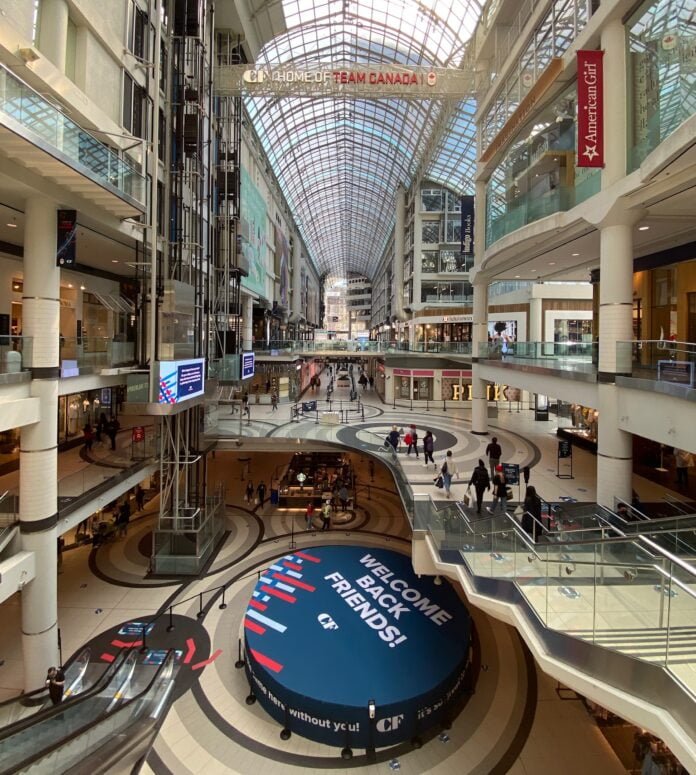
Interior image of the CF Toronto Eaton Centre taken in April 2021. Photo: Dustin Fuhs
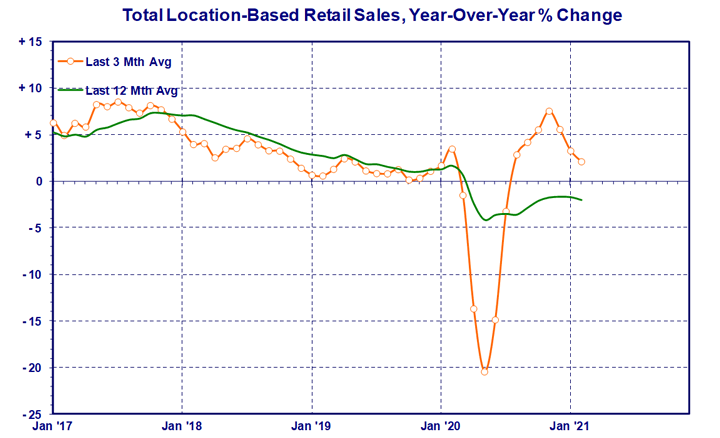
Total Canadian retail sales looked like they were on a path to recovery in the second half of last year, but things have slowed down somewhat in recent months. Going forward however, it’s unlikely that we’ll see another disastrous downward spike like Q2 2020. But it could be an illusion, because upcoming retail sales numbers in the months ahead will be being compared to very weak year ago results.
Although a third COVID wave is upon us, affected Canadian retailers should now be faster and smarter with counter-measures such as store sanitation, e-commerce, home delivery and curbside pickup.
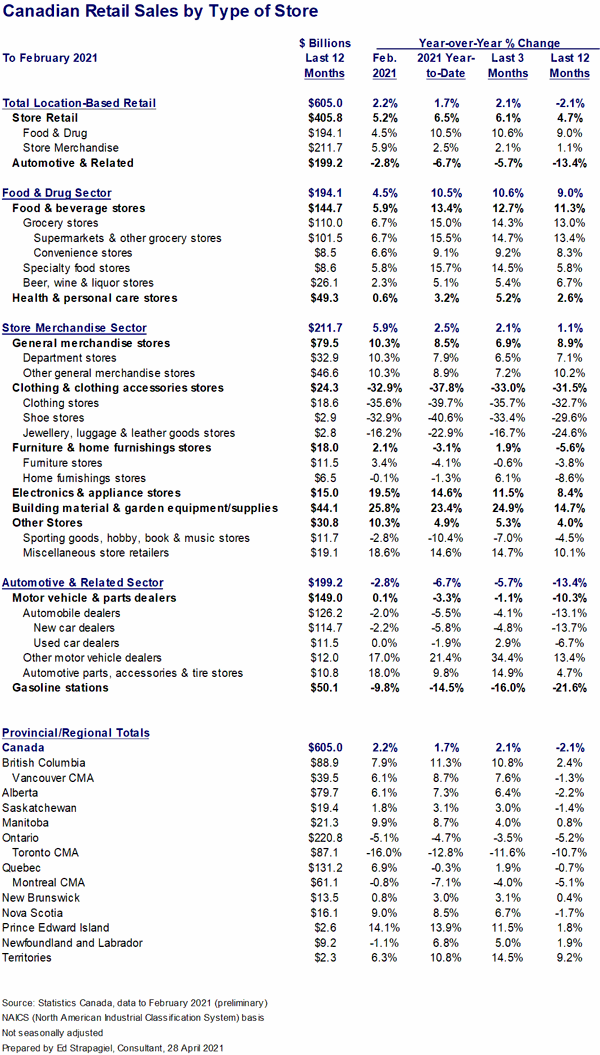
Overall Canadian retail sales were up 2.1% year-over-year for the 3 months ending February 2021. While the 3 month trend (orange line in the above chart) remains positive, it has weakened recently. The underlying 12 month trend (green line) however is still declining and there’s little relief in sight. Furthermore, sales trends and business fortunes are very uneven among the major retail sectors.
Food & Drug
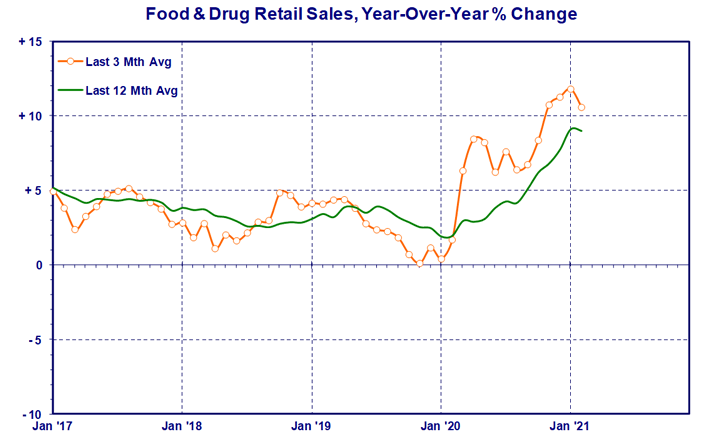
A major exception to the general case is the Food & Drug sector, which has received an unprecedented boost from the COVID pandemic. The main effect is likely that people are now preparing their own food and eating in more often as restaurants are shut down and social gatherings are restricted.
Retail sales in the sector increased 10.6% year-over-year for the 3 months ending February. The 3 month growth trend has been strong since the pandemic started, and the underlying 12 month trend has been moving up steadily as a result.
Supermarkets and other grocery stores are enjoying particularly high gains, with retail sales up 14.7% for the 3 months ending February. Specialty food stores also are doing well, with sales gaining 14.5% during the same period.
Retail sales at health & personal care stores were up 5.2% for the 3 months ending February. While this is not as robust as for food stores, it’s still more than double the overall retail average.
Store Merchandise
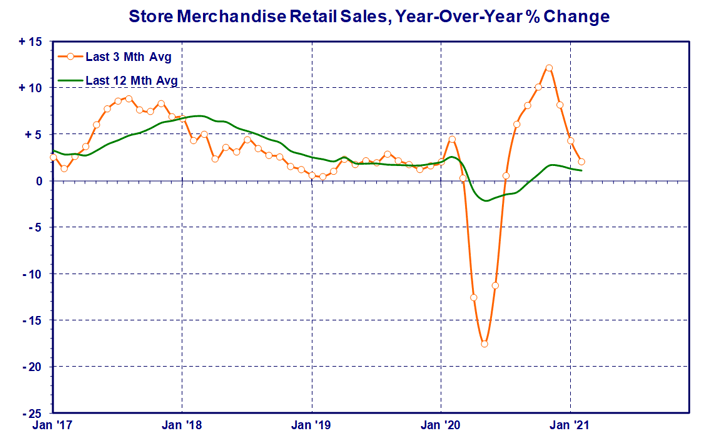
The Store Merchandise sector has been on a wild roller coaster ride. Retail sales plunged at the outset of the COVID pandemic as non-essential retailers and whole shopping malls closed down. As the first wave of COVID passed and retailers reopened, sales spiked up in the second half of last year as if to make up for lost time. Then pandemic wave 2 came along and led to another round of shutdowns and stay at home orders, and thereby a slowdown in retail sales growth.
For the 3 months ending February, retail sales in the sector gained a modest 2.1% year-over-year. But this could actually (and misleadingly) improve going forward because of comparisons to particularly weak retail sales last year.
There are still stark differences in sales trends among various retailer types in Store Merchandise. Retail sales at clothing & clothing accessories stores were down a whopping 33.0% over the 3 months ending February, but building material & garden equipment/supplies dealers were up 24.9%.
Automotive & Related
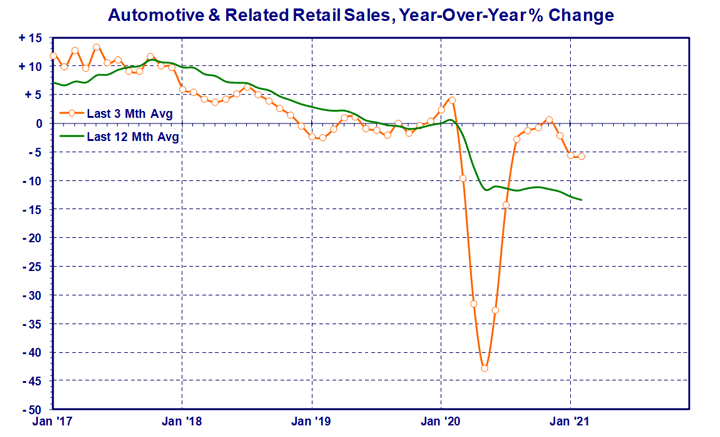
The Automotive & Related sector remains a major weak spot in Canadian retail. Sales declined 5.7% for the 3 months ending February 2021, which comes on the heels of a 12.0% decline in 2020.
Gasoline station retail sales are the main problem. Their retail sales were down 16.0% for the last 3 months. Without gas stations, overall Canadian retail sales would have been up 4.2% instead of 2.1%.
New car dealers are also struggling. Their retail sales were down 4.8% year-over-year for the 3 months ending February 2021. On the other hand, the much smaller other motor vehicle dealers group increased sales by 34.4% during the same period.
By The Numbers
Note that the data and analysis in this report are always based on not seasonally adjusted (or unadjusted) retail sales statistics.
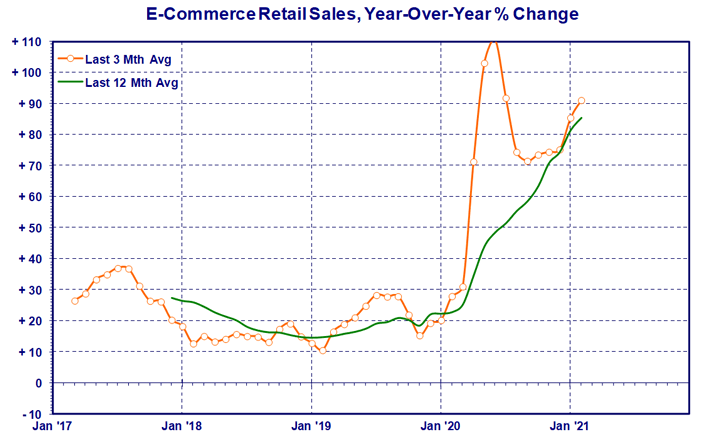
Many Canadian consumers have turned to e-commerce as COVID has severely restricted access to bricks & mortar stores. E-commerce retail sales were up 91.1% year-over-year for the 3 months ending February 2021. The pandemic has accelerated e-commerce in this country by perhaps 5 years. When things get back to “normal”, not all the sales that have gone online will return to physical stores.
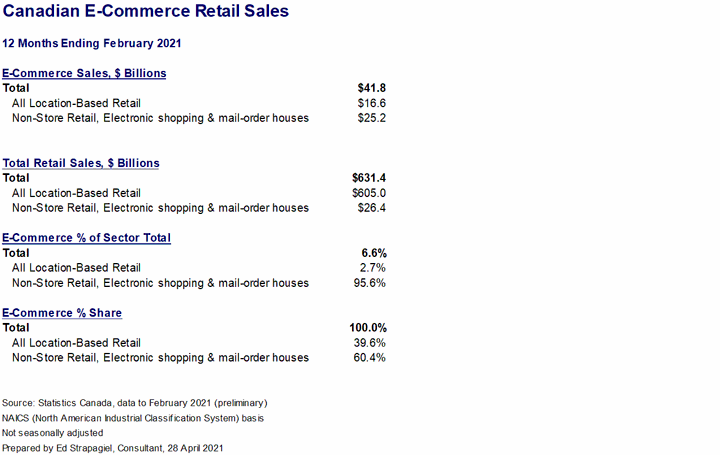
Overall, e-commerce represented about 6.6% of Canadian retail sales over the past 12 months, including both pure plays as well as bricks & clicks stores. Note that Canadian consumers may also buy online from foreign websites which is not captured in these numbers.
Location based retail is the same as that in the preceding “By The Numbers” table. It’s what’s normally reported as Canadian retail sales. Except that it isn’t. Location based retail excludes another section called Non-Store Retailers (NAICS code 454), which includes electronic shopping and mail-order houses, which in turn is where (mostly) pure play e-commerce businesses are. Over the 12 months ending February 2021, electronic shopping and mail-order houses had an estimated $25.2 billion in e-commerce sales.
But that’s not the only source of e-commerce, as (mostly) bricks & mortar location-based retailers also sell online. For the 12 months ending February 2021, this group had an estimated $16.8 billion in e-commerce sales. With electronic shopping and mail-order houses, there’s a grand total of $41.8 billion in e-commerce sales by Canadian operators. Note that this does not include foreign e-commerce purchases made by Canadian consumers, but it does include e-commerce purchases made by foreigners at Canadian operations.
For electronic shopping and mail-order houses, an estimated 95.6% of their sales are currently allocated to e-commerce. For (mostly) bricks & mortar retailers, it can be estimated that 2.7% of their total sales are attributable to e-commerce.
In the final section of the above table, (mostly) pure play operators (namely, under electronic shopping and mail-order houses) generated an estimated 60.4% of all e-commerce sales in Canada, while (mostly) bricks & mortar location-based retailers’ share of e-commerce was 39.6%.
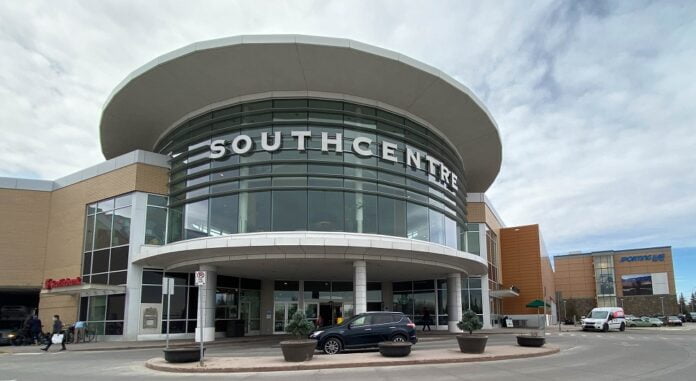
Retail Insider continues its Photo Tour series of Canadian malls to provide a glimpse into shopping centres which may be less frequented lately due to the COVID-19 pandemic. This edition takes us to Southcentre Mall in Calgary. The shopping centre contains approximately 190 stores over two floors and is owned/managed by Oxford Properties. In addition to the retail component, Southcentre has had several community support initiatives over the years, including adopting urban beehives in August 2020 and hosting autism-friendly Santa events for children.
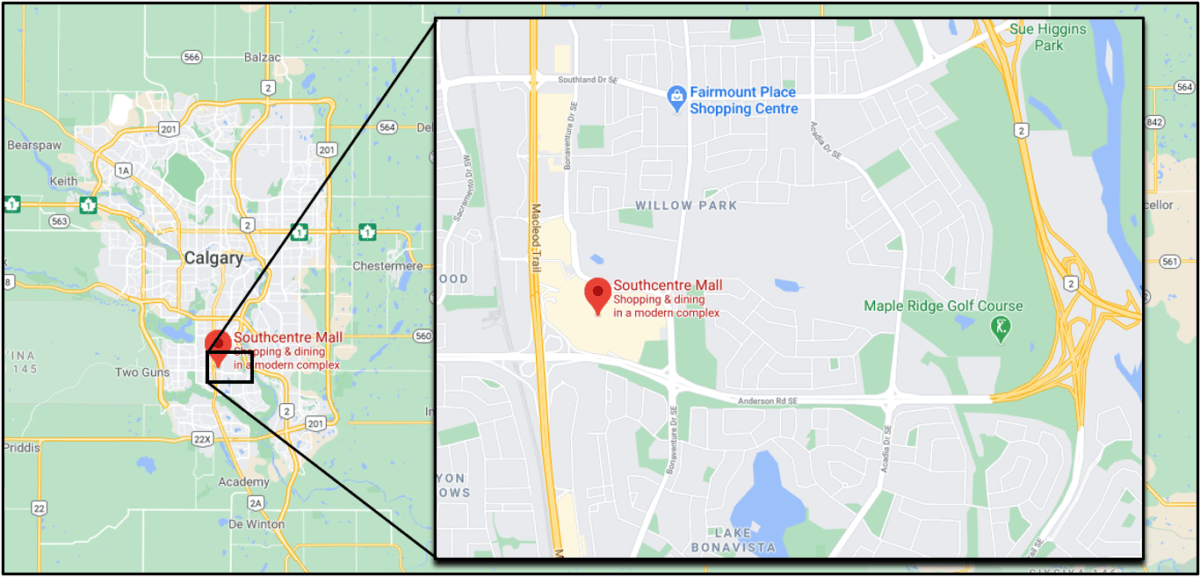
Google Map of Calgary with Southcentre Mall circled. Photo: Google Map with highlight by Retail Insider
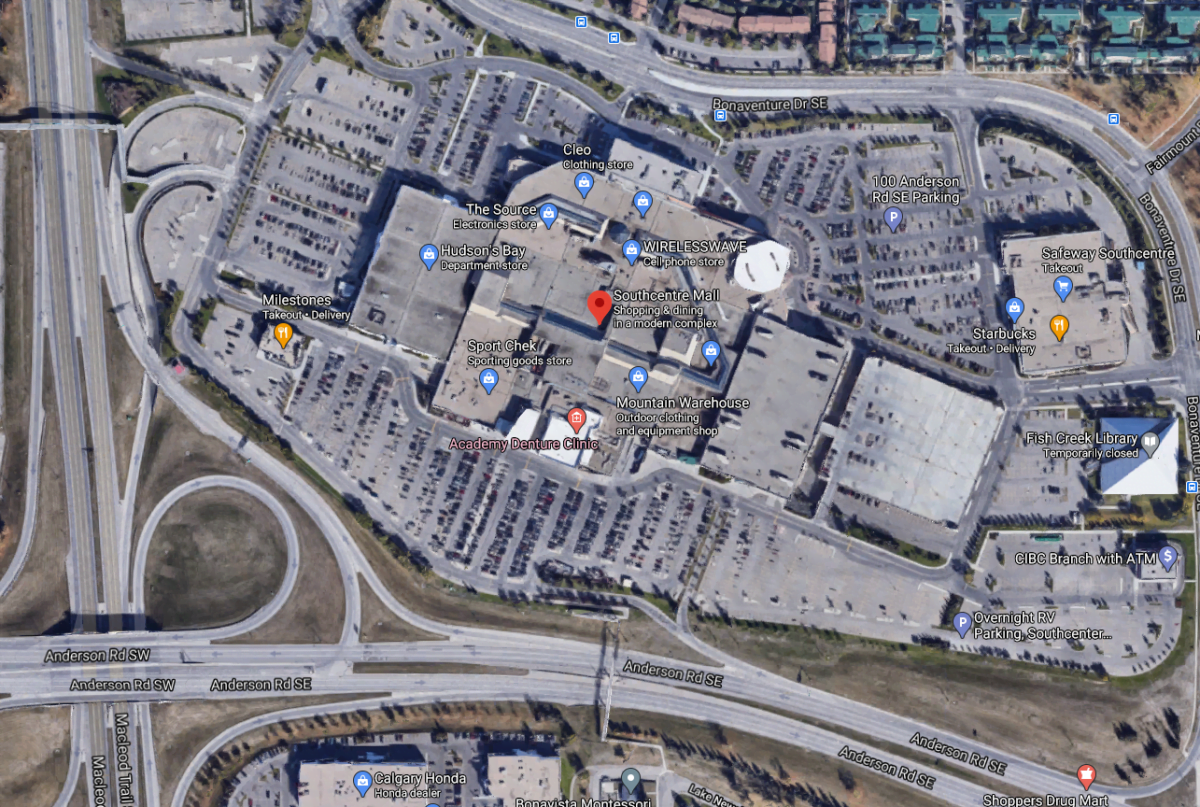
Satellite Google Map of Southcentre Mall in Calgary. Photo: Google Maps
Southcentre spans more than 1.1 million square feet and the Hudson’s Bay Company is the main anchor tenant, with the four junior tenants being Sport Chek, H&M, Sporting Life, and Old Navy.
History of Southcentre Mall
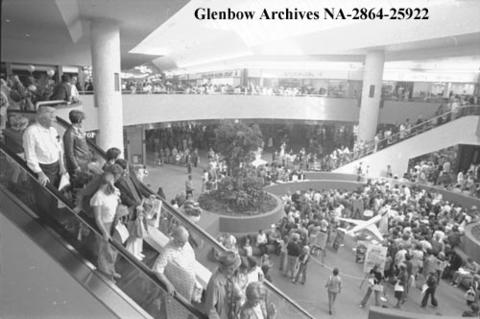
Published in the Calgary Herald, July 31, 1974. Calgary’s new $20 million Southcentre complex opens and is packed by shoppers. Photo: Alberta On Record
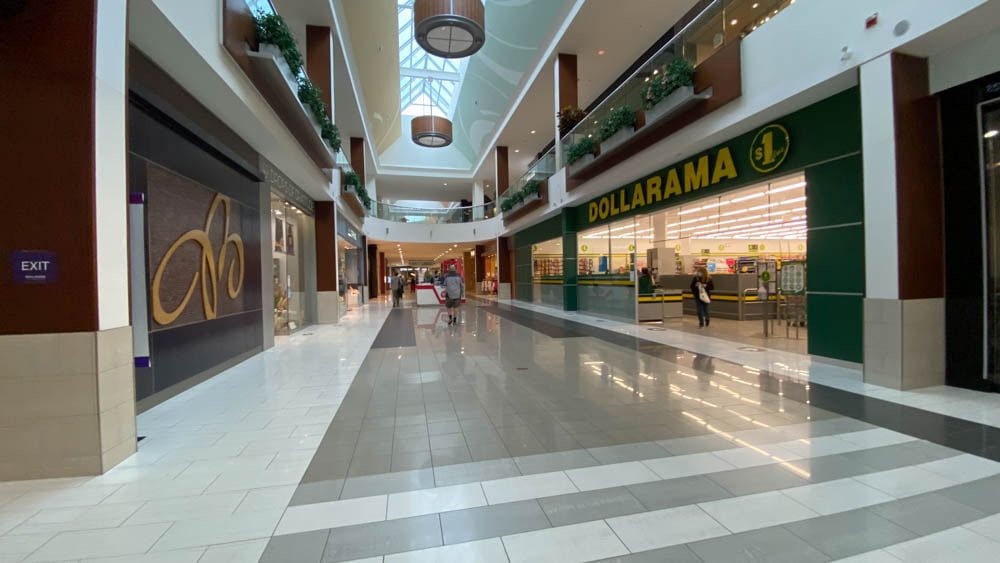
Southcentre opened in 1974 and it unveiled a north-wing expansion in 1988. A 234,000-square-foot anchor space for Eaton’s was being built just prior to the retailer’s bankruptcy in 1999, and Sears Canada subsequently secured the space which it occupied until its demise in 2018. Following Sears’ closure, a portion of the anchor space was briefly occupied by Showhome Furniture. A ground-floor subdivision of the anchor space was announced by Oxford Properties in July 2020 which saw Winners, Dollarama, and PetSmart come to occupy the demised space.
Breaking Up Southcentre Mall
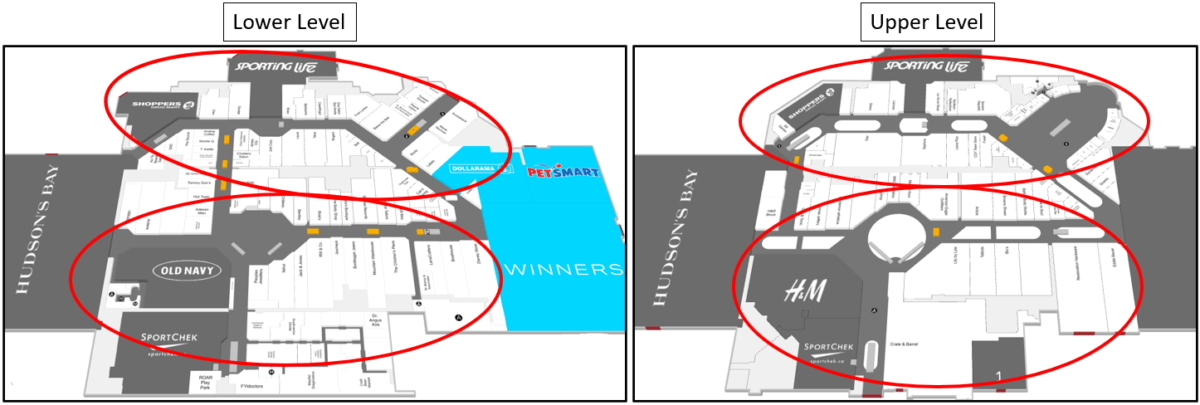
Southcentre tour zones. Photo: Southcentre Mall Map with zones overlaid by Retail Insider.
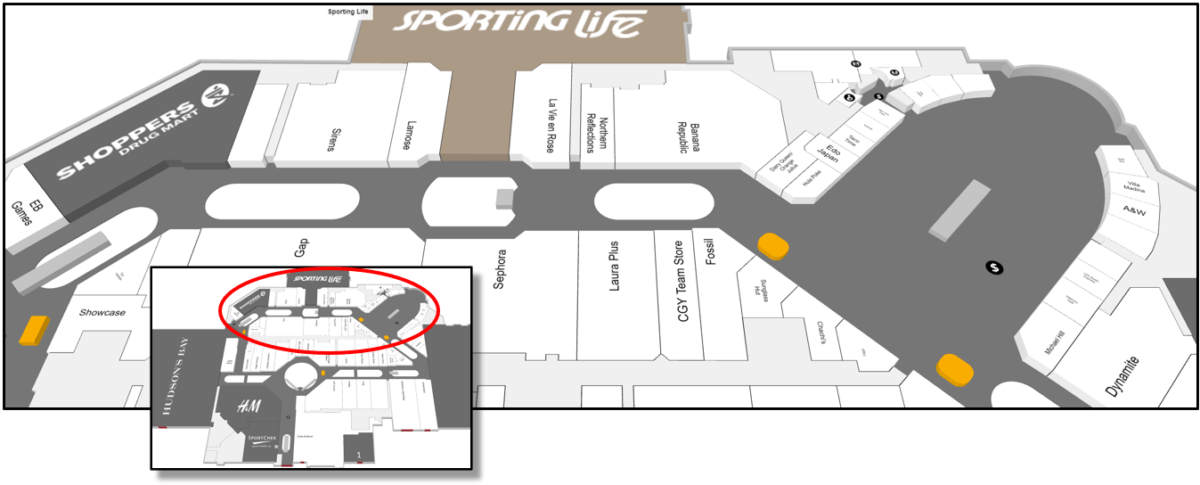
In order to make this photo tour manageable, each floor of the shopping centre has been divided into two tour zones (north and south halves).
Lower Level North at Southcentre Mall
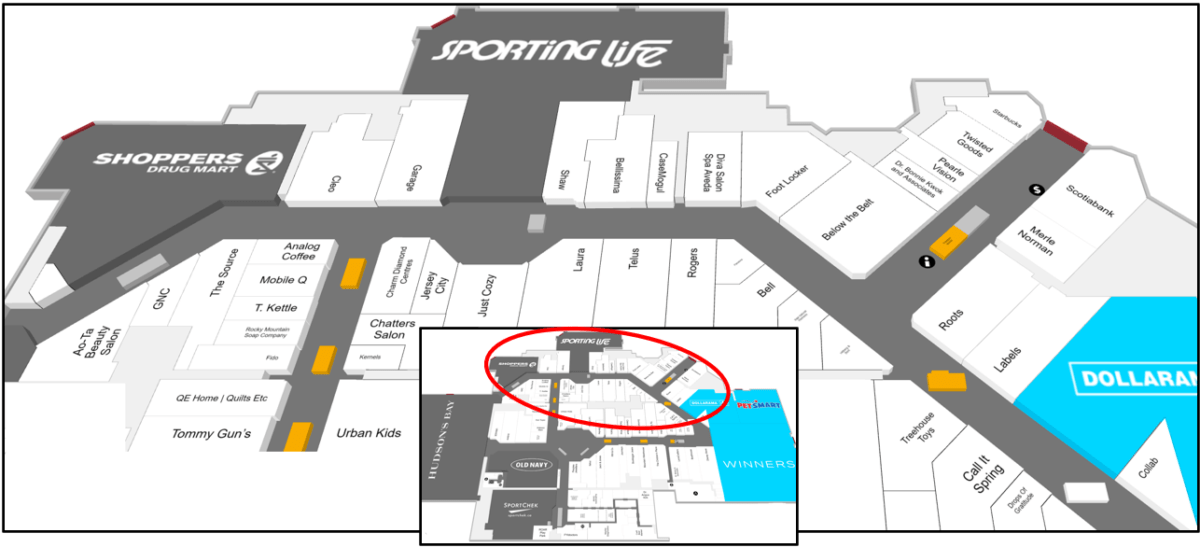
North side, lower level of Southcentre Mall tour zone. Photo: Southcentre Mall map with zone overlaid by Retail Insider
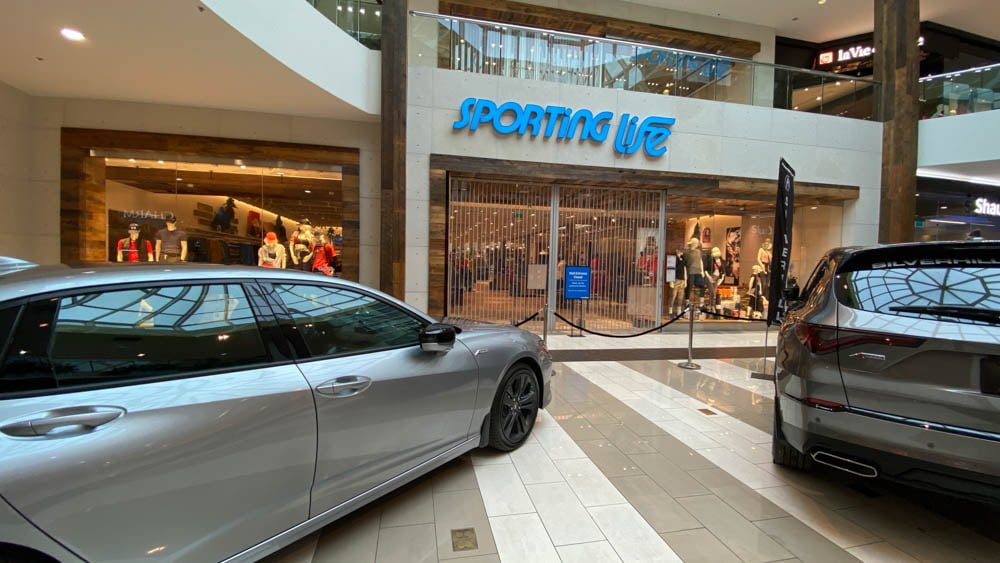
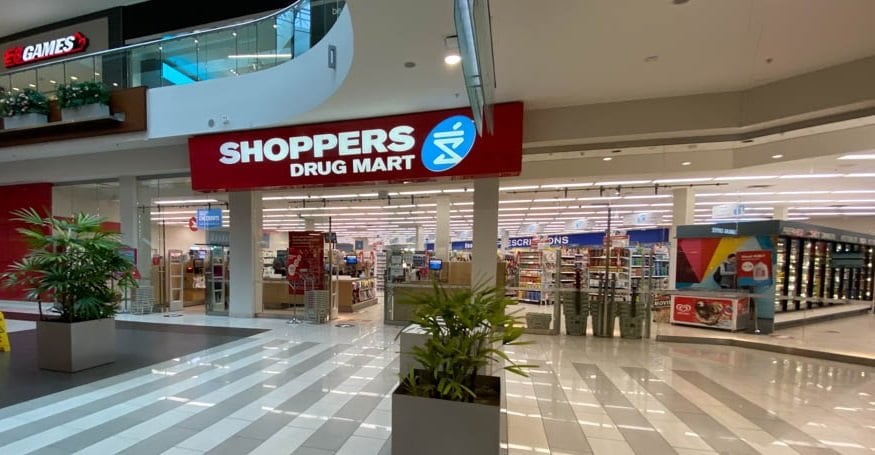
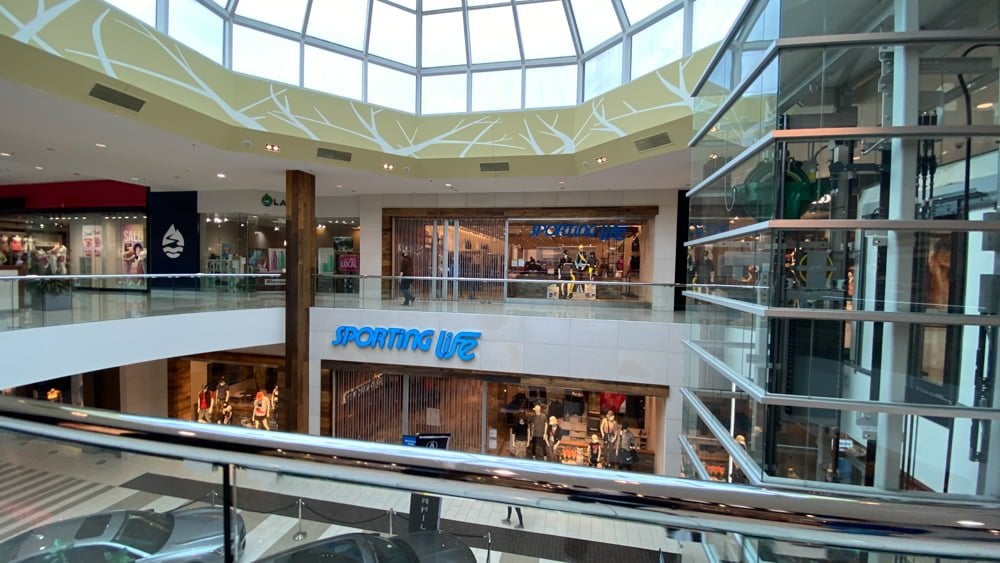
Starting at the top (or the north) section of the lower level, the key tenants are Shoppers Drug Mart and Sporting Life — which was the first in western Canada and opened in October 2016. Both retailers are two-story retail spaces with entrances on both floors.
Sporting Life at Southcentre Mall in Calgary. Photo: Jessica Finch
Shoppers Drug Mart on the lower level of Southcentre Mall in Calgary. Photo: Jessica Finch
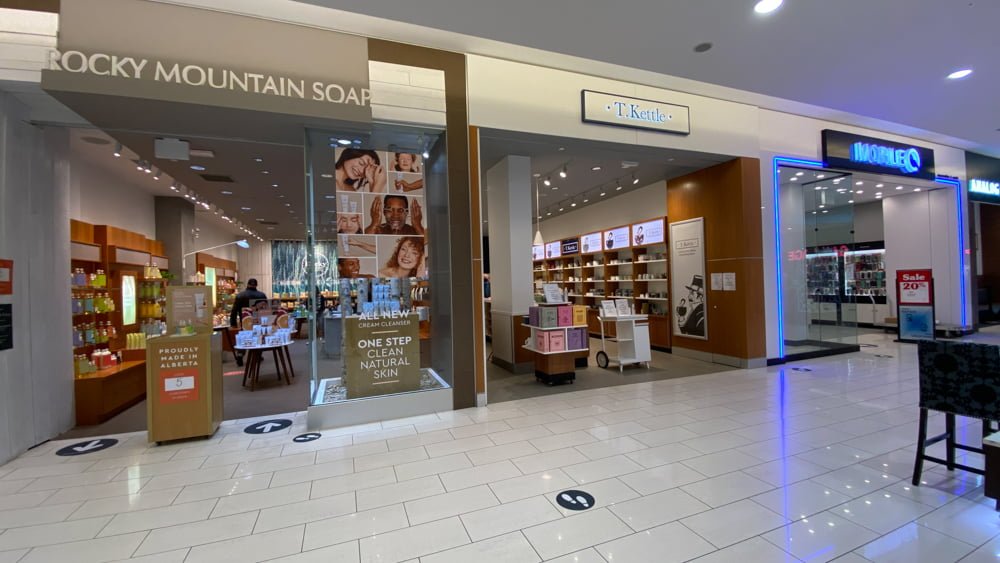
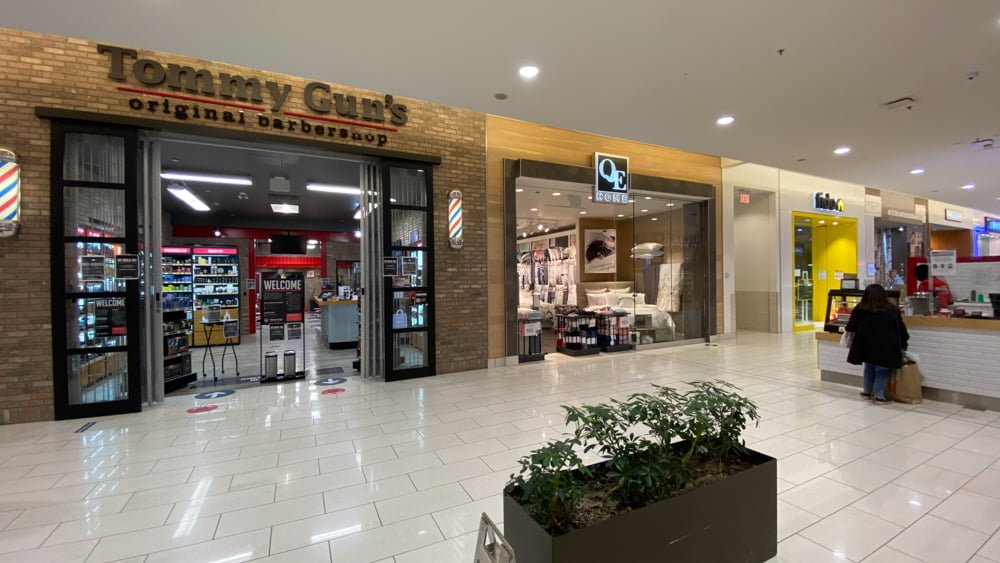
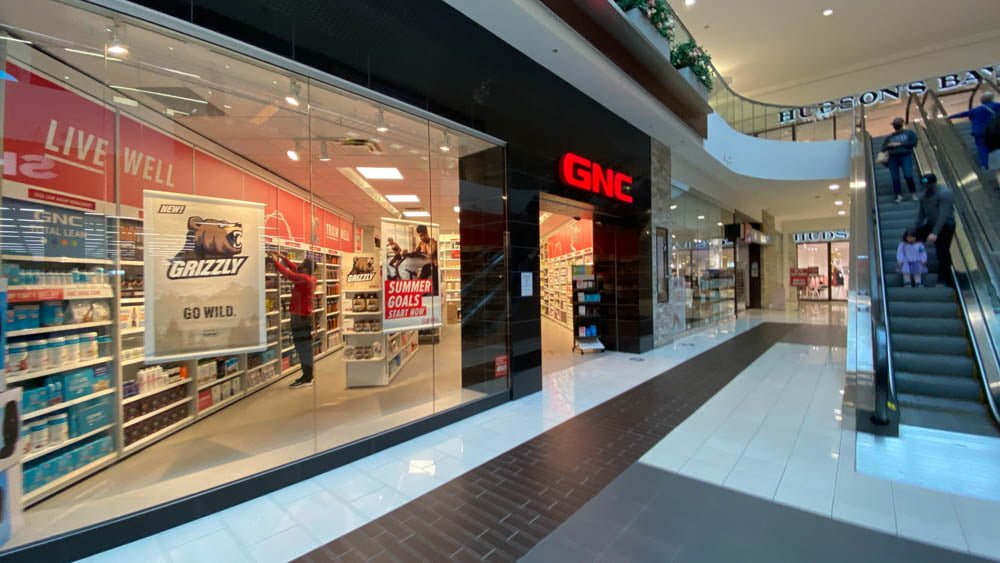
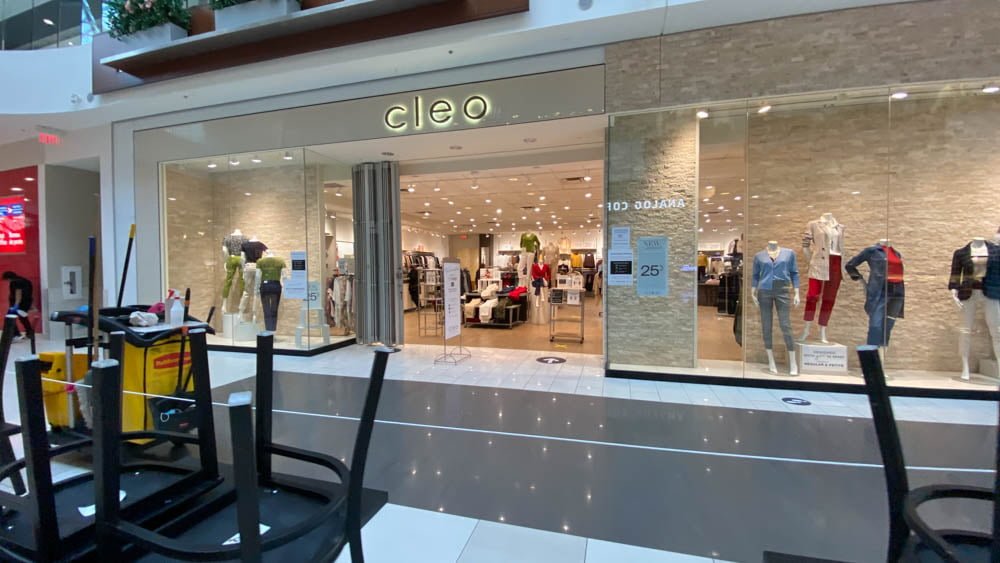
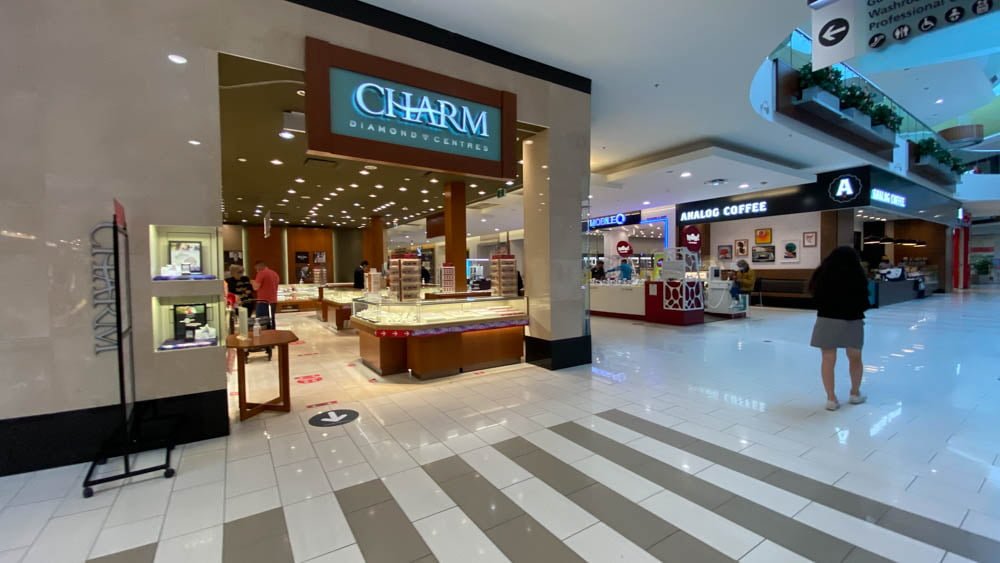
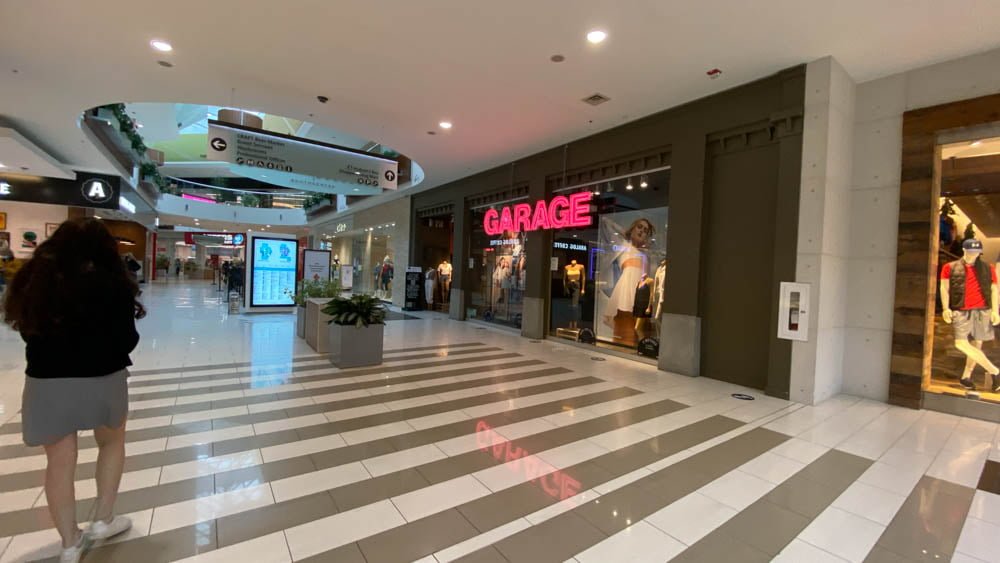
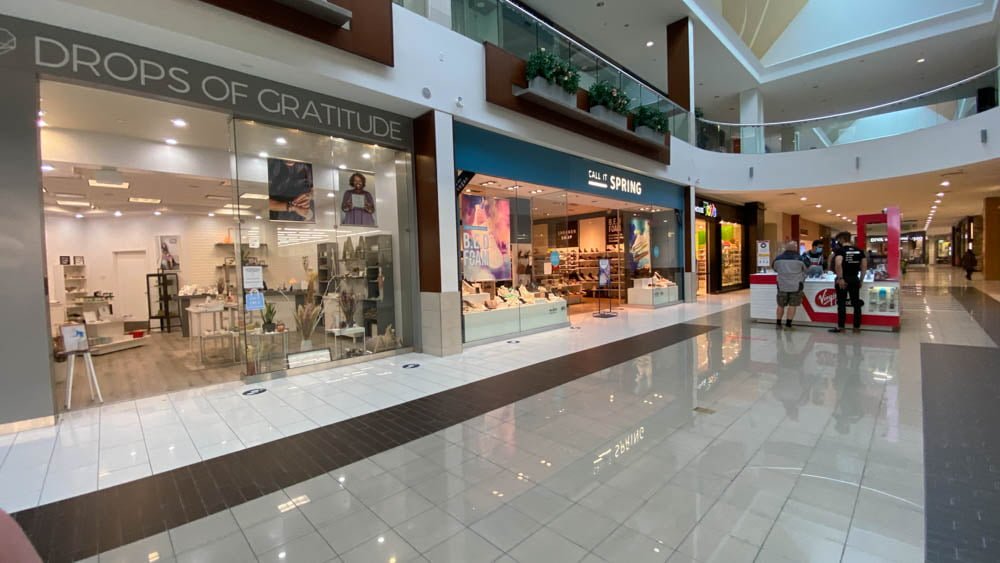
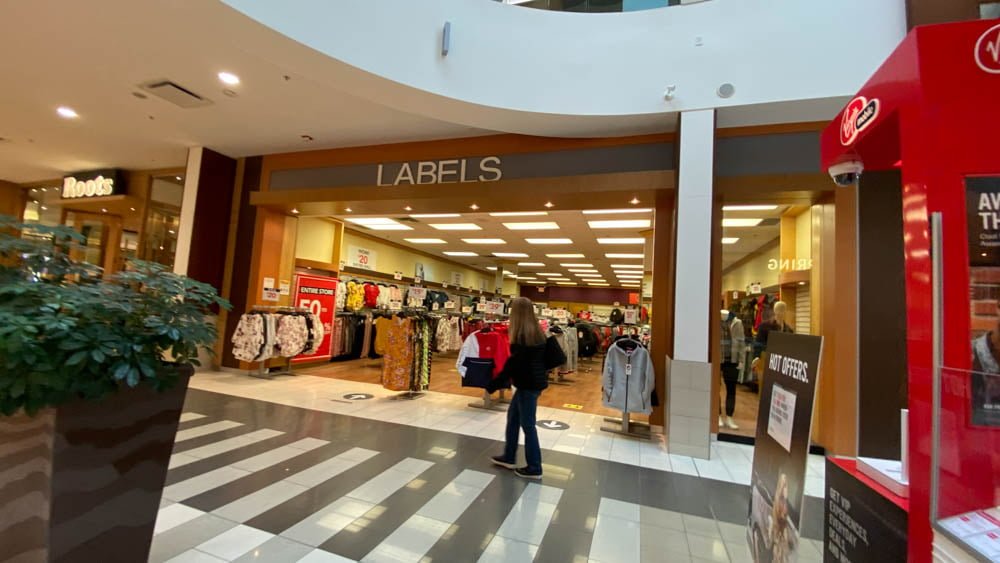
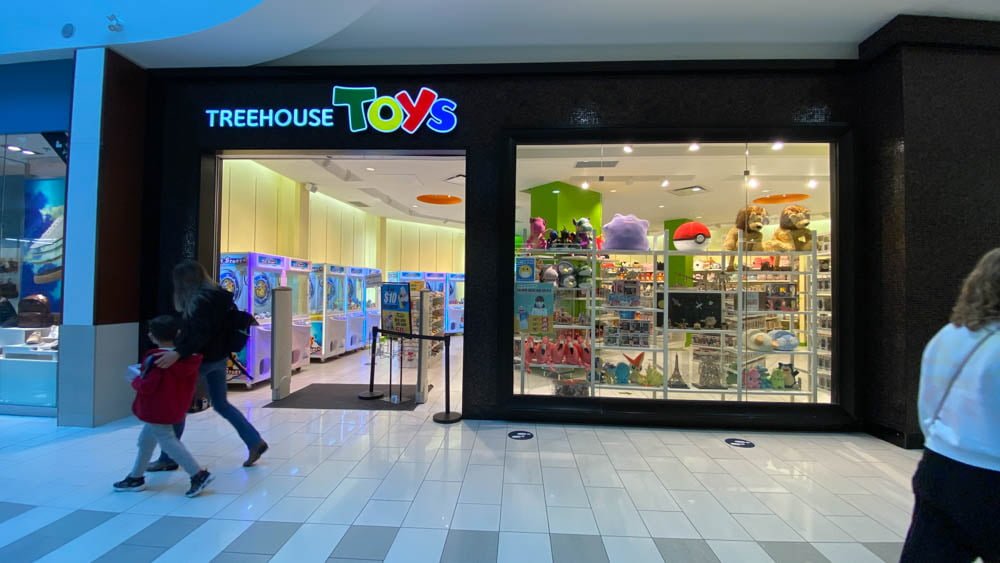
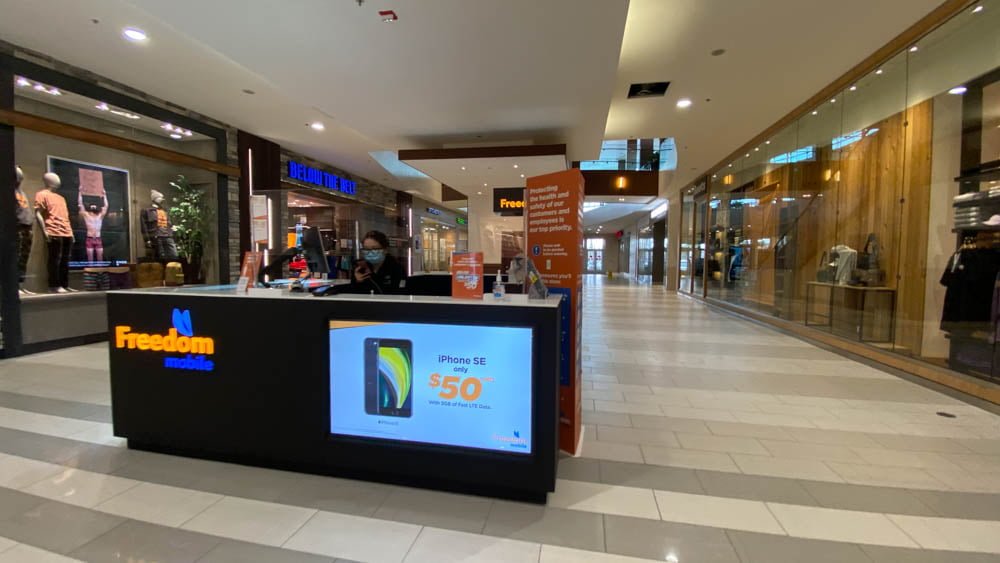
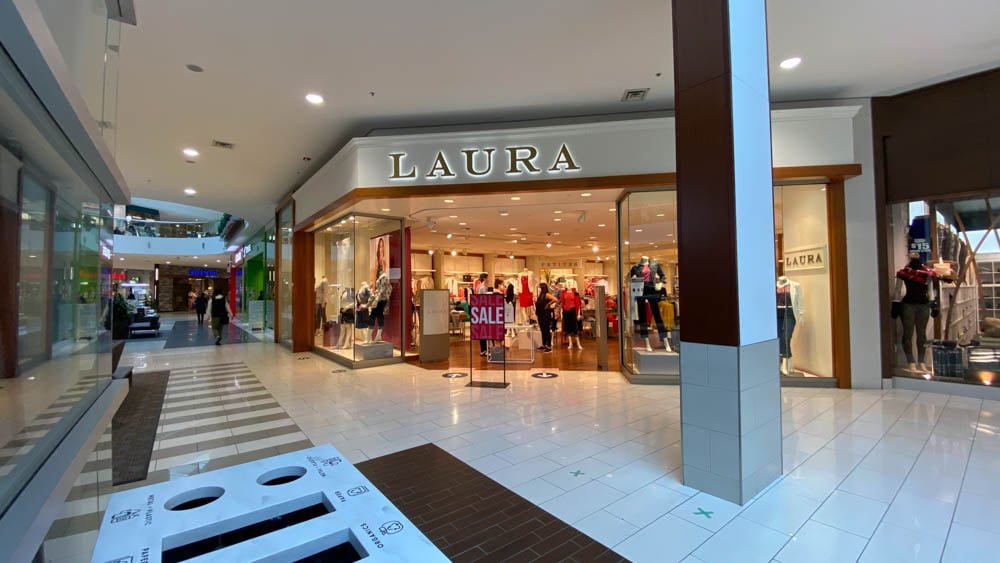
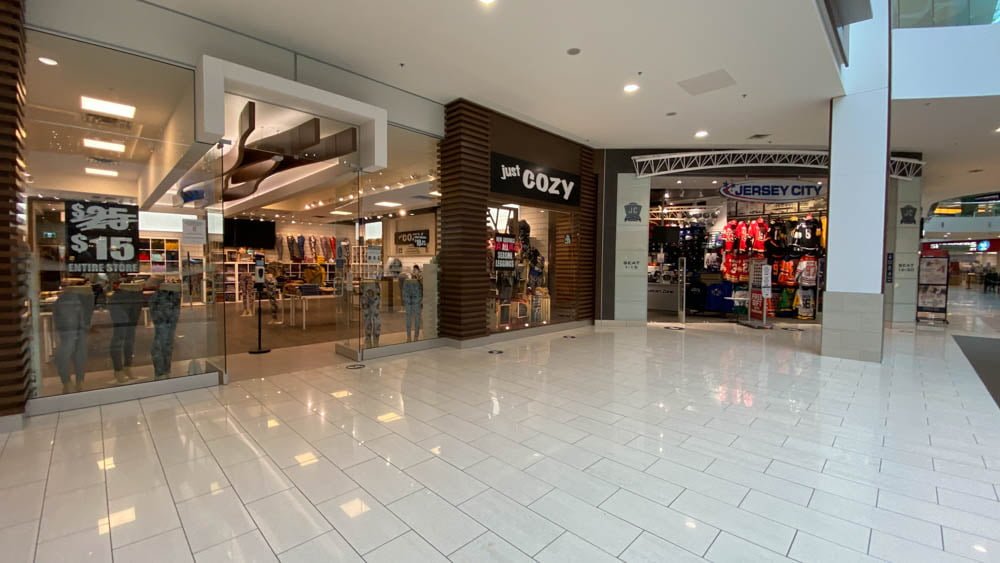
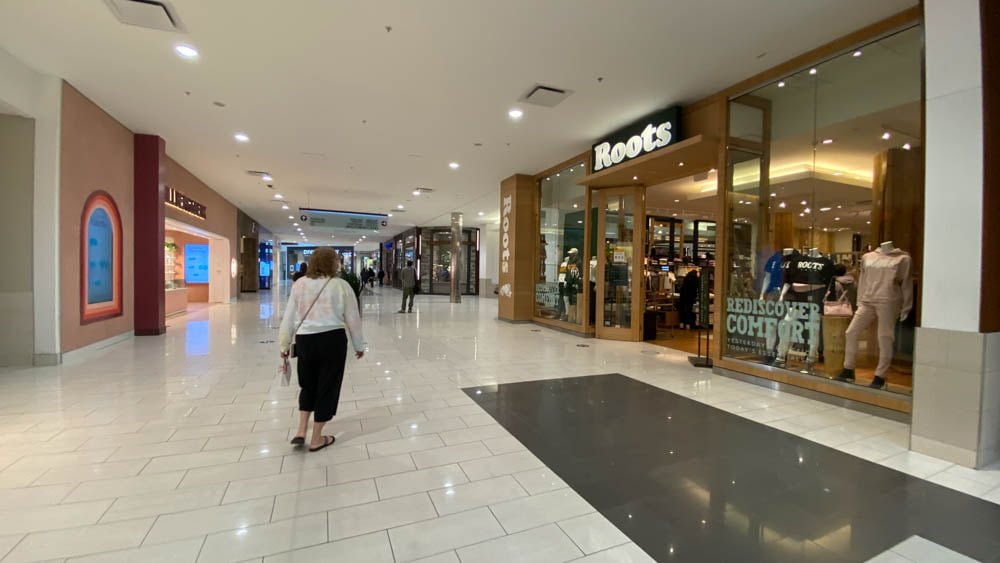
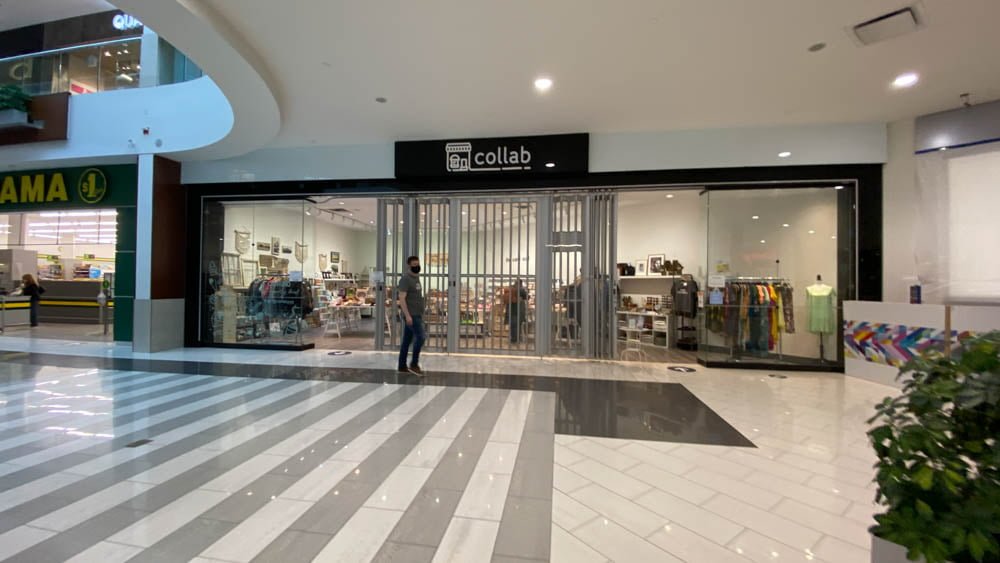
Other retailers in this section of Southcentre include GNC, The Source, Cleo, Garage, Analog Coffee, Mobile Q, T. Kettle, Rocky Mountain Soap Company, QE Home | Quilts Etc., Tommy Gun’s, Urban Kids, Charm Diamond Centres, Jersey City, Just Cozy, Laura, Bellissima, Foot Locker, Below the Belt, Twisted Goods, Merle Norman, Roots, Labels, Treehouse Toys, Call It Spring, and Drops of Gratitude.
Lower level north retailers at Southcentre Mall in Calgary
1 of 14
Rocky Mountain Soap and T.Kettle at Southcentre Mall in Calgary. Photo: Jessica Finch
Tommy Gun's and QE Home at Southcentre Mall in Calgary. Photo: Jessica Finch
GNC at Southcentre Mall in Calgary. Photo: Jessica Finch
Cleo at Southcentre Mall in Calgary. Photo: Jessica Finch
Charm Diamond Centres at Southcentre Mall in Calgary. Photo: Jessica Finch
Garage at Southcentre Mall in Calgary. Photo: Jessica Finch
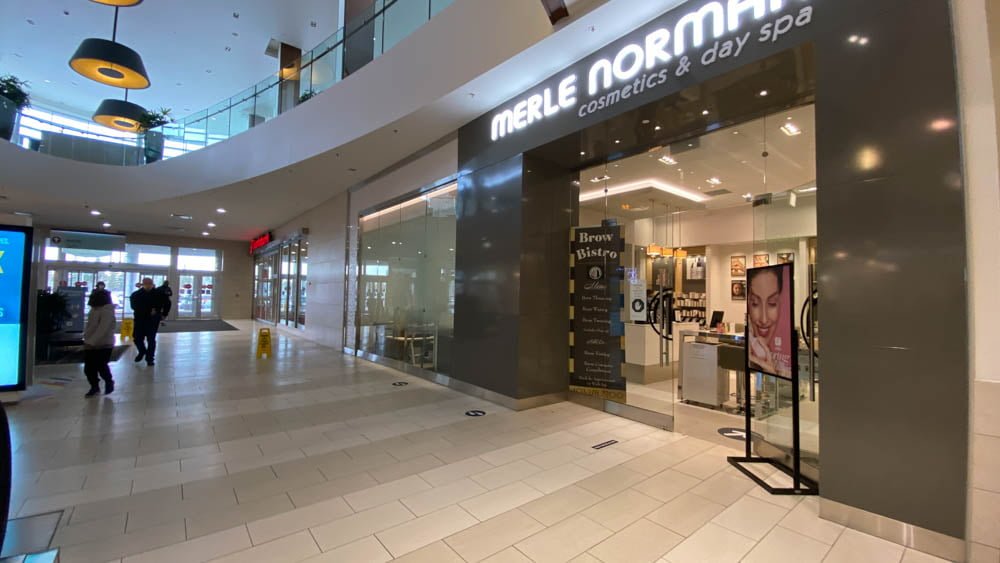
Merle Norman at Southcentre Mall in Calgary. Photo: Jessica Finch
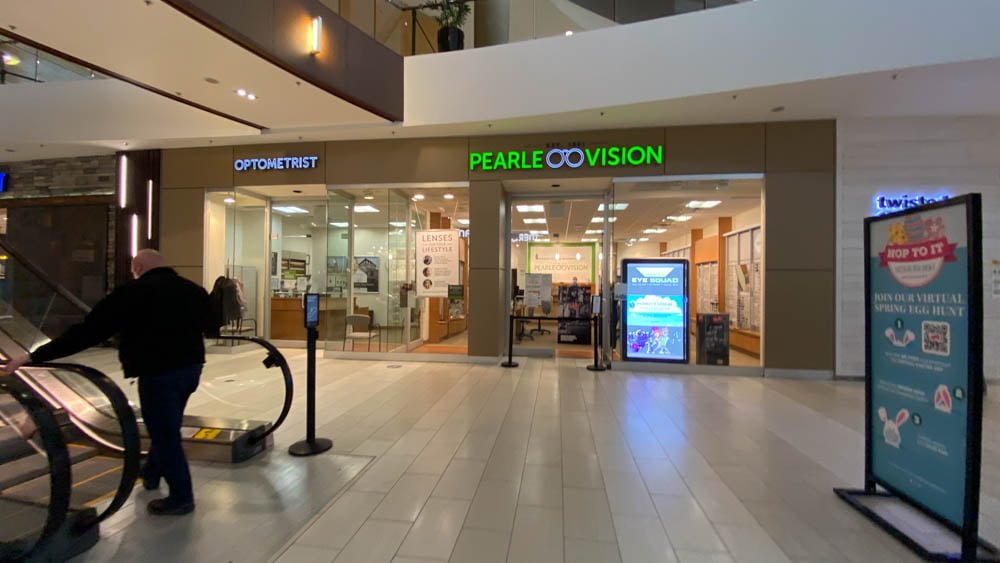
Pearle Vision at Southcentre Mall in Calgary. Photo: Jessica Finch
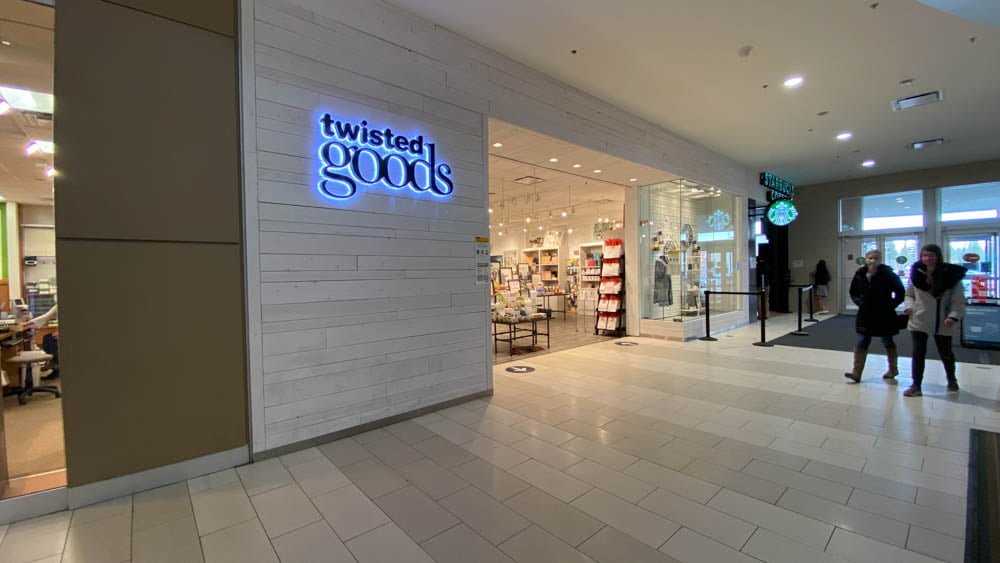
Twisted Goods at Southcentre Mall in Calgary. Photo: Jessica Finch
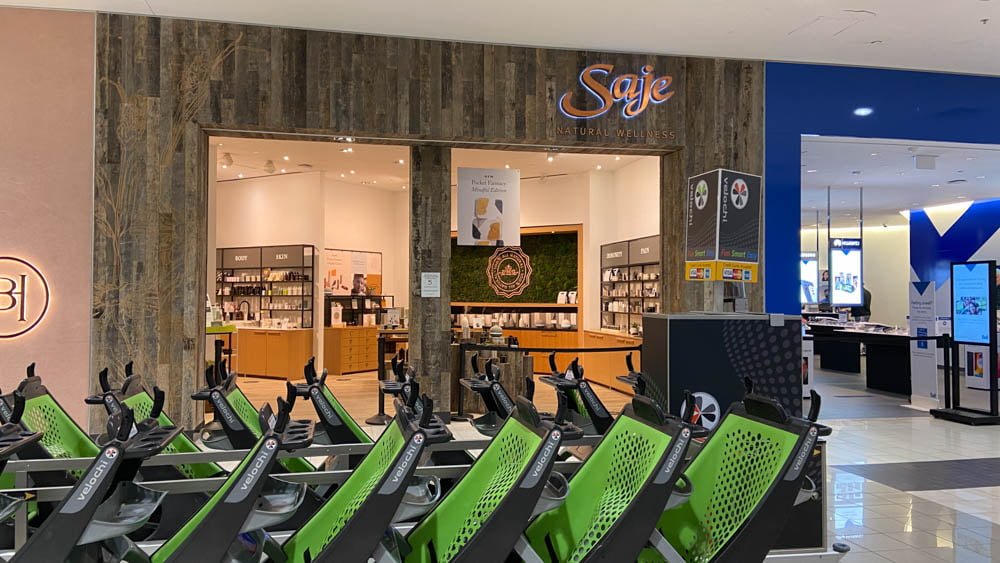
Saje Wellness at Southcentre Mall in Calgary. Photo: Jessica Finch
Call It Spring at Southcentre Mall in Calgary. Photo: Jessica Finch
Labels at Southcentre Mall in Calgary. Photo: Jessica Finch
Treehouse Toys at Southcentre Mall in Calgary. Photo: Jessica Finch
Lower level north retailers at Southcentre Mall in Calgary
1 of 8
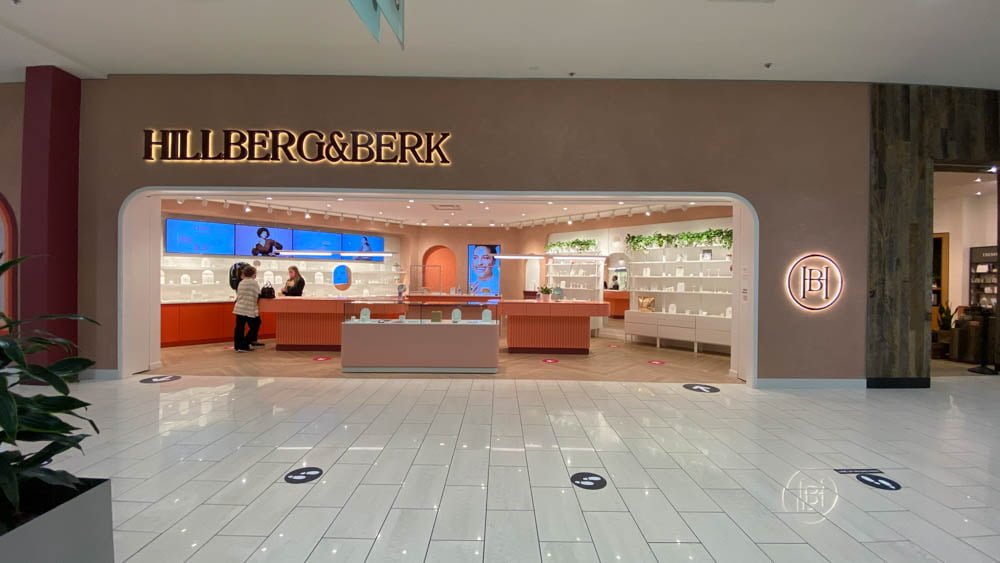
Hillberg & Berk at Southcentre Mall in Calgary. Photo: JessicaFinch.
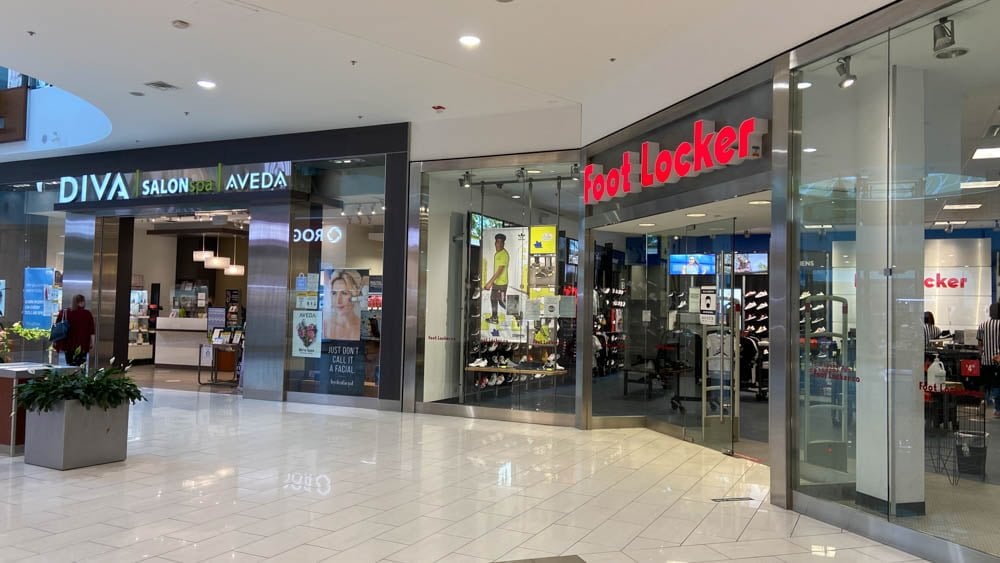
Foot Locker at Southcentre Mall in Calgary. Photo: Jessica Finch
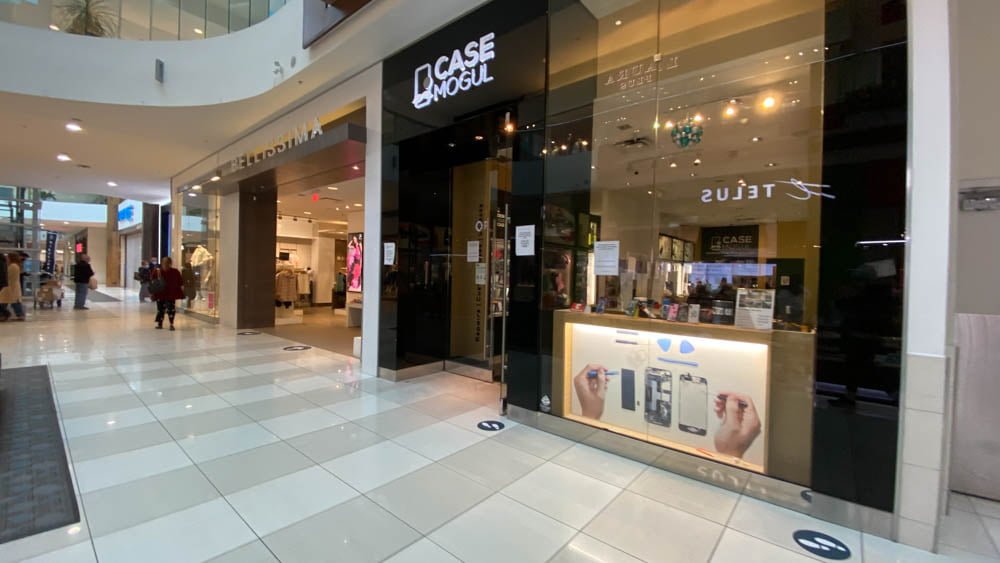
Case Mogul at Southcentre Mall in Calgary. Photo: Jessica Finch
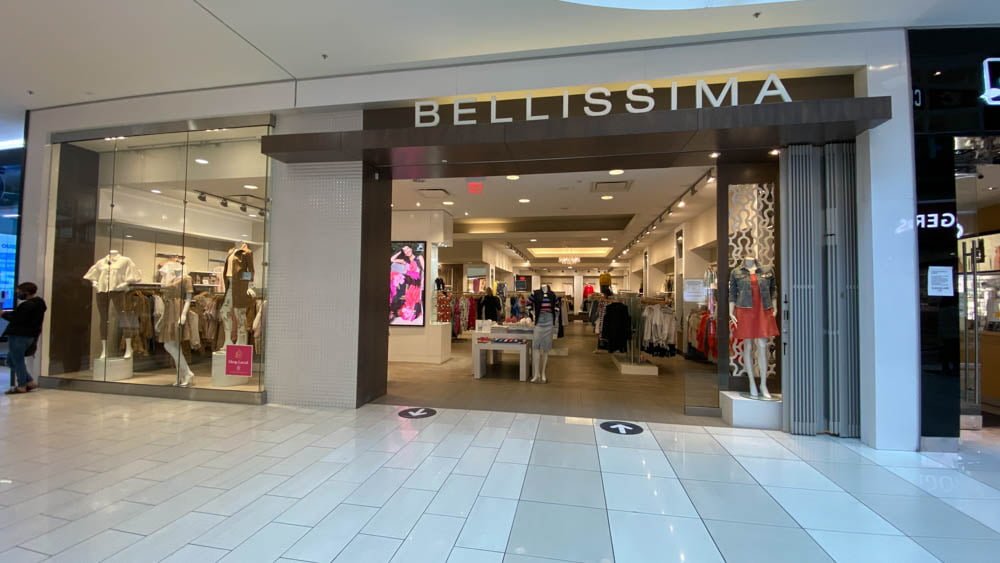
Bellissima at Southcentre Mall in Calgary. Photo: Jessica Finch
Laura at Southcentre Mall in Calgary. Photo: Jessica Finch
Just Cozy at Southcentre Mall in Calgary. Photo: Jessica Finch
Roots at Southcentre Mall in Calgary. Photo: Jessica Finch
Twisted Goods at Southcentre Mall in Calgary. Photo: Jessica Finch
Collab at Southcentre Mall in Calgary. Photo: Jessica Finch
Dollarama at Southcentre Mall in Calgary. Photo: Jessica Finch
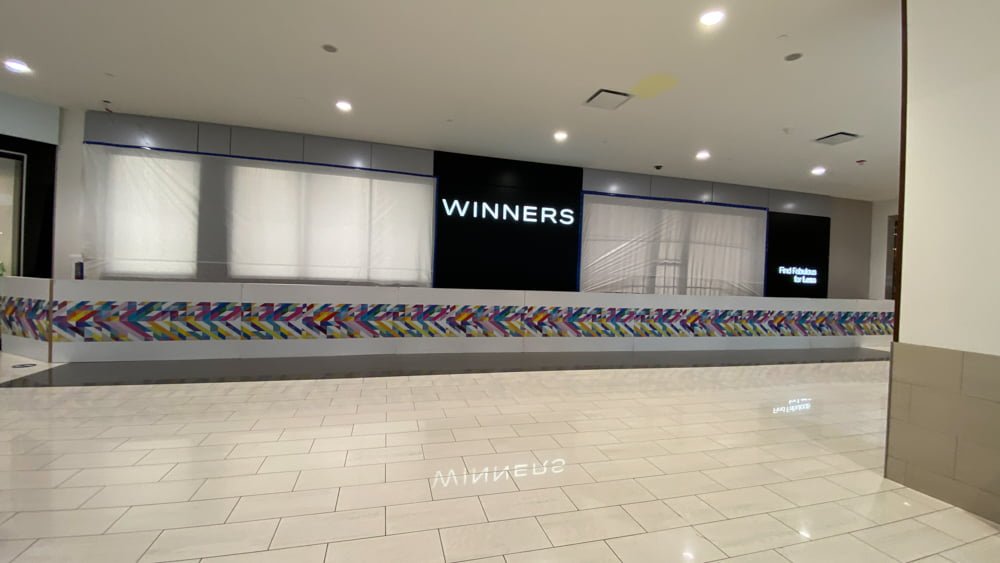
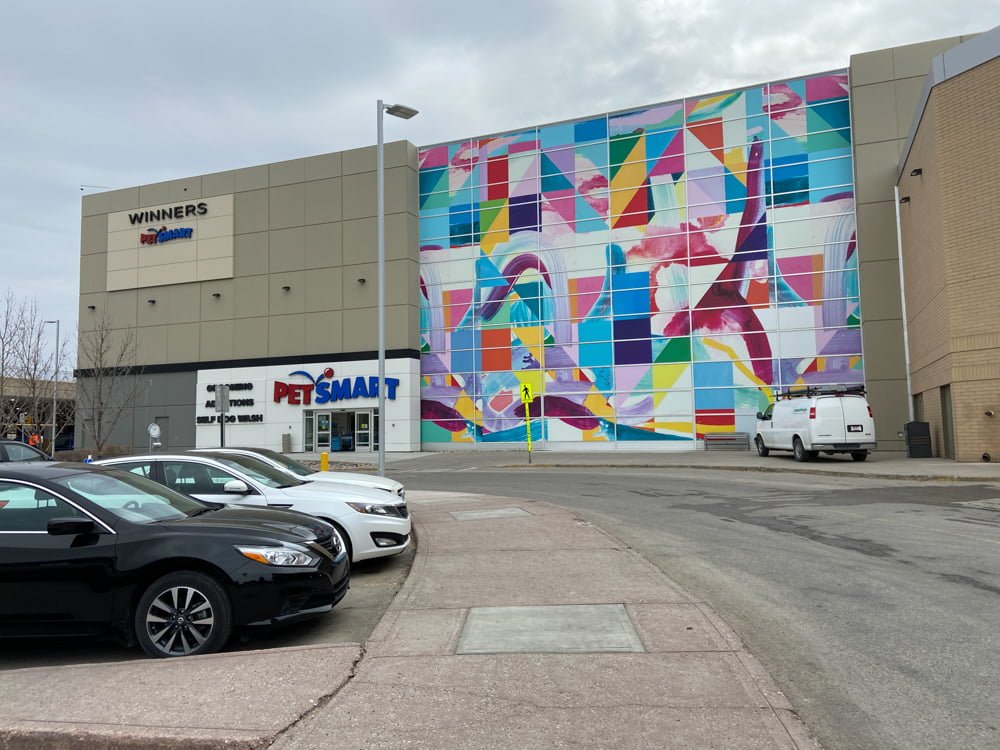
With the departure of big box and department retailers like Target, Eaton’s, and Sears Canada from the Canadian retail marketplace, landlords needed to strategize to fill vacated anchor retail spaces. With the July 2020 announcement by Oxford Properties to redevelop the vacated Sears Canada space, Dollarama officially opened in November 2020 and PetSmart opened in April 2021. Winners is scheduled to open soon.
Winners is coming soon to Southcentre Mall in Calgary. Photo: Jessica Finch
PetSmart (exterior) at Southcentre Mall in Calgary. Photo: Jessica Finch
Lower Level South at Southcentre Mall
The south side of the lower level is part of the original shopping centre build from the 1970s. It has been renovated over the years to make it seamlessly flow with the northern addition.
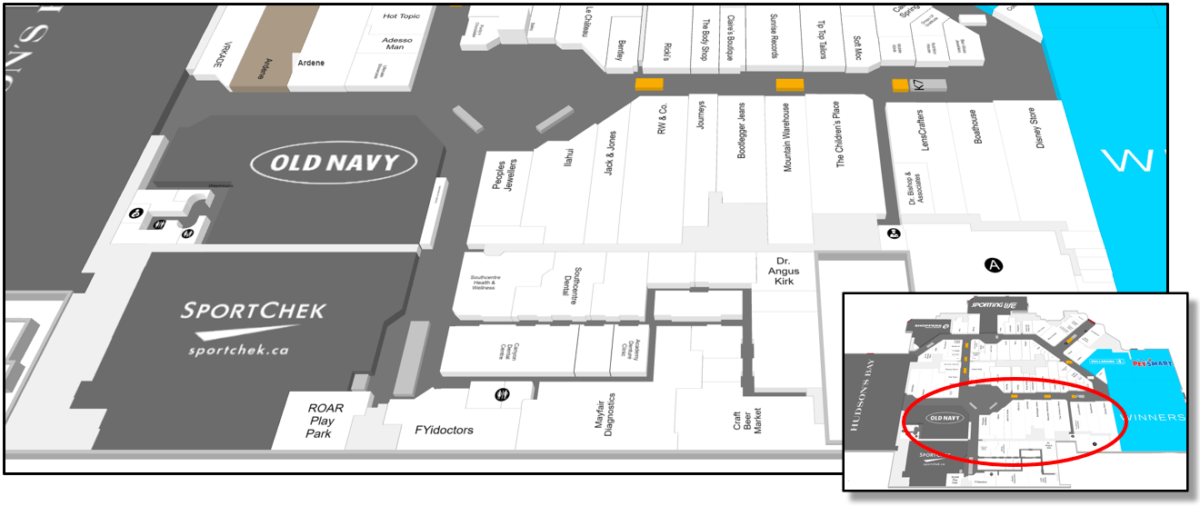
South side, lower level of Southcentre Mall tour zone. Photo: Southcentre Mall map with zone overlaid by Retail Insider
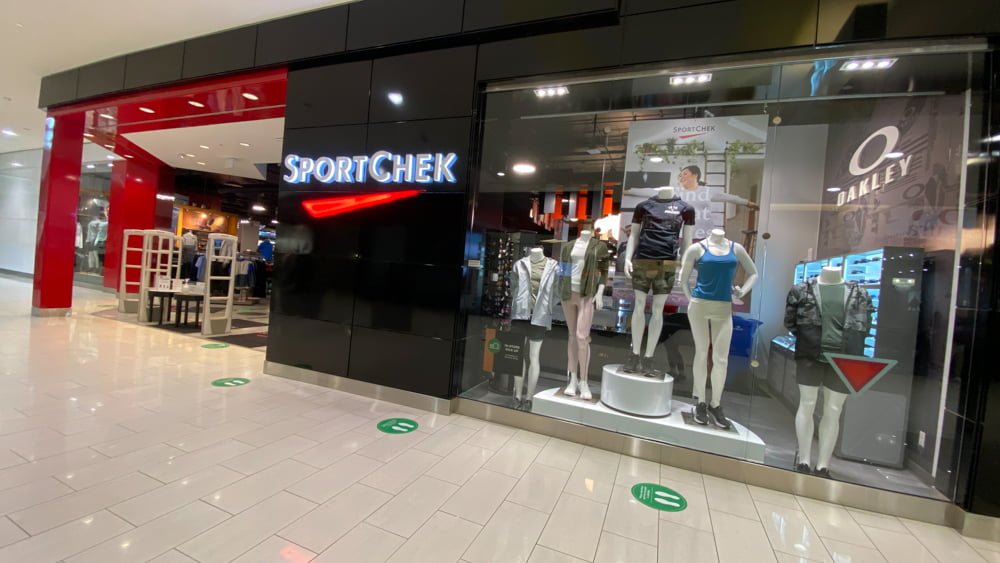
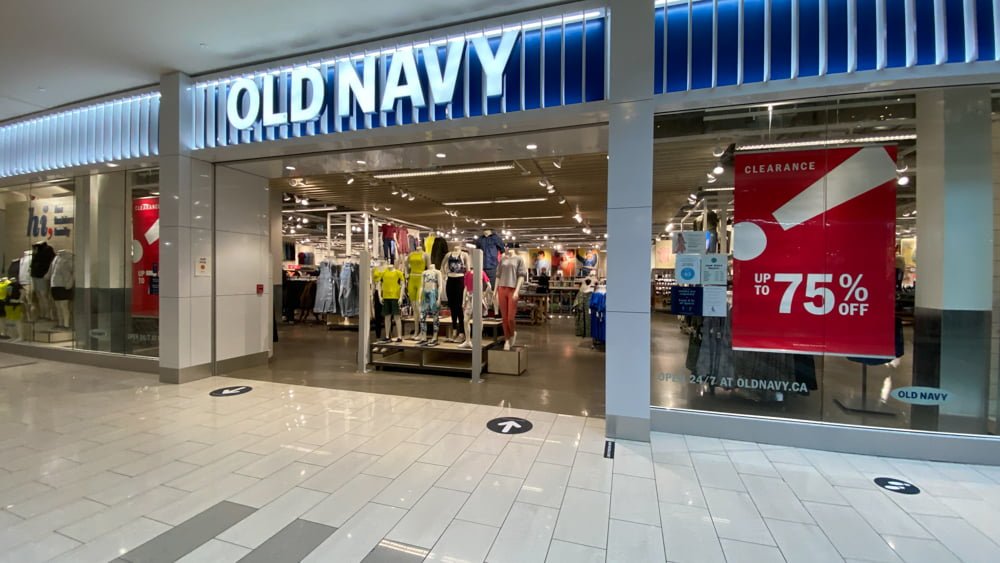
The main tenants for the south section of Southcentre are Sport Chek (which also extends up to the second level) and a single-level Old Navy store.
Sport Chek at Southcentre Mall in Calgary. Photo: Jessica Finch
Old Navy at Southcentre Mall in Calgary. Photo: Jessica Finch
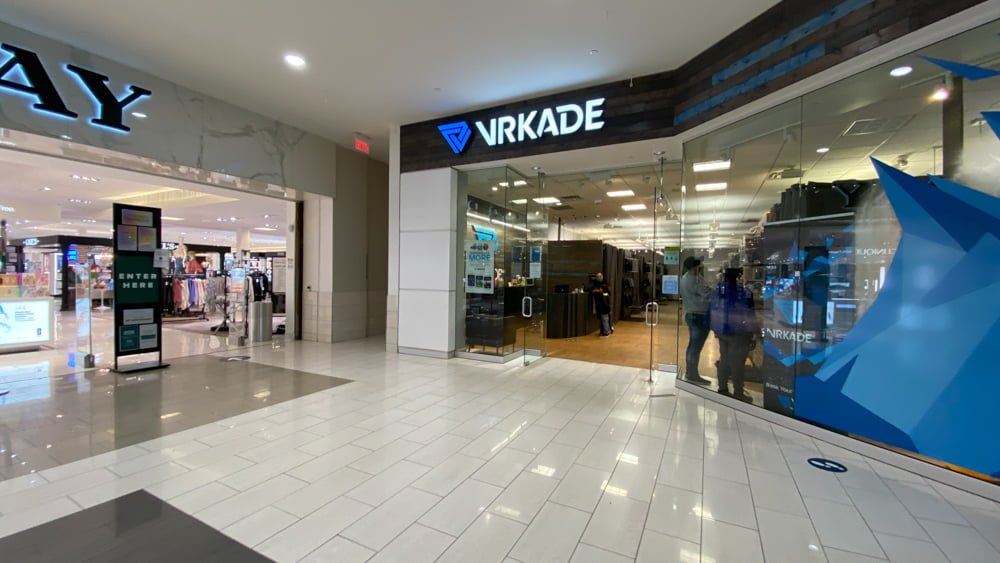
VRKADE at Southcentre in Calgary. Photo: Jessica Finch
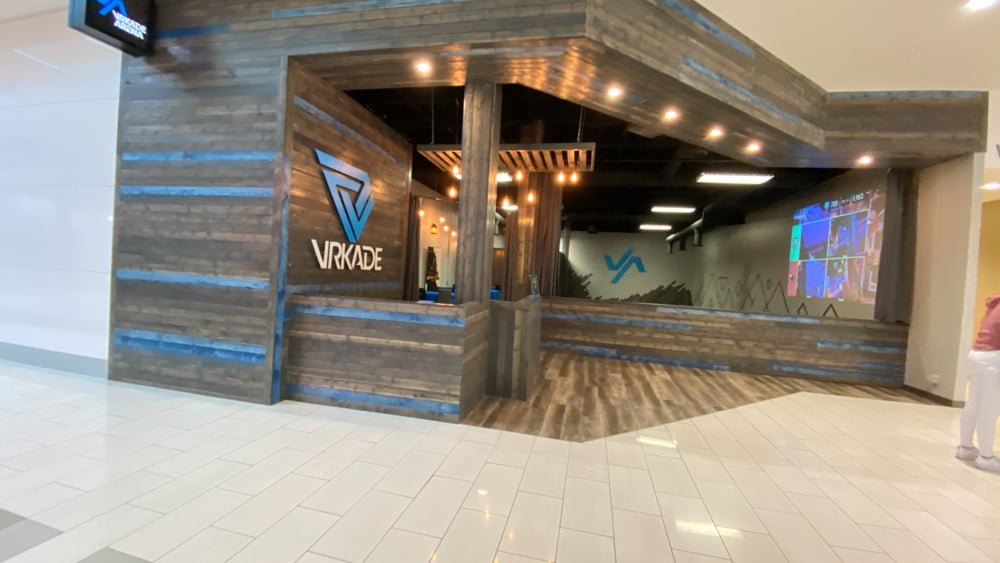
VRKADE at Southcentre in Calgary. Photo: Jessica Finch
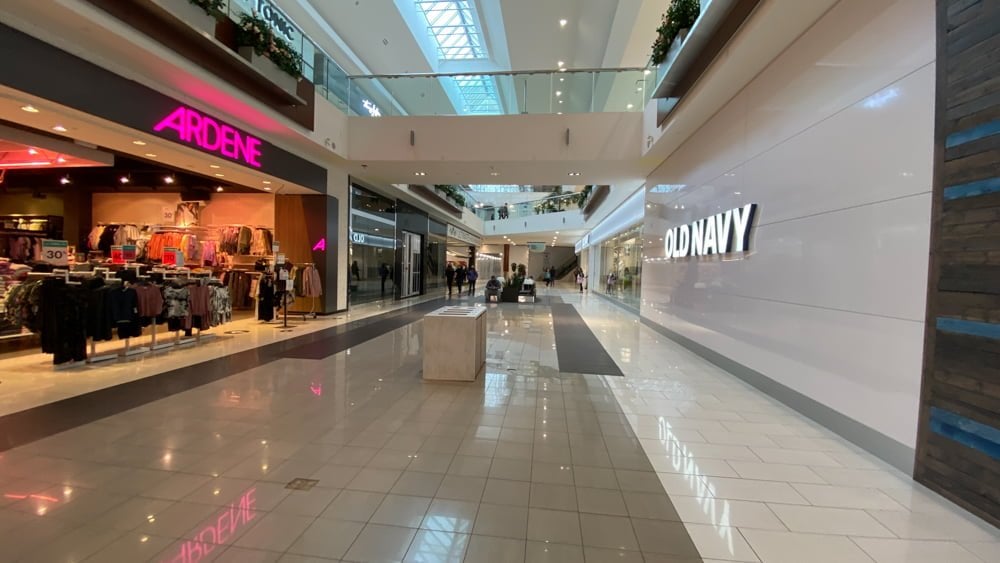
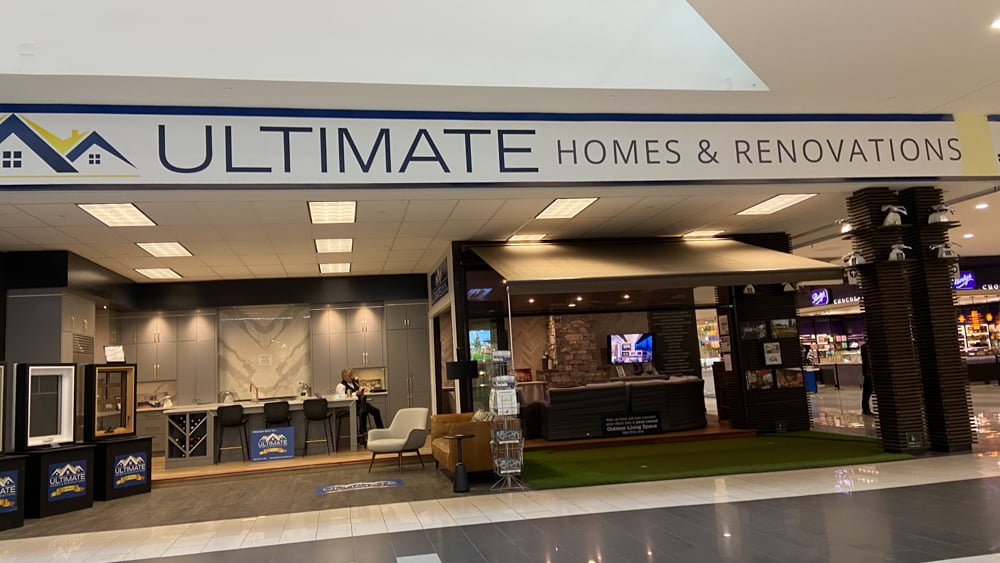
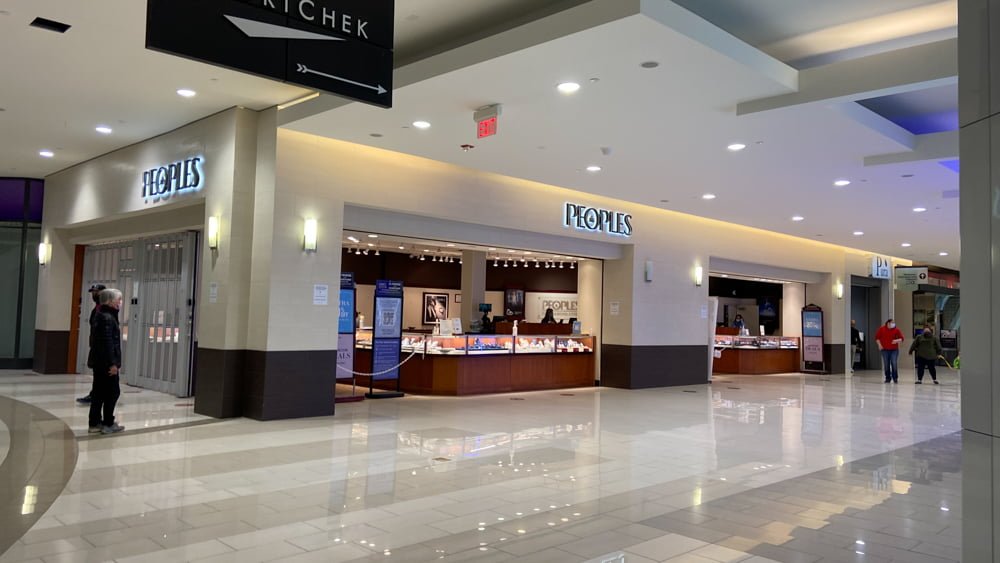
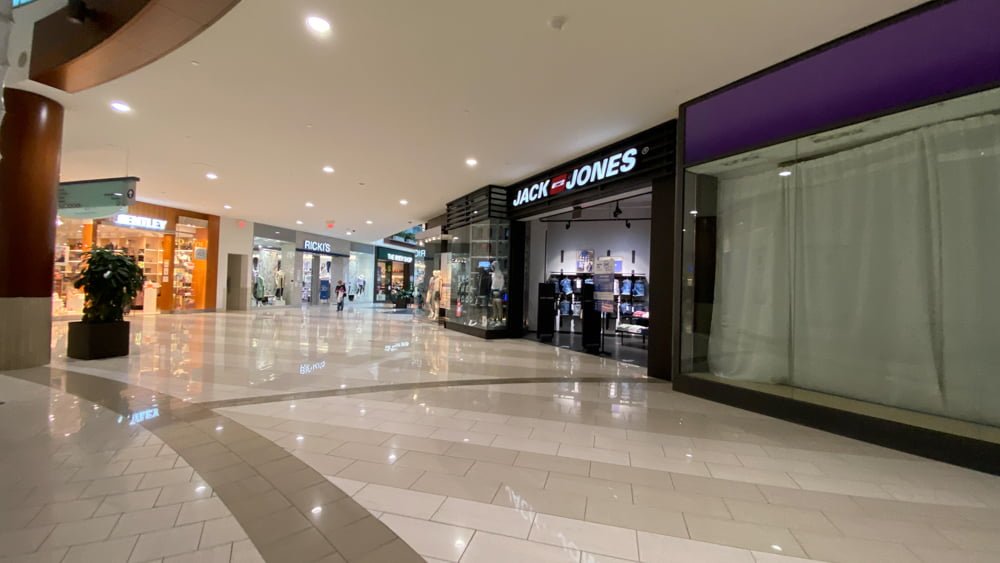
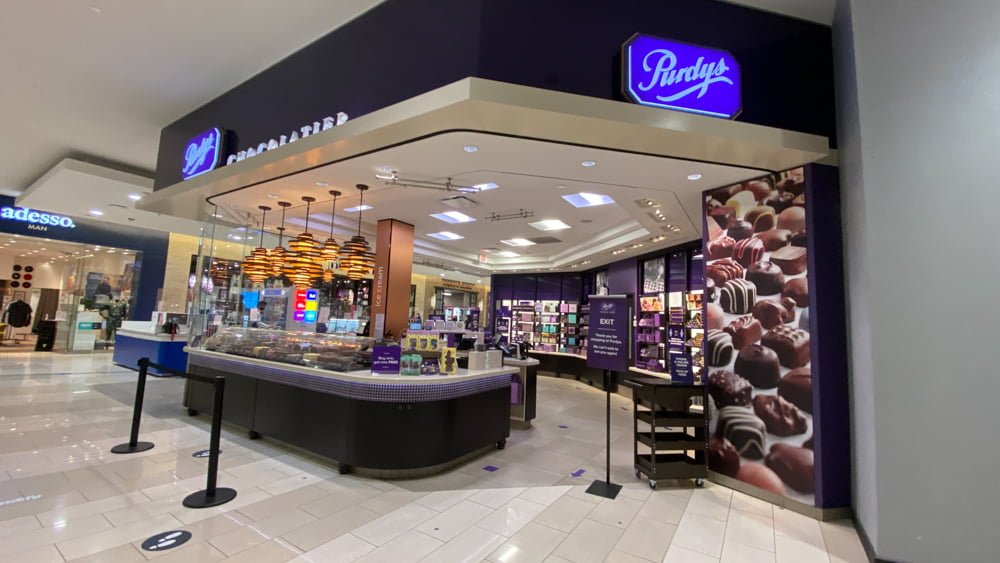
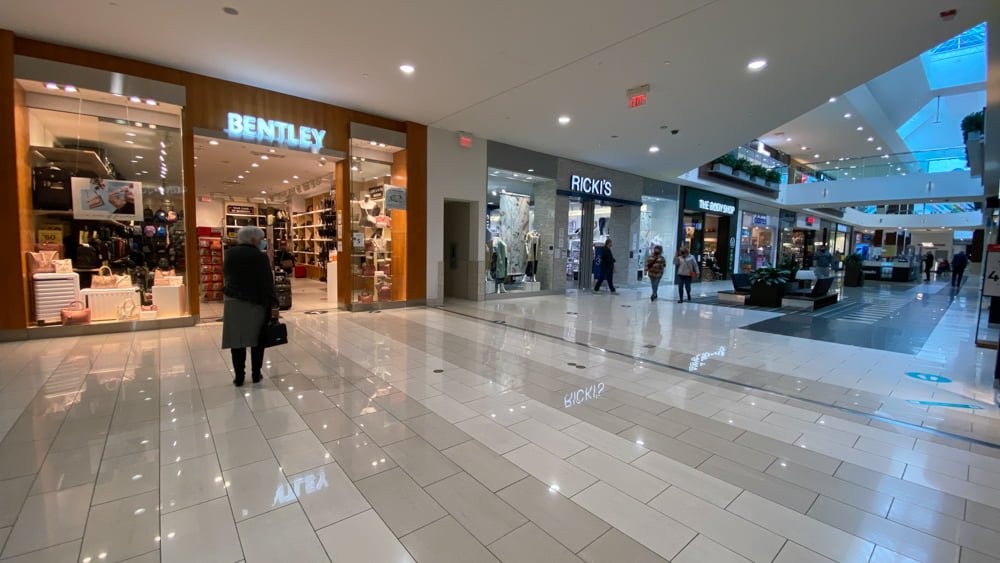
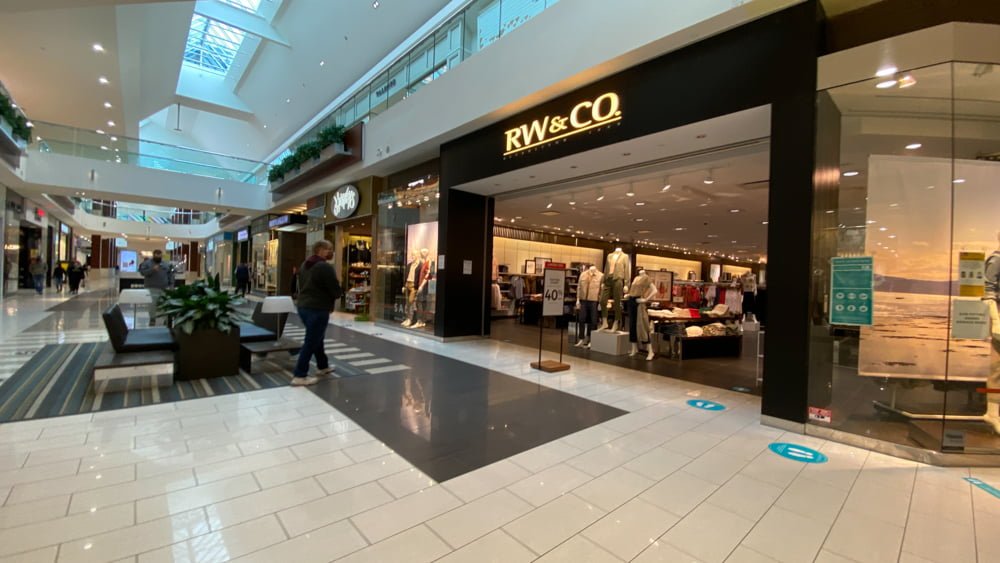
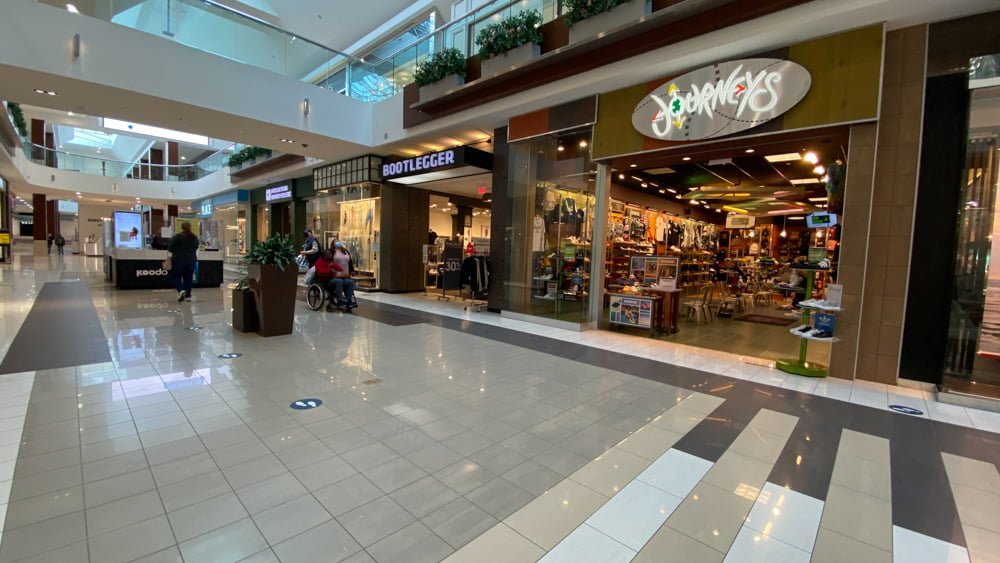
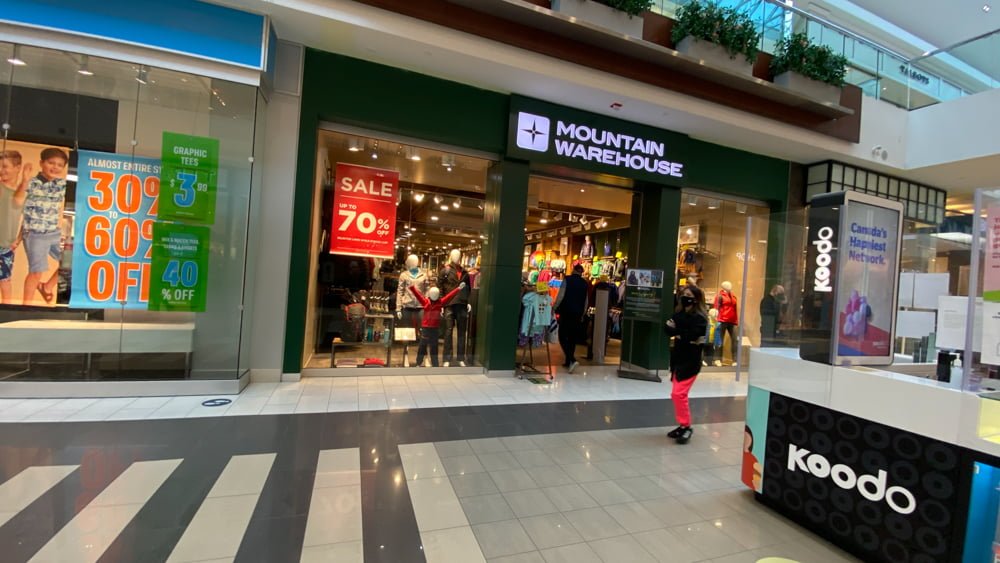
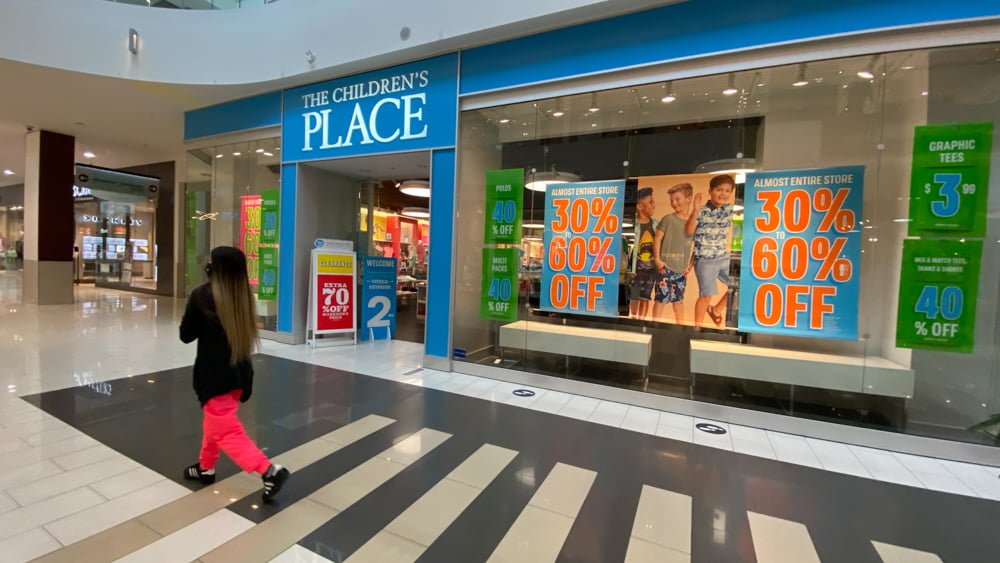
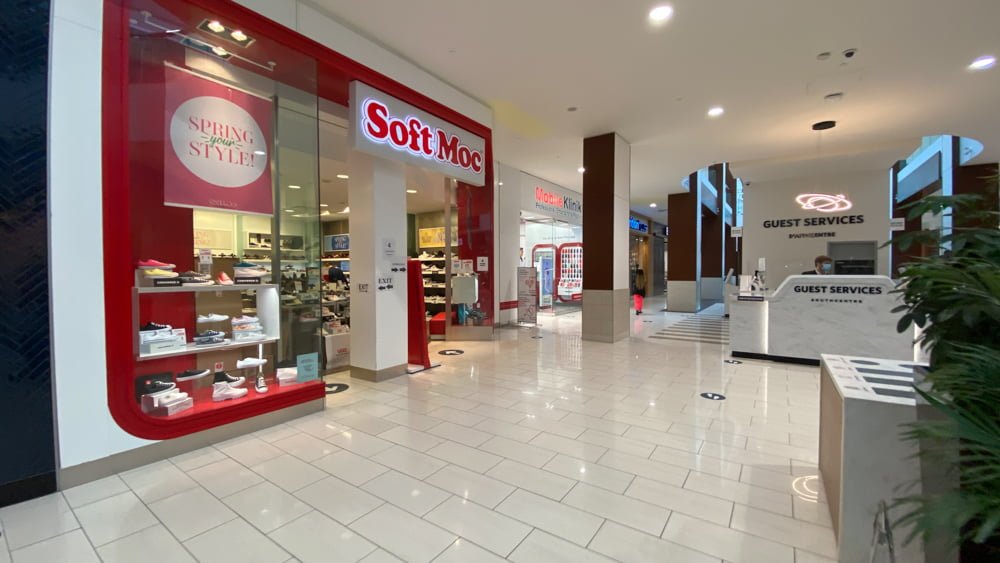
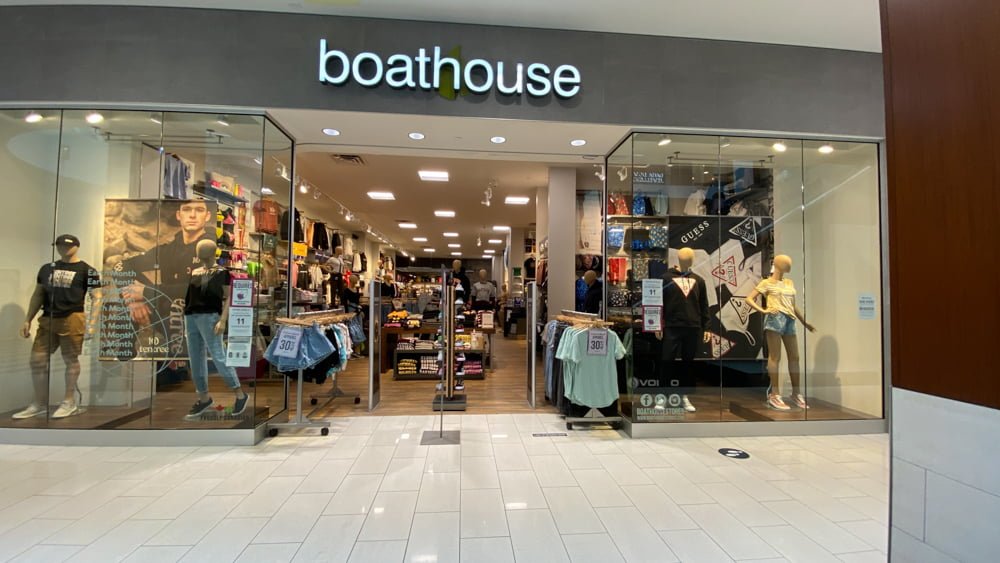
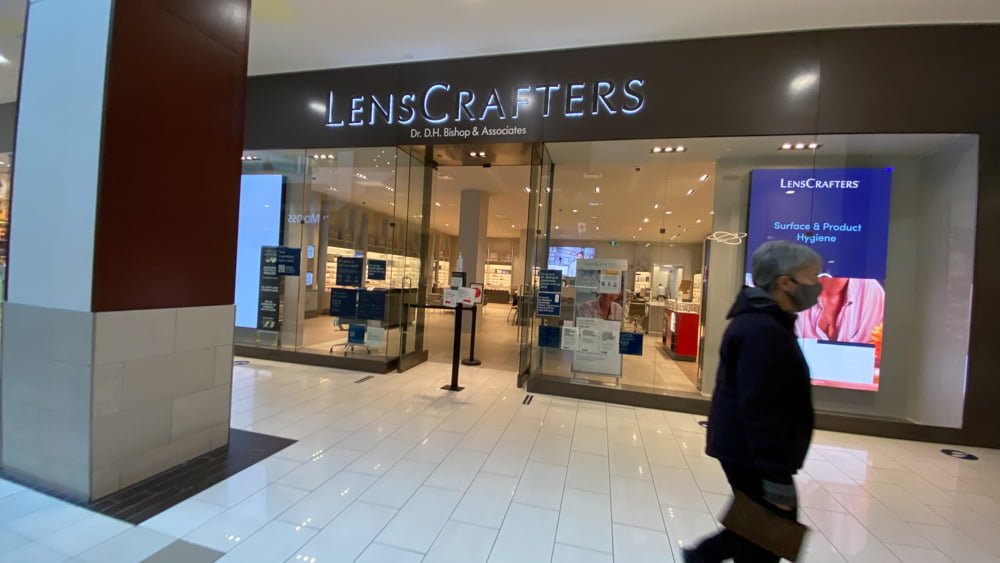
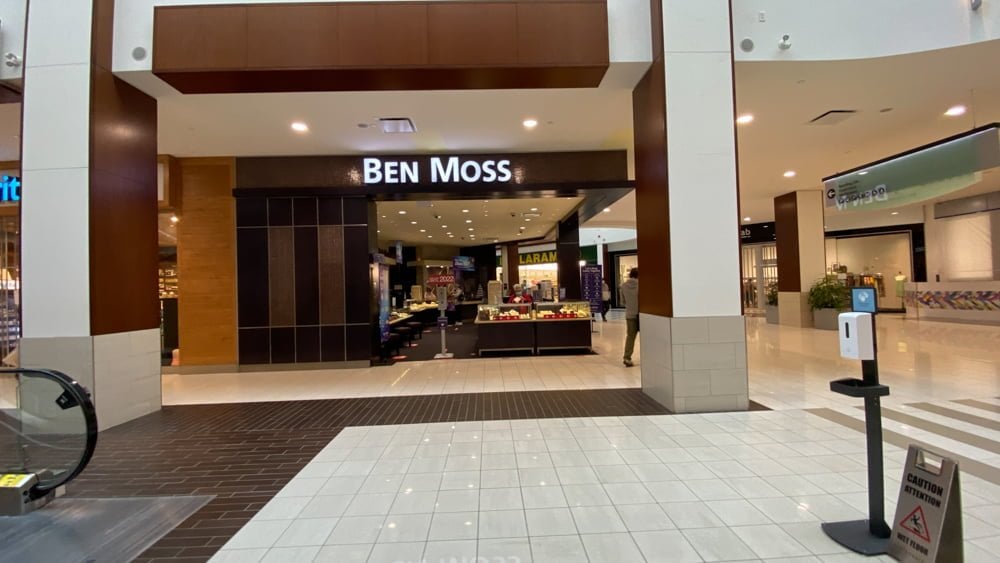
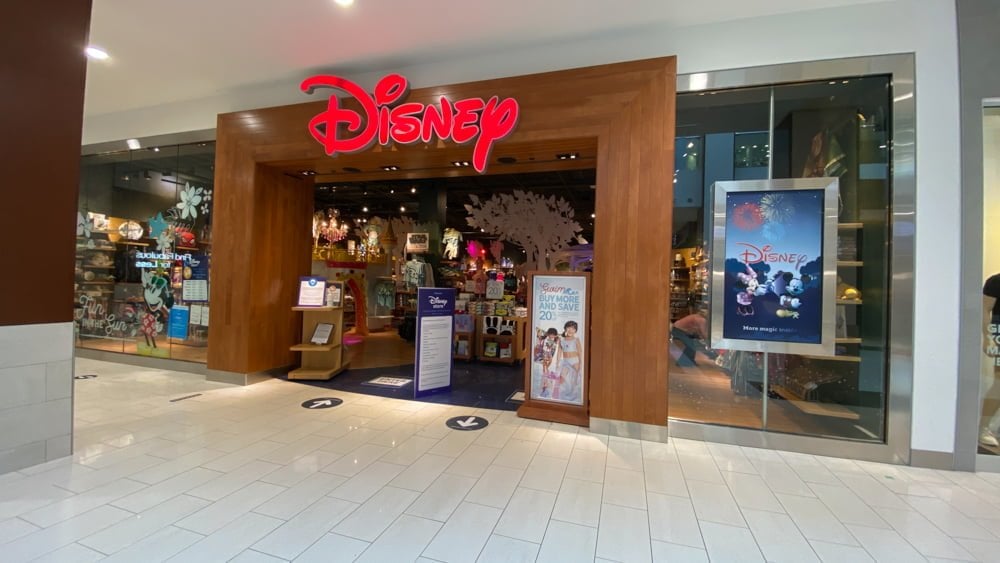
Other retailers and services in this section of the mall included Ardene, Ultimate Showcase, Purdy’s Chocolate, Bailey Nelson, Le Chateau (closing soon), Bentley, Ricki’s, The Body Shop, Claire’s Boutique, Soft Moc, Mobile Klinik, Nutrition House, Ben Moss Jewellers, Disney Store, Boathouse, LenseCrafters, The Children’s Place, Mountain Warehouse, Bootlegger Jeans, Journeys, RW&CO, Jack & Jones, IIahui, and People’s Jewellers.
Retailers in lower level south at Southcentre Mall in Calgary
1 of 9
Ardene and Old Navy at Southcentre Mall in Calgary. Photo: Jessica Finch
Ultimate Homes at Southcentre Mall in Calgary. Photo: Jessica Finch
People's Jewellery at Southcentre Mall in Calgary. Photo: Jessica Finch
Jack & Jones at Southcentre Mall in Calgary. Photo: Jessica Finch
Purdy's Chocolate at Southcentre Mall in Calgary. Photo: Jessica Finch
Bentley at Southcentre Mall in Calgary. Photo: Jessica Finch
RW&Co. at Southcentre Mall in Calgary. Photo: Jessica Finch
Journeys at Southcentre Mall in Calgary. Photo: Jessica Finch
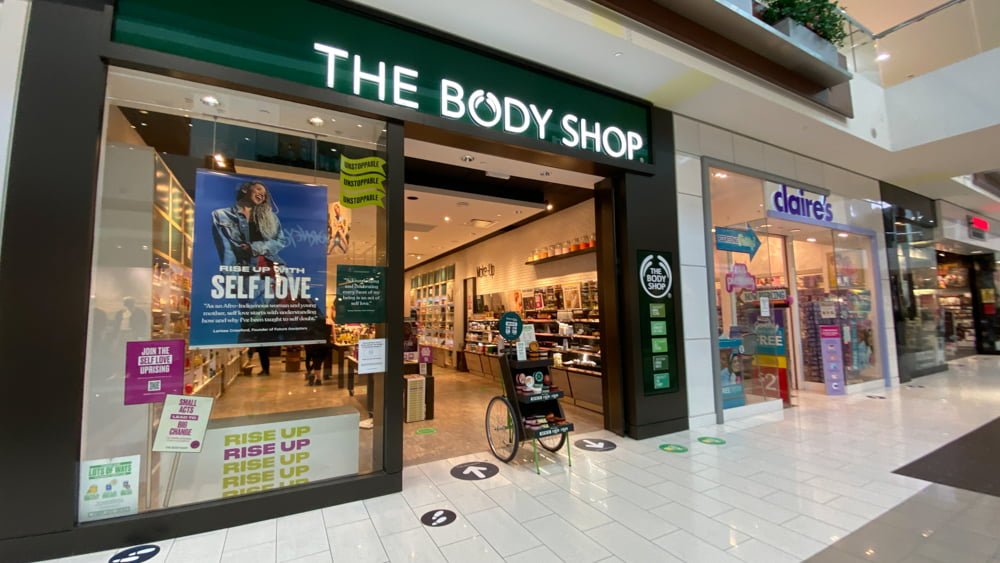
The Body Shop at Southcentre Mall in Calgary. Photo: Jessica Finch
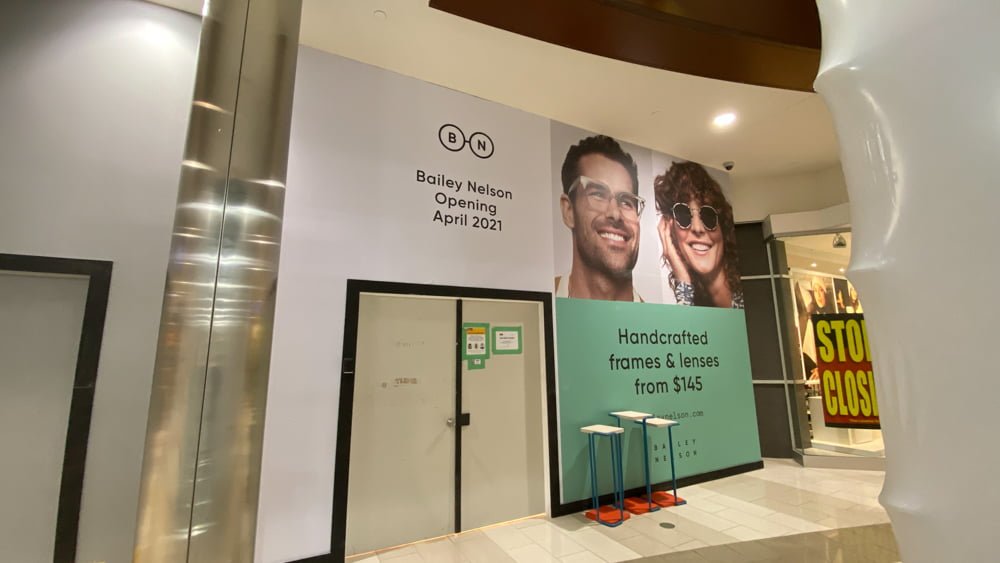
Bailey Nelson is coming soon to Southcentre Mall in Calgary. Photo: Jessica Finch
Construction signage for Bailey Nelson was happened upon during our April 2021 photo tour, claiming to be opening in April 2021.
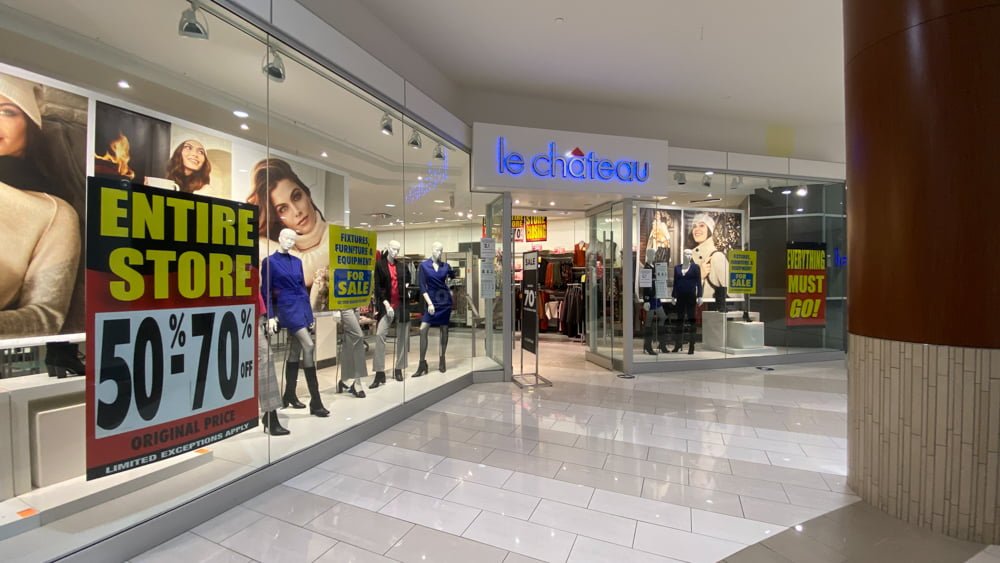
Le Chateau is shuttering Canada-wide, including at Southcentre Mall in Calgary. Photo: Jessica Finch
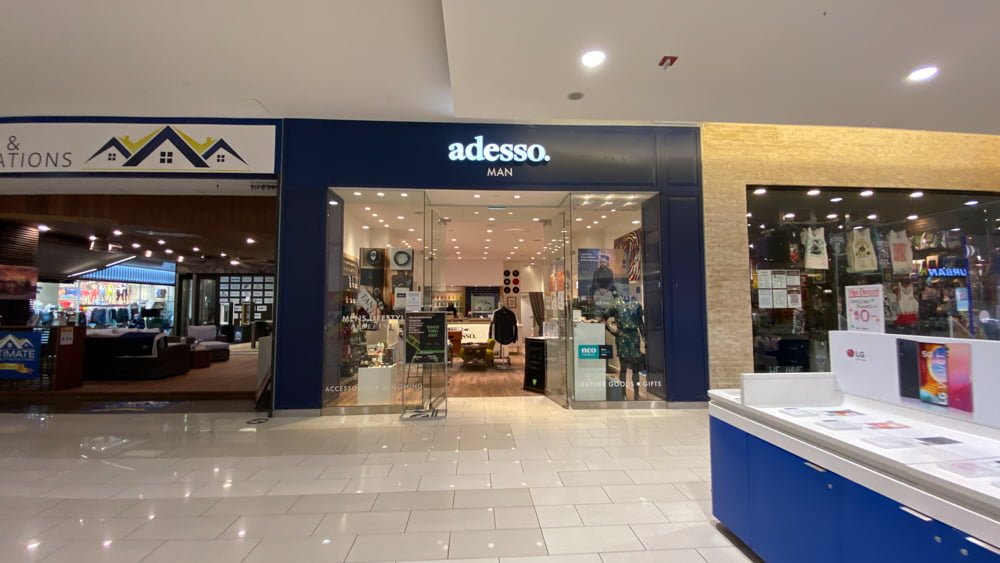
adesso. Man at Southcentre Mall in Calgary. Photo: Jessica Finch
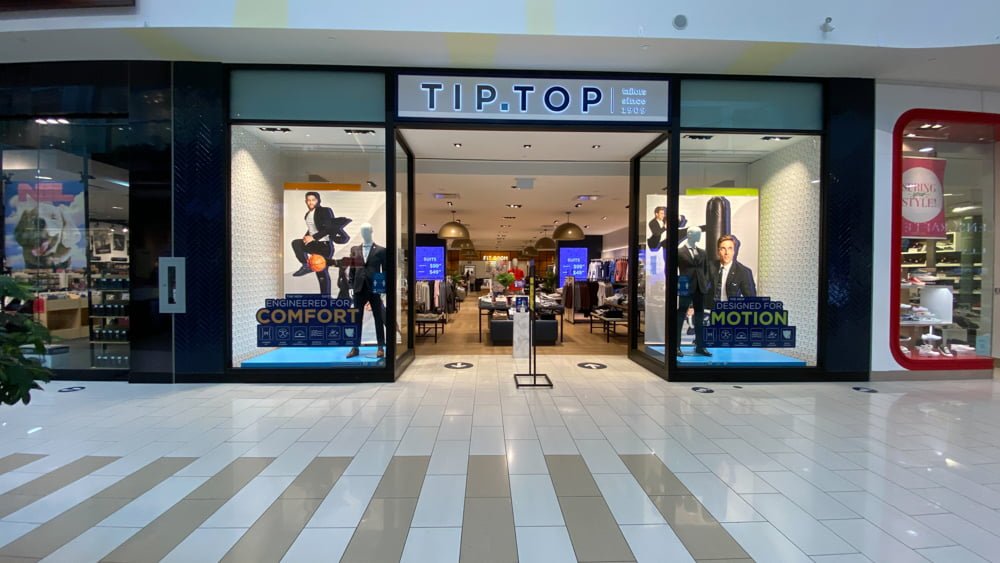
Tip Top at Southcentre Mall in Calgary. Photo: Jessica Finch
Upper Level North at Southcentre Mall
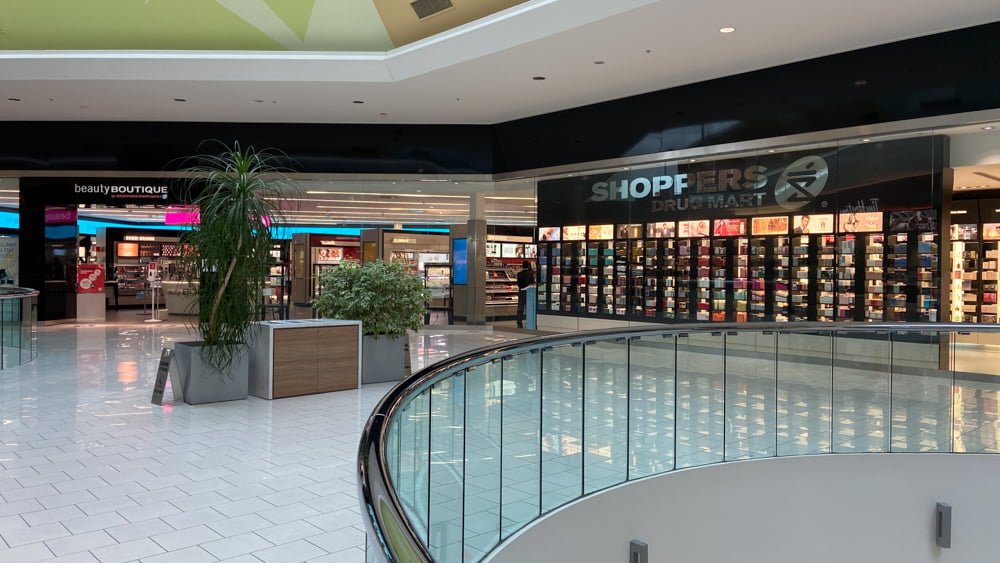
Moving up to the upper level of Southcentre Mall on the north end brings us to the renovated food court as well as the second level of the anchor tenants — Shoppers Drug Mart and Sporting Life.
North side, upper level of Southcentre Mall tour zone. Photo: Southcentre Mall map with zone overlaid by Retail Insider
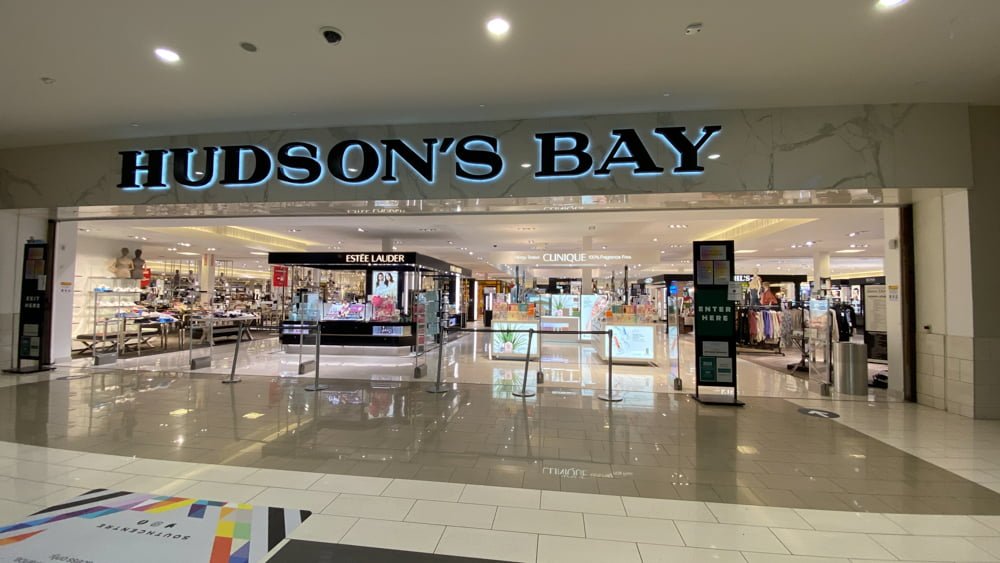
While we are loosely calling all the other retailers with a larger footprint anchor tenants, the largest and longstanding anchor tenant in Southcentre Mall is the Hudson’s Bay Company. This location was set to receive a major overhaul in 2015.
Hudson’s Bay at Southcentre Mall in Calgary which appears to be the most updated store for the Bay in Alberta. Photo: Jessica Finch
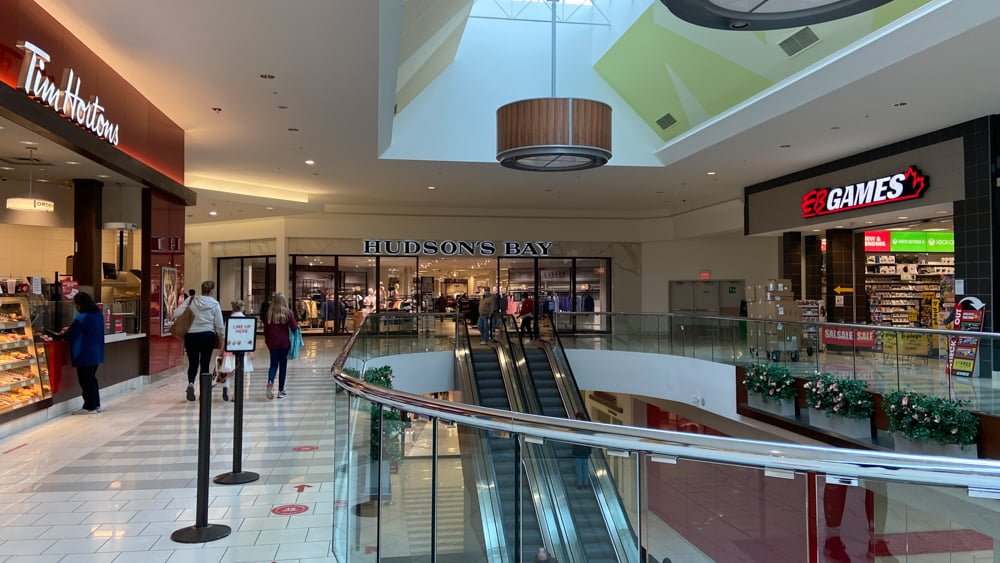
Hudson’s Bay with EB Games at Southcentre Mall in Calgary. Photo: Jessica Finch
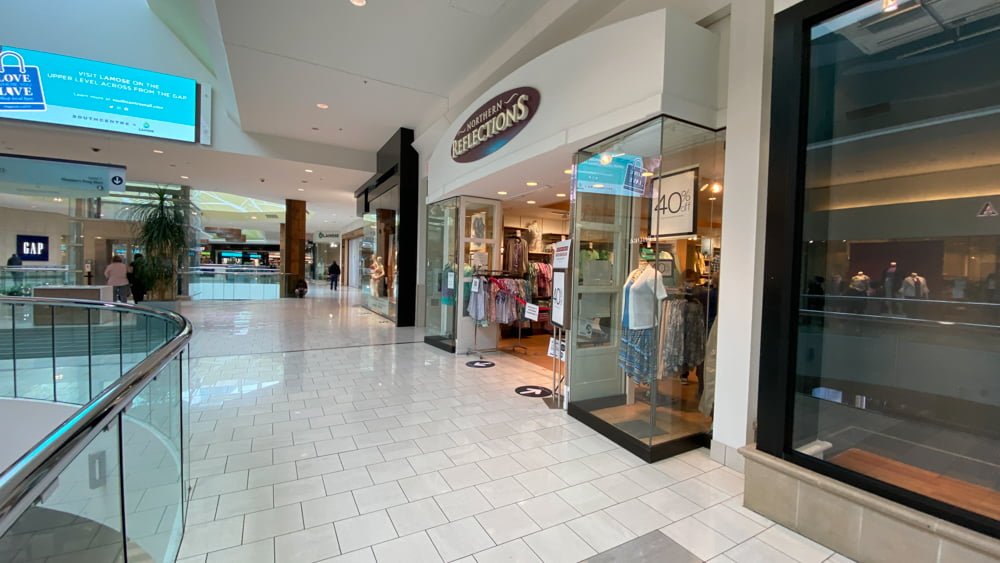
Overall view of upper level north in Southcentre Mall in Calgary. Photo: Jessica Finch
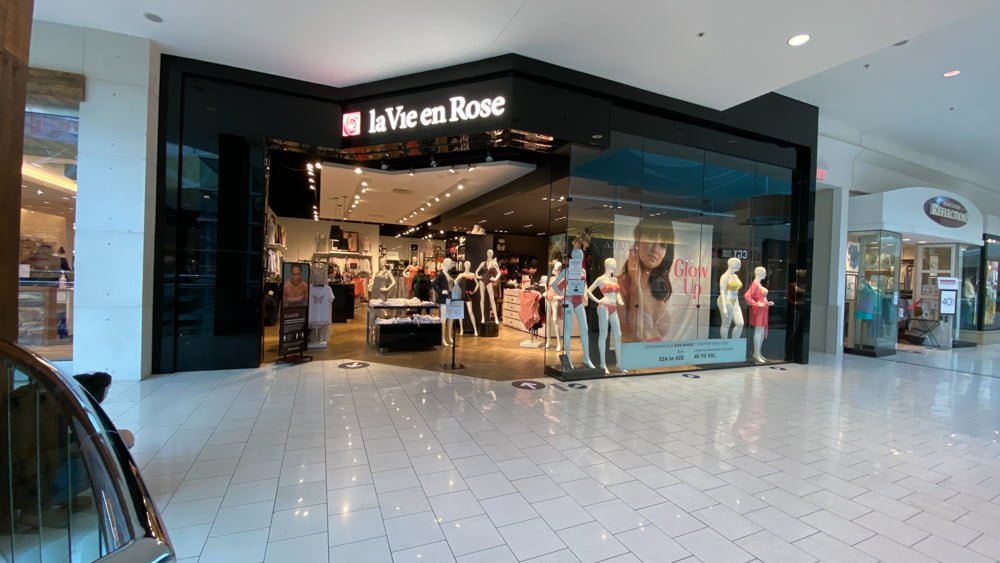
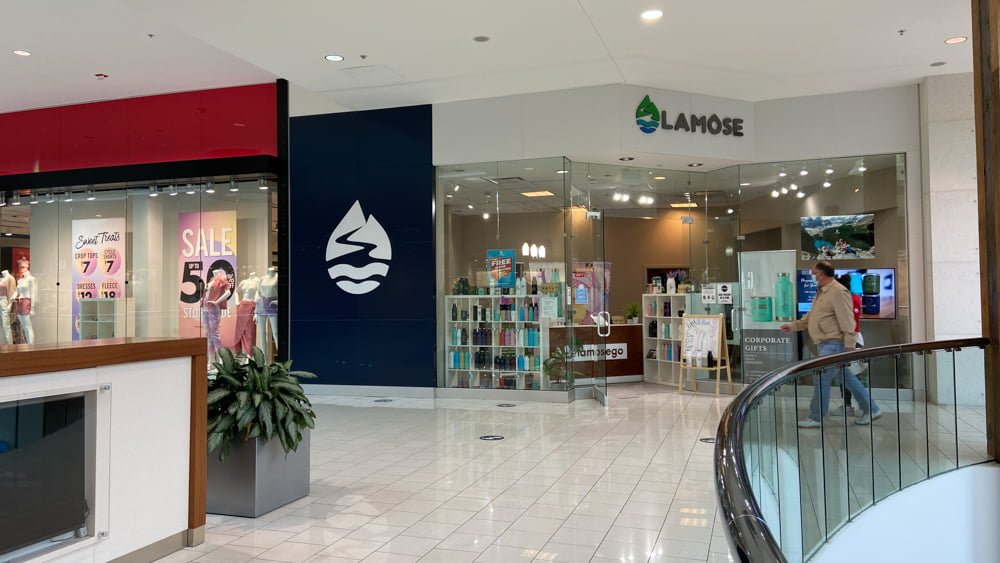
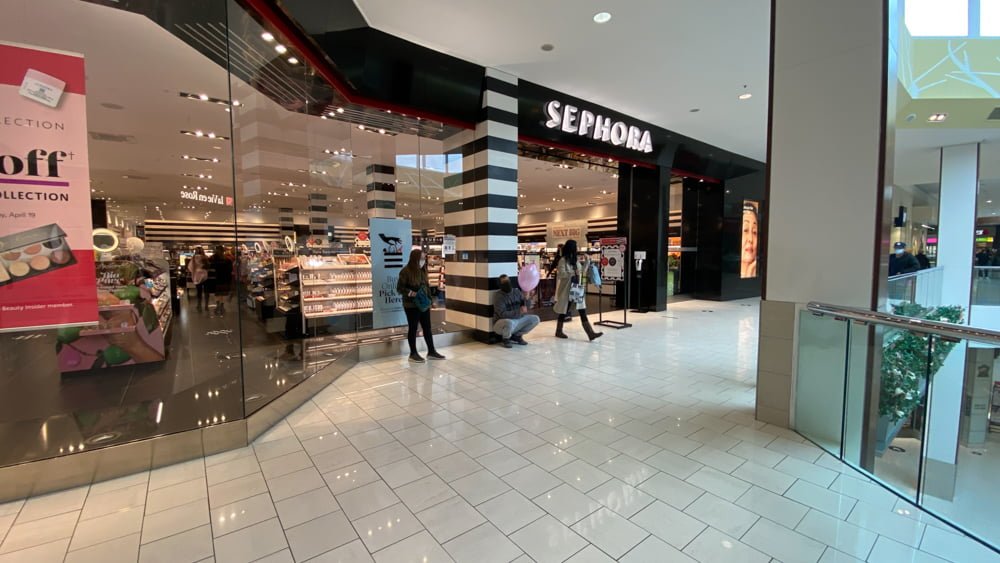
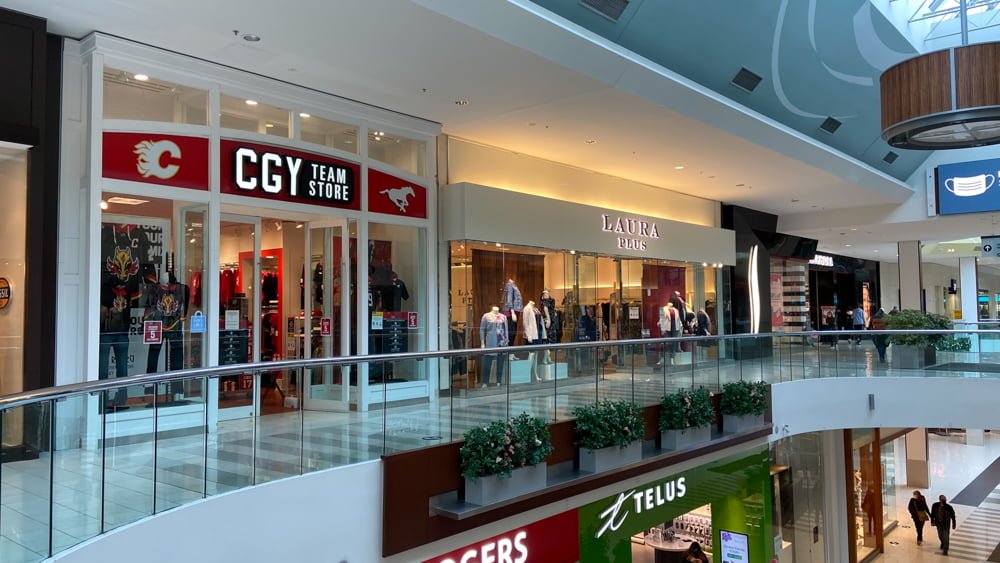
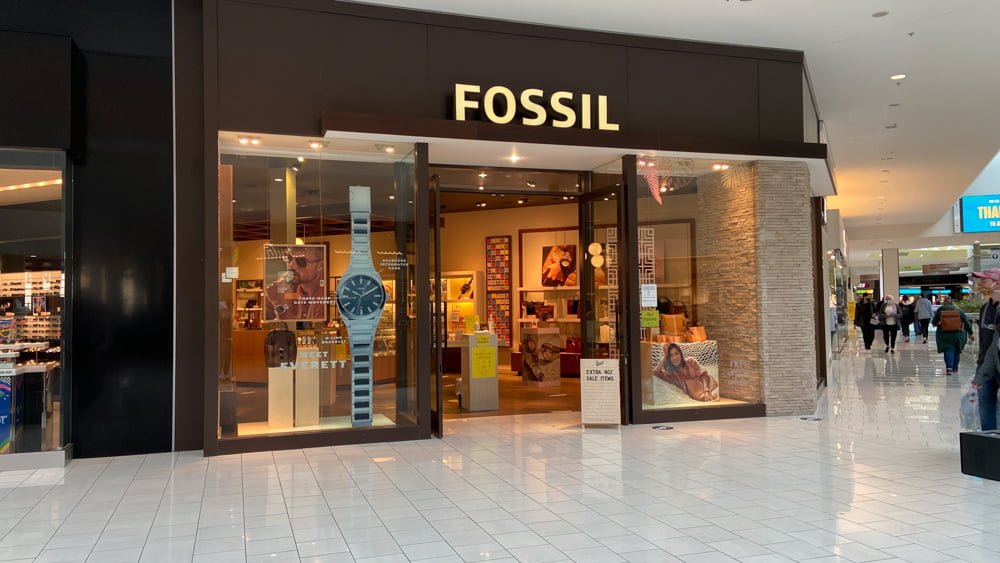
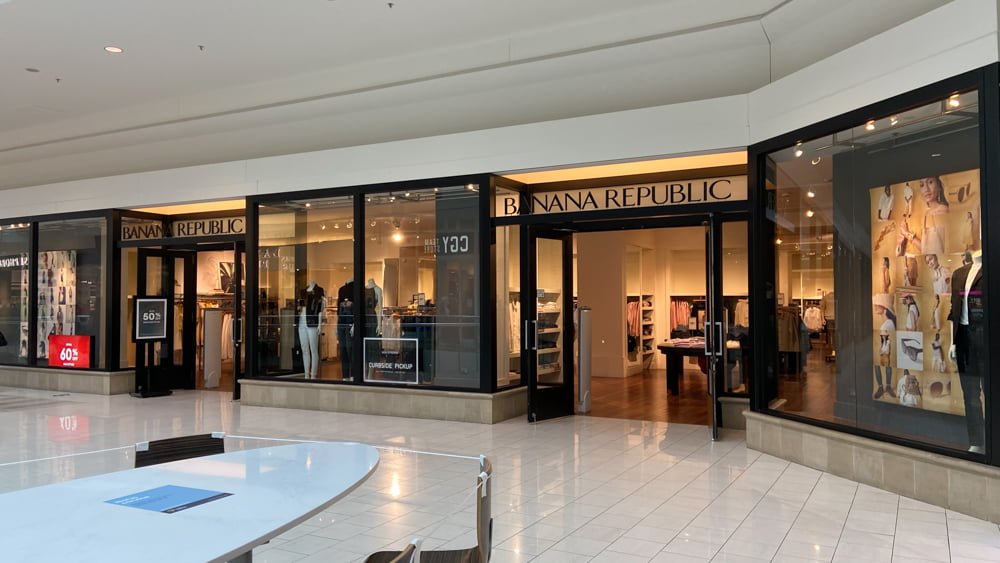
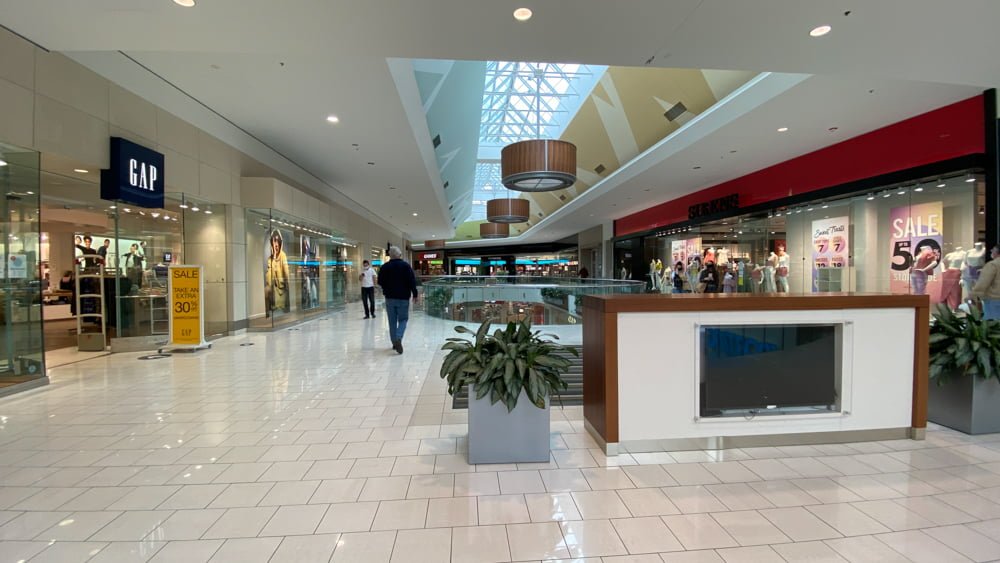
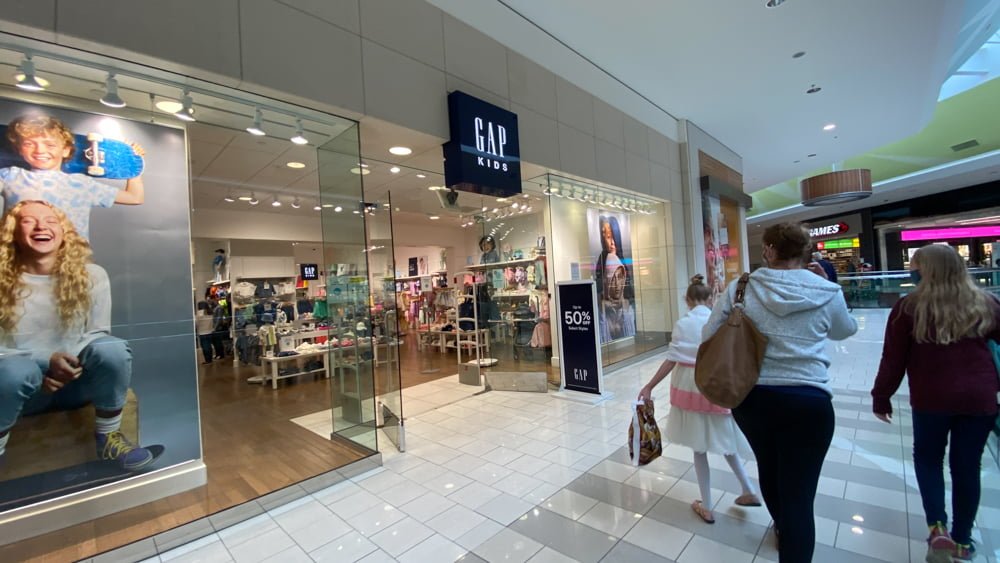
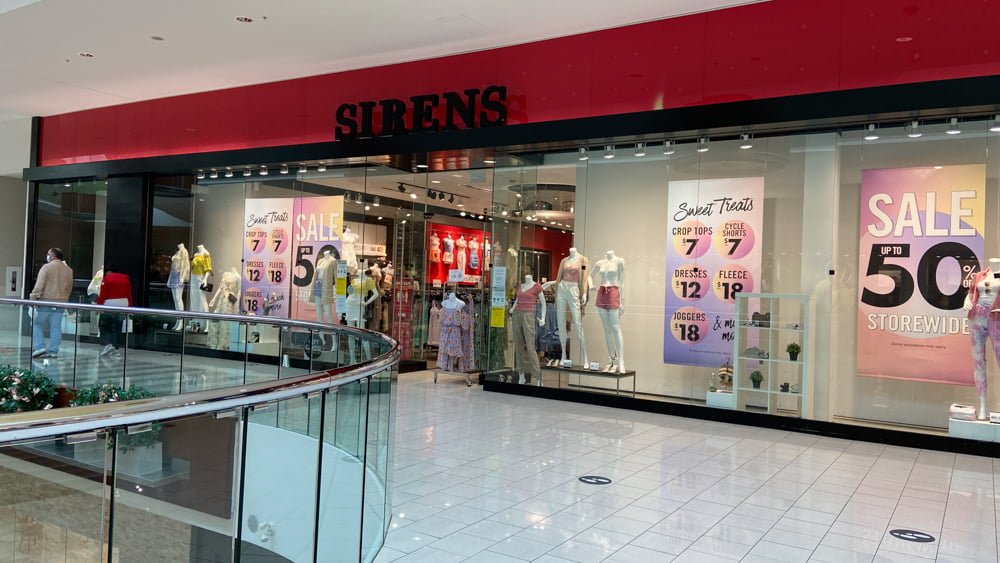
Other retailers in this section of the mall include Sirens, Showcase, Gap, Lamose, Sephora, La Vie en Rose, Northern Reflections, Banana Republic, Laura Plus, CGY Team, Fossil, Dynamite, and Michael Hill.
Retailers on upper level north at Southcentre Mall
1 of 7
Northern Reflections at Southcentre Mall in Calgary. Photo: Jessica Finch
le Vie en Rose at Southcentre Mall in Calgary. Photo: Jessica Finch
Lamose at Southcentre Mall in Calgary. Photo: Jessica Finch
Sephora at Southcentre Mall in Calgary. Photo: Jessica Finch
CGY Team Store at Southcentre Mall in Calgary. Photo: Jessica Finch
Fossil at Southcentre Mall in Calgary. Photo: Jessica Finch
Banana Republic at Southcentre Mall in Calgary. Photo: Jessica Finch
Overview of upper level north at Southcentre Mall in Calgary. Photo: Jessica Finch
Retailers on upper level north at Southcentre
1 of 4
The Gap at Southcentre Mall in Calgary. Photo: Jessica Finch
Upper level of Shoppers at Southcentre Mall in Calgary. Photo: Jessica Finch
Sirens at Southcentre Mall in Calgary. Photo: Jessica Finch
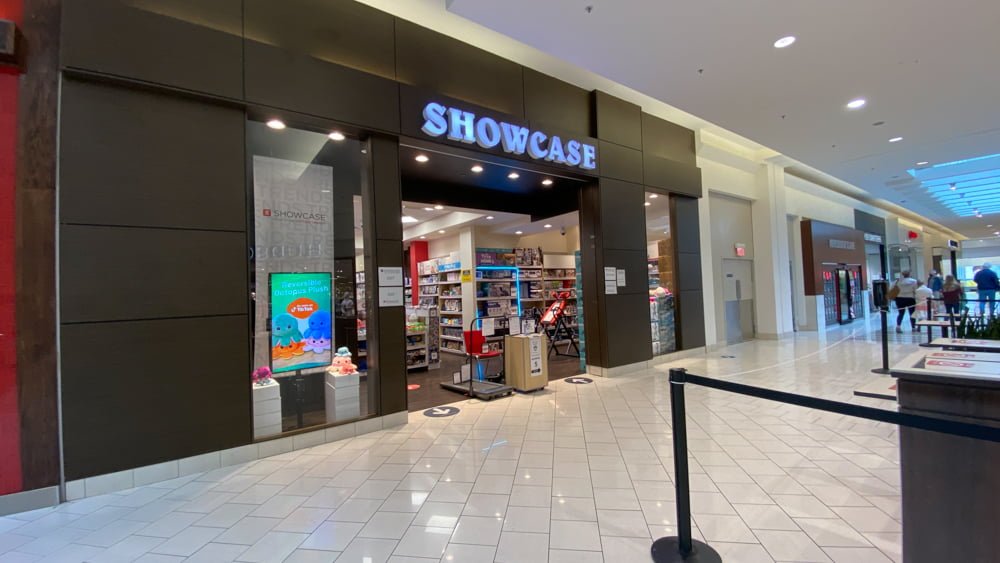
Showcase at Southcentre Mall in Calgary. Photo: Jessica Finch
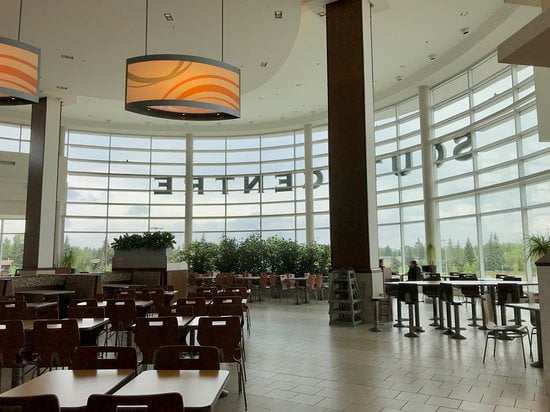
The second-level food court has a seating area that capitalizes on the iconic glass façade which is prominently utilized in the shopping centre’s marketing campaigns and is highly recognizable for the centre.
Interior food court seating area at Southcentre Mall in Calgary. Photo: Tripadvisorr
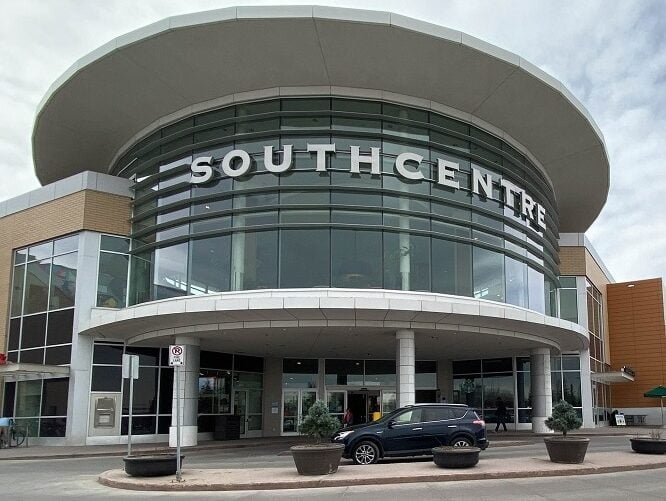
Southcentre Mall exterior. Photo: Jessica Finch
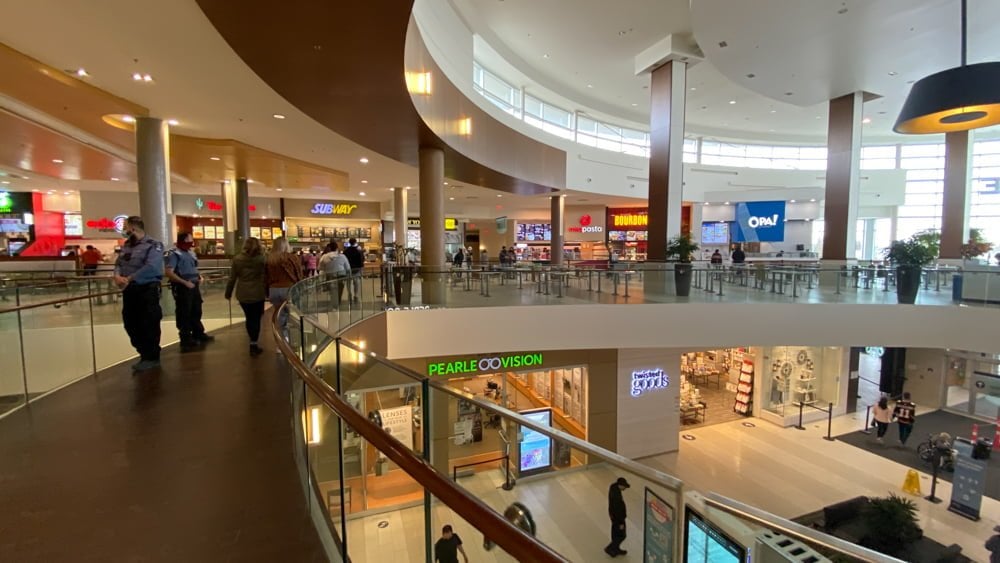
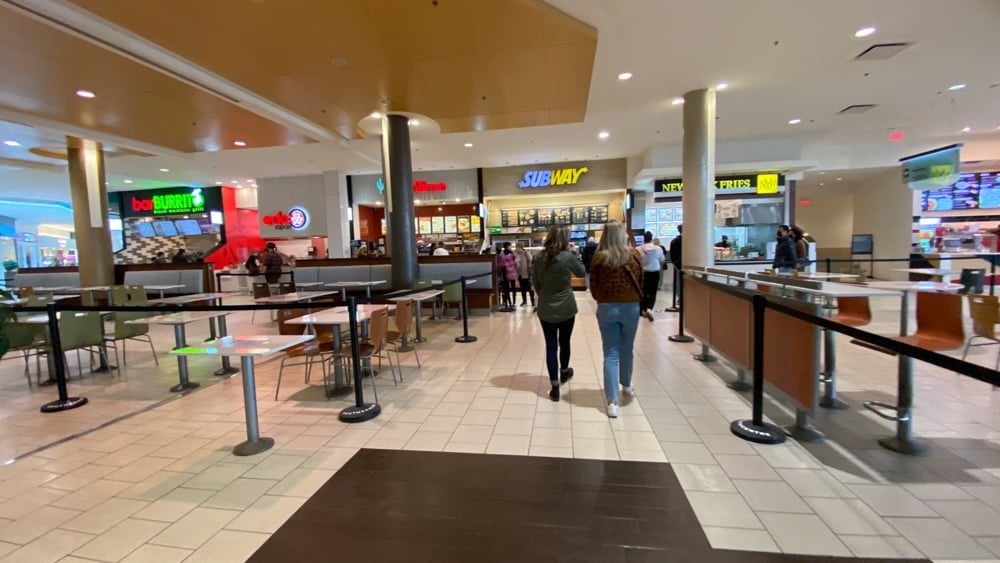
Food court at Southcentre Mall in Calgary. Photo: Jessica Finch
Food court at Southcentre Mall in Calgary. Photo: Jessica Finch
Food court at Southcentre Mall in Calgary. Photo: Jessica Finch
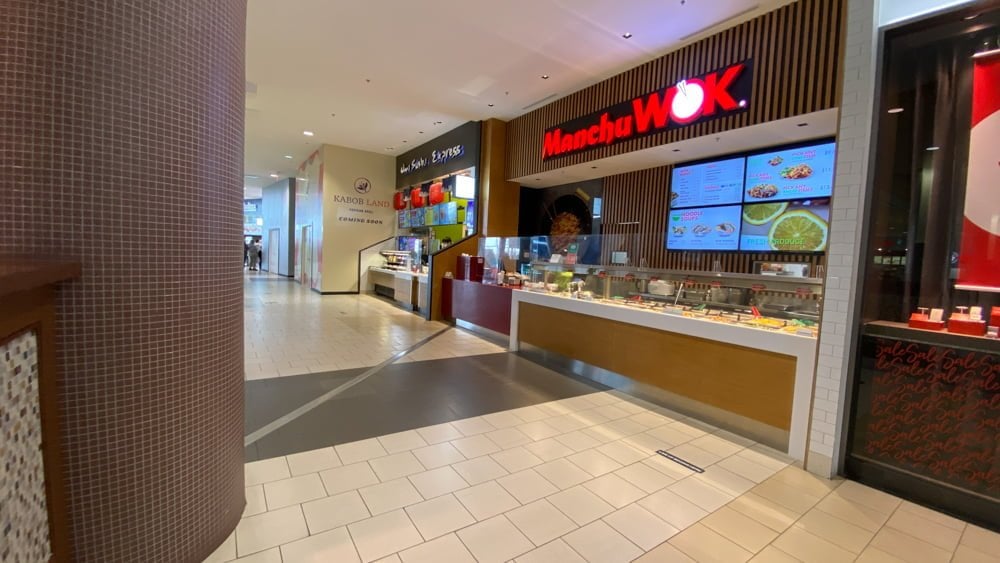
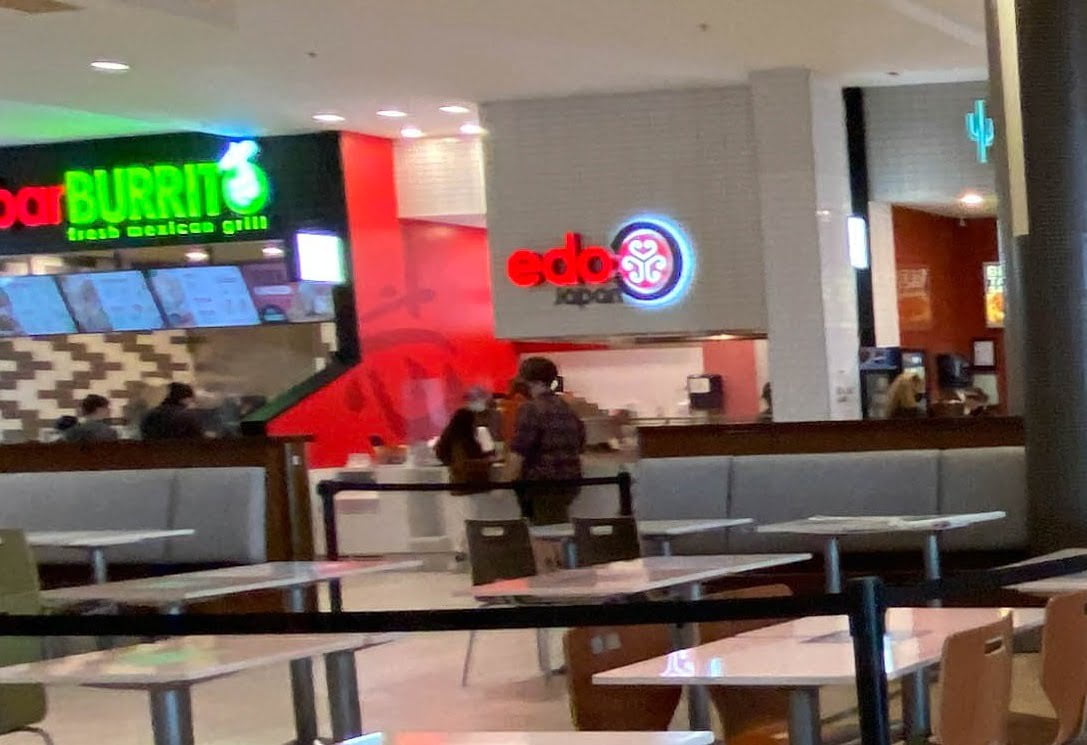
Edo Japan in food court at Southcentre Mall in Calgary. Photo: Jessica Finch
Upper Level South at Southcentre Mall
The final zone of the Southcentre Mall tour is the southern section of the upper level. This area includes access to the upper level of Sport Chek, as well as the vacant retail space yet to be filled after Sears Canada’s departure.
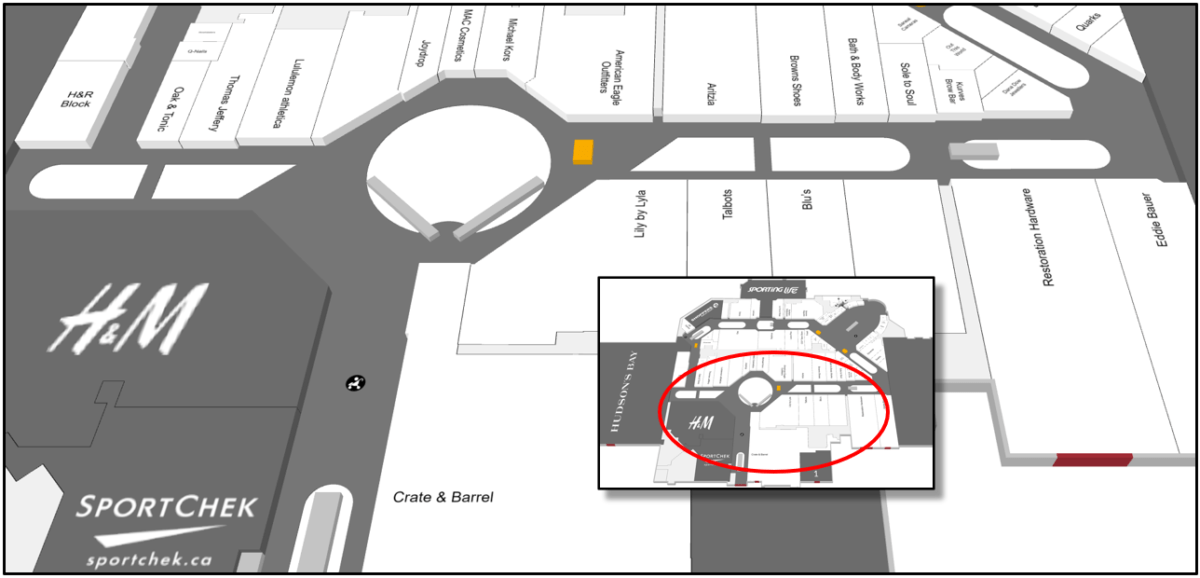
South side, upper level of Southcentre Mall tour zone. Photo: Southcentre Mall map with zone overlaid by Retail Insider
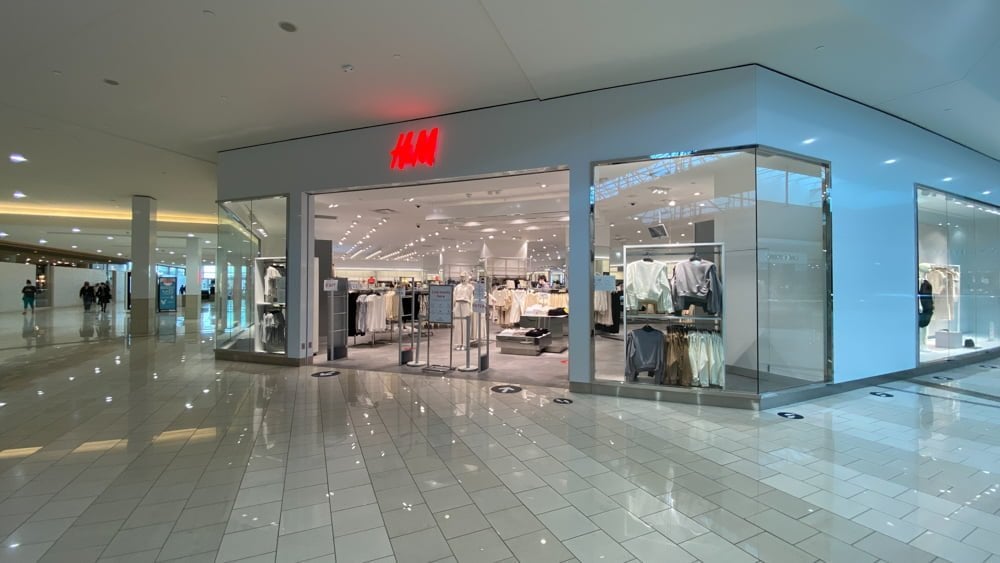
The main tenant for the zone which hasn’t been mentioned in our tour yet is H&M. This retailer does not extend to the lower level as Old Navy is below it.
H&M at Southcentre Mall in Calgary. Photo: Jessica Finch
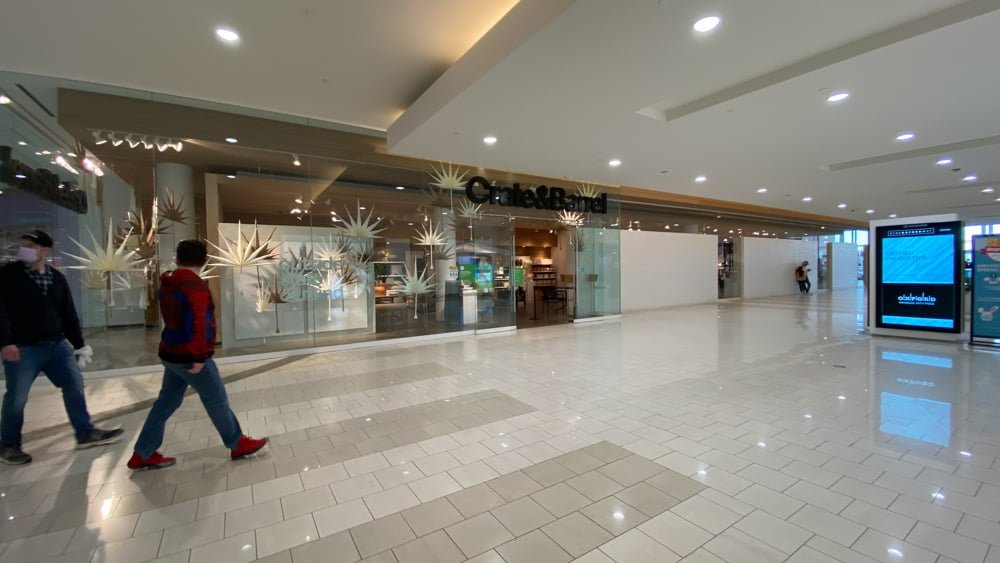
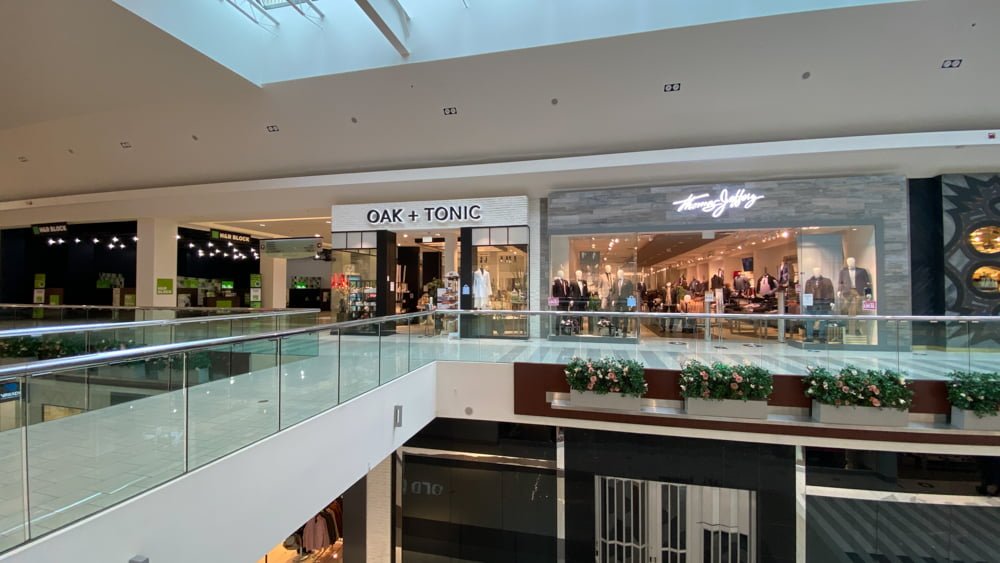
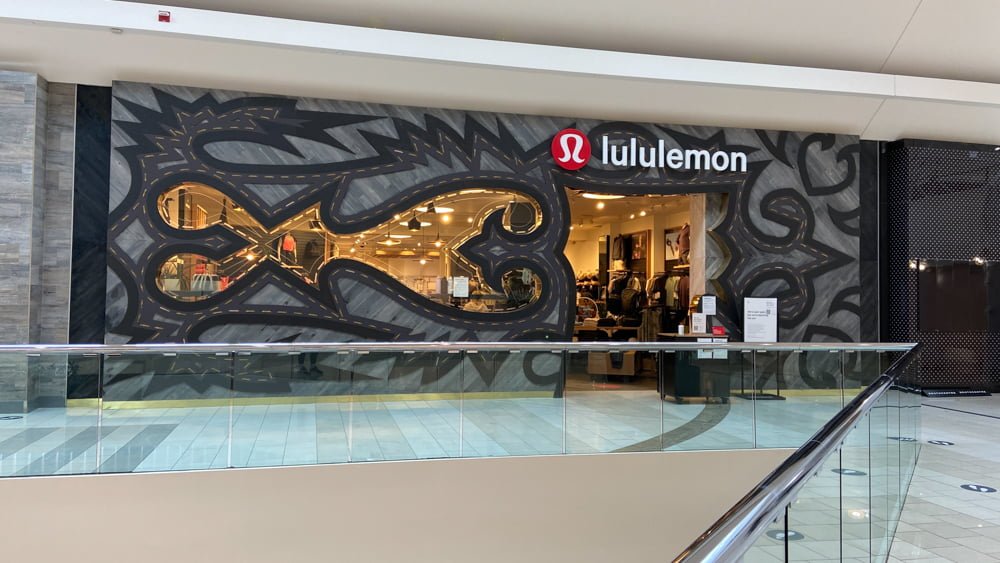
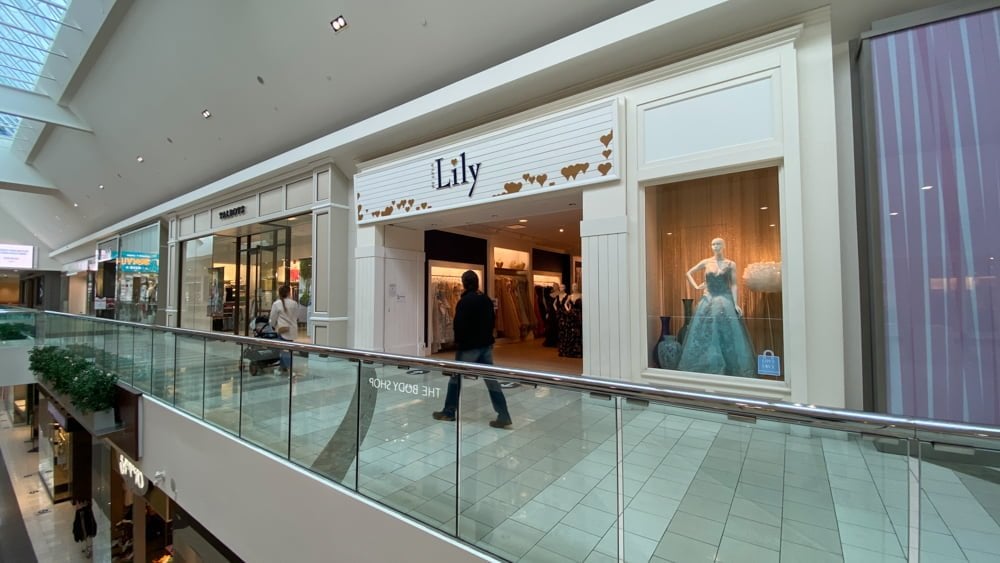
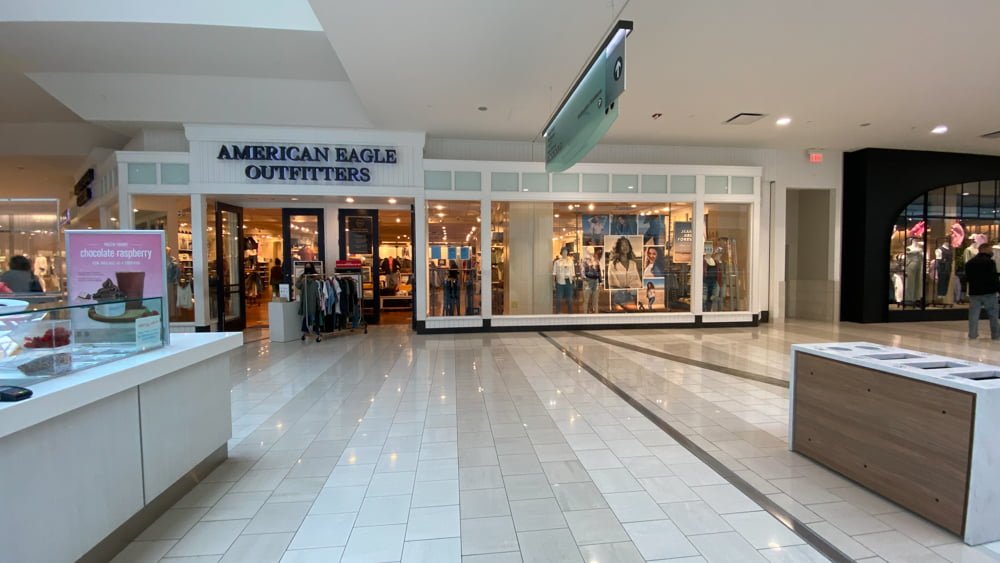
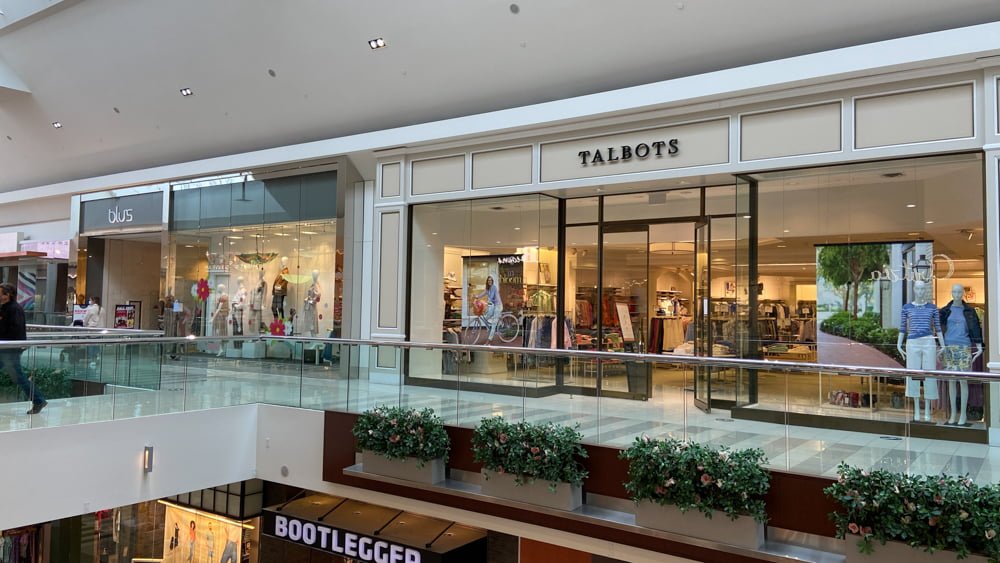
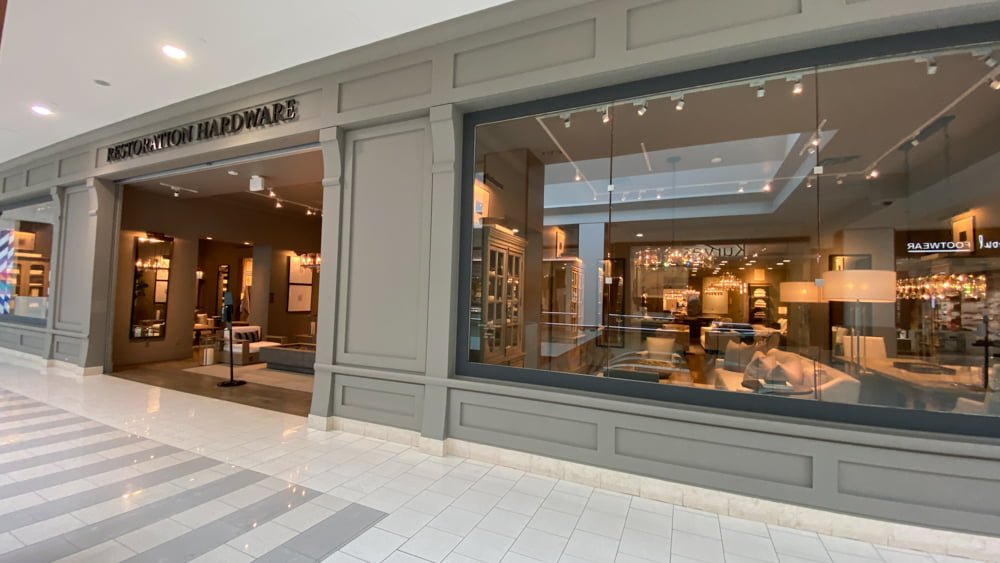
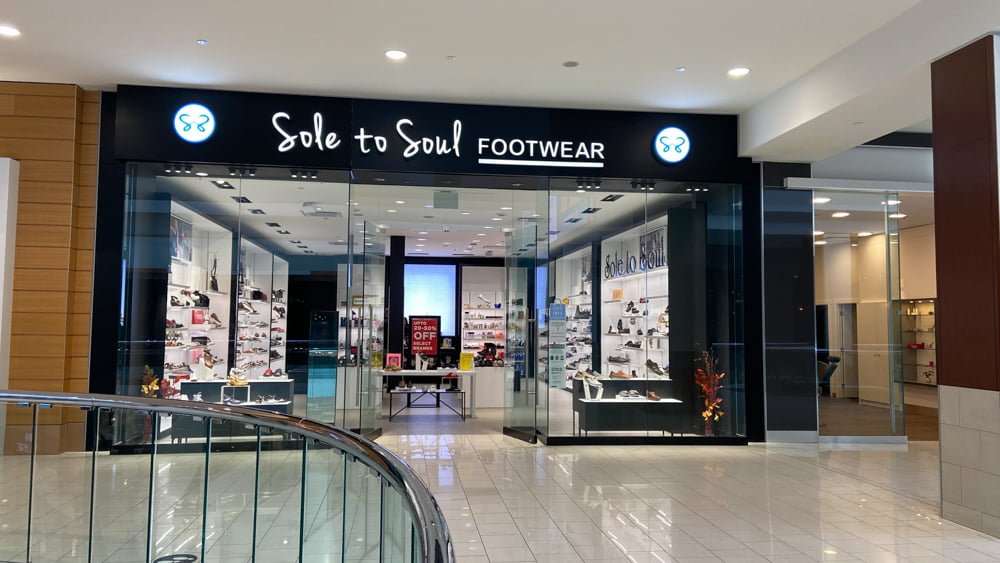
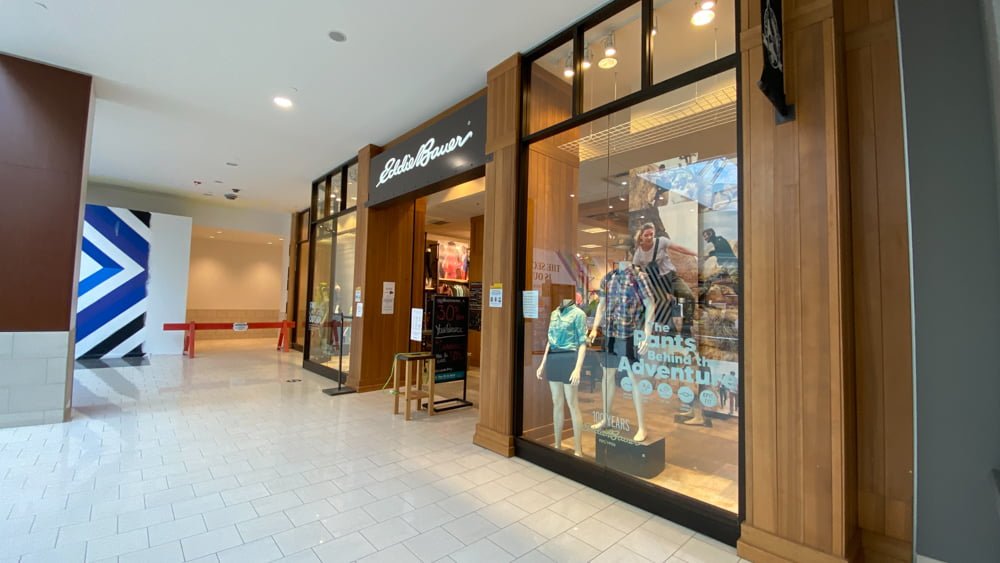
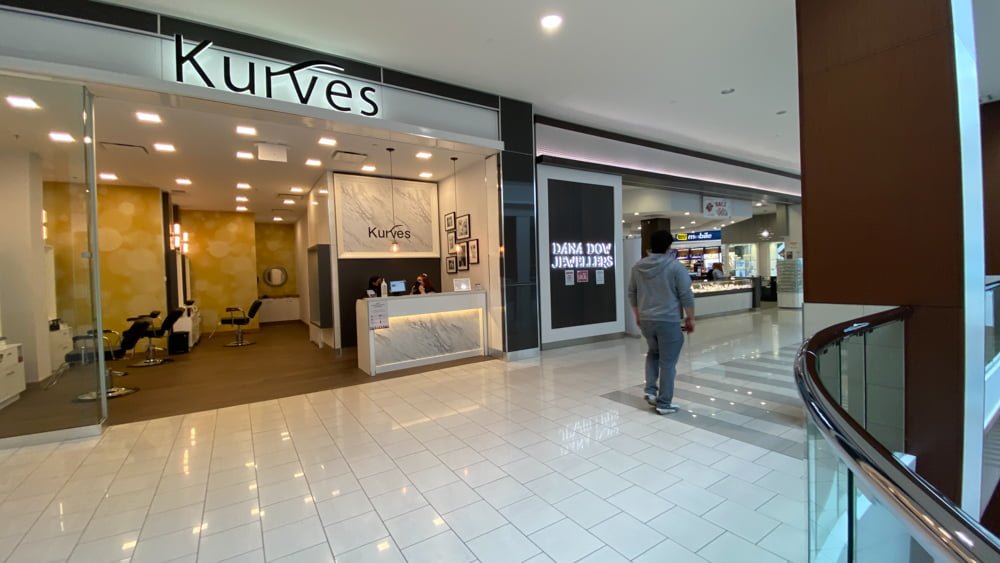
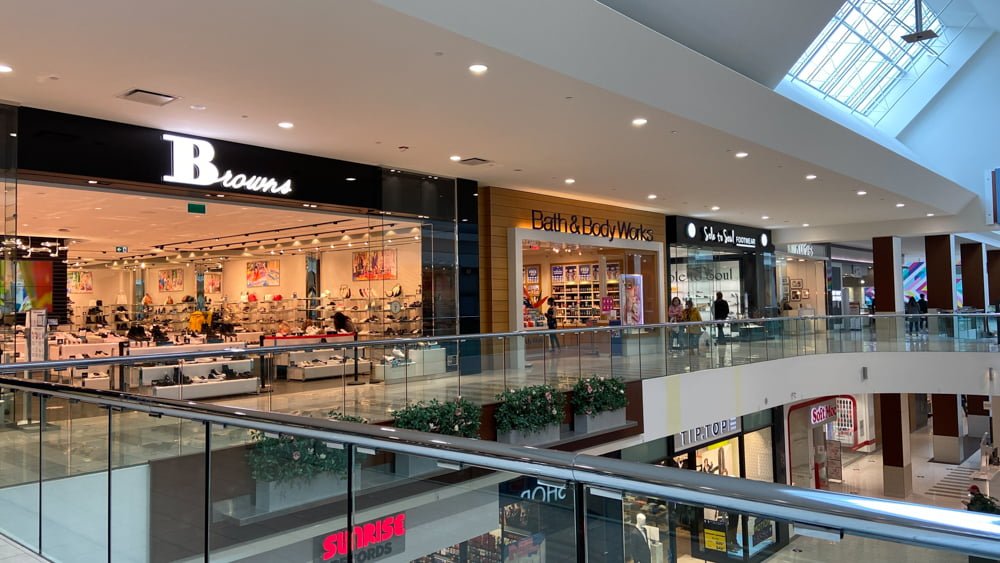
Other retailers in this section of the mall include Crate and Barrel, Oak & Tonic, Thomas Jeffrey, Lululemon, Joydrop, MAC Cosmetics, Michael Kors, American Eagle, Aritzia, Bath and Body Works, Sole to Soul, Dana Dow Jewellers, Eddie Bauer, Restoration Hardware, Blu’s, Talbots, and Lily by Lyla.
Edmonton-based Blu’s is a high-end, multi-brand womenswear retailer that has existed for more than 35 years. The retailer also operates at Banker’s Hall in downtown Calgary as well as at the Manulife Place in downtown Edmonton.
Retailers in upper level south at Southcentre Mall
1 of 4
Crate & Barrel at Southcentre Mall in Calgary. Photo: Jessica Finch
Oak + Tonic and Thomas Jeffery at Southcentre Mall in Calgary. Photo: Jessica Finch
Lululemon at Southcentre Mall in Calgary. Photo: Jessica Finch
Lily at Southcentre Mall in Calgary. Photo: Jessica Finch
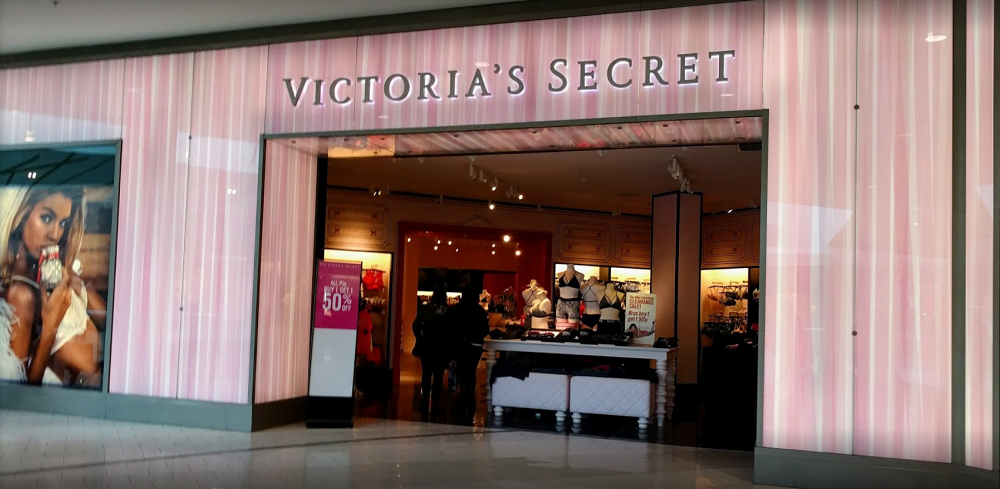
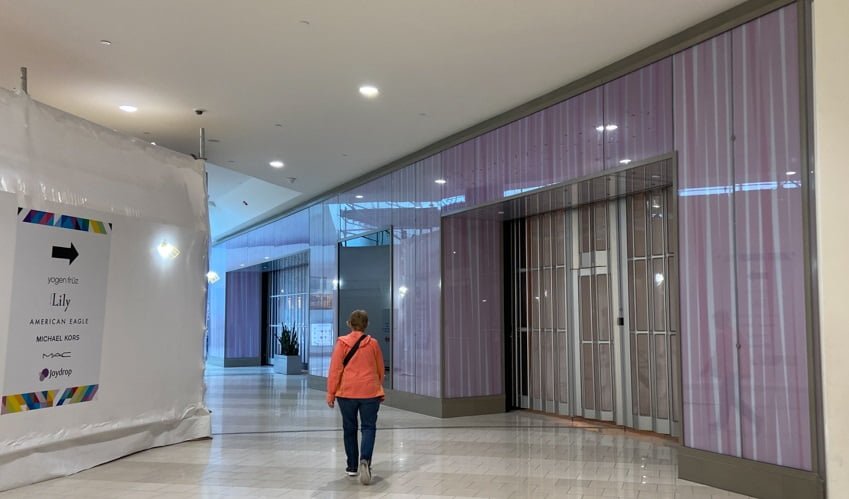
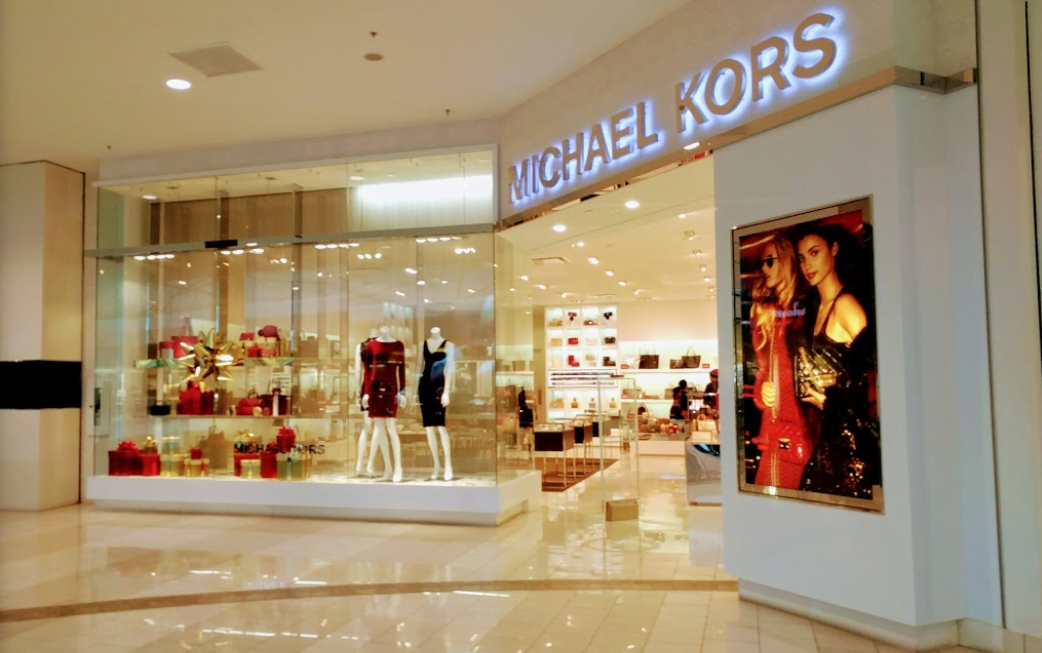
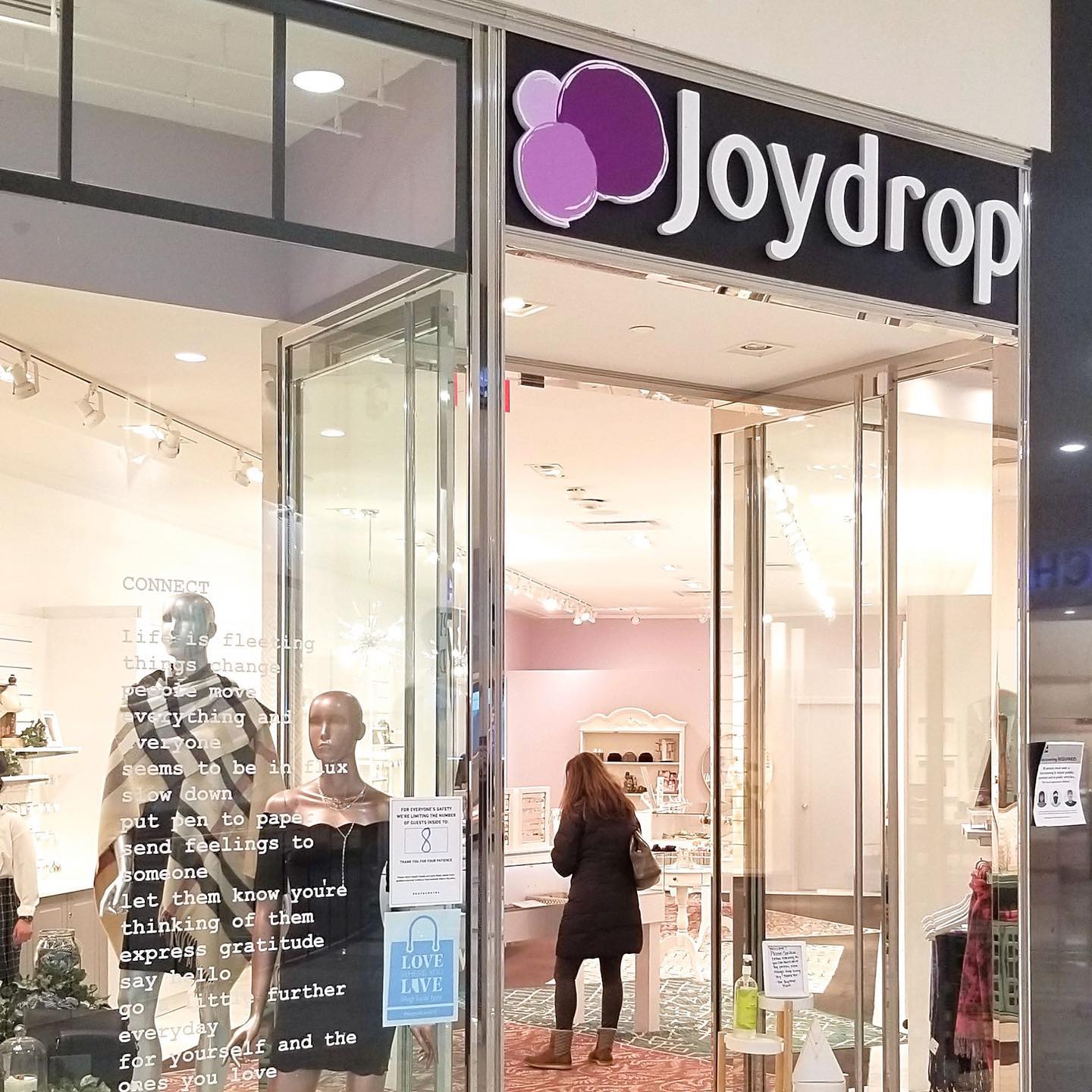
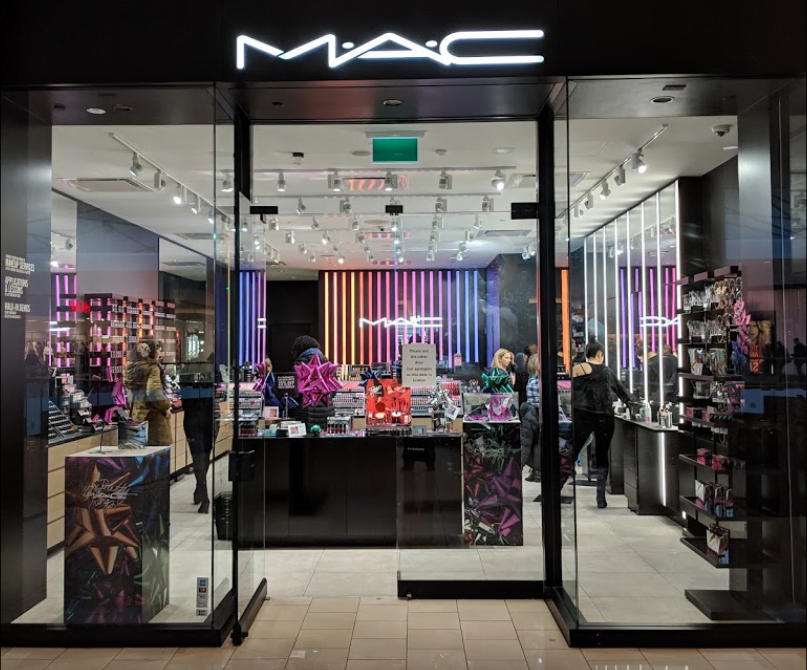
To the right of the retailer “Lily” is a vacated “Victoria’s Secret” location next to a Joydrop, MAC Cosmetics, and Michael Kors location.
Vacated Victoria's Secret storefrontRetail Space at SouthCentre Mall
1 of 2
December 2016 - Victoria's Secret prior to closing at Southcentre Mall. Photo: Google Maps/Rea Sauter
April 2021 - Victoria's Secret vacated retail space at Southcentre Mall. Photo: Jessica Finch
1 of 3
Michael Kors at Southcentre in Calgary. Photo: Google Maps/Rea Sauter
JoyDrop at Southcentre in Calgary. Photo: Southcentre Instagram
MAC Cosmetics at Southcentre in Calgary. Photo: Google Maps/Jesse Corbel
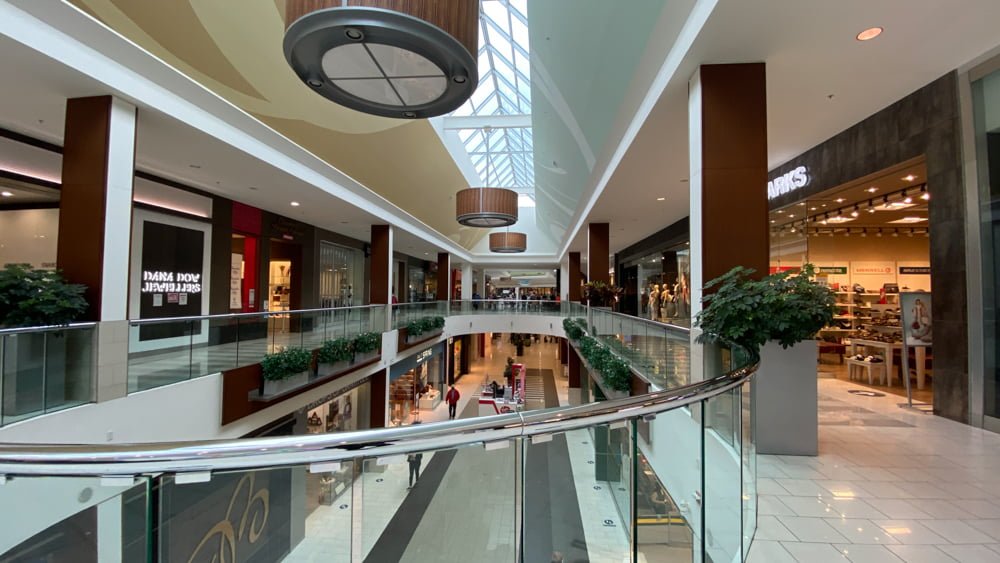
Overview of upper level south. Photo: Jessica Finch
Other retailers on upper level south at Southcentre Mall in Calgary
1 of 7
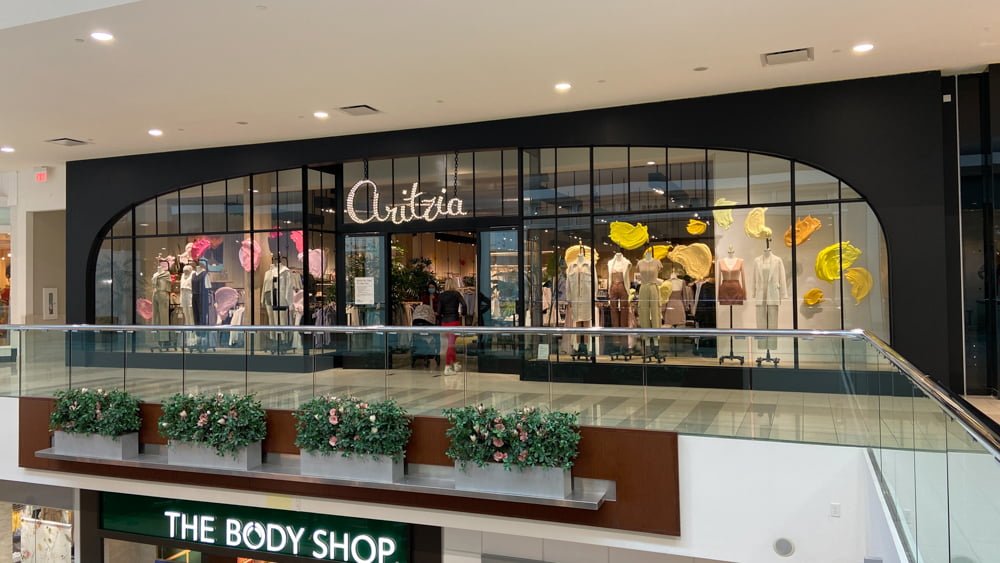
Aritzia at Southcentre Mall in Calgary. Photo: Jessica Finch
American Eagle at Southcentre Mall in Calgary. Photo: Jessica Finch
Talbots at Southcentre Mall in Calgary. Photo: Jessica Finch
Restoration Hardware at Southcentre Mall in Calgary. Photo: Jessica Finch
Sole to Soul at Southcentre Mall in Calgary. Photo: Jessica Finch
Eddie Bauer at Southcentre Mall in Calgary. Photo: Jessica Finch
Kurves at Southcentre Mall in Calgary. Photo: Jessica Finch
Browns Shoes at Southcentre Mall in Calgary. Photo: Jessica Finch
We had a very interesting photo walk around Southcentre Mall in southern Calgary and we hope you enjoyed coming along with us. Don’t forget to check out our other retail photo tours over the past few months. Thank you for taking this tour with us.
Discover More Related Retail Photo Tours From Retail Insider:
This week, Craig and Dustin discuss Disney’s plans to close all of its Canadian stores. Retail Insider reported on the development on Monday after receiving confirmation from multiple reliable sources.
The Weekly podcast by Retail Insider Canada is available on Apple Podcasts, Stitcher, TuneIn, Google Play, or through our dedicated RSS feed for Overcast and other podcast players.
Drop us a line at Craig@Retail-Insider.com. You can also rate us in Apple Podcasts or recommend us in Overcast to help more people discover the show!
Background Music Credit: Hard Boiled Kevin MacLeod (incompetech.com). Licensed under Creative Commons: By Attribution 3.0 License. http://creativecommons.org/licenses/by/3.0/
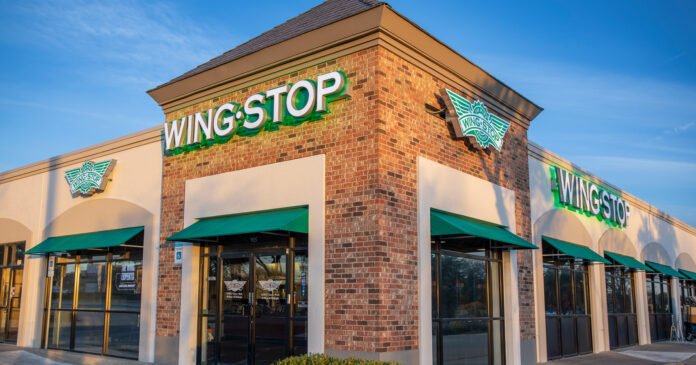
Dallas-based fast-casual restaurant chain Wingstop has announced that it will enter the Canadian market with plans for about 100 locations over the next decade. The company will launch in the Toronto area prior to expanding Wingstop nationally. The first Canadian location will open in 2022 according to the company.
Nicolas Boudet
“Wingstop in Canada marks another key step toward our stated goal of becoming a Top 10 Global Brand and further validates the portability of our brand on a global level,” said Nicolas Boudet, President of International at Wingstop. “We currently see Wingstop addressing a need in the Canadian market with our unique brand positioning and product offering and believe this is a market where we can replicate the success we’ve experienced in the U.S. based on Canadians’ appreciation and craving for bold flavour and high-quality product.”
Wingstop partnered with JPK Capital for the Canadian expansion. JPK Capital is described as a single-family office “motivated by sustainable change, technological innovation, and long-term vision.” The company was founded in 2017 by entrepreneur Joe Poulin and provides long-term capital, strategy, and tech expertise for consumer businesses. JPK Capital’s portfolio includes successful restaurant franchises across several countries.
“JPK Capital could not be happier to partner with Wingstop and lead the charge in bringing one of the most successful restaurant brands and the best wings in the world to Canada,” said Poulin. “As technology entrepreneurs and investors, we have been impressed with Wingstop’s investment in innovation and look forward to capitalizing on its proprietary tech stack to offer a best-in-class digital and in-restaurant experience to Canadians.”
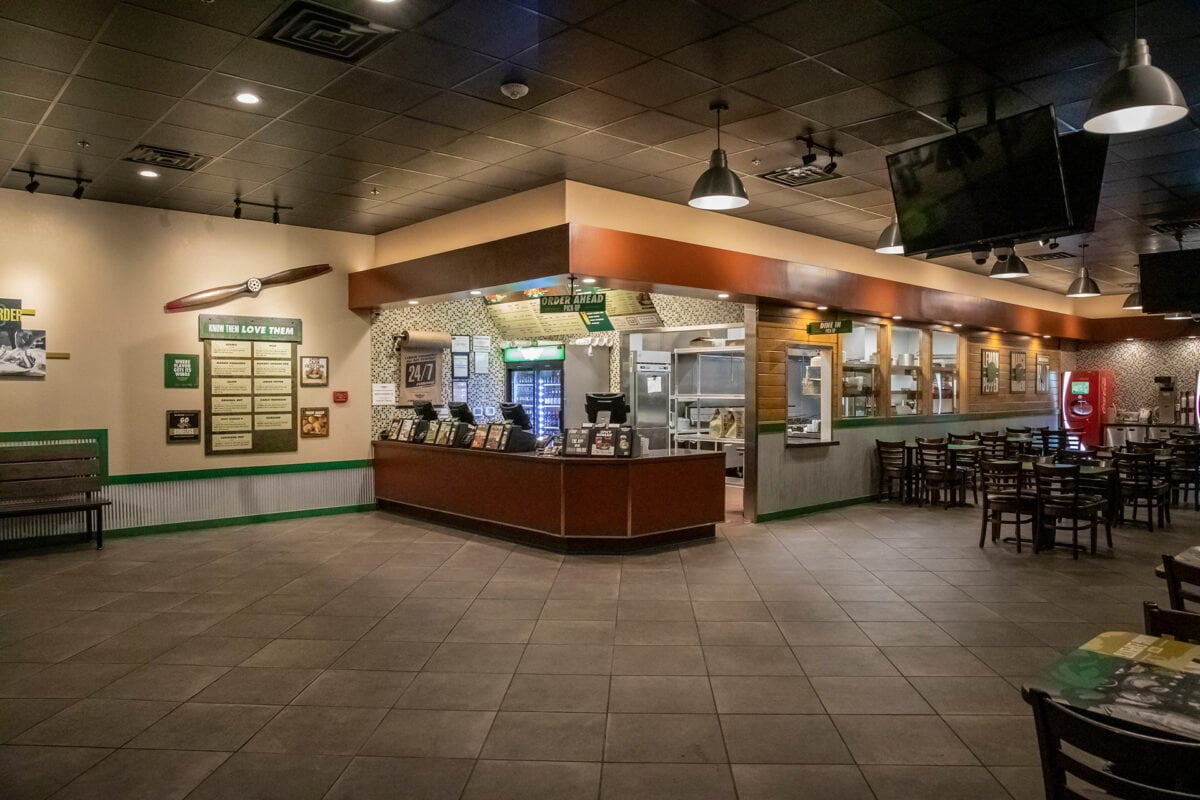
Wingstop dining room. Photo: Wingstop
The 100-location agreement starts in Ontario, with a Toronto location anticipated to open in 2022 pending any unexpected or additional Canadian border regulations and closures stemming from COVID-19. The average size of a Wingstop location is 1,750 square feet.
Wingstop says that it targeted Canada for its global expansion because of Canada’s proximity to the brand’s home market in the U.S. as well as similarities in consumer behaviours regarding digital engagement and off-premise dining. In June of last year, Wingstop opened its first ghost kitchen in the U.S. in Dallas.
1 of 4
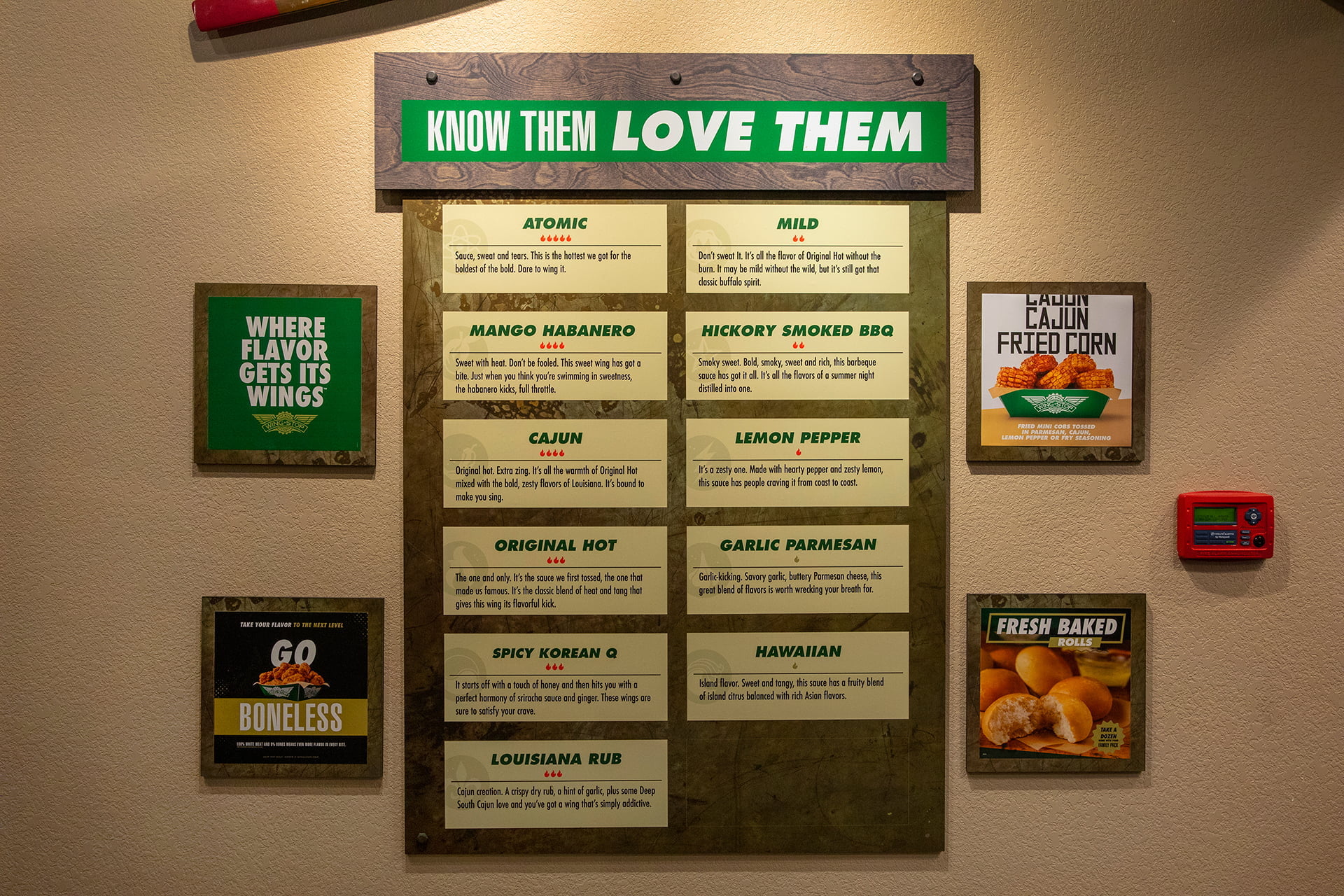
Wingstop menu. Photo: Wingstop
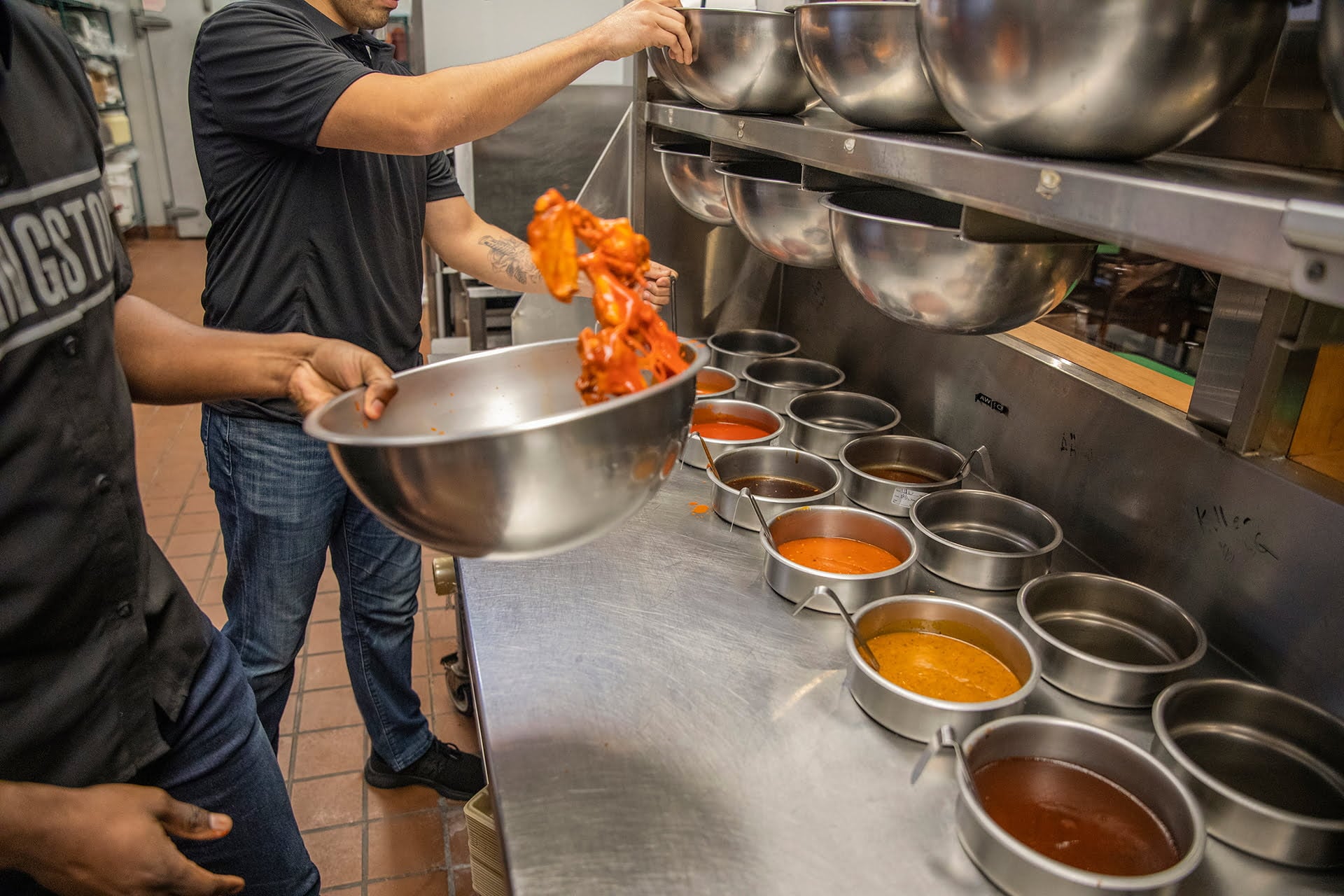
Wings being tossed in Wingstop. Photo: Wingstop
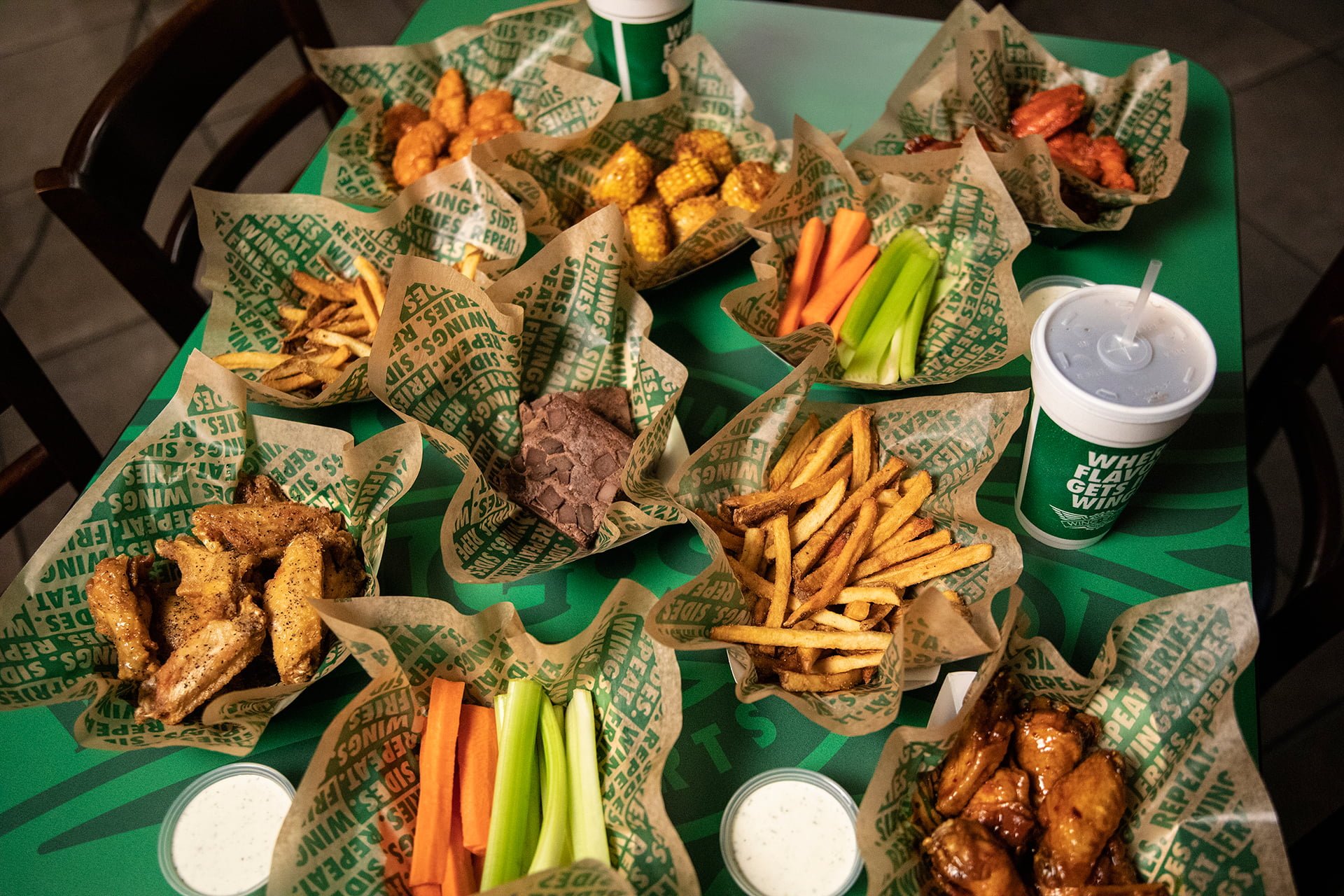
Wingstop food items. Photo: Wingstop
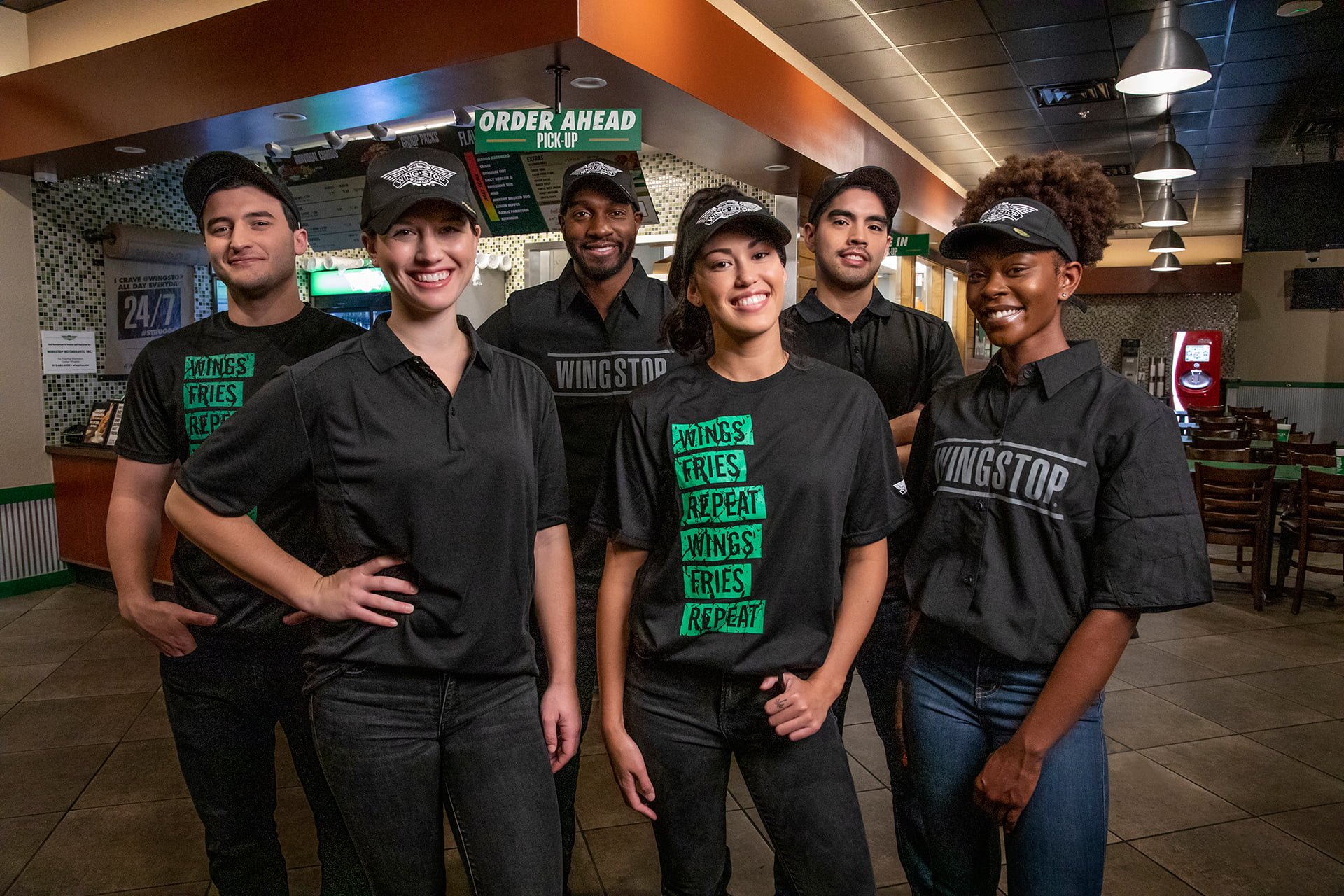
Wingstop employees. Photo: Wingstop
Wingstop was founded in Dallas in 1994 and has more than 1,500 franchised locations globally. The company’s restaurant employees, known as ‘Wing Experts’, serve a range of food including classic wings, boneless wings, and tenders, and signature sides including fresh-cut, seasoned fries, and freshly-made ranch and bleu cheese dips.
In 2020, Wingstop saw explosive growth while opening 153 net new units. Digital sales grew more than 60% last year and same-store sales grew by 21.4%. In fiscal year 2020, Wingstop’s system-wide sales increased 28.8% year-over-year to approximately USD $2 billion, marking the 17th consecutive year of same-store sales growth. Wingstop has achieved over 700% in stockholder returns since its 2015 initial public offering.
Wingstop says that its vision is to become a top 10 global restaurant brand through its independent franchise model that represents more than 98% of Wingstop’s total restaurant count. The company says that a key to its success is “The Wingstop Way” which includes a core value system of being “Authentic, Entrepreneurial, Service-minded, and Fun.”
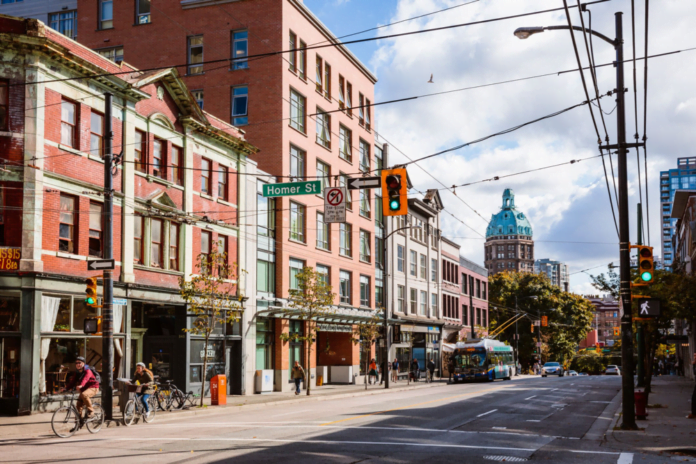
PENDER STREET IN VANCOUVER'S 'CROSSTOWN' AREA. PHOTO: TRIPSAVVY
British Columbia Minister of Finance, Selina Robinson, has instructed staff to find a way to provide temporary relief for one year for what the government says is the small number of property owners who now have to pay the speculation and vacancy tax on unbuilt residential space above their commercial property.
But many small businesses, property owners, and business groups in Vancouver simply want it scrapped.
“This change will help commercial tenants as these costs are typically passed on by the property owner,” said Robinson in a statement.
Selina Robinson
“Most businesses — more than 99 percent — will not be affected by the speculation and vacancy tax; it impacts a very small number of owners who took steps to reclassify a portion of their commercial property as residential. The split classification makes it subject to the speculation and vacancy tax; a tax that was brought in to encourage property owners to develop their land for residential purposes.
“It is likely some landowners can apply for different exemptions if they intend to develop their property. We will work with eligible landowners with this classification so they understand the exemptions they can apply for.”
The issue became a heated one recently in Vancouver when media reported that some businesses were having to pay thousands of dollars extra in tax on air space — the development potential of their property — above their actual property.
“This is an increasing concern. The rising cost of property taxes continue to be a challenge for many of our members and especially small businesses. For a long time we have been advocating to help these businesses survive by creating a new commercial property subclass, if you will, to enable split assessments, and we continue to work on their behalf and continue to advocate for government to look at options that would bring about greater fairness and certainty to the property tax system,” said Anderson.
“Given it is an expensive city, property taxes are on the rise, and especially in a pandemic, now more than ever, it is a very big concern for some of these small businesses to have extra costs pile on at a time when they’re really just trying to survive. We had the BC budget delivered (recently). That was an opportunity for the government to address this. They did not. It is something that we will continue to advocate for on behalf of our members to see a change to this.
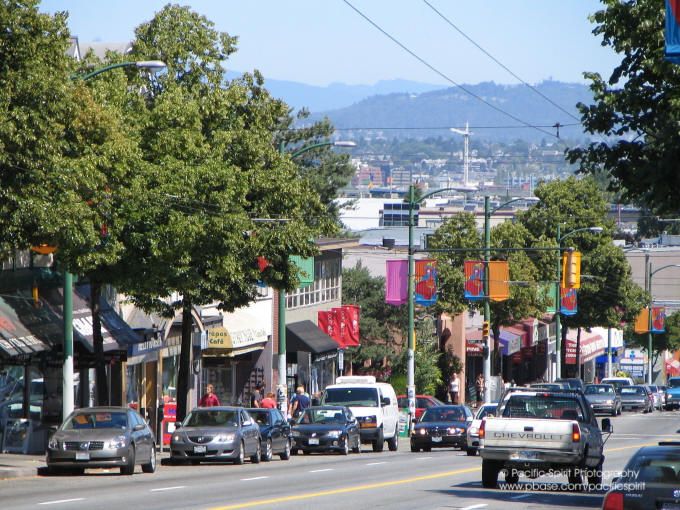
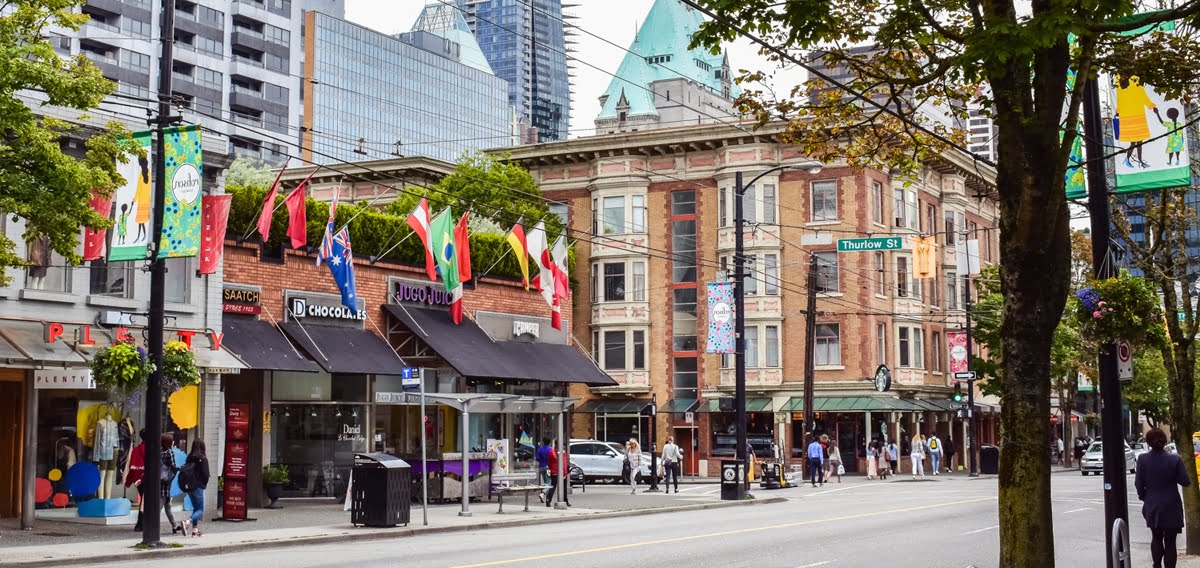
Storefronts along Kitsilano’s West 4th Avenue could be targeted with this vacancy tax. Photo: Pinterest
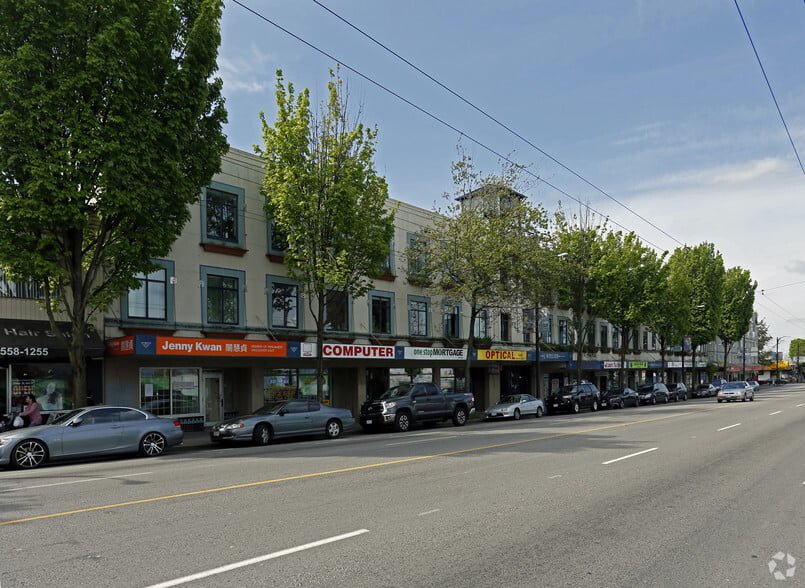
Storefronts along Hastings Street in Vancouver could be targeted with this vacancy tax. Photo: Loopnet
“When you look at that development potential, it’s almost always the residential above a commercial. So for some of these property owners, they’ve actually gone through the course to obtain what is called a split assessment, meaning the potential unbuilt condos — the airspace over the properties — are taxed as a residential rate instead of a higher commercial rate. And that’s what we believe is the fair way to do that. That split assessment. Looking at the two areas separately. One is an area of business and one most likely would be residential. And so that’s what we continue to advocate for and we would hope that in fairness this would be allowed.”
Amy Robinson, Executive Director, of LOCO BC, said many businesses were asking for the tax not to be applied to those properties — not just for it to not impact small businesses.
Amy Robinson
“Because many of the property owners are also small businesses. It’s just non-sensical to apply a vacancy tax to residential zoned properties that can literally not even be occupied. It just goes entirely against the spirit of the legislation. It makes sense to everyone I think that we have a vacancy tax to try to encourage empty properties to be rented out in a housing crisis. None of us are refuting that,” said Robinson.
“It seems like the government is going to make some changes but they’re still going to require the tax to be paid, just instead by the landlords and not by the small businesses. I don’t know how they’re going to do it because if businesses have triple net leases then there’s already an arrangement to pay a portion of the property tax. I’m not sure how they’re going to get around that. Almost every business I know has a triple net lease.”
“It’s not something that’s apparent. You have to sort of be told by your landlord or a property owner that this tax is on their tax bill. But from what I understand I calculated 70. I imagine there’s a few more as well and there’s some that it’s on the building but it’s not applicable because it’s under development or for some other reason,” said McFadden.
“It doesn’t make sense at all. It took us quite a few days just to wrap our heads around what the tax actually meant and what it was for because it doesn’t make any sense. And it’s not designed for commercial businesses to have on their buildings. We’re totally against it and fighting to have it not postponed but completely erased and eliminated. This would never be a good thing for small businesses but right now the challenges that they’re facing with the pandemic makes it the worst time that it could be brought in. I think we would fight it even if there wasn’t a pandemic simply because it doesn’t make sense.”
“This was introduced two years ago by the provincial government and they knew at the time this was going to be a problem so built into the legislation at the time was a two-year deferral of the speculation tax for commercial property,” said Barnes. “This issue was brought forward two years ago and we were informed that it would be taken care of and it would be figured out and of course it never was.
“Many of my property owners in this situation are old Italian families. The property has been in their family for years and years. This was how they were going to leave some kind of inheritance for their children. They’re not the big property developer. They don’t have the funds or the resources to develop these properties. They have maintained the building. They have rented them to small independent businesses at affordable rents.
“And if they are forced to redevelop they will be forced to sell then you will enter into a three to four year process trying to get your permits in place so you can redevelop. The small business will end up being kicked out and will never come back. And our communities are left with big vacant holes. And that hurts all the businesses around and when the development finally does get built because of all the costs that come with redevelopment many small businesses can’t afford to rent those properties.”
McFadden said on average the properties are facing increased costs of between $6,000 to $9,000 annually. Many of those impacted are small property owners who are trying to provide relief to tenants through the pandemic and they don’t have deep pockets. Their cash is tied up in the building.
Storefronts on Vancouver’s Robson Street of could be targeted with this vacancy tax. Photo: RobsonStreet
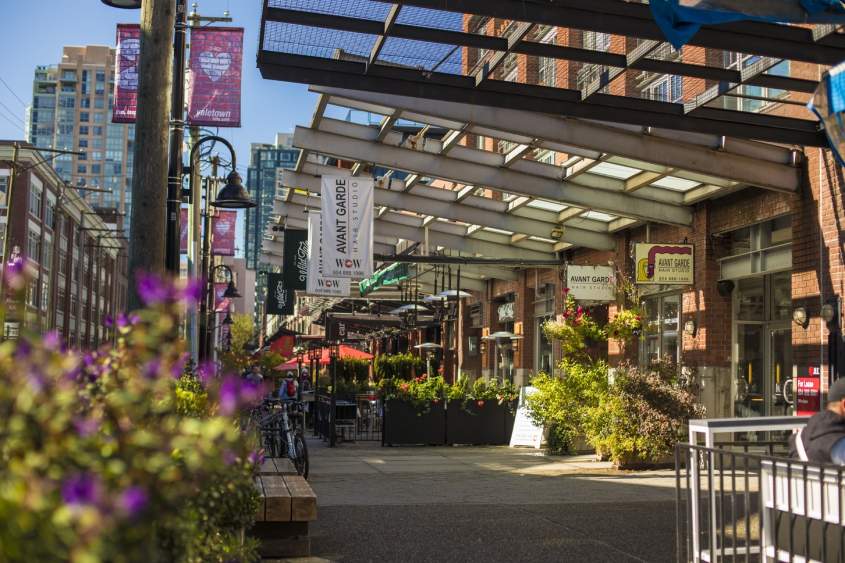
Storefronts in the Vancouver neighbourhood of Yaletown could be targeted with this vacancy tax. Photo: Vancouver Tourism
After giving property owners an exemption from the Speculation and Vacancy Tax for vacant land for the last two years, as of this year, the SVT may apply to property owners of vacant land, said the government in an email.
“In the speculation and vacancy tax areas, there are approximately 65 properties where the property owners have taken steps to have a portion of the airspace above their commercial land rezoned and reclassified as residential land (likely because they intend to redevelop the property as residential) and where they claimed the vacant land exemption last year. Most property owners in this situation are able to use exemptions to waive the speculation and vacancy tax,” it said.
“The tax rate for residential property is generally much lower than for commercial property, so the reclassification of the airspace is a tax saving measure. Once the airspace is reclassified as residential, the SVT, and other residential taxes, may apply. Taxpayers are entitled to arrange their affairs to reduce their tax burdens; however, like any other property owner who has vacant or high-value residential property, they may now be subject to specific residential taxes.
“We encourage property owners who own properties with unbuilt airspace that are classified and zoned as residential to continue in the development process to bring much needed residential housing supply to the market — this is one of the reasons we brought in the speculation and vacancy tax. If the owner is taking active steps to develop the property (including applying for permits or financing), they can claim a development exemption and the commercial tenant will not be responsible for any SVT.”
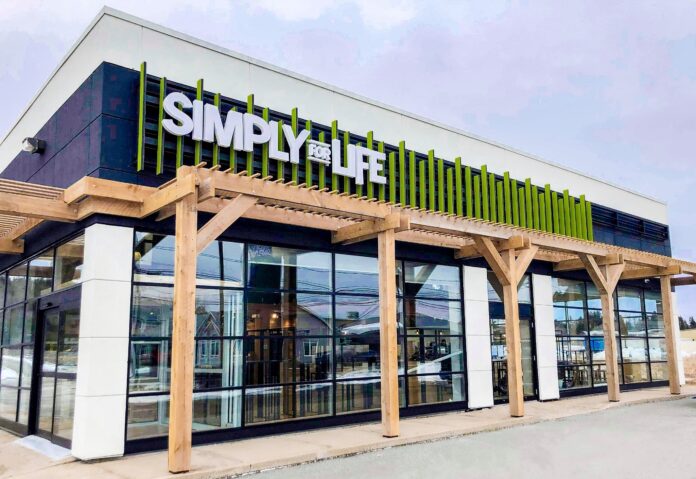
Simply For Life flagship headquarters in Saint John, N.B. Photo: Simply For Life
Starting out as a small business owner during the best of times has got to be one of the most ambitious endeavours that any one person can pursue, a task that is perhaps only surpassed in difficulty by the effort required to maintain and grow the business. However, launching a store during the onset of a pandemic is a completely different proposition altogether. It’s an undertaking that would not only require a general acumen and understanding of retail fundamentals as well as the ability to apply them effectively to their operation, but would also necessitate a level of bravery, courage and passion from the entrepreneur not found in most people. Fortunately for the natural food market chain, Simply For Life franchisee, Rukhsana Khan, is not like most people.
A Healthy Passion
A certified holistic health and life coach who also holds a Functional Diagnostic Nutrition Certificate, Khan describes her foray into retail as a “dream come true”, the fruition of a venture that she’s desired to embark on for some time. With a passion for health and nutrition, a penchant for the sourcing of best-in-class natural product and a strong belief in the power of human connection, she opened her Simply For Life franchise location in Oakville, Ontario in January of 2020. She says that she was excited, optimistic, and despite her lack of formal business experience, she was eager to open up to her community and start making a positive difference through her products and services.
Rukhsana Khan
“All of the work that was involved in preparing the store to open was amazing,” she says. “It was such a great experience to have the opportunity to work toward a vision. I wanted to bring people together and to create a very open and welcoming environment to facilitate that. I had envisioned conducting free information sessions and health coaching in order to teach people concerning the different aspects of health. I wanted it to be very social and communal, encouraging people to get together, talk, share experiences and heal together. I’m extremely passionate about what I do and believe in this kind of personal and intimate approach. I was really pleased when I opened my store in January of last year. And we immediately started doing sessions that were really well received by the community. Things seemed to be going really well. But, when COVID hit in March, everything changed. There was definitely a moment directly afterward when I didn’t know what to do.”
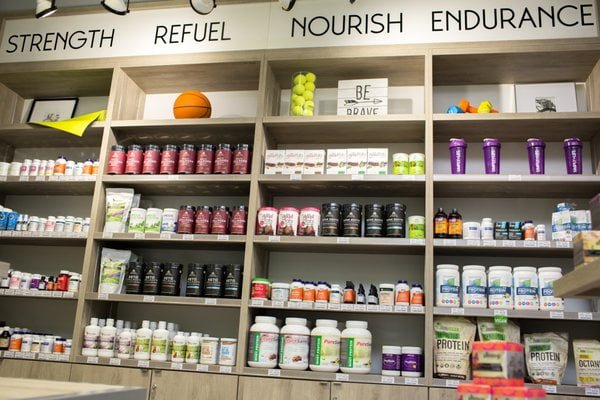
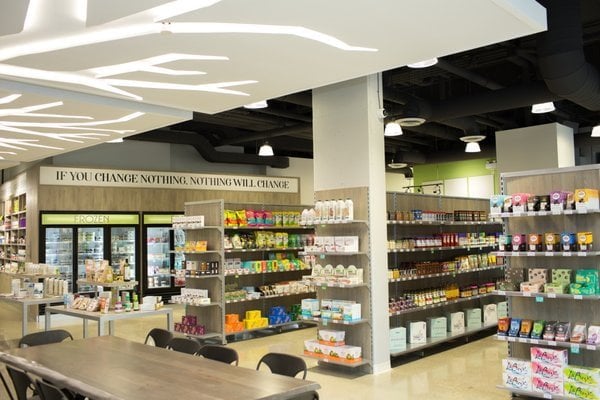
Noted interior designer Glenn Dixon of Glen Dixon Design conceptualized the space from a shell. He said that he wanted to make the space immersive as well as a comfortable environment both for customers and employees.
Digital Transformation
Because Simply For Life primarily sells food products, Khan was allowed to remain open during the first pandemic lockdown. Though, she admits that traffic to her store had been reduced dramatically as concerned people across the country kept themselves and their families at home during the first wave of contamination. She says that it was an extremely challenging time for her. Without the ability to connect with consumers and a means by which to provide them with the necessary information — the vital piece of Khan’s vision and, indeed, the critical component of her business strategy to create a healthy community through education, inspiration, and empowerment — it seemed as though her business could be lost. But not if Khan could do something about it.
“Not for a second did I ever think of submitting,” she says confidently. “I had worked too hard to realize my ambition and fulfill my passion. I knew that there was a way to continue offering my products and services to customers. I just needed to find the solution that would allow me to do that.”
Khan’s thinking was decisive and her actions swift as she didn’t hesitate in digitizing her business, implementing and activating the Shopify POS System into her operations and immediately moving to get her product online and available for transaction. She describes the initiative as a monumental task as the development of e-commerce capabilities was not something that she had previously planned for the business. However, online sales have been a success for Khan and represent an intelligent and savvy pivot on the part of the Canadian entrepreneur. But, the greatest advantage to her pivot, she points out, is the ways in which her business has benefitted from her decision to transition the store’s information sessions, coaching, and communications to a virtual environment.
“I made the decision right away to make sure that I had all of the store’s products online and available for the consumer to purchase as soon as possible when physical traffic pretty much stopped,” she says. “I also moved all of our services online, conducting all of my sessions and coaching over the phone and through Zoom. This isn’t something that I had ever thought about before. But, the response from my Simply For Life community and results of this decision have been incredible. It has not only increased my exposure and engagement within my local community, but has also opened up my services to a broader audience. I’ve now got clients in places like Ottawa and New Brunswick. The pandemic has accelerated this shift for me. And it’s definitely something that we’re going to continue building in order to connect with more people in the future.”
Fulfilling Community Needs
With knowledgeable, certified staff helping to deliver services and coaching related to meal planning, nutritional consulting, and ways to live and manage a happier, healthier life, Khan has quickly developed a reputation for her store. And, given the rise in positive consumer attitudes toward self-care throughout the pandemic, it seems it’s a reputation that will serve her and her store well going forward. According to a recent Scotiabank survey of Canadians concerning their sentiment toward their financial, mental and physical wellbeing over the course of the past twelve months, an overwhelming majority of Canadians (98 percent) say that they are focusing more on their self-care habits, which they intend to maintain into a post-pandemic world. Of those surveyed, 60 percent have spent an average of $282 on self-care since the start of the pandemic. It’s a growing sentiment that Khan recognizes, and an opportunity for her to contribute in a meaningful way to her expanding community of customers.
“It’s been a really challenging time,” she says. “But, consumer response during the past year has been very positive. There are many who have taken advantage of their situation during this time, beginning to pay more attention to their health and wellbeing. It’s become more of a priority in people’s lives, resulting in better decisions about the foods they eat and the activities they engage in. I’m excited to be able to help people on their journey of self-care and the development of a healthy lifestyle. It’s a passion of mine that I’m really looking forward to offering to more and more people.”
An Exciting Future
As traffic slowly returns to her physical location, now augmented by her new digital presence, Khan is optimistic about the near-term for her business. And, despite the uncertainty of the times and the challenges faced by most small business owners in general, she thinks that their resilience and continued efforts will soon reap rewards, maintaining their status as the backbone of communities from coast-to-coast in the country.
“Small businesses are so important to the health and success of the neighbourhoods and communities that they operate in. They are crucial to their vibrancy and activity of their street fronts and will be appreciated more and more by locals as we go forward. For my business, I’m going to focus on continuing to develop my virtual communications and presence and building out more sessions and coaching services. As a result of digitizing my store, I’ve seen firsthand the value in doing so and now realize the incredible reach and opportunity available to me to provide my expertise to people all over the world. I’m excited to continue making these connections with customers and helping them realize their nutrition goals while growing my business and service.”