The latest data from Statistics Canada show an uptick in retail sales trends pretty much across the board. But these numbers are for February 2020, more or less the last month of the pre-COVID-19 era. It was in March that social distancing, self-isolation, store shutdowns, and shopping mall closures began in earnest. The recent numbers are the calm before the storm, and probably just a rebound from weak performance in 2019.
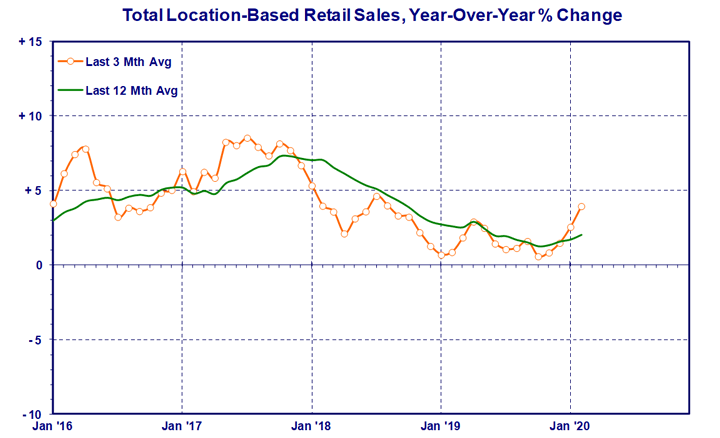
There’s no point in commenting on the latest retail sales numbers because the trends are about to go south in a hurry. The U.S. Census Bureau has released advance March retail data that show huge sales declines in most areas of retail.
The one sector that stands to gain from the current situation however is e-commerce. Many consumers are avoiding stores and switching to online shopping, so much so that it’s putting a strain on delivery services. Some of this is likely to be a permanent gain for e-commerce – we just don’t know how much.
Food & Drug
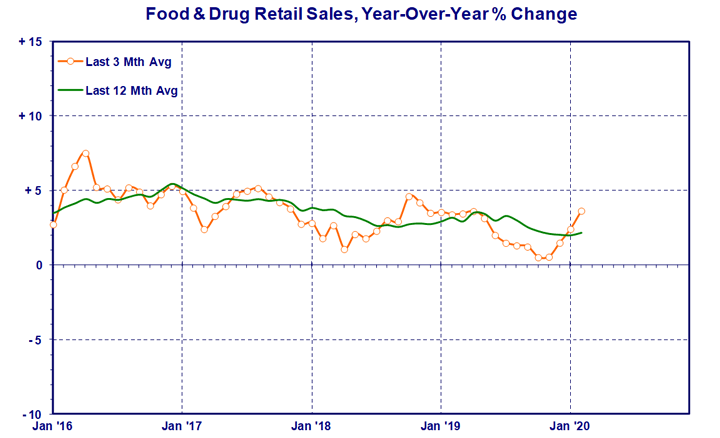
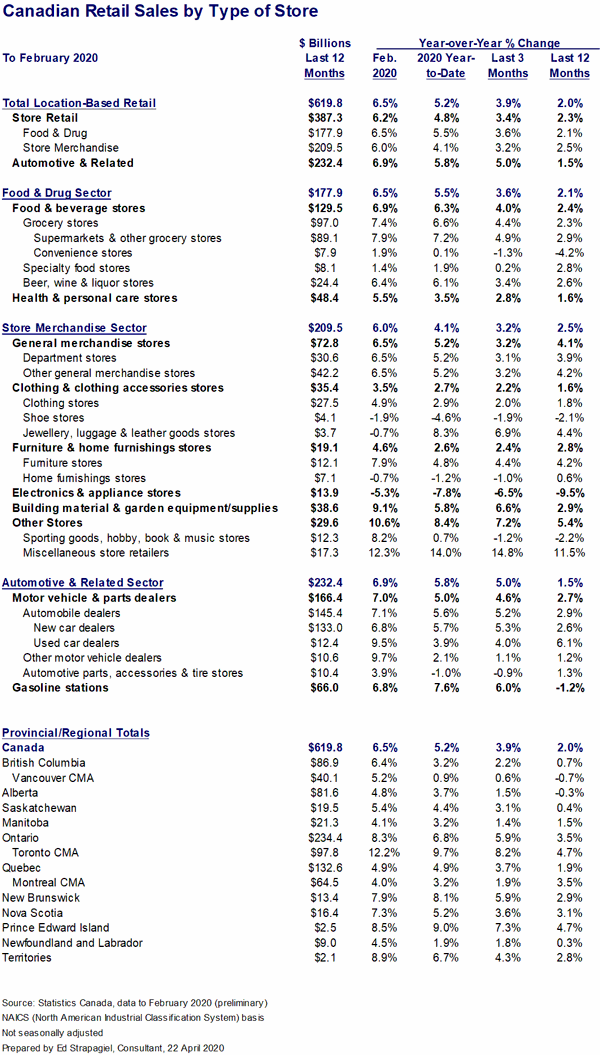
For the 3 months ending February 2020, retail sales in the Food & Drug sector were up 3.6% year over-year. This is the highest this measure has been since Q3 2018. The short term 3 month trend (orange line in the chart) has been steadily improving of late, to the point that the underlying 12 month trend (green line) is now recovering as well.
Retail sales at supermarkets & other grocery stores were up a relatively strong 4.9% year-over-year for the 3 months ending February 2020. Health and personal care stores’ sales gained 2.8% during the period, which was above average compared to recent months.
Food & Drug is very likely to be the strongest sector in the next few months. Grocery and drug stores sell essential products, and have also taken a number of measures to protect shoppers and staff from COVID-19. Consumer hoarding however implies that there might be a backlash at some point. If there’s plenty of toilet paper in the stores and you still have 500 rolls in your basement, you probably won’t be buying it for a while.
Store Merchandise
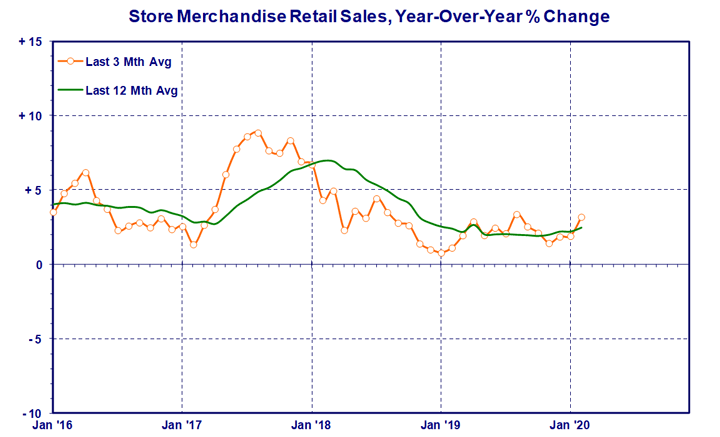
Store Merchandise sector retail sales were up an “okay” 3.2% year-over-year for the 3 months ending February 2020. While not exactly setting the world on fire, this was still the second highest such result in a year and a half, and had the effect of modestly pulling up the underlying 12 month trend.
Nevertheless, all bets are off in Store Merchandise. Many retailers in the sector are simply not operating or are proceeding with very diminished sales based on their e-commerce efforts. In many cases however, e-commerce capabilities were not well established to begin with, leaving the door wide open for other operators to come in and take over.
Other areas in Store Merchandise may have additional issues. With greater economic uncertainty, consumers tend to avoid major purchases like furniture and appliances. The decline of house sales also implies less demand for home improvement and related products.
On the other hand, computers and business supplies may be enjoying somewhat of a surge in demand, as people working at home upgrade their equipment. This however is likely to be a temporary event.
Note that Statistics Canada is now suppressing the breakdown of general merchandise stores for confidentiality reasons. The figures in the “By The Numbers” table below are estimates based on previous trends.
Automotive & Related
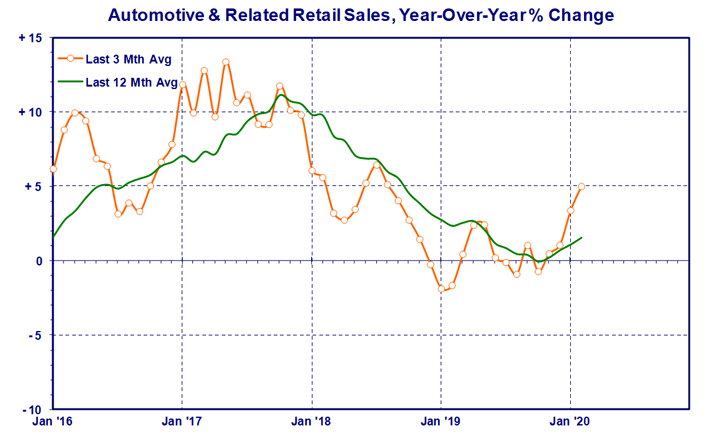
Recent data for the Automotive & Related retail sector may be the most deceiving of all. While the chart indicates a recent surge in retail sales, this is about to drastically change.
Due to the COVID-19 crises, vehicle sales started to decline rapidly in March. As unemployment rapidly rises, people become concerned about their jobs and are reluctant to take on big purchases like a new car.
After a decline in 2019, gas station sales were up 7.6% over the first two months of 2020 on the strength of higher pump prices. Since then however, oil prices have collapsed and gasoline has become cheap again. People are driving less too, due to working at home and the closure of many public facilities from parks to shopping malls.
By The Numbers
Special Note: Statistics Canada revised historical data with the February 2019 release. Unadjusted monthly data were revised back to January 2018, while seasonally adjusted data were revised back to January 2015. Those keeping score should update their files. The analysis in this report is always based on unadjusted data.
Canadian E-Commerce Sales
StatsCan started providing ecommerce retail sales data in January 2016. While the amount of data is limited, some trends appear to be emerging. Here are some results.
Overall, e-commerce represented about 3.6% of Canadian retail sales for the 12 months ending February 2020, including both pure play sellers as well as the online operations of brick & mortar stores. This number is expected to increase sharply in the months ahead as people switch to online shopping to cope with the COVID-1 pandemic. Canadian consumers however also buy online from foreign websites which is not captured in these numbers.
Canadian e-commerce sales were up 25.6% year-over-year for the 3 months ending February 2020. This was much higher than for location based retail which gained 3.9%. Year-over-year growth of e-commerce sales is expected to increase significantly in the next few months.
Note that location based retail is the same as that in the preceding “By The Numbers” table. It’s what’s normally reported as Canadian retail sales. Except that it isn’t. Location based retail excludes another section called Non-Store Retailers (NAICS code 454), which includes electronic shopping and mail-order houses, which in turn is where (mostly) pure play e-commerce businesses are. For the 12 months ending February 2020, electronic shopping and mail-order houses had an estimated $14.8 billion in e-commerce sales.

But that’s not the only source of e-commerce, as (mostly) bricks & mortar location-based retailers also sell online. For the 12 months ending February 2020, this group had an estimated $7.9 billion in e-commerce sales. With electronic shopping and mail-order houses, there’s a grand total of $22.7 billion in e-commerce sales by Canadian operators, up 22.8% over the previous year. Note that this does not include foreign e-commerce purchases made by Canadian consumers, but it does include e-commerce purchases made by foreigners at Canadian operations.
For electronic shopping and mail-order houses, an estimated 85.8% of their sales are allocated to e-commerce. For (mostly) bricks & mortar retailers, it can be estimated that just 1.3% of their total sales are attributable to e-commerce.
In the final section of the above table, (mostly) pure play operators (namely, under electronic shopping and mail-order houses) generated an estimated 65.0% of all e-commerce sales in Canada, while (mostly) bricks & mortar location-based retailers’ share of e-commerce was 35.0%.
For more explanation on the e-commerce numbers, see Statistics Canada: Retail E-commerce in Canada.