By Amy Gu
Online shopping has been growing healthily in just about every category of product. Though the market did not seem to need further motivation, the recent worldwide pandemic accelerated its growth. According to Rakuten Intelligence, ecommerce spending has jumped up around 30 percent compared to pre-pandemic figures. Are vendors adapting online shopping experiences to meet this fueled demand?
Seemingly every category of product is seeing a jump in ecommerce sales. Research by Signifyd Inc. found significant ecommerce spending in various categories that include alcohol, auto parts, general merchandise, home goods, and more. As ecommerce spending is propelled forward, there are technology implementations that can be considered to enhance the online shopping experience.
Some customers prefer certain experiences at brick-and-mortar stores. For example, hand-selecting things like produce is not possible online. This is an experience many customers desire. In addition, whether in a home goods store or a grocery store, many shoppers peruse isles to discover things they need or want as they shop. With technology, such differences in experience can be bridged. As everyone from young adults to senior citizens turn to online shopping like never before, brick-and-mortar stores need to adapt to serve their needs.
Using 2.5D Modeling to Converge an Experience
To create an online shopping experience that is more like physically being there, developers can use 2.5D modeling. Briefly, we understand two-dimensional, or 2D, things to be flat. This is much like a drawing on a paper or text on your computer screen. Everything is pretty much at the same depth.
When something is three-dimensional, or 3D, it is thought of as having three axes or three planes of depth. With a 3D view, you can pretty much rotate an entire item to see all its sides. So, we can see how 2.5D modeling might be somewhere in between.
With 2.5D modeling, it is essentially a 2D model with overlays on top to make things appear as if they were three dimensional. You might imagine a 2D picture of a box of macaroni. With a 2.5D model a developer can overlay the side or sides of the box on top of the 2D image giving the impression of depth and providing more product detail. But why not just go all the way and use 3D modeling?
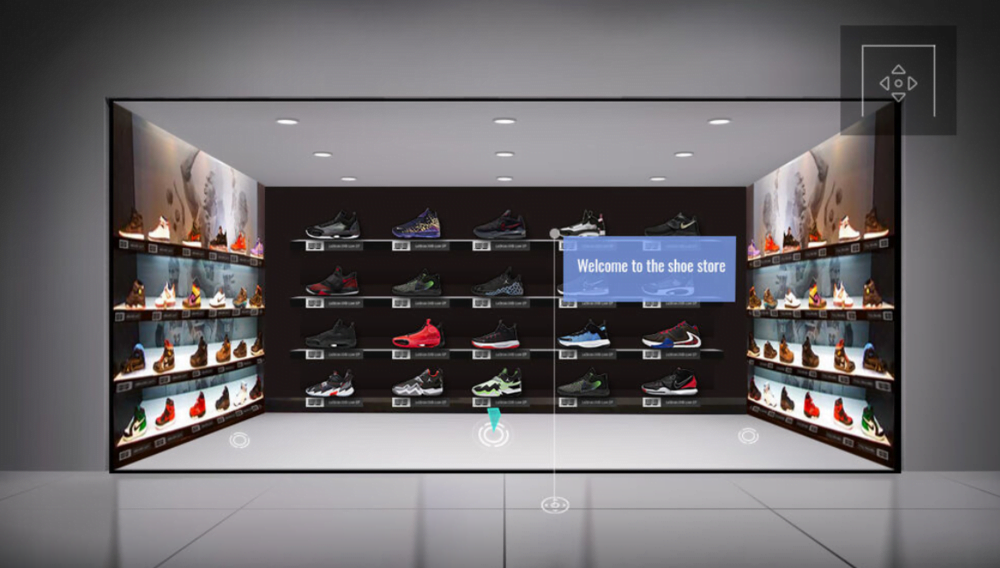
To build an online store with 3D modeling would be prohibitive in at least two ways. First, 3D imagery requires far more storage and file size. But that is not the concern as much as it is how long it would take for a customer to load a page, let alone many pages. Consumers simply are not willing to wait long enough for it. Second, building a 3D model of an entire store and all its items is also comparatively cost prohibitive.
Implementing Modeling
To create such a 2.5D model of a retail store, one can use a person, robot, or drone to move along the isles of the store. While moving, images are captured of the complete environment. These images can then be stitched together to create the virtual store.
This is much like creating a panorama shot with a camera. To do so, an amateur photographer first shoots the left side of a scene, then the middle, and then the right. With software, the images are then stitched to create one image of the entire scene. This is what a store can do but with many more images to capture the entire store, aisle by aisle. Barcode labels on store shelves can be used to create the main stitching coordinates.
One obstacle will be that when a store changes its product lines or the display and positioning, it will require redoing imagery and re-stitching. Again, this can be made simpler with barcoding. When stitching together images, using barcode price tags on store shelves is ideal. By standardizing these barcodes – their location, barcode type and so on – developers can use software that offers the capability to stitch in this manner, to build their virtual online store more easily.
Adding Augmented Reality
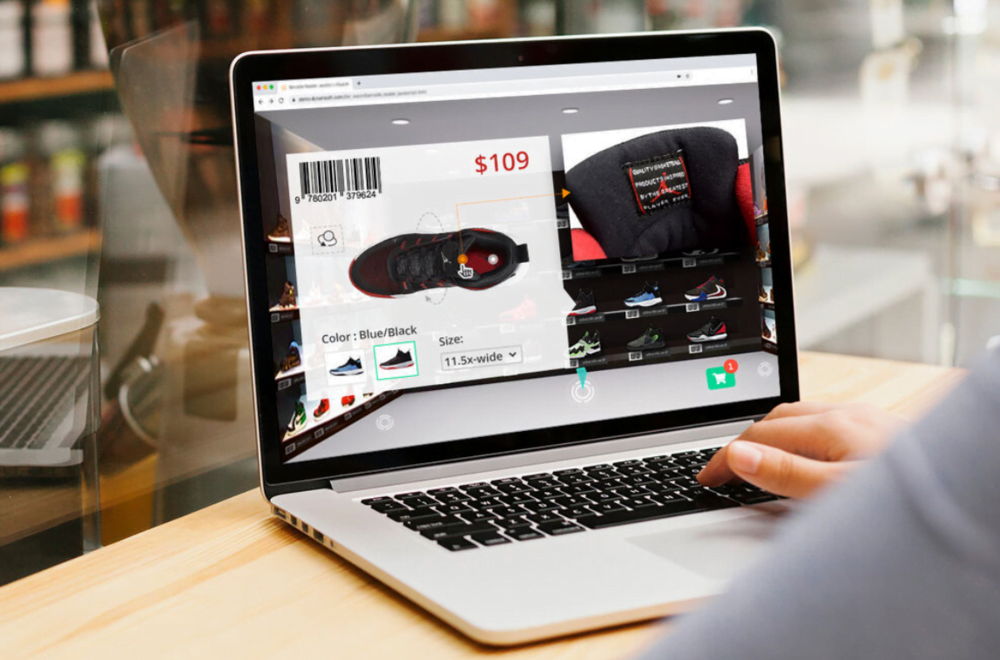
With a 2.5D model stitched together of all isles, produce areas and other product locations, you can consider augmented reality (AR) to spruce up the overall experience. AR is basically where you can further overlay more images, video, audio, haptic feedback, and more on top of the 2.5D model.
One example might be adding AR to a 2.5D model of a box of a throw pillow. When a shopper is in the view of the pillow on a shelf, they can pull it out and view it and perhaps flip it over. An AR overlay might include an informational box listing the materials it is made of. You might even add a haptic feedback of a soft vibration to imply how soft the pillow is. There are many paths to using AR to create a more enriched interactive experience. By adding AR, developers can get one step closer to mirroring an experience of being at a brick-and-mortar store.
Potential Challenges
There are two clichés that are important here. Image is everything and garbage in, garbage out. Getting good imagery to create the 2.5D virtual environment is important to the overall experience. But the better the quality of an image, the more page loading time will increase. At the same time, the more compressed an image is, the lower the quality will be.
Developers might need to balance these performance requirements against the potential local differences of a customer’s wireless connection performance. In addition, proper stitching of the environment is paramount to technical accuracy. This ensures the images the customer sees are actually for the right location and product, and that they are visually pleasing.
Also, stores would be limited in how often they might want to change product locations or in performing store redesigns. This is of course unless they are willing to also redo the panoramic imagery of the store after it has been changed.
A New Shopping Experience
With good planning, development, and execution, a whole new shopping experience is possible. Now a customer can open their browser, whether on a computer, smartphone, or tablet, and visit the online store with an experience that simulates a real visit. A customer can virtually walk the aisles of the store.
Once they see an item they like, the 2.5D imagery lets them further explore it in a way more like the real world. If they select an item, the intelligent application can be made to register the affiliated nearby barcode for the product to call up pricing and, if desired, inventory details about the product. The AR overlaid will help the customer with additional information or add to an enriched product experience.
Online shopping is changing the face of the retail experience. The pandemic has thrust brick and mortars to more quickly adapt than even before to online shopping. Companies that can more speedily and elegantly adapt to the experience customers want will be best positioned to keep or grow their customer base in a post-pandemic economy.

Amy Gu is a co-founder of Dynamsoft, a software company focused on software development kits for document imaging, scanning and barcode reader web and desktop applications. Amy holds a Ph.D. in computer science. She was an associate professor at the Artificial Intelligence Institute at Zhejiang University. She was also a visiting scholar at the University of British Columbia and an exchange professor at Simon Fraser University.