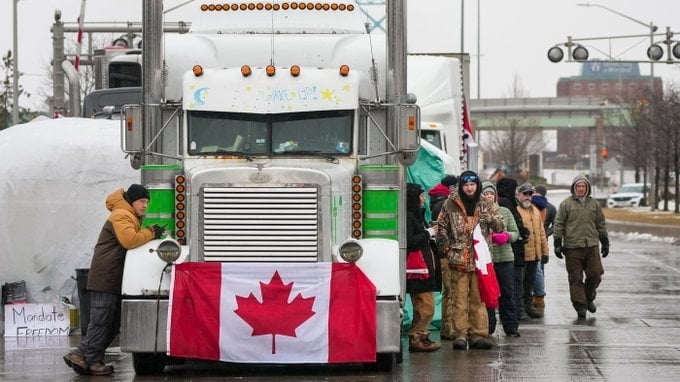
Ongoing blockades of critical infrastructure are damaging the country’s economic recovery and the harm is both immediate and severe, says the Canadian Chamber of Commerce in an open public letter.
“Each hour that these blockades continue does more serious damage to our economy and to our society. Manufacturers that depend on just-in-time delivery have been forced to cancel shifts for thousands of workers, shipments of livestock and of fresh produce face serious delays or waste that threaten food security, and deliveries of products that are greatly needed by Canadian families are being cancelled. These curtailments will only grow in scope and impact if the blockades continue,” said the Chamber.
On Friday, Ontario Premier Doug Ford declared a state of emergency in the province to deal with the trucker protests that have crippled downtown Ottawa and the blockade at the Ambassador Bridge in Windsor which sees $700 million of two-way trade every day. Protesters were cleared out by law enforcement over the weekend in Windsor.
Ford said prior that he would use legal authorities to urgently enact orders that will make crystal clear it is illegal and punishable to block and impede the movement of goods, people and services along critical infrastructure.
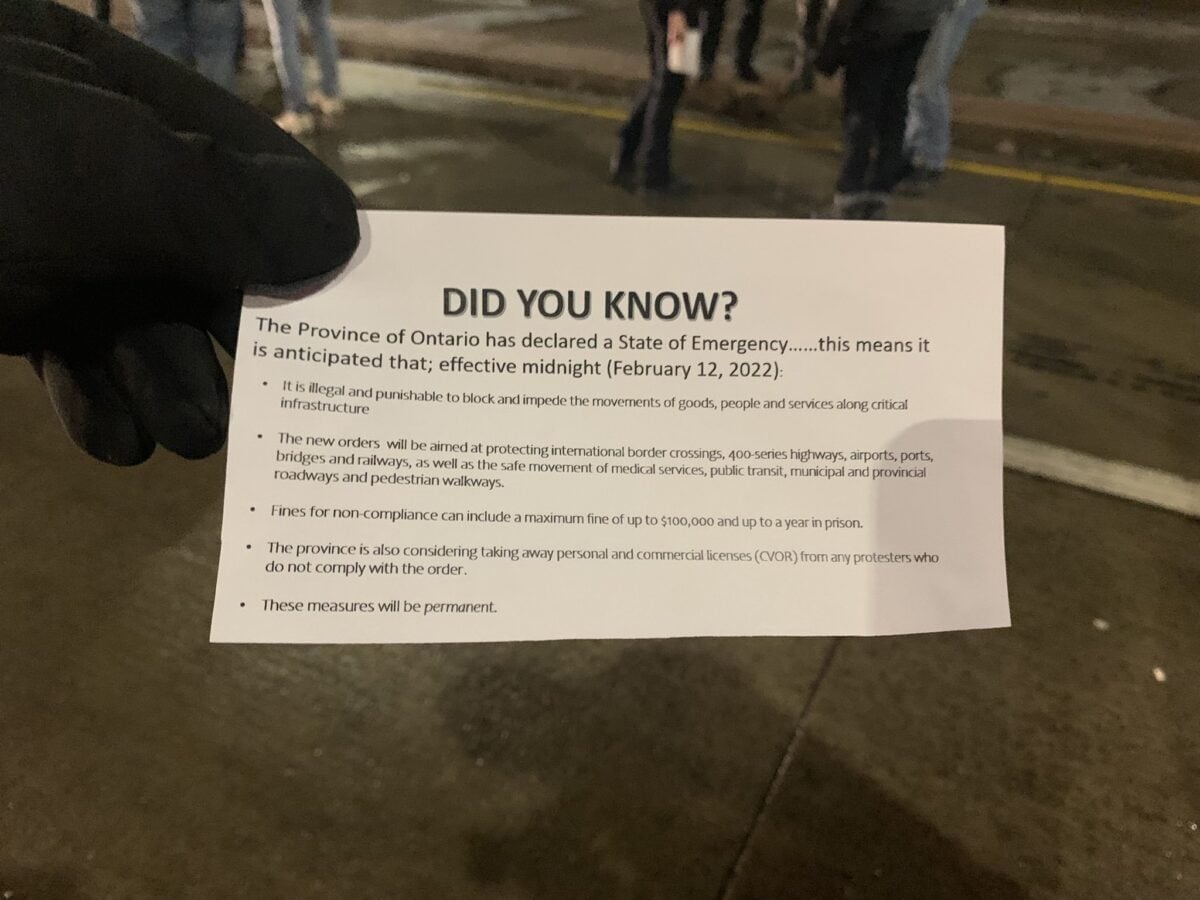
That included protecting international border crossings, 400-series highways, airports, ports, bridges and railways. Fines for non-compliance will be severe, with a maximum penalty of $100,000 and up to a year imprisonment, he said.
Meanwhile, a blockade continues to take place at the Coutts border in Alberta.
“Allowing these illegal closures to continue will also have serious economic and reputational consequences for the years ahead. The blockades not only strike against the rule of law that protects our rights and freedoms, but also undermine Canada’s international reputation. We are already hearing calls to move investment, contracts, and production from Canada because of our inability to guarantee timely delivery to international customers,” said the Chamber in its letter.
It’s Day 2 of the anti-mandate demonstration in Windsor. There is no incoming traffic from the U.S. on the Ambassador Bridge and trucks are lined up for several kilometres to cross into Michigan. pic.twitter.com/cln0q3F8fk
— Dan Janisse (@winstarjanisse) February 8, 2022

Bruce Winder, author of RETAIL Before, During & After COVID-19 and president of Bruce Winder Retail, said Canadians are past the point of allowing the protestors to occupy critical infrastructure because the negative impact to society is now massive. His comments were made prior to clearing the blockade in Windsor.
“The blockade of the Ambassador Bridge alone is costing our economy hundreds of millions of dollars a day. Retailers, suppliers, warehouses and distribution partners will need to lay off thousands of employees if this occupation is allowed to proceed,” he said.
“Consumers run the risk of empty shelves and late deliveries as much of our produce and other critical items comes from or through the United States. We must avoid damaging relations with our largest trading partner so that the U.S continues to see Canada as a country that respects the rule of law and offers reliable supply chain practices.
“While I am proud to live in a country where citizens can freely protest without harm, the time to peacefully end this protest is now.”

George Minakakis, principal of Inception Retail Group Inc. and author of The New Bricks & Mortar – Future Proofing Retail, said it is regrettable that the blockades couldn’t have just been a one day human protest.
“All politicians heard the necessary message the first day. The state of emergency in Ontario is now necessary and certainly, the current state of affairs does not help in future proofing retailers from risks. There are so many industries being impacted by this from retail to auto manufacturing, and other businesses in need of supplies to manufacture or to get their finished goods to market,” he said.
“It is clear that Canadians and people around the world are struggling with the off and on of restrictions. With respect to retailing the shutdown of local supply chains which are just over a land border are untenable. If this important supply line, under siege, were to last any longer it would crush both retailers and consumers because product shortages would reach rationing levels and prices would skyrocket. And not to forget we are entering a sensitive economic period with inflation, higher interest rates in the waiting, and continued supply chain issues from overseas.
“We don’t know how much damage has been incurred with this event. Clearly, it has impacted residents and consumers in Ottawa because it’s human nature to feel uncomfortable with having to face an unknown threat. This protest does not represent all Canadians. Everyday in speaking with colleagues and clients, we all wonder how smaller and weaker retailers have managed to hang on as they have. They just don’t need or deserve anymore setbacks. We are so close to reopening intelligently and to effectively be prepared for more waves of this virus. We all have to do our part to adapt, adopt and rebuild from here on.”

Gary Newbury, a national supply chain and last-mile expert, said after nearly two years of restrictions and supply chain challenges facing Canadian retailers based in Ontario, will the truckers’ protest, and accumulating union unrest in key areas of transportation, risk long-term damage to the province and the businesses within it?
“What’s at stake are constitutional rights and freedoms enshrined in fundamental Canadian law which have been quickly set aside under “emergency powers”, something that runs the risk of a significant legal challenge. Canadians need to watch this situation carefully, rationally and get beyond the emotional cauldron that has erupted over the last two weeks,” he said.
“Ford is currently chasing provincial legislators to punish the protestors. Will this exacerbate tensions or dispel the protestors? Will it help or hinder any economic recovery, a key tenet in supporting the debt mountain built up over the pandemic? Taking truckers’ licenses and their trucks away and fining them is not going to help the economy – we already have a severe shortfall of qualified drivers here in Canada. How’s that going to help an economic recovery, one that will rely on a fully functioning and integrated transportation network?
“I do believe there has been clear evidence of a resolve to have the restrictions lifted, but first government ministers must engage with these protestors’ representatives and assure them of their plans for lifting such to prevent serious damage to international supply chains. So far, there has been little movement towards this potentially collaborative approach and therefore, supply chains may start to seriously buckle, and businesses relying on cross border movements may see demand permanently go south of the border in the light of this as part of America’s “Build back better” strategy, reducing reliance on even their closest trade partners.”
Newbury said the consequences of shelves potentially running dry quickly and the stirring of civil unrest, which many parts of the media have seen to be invested in with their emotive and inaccurate reporting, are likely to accelerate.
“Consumers will start panic buying when they have evaluated the immediate outcomes of the next day or two, and supply chains will not be able to replenish shelves quickly enough, except through draconian measures (such as airlifting), further adding to inflationary pressures which are set to soar if this situation is not reconciled quickly and the truckers can be put back to work and be part of the solution to rebalancing inventory across Canada,” he said.
In a tweet, Dan Kelly, President and CEO of the Canadian Federation of Independent Business, said: “At this point in the pandemic, I am observing that the blockades in the name of freedom from COVID measures are, in fact, blocking freedom from COVID measures . . . Thousands of small businesses who have called on govts to relax or eliminate COVID restrictions are negatively affected even more deeply by the blockades.”