

Mandating a $20/hour living wage across Canada could push over half a million small businesses to the brink of closure, according to a new report by the Canadian Federation of Independent Business (CFIB).
The report, “Affordability, minimum wages, and living wages: Striking a balance for small businesses,” said it would cost the Canadian economy $44.9 billion in extra wages and put almost 600,000 small businesses at risk of becoming unprofitable.

“Minimum wage and living wage policies often miss the mark when it comes to truly supporting the most vulnerable workers. Governments are setting these wages with no anchor in economic reality, relying on subjective and unpredictable criteria,” said Beatrix Abdul Azeez, CFIB policy analyst. “Governments should shift away from relying on these blunt tools and instead adopt a new approach to ensure workers can cope with the rising cost of living, while also guaranteeing that small businesses aren’t unfairly burdened.”
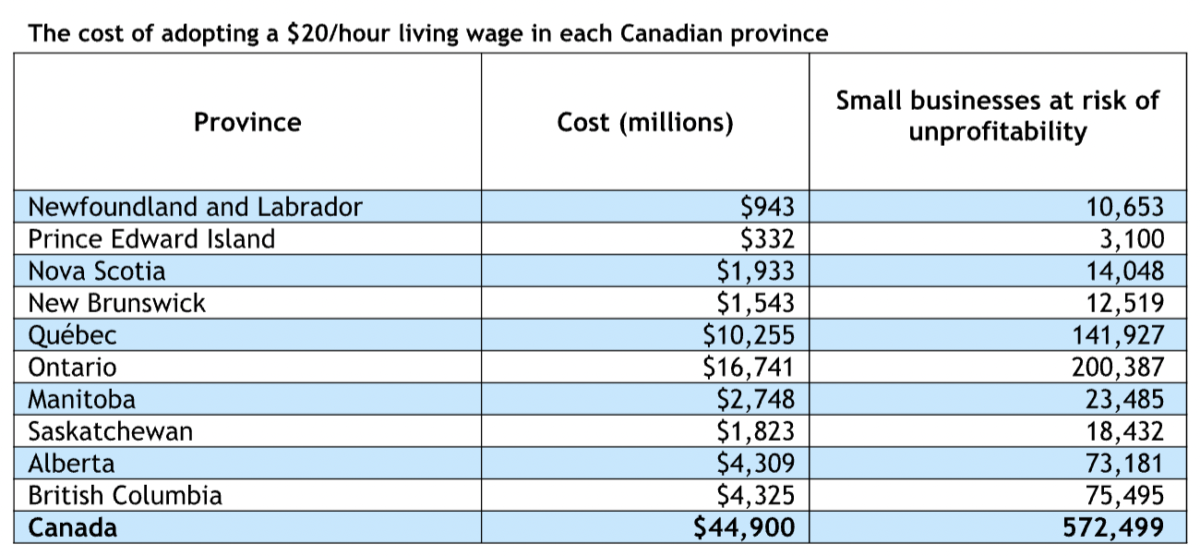
The provinces that would be hardest hit with a $20/hour living wage would be Ontario with a cost of $16.7 billion and with 200,387 businesses at risk followed by Quebec ($10.2 billion, 141,927 businesses), British Columbia ($4.3 billion, 75,495 businesses) and Alberta ($4.3 billion, 73,181 businesses).
The CFIB said governments need a new approach to address affordability challenges as traditional minimum wage and living wage policies fall short in addressing the root causes of the rising cost of living while simultaneously increasing costs on small businesses.
“Mandatory wage hikes do not actually address the affordability crisis. While they are good intentioned, they actually cause unintended consequences for small businesses,” said Abdul Azeez. “What this report does is draw attention to those consequences and offers alternative solutions that the government can put in place to address the affordability crisis.
The CFIB recommends that governments:
- Alleviate the impact of rising minimum wages on small businesses by reducing other taxes and payroll costs (such as small business tax rate, CPP, EI, health/education payroll taxes, etc.);
- Establish a minimum wage setting process that is predictable, transparent, reflective of market conditions, and mindful of economic impacts;
- Link minimum wage adjustments to private sector wage growth or a predetermined percentage of the median wage;
- Address the root causes of the affordability crisis by enacting policies to increase the supply of housing, reduce energy taxes, and remove interprovincial and international trade barriers;
- Provide targeted fiscal support for vulnerable workers through reduced personal income tax rates, increased basic personal amounts, and expanded tax credits.

“Canada says that small businesses are the backbone of the economy. So mandating the living wage will cause Canada to lose more than 40 per cent of their businesses actually,” said Abdul Azeez.
“This would be a very high burden for businesses. In fact, we asked our members what was the impact of the last minimum wage hike and for six out of 10 they actually had to increase wages for those earning even above the minimum wage which just goes to show that there’s a cascading effect on wages when minimum wages are increased.
“Another six out of 10 had to increase the prices of goods and services which just puts more inflationary pressure on the economy. And unfortunately for those small businesses who cannot absorb this extra cost they have to work more. The business owners have to work more and even cut out some investments they’re doing in their business.
“Governments need to reflect on the role they actually play in fueling this crisis. There are many different ways that the government can address this crisis by looking within. They can implement policies that help lower the price and increase the supply of essentials such as housing, food, energy, gas. Things that people require to live a normal and fulfilled life. So the governments just need to look within and address the root causes instead of placing this burden on small businesses.
“The Bank of Canada has been sounding the alarm about Canada being in a productivity emergency. What we see is we’re paying more money for the same level of productivity that we had in past years. Of course, if minimum wages are increasing arbitrarily without reflecting what’s actually going on in the labour markets people may be more inclined to hire more experienced workers. So people that are less experienced may be less likely to get jobs just because the cost of hiring them is so high. So this is one of the unintended consequences as well.”
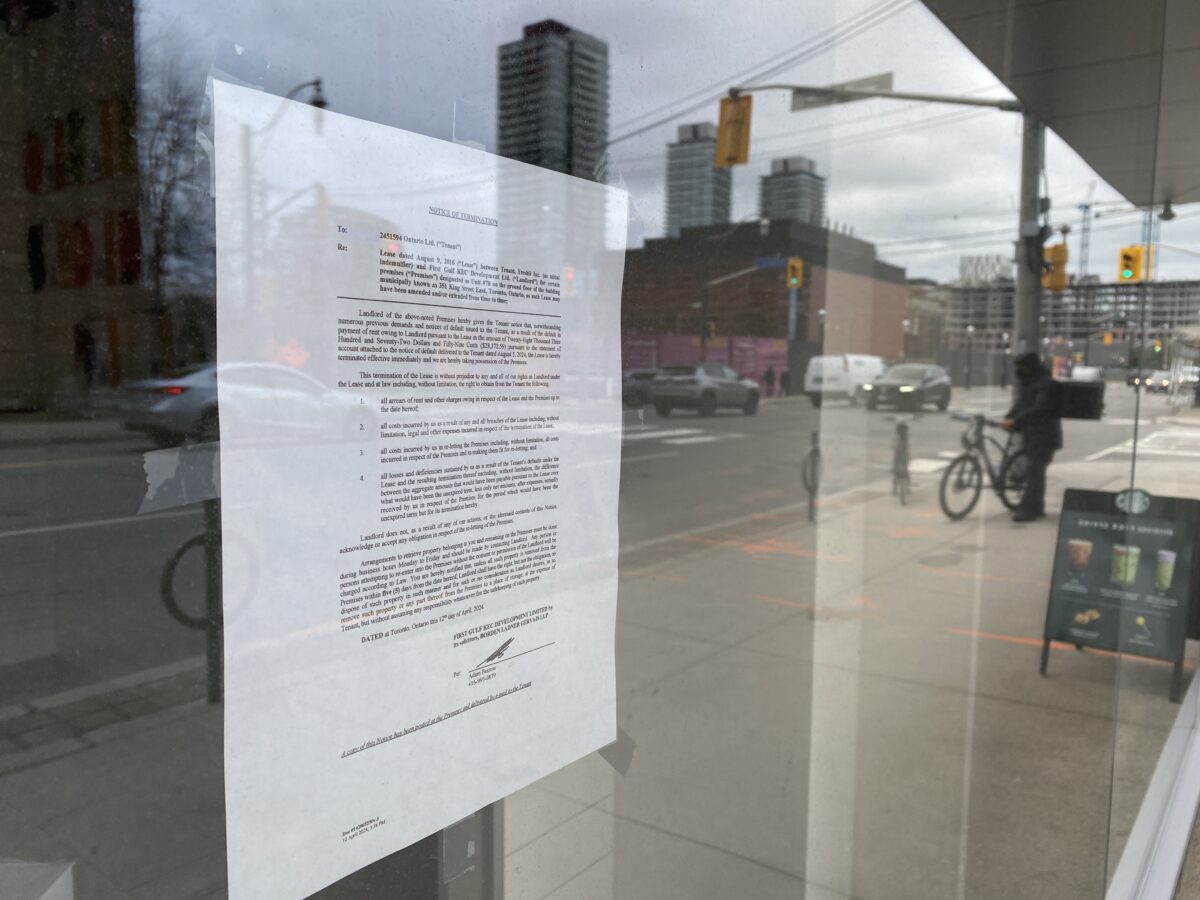
The CFIB also said that 31 per cent of small businesses had to cut back on hiring young and unskilled workers, with 25 per cent of them reducing overall employment with a hike in a minimum wage.
“Canada’s cost of living crisis requires a more effective framework: making sure rent, food, and gas prices are affordable and stable while extending support to workers and small businesses through tax reductions,” said Jairo Yunis, CFIB’s director for BC and western economic policy. “This would go a long way in addressing Canada’s affordability shock.”












Governments should….
stop actively and proactively trying to bankrupt small businesses. Those who don’t see this agenda playing out by now are remaining willfully ignorant.
Totally agree.
I do think that select Canadian municipalities like the City of Toronto and the Greater Vancouver Regional District need to enact $20 minimum wages.
Nope
Slippery Slopes are Slippery for a Reason.
Stop approving Large 15-20+ story buildings
Canada is like 80% within 100 Km’s of the boarder
We can always expand out , Mega Cities arent needed
At best they become overcrowded asphalt kingdoms
Worst Case they more communities thrive not just 1-2
I mean who has a worse carbon footprint?
Mega Cities or Communities?
Also Reject all forms of Gov’t Licensing Fee’s on Farmers for their ability to sell their yield in Public.
Its how Corporations took out mom and pop chains keeping them from growing into competition.
They lobbied to Licensing Fee’s to hurt all Farmers not signing with them on their terms.
Food isnt expensive if it comes from within Canada
Instead we target local farmers and buy from as far away as Australia
If your small business can’t succeed without exploitative wages, then you’ve got a bigger problem and a horrible business plan. CFIB should focus on helping their members overcome that issue, instead.
Simple
Unionize Customers.
Make it so the focus isnt on compounding employee’s frustrations.
Make it so you organize and attack control structures for Corporations like “Licensing Fee’s for Farmers”
It takes away Leverage so few can produce let alone negotiate under Corporate Terms.
Licensing Fee’s keep places like Giant Tiger for example from being able to rely on local products more like it used to so they could keep Eggs, Milk and Bread so cheap among other things. Licensing Fee’s forced them to a position where they can only buy from Certain people who can afford said fee’s in their designated area’s.
You needs Customers United and sending a message Stock Holders Fear
They’re the ones with the real Control in Corporations not CEO’s or even Owners
They can be replaced if Public Confidence is lost , look at Papa Johns Owner or Former owner now.
How you win is by hurting the big guy while helping your local or discount grocery stores.
By rejecting Commercialized Packaging plants and insisting on Local Food whether you justify it as Carbon issue or
Are not a Complete Fool and get the Cause vs Effect at play. Local First means stronger local gov’t and less Federal Overstepping and Globalist interference. We can all put Canada First by putting Local Food >Imported unless it cant be produced here, then fine.
Vegetables , Eggs, Milk Bread and Cheese should never be this insanely high ever
More people die of Starvation yearly then they do of whatever justification the Licensing system claims to have.
We live under capitalism. It’s time to let go off the notion that consumers are responsible for keeping businesses afloat. Until the government steps in to stop predatory inflation, the only means of aiding folks through this cost of living crisis is to bump the minimum higher. Small business owners seem very averse to anything that creates livable wages or benefits, but these are basic costs of running a real business.
People are voting with their wallets, and plenty of large corporations are going under too. We are the cutomers, not part owners or stock holders. Stop making us repsonsible for everything.