Advertisement
Advertisement

Food Bank usage in Canada soars compared to US [Op-Ed]

Date:

Share post:

Last week, Feed Ontario disclosed that over a million residents in Ontario, Canada’s wealthiest province, sought assistance from food banks over the past year. A million people. That’s essentially Nova Scotia’s entire population as a province.

This revelation presents a stark contrast when juxtaposed with the situation south of the border in the United States. In 2023, while 13.5% of Americans households grappled with food insecurity—characterized by low or very low food security (USDA-ERS, 2024)—the rate in Canada was significantly higher at 22.9% (Proof Toronto, 2024). This suggests that food insecurity in Canada is a staggering 69.6% more prevalent than in the United States—a deeply unsettling statistic.

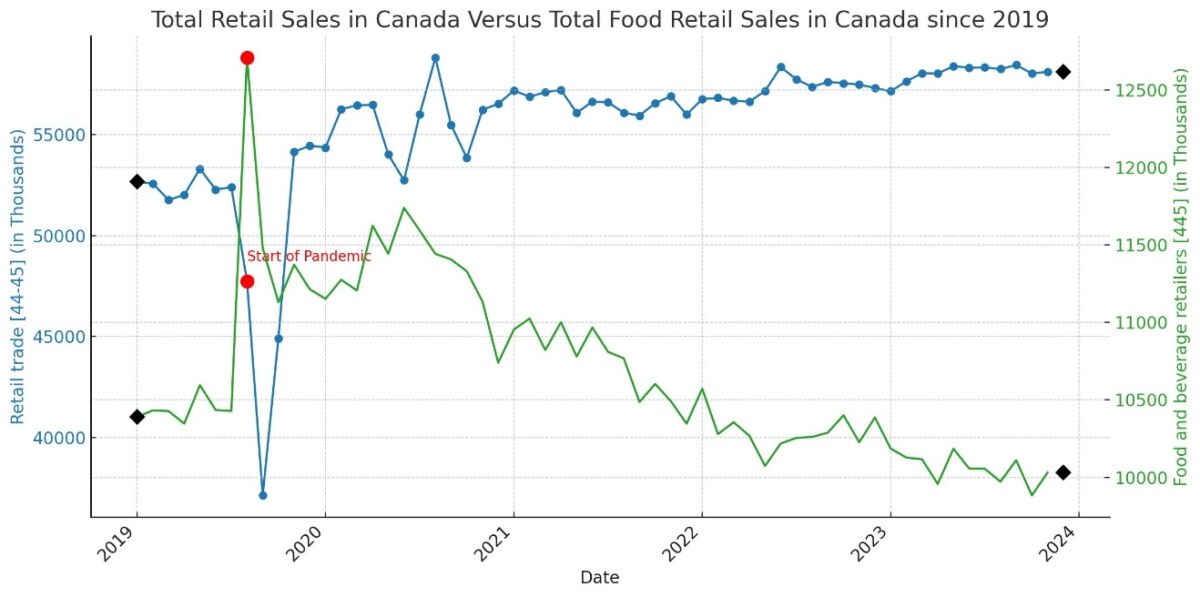
The challenge of affording food in Canada is exacerbated by anemic food sales, particularly stark when compared to the United States where grocery store sales increased by 1.8% in the last 12 months, according to the Federal Reserve Economic Data. In stark contrast, Canadian grocery store sales have plummeted by a worrying 3.2%, according to Statistics Canada (see graph on retail sales).

One plausible explanation for this disparity lies in the higher interest rates in Canada, which likely impose a heavier burden on Canadian households than on their American counterparts, given that the average debt per household is considerably higher in Canada. The Bank of Canada’s pathway to achieving a more stable inflation rate without detrimentally affecting Canadians appears much narrower than that of the U.S. Federal Reserve, evidenced by the harsh reality of ten consecutive rate hikes last year, compelling Canadians to economize particularly on food expenditures.
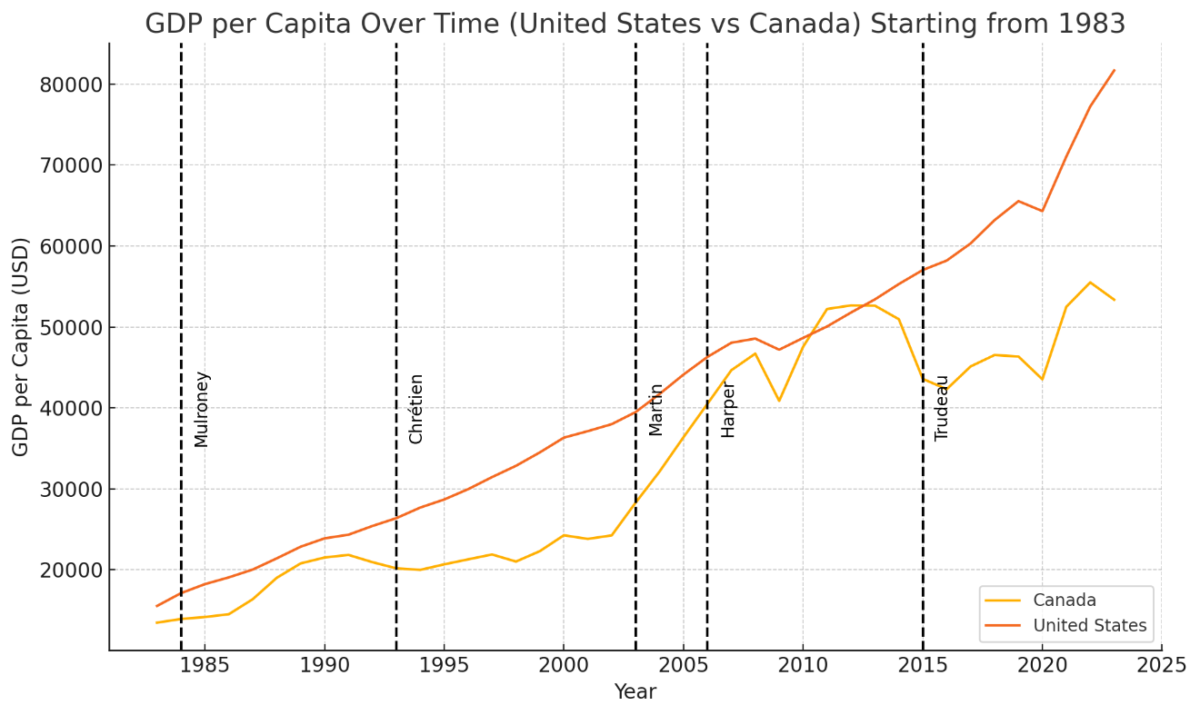
It is becoming increasingly apparent that Canada’s per capita economy is contracting, devoid of the wealth creation observed in the United States. Notably, according to World Bank Data, in 2002, the United States’ GDP per capita was 56.6% higher than Canada’s—a record high during the tenure of another Liberal Prime Minister, Jean Chrétien. The current gap, at 53.07%, is perilously close to this historical peak (see GDP Per Capita graph).
The primary drivers of GDP growth in Canada are currently immigration and public spending, with the government undertaking the bulk of economic heavy lifting. The situation is indeed dire. Moreover, the enthusiasm once held for the economic greening championed by the Trudeau administration is showing signs of significant fatigue. The carbon tax, Trudeau’s principal policy for fostering an eco-friendly economy, is increasingly losing traction due to the prevailing economic challenges. Dissenting voices from within the Federal NDP and the BC NDP government now challenge the carbon tax as the optimal path forward.

The failures of the carbon tax are emblematic of a broader trend in recent policymaking endeavours: the implementation of populist policies devoid of rigorous metrics for evaluating their success over time, all while constructing an expansive communications strategy designed to convince Canadians of the policy’s merits. The federal carbon tax is set to escalate to $95 per metric ton by April 2025, marching inexorably towards the 2030 goal of $170 per metric ton. Despite the mounting pressure, the Trudeau government has neglected to assess whether the policy meaningfully impacts our climate and emissions or to evaluate how the policy might influence the economy over time, with a particular focus on the ramifications for the agri-food sector from farmgate to plate.

The design of the rebate system ostensibly allows Canadians to overlook the real costs of this poorly-conceived policy. However, administering this massive program is not only costly but also fails to leverage the Canadian economy effectively. It is imperative to devise policies that genuinely foster both economic and environmental sustainability for the nation.

Related News:

VIDEO: Latest trends in grocery in Canada

What’s Canada’s Food Supply Looking Like These Days? Interview with Sylvain Charlebois

Where are Food Prices in Canada Headed in 2024? [Sylvain Charlebois Video Interview]

LEAVE A REPLY

Please enter your comment!
Please enter your name here

More From Retail Insider

RECENT RETAIL INSIDER VIDEOS

Advertisment

Subscribe to the Newsletter

Subscribe

* indicates required

RECENT articles

From The Desk: Strategic Expansion and Evolving Consumer Engagement Define Retail in April 2026

Retail trends highlight acquisitions, cautious expansion, and experiential growth as brands navigate 2026 challenges and shifting consumer expectations.

Lunching with Lady Eaton Returns to Toronto May 17

Historic Eaton’s Round Room dining experience returns to Toronto on May 17, 2026, blending retail history with immersive hospitality.

No Name Launches ‘Grocery Goss’ Activations in Canada

Canadian value brand No Name has taken an unconventional approach to brand building with a new experiential campaign...

Reinvention and the Luxury Career Journey

How reinvention, adaptability and strategic pivots shape long-term success in the luxury retail career journey.

Reitmans reports Q4 and year-end results

Net loss was $4.9 million for the quarter and $0.9 million for the year.

FreshCo Expands East with First Atlantic Canada Locations

FreshCo enters Atlantic Canada with new Halifax-area stores, marking Empire’s first discount grocery expansion into the East Coast.

Righteous Gelato enters $900M frozen novelty category with national Sorbetto Bar launch across premium Canadian grocers

Having strong national distribution with partners like Loblaws, Sobeys, Metro, and Whole Foods allows it to scale quickly and ensure consumers can actually find the product when they’re excited to try it.

Pet Valu celebrating 50 years in business

The brand recently opened its 870th store in Canada. 

RUDSAK Expands into Europe and Asia Markets

RUDSAK expands into Europe and Asia through premium wholesale partnerships as the Montreal brand advances its global growth strategy.

Cake Beauty expands retail footprint in Canada with Walmart and Shoppers Drug Mart rollout

Cake started in 2003 out of the kitchen of the founder Heather Reier, who wanted to create some products that were “delicious, indulgent, but also clean.”

Angels Wear Preloved Launches Canada’s Largest Resale Event

Angels Wear Preloved launches Canada’s largest luxury resale event in Toronto, bringing 40+ consignment vendors together for one day.

Daily Synopsis: Apr 9, 2026

Roots reports financials, Ikea expanding, Empire acquires Quebec grocer, T&T Supermarket head discusses expansion, Costco opening in Thunder Bay, Indigenous-owned 'department store' shutting down, and other news.

IKEA to Open London Store in Former Hudson’s Bay Space

IKEA will open a 43,000 sq. ft. store in London, Ontario, taking over former Hudson’s Bay space at White Oaks Mall.

Empire Acquires Mayrand, Enters Quebec Discount Grocery Market

Empire acquires Mayrand, gaining entry into Quebec’s discount and warehouse grocery market through a court-supervised sale process.

Reitmans unveils “bold new era” for Canadian fashion

In late April, Reitmans said it will unveil a new retail concept at Carrefour Laval, located approximately 20 kilometres from Montreal's downtown core.

Roots reports strong Q4 and Fiscal 2025 results

Sales in Fiscal 2025 were $277.7 million, a 5.6% increase compared to $262.9 million in F2024

Happy Belly Accelerates Expansion as U.S. Entry Nears

Happy Belly ramps up Canadian expansion and prepares for U.S. entry as profitability improves and new restaurant concepts gain traction.

MINISO Hello Kitty Pop-Up to Debut at Scarborough Town Centre

MINISO is launching Canada’s first Hello Kitty pop-up at Scarborough Town Centre, highlighting its IP-driven retail strategy.

Must Société opens flagship Jardin de Ville store in Laval (Photos)

Must Société is a leader in mid- to high-end indoor and outdoor furniture, with 16 stores across Québec and Ontario.

Gen Z Canadians reviving mall culture with focus on social shopping: Lightspeed Commerce

83% of Gen Z Canadians say stores with social or community features make them feel more connected, and more than half (52%) have chosen a retailer specifically for its third-space experience.