As part of its 28 th annual Reputation study, Leger has unveiled its list of the most reputable companies according to Canadians in 2025 with retail giant Costco coming out on top.
Leger’s Reputation study has become the benchmark for measuring corporate reputation in Canada and monitoring how it changes over time. This year, Leger surveyed more than 38,000 Canadians to explore their perspectives on 326 companies across 30 different sectors.
Conducted annually, it is based on Leger’s exclusive model of six recognized pillars of reputation—financial success, social responsibility, honesty and transparency, quality, attachment, and innovation.

“Reputation is more than a static score—it’s a dynamic reflection of how Canadians see the world around them,” said Lisa Covens, Senior Vice-President, Public Affairs and Communications at Leger. “In today’s marketplace, brands that understand the evolving expectations of Canadians and actively work to meet them are the ones that will earn and keep their trust.”
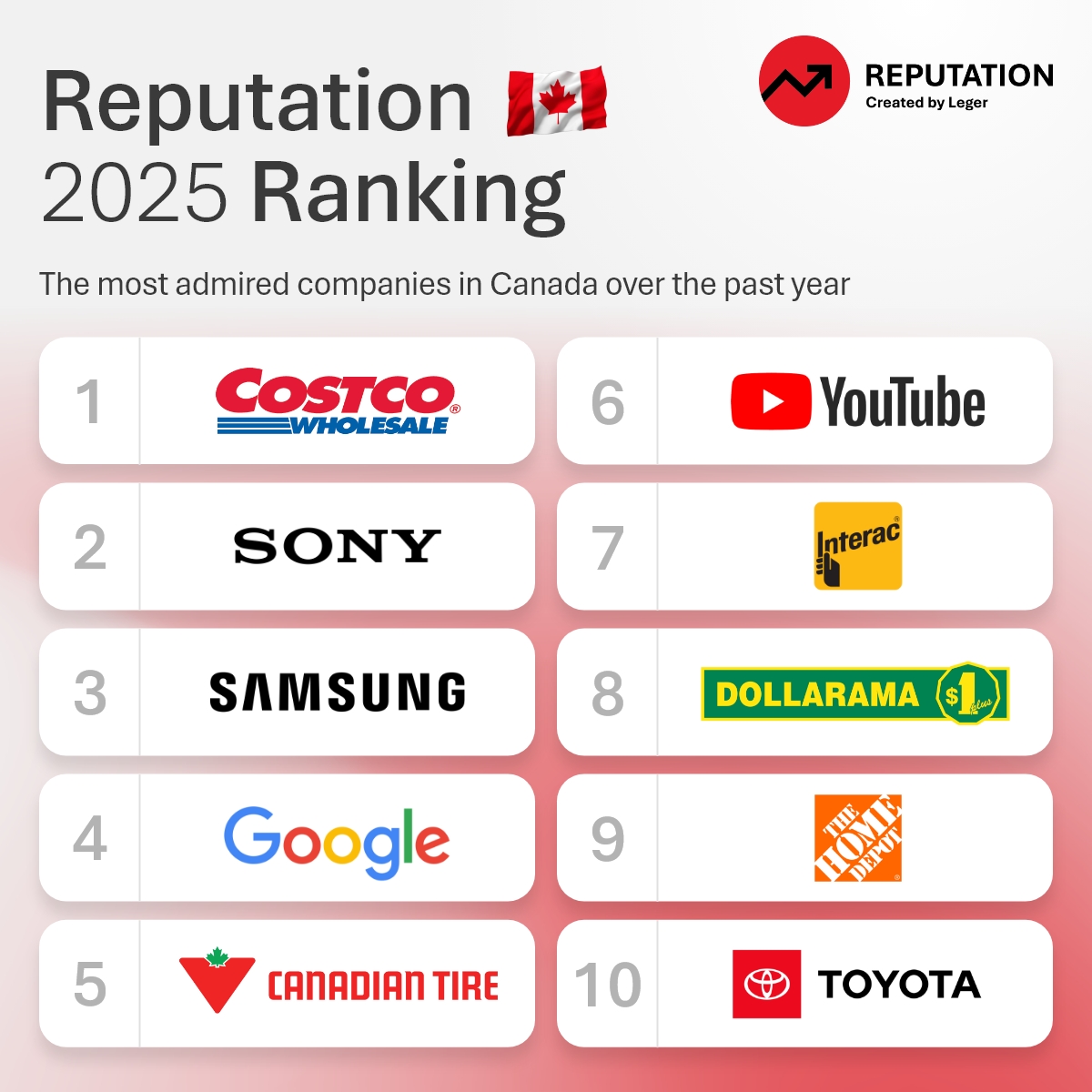
The Top 10 Most Reputable Companies in Canada in 2025*
The maximum possible reputation score is 100. This year, according to Canadians, the most
reputable companies are:
- Costco (Reputation Score: 74)
- Sony (Reputation Score: 74)
- Samsung (Reputation Score: 73)
- Google (Reputation Score: 72)
- Canadian Tire (Reputation Score: 71)
- YouTube (Reputation Score: 71)
- Interac (Reputation Score: 69)
- Dollarama (Reputation Score: 68)
- Home Depot (Reputation Score: 68)
- Toyota (Reputation Score: 67)
*Methodology: 38,616 Canadians were surveyed to explore their views on 326 companies in 30 different industries.
In a landscape shaped by economic uncertainty, political disruption, and shifting consumer priorities, Leger said Reputation 2025 study reveals a growing divergence in how Canadians perceive corporate brands. “As inflation persists, public services falter, and cross-border tensions rise, Canadians are looking to companies—not just governments—to reflect their values, meet their needs, and navigate uncertainty with transparency and agility.”
Covens said the reputation score is quite simple. People are asked if they have a good opinion, bad opinion about a company and if they know the company.
The score can actually range from plus 100 to minus 100, plus 100 being everyone knows you and has a good opinion of you while minus 100 being that everyone knows you but does not have a good opinion of you.
“We do see scores in the negative, but you know, we are Canadian and I feel like we don’t see too many. This year we had eight companies of our 326 in the negative which is telling. That’s so small when you think that we evaluated more than 300 companies and only eight have a negative score. It shows that by and large Canadians feel positive, or more Canadians feel more positive, than the number of Canadians who feel negative. But beyond that, we dig further. What goes behind reputation or how we talk to our clients after and more in depth is we look at the six pillars of reputation that build into that,” explained Covens.
“So that was years of analytics and research that have come to these six main pillars. Is the company financially successful? Are they socially responsible, honest, and transparent? Do they have good quality of products or services? Are they innovative? And is there an attachment? Do Canadians feel attached to that company?”
The brand reputation is very important especially if they ever go through a crisis of sorts.
Geopolitics Reshaping Consumer Behaviour
January 20, 2025—the day Donald Trump was sworn in for his second term as U.S.President—marked a turning point. A series of hardline executive orders and new U.S. tariffs immediately strained Canada-U.S. relations. In response, Leger went back into field in March to reassess how this new political climate is impacting public opinion.
American Brands See Steep Drops
Several well-known U.S. brands have taken reputational hits since Trump’s inauguration:
Netflix (-27): Price hikes landed poorly amid economic pressures and rising anti-
American sentiment.
McDonald’s & Starbucks (-22 each): As Canadians shift toward local loyalty, even iconic
global brands have suffered.
Tesla (-42), Meta (-28), Amazon (-29), and Google (-16): Publicized connections to the
Trump administration, including inauguration funding and the rollback of DEI initiatives,
contributed to steep declines.
Coca-Cola (-24): Widely viewed as a symbol of American culture, the brand’s image was
further impacted by media stories linking it to personal support for Trump.
Canadian Brands See a Resurgence
In contrast, Canadian companies that weathered early-year struggles have rebounded strongly:
Canada Post (+24): Once this year’s study’s biggest loser due to strikes and service
concerns, Canada Post’s reputation surged when we re-fielded in March as Canadians
rallied behind homegrown brands.
Canadian Tire (+4): A steady performer, its alignment with national values continues to
reinforce consumer trust.
“Other rebounders include Air Canada (+8) and Sunwing (+6), which rebounded from earlier lows, and a suite of auto manufacturers—including Ford (+7), Subaru (+6), Mazda, Toyota, and Volkswagen (+5 each)—whose EV momentum and reliability resonated in uncertain times. Reputation 2025 shows that Canadians are watching closely—and acting accordingly. In an era of political polarization, economic strain, and global uncertainty, brand perception is being shaped by more than price and performance. Companies must not only deliver value but align with consumer values,” said the company, which is the largest Canadian-owned market research and analytics company, with more than 300 employees in eight Canadian and U.S. offices.