Pizza Nova’s story begins in 1963, when founder Sam Primucci and his brothers opened their first pizzeria in Scarborough. The aim was straightforward, serve authentic Italian pizza made with quality ingredients, and earn loyalty one neighbourhood at a time. Today, the brand has grown to more than 150 locations across Ontario, all operating with the same emphasis on taste, consistency, and community ties.
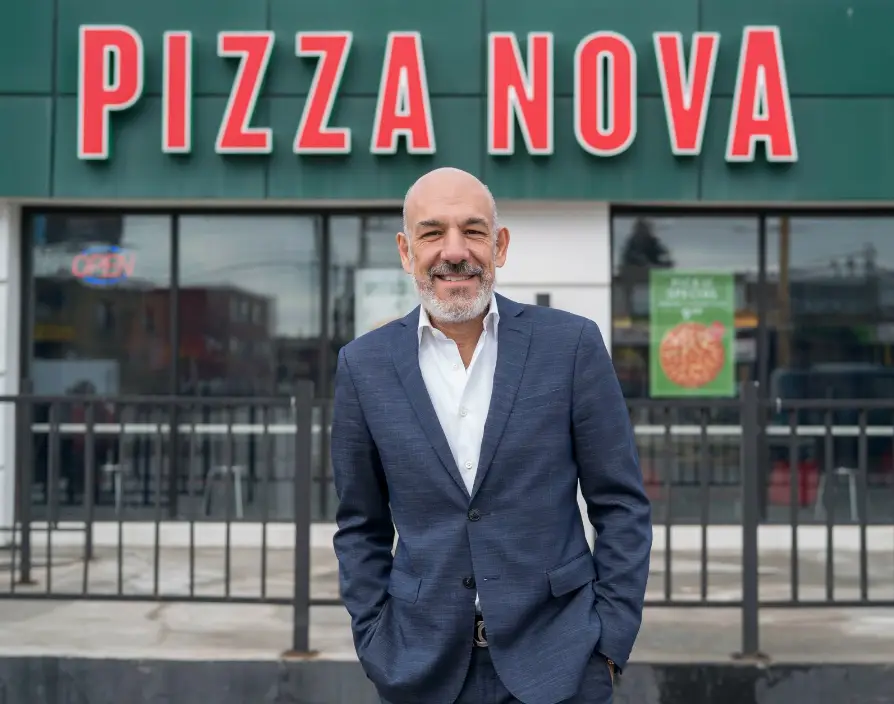
“Quality is first and foremost,” says President Domenic Primucci. “When you build a company, you need a strong foundation, and for us the foundation is our pizza. We put everything into the dough, sauce, and cheese, and make sure that is number one.” It is a philosophy formalized in the company’s Puro Promise, a commitment to premium ingredients, from tomatoes packed within hours of picking to the custom mozzarella blend and olive oil imported from Italy.
The company’s scale has changed over six decades, yet the operating model remains intensely local. Franchisees run single-unit businesses that anchor busy corners and main streets, serve surrounding neighbourhoods, and participate in local fundraisers. “We are a collection of small businesses under one brand name,” Primucci explains. “People can look at us as a chain, but our stores are local businesses. The franchisee is part of the community.”
From early franchising to a modern operator
Pizza Nova entered franchising in 1969, long before the model matured in Canada. “My dad and his brothers got into it quite early,” Primucci notes. “They were immigrants from Italy who wanted to help entrepreneurs who liked what we were doing to duplicate it in another location.” That early decision set the course for the brand’s growth through the 1970s and 1980s, culminating in a 1983 first for a Canadian pizza chain, a centralized call centre that made consistent service and cross-market marketing possible.
Primucci’s own path has traced nearly every job in the company. He started at age fourteen as a dishwasher, moved into front-of-house roles, worked the call centre, managed restaurants, and later took on marketing. After earning a business degree and launching an import-export venture, he returned full time, bringing operational knowledge and a bias for smart evolution. Under his leadership, the brand added antibiotic-free meats, plant-based pepperoni, dairy-free cheese, and specialty crusts. The menu broadened in response to changing consumer tastes, while core recipes stayed true to the brand’s origins.
The operator now employs roughly 2,500 people across the system, a mix of corporate staff and in-store teams working for franchisees. “At the end of the day, the franchisee has to make money to succeed, and for us to succeed,” Primucci says. That focus informs everything from supply chain controls, the brand continues to centralize key ingredients to guarantee consistency, to the evaluation of new sites and store formats.
Reading the Ontario market, one neighbourhood at a time
Although the brand’s footprint spans the province, its core trading area remains tightly clustered around the Greater Toronto Area. “We are basically all in Ontario, about two to two-and-a-half hours from Toronto in every direction,” says Primucci. That regional concentration has advantages. Brand recognition is high, delivery logistics are efficient, and marketing can be focused. It also means the company pays close attention to new housing, transit expansions, and shifting commuter patterns that change the shape of demand.
The pipeline is measured rather than aggressive. “We opened another location in Hamilton this past year,” Primucci says, noting that broader economic conditions have tempered expansion. “Things are slower than usual. The economy has changed the landscape. There was a lot of building, a lot of homes going up, but that has really come to a standstill. You have to be careful where you go.” In the current environment, the company is concentrating on infill, pockets where delivery service coverage can be sharpened and street presence is underrepresented. “We want to make sure we are servicing areas as best as possible,” he adds.
That cautious stance reflects macro realities retailers recognize across categories. Consumers are watching discretionary spend, and headlines about layoffs and tariffs have weighed on sentiment. “People are tightening their belts,” Primucci says. “Some people do not know if they have a job tomorrow. The negative news puts people in a holding pattern.” He adds that reciprocal tariffs have disrupted some suppliers that sell into the United States. “Those companies have really slowed down, they start looking at layoffs, and it becomes a snowball effect.”
Leasing in a high-cost cycle
Real estate strategy has evolved alongside consumer behaviour. Streetfront units, visible corners, and neighbourhood shopping strips remain Pizza Nova’s sweet spot. “You need to be in an area where there is exposure, where people can see that you are there,” Primucci says. Delivery continues to be a core sales driver, so trade areas are drawn for both walk-in traffic and logistics. What has changed most is cost. “Rental rates have gone through the roof,” he notes. “You have to be careful because there is a franchisee in that location. We look at different opportunities, and we are downsizing square footage where it makes sense.”
Smaller footprints align with ordering trends. Phone orders remain part of the mix, though they have diminished as digital channels grow. “Call-in orders are still popular, just not as popular as they used to be,” says Primucci. “We have web and app ordering, and all the mechanisms in place to make it easy.” That omnichannel approach, a familiar playbook in retail, puts pressure on back-of-house layout and prep space rather than front-of-house seating. Many units keep a few stools or a small counter for a quick slice, yet the typical store is optimized for pick-up and delivery.
A classic jingle that still converts
Few Canadian brands can claim a single advertising line that has embedded itself in popular culture the way Pizza Nova’s has. Debuting in 1987, the company’s radio jingle, “439-Oh-Oh-Oh-Oh Pizza Nova,” turned a centralized number into a household refrain. It was written by advertising executive Syd Kessler and sung by Juno Award winner Alfie Zappacosta. Ask a Torontonian to complete the number and you will hear the melody back, nearly four decades later.
“It does work,” Primucci says. “Repetition is always part of getting your voice out there and trying to gain share of voice.” The jingle lives on in new formats, from radio to specialty TV to digital clips, because the utility remains obvious. It is a memory device that shortens the path to an order. Yet the media plan that supports the brand has diversified significantly. “We do specialty channels, ethnic channels, all-day news like CP24 with some ads in there. We do geotargeting, social media, and internet advertising,” he explains. “You have to split your dollars and accommodate where people are going.”
The audience itself is more segmented than it used to be. “Years ago, you would be advertising to one or two demographics,” says Primucci. “Today, there are five or six. Everyone is attracted by something a little different, so you have to be careful.” The company sees AI as part of the marketing and ordering future, though it is early days. “We will keep an eye on it and see where it lands,” he says. What seems certain is that the brand’s memorable audio DNA will continue to carry into whatever platforms come next.
Community investment as a growth engine
There is a philanthropic thread running through Pizza Nova’s history that aligns with its local orientation. The company’s That’s Amore Pizza for Kids campaign has raised more than two million dollars for children’s causes over the years, and in 2023 the brand marked its 60th anniversary with a one-million-dollar gift to the Scarborough Health Network Foundation. Support for organizations such as Variety – The Children’s Charity of Ontario and Villa Charities Foundation further anchors the brand in the communities it serves.
For Primucci, those commitments are part of the business model. The stores sponsor local teams, contribute to neighbourhood events, and host charity promotions. Many franchisees are first-generation owners, often with family members on staff. “Although we are not a small company any longer, we are still a collection of small businesses,” he says. That outlook has earned the executive personal recognition, including induction into the Scarborough Walk of Fame in 2018 and the King Charles III Coronation Medal in 2025.
The customer journey, from click to hand-off
In a category where convenience and speed matter, Pizza Nova positions the in-store human encounter as the capstone to a digital journey. “Customer experience has taken a very strong focus for us,” Primucci says. “A lot of people will order on the web, so there may be no human interaction at that point. However, someone is going to deliver that pizza, or you are going to pick it up in a store, and there will be someone there. We want that experience to be great.”
That framing mirrors broader retail shifts. The transaction often begins online, but brand equity is reinforced at the last mile. Consistent food quality and courteous hand-offs deepen loyalty, which in turn improves the economics of dense, overlapping delivery zones. The approach also fits Pizza Nova’s franchise structure. When the person handing over a box is the local owner or someone hired by them, the incentives for service are direct.
Navigating a cautious cycle
Like many Canadian operators, Pizza Nova is tempering growth plans while maintaining momentum in core markets. The company remains open to new stores where data and street intelligence align, and where a franchise partner can be set up for success. “We will open locations where we see fit,” Primucci says. “We are being careful, and we are looking at infill where we are not servicing as best as we could.”
Higher borrowing costs, elevated construction prices, and a slower pipeline of new housing starts have complicated retail rollouts across the province. Landlords continue to price for inflationary pressures of their own, and operators are doing the math on smaller, more efficient formats. Yet the resilience of the pizza category remains, built on affordable sharing meals, strong delivery habits, and entrenched weeknight routines. For Pizza Nova, the additional tailwind is a six-decade reputation for quality that started with dough, sauce, and cheese, and expanded thoughtfully over time.
Franchising today, values intact
For prospective entrepreneurs, the brand’s pitch leans heavily on its Ontario focus, brand recognition, and operational discipline. Training is comprehensive, ongoing support is baked into the model, and centralized quality control underpins menu consistency. The company still attracts applicants who grew up with the jingle and now want to run a neighbourhood business with established demand patterns.
As Primucci puts it, the values that made the brand work in the 1960s still apply. “We have been in business for the quality, our taste, what we believe in, and the customer experience,” he says. “It comes down to human-to-human relationships.” That is a reassuring message in a market long on uncertainty and short on clarity about where interest rates, tariffs, and household budgets will land next.