

McDonald’s Canada has just pulled the pin on a full-scale price war. By freezing prices for an entire year on its $5 Value Meals and $1 menu items, the country’s largest quick-service restaurant player is locking in entry-level affordability at a moment when consumers have made it unmistakably clear they have had enough of fast-food inflation. This is not a marketing flourish. It is a defensive economic move.
The reaction from competitors was immediate. Burger King and Wendy’s are already leaning harder into value bundles and limited-time discounts. When McDonald’s moves, the entire QSR sector adjusts. There is no larger price setter in Canadian foodservice, and history shows that when McDonald’s chooses to compete on price, everyone else must follow — whether they can afford to or not.
What makes this moment especially notable is that it has been a long time since Canada has seen a true fast-food price war. The last nationwide episode dates back to roughly 2013 to 2015, when McDonald’s aggressively expanded dollar-menu pricing and value breakfasts to protect traffic. Rivals followed suit, but that war ended quietly as costs stabilized and chains pivoted toward premiumization — craft burgers, specialty coffees, delivery fees, and app-driven upselling. From about 2016 onward, the industry steadily moved away from value and toward margin expansion.
That context matters, because this price war is fundamentally different. The last one was fought during a period of relatively stable input costs and consumer optimism. Today’s battle is unfolding in an inflationary environment marked by weaker demand, declining restaurant visits, and widespread financial stress across foodservice. This is not about gaining market share. It is about preserving demand.
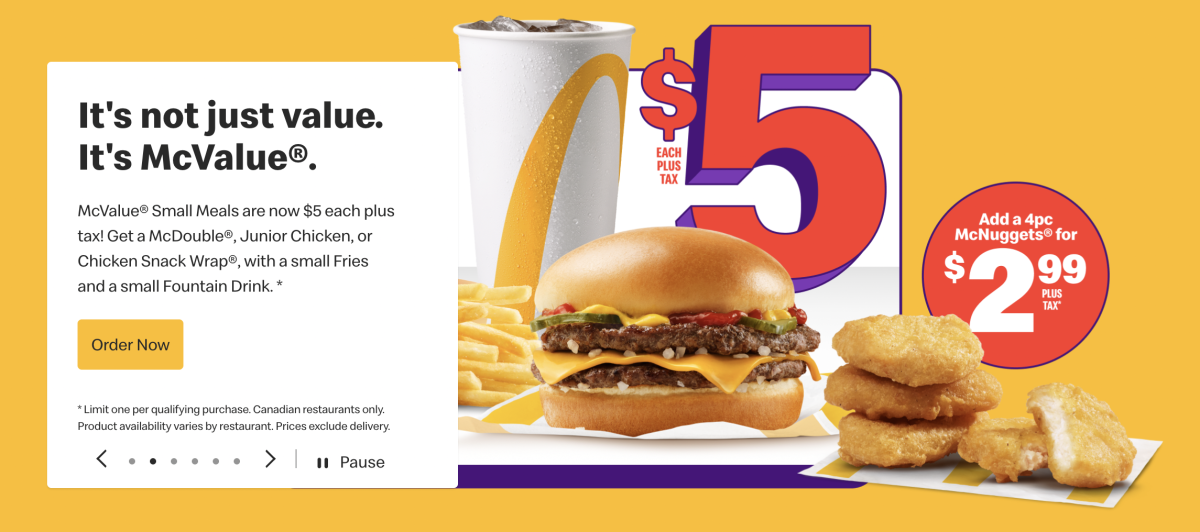
To consumers, the price freeze looks like a win. After months of menu prices creeping well beyond what “fast food” was ever meant to be, McDonald’s is restoring a sense of predictability at the counter. But price wars of this scale do not stop at the drive-thru window. They ripple through the entire food supply chain, all the way back to Canadian farms.
McDonald’s Canada is not just a restaurant chain; it is one of the most powerful agricultural buyers in the country. At the farm gate alone, its annual demand represents roughly $300 to $350 million in Canadian beef, $200 to $250 million in potatoes, $80 to $100 million in dairy, $70 to $90 million in produce, $40 to $50 million in eggs, and $25 to $35 million in wheat. Taken together, that amounts to approximately $720 to $875 million a year in farm-level value. Once processing, packaging, logistics, and distribution are added, McDonald’s injects roughly $1.6 to $1.8 billion annually into the Canadian food economy.
Those numbers explain why this decision matters so much right now. When McDonald’s freezes prices, the pressure does not disappear — it moves. Restaurants absorb margin compression first. Processors are next, pushed into renegotiating contracts, shaving costs, and demanding higher efficiency. Farmers feel it last—but they often feel it hardest. A sustained price war tightens margins upstream at a time when producers are already grappling with higher fuel, fertilizer, labour, and financing costs.
This is also happening against a backdrop of structural contraction in the restaurant sector. According to estimates from the Agri‑Food Analytics Lab, more than 11,000 restaurants in Canada are expected to close over a 24-month period, with closures significantly outpacing openings. Independent operators and mid-sized chains do not have the purchasing power or balance sheets to survive prolonged discounting. When global QSR giants fight on price, smaller players are squeezed out.
The QSR sector is already adjusting. Menus are being simplified, promotional cycles shortened, and technology deployed to cut labour costs and increase throughput. Entry-level items are being protected at all costs, even as premium offerings quietly shrink or disappear. Value, not variety or innovation, has become the dominant competitive weapon.
McDonald’s decision to lock prices for a year should not be misread as a signal that food inflation is over. It is an admission that consumers have reached their limit. When the most powerful restaurant brand in the country decides it must absorb inflation rather than pass it along, it tells us demand is fragile and confidence is thin.
Fast-food price wars are back — but this time, they are being fought in a far more fragile economy. The relief at the counter will be real. The pressure on competitors will be intense. And for processors and farmers, the consequences will be deep and lasting. Because a price war at McDonald’s is never just about burgers. It is a nationwide supply-chain shock that starts at the menu board and ends in the field.






Great job for McD to be a value leader in this regard. Burger King, A&W, Wendy’s, etc. take note. Your chequeing account doesn’t have taste buds! Value is important!
Fuck McDonalds! All of a sudden they can offer cheaper prices because of their “long term relationships with their farmers” BAhahahah – THey haven’t cared the last 5 years when they increased prices over 100% for some products (check hashbrowns) – Haven’t been going and haven’t brought my kids either. Way better value plays at Burger King and Tim Hortons and pizza places.
I love McDonald’s. This is great to save some money. Wahoo.
Best coffee
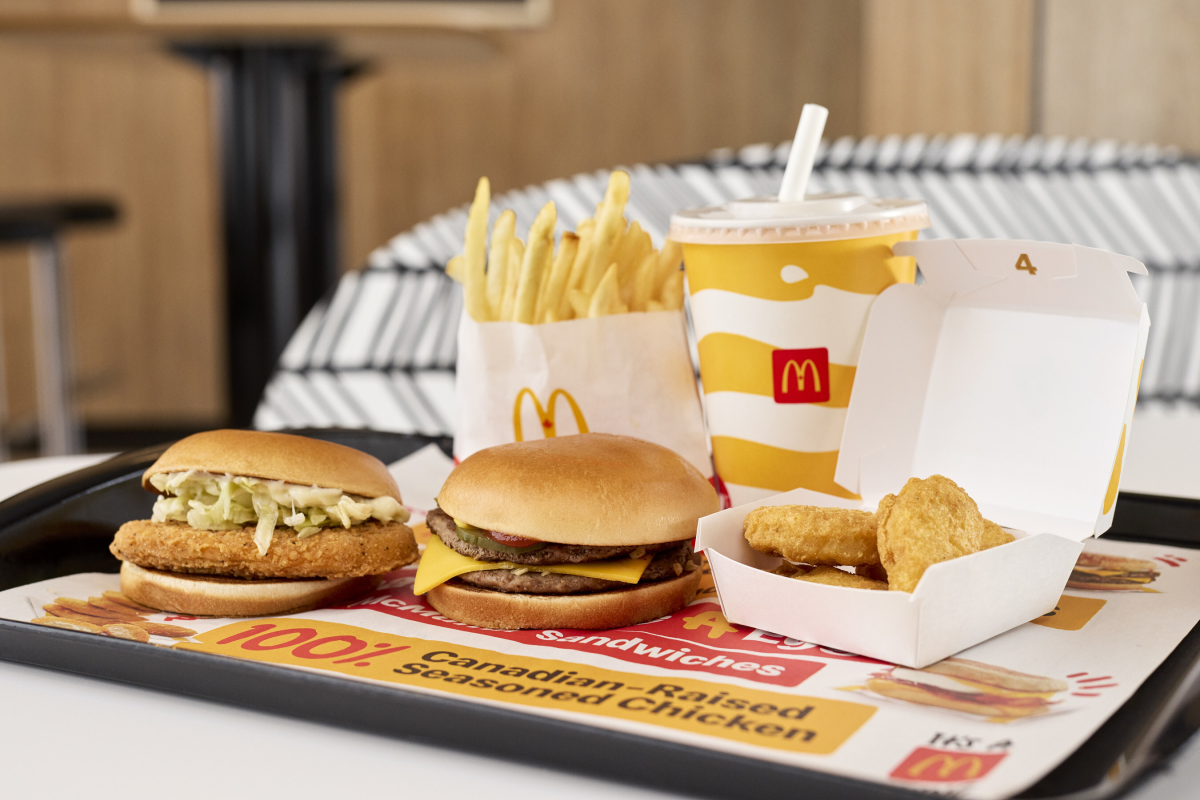
Unfortunately all of the deals are basically for kid sized burgers. Not the more popular items on the menu.