

U.S. President Donald Trump’s latest threat of a 100 per cent tariff for Canadian goods has many businesses in Canada worried about what the future will hold.
“Clearly, the latest tariff threats from the US are an unhelpful development for Canada and Canadian retailers. Any threat to our economy can cause consumers and businesses to pause spending and decisions. But, we need to keep our heads about us and focus on what we can control,” said Dan Kelly, President and CEO of the Canadian Federation of Independent Business.

“As we’ve seen this past week, the US can threaten its trading partners one day and take threats away only a few days later. Canadians, and the world community, are getting used to this approach and it isn’t causing the dramatic economic swings it did in earlier months. CFIB’s business optimism numbers rose in December and January and I believe this shows that we are getting used to the incredible level of uncertainty we are facing on the trade front.
“Obviously, a 100% tariff would be a massive blow to the Canadian economy, but these aggressive announcements seldom materialize. The best thing we can all do as consumers is continue to support Canadian made goods purchased from Canadian retailers.”
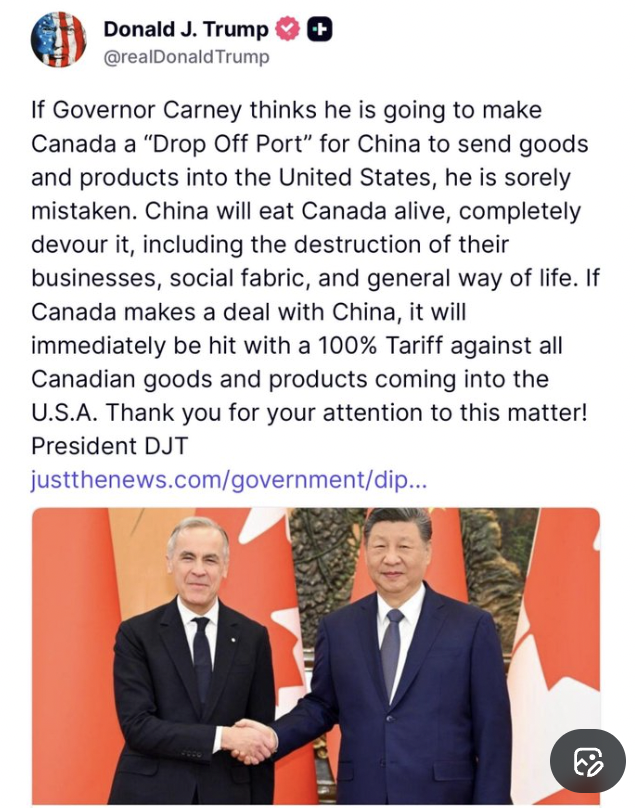
“If the Trump administration imposes 100% tariffs on all Canadian imports into the U.S. for a prolonged period, it would have a major negative impact on this country’s retail industry,” said Bruce Winder, a retail analyst and author.

“Virtually all industries that rely on the US for export would be significantly impacted. Steel, aluminum, automotive & many others. About 2/3 of Canada’s exports currently go to the U.S.
“This would cause sizeable layoffs which would drastically reduce retail spending. This reduction in retail spending would put huge pressure on retailers doing business here and large staff reductions would follow, creating a doom loop further reducing retail spending.
“However, U.S. importers & consumers would face accelerated inflation which would slow their economy & increase unemployment.”
George Minakakis, Founder and CEO of Inception Retail Group, said we should not be surprised by this threat; if anything, he is surprised it took this long.
“There are a number of fundamental issues here that directly affect consumers and businesses across Canada. First, a threat of 100% tariffs sends a clear message: that Canada is not viewed as a sovereign nation free to trade with whomever it chooses. This is not a trade disagreement; this is an attempt to dictate economic alignment through pressure rather than partnership,” he said.
“Second, we should not forget the original motivation behind this rhetoric. It was never simply about trade balance. The underlying objective was to extract economic activity from Canada and relocate jobs, investment, and production to the United States. What began as economic pressure has now metastasized into coercive tactics. Tariffs of this magnitude do not strengthen economies; they distort them. Roughly 75% of Canada’s exports go to the United States, and about 20–25% of Canada’s exports are consumer, and retail-oriented goods, a meaningful portion. Any disruption reduces demand, weakens integrated supply chains, and puts direct pressure on Canadian jobs, particularly in retail, manufacturing, and logistics. Not to forget that 100% tariffs on Canada is more inflation to the US consumer!

“Canada must approach this moment calmly but clearly. Economic resilience requires diversification, competitiveness, and the ability to make decisions in our national interest, without being coerced. Strong partnerships are built on mutual respect, not ultimatums. But let’s not be naïve about this, we cannot continue to trade under these circumstances. Canada’s Prime Minister is correct, the old-world order no longer exists. Retailers will have a challenging time if these tariffs are implemented, as consumers will retreat toward economic survival, and that means that their search for value will accelerate, and discretionary spending will slow.
“Therefore, it is important that provinces and municipalities unite in their resolve to protect Canada. The impacts of these decisions are felt first by communities: through jobs, affordability, and economic stability. Planning for these risks is no longer optional; it is responsible leadership. Canada needs to prepare economically. We are not a 51st state. We have a Prime Minister, not a Governor. Forty-one million Canadians have a voice and the economic power to defend our independence, not with anger, but with choice. Support Canada.”
Gary Newbury, supply chain expert and founder of RetailAID, said: “At this stage, the primary risk is not Canadian imports facing immediate tariffs (unless the Canadian admnstration decided to retaliate to which there is little to suggest they would currently), but Canadian exports to the United States and the knock-on effects that would flow back into the domestic retail economy. A 100 per cent tariff on Canadian goods entering the US would directly hit Canadian manufacturers and processors that rely on the US as their primary end market. Many of these firms operate inside deeply integrated North American supply chains.
“In practical terms, this often means raw materials or semi-finished components produced in Canada are shipped to the US for processing or assembly and then re-imported into Canada as finished goods. A tariff at this level would sharply increase costs and break long established cost, sourcing and processing models. For retailers, exposure would vary significantly based on how products and components are sourced and where value is added.

“Retailers anchored in genuinely Canadian-made products, where most of the cost, labour, and value are created domestically, would be far less exposed. In contrast, products dependent on cross-border processing would carry the bulk of the tariff risk, with cost inflation filtering back through supplier pricing, contract renegotiations, and product availability.
“The immediate economic impact would likely be a rapid pullback in demand. As exporters lose competitiveness and order volumes decline, production would slow quickly. That contraction would spill into employment, with layoffs accelerating the longer such a policy remained in place. Reduced household income and confidence would then feed directly into weaker retail demand across both discretionary and essential categories.
“Finally, this scenario would raise serious questions about the effectiveness of CUSMA. Currently, roughly 80 to 90 percent of goods traded across the Canada US border move tariff free. A move of this magnitude would undermine the stability CUSMA was designed to provide and force retailers and suppliers to reassess long term North American trade assumptions.”
More from Retail Insider:
U.S. Tariffs Threaten Canadian Agri-Food Exports
Tariffs & trade tensions strain Canadian consumer confidence and business outlook: Bank of Canada












We need to stop bending the knee to kiss the Tump ring F*** the mentally unstable orange madman. The US can no longer be trusted our PM is doing the right thing by greatly diversifying our trade partners and definitely including China is a great thing for Canada! We don’t need the USA the USA needs us and at this point screw them! I feel bad for the innocent people in the USA who never voted for this crap. We can handle any short term pain for the long term gain with our new trade partners.
It’s perfectly logical that the Trump administration is trying to reduce American imports of both manufactured goods, agricultural products and raw materials (such as lumber) where foreign imports compete in some way with U.S.-origin products. Remember that he was elected on a platform of reviving industry in the United States and he won twice on the basis of electoral votes from Rust Belt states like Michigan, Ohio and Pennsylvania. Trump was elected by Americans so obviously their jobs and businesses are going to be his priority.
Where the rank hypocrisy comes in is the fact that Trump insists that vehicles sold in the U.S. market should be made in the U.S., not Mexico or Canada, but meanwhile Canada should allow greater access for U.S. producers to its dairy market. Canada apparently shouldn’t be producing cars for the U.S. market which might otherwise be produced in the States, but should be prepared to buy more U.S. dairy products in competition with those made at home. Trump (and, to be fair, several previous presidents) has heavily penalized Canadian lumber exports and claims that Americans should be buying U.S. lumber instead. Yet at the same time Trump and his administration insist that Canadians and Canadian wholesalers should continue to buy U.S.-made liquor and not favour Canadian liquor. Trump’s team complain about a trade “imbalance” between the U.S. and Canada (which is due in overall terms to Canadian exports of petroleum, not manufactured goods) yet they are suspiciously silent about sectors where the U.S. enjoys an overwhelming trade imbalance with Canada (including publishing, entertainment, financial services among others).
It’s this hypocrisy that so infuriates Canadians and it is not new to the Trump administration. In some cases it dates back to the first Bush administration in the early 1990s.
The problem is that Prime Minister Carney is a bureaucrat, not a politician. He does not know how to negotiate, given that he surrendered much of his leverage when agreeing to eliminate most of Canada’s retaliatory tariffs in the interests of making a deal with Trump–only to have the president call off the negotiations on a flimsy pretext and maintain the existing tariffs which are harming both economies.