By Larry Leung, Founder and Experience-in-Chief, Transformidy
Air Canada’s latest investment in passenger comfort offers a useful case study in how a large service company can use everyday customer touchpoints to introduce Canadian brands, demonstrate business capabilities and support future growth.
Beginning in August, the airline will introduce new comfort products across its cabins on international flights. Economy and Premium Economy passengers will receive six-foot polar-fleece blankets, while Air Canada Signature Class customers will see upgraded duvets and pillows.
Air Canada has also partnered with Sahajan, the Canadian skincare company founded by Lisa Mattam, to include Lip Karma balm and The Hand Remedy cream in its amenity kits. Sahajan combines Ayurvedic traditions with modern clinical science, giving the program a Canadian wellness story that fits the realities of long-distance travel.
Cabin humidity can fall to between 10 and 20 per cent, making dry skin a common concern for passengers. The products therefore serve a practical purpose during the flight while introducing travellers to the Sahajan brand.
Hunter Amenities, a Burlington, Ontario-based hospitality products company, developed, manufactured and sourced the kits. It also manufactures the two Sahajan products for the program at its Burlington facility. Founded in 1981, Hunter works with hospitality, travel and retail partners in more than 120 countries.
Each participant brings a distinct capability to the partnership. Sahajan contributes its wellness expertise, product story and founder-led identity. Hunter provides formulation, manufacturing, sourcing, packaging and the ability to deliver at airline scale. Air Canada gives passengers an environment in which they can experience the products during a relevant moment in their journey.
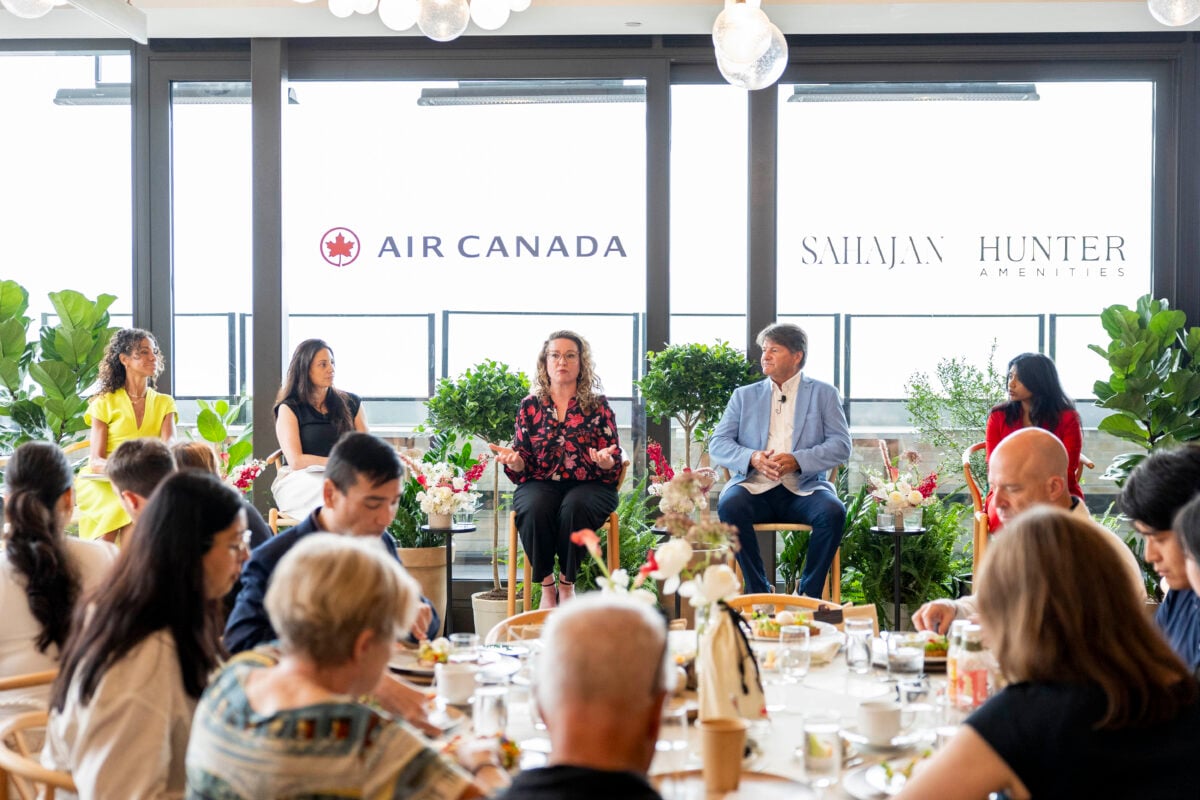
At the unveiling event at Park Hyatt Toronto, I spoke with members of Air Canada’s product team, Hunter Amenities CEO Dave Lemmon and Sahajan founder and CEO Lisa Mattam. The conversations explored the path from initial concept to final execution, along with the time, coordination and operational discipline required to launch the program across Air Canada’s international network.
What passengers see as a compact assortment of comfort products is the result of a much larger undertaking. Every item requires development, testing, manufacturing, sourcing, packaging and alignment among the participating brands. The products must also be delivered consistently across a complex airline operation.
The value of the partnership extends beyond what passengers find inside the amenity kit.
For Air Canada, the products provide a tangible expression of its customer-experience strategy. Sahajan gains exposure in a setting where its wellness proposition is particularly relevant. Hunter demonstrates its ability to convert a brand collaboration into a program capable of operating across an international airline network.
Exposure, however, does not automatically produce lasting commercial value.
Passengers may use and enjoy the products without remembering the companies behind them or understanding the expertise required to create the program. The business challenge is to build appropriate connections between the onboard experience and the wider stories of Sahajan and Hunter while preserving the exclusivity of Air Canada’s offering.
For Sahajan, the partnership introduces its products and Canadian wellness positioning to an international audience. That visibility could strengthen recognition of its wider portfolio, deepen its association with travel wellness and create opportunities in related retail, hospitality and service settings.
Hunter’s opportunity is less visible to passengers but equally important. An amenity kit does not reveal the complexity of the operation behind it. The program nevertheless demonstrates Hunter’s ability to coordinate product development, manufacturing, sourcing, packaging, sustainability considerations and brand collaboration at scale.
That record of execution may support future conversations with prospective partners across aviation, hospitality and other experience-focused industries.
The next stage of partnership value does not depend on placing airline-exclusive products on store shelves. The larger opportunity is to identify which capabilities, customer needs and brand stories can support credible future experiences or collaborations.
Air Canada, Sahajan and Hunter Amenities bring together customer reach, wellness expertise, manufacturing knowledge and operational scale. Those complementary strengths could support other relevant offerings or experiences for Canadian consumers.
The partnership also provides a useful lesson for retailers, suppliers and brand leaders. Strong collaborations can fulfil an immediate business need while giving each participant a chance to demonstrate its capabilities, deepen customer relationships and explore new sources of value.
Air Canada’s new amenities may begin with a better night’s rest in the sky. Their longer-term value will depend on how effectively the companies involved build on the experience once passengers return to the ground.