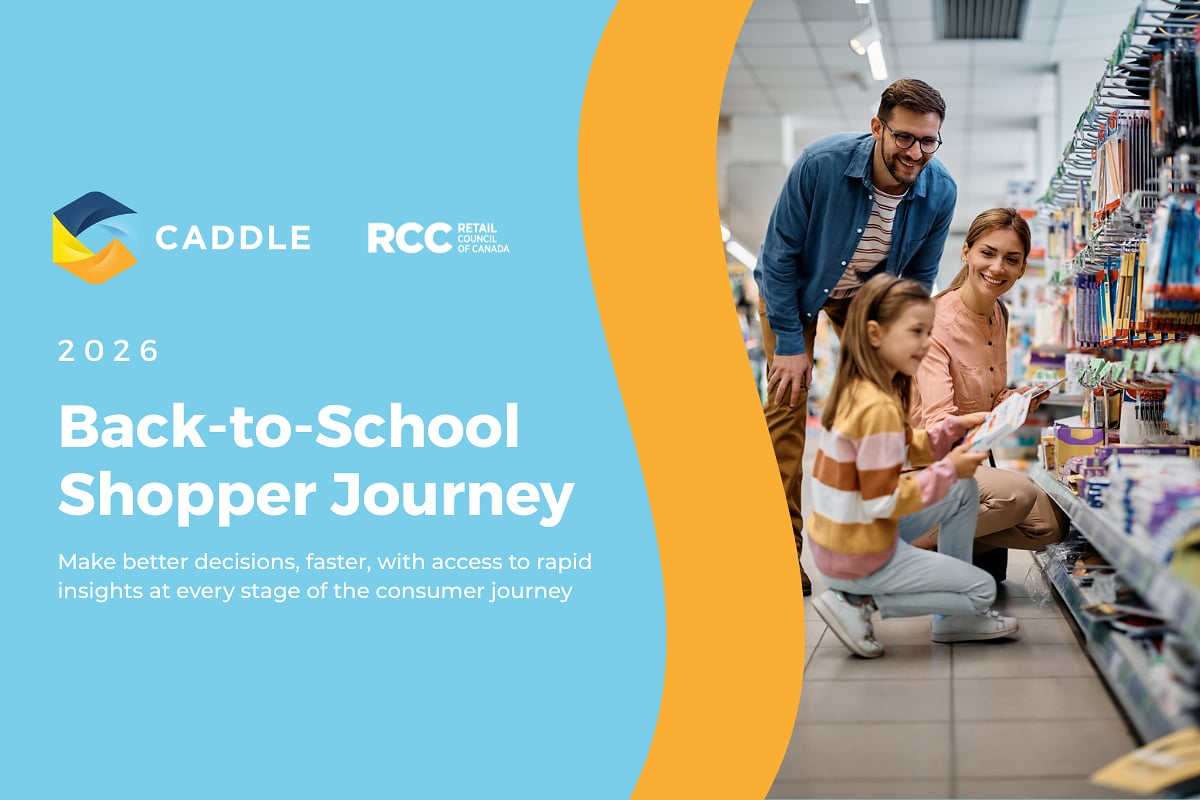
Retail Council of Canada (RCC) and Caddle released on Monday their annual consumer research on Back-to-School shopping behaviour in Canada, indicating it has become a $4.5 billion market in the country, driven by about six million K-12 students.
Average household spending ranges from $600 to $750 per child when electronics are included, making it one of the most significant retail events of the year.
Key findings from the Report include:
In-Store Shopping Remains the Dominant Channel
- Ninety-nine percent of Canadian parents plan to shop in-store for Back-to-School essentials this year. Core categories – including school supplies, clothing, snacks, and hygiene products – remain overwhelmingly brick-and-mortar purchases, despite continued growth in online research and digital discovery.
Price Is the Primary Driver of Retailer Choice
- Price remains the number one driver of where parents make their first purchase of the season with 85% of parents actively seeking deals when selecting where to shop for Back-to-School.
Most Families Begin Planning in Late Spring or Early Summer
- Sixty-one percent of parents have already started Back-to-School planning or intend to begin soon. Planning timelines vary significantly by the age of the child: parents of younger children tend to begin earlier, while parents of high school students are significantly more likely to shop without advance planning.
Most Parents Expect Multiple Shopping Trips
- While most parents express confidence in their ability to complete Back-to-School shopping efficiently, only 19% expect to finish in a single trip. The majority anticipate two to three separate visits, driven by product availability, ongoing price comparisons, and school supply lists that evolve as the season progresses.
Brand Preferences Shift as Children Age
- Private label products are most popular among parents of younger children. National brands gain influence as children age and develop stronger brand preferences of their own. A significant share of parents across all age groups remain open to switching between national brands and store labels when price and quality align.
New to this year’s research: 44% of parents are already using or are very interested in AI-powered shopping tools to help build lists, compare prices, or identify where to shop.

In an interview with Retail Insider, Santo Ligotti, Vice President, Head of Marketing and Member Services with the Council, discussed the report’s findings.
Question: The headline finding is that 99% of parents still plan to shop in-store. What does that say about the current role of physical retail, and were you surprised that e-commerce hasn’t captured more of the actual purchases?
Answer: The finding reinforces that physical retail remains central to back-to-school shopping, particularly for everyday categories such as school supplies, clothing, snacks, backpacks and personal care products. Parents often want to see items, assess quality, confirm sizing and involve their children in the decision.
That does not mean e-commerce is unimportant. In fact, 83% of parents also expect to buy something online, up four percentage points from last year. What we are seeing is a blended journey: parents research prices, products and reviews online, but still complete many purchases in-store.
So, no, the strength of in-store shopping is not especially surprising. Back-to-school is a practical, time-sensitive and often family-driven occasion. The opportunity for retailers is to make the transition from digital research to the physical store as easy as possible, with accurate inventory information, clear promotions and a consistent experience across channels.
Q: Price remains the dominant factor, with 85% of parents actively seeking deals. How are retailers changing their promotional strategies this year to compete for budget-conscious families without sacrificing margins?
A: Retailers know families are under considerable pressure. Ninety-one percent of parents believe back-to-school shopping has become more expensive, and 85% say they always or often look for promotions.
The response is not necessarily to discount everything. Retailers are becoming more targeted about where and when they offer value. That can include early-season promotions, bundles, loyalty offers, private-label alternatives and sharper pricing on the items that matter most to families.
We are also seeing more emphasis on communicating overall value, not just the lowest individual price. Selection, convenience and the ability to complete more of the shopping in one place are also important considerations for parents. Retailers that combine competitive prices with availability and convenience are in the strongest position to protect both customer loyalty and margins.
Q: Your research shows parents expect to make multiple shopping trips. Is this mainly driven by staggered school supply lists and inventory availability, or are consumers intentionally spreading purchases out to chase better prices?
A: It appears to be a combination of all three. Only 19% of parents expect to finish their shopping in one trip, while 62% expect to make two or three trips. The research points to stock availability, price comparisons and changing or evolving school lists as the main reasons.
There is also a timing factor. Families with younger children tend to start earlier, while parents of middle- and high-school students are more likely to concentrate their shopping later in August.
Consumers are being more deliberate. They may buy the obvious essentials early, wait for a school list, involve their children in later purchases or hold off for a better promotion. For retailers, that means the season should not be treated as one promotional event. There are several opportunities to bring the customer back through reminders, replenishment messages, updated offers and dependable inventory.
Q: The report highlights growing interest in AI shopping tools, with 44% of parents already using or interested in them. How do you expect AI to change the back-to-school shopping journey over the next few years, and what should retailers be doing now to prepare?
A: AI has the potential to reduce much of the work and stress involved in back-to-school planning. A parent could provide a school list, budget, child’s age and preferred stores, and receive a recommended shopping list, product comparisons, current prices and information about where items are available.
The interest is already meaningful. Approximately 23% of parents say they use something like this today, and another 21% say they would be very interested. A further 17% would consider using it if it clearly saved time or money.
Retailers should begin by getting the fundamentals right. Their product information, pricing, inventory and store-location data need to be accurate and easy for digital tools to interpret. They should also explore practical applications such as list builders, product comparison tools and personalized recommendations. The winning use of AI will not be technology for its own sake. It will be helping a busy parent make a faster, more confident and more affordable decision.
Q: Looking beyond this year’s season, what is the single most important trend in the data that Canadian retailers may be overlooking, and why does it matter?
A: The most important trend may be how fragile customer loyalty has become when convenience or availability breaks down. When a key product is out of stock, 35% of parents will go to another retailer, 30% will switch brands and 23% will order online.
That matters because retailers often focus heavily on attracting the shopper through price and promotion, but the sale can still be lost at the final stage if the product is unavailable or difficult to find.
The broader lesson is that value now includes more than price. It includes confidence that the item will be in stock, that the information online is accurate, that the store experience is easy and that the customer will not need to start again somewhere else. In a market where families are willing to switch stores and brands, execution is becoming as important as promotion.
More from Retail Insider: