A thief who broke into All Elite Cards and Games in Nanaimo, B.C., in the early hours of September 17 was inside for less than two minutes, taking more than $5,000 worth of sealed Pokémon products. Owner Allan Mah said the individual first looked for cards in display cases before turning to sealed merchandise, with the person’s familiarity with the store leading him to believe they may have visited previously.
The Nanaimo break-in joins a series of incidents involving Pokémon cards and other trading-card products across Canada. Retailers in British Columbia, Alberta, Manitoba and Ontario have reported losses ranging from several thousand dollars to well into six figures, while police have investigated clusters of break-ins involving collectible-card businesses.
Retailers are responding with measures that include moving cards into bank safety-deposit boxes, removing inventory overnight, displaying empty product boxes, adding gates and cameras, and arranging some transactions away from their stores. For independent operators, the rising value of collectible cards is creating security, insurance and real estate considerations that were not traditionally associated with hobby retail.
Pokémon Becomes High-Value Retail Inventory
Pokémon cards are part of a large collecting and resale market encompassing specialty stores, online marketplaces, card shows, private dealers, livestream sellers and grading companies. Individual cards can sell for hundreds or thousands of dollars, while sealed boxes and discontinued products can also command substantial prices.
The Pokémon Company said in May that some Pokémon Trading Card Game products were difficult to obtain because of “very high demand.” It said affected products were being printed at maximum capacity, with additional reprints planned. The trading card game is also marking its 30th anniversary in 2026.
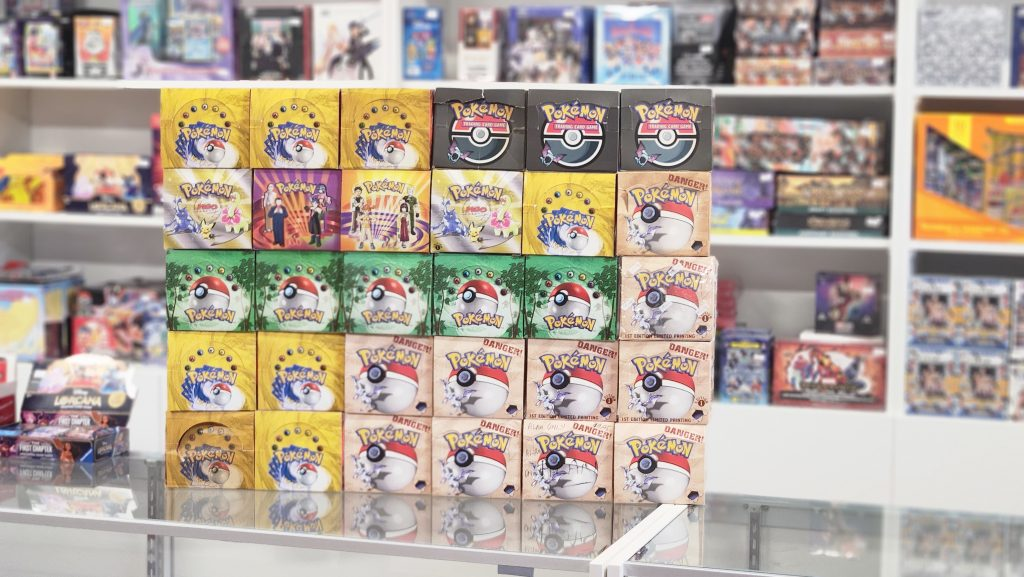
For retailers, the category can concentrate substantial inventory value into a small amount of physical space. Tens of thousands of dollars in cards can fit inside a bag, while sealed Pokémon products are recognizable and supported by an active resale market.
Professionally graded cards generally carry certification numbers and particularly rare cards may be identifiable. Sealed products and many ungraded cards can be harder to trace once they return to the resale market. Independent hobby stores can therefore find themselves carrying significant inventory values from premises that were not designed around the security requirements of traditional luxury retail.
B.C. Retailers Confront Repeated Break-Ins
House of Cards in Abbotsford was broken into in March after thieves reportedly used a vehicle and chain to pull away a security grate. The suspects spent approximately two minutes inside and left with an estimated $30,000 in Pokémon products. Owner Brandon Chreptyk told CityNews that the thieves concentrated on sealed booster boxes and bundles that could be resold quickly, while the store had already moved its most expensive products into bank safety-deposit boxes.
Other Lower Mainland card businesses were also targeted. Everything J&J in New Westminster was hit in January by four masked individuals who smashed display cases, while Captured! Cards in Burnaby experienced three attempted or successful break-ins between December and March.
Captured! Cards owner Leon Chan told CityNews that he had begun removing much of his expensive inventory overnight. He also said strata restrictions prevented him from installing bars over the store’s windows, with repeated theft and damage prompting him to consider relocating.
Vancouver Police reported another incident on August 3, when two masked suspects allegedly pried open the rear door of Royal Card Shop and Collectibles and used a stolen Ford pickup truck to pull a safe containing high-value Pokémon cards from the business.
Alberta Stores See Clusters of Incidents
Edmonton has also experienced repeated break-ins involving collectible retailers. By November 2025, police were investigating 11 incidents involving gaming and collectible-card stores dating back to September, with Cerberus Gaming, Red Claw Gaming and Teaspot and ENV Collectibles among the businesses affected.
ENV Collectibles was targeted again on Canada Day this year, when Pokémon and One Piece cards were reported stolen. Edmonton police said at the time that nine break-ins involving collectible, hobby and card stores had already been reported during 2026.
Calgary Police have separately laid charges following a series of 2025 thefts at collectibles stores. More than $72,000 in trading cards was stolen from Eastridge Sports and Games in one incident, while more than $10,600 was taken from First Player Card Shop in another. Police said power tools and pry bars were used to enter businesses and stolen vehicles were used to travel to and from stores.
Ontario Investigation Expands Beyond Card Stores
The Greater Toronto Area has seen a similar series of incidents. Sunny Hobbies in Scarborough reported approximately $36,000 in merchandise stolen during an April break-in that surveillance footage showed unfolding in 46 seconds. Owner Sunny Huang subsequently told CityNews that he sold part of his personal collection to maintain cash flow while dealing with the loss, insurance and security upgrades.
Other incidents around the same period included high-value Pokémon cards taken from a Brampton convenience store and Pokémon merchandise stolen from a collectibles business in Mississauga.
Two June break-ins in Ajax subsequently became the starting point for a much larger Durham Regional Police investigation. Trading-card retailers Mintink and We Got Gamez were targeted on June 14, with Durham police putting the combined value of stolen merchandise at approximately $148,000.
The incidents led to Project Magenta, an investigation into a broader series of property crimes. Police allege the group was responsible for 36 incidents across Durham Region and Toronto between June and September, including eight commercial break-and-enters and 15 vehicle-theft-related offences.
Trading-card retailers, jewellery stores, cannabis dispensaries and pawn shops were among the businesses targeted. Police said stolen vehicles were frequently used to facilitate the offences, including incidents where vehicles were driven into storefronts. Two adult men and two male youths face more than 200 charges, with known losses and damage across the investigation estimated at nearly $1 million. The allegations have not been proven in court.
The inclusion of trading-card businesses alongside jewellery stores is notable from a retail security perspective. Both categories can concentrate substantial resale value into merchandise that can be removed quickly, although the physical stores and traditional security models associated with the two sectors are considerably different.
Winnipeg Retailers Hit in September
September brought two significant incidents in Winnipeg. Thieves entered Terri’s Trinkets and Toys after getting through a security grate and breaking through a wall, with Pokémon cards and other merchandise taken. The store had already experienced another Pokémon theft weeks earlier, and owner Terri Settle subsequently told The Canadian Press that she plans to stop selling the cards once her remaining inventory is gone.
Days later, Mulvey Market owner Kenan Hyseni reported roughly $70,000 worth of Pokémon products stolen following a Friday night trading event. Hyseni believes someone remained hidden inside the market after closing before leaving with sealed products, individual cards and professionally graded cards.
The incidents add to the operational questions facing specialty retailers carrying increasingly expensive inventory, including how much merchandise should remain on display and whether the highest-value products should remain on the premises outside business hours.
Valuable Inventory Moves Out of Sight
Some Canadian card retailers have already changed how they operate. First Row Collectibles owner Curtis Howson told the Winnipeg Free Press that his store has been broken into multiple times and that he does not like leaving expensive Pokémon cards on the premises overnight.
In Richmond, B.C., Team Collectors added security gates and expanded its surveillance system to 10 cameras. Particularly expensive cards could be handled by appointment, with transactions potentially taking place at a bank or police station. House of Cards had already moved its most expensive merchandise into bank safety-deposit boxes.
Cloud Games in York Region has taken a different approach. Manager Randy Ngo told CityNews that most of the company’s sales are conducted online, while its small retail office operates without exterior signage. An order for a sign was cancelled amid concerns about card-store robberies, while display shelves contain empty boxes and products are stored off-site before being transported to the location for arranged pickups.
These measures run against some conventional retail practices, where signage, product displays and readily available inventory are used to attract customers and encourage browsing. For some card retailers, limiting the amount of merchandise visible or stored on-site has become part of loss prevention.
Security Becomes a Real Estate Issue
Security requirements can also extend into the retailer-landlord relationship. Captured! Cards owner Leon Chan told CityNews that restrictions at his Burnaby property prevented him from installing window bars, and he was considering relocation following repeated incidents.
Cameras, alarms and safes can generally be installed within a retail unit, while measures such as gates, bars, bollards and reinforced entrances can involve landlords, strata corporations, building design and municipal requirements. Card stores occupying conventional retail premises may therefore face limitations on the physical security measures available to them.
Insurance Adds Another Pressure
Collectibles present their own insurance considerations because inventory can turn quickly and market prices can change. Condition and professional grading affect the price of individual cards, while sealed products can appreciate after their original release.
First Row Collectibles owner Curtis Howson told the Winnipeg Free Press that contents insurance was prohibitively expensive for his business and pointed to the difficulty of maintaining an accurate inventory. Hyseni also said following the Mulvey Market theft that he did not have collectibles insurance, citing the cost.
Those examples do not establish insurance conditions across the Canadian collectibles industry, but they indicate that coverage can become another significant operating expense for independent businesses carrying expensive stock.
Risk Extends Into Private Sales
Security concerns extend into the private resale market. Vancouver Police responded to five Pokémon-card robberies beginning March 23 after sellers arranged transactions, usually through Facebook Marketplace. Police allege a buyer would meet sellers, use bear spray and take the cards, with investigators subsequently arranging their own Pokémon transaction before arresting a suspect.
Later in April, Vancouver Police arrested three teenagers following another incident in which a seller offering two Pokémon cards valued at $7,000 each was allegedly bear-sprayed. One of the cards was recovered.
Laval police reported in June that they had recorded 30 incidents linked to Pokémon-card sales since January 2025, including 11 since March 2026. At least seven involved violence, including the use of pepper spray.
The private-sale incidents are distinct from commercial break-ins but highlight another security consideration within a category where substantial amounts of money can be involved in transactions conducted outside conventional retail environments.
Large Losses for Independent Retailers
Many specialty card stores do not have the scale to absorb significant theft as routine shrink. After Sunny Hobbies lost approximately $36,000 in merchandise, Huang told CityNews that margins at the business fall into the single digits after rent, utilities, staffing, inventory systems and insurance. He sold part of his own collection to help maintain cash flow.
Merchandise losses can also be accompanied by property damage, business interruption and additional security expenses. Edmonton retailer David Bibby described the financial impact to CityNews after approximately $8,000 in Pokémon and Magic products were stolen from Red Claw Gaming.
“I’m not Walmart; all of this is coming out of my pocket,” he said.
For an independent retailer, a five-figure inventory loss can represent months of profit before repairs and security upgrades are considered.
When a Card Store Starts Looking Like a Jewellery Store
Jewellery retailers have long designed stores around merchandise that concentrates substantial value into a small space, with safes, reinforced showcases, security glazing and overnight inventory procedures common across the sector. Traditional hobby stores developed under different circumstances, while the economics of trading cards have changed considerably in recent years.
Project Magenta offers a direct comparison. Durham police allege the same group targeted trading-card businesses alongside jewellery stores and other retailers carrying expensive, readily resalable merchandise.
Card retailers are adopting some similar precautions, including safes and safety-deposit boxes, removing expensive cards from display cases overnight, using empty packaging on shelves, adding gates and cameras, and moving some transactions to more secure locations.
There is a trade-off for retailers. Trading-card businesses often serve as gathering places where customers browse, trade, open packs, play games and meet other collectors, with physical merchandise and accessibility forming part of the store experience.
Strong demand for Pokémon has created opportunities for specialty retailers across Canada, while the value concentrated in the category has introduced operating risks that many traditional hobby stores were not designed to manage. Security, insurance, inventory storage and even the suitability of the retail space are increasingly part of that calculation.