Canadian grocers are investing billions into e-commerce, AI-powered personalization, and retail media networks, yet physical stores still outperform digital platforms at one of retail’s most profitable behaviours: impulse discovery.
The contrast highlights a growing challenge within Canadian grocery retail. While online grocery shopping has become increasingly efficient at helping consumers replenish routine household purchases, digital platforms still struggle to recreate the spontaneous experimentation and exploratory shopping behaviour that naturally occurs inside physical stores.
That distinction matters because discovery is not simply a consumer experience issue. It is deeply connected to basket growth, supplier economics, retail media monetization, and profitability across the grocery industry.
Research from Leger found that 47% of Canadians made an unplanned purchase of a new food or beverage product while shopping in-store during the previous three months. By comparison, only 30% reported making similar spontaneous purchases online.
The findings suggest grocery e-commerce may have solved convenience, but it has not yet solved serendipity.
Digital Grocery Was Built for Replenishment
Online grocery platforms are exceptionally effective at helping consumers buy products they already know they want.
Search tools, saved shopping lists, predictive recommendations, digital coupons, and one-click reordering systems have streamlined the replenishment process for millions of Canadians. Consumers can quickly restock staples, compare pricing, and complete transactions without navigating stores or spending additional time shopping.
That efficiency has become especially attractive as inflation continues reshaping household spending behaviour.
Canada’s Food Price Report 2026 estimates that a family of four will spend $17,571.79 on food this year, nearly $1,000 more than in 2025. Rising food costs are making many consumers more list-oriented, price-conscious, and deliberate when shopping online.
The dominance of click-and-collect within Canadian grocery e-commerce reinforces that practical mindset. Roughly 46% of online grocery orders now occur through click-and-collect models, largely because consumers want convenience while avoiding delivery fees.
However, the efficiencies that make digital grocery attractive may also limit exploratory purchasing behaviour.
Online grocery interfaces are heavily optimized around speed, familiarity, and predictability. Consumers often search for products directly, reorder from previous purchases, or navigate highly personalized recommendation systems that reinforce established shopping patterns.
The result is an environment optimized for efficiency, but not necessarily experimentation.
Why Physical Stores Still Trigger Impulse Purchases
Physical grocery stores operate according to a fundamentally different shopping dynamic.
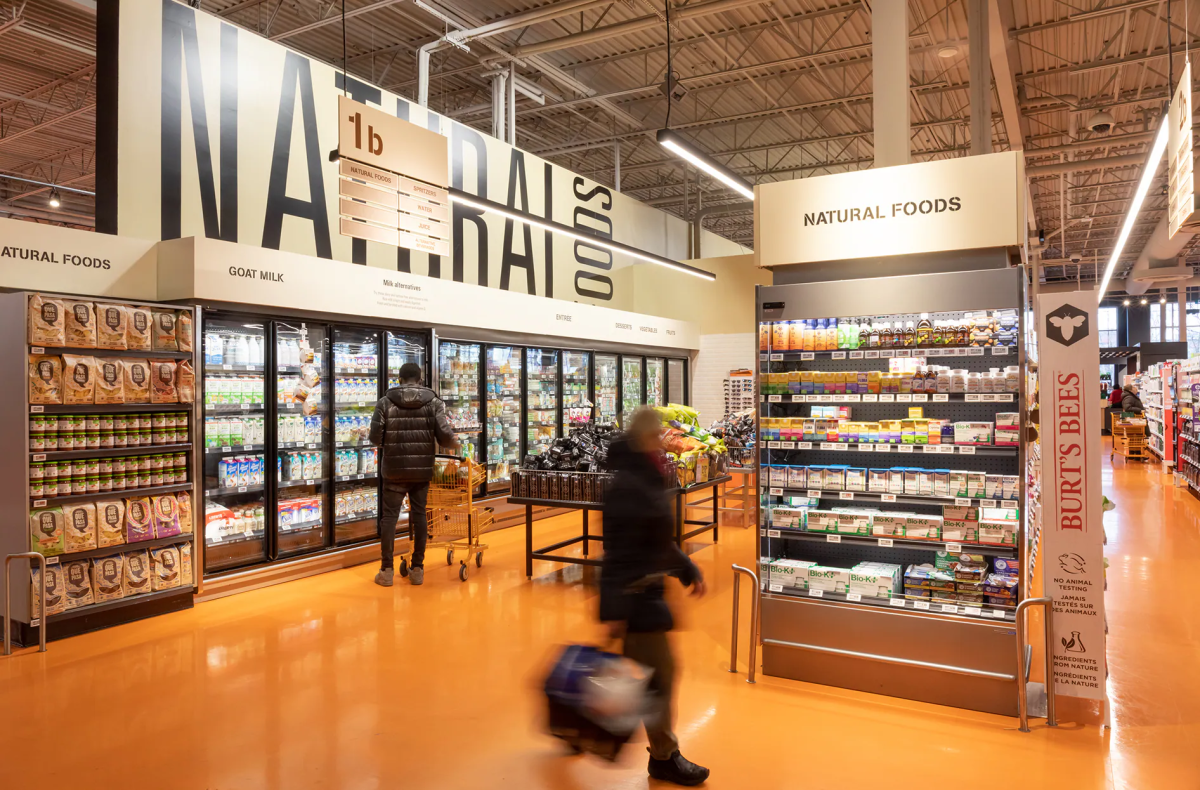
Many shoppers enter stores with incomplete lists or only loosely defined purchasing intentions. As they move through aisles, they encounter endcaps, promotional displays, prepared foods, seasonal merchandising, packaging variations, digital signage, and sampling stations that can alter purchasing decisions in real time.
Those visual and sensory interruptions matter.
A shopper entering a grocery store intending to buy bread and milk may leave with a new beverage, snack product, prepared meal, dessert, or seasonal item that was never part of the original plan. Consumers browsing after work, shopping while hungry, or waiting near checkout areas often encounter products that trigger spontaneous decision-making through convenience, curiosity, pricing, or simple visual appeal.
Leger’s findings reinforce how powerful those physical interactions remain. According to the report, 32% of Canadians discover food and beverage products through in-store shelves and signage, slightly ahead of Facebook at 31% and television at 30%.
Sampling also remains one of the strongest trial drivers. Nearly half of respondents said tasting opportunities influence whether they try new products.
That kind of exploratory shopping behaviour remains difficult to engineer digitally.
The More Efficient Algorithms Become, the Less Consumers Explore
One of the more complex challenges facing grocery e-commerce may be that modern digital retail systems are increasingly designed to reduce friction rather than encourage browsing.
Recommendation engines, personalization systems, and predictive algorithms are typically optimized around relevance and purchasing efficiency. The more efficiently digital grocery platforms learn consumer habits, the more they risk narrowing exposure to unfamiliar products.
In many cases, personalization systems are designed to eliminate friction, but friction itself is often what drives discovery inside physical stores.
Consumers moving through stores are continuously exposed to unrelated products through peripheral vision, promotional placement, seasonal displays, or simple wandering behaviour. Exploration frequently occurs accidentally rather than intentionally.
That distinction may help explain why impulse purchasing continues outperforming online discovery.
The challenge also carries significant financial implications for retailers and consumer packaged goods companies. Impulse purchases and new-product trial frequently contribute disproportionately to higher-margin discretionary spending and supplier marketing economics.
Discovery itself has become monetizable.
Brands increasingly compete for visibility across shelves, digital screens, sponsored search placements, retailer apps, and in-store promotional environments designed to capture consumer attention during active shopping moments. As retail media expands, product visibility is becoming an increasingly valuable form of commercial real estate within grocery ecosystems.
Grocers Are Increasingly Competing for Attention
The growing importance of discovery helps explain why Canadian grocers are investing aggressively in retail media and attention-based merchandising systems.
Retail media now accounts for roughly 20% of all digital advertising spending in Canada, with expenditures rising nearly 20% year-over-year as brands seek more measurable, conversion-oriented advertising environments.
Major grocery operators are rapidly expanding those capabilities.
Loblaw Companies Limited is investing approximately $2.4 billion in 2026 while expanding automation infrastructure and store development. Walmart Canada continues deploying AI-powered personalization tools and digital in-store media networks, while Empire Company Limited is building more sophisticated first-party data and off-site advertising capabilities tied to its grocery platforms.
Those investments reflect a broader strategic shift within grocery retail. Stores are no longer functioning solely as fulfillment environments. They are increasingly becoming monetized attention ecosystems where retailers, brands, and advertisers compete to influence purchasing behaviour during active shopping moments.
Can AI Recreate Serendipity?
The next major question for grocery e-commerce may be whether artificial intelligence can successfully replicate the spontaneity of physical retail.
Retailers are increasingly experimenting with conversational shopping assistants, AI-generated recommendations, personalized promotions, recipe-linked commerce, and predictive merchandising systems designed to expose consumers to products they may not have actively searched for.
The objective extends beyond convenience.
The industry is attempting to recreate digital versions of browsing behaviour, impulse engagement, and exploratory shopping that physical stores generate naturally.
Yet there may be limits to how effectively algorithms can replicate human curiosity. Recommendation systems are typically designed to predict what consumers are most likely to purchase, not necessarily what might surprise them. The more optimized digital commerce becomes around efficiency and personalization, the greater the risk that consumers remain confined within highly familiar purchasing patterns.
At the same time, younger consumers are already demonstrating more fluid omnichannel shopping habits. Leger found that Gen Z and Millennial consumers are more likely to discover products through Instagram and TikTok than older demographics.
Yet even among digitally engaged consumers, trust remains tied more closely to practical and interpersonal influences such as family recommendations, promotions, flyers, and in-store experiences.
That tension may ultimately define the next phase of grocery retail evolution.
Digital grocery continues excelling at convenience, replenishment, and transactional efficiency. Physical stores, meanwhile, still maintain major advantages in sensory engagement, spontaneous purchasing, product trial, and impulse conversion.
The retailers that ultimately succeed may be the ones that most effectively combine the efficiency of digital commerce with the spontaneity, trust, and sensory engagement that still make physical grocery shopping uniquely influential.