Visiting an Amazon 4-Star Store – Herd Mentality or Shopping Made Easy?

Date:

Share post:

I was in New York over the holidays and visited the Amazon 4-Star store in SoHo. Overall, the store was functional but not incredibly exciting from my perspective. The visit also led me to contemplate the limitations of such a concept and to challenge the very meaning of it in society. A little deep for December. Either way, I think the store meets it’s perceived objective: to add value for Amazon customers. The store was packed for at least three reasons in my opinion. Firstly, because it was late December and virtually all popular New York stores were packed. Secondly, because it is relatively new (September 2018 opening) so folks are curious and the Amazon brand is very hip. Thirdly, the store adds value to customers as an extension to Amazon’s tried and true website.

For those of you who are unfamiliar with the concept, let me explain it a little. Amazon has taken select products from it’s US website that have four star and above (five star maximum) aggregate ratings along with new and trending items and top sellers and merchandised them all in one 4,000 square foot physical location.

The store is cashless (a new trend within select retail) and is NOT set up the same as Amazon Go locations that eliminate payment lines. Customers can pay with credit card, debit or the Amazon app.

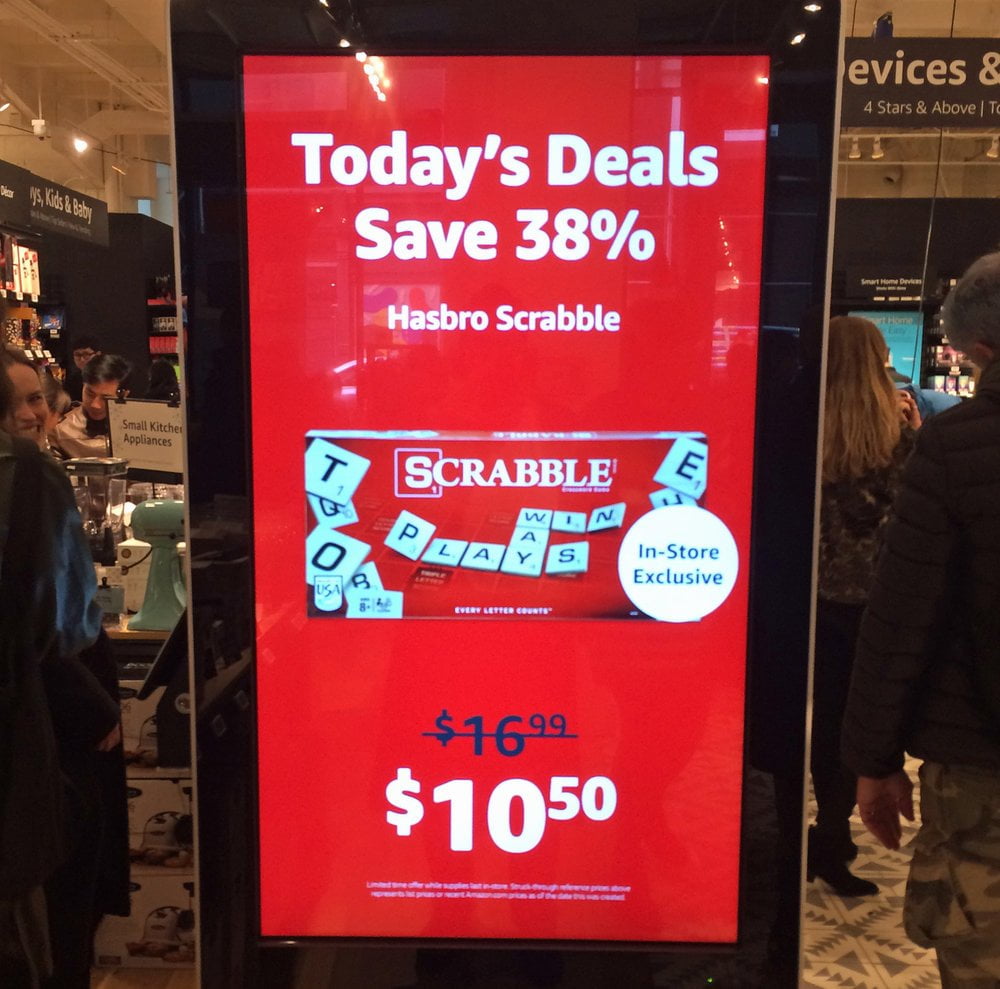
Each item is electronically signed and shows individual aggregate customer rating details along with the Amazon Prime member price and the non-member price. Electronic signage shows daily featured items.
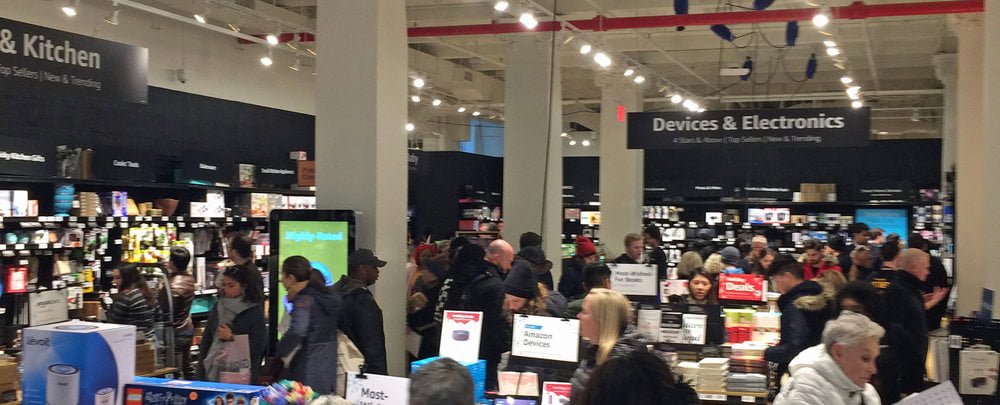
Overall, I liked the store for it’s simplicity and use of analytics to offer assortments based on what the masses prefer. I wouldn’t say that the store was exciting or offered a unique experience to customers. In fact, I found it a little boring. Having said that, I am not Amazon’s target market for this store. I don’t buy much online, except to learn from a retail perspective. I am also a bit of a minimalist (ironic, I know) and a non conformist (look at my hair).

I also liked how the store uses physical cross merchandising, highlighting products that are traditionally bought together as in the case with the smart home section that showcases all products that work with Alexa in one section. It’s much easier to tell a category story in store than online.

I also like how Amazon highlights specific New York favorites which hints at localization. I think there is an opportunity to do more of this to better address regional variances in customer preference where they arise.

The store succeeds as it reinforces Amazon’s (and society’s) use of collective ratings and reviews to assist one in making a purchase decision. That is, many of us feel more comfortable buying something that other customers have told us is great. Great may refer to quality, functionality or performance among other things. It is important to note that rating systems and specifically Amazon’s rating system has come under scrutiny of late for it’s potential inaccuracy and lack of authenticity. See the link to the article from the Wall Street Journal that talks to this. The store succeeds by adding a physical dimension to eliminate one of the remaining barriers to online shopping: not being able to touch and feel the product. Amazon’s rating system has been used as a proxy for this part of the traditional customer purchase decision making process. When customers shop online they can not touch and feel the product so they rely on others to do so for them and verify their experience with ratings and reviews. These ratings are of course aggregated and averaged.
One can contrast the role of Amazon’s 4-Star store with the trend in retail toward customized, unique and individually marketed products. If customers demand that more products are designed uniquely for them or by them, how does Amazon’s 4-Star’s aggregation and averaging of a given countries’ consumer needs fit in? If I buy a product from this store, I can feel comfortable that millions of other Americans have bought the same item and that it met their needs exceptionally well on average. There is strength in numbers. However, if I wish to express myself and stand out from the crowd with a new shirt or if my tastes vary from the average than perhaps products from this store miss the mark to some degree. Does this mean that Amazon or at least Amazon 4-Star stores are relegated to utilitarian, functional products? More discussion is needed here in my opinion.

Being in an Amazon store, I was not surprised to see customer feedback gathered at the exit with a simple four option kiosk. Simple and effective. More retailers should use this system at least as a starting point. Funny how it included only four options as opposed to five options (stars).

If you would like to see additional pictures and details, CNBC’s analysis is a worthy read.

1 COMMENT

Comments are closed.

RELATED ARTICLES

Subscribe to the Newsletter

Subscribe

* indicates required

RECENT articles

Canadians face growing job insecurity as tariffs, AI and economic uncertainty weigh on workers: MNP

MNP survey finds 55% of Canadians worry about job mobility, while AI, tariffs, debt and economic uncertainty add to financial pressures facing households.

TM Wander Eyes Canadian Expansion as Central Walk Seeks Mall Partners

Central Walk is exploring Canadian expansion for TM Wander, with Toronto, mall partnerships and large-format retail spaces among potential opportunities.

Canadian Retailers Face Rising Financial Pressure as Bankruptcy Risks Mount: Alex Hennick

Higher costs, cautious consumers and excess inventory are putting pressure on Canadian retailers, with experts urging earlier action to protect cash flow and preserve business value.

Square One Reshapes Retail Mix with New Tenants

Square One in Mississauga is seeing a major tenant refresh as Tiffany prepares a standalone boutique, Rolex expands, and SUPER MINISO, POP MART, LEGO, Flying Tiger Copenhagen and other retailers move in.

52% of tariff-impacted small businesses are performing worse: Merchant Growth report

Many Canadian small business owners say they’re an afterthought in trade negotiations and most haven’t felt the Buy Canadian boost

Canadian Retail Construction Hits Decade Low as Scarcity Reshapes Expansion

Canadian retail construction has fallen to its lowest level in a decade, but the national slowdown masks major differences across the country: JLL data.

Bayview Village Unveils Major Interior Transformation as QuadReal Advances Mixed-Use Redevelopment

Bayview Village unveils its redesigned Toronto shopping centre as QuadReal advances a major mixed-use redevelopment of the 22-acre property.

EY Canada honours entrepreneurs with 2026 Lifetime Achievement and Family Business Awards of Excellence

The EY Entrepreneur Of The Year program recognizes founders behind Booster Juice, Groupe Dynamite, The Mark Anthony Group of Companies and T&T Supermarket Inc. for creating opportunity, building communities and showcasing Canadian entrepreneurship on the global stage.

Walmart Enters Squamish Grocery Market After 20 Years of Retail Restrictions

Walmart Canada has converted its Squamish, B.C. store into an 86,000-square-foot Supercentre after local restrictions that limited fresh grocery sales were removed.

Fitness World launches HYROX Training Club in British Columbia

New HYROX Training Club classes bring affordable, race-ready training to South Surrey Signature, TRAIN by FW University Village and Brentwood Signature, with all locations equipped to help members prepare.

Tipping Decline Across Canada: Actual report

New national data reveals that tips are declining across Canada amid the rising cost of living. Hospitality workers call the shift widely misunderstood, noting that the solution lies in greater transparency — not less tipping.

Donations Needed to Help Meet Demand for Affordable Second-Hand Goods

The Salvation Army Thrift Store encourages residents to donate clothing and household goods to help meet community needs this fall and winter.

Daily Synopsis: October 2, 2026

Resale reshaping Canadian retail, Reitmans cuts 41 HQ jobs, Starbucks Closes over 37 Canadian locations, Zellers opening at Shoppers World in Brampton, and other news.

From The Desk: Polarized retail growth, evolving formats and AI-driven customer engagement

Canadian retail faces polarization between value and premium tiers, driving format changes, franchising growth and AI tools to sharpen differentiation and customer eng...

Joseph Tassoni Calls ‘Natural Authority’ His Best Show Yet as Canadian Brand Builds

Canadian designer Joseph Tassoni discusses his Natural Authority runway show in Toronto, his Oakville showroom and his strategy for controlled brand growth.

Retail Insider’s Canadian Retail Monitor — September 2026: Consumer Spending Becomes Selective

Canadian retail is experiencing widening demand gaps across categories, regions and price points as value considerations move deeper into retailer strategy.

Toronto Waterfront Retail Market Evolves as Eastern District Builds Out

Toronto’s waterfront retail market is evolving as new businesses, experiential concepts, transit investment and major eastern waterfront development create new commercial opportunities.

Lunaro Hospitality opens first restaurant with chef Justin Friedlich in Toronto

Shay Ristorante is named after Friedlich’s daughter and is described as a personal expression of his heritage and story, with a focus on creating a dining experience centred on family and Italian culinary traditions.

Canadian Grocery Supply Chains Face Rising Costs and Disruption Risks: Capgemini

Canadian grocers face tariff pressures, raw-material shortages and limited logistics alternatives as retailers diversify suppliers and strengthen supply-chain resilience.

Larry’s Catch opens a new warehouse in Vancouver as the brand makes inroads into Western Canada

The new facility will allow the brand to strengthen its delivery network, lower shipping costs and make its premium, wild-caught Canadian seafood more accessible to customers across British Columbia, Alberta and Saskatchewan.