Loblaws’ ‘Middle Mile’ Autonomous Vehicles and the Future of Grocery in Canada: Sylvain Charlebois

Date:

Share post:

Loblaws is partnering with Gatik, an autonomous vehicle provider from the United States, to launch the first autonomous food delivery fleet. This is a solution for the “middle mile”, which will assure links between distribution centres and stores. Consumers will not see autonomous vehicles driving up to their homes yet, but that day will surely come soon.

These cold-chain, capable, boxed vehicles which are not very large, have already been roaming Toronto’s streets for some time for another grocer. They even experienced last year’s winter, so Gatik is aware of potential perilous road conditions when operating its fleet. Captured data by Gatik will give the company the experience needed to make the supply chain more efficient.

What is driving this decision is clearly e-commerce. The “middle mile” is where gains can be exponential even though the last mile may be the costliest. This is the obscure part of the supply chain consumers do not see but are severely affected by. Food prices are more manageable when costs are under control. With this partnership, Loblaws will be able to move food from automated picking facilities multiple times a day to support their PC Express online grocery service in the Greater Toronto Area. The fleet will likely be expanded as this partnership is being presented as a long-term work-in-progress, if you will.

Online sales by grocers have increased almost 90% since October of 2019. For Loblaws, online sales growth is almost at 200% compared to last year. In food retail, online sales represent close to 3.3% of all sales compared to 1.7% last year, according to Nielsen. This is just incredible growth. With such a market shift, some supply chain adjustments are required. Unlike Sobeys, which is creating a unique and independent infrastructure to develop Voilà by Sobeys, Loblaws is opting to make its supply chain more cyber-friendly. Both approaches can work. With these initiatives, grocers gain the ability to make more money online, something they have hesitated to do for years. For a few years, grocers were dithering with the concept. With COVID-19, grocers are fully committed now. Moving forward, they will want us to buy more food online, and will get better at providing this service.
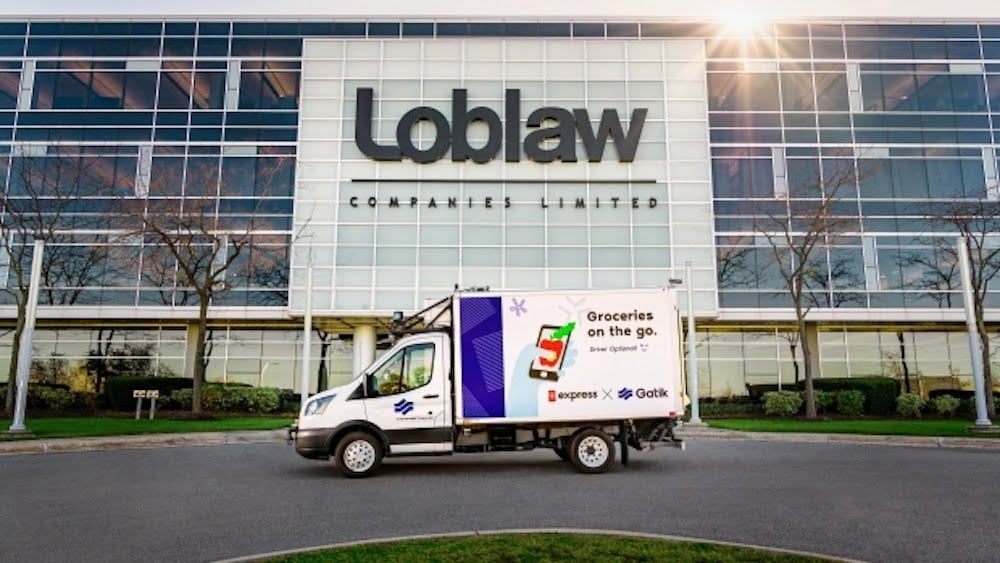
Loblaws autonomous vehicles outside Loblaws office. Photo: Loblaws

Vehicles operated by Gatik will not be entirely autonomous, however. All vehicles will have a safety driver as a co-pilot for now. Since consumers are connecting with these vehicles, the approval process will probably be faster, but neither Gatik nor Loblaws could say when the autonomous fleet would be driving around without any humans at all. It is essentially just a matter of time.

Eliminating humans from the food supply chain is an option which has gained currency throughout the pandemic. For one, jurisdictions around the globe managing routes have struggled and have had to think about restaurants, rest areas and how to keep truckers and staff safe while keeping the region food secure. Humans, as vectors for transmitting the virus, or any disease for that matter, are seen as a liability when a public health crisis occurs. Supply chains are increasingly becoming more automated, so Loblaw’s move with Gatik is anything but surprising.

This human-less food supply chain is an ideal for now, but Loblaws’ call is significant enough to allow most of us to dream. Given the economics of food distribution in Canada though, this innovation is unavoidable, and Loblaws appears to be out of the gate first, embracing what lies ahead. Digitizing the supply chain can only help grocers better serve the Canadian market. With such a vast country, with few people living in it, making the middle mile more efficient is key. It does not necessarily mean that Loblaws’, or any other grocer’s intent is to eliminate all human involvement in the handling of food throughout its operations. It will however seek different skills and knowledge to support its online ambitions. The sector needs strong employees, and always will. But as the sector morphs into an omnichannel beat of sort, employees will be expected to play different roles, and most of the work will have to be about data management, not handling food per se.

The last mile is an autonomous fleet’s next frontier, the most exciting one for the industry, and likely for us as well. Canadians may not be there yet, but grocers like Loblaw are signaling to the Canadian public that the horse has left the virtual barn.


LEAVE A REPLY

Please enter your comment!
Please enter your name here

More From Retail Insider

RECENT RETAIL INSIDER VIDEOS

Advertisment

Subscribe to the Newsletter

Subscribe

* indicates required

RECENT articles

IKEA introduces meatball-flavoured lollipops

The meatball-flavoured lollipop is not an IKEA product but the result of a creative collaboration with Chupa Chups. It will be available for tasting only and will not be sold.

Daily Synopsis: Jun 9, 2026

Ikea bringing meatball-flavoured lollipops to stores, Birks secures loan for store renos, Lego opening store at CF Toronto Eaton Centre, T&T Supermarket to begin construction in Burnaby's Brentwood, and other news.

UNIQLO announces 5 new Canadian store openings for Fall 2026

With these five new stores, UNIQLO's Canadian network will grow to 42 locations.

Royal de Versailles Builds Multi-Brand Luxury Hub on Bloor Street

Royal de Versailles unveils a major Bloor Street renovation including new Tudor and Omega boutiques in Toronto.

Stockouts push shoppers to competitors as loyalty erodes, DOSS study finds

Out-of-stock products are costing brands more than a single sale.

Canadian Franchise Association to Mark World Franchise Day

The franchise industry in Canada contributed over $143 billion to the national GDP in 2025—far exceeding the previous projection of $133 billion.

VIDEO: Canada’s economic uncertainty driving entrepreneurs toward franchising: TD explains why

A recent TD survey found that 27% of Canadians say the economy is too uncertain to start a business and 24% are not comfortable with the financial risk involved.

Accencis Opens Osha Mookata Thai Restaurant in Scarborough

Accencis Group has opened Osha Mookata, a new Thai restaurant in Scarborough featuring interactive tabletop grill and hot pot dining inspired by Thailand’s mookata tradition.

Daily Synopsis: Jun 8, 2026

Surveillance pricing concerns, Loblaw bringing back frozen concentrated juice, Competition Bureau looks into Sobeys store leases, Reformation opening at CF Toronto Eaton Centre, and other news.

Creative Production Supports Retail Growth in Canada

Brandomatic Studios helps retailers scale creative production across digital and in-store channels with consistent execution.

Open Farm partnering with PetSmart

Open Farm is partnering with PetSmart.ca to expand its pet nutrition portfolio to nearly 1,700 stores across the U.S., Canada and online.

Canada’s Luxury Retail Market Enters a More Strategic Era

Canada’s luxury retail market is evolving through flagship expansion, mixed-use development, and shifting urban retail ecosystems. Craig Patterson interviews Casdin Parr.

Endy expands retail partnership with Silk & Snow through new Winnipeg store

The companies have previously collaborated on co-branded locations in Edmonton and Vancouver.

DAVIDsTEA Returns to Oshawa Centre as Expansion Continues

DAVIDsTEA has opened a new store at Oshawa Centre as the retailer continues its Canadian expansion with locations planned in Mississauga, Edmonton and Burnaby.

Retail Remains an Outlier as Canada’s Labour Market Rebounds

Canada added 88,000 jobs in May, but retail lost 35,000. Suzanne Sears explains how careers, hiring and AI are reshaping retail employment.

Instacart expands Fulfillment Pro with new delivery management, picking capabilities

Designed to help grocers streamline order fulfillment by bringing delivery, picking and labour management into a single system, addressing inefficiencies caused by disconnected tools.

AWS launches AI shopping assistant service for retailers, expanding Amazon technology beyond its platform

The new tool can reduce development timelines for retailers seeking to build AI-powered interfaces, with deployments possible in a matter of weeks rather than years.

CF Market Mall partners with Calgary Wild FC on in-mall soccer activation (Photos)

The event, called “The Ultimate Tryout,” will run until June 27 inside the Calgary shopping centre and feature a series of soccer-themed activities, digital simulations and athlete appearances.

Sagamité to open Wendat restaurant and retail space at Québec City airport

The 273-square-metre restaurant and shop will begin serving travellers in the fall 2026, offering dine-in and takeaway food alongside Indigenous-made goods.

From The Desk: Strategic Expansion and Consumer Shifts Define Canadian Retail in Early June

Canadian retail continued to evolve this week, with store expansions, leadership changes, consumer trends, and economic insights shaping the industry's direction.