Seven & i Holdings has announced plans to close 645 7-Eleven locations across the United States, Canada, and Mexico during its 2026 fiscal year, marking a significant shift in strategy for the world’s largest convenience store operator. While the company also intends to open 205 new stores, the net reduction of 440 locations reflects a deliberate repositioning rather than a contraction of the business.
The move represents the fifth consecutive year that 7-Eleven has closed more stores than it has opened in North America, underscoring a broader transformation underway within the convenience retail sector.
The 7-Eleven store closures strategy is closely tied to financial positioning ahead of a potential U.S. initial public offering, now expected no earlier than 2027. By exiting underperforming locations, the company is aiming to improve margins and present a more efficient operating model to investors.
At the same time, the closures reflect structural changes in the business. Tobacco sales, once a cornerstone of convenience retail, have declined sharply in recent years, falling approximately 26 percent since 2019. Many of the stores being closed are older locations that were heavily reliant on cigarette sales and are difficult to retrofit for modern food offerings.
Macroeconomic pressures are also playing a role. Inflation and a softer labour market have impacted discretionary spending among core convenience store customers, resulting in lower traffic at certain locations.
In some cases, stores are not closing entirely but are being converted into wholesale fuel sites. These locations retain fuel operations while eliminating in-store retail, reducing labour and overhead costs while maintaining revenue from gasoline sales.
Pivoting Toward Food and Larger Formats
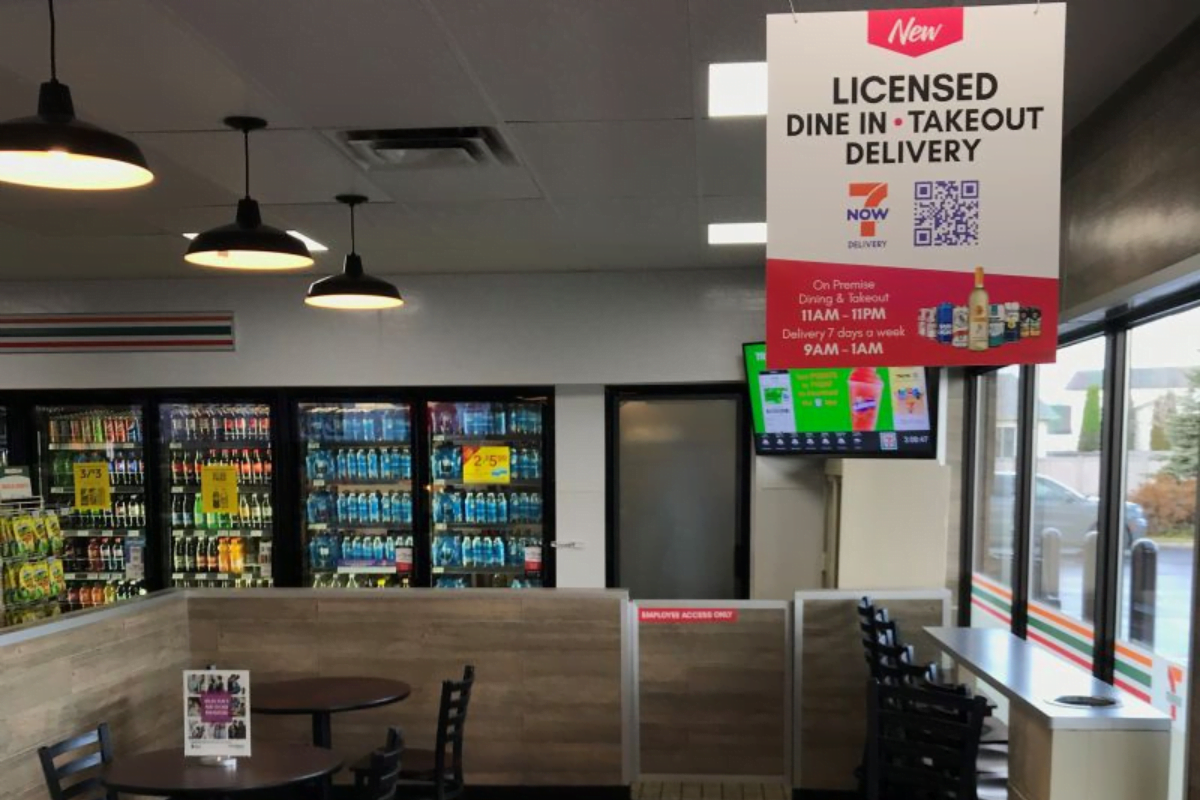
At the heart of the 7-Eleven store closures strategy is a shift toward larger, food-focused locations designed to compete more directly with quick service restaurants.
The company is reallocating capital toward stores that feature expanded fresh food programs, specialty beverages, and seating areas. Fresh food and ready-to-eat meals have emerged as one of the company’s fastest-growing categories, offering higher margins than traditional convenience staples.
This transition reflects a broader effort to reposition 7-Eleven from a last-minute stop for snacks and fuel into a destination for meals throughout the day.
Canada Plays a Distinct Role
While 7-Eleven operates as a unified North American entity, its strategy in Canada differs in several key respects.
The Canadian store base, estimated at roughly 600 locations, is significantly smaller than the U.S. network, which exceeds 12,000 sites following the acquisition of Speedway in 2021. However, Canadian locations have increasingly served as a testing ground for innovation, particularly in food and beverage.
In select provinces, 7-Eleven has introduced licensed alcohol sales, allowing stores to offer beer and wine alongside prepared food. This approach has been easier to implement in Canada than in the United States, where regulatory frameworks vary widely by state.
Canada also presents a more competitive landscape. Alimentation Couche-Tard, the Quebec-based parent of Circle K, remains the dominant convenience retailer in the country and has put pressure on 7-Eleven to improve efficiency and performance. The company’s recent efforts are widely viewed as part of a broader push to compete more effectively with its Canadian rival.
From Convenience to Destination
The evolution underway at 7-Eleven reflects a fundamental shift in how convenience stores operate.
Historically, the model relied on fuel, tobacco, and packaged goods. Today, those categories are either declining or delivering lower margins. In response, 7-Eleven is focusing on fresh, higher-quality food offerings that can drive repeat visits and increase average transaction values.
Recent product launches in Canada highlight this strategy. Items such as Japanese-style egg sandwiches, known as Tamago Sando, represent an effort to bring elevated convenience food to North American consumers. These offerings are designed to replicate the quality and appeal of Japanese convenience stores, where fresh food plays a central role in daily consumption.
By introducing globally inspired products and improving food quality, 7-Eleven is working to change consumer perceptions and build credibility as a meal destination.
Long-Term Outlook
Despite the planned closures, 7-Eleven remains the largest convenience retailer in the world, with more than 12,000 locations across North America. The company’s long-term strategy includes expanding its network of larger-format stores and reaching approximately 1,300 upgraded locations by 2030.
The current wave of closures should be viewed less as a retreat and more as a recalibration. As the traditional convenience store model faces structural decline, 7-Eleven is moving to align its footprint with evolving consumer expectations.
The success of this strategy will depend on the company’s ability to execute at scale, particularly in food service, where competition is intense and customer expectations are rising.