Twenty years after helping redefine the relationship between luxury fashion and mass retail, H&M and Stella McCartney are reuniting for a new collaboration launching May 7 in select global stores, including Canadian locations at CF Toronto Eaton Centre and Montréal’s Sainte-Catherine Street.
The collection revisits one of fashion retail’s most influential partnerships at a time when apparel retailers are navigating softer discretionary spending, growing competition from ultra-fast fashion players, and increasing pressure to demonstrate environmental credibility.
A Landmark Fashion Collaboration Returns
Originally launched in 2005, the first Stella McCartney x H&M collaboration was widely viewed as a turning point for designer partnerships in mass-market retail. At the time, collaborations between luxury designers and fast-fashion retailers remained relatively rare. The partnership helped establish a formula that would later become standard across the industry, combining exclusivity, celebrity appeal, and limited-run product drops designed to generate consumer urgency and drive store traffic.
The new 2026 collection positions itself as both a continuation and reinterpretation of that legacy.
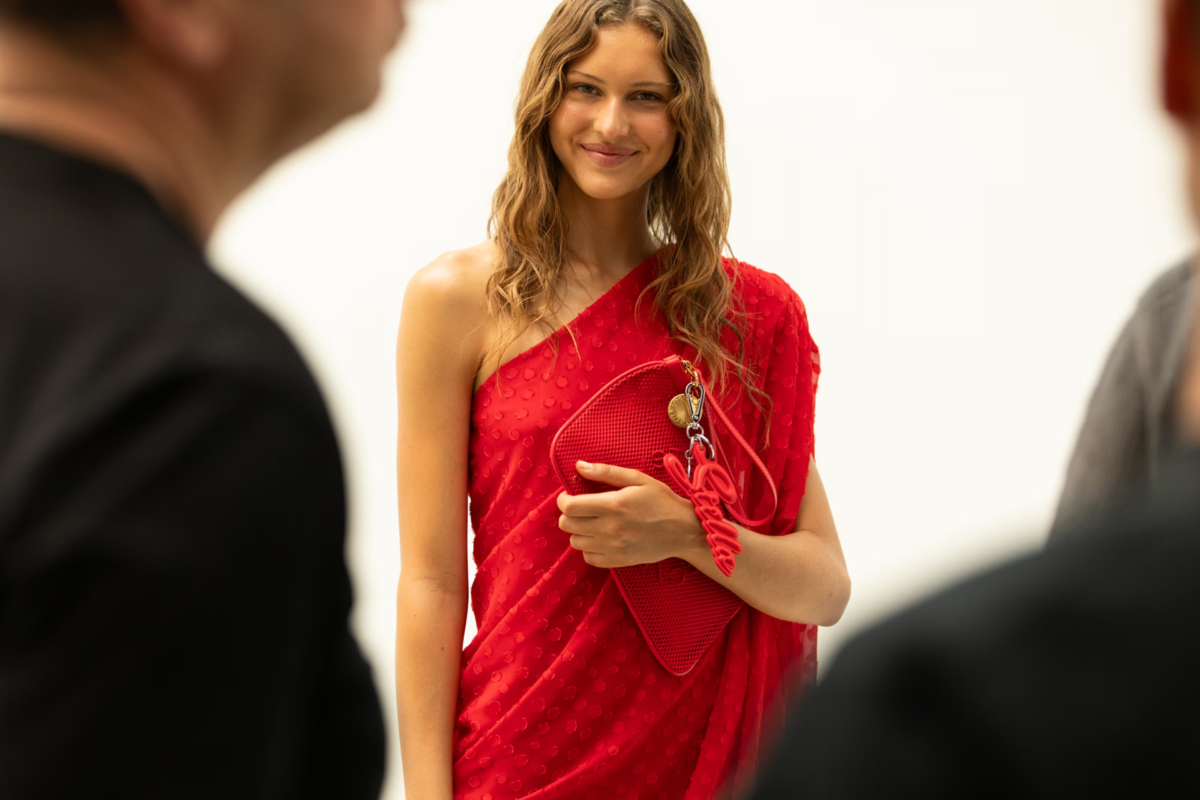
Described by H&M as a “journey through fashion history,” the assortment combines archival references with updated silhouettes, oversized tailoring, statement outerwear, eveningwear, and accessories inspired by McCartney’s contemporary collections. The range includes oversized shirting, sweeping trench coats, pinstripe tailoring, embellished partywear, and updated versions of McCartney’s Falabella handbag designs.
One of the central pieces is a “Rock Royalty” white mini-tee embellished with studs, referencing a look McCartney wore to the 1999 Met Gala. The collection also includes an oversized grey wool blazer and matching trousers made with Responsible Wool Standard-certified wool, alongside evening gowns featuring recycled embellishments and sustainable viscose blends.
Accessories play a significant role in the launch as well. Six handbag styles reinterpret the Falabella aesthetic using recycled polyamide and recycled metals for chains and hardware.
The campaign supporting the collection was photographed in London by Sam Rock and features Renee Rapp, Angelina Kendall, and Adwoa Aboah.
H&M Uses Designer Partnerships to Drive Brand Elevation
The launch arrives during a period of transition for H&M. The retailer reported a 1% decline in net sales earlier this year alongside a continued reduction in physical store counts. Like several apparel retailers operating in the mid-market segment, H&M has been working to strengthen brand perception while responding to mounting competition from lower-cost digital-first retailers.
Collaborations remain one of the company’s most effective tools for generating cultural relevance and physical store traffic.
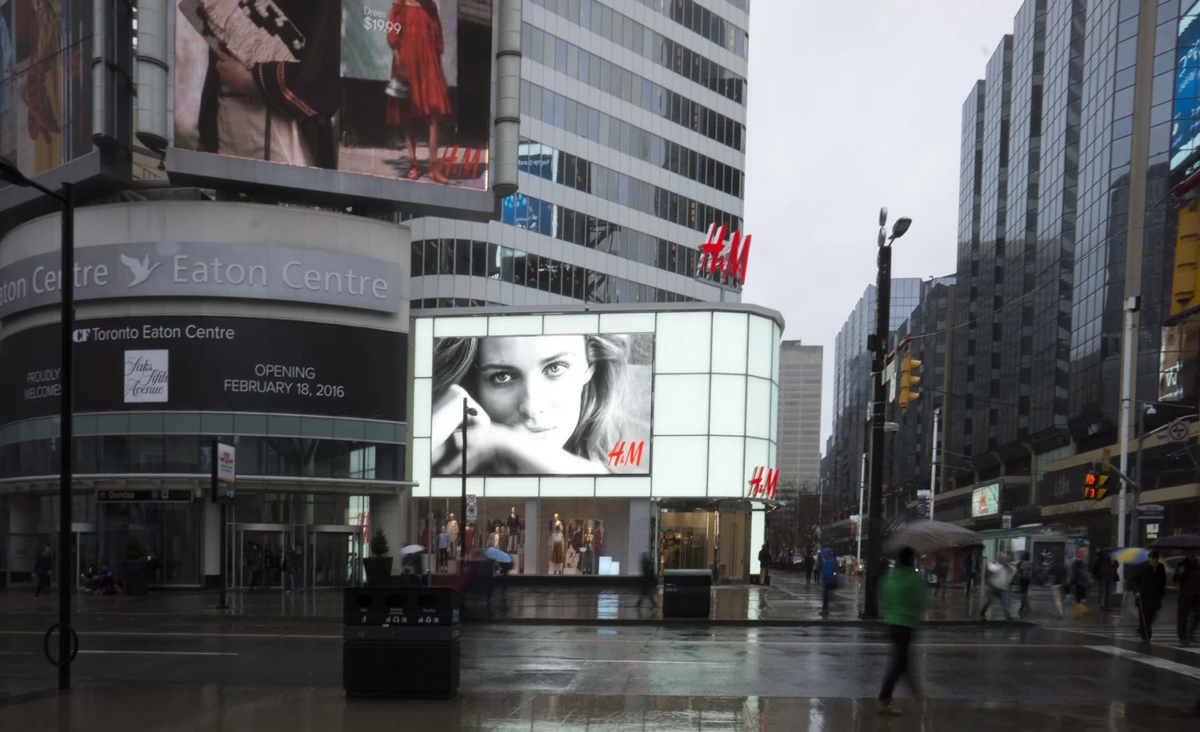
In Canada, the decision to limit the collection to flagship urban locations reflects a strategy increasingly common across fashion retail. Limited availability creates urgency while reinforcing the idea of the store itself as an event destination rather than simply a distribution point for merchandise.
The timing is also notable because fashion collaborations have evolved considerably since the original Stella McCartney x H&M launch two decades ago. What once felt disruptive has now become a core strategy for retailers seeking to create excitement in an increasingly crowded and digitally saturated market.
The collaboration also arrives as apparel retailers continue facing pressure from ultra-fast fashion competitors that have reshaped pricing expectations and accelerated product cycles across the industry. For established global retailers like H&M, limited-edition designer capsules offer an opportunity to differentiate through storytelling, exclusivity, and elevated brand positioning.
H&M has increasingly leaned into higher-profile collaborations as part of broader efforts to strengthen consumer engagement. The retailer’s previous partnerships with luxury and performance-oriented brands have helped generate social media visibility while driving traffic into flagship physical locations.
Stella McCartney Continues Sustainability Push
For McCartney, however, the collaboration also serves another purpose: sustainability advocacy at scale.
Long regarded as one of fashion’s leading voices on environmental issues, McCartney recently received the 2026 TIME Earth Award recognizing 25 years of sustainable leadership within the fashion industry. Earlier this year, she also repurchased the minority stake previously held by LVMH, returning her business to full independent ownership while continuing to advise the luxury group on sustainability initiatives.
McCartney has frequently described collaborations with large-scale retailers as a way to expand access to sustainable fashion innovation beyond luxury consumers.
“This is infiltrating from within,” McCartney said in materials accompanying the launch, referring to the partnership’s ability to help sustainable material suppliers scale production through H&M’s global reach.
That philosophy is reflected throughout the collection’s material composition. The range incorporates recycled glass embellishments, recycled metals, sustainable viscose alternatives including Bailu-ECO™ and Ecojilin™, recycled vegetable oil feedstocks used in coated outerwear, and certified wool sourcing standards.
McCartney’s broader collections have increasingly focused on material innovation as well. Her recent runway collections featured lab-grown alternatives to feathers alongside protein-based knitwear and eco-leather materials derived from fermentation technologies.
Sustainability Debate Surrounds Fast Fashion Collaborations
At the same time, the collaboration is likely to reignite broader debates around sustainability within fast fashion.
Environmental advocates have increasingly scrutinized major apparel retailers over issues tied to production volume, consumption cycles, and textile waste. H&M has publicly committed to using 100% recycled or sustainably sourced materials by 2030 and credits its original 2005 Stella McCartney partnership as an early catalyst for the company’s adoption of organic cotton initiatives.
As part of the new launch, H&M and McCartney are also introducing a joint “Insights Board” intended to help guide the retailer’s long-term transition toward a more circular business model.
Whether collaborations like this meaningfully shift industry practices or primarily function as prestige-driven marketing exercises remains a topic of ongoing debate. However, there is little question that designer partnerships continue to play an influential role in shaping how fashion retailers position themselves in an increasingly competitive global market.