Buried in Aritzia’s latest quarterly financial statements is an unusual real estate disclosure.
During the first quarter, the Vancouver-founded retailer entered a 50/50 joint venture with an unnamed third party that owns a single property expected to become a future boutique location. Aritzia contributed US$1 million for its common interest and advanced another US$27 million through a loan carrying a 10% annual return and maturing in April 2029.
The filing does not identify the property or the partner. The transaction nevertheless provides a glimpse of a company whose physical expansion is becoming larger, more capital intensive and, in at least one case, more structurally complex.
A broader strategy emerges across Aritzia’s latest financial statements, investor presentation and earnings call. The retailer has articulated a repeatable new-store model of roughly 10,000 square feet with strong economics, while selectively committing to major urban flagships three or four times that size. Around the store network, it is increasing capital spending, adding distribution capacity and pursuing a U.S. opportunity that management believes extends far beyond its current footprint.
The buildout is occurring as Aritzia itself reaches a new scale. First-quarter net revenue increased 43.4% to $951.0 million, comparable sales rose 35.1%, and the company raised its fiscal 2027 revenue outlook to between $4.55 billion and $4.75 billion.
The quarterly growth is significant. The less obvious story is what Aritzia is building behind it.
The Economics of a 10,000-Square-Foot Aritzia
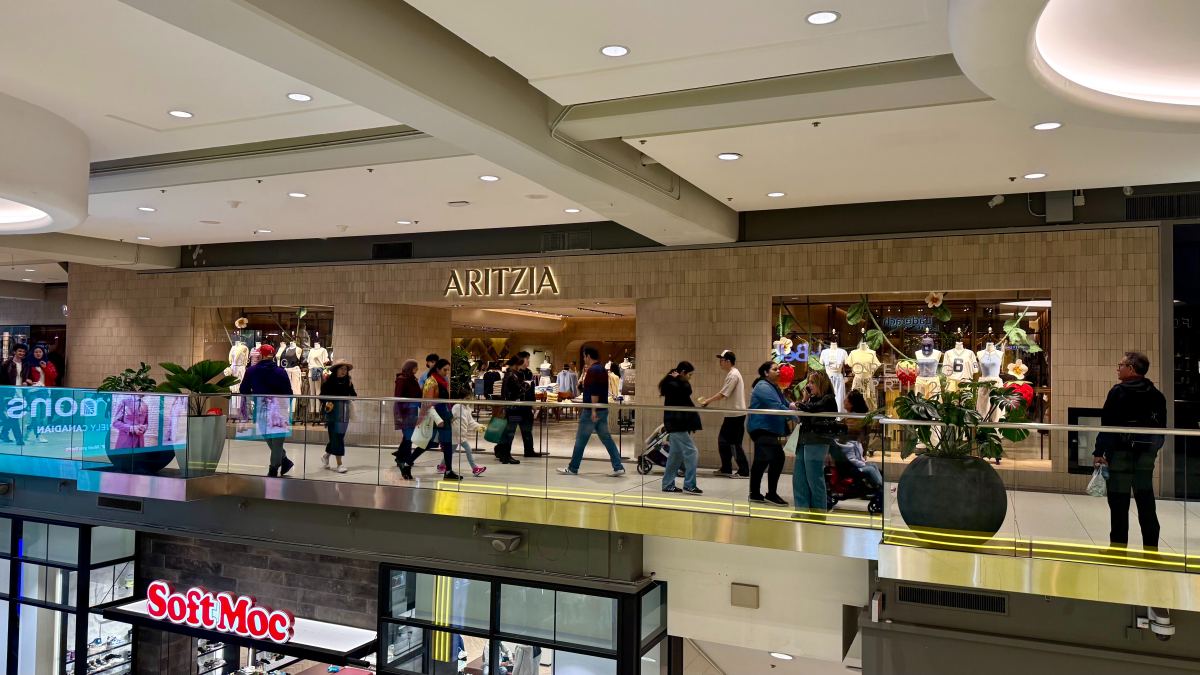
Aritzia’s Q1 investor presentation provides a rare public look at the economics behind a typical new boutique.
The model assumes approximately 10,000 square feet, sales productivity of about $1,000 per square foot and roughly $10 million in annual revenue. Aritzia estimates a net investment of about $4 million, with an expected payback period of 12 to 18 months.
Current performance is running ahead of that benchmark. Chief Executive Officer Jennifer Wong told analysts that new boutiques are paying back in less than one year on average. She also said locations above 10,000 square feet are producing sales per square foot in line with Aritzia’s highly productive smaller boutiques.

That combination goes a long way toward explaining why physical expansion remains central to the growth strategy.
Adding space can create a productivity problem for retailers. Total store sales may increase while the revenue generated by each additional square foot declines. According to Wong, Aritzia is not seeing that dilution in its larger boutiques.
The format has evolved considerably. Wong said the company was discussing average stores of roughly 6,000 square feet about a decade ago. That later moved toward 8,000 square feet. Aritzia now bases its new-store economics on a footprint of about 10,000 square feet, with selected flagships considerably larger.
The U.S. maturation curve has changed as well. Chief Financial Officer Todd Ingledew told analysts that Canadian boutiques historically opened closer to maturity while American locations tended to ramp over several years. Newer U.S. stores are now opening much closer to mature productivity, with the fiscal 2026 cohort starting from particularly strong levels.
Management did not attribute that improvement to a single factor. Greater brand awareness could be contributing, as could existing digital demand, stronger site selection and local execution. What is clear from the call is that the economics of opening in the U.S. have improved.
Aritzia therefore has a repeatable store model that has grown in size, is paying back faster than targeted and is reaching stronger productivity earlier in the United States.
It is also selectively building stores on an entirely different scale.
From 10,000 Square Feet to 40,000-Plus-Square-Foot Flagships
Aritzia’s largest urban flagships sit well outside the 10,000-square-foot model presented to investors.
On Chicago’s Michigan Avenue, the company operates from a roughly 46,000-square-foot space on the Magnificent Mile. The lease was announced as Aritzia’s largest location to date when the deal was arranged.
In New York City, its flagship at 608 Fifth Avenue spans approximately 33,600 square feet, following a major expansion of the retailer’s presence on the corridor.
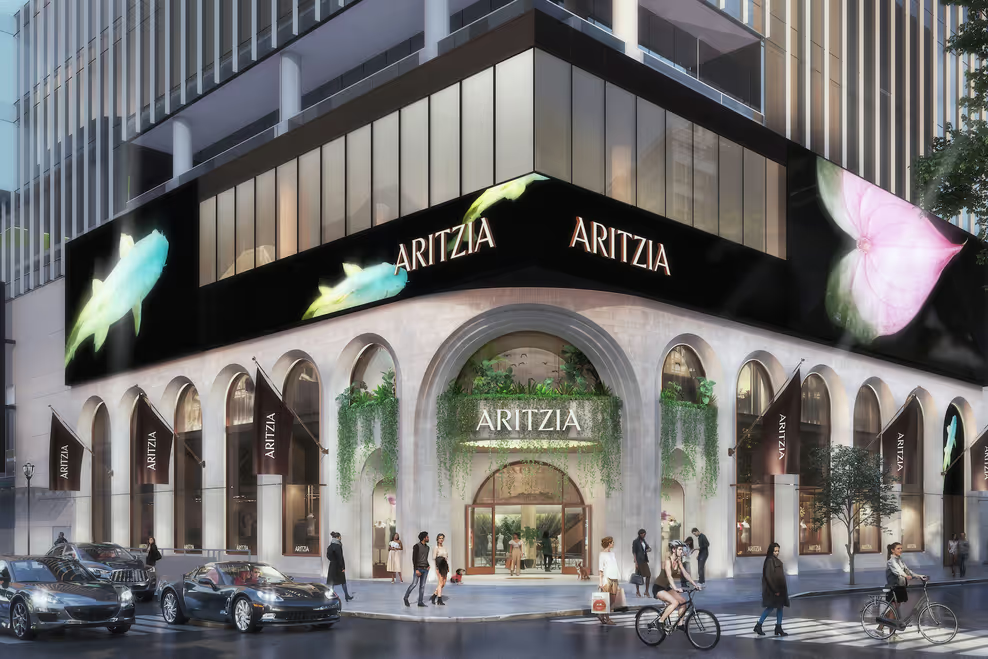
In downtown Vancouver, Aritzia is developing another major flagship at CF Pacific Centre. Retail Insider understands the four-level location will approach 42,000 square feet in part of the former Nordstrom complex.
The gap between these stores and the standard model is substantial. Aritzia’s investor assumptions centre on about 10,000 square feet, yet selected gateway-city flagships are three or four times larger.
That suggests different locations are performing different jobs within the network.
Aritzia’s own investor materials say boutiques are intended to generate sales and profits, build awareness, propel client acquisition and fuel digital growth. A major flagship can potentially extend those functions across a wider audience while giving the company more room for assortment, multiple in-house brands and a fuller physical expression of its positioning.
Highly visible locations can also reach beyond their immediate residential trade areas. Michigan Avenue and Fifth Avenue draw tourists alongside local shoppers, while the forthcoming Vancouver flagship will occupy one of the city’s most prominent downtown retail locations. The strategic value of such stores may therefore extend beyond revenue generated within four walls.
That is an analytical interpretation, not a return Aritzia has publicly quantified. The company has not disclosed a specific financial value for the brand-building role of its largest flagships.
The difference in format is nevertheless becoming difficult to miss. A 10,000-square-foot boutique provides a repeatable model for expansion. A 40,000-plus-square-foot flagship can create a level of market presence that a conventional store cannot.
The evolution is particularly visible in Vancouver. Aritzia’s first standalone boutique opened at Oakridge in 1984 at approximately 1,500 square feet. Its reimagined Oakridge Park store is now about 10,000 square feet. The downtown flagship under construction will be more than four times larger again.
A U.S. Network With Substantial Room to Grow
The repeatable boutique model becomes especially important when viewed against Aritzia’s stated opportunity in the United States.
At the end of Q1, the company had 143 Aritzia boutiques, excluding four Reigning Champ stores. Its investor presentation shows 76 boutiques in the United States and 67 in Canada.
Aritzia already has more boutiques south of the border than in its home country.
Management has also identified an opportunity for more than 180 U.S. locations that meet its criteria.
That figure is not a commitment to open 180 stores and should not be treated as a forecast. Real estate availability, market conditions and execution will determine how much of the opportunity is ultimately pursued, according to the company. Still, the gap between 76 existing U.S. boutiques and an identified opportunity above 180 shows the scale of the runway management believes may remain.
The current opening program is heavily weighted to the United States. Aritzia expects 12 to 13 new boutiques in fiscal 2027, with 11 to 12 south of the border. During the earnings call, management said Q2 openings would take the retailer into Birmingham, New Orleans and St. Louis, each a new market for the company.
Those cities also show the expansion broadening into a wider range of U.S. metropolitan markets.
The physical strategy is developing along two tracks: a scalable boutique model that can be deployed across a growing number of cities, and a selective flagship tier in high-profile urban locations. Both require increasing levels of capital and infrastructure.
The Expansion Is Becoming More Capital Intensive
Aritzia’s financial statements show how quickly the physical program is translating into investment.
During the 13 weeks ended May 31, the company recorded $69.8 million in property and equipment additions, up from $38.2 million a year earlier. The majority related to leasehold improvements at boutiques and distribution centres, along with furniture and equipment for those spaces.
For the full fiscal year, Aritzia expects approximately $250 million in capital cash expenditures, net of proceeds from lease incentives. About $210 million is related to investments in new and repositioned boutiques expected to open in fiscal 2027 and fiscal 2028.
Lease activity has increased as well. Aritzia recorded $74.5 million in additions to right-of-use assets during the quarter, compared with $29.7 million a year earlier. Total lease liabilities stood at approximately $1.08 billion as of May 31.
Those liabilities reflect accounting for contractual lease obligations and should not be equated simplistically with conventional bank debt. They do, however, illustrate the scale of the commitments attached to a growing physical network.
The importance of current store economics rises as those commitments increase. Management is reporting sub-one-year average payback on new boutiques, preserved sales productivity in larger stores and improved maturation among newer U.S. locations.
The challenge will be maintaining those outcomes as Aritzia opens more stores across a broader mix of markets and formats.
Distribution Capacity Behind the Store Growth
The retail expansion is being matched by investment behind the scenes.
In May, Aritzia brought a new 380,000-square-foot distribution centre in British Columbia online. Wong said the facility uses goods-to-person technology designed to reduce pick times and improve order accuracy, and that it ramped over a matter of weeks while maintaining service levels.
Further U.S. capacity lies ahead.
Management said the successful B.C. ramp increased confidence as the company turns toward expansion of its American distribution network. Aritzia’s investor presentation also references a second U.S. distribution centre among future infrastructure investments.
That back-end investment is directly connected to the growth strategy. A larger store network, bigger formats and expansion into new markets increase the complexity of moving and allocating inventory. Digital growth adds another layer of fulfilment demand.
The Challenge Is Shifting to Execution at Scale
For years, a central question around Aritzia was whether a Canadian fashion retailer could translate its success into the United States. The latest disclosures suggest the strategic question is changing.
U.S. revenue increased 54.5% in the first quarter to $638.1 million and represented 67.1% of total company revenue. Aritzia now has more boutiques in the U.S. than Canada, newer American stores are opening closer to maturity, and management has identified an opportunity for more than 180 U.S. locations meeting its criteria.
The challenge increasingly lies in supporting a much larger operation without weakening the execution behind the current economics.
Aritzia must continue securing productive real estate while entering a broader range of markets. It is supporting different physical formats, from 10,000-square-foot boutiques to major urban flagships. Distribution capacity and inventory allocation have to keep pace with both store and digital growth.
The company enters that phase from a strong financial position. At the end of Q1, Aritzia held $471.9 million in cash and had no amounts drawn on its $300 million revolving credit facility.
The latest filings reveal the scale of the task ahead. Aritzia is building a repeatable 10,000-square-foot boutique model while selectively committing to flagships approaching or exceeding 40,000 square feet. It is directing substantial capital toward future stores, adding distribution capacity and, in one newly disclosed case, participating in a property-owning venture tied to a future boutique.
For further insights into Aritzia’s financial performance and future expectations, the company held an earnings call on July 9, with both Wong and CFO Todd Ingledew discussing the results and outlook.