The past five years have been a truly unprecedented period of growth for luxury apparel retailing in Canada resulting in Canada becoming a major worldwide market for luxury brands.
During the period, both the size of the Canadian luxury apparel market and the competitive intensity within the market has increased significantly, according to a new report by Trendex North America, a marketing research and consulting firm.
But the market has felt the negative impact of the COVID-19 crisis just like the rest of the retail industry this year.
First the good news. Trendex estimates that the sales of Canadian luxury apparel/leather goods in 2019 totaled $2.74 billion, an increase of 5.5 percent year-over-year. Luxury apparel/accessories accounted for 8.8 percent of total 2019 Canadian apparel sales.
And in 2019 luxury apparel e-commerce sales increased by 16 percent to $170 million. While e-commerce luxury store sales only accounted in 2019 for seven percent of Canadian luxury apparel sales, the channel has been growing at almost three times faster than the entire luxury apparel market.
But here’s the bad news because of COVID.
TRENDEX ESTIMATES A 16.8% DECREASE IN THE CANADIAN LUXURY APPAREL MARKET IN 2020
Trendex estimates that the Canadian luxury apparel market will decrease by 16.8 percent in 2020 and increase by only 1.6 percent from 2019 to 2023 to $2.8 billion. The decrease of the Canadian luxury apparel market will be driven in 2020 by a 17 percent decrease in luxury women’s apparel sales while men’s luxury apparel will decrease by 16.2 percent. Purse sales will decrease by 16.7 percent.
Randy Harris, president and owner of Trendex North America, said much of the luxury apparel market decline this year is due to the absolute shut down of retail for about three months.
“But it’s also due to the lack of tourists that are coming into the country. The borders have basically been sealed for over six months now. So those high-end tourists from Asia for example are just not shopping in luxury retail stores,” said Harris. “You also have a reticence on the part of consumers right now to just go out and shop because they’re not sure if there is a second wave coming around the corner or not. So there’s a reluctance among a log to people I think to make a purchase.
“The thing that helps the luxury retailers in Canada right now and why they’re surviving is they’re backed up by ‘daddy deep pockets’. In other words, there’s nobody behind a Reitmans, there’s nobody behind a Le Chateau. But when you’re talking about Gucci in Canada if business is bad, rents have to be paid, their parent will take care of that. I think that’s what you’re seeing. Yes they will get through it but their sales will reflect what’s going on in Europe and around the world with the luxury market but it might even be affected more in Canada because of the tremendous decrease in tourists coming in.
“It’s really a shame that the industry has grown, matured, expanded over the last three or four years and in a sense ready to bloom this year and then all of a sudden it got the rug pulled out from under it through no fault of its own.”
The Trendex report said the competitive intensity in the Canadian luxury apparel retail market over the next five years will continue to increase and will be driven by a number of developments including:
An increase in the number of luxury apparel retailer doors, both in A malls and on “High Streets”;
An increase in luxury apparel brand flagship stores on High Streets and in A malls;
An expansion of the traditional boundary for High Street areas in both Toronto and Montreal;
Increased presence of luxury apparel retailers in Canada’s better off-price malls (e.g. Toronto Premium Outlets);
Additional luxury mono apparel brand specialty retailers entering Canada for the first time;
Growth of luxury apparel e-commerce sales;
Luxury apparel mono brand apparel/accessories retailers upgrading/expanding the size of their existing Canadian stores;
Holt Renfrew expanding its “World of” concessions model, will in turn serve to reinforce its position as the premier Canadian luxury apparel retailer. Of all multi-brand luxury apparel retailers Holt Renfrew should gain the most share in 2020;
Multi-brand luxury apparel retailers will increase their collective market share at a rate faster than mono brand luxury retailers. This development will be driven by two factors. The first relates to consumers increasing preference to shop in multi-brand luxury apparel retailers that offer true omni-channel capabilities. The second factor is the increasing tendency of wholesale brands to take greater control of the distribution of their own brands. By cutting back or restructuring their distribution, luxury apparel brands become better positioned in Canada to control their pricing, marketing, etc.; and
Increasing use, at the expense of traditional print advertising, of social media, influencers and other forms of non-traditional marketing, including crowdsourcing and “pop-up” stores.
“Historically the Canadian luxury apparel/accessories market was underdeveloped. The degree of underdevelopment, lessened during 2017-2019 for numerous reasons including new foreign luxury retailers/brands entering Canada, Holt Renfrew stepping up its game, luxury e-commerce growing at double digit rates and luxury retailer construction exploding in Vancouver and Toronto. A concern however is that the “supply” of luxury retailers will increasingly exceed the demand (i.e. sales) for luxury apparel. A shake-out in the Canadian luxury apparel segment is inevitable, the question is when and where it will begin,” explained the report.
“The unknowns in the forecast of Canadian luxury apparel sales are whether there will be a major decrease in the number of Chinese tourists visiting Canada, whether Canada’s economy will slow, whether millennials will shun luxury apparel, and finally how long luxury apparel retailing will be directly affected by COVID-19. The greater the increase in foreign tourists, the more the demand line (i.e. sales) will be moved upward, in effect delaying when the shake-out in the Canadian luxury apparel segment will begin.”
Hudson’s Bay Receives Eviction Notices from Malls for Unpaid Rent
According to a French language report by Marie Eve Fournier in La Presse last week, the Hudson’s Bay Company has received eviction notices from three Cominar-owned malls in Quebec due to non-payment of rents. The Hudson’s Bay Company says that the move by landlords is a form of intimidation and ‘bad faith’ and that the retailer is looking to resolution.
Cominar REIT says in court filings that HBC hasn’t paid rent since April at Rockland Centre in Montreal (monthly rent $86,200), Mail Champlain in Brossard (rent $110,200/month) and at Centre Laval in Laval (rent $20,500/month). Notices of default were sent in June and notices of termination followed last month. In total, damages and unpaid rents claimed amount to $3.68 million for Rockland Centre, $26.95 million for Mail Champlain and $2.21 million for Centre Laval. All three stores in those malls are currently open.
HUDSON’S BAY STORE IN MAIL CHAMPLAIN. PHOTO: MAIL CHAMPLAIN
Another French language report last week in La Presse noted that landlord Oxford Properties is suing HBC for more than $2.29 million in unpaid rents at two shopping centres including Galeries de la Capitale in Quebec City (monthly rent of $220,000) and Promenades Gatineau near Ottawa ($145,900/month rent). The same report notes that HBC had not paid rents for eight of the 11 Oxford-owned malls in Canada containing Hudson’s Bay stores.
Employees from HBC’s offices in Brampton Ontario are being moved to offices in Toronto. The company notes that it’s part of a “new way of working” as the world shifts amid the COVID-19 pandemic.
We’ll continue to monitor the situation.
SHUTTERED BLOOR STREET BANANA REPUBLIC. PHOTO: CRAIG PATTERSON
Banana Republic Shutters Mink Mile Flagship After 25 Years
Gap-owned Banana Republic has shut its store at 80 Bloor Street West in Toronto. The store operated there since 1995 and was one of the first three Banana Republic stores to open in Canada (the first being at West Edmonton Mall and the other at CF Toronto Eaton Centre).
The Banana Republic store on Bloor spanned two levels and more than 6,000 square feet in a space that was once occupied by an Emporio Armani store (between 1990-95). Roots is the other retail tenant at 80 Bloor Street West, and Harry Rosen’s five-level flagship store is located adjacent at 82 Bloor Street West. A major proposal could see both 80 and 82 Bloor Street West demolished for a new mixed-use tower housing retail space as well as hundreds of residential condominium units.
The Gap has been quietly closing stores across Canada with a particular bright spot being Old Navy which has done well here.
Toronto’s prestigious Bloor Street West is seeing an unusually high number of vacancies, which shouldn’t be a surprise given the COVID-19 pandemic. A J. Crew store closed late last month and the beautiful Club Monaco building at 157 Bloor Street West is also on the market (the retailer has also been on Bloor for a quarter of a century). UK luxury brand Mulberry closed its store at The Colonnade at 131 Bloor Street West in the summer and several more retailers are said to be looking at pulling the plug on their Mink Mile operations. It’s not all bad news as brokers say there is interest and leasing activity in the area, which in November of 2019 saw Eataly open at the overhauled Manulife Centre.
LEE VALLEY TOOLS OTTAWA. PHOTO: LEE VALLEY TOOLS
Lee Valley Tools Launches Mobile Shopping Tool for Customer Safety
Ottawa-based retailer Lee Valley tools is innovating in the face of COVID-19 while restructuring its operations. This month the company launched a mobile shopping tool that integrates with its website allowing for mobile contactless shopping across Lee Valley’s 20 stores across Canada.
After the COVID-19 store shutdowns in the spring, Lee Valley Tools saw an opportunity to transition from express to curbside pick-up with the launch of the mobile app adding another level of safety to the in-store shopping experience. “The health and safety of our customers and staff is our number one priority and our new easy-to-use mobile feature provides another layer of protection while shopping in-store during these unprecedented times,” said Jason Tassé, Chief Operating Officer, Lee Valley Tools. “We’re thrilled to launch this mobile tool in all our stores across Canada to give our customers a user-friendly way of making the browsing and purchase process contactless.”
SCREENSHOT OF LEE VALLEY TOOLS WEBSITE.
The mobile feature was designed to be easy to use as customers don’t need to download it on their mobile device. Rather can visit LeeValley.com when they enter the physical store and click on the barcode icon, select their store location and start shopping. The online feature also allows customers to scan an item’s bar code and see a full description of every product offered by Lee Valley Tools before deciding to purchase.
The contactless shopping option is available at all 20 Lee Valley Tools store locations across Canada starting October 1 and is compatible on all mobile devices.
NEW DIESEL STOREFRONT AT YORKDALE SHOPPING CENTRE. PHOTO: NORMAN KATZ
Diesel Opens Yorkdale Storefront, Only Standalone Full-Priced Location in Canada
Italian clothing brand Diesel has opened a new storefront at Toronto’s Yorkdale Shopping Centre. It’s now the only standalone full-priced Diesel store in Canada after other locations have shuttered since last year. Diesel has had several different locations at Yorkdale since 2012.
INTERIOR IMAGES OF NEW DIESEL STORE AT YORKDALE SHOPPING CENTRE. PHOTOS: NORMAN KATZ
1 of 3
The new 2,435 square foot Yorkdale Diesel features an LED facade that makes the store quite noticeable. The Diesel store is located between Innisfree and Oak + Fort in a retail space vacated by Reiss last year.
Diesel once had a bigger presence in Canada. Last year the brand shut several units including a flagship on Yorkville Avenue in Toronto as well as a large store on Rue de la Montagne in Montreal. Diesel still operates outlet stores in suburban Toronto and Montreal. The brand is also carried at multi-brand retailers in Canada such as Hudson’s Bay.
EXTERIOR OF FRANK AND OAK STORE. PHOTO: FRANK AND OAK
Frank And Oak Buyer Looks to Take Brand Global, Looks to Acquire Other Canadian Retailers
After filing for creditor protection in June, Montreal-based fashion retailer Frank And Oak was acquired this month by New York City-based Unified Commerce Group. In a paywalled report in the Globe & Mail on Sunday, information was provided by Unified about the future of Frank And Oak which currently operates nine stores after shutting 11 locations recently.
Many of the stores were reportedly unprofitable, as was the company which was saddled with pricey leases for some high-profile locations.
Frank And Oak started as an online men’s fashion business in 2012 and was funded by Hicham Ratnani and Ethan Song. Mr. Song resigned from the company in March of this year and Jeremy Brown, formerly CFO at Sephora, is now working with Mr. Ratnani during Frank And Oak’s transition.
An expansion into Europe and Asia is a possibility according to Unified Commerce Group co-founder and chief financial officer Greg Freihofner with China being a particular market of interest. It’s unclear if the expansion would involve physical stores or if the retailer would operate purely online.
Unified Commerce Group also said in the interview that it was looking at possibly buying other struggling Canadian retailers.
Oxford Properties Shopping CentresPartner with Food Banks Canada to Raise Funds to Help Alleviate Hunger
Yorkdale, Square One, Scarborough Town Centre, and Oxford Properties’ shopping centres across the country have launched the #PassThePlate2020 campaign in partnership with Food Banks Canada to help the organization reach its $150 million COVID-19 response fundraising goal to alleviate hunger in Canada.
As part of the effort to raise money for Food Banks Canada, the shopping centres have launched a social campaign encouraging Canadians to share a video or photo featuring a plate with the hashtag #PassThePlate2020. Oxford Properties will donate $5 for every post, equivalent to ten meals, to a maximum of $10K per shopping centre to Food Banks Canada. Canadian celebrities have shared videos of themselves passing the plate to launch the campaign and encourage Canadians to do the same.
“Food banks around the country have been seriously impacted by the pandemic, having to manage with fewer volunteers while adapting their operations and serving new clients affected by crisis,” says Bradley Jones, Head of Retail, Oxford Properties. “Our shopping centres play important roles in their communities, and we will use this reach to mobilize the wider community to take action against increasing food insecurity accelerated by the pandemic. Pass the Plate can inspire donations at a variety of levels as we partner with Food Banks Canada and work towards alleviating hunger.”
“We’re concerned for what’s ahead. The pandemic’s economic impact, especially as the income supports come to an end, will impact demand for food banks nationwide. With Oxford’s support we hope to increase awareness for our fundraising campaign and help deliver the nutritional support people need as we move into the holiday season,” said Chris Hatch, Chief Executive Officer, Food Banks Canada.
Food Banks Canada represents ten provincial associations, more than 700 affiliated food banks, and more than 3,000 community agencies. Oxford Properties’ commitment comes in response to Food Banks Canada’s “I ATE” campaign urging Canadians to make monetary donations with the goal of raising $150 million to help alleviate hunger in Canada. Food Banks Canada still needs more than $28 million to raise to meet this goal.
Additional ways to donate to Food Banks Canada include adding on a donation to a gift card purchased at any of Oxford’s GTA shopping centres, donating the balance of a gift card, or through a mobile device by scanning a QR code which will be posted throughout the centres. Oxford is committed to raising $175K in support of Food Banks Canada.
To donate or learn more about Oxford’s Pass The Plate campaign, please visit FoodBanksCanada.com
TORU AKITA
Question and Answer with Muji’s North American President Toru Akita
Retail Insider recently asked Muji’s North American President a few questions about the retailer’s Canadian operations. Muji opened its first store in Canada in Toronto in 2014 and the company now operates nine stores — five in the GTA and four in the Vancouver/Lower Mainland.
RI: How has MUJI been doing in Canada since it entered the country several years ago?
Toru Akita: Since opening the first MUJI store in Canada in November 2014, we have seen steady growth and developed a loyal customer base. We have since increased the number of stores in Canada to nine, across several provinces. We are grateful to our Canadian customers and supporters who have made this possible.
RI: Stores in BC and in downtown Toronto were expanded with a broader product assortment. Might we see more of the Ontario stores expanded as well?
Toru Akita: As we are able to expand the floor space in our stores, we can provide products and services closer to those offered in Japan–therefore we’re always thinking about which stores can be expanded and where we can offer more products. At the moment, we are considering the impact of COVID-19 on the lives of our communities, and any future expansions will have this in mind as we seek to become more useful to our customers.
MUJI STORE. PHOTO: MUJI
RI: In terms of product offerings, will we continue to see new categories in Canadian stores?
Toru Akita: We are constantly reviewing and reconsidering the products that we offer in each region, and will continue to introduce new products in our Canadian stores, especially in response to changes in changes in society and lifestyles after COVID-19. We want to create a store where all of the items necessary for life under this new normal are available in good quality and at a reasonable price.
RI: Is there a timeline for when Muji expands into the Alberta and possibly Quebec markets?
Toru Akita: We don’t have any plans to expand into these provinces for the time being.
RI: Might we see Muji grocery stores or hotels in Canada over the next decade?
Toru Akita: There are so many amazing MUJI services in Japan and elsewhere that have not yet been introduced to Canada, including grocery stores and hotels. Before we bring these major new categories to the Canadian market, we’ll need to do more work to understand how they could fit into the lifestyles, interests, and needs of Canadian consumers.
SCREENSHOT OF KING & BAY’S WEBSITE SHOWING VIROSHIELD MASKS.
King & Bay Innovate Once Again in the Face of COVID-19
Toronto-based retailer King & Bay have announced the launch of ViroShield, a face mask that protects 99.94% against COVID-19 with first-to-market technology.
The clothing company — which launched the charitable Mission2Mark program at the beginning of the COVID-19 pandemic — is once again on the frontline in the fight against COVID-19. The ViroShield face mask is unlike any other due to its three-layered design and the presence of the HealthGuard® AMIC coating — a specially formulated non-silver broad range Anti-Microbial and Anti-Viral formulated using cosmetic based chemistry which destroys SARS-CoV-2 – COVID-19 strain viruses — on its external layer. The under layers include a melt blown fabric and 100% cotton single jersey.
Other ViroShield face mask features:
• Anti-odour and hygienic
• Non-irritating with soft, lightweight, and breathable fabric
• Extra soft ear loop, minimizing pressure on the ear
• Durable to laundry wash without shrinking
King & Bay is distributing these masks in bulk, mainly for organizations (including retailers) to protect their employees at work. Organizations who are interested can contact King & Bay at MyKingandBay.com
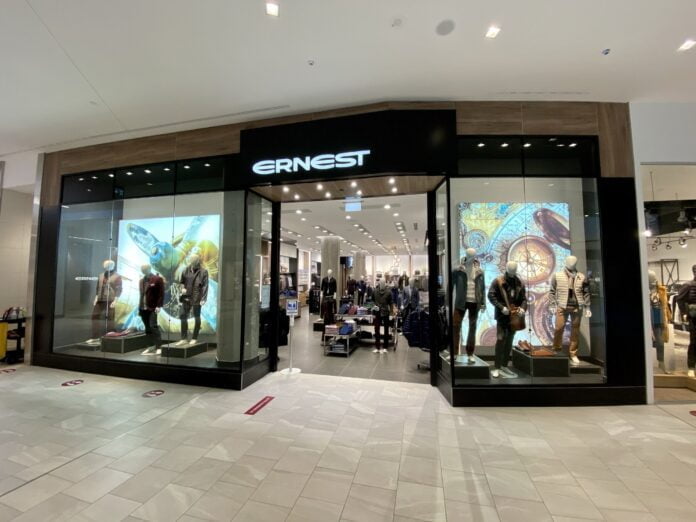
Montreal-based men’s fashion retailer Ernest has unveiled a new store concept after filing for creditor protection last month. The new storefront at the Montreal Eaton Centre is a refresh of the brand which is expected to be rolled out into other locations.
The Montreal Eaton Centre Ernest location spans just under 2,500 square feet and features high ceilings in an airy space with wood accents and a contemporary feel. The store is located on the street level of Montreal Eaton Centre next to the recently opened Samsung and facing a new concept Pandora store as well as Uniqlo which opens on October 23.
Men will find a wide range of suits as well as sportswear and footwear. Tailoring is available with Ernest’s personalized customer service. The store features a wall dedicated to shirts.
The new store’s location is intended to be closer to the office towers of downtown Montreal, which are beginning to see some workers return. Ernest had two stores downtown further west, including a unit operating at 1199 Sainte-Catherine Street West a couple of blocks from the recently completed Holt Renfrew Ogilvy store. The future of the 1199 Sainte-Catherine storefront is uncertain — Ernest says that it is still in negotiations with the landlords and that it will most likely close as the lease expires amid a challenging retail environment. Foot traffic is also said to be a concern given construction on Ste-Catherine Street.
INTERIOR IMAGES OF ERNEST’S NEW CONCEPT STORE IN MONTREAL. PHOTOS: MAXIME FRECHETTE
1 of 6
Foot traffic from the Time Out Market food hall was another attraction to the Montreal Eaton Centre according to an Ernest representative. The Market opened in November of 2019 and is expected to again be a traffic generator following COVID-19 mandated shutdowns in Quebec.
Earnest filed for creditor protection in September and used the opportunity to renegotiate some leases. The company has 40 stores (33 branded as Ernest, six under the Jonathan banner and one under the Anthony banner, all of which are located in the province of Quebec except for one unit in Moncton, New Brunswick. No jobs were lost with the filing and only one store on Ste-Catherine Street in Montreal shuttered as a result.
The retailer says that it is holding off on future expansion plans for the time being as it watches the industry and COVID-19. In a more favourable time, Ernest could expand into the Ontario market.
Ernest was founded in 1958 in Montreal by Ernest Iarrera with a store on Ste-Catherine Street East. The concept expand into Quebec Cit in 1991. The founder’s son and daughter now run the operations and Ernest is still family owned.
As with most things during the pandemic, the traditional festive marathon, which has hinged on Black Friday & Cyber Monday deals, door crasher events, special promotions, and impulse buys, is being rethought in 2020 to meet today’s customer needs for the holidays in an environment of ongoing uncertainty.
To help retailers in Canada, who are already gearing up for the season, have the latest global and Canadian retail insights so they can build on the new opportunities to uniquely delight their customers this year, Retail Council of Canada will hold a ½ day online event, the Retail Holiday Shopping Forum on October 20, 2020. The session will be packed with practical information to ensure it is a well spent 3 ½ hours during a very busy time of the year.
Speaking at the forum will be influential retailers and industry insiders like Tal Zvi Nathanel, Founder and CEO of SHOWFIELDS; Luc Dumont, Vice President, Research and Innovation at Leger; Lee Jeyes, Senior Director, Store Process and Innovation at Walmart Canada; Matt Mackenzie, James Gott, Ciff Grevler, Partners at the Boston Consulting Group and more powerhouse speakers.
Key takeaways from the Retail Holiday Shopping Forum will include:
How to plan for success in the current retail landscape
Expectations of today’s consumer
How to prepare for the inevitable ecommerce explosion
Preparing staff and customers for a successful holiday season
And more
View the agenda. Retail Council of Canada is still adding speakers and content so check back often.
Registration for this timely educational opportunity is completely free for RCC members and $49 for non-members.
Anyone interested in participating in this highly informative ½ session can do can by registering here.
Retail Council of Canada also has a Holiday Resource for Retailers webpage which also lists other great tips and tools for retailers as they rethink their holiday 2020 planning and marketing approaches.
The federal government announced Friday some major new changes to support businesses in Canada that have been hit hard, and on the verge of collapse, due to the COVID-19 crisis.
Those changes include:
The new Canada Emergency Rent Subsidy, which would provide simple and easy-to-access rent and mortgage support until June 2021 for qualifying organizations affected by COVID-19. The rent subsidy would be provided directly to tenants, while also providing support to property owners. The new rent subsidy would support businesses, charities, and non-profits that have suffered a revenue drop, by subsidizing a percentage of their expenses, on a sliding scale, up to a maximum of 65 per cent of eligible expenses until December 19. Organizations would be able to make claims retroactively for the period that began September 27 and ends October 24;
A top-up Canada Emergency Rent Subsidy of 25 per cent for organizations temporarily shut down by a mandatory public health order issued by a qualifying public health authority, in addition to the 65 per cent subsidy;
The extension of the Canada Emergency Wage Subsidy until June 2021, which would continue to protect jobs by helping businesses keep employees on the payroll and encouraging employers to re-hire their workers. The subsidy would remain at the current subsidy rate of up to a maximum of 65 per cent of eligible wages until December 19;
An expanded Canada Emergency Business Account (CEBA), which would enable businesses, and not-for-profits eligible for CEBA loans—and that continue to be seriously impacted by the pandemic—to access an interest-free loan of up to $20,000, in addition to the original CEBA loan of $40,000. Half of this additional financing would be forgivable if repaid by December 31, 2022. Additionally, the application deadline for CEBA is being extended to December 31. Further details, including the launch date and application process will be announced in the coming days. An attestation of the impact of COVID-19 on the business will be required to access the additional financing.
“Canadian businesses and workers have shown tremendous resilience in adapting to the challenges posed by the global pandemic. With the country now in the second wave of this virus, our government knows businesses and workers need continued support. We were there to help businesses when the COVID-19 pandemic began, and we will continue to give them the support they need. As we get through this difficult situation, we will keep taking action to support our businesses, protect jobs, and keep Canadians safe and healthy,” saidChrystia Freeland, Deputy Prime Minister and Minister of Finance.
The Canadian Federation of Independent Business (CFIB) said it welcomes the announcement of a new rent relief program as well as extensions and expansions of the CEBA loan program and the wage subsidy (CEWS) for small businesses impacted by COVID-19.
“We are particularly pleased the government has delivered on CFIB’s three major recommendations for rent support, ensuring the program is independent of landlord participation, continues for the months ahead and provides support to businesses with revenue losses on a sliding scale,” said Laura Jones, CFIB’s executive vice-president. “The additional 25 per cent coverage for businesses facing closures due to public health orders is also good news.”
PEDESTRIANS WALKING PAST RETAIL OUTLETS ALONG STEPHEN AVE IN AUTUMN, CALGARY, ALBERTA. STEPHEN AVE IS A FAMOUS PEDESTRIAN MALL IN DOWNTOWN CALGARY. PHOTO: VIEWFINDER – STOCK.ADOBE.COM
It said rent relief is critical to the future of many Canadian small businesses. The government’s original Canada Emergency Commercial Rent Assistance (CECRA) program was deeply flawed and left too many businesses without the help they badly needed. When it ended at the end of September, 47 per cent of small business tenants needed rent relief but were not able to access it. With only 30 per cent of firms back to normal revenues, it is more important than ever that small businesses have support to cover their fixed costs such as rent, said the CFIB, but it added it is disappointed that the government has not created a retroactive pathway to access funds for businesses that met the 70 per cent CECRA revenue loss criteria from April to September, but whose landlord chose not to apply.
“Many businesses have taken on tens of thousands of dollars in new debt to stay afloat during the last six months and they should not be left to deal with it with no help,” said Jones.
Dan Kelly, President of the CFIB, said it is pleased the government has agreed to expand the CEBA loan program by $20,000 with an additional $10,000 forgivable in the days ahead.
“CEBA has been a critical lifeline to many small firms and offers the benefits of flexibility to be used for several purposes,” said Kelly. “But far too many very small firms have slipped through cracks in the program. Firms with business bank accounts still do not have access to the program despite repeated promises from government. And those without payroll still struggle to have access to the program due to the restrictive conditions and giant administrative delays. This needs to change.”
He said it is good news that the government will maintain the wage subsidy at a maximum of 65 per cent until December 19.
“This will help small firms know how much help this critical program will deliver in the months ahead to allow them to determine how many staff they can afford to hire, retain or call back,” added Kelly.
“With fears of a second wave leading to further business closures, it is absolutely critical that the federal and provincial governments find ways to provide full economic supports for affected firms. These new federal measures need to be followed by extended commercial eviction protection and additional provincial supports as the Quebec government has announced in recent days. No firm should be forced into bankruptcy due to an order to close their doors from government.”
Karl Littler, Senior Vice President, Public Affairs at the Retail Council of Canada, said the new CERS program shares features with the CEWS wage subsidy program – in that they both provide for a sliding scale of support, calibrated based on revenue loss and, as with CEWS, will be continued until June 2021.
The following elements were not mentioned in Friday’s announcement and have instead emerged in discussions between RCC and senior officials, he said:
“Notably, the CERS program looks like it will extend to a greater range of rental settings and to companies of greater size levels than was the case with the previous CECRA program. We understand that the former limitation to enterprises with under $20 million of annual revenue will be dropped and that a cap of $300,000 in total assistance on a go-forward basis will be imposed instead.”;
“RCC also understands that the subsidy will apply to locations with up to $75,000 of gross monthly rent, up from $50,000 of gross monthly rent under the CECRA program. Further, we understand (but do not have formal confirmation) that locations with gross monthly rent of over $75,000 may still be eligible for support on that first $75,000. This is obviously a critically important issue and we will be seeking further clarification.”
David Lefebvre, Restaurants Canada Vice President, Federal and Quebec, said the organization commends the government for “committing to act on one of our top recommendations to make rent assistance accessible directly to commercial tenants.”
“We appreciate the continued efforts of Minister (Mary) Ng (Minister of Small Business, Export Promotion and International Trade)to champion the needs of small and medium sized businesses like restaurants, who are a critical load-bearing pillar of communities across the country,” said Lefebvre.
Michael Smith, co-founder of Save Small Business, said Friday’s unveiling of the Canada Emergency Rent Subsidy (CERS) will be welcome news for main street businesses owners across Canada. The federal government has finally acted on what Save Small Business and other organizations have been saying for months: small business tenants need a better, more inclusive rent relief program that they could apply to directly. An estimated three-quarters of landlords, mainly small and mid-sized players, simply didn’t apply to CECRA because of poor design even though their tenants were eligible for the program, he added.
“It’s also important that there’s now a sliding scale of support based on revenue decline given the previous eligibility threshold of 70 per cent was too high. CERS will also provide support to property owners on their mortgage payments which will be helpful to many landlords,” said Smith.
“We’re encouraged by the longer-term signalling of the rent subsidy through June 2020 and the commitment to provide additional targeted support for those businesses ordered to close. This is very important because it will help small business owners have greater confidence they’ll be able to cover their major fixed costs and get through the pandemic, even if operating at reduced capacity, with lower than usual sales, or if required to close to protect public health.
“Unfortunately CERS doesn’t address some outstanding issues caused by CECRA: an estimated 300,000 small business owners were eligible for CECRA and another 200,000 that would have benefited from some rent support during the April to September period. These small businesses will receive no retroactive financial support under CERS. This is an equity issue given tenants whose landlords applied to CECRA would have had 75 per cent of rent subsidized for up to six months. The expansion of CEBA and the $10,000 forgivable loan increase doesn’t come close to addressing the fact that main street businesses have been forced to take on an average of $135,000 in new debt since the start of the pandemic.”
The economic landscape of 2019 was vastly different to that of 2020. The trade war between the US and China loomed large, and threatened to end the stability of the global financial markets. This naturally impacted GDP growth which declined quarter on quarter heading into 2020. Analysts at Deloitte anticipated GDP slowing to a crawl at 1.6% in 2020. We now know that the economy has been upended in an unprecedented way, what with the novel coronavirus destroying any hopes of a return to normalcy, any time soon. Consumer spending has contracted sharply, and uncertainty is the order of the day.
Prior to the outbreak of the pandemic, expectations of a 2.2% growth in real consumer spending were forecast. In these unprecedented times, it is exceptionally difficult to forecast the impact of the novel coronavirus on labor markets, wage growth, disposable income, and rising unemployment levels. Yet, even within this quagmire there is a degree of predictability with regards to certain trends. The Retail Apocalypse which began in 2010 has accelerated sharply in 2020. Tens of thousands of retail operations have shuttered their doors, owing to rising costs, declining footfall traffic, social distancing, and government-issued mandates to guard against the pandemic.
Meeting Customers Where They Shop
One of the most notable changes to take place in 2020 is the shift in retail industry trends where customers want to shop. There is no denying the rapid and unprecedented decline in the popularity of malls across the country. Once a staple of American retail enterprise, malls are trending towards persona non grata status for a variety of reasons. For starters, high fixed costs, limited market reach, and the decreasing popularity of shopping centers are a reality that retailers must contend with. Time.com writer, Josh Sanburn penned an op-ed titled, ‘Why the Death Of Malls is About More Than Shopping’, and he went to great pains to explain this phenomenon. Once a nexus of American social activity, malls no longer serve that role. Hundreds of thousands of jobs have been shed annually, as malls contend with declining footfall, increasing costs, and diminished sales.
This naturally lends to an entirely different set of thought processes around retail activity in the US, and elsewhere. Major brand names like JCPenney, Macy’s, Forever 21, Modell’s Sporting Goods, Pier 1 Imports, Dressbarn, Ascena, NY&C, Muji, Brooks Brothers, NPC International, Chuck E. Cheese, GNC, 24 Hour Fitness, Advantage Rent A Car, Neiman Marcus, Gold’s Gym, True Religion, and at least 100+ others in 2020 alone have filed for bankruptcy owing to the effects of the Retail Apocalypse. For many of these retail operations, there simply was no other alternative save for bankruptcy and liquidation. When multiple stores in a chain are unprofitable, divestiture from poorly performing units is the standard operating procedure. Whether it’s Chapter 7 bankruptcy, or Chapter 11 bankruptcy, many of these retailers had no choice.
Specific Case Studies: Modell’s Sporting Goods and Pier 1 Imports
Modell’s Sporting Goods is a 131+ year-old staple in American retail sporting goods apparel. It has an established presence across the north-east, and beyond. Brand awareness, market penetration, and industry-leading dominance are features of this brand. However, declining sales and profitability [exacerbated by current market conditions] rapidly led to an untenable situation with the company. According to industry reports, this sporting goods retail operation filed Chapter 11 bankruptcy proceedings in March 2020, and then requested an extension owing to the devastating effects of the novel coronavirus on proceedings. The company ran 134+ retail outlets, and was put up for sale after operations shuttered. Retail E-Commerce Ventures (REV), under the stewardship of investor-entrepreneurs Tai Lopez and Alex Mehr acquired the company’s assets for $3.64 million.
Their motivation behind the purchase was simple: ‘Sporting goods is a great vertical to be in, and Modell’s is a well-known and beloved brand in that vertical.’ [Alex Mehr CEO of REV]. With social media icon Tai Lopez revolutionizing the retail industry, along with his millions of followers, Modell’s Sporting Goods has undergone a dramatic reconstruction with an e-commerce makeover. By meeting customers on their turf, Lopez and Mehr believe that the Modell’s brand can be salvaged, and ultimately prove to be profitable in a big way. Now, customers are able to purchase all their favorite sporting goods online. The shift from traditional retail operations to bricks and mortar is well and truly underway. Modell’s is one such example of how that transformation is playing out in real time.
Making the Case for Pier 1 Imports
Pier 1 Imports is another iconic brand in the US which recently announced that it was going out of business. Once again, the brains trust behind REV, Alex Mehr and Tai Lopez were front and center. They are of the opinion that the future of retail is e-commerce. In February 2020, Pier 1 Imports filed for bankruptcy and closed all of its retail outlets as the novel coronavirus was battering the global economy. At the time, REV [Retail E-Commerce Ventures] outbid its competition and purchased Pier 1’s virtual assets for a price of $31 million. REV now boasts an impressive portfolio of assets, from distressed retail brands that have been transformed into e-commerce success stories. These include Dressbarn, the Franklin Mint, Linens N Things, Mentor Box, ESR Holdings, Knowledge Society, and The Book People, et al.
The lesson learned from the changes in the retail industry are clear: Consumers are taking their business online and businesses that fail to heed this call will be relegated to the annals of history, along with the dinosaurs.
Salesforce Industries Summit showcases how the customer relationship management company is delivering innovative, purpose-built solutions to help companies go digital fast. Now, Salesforce is rolling out a new industries-specific product portfolio to its customers, focused on delivering value, ROI, and speed. On October 14, get on your path to growth with retail and consumer goods-specific innovations
Join the virtual Retail & Consumer Goods Channel. You’ll get an in-depth look at how retail & consumer goods organizations are designing digital-first experiences, reimagining best-in-class customer service, and leveraging the latest technologies to achieve faster time-to-value.
It will feature four 30 minute episodes highlighting dynamic speakers and compelling customer stories including:
A fireside chat with PepsiCo’s Dan Moisan, Chief Commercial Officer, PepsiCo Latin America
Consumer Goods Clouds’ newest innovations
How RMDY Growth Corp accelerated distribution growth across channels by going digital
Reimagine the customer experience for today’s digital shopper
Bring your questions to the live ‘Ask the Expert’ sessions, where you’ll join product and industry experts to get answers to your most relevant product adoption, best-practices, and how-to questions.
Get on the fastest path to digital transformation for the retail & consumer goods industry.
Upscale home furnishings retailer ELTE is looking to hire a sales associate in Toronto. The highly respected retailer operates a store and café at 80 Ronald Avenue in Toronto’s Castlefield and Caledonia area. To apply for the position, please contact Suzanne Sears of Luxury Careers Canada at: best-retail-jobs@live.ca.
Retailers looking to post positions with Luxury Careers Canada may also contact Suzanne Sears or Craig Patterson at: craig@retail-insider.com
For over 100 years, our mission has been to inspire our customers’ through beautiful product and design. At ELTE, we look for individuals who are excited to continue our family tradition of creating beautiful spaces in our customers’ homes while providing them with an excellent in-store experience.
WHO YOU ARE:
You have the entrepreneur spirit and an eye for design. You believe in building strong, lasting relationships with others, and much of your success has come from your ability to connect with people through your work experience waitressing, serving, in customer service, or in sales.
You are looking for a full time work opportunity. Providing excellent customer service is your passion. Work life balance is important to you and something you value in your next role. When people speak about you, they make special mention about your exceptional grit and gumption. You love to win, you thrive in a team environment and You are always looking to grow.
ATTRIBUTES OF THE PERFECT SALES ASSOCIATE
Passionate about our products
People person with a customer service, serving industry or sales background
Polished and professional with an understanding of our clients and high-end Luxury
Problem solver with high standards of customer service
Promotes and embodies the Elte brand
Proficient communication skills
Projects enthusiasm and energy
Personal style, fashionable
WHAT YOU DO (among other things)
Quality sale over quick sale, thorough engagements with customers
Consistently walk the showroom floor actively engaging with clients
Provide an elevated service experience for each client by identifying needs, providing information and quick follow up for a seamless interaction
Create quotes and sales orders reflecting the wants of the customer
Foster client relationships for repeat business and to develop a self-sustaining network of clients
Insatiable desire to learn so you can improve on the sales floor
Maintain a high level of store maintenance
WHAT’S IN IT FOR YOU?
Excellent earning potential
Amazing Hours & Work/Life Balance
Comprehensive group benefits
Beautiful Work Environment
Opportunity for growth and development
If you are interested in this career opportunity, we’d love to hear from you. ELTE thanks all applicants who apply, but also those candidates selected for an interview will be contacted.
In accordance with the Ontario Human Rights Code, Accessibility for Ontarians with Disabilities Act, 2005, and ELTE Accommodation Policy, accommodation will be provided in all parts of the hiring process. Applicants need to make their needs known in advance.
*Retail Insider has partnered with Luxury Careers Canada to support the industry. For more information, contact Craig Patterson at: craig@retail-insider.com
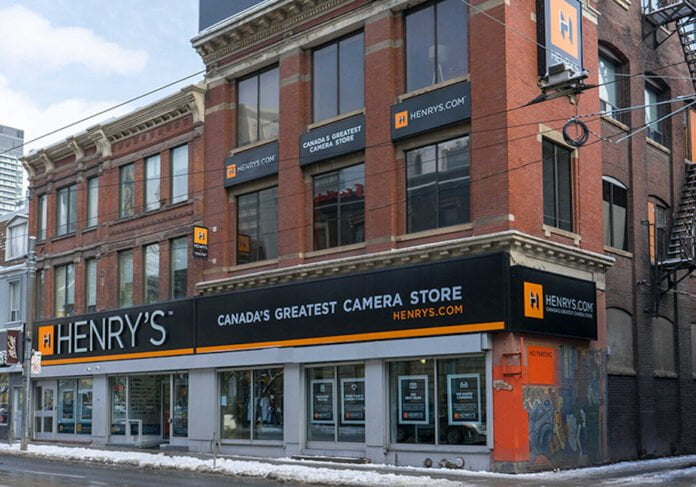
It’s often been described by those who have experienced it as a feeling of drowning. Its effects can be debilitating, rendering some completely and utterly helpless, skewing perspective, and sending senses and faculties of mind whirling uncontrollably. It’s a leading cause of disability in Canada. And yet, our understanding of mental illness, the anguish endured by those who suffer from any of its many forms, and the triggers in society that cause the hurt in so many is still not well understood by the general public. For this reason — to help support the mental health of all Canadians and continue to expel the stigma of mental illness — Henry’s Foundation is bringing the issue into focus through its dedicated work and the launch of its #uncapturedmoments campaign.
Founded in 2019 by the Stein family, and supported proudly by fourth generation family-owned and-operated creative retailer Henry’s, the Henry’s Foundation is a Canadian registered charity with a mandate to raise awareness around the issues and impacts of mental illness and, through charitable donations, help to support the efforts and initiatives of its national and regional partners aimed at addressing and improving the mental health of Canadians.
“Mental illness is something that touches everyone, either directly or indirectly,” says Amy Stein, Executive Director of Henry’s Foundation, adding that the issue of mental health is something she and her family feels passionately about. “It might be a neighbour who’s affected, a friend, co-worker or a family member. The statistics related to mental illness and the number of Canadians negatively affected by it are staggering. We want to make a positive impact on those who are suffering and help to lessen the severity of its effects and repercussions. Our objective is to continue advancing our work so that the positive impact that we make for those suffering from mental illness is long lasting and to expand its understanding with all Canadians.”
Making a Difference
The statistics related to mental illness that Stein refers to are, indeed, staggering. According to the Centre for Addiction and Mental Health (CAMH), it’s estimated that in any given year about one in five Canadians experience the effects of mental illness. And, as individuals grow older, those numbers only increase, with at least 1 in every 2 people in the country having experienced a mental illness at least once in their life by the age of 40. What’s more, the many forms of the disorder do not discriminate, impacting everyone of all ages and backgrounds.
One of the ways in which Henry’s Foundation is already making its intended impact is through the many partnerships that it’s formed with mental health organizations across the country, including Kids Help Phone and Jack.org, Centre for Addiction and Mental Health (CAMH) in Toronto, VGH & UBC Hospital Foundation in Vancouver, Douglas Foundation in Quebec, and the Mental Health Foundation of Nova Scotia. By way of charitable donations, Henry’s Foundation helps to support the initiatives and programs offered by its partners, helping to forge a community of assistance and support for those in need, and a unified voice around the obligation to provide them with the proper help.
“Our wonderful partners are critical in providing mental health services and support across Canada,” says Stein. “They are partnerships that have been deliberately and purposefully formed. These organizations are leaders in the areas of their focus, providing Henry’s Foundation with a great cross-section of partners offering services, research, and programs that empower at all ages across Canada. These partnerships are so important to what we do and helps us realize our goal to reach as many Canadians as possible.”
Breaking the Stigma
Mental illness, which can be seen by the unenlightened as an inconvenience of society, can manifest itself in numerous ways, resulting in complications that can lead to family conflicts, relationship issues, social isolation, discontented life, challenges with addiction, legal and financial problems, poverty and homelessness, amongst many other challenges. It also rears its ugliness through physical reactions that can result in a range of ailments, from a weakened immune system to heart disease and other medical conditions and, in worst case scenarios when the proper care is not provided, self-harm and harm to others, including suicide or homicide.
The presence of mental illness can be caused by a multitude of conditions and factors and be contributed to in a number of different ways, including those that are brought on and impacted by feelings of social anxiety and marginalization. And, despite all of the wonders of communication that social media platforms have bestowed upon us, the false representation of perfection in an imperfect world that the medium has helped cultivate and personify has bred a feeling of inadequacy and failure in many, lending to a demoralization of self.
“People generally only post the highlights of their lives on social media,” recognizes Stein. “But there is much more going on in the background of everyone’s ‘real’ life that nobody gets to see because those things never get posted. Everyone has a tough time getting out of bed some mornings. Everyone experiences difficulties maintaining friendships and relationships from time to time. Everyone struggles. Life isn’t perfect and has its ups and downs. We saw this as an opportunity to leverage social media to build a community with the message that ‘it’s ok NOT to be ok’ and to encourage the sharing of real moments that may not be our best.”
The Henry’s Foundation #uncapturedmoments campaign, launched in alignment with Canadian Mental Illness Awareness Week and World Mental Health Day, challenges people to use their photographic creativity to share their everyday moments, unfiltered, in an effort to shift the narrative and shatter the illusion of perfection that’s infiltrated social media. By uploading images of “uncaptured moments” to the Henry’s Foundation website, or by sharing them on Instagram with the hashtag #uncapturedmoments, anyone can participate in helping to eradicate the stigma of mental illness and show others that they are not alone. In addition, the campaign, which runs until Saturday, October 10, will generate a donation of 25 cents from Henry’s Camera for tags, comments or images submitted, with proceeds of the campaign going toward support of the services of its mental health organization partners. Donations can also be made online at henrysfoundation.com or by visiting any Henry’s retail location. A selection of images can be found on www.henrysfoundation.com/moments
Impact of Global Pandemic
Stein, who worked for Henry’s for 19 years serving in various roles on the corporate side of the company before starting Henry’s Foundation, also recognizes the ways in which the COVID-19 pandemic has highlighted mental health and the need to provide the right support for those affected. Mandatory health measures and precautions, which have been directed toward advising people to stay home and avoid contact with others when possible, have resulted in increased feelings of anxiety and stress for many. In fact, 50% of Canadians have reported that the current pandemic situation has negatively impacted their mental health with an alarming 80% of the country’s workforce reporting the same, exacerbating an already prevalent and widespread issue.
“The pandemic has significantly impacted everybody’s mental health to some degree,” says Stein. “I think that’s the understatement of the year. Disruptions to our families and daily lives, the economy, the way we work and interact with people, has impacted everyone. And I think the things we’ve all been going through collectively have really emphasized the importance of our mental health and the fact that it needs to be made a priority now and moving forward, perhaps more than ever before.”
The critical role retailers and businesses play in supporting the health of their employees is also something that Stein addresses, pointing out their responsibility to do so.
“All businesses need to take it upon themselves to support the mental health of their employees. Those working in frontline customer service roles are experiencing a lot of anxiety. Some of them might be dealing with personal issues that employers may not be aware of. Employers need to listen to their employees, building relationships with them that are authentic, ensuring that they maintain regular communication, providing access to support resources. As leaders, we need to set an example, making sure that our employees feel supported and appreciated, giving back to the people and communities who have always supported us as a business”
Stein admits that it’s always been a part of the Henry’s Camera philosophy to give back to the communities it serves, and that the work being done by Henry’s Foundation is just another representation of the company’s vision. However, it seems to serve as an extremely important extension of its philosophy and vision, filling a vital role in a time of dire need. And, listening to the Foundation’s Executive Director vocalize her plans for the future, it seems the role Henry’s plays in supporting mental health will only continue to grow in significance
“We want to continue supporting our employees and their families across the country. And we want to continue to integrate and nurture a culture of mental health into the day-to-day operations at Henry’s, making it a priority in everything that we do as a company. But we also want to take our work and the positive change that we can influence beyond retail to reach every Canadian in need, and to continue working with our partners to help amplify the amazing work that they do in an effort to support the mental health of everyone from coast-to-coast across the country.”
It’s no secret that the retail industry around the globe is currently experiencing one of the biggest challenges in its history, caused by COVID-19 and the subsequent economic downturn that is challenging businesses’ cashflows and ultimately their existence. In order to prepare for the future and ensure survival, some companies began to innovate and adjust to the micro and macro-economic shocks that reshape the already competitive retail space.
A retailer of tomorrow must not only be connected with its customers and key stakeholders, it should also be agile and quick to adapt to the challenges and new regulations that are imposed industry-wide. From the booming e-commerce industry and shifting generational trends, to AI and machine learning CRM solutions, a successful retailer must be aware of the opportunities that those changes create.
Retail Insider has in the past reported on a Concord based premium retailer, OriginalLuxury Inc., that currently carries a number of extravagant brands that were not widely available in Canada in the past including a notoriously rebellious Philipp Plein from Switzerland, a classic and chic Zilli from France, and highly-popular and growing Slowear group of brands. In order to learn more about the company’s success and its approach to maneuver through these difficult times, we spoke with Husan Aripov, managing partner of OriginalLuxury, to see what tools and tactics could be employed by other Canadian retailers facing the same issues.
OriginalLuxury Inc. is a premium retailer of exclusive (mainly European) brands that was founded in 2018 to cater to the Canadian market. In a short period of time, the company became an official distributor for a number of high profile brands, including Artioli, Faliero Sarti, Billionaire, Philipp Plein, Barba Napoli, Incotex, Zilli, and more. It is worth noting that some of those brands were not present in Canada before, or were represented in very small variety. Zilli, for example, is one of the oldest and most sought-after ultra-premium menswear brands, that caters to the most affluent clientele. This approach of targeting niche brands allowed OriginalLuxury to position itself among premium retailers very well, without directly competing with them.
Although the company is mainly focusing on e-commerce sales through its own platform, this year it has opened a “by appointment-only” showroom for OriginalLuxury clients to be able to see and try the products on before making a purchase. “We strongly believe that COVID-19 pandemic has changed the way individuals eat, go out, and most importantly shop” says Aripov. “You do not want to go to a crowded mall, or a store during a pandemic – simply because the associated risks outweigh one’s desire to go shopping. As a result, customers are shifting towards online shopping across all product segments, which puts even more emphasis on ensuring quick and high-quality production of content for e-commerce platforms”. OriginalLuxury was lucky enough to create its own subsidiary, Stylephotos.ca, that acts as an in-house photography and videography studio.
StylePhotos helps other retailers across Canada to create outstanding photo and video content at a reasonable price, something that is so needed in today’s economy. Retailers are always stuck in a “loop” of buying new collections three or four times a year, and the faster their order gets online the faster they will make money. “At StylePhotos we were able to create a system that allows for consistent and streamlined process to take place — something that never existed in product photography before,” said Husan.
Being in e-commerce industry themselves, allowed the young and innovative start-up to tailor their service offering specifically for every client. “Our photo-studio is not managed by photographers,” said Aripov, “it is run by business-minded individuals who look at cost-saving for clients first”. We believe that this mindset is the key factor that allowed StylePhotos to partner with the largest Canadian retailers, while offering the same service to small companies and individual entrepreneurs.
For OriginalLuxury, staying focused on customer service, having a limited and carefully-curated brand portfolio, and constant innovation allowed the company to survive the ravaging effects of the COVID-19 pandemic. These factors are also relevant to other retailers, who are looking not only to survive, but to succeed at a time, where odds are not in their favour.