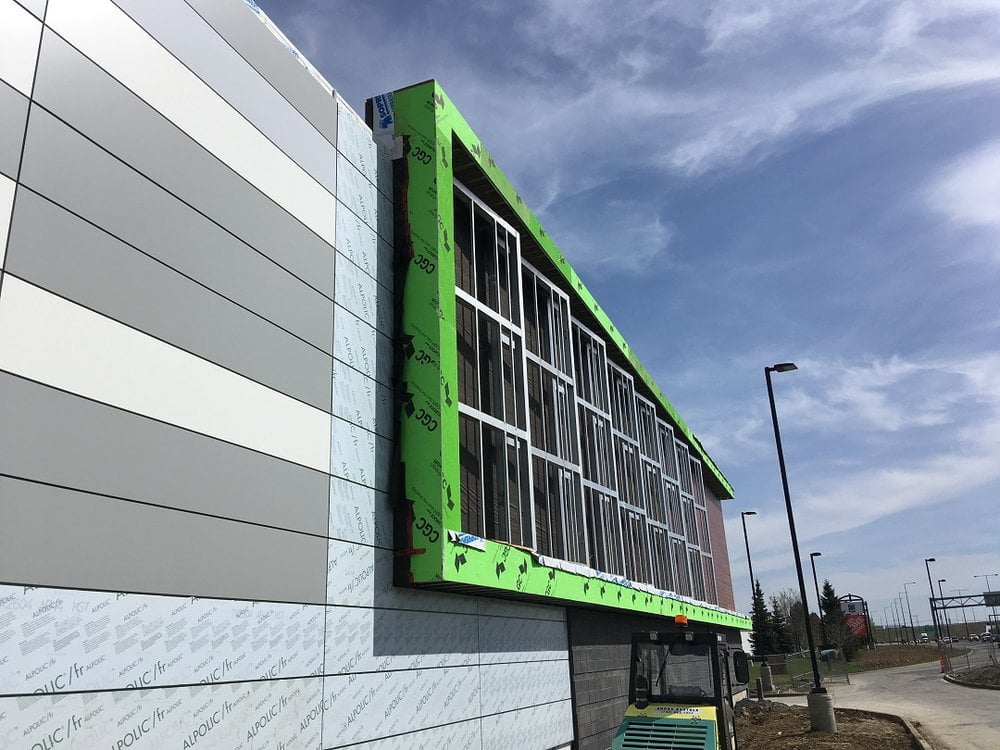
CONSTRUCTION UPDATE AT COQUITLAM CENTRE. PHOTO: BOYS'CO
Upscale and trendy Vancouver-based multi-brand men’s retailer Boys’Co will be relocating its downtown store to the suburban Coquitlam Centre in August, exiting a Vancouver Robson Street location. The new store will become the largest in the company’s history.
The new Coquitlam Centre Boys’Co will span about 3,000 square feet with an impressive 50-foot frontage that will provide exceptional visibility. According to the company’s President, David Goldman, the Coquitlam Centre Boys’Co is “at centre ice” in the centre, across from the mall’s Apple store (one of the largest in BC) and adjacent to a busy Aritiza location on the mall’s upper level.
The Morguard-owned Coquitlam Centre is one of the largest malls in the Lower Mainland, spanning about 1.18-million square feet with more than 200 stores, 11+ million visitors annually and 4,500 parking spaces. Anchors include Hudson’s Bay and Walmart as well as smaller anchors such as Best Buy, Golf Town, London Drugs and a T&T Supermarket. Coquitlam Centre is one of the most productive shopping centres in the Lower Mainland in terms of sales per square foot, and the centre is seeing some exciting new retailers, including a Uniqlo store which will be opening in the centre this fall.
CLICK FOR INTERACTIVE GOOGLE MAP
ROBSON STREET STORE IN 2014. PHOTO: COLIN ARBER
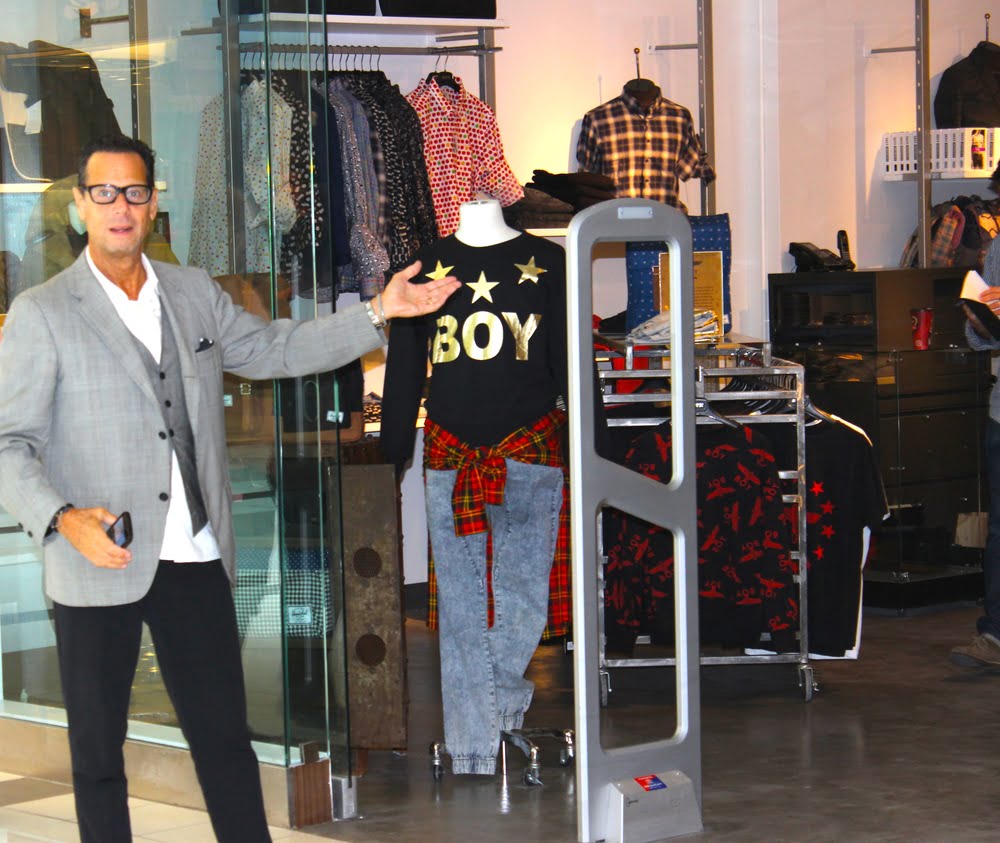
DAVID GOLDMAN IN FRONT OF GUILDFORD STORE
Boys’Co showcases well-established, and medium to upper end designers, catering to young and ‘fashion-inspired’ men, according to Mr. Goldman. In 1984, the store concept was conceived by Mr. Goldman, whose family has been in the men’s retail clothing business for three generations. Boys’Co’s first store was at Oakridge Centre.
The existing 2,000 square foot Robson Street flagship at 1044 Robson Street opened in 1997, which replaced an earlier location at 1080 Robson Street that opened in 1987 (that building was demolished for redevelopment). The 1044 Robson Street flagship was renovated in 2014 and we attended the ‘grand re-opening’ that October.
Boys’Co continues to operate a store at Vancouver’s Oakridge Centre, as well as a newly renovated unit at Metropolis at Metrotown in Burnaby, and at Guildford Town Centre in Surrey. The suburban retail model appears to be working for Boys’Co, as both the Metropolis and Guildford locations are said to be the top-producing units for the chain.
METROPOLIS AT METROTOWN STORE. PHOTO: BOYS’CO
INSIDE THE ROBSON STREET LOCATION. PHOTO: ADRIAN MANDY
The Boys’Co nameplate is part of the Murray Goldman Men’s Wear group, which was founded by David Goldman’s father in Vancouver in 1946. The original West Hastings Street multi-brand retailer became an important menswear destination for the city. In 1957, Murray Goldman opened the city’s first young men’s store, called ‘The Ivy Room’, which catered to the Ivy League look of the 1950’s, (think Oxford button down shirts, cardigan sweaters and skinny Levi’s), and was located next to his Hastings Street store.
David Goldman started his fashion career as a teenager in the 1960’s. While in high school, he worked part-time at his father’s store, Murray Goldman Men’s Wear. After college, David Goldman moved to London, England, where he worked full time at a young men’s boutique on fashionable King’s Road. He then returned to Vancouver in 1971 to work alongside his father. David’s initial responsibilities included operating and buying for their then jean shops, called Bus Stop Stores — a predecessor to Boys’Co.
Today, Boys’Co has its third generation family member, Sam Goldman, as lead fashion buyer and directing operations. Rounding out the management team is Executive General Manager – and almost 33 year company veteran, Michael Roley.
Over 200 distinguished VIP and media guests gathered at the Vancouver Convention Centre last week for the Kimberlite Diamond Fine Jewelry Show, coinciding with the opening of Kimberlite’s first flagship store in North America at 2828 Granville Street. On the runway was $50-million worth of signature haute masterpieces which impressively conveyed the brand’s global vision in luxury jewelry design. The evening’s celebration was the follow-up of the launch of Kimberlite’s North American flagship on Vancouver’s South Granville Street.
Hosted by Columbian-Chinese pageant queen Maria Rincon and including performances by renowned Chinese opera singers Mr. Yu Junjian, Ms. Wang Yifeng, and Ms.Yin Xiumei (who were flown in especially for the event), guests were entertained by an acrobatic duo, three distinct media walls for portrait options, and a catered selection of food and beverages.
Opening speakers included Mr. Yu Shanjun of the Chinese Commercial Consul and Mr. Dong LiuSheng, President of Kimberlite. Sitting in a position of honour in the audience, with Kimberlite’s Head of Canada Erica Chen, was Canadian-born Hong Kong-based actress Linda Chung.
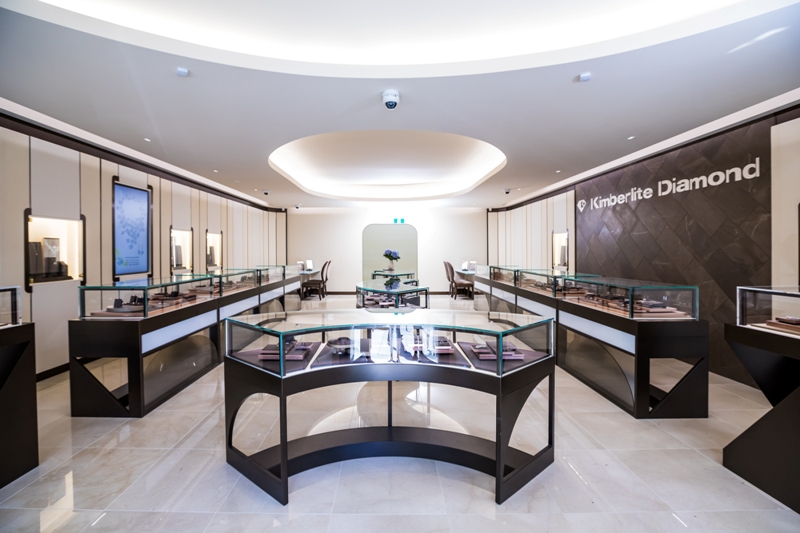
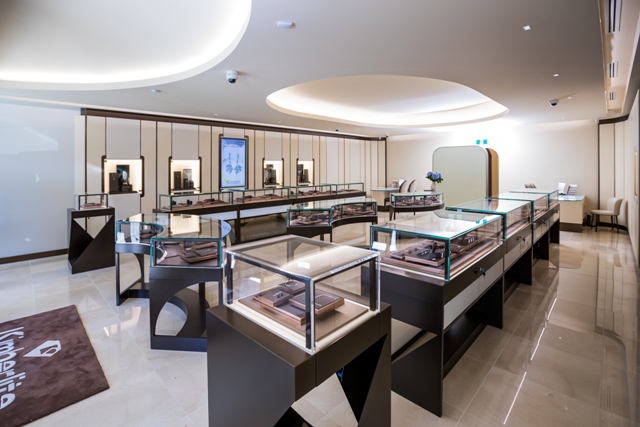
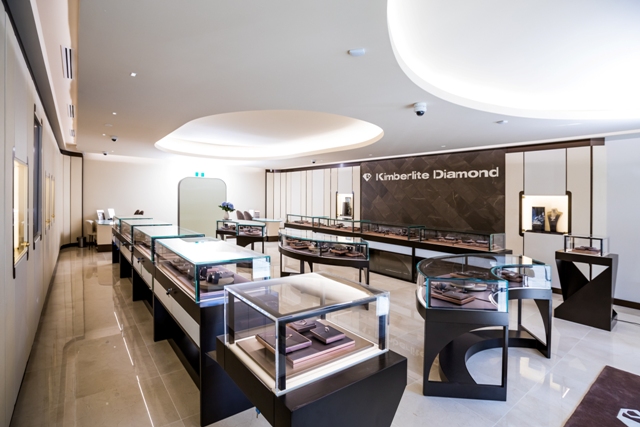
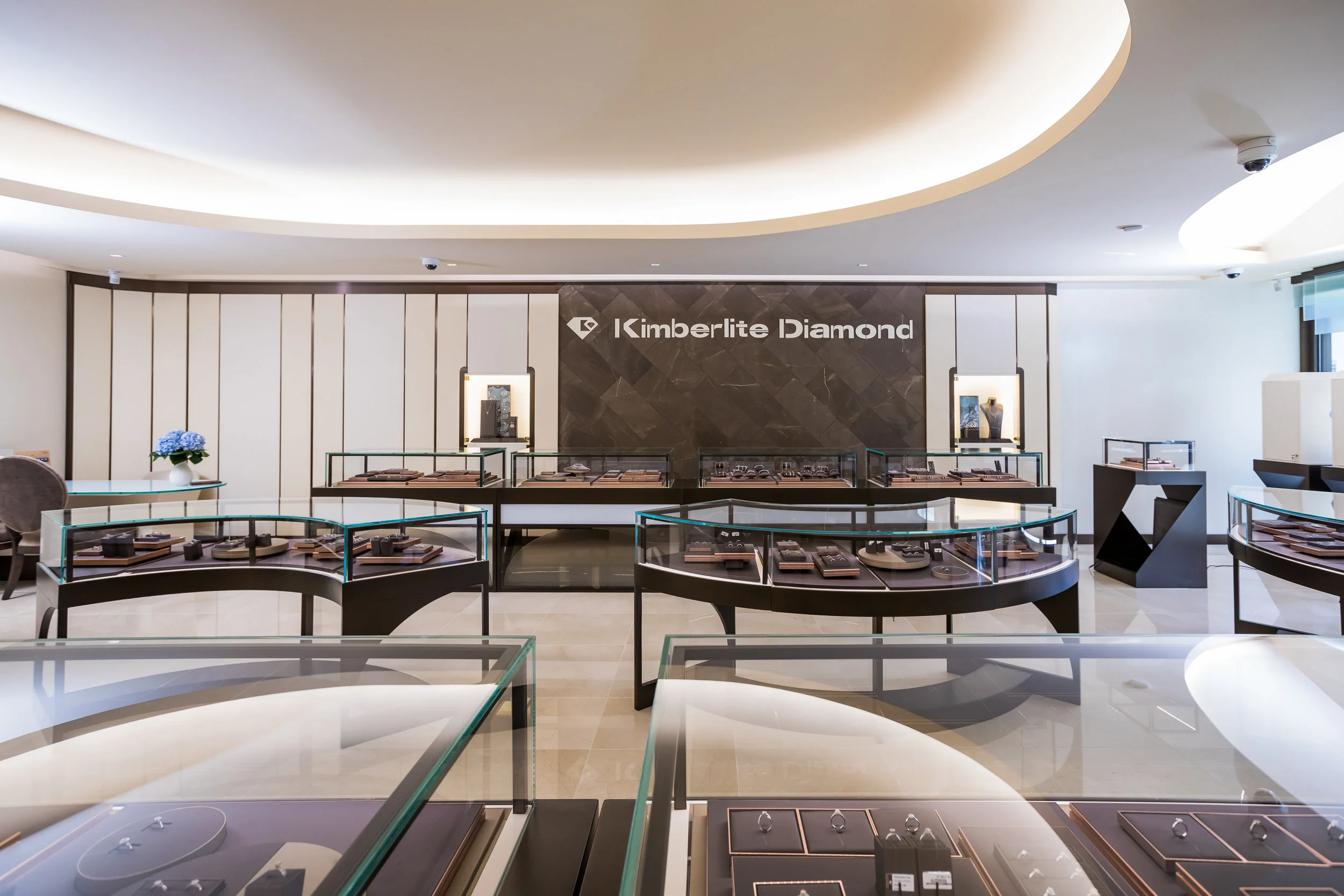
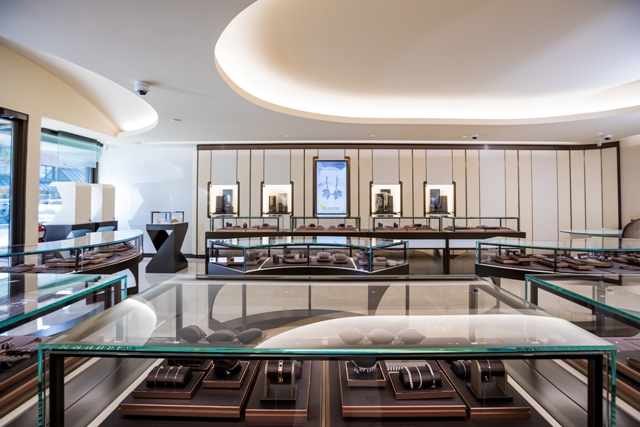
Granville Street storefront (Above) by Helen Siwak. Interior photos (Below) by rae kung (Think x Blink)
The 2,012-square-foot space on South Granville was envisioned by Vancouver design firm Cutler, and completed with assistance from Peregrine and CDC Construction. Fixtures and design cases were custom-ordered and tailored especially for the Canadian market with the marble flooring laid with the greatest of care. The use of luxurious textures and finishes in a neutral palette reflect the quality of the product while letting the diamonds glimmer without competition for attention.
Impressive design features include custom ceiling coves with indirect lighting, leather-inspired wall paneling, soft forms, and layers of glass. The overall effect is one of understated elegance. Peregrine manufactured the store’s upholstered wall panels, metal and glass showcases and consultation desk.
Established in 1995, Kimberlite Diamond is the first definitive brand to specialize in diamond jewelry in China and is recognized as the leader in China’s diamond industry with almost 700 retail locations. Kimberlite was also the first in China to follow the “quality authentication protocol” with international diamond professional organization HRD (Belgium Diamond High Council), ensuring high-quality diamonds for all Kimberlite Diamond customers.
“Because we truly value the North American market, we have presented the best of our high jewelry collection at this top-notch Fine Jewelry Show in Vancouver,” said Mr. Kellan Dong, Kimberlite Diamond’s CEO. “We hope all of our distinguished customers and media guests are able to better understand our brand’s vision, with the showcase of our ultimate collection at last night’s fine jewelry show.”
Since 2015, Kimberlite Diamond has been the only jewelry brand from China to showcase its diamond collection at Baselworld in Switzerland. After being exhibited along with the world’s most prestigious jewelry brands inside the High Jewelry Pavilion, the Kimberlite brand is now well-recognized as a rising star in the industry.
When asked why Vancouver was chosen as the North American flagship location at 2828 Granville Street, Dong explained that as a company they “recognize the potential growth of spending power in North America, especially in Vancouver. Vancouver is an iconic multicultural city where people here can well-accept different cultures and new ideas.”
Highlights of the Fine Jewelry Show:
The Moon Goddess. Photo: Kimberlite Diamonds
“The Moon Goddess” is a 25.05-carat main moon-shaped diamond, complemented by 1877 gems creating a unique silhouette, and a total weight of 108 carats, valued at $26M.
The Melting Iceberg. Photo: Kimberlite Diamonds
“The Melting Iceberg,” winner of the Designer Award of China Jewelry Design and Production Skills Competition, valued at $400,000. Platinum and diamonds depicting an iceberg floating atop the Arctic Sea.
Plum Blossom. Photo: Kimberlite Diamonds
“Plum Blossom” crown and bracelet set unveiled at Baselworld 2016, valued at $300,000, from Kimberlite Diamond’s “Charm of China” collection.
Riding the Wind and Waves. Photo: Helen Siwak
“Riding the Wind and Waves” necklace and earring set from the “Sino-Song” collection, valued at $380,000. Inspired by a Song dynasty painting titled “Layers of Raging Waves.”
Zhu Wenjun with Models. Photo: Kimberlite Diamonds
“These extraordinary pieces illustrate our unique approach to luxury jewelry design. The idea of “East Meets West” hasn’t just distinguished our brand, but has also extended our creative sphere by synthesizing traditional Chinese culture with contemporary jewelry design,” commented Ms. Zhu Wenjun, Chief Designer of Kimberlite Diamond and the proud winner of the World Gold Council and Hong Kong JMA International Jewelry Design Competition.
To further introduce Kimberlite Diamond’s unique vision to the world, the company is already looking to expand into other core North American cities such as Toronto, New York, and Los Angeles.
Luxury resale – buying and selling of preowned luxury goods – is a booming business that is fuelled by digital businesses that are also opening brick-and-mortar storefronts.
The first-of-its kind cutting-edge retail space will be used as a prototype for the chain as it embraces the future of experiential retail. Innovations allow visitors to see a vast assortment product not actually in the store by using augmented reality, video walls and touchscreens.
STOREFRONT AT 829 QUEEN ST. WEST ON SATURDAY, JULY 14. PHOTO: ACT7/URBAN TORONTO
Korean beauty company VDL will open its first North American store this summer on Toronto’s trendy ‘West Queen West’. This month, the company is also launching wholesale distribution for 200 of its products in several ‘The Face Shop’ and ‘Nature Collection’ locations in Ontario, Alberta and British Columbia.
VDL’s expensive product offerings include makeup (face, lip, eyes, cheeks), nail, skin care (including masks and men’s offerings), cleansing, body & hair and related beauty ‘tools’ such as foundation brushes. The line, which stands for “Violet Dream Luminous”, was founded in 2012 and it has stores in Korea, Singapore, Vietnam, Philippines, China, Hong Kong, as well as wholesale distribution in various global markets.
Prices for VDL products are considered to be ‘moderate’ — they’re generally lower than luxury brands found in department stores, but higher than some value-priced drugstore brands, as well as brands like Deciem that are competing on both quality and price.
VDL was expected to open its Queen Street West store at the end of June, though a visit last week showed that it was still under construction. We’ll update this article with more information once the Queen Street store opens to the public.
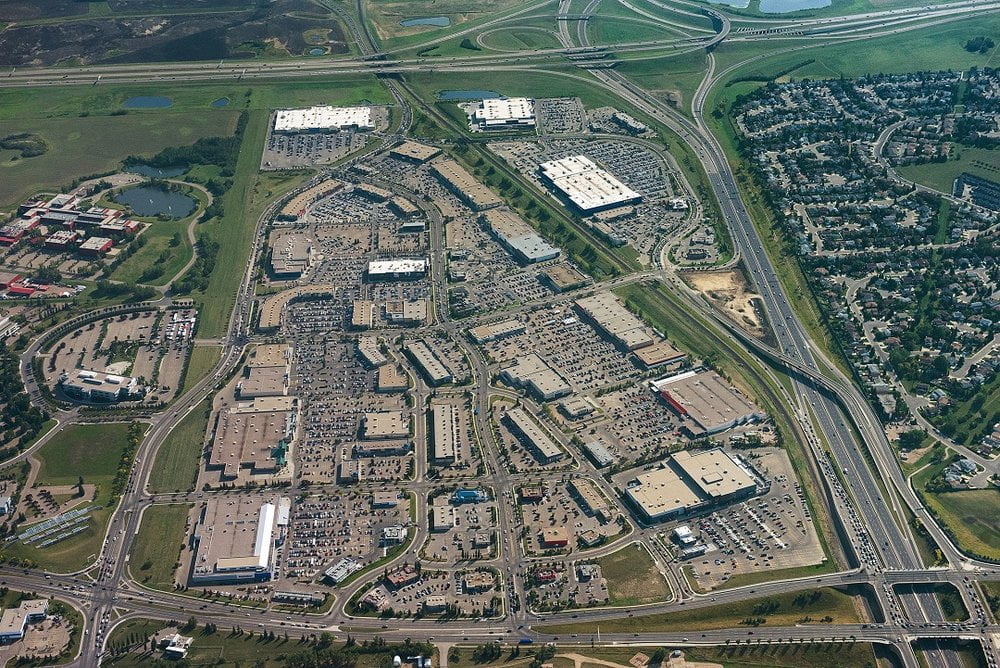
South Edmonton Common, one of the largest open-air retail developments in North America, will get bigger in the fall with the opening of a Nordstrom Rack location.
The retail power centre, spread over 320 acres and containing more than 2.3 million square feet of dining, shopping and entertainment space, has developed a reputation of being the place where many retailers establish their first locations when they come to Edmonton.
“So the flagship Canadian Tire store, also the biggest Canadian Tire store in Canada, is located there,” said Pacheco, of the 140,000-square-foot store over two floors which opened in 2015.
He said the Nordstrom Rack, which opens in October, will be the first location in Edmonton and the only confirmed one.
It will be 35,000 square feet and is Nordstrom’s off-price retailer offering on-trend clothing, shoes and other accessories. The power centre said Nordstrom Rack will be offering 30 to 70 per cent off regular prices and the store is designed to provide the ultimate treasure hunt to style-savvy customers.
When Nordstrom first announced in August 2016 that it would be entering the Edmonton market at South Edmonton Common, its Canadian president Karen McKibbin said: “We want to be in compelling locations with a great retail mix, and we feel our new store at South Edmonton Common helps us to achieve that goal. We look forward to introducing ourselves to customers in Edmonton and bringing them great brands at great prices.”
It’s located at the gateway to the south entrance into Edmonton and situated at one of the city’s highest traffic locations, bordering the city’s eight-lane ring road, Anthony Henday Drive – making it easily accessible to shoppers from all of Edmonton’s suburban areas.
“It’s one of the places where you can only find these stores in. So there’s something for everyone and in some cases as with Nordstrom Rack it’s the only one of that in the city,” said Pacheco. “There’s the only IKEA in the city there. For awhile it was the only Rec Room.”
Over the years, South Edmonton Common has been a leader when it comes to power centre developments across North America. It has often been where many retailers have first introduced their brand to the Edmonton market.
“The centre’s almost fully built out. We’re really excited because this format didn’t exist in Edmonton before this sort of open-air big box centre a bit outside of the city. A place of firsts for standalone retailers,” said Pacheco.
Image: South Edmonton CommonImage: South Edmonton Common
The centre is promoting walkability and sustainability. It will be putting in electric vehicle chargers in there shortly. It is also looking at improving transportation in the area.
“We’re really updating it for modern consumers,” added Pacheco.
“We may look at having a public space in there – an event space.”
With a population exceeding 650 million people, Latin America is a key partner in terms of commercial relations for many nations worldwide. With a potential market of this size, it comes as no surprise that the region is growing in the eyes of international sellers looking to expand globally.
It is no different for Canada. In fact, the region is among the most important ones for the country: Mexico, the second largest Latin American economy, is in the top 5 countries to which Canada exported the most in 2016, figuring not so far behind Japan, according to World Bank’s data. The value of bilateral trade between Canada and Brazil, the largest economy in the region, amounted to $6.4 billion Canadian dollars in 2017.
For Canadian online retailers looking to start selling or increase sales to Latin America, this is great news, showing that commercial relations are healthy. It is a matter of improving the online store having Latin American consumers in mind.
And having Latin American consumers in mind means building a sales strategy tailor made to reach them, considering all of their specificities. For users of the Shopify platform, which is often among the most used ones worldwide, there are a few apps and hacks that can improve user experience based on these specificities, and ultimately impact sales rate of the online store.
But, before jumping into Latin America’s specificities and the things you need to do in your Shopify store in order to increase sales in the region, let’s really understand the size of your opportunity there.
GALERÍAS PACÍFICO SHOPPING CENTRE IN BUENOS AIRES, ARGENTINA. PHOTO: DE PASERIO
Why should I think about starting or increasing sales to LaTam?
Commercial opportunities in general are great in Latin America. When it comes to ecommerce specifically, the region’s landscape offers equally excellent opportunities. High levels of internet penetration are helping ecommerce to grow at a remarkable pace. Take Brazil as an example: it is one of the top 10 ecommerce markets in the world while being the fourth country with more internet users.
Retail ecommerce sales in Latin America as a whole are expected to reach $84.75 billion U.S. dollars by 2019. Two of the three fastest-growing ecommerce markets in the globe are Latin American countries: Colombia and Argentina.
When we consider cross-border ecommerce market in Latin America, the environment is also great. In Brazil, 22.4 million people purchased online from foreign websites in 2017, as reported by WebShoppers, a research conducted annually by Ebit on Brazilian online consumers’ behavior. In Mexico, 67% of online consumers bought from international websites in the same year, according to Mexican Internet Association’s report.
Undoubtedly, 2018 is an ideal time for Canadian online retailers to look closely at the Latin American ecommerce market. Not only to simply enjoy a market share of this total amount, but also because a trade war is raging between the country and the United States, which is currently Canada’s most important export partner.
As an aspiring online retailer or an already established one, you need to stay ahead of the competition and make your online store more convenient for the LaTam market.
Things to consider when selling in Latin America
As said, Latin America has its own specificities. The fact that it is comprised of over 40 countries gives an idea of how diverse it is. With the exception of Brazil, which speaks Portuguese, the majority of countries speak Spanish. Currencies also differ. So, a multi-language website, that displays prices in local currency is a must. Payment methods are another particularity.
Whether you are targeting Brazil, Argentina, Mexico, Colombia, or any other country in Latin America, you must understand all these differences and put together the best sales strategy.
Here are some significant things that you need to know and that you can do to enhance your Shopify online store in order to increase sales in Latin America, considering all its specificities:
Offer a multi-language website to navigate in
Having a multi-language online store will unlock new opportunities to your ecommerce business while helping you build trust in the Latin American market. A multilingual website allows you to provide an enhanced user experience for customers in the region, talking to them in the languages they are comfortable with. A multi-language ecommerce website will also help you improve your visibility and attract more customers.
Sometimes, adding full multilingual support adds immense complexity to your regular online store. This is why Shopify has developed language apps and themes that can make the process easier and smoother.
Here are some of the best multilingual apps available for Shopify:
Langify App
Panda Language Translate
EBANX Shopify App – Mixtore
LangShop App
Multi Lingo App
Weglot Translate
Each app has its own features, charges, and specialties. So, choose the most suitable one for your ecommerce store and reach the Latin American ecommerce market with ease.
Display multi-currency prices
User experience is highly valuable in ecommerce stores. One single click can drive potential customers away. Product prices shown in a currency other than your customer’s means that they will have to calculate how much the amount represents in their local currency. The whole process can scare visitors off, since they won’t be able to instantly determine if a purchase fits into their budget or not – estimates don’t always come easily since exchange rates can fluctuate a lot. This uncertainty will eventually increase cart abandonment rate.
If you are planning to target Latin America, you really need to display prices in local currencies: in Real (BRL) in Brazil, Mexican Peso (MXN) in Mexico, Argentinian Peso (ARS) in Argentina, Colombian Peso (COP) in Colombia, and so on.
Shopify allows you to display your products in different currencies with the help of multi-currency converter apps. Here are some of the best ones:
BEST Currency Converter
Auto Currency Switcher
Coin
Currency Converter Plus
Before you choose any app, it is recommended to do some research and choose the best one according to your needs and specifications.
Provide payment options with which people are used to
When it comes to selling efficiently in Latin America, you need to consider local payment methods as well. Even when buying online, Latin Americans often like to pay with offline payment methods, such as cash vouchers, which are very popular in the region. When you consider that 49 percent of the Latin American adult population is unbanked, and has no access to financial products such as a credit card whatsoever, it is possible to understand the immense importance of cash payment options in the region.
Brazilians, for instance, use a voucher payment method called Boleto Bancário to pay from utility bills such as water and electricity to online purchases, either by going to an authorized place to pay it with cash, or by using internet banking. People from all around Mexico know, trust and use the OXXO voucher, which allows them to pay for online purchases at a convenience store, using cash.
Domestic credit and debit cards, that cannot process foreign currencies, are also used by many Latin Americans.
However, shopping transactions outside the region can make payment processing more complicated. Authorization rates decline with various bank requirements and processes with direct credit and debit card payments. Using international payment gateways can resolve this problem.
Latin Americans also pay through international payment gateways for online shopping and other digital transactions. International payment processors enable Canadian merchants to accept preferred payment methods without maintaining a relationship with financial institutions. They support e-commerce retail brands to boost sales by eliminating payment barriers for international shopping transactions.
With international payment gateways, Shopify store owners can scale quickly as they can accept local payment methods, collect taxes, and comply with domestic transaction laws. This seamless payment processing entices new customers and increases your store’s referral rate with the help of your existing customers.
By implementing multiple payment methods to your Shopify store, you will be able to reach all customers, including the ones that do not have an international credit card and the ones that simply prefer to pay with local payment methods. This will boost your online store’s conversion rates while winning consumers’ trust.
Mixtore powered by EBANX is a solution that allows Shopify online stores to offer Latin American local payment methods, making sale rates rise. Merchants that added the Mixtore local payment gateway in Brazil, for instance, experienced a sales growth of up to 3,000 percent in the country, by offering payment options such as Boleto Bancário for their Brazilian customers.
Shopify provides other third-party payment gateway integrations. Before you start selling in LaTam, discover the most suitable ones for your targeted audience.
Other Shopify hacks that will improve your conversions
Undoubtedly, Shopify is one of the best ecommerce platforms which allow to display multiple languages, currencies, and offer multiple local payments. It can help you put together a professionally-developed global online store. But, there are other hacks that can also help you establish your online store as a winner in the LaTam ecommerce market.
Here are some of the highly-recommended Shopify apps which must be considered by every Canadian merchant:
● Plug in SEO
Several approaches can help you drive traffic to your online store, but one of the best and long-term strategies by far is SEO (Search Engine Optimization). A well-planned SEO strategy can help your ecommerce website to be on top of the results of search engines such as Google, Bing, and Yahoo.
Plug in SEO is a widely-preferred Shopify app which works like a practical assistant, providing verdicts about what you can do to optimize your website for search engines. You can download and try this app for free for 14 days.
● Outfy
Outfy will help you promote your products to over 14 social media platforms from a single place. Facebook, Twitter, Instagram, and Pinterest are some of these social media. It also allows you to schedule your posts in advance and get all the insights about the traffic and conversions, increasing your productivity.
● Tidio Live Chat
When you are dealing with multiple countries, you need to be available 24/7 to answer customer queries. Tidio Live Chat works like a window in your ecommerce page, providing a channel to communicate fast with your customers. You can also connect it to your mobile phone to quickly respond to your online buyers from anywhere and anytime.
● Oberlo
Oberlo allows you to add dropshipped products to your online store and ship them directly to your buyers. The app is specially designed for startups who work with importation and dropshipping. So, you can easily deal with Latin America and improve your ecommerce business without sourcing the products. Oberlo also makes it easy to track your orders while automating order management.
Wrapping it all up, a multi-language website coupled with multi-currency prices and multiple payment gateways, great chat support and other exciting features can help enhance your Shopify online store. Hopefully, all those tips mentioned above will contribute to your global sales strategy and increase sales in Latin America.
Nicholas Ghitti
Nicholas Ghitti is a sales and payments specialist with deep knowledge and proven track record on the Latin American market. He already developed and managed inside sales strategies for great Latin American tech companies, besides being a mentor for startups at InovAtiva Brasil. Ghitti is the head of Inside Sales at EBANX, a global fintech headquartered in Brazil that helps international merchants to increase online sales to the Latin American ecommerce market, by offering end-to-end Latin American local payment solutions. EBANX also provides marketing consultancy to its merchants and a 24/7 local customer support team, ready to answer all questions of its merchants’ clients – in their own language. Differentiations like these elevate EBANX to a complete market entry solution.
The phenomena known as Amazon Prime Day starts next Monday, with the promise to drive considerable sales to participating small and medium-sized retailers. Some will see such high sales numbers that the 36-hour Prime Day is being compared to the Christmas rush that is typically seen in November and December and for some retailers, Prime Day’s sales surpass those of the traditional winter Holiday Season.
Prime Day 2018 starts on Monday, July 16 at 12 pm PT/3 p.m. ET, and customers can shop the deals from businesses selling on Amazon at amazon.ca/primeday.
“Prime Day helps small and medium businesses reach more than 100 million paid Prime members around the world, and provides an opportunity for the smallest of businesses to sell right alongside the biggest household brands,” said Nicholas Denissen, VP Marketplace Business, Amazon. “In fact, Prime members ordered more than 40 million items from small and medium-sized businesses during Prime Day 2017, generating record-breaking success for those entrepreneurs.”
The idea behind Prime is for Amazon to provide unlimited fast, free shipping to its members who pay an annual premium for the privilege. In Toronto and Vancouver, Prime members can get free same-day delivery. In six other Canadian cities, Amazon Prime entices with free two-day shipping. Globally, more than 100-million people globally are Amazon Prime members, who are able to use the platform to purchase products as well as entertainment. In Canada, that includes unlimited access to award-winning movies and TV episodes with Prime Video, access to over one-million songs on Prime Music, unlimited photo storage with Prime Photos, Twitch Prime, and early access to select Lightning Deals, among other benefits.
Last year on Amazon Prime Day 2017, thousands of small and medium-sized businesses saw more than $50,000 in sales. It’s a remarkable feat, considering that retail sales numbers in mid-July are typically unremarkable for most retailers.
Canadian retailers are embracing Prime Day as well, as Amazon continues to gain market share as it attracts more Canadian shoppers. Canada is a rapidly growing market for Amazon Prime subscribers, especially as the annual Prime membership fee in Canada remained the same ($79) while at the same time it was raised in the United States over the spring.
“We take part in Prime Day every year, and every year proves to be more successful than the last. Prime Day has not only been our highest grossing sales day, but it has also resulted in a strong repeat customer base by exposing our high-quality Canadian products to customers who were not aware of our brand,” said Baber Khimani, head of Blackstone Naturals from Mississauga. Mr. Khimani’s company retails natural skin care and aromatherapy products and is offering up to 40% off selected Argan, Moroccan and Beard Oils from its own brand.
Mr. Kimani’s comments are reflective of a potential shift in online retail from the typically busier pre-winter holiday season, where many retailers make the bulk of their sales. Other retailers share similar stories.
“Prime Day is an incredible opportunity for us to reach new customers that are interested in our products. The sales increase we see on Prime Day tops any other sale our business participates in. It’s our favourite day of the year!” said James Edwards, President of Spektrum Glasses in Vancouver. Again, it would appear that Amazon Prime Day has become an incredibly important part of this independent retailer’s business where in years past, July would generally have been an average month. Spektrum Glasses creates computer glasses that reflect blue light away from the lens and relieve long-term eye strain caused by excessive electronic device use — probably something many of us might consider investing in and during Prime Day, the company is offering up to 32% off selected computer glasses.
Retailers Canada-wide are optimistic that Amazon Prime Day will be a huge success — even those who are still relatively new to the game. “Prime Day is an amazing day! Last year we sold more than 10 times what we do on an average day in less than three hours. I remember refreshing my phone last year and seeing the number skyrocketing, it was so exciting! This is our second Prime Day and we will be offering more products to our customers this year,” said Tao Guo, head of Little Bot Inc. from Toronto. The retailer, known for its fun and trendy baby items made from safe non-toxic products, is offering up to 32% off during Prime Day.
One of the goals of Prime Day, as well, is to obtain new customers that might otherwise not have bought from the company in the past. “Prime Day is a celebration of Amazon offering amazing deals to customers and driving strong sales for small businesses. As a small business, it’s an incredible opportunity to easily reach tens of thousands of new customers. We highly recommend participating in Prime Day,” said Kevin Pasco, co-Founder and CMO at Nested Naturals from Vancouver. Known for its natural supplements, Nested Naturals is offering up to 23% off selected vegan capsules and sleep aid tablets from their own brand.
The team from Nested Naturals pose for a photo at the corner of West Hastings Street and Hornby Street in Downtown Vancouver
Increased sales and new customers are expected by Montreal-based GoWood, with company representative Tania Brassard saying, “The visibility and success we have on Prime Day is incomparable. Not only do we get a massive boost of sales, but also huge exposure to new clients. We’re sure this year won’t be any different.” Her company is known for its wood sunglasses and wood phone cases, made from bamboo and/or wood materials that are recycled or planted for production. During Amazon Prime Day, GoWood is offering up to 20% off selected wood glasses and phone cases.
It will be interesting to see the results of 2018’s Amazon Prime Day in Canada, as retailers are increasingly relying on the brief event to drive sales to their online stores. The Canadian retail industry is seeing considerable disruption from all directions, with online retail continuing to see considerable gains when compared to brick-and-mortar retail growth. Nevertheless, more than 90% of all retail sales are done in physical stores but as platforms such as Amazon continue to make inroads and create consumer habits, online will continue to see an increasing share in Canadian consumer dollars.
Toronto-based Consonant Skincare, known for its 100% natural products, has opened its new flagship location on Toronto’s trendy ‘West Queen West’. The impressive, intimate retail space reflects an upscale positioning for the company, which includes a dedicated area for its Hydrextremeproduct line. Consonant has also moved its offices into the back of the new space, as the company embarks on a retail expansion that will include an enhanced focus on direct-to-consumer retail locations.
It’s Consonant’s third standalone brick-and-mortar location, following stores in Toronto’s Yonge & Eglinton area (2479 Yonge Street, opened in 2011) as well as on the PATH level at the Richmond Adelaide Centre in Toronto’s Financial District which opened in 2015.
Located at 819 Queen Street West, the new store occupies more than 1,700 square feet on one level. The space is sleek and modern, which is a contrast to the historical buildings in the area that are otherwise mildly gritty with a super-cool factor. Customer service is paramount in the new store, which features onsite Regimen Coaches who work one-on-one with shoppers to educate and otherwise assist.
Bill Barker
“Our mission at Consonant is to help our guests achieve their best self through a well-rounded Consonant life,” said Bill Baker, founder of ConsonantSkincare. “Our onsite Regimen Coaches are a great resource to help shoppers make healthier choices, whether it’s related to nutrition, lifestyle, skincare and more. We’re very excited for our guests to enjoy our new store and everything that it has to offer.”
Founded by Bill Baker almost 10 years ago, Consonant’s products are 100% natural and are said to be clinically proven. Products are, for the most part, made in Canda, and are made of the highest possible concentration of organic botanical ingredients. The idea is that formulations will work in harmony with one’s natural chemistry to improve the health of skin over time.
Consonant’s new Queen Street store isn’t just a retail space, however. It also acts as a community hub for guests seeking a holistic lifestyle, according to Mr. Baker. As a result, there’s ongoing community programming for healthy living and wellness initiatives that are hosted by industry experts and leaders.
A schedule of events can be found in the store where customers are able to further learn about wellness, not to mention how the Consonant brand can assist. Yoga, healthy eating and other educational programs are all meant to promote a healthy lifestyle, with Consonant’s skincare products helping enhance an overall healthy persona.
Premium product line ‘Hydrextreme’ wall in the new store.
Mr. Baker explained how direct-to-consumer retail spaces offer face-to-face feedback that often isn’t possible with wholesalers, or online. As a result, Mr. Baker said that he expects the Consonant brand to roll-out more retail locations to further engage with consumers and to promote the brand, though such an expansion would be careful and calculated. He noted that skincare is a competitive business, and that Consonant’s products will stand the test of time when compared to other brands that are also seeking a percentage of the market. Ultimately, getting the word out is important for a brand such as Consonant.
Standalone stores is a trend being seen amongst brands as of late, in a range of categories spanning from outerwear to footwear to jewellery. Beauty and skincare, as well, is seeing rapid growth in the opening of standalone stores, with companies such as Clinique, Deciem, Jo Malone and Valmont and others opening standalone stores to attract and retain clientele.
Consonant Skincare’s value proposition could see it expand its base of stores well beyond the Toronto market — with prices that are mid-range and quality that is unmatched, the brand anticipates gaining and maintaining loyalty by supplying exceptional products in friendly, attractive retail spaces.
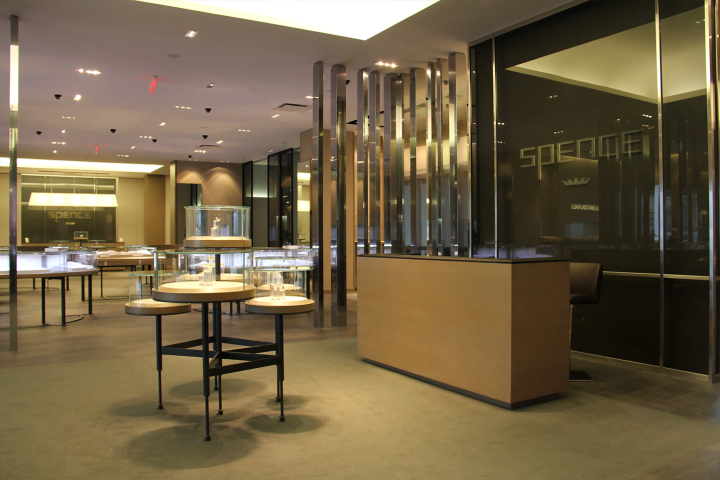
Spence Diamonds has aggressive plans to expand its footprint across North America in the coming years.
Eric Lindberg, the company’s executive chairman, told Retail Insider that Spence Diamonds definitely has plans to grow the business to other places bringing its offering from the current 10 stores to up to 40 to 45 locations across Canada and the United States.
“There are a lot of diamond retail operations in North America already that are pretty well entrenched in all of these markets. There’s not an area where there’s an obvious gap in terms of the ability of diamond retail,” said Lindberg.
“But as we have taken a look over the course of the last three years, the diamond retail buying experience this is really one of the most retrograde retail experiences that still exists really sort of largely operating in a 1950s and 1960s approach – the very highly adversarial nature of retail that operated back then. And today outside of diamond retail, and probably used car lots and mattress stores, there aren’t a lot of other areas in retail that haven’t been turned into a positive experiential customer first environment.
“Our intention is to bring that level of modern retail experience . . . over the course of the next four to six years to every major market in North America.”
Lindberg said the company’s desire to grow its footprint is driven not by the need for more diamond retail in general but because it thinks the industry hasn’t adapted to serving younger customers, providing a great experience in the store and providing the types of products and services that modern customers expect today.
Spence Diamonds was founded in Vancouver in 1978. It currently has 10 stores – seven of them, the early generation stores, are in Canada with three in the Greater Toronto Area, two in Vancouver and one each in Calgary and Edmonton. Newer generation, experiential-focused, stores are operating in the Silicon Valley in California, Scottsdale, Arizona and Austin, Texas.
The American stores opened within a few months of each other about 18 months ago.
Lindberg said there is speculative talk in the media that younger consumers are migrating away from diamonds as a mark of engagement, marriage or other activities. But he said demand for diamonds remains very, very strong.
The company’s success recently is due to its initiative to modernize its customer proposition.
“In 2017, when we deployed a whole host of improvements in the Spence experience, while the rest of retail was flat and declining, we saw a huge same store sales increase last year, particularly around our bridal sales,” said Lindberg. “You can generate tons of growth in retail if you’re obsessed with making your customers happy and with meeting their needs which is what our entire business has been changed into being focused on.”
Part of that includes Spence’s Artisan Created Diamonds. The company says it is the only diamond retailer in the U.S. and Canada to showcase both Artisan Created Diamonds, which are man-made in a laboratory setting, as well as earth-mined diamonds side-by-side, offering customers the most extensive diamond education and choice.
The Artisan Created Diamonds are indistinguishable from earth-mined diamonds. They display the same chemical and optical properties because the technology used to create them replicates how diamonds are formed in the earth.
Lindberg said Artisan Created Diamonds are always at least 25 per cent larger and are of a higher quality by two clarity grades than a similarly priced mined diamond.
He said Spence offers more than 2,500 engagement ring styles that can be made with both Artisan Created or earth-mined, or rings can be customized and designed from scratch.
“Our manufacturing studio in Vancouver can now make a customer any ring,” said Lindberg. “Spence very uniquely is vertically integrated and so we can, on the ring design side, make anything that a customer wants in about a 10-day period which is really unprecedented anywhere in mainstream diamond retail.”
He said the rest of the industry has had “its head in the sand” regarding the Artisan Created Diamonds as four to five years ago the science behind manufacturing diamonds finally reached the point where in a laboratory environment the industry was able to create diamonds that are of gem grade.
“The technology is really amazing. It is an extraordinary process by which over a 12-week period we’re now able to create diamonds that are indistinguishable that are physically identical to mined diamonds,” said Lindberg.
Starting about a year and a half ago, Spence made it a standard policy to encourage customers to look at all options of diamonds.
“We only began selling the Artisan Created Diamonds a year and a half ago and the customer adoption I would say has absolutely shocked us the degree to which both Canadian and U.S. customers when presented with those choices people have gravitated to the Artisan diamonds at a rate that I think is really unprecedented for any new product type like this . . . It is unbelievable how much consumers love the Artisan Created Diamonds.”
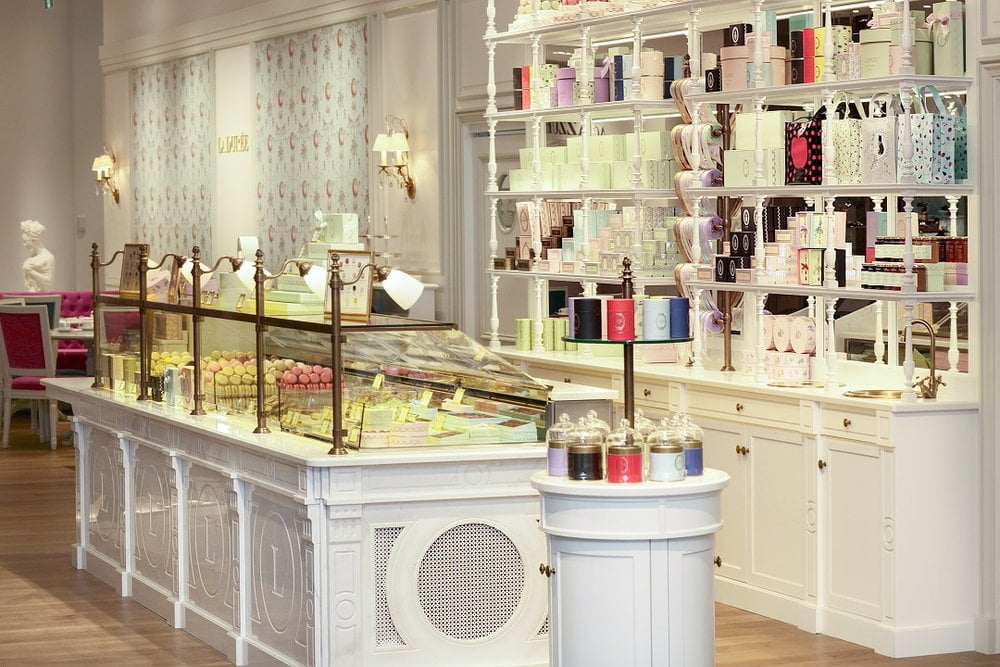
Upscale French bakery and sweets maker Ladurée has expanded its offerings at its first two Canadian locations in Vancouver, courtesy of the new purposely built Pastry Laboratory that has opened in the city. A Ladurée International Pastry Chef has relocated from Paris to Vancouver to oversee preparation of the world famous Ladurée cakes and pastries that, until now, were unavailable at Ladurée in Canada.
Chef Mickael de Monte is said to be a quintessential French pastry chef with 15 years of experience in pastry making and 5 years of experience with Ladurée. Until now Ladurée’s Canadian operations have stocked a selection of sweets such as its famous macarons, chocolates, teas, jams, accessories along with savoury and sweet menu items at the tea salons. Ladurée’s Canadian licensee Olesya Krakhmalyova explained that bringing Chef Mickael to Canada was the next step in the progression of Ladurée’s Canadian operations, which now includes three standalone locations — two in Vancouver and one in Toronto.
Ms. Krakhmalyova explained that Ladurée’s pastries are only made by Laduree’s International pastry chefs, hence the investment in talent as well as a commercial kitchen space which spans about 1,500 square feet. “We have been working towards this from the beginning,” she said. The Ladurée Pastry Laboratory will serve the Vancouver boutiques and tea salon, and a Toronto Pastry Laboratory is expected to follow next year to further serve the expanding Toronto operations.
LADURÉE ON ROBSON STREET, VANCOUVER
1 of 3
The Pastry Laboratory investment is significant, she explained, with about 90% of the equipment in the kitchen being imported from France. That includes a special oven for baking Ladurée’s famous cakes and pastries, which have become known worldwide for their unparalleled taste, exquisite beauty and consistent quality and freshness.
As Laduree Canada Executive Pastry Chef, Mickael de Monte will oversee all aspects of operations and production of the pastry laboratory in Vancouver on a consistent basis. Vancouver will now have the same product selection as Ladurée locations in international markets such as Paris, London and New York City. Ladurée operates retail locations and cafes in many of the world’s global cities — an impressive feat for the company which was established in 1862.
1 of 3
When Ladurée opened its first Canadian location in Vancouver at 1141 Robson Street in the spring of 2016, there were lineups for weeks to get in. That prompted a second Vancouver location to open inside of Holt Renfrew in the spring of 2017, located adjacent to the store’s expansive women’s footwear hall. In December of 2017, Toronto’s first Ladurée also saw lineups when it opened at Yorkdale Shopping Centre. The Toronto market has been receptive to Ladurée. “The Yorkdale location is doing exceptionally well,” according to Ms. Krakhmalyova.
Laduree’s Owner and President, David Holder, visited Canada earlier this year, and was incredibly happy with Laduree’s growth and expansion in Canada. He said in an earlier interview that more Canadian locations could follow, with eyes to a second location in or near downtown Toronto at some point, while the Montreal market is also being explored. Yorkdale was something of a “teaser” for Toronto, said Mr. Holder, recognizing that the Greater Toronto Area has a population exceeding six-million residents, with a population that includes immigrants as well as many avid world travellers.
We’ll follow Ladurée’s progression as the company continues to expand its operations and offerings in the Canadian market.
A new study by eTail Canada, which was sponsored by Radial, provides insight and benchmarks relating to the complexities of Canadian retailers expanding internationally. The study notes that a significant number of Canadian retailers are either looking expand their operations internationally, or are already in the process of doing so. The report can be downloaded here.
More than one-third of Canadian retailers have started to expand their business into the Asia-Pacific region, as well as into Central and South America. With such expansions, Canadian retailers are engaging in new competitive markets with uncertainty — unfamiliar customs are the norm, though there are tremendous growth opportunities. Canada is a small country and opening business up to international markets can be lucrative, if done right.
As part of its analysis, the eTail Canada study recognizes that creating a great customer service experience abroad requires analyzing challenges to international expansion, building multi-location fulfillment strategies, and understanding cultural differences that will affect brand performance. The report discusses some of the most pressing challenges and strategies to combat the numerous challenges that present for expanding Canadian retailers. Some of these challenges include:
Centralizing distribution to reduce capital expenditure and gain better control over the supply chain,
Identifying unique consumer preferences in international markets, and
Finding global expertise to reduce operational costs and acquire customers.
Download the study to learn more. It’s full of interesting and useful information and can be used as a benchmarking tool for retailers that are contemplating an expansion, or have already initiated that process.



















![Off-White Opens Unique Vancouver Pop-Up [Photos]](https://images.squarespace-cdn.com/content/v1/529fc0c0e4b088b079c3fb6d/1599777815572-YIZMVS9BNDO61DW98PMH/ke17ZwdGBToddI8pDm48kHH9S2ID7_bpupQnTdrPcoF7gQa3H78H3Y0txjaiv_0fDoOvxcdMmMKkDsyUqMSsMWxHk725yiiHCCLfrh8O1z4YTzHvnKhyp6Da-NYroOW3ZGjoBKy3azqku80C789l0nQwvinDXPV4EYh2MRzm-RRB5rUELEv7EY2n0AZOrEupxpSyqbqKSgmzcCPWV5WMiQ/018A5383.jpg)
![Poliform Furniture Launches Vancouver Flagship [Photos]](https://images.squarespace-cdn.com/content/v1/529fc0c0e4b088b079c3fb6d/1568828411289-W2P44FIIMZSDHSKMQR49/ke17ZwdGBToddI8pDm48kFRwGHBFUWzAUc1JQJw8rUNZw-zPPgdn4jUwVcJE1ZvWQUxwkmyExglNqGp0IvTJZamWLI2zvYWH8K3-s_4yszcp2ryTI0HqTOaaUohrI8PIuLPYC7ypGv1f9Lgkayx4cIVOSpWqURSsQnLhlTQjpTwKMshLAGzx4R3EDFOm1kBS/image%2B%25284%2529.jpg)
![Canadian Furniture Retailer Leon’s Unveils Innovative Tech-Heavy Concept Store [Photos]](https://images.squarespace-cdn.com/content/v1/529fc0c0e4b088b079c3fb6d/1566316698082-S7ZQKHFQ5XMYAMF534J3/ke17ZwdGBToddI8pDm48kDcltHBmjuwgmWYVkvnehFV7gQa3H78H3Y0txjaiv_0fDoOvxcdMmMKkDsyUqMSsMWxHk725yiiHCCLfrh8O1z5QPOohDIaIeljMHgDF5CVlOqpeNLcJ80NK65_fV7S1Uc8psjJDNsqVevI019tX4emFaNVubPcBeZjOXErfNqqidwOfxJ5FQ_We2QAod7dd2w/Leon%2527s%2B%252816%2529.jpg)