Advertisement
Home Blog Page 1093

Robson Street to See Resurgence [Feature]

Robson Street - (PHOTO: LEE RIVETT)

Vancouver’s popular Robson Street has been in transition over the past several years, with some theorizing that empty storefronts represented a street that is struggling. It’s a narrative not being shared among brokers doing deals on the street as well as the BIA, however — Robson Street is hot again, and several new deals are expected to have the street roaring back with an encore, according to multiple sources. 

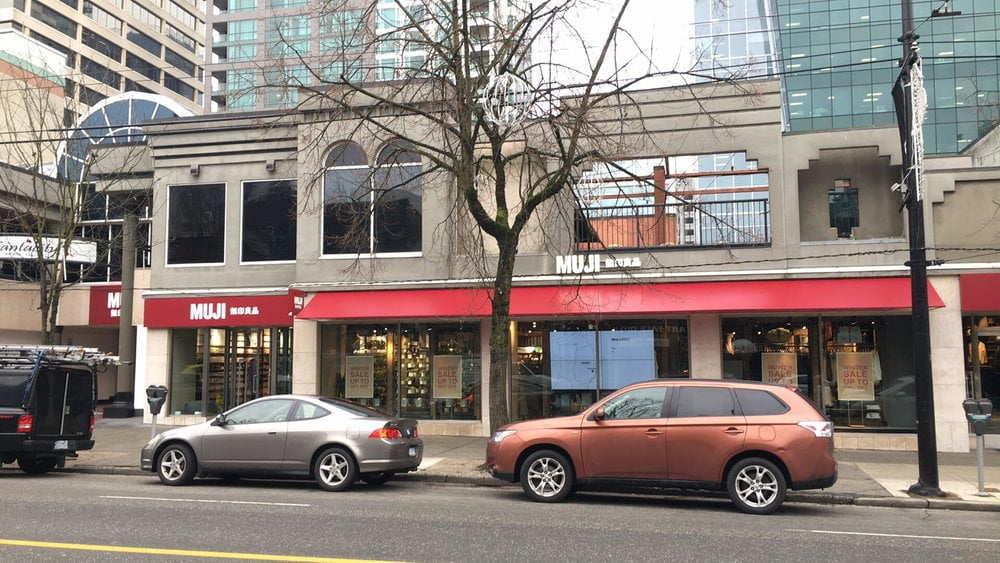
Several international retailers recently moved onto the street. Most recently, minimalist Japanese retailer MUJI opened its largest store outside of Asia at 1125 Robson Street — curious shoppers lined-up to see the new store, which features a dramatic barrel vault glass ceiling that was once part of a small shopping galleria. A few doors down last year, French baker Ladurée opened its first Canadian location and, again, there were lineups every day for weeks just to get in. Both of these openings were on Robson Street’s 1100 block, that some had written off as being past its prime. 

That’s certainly not true, according to CBRE Vancouver Associate Vice President Martin Moriarty, who continues to be in talks with international retailers seeking spaces along Robson Street’s 1000 and 1100 blocks. Due to confidentiality, Mr. Moriarty wouldn’t disclose what’s in the works, though he pointed out several recent openings that he was involved with as broker — besides the MUJI and Ladurée deals that he helped coordinate, Mr. Moriarty secured Aussie eyewear retailer Bailey Nelson’s first Canadian corporate location on the strip, as well as Nike and several other popular brands. 
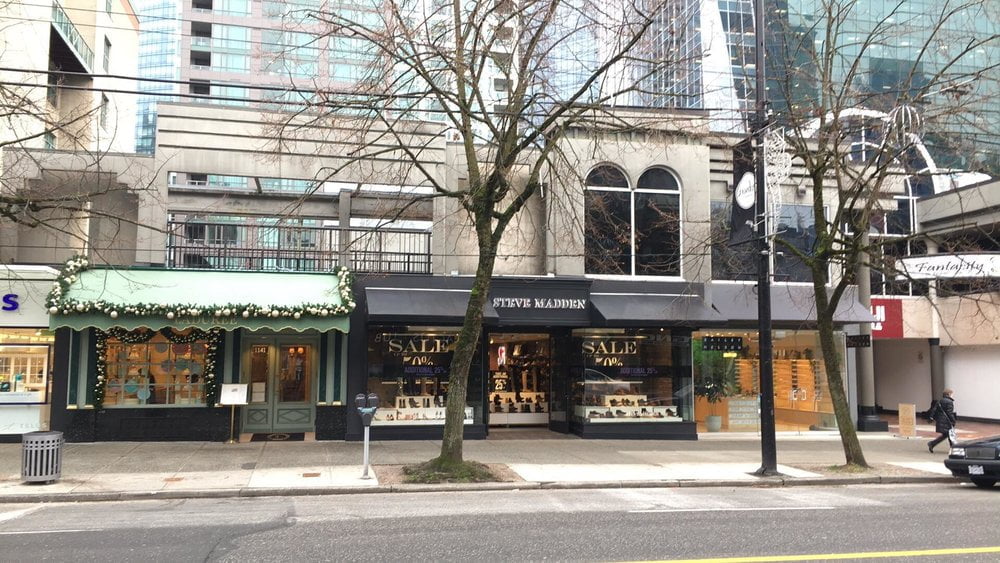
(LEFT-TO-RIGHT: LADURÉE, STEVE MADDEN, AND BAILEY NELSON STORES. PHOTO: LEE RIVETT)
(MUJI OPENED A 14,500 SQUARE FOOT STORE ON ROBSON STREET’S 1100 BLOCK LATE LAST YEAR TO LINEUPS. PHOTO: LEE RIVETT)

Over on the 1000 block (located between Burrard and Thurlow Streets), Canadian ‘cultural department store’ retailer Indigo recently announced that it would move into the former Forever 21 space at 1033 Robson Street, in a sublease deal that will see Indigo occupy a two-level, 29,000 square foot space. Indigo stores tend to be open late and its presence is expected to further draw people into the area — Indigo closed a nearby 53,000 square foot store in June of 2015, with the intention of eventually returning to the area. 

Chris Wood, Northwest Atlantic Principal for Western Canada, represented Indigo in the deal and explained how Robson Street is seeing a resurgence along its stretch between the 900 and 1100 blocks — or roughly between Hornby Street and Bute Street. The 1000 block, where Indigo will be located, along with the 900 block, are currently the strongest he said— though the 1100 block is on the upswing, and its slightly lower rents will attract new tenants. Mr. Wood also noted that there could be some redevelopment plays on the street in the coming years, as land prices go up and buildings devalue as they age. 

After Nordstrom opened at 799 Robson Street in September of 2015, the vibe on Robson Street began to change — crowds increasingly congregated near Nordstrom’s CF Pacific Centre store, which is a top performer (Northwest Atlantic acted on behalf of Nordstrom for the deal). Though footfall may have been reduced slightly on the westward stretch of Robson Street near the corner of Bute Street, things have more recently picked up with the addition of Ladurée and MUJI and on the 1200 block of Robson Street, Canada’s first location for French pastry retailer L’Eclaire de Genie debuted in the spring of 2017. 

(NORDSTROM OPENED ITS WILDLY POPULAR CF PACIFIC CENTRE FLAGSHIP IN SEPTEMBER OF 2015 — THE STORE COMPETES WITH THE SEATTLE FLAGSHIP FOR TOP SPOT, IN TERMS OF REVENUE, AND HOUSES CONSIDERABLY MORE LUXURY BRANDS THAN MOST NORSTROM STORES. PHOTO: TOURISM VANCOUVER)
(LOOKING TOWARDS THE ARITZIA FLAGSHIP STORE AT 1100 ROBSON STREET)

Other recent additions include Japanese-themed variety retailer Miniso, Montreal-based Frank & Oak (which opened a women’s store on a 12-month trial basis), and one of several recent store expansions on the street includes LUSH, which more than doubled the size of its store in the 1000 block. Vancouver-based fashion retailer Reigning Champ is about to open a store on Robson Street’s 1100 block, and Canada’s first location for beauty brand Bellami will debut this spring at 1168 Robson Street, in a retail space formerly occupied by fashion retailer Guess

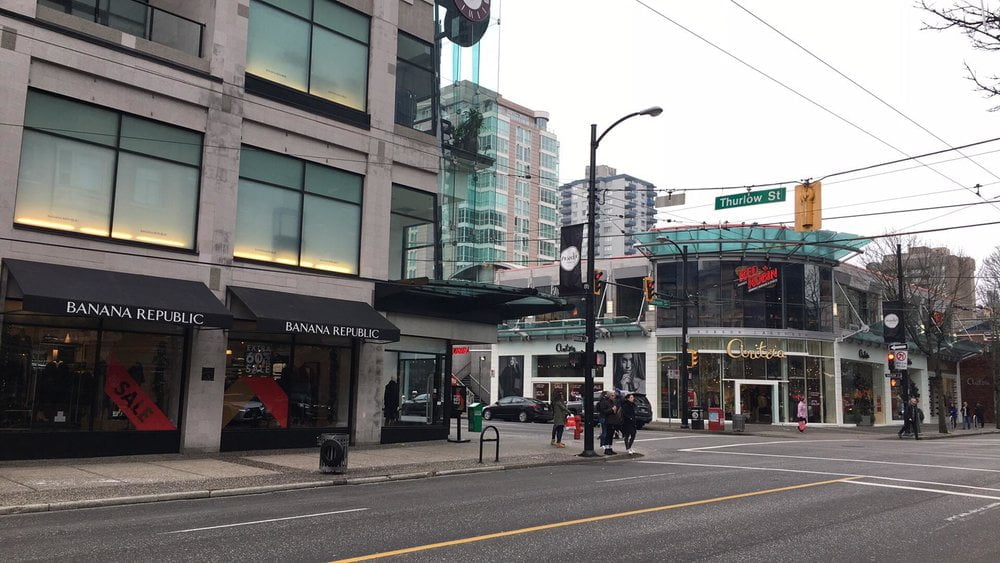
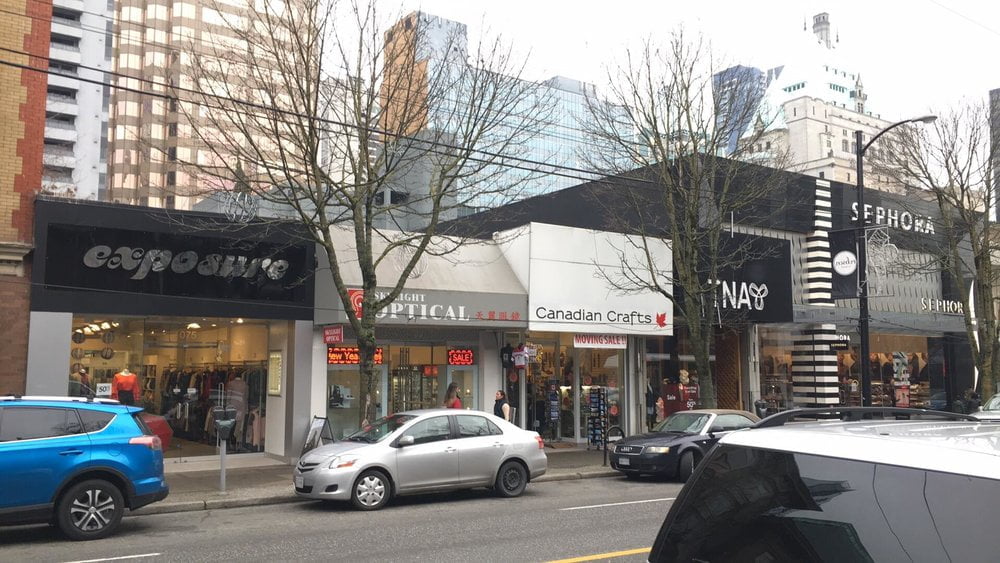
Constantly in flux, Robson Street will see some more changes in 2018 and beyond. On the 1000 block between Sephora and the Manhattan building, a new multi-level commercial building is proposed that could house one or more major retailers. Plans show the potential for a two-level 13,500 square foot space or three-level 20,000+ square foot space. CBRE is marketing the property. 

(1067 ROBSON STREET PROPOSAL, RENDERING VIA CBRE)
(CURRENT 1067 ROBSON STREET CONFIGURATION. PHOTO: LEE RIVETT)

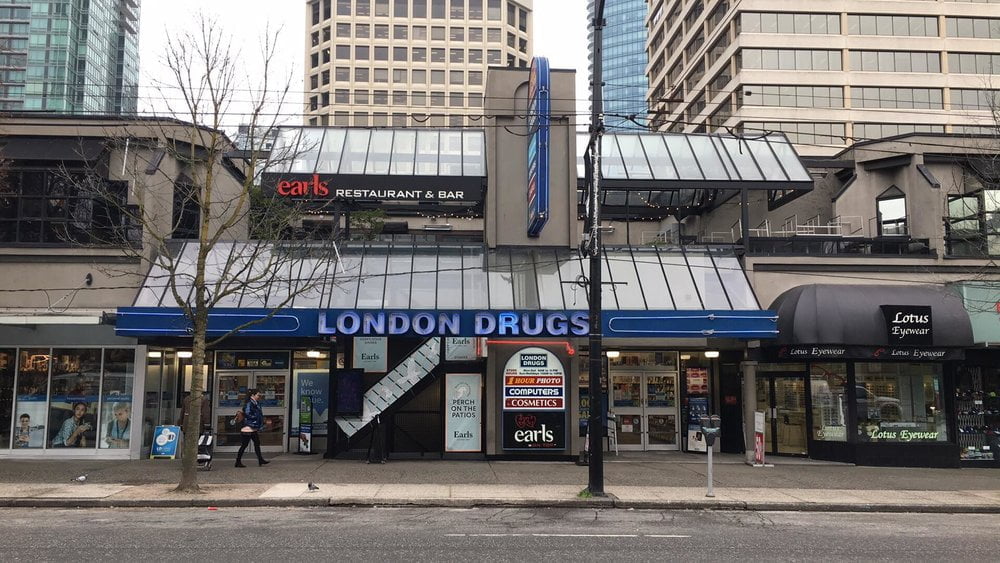
Robson Street’s 1100 block could see some very significant changes in the years to come, particularly to the commercial block currently anchored by London Drugs at 1185 Robson Street. One only has to look at the recently updated BC Assessment to see that a redevelopment play is likely — the property is assessed at $75.8 million and upon closer inspection, that’s almost entirely land value — the current buildings on the site have been assessed at $89,800, making them almost worthless in comparison. 

(AN EXAMPLE FROM BC ASSESSMENT OF A SITE WHERE THE LAND IS WORTH A FORTUNE, AND THE BUILDINGS ARE PRACTICALLY WORTHLESS. THERE ARE PLENTY OF OTHER EXAMPLES IN THE AREA, SIGNALLING THE POSSIBILITY THAT, AT SOME POINT, A REDEVELOPMENT COULD BE AT PLAY)
(THE COMMERCIAL BUILDING TIED TO THE ASSESSMENT MAP DIRECTLY ABOVE. PHOTO: LEE RIVETT)

While current zoning wouldn’t allow for skyscrapers along the main Robson Street shopping stretch, multi-level commercial is allowed with height and density restrictions, and increasing rents could be enough to justify some redevelopment opportunities. Examining BC Assessment’s latest numbers, there are other properties on Robson Street that appear to have a land value that is substantially higher than on-site buildings. And while that of itself isn’t an indication that a site will be redeveloped, a cursory look at some of the dated, relatively low-density buildings on the strip provide indication that some properties are ripe for demolition — under the right circumstances, that is, with a goal of securing high-paying commercial tenants with prime street-level space housing retailers that can afford rents that may approach and even exceed $200 per square foot, annually. 

Northwest Atlantic’s Chris Wood noted that the adjacent John Robson Place at 1151 Robson Street is expected to see changes to its ground level retail base — a listing shows an attractive updated facade to the building, which currently has a 1,817 square foot recap space for lease. 
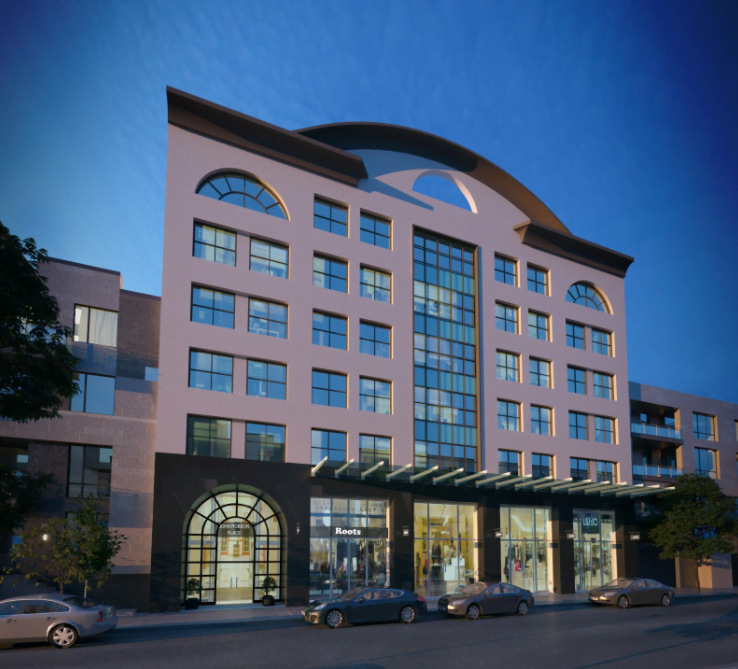
(THE ‘JOHN ROBSON PLACE’ BUILDING AT 1151 ROBSON STREET IS EXPECTED TO GET A REFRESH SIMILAR TO THIS RENDERING, VIA CBRE)
(LULULEMON OPENED A UNIQUE FLAGSHIP STORE AT THE SOUTHEAST CORNER OF ROBSON AND BURRARD STREETS IN 2015. PHOTO: LEE RIVETT)

Teri Smith, Executive Director of the Robson Street Business Association, noted that good things are in store for Robson Street in 2018 — streetscape improvements are on the way that will include street furniture, upgraded tree wells and, at some point in the future, mid-block crossings on the 1000 and 1100 blocks. There’s an overall feeling of optimism as more people, including families from the Lower Mainland, descend into the area to see what’s new. 

Robson Street’s tenant mix is generally one for mid-priced and to some degree, ‘aspirational luxury’ — at one time, there were several luxury retailers on the street, with Salvatore Ferragamo still occupying 918 Robson Street where it’s been for decades. If a ‘trickle-down’ theory were relevant here, Robson Street stands to gain from impressive growth seen a block north in the city’s burgeoning ‘Luxury Zone’, which continues to add mono-brand luxury stores that are said to be among the top performers in their respective chains, globally. In theory, those wealthy shoppers descending into the area seeking Louis Vuitton bags and Van Cleef & Arpels jewellery may also pay a visit to Robson Street for something a bit more affordable — these days, consumers often tend to shop ‘high-and-low’, though that doesn’t appear to have helped Forever 21 remain in the area. Luxury brands are now encroaching on the periphery of the Robson Street BIA, so there’s tremendous proximity — Versace, Brunello Cucinelli, Saint Laurent, Escada and Moncler are all located on the 700 block of Thurlow Street just north of Robson Street and, soon, luxury streetwear brand Off-White will open a licensed location in the restored alleyway between Robson and Alberni Streets’ 1000 blocks. 
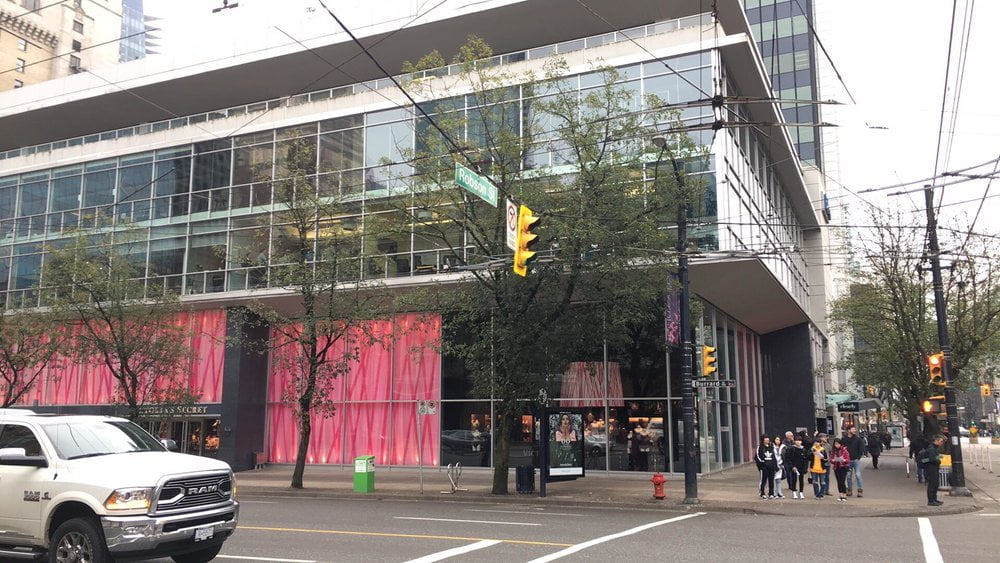
(ONE OF THE WORLD’S LARGEST VICTORIA’S SECRET STORES IS LOCATED AT THE NORTHEAST CORNER OF ROBSON AND BURRARD STREETS. PHOTO: LEE RIVETT)
(LOOKING ALONG THE 1000 BLOCK EASTWARD TOWARDS VICTORIA’S SECRET. PHOTO: LEE RIVETT)

The street continues to find its place with a renewed identity, which is being helped by public-realm improvements such as a recent decision to make a temporary parkette on Bute Street permanent — a half-block stretch of Bute Street south of Robson Street was closed off to cars on a trial basis over the summer, with overwhelmingly positive feedback. The plan is to make the plaza a permanent fixture, which will include an investment to make it as people friendly as possible, according to Teri Smith of the Robson Street BIA. 

There continues to be optimism in regards to Robson Street, which appears to be having a resurgence as Vancouver’s primary outdoor commercial high street. New retailers, as well as the eventual redevelopment of some properties, will continue to solidify Robson Street as an important retail address. We’ll follow up periodically and provide further updates, as we’re told that there will be several significant retail tenant announcements for Robson Street in the coming months. 

Sandro and Maje Continue Canadian Expansion with Cadillac Fairview Partnership

Sandro + Maje

Upscale French fashion brands Sandro and Maje continue to open standalone stores in Canada. Construction signage shows that more locations for both brands will be opening this spring/summer — Sandro and Maje will open their third batch of stores in Toronto, and Sandro will open its first standalone store in Vancouver.

Sandro and Maje’s newest Toronto locations will open at CF Sherway Gardens in Toronto this spring, in retail spaces directly north of the mall’s Ted Baker store. The spaces were made possible by carving out space vacated by Holt Renfrew, which relocated to Mississauga’s Square One in the summer of 2016. 

A standalone Sandro location will also open in Vancouver’s CF Pacific Centre this summer, in part of a retail space formerly occupied by Guess. Some had expected Sandro (and sister brand Maje) to take up space on the 1100 block of Alberni Street in downtown Vancouver, as the block transitions towards becoming a destination housing contemporary and luxury/aspirational brands. Multi-brand contemporary women’s fashion retailer Blubird, for example, is relocating to a space at 1108 Alberni Street this spring from a location on the 1000 block. 

(CONSTRUCTION SIGNAGE IS UP FOR SANDRO’S CF PACIFIC CENTRE STORE. PHOTO: HELEN SIWAK)

Sandro and Maje opened their first freestanding Canadian stores in the fall of 2016 at Toronto’s Yorkdale Shopping Centre, after operating exclusively as concessions with a handful of Hudson’s Bay flagship locations. Sandro and Maje subsequently opened at CF Toronto Eaton Centre in the fall of 2017 and Canada’s first outlet locations for the brands recently opened at the McArthurGlen Designer Outlets at Vancouver International Airport.

Sandro and Maje entered Canada in 2014 with the opening of several shop-in-store concessions at Hudson’s Bay. The partnership has also expanded — Sandro and Maje concessions can be found at Hudson’s Bay in Toronto (Queen Street, CF Sherway Gardens, Yorkdale), Montreal (downtown), Vancouver (downtown) and in Calgary (CF Chinook Centre). 

Sandro and Maje are considered to be in the ‘contemporary’ price-point, with fashion-forward designs that are proving popular for Canadian urbanites. Sandro began in Paris in 1984, and is known for focusing on “sleek, chic and effortlessly cool womenswear and menswear” — there are over 500 Sandro stores worldwide, and parent company SMCP (which stands for Sandro, Maje, Claudie Pierlot) operates close to 1,200 points of sale globally in 35 countries, with about 4,300 staff. Sister-label Maje, dedicated to women’s fashions, was founded in Paris in 1998 and with over 400 locations worldwide, is known for “bohemian-chic, solar, and more feminine womenswear collections”, according to SMCP.

Fashion Retailer ‘Aubainerie’ to Open 1st Store Outside of Quebec this Spring

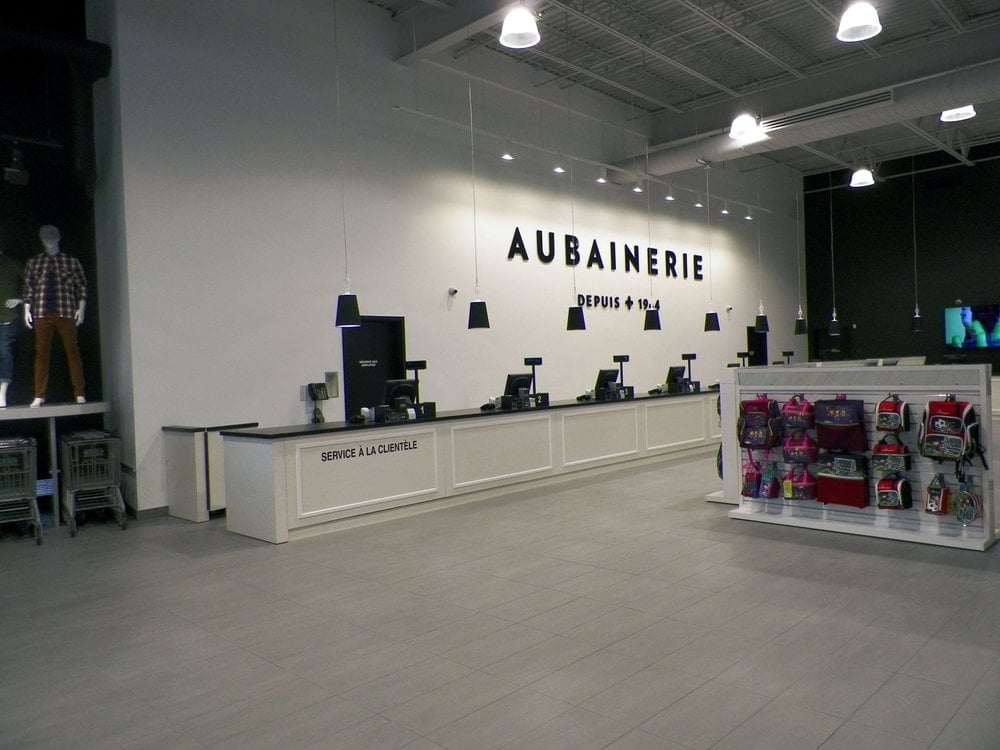
AUB44 by Aubainerie

Quebec-based family-oriented clothing company Aubainerie is venturing into the Ontario market, with a new store opening in the Ottawa region in March.

The new store, located in Place d’Orleans shopping centre in the eastern part of Ottawa, will be called AUB44 – a departure from the Aubainerie name that is well known in the Quebec market.

Aubainerie, which was established nearly 75 years ago, operates 57 stores throughout the province of Quebec. The retailer provides trendy clothing for all age groups.

“We sell clothing for the entire family, from baby to teenagers to women and men,” says Chantal Glenisson, CEO of Aubainerie. “Our mission is to offer to the customer trendy, fashionable clothing, but with affordable prices.”

Providing value for customers is core to the company’s philosophy, Glenisson says. “Families today really need to respect their budget for clothing,” she says. “So that’s why we make our prices lower than the competition.”

Aubainerie’s men’s and women’s tops, for example, range in price from approximately $10 to $40, with children’s clothing starting at about $4. In addition to everyday clothing, the retailer carries a range of sportswear, outerwear, sleepwear, beachwear and accessories.

In addition to its regular stores, Aubainerie operates 13 outlet locations, carrying overstock and end of line merchandise at a discount.

The new Ontario AUB44 store, which opens on March 15th, is 24,000 square feet in size.

The company decided to use the name AUB44 since “Aubainerie” could be difficult to pronounce in English, and might not resonate with customers outside of Quebec, Glenisson says.

“We thought it’s time for us to refresh our brand,” she says. If the new name resonates with customers, she says, the company might consider applying the name to more of its stores.

Other than the name, the Orleans store will be the same as Aubainerie stores in Quebec, and will carry the same range of merchandise that is available in the other stores.

Since Orleans has a large French-speaking population in addition to its majority English-speaking population, it represented an appealing location for Aubainerie’s first Ontario location, as the company transitions to the new market.

“For us, it’s a very good first step into the Ontario market to give us the time to really understand the market and the customer,” Glenisson says.

Depending on how well the new store is received, the company plans to explore further expansion opportunities. However, Aubainerie is taking a slow and measured approach to its growth, Glenisson adds.

“It doesn’t happen overnight,” she says. “We need to plan ahead where we want to go, how big the stores are going to be, and do all of the market analysis. This is a lot of work before getting there.”

Aubainerie stores range from 15,000-45,000 square feet. Although the chain operates some locations in enclosed malls, many of its stores are free-standing locations.

“It’s a destination for families – they plan to go to Aubainerie,” says Glenisson.

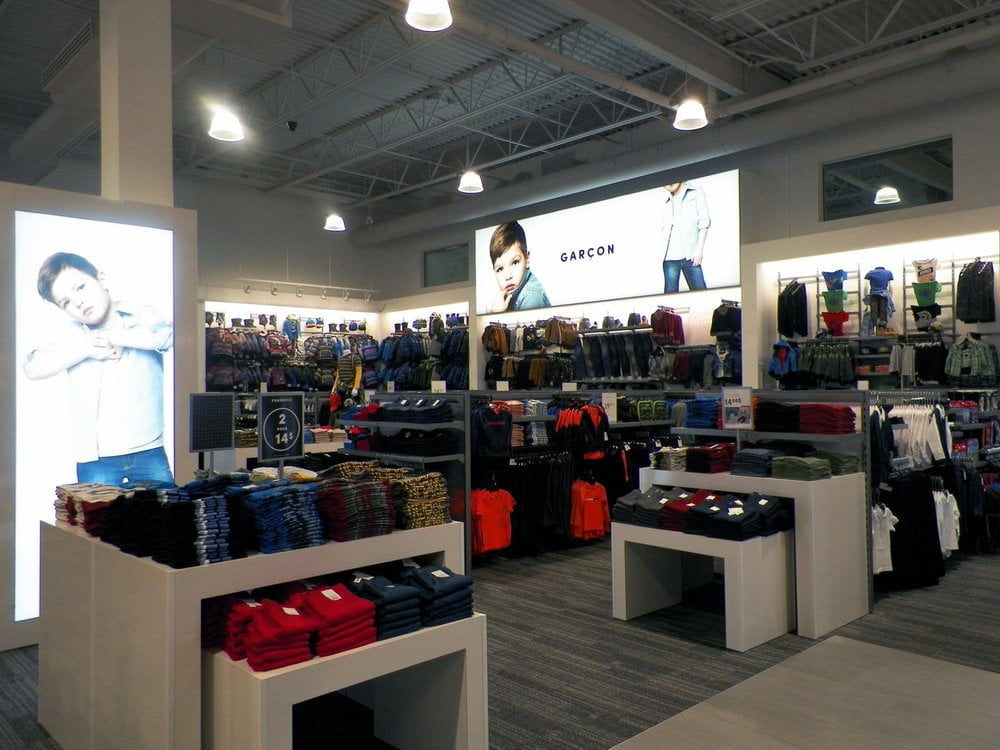
The stores are designed to create a pleasant shopping experience for customers, she adds. Each store is divided into separate departments for each member of the family, with fitting rooms located in the centre of the store.

“The way we build the stores – the colours, the lights – we try to make it a very good shopping experience,” Glenisson says.

Aubainerie currently offers a limited selection of its merchandise for sale on its website, and the company is gradually expanding its e-commerce capabilities. By 2019, the company plans to have all of its merchandise available online.

Retail Vacancy Rates Jump Following Sears Canada Closure

Sears at CF Toronto Eaton Centre (Image: Daily Hive)

Vacant Sears Canada space in Calgary pushed the city’s retail vacancy rate at the end of 2017 to more than twice the 10-year average.

A report by CBRE said Sears Canada released more than 650,000 square feet of space back to the market, accounting for 60 per cent of the overall vacancy increase which rose from 3.52 per cent in the first half of the year to 6.5 per cent in the second half.

The 10-year average is 3.02 per cent.

CBRE says that besides the Sears space several other factors contributed to the soaring vacancy – high turnover in top-tier restaurants; struggling mid-tier fashion, which led to the closure of several mid-to-big-box retail spaces and the increase in minimum wage.

PHOTO: CONSUMER PRODUCTS BRAND DEVELOPMENT

CBRE says the vacant Sears space came from five locations throughout Calgary including Southcentre Mall, North Hill Shopping Centre, Marlborough Mall, Glendeer Junction and the Sears Sunridge location.

Alistair Corbett

Alistair Corbett, senior vice-president with CBRE, says he hasn’t seen a vacancy rate this high in the retail market in the last 20 years.

“That’s a big jump for this market,” he says.

“Seeing that much space come onto the market, apart from Target, is the biggest thing that’s happened for quite some time.”

If Sears was taken out of the factoring, the city’s retail vacancy rate would be 4.7 per cent, according to the report.

“Historically speaking, using Target Canada as an example, footprints of this size take time to fill and require exceptionally large tenants. The submarkets most impacted by these anticipated prolonged pockets of vacancy are the East, Southeast, South Central and Northwest submarkets.”

Target Canada Closing (PHOTO: CANADIAN GROCER)

Michael Kehoe, an Alberta-based retail specialist with Fairfield Commercial Real Estate in Calgary, said the departure of Sears from the Calgary retail scene will have a short-term impact on the overall retail vacancy rate as the affected retail landlords work to recycle these major blocks of the space with new tenants.

“Most of the five former Calgary Sears locations are prime candidates for redevelopment and possible densification perhaps with non-retail uses and should cycle quickly with a new look. The owners of the former Sears locations have had ample lead time to plan and execute remerchandising or redevelopment strategies as the demise of Sears was a long and drawn out process and we can expect some significant announcements in the near future,” he said.

“Calgary is blessed with a robust retail scene, however other markets across Canada will see longer periods where the former Sears spaces sit vacant and available to be recycled with new retail tenants or alternate uses. These large blocks of space, many in older shopping centres will likely be back-filled with non-retail tenants such as entertainment, office, fitness or medical tenants such as the REC Room by Cineplex and World Health, Good Life Fitness or public libraries.”

Rendering: The Rec Room / Cineplex

CBRE says tenants in the market are experiencing compressed margins due to several microeconomic factors, including the increase in minimum wage and mandatory vacation pay.

“This has led tenants to shrink their footprints and undergo a fundamental shift from a product/inventory heavy retail presence to a more experience-driven retail model. Enhanced supply chains have made this transition easier for retailers as the need to store inventory on-site becomes less of a necessity,” added the CBRE report.

There is currently close to 1.5 million square feet of new supply under construction with another 2.5 million square feet planned or proposed.

According to a Barclay Street Real Estate report, the dollar volume for commercial real estate investment sales of $1-million-plus was down in the Calgary retail market in 2017 but the number of sales rose.

Dollar volume dipped from $449 million in 2016 to $306 million in 2017 while sales rose from 52 transactions to 56.

The retail investment market represented 13 per cent of the overall market.

The average sale price per square foot also rose from $399 in 2016 to $455 last year.

Q&A: Giant Tiger Launches ‘Carisma’ Line and Campaign

exc-5a95ea579140b782c5f14988

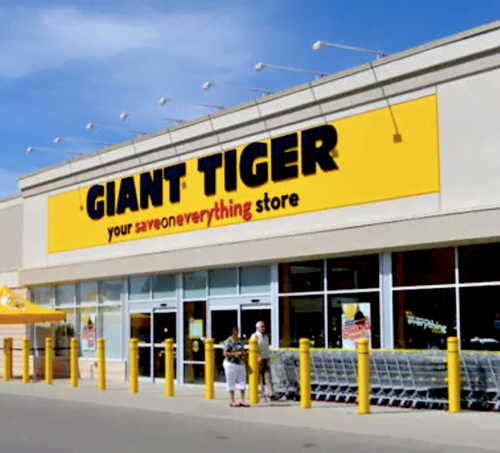
Popular Ottawa-based discount retail chain Giant Tiger recently launched a new exclusive women’s sleepwear, intimates, and basics brand called Carisma, and it’s already a hit among consumers. Giant Tiger hosted it’s first-ever Facebook Live event to ‘talk all things Carisma’ that was launched on “Galentine’s Day” on February 13 — , Galentine’s Day is a relatively new phenomenon where “ladies celebrate ladies”. 

The response to the campaign was exceptional — the company’s video has been viewed more than 40,000 times. The following is a Q&A with Karen Sterling, VP Marketing at Giant Tiger.   

Q: What made Giant Tiger choose the name ‘Carisma’ for its new women’s line? 

A: When we were creating the brand identity, we considered how women would want to feel wearing this collection. We wanted them to put on the pieces and immediately feel good. When you feel confident, it radiates outward. We understand the busy Canadian woman and her desire to feel great all day long.

Q: What can Canadian women expect from the new and exclusive women’s basics brand? 

A: Ultimately, we want Canadians to feel great about fashion without the guilt of overspending. Women can indulge in purchasing great sleepwear or a comfortable bra without compromising on value. At Giant Tiger, we demonstrate value by combining our low prices, our chic styling and our exceptional quality. All our pieces are on trend, they’re easy to mix-and-match and they’re available from small to 3X.

Q: What makes Carisma an “approachable” brand?

A: Carisma is approachable because it’s real, genuine and authentic. It works for our customers; they want quality fabrics that stand up to everyday wash and wear. Carisma “gets” Canadian women; the collection pulls together pieces that allow them to have fun or feel more sophisticated if they want to be. Women need a brand they can count on for whatever they’re feeling that day. We’ve tried to complement this approachability with a convenient and inviting in-store shopping experience dividing Carisma into three categories: intimates, sleepwear, and basics.

Q: Being the VP of Marketing, do you have any favourite Carisma pieces? What about the new brand speaks to you as a “modern, everyday woman”?

A: One of my favourites right now is our retro-chic 2-piece pyjama set. The matching top and bottoms feature the “peachy dream” softness of so many of our PJs; it’s just so comfortable. It’s important to note that our Carisma brand is available in all sizes, including plus. They are so affordable, too, and wash like a dream.  I’ve even bought them for my daughter and some of my friends! These pyjamas definitely give me a sense of Carisma.

Q: Carisma was launched in time for Galentine’s Day (February 13). Why was Galentine’s Day chosen talk about the new brand?

 A: Galentine’s Day is all about celebrating women and the power of female friendship. And Carisma is all about celebrating real Canadian women. It’s just such a natural fit. We also hosted an interactive Facebook Galentine’s Day event. It was a very successful event. To date, the video has been viewed over 40,000 times and the overall engagement has been over 34,000.

Q: Speaking of Galentine’s Day, do you yourself have one or more female friends who inspires and supports you? 

A: Hopefully, we all know people who are simply extraordinary to us. I am humbled by them, in awe of them and all that they accomplish, all that they generously share, and all that they do regardless of their circumstances. I cannot imagine my life without the inspiration, friendship, wisdom, support, laughter, blunt honesty and insight of the amazing women in my life.

Q: Giant Tiger has experienced significant fashion evolution over the last two years. Is there anything else that we can expect?

A: Of course! At Giant Tiger, we are always evolving and looking at how we can best meet the needs of our customers and communities. We are always asking for feedback from our customers and adjusting our strategy accordingly. It is this adaptability that is one of our key strengths.

*****

Rapidly-expanding Giant Tiger was founded in 1961 in Ottawa’s Byward Market area, and has since grown to operate over 240 Canadian stores and employs over 8,300 ‘team members’. Stores carry categories such as family fashions, footwear, groceries, confectionary, pet food, cleaning supplies, housewares, stationery, toys, and health/beauty products. The company’s strategy involves striving to lower prices through continued improvements to efficiency as well as maximizing buying power through economies of scale, as well as increasing market share in existing markets by modifying stores and assortment, based on local needs. The company continues to seek out new markets to further increase revenues via well-researched and planned expansion that involves opening new store locations.

2017 Canadian Retail Sales Growth Hits a 20 Year High

Total Canadian location-based retail sales were up 6.7% in 2017 versus the previous year, according to the latest Statistics Canada numbers. This is the best result since 1997 and a 20 year high. If e-commerce sales by non-store retailers were also included, it would add about 1.5% to the 2017 growth rate. Here’s a summary of the last 5 years.

The Automotive & Related sector clearly contributed the most to overall sales growth, with both vehicle dealers and gasoline station sales recording high increases in 2017. Food & Drug however was a disappointment, especially after a relatively good year in 2016. This was offset by strong results in the Store Merchandise sector, up 6.5% in 2017, an 11 year high.

As the chart above shows, the 3 month growth trend (orange line) has now dropped off from the levels set in mid 2017. The underlying 12 month growth trend (green line), after strengthening for almost 2 years, has flattened out. Nevertheless, both measures are at fairly high levels, so recent trends may well be more of a correction rather than a collapse.

December retail sales results have been reported to be below expectations. But this may be partly because shopping activity is being pulled into November due to promotions like Black Friday and Cyber Monday and by retailers’ efforts to start holiday sales earlier. For November and December combined, total retail sales were up 5.1% in 2017. This is below the average growth for the year, but still a respectable result.

Food & Drug

The underlying 12 month trend for Food & Drug retail sales (green line in the above chart) slid steadily in 2017. The 3 month trend is tracking below this, implying further weakness ahead.

Sales at supermarkets & other grocery stores have been particularly slow, increasing just 0.9% in 2017, and even down 0.7% in Q4 alone. Specialty food stores did well however, with annual retail sales gaining 8.0%.

Retail sales at health & personal care stores ended 2017 up 5.7% for the year. While this is a respectable gain, it’s well behind the 13.8% annual increase recorded for 2016.

Store Merchandise

The underlying 12 month trend for the Store Merchandise sector (green line in the above chart) improved significantly in 2017. A retail sales gain of 6.5% was recording for the year, the best result since 2006. The sales trends however weakened slightly late in the year, although it’s too early to tell if this will continue into 2018.

The two biggest winners in 2017 were electronics & appliance stores with retail sales up 12.8%, and building material & garden equipment/supplies dealers close behind with an increase of 12.7%.

On the other hand, home furnishings stores’ retail sales were up just 0.8% in 2017, the lowest gain of all retailers in this sector.

Note that Statistics Canada is now suppressing the breakdown of general merchandise stores for confidentiality reasons. The figures in the table below are estimates based on previous trends.

Automotive & Related

The Automotive & Related sector continues to be the bedrock of Canadian retail sales. The annual increase in 2017 was 10.1%, a 7 year high.

Gasoline stations are experiencing high growth, with retail sales up 12.9% in 2017. Gasoline stations have now more than recovered the sales losses incurred in 2015 when gasoline prices significantly declined.

Automobile dealers just keep on setting sales records. Their retail sales were up 9.4% in 2017.

By The Numbers

For definitions of store types, see Statistics Canada NAICS.

Canadian E-Commerce Stats

StatsCan started providing ecommerce retail sales data in January 2016. While the amount of data is limited, some trends appear to be emerging. Here are some results.

Overall, e-commerce represented about 2.6% of Canadian retail sales in 2017, including both pure play operators as well as the online operations of brick & mortar stores. Canadian consumers however also buy online from foreign websites, spending which is not captured in these numbers.

Results for 2017 show that Canadian e-commerce sales were up 30.6% from the year before, a much higher gain than for retail in general. But for Q4 2017, the year-over-year increase was 15.6%, indicating that e-commerce sales growth may be slowing down.

Note that location based retail is the same as that in the preceding large “By The Numbers” table. It’s what’s normally reported as Canadian retail sales. Except that it isn’t. Location based retail excludes another section called Non-Store Retailers (NAICS code 454), which covers electronic shopping and mail-order houses, which in turn is where (mostly) pure play e-commerce businesses are. For 2017, electronic shopping and mail-order houses had an estimated $8.8 billion in e-commerce sales.

But that’s not the only source of e-commerce, as (mostly) bricks & mortar location-based retailers also sell online. For 2017, this group had an estimated $6.9 billion in e-commerce sales. With electronic shopping and mail-order houses, there’s a grand total of $15.7 billion in e-commerce sales by Canadian operators over the year. Note that this does not include foreign e-commerce purchases made by Canadian consumers, but it does include purchases made by foreigners at Canadian e-commerce businesses.

For electronic shopping and mail-order houses, an estimated 82.7% of their sales are allocated to e-commerce. For the (mostly) bricks & mortar crowd, it can be estimated that just 1.2% of their total sales come from e-commerce.

In the final section of the above table, (mostly) pure play operators (namely, under electronic shopping and mail-order houses) generated an estimated 56.2% of all e-commerce sales in Canada, while (mostly) bricks & mortar location-based retailers’ share of e-commerce is 43.8%.

For more explanation on the e-commerce numbers, see Statistics Canada: Retail E-commerce in Canada.

How Sears Canada Could Have Been Saved: Expert

SEARS STORE EXTERIOR (PHOTO: GETTY IMAGES)

A veteran Canadian retail consultant says Sears Canada didn’t have to close down its operations and could have stayed alive if the company adopted a unique and innovative strategy.

Mark Healy, a Toronto-based consultant in investment banking, real estate and retail, was a Canadian Tire franchise owner for 20 years and says Sears could have taken a look at creating a system of franchise ownership similar to Canadian Tire.

“About a year and a half ago, I tried to get ahold of Sears,” says Healy. “They were changing CEOs every two years.”

“I was thinking of my Canadian Tire days and how the system works but I’m thinking a lot of the stores at Sears were catalogue stores or actually dealer stores. So my thinking was with regards to Sears to save it you franchise the stores just like the Canadian Tire model.”

Sears Canada closed all its remaining stores in the country in mid-January. At one point in time, the company, which began operations in Canada in 1953, had 190 stores and well over 15,000 employees.

The controversial closure continues to make headline news across the country as former employees battle in court over a pension shortfall.

“I would have franchised it,” says Healy. “A lot of the stores they were hemorrhaging and bleeding with they could have leased them out or you redevelop. You repurpose that land. You build them into condos. You bring the customers to the mall – the vacant mall.”

“The most important thing is they didn’t have an ecommerce platform. They didn’t have anybody that could handle that. Guess what. Amazon’s going out and building brick and mortar stores. Cut a deal with Amazon and get them to handle your back end. Let them take the ecommerce. Let them do the deliveries. Let them do everything. I think there could have been an opportunity there with Amazon. It’s too late now obviously but I honestly believe that Sears didn’t really want to survive.”

PHOTO: CHAIN STORE AGE

Healy says he tried numerous times to present his plan to Sears.

“I couldn’t get through to anybody,” he says. “Couldn’t get through to Fort Knox.”

His idea of the franchise model would have meant that dealers would have had equity in the store.

“And usually like the Canadian Tire model you have some skin in the game. You care if the lights go off at 9:15 that they’re not burning all night. You watch your wages. You run a better store. You have profit sharing,” says Healy.

“What they do (Canadian Tire) is they own the land and the building. They charge the dealers a percentage of sales for rent. They take a mark up on the inventory but the dealers finance in the inventory and the assets. And they own it. And they make it work.”

“You need to have a dealer in there. A GM (general manager) is not going to care. At the end of the day, he’s going to do his best but there’s only so much he can do. But if you have skin in the game you make it work. You’re rotating your inventory. You’re worried about your discontinueds. You’re a buyer on the premises. You know what’s moving.”

Healy says he would have also renamed Sears.

“It’s an old name. It’s an American name. I would have rebranded it,” says Healy. “They brought in all these specialists spending money on fashion, accessories. Just get down to the retail street. Give the customers what they want. Service the heck out of them. I would have changed the name – made it more a Canadian name.”

The State of Retail in 2018 – Turbulent, Transformative, but Surprisingly Healthy

[SOURCE: THE NEW YORKER]

Besides Trump dominance of the airwaves, few other topics got as much attention over the last 18 months than what is happening in the retail sector.

However, the common narrative throughout the year seems misguided. Having just come back from more than 30 years outside North America to become the Executive Director of the soon to be launched Bensadoun School of Retail Management at McGill University, I was immediately struck by an overwhelmingly consistent view on the state of retail. Traditional is on its deathbed, overall retail is in doldrums with only one winner – Amazon. To quote former dot.com executive Seth Godin, “the battle for shopping is over and Amazon has won”. Looking in more detail at what has and is actually happening tells a different story.

Retail is a healthy, growing sector of the economy: Global retail is growing at an average annual rate of 6% over the last five years. Even in North America, retail sales figures indicate a sector of the economy that is healthy and performing well. Over the same period, retail in both Canada and the US has seen average growth rates of over 4%. 2017 was exceptionally good with 4.4% growth in sales in the US and an estimated 7% + growth in Canada if one includes the automotive sector and about 4.2% if we exclude it. The Holiday season year-end period was particularly strong with 5.6% increase in the US and 4.4% in Canada.

Given the estimated 2017 GDP growth figures of 2.6% in the US (Source: Bureau of Economic Analysis) and 3% in Canada (Source: IMF), these are retail figures to be proud of, not those of doom and gloom.

Retail is in a transformative period moving to two extremes: We do, nevertheless, see retail in a transformative period moving to two extremes: 1) convenience & efficiency and 2) experience.

The extreme of Convenience and Efficiency has to do with functional, day-to-day goods which are increasingly, but not exclusively being purchased online — think Amazon. It is allowing consumers to find the right product at the right price and at the right place in the most convenient and efficient way. It is a battle ground where technology plays a critical role through AI, big data, voice, hyper personalization, new payment platforms, … It is also an area where supply chain and retail operations optimization play a significant role in satisfying consumers, both in terms of speed and convenience. It is the ultimate battle ground between Amazon and Walmart. But not just them, we see Costco and the Dollar stores concept (eg. Dollar General, Dollarama, …) performing extremely well with principally a brick and mortar approach. 

At the same time, we are seeing a rise in Experience based retail. This is more associated with our deep needs as human beings for social interaction. It is community-driven, more about doing, experiencing and storytelling. This is not new. Hotel groups such as Four Seasons, Food & Beverage concepts such as Starbucks and McDonalds continue to excel in this area, as do other concepts such as IKEA and Indigo. Experience based retail is also often closer to home or places that we love with locally sourced products in markets, handicraft driven concepts. It is usually more associated with physical shops, but not always. Take for example the online retailerSsense. Its highly curated content and product offering connect completely with its target community – worldly millennials who are fashion forward always looking for the newest and coolest products and experiences.

Image: Toys-R-Us

Retail is turbulent with some big losers: News headlines have focused on the demise of certain retail actors, namely Department Stores like Sears, JC Penney, Macy’s, others like Toys-R-Us. Department stores have seen a sales decrease in 2017 of close to 2% (Sources: NRF and US Census Bureau).

Take for example Toys-R-Us which recently announced the closure of 180 stores. On the convenience and efficiency end, it is losing out to the likes of Walmart, Amazon, Costco and even the Dollar stores, especially for all party related items, by not being strong enough in offering the right range of products at the right price in the right place. On the other end, its experience journey is leaving customers underwhelmed  when compared to other retail concepts & activities that parents and kids love – eg. McDonalds, Ikea, Indigo, even Canadian Tire. Toys-R-Us is a cautionary tale. Choosing the middle of the road strategy is no longer viable, leaving them in a race against time to survive.

Traditional Food retailers are also under pressure with only marginal growth overall in Canada and razor thin margins. Attacked by Amazon, Walmart, Dollar Stores for day to day, repetitive purchases such as tea, coffee, toilet paper, detergent, …. They are also under threat from new business models such as meal kits such Blue Apron, Good Food, … and farm to table concepts. 

As a result, most mall owners are seeing a decrease in footfall & sales. They are scrambling to stay alive by closing underperforming malls and trying to find new ways to do business and engage customers.

… but the emergence of winners

We are, however, seeing the emergence of winners at both extremes. Online retail had a banner year in 2017 with increase in sales of over 10% in the US (Sources: NRF and US Census Bureau) and up 35% in Canada (source: Stats Canada). Amazon was responsible for the lion’s share with about 44 percent of all U.S. e-commerce sales (Source: One Click Retail).

Walmart, for its part, has been aggressively transforming itself into an agile giant capable of operating as effectively off-line as on-line and working on not only bringing everyday low prices, but also trying to maximize convenience to their consumers. As a result, Walmart announced a 3% growth in US sales in 2017 which is impressive given its size and performance relative to other Brick & Mortar competitors.

Dollar Stores have continued to perform extremely well, by focusing on affordable household consumer goods. Home improvement and home furnishings retailers like Home Depot, Lowe’s have also finished strong with 7-8% growth (Source: Customer Growth Partners and US Census Bureau). Consumers want to do it themselves, at least in their homes. TJX with its treasure hunting approach with discount prices continues to perform strongly with a 6% increase (Source: TJX). 

Consumers are also shopping closer to home. Proximity retailers have seen sales grow twice as fast the US market at 7.2% as of end of October 2017. Shoppers are skipping the malls in favor of neighborhood stores and are willing to pay higher prices for the experience and convenience. They are proud community members who are happy to engage with local retailers, buy locally sourced and manufactured products and are keen to keep their local environment thriving.

There are a number of other successful experience based retailers such as Indigo in the bookstore space, Gucci, Simons, SSENSE, Zara in fashion, Apple in the electronics space. A great example is Adidas which announced sales in 2017 increasing by over 15% and profits by over 25%. They have a very keen sense of their brand and the community of enthusiasts that they are engaging. They know what products, services, brand ambassadors and key opinion leaders that their loyal customers crave. They are masters at storytelling and bringing experiences to life that their fans love. And they use technology, trends, new ways of doing things as enhancers to their brand and what they are delivering to their customers.

Image: adidas

The future of retail is both exciting and challenging for the CEOs and C-Suites

It is exciting times for the CEOs and C-Suite members in retail companies, but I do not envy the challenge of optimizing strategic and investment decisions. It seems that the choices are endless, but with finite resources. Do we invest in technology? If so which ones and for what purpose? Do we upscale our operations (IT, Supply Chain, …)? Do we create a data analytics department focused on hyper personalization? How much of our business do we shift online? If so, which stores should we close? Do we invest in store customer experience and how? … So many options of where to strategically invest. Senior leaders will need to be agile, data savvy, but also intuitive and open minded. They will need to fully grasp their brand and the community that they are serving to make the best choices to enhance the effectiveness of their businesses. One thing is for sure, they will need to test, keep what works and discard asap what does not. This atmosphere creates a great mix of exciting times and sleepless nights!!

Charles De Brabant

Charles De Brabant joined McGill University in August 2017 to co-lead the creation of the Bensadoun School of Retail Management (BSRM). He has over 20 years experience in retail in Europe and most recently in China and South East Asia. Born and raised in Montreal, Charles holds a B. Com. from McGill, an M. Litt. in History from Oxford University and an MBA from Stanford Business School. Charles’ focus at BSRM will be on collaboration with local and international industry partners and the administration of the school.   

BRIEF: Simons Prepares to Open Eco-Store, H&M Sees Gains in Canada, Blubird Relocation

La Maison Simons Prepares to Launch 1st ‘Eco’ Store

Quebec City-based multi-brand large format retailer  La Maison Simons will unveil its first net-zero department store next month at Les Galeries de la Capitale in Quebec City. The 80,000 square foot store will replace an existing 45,000 square foot location in the same mall. 

Simons is moving into part of the space that was vacated by Target in 2015, when the Minneapolis-based retailer exited its Canadian operations. 

“This is the very first store where the concept of ecology will be ubiquitous”, said company president Peter Simons. The store will occupy about 80,000 square feet and will feature solar panels and recharging stations for electric cars, among other innovations. “The goal is to achieve a zero net footprint”, said Mr. Simons. 

The store will also be a prototype, providing “a unique and improved customer experience through new digital and interactive technologies” that will initially be tested in the new store before being introduced to other Simons locations.

The store officially opens on Thursday, March 15, and Retail Insider will publish a feature article that will include photos of the highly anticipated new store. 

Blubird to Relocate on Alberni

Vancouver-based fashion retailer Blubird will be relocating its 1000-block Alberni Street flagship to Alberni’s 1100 block this spring, as the street continues to transition to become one of North America’s leading luxury addresses. 

Blubird carries a range of popular women’s contemporary brands in two locations — a downtown store that will be relocated in May, as well as a location at Oakridge Centre on Vancouver’s West Side. Blubird is owned by Vancouver-based fashion conglomerate Vestis Fashion Group, which also holds licenses for Western Canada’s Max Mara and Pomellato stores. 

Blubird will move into the former Strellson retail space at 1108 Alberni Street, vacating its current 1055 Alberni Street space that it has occupied for about a decade. The new Blubird will span about 2,200 square feet at the base of the 745 Thurlow Street office tower, which also houses Brunello Cucinelli and Versace along its Thurlow Street side. 

Alberni Street’s 1000 block is transitioning to become a significant luxury address, with recent store openings such as Van Cleef & Arpels, IWC Schaffhausen, Hublot and others — Tiffany & Co. recently expanded, Jimmy Choo will open nearby this year, and Cartier and a new Hermes flagship are going to be announcing stores in the area soon. 

745 Thurlow Street is owned by bcIMC and is managed by QuadReal —  Larissa Jacobson negotiated on behalf of the landlord. CBRE’s Martin Moriarty and Mario Negris coordinated on behalf of the tenant. 

Vancouver-based Peregrine created many of the fixtures in the the Bluebird space that opened in the spring of 2018. Photos can be found here.

Hillcrest Mall Taps into Consumer Demand for Payment Options

(PHOTO: OXFORD PROPERTIES GROUP)

Canadians are actively using mobile devices for shopping and, according to a 2017 Neilson study, 67 per cent of Canadian smartphone mobile payers are or will become mobile wallet users in the next six months. Oxford PropertiesHillcrest Mall in Richmond Hill, recently introduced AliPay and WeChat Pay at Guest Services to capitalize on the uptake in consumer use of mobile pay systems. By allowing customers to use mobile pay services to purchase gift cards, Hillcrest says they saw an increase in sales of over 636 per cent as compared to February of 2017.
To introduce this service to shoppers, Hillcrest offered a special promotion which ran from February 1st to 18th, which saw customers who purchased an Oxford Gift Card Plus with a minimum $200 spend receiving a bonus $10 gift card in return (maximum spend of $7,500 per person). Customers who paid with WeChat Pay or AliPay qualified to receive a discount of ¥2018 Renminbi currency on gift card purchases.

In addition to Guest Services, other Hillcrest retailers have also embraced the use of mobile pay systems. Sporting Life and Chatime/Bake Code also accept payment by both WeChat and Ali Pay, and the Nespresso cafe is completely cashless.

The popularity of tapping a card to pay now feels completely natural to shoppers and introducing mobile pay is a strategic and logical next step that Hillcrest and Oxford Properties are embracing.

Retail lnvestment Opportunity Straddles 2 Provinces

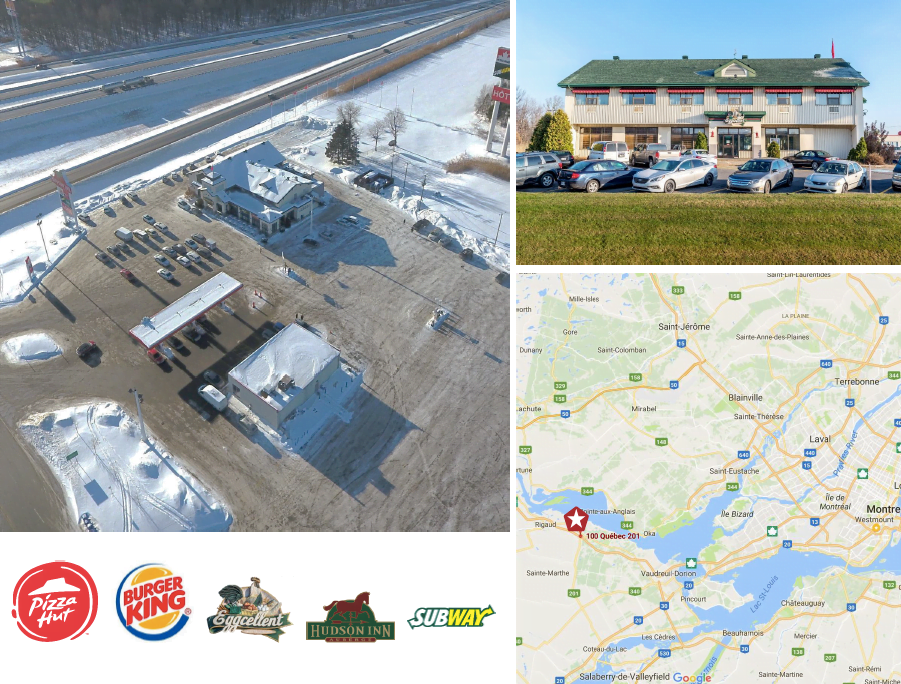
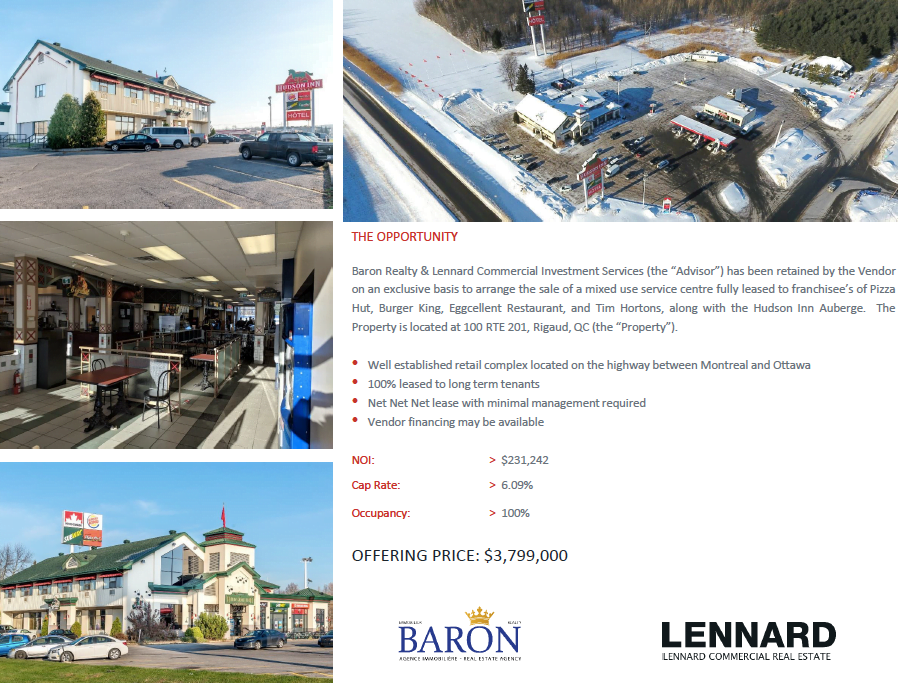
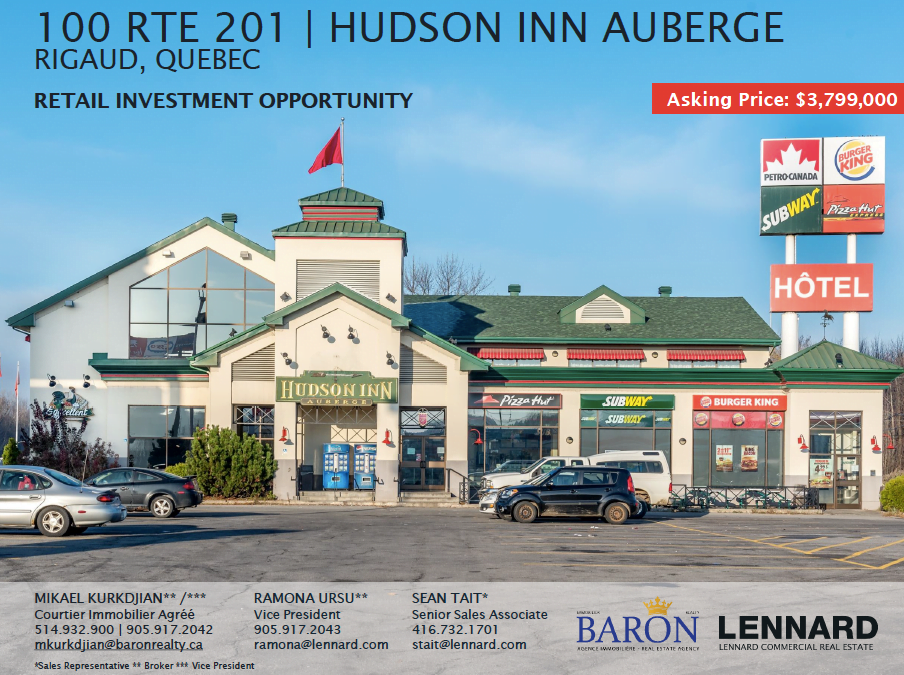
This week Lennard Commercial Real Estate is offering up an investment opportunity in Rigaud, Quebec, near the Ontario border with great growth potential.

The current owner is seeking to divest and retire (most likely to a warmer climate) and has offered for sale this complete property which includes the Hudson Inn Auberge Hotel and multiple restaurant components: Pizza Hut, Subway, Burger King, Harvey’s, Tim Hortons, and Eggcellent. There are two gas stations on the property drawing in traffic, a Petro Canada and an Esso, but they are not included in this offer.

The restaurant tenants have great brand name pull and combined with the gas stations and hotel, makes this property primed for retail expansion. The property faces the Route 201 highway and the wooded area can be built on to increase development opportunity. 

With an asking price of $3,799,000, net income of $231,242 (NNN), and a 6.09 per cent Cap Rate, this investment ready property is offered with a long-term lease and a 10-year option of renewal.

For more information, contact Ramona Ursu at: ramona@lennard.com or: 905-917-2043. [Download Full PDF Package Here]

INDOCHINO Excels at Following Their Designs

INDOCHINO

Innovative Vancouver-based INDOCHINO, the world’s largest made-to-measure menswear company, is on track with its aggressive North American expansion mode that will see it open four new locations in the southern United States this spring. 

The four new “designed by you” showrooms are to be launched in key business centres with thriving young professional populations, beginning with Charlotte, North Carolina on February 23, followed by Texas showrooms Houston (March 2nd), Austin (April 20th), and Dallas (April 27th). According to CEO Drew Green, these four locations “are already home to thousands of customers who shop with us online and are strong ambassadors of the INDOCHINO brand.”

It was less than three months ago, in December 2017, Retail-Insider reported that INDOCHINO announced plans to open up to 18 locations in 2018 following the 8 which opened in 2017

INDOCHINO launched and established itself online before opening its first bricks and mortar location in Vancouver’s Gastown in 2015 and is continuing to make strides with its immersive and engaging showrooms and its three-week delivery promise on all orders.

Heidi Sopinka Takes Off as New Novel ‘The Dictionary of Animal Languages’ Debuts

Heidi Sopinka is perhaps best known around Toronto as the shop owner and co-founder of Horses Atelier. With a diverse life story that includes time as a bush cook in the Yukon, travel writer in Southeast Asia and a helicopter pilot, one is not surprised that her first novel The Dictionary of Animal Languages is as eclectic as herself.

Sopinka has crafted a story of love, longing, and art set in interwar Paris and appeals to readers of All the Light We Cannot See and The Disappeared. The story revolves around renowned artist Ivory Frame, who in her nineties is a famously reclusive painter who never married, had neither a family nor a child. After finding out she has a grandchild, her world is turned upside down. She soon finds herself returning to a project she had begun in Paris decades ago, and which will consume the rest of her life: a dictionary of animal languages. Part science, part art, the dictionary strives to transcribe the wordless yearning of animals, the lonely and love-laden cries that expect no response. 

The Dictionary of Animal Languages, her first novel, is published by Penguin Random House, and is forthcoming in the UK, US, Australia, New Zealand, and will be translated into Polish. Available now at GoodReads.com.

H&M Canada Reports A 7% Sales Increase During 2017

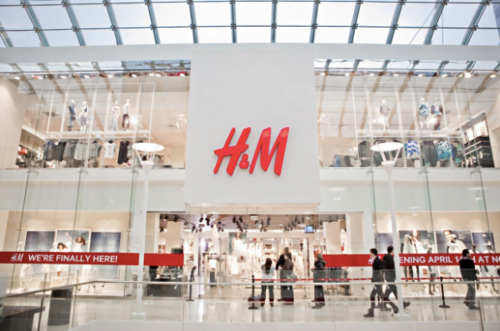
[Courtesy of Randy Harris, President of Trendex North America] H&M, Canada’s seventh largest apparel retailer during 2016, probably moved up two notches in 2017 as a result of a 7% increase in the company’s total sales during the past year. The retailer, whose sales during its fiscal year December 1, 2016 – November 30, 2017 totaled C$692 million, added 8 stores and closed two stores. At the end of the year, the retailer operated 91 stores (vs. 536 stores in the U.S.). Six of the Canadian stores were COS stores. During its fourth quarter ending November 30, 2017, H&M Canada’s sales decreased by 2% even though it added a net of three stores during the quarter.  

For all of 2017, H&M Canada’s parent company reported worldwide sales of C$35.3 billion, an increase of 3% over sales the previous year. During 2017, H&M opened a net of 388 new stores, and ended the year with 4,739 stores in 69 countries. The retailer’s profits decreased 13.2% for the year. During 2018 H&M plans to enter Uruguay and the Ukraine. Additionally, in recogni-tion of the growing importance of e-commerce, H&M plans to open on Tmall, the world’s largest e-commerce platform. [Trendex’s monthly Newsletter available at http://www.trendexna.com/can-apparel-insights]

Fendi Casa/Bentley Home Retail Space Debuts in Vancouver

exc-5a9222639140b7427f193066

Major Interiors opened the doors to their newest luxury retail venture, the Fendi Casa  Bentley Home showroom, in the heart of Hastings Crossing at 300 West Pender Street. This area between Gastown and Yaletown is undergoing rapid gentrification and as a result features numerous trendy boutiques, restaurants, and cafés.

The 5,000-square-foot open concept showroom has exposed brick, large character windows, and impossibly high ceilings, and is divided into several rooms with vignettes that showcase luxury furnishings collections from the brand portfolio of Italy’s Luxury Living Group.

Blending both The Fendi Casa collection, which celebrates the Roman Maison codes, and Bentley Home, inspired by the British luxury car company, into one location satisfies clients with a wide range of taste and styles. Visitors will note the added golden touch of Versace Home plateware and crystal decor peppered throughout the room displays.

Near the back of the showroom is a Steinway & Sons black regular grand piano which is next to the soon-to-be completed private shopping area and adjacent to a section of floor space which will be for seasonal installations where Major will introduce luxury homewares and unique decor from emerging brands that compliment the Fendi Casa Bentley Home lifestyle.

With over two decades of experience working in North America, Major Interior has grown to become a company known for the development, production, and distribution of luxury home products including partners Versace Home and Misura Emme.