Leger invites you to attend the annual WOW Customer Experience Index. Be the first to see who the top retailers are in customer experience in Ontario and in Quebec by attending one of Leger’s events.
See who is winning in the changing retail landscape. Join them to learn how over 15,000 consumers rated their in-store experiences. Learn who is winning the customer’s vote! Learn how your organization ranks vs. key competitors.
Presentations will include:
2017 WOW Index highlights
Rank order of retailers by sector
Digital profiles of customers
Simply click on the link to be our guest.
Toronto: November 14th at 7:30 a.m. for breakfast at the St. James Cathedral. https://goo.gl/8EnV8R
Montreal: November 22nd at 5:00 p.m. for cocktails at Leger’s head office. https://goo.gl/ABV84t
There is a talent crisis in the retail industry and retailers have to start thinking very differently about how they are going to fill their growing vacancies.
Suzanne Sears
“Retailers have lost touch with the job market in the sense of who wants to work in retail, what they need to pay, and what the ground level is asking in terms of career,” says Suzanne Sears, of Toronto-based Best Retail Careers International Inc., which is retained primarily by retailers to do private searches to fill vacancies or key replacements from the CEO to sales clerk level.
“It’s rare to see a retailer that doesn’t have a 20 to 50 per cent vacancy rate in their stores. It’s very rare to see a retailer that doesn’t have 20 to 50 per cent annual turnover. It’s rare to see a job that gets filled even at the lowest level. The lowest level is actually harder to fill in anything under three months.”
Last year, Canadian Press reported on a Conference Board of Canada study saying employment in Canada’s retail sector would hit a 12-year low in 2016 as companies adopt technology and trim costs in response to weak growth in consumer spending. That didn’t happen, however, Sears noted – instead, new retailers continue to open stores with her mentioning recent openings in Toronto’s Bloor-Yorkville such as Eleventy, Belstaff, Moncler and, soon, Hermes, among many others.
(LOUIS VUITTON IS AN EXAMPLE OF A SUCCESSFUL RETAILER THAT IS EXPANDING — IN DECEMBER, IT WILL UNVEIL ITS FIRST DEDICATED MEN’S STORE AT HOLT RENFREW IN VANCOUVER. IMAGE IS OF YORKVILLE IN TORONTO, VIA: INSIDERCONDOS.COM)
The Conference Board of Canada said the total number of jobs in grocery, clothing, department, home improvement, furniture and appliance stores was expected to drop to 1.26 million last year, a decrease of 2.6 per cent from the previous year and the lowest it has been since 2004. Again, that didn’t happen, she said.
Sears says retail staffing woes impact sales and productivity and add extra costs for a retailer. But the faster they fill roles the more profitable they become.
“In fact, what companies in retail seem to miss is that the quickest way to improve your sales is to fill your roles faster,” she says, adding that the competitive edge is people and retailers have to invest in retail being a legitimate career and creating an environment where young people want to work.
“It’s all about the people.”
Sears explains that there’s a massive disconnect between what retailers need, what they are getting and how long it’s taking.
Years ago, retail shifted responsibility for hiring to human resources which was never its function. That department for many stores inherited the position of gatekeeper of who can work for the company. But in most cases they have no financial accountability. They don’t have a seat at the table for results.
Sears says there are 2.5 retail jobs available for every one person that might want one.
“The market is screaming for people,” she says.
“So the net result of having HR running retail hiring for the last 20 or 30 years – even though retail is one of the largest economic engines as a source of employment in all of Canada – we don’t have anyone that wants to join it . . . They’re killing retail from the inside out. The crisis in retail terms of staffing is massive.”
Older people made careers out of retail. But that is no longer the case. Sears says it’s not an attractive career option for younger people. They’ve seen retail strip away pensions. Strip away tenure and longevity.
(ON THE GROW: BELSTAFF LAUNCHED ITS CANADIAN STORE EXPANSION THIS FALL WITH ITS FIRST FREESTANDING STORE AT TORONTO’S YORKVILLE VILLAGE, RUN IN PARTNERSHIP WITH THE ZAPPACOSTA FAMILY. PHOTO: LOUISE YU)
Young people see what is happening in the landscape and they don’t see retail as a career. Rather, they see it as a temporary thing to do until they get a “real” job.
“Young people don’t want the work that the old people have been shoved out of,” says Sears.
“Retail has to change if it wants any of these younger workers. Retail has to create a real career path. My biggest competition for retail workers is the banks. And why? Because they offer stability and they offer great wages to young people and they really do offer a long-term career path. And retail isn’t doing anything. None of it.”
*Top Photo: Toronto’s Yorkville Village continued to add new first-to-market retailers, as it nears the completion of a multi-year overhaul. Photo: First Capital Realty.
The morning kicks off with a breakfast and networking, followed by three sessions. The first session discusses Canadian shopping centres, referencing the soon-to-be-released 2017 Retail Council of Canada Canadian Shopping Centre Study. The conversation will revolve around what Canada’s top malls are doing to remain relevant, and Kevin Graff, President of Graff Retail, will host the panel. Panelists will include a handful of retailers and landlords, and Retail Insider’s Craig Patterson will also be speaking about the study’s results.
The second discussion will revolved around how retailers can leverage their digital influence for bricks & mortar purchases. Google Canada will be joined by Reitmans Canada Ltd. to review an example of how cutting edge location based technologies are enabling retailers to measure the impact of online investments to store traffic and sales, and how retailers can make digital spending decisions to increase store traffic.
The third session, titled “Why Now? Bricks & Mortar Expansion in the Retail ‘Apocalypse’” will discuss the fact that physical retail is still very much alive and well, with a discussion with innovative retailers that are opening new stores across Canada, and why they have confidence in bricks & mortar retail.
There’s room to sponsor both events, even together — the Retail Council of Canada Shopping Centre Study is used as a tool for many in the industry, and the Forum will be well attended. For sponsorship information, contact Mary Markou at: mmarkou@retailcouncil.org.
Canadians love their flyers. This isn’t new news. In fact, 9 in 10 Canadians check some form of flyer or coupon before they hit the stores. But I think it’s easy to assume that everyone who checks those flyers are driven by the same simple desire: to save money. Some new research that our team at Metroland has just completed in collaboration with BrandSpark International shows that it’s a bit more complicated than that.
Sure, saving money is important. But many Canadians consider flyers a source of inspiration as much as they are a source of information. In fact according to our research, 21% of all flyer and coupon users are “Inspired” shoppers who often look through flyers for new products, ideas and information and often read flyers for sheer enjoyment.
Inspired [21%]: “Inspired” shoppers are one of the four unique consumer segments identified in our research. As with most Canadians, saving money is important is important to this type of shopper, but they are willing to pay more for better quality products that are more suited to their needs. Other segments include:
Engaged [34%]: Engaged shoppers are “shopaholics” – utilizing all sources of information to save money and find the newest products. These are savvy shoppers that are comfortable using both printed flyers as well as the latest technology and apps to get an “edge” while shopping, and have no problem visiting multiple stores and spending extra time to get the best value wherever they can find it.
Deal-Seeking [19%]: Driven by their need to save money, Deal Seekers target stores and products that will help them stay within a predetermined budget – whether the need comes from lower discretionary income, or a desire to be a “smart shopper.” Flyers and coupons are the means by which they find deals and create a shopping list to prevent impulse buying.
Utilitarian [26%]: Utilitarians are shoppers with little time and attention, and who view shopping largely as a task. While deals and saving money are valued, they are secondary priorities to making shopping trips as fast and simple as possible. They use flyers as a tool to build their shopping list as they search for nearby stores that carry the products they need.
Our study also revealed that “Engaged” shoppers were more frequent shoppers than any other psychographic segment in the categories studied, except for Home Improvement in which Inspired shoppers came out on top.
This suggests that while flyers and coupons are often targeted to meet the needs of the “Deal- Seeking” shopper, there is a real opportunity for brands and retailers to integrate more inspirational content into their flyer to serve and appeal to the attractive “Engaged” and “Inspired segments.
On the other hand, brands should also continue to consider how these needs, and the value they can provide, still hinge on the format in which it is offered. Our research revealed that when seeking inspiration, printed flyers are typically at the top of the media hit-list. But when shoppers are looking to compare prices, flyer apps and aggregated sites (such as Save.ca) viewed on mobile devices are often the format of choice.
The key takeaway from these few examples is that it’s not enough to target your customers by medium; instead, brands and CPG retailers should customize the content of their flyers both for the customer they’re targeting, and the format through which they’re receiving it. Leveraging a variety of flyer and coupon formats with content targeted to these different shoppers based on their unique needs – whether they are deal-hunting or seeking inspiration – will set you up for success!
To access the full report, A Consumer’s Path to Savings: The Role of Flyers in Today’s Digital World, go to: metroland.com/path-to-savings
Lisa Orpen is Vice President, National & Multi-Market Sales for Metroland Media Group.
The first-of-its-kind initiative is a multi-sensory experience redefining the way men and women discover fragrance as the space is aimed at reaching millennials in a category where the shopping experience has remained largely consistent over the years.
Amaury de Vallois, General Manager at COTY Canada, says the company recognized an opportunity to reinvent and elevate the art of perfume in a modern way.
“Millennials have different shopping habits from the generations before them, and this new experience is visually interesting – an innovative and interactive way to try different scents.”
The new shop-in-a-shop retail outlet is a pilot project after officials realized some interesting things from research about millennials. First, shopping is an experience for them as they look to interact with brands before buying. Second, 75 per cent of them still want to buy in a bricks and mortar location. And third, memorable, entertaining experiences allowing for the discovery of something new are important to them.
The new fūme scent lounge was designed for that with sight, sound, touch and smell part of the sensory journey to discover fragrance with a modern approach.
Diane Sonnenberg, vice-president, marketing, luxury with COTY Canada, says the concept is the company’s re-invention and re-imagination of the fragrance shopping experience.
“It’s really bringing fragrance shopping back to an art form,” she says. “If you think about fragrance, everything about it is art from the creation of the fragrance itself from a master perfumer to the artisan that creates the bottle, the art directors that create the campaigns whether they be the photography or the video. It’s all art. We really wanted to elevate the experience to an art form in a very modern way . . . A completely different experience for the modern consumer.”
“We felt we had an obligation to help modernize the fragrance selling experience and make it fun and experiential. This is a pilot project . . . We’re testing this one and we’re hoping for great success and we’ll see where things go from there.”
Here are some of the key features of the lounge:
It is framed below a curling fabric canopy designed to resemble perfume mist;
There are large-format screens across a series of sculptural digital pillars;
The latest videos from fashion icons such as Gucci and Marc Jacobs will be played to music;
Non-spray inhalers allow consumers to explore the different fragrances;
Each inhaler is RFID-tagged, so it can be scanned on the interactive table, displaying information about the brand, the fragrance notes, selection and price; and
A playful quiz provides consumers with custom scent suggestions.
“This concept aligns with our vision to offer our customers new and unique experiences,” says Alison Coville, President, Hudson’s Bay. “We believe it will excite our customers and enhance their shopping experience, allowing them to discover the perfect fragrance in a new and playful way.”
“When we started working on it, I knew immediately this could not be a normal fragrance counter,” says Pereklita.
“We’re leading the customer on a journey of discovery . . . It’s really quite a different experience than the traditional department store way of buying perfume.”
COTY is the third largest beauty company in the world with approximately $9 billion in pro forma revenue. It operates three divisions – Consumer Beauty, which is focused on mass colour cosmetics, mass retail hair colouring and styling products, body care and mass fragrances with brands such as COVERGIRL, Max Factor and Rimmel; Luxury, which is focused on prestige fragrances and skincare with brands such as Calvin Klein, Marc Jacobs, Hugo Boss, Gucci and philosophy; and Professional Beauty, which is focused on servicing salon owners and professionals in both hair and nail, with brands such as Wella Professionals, Sebastian Professional, OPI and ghd.
Guildford Town Centre and Metropolis at Metrotown are both owned and operated by Ivanhoé Cambridge.
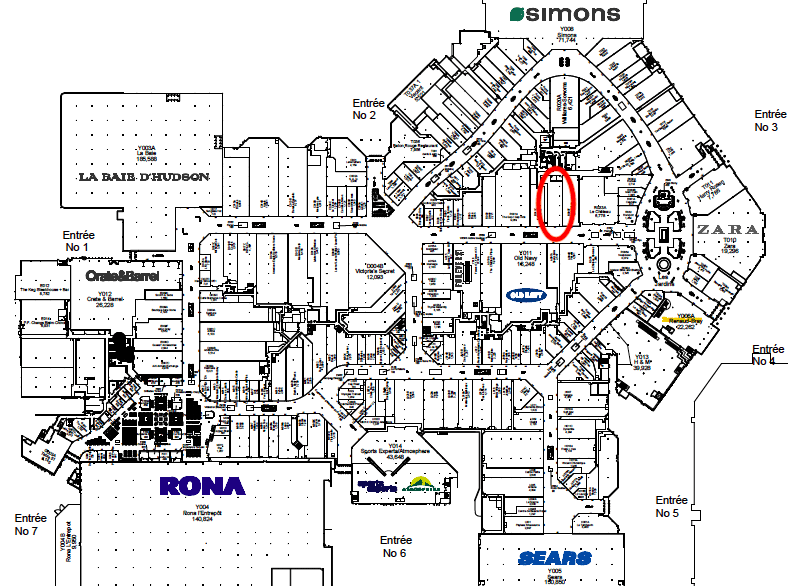
The Guildford Town Centre UNIQLO will span 18,000 square feet on the mall’s second level. The corner retail space is partly contained within an expansion corridor, with the store being next to the GAP on one side and across from Old Navy on the other.
The Metrotown UNIQLO opened to massive crowds, and occupies two levels and 20,630 square feet in the mall.
In September of 2016, UNIQLO Founder and CEO Tadashi Yanai told Marina Strauss of the Globe & Mail that UNIQLO could eventually operate as many as 100 stores in Canada.
UNIQLO now operates approximately 1,900 stores in 19 countries worldwide, including Japan, Australia, Belgium, Canada, China, France, Germany, Hong Kong, Indonesia, Malaysia, Philippines, Russia, Singapore, South Korea, Spain, Taiwan, Thailand, U.K. and the United States.
(RENDERING OF THE NEW VANCOUVER OLYMPIC VILLAGE STORE)
Outdoor gear retailer MEC (Mountain Equipment Co-op) is building new flagship stores in Vancouver and Toronto as it eyes further expansion in the future across the country.
David Labistour, CEO of MEC, told Retail Insider that the company’s website is by far its fastest growing store and its single biggest store.
“But we also know we have to have convenient locations for our customers,” he says. “I think we have to put in more stores. Ontario. We’re under-stored in Ontario. The whole GTA region. If the right opportunity presents itself we’ll go into Saskatchewan.”
“Retail is shifting incredibly quickly. I think we have to be adaptable and make sure that we respond to the changes that are happening.”
(MASSIVE WOOD CANOPY IN THE KELOWNA STORE, BUILT BY VANCOUVER-BASED PEREGRINE.BUILD)
MEC has 22 stores in British Columbia, Alberta, Manitoba, Ontario, Quebec and Nova Scotia.
It is Canada’s largest consumer co-operative with about five million members across the country. A lifetime membership is available for $5.
“We’ve always been very focused on having a very strong customer focus,” says Labistour. “We’ve had a very clear idea the purpose of the organization to be. We want to get people active and get people outdoors. A lot of what we do is aimed at the purpose of getting people off the couch and out the door. We’ve really tried to build a brand that is consistent with that and I think we’ve managed to build a very authentic brand that does resonate with people.”
He says the company is moving its Toronto store from King Street to Queen Street.
“King Street has become very congested. We know that it’s becoming very difficult for people to access that store. So we’re moving the store to an area where it’s more of a shopping precinct and has better access. I think in retail you need to continue to assess whether you can improve your locations,” says Labistour.
The new build will be about 40,000 square feet.
“It will be a much nicer store we believe because it gives us the opportunity to freshen up the way we build stores now. And our new store builds are quite different. They’re much more open and light. Have better flows,” he says.
There is no firm date on the opening of the new store but it will be within the next year.
(NEW TORONTO QUEEN STREET STORE. RENDERING: MEC)
Recently, MEC also announced it was building a new 60,000-square-foot flagship store in Vancouver with the three-storey building to be located at the eastern gateway to Olympic Village.
MEC’s Olympic Village location will replace its store at 130 West Broadway, which the Vancouver-based retailer has occupied since 1995.
Labistore says the current store in Vancouver on West Broadway is leased. The lease is coming due and the landlord wants to redevelop that site.
“In moving, it gives us a chance to really build a great flagship store in Vancouver because our oldest and possibly, arguably, least attractive store we have is our Vancouver downtown store. So it gives us a chance to really build a beautiful new building while moving to a new site to avoid disruption,” says Labistour.
Beedie Development has owned the site of the new MEC store to be built at 2nd Avenue and Quebec Street since 2007. When construction of the new store is complete in mid-2019, MEC will operate the purpose-built, high-performance green building on a leasehold basis from Beedie for at least 20 years.
(THE RUNNING ROOM, BAY STREET IN TORONTO. PHOTO: CRAIG PATTERSON)
Two or three years ago e-commerce was barely 1.5 per cent of the Running Room’s overall business.
After a significant investment that percentage has ballooned to near 10 per cent for the Edmonton-based retailer, which has stores across the country and into the United States.
“I really hope we’re going to hit that number by the end of the year. We’ve got an aggressive program. We want to have it 20 per cent in the next two years. That’s our goal,” says Jason Stanton, a partner and CMO of the company.
Stanton’s father, John, founded the family business in 1984 with its first store in a small room of an old house in Edmonton. Today, the retailer has 107 stores in Canada and nine in the United States.
(JASON STANTON)
“We started to take a look at our competitors,” explains Stanton of the company’s e-commerce push. “Certainly because of the landscape, borders aren’t as relevant. We started to look at some of our U.S. counterparts and what was going on and just realized that we needed to up our game and we made a really good investment a couple of years ago just to get our shopping platform more friendly and certainly catching up to what the consumers’ expectations were with it.”
That resulted in a much smoother process in how customers buy and pick up their merchandise.
“In the last six months, we’ve been seeing such a strong growth rate that we decided to really kind of double down and make sure that we are where our consumers want to purchase and how they want to purchase,” adds Stanton. “What we’re finding is they love shopping online but they really still love visiting retail. So we’re sitting at about 53 per cent of our online purchases are picked up at our retail stores which is quite unique.”
Six months ago the Running Room decided to add on another 5,500 square feet of dedicated dot.com space for its customer service group which is continuing to grow. Right now, it’s growing at a 25 to 32 per cent rate in the last six months and the company is really happy about that.
(SCREEN SHOT OF RUNNING ROOM’S ECOMMERCE SITE)
“Having a facility and a dedicated inventory for the dot.com has been a really big investment that’s been going on for us over the last six months,” says Stanton.
While there is joy in being and growing in the dot.com space, there’s no question the Running Room remains a very customer service-oriented company for products it sells.
“Overall we still feel there are opportunities (for expansion),” says Stanton. “We just had a store move in Victoria which we feel there’s lots of those type of opportunities, of stores that have done well for us.”
They will be strategic moves for existing stores but also the company will keep its eyes open for expansion as well.
“If there’s any oddities we see come up . . . then we’re for sure looking for that,” says Stanton. “We’re still committed to the U.S. as well but they have some pretty strong headwinds there with sporting goods and the run specialty (retail industry). So we’re letting those waters kind of calm down and making sure our stores are up to standard. And for sure the U.S. is a place we’re going to look to expand. We’re talking a bit of a 10-year plan.”
(JOHN STANTON JR., JOHN STANTON SR.[FOUNDER], JASON STANTON)
According to Statistics Canada, Canadian retail sales in June rose for the fourth consecutive month, edging up 0.1 per cent to $49 billion. That’s also a 7.3 per cent hike from a year ago.
Stanton says there have been some pretty strong headwinds for the business in the last couple of years but it is somewhat insulated because of what it does and what it offers. The Running Room is more than just a retail operation because it has running clubs and clinics and it is involved in many different events.
“Despite some economic ups and downs in retail that go on we still have our run clubs and clinics that are thriving and doing quite well . . . On the retail side, though, we’ve been fighting that plus minus two, three per cent for the last couple of years. We’re excited because the last six months we’ve seen some really positive numbers. Certainly out of Ontario. And Alberta has actually really weathered the storm quite well and is starting to breathe again quite nicely.”
Popular French optician and acoustics specialist Acuitis is launching its North American expansion in Quebec this fall, with the opening of a 3,226 square foot flagship boutique at CF Carrefour Laval in mid-November. The store will feature quality eyewear and hearing aid services, and a second Canadian location is also already confirmed for Acuitis.
The family business was founded in 2010 by father-son team Daniel and Jonathan Abbitan, with a goal of offering quality, affordably accessible eye and hearing care while also providing personalized, customer-centric service. Acuitis offers an ‘all inclusive’ service for its eyewear including eye examinations, mounting, lenses and any required adjustments. Glasses are often ready within an hour, with prices ranging from $120 to $550.
The company’s artistic Director Frédéric Beausoleil has worked with some of the world’s biggest names in eyewear (including Cartier, Louis Vuitton and Marc Jacobs), and styles will be unique in Canada. This season, many frames will be brightly coloured to highlight a sportier look, while metal frames will be modern and minimalist. Acuitis will also offer branded sunglasses, such as Ray-Ban, Lacoste, Calvin Klein, Nike and others. The retailer also features ‘hearing glasses’, which feature hearing aids that are are attached to the sleeves of the frame.
Acuitis is expanding quickly, having recently opened 21 stores in Europe this year alone. The company currently operates 71 stores in France, Switzerland, Luxembourg and, most recently, Italy and England, with more to come.
A second Quebec boutique is already scheduled for spring 2018 at CF Promenade St-Bruno. When asked about more locations, the company says that it will first monitor the success of its first two stores before expanding further into North America. If an expansion launches as anticipated, Canada will see even more competition in the rapidly expanding optical retail market.
CF Carrefour Laval is one of the country’s top malls in terms of sales per square foot, according to Retail Council of Canada’s Shopping Centre Study. A 2017 study will be released next month, and there are sponsorship opportunities available for companies seeking exposure to the industry (email: mmarkou@retailcouncil.org). As well, Retail Council of Canada is hosting a discussion forum to coincide with the release of the study on November 21 at Google’s downtown Toronto headquarters. [Details]
Two events occurred in Canadian apparel retailing earlier this year that, while not coming as a surprise, still require a comment.
The first involved the news that both Jean Machine and Grafton Fraser, Inc. had filed for Creditor Protection. In addition, German women’s apparel retailer, Gerry Weber, announced it was closing its eight corporate owned stores. Over the past three years a predictable pattern of post Holiday Season store closings has emerged. So the fact that three company’s made similar announcements really should have not come as a surprise.
The second development also involved a predictable occurrence. Industry savants have opined that the fate of the three retailers were preordained as they operated in the middle of the apparel market. The corollary that inviably followed was that the middle of the market was a dead zone, as consumers were trading up or trading down. To that contention, Trendex notes the following:
Over 80% of Canadian apparel retailers operate in the “middle of the market”, so it should not come as a surprise that the overwhelming number of apparel retailers that experience financial problems are in the middle of the market
If the low-end of the market is growing, why are the sales of Walmart Canada, YM Inc. and the Inc. Group not increasing?
Just because a group of retailers are labelled “off-price” does not mean they should be lumped in with true low-price retailers, including Walmart Canada. Without a doubt, the products/prices at Saks OFF 5TH and Marshalls are the same or often more than comparable items Sears sells. Because an off-price retailer sells a pair of $200 women’s jeans for $52 does not make it a bottom-tier retailer
Fast fashion retailers are usually included in the definition of low-tier retailers. Obviously Zara’s pricing would preclude it from ever being considered as a bottom-tier retailer
Many apparel retailers that define the middle of the market, including Marks, Moores and the Hudson’s Bay continue to prosper. Simons certainly could not be considered either a low-end or high-end retailer, as such it must be included in the middle of the market
There is no statistical evidence (only anecdotal evidence) which substantiates the contention that Canadian apparel consumers are trading up or down. If such evidence exists industry savants should share it.
In commenting on the closing of stores, Doug Stephens, CEO of Retail Prophet noted, “their cases are really symbolic of the struggles that most mid-tier fashion retailers have been experiencing.” This publication is in total agreement that many mid-tier fashion retailers are struggling, however their problems are a result of two groups of factors. The first are external, including the growth of e-commerce and the influx of foreign apparel retailers. The second group of factors are internal, or self-inflicted if you will. They include troubled apparel retailers including Sears Canada’s failure to:
Offer consumers a high value product
Delineate a unique selling proposition
Operate a first-class e-commerce program
Implement a comprehensive marketing plan which communicates the retailers USP
Close underperforming stores
Readers will note that one of the factors does not involve consumer’s wholesale abandonment of the middle of the market. Without a doubt some consumers are truly trading up or down, but this publication would contend that the number that do so, are far too few to explain the problems that some retailers in the middle of the market have experienced.
It would be safe to assume that what most “consultants” do not realize is that the middle of the Canadian apparel market is undergoing a period of “creative destructionism”. During this evolutionary retail period, Canadian consumers will continue to move up, down, and in many cases sideways, but within the middle of the market. Consumers might migrate to Frank & Oak or Zara, but they are still staying within the boundaries of the middle of the market. Canadian consultants will continue to mischaracterize what is going on with the middle of the Canadian apparel market until they realize that retailers like Marshalls have as much in common with Walmart as Donald Trump has with his predecessor.
This article appeared earlier this year in Canadian Apparel Insights, a monthly publication by Trendex North America. For more information and to subscribe, visit the Trendex website.