According to the Canadian Competition Bureau, when a retailer sets a sale price, that retailer must have already sold a reasonable quantity at the ordinary selling price or offered the item at the ordinary selling price for a reasonable amount of time. Misleading customers about a regular price is prohibited, as is advertising a sale price and not having enough stock available.
The problem is, the vast majority of Canadian and United States vendors aren’t sticking as close to the law as they should be – as many make the claim that what is being sold at a “.ca” e-tailing URL is “cheaper” than the list price the vendor would charge me in a physical store.
According to a recent article in The New York Times, list price discounting has become “a sales tactic that is drawing legal scrutiny, as well as prompting questions about the integrity of e-commerce”.
E-commerce retailers draw buyers in with “list prices” or “official prices” and mark them down dramatically to get a sale. Online shoppers want to feel they have a bargain, and online retailers want to satisfy that desire. With so many online retailers jostling for business, it seems that it’s becoming increasingly impossible to pay the list price for a product. And given that anyone and everyone shopping in cyberspace is after a deal, this matters.
In fact, our systems, which every day monitor 130,000 brands in 1,100 categories, has itself discovered that in North American sales, only a small set of items are ever sold at list price anyway (no more than 45%). In the case of precious stones & gems, camera accessories, bakery products, baking ware, food cupboard staples like sauces, marinades & dressings, ready-for-consumption frozen and pet care merchandise, with only 1 in 10 instances are sold at list price.
I say Canadian and US, but this is really a global issue. Internet retailers including Wayfair, Walmart, Rakuten (formerly Buy.com), Crate & Barrel and Williams-Sonoma employ list prices to varying degrees; Amazon, the biggest e-commerce player, uses them extensively and prominently. But it’s one that’s come under scrutiny, given recent US legal moves that look set to curb the whole practice, and so will obligate all North American retailers to swiftly change their digital sales techniques.
The backlash against list-price discounting first rose its head in 2014, when a group of California district attorneys brought a false advertising suit against Overstock.com, accusing the online retailer of using misleading list prices in order to exaggerate the amount of a customer’s savings. The firm was fined US$6.8 million, twice the size of the next-largest penalty for false advertising in California, and has also cost Michael Kors US$5 million to settle a class action suit challenging the prices offered at its outlet stores.
With the US government’s FTC (Federal Trade Commission) first off the blocks in investigating these tactics, the mythical iron “standard price” could soon see its demise in cyberspace. According to David C. Vladeck, the former director of that organization’s Bureau of Consumer Protection, after all, “If you’re selling US$15 pens for US$7.50, but just about everybody else is also selling the pens for US$7.50, then saying the list price is US$15 is a lie… And if you’re doing this frequently, it’s a serious problem.”
Contextual understanding is key
The problem here is that getting the pricing facet of online sales is one of the most difficult parts of cyber retail. It is a huge challenge to keep up with a dynamic, ever-changing marketplace; if the price is too high, online shoppers buy elsewhere, if too low you risk your profit margin.
What’s more shoppers thrive on comparing prices, so your relative prices compared to your competitors are paramount. Smart pricing technology will become the next way of enticing and satisfying bargain-hungry visitors to your website, as great data and smart, real-time optimization really is the only chance to evolve your sales strategy past this now-outdated trick. According to Rafi Mohammed, a consultant and author of The 1% Windfall: How Successful Companies Use Price to Profit and Grow, “Online retailers don’t use blowout sales since it’s so easy to shop there. But to provide confidence to consumers that they are consistently getting good deals, it’s even more important for them to provide price comparisons.”
Real-time, constant pricing adjustment based on market factors has to be the solution to satisfying the bargain-hunting appetite of online shoppers in the form of automated price optimization. To get there, pricing response time is key, as automation enables online retailers to optimize pricing 24/7. The market changes quickly and to succeed online retailers need to be able to change pricing to keep up with it.
Technology that can really analyze big data to enable online retailers to get full visibility of new and returning customers, enabling you to optimize for demand, trends, products, price architecture and regional behavioral differences has to be the way forward. But you need a smart, flexible system to get this right.
The verdict’s clear; old techniques can’t be relied on any more. You need real-time, accurate pricing and merchandising intelligence no matter the geography, vital as country boundaries disappear with the rise to dominance of e-retail – and also vital as the threat of legal action if you make any mistakes in this regard takes root.
Volume, pricing and revenue goals with automated price adjustments constantly taking place will enable online retailers to operate with confidence in this “list price” free world. Don’t get left behind.
The author, Sanjeev Sularia, is CEO at Intelligence Node, a leader in the field of pricing strategy automation
An expansion and renovation of Toronto’s RioCan Yonge Eglinton Centre is nearing completion after more than three years of construction. The centre anchors one of the busiest intersections in the region, which will only become busier when the $5.3 billion Eglinton Crosstown light rail transit line is completed in 2021.
French beauty retailer Sephora will anchor a prominent corner retail space at the centre, with frontage on Yonge Street as well as from access points within the centre. Construction is now underway on what will become one of Canada’s largest Sephora stores at 10,459 square feet, which is scheduled to open in July of this year.
According to RioCan Vice President/Leasing Jeffrey Stephenson, the centre features a mixture of both destination and local retailers to serve resident and visitor populations. Local shoppers might patronize recently renovated grocery retailer Metro or Goodlife Fitness, for example, while retailers such as Sephora, Swarovski, Urban Outfitters and Michael Hill can pull shoppers from a wider catchment area. Page + Steele / IBI Group Architects were responsible for the 70-store retail component renovation (including the addition of a 40,000 square foot glass/metal ‘cube’ at the Yonge/Eglinton corner), as well as designing the re-cladding of the centre’s two office towers.
RioCan Yonge Eglinton Centre (Image: RioCan)
A number of new tenants were recently added to the centre, diversifying its retail mix with a variety of food and fashion. The four-level retail podium features a number of food retailers on the subway level, and the top two floors also feature a number of large format retailers such as Winners, Toys “R” Us, Indigo Books & Music, and Goodlife Fitness. An enhanced concept Pickle Barrel restaurant, also upstairs, overlooks the busy neighbourhood below. Recognizing affluence in the surrounding area, Cineplex recently opened one of the region’s only VIP Theatres, further driving traffic to the centre.
According to RioCan Senior Vice President of Leasing Jeff Ross, the decision to expand and improve the centre was partly in response to anticipated increased traffic from the new Eglinton Crosstown Line, as well as new residential development in the immediate area. RioCan earmarked over $100 million to improve the centre, which now includes a 264,400 square foot retail component as well as about 754,000 square feet of office space in two tall towers. The intersection is already very well-trafficked, with an estimated 80,000+ daily pedestrians. Only Toronto’s Yonge and Dundas Street intersection is busier.
RioCan Yonge Eglinton Centre (Image: RioCan)
RioCan’s focus isn’t just on its retail/office plaza at Yonge and Eglinton’s northwest corner, however — the company has partnered with Bazis and Metropia for a project called ‘E Condos‘ at the northeast corner of the same intersection. That development will include a 54,000 square foot commercial podium at the base of two residential towers measuring 58 and 38 stories, with over 850 residential units between the two of them.
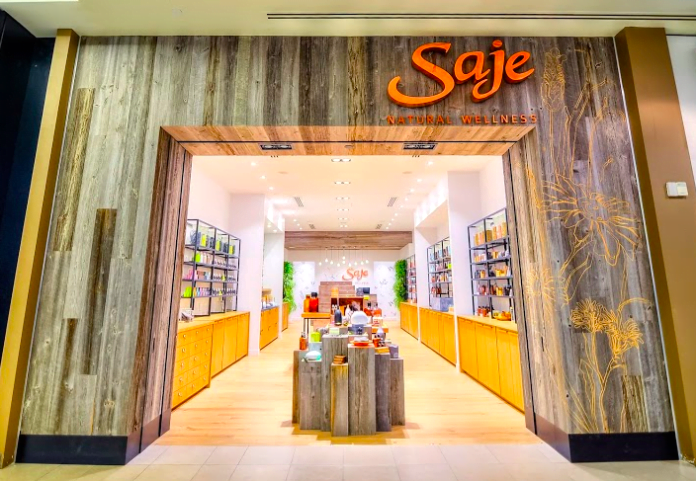
Popular Vancouver-based retailer Saje Natural Wellness has provided a list of where it will open stores in 2016. Its ‘Saje at Home’ concept already opened earlier this month on Vancouver’s Robson Street.
Saje Natural Wellness’ store openings in 2016 include the following locations:
In early 2017, Saje will open its second Saje at Home concept store at West Edmonton Mall.
Saje was founded in 1991, with the opening of a small shop at North Vancouver’s Lonsdale Quay. The retailer has since grown to retail hundreds of different natural wellness products, accessories and gift ideas. Products contain 100% natural ingredients, including plant-derived essential oils and base ingredients. Profit Magazine recently ranked Saje as #154 in its top 500 fastest-growing Canadian Companies. The company has doubled its store count over the past two years, and it plans to operate 50 Canadian stores by the year 2018.
ARITZIA AT METROPOLIS AT METROTOWN. PHOTO: IVANHOÉ CAMBRIDGE
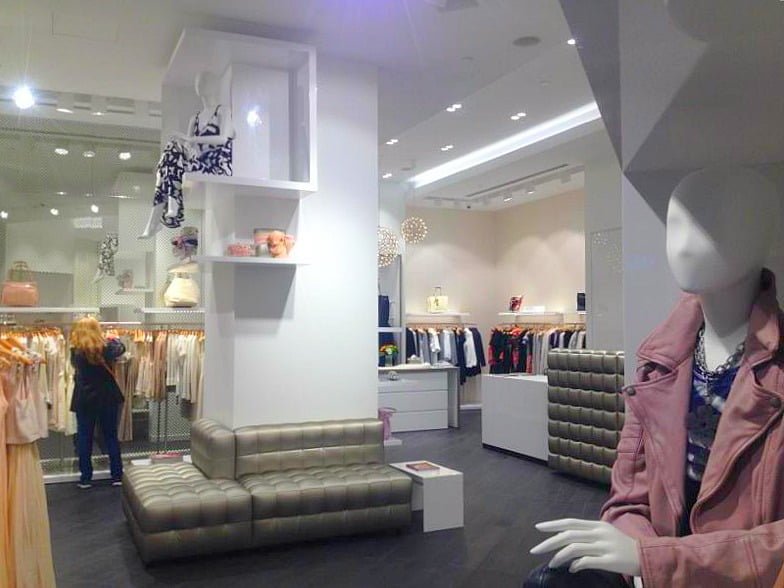
Popular Vancouver-based women’s fashion retailer Aritzia will spin off another one of its private label brands into its own retail concept. This will will be the company’s third in-house label to see its own freestanding stores.
In the fall of 2016, Aritzia brand Babaton will open a freestanding location at CF Toronto Eaton Centre in downtown Toronto. The 1,780 square foot Babaton store will replace the mall’s existing Wilfred location, which will move downstairs into a new 5,150 square foot space. Babaton will be strategically located between retailers Hugo Boss and Reiss on the third level of the mall. That level is considered to be very desirable — a south end pedway leads directly to Saks Fifth Avenue and Hudson’s Bay and on September 16 of this year, Nordstrom will open a 220,000 square foot flagship at the north end on the same floor.
Babaton is the latest Aritzia brand to launch its own stores. In-house brands TNA and Wilfred already operate six freestanding locations in British Columbia, Alberta and Ontario. The Wilfred brand will see more store locations opening in Canada this year, according to Aritiza’s Chief Marketing Officer Oliver Walsh.
LEASE PLANS ABOVE AND BELOW ARE VIA CADILLAC FAIRVIEW
Toronto’s Babaton will be designed by Aritzia’s in-house team of store designers, according to the company. The Aritzia brand itself is seeing a substantial store expansion, which we’ll discuss soon in a separate article.
The Babaton deal was negotiated by Northwest Atlantic Principal/Broker Dianne Lemm, who represents Aritzia in Canada.
Founded in 1984, Aritzia’s target market is women aged 14 to 30. Much of the clothing sold in its stores are its own exclusive brands, including Auxiliary, Babaton, 1-01 Babaton, Community, Wilfred, Le Fou by Wilfred, Wilfred Free, TNA, Golden by TNA, Parklife, and Talula. Stores also carry clothing from brands such as Mackage, J Brand, Citizens of Humanity, A Gold E, Frame, Levi’s, Rag & Bone, Adidas, One Teaspoon, and Herschel.
Saint Laurent Paris THURLOW STREET, VANCOUVER, ON APRIL 16 2016. PHOTO: HELEN SIWAK OF @ECO.LUX.LUV
French luxury fashion brand Saint Laurent Paris (aka ‘Yves Saint Laurent’) will open its first Canadian location this year in downtown Vancouver. The store will be located in the city’s burgeoning ‘Luxury Zone’, and will measure about 5,000 square feet over two levels.
Saint Laurent will have the address 746 Thurlow Street, and will be located between Moncler and Prada, in The Carlyle retail complex. CBRE has been involved with leasing spaces in the Carlyle, which also includes upscale tenants De Beers and Tory Burch. Hoarding for the new Saint Laurent store went up over the weekend.
Company representatives were in Vancouver last week, confirming that the city’s Saint Laurent store will feature the brand’s women’s and men’s ready-to-wear collections, as well as accessories and footwear. Women’s fashions will be on the main floor, menswear will be located on the second level, and a basement space will be dedicated to offices/storage. Saint Laurent women’s ready-to-wear and accessory boutiques opened within Vancouver’s flagship Nordstrom in September of 2015, and a limited selection of men’s Saint Laurent fashions are carried at Leone and Holt Renfrew in downtown Vancouver.
IMAGE: GOOGLE MAPS
When it opens, Vancouver’s 5,000 square foot Saint Laurent store will be one of the biggest in North America. Only its New York City (14,000 square feet at E. 57 Street) and Beverly Hills (10,000 square feet on Rodeo Drive) units are larger. Saint Laurent currently operates 17 freestanding and two outlet stores in the Unites States.
Last month, designer Hedi Slimani made news when he exited Kering-owned Saint Laurent after completely transforming the brand’s image. Versace protege Anthony Vaccarello has taken over.
Upscale German women’s fashion brand Marc Cain opened a flagship location last week at CF Toronto Eaton Centre. The brand entered the Canadian market in late 2015, and already operates five Canadian stores.
The 2,033 square foot CF Toronto Eaton Centre store is located on the mall’s ‘Level 3’, which includes popular retailers such as Harry Rosen, Ted Baker and an Apple Store. The same mall level features pedway access to Hudson’s Bay/Saks Fifth Avenue to the south, and this fall Nordstrom will open at the north end of the downtown Toronto mall. Marc Cain’s new store features high-gloss finishes with metallic shimmering walls, deep-pile fitted carpets, and large changing rooms.
“We are excited about the launch and rapid expansion of Marc Cain in the Canadian landscape,” says Stephen Belfer, Managing Director for Marc Cain Canada. “We are increasingly seeing a European flair in the clothing choices of Canadian women and thought it was the perfect time to introduce this brand to the market.”
The new store features the company’s core label Marc Cain Collection, as well as the more casual Marc Cain Sport and classic Marc Cain Essentials.
Founded in Bodelshausen, Germany in 1973, Marc Cain operates 204 stores as well as 280 shop-in-stores, 307 ‘custody customers’ and another 1,053 upmarket specialist retail stores in 59 countries. Brokerage Oberfeld Snowcap represents Marc Cain in Canada and according to its website, Marc Cain seeks retail space in enclosed malls, outlets/power and lifestyle centres, and urban streetfronts. Stores will ideally be in the 1,500 square foot to 1,800 square foot range, according to Oberfeld Snowcap.
Canadian retailers and other businesses can now inexpensively and easily create high quality marketing videos with an innovative new platform. This could in effect ‘level the playing field’ for retail marketing, as video has traditionally been expensive to produce and a challenge to create. A company called Magisto created a platform to simplify the video creation process, which is timely, considering that studies show video to be one of the most effective marketing tools available. Some are even calling it ‘the industrial revolution’ of video.
Magisto recently launched ‘Magisto for Business‘, which gives content creators the ‘creative director’ role without any intensive editing or content production. Magisto’s patented A.I. and new Smart Storyboard™ technology allows for filming on a smartphone, and the result is high quality, easy to create marketing videos.
There’s a story behind how the technology was developed. Founder Oren Boiman is both a scientist and a father. After the birth of his first child, Mr. Boiman and his wife took many digital photos and like many new parents, wanted to make home movies. After taking two weeks to create a high quality three-minute video, Mr. Boiman came to the conclusion that there needed to be a better way. At the time, he was a Ph.D. student researching the science of Video Vision and using Artificial Intelligence to create videos, he created the Magisto video platform.
Magisto has already become the world’s most popular smart video storytelling application that uses Emotion Sense Technology™ — a patented story detection that automatically analyzes and edits raw video footage and photos into movies, making video storytelling simple and easy to share. Initially used by individuals, businesses are now jumping on board to use Magisto, which is available for iOS, Android, PC and the Web. Magisto recently did a survey of its users, and 65% of them said that they already used or wanted to use Magisto in their professional lives.
Video is extremely useful to marketers — Facebook recently reported the number of video views increased 10 times over the last year to 8 billion views per day. It’s clear that video engages viewers and because of this, retailers must seriously consider using it to market to current and potential customers.
How it Works: Magisto is driven by patented Artificial Intelligence technology that selects the most compelling moments from a collection of digital videos and photos and automatically edits them together to create powerful, highly shareable movies that vividly express personal stories with customized themes, styles, and music. A new technology called “Smart Storyboard” ™ can be used to influence production value, define scene selection, refine messaging and brand movies without the usual complexities of video editing and production.
Below is a video from a retailer:
“The Smart Storyboard lets the business user focus on how to tell the story rather than worrying about how to edit, produce and create that same story using complicated tools,” said Magisto’s CEO, Oren Boiman. “It’s a bit like giving specific creative direction to your own video production team; that production ‘team’ just happens to be an intelligent machine that works in minutes rather than hours.”
Due to the traditionally high cost and complexity of producing high-end video, and the low quality results of most consumer video technology, many small and medium-sized retailers don’t use video as part of their marketing mix. Magisto can change that — with 75 million users and 2.5 billion pieces of content analyzed, Magisto’s AI-based video storytelling platform is evolving rapidly, and the improved technology has pushed the boundaries of the quality, ease and scale of video content that can be created by a machine.
“By extending Magisto to businesses, we’ve reduced the cost of producing a professional video by two orders of magnitude, while making it a thousand times faster because it’s generated by a machine,” said Magisto’s CMO Reid Genauer. “Within the last year, we have seen every major social network optimized for video creating the world’s first effective distribution platform for long-tail business video. “This is the industrial revolution of video and video marketing is no longer a “nice-to-have” — it’s critical for any business,” he continued.
Below is a promotional video for a fashion designer:
Magisto for Business incorporates several features specifically designed for small and medium-sized retailers and other businesses including custom scene selection, scene ordering, scene captioning, speech detection and custom branding. It also offers music licensed for commercial purposes, faster movie creation and unlimited HD downloads. New editing styles and algorithms allow the user to tell the Artificial Intelligence engine what the business use case is, enabling the Emotion Sense Technology (™) to make movies that accurately represent those use cases including; Business Overview, Product Demo, Tutorial, Creative Portfolio and Event Recap. Magisto intends to offer dozens of new business use cases to integrate with e-commerce and vertical marketplaces across numerous categories in 2016.
For more information on Magisto, visit magisto.com.
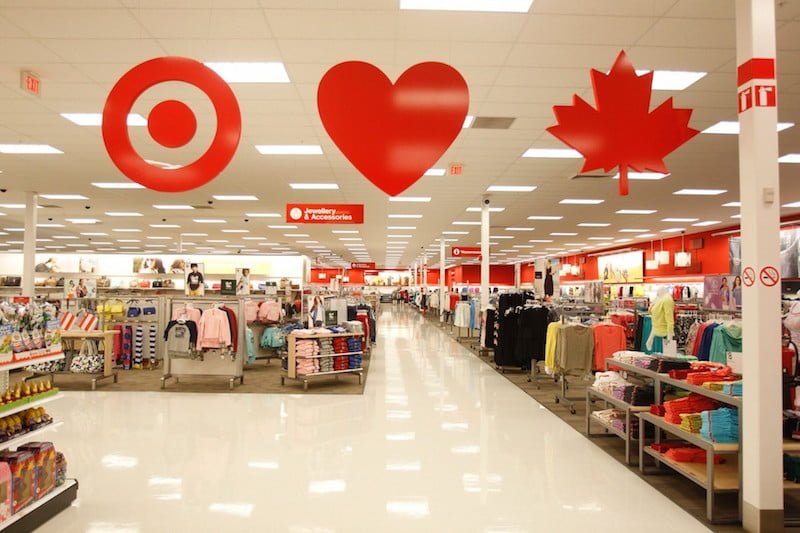
April 12 marked the one-year anniversary of the closing of Target stores in Canada. In the Jewish tradition, we mark the anniversary of a passing by observing yahrzteit, or remembering.
Although Target might have only lasted about 2 years in Canada (some stores as few as 6 months), because of the size and scale of the operation, it will continue to affect Canadian retail for the foreseeable future. In this essay, I identify some of the long-term impacts and lessons about the Target fiasco in the Far North.
1. Target actually had some better brands of merchandise in Canada than in the US. For example, in its housewares department, Target Canada carried the Joseph Joseph line of high fashion kitchen accessories. Target USA does not carry this line; JC Penney had it the last time I checked (a few months ago). Joseph Joseph is also carried by Hudson’s Bay in Canada and Macy’s in the USA—“next step up” stores.
But I’m not sure anyone noticed and I don’t remember Target making much of an effort to promote this. And Target should have.
Target carries the Kitchen Aid line in its USA stores but Canadian Tire seems to have an exclusive on that line in Canada, meaning that Target couldn’t carry all of the merchandise in Canada that it carries in the USA because of existing agreements between the same suppliers and other stores. (I conjecture this because I don’t see it elsewhere and Target didn’t carry it.)
Even before it opened, Target said it would have some unique products in Canada that it didn’t sell in the US. In the case of housewares, Target “traded up” for some better merchandise but never really announced it. They should have promoted Target Canada exclusives in store and in its advertising and defined exclusive as either not available in Target USA or only available at Target.
2. Target got help screwing up some of its Canadian merchandising. Although Target admittedly has primary blame for its failure in Canada, it actually had help screwing up a number of its departments. As I noted in the previous post (and others have noted, too), Target had a lousy and overpriced merchandise mix—especially in groceries and health and beauty- pharmacy. But in many parts of the country, Target relied on a major local supplier to help with those. Groceries were supplied by Sobeys and, at least in Quebec, pharmacy was supplied by Brunet (part of the Metro group).
I only know about these from what I read in the paper and saw in the stores, but as I understand the situation, they were supposed to provide a Canadian imprint on these departments. The problem is, they put a Sobeys or Brunet imprint on these departments, someone forgot that these are Target departments.
It appears that no comparison was made with the merchandise mix at Target US and Target Canada, something that Target should have overseen and required of its suppliers. Furthermore, it appears that no effort was made to coordinate store brands between the two countries; it appears that Sobeys and Brunet store brand products was merely packaged in Target store brand packaging. So what appeared to be similar or identical products to Target USA on the outside seemed like substantially different products on the inside.
3. Target might not have lasted, but mall upgrades made to accommodate it have. Before Target announced its entry into Canada, many Canadian malls—especially in the Class B and Class C ranges—had delayed necessary renovations. Malls like CF Galeries d’Anjou in Montreal and Bayshore Shopping Centre in Ottawa appeared stuck in the 1990s, both in terms of appearance and lackluster store mix.
Expecting greater foot traffic from Target, however, these malls finally entered the second decade of the new millennium. They remodelled their interiors, updating colour schemes, furnishings, and decorative elements. They reworked their store mixes. The updated malls appeared more fashion-forward and reflective of the times.
4 . Target might not have lasted but upgrades to its competitors leave them in stronger positions long-term. Target thoughtfully gave Canadian retailers two years’ warning of its arrival and the retailers used that time to significantly up their game. And most major retailers did, with Canadian consumers benefitting long-term, even if Target didn’t last. Consider these long-lasting improvements to some iconic Canadian retailers:
• Canadian Tire: Strengthened its coverage of the basics and customer service, and re-emphasized its place in Canadian communities to maintain its place as the go-to-store for anything basic in the household, the place that Target tried—and ultimately failed—to supplant. Instead, Canadian Tire seems to have strengthened its role as the go-to store for anything basic in the household.
• Hudson’s Bay: Transitioned from a ho-hum four-century-old operation to one that looks relevant and new. (Of course, the $1.2 billion it received from selling its Zellers leases to Target helped.) It emphasized higher end and quality fashion and home furnishings to distinguish it from the cheap chic expected from Target.
• Loblaws: Strengthened the design appeal of its housewares (looking chicer than Target’s while offering similarly low prices) and launched the Joe Fresh clothing line, which challenges Target’s on price and style.
In a bit of tit-for-tat, Loblaws tried to strike back by launching Joe Fresh in the USA. As Target failed in Canada, so Joe Fresh seems to have quickly gone stale in the US: its relationship with JC Penney cut short and its Fifth Avenue flagship in New York quickly closed.
• Metro: The central and eastern Canada grocer continued to focus on groceries, but upscaled the experience. It brought all of its stores under the Metro brand (previously limited to Quebec) and reworked its logo Metro also expanded its prepared foods, strengthened its store brand, and launched an American-style grocery store loyalty program (Metro et moi / Metro and me).
• Sears Canada: Although on a self-inflicted death spiral, Sears made some nominal moves to counter Target, including a couple of store remodels in malls where Target would also locate (like CF Galeries d’Anjou in Montreal).
But Sears most interesting moves came after the store closed, when it offered jobs to Target employees. Admittedly, that was a head scratcher, as Sears has been laying off employees with increasing regularity. But in the end, Sears is still here and Target isn’t.
• Walmart: Already having had upped its design game for US stores to compete against Target’s admittedly diminished housewares (which suffering from the departure of major designers like Michael Graves), Walmart decided to primarily compete with Target in the grocery department, expanding many of its existing Walmart (which have a small grocery section) to Walmart Supercentres (which have full-line grocery stores in addition to all of the other departments).
PHOTO: TARGET CANADA
5. Target might not have lasted, but some of its empty storefronts will serve as long-term reminders of the failure. One of the long-term problems of Target leaving is that it also leaves lots of empty space: about 2 to 3% of all retail space in Canada. About a third of its leases were picked up within 9 months—some by Walmart, some by Lowe’s, some by a gym—but the majority are vacant and are likely to remain that way.
That’s because the demand for 120,000 square foot stores is limited. A few malls are rebuilding the space so they can lease smaller stores.
But in a climate whose medium-term outlook for the next few years is flat, absorbing all of that still-vacant space remains a challenge.
So shadows of Target signs remain on walls in and out of malls that look like Target bullesyes but aren’t any more.
And nothing looks more creepy than a big vacant store.
6. Target needs to revisit its playbook for entering a market, especially if it tries again to enter international markets with bricks-and-mortar stores. Target likes to enter new markets by making a splash and launch a number of stores all at once.
But it overlooks Target’s history: how Target entered new markets in the US. It reads just like the playbook for Target Canada. When possible, Target would buy the real estate of a distressed competitor, such as Richway in Atlanta and Ames in Boston. If necessary (as it was in Atlanta), Target waited until after the store liquidated its merchandise and formally laid off its staff, before bringing in the construction crews and hiring teams to open a new Target.
That’s what happened with Target’s purchase of Zellers leases.
The massive construction-then-massive-launch approach might work in the US, where communities are increasingly similar in their day-to-day needs, and, except for some local variations, the company would still retain its basic supplier relationships, operating logistics, and HR practices (with minor adjustments for local laws and customs).
But even though the population of Canada is about the same size of California (or about 5 Target market areas), it’s a different country and Target could have considered an entirely different playbook.
Rather than buying the leases, emptying the stores, laying off all of the talent, and investing in reconstruction, Target could have purchased Zellers’ outright, taken advantage of its expertise, supplier relationships, ongoing operations, and, significantly, functioning inventory control system, then made adjustments as it learned the market and slowly but surely convert the Zellers stores to the Target nameplate, learning from the successful lessons of Walmart’s successful entry into Canada at Woolco stores.
7. Although Target’s policies are written to value human resources, its choices in Canada suggest that a bridge still exists between what’s written on paper and what’s practiced in the business. One reason that Target had chosen to wait to occupy a former retailers’ space rather than merely take over its business as described above is that Target is a non-union company and most of the stores it has replaced had unionized staffs. Without going into the pro- or anti-union issue, which is beyond the scope of this discussion, practical considerations suggest that addressing broader business needs might necessitate rethinking this employment practice.
In this particular situation, Zellers was a functioning business and Target would have rebuild all of that from scratch.
But Target also ignored the practical limitations of the real world when choosing to do so, because the company made three other choices that rely on effectively managing human capital dimensions and, in both cases, made disastrous choices.
The first two choices are related: planning to open 133 stores across Canada within three years and launching a two significant pieces of technology–an inventory control system and a point-of-sale system–both of which touch on every part of the organization. Both timetables were unrealistic, but especially the inventory control system, on which the entire operation of Target depended.
Anyone with passing knowledge of enterprise systems knows that such a comprehensive system cannot be launched in two years, no matter how smart the people working on the team or how experienced the systems integrator (Accenture in this case.) Canadian Business has an amazing post-mortem of the situation. Both systems probably could have been successful if management had been realistic about the schedules for systems planning, installation, customization, and implementation. And they could have been realistic, because a wide body of experience with enterprise systems in general, and inventory and point of sales systems, in particular is available. But management chose to ignore that almost all of that history suggests that a successful implementation requires three to five years. In other words, they ignored one of the most basic principles of human performance: the best predictor of future performance is past performance.
The third choice Target made was to shortchange training. I had been aware of that problem; I had spoken informally with certified trainers whom Target lured from other Canadian retailers. But the trainers I spoke to were hired on contract and told me that, as soon as initial training was complete, Target dismissed them. Ironically, these trainers provided training on their systems.
That might not have been as serious of a problem in Target USA, the company not only has functioning inventory control and point-of-sale systems, but also has experienced workers who can provide the development needed to bridge the gap between classroom training and the job.
But all of Target Canada’s employees were new and, as happens in situations like these, relied on incidental, on-the-job learning rather than close supervision and mentorship, some of which was not feasible because of the general inexperience of the Target Canada staff, but some of that supervision and mentorship not feasible because the company chose to provide less rather than more training, when learners could be observed performing successfully before they return to the workplace.
And some of the informal lessons learned turned out to be how to game the system. In doing so, staff exacerbated an already public and humiliating problem with inventory. As reported in Canadian Business:
Business analysts (who were young and fresh out of school, remember) were judged based on the percentage of their products that were in stock at any given time, and a low percentage would result in a phone call from a vice-president demanding an explanation. But by flipping the auto-replenishment switch off, the system wouldn’t report an item as out of stock, so the analyst’s numbers would look good on paper. “They figured out how to game the system,” says a former employee. “They didn’t want to get in trouble and they didn’t really understand the implications.”
Although presented in the magazine as a technology issue, the situation sounds like a classic human resources management and development problem.
By all accounts, despite these problems, Target had a committed and engaged workforce according to the Canadian Business report. But a committed and engaged workforce can only go so far when the system sets that workforce up for failure.
8. Bankruptcy is ugly. It humbles even the great. In bankruptcy, Target violated its own century-old values as a corporation and seriously tarnished its image in the Canadian community. It wrote checks to community organizations just before the bankruptcy that bounced when the community organizations tried to cash the checks within days of the bankruptcy. It laid off nearly 18,000 of its own workers, and cost thousands more their jobs. It ruined suppliers. It raised questions about its own ethics by the choice of bankruptcy statute to use in its filing. The manner in which it tried to get out of its leases further tarnished its reputation and the company found itself in protracted court proceedings over its bankruptcy plan.
In other words, Target lost more than billions of dollars in this failure; it lost a part of its soul, even if most of that news was only covered in Canada and received far less coverage in the USA.
9. Target USA does seem to be recovering. Although the stated reason for departing Canada is that the company saw no path to profitability before 2021, if even then, part of the reason has to be that its US stores needed primary attention.
Although everyone talks about how lousy the Canadian stores were, the USA stores weren’t so wonderful. Sales were flat. The chic had departed and, even in harsher times, cheap alone wasn’t attracting customers. And with a data breach of massive proportions, the company lost the trust of its customers, too.
Around the time of the Canadian departure, Target executives announced efforts to revitalize the product line and shopping experience. The proof would have to show itself on the showroom floor.
And it is starting to. The housewares section has been reimagined and the displays are impressive. I have seen pictures of a reimagined grocery section, which is supposed to have a strengthened focus on healthier foods. If those pictures of the prototypes eventually appear in the grocery department, that department, too, should show new signs of life.
In other words, closing the Canadian stores to concentrate on the American stores was not only a good business decision, it also appears to be one bearing fruit for Target. (That some post-Canada earnings reports have shown signs of life further supports that decision.)
10. Target does not seem to have learned all of its lessons about international retailing. Although Target got many things wrong when it tried to enter Canada, it did recognize that, at the least, it needed to be culturally sensitive to shoppers in Quebec and made a strident effort to understand its culture. The problem was, Target didn’t understand the local shopping habits and just assumed people would change them, just because Target is Target. Target was wrong.
Similarly, although Target acknowledges that it failed in Canada, it seems to have ignored anything that could have been learned from the experience when the store opened an international website.
The site allows visitors to shop at Target.com and ship to countries outside the USA. But this international website offers the same value proposition as its Canadian stores—fewer products available at much worse prices.
On the one hand, I doubt many Canadians will shop there. On the other hand, visiting the site and seeing the crappy selection and lousier prices gives us a nice chuckle.
Perhaps that was the point? (Probably not, but just in case…)
ABOUT THE AUTHOR: Montreal-based Saul Carliner is an associate professor at Concordia University, has published widely on training and development and professional communication, and blogs about shopping and museums. He has been featured in the Globe and Mail, Les Affaires, Montreal Gazette, CBC, Global News, CTV Montreal, and CNBC Asia.
Oxford Properties has revealed a partial list of the retail tenants that it has secured for the next expansion of Toronto’s Yorkdale Shopping Centre, in a new wing that will be anchored by a 196,000 square foot Nordstrom store. The mall is Canada’s top selling with $1.2 billion in annual sales, with Canada’s highest mall productivity of $1,610/square foot annually.
The 300,000 square foot, $331 million expansion wing is scheduled to open on October 18 of this year, and it will be located on the mall’s east side. Oxford Properties confirms that the following stores will open in the new expansion wing:
More retailers will be announced this spring as details become available — about 30 retailers will eventually open in the new 112,000 square foot (excluding anchor) Nordstrom wing.
“This expansion will signal a new era in the evolution of the Canadian retail landscape,” said Claire Santamaria, Yorkdale Shopping Centre’s General Manager. “We have been strategically expanding to meet shopper demand for a retail environment unlike any other in Canada. This investment is designed to cater to that demand and attract new shoppers seeking exceptional choice and diverse retailers.”
Nordstrom’s Yorkdale store is scheduled to open on Friday, October 21, with a charity gala to be held two days prior. Yorkdale will be Nordstrom’s second Toronto store, following the opening of its highly anticipated 220,000 square foot CF Toronto Eaton Centre flagship on September 16 of this year.
Yorkdale’s Nordstrom wing expansion isn’t the last for the centre, however. Preparations are already underway for a westward expansion towards Dufferin Street, which will see the addition of a 69,000 square foot RH (aka Restoration Hardware) store as well as smaller retail units.
Yorkdale has become decidedly upscale, particularly in the mall’s new ‘luxury wing’ near Holt Renfrew. Yorkdale was Canada’s first suburban shopping centre to feature a significant luxury retail component, housing free-standing locations for brands such as Cartier, Bulgari, Mulberry, Jimmy Choo, Moncler, David Yurman, Montblanc, Versace, Salvatore Ferragamo, Hugo Boss, and others. Last spring, French luxury brand Longchamp opened a new store across from Holt’s and in the fall of 2015, luxury timepiece brand Jaeger-LeCoultre opened one of two Canadian locations at Yorkdale. Holt Renfrew, itself, features mall-facing concessions for luxury brands Chanel, Prada, Gucci and Louis Vuitton, as well as internally-accessed concessions for Dior, Giorgio Armani and others.
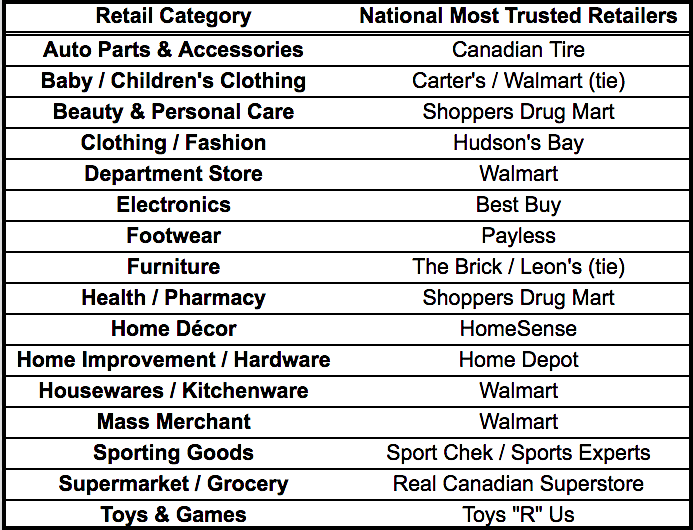
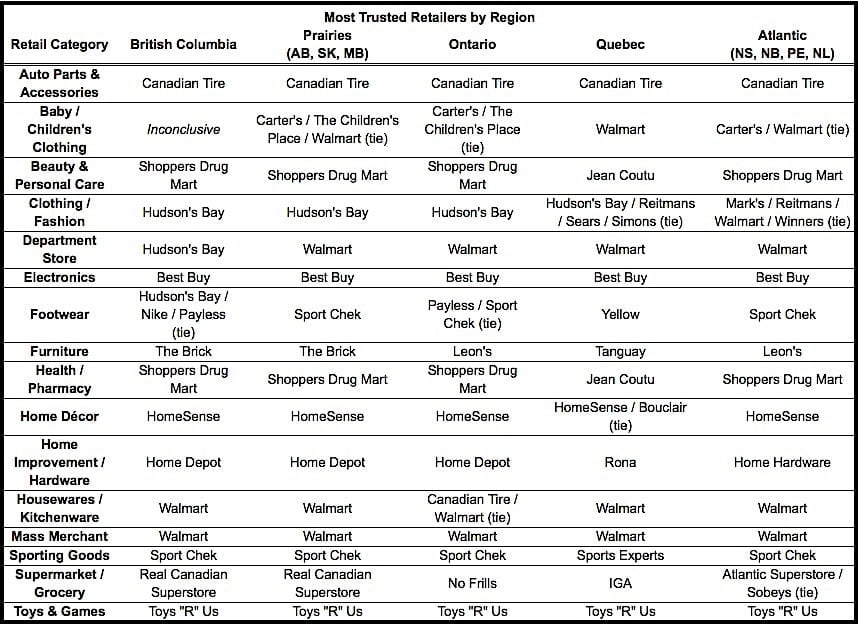
Toronto-based market research firm BrandSpark International has revealed its 2016 list of most trusted Canadian retailers, based on its annual Canadian Shopper Study. The study ranks retailers by category as well as national and regional ranking.
Over 7,500 Canadians participated in the study, ranking what retailers that they considered their ‘most trusted’ in 16 household and personal shopping categories. Listed directly below are the national winners by category.
Several retailers lead their categories from coast to coast, including Canadian Tire (auto parts and accessories), TJX-owned HomeSense (home decor), Sport Chek/Sports Experts (sporting goods), Toys “R” Us (toys and games), and Best Buy (electronics). Shoppers Drug Mart is most popular in English Canada for beauty and personal care as well as health and pharmacy, while Jean Coutu is Quebec’s most trusted choice.
Quebec had several unique ‘most trusted’ retailers, including Tanguay for furniture, Yellow for footwear, and Bouclair for home decor (a tie). Rona is Quebec’s most trusted retail brand for home improvement, while Home Depot ranks first in the rest of Canada.
Regional differences were present for grocery retailing as well, with Loblaw-owned No Frills earning top spot in Ontario and IGA in Quebec. The Loblaw-owned Real Canadian Superstore brand comes out on top in the rest of Canada, in a tie with Sobeys in Atlantic Canada. The study notes that Quebec and Atlantic Canada’s top grocery pics weren’t price-focused, as was the case for the rest of Canada.
The study also notes that American behemoth Walmart has become a trusted destination for low priced goods generally, and particularly for housewares and children’s clothing.
In the study, Canadian shoppers also revealed what determines their trust in a retailer. According to the study’s findings, Canadian shoppers expect consistently strong value (often driven by low prices or high-value promotions), a strong selection of quality products, and a consistent and convenient shopping experience from their most trusted retailers. One Ontario shopper gave their reason for citing No Frills as their most trusted supermarket: “The prices are cheap for a variety of foods, and [the stores are] mostly clean, depending on the branch. They have a wider selection of international grocery items.” Meanwhile, a Sobeys shopper wrote: “I trust [Sobeys] the most due to overall cleanliness, friendly staff, and great tasting, fresh products.”