Innovative Canadian tea brand DNA Tea is seeking retail partners for its exclusive line of 100% authentic Darjeeling medicinal teas, which are blended with 35 rare herbs. Developed by Dr. Rahul Kushwah over the past 18 months, the brand is also looking to eventually open its own freestanding locations with retail partners.
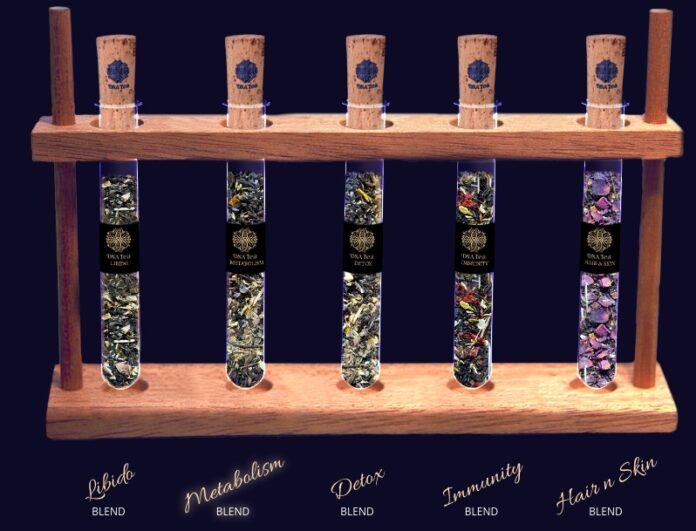
The herbal ingredients in the teas have been medically shown to positively impact the human body, with health benefits supported by clinical trials. Remarkably, DNA Tea is the only tea-based natural product proven to do so. Its effects range from protecting DNA, preventing cancer, improving metabolism, improving libido, eliminating toxins from the body, enhancing immunity to even improving the health of hair and skin. The five DNA Tea lines include:
Links to each of these above provide extensive descriptions of how they work.
DNA Tea’s blends use a combination of 35 herbs shown to impact, protect and enhance the working of the human body. They were also developed to be delicious, according to Dr. Kushwah, with flavour coming exclusively from 100% Darjeeling Tea and 100% pure herbs. Unlike other tea manufacturers, DNA Tea has no chemicals, no preservatives, no artificial flavouring and no external flavouring, he said. At the same time, unlike other detox products available in health food stores which taste like “medicine”, DNA Tea is completely free of laxatives and at the same time is aromatic and delectable.
Antioxidant-rich Darjeeling teas have high levels of complex molecules such as theaflavins and thearubigins, with proven health benefits. Darjeeling tea is the most expensive, exotic and exclusive tea in the world, grown in only in 78 tea gardens at elevation of 6000 feet in the Himalayan Darjeeling hills. Darjeeling tea is the only tea designated as “Champagne of Teas” by the UK Tea council. DNA Tea takes pride in being the only company to use premium Darjeeling tea in all of their products.
Dr. Kushwah’s background is particularly notable, having been Professor at the Faculty of Medicine in the University of Ottawa, a Scientist at the Human Health Therapeutics Branch of the National Research Council (Government of Canada), as well as a Banting Fellow (Select group of 22 recipients from all over the world). He developed the line of teas after a serious illness where, due to an antibiotic interaction, his body quit making red blood cells. He consulted with a Naturopath who inspired him to develop a line of teas infused with herbs, which while tasting good also have a positive impact on the functioning of human body.
DNA Tea is seeking retail partnerships for its products. Benefits of partnering with DNA Tea include:
Attractive margins for retailers with preferred pricing,
Opportunity to carry an unique, innovative, impactful, premium product line with high percentage of repeat clientele,
Carry a completely natural product, aromatic and delectable, blended in Canada, and
Eye catching, unique packaging to retain flavour and aroma, while being aesthetically different and attractive.
For retailers interested in getting involved with DNA tea, call 1-888-IDNA-TEA (436-2832) or email: customerservice@DNATea.com. Website: www.DNATea.com. As well, the brand is looking to possibly spin off into a franchise model with its own tea boutiques.
Winmark Corporation-owned women’s resale concept Style Encore will launch its first Canadian store location next year, and the company is actively seeking franchisees for more than 40 territories nationally.
Style Encore caters to women in their late 20’s and upwards, selling gently-used clothing, footwear, handbags and accessories. Fashions range from casual to dressy, with Style Encore buying items that have been in retail stores within the past couple of years in order to reflect current trends. Unlike consignment, Style Encore pays cash on the spot for items it wants for its stores, and walk-ins are welcome. Style Encore stocks a variety of women’s sizes, ranging from size 0 to 4X. The company also makes it clear that it doesn’t sell counterfeits, and takes measures to ensure brand authenticity.
The company’s first Canadian store will open in the spring of 2017 in Guelph, Ontario, in unit 4 of the strip retail plaza at 170 Silvercreek Parkway North. Style Encore prefers retail locations with easy vehicle access, for the convenience of both consumers and product deliveries. Because of this, strip malls and similar retail environments are preferred.
Winmark Corporation is seeking Canadian franchisees for its Style Encore expansion. There are currently 40 territories open in Canada for Style Encore franchisees. The company has signed agreements for various sites, so the company is not soliciting sites from landlords at this time. The company utilizes Aurora Realty Consultants as its Canadian brokerage.
Minneapolis-based Winmark specializes in developing franchises for retail stores that buy, sell and trade new and used merchandise. It’s the parent company to retail concepts Plato’s Closet, Once Upon A Child, Play It Again Sports, Music Go Round, Style Encore, Wirth Business Credit and Winmark Capital. All focus on different demographics but adhere to the same frugal concept of ‘sell.buy.repeat’. The company’s retail brands have in excess of 1,150 franchised operations in North America with over $1 billion in sales, and it continues to expand rapidly. Winmark first entered the Toronto market in 1993 with the opening of a Play It Again Sports store in Whitby.
Toronto-based retailer BRIKA, profiled last week on Retail Insider, has acquired Sonder Mill, a curated peer-to-peer online marketplace for furniture and housewares based out of Toronto. It marks the first major acquisition for BRIKA, which is both an e-commerce company and bricks-and-mortar retail concept that sells crafted goods from the artisan and designer community.
“There is a consistent demand for beautifully designed furniture – and a community of talented Makers who supply the highest quality product in this category,” said Jennifer Lee Koss, BRIKA’s co-founder. “The furniture category is one that BRIKA has always wanted to delve into and aligning with a like-minded, Toronto-based entrepreneur was just the catalyst we needed.”
“BRIKA and Sonder Mill share the same vision for the future of craft retail,” said Sonder Mill Founder Scott Miller. “Expert product selection by way of staying true to quality craftsmanship is a must, and the reason our artisans and customers continue to resonate with our brands.”
Sonder Mill’s community of ‘Makers’ and products will be folded into BRIKA’s website and retail spaces, significantly broadening the scope of products offered and wholesale opportunities for artisans. “We are building a one-stop destination for only the most talented designers and their goods,” said Ms. Koss. “From the brand to the business, we see this acquisition as being a strategic move for us that will continue to expand BRIKA and fuel our future growth, both online and in-store.”
BRIKA was founded four years ago as a pureplay online retailer, sells unique crafted products from “the most talented, authentic artisans and makers”, according to the company. BRIKA now has two permanent Toronto retail locations as well as a series of pop-ups in partnership with Oxford Properties, and the retailer is also launching online through a variety of retailers, including Lord & Taylor in the United States. The company was founded by Jennifer Lee Koss, a Harvard MBA graduate and Kena Paranjape, a University of Toronto MBA graduate, former retail buyer and blogger.
BRIKA is launching a series of pop-ups in time for the winter holidays, offering curated shopping experiences to help with gifting. For more information, visit: www.brika.com.
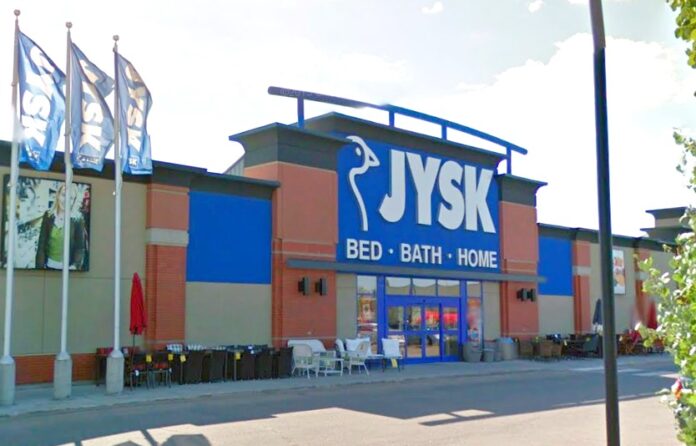
Affordably priced Danish home furnishings retailer JYSK plans to substantially expand its Canadian operations. The company will open four more stores this year and in 2017, JYSK plans to open seven or more Canadian locations.
JYSK was founded in Aarhaus, Denmark in April of 1979, and is now the largest Danish retailer operating internationally. The company operates over 2,300 store locations in over 40 countries. It sells household goods such as mattresses, furniture, and interior decor, and also features seasonal furniture offerings.
According to Director of Advertising Lynne Williams, JYSK will open four more stores this year — a location opened in Trois Rivieres, Quebec last week, and stores will soon open in Edmonton, Oshawa ON, and at Heartland Town Centre in Mississauga. JYSK will continue with expansion plans into 2017 with stores in Ontario (Hamilton, Brampton and possibly Cambridge), in Laval and Sherbrooke Quebec, as well as on Vancouver Island and in the Maritimes. The retailer is looking to particularly increase its brand awareness in the province of Quebec, where it currently operates eight locations, she said.
JYSK’s Canadian stores are typically in the 22,000 square foot range and according to Ms. Williams, its new stores will be larger — typically in the 26,000 square foot to 30,000 square foot range, in order to accommodate an expanded furniture selection. Larger stores will also be able to house and display outdoor furniture inside stores, as opposed to outdoor displays that may be challenging for some retail locations.
JYSK is celebrating 20 years of operating in Canada this month, including a new advertising campaign. The retailer’s first Canadian location opened in Coquitlam, British Columbia in 1996, and its Canadian headquarters remains in the Lower Mainland. Ms. Williams explained that the west coast connection allows the company to be within proximity to its buying office in China.
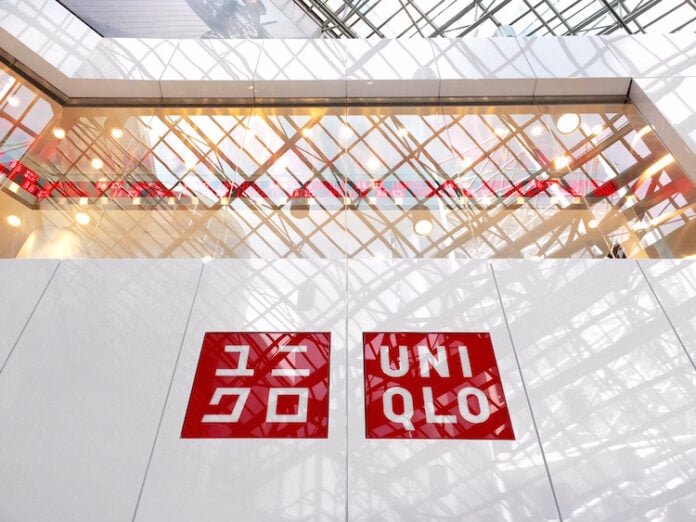
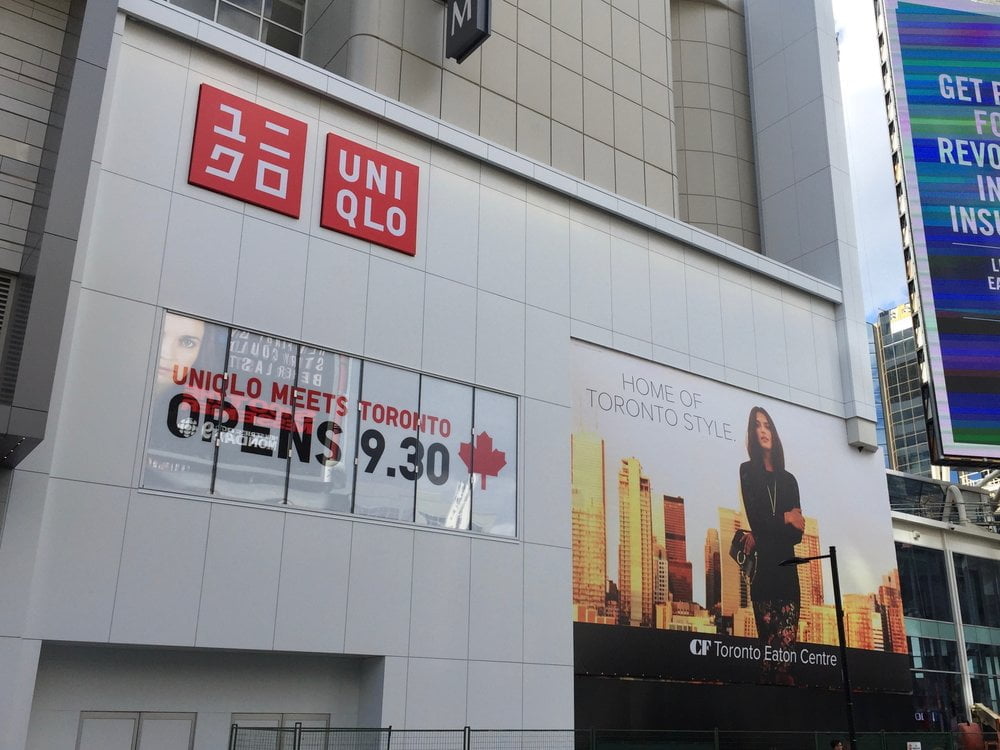
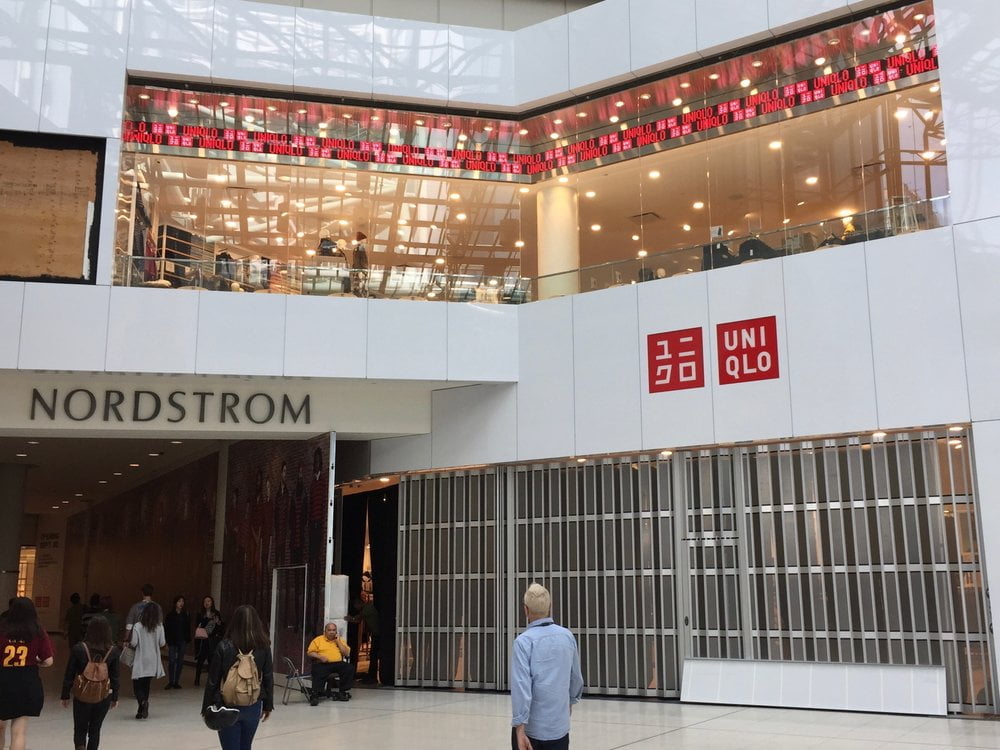
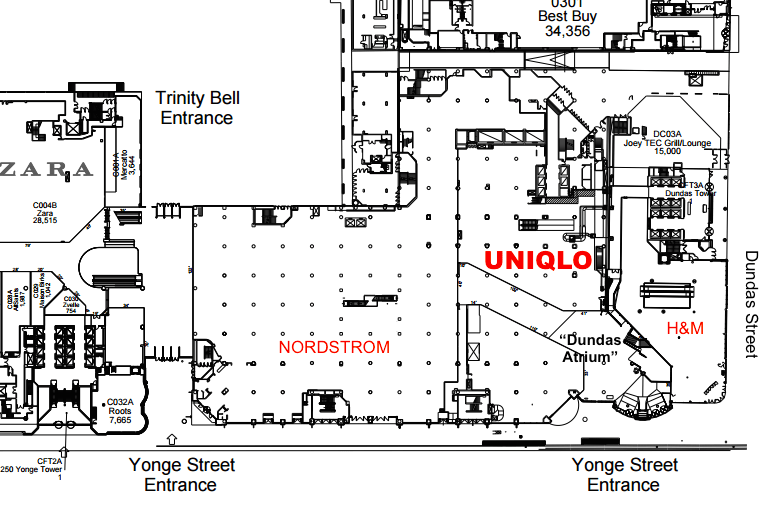
Popular Japanese fashion retailer Uniqlo is preparing to open its first location in Canada at CF Toronto Eaton Centre. The 27,400 square foot space will be open to the public on Friday, September 30, 2016. Uniqlo is located on the third floor inside the Dundas Atrium, nestled between Nordstrom and H&M.
EXTERIOR OF UNIQLO TORONTO, FACING ONTO YONGE STREET. PHOTO: DEVON JOHNSON
MAIN ENTRANCE TO UNIQLO IN THE DUNDAS ATRIUM OF CF TORONTO EATON CENTRE. PHOTO: DEVON JOHNSON
CLICK ABOVE FOR PDF CF TORONTO EATON CENTRE LEASE PLAN, VIA CADILLAC FAIRVIEW
Ranging from down jackets to dress pants, Uniqlo’s fashions are known for being simple, affordable, and high quality. The company was founded in Japan in 1974, and operates over 800 stores globally.
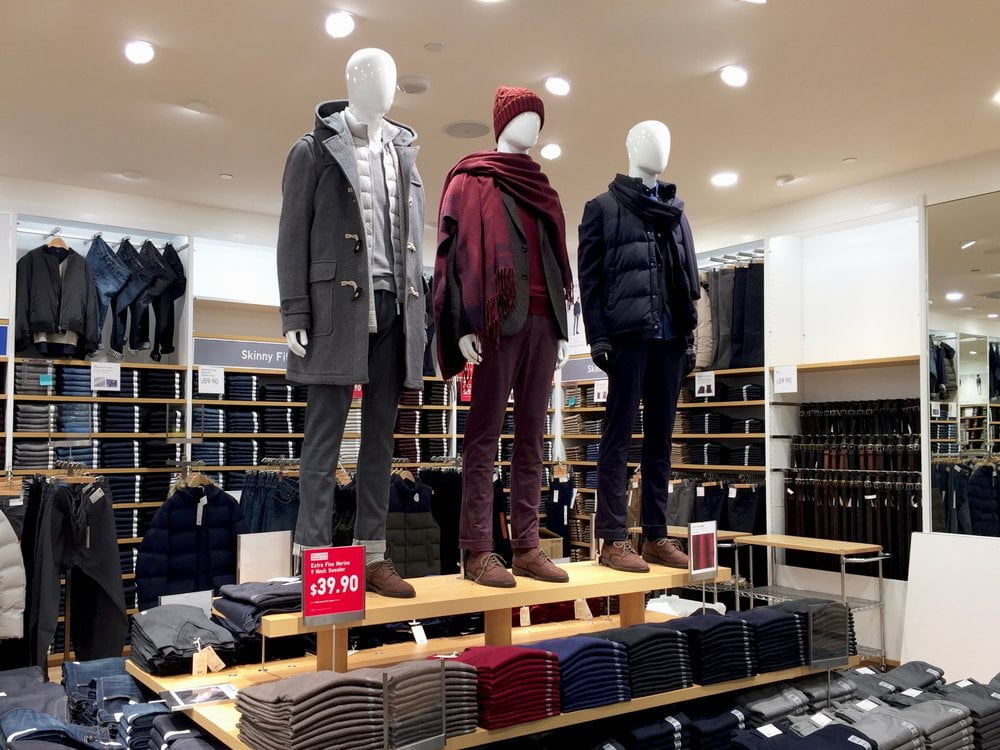
MEN’S JEANS AND PANTS ARE LOCATED ON THE SECOND FLOOR. PHOTO: DEVON JOHNSON
We met with Uniqlo Chief Operating Officer, Yashuhiro Hayashi, for a sneak preview inside Canada’s first Uniqlo location. Construction has been ongoing for over four months, and is coming to a close. Boxes of merchandise continue to be unpacked, mannequins are still being styled, and two escalators are finishing installation.
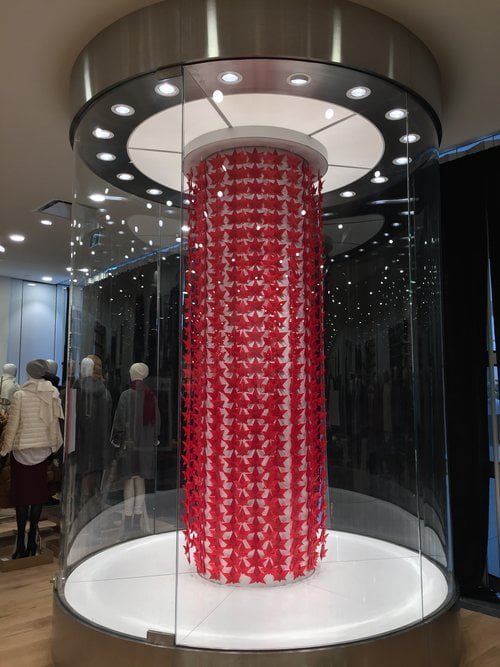
JAPANESE ORIGAMI ART HAS BEEN CAREFULLY FOLDED INTO CANADIAN MAPLE LEAFS. PHOTO: DEVON JOHNSON
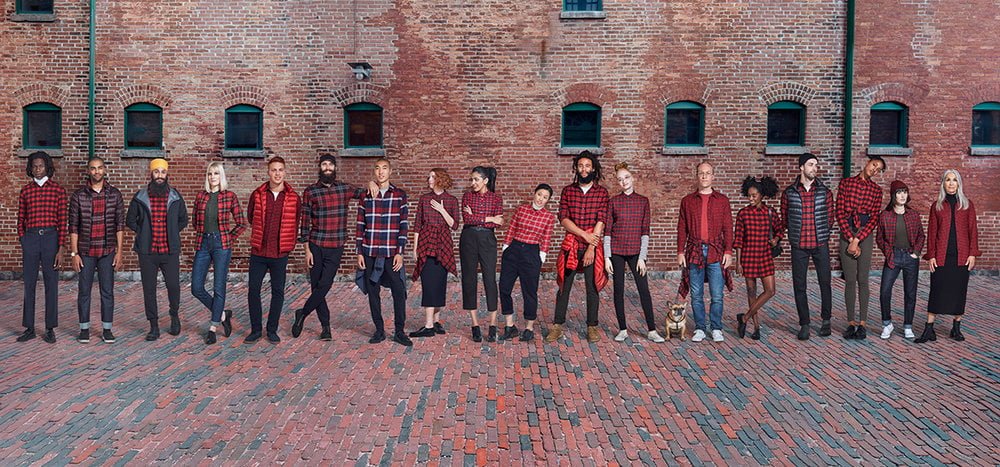
Inside the main entrance is a large circular window display decorated with Japanese origami art, shaped as Canadian maple leafs. Behind the window display lies a table of flannel shirts. “We made sure we had enough red flannel,” Mr. Hayashi laughs. The presence of Canada is felt throughout the entire first floor. Photos from Uniqlo Canada’s latest campaign ‘Uncommon Thread’ are placed around the store, which features Toronto-based models of different ethnicities and ages at different locations in Toronto.
What are Canadians to expect from Uniqlo? Mr. Hayashi says that Uniqlo is for everyone. “A teenager can come, a senior citizen can come. You can come to Uniqlo with your entire family and [each person] can easily find at least one piece they want”. Although many retailers keep men’s and women’s fashions separated by floor, Uniqlo decided to place both men’s and women’s fashion on the first floor to stress to those unfamiliar with the brand that Uniqlo is for all ages and genders.
UNIQLO CANADA’S LATEST CAMPAIGN ‘UNCOMMON THREAD’ FEATURES TORONTO RESIDENTS IN VARIOUS TORONTO LOCATIONS. PHOTO COURTESY OF UNIQLO.
The mix of merchandise is nearly identical to that in Uniqlo flagships around the globe. “What you see in London, Tokyo, and New York is the same product selection you will see here in Toronto”. Mr. Hayashi said, stressing the importance of a similar in-store experience for Uniqlo locations in all countries.
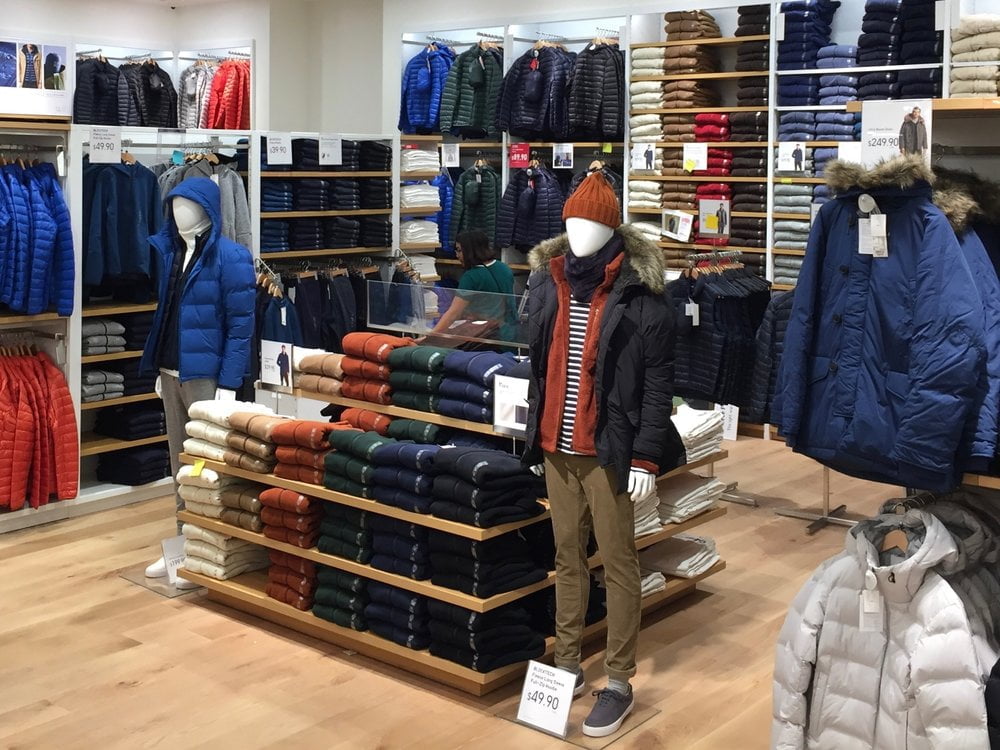
COATS AND WINTER JACKETS CAN BE FOUND ON THE FIRST FLOOR. PHOTO: DEVON JOHNSON
Prices in the Toronto store align with Uniqlo locations in the United States. “This is a shop that doesn’t go above $250”, Mr. Hayashi said, pointing to a men’s down jacket. One will find ‘HeatTech’ undershirts for $20, and will also find cashmere sweaters in over 12 colours for $99 each. Mr. Hayashi says many items including the cashmere sweaters are the exact same prices found in the United States. Canadians will benefit with exchange rate, Mr. Hayashi says. This makes many of the items in Toronto less expensive than in its American stores.
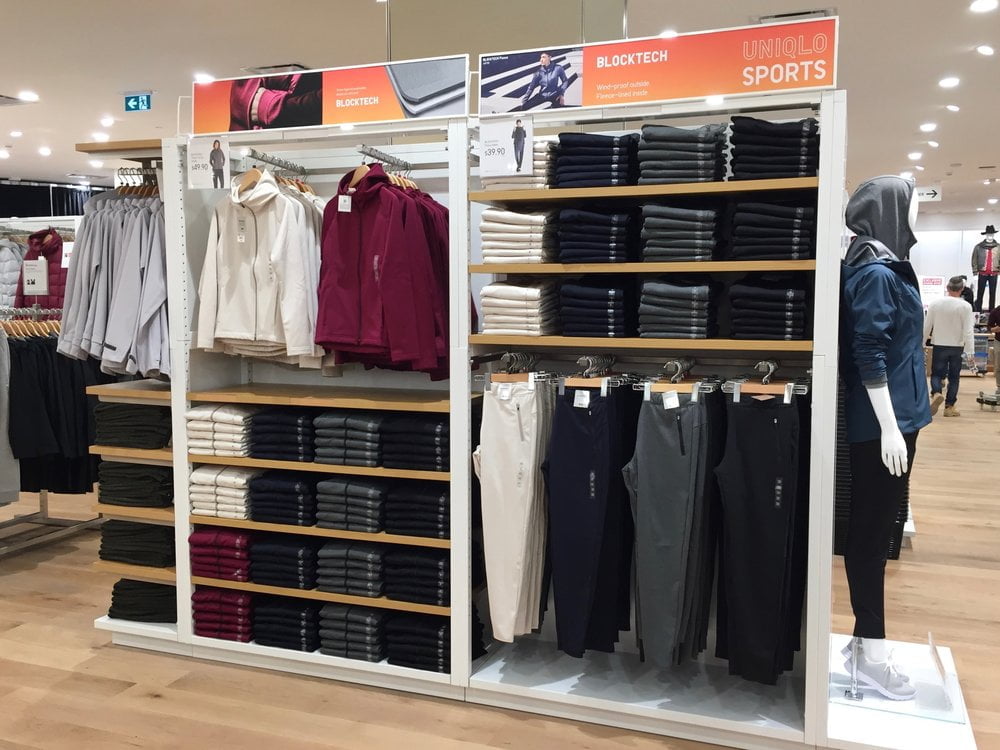
A VARIETY OF SPORTSWEAR USING UNIQLO’S BLOCKTECH FABRIC. PHOTO: DEVON JOHNSON
We headed up to the second floor via elevator, where we discovered more casual wear for men and women. Kids clothing and undergarments are also found on this level.
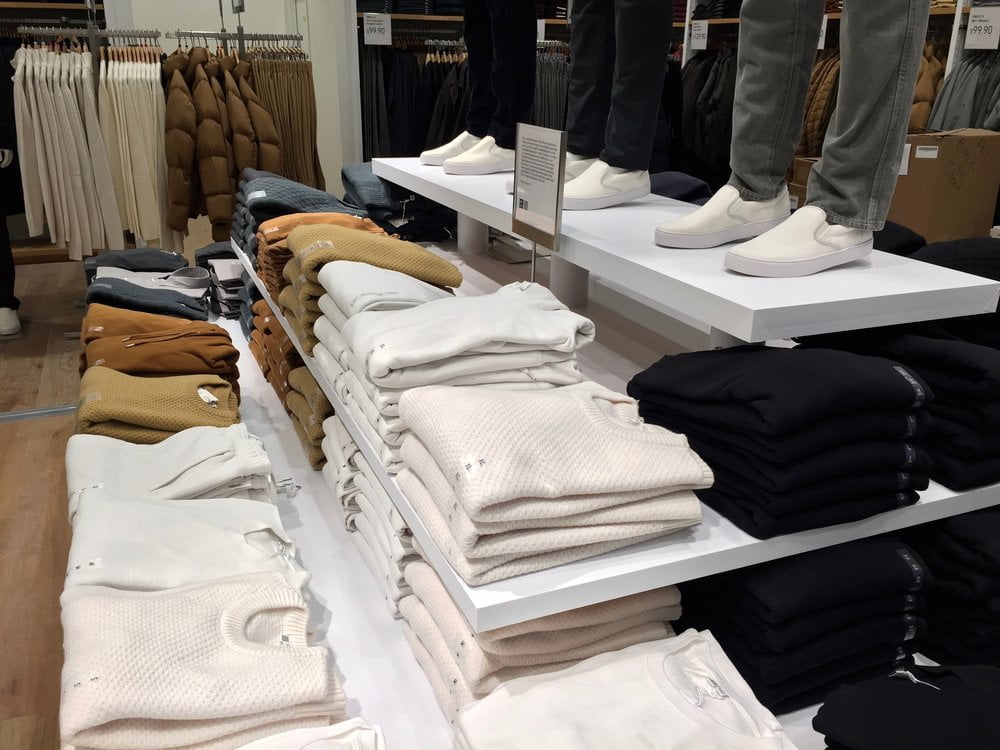
We found clothing items from Uniqlo’s latest label ‘Uniqlo U’. This special collection was spearheaded by Christophe Lemaire, the former artistic director from Hermes, who is now Uniqlo’s global artistic director. To celebrate the opening of Toronto’s Uniqlo location, this collection will be exclusive in North America for one week. “We’re selling Uniqlo U in Toronto ahead of San Francisco and New York”. These items are specially designed with even more precision, and are one of the more sophisticated lines in the store.
MEN’S SWEATERS FROM THE ‘UNIQLO U’ CLOTHING LINE SIT ON THE SECOND FLOOR DISPLAY TABLE. PHOTO: DEVON JOHNSON
One unique component to this location is a section on the first floor that will offer a rotating array of local Toronto company offerings, which will be only available in Canada at the CF Toronto Eaton Centre Uniqlo location.
The section includes a wall showcasing Toronto brands, including the Drake General Store, Blacksmith Cycle, and Souvenir Studios. Within these collections are local business-branded items as well as Uniqlo clothing pieces themselves, with each local business picking out specific pieces that align with both their own and Uniqlo’s brand.
DRAKE GENERAL STORE. PHOTO: DEVON JOHNSON
Many analysts will be watching Uniqlo closely. We asked about future locations, and Mr. Hayashi says that Uniqlo’s Canadian store expansion will be carefully considered. “Toronto is an international city, but at the same time our studies show that our brand awareness is quite low.” Mr. Hayashi said, going on to say that before expanding Uniqlo across Canada, the retailer will be tracking success and listening to customer feedback from its CF Toronto Eaton Centre and Yorkdale Shopping Centre locations (the Yorkdale unit opens next month, on October 20).
“It will depend on the customers reaction. We want to make sure we’re solid here,” Mr. Hayashi stressed. “If were not getting it right, it’s not good to expand too fast. We’re going to take it slow, and serve customers right. When we’re ready, we’ll expand to other major cities or open more stores in Toronto ”, he said.
When asked how Uniqlo plans to win over Canadian shoppers, Mr. Hayashi explained that Uniqlo focuses on a solid product offering. Uniqlo specializes in creating casual wear that is versatile, high quality, and high function. Uniqlo continues to create a strong brand experience, and continues to improve existing product offerings.
“We’re not aiming to be the brand you wear for a date or gala,” Mr. Hayashi says. “We want to serve the customer with our [versatile] styles, rather than dictate the look. We provide those tools, the final look is provided by the individual”.
CASH REGISTERS ARE LOCATED ON BOTH THE FIRST AND SECOND FLOOR. PHOTO: DEVON JOHNSON
Uniqlo’s first Canadian store will open at CF Toronto Eaton Centre on Friday, September 30, 2016 in the Dundas Atrium, neighbouring the newly opened Nordstrom and the newly renovated flagship H&M.
Uniqlo’s second Canadian store will open at Yorkdale Shopping Centre on October 20 in the new $331 million 300,000 square foot wing that will be anchored by Nordstrom. Uniqlo will occupy a two level, 25,500 square foot space at Yorkdale and will be a neighbour with fellow Japanese retailer, Muji.
Toronto’s Yorkville Avenue will see more luxury retail with the announcement of a new 35,000 square foot project. Two investors, Greybrook Realty Partners Inc. and First Capital Realty, have partnered in the initiative.
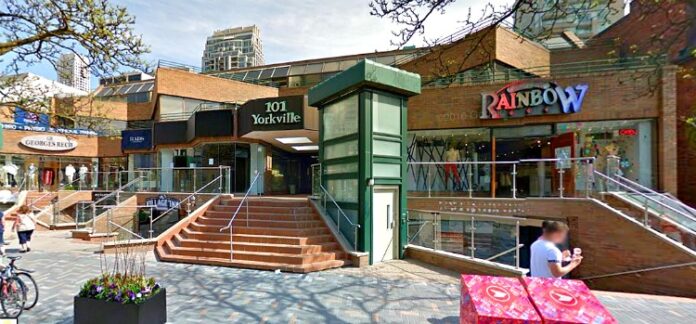
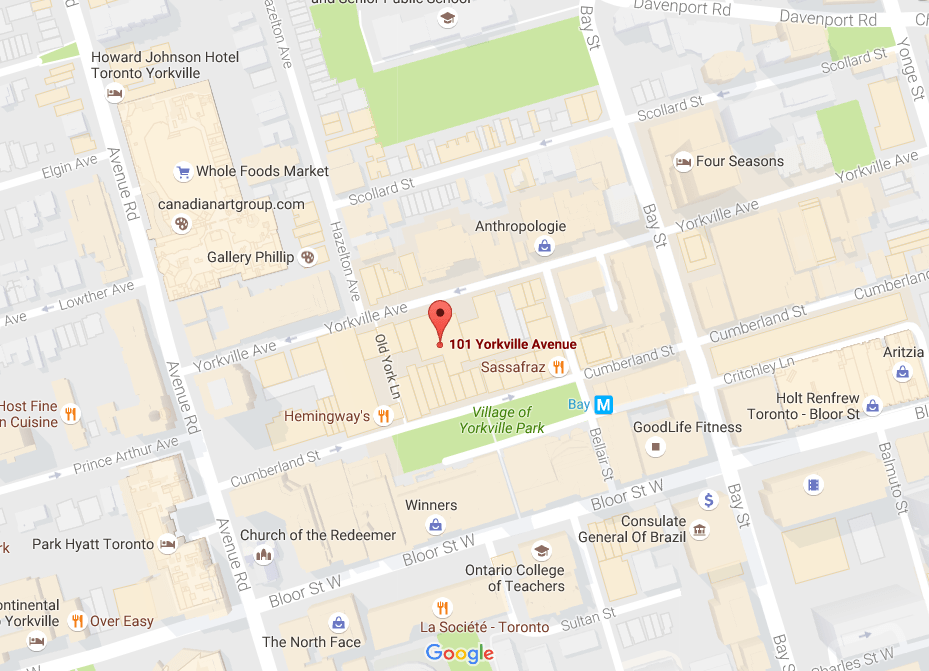
Located at 101 Yorkville Avenue in the heart of the city’s affluent Yorkville area, the project will involve the demolition of an existing 45,000 square foot multi-level commercial building housing notable tenants such as denim retailer Over The Rainbow. The building’s current configuration, featuring retail that is half-level upstairs and half-level downstairs, has failed to attract luxury brands that prefer street-level entrances. The building was built in 1977 and reflects architecture of its time.
Greybrook and First Capital Realty each own 50% of the half-acre site (Greybrook has revealed that its share cost $17,785,000), boasting a 120-foot frontage on prestigious Yorkville Avenue. A number of luxury retailers are located nearby, and several others have either signed leases or are negotiating for nearby retail spaces. Last month, French footwear brand Christian Louboutin opened its Canadian flagship next door at 99 Yorkville Avenue, and in several months, Chanel will relocate to an 8,700 square foot space at 98 Yorkville Avenue. More luxury retailers will open as new retail space is added (also involving building demolitions) by First Capital Realty, which now owns a considerable amount of the retail space on Yorkville Avenue between Bay Street and Avenue Road.
For 101 Yorkville Avenue, First Capital Realty will act as development, leasing and property manager for the retail project, according to a press release issued by Greybrook Realty Partners.
There’s no mention of any residential being added to this project, with the immediate area being home to some of Canada’s priciest condominium residences. The most expensive home that has sold to date is the 9,038 square foot Four Seasons penthouse, which sold in 2011 for $28 million.
Yorkville Avenue will continue to see more luxury brands move onto the street, as retailers seek alternatives to prestigious Bloor Street West. Although Yorkville Avenue continues to see interest from a number of luxury brands, Bloor Street continues to also attract luxury brands, with recent flagship announcements for Dior, Moncler and Hermes.
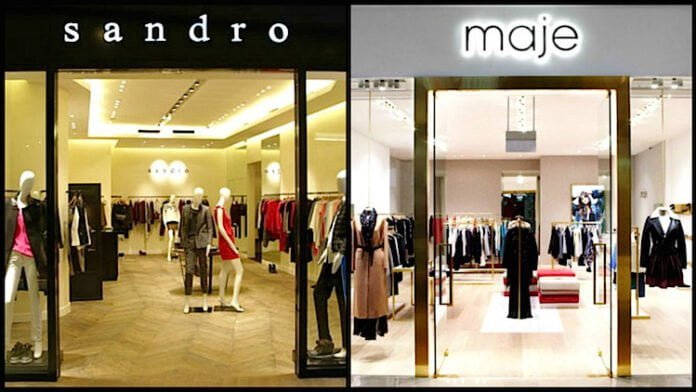
French fashion brands Sandro and Maje will both open their first freestanding Canadian locations next month at Toronto’s Yorkdale Shopping Centre. The fashion boutiques will locate in the mall’s new 300,000 square foot, $331 million expansion wing (opening on October 18 of this year) that will be anchored by a 199,000 square foot Nordstrom store (opening on October 21).
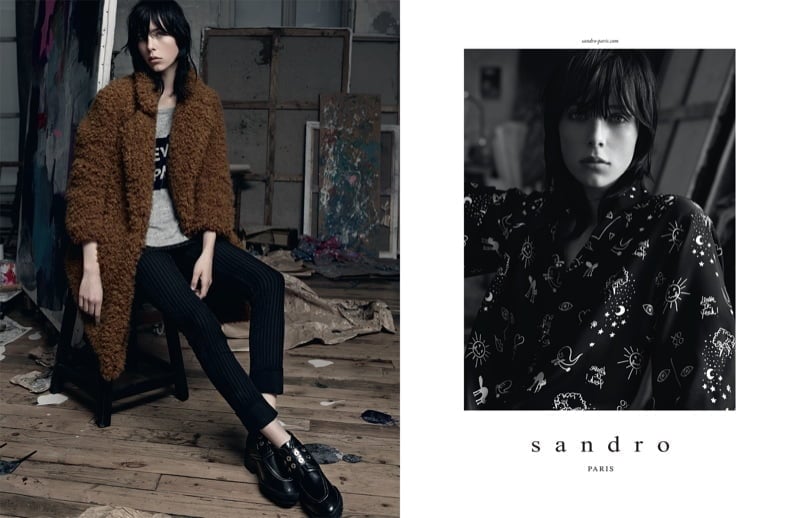
The Sandro brand launched in Paris in 1984, and is known for focusing on “sleek, chic and effortlessly cool womenswear and menswear”. Maje was founded in Paris in 1998 and is known for “bohemian-chic, solar, and more feminine womenswear collections”, according to the company. The Yorkdale flagship will carry both men’s and women’s fashions/accessories/footwear, while Maje caters to women. There are over 500 Sandro stores and over 400 Maje locations worldwide. Parent company SMCP (which stands for Sandro, Maje, Claudie Perlot) operates 1176 points of sale globally in 35 countries, with about 4,300 staff.
“Canadian shoppers have a European heritage and sensibility to styling which is very much in line with the Parisian Chic DNA of our brands,” said Paul Griffin, President & CEO, SMCP North America. “Yorkdale is the highest performing shopping centre in Canada with the strongest mix of accessible luxury. The choice of Yorkdale as our gateway into Canada was part of our larger strategy to expand our freestanding footprint in that market, as we continue to develop our North American business.”
Although these will be the first freestanding locations for Sandro and Maje in Canada, the brands have had a concussion presence in Canada for the past several years at several Hudson’s Bay stores. Sandro operates women’s concessions at Hudson’s Bay in downtown Vancouver, Montreal and in Toronto at Hudson’s Bay’s Queen Street, Yorkdale and CF Sherway Gardens locations. Sandro Men’s concessions are contained within Hudson’s Bay’s downtown Vancouver and Toronto Queen Street stores. Maje womenswear concessions are located within Hudson’s Bay’s downtown Vancouver, Montreal, and Toronto Queen Street and Yorkdale stores.
Yorkdale is currently Canada’s most productive shopping centre, with sales of $1,610 per square foot. The mall’s Nordstrom expansion will include several other ‘firsts’, including the world’s first Canada Goose retail store. After the expansion opening on October 18, landlord Oxford Properties will continue expanding the centre westward with a wing anchored by RH (Restoration Hardware) and at least two other confirmed anchors.
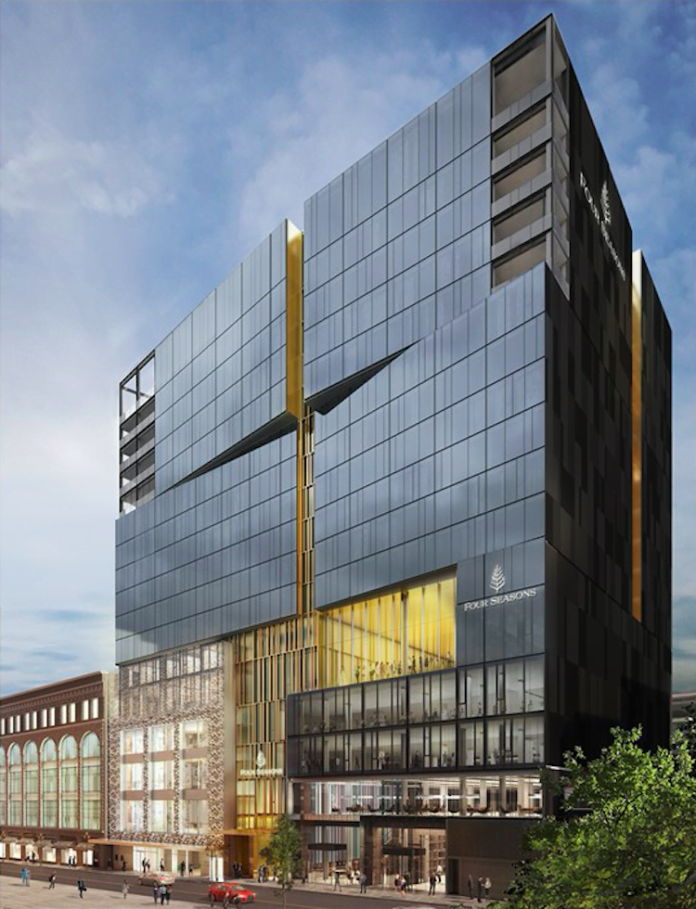
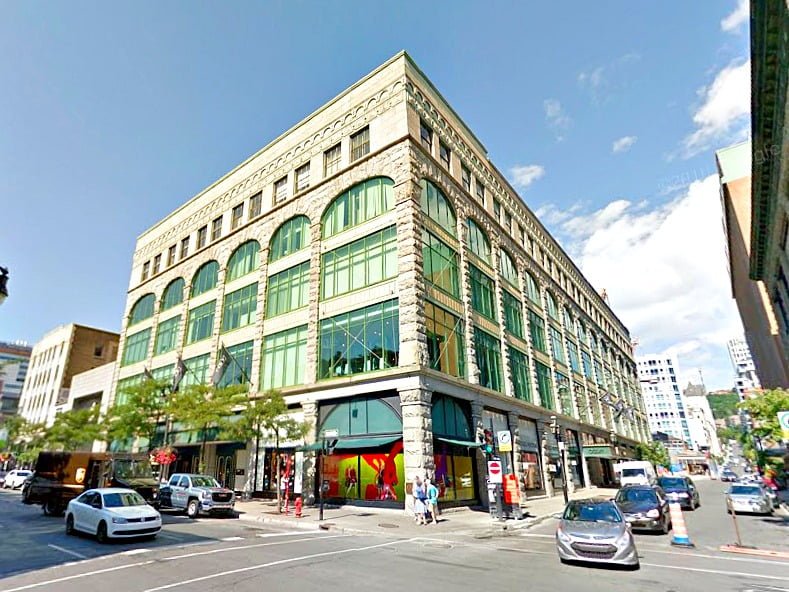
The mystery has been solved as to which hotel provider will operate a property beside Montreal’s merged Ogilvy-Holt Renfrew store. La Presse reports that the Four Seasons hotel chain will return to the city after more than 20 years, bringing with it a collection of luxury residences that will be among the most expensive in Canada. The adjacent department store, itself, is also undergoing a substantial expansion as Selfridges Group-owned Ogilvy merges with nearby Holt Renfrew.
Montreal-based developer Carbonleo is spearheading the project in partnership with the hotel and retailer, which will see hotel rooms priced from $600 per night, and condominium units averaging $1,500 per square foot. Prices for the condominiums are expected to sell for between $4 million and $20 million with an average cost of $5 million, according to La Presse. There will be two $20 million penthouses, in fact, each measuring about 7,000 square feet, featuring 14 foot ceilings and 2,500 square foot terraces.
The project will feature 163 hotel rooms and 18 condominium units, all within an 18 storey building. About a quarter of the condominium units are expected to be purchased by international buyers. The Four Seasons Hotel and Private Residences project is expected to be completed by the winter of 2018. La Presse notes that since the year 2000, only two condominium units in Montreal have sold for over $5 million.
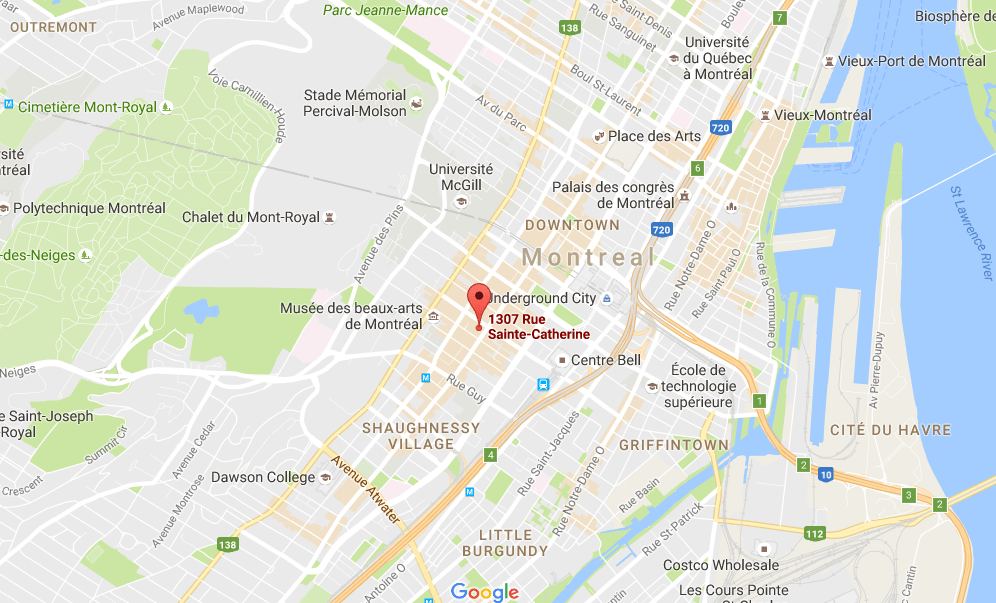
CLICK IMAGE FOR INTERACTIVE GOOGLE MAP.
EXISTING OGILVY STORE IN AUGUST OF 2016. PHOTO: GOOGLE STREET VIEW SCREEN CAPTURE.
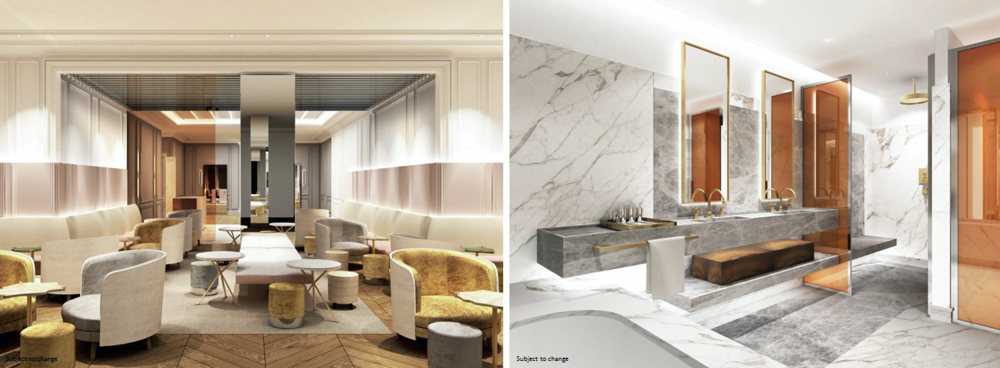
RENDERING OF THE FOUR SEASONS HOTEL LOBBY ON THE LEFT, AND WITHIN A FOUR SEASONS PRIVATE RESIDENCE ON THE RIGHT, VIA CARBONLEO.
The entire project will cost in excess of $250 million, including the cost of the department store expansion at the corner of Sainte Catherine Street West and Rue de la Montagne. The existing 160,000 square foot Ogilvy building will be expanded to 220,000 square feet in order to house a combined Ogilvy/Holt’s, operating under the formal name “Ogilvy, part of the Holt Renfrew & Co. collection”. The expanded and merged store will result in the nearby Holt Renfrew flagship on Sherbrooke Street West closing, after operating at that location for almost 80 years.
Sources confirm that many of the luxury brands and concessions within the existing Sherbrooke Street Holt Renfrew will relocate into the new combined Sainte Catherine Street store.
The new Ogilvy/Holt’s will have a major competitor when it opens in 2018. Last week, the Hudson’s Bay Company announced that it would open a 200,000 square foot Saks Fifth Avenue store within its existing Bay location on Sainte Catherine Street West, about 800 metres east of the Carbonleo Four Seasons/Ogilvy project. Although it will be technically the largest Saks store in Canada, about 80,000 square feet of space will be dedicated to food and beverage, including a Quebec-themed food hall and a yet-to-be-determined restaurant concept.
A new Canadian e-commerce retailer is offering one-on-one personalized service, seeking to bridge the gap between online and brick-and-mortar by providing comprehensive online styling services. Created by entrepreneur Juliana Gallimore, the new Forty-Eight 10 site launched in Canada last week, and plans to expand internationally next year.
The company has partnered with fashion stylists throughout Canada, who will help online shoppers pick out the best looks to suit their busy lifestyles. Stylists create a profile for each client, constantly updating them on new product to suit their needs. With a styling background herself, Ms. Gallimore came up with a series of key questions that allow staff stylists to “virtually step into the client’s closet” to gain an understanding of what she wears, morning-to-evening. Styling is an added bonus and is included in the price of the site’s products.
After its Canadian launch, Ms. Gallimore will look to expand Forty-Eight 10 into the United States, U.K. and Australia. That expansion is expected for the latter part of 2017, she said.
By any measure, empirical and anecdotal, the number of people visiting retail stores is down. There are plenty of theories about why: it’s the mass movement of shoppers to online; it’s changing consumer preferences; it’s the weather; it’s those pesky, hard-to- figure-out millennials who would rather hunt for Pokémon than bargains at the mall.
As Jim Quinn of The Burning Platform describes in his compelling and disturbing article, The Retail Death Rattle, the decline in retail traffic may be a result of more obvious and, ultimately, troubling reasons. Too many retail stores chasing too few consumers who have less money to spend. This is a bad combination.
As someone who has studied brick-and-mortar store traffic trends for more than 20 years, I believe that Jim’s apocalyptic conclusions may be directionally correct. Headlines like Gap Tumbles as Dismal Store Traffic Drags Down July Sales recently published on Bloomberg.com supports his thesis.
As retail traffic analysts, my team and I analyze store traffic from thousands of retail stores across North America monthly, and it’s not unusual to see year-over-year store traffic declines of 5%, 10% and even 20% or more. When you put this in absolute terms, it can be startling.
We recently analyzed the store traffic data from a 600-store specialty retailer. Last year, their stores averaged about 200 traffic counts per day, which over the course of the year adds up to some 43 million store visits. For the first half of 2016, the chain experienced a 7% decline in store traffic – that’s about 1.5 million fewer people visiting their stores so far this year. If this trend holds, there will be some 3 million fewer people visiting this retailer in 2016 compared to 2015. Ouch.
Instead of hoping that traffic will return like a flock of migrating birds, retailers need to face the very real possibility that store traffic might not return – at least not in the numbers they had in the past.
I agree that declining store traffic is a real concern and that cauterizing the traffic hemorrhage may be difficult if not impossible for some retailers to do. However blaming poor sales results on store traffic is giving up the battle too easily and too early. Based on our work, we know that if retailers focused as much attention on converting the traffic they already get in their stores as they do worrying about the traffic they don’t get, their results would be significantly better. There’s a lot retailers can do to improve their results despite lower store traffic.
Before we get to the ‘what retailers can do about it’ part, we need to clear up a couple of persistent and unhelpful misconceptions about the connection between store traffic and sales and the use of sales transaction counts as a proxy for store traffic counts.
Store Traffic and Sales: Correlation vs. Causation
All retailers know that store traffic and store sales are connected. In fact, based on the mountains of traffic data I’ve studied, I can categorically say that store traffic and sales are indeed correlated. Store traffic defines the sales opportunity: less traffic, smaller sales opportunity and, often, lower sales; more traffic, bigger sales opportunity, often higher sales.
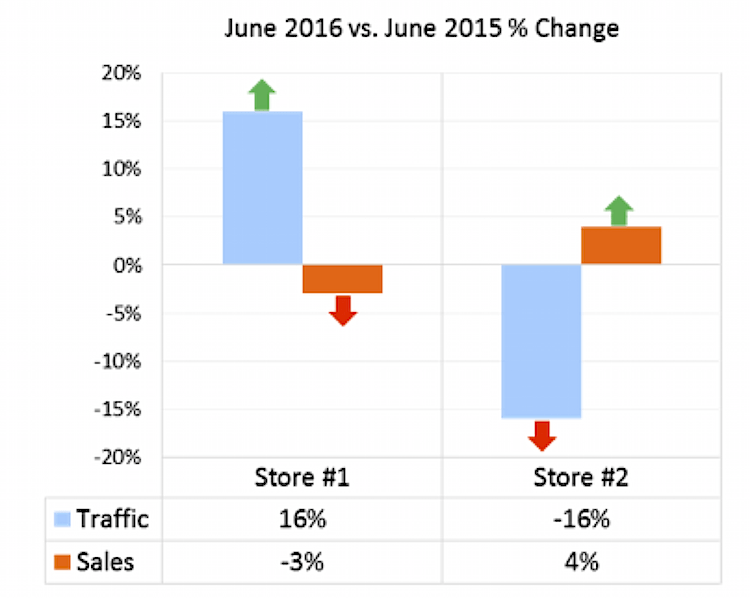
But store traffic is only one piece of the retail sales puzzle. While store traffic and sales are correlated, a decline in store traffic does not necessarily cause lower sales, just as an increase in store traffic doesn’t necessarily cause higher sales. Here’s a simple example using actual data from two stores in the same chain.
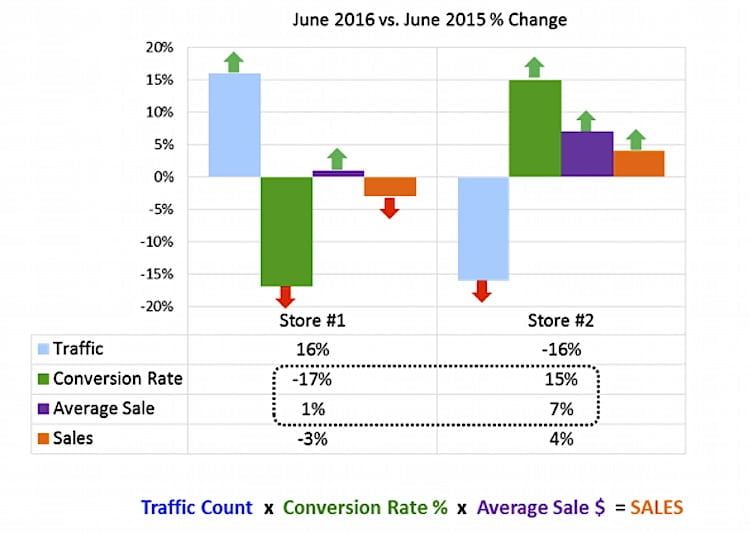
In store #1, year-over-year traffic was up 16%, yet sales were down 3%. In store #2, traffic was down 16%, yet sales were up 4%. If there were a causal relationship between store traffic and store sales, these results wouldn’t make any sense and it would be easy to write them off as anomalous. But these results are not anomalous. In fact, based on the work we do analyzing traffic data from thousands of retail stores every month, this is not uncommon at all.
So how is this possible? The answer is perfectly clear when you break the sales results down by sales driver. Sales are a function of three components: store traffic, conversion rate (i.e. the percentage of people who actually made a purchase) and average sale value. The calculation is simple: Traffic Count x Conversion Rate % x Average Sale $ = Sales.
Store #1 had 16% more traffic, but conversion rates fell by 17%, that is, they sold to 17% fewer people who visited, and even though average sale values were up 1%, it wasn’t enough to make up for the drop in conversion rate. Add it all up, and sales were down 3%. This retailer would be incorrect to blame traffic on these poor results.
In store #2 traffic was down 16%. The sales opportunity got 16% smaller but the store still delivered a 4% increase in year-over-year sales. In this store, conversion rates were up 15% and average sale values up 7%. This store had significantly less traffic, but was still able to deliver positive sales by converting more of the traffic into a sale and selling more to each buyer. This is really terrific performance, despite the traffic decrease.
I find it ironic that some retail executives use sagging store traffic to explain away poor sales results (at least publicly) when we know that excuse would never be tolerated from their own store managers. Traffic may not even be what’s driving results. Furthermore, even when traffic is down, it doesn’t mean sales need to follow.
When it comes to sales results, it’s not just how much traffic a store gets, it’s what the store does with the traffic that matters most. In this case, ignorance is not bliss. If a retailer does not have access to these basic facts, they are, by definition, going to be oblivious to the possible corrective actions. In some cases, it is because the retailer does not actually count traffic in their stores. Or worse, they use sales transaction counts as a proxy for store traffic so they think they know what their store traffic is when they actually do not. Retailers that don’t have traffic count data are literally flying blind.
Transaction Counts vs. Traffic Counts — Hits vs. At-Bats
As I described in an article I wrote years ago, The Trouble with Traffic — What Retailers Can Learn From Baseball, there is a profound difference between transaction counts and traffic counts. It’s mind-boggling to me that, in the data-savvy world we live in today, many retailers still do not get this simple concept.
To say that transaction count represents a reliable proxy for store traffic is analogous to saying that ‘hits’ are a reliable proxy for ‘at-bats’ in baseball. Yes, the two stats are related, but they are not proxies — not even close. Store traffic is a measure of all the people who visit the store, including buyers and non-buyers where transactions obviously only account for the number of buyers. Here’s what the numbers looked like in our two-store example.
If this retailer relied on transaction counts as a proxy for store traffic, the conclusion is obvious: store traffic is down in both stores! Comparing actual store traffic counts to transaction counts completely changes the conclusion. Store traffic was not down in store #1, it was up – 16%! In store#2, the transaction counts were down 3%, when in fact, store traffic was actually down 16%, much worse than the transaction counts indicated.
Here’s the point: using transaction counts as a proxy for store traffic will lead to wrong conclusions; wrong conclusions lead to bad decisions; bad decisions lead to poor results. And, it’s just wrong and reckless.
So when someone cries “Oh no…store traffic is down!” the first question you should ask is, “Are you using transactions as a proxy for store traffic?” If the answer is ‘yes’, tell him/her to calm down until he/she has the right data.
OK, enough about traffic, let’s get on to what retailers can do to improve their results.
Productivity – making the most of the traffic you have
Retailers are always talking about how they plan to deliver better financial results by improving ‘productivity’ in their stores – great, but what does that actually mean? The obvious answer is, sell more stuff with essentially the same resources. It’s a worthy pursuit. But how should we think about this nebulous notion called productivity?
Recall, sales are a function of store traffic, conversion rate and average sale. Since store personnel don’t control the amount of traffic their store receives, the only two variables they can influence are conversion rate and average sale – sell to more of the people who visit and/or sell more to each buyer.
As my two-store example illustrates, store #2 delivered positive year-over-year sales despite having a significant decline in store traffic. If you think about productivity in terms of conversion rates and average sale values, it’s clear that store #2 was more ‘productive’ with its traffic than store #1 – despite having less of it.
Some stores may have higher conversion rates while others may have higher average sale values – frankly, it doesn’t matter how the store delivers the results, as long as they do. I think it’s helpful to amalgamate these two metrics into one metric that reflects the sales generated for every traffic count logged in the store. This can be done by either multiplying the conversion rate by average sale or by simply dividing sales by traffic counts. I call it ‘traffic productivity’. The results for the two stores are below.
Store #2 increased sales generated for each traffic count in their store by 23% and that’s why it was able to generate a 4% increase in year-over-year sales despite a 16% decrease in store traffic. It’s also clear why results at store#1 sucked – it squandered its traffic opportunity, generating a buck less for every visitor than the prior year.
I like the idea of traffic productivity – a lot. Some call it revenue per visitor, or sales per guest, but whatever you call it, it’s a terrific way to measure, trend and compare store performance, and it’s a great way to keep store personnel focused on making the most of every visit to their store, regardless of whether traffic is increasing or decreasing.
Here’s the catch: you can’t calculate conversion rates or traffic productivity unless you actually count store traffic. If you’re one of those ‘the earth is flat’ misguided retailers who still use transactions as a proxy for traffic, forget about everything you just read because you don’t have the data to create these important insights.
What drives Productivity?
So even if we all agree that driving traffic productivity is a smart thing to do (which of course it is), the obvious question is, How?
There are many things that influence productivity. For brevity sake, I’ll boil it down to three general areas: (1) inventory/merchandising, (2) promotional activity and 3) labor/scheduling.
I know what you’re thinking: “Duh! Thanks for the blinding insight…a part-time sales associate could have come up with this list.” I agree. The reasons people buy or don’t buy are well understood by most retailers. It’s a profound statement of the obvious to say a retailer needs to have the right inventory and merchandise it well or that promotions, sales events or discounting will influence purchase behavior. Of course it all does. But what about labor and scheduling?
Surely every retailer knows they need to have enough trained staff to facilitate the sale, whether that’s efficiently processing sales transactions at check-out, helping locate a particular stock item or answering questions. Furthermore, you don’t need to be a rocket scientist to know that labor should be scheduled according to when people are actually visiting the store. No brainer, right
Store Labor and Productivity
Retailers today are rightly hyper-sensitive to wage expense. However, the cost of understaffing or misaligning labor relative to traffic is not well understood. One retail executive euphemistically described their conscious understaffing as a “lean staffing model.” The concern about overstaffing is legitimate. Excessive wage costs will kill profitability, but understaffing and/or misaligning labor can be even worse.
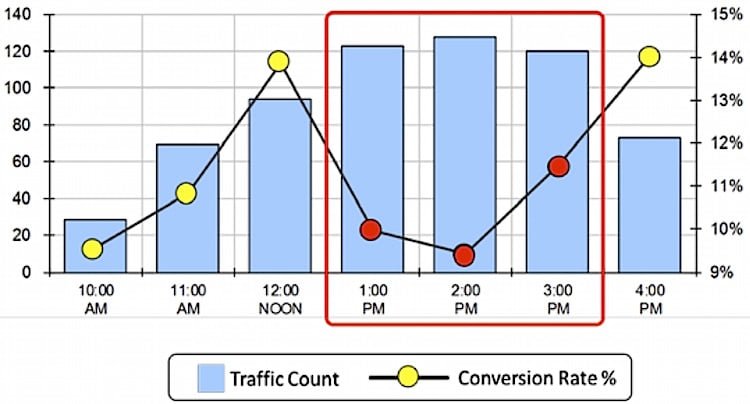
The chart below shows what happens to conversion rates when the store gets busy and there’s not enough staff to serve customers. It’s not pretty. These conversion rate ‘sags’ represent missed sales opportunities that can add up to many millions in lost sales annually.
Not having enough staff at the right times not only impacts conversion rates and therefore immediate sales, but it creates a lousy in-store experience that can turn a once happy customer into a social media terrorist bashing your brand, leaving a permanent digital scar.
Declining store traffic is a serious matter and we are sympathetic to the plight of retailers who are experiencing dramatic store traffic declines. However, it is hard to have sympathy for the retailer who squanders their store traffic, delivers poor sales results and then blames it on declines in store traffic. These are self-inflicted wounds resulting from ignorance or arrogance and retailers like these should accept whatever fate retail Darwinism provides.
The plain truth of it is that in today’s retail environment, no retailer can afford to squander their store traffic – it should be treated as a precious, non-renewable resource. Don’t count on “be-backs” and it does no good to think of your stores as responsible for traffic. They aren’t and can’t. Hold your marketing team responsible for traffic, but hold your store team responsible for conversion.
For those retailers who are doing all the right things – measuring store traffic, focusing store teams on productivity, providing enough labor to serve customers – keep going. That’s the formula to deliver the best results – even in a retail world of declining store traffic.
For everyone else, there are a number of things you need to do – the five most important are listed below.
5 Things Retailers need to do to thrive in a declining store traffic world
1) Get serious about measuring traffic in ALL of your stores – if you don’t have traffic counters installed in all your stores, install them now. Having traffic counters in only some of your stores and extrapolating results across your chain is imprecise. If you use sales transactions as a proxy for store traffic, stop it. It’s just wrong and reckless. If you have traffic counters installed in your stores, but you don’t believe the data or the data is sketchy, clean it up and keep it clean.
2) Understand your sales drivers – map performance of every store by breaking results into the underlying drivers: traffic, conversion rate and average sale. You can’t improve results unless you know what’s driving the results and without breaking them out, you’re guessing and very likely to make the wrong decisions.
3) Focus your store and district managers on driving conversion and average sale – store/district managers don’t control store traffic, but they absolutely influence conversion and average sale values. Provide your managers with easy-to-digest insights on traffic/conversion/average sale results, train them on what to do with the insights and then hold them accountable for results. It’s not good enough to dump data on these managers and hope they understand what conversion means – most of them do not have the time nor the expertise to do the analysis and develop the insights you need them to have.
4) Stop understaffing your stores – what’s the point of driving traffic to the store if you don’t have enough staff to service it? It’s pointless. Make rational allocations of labor for each store based on the traffic volume it receives. Compare performance across your entire chain to establish optimal staff to traffic ratios and then staff accordingly. Allocating labor based on store sales and/or sales transaction counts will guarantee that you under or over-staff your stores.
5) Rationalize your store base – review the long-term traffic trends and conversion/average sale productivity of every store. If you have stores that have significantly less traffic opportunities, either invest marketing dollars to try to drive up traffic or close the store. High productivity won’t matter if you have no traffic. Closing stores suck; operating stores that have pitiful and declining traffic opportunities sucks more. And, these stores become a drag on the chain’s resources and results.