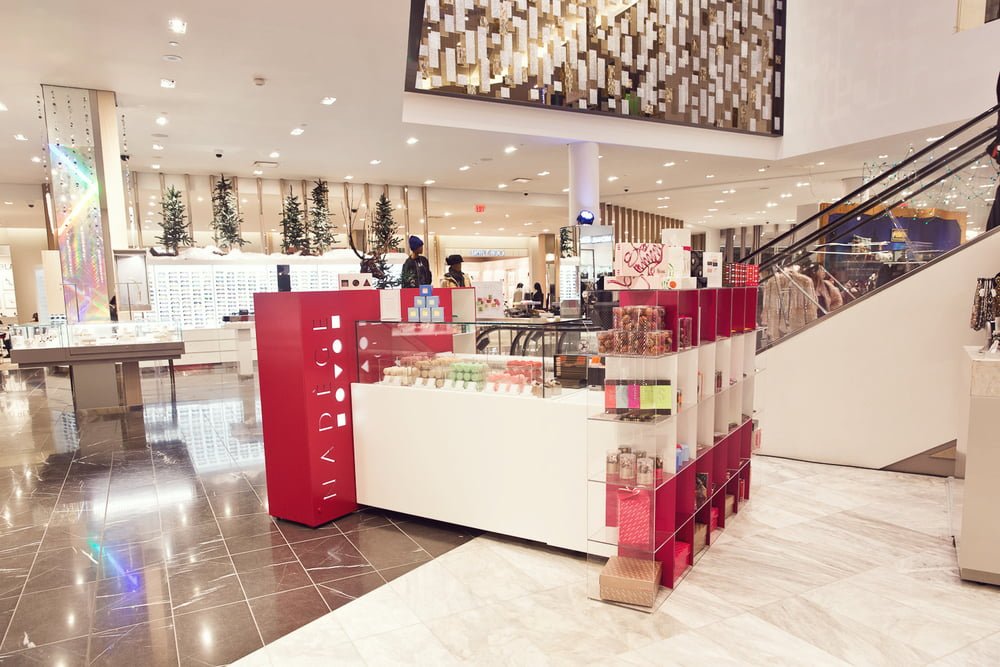
INSIDE THE ROSEDALE NADEGE STORE. PHOTO: WWW.PHOTOKLIK.COM
Upscale Toronto-based bakery/cafe Nadège Patisserie is looking to grow its current store base, including possibly expanding into other parts of Canada. The retailer has seen tremendous success with its various attractive and delicious products. Besides its current two (and soon, three) permanent bricks-and-mortar boutiques, Nadège also operates two temporary locations within Holt Renfrew.
Nadège Patisserie’s first bricks-and-mortar location opened in July of 2009 at 780 Queen Street, across the street from Toronto’s Trinity Bellwoods Park. It was founded by chef Nadège Nourian and her partner, Morgan McHugh. Selling fine chocolates, pastries, cakes, macarons, sandwiches, gift ideas, and seasonal collections, Nadège Patisserie quickly saw success, warranting more store locations.
In May of 2011, the retailer opened a 700 square foot boutique at 1099 Yonge Street in Toronto’s upscale Rosedale area and next week, it openes a 950 square foot location along Toronto’s busy underground PATH system, within the Richmond-Adelaide Centre. Referred to as NADÈGE @ PATH, the new location features an extended coffee program and innovative corporate catering offerings, as well as the delicacies described above.
In November, Nadège opened temporary boutiques at two Holt Renfrew locations in Toronto – one at 50 Bloor Street West, the other at Yorkdale Shopping Centre. We’re told that these shops are a resounding success, prompting the retailer to consider further expansion.
INSIDE OF THE QUEEN ST. NADEGE FLAGSHIP. PHOTO: WWW.BARBARALEUNG.COM
TEMPORARY YORKDALE NADEGE CONCESSION. PHOTO: JENNA MARIE WAKANI
Remarkably, in only five years, Nadège Patisserie has grown to employ over 60 people. As Nadège continues to prosper, it may consider opening more locations in Toronto, and even possibly in other Canadian cities.
Regarding a Canadian expansion, “the world is our oyster!” we’re told. It would appear that given the size and location of its current locations, Nadège would seek streetfront and mall retail space under 1,000 square feet.
Until Nadège does expand its bricks-and-mortar presence into other Canadian cities, you can buy its products on its e-commerce site: nadege-patisserie.com, which launched in November of 2013.
*UPDATE* Since we published this article, Shopping Centers Today tweeted the following, possibly putting the rest rumours that Holt Renfrew will expand into the United States:
Our article on the topic:
On Monday, a tweet from the International Council of Shopping Centers‘ (ICSC) Shopping Centers Today indicated that Toronto-based luxury department store Holt Renfrew could be looking for retail space in New York City. Sources say that Holt’s has sought retail space in Manhattan in the past and if the retailer succeeds this time, it could possibly signal the beginning of Holt’s opening stores in various American cities.
Sources confirm that Holt Renfrew representatives were at the ICSC New York National Deal Making Conference on December 8th. On that afternoon, Shopping Centers Today (SCT) tweeted that “Canada’s Holt Renfrew department store is seeking space in NYC #CRE #NYConf #ICSC look for a lease signing soon”.
The tweet has since been removed from SCT’s Twitter account, though we screencaptured it, partly out of disbelief.
Holt Renfrew declined to comment on the subject. Sources at the conference, however, provided informative details that we’ll refrain from publishing at this time, except to say that SCT’s tweet may not be inaccurate.
Analysis:
If Holt Renfrew were to open in New York City, it could signal Holt’s intentions to expand into various markets throughout the United States. This would no doubt be a challenge for Holt Renfrew — it would need to secure a variety of premium luxury brands, many already carried in similar stores such as Saks Fifth Avenue, Neiman Marcus, Bloomingdale’s and Barney’s New York. Holt’s would then need to coordinate American logistics, not to mention secure retail space. Holt Renfrew’s newer stores are now as large as Saks Fifth Avenue and Neiman Marcus stores — its Mississauga Square One location for example, opening in the spring of 2016, will measure about 120,000 square feet. Its recently expanded Yorkdale store is about the same size and its Vancouver and Bloor Street flagships are both substantially larger (and set to expand). Its largest location, a combined Ogilvy/Holt’s in Montreal, will open in 2017 with 220,000 square feet.
Even if Holt Renfrew were to operate only one American location in New York City, finding space large enough could pose a challenge. Before Nordstrom settled on occupying 285,000 square feet at 225 W. 57th Street (scheduled to open in 2018), it examined a number of locations that would possibly be appropriate for Holt Renfrew. A potential location at Park Avenue and 56th Street, however, is no longer available. Nordstrom, itself, is reportedly seeking retail space Downtown for a second Manhattan store, and three other department stores have recently announced new Manhattan locations.
NEIMAN MARCUS’ NEW MANHATTAN LOCATION WILL SPAN 250,000 SQ FT. PHOTO: OXFORD PROPERTIES.
In September, Neiman Marcus announced that in 2018, it would occupy 250,000 square feet at the Hudson Yards, a massive multi-use development on Manhattan’s Far West Side. Saks Fifth Avenue recently signed for an 85,000 square foot space in Manhattan’s Brookfield Place, steps away from the rebuilt World Trade Centre. Last year, Barney’s New York announced that it will open a second Manhattan location at at 7th Avenue and 16th Street in 2017, measuring about 57,000 square feet.
SAKS FIFTH AVENUE’S MANHATTAN FLAGSHIP IS WORTH AN ESTIMATED $3.7 BILLION. PHOTO: WWW.NYC-ARCHITECTURE.COM
These new stores join Manhattan’s exceptional luxury flagship department stores, all of which are spending millions on renovations. Bergdorf Goodman‘s iconic Fifth Avenue stores (316,000 square feet: 250,000 sq ft + separate 66,000 sq ft men’s store) are seeing substantial remodels, solidifying the retailer’s reputation as one of the world’s top luxury stores. Barney’s New York continues to remodel its 275,000 square foot Madison Avenue flagship, and Bloomingdale’s is in the process of upgrading various departments at its 860,000 square foot Lexington Avenue flagship. Saks Fifth Avenue’s 646,000 square foot flagship, recently assessed at U.S. $3.7 billion, will see a $250 million overhaul, overseen by a president hired from London’s Harrod’s.
Department stores aren’t the only competition that Holt Renfrew would face. New York City boasts dozens of the world’s top mono-brand luxury boutiques, some with multiple locations in upscale shopping areas such as Fifth Avenue, Madison Avenue and Soho.
SOURCES SAY THAT SEVERAL YEARS AGO, HOLT RENFREW WAS LOOKING TO OCCUPY RETAIL SPACE AT THE BASE OF NEW YORK’S PLAZA HOTEL. PHOTO: HTTP://WORLDTRAVELNTOURISM.INFO
Sources tell us that Holt Renfrew has shown interest in Manhattan in the past. Prior to the Plaza Hotel‘s 2008 renovation, Holt Renfrew was looking to occupy retail space at the base of the iconic hotel, directly north of Bergdorf Goodman’s luxurious flagship. Holt’s would have been substantially smaller than Bergdorf’s, as Holt’s would have occupied less than 50,000 square feet of The Plaza’s 170,000 square foot commercial/retail component.
INSIDE HOLT RENFREW’S VANCOUVER FLAGSHIP. PHOTO: ENROUTE.AIRCANADA.COM
Some speculate that Holt Renfrew could see success in Manhattan. New York City is home to a considerable number of Canadian expats, who may be receptive to shopping at an American version of Holt’s. Holt Renfrew has positioned itself as a slightly trendier version of Saks Fifth Avenue and Neiman Marcus, even by the music it plays — at Saks and Neiman’s, music tends to be more traditional, while at Holt’s, you’ll often hear upbeat 80’s songs such as Prince’s Raspberry Beret. Holt Renfrew’s more youthful vibe may be partly due to its ownership by London-based parent company Selfridges Group, which also owns Selfridges stores in Great Britain, Brown Thomas in Ireland, and de Bijenkorf in the Netherlands.
To be clear, this is speculation, and we cannot confirm that Holt Renfrew intends to expand into the United States. This article is based on SCT’s tweet and conversations involving conference attendees. Holt Renfrew may end up never expanding into New York City or to other parts of the United States.
If Holt Renfrew chooses to expand into the U.S., however, it could signal a heated war with Richard Baker‘s Saks Fifth Avenue chain, which plans to eventually operate as many as seven Canadian locations. We’re told that Holt’s is taking Saks’ Canadian entry very seriously and as a result, Holt’s is upgrading its store fleet and closing underperforming locations.
We’ll be sure to keep you updated on speculation that Holt Renfrew could open its first international location in New York City.
MOVABLE WESTERN MAPLE TABLE WITH 'LIVE EDGE' FINISH. PHOTO: NICHOLAS YEE.
Lululemon‘s new store creates a focal point for the local community, addressing the trend towards retail space acting as a ‘hangout’. The brand’s overhauled store on Edmonton’s Whyte Avenue features innovative design with impressive, substantial wood fixtures and modifiable common areas allowing for collaboration, socialization, or even a place to work quietly. We took a number of high quality photos of the store and its features, specifically for this article.
The Whyte Avenue store was designed by Lululemon’s in-house store designer, Alison Janzen, based on feedback from locals in the adjacent Old Strathcona area. Requests included space to “connect, share and sweat with eachother”, according to Area Community Manager Lindsay Claydon. The resulting space features space for guests (as Lululemon calls its customers) to work, socialize, and even drink tea. Lululemon commissioned stunning fixtures for those purposes, including several movable solid-wood tables, stools, and wall fixtures.
“To create this community hub, we designed custom fixtures that are maneuverable and provide flexibility so the team can continually adjust the space to reflect the needs of the store for events and merchandising. We also added large live-edge communal tables from Peregrine to give guests a place to work and connect in the store” said store designer Alison Janzen.
LIVE EDGE WESTERN MAPLE LEDGE. PHOTO: NICHOLAS YEE.
We were immediately struck by the substantially thick wood used in many of the store’s fixtures, and how many fixtures serve not to display product, but for customers to use for their own enjoyment. A series of movable ‘collective tables’ line the centre of the store, encouraging patrons to sit, socialize, or even work on their laptops. USB and electrical cord plugins are provided in the tables, which are made from ‘live edge’ finishes and lucite legs. Fixtures are movable so that they can be moved to host a local vendor market, a goal coaching workshop, wine tasting, or other activities. The wood used in these and other fixtures is Western Maple which was sustainably sourced from Vancouver Island, according to Vancouver-based Peregrine.
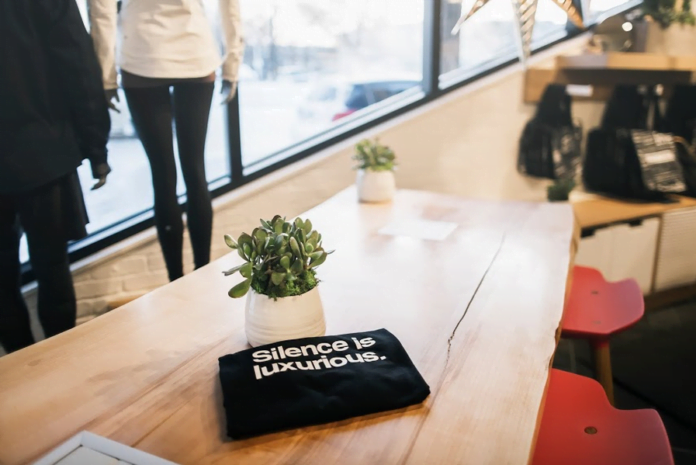
One of the wood tables hosted a pop-up shop from a community vendor, selling novel T-shirts reading “Silence is Luxurious” (see top photo). Lululemon tells us that its community strategy is decentralized, and that stores are individually responsible for creating experiences that resonate with guests and support their local communities.
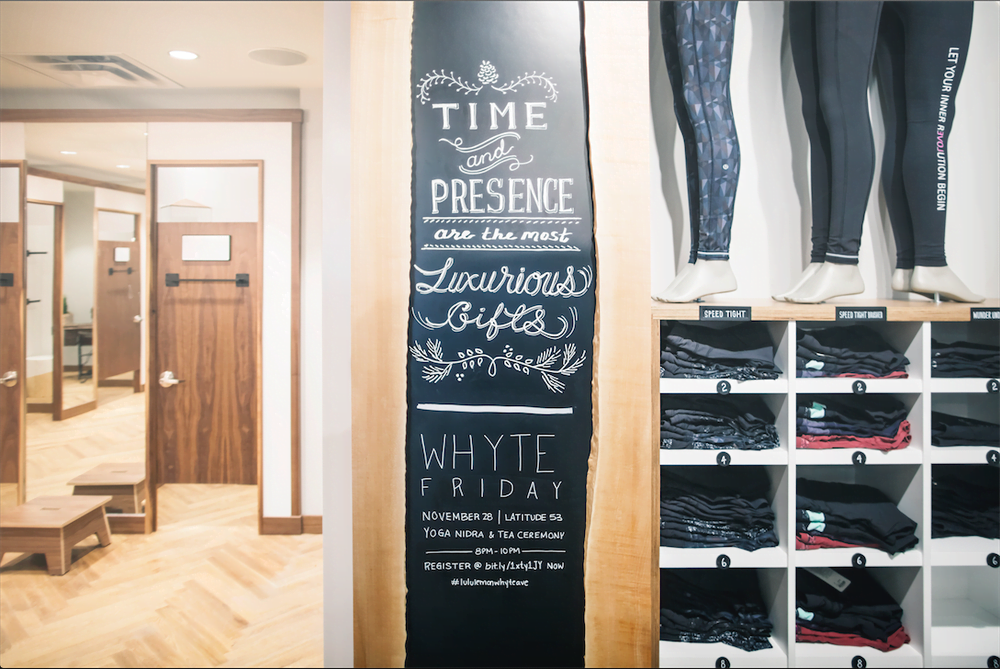
We were also impressed by some of the store’s other thick wood fixtures, also featuring ‘live edge’ finishes. Featured on the store’s walls are the store’s ‘What’s Happening Board’ and ‘Community Board’, as well as a wall-mounted acrylic mirror framed in thick Western Maple over the store’s cash desk. According to Lululemon, fixtures were designed by Alison Janzen and then manufactured by Peregrine. Peregrine, we’re told, fabricates fixtures for some of Canada’s top retailers.
CONVENIENT PLUGINS ADORN THE WESTERN MAPLE WOOD TABLES, DESIGNED BY ALISON JANZEN, FABRICATED BY PEREGRINE. PHOTO: NICHOLAS YEE.
While visiting the store, we observed several people meditating and doing yoga. Most were on floor mats, though one woman meditated on one of the substantial wood tables. Not long after, a young woman plugged in her laptop and was working at one of the central stations. All the while, the store’s cash registers seemed to be ringing up substantial sales — despite space being used for non-retail purposes, the store is still making money.
The Whyte Avenue store addresses a new trend: “These brands are taking a different view toward what a physical store does and aren’t just looking at them as places for commerce,” says Neil Stern, a senior partner at retail consultancy McMillanDoolittle. “Everyone aspires to be Apple,” he says, referring to the stores’ accommodating atmosphere that sees scores of people using the free Wi-Fi. “These brands want to be the place where you hang out.”
Using the space for alternative purposes is strategic, says retail expert Bridget Russo. Community collaboration and in-store events “are helpful in driving store traffic and ultimately sales,” she says, “but really it’s about keeping the store active, becoming a brand people know and supporting other local businesses.” The strategy also tries to solve the problem of waning enthusiasm for brick-and-mortar shopping.
LIVE EDGE WESTERN MAPLE ‘WHAT’S HAPPENING’ BOARD, DESIGNED BY ALISON JANZEN, FABRICATED BY PEREGRINE. PHOTO: NICHOLAS YEE.
Given the hole left by declining neighbourhood institutions, the community store trend will continue to grow, McMillanDoolittle’s Stern says. “These brands are trying to take their place and ingratiate themselves into the community in a smart way at a fairly low cost.”
For those wishing to view the new store in person, Lululemon’s newly renovated Edmonton store is located at 10544 Whyte (82nd) Avenue. Its hours of operation are Monday-Friday 10:00am – 8:00pm, Saturday 10:00am – 6:00pm, and Sundays 11:00am – 5:00pm.
IMPRESSIVE LIGHT FIXTURE IN THE DRESSING ROOM AREA. PHOTO: NICHOLAS YEE.
FIXTURES CAN BE MOVED FOR VARIOUS IN-STORE ACTIVITIES. PHOTO: NICHOLAS YEE.
Earlier this year, while working on an international omni-channel strategy for a Canadian competitor of Mexx, we attempted to audit Mexx’s online strategy. At the time, we found that they had recently put their online business to bed.
According to the company, they decided to close the website to build a better one that would provide its customers with a superior shopping experience—a wise move in a digitally driven world.
However, now that the company is bankrupt, it appears that not only their online business but also the brand has died, or is about to die in its sleep!
Mexx.ca
On December 5, 2014, the day after Mexx filed for bankruptcy, we discovered the company’s website is no longer in a state of slumber, but it has not fully awaken. For instance, a banner that advertised a door crasher special for girls’ apparel was still on the homepage despite the fact that the offer had ended on December 1, 2014, which was eight days ago!
Online Sales Continue to Rise
An interesting shift is occurring in the retail world. For some retailers, online sales could potentially account for the majority of total sales in the near future. A new research report from UBS highlighted four companies that are expected to see a large portion of sales coming from e-commerce in the fourth quarter of 2014. These retailers include:
It was not long ago when many had said apparel purchases would not be well-received online!
“Go Omni-channel or Go Home”
While e-commerce is clearly the way to go, successful retailers are not stopping at a spectacular website. They are embracing what it means to be an omni-channel retailer. An omni-channel retailer integrates all of their channels to engage customers with a consistent, seamless and superior experience and message, and/or to gain efficiencies, such as inventory efficiency.
J.C. Williams Group’s quarterly Canadian E-tail Report surveys Canadian consumers regarding their online purchasing habits. The message has consistently been “Go Omni-channel or Go Home!”
Retailers who have invested in an omni-channel strategy have seen both their online sales and enterprise value increase.
If you don’t have an omni-channel strategy, in its place is a gaping hole in your business. Your customers are probably going elsewhere while you are sleeping. It is time to wake up before your brand falls into an eternal omni-channel slumber.
J.C. Williams Group is a well-known, full-service retail and marketing consulting firm. It offers clients practical, creative, and in-depth knowledge of retailing and marketing, including up-to-date know-how and techniques to make retail operations better and more profitable. You can also read their informative blog, Retaileye, here: retaileye.wordpress.com.
Innovative large-format Quebec-based fashion retailer La Maison Simons plans to eventually operate as many as 20 Canadian store locations, according to CEO Peter Simons. The company is aggressively expanding by opening stores Canada-wide which is impressive, considering it currently has only one location outside of Quebec.
Simons’ first location outside of Quebec opened in October of 2012 at West Edmonton Mall. The 126,000 square foot store has seen tremendous success and according to Mr. Simons, is the chain’s second-highest performer. After perfecting its store design with the August 2013 opening of its 115,000 square foot location at Montreal’s Galeries d’Anjou (its eighth store in Quebec), Simons embarked on its ambitious cross-Canada expansion.
Canada is seeing substantial growth and increased competition among upscale retailers. Holt Renfrew, Harry Rosen, Nordstrom and Saks Fifth Avenue are expanding throughout Canada, carrying some of the same upscale designers as Simons. Simons differs from these other retailers, however, in how it pairs pricey designer products with its substantial moderately-priced private-label in-house fashion. Simons stores also lack cosmetics departments and large footwear areas typical of similar-sized department stores, instead focusing on ready-to-wear, accessories, and some home furnishings.
Mr. Simons tells us that he’s keen to open even more Canadian stores, and that discussions continue for a number of potential locations. He says that he’s very much interested in opening a large store in downtown Toronto, though it may not be at Toronto Eaton Centre, as many have speculated. A second Calgary location could also be in the works, according to Mr. Simons, though he declined to provide details. Mr. Simons says that the retailer was contemplating opening a Winnipeg store, though at the moment it’s concentrating on other Canadian cities. Sources also confirm that Simons has been in talks with Oxford Properties to open a 120,000 square foot location at Toronto’s Yorkdale Shopping Centre though again, Mr. Simons declined to comment.
Given the assertion that Simons could operate up to 20 Canadian locations, and given the reality that it operates multiple stores in some markets, we speculate that it will operate at least two locations in the Greater Vancouver Area. Simons will no doubt resonate with West Coast shoppers — Simons is fashion forward, and a considerable amount of Vancouver’s apparel is purchased by trend-setting Asian locals and tourists. A suburban Calgary location is also a possibility and would be strategic, given the aversion of many Calgarians to shop downtown.
Mr. Simons told us in passing that, possibly some day, the retailer could expand internationally. For a retailer with such lofty Canadian expansion plans, we wouldn’t be surprised. It will be interesting to watch Simons’ expansion as it moves into Canadian cities where it has limited brand awareness, and we’ll keep you updated on any new store announcements.
Importing pieces directly from Italy, women’s multi-brand clothing retailer Maska Mode continues its Canadian store expansion with plans for several Canadian locations. Given that it carries brands exclusive to them in North America, Maska is also looking to expand into the United States.
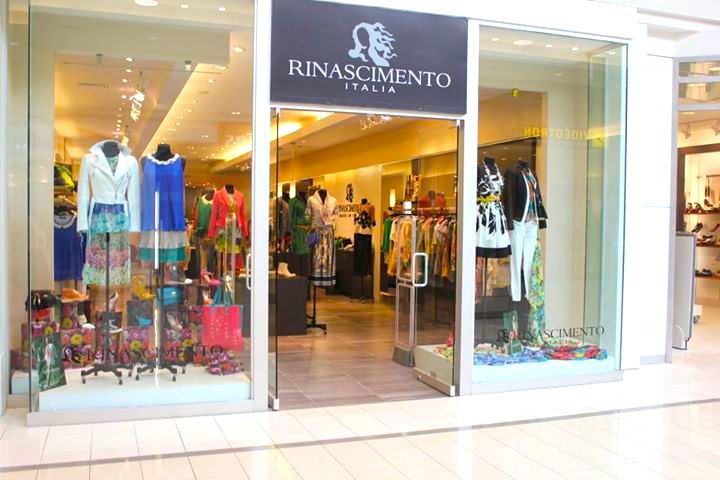
The privately-owned, family-run Montreal-based retailer specializes in ‘high-end fast fashion’ according to a company representative. Trends are addressed quickly, and all merchandise is imported from Italy. Its brands include names such as Gil Santucci, Northland, Imperial Fashion, and Rinascimento, and all stores are corporately owned.
Maska Mode currently operates 21 stores under the Maska, Rinascimento, and Imperial labels. In Quebec, Maska Mode’s stores include six Maska stores, five Rinascimento boutiques, and four Imperial locations. In Ontario, the company operates two Maska and two Rinascimento stores – all in the Toronto area. On November 24th, Maska’s first Alberta location opened at Calgary’s Chinook Centre, measuring about 1,170 square feet.
Maska has just opened two new locations in Vancouver, including a temporary location which opened over the weekend at 2756 Granville Street in Vancouver’s tony South Granville shopping district. We say ‘temporary’ because the store will close at the end of this month for a full-on renovation, prior to re-opening at the end of January, 2015. Maska opened a location last Thursday at Vancouver’s Oakridge Centre (1,115 square feet, replacing womenswear retailer Crisca) and in March of 2015, Maska will open a unit at West Vancouver’s Park Royal.
Maska has further Canadian expansion plans, including a new location at the CORE in downtown Calgary. An opening date for that location has yet to be set. Maska is investigating opportunities in other Canadian cities, though a representative wouldn’t comment on which cities. Maska seeks retail space in the 1,000 to 2,000 square foot range, both in shopping centres and on upscale ‘neighbourhood’ shopping streets such as Sherbrooke Street in Westmount, Quebec and on Vancouver’s South Granville.
Maska also has big plans for the United States. Although the search for store space has yet to begin, the company sees possibly operating stores in cities such as Boston, New York City and Chicago.
We’ll update you when we learn more on Maska Mode’s expansion plans throughout Canada.
Although a number of Canadian retailers have recently folded or are downsizing, some are succeeding and growing substantially. We interviewed retail expert Antony Karabus on what some retailers are doing right, and why investing in physical stores and omni-channel will be crucial to retailers seeking success in 2015.
Online retail in Canada is growing 15% this year and expected to grow by 11-13% over the next three years (Source: Forrester), versus bricks-and-mortar’s anticipated current year to date sales growth of under 4% (Source: Retail Council of Canada Fast Facts).
As a result of the minimal brick and mortar growth, the majority of store sales growth for retailers will have to come from capturing market share. Therefore retailers will need to invest in creating compelling reasons for shoppers to come into their physical stores. Mr. Karabus says that a number of Canadian retailers are doing it the right way — that is, they’re creating engagement in-store, as well as creating a differentiated digital presence. As a result, retailers investing in stores will see customers willing to pay full-price, as opposed to retailers who rely on discounts for foot traffic. Some of the more innovative retailers include (and are not limited to) Indigo Books (with the creation of the first “cultural department store” and the partnership with American Girl to offset the secular decline in physical books), Aritzia, Sport Chek and MEC — all which have built businesses based on positive in-store experiences, as well as investing heavily in creating a digital experience.
A number of Canadian retailers are re-invigorating their store fleet and investing tens or even hundreds of millions to create compelling reasons for customers to keep coming back. Harry Rosen, Holt Renfrew and La Maison Simons, for example, are spending hundreds of millions on store upgrades and new stores, as well as revamping e-commerce sites. Harry Rosen’s new Ottawa shoe store, for example, is “a brilliant move” according to Mr. Karabus, as it speaks to an innovative in-store experience in a segment that is poised for significant growth, namely better men’s shoes.
Mr. Karabus predicts that ‘click-and-collect’ will be a trend for 2015, where shoppers buy online and pick up purchases in-store. There’s a convenience factor involved — rather than wait for (and possibly miss) a delivery at home from an online purchase, shoppers may pick up items at their local store at their convenience. Retailers will have to make modifications to their fulfillment and backroom processes and infrastructure to facilitate these omni-channel capabilities. The retailer may ultimately benefit from this arrangement according to Mr. Karabus – the possibility to up-sell products to the purchaser is easier face-to-face in the store, not to mention human interaction which personalizes the purchase experience. Mr. Karabus says that shopping centres may be able to facilitate the ‘click-and-collect’ trend by modifying real estate to include drive-through centres, for example. As a result, retailers must develop and implement omni-channel capabilities to capture the growing number of consumers who research before buying and want to ‘reserve’ or order the items in store for pickup or return.
Mr. Karabus notes that the retailer’s existing cost structure that supports the legacy bricks-and-mortar business will need to be meaningfully re-invented to fund the massive additional investments which are required to fund the creation of new omni-channel, fulfillment and online capabilities and the re-invigoration of store fleets to create more compelling store experiences. Those who ignore this could be doomed to fail.
Consumers are ultimately looking for positive experiences, be it a trip to an exotic destination, or a new jacket in a store. In order to compete for limited shopping dollars, retailers must create an engaging experience. Retailers that can engage shoppers and increase loyalty and shopping frequency will succeed and on the flipside, those who fail to engage risk losing out to better retailers, not to mention the proliferation of e-commerce possibilities.
In Summary, the entry into Canada of world-class retailers such as Nordstrom as well as incumbent retailers that are “ raising the bar” on their existing operations, will be excellent for Canadian consumers as it both provides much increased choice and availability of places to visit and shop, as well as more interesting shopping experiences.
About Our Expert:
Antony Karabus became CEO of HRC Advisory in January of 2013. He has been a trusted and passionate advisor to retailers on strategic and financial performance issues for over 25 years. He has assisted numerous North American retailers to create significant shareholder value during this time. He has worked with numerous well known retail chains in key sectors such as department store, specialty apparel and hard lines, big box chains and food and convenience.
Antony began his career at Arthur Andersen in Cape Town, South Africa and moved with the firm to Toronto, where he founded Karabus Management as a Canadian retail advisory firm in 1990. In 2001, Karabus Management expanded into the United States, where the firm became a leading North American specialist retail consulting firm. In 2008 he sold the firm to an International Accounting/Consulting firm where he served as the leader of that firm’s Retail Consulting Services practice until he left the firm in December 2011.
Antony conducts annual surveys of Retail CFO and CEOs to determine key priorities in assisting their business to enable substantive value creation.
Antony is a recognized speaker and a published author providing thought leadership at industry forums, including the National Retail Federation, Retail Council of Canada, World Retail Congress and the Fashion Institute of Technology and providing content to The Wall Street Journal, The New York Times, Stores Magazine, The Globe & Mail, Chain Store Age, National Post, Toronto Star and Women’s Wear Daily, among others.
About HRC: HRC Advisory is a specialist boutique retail advisory firm. Together with its predecessor firms, it has been assisting Canadian and US Retail Chains to improve their profitability and strategic positioning for more than 25 years. Many of HRC’s senior advisors were previously at Senn Delaney Retail Consultants and Karabus Management following retail leadership roles. Other senior advisors at HRC have a mix of retail leadership and retail consulting experience gained with other leading firms
HRC has significant retail depth in strategic planning, buying, merchandise planning and inventory management, indirect procurement, store operations and omni-channel processes, supply chain/logistics and fulfillment, and comprehensive cost optimization services. HRC has worked extensively with both healthy top performing chains as well as developing and executing turnaround mandates at a number of retailers in difficult situations. For more information, please visit www.HRCadvisory.com.
The process appears to be modelled after Tesco’s program in the UK, with a few differences:
There was a fee for Loblaws’ click-and-collect service. From a business standpoint, Loblaws obviously has to cover the incremental labour costs for picking, packing and processing, but as a consumer, we expected that if we were going to “do the work” and pick up our order, there would be no fee.
Loblaws has a minimum order requirement. Tesco does not charge a fee if the order exceeds £25 (or approximately $45CDN), while Loblaws has a minimum order requirement of $50CDN and fees range from $3 to $5, depending on the pick-up window that is selected. Loblaws refers to this as a “convenience fee” on the customer receipt.
Where Loblaws Click-And-Collect Fell Short
1. Lack of product availability.
Not all items that are in the store are available to order online (for example, we wanted to order a 1L size of 1% milk, but this was not available online). In addition, most of the milk products were higher end products: Natrel brand, organic, etc. There was not enough variety on the website to make the customer choose it over an in-store trip.
2. Lack of product customization.
Customers want to be able to order online the same way they purchase in store, particularly in categories like bakery. Freshly baked in-store items come only pre-packaged in 6’s (we wanted fresh bagels). We were not able to choose our quantity in units, which is surprising given the shopper has to pick in singles anyway. However, at least they offered the option of freshly baked goods; Canadian online grocer Grocery Gateway offers only pre-packaged, branded baked goods.
3. Missing product information.
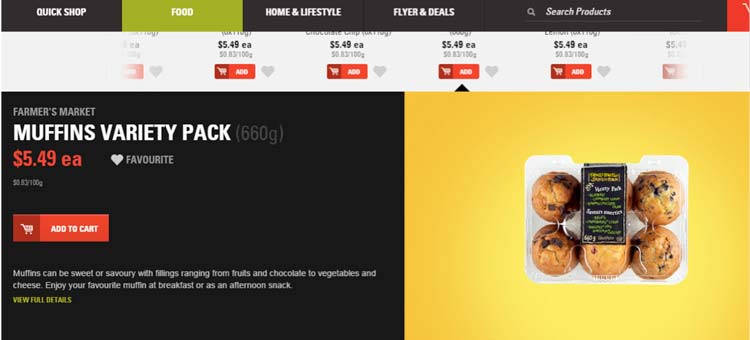
In some instances, item description did not give sufficient detail to help the customer make a purchase decision. For example, veal scallopini was listed with a price of $26.45, but with no indication of weight or quantity of cutlets in the package. A variety 6-pack of muffins did not specify the muffin flavours inside.
4. User-friendliness could improve.
The navigation menu is not as user-friendly as Grocery Gateway’s. To get out of a category, we had to go back to the menu and re-select each level of sub-category, whereas at Grocery Gateway, changing categories is one click away.
In addition, when we completed our shop, we specified that we didn’t want to allow substitutions (if required). However, when we received notice of our order being ready, we were told a substitution had been made. Upon reviewing our profile, it still showed that we would allow substitutions for any products. For foodies or those who are loyal to brands, this automatic substitution and the requirement to deal with customer service to request a credit was a hassle that detracted from the overall experience.
5. Spelling mistakes and slow page loads detract from the overall experience.
We also noted several spelling errors throughout the site. While seemingly insignificant, the devil’s in the details and a typo can easily take away from a polished experience. The pages were also slow to load which made the ordering process longer than it should be and could have potentially turned off customers who are in a hurry.
Where Loblaws Click-And-Collect Succeeded
1. Smooth pick-up experience at store.
The store has a very clearly marked pick-up location in the parking lot. Our order was ready, staff were quick to bring it out from the store, and seemed very educated about the process (and friendlier than the in-store checkout experience!). All the cold and frozen foods were still cold when we brought them home.
2. PC Plus integration was solid.
Your online profile can be linked to your PC Plus account (Loblaws’ loyalty program), so you can view your personalized offers as you shop. Weekly flyer specials can be shopped separately, and are also flagged within categories, as are other deals. Notification of order being ready for pick-up was prompt and clear.
Key Takeaways
The click-and-collect experience, as is the case for the home delivery experience, is definitely a customer convenience, but it is not for every customer. For many, grocery shopping remains a sensory experience: touching an avocado, smelling a fish, and seeing the colour of bananas is the only way to select your food. However, every consumer will at some point need to make a quick shop or a stock-up shop.
In some cases, grocers can even combine click-and-collect with home delivery to truly satisfy customer needs. The question will be whether this will be sufficient volume to make the model profitable over time. For Loblaws, the holiday season will prove to be the true test of capacity.
Vicky Applebaum is a consultant with Retail Category Consultants Inc. and helps clients develop and implement retail strategy, marketing and innovation projects. Vicky has over 15 years of progressive retail experience in Canada in multiple disciplines.
Her experience includes advertising and merchandising at Loblaw Companies, and marketing, merchandising and category management with Shoppers Drug Mart. Her love for all things marketing also led her to work on the agency side and in independent consulting in advertising, event marketing, direct marketing, new product launches and loyalty. Born in Montreal, Quebec, Vicky holds a Bachelor of Commerce (Marketing) from Concordia University. She and her husband live with their daughter in Richmond Hill, Ontario where they operate a rental moving box business, CityBoxes.ca.
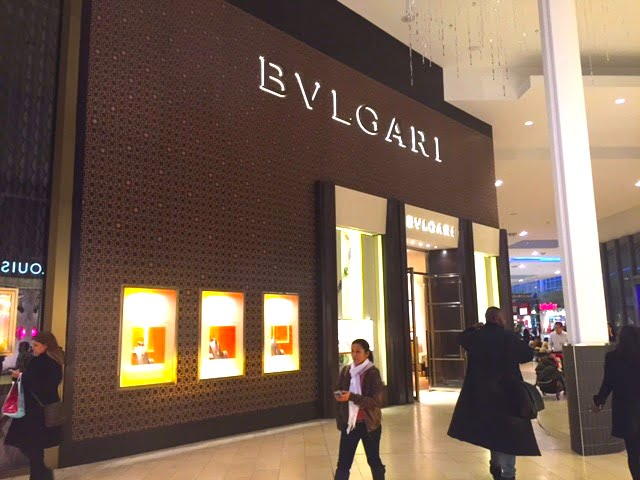
Luxury Italian jeweller Bulgari has opened its first Canadian location at Toronto’s Yorkdale Shopping Centre. It could be the first of several Canadian locations for Bulgari, we’re told, though the retailer is being cautious with any potential expansion plans.
Bulgari Flagship Boutique at Toronto & Yorkdale Mall
Bulgari’s Toronto store carries the brand’s pricey jewellery collections for women and men, as well as handbags and accessories, timepieces, and fragrances. The store’s exterior facade features oversized windows and soaring marble columns, with the BVLGARI logo backlighted on the cream coloured stone. One of the brand’s key design elements, the Condotti eight point star, lies on the store entrance. The store features bridal, male, accessories, and VIP areas, where pieces can be viewed in privacy.
“Bulgari represents the ultimate in craftsmanship, creativity and innovation,” said Jean-Christophe Babin, CEO of Bulgari. “We are thrilled to open this store and to bring that extraordinary combination to Canada in a manner that perfectly represents the modern Bulgari brand while still paying tribute to our rich Roman heritage.”
The 1,815 square foot Yorkdale boutique is located across from Holt Renfrew in the mall’s ‘luxury wing’, alongside brands such as Mulberry, Salvatore Ferragamo, Cartier, Versace, Tiffany & Co, Jimmy Choo, and others. Yorkdale, itself, has created a world-class cluster of luxury retailers in a concentration unrivalled anywhere in Canada. The neighbouring Holt Renfrew houses luxury concessions such as Louis Vuitton, Chanel, Gucci, Prada, Dior and Giorgio Armani, as well as a vast assortment of upscale brands across various product categories.
Founded in 1884 in Rome, Bulgari is now part of French luxury goods conglomerate LVMH. Bulgari operates over 300 stores worldwide, including 15 free-standing American locations. Bulgari shops-in-stores are also located in various upscale jewellers, as well as luxury department stores such as Saks Fifth Avenue and Neiman Marcus. No word yet if Bulgari shops will be featured in any Canadian Saks Fifth Avenue locations.
Bulgari representatives won’t formally comment on the retailer’s Canadian expansion plans, except to say that future locations are a possibility. A business analyst, speaking on the condition of anonymity, says that the brand’s Canadian expansion plans will be cautious and be partly based on the success of its Yorkdale store. Retail analysts speculate that Bulgari could eventually operate three or more Canadian locations. Vancouver is an obvious choice for Bulgari, given its rapidly growing luxury market fuelled by affluent Chinese shoppers. A second Toronto location is also speculated, likely in the city’s posh Yorkville shopping area either on or close to Bloor Street West. One source speculates that a Calgary location could also follow.
In the early to-mid 2000’s, a 700 square foot Bulgari shop-in-store operated with a 101 Bloor Street West entrance at Royal de Versailles jewellers in Toronto. The store closed due to lack of sales, and the space is now occupied by watch brand Rolex.
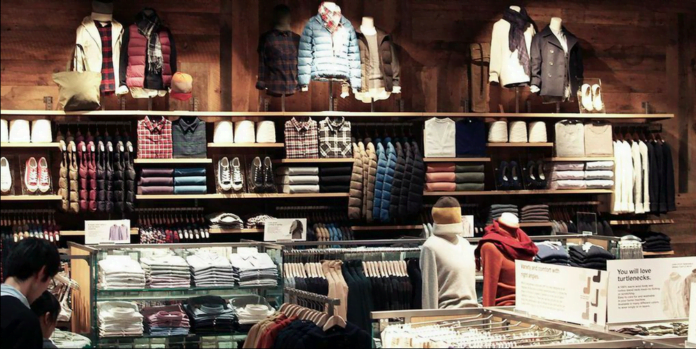
MUJI’S WOMENS APPAREL DEPARTMENT AT THE COMPANY’S FIRST STORE AT THE ATRIUM IN TORONTO. PHOTO: RETAIL ASSEMBLY
By Jennifer Pilkington
MUJI Atrium opened in Toronto this Saturday with long line-ups for it’s country launch. The retailer faces the same challenges as any new retailer to Canada, and methodically selected a smart location, determined a strong product mix, and ensured good inventory levels.
The Atrium in downtown Toronto is directly across from the foot-traffic heavy Toronto Eaton Centre and Dundas Square. With a Dundas Street-facing entrance next to Forever 21, the retailer avoids high rent while benefiting from the block’s significant foot traffic.
The store at 4400 square feet is half the size of MUJI’s Hollywood location, the largest North American offering. Launching downtown often means smaller spaces. In Japan, where the retailer has 385 stores, 7000 different products are offered, including widely popular grocery, snacks, confectionary and even prefab (ready made) houses for small city spaces.
Toronto launches without the houses and food, although the latter can be expected in Canada eventually.
The 2800 products that are on offer are some of MUJI’s best: a mellow tonal cuckoo clock, the aroma diffuser that waves pure plant-based fragrant oils, simple, well-designed functional products and stationery.
Each product is made with the care and consideration of the MUJI merchandising team. Ensuring each item is pleasant to use, and made with sustainable practices is important for the retailer. Minerals are used to colour, patterns are not used because of their excessive production requirements, items are designed simply and timelessly of natural materials.
MUJI’s much-loved stationery department is located at the mall entrance, next to mens basics. The home department includes kitchen utensils, dishes, textiles, and travel. This area typically generates 54 percent of the company’s sales, but Canadian president, Mr. Toru Tsunoda sees significant opportunity in womens apparel, and beauty in Toronto.
“Its looks like womens apparel is the most prospective category including shirts and knit products. Another big category is health and beauty,” said Mr Tsunoda in a Japanese-language interview. The women’s apparel department opens the store to the right, gift and basics at the entrance, flowing into travel and beauty at the cash.
The retailer is known to spend little on market research and advertising. However it is clear from conversations with Mr. Tsunoda and his team that they are, nonetheless, very well researched. Shopping the local market was a key component to developing the launch assortment strategy.
The product available in Canada is the same product available at the almost 650 MUJI stores across the world. “We are trying to harmonize and sell products that are available [everywhere]. The only difference is the sizes”, Mr. Tsunoda emphasizes. Food and safety regulations require some adjustments, but otherwise the products that are successful in one area will be offered in other geographic regions.
‘Creating MUJI fans’ is the retailer’s number one priority. Their unbranded, quality items – the definition of Mujirushi Ryohin, the phrase which the retailer generates its name from – have a global cult following. While MUJI does not have the brand recognition of say Target or Nordstrom, it does have a smart launch strategy. Fans first, more stores second.
It’s a quieter approach than we’ve seen from both Target’s mass launch, and Nordstrom’s PR based entrance. Each country / region has to operate profitably as it’s own company within the Japanese holding organization Ryohin Keikaku Co. Ltd. This is perhaps what drives the fans-first approach, and ultimately line-ups out the door on launch day. “My dream is to open a space as large as [in] the United States”, Mr. Tsunoda says with a smile.
Visit MUJI Atrium on Bay is located at 20 Dundas St. W., Toronto ON | Monday-Friday 10:00am-8:00pm, Saturday, 10:00am-7:00pm, Sunday, 11:00am-5:00pm.
A merchant first, now Managing Director of RETAIL ASSEMBLY Inc., Jennifer continues to work with the globe’s best brands and retailers. Always a champion of excellent creative and meaningful commerce, she works to build businesses and train/develop teams. retail-assembly.org | @RetailAssembly