

By Vicky Applebaum
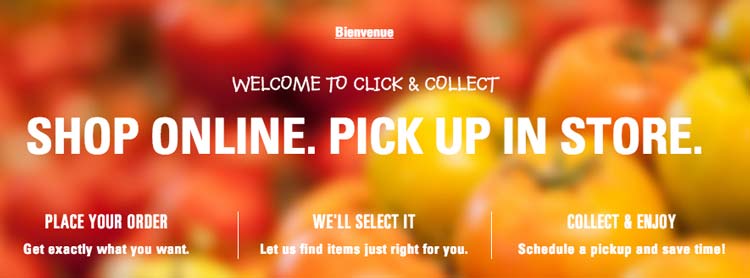
Retail Category Consultants tested Loblaws‘ click-and-collect pilot program, which gives shoppers the ability to collect, or pick up, online orders in stores. If executed properly, the click-and-collect model benefits both retailers and consumers in significant ways.
The process appears to be modelled after Tesco’s program in the UK, with a few differences:
- There was a fee for Loblaws’ click-and-collect service. From a business standpoint, Loblaws obviously has to cover the incremental labour costs for picking, packing and processing, but as a consumer, we expected that if we were going to “do the work” and pick up our order, there would be no fee.
- Loblaws has a minimum order requirement. Tesco does not charge a fee if the order exceeds £25 (or approximately $45CDN), while Loblaws has a minimum order requirement of $50CDN and fees range from $3 to $5, depending on the pick-up window that is selected. Loblaws refers to this as a “convenience fee” on the customer receipt.
Where Loblaws Click-And-Collect Fell Short
1. Lack of product availability.
Not all items that are in the store are available to order online (for example, we wanted to order a 1L size of 1% milk, but this was not available online). In addition, most of the milk products were higher end products: Natrel brand, organic, etc. There was not enough variety on the website to make the customer choose it over an in-store trip.
2. Lack of product customization.
Customers want to be able to order online the same way they purchase in store, particularly in categories like bakery. Freshly baked in-store items come only pre-packaged in 6’s (we wanted fresh bagels). We were not able to choose our quantity in units, which is surprising given the shopper has to pick in singles anyway. However, at least they offered the option of freshly baked goods; Canadian online grocer Grocery Gateway offers only pre-packaged, branded baked goods.
3. Missing product information.
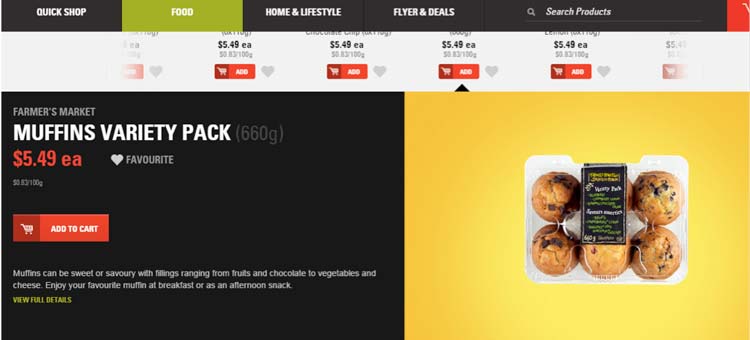
In some instances, item description did not give sufficient detail to help the customer make a purchase decision. For example, veal scallopini was listed with a price of $26.45, but with no indication of weight or quantity of cutlets in the package. A variety 6-pack of muffins did not specify the muffin flavours inside.
4. User-friendliness could improve.
The navigation menu is not as user-friendly as Grocery Gateway’s. To get out of a category, we had to go back to the menu and re-select each level of sub-category, whereas at Grocery Gateway, changing categories is one click away.
In addition, when we completed our shop, we specified that we didn’t want to allow substitutions (if required). However, when we received notice of our order being ready, we were told a substitution had been made. Upon reviewing our profile, it still showed that we would allow substitutions for any products. For foodies or those who are loyal to brands, this automatic substitution and the requirement to deal with customer service to request a credit was a hassle that detracted from the overall experience.
5. Spelling mistakes and slow page loads detract from the overall experience.
We also noted several spelling errors throughout the site. While seemingly insignificant, the devil’s in the details and a typo can easily take away from a polished experience. The pages were also slow to load which made the ordering process longer than it should be and could have potentially turned off customers who are in a hurry.
Where Loblaws Click-And-Collect Succeeded
1. Smooth pick-up experience at store.
The store has a very clearly marked pick-up location in the parking lot. Our order was ready, staff were quick to bring it out from the store, and seemed very educated about the process (and friendlier than the in-store checkout experience!). All the cold and frozen foods were still cold when we brought them home.
2. PC Plus integration was solid.
Your online profile can be linked to your PC Plus account (Loblaws’ loyalty program), so you can view your personalized offers as you shop. Weekly flyer specials can be shopped separately, and are also flagged within categories, as are other deals. Notification of order being ready for pick-up was prompt and clear.
Key Takeaways
The click-and-collect experience, as is the case for the home delivery experience, is definitely a customer convenience, but it is not for every customer. For many, grocery shopping remains a sensory experience: touching an avocado, smelling a fish, and seeing the colour of bananas is the only way to select your food. However, every consumer will at some point need to make a quick shop or a stock-up shop.
In some cases, grocers can even combine click-and-collect with home delivery to truly satisfy customer needs. The question will be whether this will be sufficient volume to make the model profitable over time. For Loblaws, the holiday season will prove to be the true test of capacity.

Vicky Applebaum is a consultant with Retail Category Consultants Inc. and helps clients develop and implement retail strategy, marketing and innovation projects. Vicky has over 15 years of progressive retail experience in Canada in multiple disciplines.
Her experience includes advertising and merchandising at Loblaw Companies, and marketing, merchandising and category management with Shoppers Drug Mart. Her love for all things marketing also led her to work on the agency side and in independent consulting in advertising, event marketing, direct marketing, new product launches and loyalty. Born in Montreal, Quebec, Vicky holds a Bachelor of Commerce (Marketing) from Concordia University. She and her husband live with their daughter in Richmond Hill, Ontario where they operate a rental moving box business, CityBoxes.ca.
To learn more about how Retail Category Consultants can help your retail business achieve success, visit their retail services page or contact them for further information.




Great insight and details. Learned a lot in a few moments.
Loblaws is using plastic bags for this service. You can request that they use your reusable bags, but that means everything, especially your produce is being handled at least 3 times…and you have to wait while they re-bag everything. This is a deal breaker for me. Why not implement a plastic bin service like Knob Hill Farms used to use? You pay a deposit on the bin and your money is refunded when you return it….ideally when you pick up your next order.