Home Blog Page 1267

HR Challenges Retailers are Currently Facing

Editor’s message: If you’re looking for new software to improve your business, look no further than this human resource software from Cezanne.

By Lisa McCann

Retailers strive to build strong performing workforces but with changing demographics and market trends, sustaining a strong workforce long term is becoming more and more challenging.

So how can a company better prepare to build a workforce for long term business success? It all starts with understanding which HR challenges are currently affecting retailers across Canada.

You can start by thinking about the following:

  • Where is my organization expecting to grow (or shrink) in the next few years?

  • How will this affect my current workforce?

  • How will this affect how I source potential candidates?

  • Will any new talent gaps arise due to these changes?

There are two main external areas that are creating HR challenges today, these include the rising war for talent and continuous technological changes in the market:

War For Talent

Currently, companies are seeing an aging population of retiring baby boomers exiting the workforce and a new much smaller generation of workers entering the market. It’s easy to see how this is soon going to become a predominant topic. We have more people exiting the workforce then entering, therefore we are making a swift change into a job seeker market. This means companies will see much higher rates of competition arise for talent. Additionally, the newer generations who are entering the market have very different values, expectations, and working styles that is causing a shift in the way companies are building their recruitment strategies.  Retailers need to quickly adapt and find ways to engage, retain and grow their workforce of different generations.

Technological Changes

Improvements in technology can be felt across all channels of our working lives but in regards to HR, technology has shifted the way companies recruit new talent. People aren’t just looking for a job description online, they want to be able to engage, interact and truly understand your employment brand. People place higher expectations on what a company has to offer and adopting new technology trends is no different. Social recruiting has become more predominant with the rise in social media usage, sites such as Facebook, Twitter, and Linkedin are just a few of the channels job seekers are using to search and apply for jobs.

Although retailers can’t have a say on the external factors that are creating HR challenges, there are numerous internal areas that need to be addressed readily to be a front runner for talent.  Here are a few common internal areas we see HR professionals struggling with today:  

Continually Sourcing Top Talent

As talent shortages increase, it’s becoming more challenging for companies to find top talent. Recruitment strategies need to be focused around attracting top tier candidates who will be committed to growing with your organization. Hiring these top tier candidates means you have to be willing to invest in your recruitment processes and implement assessments and screening capabilities that will help you drive better quality candidates. This includes putting an emphasis on cultural fit as this is becoming a predominant determinant of long term success with an organization. By planning for future success you will be saving in areas of recruitment, training, and succession planning.

Increasing Engagement Levels

Employee engagement is a hot topic in HR and has proven to reflect employees’ productivity and successes in their roles. Therefore, it’s simple, an engaged workforce means better business results… right? It’s not so simple, you need to first clearly understand what your workforce values and how you plan to support those values each day. Engagement is closely tied to productivity, turnover levels and morale. By committing to understand and improve your employee engagement levels, you will be committing to better business results long term. 

Retaining & Rewarding Your Best Employees

Attracting top tier talent is one thing, retaining them over time is another. Building a strong long term workforce is another area that creates HR challenges. More often than not you see your top performers moving on to other opportunities within a few years of entering the organization. So how do you retain these employees long term? You need to start by building a leadership development plan, where there is formal training and development in place to help employees grow within your organization. Employees often move around within a company without any formal succession planning in place. By supporting your employees with the proper training they will feel committed and well equipped for their new role.  Additionally, rewarding employees doesn’t always mean an increase in wages but a shift towards workplace benefits they value such as flexible hours or working from home.

Building an Attractive Corporate Culture

Job seekers are looking to work for a retailer whose culture emulates what they want in a working environment, whether it is a work life balance, openness and transparency, or innovation and creativity. It’s also important to maintain a strong brand reputation, this gives your employees a sense of pride in working for your organization and often attracts many candidates to apply.

Lisa McCann is the Corporate Marketing Manager at Vancouver-based recruitment company, MindField Group.
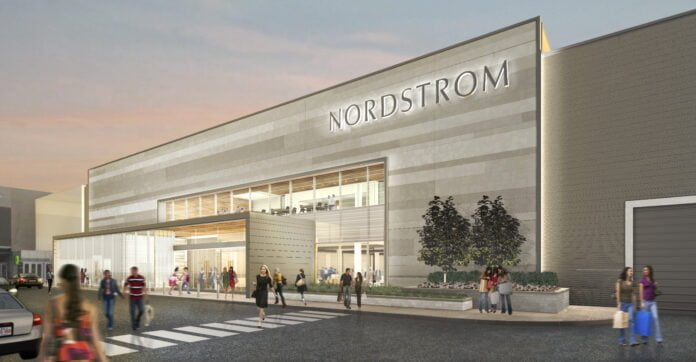
Details of Canada’s 1st Nordstrom store revealed

Image: Nordstrom

Nordstrom’s menswear department, on the store’s ground floor, will showcase an edited collection of suits, sportcoats and trousers in sizes 38 short to 50 long. Dress shirts will be available in more than 50 sizes. An in-store tailoring service will be available. Outerwear, business-casual and weekend-casual styles, jeans, and some trendier men’s clothing items will be featured in-store. Men’s furnishings including ties, socks, belts, underwear, bags and tech accessories will be available, as will luggage, fine fragrance and skincare products.

Upscale children’s wear is a category lacking in many Canadian cities. Calgary’s affluent population will make Nordstrom’s children’s wear departments a hit. Boy’s clothing including active, play and casual clothes, will be sold in sizes 2-20. Girl’s clothing, from playwear to dresses, will be carried in sizes 2-16. Baby clothing will also be featured, for kids under the age of two. In addition, kid’s shoes will also be carried, from infant to youth size 6. Designers include Burberry, Dolce & Gabbana, Oscar de la Renta, Missoni, and Moncler, as well as lesser-priced labels. 

Nordstrom’s cosmetics and beauty department will feature an ‘open-sell‘ concept with a wide variety of vendors. Jewelry at a variety of price points will be available, from inexpensive to ‘Fine Jewelry‘ by designers such as David Yurman and Roberto Coin. Designer jewelry will also be found, by some designer names also carried in its Collectors womenswear department. Both cosmetics and jewelry will be on the store’s ground floor. 

We’ve got details of Nordstrom‘s first Canadian store, including what departments and services will be included in its Chinook Centre location. Nordstrom’s most expensive designer departments will be featured for womenswear, menswear, footwear and accessories, with prices into the thousands of dollars. Not all merchandise will be as costly, however, as moderately-priced departments will also be present. Children’s clothing will be available at a variety of price points. A restaurant and a coffee bar will be featured, as will a variety of services that reinforce Nordstrom’s reputation for exceptional customer service. We can also expect similar departments and services for other Canadian Nordstrom stores as they open over the next three years. 

Luxury will be prominent at Calgary’s Nordstrom, including clothing, accessories and shoes. Its upscale women’s department, called Collectors, will locate on the second floor of the Calgary store. Boasting some of the world’s top luxury designers, Collectors departments typically carry designers such as Dolce & Gabbana, Valentino, Oscar de la Renta, Burberry, Versace, Armani Collezioni, Lanvin and others. Designer handbags, located on the store’s ground floor, include a roster of similar designers – Valentino features prominently at many Nordstrom stores, as does Ferragamo, Tod’s, Saint Laurent, Chloé and even high-priced Bottega Veneta. Given Nordstrom’s reputation for an extensive range of footwear, it comes as no surprise that plenty of designer shoes will be carried at Calgary’s Nordstrom. Its top-priced department, Salon Shoes, carries prominent designers such as Manolo Blahnik, Jimmy Choo, Miu Miu, Valentino, Gucci and many others. 

A limited selection of luxury men’s collections, located on the ground floor, will also be featured at Calgary’s Nordstrom. In the United States, Nordstrom’s designer menswear section includes Moncler, Armani Collezioni, Dsquared2, Canali and at its better stores, Lanvin, Jil Sander, Thom Brown, and Marni. The men’s designer shoe section will likely feature staple designers such as Gucci, Prada, Salvatore Ferragamo, Tod’s, To Boot New York, and others. A source tells us that Nordstrom will carry upscale men’s accessories at its Calgary store, as menswear and accessories have recently seen substantial growth at Nordstrom. 

Nordstrom isn’t all about luxury designers, however. Its Canadian website reveals that its Calgary store will carry the following lesser-priced women’s clothing departments: 

  • via C: Nordstrom’s mid-priced department which features trendy and emerging designers, including the likes of Alice + Olivia, Elizabeth and James, rag & bone, Alexander Wang, Helmut Lang, KENZO and MSGM,
  • Savvy: Nordstrom’s fashion-forward, value-priced designer department,
  • t.b.d.: Nordstrom’s trendy women’s denim department, including designers such as Citizens of Humanity, Paige Denim, Hudson Jeans, Splendid, Free People, Ella Moss, James Perse and J Brand,
  • Active and swim,
  • Juniors, and
  • Lingerie and hosiery.

Offering a wide variety of footwear and prices, Nordstrom’s lesser-priced women’s shoe departments include ‘B.P. Shoes‘ and ‘Women’s Shoes‘. Thousands of shoes will be carried, and will be displayed near the store’s mall entrance on the main level. Nordstrom’s shoe selection will rival and possibly surpass any in Canada, though Hudson’s Bay’s massive Toronto footwear salon will give Nordstrom a run for its money. 

Other in-store services will include on-site alterations, beauty stylists, certified shoe fitters, certified bra fitters, complimentary gift boxes, and a fee-based delivery service. 

Nordstrom’s coffee concept, eBar, will serve coffee beverages, smoothies, pastries, as well as a variety of fresh grab-and-go sandwiches, salads and snacks. A restaurant concept will also open on the second floor, and we’ll discuss Nordstrom’s food offerings in a separate article.

Nordstrom’s 140,000 square foot Calgary store opens at 9:30 am on Friday, September 19th. 

*Our sources for this article have asked to remain anonymous*

New Technology for Retail Execution and In-Store Support

exc-5390addce4b0b4ca734382c7

Solving Out-of-Stocks with Crowdsourced Intelligence, Mobile Alerting and an On-Demand Workforce

By Marie Jackson, CMO of Retail Solutions Inc. (RSi)

You’ve got the right placement, pricing and point-of-sale merchandising. But how do you know, at the store level, that each critical piece of your strategy is being executed correctly? How do you ensure proper execution of promotional displays, achieve new item planogram compliance or preempt risks for out-of-stocks? What if you could combine sophisticated retailer downstream data transformed into scientific out-of-stock alerts with local intelligence and serve it to your field and sales operations teams on a mobile device for immediate response, remediation and reporting?

Now you can. Retail Solutions Inc., a leader in big data analytics and real-time intelligence for the consumer products industry, has partnered with Gigwalk, a local visibility software platform changing the way brands and retailers collaborate, to bring-to-market RSi Intelligent Crowdsourcing. The new solution provides brands with end-to-end business intelligence that drives sales by delivering real-time, actionable intelligence to field operations for improved in-store retail execution on on-shelf availability.

Here’s how it works. The RSi Intelligent Crowdsourcing application blends the company’s proprietary algorithms and unmatched on-shelf alerting capabilities with Gigwalk’s reach and on-the-ground resources to give customers a laser-focused and immediate in-store activation plan. Leveraging Gigwalk’s on-demand public network of 550,000 mobile-enabled independent contractors, brands and retailers can gather localized, in-store intelligence which then gets served back to RSi for data transformation and analysis. The RSi Intelligent Crowdsourcing application then alerts field teams, through their mobile device, where gaps in the supply chain have been identified or triggers actions at the store level to correct errors in near real-time.

Each year, $800 billion in revenue is lost globally to avoidable issues like out-of-stocks. Using RSi Intelligent Crowdsourcing powered by Gigwalk, brands and retailers are armed with three tenets to success: collaboration (data sharing), visibility (finding errors or execution gaps undetected previously) and action (immediate fixes at the retail level). Here’s just a few benefits that can be anticipated from this new approach to retail execution and store support:

  • Find and fix errors in hours — not days or weeks. 
  • Easily scale workforce resources to meet the needs of critical initiatives without incurring unnecessary overhead. 
  • Algorithm-based on-shelf alerting and scorecard reporting to accurately detect store or event conditions.
  • Send real-time fix notices to store teams. 
  • Share observations with the value chain.
  • Reach any store, at any location at any time with accurate alerts.
  • Better react to market pressures and increased competition.
  • Reduce out-of-stocks and improve on-shelf availability.
  • Reclaim lost sales.

Early pilot testing, which was completed was completed with five major retailers and multiple industry leading suppliers, resulted in an average ROI of eight times the original investment. In some instances, returns as high as 18 percent were achieved in just a few weeks’ time.

To learn more about RSi Intelligent Crowdsourcing, please visit: http://www.retailsolutions.com

Uniqlo’s Canadian store locations: discussion

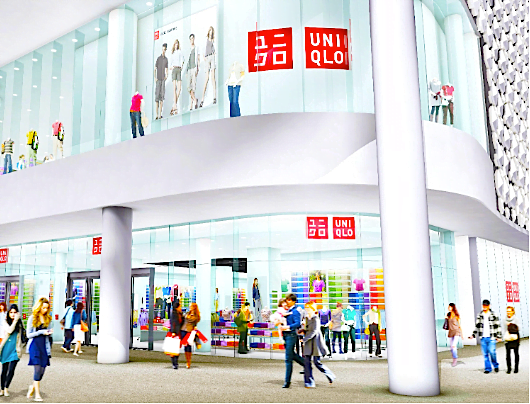
RENDERING: UNIQLO

Japanese fast-fashion retailer Uniqlo is working with a broker to open Canadian stores. Uniqlo’s choice of American locations can be considered an indication of what it wants in Canada: prime retail space on busy streets and in prominent malls. Expect large Canadian Uniqlo flagships, as well as some smaller mall-based stores. However, its cautious American expansion foreshadows what’s in store for Canada, at least in the short term, as only a handful of American cities see multiple Uniqlo locations. This will change, eventually, as Uniqlo’s goal is to become the world’s top-selling fashion retailer. We’ll explain why Uniqlo stores will open in many Canadian markets over the next several years, and we’ll then discuss some of its most likely Canadian locations. 

Sources inform us that Uniqlo is talking to Canada’s largest mall landlords as its searches for Canadian retail space. In March, the Financial Post reported that Uniqlo was in talks to open a 35,000 square foot space at Toronto’s Yorkdale Shopping Centre. Toronto and Vancouver are ideal cities for the Japanese retailer: both see exceptionally high retail sales, large Asian populations, and considerable Uniqlo brand awareness. Other desirable markets include Montreal, Edmonton, Calgary, and possibly Ottawa and Winnipeg, as the company continues expanding. 

Uniqlo’s first American stores were unsuccessful, having opened in three suburban New Jersey malls in the early 2000’s. The small stores failed to attract local shoppers, who were lacking brand awareness. Uniqlo stepped back and re-entered the United States via larger stores in prominent urban locations. Concentrating on metropolitan New York City and San Francisco, Uniqlo opened large flagships as well as stores in top local malls. It subsequently announced expansion plans for Los Angeles, Boston, and Philadelphia. Its current store opening strategy involves placing multiple stores in each market, leverage advertising dollars in each city. The American midwest is noticeably absent of Uniqlo stores, at least for now. We’re told, however, that Chicago is first for its midwest expansion once Uniqlo solidifies brand dominance on the coasts. 

In Canada, Uniqlo may use a similar geographic strategy, concentrating its first stores in Toronto and Vancouver. The company plans to overtake Zara as the world’s largest clothing retailer and to that end, we can expect Uniqlo stores in various Canadian cities. Given the retailer’s recent propensity towards opening in busy malls and on busy commercial streets, we’ll discuss a few Canadian locations where Uniqlo stores are likely. 

Toronto – Toronto is an obvious choice for Uniqlo: Canada’s largest city also boasts the nation’s most comprehensive retail. Uniqlo will likely open a large, splathy flagship in the core, either in or close to the Toronto Eaton Centre. Queen Street West is possible, as is the Bloor-Yorkville area. Sources tell us that the Yorkdale Uniqlo deal is done, with a 30-35,000 square foot location expected to open in 2016. Uniqlo will likely open in the new retail wing anchored by Nordstrom, in the northeastern portion of the new retail space. Busy malls such as Sherway Gardens and Mississauga’s Square One are also likely candidates for Uniqlo. 

Vancouver – Sources tell us that Uniqlo wants to open a large store on Vancouver’s Robson Street, which should come as no surprise: Robson is the city’s most popular shopping street, boasting flagships for Zara, Roots, LululemonVictoria’s Secret and others. Pacific Centre is another possibility, being exceptionally busy, and the soon-to-be home of Nordstrom as well as an expanded and renovated Holt Renfrew flagship. Oakridge Centre, Metropolis at Metrotown, Richmond Centre and West Vancouver’s Park Royal are also top contenders for Uniqlo. 

Montreal – Sainte Catherine Street is a logical choice for a Uniqlo flagship: the busy street boasts similar tenants as Vancouver’s Robson Street. Carrefour Laval has emerged as the region’s top suburban mall, hoasting millions of visitors annually. Lifestyle centre Quartier Dix30 is a possibility, are as several popular suburban malls including Les Galeries d’Anjou, Fairview Pointe Claire and Centre Rockland

Edmonton – West Edmonton Mall is an obvious choice for Uniqlo: the entertainment-themed mall boasts some North America’s top-selling chain store locations. We’d expect a large Uniqlo location there, if it chooses to open in Edmonton. Southgate Centre is another possibility for Uniqlo, and any further Edmonton locations are anyone’s guess. 

Calgary – Chinook Centre is Uniqlo’s likely first choice for Calgary: the popular suburban mall hosts millions of visitors, and will boast Canada’s first Nordstrom store location. Its TopShop, H&M and other flagships do exceptional sales. Southcentre and Market Mall continue to be strong, and CrossIron Mills is a possibility for Uniqlo, as well. A downtown Calgary Uniqlo is possible, though Calgary’s suburbs continue to dominate the market. 

Ottawa – If Uniqlo enters the Ottawa market, we’d expect Rideau Centre to be its first choice. The overhauled mall will feature Canada’s second Nordstrom store, scheduled to open next year. La Maison Simons will open in the mall’s expansion, a year later. Canada’s second-largest Zara store will open in the mall’s expansion, and H&M is expected to announce a Rideau Centre location shortly. Other top Ottawa malls include the Bayshore Shopping Centre, St. Laurent Centre, and Les Promenades Gatineau

Winnipeg – If Uniqlo chooses Winnipeg, Polo Park is its likely first choice. The city’s premier mall will soon see the opening of an H&M, and interesting plans are in store for a further mall expansion. Time will tell if the Seasons at Tuxedo and St. Vital Centre could become home to the retailer. 

Quebec City – Uniqlo could eventually open in one or more popular malls, including Laurier Quebec, Place Ste-Foy or Les Galeries de la Capitale

We’ll update you when we learn more about Uniqlo’s new Canadian store locations. 

Nuance brings SK-II to Canada via Toronto’s Pearson Airport

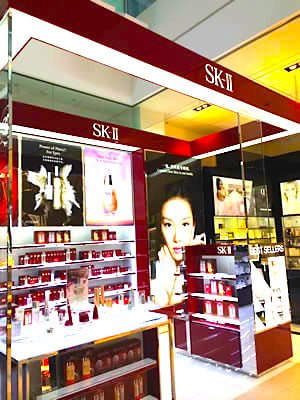
SK-II (PHOTO: THE NUANCE GROUP)

The Nuance Group is the first Canadian retailer to offer luxury Japanese skincare brand SK-II, recently introduced to Nuance’s store location in Toronto’s Pearson International Airport. Located in Terminal 1, SK-II is the latest beauty shop for Nuance, following its Jo Malone, Aveda and MAC Cosmetics boutiques, also located in Terminal 1. 

The founding of SK-II is an interesting story. Over 30 years ago, it was observed that workers in a Japanese sake brewery had elderly faces but smooth, youthful hands. SK-II scientists spent five years studying more than 350 yeast strains to discover why, eventually discovering a nutrient-rich liquid which they named Pitera: now the ‘secret key component’ within SK-II’s products. 

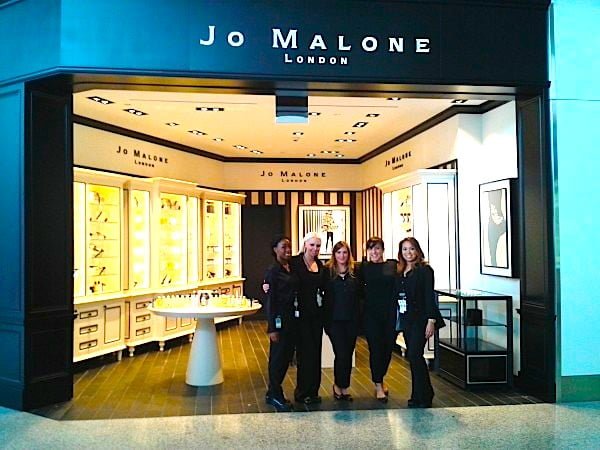
The new Jo Malone boutique in Toronto – currently the only free-standing Canadian boutique for the brand. 

Owned by Procter & Gamble, SK-II is available in 15 countries including Japan, Mainland China, Hong Kong, Macau, Taiwan, Korea, Singapore, Malaysia, Thailand, Indonesia, Philippines, the UK, the USA, Australia, the United Arab Emirates and now, Canada.

Last month, Nuance opened Jo Malone, Aveda and MAC shops at Pearson Airport’s Terminal 1. British-based Jo Malone stands out, being the only free-standing Canadian location for the brand. Jo Malone is also available at Holt Renfrew stores in Canada, and will likely be available at Nordstrom and Saks Fifth Avenue when both open Canadian locations. 

Nuance operates duty-free concessions out of eight airports in the United States and Canada, including those of Toronto, Calgary, Chicago, Denver, Fort Lauderdale, Houston, Las Vegas and Orlando. This week, Switzerland-based duty free retailer Dufry AG bought Nuance for US $1.7 billion. 

Source: Moodie Report/Nuance Group, via ACT7 of Urban Toronto

Fossil continues its cross-Canada expansion, seeks new retail space

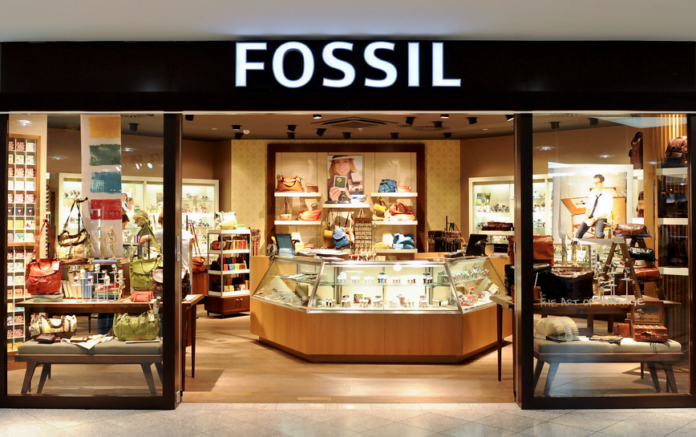
Photo: Fossil

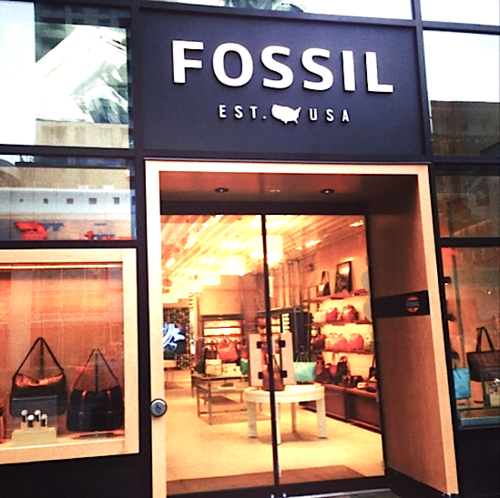
American watch and accessory brand Fossil continues its cross-Canada expansion. It is actively seeking retail space as it continues aggressively opening stores in various cities. Fossil recently opened five stores in just over one month, and it plans to operate 33 Canadian locations by the end of this year. It also just opened its Canadian flagship on Bloor Street in Toronto, which is a prototype for future locations. 

Fossil is especially interested in new retail space in Toronto, Calgary and Vancouver. The retailer currently has three Calgary stores, as well as four in Vancouver and six in Toronto. Fossil seeks retail space in super-regional malls, as well as downtown street-front spaces. For its full-priced stores, Fossil ideally wants space between 1,200 to 1,500 square feet with a 23.5+ foot width. Its outlet stores are twice as large, ideally occupying about 3,000 square feet. 

In April, Fossil opened stores at Masonville Place in London, Ontario, Lime Ridge Mall in Hamilton, Quartier Dix30 in Montreal, and an outlet at The Outlet Collection at Niagara in Niagara-on-the-Lake, Ontario. 

FOSSIL’S 2,650 SQ FT CANADIAN FLAGSHIP JUST OPENED AT 50 BLOOR ST. WEST IN TORONTO, IN A RETAIL SPACE FORMERLY OCCUPIED BY ALDO SHOES. PHOTO: BLOOR-YORKVILLE BIA, VIA INSTAGRAM

Later this year, Fossil will open stores at the Montreal Premium Outlets, Market Mall in Calgary, Polo Park in Winnipeg, as well as an outlet at the Tanger Outlets in Ottawa. In May of 2015, Fossil will open at Vaughan Mills, just north of Toronto. 

Fossil’s new 2,650 square foot Toronto flagship showcases the company’s new, upscale and modern design prototype. It boasts a street-front presence at the Holt Renfrew Centre, 50 Bloor Street West. Fossil replaces Aldo, which abandoned the location several months ago. Although considered Canada’s flagship, Bloor Street’s Fossil measures slightly smaller than the Yorkdale Shopping Centre location, with about 2,670 square feet.  

Fossil operates more than 550 corporate stores around the world, with net sales in excess of $3 billion. 

Sources: Monday Report on Retailers/Think Retail

The heart of omni-channel is still the physical store

exc-538f770be4b0272ab59f701d

By Steven P. Dennis

You can fixate on the decline of brick & mortar retail all you want, but for the foreseeable future–in the vast majority of product categories–more than 90% of sales are still going to be done in physical stores.

You can make a big deal of the hyper growth in your digital channels, but don’t forget that many of those customer relationships started in a store. And many of the sales you ring up as a web order originated through exploration done in a physical location.

Sure, there are a handful of web companies where expansion into brick & mortar sites is secondary and mainly serves as a way to address the shortcomings of a purely digital experience. But for the overwhelming majority of brands, the physical store will be the dominant driver of sales, whether that revenue is actually booked in a store or not.

The other often neglected fact is that for many retailers their most profitable customers purchase regularly in both brick & mortar and e-commerce channels. If the physical store experience wanes, you can expect overall sales and profits to suffer. 

As industry analysts and the press hyper-focus on a company’s e-commerce performance, the danger is that physical locations get short-changed. We are already seeing many retailers disinvest in their stores. These brands should tread very carefully.

As there is a continued rush to “right-size” store counts, many retailers will discover that closing stores will dramatically affect their e-commerce growth in the vacated trade areas. If your store closing analysis doesn’t include the impact on your web sales you are making a huge mistake. Too many stores were opened pre-recession. Too many stores will be closed in the next few years. Tread carefully here as well.

Without question you should be investing mightily in digital capabilities and just about anything mobile. But physical retail is likely to remain the heart of omni-channel for most brands for a long time. 

You can go on and on about omni-channel this and omni-channel that, but screw up the store experience and you will be paying the price for years to come.


Steven Dennis is a senior omni-channel retail executive and strategic growth advisor at SageBerry Consulting , LLC. . He is also a Former Chief Strategy Officer at Neiman Marcus. [More about Steven P. Dennis]

Published with permission. This post originally appeared at Steven P. Dennis’ Blog on June 4, 2014. Copyright 2014. Follow Steven P. Dennis’ Blog on Twitter.

GO BACK

One-stop Canadian retail e-news. Subscribe:

* indicates required


Most of Hudson’s Bay’s merchandise will be available online by the end of this year

exc-538bba66e4b01a84edc557aa


Hudson's Bay website retail insider.pngHudson's Bay website retail insider.png

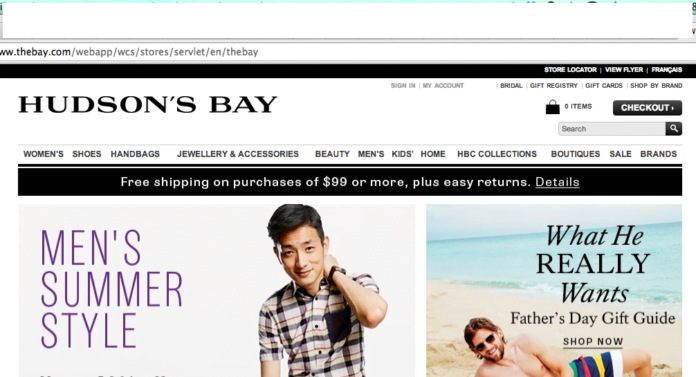
About 80% of Hudson’s Bay‘s flagship in-store merchandise will be available on its website by the end of this year, according to company president Liz Rodbell. Even more impressively, its website will offer a wider variety of sizes and colours than those available in-store. Hudson’s Bay expects that more than 10% of its total revenues will come from online sales within the next four years, up from 3.5% this year. Despite these gains, Canada’s Hudson’s Bay website lags behind parent Hudson’s Bay Company‘s (HBC) online initiatives in the United States. 


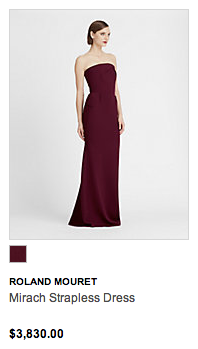
Roland Mouret dress from Hudson's Bay's luxury women's department 'The Room. Click image to visit the website link. Roland Mouret dress from Hudson's Bay's luxury women's department 'The Room. Click image to visit the website link. 

Roland Mouret dress from Hudson’s Bay’s luxury women’s department ‘The Room. Click image to visit the website link. 

The online-focussed strategy will see the company’s website become a destination unto itself, considering the increased trend towards online shopping. Men’s ‘big-and-tall’ clothing, for example, will only be available on Hudson’s Bay’s website. Hudson’s Bay already carries a considerable amount of product online, from relatively inexpensive items to luxury goods, priced into the thousands. 

Merchandise from women’s luxury department The Room, for example, is prominently displayed with its own website link. A limited selection of designers and products are listed, and those available are pricey. A Roland Mouret dress, priced at $3,830, is the most expensive clothing item. A $1,415 crystal-encrusted Casadei shoe is available, along with a variety of other pricey footwear. There are handbags priced into the thousands, including a $3,250 Proenza Schouler PS11 Classic handbag. Last year, a similar bag on the website cost over $8,000, which isn’t surprising, considering that The Room carries some of Canada’s most expensive clothing and accessories.


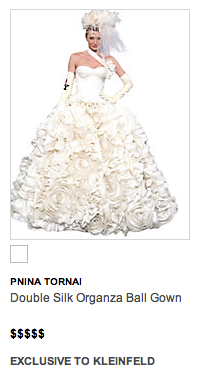
Kleinfeld's bridal gowns, priced as high as $32,000, don't include prices on the website. Kleinfeld's bridal gowns, priced as high as $32,000, don't include prices on the website. 

Kleinfeld’s bridal gowns, priced as high as $32,000, don’t include prices on the website. 

Kleinfeld Bridal, operating on the seventh floor of Hudson’s Bay’s Toronto flagship, also offers product on the website. Gowns featured in-store are priced between $1,400 and $32,000. Prices aren’t listed on the website, however, and gowns must be tried on and altered in the store. 

TopShop and TopMan merchandise featured on the site is priced lower than in the United States, even with the weaker Canadian dollar. This is because Hudson’s Bay has an agreement with the British fast-fashion brand to keep Canadian prices lower. 

Online sales account for 11% of all revenue for parent company HBC, which includes American retailers Saks Fifth Avenue and Lord & Taylor. HBC’s online sales reached $207 million last quarter, according to CEO Richard Baker. The company hopes to raise online sales to 20% over the next five years. Americans are generally more receptive to online shopping, according to company president Liz Rodbell, who presented at yesterday’s Store Conference 2014 in Toronto. 

GO BACK

One-stop Canadian retail e-news. Subscribe:

* indicates required


Identifying High & Low Performers with Retail Employee Assessments

exc-538cee60e4b0c07f82710059

By Lisa McCann

Have you ever wondered how to make all your retail employees like your top 10%?

Surveying your current workforce and identifying your high and low performers will help you better understand what you need to drive better hires. Using tools such as employee assessments and performance summaries allow you to gain insights into the key areas high performers are succeeding in and their associated skills. Analyzing your low performers is also important because you can focus in on the areas that you think are causing them to lag behind their peers. The first step is to understand what differentiates these two groups is to focus on the variations in their skills, capabilities, personality traits, and behaviours.

Where are the Competency Gaps?

Your current workforce needs to take your employee assessments. The questions will provide you with insights into what key competency areas high performers are excelling in comparatively to low performers. You can then plot your employee scores over each competency and see which areas have skill gaps. These are the important competencies to place a higher weight on in the assessment scoring.

It’s also important to understand which employees are having long term success and are growing within the business. These are employees who you will want to understand their key competency areas and how they differ from those who turnover. This will help you again weigh in on what a great hire looks like and their associated score.

Why Focus on Low Performers?

Low performers can give you immense insights into skills gaps within your current workforce and future needs that will start to arise. When you see the differentiators between high and low performers you can start to red flag those low scoring competencies in the employee assessments. If a candidate ranks substantially low on something that is deemed essential for employee success in the role, they will be red flagged. In terms of current employees, this helps your organization decide how to best deal with current skills gaps and what training or development programs you may choose to implement to improve your workforce. A current employee may rank high in a customer service role, but their selling abilities may be lacking. This may allow you to transition the employee into another area of the business where their strengths could be used or opt to implement a training program to help them better their selling skills.

What Roles Drive Results?

Looking at the key roles within your organization and which are driving front-line business results will help you create a stronger assessment tool. If certain roles are essential to business results, you will want to ensure that they are being filled with best fit candidates. These are areas you will want to build out in an employee assessment to ensure you are hiring candidates who will match your expectations. Scoring will never be perfect but if you can continuously reassess your optimal scores and make improvements based on post hire results, you will drive better hires each time. Additionally, strategic planning comes into play when you start to understand which employees are successful in the long term with your organization. These are employees you will want to build training and retention programs for to make sure that your organization is developing top talent.

Lisa McCann is the Corporate Marketing Manager at Vancouver-based recruitment company, Mindfield Group.

GO BACK

One-stop Canadian retail e-news. Subscribe:

* indicates required


Canada Faces Increased International Competition for Retail Expansion Dollars: Report

exc-538ce6a6e4b05f8b8742dc5f


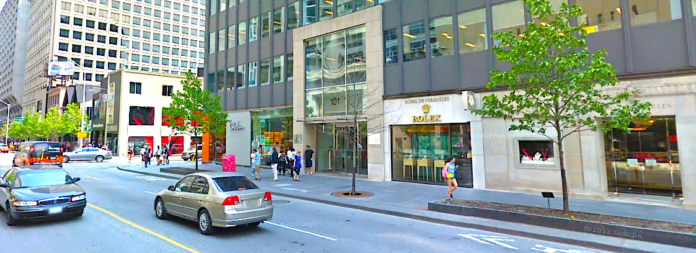
bloor street toronto retail insider.pngbloor street toronto retail insider.png

A new report by CBRE finds that although foreign retailers continue to enter the Canadian market, they’re doing so less than before. As global markets have largely recovered from the recession, international retailers now have an increased number of expansion opportunities to consider. The report, entitled , analyzes 334 leading retailers in 61 countries. The report suggests that the Canadian retail market recorded fewer new entrants last year than the year before. 

The report notes that in 2012, Canada ranked sixth in the world for the most new foreign retail entrants. Toronto was listed amongst the twenty most targeted cities. In 2013, Canada no longer ranked among the countries attracting the most new retailers, and it did not have a city ranked among the top 20 most targeted markets. 

Canada still ranks highly, however, in terms of the variety of global retailers that are present in cities. In 2013, Canada had 35% of global retailers present, enough for us to rank 20th in the world. Comparing city-by-city retailer penetration rates, Toronto slipped from 37th to 38th place, Vancouver jumped from 56th to 51st place, Calgary climbed one spot to 76th, and Montreal remained at 83rd place. 

Last year, the bulk of new international entrants were in the luxury and fashion categories. Homewares and food were the other active categories. 

“While Canada remains an appealing destination for global retailers, our competitors are catching up and Canada has had to relinquish our unusually large share of the spotlight,” said Ross Moore, Director of Research for CBRE in Canada. “One reason for the decrease in new retailers coming to Canada is that there is little to no vacancy in highly sought after shopping centres and high street locations. It is only natural for there to be a pause while developers and supply chains adjust to the influx of brands from years past.”

“The retailers that entered Canada with a limited number of stores have been busy expanding their footprint across the country,” Moore added. “No longer satisfied with a single location, usually in Toronto, we have seen retailers pursue opportunities in Vancouver, Calgary and Montreal. As a result, most Canadian cities had their rankings improve in terms of overall retailer representation.”

GO BACK

One-stop Canadian retail e-news. Subscribe:

* indicates required