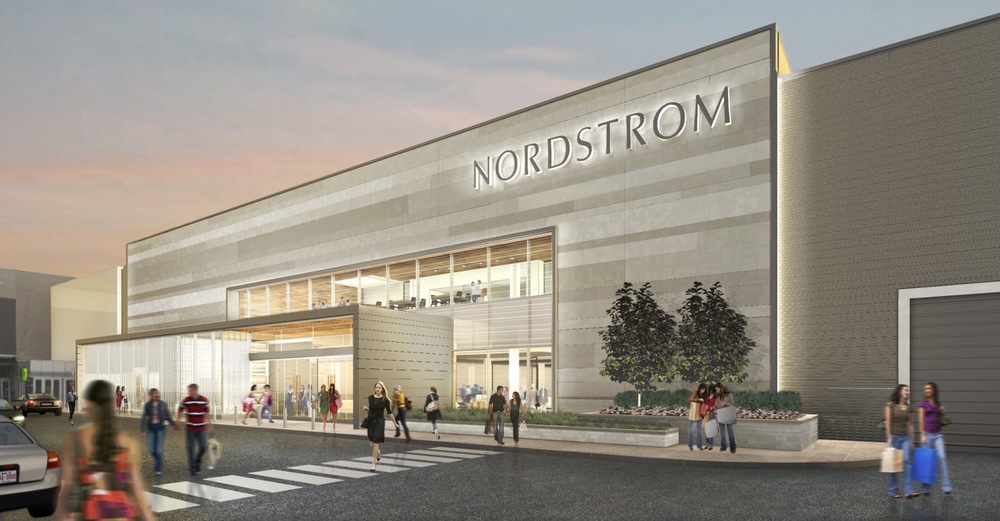
Nordstrom, Chinook Centre, Calgary. Image: Nordstrom
Nordstrom is currently hiring approximately 400 staff for its Calgary store. Job applications are currently being accepted, and interviews begin this Friday. Chinook Centre will be the company’s first Canadian location, with the 140,000 square foot store opening on September 19th.
Nordstrom’s website provides a link where applicants may create a profile and apply for jobs. Calgary’s jobs have yet to be posted on the site, despite interviews commencing this week. The site will reportedly post hundreds of Calgary-based jobs, shortly.
The Calgary Herald reports that positions in the Calgary store are available in all areas of operations, including sales in men’s, women’s, and children’s apparel, shoes, accessories, cosmetics, designer, and various support positions in alterations, facilities, and loss prevention. Additional positions are also available in the store’s restaurant and coffee bar.
In January, Nordstrom announced that Shelia Woodridge was appointed to manage the Calgary store. Ms. Woodridge is an American who began her Nordstrom career in Dallas. In April, Nordstrom announced that John Banks will head its new Ottawa store, which will open in the spring of 2015.
According to the Calgary Herald, Nordstrom hired 28 Canadian department managers in February. They are currently in Seattle, attending a nine-week, cross-cultural training program that began on April 28th and ends on June 27th. New managers are learning about Nordstrom firsthand by working in a store with a fellow mentor manager. The company will also reportedly offer a training program in Calgary for new non-management employees.
Calgary’s Nordstrom replaces part of a 173,000 square foot former Sears store. Extensive renovations will see Calgary’s Nordstrom boast the latest in the chain’s updated interior store design. We’ll discuss the look of Canada’s new Nordstrom stores in the next few days.
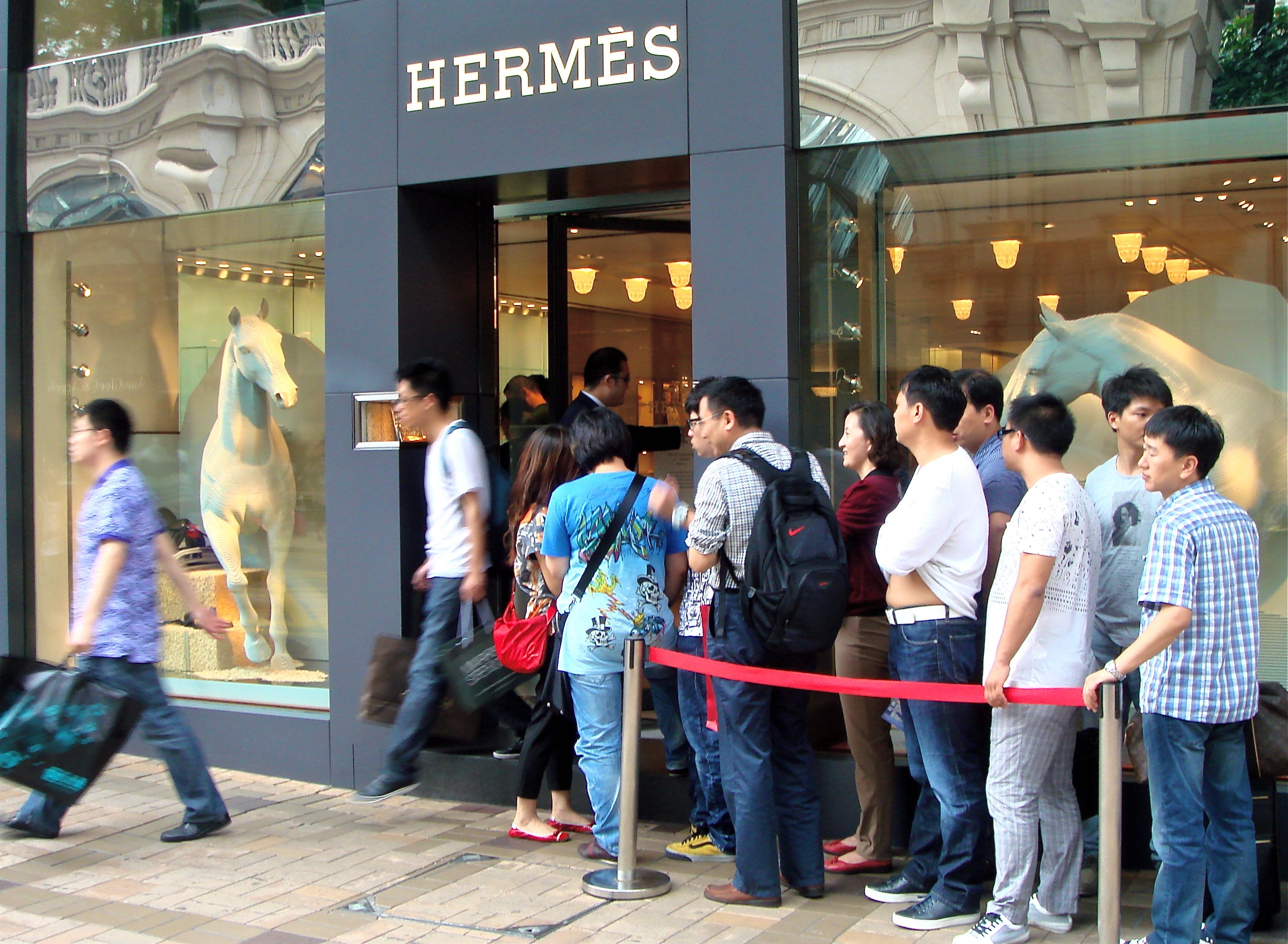
Canadian consumers are right, there is a price gap between the cost of goods in Canada and cost of goods in the United States. This has been an issue that retail buyers, wholesale reps and Canadian distributors have been struggling with for well over a decade.
Most Canadian cities are located within a few hours of the US border. Better sales, better brands, and better pricing have been consistent reasons cited by customers for shopping in the US, instead of Canada. Although there is better brand availability in Canada, pricing is still a concern.
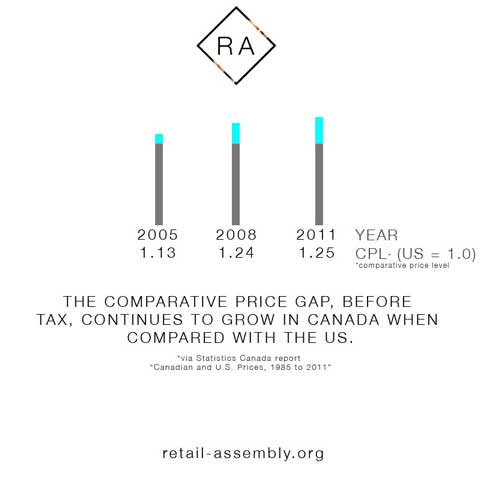
The retail industry has largely attributed higher taxes, shipping, customs and duty for this perception. But a new Statistics Canada Report indicates that the before-[consumer-]tax price of non-regulated goods is almost 25 percent higher.
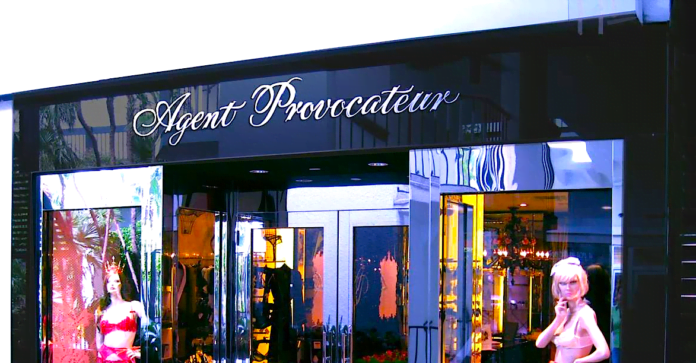
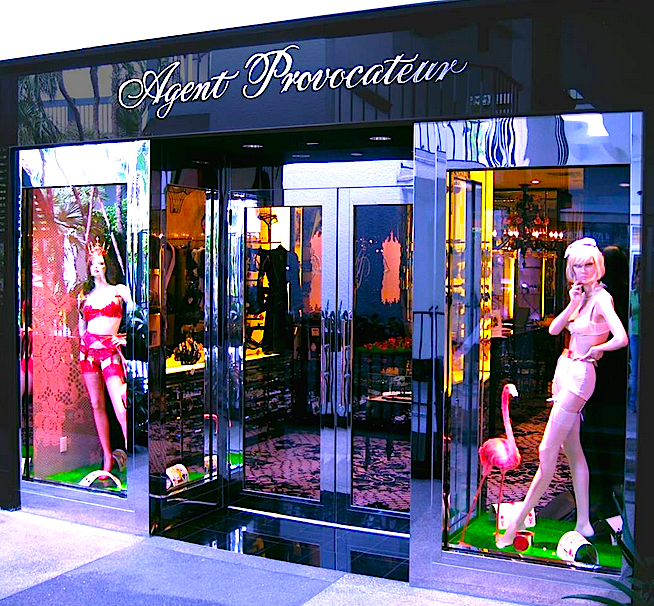
British lingerie retailer Agent Provocateur will open a flagship store at Canada’s most luxurious retail plaza. Located within The Colonnade at 131 Bloor Street West in Toronto, Agent Provocateur will occupy two small retail spaces next to Escada.
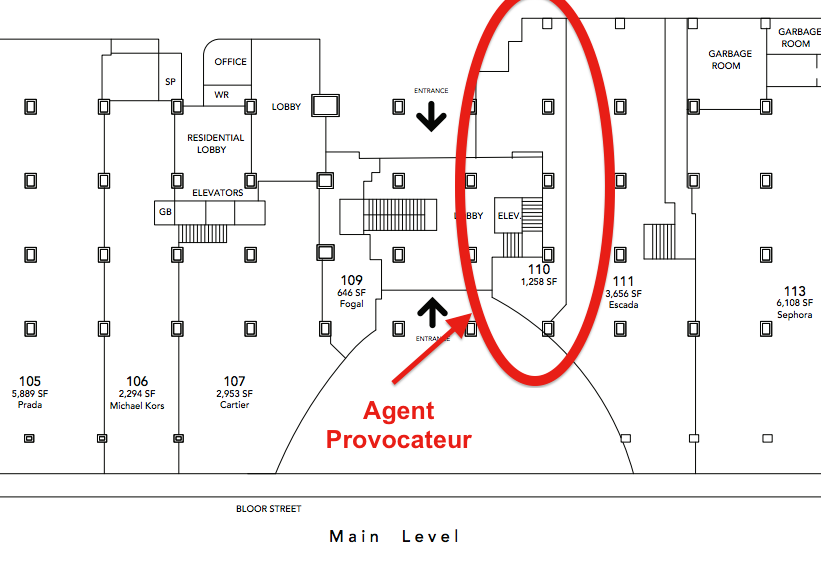
From the lease plan of The Colonnade, 131 Bloor St. W., Toronto. Click image for entire lease plan (.pdf)
According to the City of Toronto Building Application website, Agent Provocateur will occupy spaces #110 and #116 within The Colonnade. According to lease plans provided by landlord Morguard, the combined space measures 1,258 square feet. Click the image to the right for a pdf of the complex’s entire retail lease plan.
Agent Provocateur is considered to be a luxury lingerie company. It was founded in 1994 by the son of British fashion designer Vivienne Westwood. It is known for its potentially racy ad campaigns, including the video below starring Kylie Minogue, below (caution, potentially not safe for work).
There are currently three small Agent Provocateur boutiques in Canada. All are concessions within Holt Renfrew‘s flagships in Vancouver, Montreal and Toronto (Bloor Street). Each concession measures about 150 square feet, substantially smaller than the new Toronto flagship. Holt Renfrew’s first Agent Provocateur concession opened in March of 2012 in Vancouver, followed by Montreal in October of 2012, and Toronto in November of 2013.
Vancouver was once home to Canada’s first and only free-standing Agent Provocateur store. The franchised location opened on Alberni Street in late 2007, and it closed in the summer of 2011. Sources say that the franchise owner lacked retail experience, contributing to the location’s failure.
There are 11 free-standing Agent Provocateur stores in the United States, as well as four concessions within Bloomingdale’s stores.
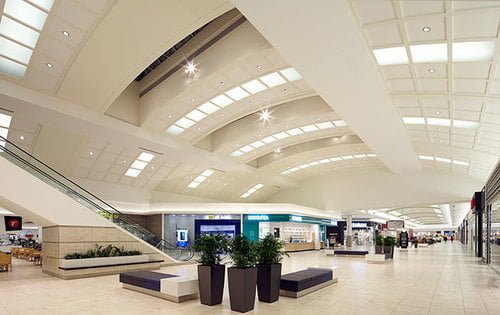
This is my new favourite mall in Montreal, which is saying a lot because other malls in the area like Carrefour Laval and Quartier Dix30 have significantly upped their game in the past year.
But the late 2013 additions of Simons and Target prompted transformations throughout the mall. Hudson’s Bay – once one of the dowdiest in the chain—to transform itself into a chic La Baie d’Hudson and carve space for Topshop/Topman within the building.
PHOTO: SAVOIA CANADA INC.
The addition of Simons (easily the nicest one in Quebec, which is saying a lot as it is even nicer than the flagship Simons in Quebec City) prompted a number of other positive changes:
A Starbucks to hang out in, the addition of some new stores including the imaginative Kasa Living
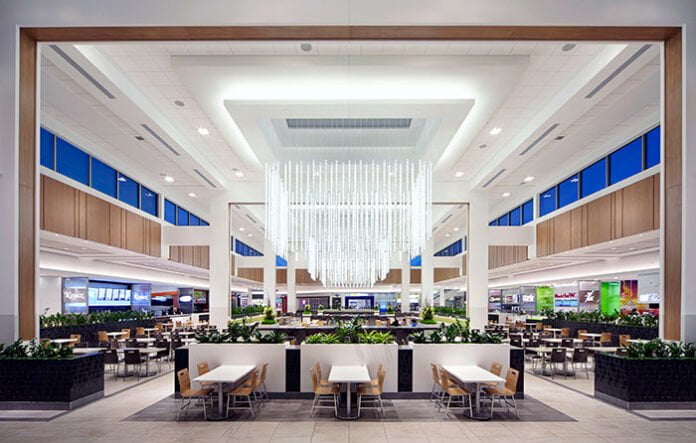
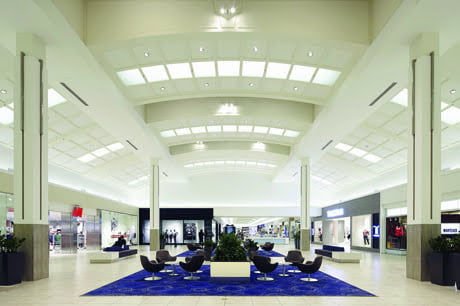
An entirely new food court near Target. In addition to a superb selection of dining options (including definitely-not-greasy-fast-food providers Grillades Torino and Smart Burger), the new dining area is light, bright, and airy with plenty of seating and comfortable, attractive wood tables and chairs. The dining area provides more than a quick meal; it’s a great place for a nice meal. And the real china (part of a sustainability initiative) only adds to the higher-end ambience.
The additions have brightened a mall that was already refreshed less than 10 years ago with the arrival of The Brick and the more recent launch of Linen Chest. But it also raised the mall from a mid-market mall to something more upper-end and further distinguish it from aging neighbour Place Versailles.
PHOTO: IVANHOE CAMBRIDGE
Special kudos to both Hudson’s Bay and Simons for their new stores. As noted earlier, the Bay has completely transformed. Simon’s has one of the largest men’s departments in its chain and is the only store in the chain that has a restaurant (a cute bistro, at that).
In the decade that I have been following this mall, the landlord (Cadillac Fairview) has continually demonstrated its commitment to keeping the mall fully occupied and up-to-date. Stores do not stay vacant for long and the mall has been through two major and several minor remodels during this time. According to the Wikipedia page for Galleries d’Anjou, the mall has continually changed anchors as the needs arose, whether they arose from consumers or, more frequently, from changes in the fortunes of the anchors. The most recent renovations, however, have strengthened the mall and made it more of a must-visit destination.
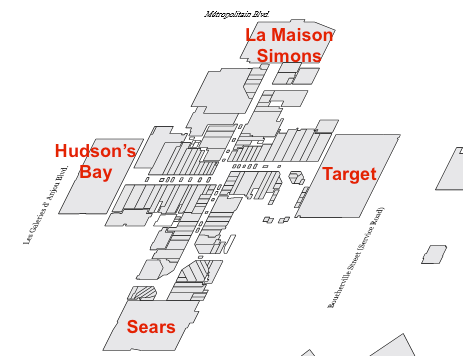
MALL FLOORPLAN
Fast Facts about the Mall
Anchors: The Brick, La Baie d’Hudson, Linen Chest (no entrance from inside the mall.) Sears, Simons, Target National chains: American Eagle. Centre du Rasoir, Cuir Danier, H&M, Jean Coutu, L’Equippeur, Reitmans, Sony. Swarovski. Topshop/Topman.
On mall property—but not in the mall: Best Buy. Future Shop. L’Academie. Wendys.
Variety of merchandise: Excellent. La Baie d’Hudson and Simons have the broadest selections of fashion. For a mall, the selection of household supplies, personal care supplies, electronics and sporting goods is excellent.
Special notes: Great restaurants and electronics are located in freestanding buildings outside the mall but on the mall property.
Food court: A true dining experience. Asian (Manchu Wok, Thai Express), Middle Eastern (the amazing Grillades Torino). High-end fast food (Smart Burger, Subway), and an ice cream place. Even nicer, the large, airy, bright dining area with real plates and silverware.
Saul Carliner is a Montreal-based writer and consultant who focuses on the design of edu marketing and edu-tainment experiences. For more information, visit mallsacrossamerica.wordpress.com and www.saulcarliner.com.
A new ranking of Canada’s top 25 most valuable brands includes six retailers. The report, published every two years by consulting firm Interbrand, attempts to assign monetary values to brands. Eligible brands must be profitable, prolific, and provide publicly available financial information.
The six Canadian retailers’ ranks and estimated brand values are as follows:
Interbrand’s report includes brands that have Canadian origin, even if the brand is foreignly owned. Winners and La Senza are both examples: both are American owned, though they were founded in Canada. Winners is owned by TJX Companies, and La Senza is owned by Limited Brands.
Five of the six above-mentioned retailers were in Interbrand’s 2012 top 25 ranking. The sixth entrant, Montreal-based Dollarama, is an interesting case study. Dollarama broke “virtually all of the established retail rules,” according to the study. Dollarama doesn’t advertise, except to promote new store openings. It doesn’t put items on sale, nor does it run in-store promotions. Also lacking loyalty programs or coupons, Dollarama flies in the face of conventional retail strategies. And it’s working: it plans to add 400 more stores to its already 800 Canadian locations.
The report is also disappointing. Only one of the previous five ranked retailers gained brand value between 2012 and 2014 and that was Winners, gaining 12%. Shoppers Drug Mart remained the same between 2012 and 2014, while Lululemon lost 10%, Canadian Tire lost 9%, and La Senza lost 11% of its brand value.
A potentially revolutionary invention could see mall parking lots, as well as streets and other ground surfaces, paved with solar panels. It sounds outlandish but it’s already being funded and tested, and its inventors are seeking funding to make it a reality. Interestingly, the technology would also allow for parking surfaces to be modified with ease, as LED-illuminated roadway lighting would replace painted asphalt. Its inventors say that the technology will pay for itself, not to mention be beneficial to the environment.
Solar parking lots (and streets) could do the following:
allow malls to create handicapped and other targeted parking zones, based on needs at the moment,
improve road safety by changing traffic patterns in real time when needed, essentially eliminating the need for painted roadways,
prevent accidents by providing advance illuminated warning of animals or debris on the road,
melt ice in an environmentally-friendly way without the need for salt or sand.
Solar Roadways is a modular paving system of solar panels that can withstand the heaviest of trucks, weighting up to 250,000 lbs. Solar panels can be installed on roads, parking lots, driveways, sidewalks, bike paths, playgrounds; any surface under the sun. Its inventors say that the panels pay for themselves primarily through the generation of electricity, which can power homes and businesses connected via driveways and parking lots.
A nationwide system could produce more clean, renewable energy than a country uses as a whole, according to their website: http://solarroadways.com/numbers.shtml. The panels have many other features as well, including: heating elements to stay snow/ice-free, LEDs for road markings and signage, and an attached cable corridor to store and treat stormwater and house power and data cables. Electric vehicles would be able to charge with energy from the sun (instead of fossil fuels) from parking lots and driveways, and after a roadway system is in place, mutual induction technology would allow for charging while driving.
Solar Roadways has received two phases of funding from the U.S. Federal Highway Administration, for the research and development of a paving system that will pay for itself over its lifespan. The company’s second phase involves building a prototype parking lot, for which it’s currently fundraising.
The panel’s glass surface has been tested for traction, load testing, and impact resistance in civil engineering laboratories, and has exceeded all requirements.
The problem of polluted stormwater is also addressed: currently, over 50% of the pollution in our waterways comes from stormwater. Solar Roadways has created a section in its cable corridors for storing, treating, and removing stormwater.
Solar Roadways is leveraging its initial Federal grant with an Indiegogo campaign that has already surpassed its Indiegogo crowdfunding goal of $1,000,000. It has three more days to go. Click the link below to contribute:
Roots (Rendering: Norm Li Architectural Graphics + Illustrations)
Above is an updated rendering of Roots‘ expanded and renovated Downtown Vancouver flagship store. Its exterior will be transformed, becoming more modern and attractive. In February, we interviewed Roots Canada co-founder Michael Budman, about his company’s proposed renovation and expansion to Root’s Vancouver flagship. Roots recently re-signed a long-term lease for the Vancouver retail space as part of its renovation and expansion plans.
Vancouver’s Roots flagship is the chain’s second highest-selling store. Mr. Budman noted that the store has seen double-digit growth yearly, declining to provide exact sales figures. 2013 marked Root’s 40th anniversary and overall sales were the highest in the company’s history. Increased sales were fuelled by domestic growth, online sales, and an expansion of Roots stores in Asia. Roots has over 120 stores in Asia, speaking to its popularity. As Vancouver is Canada’s ‘gateway to the Pacific’, Roots has decided to enlarge the store’s interior and upgrade its appearance.
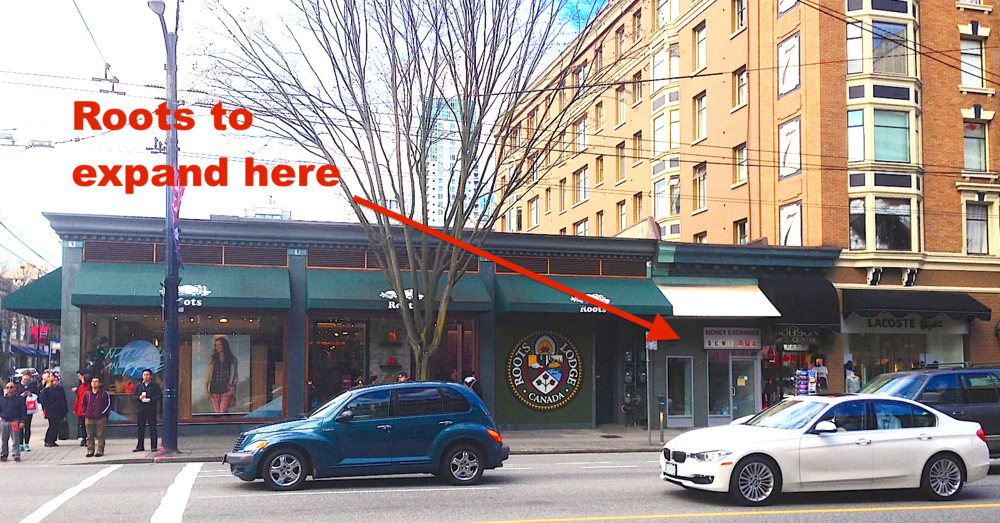
Besides new interiors and exteriors, Roots’ Vancouver store will annex the adjacent retail space at 789 Burrard Street, formerly occupied by a currency exchange business. Budman estimates the current Roots store to be about 4,000 square feet in size, and the expansion will enlarge the store slightly, though not nearly to the size of its largest store, known as ‘Roots Central’ at the Toronto Eaton Centre. Roots Central measures 7,665 square feet according to lease plans provided by landlord Cadillac Fairview.
Photo: Colin Arber
We’d heard from sources that Roots wanted to add a second level to its current one-level Vancouver Roots flagship. Mr. Budman confirmed that to be only a “pipe dream” for the company at the moment.
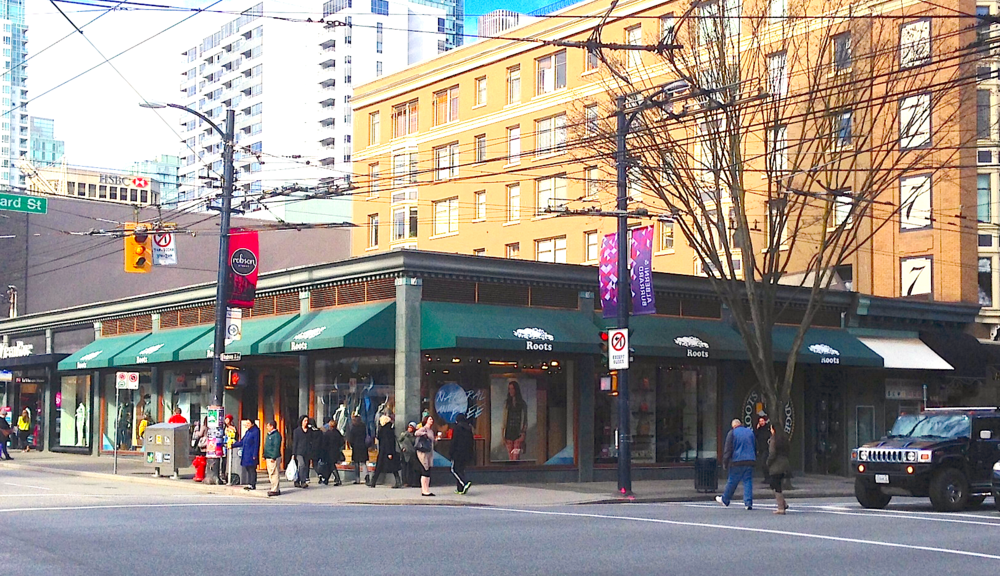
Vancouver’s Roots flagship store sits prominently at the north-west corner of Robson and Burrard Streets. The same intersection boasts the world’s second-largest Victoria’s Secret store, as well as a Lululemon flagship store that is currently under construction. The last of the intersection’s four corners sits empty, recently vacated by a 5,000 square foot Bebe store. Half of it, occupying the corner, will soon be home to a flagship L’Occitane.
Construction within the store’s northward expansion is already underway. Renovations to Roots’ main store begin this fall, following the summer tourist season.
Roots will remove its awnings, according to the rendering at the top of this article. Photo: Colin Arber
Porsche Design, 77 Bloor St. W., Toronto [Image Source]
In the summer of 2012, Porsche Design opened its first Canadian store on Bloor Street West in Toronto’s Yorkville neighbourhood, in what is arguably ground zero for luxury retail in Canada. It didn’t take long for a limited edition rose gold Le Mans watch to sell for an eye-popping $275,000. A few months later, on a whim, I ventured into the store myself, only to witness a man in his early 40’s drop $75,000 on an ultra-sleek timepiece, while in the back corner of the store, a woman snapped up all eight limited edition hookahs, priced at $2,500 apiece.
A couple of blocks north, in the Hazelton Hotel, Canada’s only Richard Mille boutique (a small shop-in-shop at Louis Black) is selling half million dollar tourbillion watches – the same kind that Rafael Nadal had stolen from his locker at the 2008 Rogers Cup – to the handful of uber-rich that can afford them. I ask the salesman if any of them have sold, and he informs me that they’ve been so popular he has them on back order. As I pretended to be interested in the cheapest watch in the store (a $15,000 Hublot) , I realized very quickly that this would be more of a browsing excursion and that I would be returning home empty-handed, probably feeling a little worse about the watch strapped around my wrist.
If you’ve ever wondered just who’s shelling out for this type of opulence, you’re not alone. In general, we tend not to think of Canada as being ostentatious, a place where the ultra-wealthy want to spend their money. However, Toronto is fast becoming a place where the world’s 1% are choosing to park and spend their dollars. Often referred to as ‘stealth wealth’, these newcomers are settling in neighbourhoods like Yorkville, The Bridle Path, Lawrence Park, and Rosedale, and are snapping up one, two, and sometimes three multi-million dollar residences. If they’re not quite sure yet just where they want to put down roots, they’re quite comfortable renting a tony apartment for $20,000 a month.
WEALTHY LOCALS: WORLD CLASS NUMBERS POINT TO RETAIL POTENTIAL
In Canada, close to 1/3 (30.6%) of families who families who earn $250,000 per year or more live in Toronto, followed by Montreal at 11.4%, Vancouver at 8.2%, and Calgary at 8.0%. Of the top 1% highest income earners in the country, slightly more than (51.1%) live in Ontario, followed by Alberta at 23.3%, B.C. at 11.5%, and Quebec at 10.1%.
A recent report by Wealthinsight ranked Toronto 15th in the world when it comes to the number of millionaires that live here. At 118,000 millionaires, Toronto ranks ahead of cities like Chicago, Sydney, and Moscow. For comparison, amongst Canadian cities, the number of millionaires that live in Montreal is 52,000, Calgary 32,000, Vancouver 25,000, and Edmonton 14,000. Taking it even further, the report goes on to say that when it comes to the number of multi-millionaires who live here, there is a healthy 1,184 individuals living in Toronto, once again placing it ahead of Chicago, Sydney and Moscow, and vaulting it ahead of Los Angeles, Geneva, Shanghai, and Rome.
Opulent $12.9 million penthouse at 80 Yorkville Avenue, currently for sale.
A similar report by UK firm Knight Frank, places Toronto 20th in the world when it comes to Ultra High Net Worth Individuals (UHNWI) – with 1,765 individuals with investable assets of $30 million or more – ahead of cities like Singapore, Geneva, Zurich, Sydney, and Rome. This number is expected to increase by 34% to 2,367 by 2022 given Toronto’s propensity to attract UHNWI. The report ranks Toronto 9th in the world among cities ‘that matter to UHNWI’, meaning cities that are strongest in economic activity, political power, quality of life, and knowledge & influence. The report goes on to say that the list of “cities with an international reputation for providing the ultimate urban utopia is led by Zurich…followed by Melbourne, Sydney and Toronto.”
Wealth, of course, can be measured in different ways, so it’s worth mentioning that neither of these reports includes the value of real estate in their measurements of net worth. Surprisingly, including real estate would not make a significant difference in overall net worth when dealing with such enormous wealth. The benchmark composite home price index of all types of housing units in the Greater Toronto Area (a more accurate measure of the typical, not average, price of a home, whether it be a single family detached home, townhouse, or apartment) according to the Toronto Real Estate Board, was $502,700 as of April, 2014. Greater Vancouver’s, for comparison, was $619,000.
It probably goes without saying that it’s not just local wealth that is being targeted when it comes to luxury retailing. There has been a lot of media coverage over the past few years focusing on attracting tourist dollars and on the countries’ travelers are spending the most. According to Visa’s Global Travel Intentions Study 2013, Saudi travelers spend the most when they travel abroad, averaging US $6,666 per trip. Surprisingly, Chinese travelers are in third place in the survey, and spend an average of US $3,824 per trip. Saudi Airlines’ upcoming three times weekly non-stop service from Riyadh to Toronto, beginning October 28, 2013 should serve to benefit the luxury retail scene in the city.
Furthermore, according to the most recent Mastercard Global Destination Cities 2013 Report, Toronto ranks first in North America and thirteenth in the world, for the city with the fastest air connectivity growth. In addition to Saudi’s service to Riyadh, Air Canada’s growth strategy includes non-stop service to Rio de Janeiro, Accra, Delhi, Lagos, and Moscow, plus increased service to China. In the past year Toronto has seen the introduction of service to Addis Ababa from Ethiopian Airlines, Cairo from Egyptair, the reinstatement of service to Moscow from Aeroflot, plus an announcement from Aer Lingus to begin Dublin service in March of 2014.
With already existing non-stop service to several cities in China from Pearson Airport, of the 1.4 million overseas tourists that visited Toronto in 2011, the city saw 142,800 tourist arrivals from China, a 25% increase over 2010. Shopping being the number one activity for Chinese tourists, spending was also up significantly to $126 million. Compare this to Chicago’s 80,000 Chinese visitor arrivals, approximately 200,000 to San Francisco, 520,000 to New York City, 459,000 to Los Angeles, and Vancouver’s 122,116 and it’s clear that there is still plenty of room to grow. Canada’s recent upgrade to Approved Destination Status in China will only have a positive impact on the number of Chinese tourist arrivals in the future. It’s not only tourists from China, however, that are fuelling a luxury spending boom in Toronto. Already home to approximately 600,000 Chinese (the largest Chinese diaspora in Canada and second largest in North America behind New York City), the Greater Toronto Area receives the lion’s share of high net worth Chinese immigrants to Canada, followed by Vancouver.
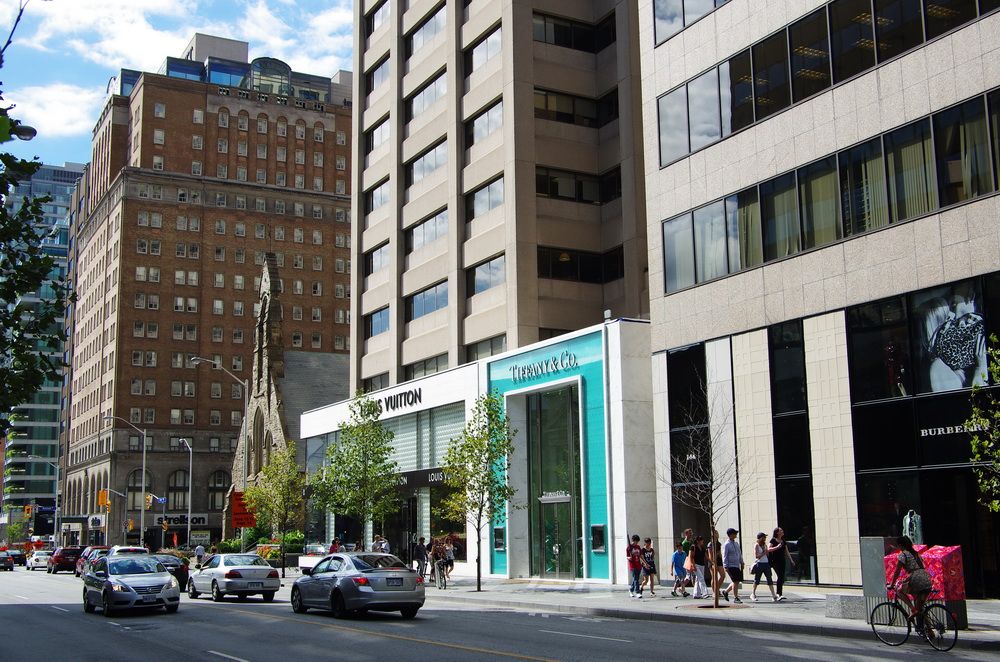
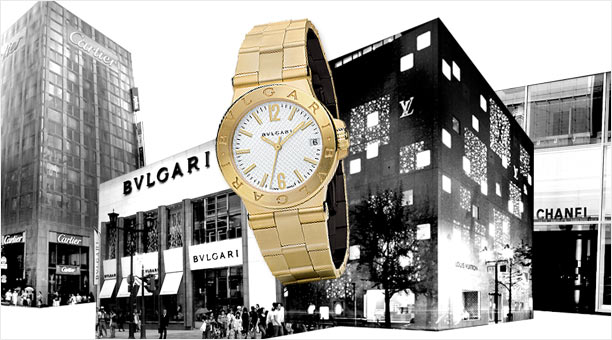
Yorkville, more so than anywhere else in Toronto, has traditionally been the first point of entry for luxury retail into Canada. Louis Vuitton, Tiffany’s, Burberry, Cartier, Montblanc, Prada, Mulberry, Dolce & Gabanna, Hermes, Chanel, and Gucci, to name but a few, all have flagship stores on the Mink Mile. Already the most expensive retail strip in Canada (and 20th in the world), with lease rates exceeding $315 per square foot, Bloor Street West between Avenue Road and Yonge Street has long been the epicentre for extravagant shopping in the country. The Greater Toronto Area is home to both the largest Ferrari and Aston Martin dealerships in North America, so it’s no wonder, if you spend an afternoon walking around the posh shops of Cumberland Street and Yorkville Avenue, and you’ll quickly lose count of how many Ferrari’s, Lamborghini’s, Aston Martin’s, Bentley’s, and Maserati’s that cruise by. And in the past year and a half alone, the city has seen a luxury hotel boom, unprecedented in its history, with the likes of Shangri-La, Ritz Carlton, Trump, and a brand-spanking new Four Seasons all opening swanky new properties. Typical room rates start at over $500 a night, and the penthouse atop the Four Season Private Residences sold for a Canadian record $28 million.
LUXURY RETAIL: YORKDALE AND PEARSON INTERNATIONAL AIRPORT
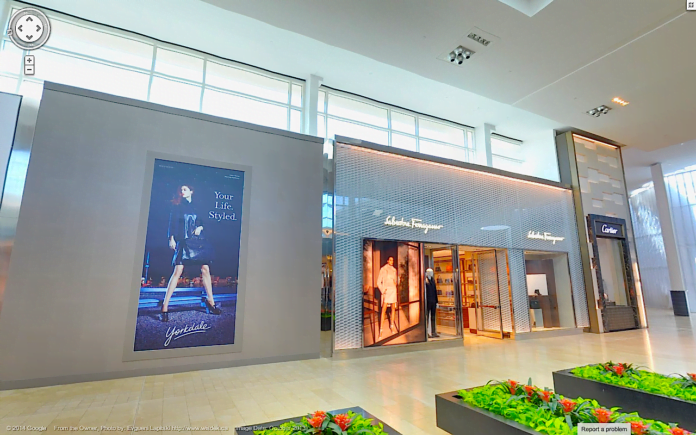
It’s not just Yorkville, though, that’s cashing in on the enormous wealth that exists in Toronto. Recently, Yorkdale Mall in the north part of the city has seen an onslaught of luxury retail with the likes of Salvatore Ferragamo, Cartier, Versace, Chanel, Gucci, Prada, Mulberry, Tumi, Jimmy Choo, Moncler, Versace, Bulgari and Tiffany & Co., all having opened, or are soon to be opening, freestanding stores or shop-in-shop boutiques. Even the once blasé shopping experience at Toronto Pearson International Airport is about to undergo likely the most luxurious retail renaissance in its history, with boutiques for Bvlgari (Canada’s first), Burberry, Gucci, Ferragamo, Montblanc, and Omega all opening in the international piers of Terminal 1 and Terminal 3.
Richard Mille Tourbillion watch
WHAT’S NEXT?
Although the luxury retail landscape in Toronto has changed dramatically in the past decade, when compared to cities of similar size in the U.S. and around the world, it’s clear there is still plenty of room for growth. Yorkdale is about to undergo its second major expansion in two years, creating room for more luxury retailers and high end department store, Nordstrom. Hazelton Lanes in Yorkville is attempting to recapture its glory days as Toronto’s premier luxury shopping destination by investing in a major renovation, and Bloor Street West will see several thousand square feet of retail becoming available in the next year and a half, paving the way for a number of luxury brands seeking flagship opportunities on Canada’s premier shopping street.
So the next time you find yourself wondering who in the world is buying that $365,000 Grand Tourbillion Heures Mysterieuses titanium watch from Montblanc, take comfort in the fact that it may just be pocket change for someone.
Utilizing the best job search websites is an essential step in attracting the right candidates for your business. Companies often struggle with selecting which boards will be most effective for their industries and specific role postings. Traffic, content and price are all important factors to look at when making a selection, however you need to see if your business is analyzing these factors accurately. Here are some helpful tips for traits to look at when selecting the best job search websites for your business.
1. Relevant Traffic Volume is not the most important trait of a successful job board. Relevant volume is what companies should hold most interest in when selecting which boards to post on. Firstly, it needs to be identified which boards job seekers are looking on in your industry. Secondly, you must identify which boards your industry and talent competitors are actively posting on. Both these elements will help you drive more applicable and higher quality applicants. Relevant traffic will also help build your brand awareness as job seekers will begin to become familiar with your company and start recognizing your postings.
2. Relevant Content Branded job descriptions help give job seekers a feel for what your company is about or reiterate what they already know about you. Your posting should feel and sound like your brand, this also includes adding images and logos to generate appeal. Also, the amount of activity of new job posting is important to look at as this will indicate how many relevant jobs and content is being produced by the specific site. If new jobs are continuously being posted, job seekers will be actively looking and searching out new positions. It’s also important to look at not only the activity but the amount of similar postings. If the postings are similar to your competition, this again will attract job seekers to continuously come back to seek out postings.
3. Price Price is an important factor but shouldn’t be the deciding factor. Companies should be aware of price points but if you see the value attached to the set price, then for your company it may be worth the extra dollar. If companies are spending money on job postings, then it’s important to start calculating the cost-per-hire. This will give employers a way to track what they are spending on recruitment and comparing it to their return on recruiting investments.
4. Quick Apply The ease of applying to a job board is a deciding factor for many applicants. When the task is made to be simple and quick, you will see that more applicants are applying to your postings. This is the first stage of the application and the larger the pool of applicants the more likely you will find the best fit. Therefore, the easier the process of applying to a job, the better end result your business will achieve.
5. Refresh It’s essential that job search websites are continuously refreshing your postings and keeping your company top of mind. Additionally, removing any jobs that have been filled will allow job seekers to not waste time applying for jobs that do not exist. Remember that when you are deciding which job boards to use you should always test them first. If you are struggling to find a job or work through the job board, it’s highly probable that job seekers will not be successful in finding and applying for your posting.
Check out www.HOURLYJobSpot.com for an example of a job search website which services many well-known retail and hourly employers!
Lisa McCann is the Corporate Marketing Manager at Vancouver-based recruitment company, Mindfield Group.
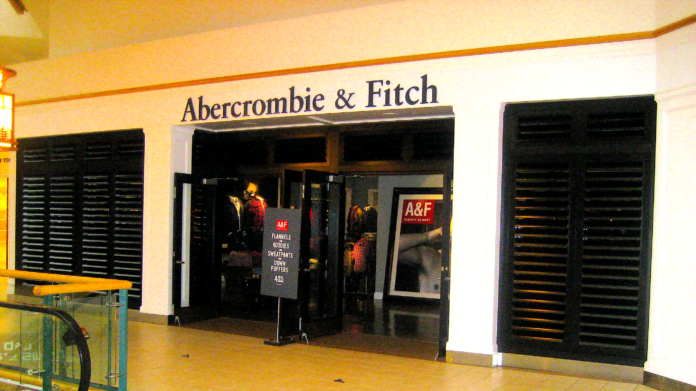
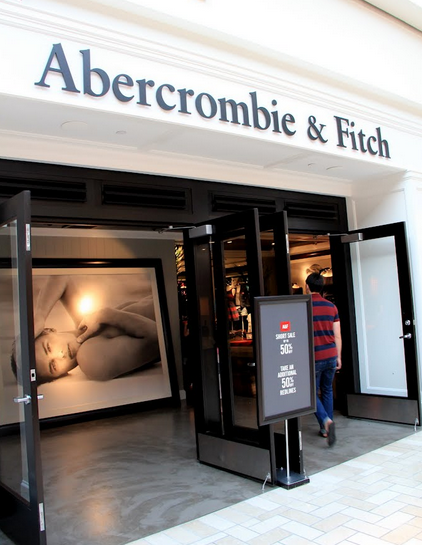
Abercrombie & Fitch Co. (A&F), a leading global specialty retailer, has faced arguably well more than its fair share of crises over the past five years. The retail chain has dealt with store fires, natural disasters (including Superstorm Sandy and the Japanese tsunami and nuclear reactor meltdown), social media snafus, cyber-attack threats, negative publicity and shareholder activism, among others.
The company has weathered these crises, in part, by having a crisis management team and protocol pre-assembled. Having this process in place is critical for retailers because of the unusually large number of different touch points that retailers have. For example, A&F is a public company that typically has tens of thousands of sales associates working for it – most part-time – throughout the course of a year; has over 1,000 stores spread throughout the United States and the rest of the world; and relies almost exclusively on third party suppliers, many of whom are located in developing countries with varying degrees of regulatory oversight.
Setting up a Crisis Response Team
A&F didn’t always have a formal crisis management team. The idea for a formal process came about through the company’s enterprise risk management and annual risk management review. This review identified the need to have a mechanism in place to identify potential crises and to establish a crisis management team that would be prepared to respond to a crisis anywhere in the world on a 24/7 basis.
During my tenure, the A&F crisis team was co-chaired by the CFO (now COO) and General Counsel. The head of Human Resources served as an additional co-chair depending on the issue. When a crisis was identified, either through real-time monitoring of social media, press and TV, message boards, etc. or via an internal notification, the co-chairs evaluated the issue and determined who from the extended crisis management team should be involved. A&F’s extended crisis management team included operational heads within the company and outside legal, PR, financial, insurance, asset protection and other resources throughout the world.
When setting up a crisis response team, companies should keep the following practice pointers in mind:
Have both internal and external current contact information for an extended crisis management team readily available at all times.
Run periodic scenario planning exercises to keep the team sharp and to continually refine the process, especially if a company is fortunate enough not to have many real life situations.
If the CEO is not part of the front-line crisis management team, maintain a protocol for when and how to bring the CEO into the loop.
Responding when a Crisis Occurs
Social media can quickly elevate something minor into a full-on crisis. As a company, a management team and a crisis response team, you have to be prepared to respond, and respond quickly. Through a combination of internal and external resources, A&F’s internal PR team monitored social media events and, in appropriate circumstances, depending on the volume and tone of what was being said – and by whom, would elevate a given event to the crisis management team.
For example, a few years ago, A&F was opening a store in South Korea and, as part of that opening, some of the company’s American “lifeguards” were brought in to greet customers and pose for photos with them. Several of these photos were posted to social media and in some of the photos, the lifeguards appeared to be making fun of and mocking the customers in a racist manner. This issue quickly spread across social media and became a regional crisis in need of immediate attention before becoming a global issue. The A&F crisis management team assembled in the early morning hours (mindful of the 13-hour time difference between the two countries) and analyzed the complex situation. Internal HR, PR and legal counsel were consulted, as were external PR experts. A decision was made after a fulsome discussion that balanced concerns for the careers of the two young men involved in the incident, who may have been acting improperly but not necessarily with malicious intent, and the company’s desire to do the right thing, which included not offending a significant customer base. A consensus having formed around the correct course of action, a few hours later, as the young men stepped off their return flight from Asia, they were informed that they were being dismissed, and the company issued an online apology, in a manner intended to be culturally appropriate within the region, that ultimately quelled the crisis before it spread globally.
Marshalling Appropriate Resources to Respond
There are times when an internal team can adequately respond and quell a crisis, but there are also times when bringing in outsiders quickly is the key. Shooting a mosquito with an elephant gun is counterproductive, but our experience was that a company shouldn’t be shy about bringing in outside assistance, whether that was the insurer, outside counsel, PR experts (with local knowledge), financial advisors or other relevant experts. As our team gained experience, we tended to become more likely to involve outside experts rather than less. Perhaps in a corollary to the “Powell Doctrine,” our team found that having more resources at our disposal, rather than fewer, made it more likely that an incipient crisis could be quelled or avoided before becoming full blown.
Keep the Board Appropriately Informed
Just as not every purported crisis is a crisis, not everything that comes to a crisis management committee is necessarily something to escalate to the Board. On the other hand, it is also important not to allow the Board to be caught off guard and learn about a company issue in an article or blog post. Monitoring social media and the press internally helps the crisis response team discern when there could be negative publicity and give the Board a timely heads up (rather than the other way around). The team should also provide an explanation with relevant background information, since often what appears in print or online can be incorrect.
Keep Calm
This may be the most important aspect of crisis management. Keeping an even keel and not panicking is important both internally and externally. Even if the crisis team leader is personally substantively worried about the crisis or potential crisis situation, it is critical not to let the broader team know that. Rather, the leader should fall back on the process above that has been pre-established: gather information, assemble the appropriate team, fashion a response, and a plan, and then execute against it. Then monitor the execution and/or revise until the crisis has been resolved.
About the author: Ronald “Rocky” A. Robins, Jr. with Vorys, Sater, Seymour and Pease LLP. He previously served as the senior vice president, general counsel, chief compliance officer and secretary for Abercrombie & Fitch Co. Robins also co-chaired the company’s crisis management committee. He can be reached at rarobins@vorys.com.










![Porsche Design, 77 Bloor St. W., Toronto [ Image Source ]](https://images.squarespace-cdn.com/content/v1/529fc0c0e4b088b079c3fb6d/1401254656542-HYUXPPUGVEVRYYUANS23/ke17ZwdGBToddI8pDm48kGPfZS9oov4MU0yX0txFonJZw-zPPgdn4jUwVcJE1ZvWhcwhEtWJXoshNdA9f1qD7UPPfIJFSF9MDeSHXxnsR9pMeJIZnCB0NnJ7JXGTddBr3reBY7UR3I3iEGNm6awtbQ/image-asset.png)
![Rosedale, Toronto [ Image Source]](https://images.squarespace-cdn.com/content/v1/529fc0c0e4b088b079c3fb6d/1401254724316-QYRFAD4G2FJACPEHW8Q7/ke17ZwdGBToddI8pDm48kMnHRrpWSlSCB9XabjgyantZw-zPPgdn4jUwVcJE1ZvWQUxwkmyExglNqGp0IvTJZUJFbgE-7XRK3dMEBRBhUpz4FkPJA585QYBg9EjPvRpkIxxB_SdP_xzqtxyFDizV5aadH9FfX0OATazAJGndjd8/image-asset.jpeg)

![[ Image Source ]](https://images.squarespace-cdn.com/content/v1/529fc0c0e4b088b079c3fb6d/1401254768846-A2CXDZKFLNYHMOV9UFQR/ke17ZwdGBToddI8pDm48kOgZXteDJRkaKhb7y6U1tytZw-zPPgdn4jUwVcJE1ZvWQUxwkmyExglNqGp0IvTJZUJFbgE-7XRK3dMEBRBhUpzVPkONU-6QcjlTZVW4MR14vxqLK127VJ9-yYIzJR66eDDlI2ukGghI5BDeMarFCRE/image-asset.jpeg)
![[ Image Source ]](https://images.squarespace-cdn.com/content/v1/529fc0c0e4b088b079c3fb6d/1401254825648-0RFJJCDLIQ18XS6JH2UD/ke17ZwdGBToddI8pDm48kJSi9Y41SsBhsPtAYrv0UjRZw-zPPgdn4jUwVcJE1ZvWQUxwkmyExglNqGp0IvTJZUJFbgE-7XRK3dMEBRBhUpzTBHJUZ7JOi-aMF_hVNJicbtMta91WfTRVIOctPV6jMph8aWoZwfnFcOvI3Be6qUQ/image-asset.jpeg)
![Bloor Street/Yorkville, Toronto [I mage Source ]](https://images.squarespace-cdn.com/content/v1/529fc0c0e4b088b079c3fb6d/1401254911504-G9O9XBL0WSKMEQKW978A/ke17ZwdGBToddI8pDm48kOdzDdw5b51qd8LWcq9GF9ZZw-zPPgdn4jUwVcJE1ZvWQUxwkmyExglNqGp0IvTJZUJFbgE-7XRK3dMEBRBhUpwb7kkYSBZ-vesKghH-TzLiRZDvSNo4q94t0OghEso8pDw5dpFNrqxK_jvP4ywHtms/image-asset.jpeg)










![Image Source]](http://farm2.staticflickr.com/1409/544980662_454c7c37d7_z.jpg)