Home Blog Page 170

Calgary retailer Vena Nova partners with Flourishan for lab-grown diamonds

Photo: PARKER media
Photo: PARKER media

Flourishan, an expert in eco diamonds and innovative jewelry design, has brought its sustainable luxury to Calgary, partnering with Vena Nova Diamonds — the city’s only dedicated lab-grown diamond store and a recognized pioneer in the market. 

This collaboration marks Flourishan’s first North American location and a major milestone in its global expansion. Calgary consumers can now experience Flourishan’s globally celebrated craftsmanship and commitment to sustainability locally. Most of the Flourishan diamonds are created by renewable energy, announced officials in a recent press release. 

Photo: Flourishan
Photo: PARKER media

“We’re thrilled to bring Flourishan to Calgary,” said Justin Ng, Founder, Vena Nova. “As Canada’s first exclusively lab-grown diamond jeweler, it’s an honour to collaborate with a brand that shares our values of transparency, innovation and environmental responsibility. Together, we’re redefining what it means to own a diamond.”

Flourishan was founded by famous artist from Hong Kong Rosina Lam, and it has earned international recognition for its stunning, ethically made diamonds grown with cutting-edge technology and nearly zero environmental harm. Each Flourishan diamond is identical in beauty, brilliance and durability to mined diamonds but without the social and ecological cost of traditionally sourced diamonds, explained officials. 

Photo: Flourishan
Photo: PARKER media

“Flourishan believes Lab-grown diamonds are setting the modern trend in jewelry style. Through the latest market research, Calgary consumers ranked the top in spending on lab-grown diamond with 92% of Calgary consumers say they plan to purchase lab-grown diamonds in the next 12 months. Based on the data, Flourishan picked Calgary as the first city to launch its collection. Flourishan will bring the latest collection, LOOP which gives customers the opportunity to personalize their bracelet and necklace to create unique and beautiful pieces,” it said.

Vena Nova is located at CF Market Mall.

Officials said the global lab-grown diamond market is on track to surpass USD $50 billion by 2030, driven by younger generations prioritizing sustainability and value. The market is expected to grow at a CAGR of approximately 14.11% over the forecast period, according to Fortune Business Insights.

More from Retail Insider:

Photo: Flourishan
Photo: PARKER media

Canada’s Food Price Report 2026 predicts Canadian families will spend up to $994 more on food next year

Woman shopping in a grocery store. Image: iStock/licensed

Canada’s Food Price Report (CFPR) 2026 forecasts that overall food prices will increase by 4% to 6%. The average family of four is expected to spend $17,571.79 on food in 2026, an increase of up to $994.63 from last year.

Food prices are 27% higher than they were five years ago. Annual food price increases are currently within the range predicted in the 2025 report (4%), however meat increased at a faster rate than predicted (5% to 7%). Alberta, New Brunswick, Nova Scotia, Ontario, and Quebec are forecasted to experience food price increases above the national average next year, added the report from Dalhousie University.

Sylvain Charlebois
Sylvain Charlebois

“Despite steadier inflation, Canadian families are still feeling the squeeze at the grocery store,” said Dr. Sylvain Charlebois, Project Lead, Dalhousie University. “Our forecast for 2026 makes one thing clear: food affordability will remain a major pressure point in the year ahead.”

Officials said this marks the 16th edition of Canada’s Food Price Report (CFPR),an annual publication produced collaboratively by Dalhousie University, Saint Mary’s University, University of Prince Edward Island, Cape Breton University, the University of Guelph, the University of Alberta, Université Laval and the University of Saskatchewan.

Evan Fraser
Evan Fraser

“Prices are only one piece of Canada’s complex food industry story. Prices increase year over year but reports like this one help us understand that our food sits in the middle of shifting disputes, behaviours, and policies,” said Dr. Evan Fraser, Director of the Arrell Food Institute, University of Guelph. “It remains critical that we continue to collaborate across Canada to track new trends, because affordable access to food is a matter of security.”

The report outlined the following key factors that significantly affected the food economy in Canada this year:

GST/HST Holiday

From mid-December 2024 to mid-February 2025, the Canadian government implemented the All Canadians Act (Bill C-78), which removed Goods and Services Tax (GST) or Harmonized Sales Tax (HST) charges on select product purchases, including most food and beverages. This contributed to a large decrease in food inflation, dropping to -0.6% in January (the first time this has been a negative number in over eight years). In other words, Canadians spent much less on food over this two-month period.

United States Trade Dispute

In early 2025, the new American administration announced tariffs on most goods and energy imported from Canada. The Canadian government implemented substantial counter-tariffs in response. Since coming into effect in March 2025, the tariffs, the food industry has experienced increased costs and price volatility.

Buy Canadian Movement

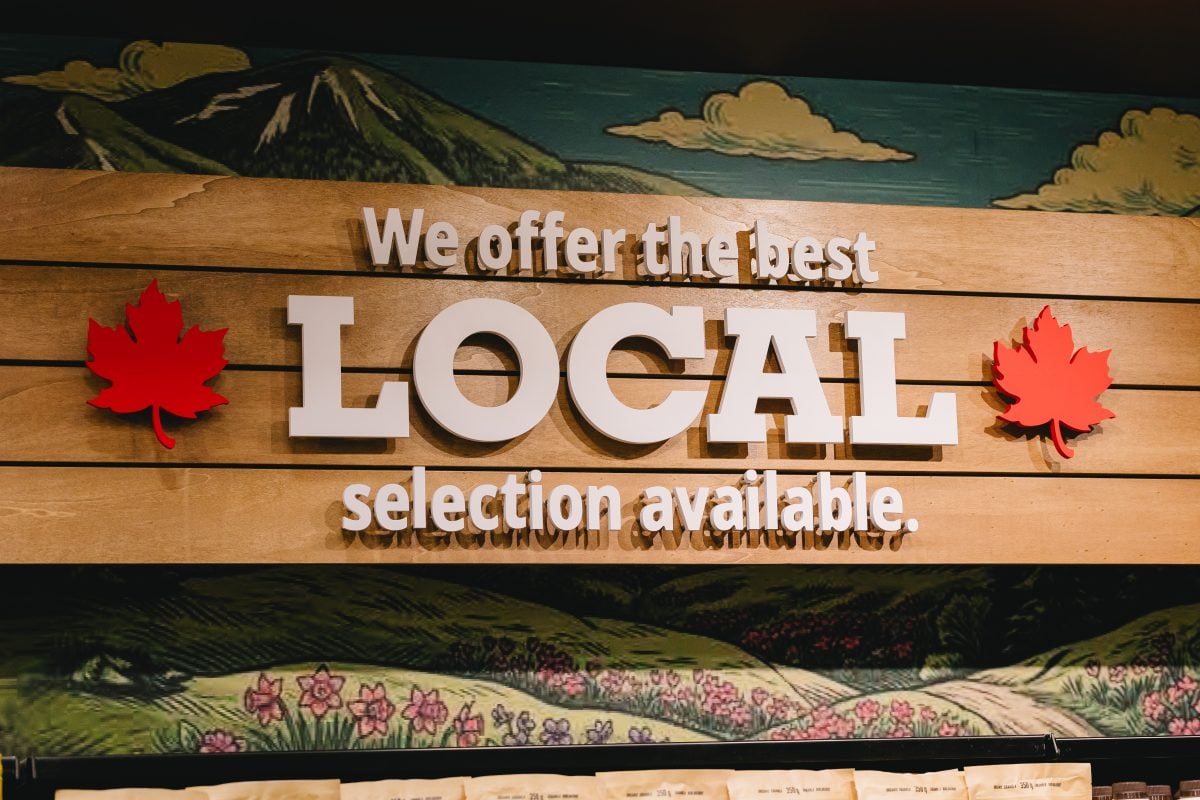
In a show of national patriotism, many Canadians pledging to keep their dollars at home by purchasing domestically grown and produced products. Retailers assisted by highlighting Canadian goods through special maple leaf and Canadian flag labels. However, research shows that price is still the main driver of Canadian food purchases.

A woman shopping with her son in a grocery store. Photo: Unsplash

Interest Rate Cuts

To boost economic activity, the Bank of Canada lowered interest rates approximately 75 points throughout 2025, with the latest cut in late October bringing the rate down to 2.5%. Lower rates allow food businesses to access more affordable loans, making expansion and acquisition easier.

Changes to Temporary Foreign Worker Program (TFWP)

The Canadian government has implemented a 10% cap on the number of workers in low-wage positions at a single work location. They have also announced plans to reduce the number of temporary residents from 7% to less than 5% of the population by 2027.

Beef Prices

The price of beef soared in 2025, with a 19% increase in the first quarter alone. This stabilized in later seasons, but prices were still up 23% from the five-year average.

Stuart Smyth
Stuart Smyth

“While all food prices will experience slight increases, meat and beef witnessed the largest increase,” said Dr. Stuart Smyth, Campus Lead, University of Saskatchewan. “Nearly a decade of drought in the leading beef producing area of Canada has resulted in the smallest number of cattle since the late 1980s. Reduced supply and consistent demand creates upward pressure. Canadian beef is high quality and consumers intending to keep buying it will need to be increasingly conscious of optimum purchasing opportunities.”
Food Manufacturing Under Threat

The food manufacturing industry employs over 300,000 people in Canada. In 2025, many large corporations, including Kraft-Heinz and Dr. Pepper Kellogg, restructured and downsized, laying off thousands of workers. The volume of food sold in Canada has reduced considerably and production costs have risen, leading to a 1.9% decrease in food manufacturing growth.

Stacey Taylor
Stacey Taylor

“Food inflation is putting Canadians under a lot of pressure, forcing people to make trade-offs every day. These trade-offs range from switching to a cheaper brand to delaying making purchases altogether,” said Dr. Stacey Taylor, Assistant Professor, Business Analytics, Cape Breton University. “Not only is there an issue with food security, but there is also a lot of concern over nutritional security and being able to afford a healthy diet.”

What can Canadians expect for 2026, according to the report?

  1. Inflation is likely to further decrease, settling around 2% and holding steady. Canadian GDP growth will continue to slow to approximately 1.2% to 1.4%.
  2. The US trade dispute is ongoing, although a recent rollback of tariffs on more than 200 agricultural and food products is a promising pivot.
  3. The TFWP reforms could lead to labour shortages, and the agricultural industry relies heavily on seasonal workers. This could increase costs for businesses already operating on tight margins, with those extra costs being passed onto customers.
  4. The One Canadian Economy Act passed in July 2025 should stimulate trade between provinces, reduce costs, encourage labour mobility, and strengthen domestic competition.
  5. The Grocery Code of Conduct becomes fully operational in January 2026. It remains to be seen if it will be effectively enforced. The top four grocery chains control at least 72% of the national market share.
  6. As of January 1st, 2026 it will be mandatory for all food that surpasses a pre-determined threshold for sodium, sugar, and saturated fat to include front-of-pack labelling. This will help consumers make better choices and could encourage product innovation. Also, Health Canada mandated that by December 31st, 2025 dairy milk must be fortified with nearly double its current amount of Vitamin D.
  7. Chicken prices are set to rise substantially in 2026. Customer demand for chicken has increased due to the higher cost of beef. Canada has strengthened beef import partnerships with Mexico and Australia. This should help stabilize prices, but the squeeze is expected to continue until at least 2027.
  8. Increasingly severe and unpredictable weather events around the globe will continue to disrupt agricultural production, creating supply challenges.

More from Retail Insider:

American Express and International Downtown Association Foundation honour 20 restaurants in Toronto and Montreal making a positive impact in local communities 

American Express and the International Downtown Association Foundation have announced the 20 grantees of the 2025 Backing International Small Restaurants program in Canada, an initiative that honours restaurants that have demonstrated a positive impact in their local communities. Globally, the initiative will award over US $1.4 million to 97 small and independently owned restaurants across 14 cities in the UK, Mexico, Australia, New Zealand, Japan, Canada, Spain, and France.

This year’s grantees are more than places to eat–they’re crossroads where communities connect through food, art, and shared experiences. Led by passionate and resilient owners, the grants will help modernize dining spaces, improve kitchen operations, and enhance digital tools, empowering them to grow, adapt, and thrive while fueling local economies and enriching the soul of their cities.

Nicaroma Café is one of the 2025 Canadian grantees. Located in the heart of Oakwood Village in Toronto, it’s a vibrant family-run spot serving Nicaraguan coffee, breakfast, quick bites, and desserts, and serving as a gathering space for the Latin American community. “With support from the Backing International Small Restaurants program, we’ll be able to upgrade our equipment and expand our operations, allowing us to welcome more guests while maintaining the heart and authenticity that define who we are,” said Rebecca Alberico, co-owner of Nicaroma Café.

Rutba is another 2025 Canadian grantee, based in Montreal. It blends authentic North Indian recipes with modern influences, while building a warm, inviting space for the city’s communities. With the grant, Rutba plans to make essential improvements, including interior renovations, upgraded kitchen tools, staff training, and a strengthened marketing presence to reach more of the community. “This grant will help us continue to share soulful Indian flavours with the city and strengthen the bridge we’re creating through our food, stories and community.”

Kerri-Ann Santaguida

“Small restaurants play an essential role in their local communities and their stories of resilience and passion inspire us every day,” said Kerri-Ann Santaguida, Vice President and General Manager of Merchant Services at Amex Canada. “Through the Backing International Small Restaurants grant program, we’re proud to support business owners who bring connections and vibrancy to their neighbourhoods.”

David Downey
David Downey

“As we celebrate the fourth year of the Backing International Small Restaurants program in Canada, we are continually inspired by the resilience and positive impact of the small, independent restaurants selected as this year’s grantees”, said David Downey, Executive Director, International Downtown Association Foundation. “These restaurants are the heart and soul of their neighbourhoods, and through the generous, sustained support of American Express, we are proud to help strengthen the fabric of local communities across Canada and the world.” 

This initiative complements American Express’s Backing Historic Small Restaurants program, which has provided over $8 million to 180 restaurants across all 50 U.S. states, D.C., Puerto Rico, and the Virgin Islands since its creation in 2021. Together, these programs have delivered over $11 million to support more than 410 small restaurants globally. American Express has long championed small businesses, launching Small Business Saturday 15 years ago and founding Shop Small, now a global movement across the UK, Japan, Australia, Canada, Mexico, France, Spain, New Zealand, and more, according to a news release.

Learn more about how American Express supports small businesses and communities: https://www.americanexpress.com/en-us/company/corporate-sustainability/community-impact/

Explore the 2025 grantees: https://downtown.org/backing-international-small-restaurants-grant-program/

2025 AMERICAN EXPRESS BACKING INTERNATIONAL SMALL RESTAURANTS GRANTEES IN CANADA:

  • 11:59 Bar:Cafe
  • Archway Verdun
  • AWIDELINE Cuisine & Pâtisserie
  • Bread and Butter
  • De Chou Korean Restaurant
  • HANBINGO
  • Henry VIII Ale House
  • Joanne’s Deli
  • Kawa Sushi
  • La Beignerie
  • Le Club Cafe
  • Lucile’s Caribbean Restaurant & Bar
  • Madras Curry
  • Mapo Gamjatang
  • Nicaroma Café
  • Rutba Indian Cuisine 
  • Sakebarkushi
  • Stout Irish Pub
  • The Diner’s Corner
  • Wychwood Pub

More from Retail Insider:

Canada creates 54,000 jobs in November, but retail trade declines: Statistics Canada

Photo: cottonbro studio

Employment increased by 54,000 (+0.3%) in November, driven by gains in part-time work. The employment rate rose 0.1 percentage points to 60.9%, while the unemployment rate fell 0.4 percentage points to 6.5%. Employment growth was concentrated among youth aged 15 to 24 (+50,000; +1.8%). There was little change in employment for core-aged people (25 to 54 years) and people aged 55 years and older, reported Statistics Canada on Friday.

In November, employment increased in health care and social assistance (+46,000; +1.6%), accommodation and food services (+14,000; +1.2%) and natural resources (+11,000; +3.4%). On the other hand, employment decreased in wholesale and retail trade (-34,000; -1.1%). Employment was up in Alberta (+29,000; +1.1%), New Brunswick (+5,500; +1.4%) and Manitoba (+4,500; +0.6%). Employment was little changed in the other provinces. Average hourly wages among employees increased 3.6% (+$1.27 to $37.00) on a year-over-year basis in November, following growth of 3.5% in October (not seasonally adjusted), said the federal agency.

“Employment rose by 54,000 (+0.3%) in November, the third consecutive monthly increase. Cumulative increases in September, October and November (+181,000; +0.9%) followed a slow start to the year, with little net employment change from January to August. The employment rate—the percentage of the population aged 15 years and older who are employed—increased by 0.1 percentage points to 60.9% in November, the third consecutive monthly increase. Compared with 12 months earlier, the employment rate was unchanged. The number of private sector employees rose by 52,000 (+0.4%) in November, while there was little change in the number of public sector employees and self-employed workers,” explained Statistics Canada.

Photo: Amina Filkins

It said employment growth in November was driven by a rise in part-time employment (+63,000; +1.6%). Over the past three months, part-time employment has increased at a faster rate (+2.7%; +103,000) than full-time employment (+0.5%; +78,000).

“The unemployment rate fell 0.4 percentage points to 6.5% in November, following a 0.2 percentage point decline in October. The unemployment rate had previously trended up through most of 2025, reaching 7.1% in September—the highest level since May 2016 (excluding 2020 and 2021 during the COVID-19 pandemic),” it said.

“There were 1.5 million unemployed people in November, a decrease of 80,000 (-5.1%) from the previous month.

“Among people who were unemployed in October, 19.6% had found work in November. This job finding rate was up slightly compared with the same months in 2024 (18.6%), indicating that job searchers were more likely to find work in November 2025 than a year earlier (not seasonally adjusted). In comparison, increases in the unemployment rate earlier in the year had been associated with lower job finding rates.”

The layoff rate in November (0.7%) was virtually unchanged compared with 12 months earlier (0.8%) and comparable to the average November layoff rate from 2017 to 2019 (0.8%) (not seasonally adjusted). This rate represents the proportion of people who were employed in October and had become unemployed in November as a result of a layoff. The layoff rate has varied little on a year-over-year basis throughout 2025, it said.

“The total number of people in the labour force edged down (-26,000; -0.1%) in November. The participation rate—the proportion of the population aged 15 and older who were employed or looking for work—fell by 0.2 percentage points to 65.1%.”

More from Retail Insider:

L’Oréal Canada CEO honoured with triple recognition

An Verhulst-Santos, President & CEO of L'Oréal Canada received the WXN Most Powerful CEO Award on November 27th. (CNW Group/L'Oréal Canada Inc. (Only Use For Wire))

An Verhulst-Santos, President and CEO of L’Oréal Canada, has received three esteemed recognitions, solidifying her position as a leading force for positive change, impactful leadership, and business excellence within Canada and globally.

These significant accolades include selection in the Meaningful Business 100 (MB100), recognition as an Impact Leader by the Réseau des Femmes d’Affaires du Québec, and the prestigious Canada’s Most Powerful CEO award from the WXN (Women’s Executive Network), said the company, adding that these honors underscore Verhulst-Santos’ unwavering commitment to purpose-driven leadership, fostering an inclusive environment, and steering L’Oréal Canada towards remarkable success and societal impact. 

Her vision and dedication have not only propelled the company forward but have also inspired countless individuals across various sectors, it said.

An Verhulst-Santos
An Verhulst-Santos

“These recognitions are truly humbling, and I accept them on behalf of the 1,750 employees at L’Oréal Canada,” said Verhulst-Santos. “They are a testament to our collective dedication to creating the beauty that moves the world, to our shared values, and to the relentless pursuit of excellence and positive impact in everything we do. It’s the passion and hard work of our teams that truly make these achievements possible, and I am incredibly proud to lead such inspiring teams.

“As the first woman President and CEO of L’Oréal Canada, I am proud of the diversity within our teams. I am strongly committed to creating an inclusive environment where everyone can thrive, innovate, and lead change.”

L’Oréal Canada is a subsidiary of the L’Oréal Groupe, the world’s leading beauty company. The Canadian subsidiary, established in 1958, includes a head office, plant and distribution centre in Montreal, a sales office in Toronto, and employs 1,750 people from 73 different nationalities. The products from its 39 iconic brands are available in all distribution channels, including hair salons, department stores, supermarkets, pharmacies, medi-spas and e-commerce.

The company said the inclusion of Verhulst-Santos in the Meaningful Business 100 (MB100), an elite global community of leaders combining profit and purpose, highlights her dedication to sustainable practices and responsible business. This recognition celebrates her strategic initiatives that prioritize environmental stewardship, social responsibility, and ethical governance, a mission she champions with her teams every day, thanks to L’Oréal brands’ social causes and the L’Oréal for the Future program, helping 110,000 Canadians each year.

“Evaluated by a panel of expert judges representing organizations like Google, Mastercard and the World Economic Forum, the winners were selected from over 900 nominations, across 86 countries and scored across five key areas: equity, impact, innovation, leadership and scalability. 

Tom Lytton-Dickie
Tom Lytton-Dickie

Commenting on the 2025 MB100, Tom Lytton-Dickie, Founder & CEO, Meaningful Business said: “Firstly, a big congratulations to An Verhulst-Santos, whose inspiring work at L’Oréal Canada demonstrates how combining profit and purpose can tackle complex social and environmental issues. The caliber of this year’s applications was exceptionally high, and we’re honored to have An join our global community.”

Verhulst-Santos was also celebrated as an Impact Leader at the Gala of the Réseau des Femmes d’Affaires du Québec. A true driving force, Verhulst-Santos leads a full ecosystem that generates 20,500 jobs in Canada and an economic contribution of $5.2 billion in the Canadian economy, explained the company. 

And Verhulst-Santos was honoured with the Canada’s Most Powerful CEO award from the WXN. The company said the esteemed award celebrates Canada’s most powerful women who have made significant contributions to Canadian society. It recognizes her exceptional strategic acumen, innovative spirit, and her ability to lead L’Oréal Canada to new heights, all while cultivating a vibrant and engaged workforce.

More from Retail Insider:

Telus Unveils Stranger Things Pop Ups in Canada

Stranger Things pop-up at Telus. Image: TELUS

As the final season of Stranger Things begins rolling out on Netflix, Telus is inviting fans into its own version of the Upside Down. In select stores across the country, the telecommunications company has introduced immersive displays that re-create scenes from the series, drawing on the show’s familiar 1980s atmosphere to promote its Stream+ bundle. The activation marks one of the more ambitious examples of experiential marketing to appear in Canadian telecom retail as the streaming landscape becomes increasingly competitive.

The first four episodes of the season are now available on Netflix, with another three scheduled to arrive on Christmas Day and a two-hour finale released on New Year’s Eve. Telus has timed the pop ups to track the staggered rollout, keeping the installations open until January 19. By placing the displays at high-traffic malls during the holiday rush, the company hopes to reach fans at a moment when interest in the franchise is at its peak.

Stranger Things pop-up signage at Telus, CF Toronto Eaton Centre. Image: TELUS

Immersive Displays in Four Canadian Cities

Each Telus Stranger Things pop up features a compact walk-through experience housed inside the carrier’s stores. The installations include a Demogorgon photo display and a set of bikes arranged to evoke memorable moments from the series. Visitors can pose with the props, share photos online and enter a national draw for a prize pack valued at $700. The items include a branded record player, a Hawkins Tigers bomber jacket and a themed holiday sweater, all designed to appeal to fans of the show.

The displays are located at CF Toronto Eaton Centre from December 3 to January 19, Calgary Southcentre Mall from December 5 to January 19, Quebec’s CF Fairview Pointe-Claire from December 4 to January 19 and Kelowna’s Orchard Park Mall from December 6 to January 19. While the installations are modest in scale, they offer a brief opportunity to step into Hawkins, creating a retail destination that aims to mix entertainment with product education.

During the visit, staff will explain how Stream+ works. The bundle includes Netflix, Disney+ and Amazon Prime Video and begins at $10 per month for ad-supported tiers or $25 per month for premium ad-free access. Telus has been promoting the package as a way to consolidate streaming costs, noting that the bundle offers significant savings compared to paying for each service individually.

Stranger Things pop-up at Telus. Image: TELUS

Entertainment and Telecom Interests Converge

For Netflix, the partnership enables a physical presence during a critical moment for one of its biggest global properties. The Stranger Things franchise has long incorporated experiential activations into its marketing campaigns, often drawing large audiences at retailers such as Target, Primark and Aldo. These installations serve as opportunities for fans to interact with props and environments that loosely mimic the show, sustaining conversation and social media activity between episode drops.

By collaborating with Telus, Netflix extends this strategy into Canadian telecom retail, a setting where customers are often reviewing subscriptions or making decisions about content platforms. The Telus Stranger Things pop up therefore functions as a cultural touchpoint inside a venue that is traditionally more associated with data plans and phone upgrades than themed displays.

The partnership also reflects a broader shift in how streaming services approach promotional opportunities. With many households reconsidering which platforms they subscribe to, Netflix gains visibility in an environment where consumers are already thinking about digital entertainment. The pop ups are positioned to catch attention from holiday shoppers as well as existing Telus customers who may not yet be familiar with Stream+.

More from Retail Insider:

The Sartorial Shop Partners With Mario Bemer in Vancouver

Anastasia Besiou and Zahir Rajani at The Sartorial Shop Atelier in Downtown Vancouver. Photo: The Sartorial Shop

The Sartorial Shop in downtown Vancouver has formalized a partnership with Italian-based bespoke shoemaker Mario Bemer, marking a significant expansion of its offerings and introducing one of Italy’s most respected makers to the Canadian market in an official capacity.

The collaboration began in November 2024, when Bemer became the first true Italian shoemaker to visit Canada for client work and trunk show appointments. Unlike the common industry model where global brands send representatives or apprentices abroad, Bemer’s work remains fully handcrafted by him in Florence. He produces approximately 200 pairs of shoes per year, selecting each piece of leather directly at the tannery and constructing every pair by hand.

Mario Bemer footwear. Photo: The Sartorial Shop

According to co-founder and CEO Zahir Rajani, the partnership emerged during planning for The Sartorial Shop’s first Negroni Night event, alongside Cappelleria Bertacchi. “We had hats with Bertacchi, we had bespoke tailoring with our offering, but we did not have high quality luxury footwear,” Rajani says. “Knowing Mario’s story and the quality of his work, I reached out, and the partnership came together within minutes.” Bemer and his wife Sandra subsequently travelled to Vancouver for the event, which also became Canada’s first Italian shoemaker trunk show.

The Sartorial Shop has since hosted a second trunk show and its second annual Negroni Night featuring Mario Bemer as chief guest. The collaboration allows Canadian clients direct access to two of Bemer’s lines: a made-to-order programme, which incorporates custom adjustments to the last and requires 90 to 120 days to complete, and a full bespoke programme, which requires multiple fittings over a five- to nine-month period.

According to Deep Market Insights, the global bespoke luxury garment market is valued at approximately USD 58.3 billion in 2024 and is projected to reach USD 89.7 billion by 2030. This growth positions bespoke apparel as one of the strongest segments within the broader luxury apparel category, which is expected to expand at a compound annual growth rate of approximately 7.6 percent from 2025 to 2030. Analysts attribute this trajectory to rising consumer demand for personalised fashion, increased awareness of craftsmanship, and technology that enhances fit precision and production capabilities. This industry context reinforces The Sartorial Shop’s decision to expand its offering and enter new categories such as bespoke footwear.

Co-founder Anastasia Besiou notes that the partnership aligns with the company’s broader expansion strategy as it prepares to introduce a bespoke womenswear collection in early 2026. The addition of Mario Bemer’s footwear supports the goal of offering a fully integrated sartorial experience and strengthens the business’s curated network of the world’s best international craft partners.

Bemer’s presence is notable in the global footwear industry. A founding member of Stefano Bemer, a company established in 1983 in Greve, Italy, he later launched Mario Bemer Firenze in 2014, operating under his own name from 2018 onward. His work has attracted a wide range of clients, including high-profile figures such as Daniel Day-Lewis, who apprenticed under him prior to filming Gangs of New York.

The Sartorial Shop’s partnership with Bemer complements several other developments underway at the business. Recent additions include Canadian-born actor Angelo Agalou as brand ambassador; the styling of the Sugarcane cast for the Oscars red carpet; the upcoming launch of a remote bespoke offering that will make services available globally; expanded manufacturing capabilities for boutiques worldwide; and the forthcoming womenswear collection overseen by Besiou.

These initiatives are designed to position the company for broader international reach while maintaining a controlled, high-touch service model rooted in bespoke craftsmanship.

About The Sartorial Shop

The Sartorial Shop, located in downtown Vancouver, is a by-appointment atelier specialising in custom and bespoke clothing for men and women. Founded by co-owners Zahir Rajani and Anastasia Besiou, the business has established a reputation for technical precision, incorporating more than 35 body measurements and detailed postural notes into each garment.

The company offers bespoke and semi-bespoke suiting, tuxedos, formalwear, overcoats, shirts, skirts, waistcoats, and vests. Fabric options include textiles from leading English and Italian mills such as Dormeuil, Holland & Sherry, Loro Piana, and Zegna.

Anastasia Besiou at The Sartorial Shop Atelier in Downtown Vancouver. Photo: The Sartorial Shop

The Sartorial Shop’s roots trace back to Tasleem’s, the Main Street clothing business founded by Rajani’s parents in 1984. A custom line of shirts and suits introduced in 2007 evolved into a referral-based model by 2010, marking Rajani’s entry into the tailoring sector. After a decade-long executive career in global real estate, he returned to bespoke tailoring in 2023, reopening the family business as Rajani Bespoke.

The company re-launched as The Sartorial Shop in August 2024 to align with its broader strategic direction, including expanded product categories and new international partnerships. The business continues to refine its process and scale its offering, supported by collaborations with premium fabric mills, manufacturing partners, and craft specialists such as Italian shoemaker Mario Bemer.

Today, The Sartorial Shop positions itself as an emerging leader in Canada’s bespoke clothing market, with plans to expand its atelier footprint, introduce remote bespoke capabilities, and further develop its womenswear and global manufacturing divisions.

The Sartorial Shop operates its by-appointment atelier at #706 – 602 West Hastings Street in Vancouver.

More from Retail Insider:

Peavey Mart Reopens in Alberta After Year of Turmoil

Image: Peavey Mart

The return of Peavey Mart is now official as the well-known Canadian farm and ranch retailer has reopened four Alberta stores following an unexpectedly turbulent year that saw the company close all of its locations nationwide. The comeback represents a significant turnaround for a brand that had long held deep roots across the Prairies, and customers this week have already been welcoming the reopening of familiar stores in Lacombe, Camrose, Spruce Grove, and Westlock.

The relaunch marks the first phase of a renewed strategy funded by a group of investors operating as 2707162 Alberta Ltd., which acquired the name and intellectual property earlier in the year. Positioned as a leaner, more focused business, the company is working to rebuild goodwill and reconnect with long-time rural customers who relied on the retailer for decades. With this initial wave of openings now complete, executives say the priority is to reintroduce stores with familiar assortments, dependable service, and a renewed emphasis on core categories related to life on the Prairies.

Four Alberta Stores Welcome Shoppers Once Again

Peavey Mart reopens in Alberta at a time when rural consumers have been seeking a return to the type of assortment, convenience, and community presence the retailer once offered. On Tuesday, December 2, customers walked through the doors of the Lacombe and Camrose locations for the first time since the nationwide shutdown. Two days later, on December 4, the Spruce Grove and Westlock stores began operating as well, officially marking the relaunch of Peavey Mart in Western Canada.

These stores represent a milestone for the ownership group, which has been rebuilding the chain with a more disciplined approach after the turbulence that led to its collapse earlier this year. The stores now operate under 2707162 Alberta Ltd., a privately funded investment group that stepped in to rescue the brand with plans to open between seven and twelve locations across Alberta and Saskatchewan.

Customers returning this week found shelves stocked with many of the brands they remembered, including Harvest Goodness, Rolling Acres, Scotts, Dickies, Pit Boss, and Shell. Executives noted that additional assortments will continue to roll out as supply stabilizes through the company’s developing distribution infrastructure.

A Comeback Rooted in Prairie Communities

The story of how Peavey Mart reopens in Alberta begins with its abrupt disappearance in early 2025. After more than fifty years serving Canadians, the retailer entered creditor protection under the Companies’ Creditors Arrangement Act due to rising operational pressures, softening consumer spending, and the escalating costs of running nearly one hundred stores across the country. The closure left many rural communities without a familiar source for agricultural, hardware, home, and homesteading products, and the loss resonated deeply with shoppers and employees across the Prairies.

By the spring, a new set of investors signaled interest in purchasing the intellectual property with a plan to rebuild the company around a smaller and more agile footprint. Their objective was to revive the brand while avoiding the heavy debt and expansive national reach that had burdened the previous iteration.

Doug Anderson, part of the leadership group guiding the relaunch, previously stressed the importance of bringing the retailer back in a way that honours its history and customer base. He said the team recognized the depth of loyalty the brand had accumulated since its founding in 1967 and felt a responsibility to restore its presence where demand remained strong.

A More Disciplined Expansion Strategy

The new ownership group has been clear that the relaunch will not mirror the company’s previous national aspirations. Instead, the model focuses on a more disciplined, regional strategy that prioritizes operational sustainability and financial stability. While the first phase consists of four Alberta stores, plans are underway to open additional locations in Red Deer, as well as Assiniboia and Yorkton in Saskatchewan, in spring 2026.

This next wave is expected to coincide with the ramping up of a new 40,000 square foot distribution facility in Red Deer County. The warehouse is designed to support the company’s store network more efficiently than before and will play a crucial role in ensuring reliable inventory flow and streamlined logistics. Recruitment for warehouse staff and store employees is already underway, with the company actively working to rebuild its operational capacity.

The decision to grow gradually reflects lessons learned from the collapse of Peavey Mart’s previous parent company, Peavey Industries LP. As pressures mounted from inflation, supply chain volatility, and the complexities of operating close to one hundred stores across multiple provinces, the business struggled to maintain footing. The new ownership group says it intends to avoid a similar fate by growing in incremental steps and ensuring each store operates with a clear path to profitability.

Returning to Core Customers and Core Values

As Peavey Mart reopens in Alberta, the leadership team has emphasized that the revived chain will return to its traditional focus on farmers, ranchers, acreage owners, homesteaders, and homeowners who live and work in regional and rural areas. Lead Merchant Kurt Schultz has long underscored the importance of concentrating on the needs that first shaped the brand nearly sixty years ago.

The revived assortment includes a mix of recognizable labels and new local offerings that reflect the entrepreneurial energy of Western Canada. The company plans to expand its private label products as well, which historically played a key role in the brand’s reputation for value and quality.

Schultz noted that agility will be central to the company’s culture as it moves forward. He described a collaborative approach that will encourage store teams, distribution staff, and office leadership to act quickly to meet customer needs and find efficiencies in day-to-day operations. That mindset, he said, will help Peavey Mart build lasting relationships with customers and suppliers while ensuring the business remains financially viable.

Industry observers have also noted that Peavey Mart reopens in Alberta at a unique moment for Canadian retail. Rural markets remain underserved in many categories, and the closure of the original chain earlier this year created a notable service gap. The absence of strong competitors in certain product areas may provide the revived Peavey Mart with room to reestablish itself while capitalizing on brand familiarity.

Peavey Mart’s history stretches back to 1967, when it began serving prairie residents with hardware, agricultural supplies, and household essentials. Over the decades the retailer became known for its broad assortment, approachable in-store experience, and consistent focus on the needs of rural and small-town customers. At its peak the chain was the largest farm and ranch retailer in Canada.

More from Retail Insider:

Canadian Retail News From Around The Web For December 5, 2025

Canadian Retail News From Around The Web

News at a Glance

Retail Insider is streamlining its Canadian retail news from around the web to include a handful of top news stories that can be viewed quickly during the day. Here are the top stories from the past 24 hours.

Food prices could increase in 2026, with meat leading the way, say Dalhousie researchers (CBC)

Sleep Country Canada charting revival of Bed Bath & Beyond next year (Canadian Press)

Bryzgalski painting of snowshoers in striped coats star of HBC’s first online auction (CP24)

Aritzia founder calls for Ottawa to scrap duty-free imports to help Canadian retailers compete at home (Financial Post)

Toys “R” Us Canada is closing 50 stores, including multiple locations in Ontario (Inside Halton)

Telus Stores Are Turning into ‘Stranger Things’ Pop Ups: Here’s Where (iPhone in Canada)

Owner of Bathtub Bikes celebrates new business sign after five-year wait (Calgary Herald)

How shopping local boosts Revelstoke businesses at a critical time (Revelstoke Review)

Treat yourself: Brio, Duchess bakeries benefitting from rising Edmonton industry (CTV)

Pattison Food Group unveils Vancouver’s first wine department in a grocery store in Save-On-Foods (Grocery Business)

Manitoba to sell shelved U.S. booze with revenue going to holiday charities: premier (CBC)

Dickey’s Barbecue Pit Expands With New Airdrie, Alberta Store (Restaurant News)

Sechelt coffee shop employees scared to go to work after front door set on fire (CBC)

Apple Names Former Meta Legal Chief Jennifer Newstead as Next General Counsel in Executive Shakeup

Apple Watch Ultra 3. Photo: Apple.

Apple is reshaping its senior leadership team, announcing that Jennifer Newstead will join the company as a senior vice president in January and become general counsel on March 1, 2026, following a transition from long-time legal chief Kate Adams.

Adams, who has served as Apple’s general counsel since 2017, will remain with the company through a transition period and is expected to retire late next year, Apple said.

The changes also include the retirement of Lisa Jackson, Apple’s vice president for Environment, Policy, and Social Initiatives, who will step down in late January 2026.

For Canadian business leaders, regulators, and consumer-facing retailers, the leadership moves signal a renewed focus on legal, regulatory, and policy execution at a time when Apple faces rising scrutiny globally—spanning privacy, competition policy, app distribution rules, and environmental compliance frameworks that affect product strategy and market access.

Apple said Newstead will assume oversight of both its Legal and Government Affairs operations, reflecting what the company described as increasing overlap between the two functions.

Following her March 2026 appointment, her title will become senior vice president, General Counsel and Government Affairs.

In the interim, Apple’s Government Affairs organization will transition to Adams, who will oversee the team until her retirement late next year. After that, leadership of Government Affairs will move to Newstead.

The reorganization consolidates two of Apple’s most strategically sensitive areas—legal defence and lobbying/policy engagement—under one executive, signalling a governance model designed to move faster amid growing regulatory complexity across major markets, including Canada.

Lisa Jackson’s Team to Report to Apple COO Sabih Khan

Apple said Jackson’s retirement will prompt further shifts inside the company, with the Environment and Social Initiatives teams now reporting to Sabih Khan, Apple’s chief operating officer.

Jackson has been one of Apple’s most public-facing executives on sustainability and social initiatives, often linked to the company’s climate targets, supply chain policies, and government engagement on topics such as energy transition and environmental regulation.

Cook credited Jackson with helping Apple reduce global greenhouse gas emissions by more than 60% compared to 2015 levels, and described her role as central to Apple’s international engagement with governments on issues affecting users.

Tim Cook Praises Adams’ Privacy and Innovation Focus

In announcing Adams’ transition and upcoming retirement, Apple CEO Tim Cook positioned the outgoing general counsel as a key figure in defending Apple’s privacy posture and its freedom to innovate through litigation and regulatory disputes.

Cook said Adams provided critical advice and was a consistent advocate for customer privacy—a longstanding Apple message that has become increasingly central as AI features, app ecosystems, and regulatory oversight converge.

In Canada, those themes remain highly relevant as policymakers continue to evaluate digital privacy rules, platform accountability, and competitive dynamics within mobile ecosystems.

Newstead Brings Deep Government and Big Tech Credentials

Newstead joins Apple from Meta, where she served most recently as chief legal officer. Apple is also emphasizing her prior U.S. government experience, including serving as legal adviser at the U.S. Department of State.

Earlier in her career, she held senior roles across the U.S. federal government and served as a partner at Davis Polk & Wardwell, advising global corporations on complex legal and regulatory matters.

The hire signals Apple’s preference for legal leadership that can operate across both corporate and geopolitical contexts—an increasingly critical skill set as technology regulation becomes more interconnected across jurisdictions.

Why the Leadership Changes Matter for Canada

Although Apple’s announcement focuses on executive appointments, the implications extend beyond corporate structure. Apple’s legal and government affairs functions are increasingly intertwined with market realities facing Canadian consumers and businesses, including:

  • evolving rules around app marketplace governance and platform fees
  • data protection and privacy compliance expectations
  • sustainability mandates and supply chain reporting requirements
  • cross-border digital services oversight, including taxation and competition policy

By consolidating Legal and Government Affairs under one future leader while moving environmental and social initiatives closer to core operations, Apple is signalling a more integrated approach to managing external risk—particularly as regulatory enforcement and political pressure rise globally.

Newstead’s appointment, alongside Adams’ planned retirement and Jackson’s exit, marks a significant transition in Apple’s senior leadership bench at a time when legal and policy outcomes increasingly shape how major technology companies can operate, innovate, and distribute products worldwide.